







Cycling of Ideas
2
Managing Partner
Phenomena Communications
3
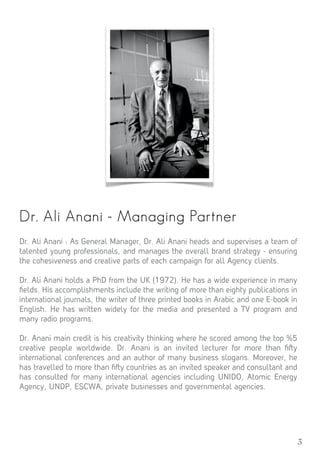
Dr. Ali Anani - Managing Partner
Dr. Ali Anani : As General Manager, Dr. Ali Anani heads and supervises a team of
talented young professionals, and manages the overall brand strategy - ensuring
the cohesiveness and creative parts of each campaign for all Agency clients.
Dr. Ali Anani holds a PhD from the UK (1972). He has a wide experience in many
fields. His accomplishments include the writing of more than eighty publications in
international journals, the writer of three printed books in Arabic and one E-book in
English. He has written widely for the media and presented a TV program and
many radio programs.
Dr. Anani main credit is his creativity thinking where he scored among the top %5
creative people worldwide. Dr. Anani is an invited lecturer for more than fi y
international conferences and an author of many business slogans. Moreover, he
has travelled to more than fi y countries as an invited speaker and consultant and
has consulted for many international agencies including UNIDO, Atomic Energy
Agency, UNDP, ESCWA, private businesses and governmental agencies.
4
index
We Plan and Destiny Laughs
The Emerging Rethinking
Is Social Media Waste of Time?
The present is a temporary filling
If that simple, why do we fail to understand them?
Living Stories on the Observing Effect
The Habits of Humans, Minerals and Plants
Are Tears the New Fingerprints?
Polished Perspectives on Motivation
Names in My Life- Sara (h)
Triads Are Everywhere
Going against Nature
Glassy Ideas and Opinions
Love is to Grow Less
Disruption of Thinking
Two Illuminating Stories
Costly Assumptions
Bees and Beer
The Change and Adaptation Gap
The Fractal Change
The Curly Hair of Change
Soapy Human Behaviors
Pungent, but Real Stories
Creative Reflections
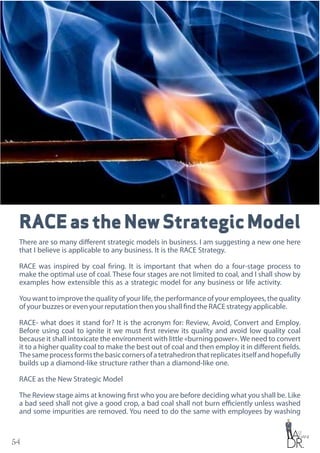
RACE as the New Strategic Model
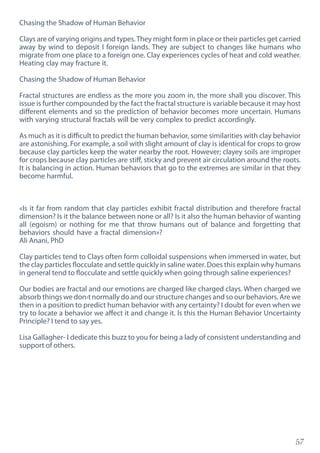
Chasing the Shadow of Human Behavior
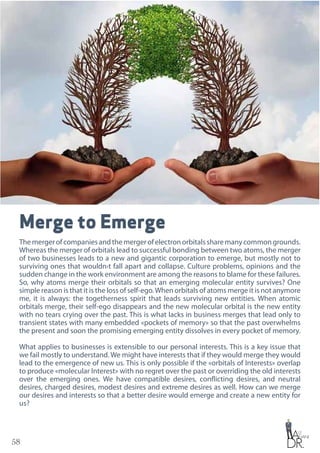
Merge to Emerge
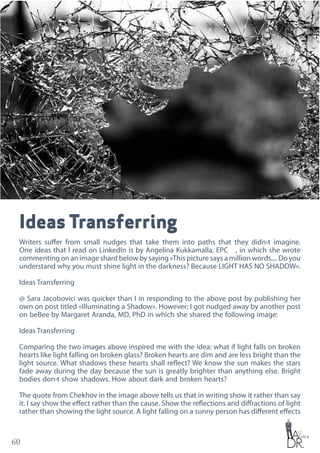
Ideas Transferring
New Metaphors on Employee Selection
Sounds there is a treasure beneath
Distraction as a Powerful Tool
Living the Pollination of an Idea
Predicaments as Driving Forces
Minds in the laundry, or Mente en la lavandería
Joy Dancing for Me
The Seedless Love
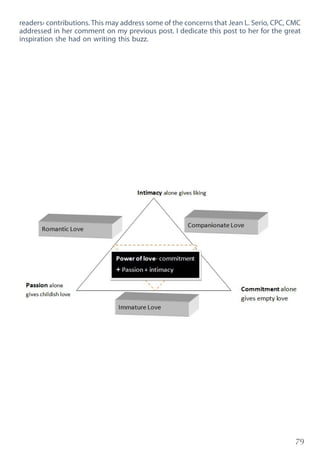
I Love You- What Does it Mean?
What Truly Roots Customers?
«Being in the Middle» Dilemma
To know or not to know
BeBee Hives Provide Unique Opportunities for
Businesses
Who Should Make the First Move?
The Integration of Two Spanish Experiences
A Metaphor for Ideas Testing
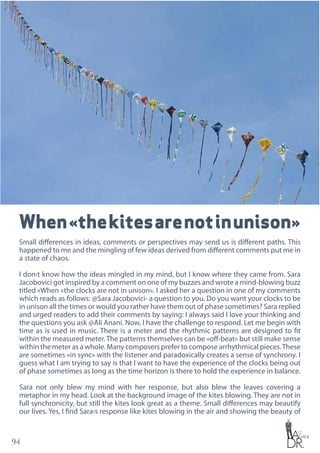
When «the kites are not in unison»
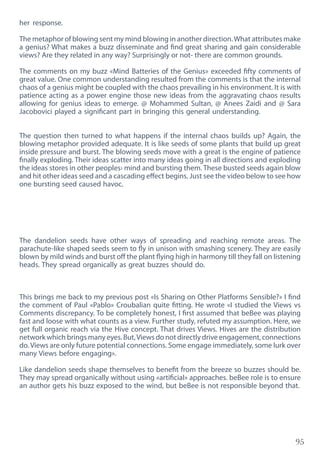
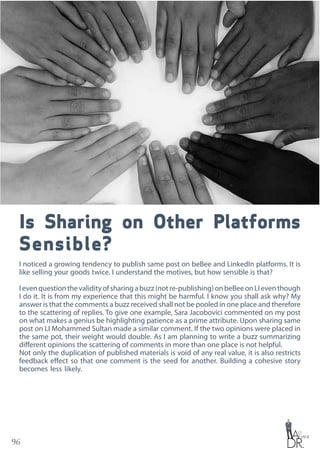
Is Sharing on Other Platforms Sensible?
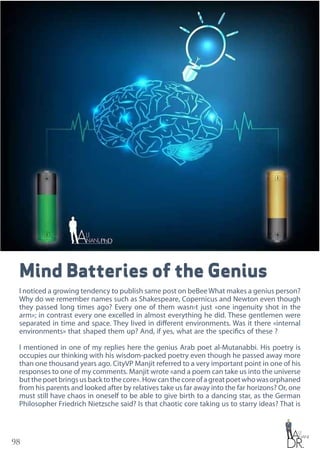
Mind Batteries of the Genius
Business Ideas from Bees
Places not for them
Suggestions to improve beBee
The Paradox of Fractal Repetition
6
8
10
12
14
16
18
20
22
24
26
28
30
32
34
36
38
40
42
44
46
48
50
52
54
56
58
60
62
64
66
68
70
72
74
76
78
80
82
84
86
88
90
92
94
96
98
100
102
104
106
108
5
6
We Plan and Destiny Laughs
I keep asking myself if planning has a real value! We humans are complex systems and our
behaviors are complex too.The feedback mechanisms in our bodies are frequent and result
in simple deterministic rules to turn into chaos. We are complex emotions and once we
energize one emotion it can send us into paths that we haven›t anticipated.The uncertainty
Principle prevails. I feel we are like an electron if we try to locate its positions we change it
because we energize it. In strategy, we say know where your position is to know where to
go. But once we try to know our position we change it. Are we then chasing a shadow?
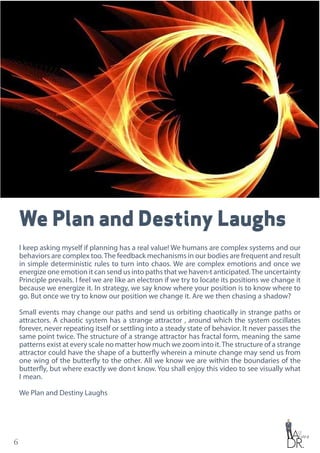
Small events may change our paths and send us orbiting chaotically in strange paths or
attractors. A chaotic system has a strange attractor , around which the system oscillates
forever, never repeating itself or settling into a steady state of behavior. It never passes the
same point twice. The structure of a strange attractor has fractal form, meaning the same
patterns exist at every scale no matter how much we zoom into it.The structure of a strange
attractor could have the shape of a butterfly wherein a minute change may send us from
one wing of the butterfly to the other. All we know we are within the boundaries of the
butterfly, but where exactly we don›t know. You shall enjoy this video to see visually what
I mean.
We Plan and Destiny Laughs
7
Let me explain more by real examples. I read recently the story of a football player who was
driving his car in a heavy traffic to sign a contract with a new club of his choice.While driving,
he received a phone call from Norwich Football Club (my favorite club being graduate of
the University of East Anglia) offering him a contract. The player accepted the offer and
changed his career path by driving to Norwich. All his planning changed because of the
annoying heavy traffic.
I was flying back home from an Arab country in which I was invited for an interview. A
businessman sat next to me on the plane. Soon we greeted each other and began talking.
He asked me few questions and then mentioned that he was facing a challenging problem
inhisindustrialplant.Theconversationendedinmeofferingsimplesolutions.Uponlanding
and unable to refuse his invitation I ended changing my path accompanying the man to
visit his plant. That day I signed a contract with him for two years which changed my career
path. All my planning for the interview ended in doing what I have never planned for.
Mybrotherwasoutstandinginmath.Hehadabrilliantmindforit.Heusedtosolveproblems
aimed for the tenth grade when he was in the sixth grade. Everybody expected him to be a
successful engineer. One day he heard my other saying to my father that she wished one of
her sons would be a medical doctor. My brother is now a famous MD. He changed his career
path to please my mother even though she never planned for it or even knew till years later
why my brother decided to change his study.
My eldest brother was a smoker. He wanted to quit so frequently that even before he had
finished his intention he lit a new cigarette. His youngest son told him one day that if you
would care for me you wouldn›t smoke.You don›t only hurt yourself, but also hurt my future.
Since that day my brother became the most anti-smoking person you would meet.
Our lives seem to go orbiting around strange things that have the structure of a strange
attractor. No matter how much we plan, destiny has its final word.
Do you agree?
8
The Emerging Rethinking
A comment may send us into new and/or re-energizing paths. A comment by the great
thinker David Navarro López on my buzz on «Living Stories on the Observing Effect» did
just that to me. In his second comment David wrote « Thank you for your nice words, but I
am just a normal person who tries to know more, learning from the bests.
In my understanding, no doubt the feelings is «the engine». But beliefs is «the gasoline» you
feed it with. If one works on discarding negative perceptions/knowledge, will have a much
«bettergasoline».
Let us take as example your «reaction» to my post.
I could take your words in negative aim. You are a very cultivated man, full of success, a
living example of a human being. So these words coming from you, knowing that I come
from a much more humble condition, could seem to me sarcastic.
Thus I could think about your question «do feelings precede to beliefs...?» is trying to make
laugh about me. Or with your words «your perspective… is different from all others..» I
could take it as if I am not in the line/should not be commenting here. But my perception
ever since I first read your lines, is that you are a great human being, I acknowledged it, and
i firmly belief that even if you heavily criticize me, my feelings would be of gratefulness, as
a normal reaction of my feelings due to the perception I have from you.
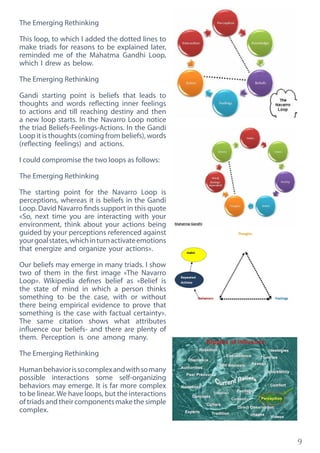
Perception-knowledge-beliefs-feelings-action-interaction-perception......I like the name of
Navarro loop.
I drew The Navarro Loop because when we draw new observations may appear.
9
The Emerging Rethinking
This loop, to which I added the dotted lines to
make triads for reasons to be explained later,
reminded me of the Mahatma Gandhi Loop,
which I drew as below.
The Emerging Rethinking
Gandi starting point is beliefs that leads to
thoughts and words reflecting inner feelings
to actions and till reaching destiny and then
a new loop starts. In the Navarro Loop notice
the triad Beliefs-Feelings-Actions. In the Gandi
Loop it is thoughts (coming from beliefs), words
(reflecting feelings) and actions.
I could compromise the two loops as follows:
The Emerging Rethinking
The starting point for the Navarro Loop is
perceptions, whereas it is beliefs in the Gandi
Loop. David Navarro finds support in this quote
«So, next time you are interacting with your
environment, think about your actions being
guided by your perceptions referenced against
yourgoalstates,whichinturnactivateemotions
that energize and organize your actions».
Our beliefs may emerge in many triads. I show
two of them in the first image «The Navarro
Loop». Wikipedia defines belief as «Belief is
the state of mind in which a person thinks
something to be the case, with or without
there being empirical evidence to prove that
something is the case with factual certainty».
The same citation shows what attributes
influence our beliefs- and there are plenty of
them. Perception is one among many.
The Emerging Rethinking
Humanbehaviorissocomplexandwithsomany
possible interactions some self-organizing
behaviors may emerge. It is far more complex
to be linear. We have loops, but the interactions
oftriadsandtheircomponentsmakethesimple
complex.
10
IsSocialMediaWasteofTime?
There are many people who believe social media is waste of time. For example, this post
«Top 10 Reasons Why Social Networking is a Waste of Time?» gives ten reasons why social
media is waste of time. Among the reasons given is that social media is too big to manage,
privacy intruder, fake identity, bullying and scam and its bad effects on study, work and
health.
Critics such as Sherry Turkle advocate the idea that society at large is growing “alone
together” in the face of the rapidly-changing technology at our fingertips. Businesses are
losing precious times because of workers spend considerable times socializing in activities
not related to their work. Businesses mostly find the dividends of social media are hardly
noticed.Focusislostasworkersmaybebusywithvaryingissuesatthesametime.Credibility
of recommendations are declining as the attitude of «recommend me and I recommend
you back» is growing. Large scale campaigns on illusionary and faked issues.
The commonsense says that we should go where the customer is. I say we should go where
the customer spends his time. The customer isn›t necessarily a business one; he/she could
be a reader of this buzz. Let us accept facts whether on social media or not only %10 of
readers or business customers are pioneers or early adopters. We need others to cross the
chasm to follow and the late laggards are already too late. This human behavior may be
11
noticeable on social media and this offers the opportunity where to direct efforts.
We need to ask ourselves why we get involved in social media. It could be finding romance,
detecting trends, socializing, meeting people from different parts of the world, finding a job,
recommendations on hotels and resort, selling and many other possibilities. On a personal
level I find social media a prime source of identifying thinkers and to exchange my thoughts
with them, brainstorming new ideas, receiving feedback and hoping for creative ideas to
emerge. On a business level, I need social media to increase the awareness of potential
candidates of my clients› business. I may measure the success and take corrective steps
accordingly. I have made excellent connections that helped me grow. I didn›t make a penny
out of social media because this wasn›t my goal to start with. I had my bad experiences
such as getting invited to a global conference that never happened. However; in life we
don›t get anything for nothing and to reap delights one must be ready to accept few pains.
Is Social Media Waste of Time?
Building connections requires mutual trust. Building trust isn›t easy. It takes more effort
when the relationship isn›t physical.This is one of the basic challenges of social media.Trust
and expectations might work in opposite directions and this is one of the new challenges I
facepersonally.Avirtualfriendasksmetocommentononeofhisposts.Hisexpectationsare
that I shall endorse his post and share it. If I don›t comment because I find the post irrelevant
or misleading the author would think that I am ignoring him. If I write a moderate and not
even very critical review, he would think that I am acting and his trust in me dwindles. I
even wrote to few supposedly friends with some critical views and this resulting in never
hearing from them again. I find social media role as a sieving media is important. It sieves
away people who only expect praise. This is not the way to learn and grow.
Is Social Media Waste of Time?
Wehaddifferentexperiencesonsocialmedia.Someauthorsmigratedfromotherplatforms.
Few other authors abandoned social media as they found it «a complete wastage of time». I
invite you to share your experience whether you find it rewarding to spend hours on social
media.
12
Thepresentisatemporaryfilling
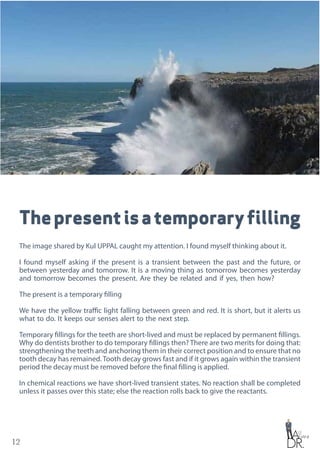
The image shared by Kul UPPAL caught my attention. I found myself thinking about it.
I found myself asking if the present is a transient between the past and the future, or
between yesterday and tomorrow. It is a moving thing as tomorrow becomes yesterday
and tomorrow becomes the present. Are they be related and if yes, then how?
The present is a temporary filling
We have the yellow traffic light falling between green and red. It is short, but it alerts us
what to do. It keeps our senses alert to the next step.
Temporary fillings for the teeth are short-lived and must be replaced by permanent fillings.
Why do dentists brother to do temporary fillings then? There are two merits for doing that:
strengthening the teeth and anchoring them in their correct position and to ensure that no
tooth decay has remained.Tooth decay grows fast and if it grows again within the transient
period the decay must be removed before the final filling is applied.
In chemical reactions we have short-lived transient states. No reaction shall be completed
unless it passes over this state; else the reaction rolls back to give the reactants.
13
Politicians call for temporary and calming periods among fighting parties so that a solution
maybearrivedat.Moreoftenthannot,theseeffortsrollbacktotheinitialchaos.Antagonism
wins and as a result fiercer fighting initiates.
A temporary or transient solution must be short in duration; prolonging it makes it worse.
No temporary filling is welcome and no lasting today is a reward. Transient periods are like
transient fillings- they have functions to accomplish with a short period of time.
Yes, live the day and accomplish what must be accomplished within the day. Time waits for
nobody and procrastinating on doing what must be done is a sure thing to make things
advance, but to the rear.
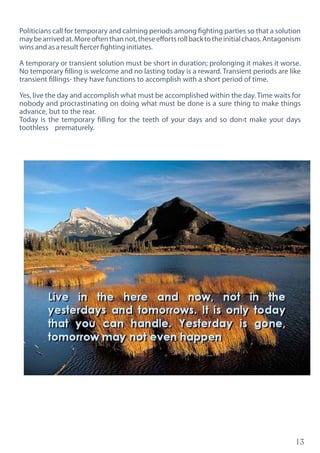
Today is the temporary filling for the teeth of your days and so don›t make your days
toothless prematurely.
14
If that simple, why do we fail to
understand them?
There are simple facts and are so simple that we bypass them. To give one example,
trees that are fractals being self-similar on all scales have been there for long times, and
we overlooked the fact that their shapes are not traditional ones. Only in recent years
Mandelbrot introduced the term fractals to describe trees and many other fractals in nature.
Human may lead themselves astray.
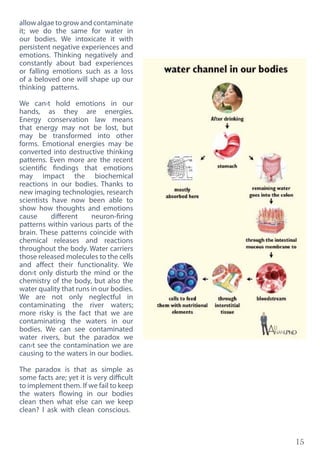
There is simple fact- water running in our bodies. Water constitutes %70-%60 of the adult
human. It has its flow channel in our bodies. Water serves critical functions in our bodies.
It is an important constituent of cells and is necessary for cells to function properly. Water
transfers nutrients and removes wastes. It enters in the metabolic reactions of our bodies.
Water regulates our body temperature. As much as these functions are vital to our survival;
yet many of us fail to drink enough water. Simple facts and simple actions and still we fail to
implement them. I appreciate helping me in understanding it.
If that simple, why do we fail to understand them?
Water flow is dependent on the volume of water. If water quantity drops in our bodies we
expose ourselves to great risks. Like a river, we may contaminate it with toxic chemicals, or
15
allowalgaetogrowandcontaminate
it; we do the same for water in
our bodies. We intoxicate it with
persistent negative experiences and
emotions. Thinking negatively and
constantly about bad experiences
or falling emotions such as a loss
of a beloved one will shape up our
thinking patterns.
We can›t hold emotions in our
hands, as they are energies.
Energy conservation law means
that energy may not be lost, but
may be transformed into other
forms. Emotional energies may be
converted into destructive thinking
patterns. Even more are the recent
scientific findings that emotions
may impact the biochemical
reactions in our bodies. Thanks to
new imaging technologies, research
scientists have now been able to
show how thoughts and emotions
cause different neuron-firing
patterns within various parts of the
brain. These patterns coincide with
chemical releases and reactions
throughout the body. Water carriers
those released molecules to the cells
and affect their functionality. We
don›t only disturb the mind or the
chemistry of the body, but also the
water quality that runs in our bodies.
We are not only neglectful in
contaminating the river waters;
more risky is the fact that we are
contaminating the waters in our
bodies. We can see contaminated
water rivers, but the paradox we
can›t see the contamination we are
causing to the waters in our bodies.
The paradox is that as simple as
some facts are; yet it is very difficult
to implement them. If we fail to keep
the waters flowing in our bodies
clean then what else can we keep
clean? I ask with clean conscious.
16
Living Stories on the Observing
Effect
Humans are like plants as both are affected by the environment. If we place employees in
a family-like environment their behaviors shall be different from placing them in a hostile
environment. The environment affects the individual who in turn affects others. Soon, a
polarization effect may appear on a debated issue. I wish to share two stories to explain the
effect of observation on the behavior of individuals and groups. These are two stories that
I witnessed and they are quite telling.
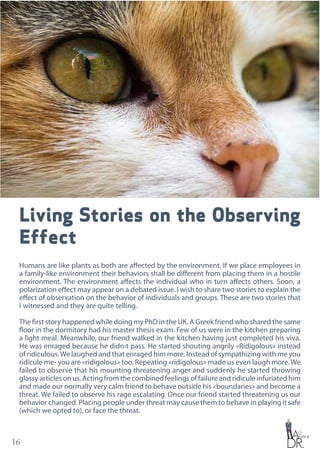
The first story happened while doing my PhD in the UK. A Greek friend who shared the same
floor in the dormitory had his master thesis exam. Few of us were in the kitchen preparing
a light meal. Meanwhile, our friend walked in the kitchen having just completed his viva.
He was enraged because he didn›t pass. He started shouting angrily «Ridigolous» instead
of ridiculous.We laughed and that enraged him more. Instead of sympathizing with me you
ridicule me- you are «ridigolous» too. Repeating «ridigolous» made us even laugh more.We
failed to observe that his mounting threatening anger and suddenly he started throwing
glassy articles on us. Acting from the combined feelings of failure and ridicule infuriated him
and made our normally very calm friend to behave outside his «boundaries» and become a
threat. We failed to observe his rage escalating. Once our friend started threatening us our
behavior changed. Placing people under threat may cause them to behave in playing it safe
(which we opted to), or face the threat.
17
The second story is related to an MD who was newly appointed in another country. In that
country senior official was fond of horses and it happened that his most beloved horse
got very sick. There was no veterinary doctor around. So, the owner of the hors consulted
with an MD. The MD observing the love of the official for his horse and mixed with the fear
the horse might die and this would threaten him reacted by saying «I am not a veterinary
doctor» There were few MDs in that small city> SO, the official invited all of them and he
received the same response.The MDs polarized to the same response. Finally, it was brought
to the attention of the official that a new MD arrived (who is till today a friend of mine). The
new MD knew that he would be scorned like other MDs if he responded similarly. So, when
the official met with him he had a different response by accepting to treat the horse. The
new MD idea was focused on finding a neutral treatment- something that can be given to
horses and humans. He thought of multivitamin injection. He tried and in less than two
hours the horse was on its feet running. The official rewarded him with a huge bonus.
Living Stories on the Observing Effect
These two stories show us how observing others may affect our decisions and behaviors.
What prompted me to share this buzz is an article titled « Others› Anger Makes PeopleWork
Harder Not Smarter: The Effect of Observing Anger and Sarcasm on Creative and Analytic
Thinking».In this article the authors find that The authors examine whether and how
observing anger influences thinking processes and problem-solving ability. In 3 studies, the
authors show that participants who listened to an angry customer were more successful in
solving analytic problems, but less successful in solving creative problems compared with
participantswholistenedtoanemotionallyneutralcustomer.InStudies2and3,theauthors
further show that observing anger communicated through sarcasm enhances complex
thinking and solving of creative problems. My two stories provide further illumination on
the effect of increasing social exposure in an environment wherein negative feelings may
prevail (first story) and turning negative exposure to a positive one (second story).
We need to observe what feelings our actions generate into others. These observations
have drastic effects on our lives.
18
The Habits of Humans, Minerals
and Plants
Marketing to people›s habits is a thriving field. It is not my intention to repeat what I wrote
before or even extend one idea. My intention here is to relate the human habits with plants
and minerals habit and find out the common threads among this triad.
As I was in the process of writing the draft of this buzz, Irene Hackett wrote a great buzz on
«Drowning in the Pursuit of Happiness». This is a heart-moving buzz. Irene responded to
one of my comments by writing «The sadness you may have experienced from reading this
is a normal reaction; and yet it is in the sadness where humans connect at a deeper level».
This response moved me so much and changed the course of the flow of ideas in my mind.
Are we like diamond form very deep in the earth and wait for volcanic eruption to send
us to the surface? Do we need to sink deep in our sorrows and pressure so that we may
transform into diamond-like humans? Diamond has very unique habits such as having the
highest melting point mineral, the highest refractive index mineral and is transparent over
the greatest number of wavelengths. What has transformed charcoal or graphite to such
a high value mineral is its exposure to harsh conditions. Crystals of diamond often have
curved faces, and in some cases they can be almost round. One crystal habit is ball-shaped
agglomerates of radiating diamond crystals forms. Even the same crystal, it may shape up
in different forms. It is like the spirit of Irene that is radiating with such great thoughts. Not
19
all transformations are equal.
People are like minerals. Some people have the habits of diamonds and other the habits of
muchlessvaluableminerals.Apparently,transformationiscostlyandwehavetoexperience
difficult situations deeply to transform us and that once our inner volcanoes erupt we come
to the surface to be «collected» by others.
Like radiating selves and radiating diamond, there are also radiating plants. We may
expose plants to radiation. The flavor in your chewing gum and toothpaste, and the red-
ruby grapefruit on your plate, is the result of mutation caused by deliberate irradiation.
We may be exposed to the radiation coming out from the experiences of others and
transform into useful human beings. The sharing of experiences is one way of achieving
that. Telling personal stories, as Irene did, is a way of exposing us to radiations to change
to our betterment. It is not uncommon for one species of plant to exhibit growth habits
among its different varieties. I believe the same extends to us and we produce different
human varieties when we grow under slightly different conditions. Our growth experiences
the Butterfly Effect wherein small changes may create different us.
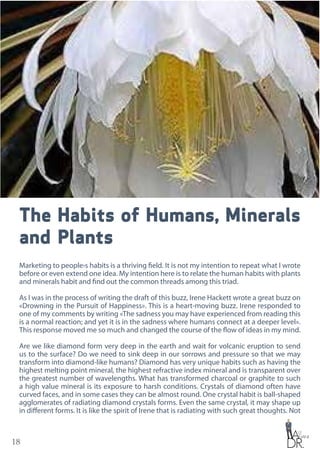
Salt and granite minerals make domes. Plants make domes. Human build domes. Flowers
make domes as this one (the background image), which @Joanne Swecker has kindly
permitted me to re-use.We need to transform into domes of light so that we may enlighten
the path of others who experience rough condition underneath the soil of their sorrow,
sadness, suffering and pressure. Let us transform to domes of others to complete their
transformations.Thebleedingfromtheheart-bleedingplantmightbeourwaytotransform.
The Habits of Humans, Minerals and Plants
I dedicate this buzz with a transformed heart to the wonderful lady with her diamond-like
habits. I dedicate it to Irene Hackett and to the memory of her mother who gave birth to
such a grateful and blessed daughter.
20
Are Tears the New Fingerprints?
I find it fascinating the new facts about tears. They unfold new realties and next time you
cry have a new attitude to the tears you shed. New scientific findings disrupt our beliefs,
and I dare say even well-established scientific Laws such as Newton›s Law for every action
there is an action. I say the reaction is specific to the action and state we are in. It is not a
general one. Equally important is that these findings disrupt our attitudes to crying.
Theadaptabilityofthehumanbodyinspiteofitscomplexityisamazing.Stressinourbodies
generates volatiles that mix with the exhaled air when we breathe. From this breath we may
detect harmful chemicals and the breath is used in hospitals now to check our healthiness.
It was a great question by Rose-Lynn Fisher if tears are all the same. There are tears by
onion. These tears are not generated because of internal emotions such as tears of sadness
or tears of joy.They are not basal tears that help our eyes to stay lubricated.The tears are the
reaction of different actions. We call them tears, but are they equivalent?
Taking a tear on a slide and drying it will leave behind the chemicals that are in tears.
Surprisingly, not all tears are the same. They mirror the actions that caused them. These
chemicals impact the flow of tears. Inspecting the flows of different tears showed that they
vary and have their own «flow patterns». Tears caused from onion are different from tears
caused by stress leading us to cry. In the latter case tears contain stress chemicals the body
releases to tranquilize us. Tears are thus the fingerprints of our states because they have
21
distinct patterns and chemical composition.
These findings also reveal the need to let our emotions flow and force them not to flow out.
We need to express our emotions and if we imprison our tears we also prison chemicals that
our bodies want to get rid of. That men shouldn›t cry is a distorted and even intoxicating
belief. Next time your child cries may be he is doing the right thing and by asking him not
to cry we are asking him/her to keep the intoxicating chemical in his/her body.
One other very interesting aspect of tears is studying their emotional swing. If we notice
somebody crying from sorrow (say hearing news that a relative passed away). While crying
this person receives breaking news that the relative is still alive and this person starts crying
out of joy. Will the tears show a distinct pattern? They did and the work of Rose-Lynn Fisher
reveals this. Will tears be our new tool to study the swing between opposite emotions?
Are Tears the New Fingerprints?
Source: http://theawesomedaily.com/tears-are-awesome/
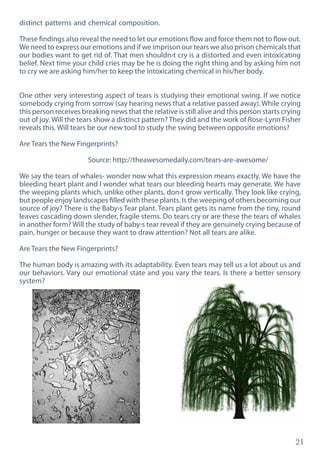
We say the tears of whales- wonder now what this expression means exactly. We have the
bleeding heart plant and I wonder what tears our bleeding hearts may generate. We have
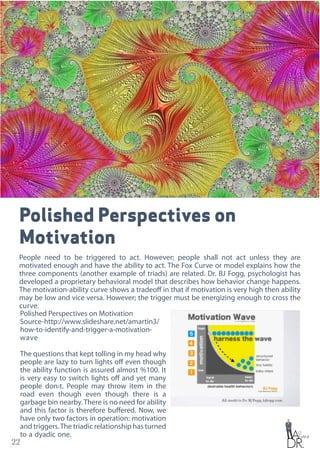
the weeping plants which, unlike other plants, don›t grow vertically. They look like crying,
but people enjoy landscapes filled with these plants. Is the weeping of others becoming our
source of joy? There is the Baby›s Tear plant. Tears plant gets its name from the tiny, round
leaves cascading down slender, fragile stems. Do tears cry or are these the tears of whales
in another form? Will the study of baby›s tear reveal if they are genuinely crying because of
pain, hunger or because they want to draw attention? Not all tears are alike.
Are Tears the New Fingerprints?
The human body is amazing with its adaptability. Even tears may tell us a lot about us and
our behaviors. Vary our emotional state and you vary the tears. Is there a better sensory
system?
22
Polished Perspectives on
Motivation
People need to be triggered to act. However; people shall not act unless they are
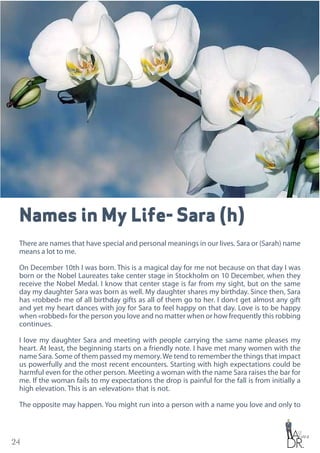
motivated enough and have the ability to act. The Fox Curve or model explains how the
three components (another example of triads) are related. Dr. BJ Fogg, psychologist has
developed a proprietary behavioral model that describes how behavior change happens.
The motivation-ability curve shows a tradeoff in that if motivation is very high then ability
may be low and vice versa. However; the trigger must be energizing enough to cross the
curve.
Polished Perspectives on Motivation
Source-http://www.slideshare.net/amartin3/
how-to-identify-and-trigger-a-motivation-
wave
The questions that kept tolling in my head why
people are lazy to turn lights off even though
the ability function is assured almost %100. It
is very easy to switch lights off and yet many
people don›t. People may throw item in the
road even though even though there is a
garbage bin nearby. There is no need for ability
and this factor is therefore buffered. Now, we
have only two factors in operation: motivation
and triggers.The triadic relationship has turned
to a dyadic one.
23
Polished Perspectives on Motivation
It is clear that when we are internally
motivated and triggered we are placing
the spark (trigger) to the high quality
fuel (motivation). On contrast, when we
have a person acting because of external
triggers and motivation. This person is
very unlikely to act. This could explain
why some people are lazy to turn lights
of, or to click a like button on beBee.
Itisunfortunatethatinsteadofgoingwith
nature that we go against it sometimes.
Promise an attacker in a football game
a huge amount of money (external
motivation) for each goal he scores. The
result shall be that the attacker shall play
for himself and not the team. It happened
and the team lost. This is an example
in which we intoxicate motivation and
expect positive results! These are self-
defeating approaches. We need to
promote group motivations and avoid
the factors that enhance egoism.
Polished Perspectives on Motivation
In brevity, people shall not act even for
effortless tasks or jobs if the triggers and
motivations factors are external.
I would love your thoughts.
People who don›t act even though the task is easy either they have no motivation, or no
trigger or both. We have more examples on beBee. It is very easy to like a buzz, but most
readers don›t even if they like the buzz.This «poverty» of action isn›t surely related to ability;
more to the dyadic motivation-trigger factor.
It occurred to me that it would be a good idea to introduce the motivation-trigger quadrant.
We have internal and external triggers and we have internal and external motivation. The
quadrant is then as follows:
When it comes to groups› motivation there are certain factors that encourage cooperation
or lack of it. Just observe ants how they make a raft so as not to sink in water or in sand. Ants
in the latter case excrete huge amount of glue that stick the sand grains together and the
ants survive.
Polished Perspectives on Motivation
24
Names in My Life- Sara (h)
There are names that have special and personal meanings in our lives. Sara or (Sarah) name
means a lot to me.
On December 10th I was born. This is a magical day for me not because on that day I was
born or the Nobel Laureates take center stage in Stockholm on 10 December, when they
receive the Nobel Medal. I know that center stage is far from my sight, but on the same
day my daughter Sara was born as well. My daughter shares my birthday. Since then, Sara
has «robbed» me of all birthday gifts as all of them go to her. I don›t get almost any gift
and yet my heart dances with joy for Sara to feel happy on that day. Love is to be happy
when «robbed» for the person you love and no matter when or how frequently this robbing
continues.
I love my daughter Sara and meeting with people carrying the same name pleases my
heart. At least, the beginning starts on a friendly note. I have met many women with the
name Sara. Some of them passed my memory.We tend to remember the things that impact
us powerfully and the most recent encounters. Starting with high expectations could be
harmful even for the other person. Meeting a woman with the name Sara raises the bar for
me. If the woman fails to my expectations the drop is painful for the fall is from initially a
high elevation. This is an «elevation» that is not.
The opposite may happen. You might run into a person with a name you love and only to
25
find out this person comes from an unfriendly place, different background or whatever
differences. You feel there are barriers between you and the person even though you or
she has nothing to do with these differences. The repeated revelation might end up with
a genuine «elevation» of expectations, respect and being a genuine human. I have had
many brain-encounters with Sara Jacobovici, which resulted in building brain-connections
and building together mental understanding beyond doubts. We both wrote buzzes being
inspired by each other and established hives that resulted from our brain encounters. We
differ, but with respect and we disagree occasionally to learn more and pursue our paths.
When people reach this level of understanding differences become tolerable, if they don›t
melt away.
BeBee has turned the Place to meet lovely women with the name Sara(h). The other Sarah I
met on beBee is Sarah Elkins. Sarah might not be aware completely that she impacted me,
even though we had only few «brain-encounters» and that I learnt a lot from her. Being a
prolific writer with a musical heart qualified her to be an authentic writer with great insights
and vibrating words that fill the heart with joy and ideas. Sarah writes on her beBee profile
«I love to help people figure out what›s stopping them from being successful, no matter
how they define success. The truth is that if you can share your story, you will improve your
chances of success». I share my story and you Sarah have improved my chances of success.
It is time to say thank you.
There are many other women with the name Sara or Sarah with whom I had no direct or
indirect encounter and still they influenced me through their genuine vibrations over time
and space. There is a video titled «Famous People Named Sarah», which I embed for more
info.
http://www.biography.com/people/groups/famous-named-sarah
Names stay with us and we associate them with events in our lives.You may have your story
with a name that influenced your life. I invite all readers to contribute on why special names
have a place in their hearts.
26
Triads Are Everywhere
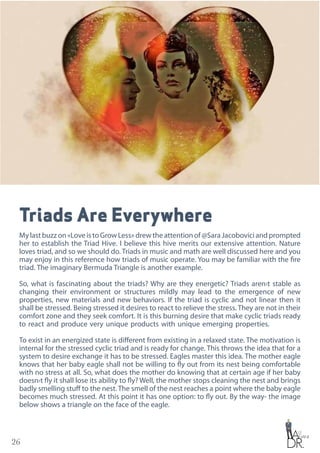
Mylastbuzzon«LoveistoGrowLess»drewtheattentionof@SaraJacoboviciandprompted
her to establish the Triad Hive. I believe this hive merits our extensive attention. Nature
loves triad, and so we should do. Triads in music and math are well discussed here and you
may enjoy in this reference how triads of music operate. You may be familiar with the fire
triad. The imaginary Bermuda Triangle is another example.
So, what is fascinating about the triads? Why are they energetic? Triads aren›t stable as
changing their environment or structures mildly may lead to the emergence of new
properties, new materials and new behaviors. If the triad is cyclic and not linear then it
shall be stressed. Being stressed it desires to react to relieve the stress. They are not in their
comfort zone and they seek comfort. It is this burning desire that make cyclic triads ready
to react and produce very unique products with unique emerging properties.
To exist in an energized state is different from existing in a relaxed state. The motivation is
internal for the stressed cyclic triad and is ready for change. This throws the idea that for a
system to desire exchange it has to be stressed. Eagles master this idea. The mother eagle
knows that her baby eagle shall not be willing to fly out from its nest being comfortable
with no stress at all. So, what does the mother do knowing that at certain age if her baby
doesn›t fly it shall lose its ability to fly? Well, the mother stops cleaning the nest and brings
badly smelling stuff to the nest. The smell of the nest reaches a point where the baby eagle
becomes much stressed. At this point it has one option: to fly out. By the way- the image
below shows a triangle on the face of the eagle.
27
Triads Are Everywhere
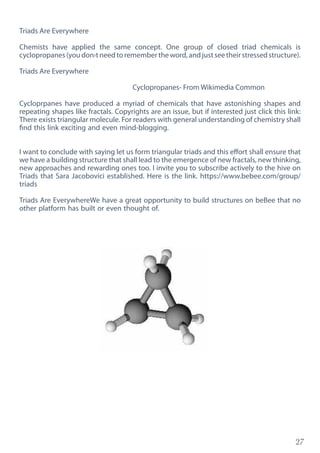
Chemists have applied the same concept. One group of closed triad chemicals is
cyclopropanes(youdon›tneedtoremembertheword,andjustseetheirstressedstructure).
Triads Are Everywhere
Cyclopropanes- From Wikimedia Common
Cycloprpanes have produced a myriad of chemicals that have astonishing shapes and
repeating shapes like fractals. Copyrights are an issue, but if interested just click this link:
There exists triangular molecule. For readers with general understanding of chemistry shall
find this link exciting and even mind-blogging.
I want to conclude with saying let us form triangular triads and this effort shall ensure that
we have a building structure that shall lead to the emergence of new fractals, new thinking,
new approaches and rewarding ones too. I invite you to subscribe actively to the hive on
Triads that Sara Jacobovici established. Here is the link. https://www.bebee.com/group/
triads
Triads Are EverywhereWe have a great opportunity to build structures on beBee that no
other platform has built or even thought of.
28
Going against Nature
It amazes me how often we make the easy difficult for us by going against nature. We tend
to swim against the tide and go against gravity for no good reason. Businesses tend to do
the same. Going against nature may not be easily realized, and I am providing examples of
what I mean.
Trees provide a good example. Trees are fractals. The beauty of fractals is their paradox
being self-similar, but with authenticity and uniqueness. No tree is an exact copy of another
tree, or a branch is copy of other.They preserve their unity while individually they are fractal.
The human body is fractal too, and even though we look similar, every one of us has his/
her unique personality. However; many act in violation of our nature and end up exploiting
their energies in redundant actions.
Ali Anani, PhD
Think about jealousy. To feel jealous is to compare what you have with what someone else
has and end up with «inferiority complex». We were meant to be different. This is the way
we are. We go against this nature by feeling inferior. We fold in and reduce our potential.
We lose our authenticity. To feel jealous and allow it to reach high levels of intoxication
shall harm us and not the person we envy. We are not meant to be coy of others and we
insist to do so. We could do much better by focusing on our strengths to build them and
weaknesses to alleviate them and transform into better humans.
This leads me competition and benchmarking. Spending lots of times on doing these
29
activities are in fact a way of swimming against nature. No two businesses are similar.
Focusing on benchmarking and competition hides a message that we are inferior to the
organization that we compare ourselves with. I view competition as a disguised form of
jealousy. Why not be your business and work on it? Casual checking is fine, but to keep an
eye on your competitors make them feel they are stronger than you.
Comparisons lead to jealousy and jealousy lead to feelings of inferiority complex and envy.
Just thinking about it we now start going with nature, but in the wrong direction leading to
losing ourselves and the business as well.
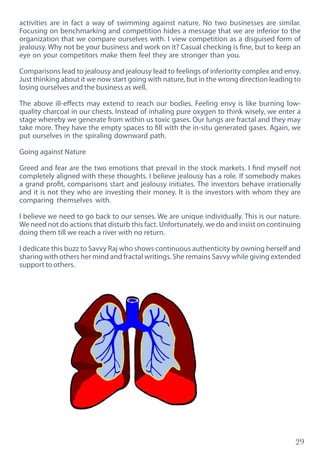
The above ill-effects may extend to reach our bodies. Feeling envy is like burning low-
quality charcoal in our chests. Instead of inhaling pure oxygen to think wisely, we enter a
stage whereby we generate from within us toxic gases. Our lungs are fractal and they may
take more. They have the empty spaces to fill with the in-situ generated gases. Again, we
put ourselves in the spiraling downward path.
Going against Nature
Greed and fear are the two emotions that prevail in the stock markets. I find myself not
completely aligned with these thoughts. I believe jealousy has a role. If somebody makes
a grand profit, comparisons start and jealousy initiates. The investors behave irrationally
and it is not they who are investing their money. It is the investors with whom they are
comparing themselves with.
I believe we need to go back to our senses. We are unique individually. This is our nature.
We need not do actions that disturb this fact. Unfortunately, we do and insist on continuing
doing them till we reach a river with no return.
I dedicate this buzz to Savvy Raj who shows continuous authenticity by owning herself and
sharing with others her mind and fractal writings. She remains Savvy while giving extended
support to others.
30
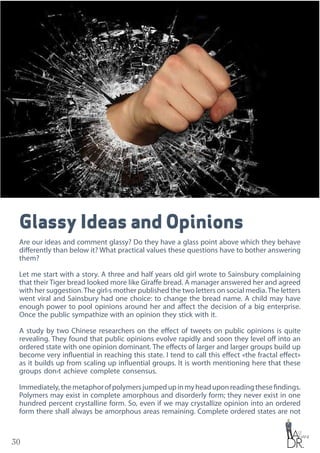
Glassy Ideas and Opinions
Are our ideas and comment glassy? Do they have a glass point above which they behave
differently than below it? What practical values these questions have to bother answering
them?
Let me start with a story. A three and half years old girl wrote to Sainsbury complaining
that their Tiger bread looked more like Giraffe bread. A manager answered her and agreed
with her suggestion.The girl›s mother published the two letters on social media.The letters
went viral and Sainsbury had one choice: to change the bread name. A child may have
enough power to pool opinions around her and affect the decision of a big enterprise.
Once the public sympathize with an opinion they stick with it.
A study by two Chinese researchers on the effect of tweets on public opinions is quite
revealing. They found that public opinions evolve rapidly and soon they level off into an
ordered state with one opinion dominant. The effects of larger and larger groups build up
become very influential in reaching this state. I tend to call this effect «the fractal effect»
as it builds up from scaling up influential groups. It is worth mentioning here that these
groups don›t achieve complete consensus.
Immediately,themetaphorofpolymersjumpedupinmyheaduponreadingthesefindings.
Polymers may exist in complete amorphous and disorderly form; they never exist in one
hundred percent crystalline form. So, even if we may crystallize opinion into an ordered
form there shall always be amorphous areas remaining. Complete ordered states are not
31
possible.
So, when we exchange comments and opinions on many issues here on beBee we may
reach some ordered agreement that could reach no more than %95 (and normally less than
that). We shall always have the ordered leveling off by forming a general understanding,
but shall also have the ‹amorphous opinions». So, what to expect? And in shape opinions
and ideas end up with?
Polymerssettleinfewshapessuchascubicandoctahedral.Eachshapehasitscharacteristic.
Moleculesvibrate,ourideasvibrateandouropinionsvibrate.Whenwehavesimilaropinions
from all sides we end up with a cube-shaped opinion and ideas, for example. However; the
main difference is the behavior of these shapes. In case we have a polymer with an ordered
state and amorphous state they behave quite differently. The crystalline part (orderly part)
melts, but the amorphous one passes through a glass transition point. It behaves like glass.
When we have opinions to which the majority agree with we still have amorphous opinions
and if we ‹cool» them by putting their ideas in the fridge they might become brittle and
break sporadically.
Glassy Ideas and Opinions
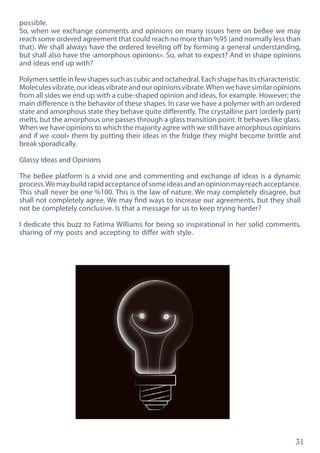
The beBee platform is a vivid one and commenting and exchange of ideas is a dynamic
process.Wemaybuildrapidacceptanceofsomeideasandanopinionmayreachacceptance.
This shall never be one %100. This is the law of nature. We may completely disagree, but
shall not completely agree. We may find ways to increase our agreements, but they shall
not be completely conclusive. Is that a message for us to keep trying harder?
I dedicate this buzz to Fatima Williams for being so inspirational in her solid comments,
sharing of my posts and accepting to differ with style.
32
Love is to Grow Less
My last buzz on «Glassy Ideas and Opinions» drew some very interesting comments. A
comment by the thinker @Anees Zaidi, in which he wrote «An idea, be it glassy, crystallized
or amorphous, if it helps others to find colors for their dreams are worth pursuing» captured
my attention. The use of or in the comment triggered me the most. What if we change or
to and as the three forms may in reality co-exist. Again, the word three triggered my mind
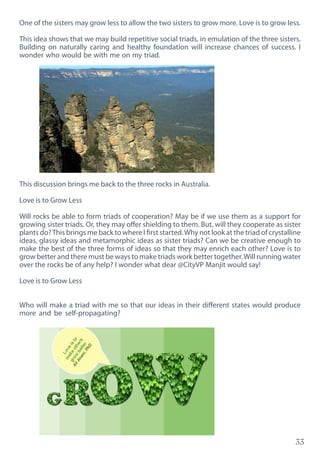
for the second time. There are the three rocks in Australia. There are the three simple rules
everywhere. There are the three sister plants as well. At this moment my mind froze. The
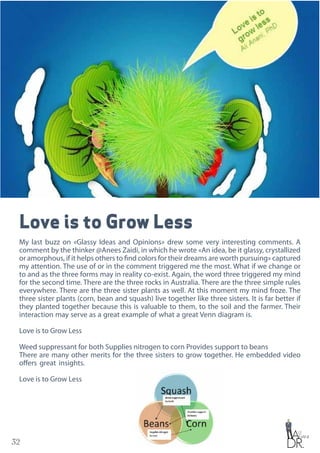
three sister plants (corn, bean and squash) live together like three sisters. It is far better if
they planted together because this is valuable to them, to the soil and the farmer. Their
interaction may serve as a great example of what a great Venn diagram is.
Love is to Grow Less
Weed suppressant for both Supplies nitrogen to corn Provides support to beans
There are many other merits for the three sisters to grow together. He embedded video
offers great insights.
Love is to Grow Less
33
One of the sisters may grow less to allow the two sisters to grow more. Love is to grow less.
This idea shows that we may build repetitive social triads, in emulation of the three sisters.
Building on naturally caring and healthy foundation will increase chances of success. I
wonder who would be with me on my triad.
This discussion brings me back to the three rocks in Australia.
Love is to Grow Less
Will rocks be able to form triads of cooperation? May be if we use them as a support for
growing sister triads. Or, they may offer shielding to them. But, will they cooperate as sister
plants do?This brings me back to where I first started.Why not look at the triad of crystalline
ideas, glassy ideas and metamorphic ideas as sister triads? Can we be creative enough to
make the best of the three forms of ideas so that they may enrich each other? Love is to
grow better and there must be ways to make triads work better together.Will running water
over the rocks be of any help? I wonder what dear @CityVP Manjit would say!
Love is to Grow Less
Who will make a triad with me so that our ideas in their different states would produce
more and be self-propagating?
34
Disruption of Thinking
Few scientific discoveries disrupt our thinking and turn it upside down. Not only these
discoveries disrupt our thinking, but also our perspectives, attitudes and beliefs. One of the
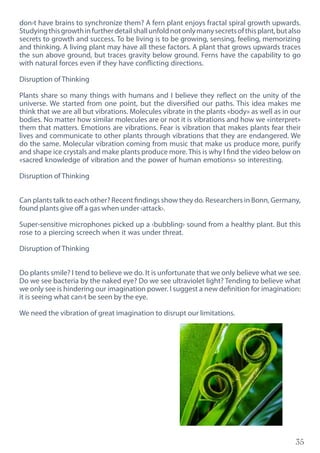
discoveries that prompted me to write this buzz is that plants have their brains and that
they suffer from pain. These aren›t simple findings as their impact has rippling effect on
many facets of our lives.
Just think about few of these observations:
· Plants have nervous systems stems from several sources of information. Amazingly,
some of the chemicals in human nervous system are shared by the pants nervous system.
The plants also show synapse-like regions between cells, across which neurotransmitter
molecules facilitate cell-to-cell communication
· Some plants fold their leaves rapidly when touched
Plants think, communicates among each other, suffer from pain, enjoy music and many
more fascinating facts. They have many similar molecules like humans. Humans want to
survive. Plants want to survive. We alert our human mates to forthcoming dangers. Plants
do the same. Are these analogies for no reason?
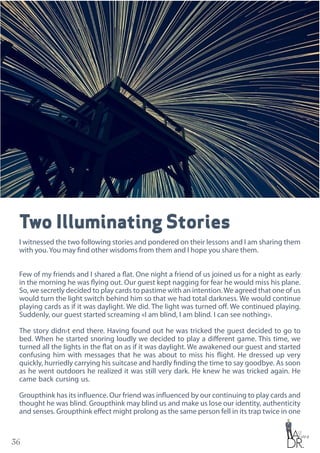
We talk about spiral growth. Look at the fern plants and how they grow spirally and unfold
their secrets in a timely manner. The question that bombards my mind is such behaviors
35
don›t have brains to synchronize them? A fern plant enjoys fractal spiral growth upwards.
Studyingthisgrowthinfurtherdetailshallunfoldnotonlymanysecretsofthisplant,butalso
secrets to growth and success. To be living is to be growing, sensing, feeling, memorizing
and thinking. A living plant may have all these factors. A plant that grows upwards traces
the sun above ground, but traces gravity below ground. Ferns have the capability to go
with natural forces even if they have conflicting directions.
Disruption of Thinking
Plants share so many things with humans and I believe they reflect on the unity of the
universe. We started from one point, but the diversified our paths. This idea makes me
think that we are all but vibrations. Molecules vibrate in the plants «body» as well as in our
bodies. No matter how similar molecules are or not it is vibrations and how we «interpret»
them that matters. Emotions are vibrations. Fear is vibration that makes plants fear their
lives and communicate to other plants through vibrations that they are endangered. We
do the same. Molecular vibration coming from music that make us produce more, purify
and shape ice crystals and make plants produce more. This is why I find the video below on
«sacred knowledge of vibration and the power of human emotions» so interesting.
Disruption of Thinking
Can plants talk to each other? Recent findings show they do. Researchers in Bonn, Germany,
found plants give off a gas when under ‹attack›.
Super-sensitive microphones picked up a ‹bubbling› sound from a healthy plant. But this
rose to a piercing screech when it was under threat.
Disruption of Thinking
Do plants smile? I tend to believe we do. It is unfortunate that we only believe what we see.
Do we see bacteria by the naked eye? Do we see ultraviolet light? Tending to believe what
we only see is hindering our imagination power. I suggest a new definition for imagination:
it is seeing what can›t be seen by the eye.
We need the vibration of great imagination to disrupt our limitations.
36
Two Illuminating Stories
I witnessed the two following stories and pondered on their lessons and I am sharing them
with you. You may find other wisdoms from them and I hope you share them.
Few of my friends and I shared a flat. One night a friend of us joined us for a night as early
in the morning he was flying out. Our guest kept nagging for fear he would miss his plane.
So, we secretly decided to play cards to pastime with an intention.We agreed that one of us
would turn the light switch behind him so that we had total darkness. We would continue
playing cards as if it was daylight. We did. The light was turned off. We continued playing.
Suddenly, our guest started screaming «I am blind, I am blind. I can see nothing».
The story didn›t end there. Having found out he was tricked the guest decided to go to
bed. When he started snoring loudly we decided to play a different game. This time, we
turned all the lights in the flat on as if it was daylight. We awakened our guest and started
confusing him with messages that he was about to miss his flight. He dressed up very
quickly, hurriedly carrying his suitcase and hardly finding the time to say goodbye. As soon
as he went outdoors he realized it was still very dark. He knew he was tricked again. He
came back cursing us.
Groupthink has its influence. Our friend was influenced by our continuing to play cards and
thought he was blind. Groupthink may blind us and make us lose our identity, authenticity
and senses. Groupthink effect might prolong as the same person fell in its trap twice in one
37
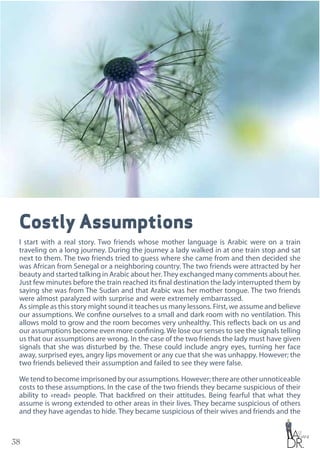
night.This exemplifies the fact that we may switch off the light bulbs in our minds and think
we are blind. Separating our minds from our senses is like switching off lights in a room.The
darkness of the room doesn›t mean we are blind; it s the darkness of separating our logic
from our senses that lead us to think so.
This exemplifies the fact that we may switch off the light bulbs in our minds and think we
are blind
Ali Anani, PhD
Having light in the room doesn›t mean it is daylight outside; in contrast it could be very dark.
We need our senses to work with our brains to reach at the right conclusions; else we start
behaving wrongly by making wrong assumptions. To be tricked twice in the same night
means that the person extended the same mistake: blind because it was dark surrounding
him and light outside because it was like daylight inside.
Having light in the room doesn›t mean it is daylight outside; in contrast it could be very
dark
Ali Anani, PhD
Darkness may lead us blind; so does daylight. It is not only darkness that makes us unable
to see reality. Daylight may do the same. We need to sense both together. We don›t have
darkness without the brightness of the day. Likewise; we don›t have the light of discovery
without having the darkness of the unknown. They work together. It is us who want the
light without the darkness and the result is ending up living in darkness. Who shall switch
the lights on?
Darkness may lead us blind; so does daylight. It is not only darkness that makes us unable
to see reality. Daylight may do the same
Ali Anani, PhD
38
Costly Assumptions
I start with a real story. Two friends whose mother language is Arabic were on a train
traveling on a long journey. During the journey a lady walked in at one train stop and sat
next to them. The two friends tried to guess where she came from and then decided she
was African from Senegal or a neighboring country. The two friends were attracted by her
beauty and started talking in Arabic about her.They exchanged many comments about her.
Just few minutes before the train reached its final destination the lady interrupted them by
saying she was from The Sudan and that Arabic was her mother tongue. The two friends
were almost paralyzed with surprise and were extremely embarrassed.
As simple as this story might sound it teaches us many lessons. First, we assume and believe
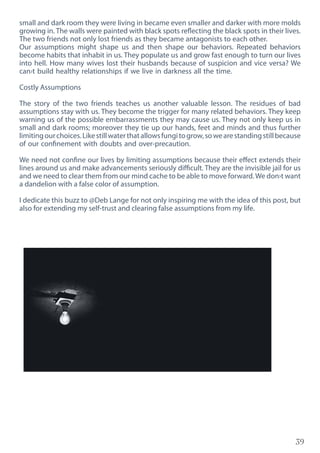
our assumptions. We confine ourselves to a small and dark room with no ventilation. This
allows mold to grow and the room becomes very unhealthy. This reflects back on us and
our assumptions become even more confining.We lose our senses to see the signals telling
us that our assumptions are wrong. In the case of the two friends the lady must have given
signals that she was disturbed by the. These could include angry eyes, turning her face
away, surprised eyes, angry lips movement or any cue that she was unhappy. However; the
two friends believed their assumption and failed to see they were false.
We tend to become imprisoned by our assumptions. However; there are other unnoticeable
costs to these assumptions. In the case of the two friends they became suspicious of their
ability to «read» people. That backfired on their attitudes. Being fearful that what they
assume is wrong extended to other areas in their lives. They became suspicious of others
and they have agendas to hide. They became suspicious of their wives and friends and the
39
small and dark room they were living in became even smaller and darker with more molds
growing in. The walls were painted with black spots reflecting the black spots in their lives.
The two friends not only lost friends as they became antagonists to each other.
Our assumptions might shape us and then shape our behaviors. Repeated behaviors
become habits that inhabit in us. They populate us and grow fast enough to turn our lives
into hell. How many wives lost their husbands because of suspicion and vice versa? We
can›t build healthy relationships if we live in darkness all the time.
Costly Assumptions
The story of the two friends teaches us another valuable lesson. The residues of bad
assumptions stay with us. They become the trigger for many related behaviors. They keep
warning us of the possible embarrassments they may cause us. They not only keep us in
small and dark rooms; moreover they tie up our hands, feet and minds and thus further
limitingourchoices.Likestillwaterthatallowsfungitogrow,sowearestandingstillbecause
of our confinement with doubts and over-precaution.
We need not confine our lives by limiting assumptions because their effect extends their
lines around us and make advancements seriously difficult. They are the invisible jail for us
and we need to clear them from our mind cache to be able to move forward.We don›t want
a dandelion with a false color of assumption.
I dedicate this buzz to @Deb Lange for not only inspiring me with the idea of this post, but
also for extending my self-trust and clearing false assumptions from my life.
40
Bees and Beer
The internet cable is broken in my office and I decided to go down to the café shop to use
the available internet. Changing places may lead to changing thinking. A bee buzzed in my
mind and a wiggling idea started to dance in my head. Bees make honey and humans make
beer. The difference in the last letter reveals much more than we can think of.
Understanding how bees make beer and watching them doing that fills the heart with joy.
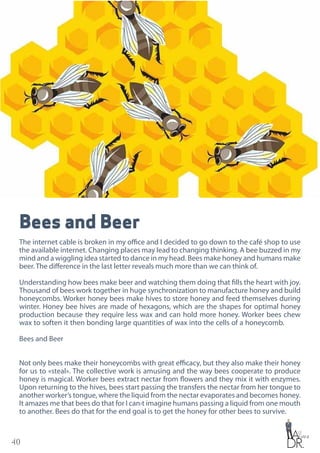
Thousand of bees work together in huge synchronization to manufacture honey and build
honeycombs. Worker honey bees make hives to store honey and feed themselves during
winter. Honey bee hives are made of hexagons, which are the shapes for optimal honey
production because they require less wax and can hold more honey. Worker bees chew
wax to soften it then bonding large quantities of wax into the cells of a honeycomb.
Bees and Beer
Not only bees make their honeycombs with great efficacy, but they also make their honey
for us to «steal». The collective work is amusing and the way bees cooperate to produce
honey is magical. Worker bees extract nectar from flowers and they mix it with enzymes.
Upon returning to the hives, bees start passing the transfers the nectar from her tongue to
another worker’s tongue, where the liquid from the nectar evaporates and becomes honey.
It amazes me that bees do that for I can›t imagine humans passing a liquid from one mouth
to another. Bees do that for the end goal is to get the honey for other bees to survive.
41
Bees and Beer
Bees make honey and humans make beer to get the bees drunk. The process of making
beer depends on extracting sugars from grains like barley so that the yeast can turn it into
alcohol and carbon dioxide, creating beer.The grains are harvested and processed through
a process of heating, drying out and cracking. This process isolates the enzymes needed
for brewing so that it is ready for the next manufacturing step. We use enzymes to convert
sugar to alcohol whereas bees use enzymes to turn nectar into honey. It is interesting here
those bees that drink alcohols get punished and even killed.
Bees and Beer
Are humans behaving more like the Fruit Fly? This fly is seen often near decaying fruits
and near thrown away bottles of alcohol. They wish to get drunk. Research has shown that
insects get intoxicated and change their behavior when exposed to alcohol. The fruit fly
feeds on yeasts to ferment decayed fruits into alcohol. This fly is pleasure-seeker. This fly
as all drunken insects suffer from alcohol intoxication. Enzymes are for honey production
in bees and alcohol production in the fruit fly. It is our behavior that decides which route
to go. An experiment on bees using an ethanol/sugar solution (about %2.5 alcohol) found
that they walked, rested, and exchanged food less often when intoxicated.Wrong behaviors
may extend to good behaviors and intoxicate them.
We may get drunk and in the process intoxicate the bees to produce less honey. It is the
same behavior that intoxicates our behavior.
I dedicate this post to Praveen Raj Gullepalli for enriching my buzzes with his excellent
comments. I plan to write a buzz on his comments.
42
The Change and Adaptation Gap
Change is the only constant- this is a paradox that we live in. The constant is turning into
variable. To keep up with change all living systems must adapt. We are in a constant wavy
motion of change. I made a comment to @Sara Jacobovici In which I wrote that there is a
widening gap between the rate of change and the rate of our adaptability. What would
happen if the present trend of experiencing exponential changes and almost linear capacity
to adapt? Sara›s response encouraged me to investigate this issue further.
Technology changes are bringing about changes in our social structures, organizational
structures, communication structures, habits structures and almost every facet of our lives.
One change brings spillover changes. No more we teach the same way, communicate the
same way and think the same way. We are facing changes coming from different directions
and speeds. We are becoming like wind turbines that face varying wind directions and
speeds. The centrifugal force on the spinning blades of wind turbines increases as the
square of the rotation speed, which makes this structure sensitive to over speed.The power
of the wind increases as the cube of the wind speed, and therefore turbines have to be built
to survive much higher wind loads than those from which they can practically generate
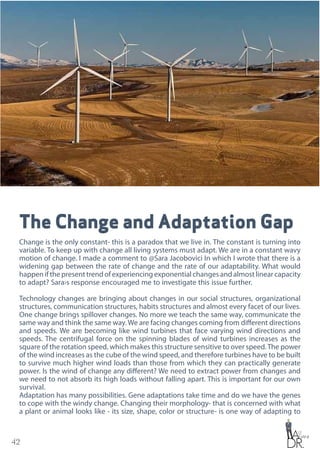
power. Is the wind of change any different? We need to extract power from changes and
we need to not absorb its high loads without falling apart. This is important for our own
survival.
Adaptation has many possibilities. Gene adaptations take time and do we have the genes
to cope with the windy change. Changing their morphology- that is concerned with what
a plant or animal looks like - its size, shape, color or structure- is one way of adapting to
43
change.There is a general rule; bodies become smaller in response to general warming and
larger with cooling. Plant leaves become narrower to lose less water in arid zones. Another
possibility is changing behavior. We humans are generating The Greenhouse Effect and
making the earth warmer.To cope with these changes animals become narrower in size and
migrate to different places than they were accustomed to. Gene mutations are an effective
way of coping with change, but it takes time.
The Change and Adaptation Gap
Are we humans giving enough breathing space to mutate our behaviors to cope with the
changes that we are introducing to our environment? Can our stomach digest the changes
or are we eating too fast to allow the full digestion of information?We are not chewing new
changes long enough and we are not assimilating changes long enough and the result is
changes indigestion problems.
Where are we going? Rapid changes and much slower adaptation shall mean that
the disparity between change and adapting capacity shall increase. This shall also be
accompanied by a vicious feedback- being unable to adapt shall stress us more and this
lowers our capacity to meet new changes. Growing changes and reduced capacity to meet
the challenges of change introduce new wind of challenges that again reduce our capacity
to adapt.
Is there a place for what some people refer to as change management?
44
The Fractal Change
The comments on my last buzz on «The Curly Hair of Change» drew quite few interesting
comments. One comment from @Aaron Skogen drew my attention considerably. He wrote
«@Ali Anani, I very much enjoyed another of your analogies.This I witness on a regular basis
«Some people will move into the acceptance and demand stages while many others shall
be lagging in rejection and resistance stages.» As a bald guy, when the rain falls, it lands
making twisting and turning patters on my scalp. It reminds me that this life, our work, our
relationships are not linear and the only constant in life is change.Yet, I wonder, how do we
as leaders help those curls to get past the emotion and see the benefit of the change? How
do we help bring others to embrace it?»This buzz is my response to this lovely comment. I
start by asking few questions:
· Why do people wish to change the shape and/or color of their hair?
· Does change of hair color and/or shape reflect on their attitudes towards change in
general?
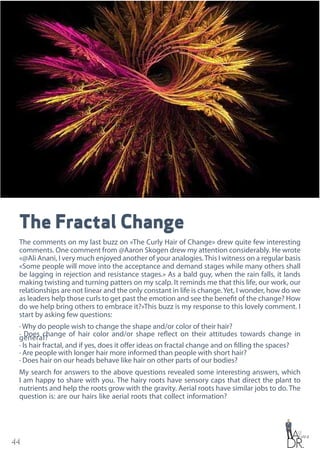
· Is hair fractal, and if yes, does it offer ideas on fractal change and on filling the spaces?
· Are people with longer hair more informed than people with short hair?
· Does hair on our heads behave like hair on other parts of our bodies?
My search for answers to the above questions revealed some interesting answers, which
I am happy to share with you. The hairy roots have sensory caps that direct the plant to
nutrients and help the roots grow with the gravity. Aerial roots have similar jobs to do. The
question is: are our hairs like aerial roots that collect information?
45
The Fractal Change
It was very interesting to find a reference showing the Relation between Long Hair &
Extrasensory Perception Sitting Bull, a Native American chief, with long hair we are
conditionedtothinkthathairstylingisimportantandhowitmakesacoolfashionstatement.
But in olden times it was a different story. An interesting find revealed that long hair in men
was actually related to consciousness or the sixth sense. When the hair was cut the sixth
sense was lost. I wonder if our preferences deprive us sometimes of our «meta-senses»!
This is beyond our use of hair analysis to detect the level of poisonous lead in our bodies.
Can we then grow our meta-senses by allowing hair to grow long? One more question for
the ladies: do you have a more powerful sixth sense than men because normally you have
longer hair than men?
The Fractal Change
Hair coloring is the practice of changing the hair color.What prompts us to change hair color
and does it reflect on our attitude to change? One Arab poet said that he was so intimate
that if he would become young again he would part of his grey hair with a bleeding heart.
Another poet wished that he would love to relive his adulthood so as to complain to it what
damages grey hair has done for him. These are two widely opposite attitudes to grey hair.
Do we allude ourselves by changing hair color that we become younger? Why don›t we go
with the flow of the fractal time and enjoy it? Does false reality make us live a false life?
The way we may dye hair may serve as a great metaphor for managing change. Permanent
hair dyeing, demi-permanent, semi-permanent, temporary dyeing and use of alternative
colors are among the available solution. The selection of type of dyeing depends on the
quality of hair, personal desires and environment.When we manage organizational change
we may greatly benefit from lessons derived from hair coloring. Our personal desires may
be conflicting with the quality of our hair and how to deal with such situations. When to
look for permanent change or temporary change is another lesson. A third lesson is not
all changes are desirable and when we change hair color it might be repelling. To restore
previous colors when we have undergone permanent dyeing is costly and difficult to do.
Hair is fractal and has lots of unfilled spaces. We may redesign hair to look like fractals and
enrich it with colors. You may enjoy creative designs on this link:
http://www.haircutweb.com/03/2015/when-hairstyle-inspires-fractal-art.html
You can even enjoy the science and art of making use of fractals in beautifying the design
of your hair by inspecting the rewarding post: HISTORY: Ron Eglash:The fractals at the heart
of African designs.
Not all hairs in our body behave similarly. For example, skin and hair react differently to
sunlight.Typically, the skin darkens and the hair lightens a result of a pigment in the human
body called melanin. Melanin darkens the skin to protect it from harmful solar radiation.
Because hair cells are not alive like skin cells are, melanin cannot protect hair from sun
damage. Hair takes on a bleached appearance, while skin becomes darker. In managing
change, we must pay attention to the type and position of what we wish to change.
I find the fractal hair as a great metaphor for managing change in a fractal approach and
color it suitably to serve our intentions of making change.
46
The Curly Hair of Change
I was busy writing a buzz on behavioral change when the idea of this buzz suddenly
popped up. Change follows a curved path and straight hair follows a curly path to become
curved. Are there similarities between the two changes and what lessons does the curly
hair metaphor teach us? This buzz tries to provide answers to these questions.
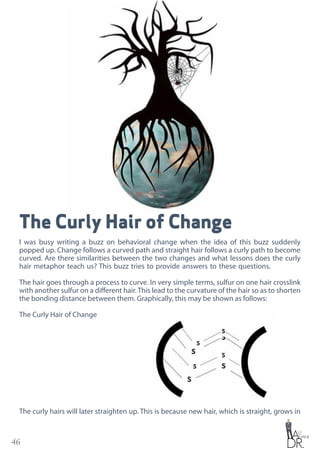
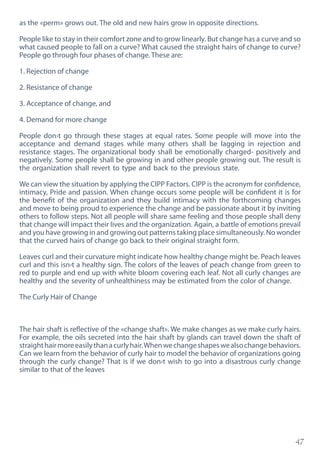
The hair goes through a process to curve. In very simple terms, sulfur on one hair crosslink
with another sulfur on a different hair. This lead to the curvature of the hair so as to shorten
the bonding distance between them. Graphically, this may be shown as follows:
The Curly Hair of Change
The curly hairs will later straighten up. This is because new hair, which is straight, grows in
47
as the «perm» grows out. The old and new hairs grow in opposite directions.
People like to stay in their comfort zone and to grow linearly. But change has a curve and so
what caused people to fall on a curve? What caused the straight hairs of change to curve?
People go through four phases of change. These are:
1. Rejection of change
2. Resistance of change
3. Acceptance of change, and
4. Demand for more change
People don›t go through these stages at equal rates. Some people will move into the
acceptance and demand stages while many others shall be lagging in rejection and
resistance stages. The organizational body shall be emotionally charged- positively and
negatively. Some people shall be growing in and other people growing out. The result is
the organization shall revert to type and back to the previous state.
We can view the situation by applying the CIPP Factors. CIPP is the acronym for confidence,
intimacy, Pride and passion. When change occurs some people will be confident it is for
the benefit of the organization and they build intimacy with the forthcoming changes
and move to being proud to experience the change and be passionate about it by inviting
others to follow steps. Not all people will share same feeling and those people shall deny
that change will impact their lives and the organization. Again, a battle of emotions prevail
and you have growing in and growing out patterns taking place simultaneously. No wonder
that the curved hairs of change go back to their original straight form.
Leaves curl and their curvature might indicate how healthy change might be. Peach leaves
curl and this isn›t a healthy sign. The colors of the leaves of peach change from green to
red to purple and end up with white bloom covering each leaf. Not all curly changes are
healthy and the severity of unhealthiness may be estimated from the color of change.
The Curly Hair of Change
The hair shaft is reflective of the «change shaft». We make changes as we make curly hairs.
For example, the oils secreted into the hair shaft by glands can travel down the shaft of
straighthairmoreeasilythanacurlyhair.Whenwechangeshapeswealsochangebehaviors.
Can we learn from the behavior of curly hair to model the behavior of organizations going
through the curly change? That is if we don›t wish to go into a disastrous curly change
similar to that of the leaves
48
Soapy Human Behaviors
The exchange of comments with @Sara Jacobovici is always interesting and challenging.
Sara commented on my last post on «Pungent, but Real Stories» by writing» Forgive me @
Ali Anani but I say this with serious intent, «A rose by any other name would smell as sweet».
The reason I say that is that everything has to exist; the (sweet) smell of a rose as well as the
(pungent) smell of the corpse flower. What is pungent to us is fragrant to the fly. Now we
look at how that transfers to behaviours and I can only refer to @CityVP Manjit›s comment.
Thank you Dr. Ali for pointing out the diversity of nature and our human nature.
Irespondedbywriting«WithseriousnessIsay@SaraJacoboviciyes,pairingisthere.WEcan›t
have one without the other. However; we have reference- that is our favoritism. In stories
for example, they are only interesting if they have a conflict. We are biased to the hero and
hate the antagonist. The hero has people who hate him and likewise the antagonist has
people who stand by him. There is a porous dividing line. In solutions we have unsaturated
one, saturated one and oversaturated one. If we change the temperature a shift takes and
the saturated one may move this direction or the other. I wonder what you think»!
Sara responded by saying» I think that you present a very wise perspective @Ali Anani. And
you provoked me to think about the distinction between «attraction» and «identification»;
in nature we are predisposed to be attracted to those things in our internal and external
environments which will be of benefit to us.Yet our human nature is drawn to aspects (such
as heroes and antagonists) that we connect with through identification.Would you say that
this distinction falls along that porous dividing line»?
49
We humans are mostly human bodies and metaphors based on water resonate with me
accordingly.IamthereforeusingawatermetaphorinmyattempttoanswerSara›squestion.
Watermoleculeshaveanaturaltendencytobondtoeachotherthroughhydrogenbonding.
This is a built-in tendency and so water molecules attract each other. Attraction is one part
of Sara›s comment and the remaining part is identification. Water molecules form spheres
because this is the lowest surface area possible and may be affected by gravity so that
spheres may not be perfect. Like we are prone to be attracted to things that benefit us so
are water molecules. These attractions dictate our shape and how we look and the effect of
external factors that may distort our «spherical» shape, but without changing it completely.
Soapy Human Behaviors
Now, introduce an external factor. Imagine having a fatty surface such as leaves instead of
neutral ones and spray the leaves with water. The fat on the leaves weakens the bonding
or the cohesion of water molecules. No more the water molecules are able to bond like
before. They lose their acquired identity and almost revert to type. We have almost free
water molecules that form sheets instead of droplets.The sheet of water runs off the leaves.
This explains why having fog of water on the mirrors of car makes driving difficult. The
water drops act as minor mirrors that reflect light in many directions. To get rid of these
problems just try adding soap to the mirror. The soap forces water drops to form a water
sheet and drop off.
The water identity is affected by the bonding (attraction) by the water molecules. Reducing
the attraction of water molecules gives a new identity for water. Identity and attraction fall
on the porous dotted line.
When we change shape we change our attractions by strengthening them or weakening
them. Attraction and identification are not working in isolation.
What do you think?
50
Pungent, but Real Stories
It amazes how plants distribute where you may find abundance of a plant in most parts
of the world versus some plants where they find their niche for survival in limited areas.
Plants which blossom regardless of their abundance need to be pollinated by birds, insects,
animals and wind to carry their pollens to other similar plants.
To attract pollinators, plants use different strategies and mostly rewarding strategies such
as providing inviting landing surfaces, colors, scents and combination of these attractants.
What puzzles me mostly is the tendency of some plants to attract pollinators using pungent
smells such as rotten meat smell-like to attract flies.Why would some insects favor pungent
smells when they could find nearby flowers with lovely smells to visit?
Take the corpse flower as an example. This flower looks attractive, but smells like corpses.
It depends on flies as pollinators. The flies prefer to lay their eggs in dead places and so
the smell of corpses attracts them. The corpse flower gets pollinated by the flies before
leaving. This behavior reminds me of the behavior of a real man whom I knew when I was a
child. I am not making up this story and it is real. In a village where workers used to gather
for lunch one worker used to spit in the pot which contained the shared lunch. Workers
avoided eating the food being disgusted by the idea of eating food with the spit in it. All
food was left for the stingy worker.
Pungent, but Real Stories
51
A second story that I remember from my childhood is a taxi driver hitting a donkey and
killing it. That donkey was owned by a very stingy man. So, the driver went to him and
offered him money in compensation for the killed donkey. OK, the owner said. But how
much money you want, the driver asked. The owner responded come tomorrow and we
shall weigh the donkey.You have to pay per weight. The driver came back next day, but the
owner told him to return tomorrow as he was too busy with other things at hand.The same
thing happened on the second day. On the third day they weighed the dead donkey and
the driver paid the owner his dues. Before leaving, the driver asked the owner how come he
waited for three days to collect his money. The owner replied by telling the driver «you are
stupid to have accepted. A dead body collects water up to three days and then it starts to
lose it. For three days the donkey weight was increasing. I didn›t wait for nothing». It is not
only flies that visit corpse bodies and there are humans who do the same.
The strategy of «wait before weight» is a pungent one. There is a big lesson in these stories.
Plants that use bad smells for pollination are rare and their growth capacity is limited. The
spaces available for following such strategies are limiting. It is not surprising that real bees
visit fragrant flowers. Be a genuine bee.
52
Creative Reflections
One of my definitions of creativity is turning negative to positive. Based on my personal
experiences I know this is both challenging and true. One example is my dealing with a
complaint that the City (Newspaper) is for free. Readers objected that their city was offered
for free. My solution was adding this The City is for free; it is too dear to be sold. That was
magical not in only solving the problem, but also in greatly enhancing the readership of the
newspaper.
JoanneSweckerdidthesameinhercommentonmybuzz«ideastransferring».Shebrilliantly
wrote «Many thoughts come to mind such as, power verses force, light verses darkness. To
become more conscious is the greatest gift one can give to the world as it comes back to its
source...a ripple effect. Much is said about light and is many layers and effects, but have we
taken notice of the mystery of darkness? Light comes and it goes, whereas darkness always
is, it is not an effect like light and seems not to need any fuel. Close your eyes and darkness
is always there, blow out a candle, darkness is there. Darkness cannot be seen in the light,
light blocks our vision. Is not light caused by something, dependent on something, a source
to fuel it? Darkness is silence, we feel our aloneness, in light we are busy, we see everyone,
and we appear separate».
We use dark materials as cork in a test tube to trap air and heat it by light. The cork absorbs
the light and in turn heats the trapped air. This makes the hot air produce sounds. Like bats
use sounds for echolocation, we use sound for testing the quality of cork or any other dark
material. Darkness is our light to study opaque materials.
53
Creative Reflections
As Joanne mentioned in her comment light might even block our vision. Just driving in
the glaring sun will show how true this can be. I may add here that the reflections we get
might be very dependent on the type of mirror we use. Is it flat, concave, convex, painted,
or double mirror? It could be even a sound mirror reflecting sound rather than light. You
have heard sound singing because of tiny spherical silica sand with sized-gratings enough
to reflect sound and make it sing.
Creative Reflections
I asked if metaphors are mirrors (without specifying what mirror I am talking about).
Brilliantly, Sara Jacobovici responded by saying metaphors are more like kaleidoscopes.
That sent my mind to opal which is viewed as a structure of microspheres with enough
grating to cause brilliant display of kaleidoscopic colors mirrors. Are our minds opal-like
with closely paled arrays of millions of spherical particles of amorphous silica stacked in a
three dimensional grating? Yes, in this case our minds are millions of kaleidoscopes as Sara
suggested. Certain opals display different colors when viewed from different directions, or
when the stone is turned, or when the light source is moved. This shows the importance
of seeing issues from different angles, perspectives and light sources so that light may not
throw us in the darkness of false assumption. Here is a paradox that Sara Jacobovici would
enjoy.
Creative Reflections
I wonder if our minds are also like many water drops on leaves with each water drop acting
as a mirror. Water shall form a sheet or droplets depending on how fatty the leave is. How
«fatty» our minds are will determine if they work like a kaleidoscope or as a flat sheet mirror
in which watery ideas just flow off.
Creative Reflections
Savvy Raj wrote a buzz on «The Space between the Steps», in which she wrote «Just like the
sounds of music in the spaces between the notes, there is dancing in the spaces between
the steps. It is only when we become aware of the value of the spaces between the thoughts
that we can truly reflect, revel and dance with ease through our lives». Dear Savvy, these are
the reflecting and diffracting spaces in the opal-like minds.Your poetry has a solid scientific
reasoning.
When we say reflect I do hope that we don›t reflect more darkness.
54
RACEastheNewStrategicModel
There are so many different strategic models in business. I am suggesting a new one here
that I believe is applicable to any business. It is the RACE Strategy.
RACE was inspired by coal firing. It is important that when do a four-stage process to
make the optimal use of coal. These four stages are not limited to coal, and I shall show by
examples how extensible this as a strategic model for any business or life activity.
You want to improve the quality of your life, the performance of your employees, the quality
of your buzzes or even your reputation then you shall find the RACE strategy applicable.
RACE- what does it stand for? It is the acronym for: Review, Avoid, Convert and Employ.
Before using coal to ignite it we must first review its quality and avoid low quality coal
because it shall intoxicate the environment with little «burning power».We need to convert
it to a higher quality coal to make the best out of coal and then employ it in different fields.
Thesameprocessformsthebasiccornersofatetrahedronthatreplicatesitselfandhopefully
builds up a diamond-like structure rather than a diamond-like one.
RACE as the New Strategic Model
The Review stage aims at knowing first who you are before deciding what you shall be. Like
a bad seed shall not give a good crop, a bad coal shall not burn efficiently unless washed
and some impurities are removed. You need to do the same with employees by washing
55
away their fears and negativity before they may ignite purposefully. You want the same
with your family members and with whatever you write, just to give two examples. The
review step is the beginning of performance-building capacity.
«Remember that by removing negativity and fears we create a «mind space» with which we
could fill with positive thinking and courage to try new approaches and not fear changes».
Ali Anani, PhD
The Avoidance stage concerns itself with knowing what not to do before knowing what to
do. Igniting employees who are cold or living in doubt is like igniting low quality coal and
intoxicating the environment. We don›t expect employees or family members or readers
to «ignite» unless we upgrade their quality first and become ready for «ignition». Show
appreciation so that employees or readers may change their behavior and ignite with
efficiency. Remove the «cold spots» because they shall cool the «burning desires». Instead
of burning coal, we are burning desires. Performance is directly linked to desirability and
knowing how to increase desirability is of utmost importance.
«We don›t expect employees or family members or readers to «ignite» unless we upgrade
their quality first and become ready for «ignition».
Ali Anani, PhD
Now you are ready to convert coal to coke, which has better burning properties. Now you
are ready to convert the efforts and resources into fuel of higher calorific value. Convert the
low moral to a high one. Now is the time to convert non-customers to customers. Now is the
time to convert the attention of your family members to higher levels. Now is the time to
convert external motivation to an internal one. Now is the time to convert low performers to
high performers. Now is the time to convert your employees from disengaged to engaged
ones. Now is the time to select the conversion process as we do for coal by using many
different processes such as chemical and catalytic conversions. Now is the time to convert
coal into a jet fuel of high value-added.
We may convert the coal to employ it in other applications such as production of new
chemicals. This is the time to employ not employees, but new applications, new designs
and new products.
The RACE model in my view is applicable to a wide range of businesses and social activities.
Just think of it if you were o raise up a kid of yours. Would you not first review and find out
what negative feelings and bad ideas the kid may have.Would not you wash them out first?
Would not you convert the kid›s interest to something of higher value so that your kid may
employ himself in other activities?
RACE as the New Strategic Model
Convert your life from graphite-like to diamond-like by following creatively the RACE
Strategy Model.
56
Chasing the Shadow of Human
Behavior
A comment by @Lisa Gallagher on my previous post on «Merge to Emerge» was the urge to
write this buzz. @Savvy Raj showed her genuine appreciation by commenting «@Ali Anani
it is a treat for any writer to be valued for their consistency as we are only human as dear @
Lisa Gallagher has reflected in such a heartfelt earnestness and so in deep humility I thank
you for all your generous reflections in inclusivity.
Were humans created from clay? And if so, which clay? That humans were created from
clay finds support in the analogy of the chemical analysis of clays and the human body
which shows close similarity. For me, the greater analogy is in the fractality of both clays
and human bodies. Clays show fractal structures and so the human body. The repeating
units forming clays are fractal and so the human body is.
Humans vary in their characters and clays vary in their structures and behaviors accordingly.
The clays have charged sites allowing them to accommodate oppositely charged bodies in
between the layers and on the externally charged ions.There is no guarantee that the same
clay will have the same ions always and therefore clays have varying properties. Humans are
charged with varying views and emotions and are subject to absorbing oppositely charged
ideas or replacing old ones with new ones. Can a varying structure show a consistent
behavior? No way, and I wonder if we would ever witness a consistent human behavior.
57
Chasing the Shadow of Human Behavior
Clays are of varying origins and types.They might form in place or their particles get carried
away by wind to deposit I foreign lands. They are subject to changes like humans who
migrate from one place to a foreign one. Clay experiences cycles of heat and cold weather.
Heating clay may fracture it.
Chasing the Shadow of Human Behavior
Fractal structures are endless as the more you zoom in, the more shall you discover. This
issue is further compounded by the fact the fractal structure is variable because it may host
different elements and so the prediction of behavior becomes more uncertain. Humans
with varying structural fractals will be very complex to predict accordingly.
As much as it is difficult to predict the human behavior, some similarities with clay behavior
are astonishing. For example, a soil with slight amount of clay is identical for crops to grow
because clay particles keep the water nearby the root. However; clayey soils are improper
for crops because clay particles are stiff, sticky and prevent air circulation around the roots.
It is balancing in action. Human behaviors that go to the extremes are similar in that they
become harmful.
«Is it far from random that clay particles exhibit fractal distribution and therefore fractal
dimension? Is it the balance between none or all? Is it also the human behavior of wanting
all (egoism) or nothing for me that throw humans out of balance and forgetting that
behaviors should have a fractal dimension»?
Ali Anani, PhD
Clay particles tend to Clays often form colloidal suspensions when immersed in water, but
the clay particles flocculate and settle quickly in saline water. Does this explain why humans
in general tend to flocculate and settle quickly when going through saline experiences?
Our bodies are fractal and our emotions are charged like charged clays. When charged we
absorb things we don›t normally do and our structure changes and so our behaviors. Are we
then in a position to predict human behavior with any certainty? I doubt for even when we
try to locate a behavior we affect it and change it. Is this the Human Behavior Uncertainty
Principle? I tend to say yes.
Lisa Gallagher- I dedicate this buzz to you for being a lady of consistent understanding and
support of others.
58
Merge to Emerge
Themergerofcompaniesandthemergerofelectronorbitalssharemanycommongrounds.
Whereas the merger of orbitals lead to successful bonding between two atoms, the merger
of two businesses leads to a new and gigantic corporation to emerge, but mostly not to
surviving ones that wouldn›t fall apart and collapse. Culture problems, opinions and the
sudden change in the work environment are among the reasons to blame for these failures.
So, why atoms merge their orbitals so that an emerging molecular entity survives? One
simple reason is that it is the loss of self-ego.When orbitals of atoms merge it is not anymore
me, it is always: the togetherness spirit that leads surviving new entities. When atomic
orbitals merge, their self-ego disappears and the new molecular orbital is the new entity
with no tears crying over the past. This is what lacks in business merges that lead only to
transient states with many embedded «pockets of memory» so that the past overwhelms
the present and soon the promising emerging entity dissolves in every pocket of memory.
What applies to businesses is extensible to our personal interests. This is a key issue that
we fail mostly to understand. We might have interests that if they would merge they would
lead to the emergence of new us. This is only possible if the «orbitals of Interests» overlap
to produce «molecular Interest» with no regret over the past or overriding the old interests
over the emerging ones. We have compatible desires, conflicting desires, and neutral
desires, charged desires, modest desires and extreme desires as well. How can we merge
our desires and interests so that a better desire would emerge and create a new entity for
us?
59
Merge to Emerge
Merginginterestspurposefullyandgenuinelyisagreatwaytomakeprogressinlife.Ibelieve
there are enough stories on beBee that would make all of us realize the value of merging to
emerge a new person. I give one example of Margaret Aranda, MD, PhD. Her writings tell us
about some of her great sufferings. But she managed to merge her interests for writing and
herpersonalsufferingsincreatingnewbusinessmodels,ideasandevennowwritingpoetry.
Being a researcher and a poet might seem to be conflicting interests; but it is the merging
of these two interests that make her write unique poetry. May be one day she would start
a training business on writing scientific poetry in partnership with @debasish majumder. I
am sure there are many examples of beBee authors who have combined interests in a way
that resulted in the emergence of new business ideas. I don›t wish to discuss the authors›
personal stories, but I do invite them to share them. For example, Lisa Gallagher rich writing
invokes the idea of inviting her to share her stories.
On a personal level I suffered (and still do) from my awful handwriting. My love for writing
conflicted with me unable to read my own handwriting sometimes! I had conflicts of
interests. I learn computer science so as to use the computer as a writing tool long times
ago. Rarely now I use a pen to write as the keyboard and voice recording are my main tools
for writing. I started a business on computers. I may claim that I succeeded because I have
never looked back at my problems of poor handwriting and the new me lasted because the
merge of my conflicting interests was genuine.
I was in Turkey last week. I found new spots that filled my heart with new interests such as
photography.Idiscoverednewinterestbecauseofmyfailuretocapturesomegreatscenery.
I am looking now to combine this interest with other interests so that a new molecule would
emerge.The journey has begun.
Let beBee be the landscape for meeting and merging of interests with the hope the
emerging new ones will stand the test of time. BeBee isn›t sharing of profiles or affinities;
more is how to make these interests merge and new possibilities emerge accordingly. This
is a noble goal that is worthy of pursuing.
60
Ideas Transferring
Writers suffer from small nudges that take them into paths that they didn›t imagine.
One ideas that I read on LinkedIn is by Angelina Kukkamalla, EPC✔🌏, in which she wrote
commenting on an image shard below by saying «This picture says a million words.... Do you
understand why you must shine light in the darkness? Because LIGHT HAS NO SHADOW».
Ideas Transferring
@ Sara Jacobovici was quicker than I in responding to the above post by publishing her
own on post titled «Illuminating a Shadow». However; I got nudged away by another post
on beBee by Margaret Aranda, MD, PhD in which she shared the following image:
Ideas Transferring
Comparing the two images above inspired me with the idea: what if light falls on broken
hearts like light falling on broken glass? Broken hearts are dim and are less bright than the
light source. What shadows these hearts shall reflect? We know the sun makes the stars
fade away during the day because the sun is greatly brighter than anything else. Bright
bodies don›t show shadows. How about dark and broken hearts?
The quote from Chekhov in the image above tells us that in writing show it rather than say
it. I say show the effect rather than the cause. Show the reflections and diffractions of light
rather than showing the light source. A light falling on a sunny person has different effects
61
than same light falling on a cloudy or gloomy person. The cause or source is the same, but
the effect is different. Reena Saxena commented on Sara›s post by saying «Shall I equate
this phenomenon with a teacher-disciple relationship? We do not see flaws in our thinking
process, till we come across a higher source of knowledge.The teacher need not be human.
A book, an article, a website, an opinion or argument can all ignite these sudden insights.
Synergy is not created till one agrees to merge». By the same token, we need a brighter idea
to question a bright one.
A new nudge breaks in now as the image of broken glass reminds me of the «Broken
WindowsTheory».This theory states that maintaining and monitoring urban environments
to prevent small crimes such as vandalism, public drinking, and toll-jumping helps to create
an atmosphere of order and lawfulness, thereby preventing more serious crimes from
happening. There are some doubts about the validity of this theory. I have my own. This is
because a smaller act is preventing bigger criminal acts. But it is the brighter sun that hides
the stars. Will by the same token only bigger acts eclipse smaller ones? This thinking works
in the opposite direction of the Broken Windows Theory.
Your thoughts are greatly welcome.
62
New Metaphors on Employee
Selection
I feel sometimes that the selection of employees is like selecting a watermelon, or some
other fruits.You shall only be quite sure of the quality of a watermelon by cutting it, making
sure its seeds is black and that it is red. We run many times into assuming that we selected
the right watermelon only to be disappointed that it is white and non-tasty from inside.
The selection of employees and of friends are not different for we run into many
disappointments upon finding out what looked promising from outside turned into
displeasure. We may improve our guessing of the quality of watermelon by properly
examining its outside. A mature watermelon will have a yellow spot where it was sitting.
This is because this part didn›t have the opportunity of exposure to direct sunlight. We
may that some candidates may have a «yellow spot» because they were not exposed to
the cameras. They were dimmed from exposure; in fact such «spots» may be indicative of
hidden strengths and qualities. This yellow spot may not in effect reflect a «yellow» person.
The outside of a watermelon should protect it from major bruises. That is a main job. A
candidate employee might have suffered from minor bruises, but his «skin» should be
devoid of major ones. The bruises are mostly intangible. Check for major and repeated
complaints, and their pattern of repetition. A watermelon with major bruises should not
be picked. Candidates with deep wounds and bleeding memories may be not suitable for
63
«picking up».
A good watermelon is uniform in shape. Uniformity is quality. Look for the «shape» of
employees and how uniform they are. In particular consider how they shape up not their
bodies; more importantly their thinking authenticity. You don›t want candidates who flow
with the ideas of the interviewers and their opinions take the shape the vessel they fill. You
need employees who fill their vessel with solid thinking and not fluid thinking just to fill the
vessels of others.
The paradox here is that watermelons are essentially water (%92).They are fluid from inside.
If the outside isn›t uniform, firm and has the right colors then the inside fluid is not of value.
Human are also mostly water. If the outside of the human is bruised, of the wrong attitudes
and high susceptibility to bruises then the inside might not be safe to deal with.
Someone famous in Source Title
Human are also mostly water. If the outside of the human is bruised, of the wrong attitudes
and high susceptibility to bruises then the inside might not be safe to deal with.
Ali ANani, PhD
64
Sounds there is a treasure
b e n e a t h
The story of sound is truly amazing. You hear sand singing with different tones. You hear
leaves-cutting ants making different sounds. You hear the bursting of seeds coming out of
their shell. You hear the sound of trapped air in a test tube if you heat the trapped air. You
hear the sound of logic and the sound of possibilities in their varying tones. You hear birds
singing or weeping and you hear the sound of your conscious. You hear the sound of bees
buzzing.
It is amazing how much sound plays a role in our lives and sometimes beyond our
expectations and understandings. We are limited by our «boundaries› to hear, but limited
sounds because there are sounds that exist even though we can›t hear them.
Is producing sounds purposeful and if yes, then what purpose? It might sound as a trivial
thing for leaves-cutting ants that they produce sounds while doing their job. Not at all and
finding to find the purpose many striking things emerge. So striking they are that the more
we know about, the more we want to know.
Ali Anani, PhD
A fractal is forming whereby one small observation has led us into a series of repeating
questions of whys and
65
Ants cut leaves and make sounds to alert other ants that they have a crop to carry to their
nest in the soil. It is a way of communication? Once in the nest, the ants grind up the leaves
and inoculate them with algae so that algae may grow and have a symbiotic relationship
with the ants. Ants don›t have ears and may be they respond to sound through their
vibrations.
whys and whys at different scales. Is our unknowing is fractal? I dare say it is.
Ali Anani, PhD
Sounds there is a treasure beneath
Ninety percents of plant roots have a symbiotic relationship with algae. Both ants and
plant roots need algae to develop symbiotic relationship with them. Is this a coincidence?
Roots are fractal. Algae threads or mycelia are fractal. Do fractals talk to fractals only? Plants
are not only connecting directly underground, but also indirectly through the mycelia of
algae. It is the fractal connection that makes interconnections the rule. These sounds in
line with what @ Sara Jacobovici wrote in her buzz «I have been fortunate to experience
this miraculous interconnectedness here on beBee and I think the element in nature that
sustains this relationship is choice». @Emília M. Ludovino wrote:”BEES SERVE AS IMAGES OF
THE MIRACULOUS INTERCONNECTEDNESS OF LIFE. The intricate intercellular structure that
secretes the golden essence of life is an image of the network of invisible nature that relates
all things to each other in an ordered harmonious pattern.”It is my turn to ask if the invisible
nature of all things becomes visible, but only for many more to become invisible.
Sounds there is a treasure beneath
Plants lose water from their leaves and roots in the soil provide water to the leaves to
substitute the lost water. In its journey up the water might have a «water clot» forming.You
see air bubbles forming in the ascending water. Some plants produce sound when these air
bubble burst. Is it a call for help, as leaves-cutting ants do? Is there a bigger purpose that is
hidden from us? Air bubbles will stop the flow of water and the plant will eventually die. So,
how surviving plant manage to cope with this dilemma?
Research has revealed some fascinating facts. Plants that engage in frequent bursting of
trapped air and then repairing the busted part do survive. It is a dynamic process and its
frequency may adapt with the need for shortening or elongating the time cycle of bursting
and repairing. The bursting sounds carry a significant message: damage has occurred and
it is time to repair. It is the continuous flow of information to do things that plants fail to do
don›t survive. Does this explain what @Deb Helfrich wrote «the process of learning to keep
love flowing even when you aren›t in an easy vibration with the other person?» Humans
have bursts of their communication. We need to consider adopting a bust-repair cycle to
keep communication alive. It is not only communication; it is more important to keep it as
a dynamic process.
Next time you hear your conscious remember that behind the sound you hear there may
be a hidden treasure beneath. Uncover it. The iceberg of your sound is worthy of exploring.
66
Distraction as a Powerful Tool
Itamazesmehowourperspectiveschangewiththesituationwearein.Ilivedthisexperience
having read the buzz by the great writer Sarah Elkins on beBee and titled «Distraction Can
Be the Perfect Gift». In this buzz Sarah explains how to distract purposefully children in
restaurants by handing to them interesting coloring materials so that they don›t disturb
others. Sarah concludes with stating that «With children and adults, this tool can be used
to de-escalate a situation and to disarm an angry customer or employee. Watch people
for signs of boredom or frustration. Be prepared with a distraction or two; I always have
treats at my desk like chocolate or pretzels. Offering a snack, water, or coffee, can be just
enough of an interruption to change the direction and tone of a conversation.Who knows?
Maybe a coloring book sitting on the table in your office would offer a good and humorous
distraction»?
The background image of Sarah›s post is interesting. I re-use it here mixed with the skin of
zebra.
Distraction as a Powerful Tool
Zebra disrupts enemies by having chaotic skin stripe patterns to confuse predators. I
discussed this issue in a SlideShare presentation title «Disruption as a Survival Strategy».
I wonder if the stripes on the ice cream are disrupting the mouths from eating it. In my
example disruption is a «diverging force» or tool. In opposite; in Sarah›s example disruption
is a «converging force». It is interesting how putting the same force in different needs
67
change their role from pushing to pulling and from diverging to converging.
http://www.slideshare.net/hudali15/disruption-as-a-survival-strategy
I also recall my other slideshare presentation on «Disruption Is the New Habit». This
presentation shows our tendency to go for more distractions. One example is the mobile
phone.You see friends sitting together and each one is busy looking at the mobile scrolling
it fast to catch news or info. Not only they are distracted by mobile phone; they are even
themselves distracted by the rapidity of the flow of info and hardly finding the time to focus
on any bit of info.
http://www.slideshare.net/hudali15/distraction-is-the-new-habit51632865-
Disruption is a negative word and Sarah managed to turn the negative into positive. This is
genuine creativity. Successful businesses are those who shall be able to turn the disrupting
habits of customers into positive outcomes.
Your comments are highly welcome
Lifestyle
beBee in English
Writers
68
Living the Pollination of an Idea
I am repeating an experiment I did before so that we all may witness how the progressive
pollination of an idea takes us into different paths. We see pollination of ideas working,
progressing, illuminating, giving hues of new ideas and develop the value of ideas
pollination live.
Two years ago I started the seed idea by showing two differently shaped rainbows in my
bedroom in a sunny day. The image of the two rainbows triggered minds and many new
ideas floated. I thought of repeating the same experiment on beBee because I expect more
ideas to emerge. My friends on beBee have different mentalities, interests, backgrounds
and talents. Let us all live the experience and see together the growth of a simple idea.
I shall give few examples of few ideas that resulted from the earlier pollination, with the
hope that more bees here are very genuine pollinators.
Here are the two rainbows I see in my bedroom
Living the Pollination of an Idea
Just look at the two simultaneously-formed rainbows and see if any idea comes to your
mind before continuing reading.To make life not easier, but more inspiring I share with you
some of the ideas that were generated and then pollinated.
Living the Pollination of an IdeaLiving the Pollination of an Idea
69
Different rainbows with different resolutions and shapes prompted another idea:
Living the Pollination of an Idea
We may have the same ingredients (ideas), and yet the finished product is different. If your
idea is fluid enough it shall it the shape of its container (you).
Living the Pollination of an Idea
The previous contributions then inspired me of the idea of having «idea Crystals» and hence
«IdeasRainbows»
agment
Living the Pollination of an Idea
From now on, ideas pollination got a real kick-off
Living the Pollination of an Idea
One idea that resulted referred to honeycombs- we were thinking of beBee then?!!!
Living the Pollination of an Idea
Still more birth of new ideas kept going
Living the Pollination of an Idea
What started with one seed slide ended up in fifty six slides with tremendous values, shapes
andcolors.
What ideas come to your mind? Let us explore.
70
Predicaments as Driving Forces
We run into predicaments that may freeze us or act as a driving force to move forward. I am
sharing my own story to explain what I mean.
I started a part time side job in a university. Meanwhile, I registered at The Voltaire Institute
to study French for the evening classes. To my surprise, the two girls setting next to me in
the French class were my students at the university. During the day they were my students;
in the evening they were my classmates.
The real predicament for me started upon finding that we were taught French like children
learn a language. No written material. Only a video to hear few sentences and then repeat
them with the instructor speaking only in French to answer questions. I still remember the
first thing we had to repeat «Je vais avec vous». Almost all students comfortably repeated it,
and I was singled out as a complete failure. We had three French classes every week. Upon
completing the second week I had to make a decision. To continue making very sluggish
improvement in learning French was not good for my image as a university lecturer. My
two students started to doubt my ability and whether I liked it or not my reputation was in
jeopardy. I opted first to drop learning French. This proved to be a short-living one. I said to
myself «what would my students say about me?» I wanted to study French because of my
need as well for it as I was a frequent traveler. As leaving was not an option, the only left one
was to continue in a different way. I had to find a new way.
I found a solution. I invited a French instructor who happened to teach French at a high
71
school. I decided to spend only one weekend from morning till evening learning from him
so that my ear would adjust for the French language. This idea proved its merit. I regained
my confidence that I could learn French. The private instructor even relaxed me more. I
wasn›t that dummy. My two students studied French for two years at high school. They had
a big advantage over me to start with.
My confidence in learning French grew. Soon, I developed intimacy to French Language,
which again started to develop into pride. My pride culminated when a French inspector
walked in the class and started addressing us in French. I was the only one to understand
all what he said. He asked me if I had studied French before. My answer was no, and I gave
the credit to the instructor (even though she disliked me at the beginning being the only
retarded student).The inspector gave a very high evaluation to the instructor.This changed
her attitude to me. Soon, she and I became «passionate». I passed the globally standardized
exam for all classes worldwide with a tres bien grade.
As I am at this old age trying to learn some Spanish I find French language of great help. I
enjoy learning. But, what I enjoy most is the building up of passion to learn. My previous
predicament to learn French has turned into a driving force to learn Spanish.
I dedicate this post to all learners who make a genuine effort to learn with passion.
72
Minds in the laundry, or Mente en
lalavandería
I am trying to learn Spanish. This is my first bilingual article. Enjoy
Not washing hands causes %80 of the diseases. Only %20 of diseases are attributed to other
factors.
And we still fail sometimes to clean our hands. Or, we clean them with contaminated waters.
I would extend the same analogy and say negative thinking cause %80 of the diseases that
we encounter. Either we keep their roots in our minds or fail to clean our minds› cache.
Let us keep the waters of beBee clean, devoid of contamination, negative ideas, negative
emotions so that we may have clean minds.
There is no better purifier to the mind than a positive idea that turns negative views into
positive ones.
I am keeping my mind clean. May be I send it to the laundry to have a dry cleaning.
Spanish Version Minds in the laundry, or Mente en la lavandería
73
No lavarse las manos causan el %80 de las enfermedades. Sólo el %20 de las enfermedades
se atribuyen a otros factores.
Y seguimos sin veces para limpiar nuestras manos. O bien, las limpiamos con aguas
contaminadas.
Me gustaría extender la misma analogía y decir causa el pensamiento negativo del %80 de
las enfermedades que nos encontramos. O nos mantenemos sus raíces en nuestra mente o
dejamos de limpiar la caché de nuestra mente.
Vamos a mantener las aguas de Bebee limpia, libre de contaminación, las ideas negativas,
las emociones negativas para que puedan tener la mente limpia.
No hay mejor purificador de la mente de una idea positiva que convierte las opiniones
negativas en positivas.
Estoy manteniendo mi mente limpia. Puede ser que enviarla a la lavandería para tener una
limpieza en seco.
74
Joy Dancing for Me
My most viewed presentation is titled «Bubbling Ideas», and the number of views exceeded
fifty thousands. Slide 12 of the presentation reads as the image shows:
Joy Dancing for Me
Dowejumpordanceforjoy,ordoesjoydanceforus?Thisseemstobeaninnocentquestion;
in reality it is not.
Our bodies are dancing water. At least %80-70 of or bodies are water. Water molecules
dance all the time. Do they dance for joy, or joy dances for them. Just watch the video below
to see water molecules perform their dancing:
Joy Dancing for Me
Water Dance
Joy Dancing for Me
Baby Dance
Have you ever seen molecules dancing?There are other molecules that dance as water, and
with more vibration.Watch the chemists dancing for joy or joy of the molecules dancing for
them.
75
Joy Dancing for Me
Bees do waggle dance. They enjoy it. It is a way of communicating they found a new home
or nectar source.
Joy Dancing for Me
Emilia M. Ludovino commented on one of my buzzes by writing «Sadness gives depth.
Happiness gives height. Sadness gives roots. Happiness gives branches. Happiness is like a
tree going into the sky, and sadness is like the roots going down into the womb of the earth.
Both are needed, and the higher a tree goes, the deeper it goes, simultaneously.The bigger
the tree, the bigger will be its roots. In fact, it is always in proportion. That›s its balance.
I wonder for whom the baby in the «Womb of Earth» is dancing?
76
The Seedless Love
My dear friend @Anees Zaid I commented on my post I Love You- What Does it Mean? By
writing «A wonderful observation dear @Ali Anani- ‹Values have seeds that need to spread.›
Nature has given a life time opportunity to everyone of us to decorate our Garden and sow
the ‹seeds of values›. Beauty of our Garden is directly proportionate to the quality of the
seeds we sow and the care we take.The word seed in the comment revived many memories
and thoughts in my mind. May be they do the same to you as you are reading this buzz.
Is seedless love like seedless grapes? It is not the sour grapes that the fox described grapes
having failed to reach them. If grapes have no seeds would they be of any value? If hope is
seedless will it ever grow again? What seeds would spread if there are no seeds?
My journey in the darkness started with a hope. Grapes that are seedless may grow, but
differently. Instead of growing them from seeds, seedless grapes are grown from cuttings
taken from existing plants.They are clones of other plants. Does that mean we may dispense
of seeds and go for cloning?
It turns out that seedless grapes are of lesser value than seeded grapes. The seeds that
we hate to eat and describe as inconvenient have high nutritional values. For example, oil
that is extracted from grape seeds is very helpful in lowering blood pressure, regulating
the formation of free radicals that may cause cancer. The power of halting free radicals
formation is almost fifty times greater than vitamin C. There are reports that grape seeds
fight depression because they have a natural chemical to do that. The seeds of grapes are
typically rich in vitamin and mineral content. The seeds of a plant or fruit are typically rich
77
in vitamin and mineral content. An important function of a seed is to act as an energy and
nutrient source for the new plant germinating from it.
The Seedless Love
We may dispose with the seeds of hopeful love and go for the clone alternative. This might
be out of convenience, but the nutritional cost is high. We need to plant the seeds and
spread them. It is similar to preferring artificial flowers over natural ones because they are
easier to arrange and clean, but where is the natural fragrance? Bees go for cut flowers for
there they find their nectar.
We may have clone hopes that grow as clones. These are seedless hopes and are deprived
of their real values. Let us spread the seeds of love and enjoy its full value. To love is to keep
values and not dispense off hem.
78
I Love You- What Does it Mean?
It amazes me how we use words very frequently without knowing exactly what they
mean. Just ask for the definition of leadership and strategy and you shall be puzzled by
the variations in definitions. I experienced this. I asked for the opposite of love in a post,
which I published almost a year ago. Comments revealed many opposites such as hate,
indifference and a host of different «options».
In trying to find what love really means I suddenly remembered the Sternberg›s triangular
theory of love. I find best to give a visual presentation of this triangular love.
I Love You- What Does it Mean?
Passion, commitment or intimacy- each one alone doesn›t produce love with enough
power to drive the real meanings of love. The absence of one or two of Intimacy, passion
and commitment yields «inferior love» with varying degrees.
This may explain why people don›t know what the opposite of love is. Love has different
levels and we don›t speak of same love accordingly.
What I find missing in the triangle above is opposite direction. When passion turns to
intensive dislike, for example, what shall be left? When commitment turns to commit self
to harm the partner, or intimacy turns to enmity? I believe this points is worthy of the
79
readers› contributions. This may address some of the concerns that Jean L. Serio, CPC, CMC
addressed in her comment on my previous post. I dedicate this post to her for the great
inspiration she had on writing this buzz.
80
What Truly Roots Customers?
Understanding the pulling forces that attract customers or readers is a well sought-after
goal. In advertisement we useThe AIDA Model (The acronym for Awareness, Interest, Desire,
and Action). They need to follow each other as each one of them occupies a higher level
than the preceding one).
I find the real need to couple the AIDA Model with the CIPP Model (The acronym for
Confidence, Integrity, Pride, and Passion). It is the amalgamation of the two models that
shall make a startup like beBee a success.
What Truly Roots Customers?
The CIPP Model is based on surveys that Gallup started and is well-explained in the book
titled Follow This Path by the authors are Curt Coffman and Gabriel Gonzales Molina, Ph.D.
Again, you have to fulfill confidence level before going to the next and higher level emotion
of Integrity and thereof the sequence of pride and then passion.
Are these two models separated from each other? Are they in support of each other or
negate each other? Is following one of them is enough to dispose of the second? In fact they
are connected. If I am unaware of a business or of what services and products it provides
then most likely I shall not deal with this business. So, I would suggest that awareness in the
AIDA Loop precedes confidence in the CIPP Loop.The more we become aware of a business
81
and trust it, the more confidence we shall have in it in meeting our basic requirements. Our
interest increases in dealing with this business. In other words the awareness of a business
shall never climb up the ladder to interest unless our confidence barometer has reached a
high level.
The higher we go up the ladder, the higher our expectations become. We expect faster
responses, faster attention, faster acknowledgement of issues and faster response to their
solution. Moving up the ladder becomes more demanding so that we may desire to deal
with a business and reach the stage of feeling our integrity in dealing with it. Only then
we may turn our desire into action and our integrity to acquire feeling the pride in dealing
with it.We shall not take strong actions such as defending the business and recommending
others to join unless we get the feeling of pride and move to feeling passionate about it.
beBee Team lives the experience and realizes the value of timely responding satisfactorily.
When we refer to an issue and discuss it is only because we feel proud of beBee and to show
the world that beBee exceeds our expectations in responding. beBee has at least reached
the integrity level in that it walks the talk. But it is not walking any more. It is more testing
the fast wheels on the road.
I dedicate this post to Margaret Aranda, MD, PhD for she shows her pride and passion
in what she wrote «Fear not, and be rest assured that what didn›t kill me, just made me
stronger! And I turned and twisted it to make it work for good, to transform that ball of clay
onto a spin wheel in my mind, where I could turn it into a lovely vase for all the flowers I had
grown in my imaginary garden! And I did it!» Margaret, you are on top of the ladder.
82
«Being in the Middle» Dilemma
I am not referring to the Middle East Dilemmas, though they merit attention. I am not
referring to the middle boy dilemma in which the eldest son gets attention for being first
and the youngest gets caring for being the youngest. The middle boy gets sandwiched
between the two. Some middle boys may become introverts by the feeling of neglecting, or
they find creative ways to draw attention and including some creative naughty behaviors.
We tend to do the same. We give our attention to the end poles of opposites. We highlight
very hard hearts or minerals and the soft corresponding ones. The ones in the middle get
obscured. We ask acidic or basic and the neutrals in between are not mentioned. We speak
of crystalline materials or amorphous ones, but the ones in the middle are forgotten. We
care more for solids versus liquids and rarely the ones in between (gels and liquid crystals)
get little attention.
People are mineral-like in their behavior. Some people (leaders) are hard is mind and heads.
Others are soft in both. Just if we look the Mohs Scale of hardness something interesting
appears
«Being in the Middle» Dilemma
Source: Wikipedia, the free encyclopedia
83
The curve increases almost linearly and then it shoots up. I wonder if leaders would exhibit
similar distribution. Can we then manage the ones in the middle the same way we manage
those leaders falling on the extreme? Middle management- does it fall on an inflection
point and if it does shouldn›t we then deal better with the Middle Management Dilemma?
Natural gels from plants such as aloe vera exhibit unique properties. Apparently gels suffer
from being in the middle and try to prove their value and bring attention to them. This
particular gel is unique in its broad range of uses such as treating minor burns, soothing
and healing sunburns and removing itching from stings by bees.
«Being in the Middle» Dilemma
We shouldn›t assume that the opposites fall on linear ends as they may fall on a curve.
When On the inflection point of the curve small nudges make big differences. Verify first
how opposites fall on a curve or a straight line. Know your position first before making a
move and the position of people you lead as well. Small actions may be enough to move
considerably those falling in the middle.
The outside or inside and which one should we consider? Well, how about the layers in
between. Remember a hard egg from outside once breaks make generate terrible smells
because it is rotten from the inside. Inspect the middle layers and see the great damage to
them.
I wish to introduce here the concept of middle information. Very little knowledge or
abundant knowledge we know about. The middle knowledge could be the real impacting
one for any increase in it might lead to great benefits.
I dedicate this post to Deb Helfrich- I am in the middle not knowing for sure if she would like
the buzz or sure she would like it.Thanks for placing me on an inflection point, Deb
84
To know or not to know
Itisamazinghowideasbranchoutwhensequentiallycarriedbydifferentauthors.Twoyears
ago I published a presentation on fractal management and the use of fractal why questions.
Sara Jacobovici got inspired and wrote a brilliant post on why questions and ended it by
saying that only humans ask why. William King questioned if knowing sometimes take the
peace of mind away. This question prompted Anees Zeidi to write a post titled «That Noble
‹Soul›» in which he concluded «I wish I could meet that noble ‘soul’ in person to say a big
‘Thank you’in helping me find my‘why to live’».
It is now my turn to try to answer the question- are we better of sometimes not to know
because knowing may disturb our lives.This might sound as an easy question, but trying to
answer it proved challenging.
In trying to know you might end up in knowing less. This I would call The Knowledge
Uncertainty Principle. If we locate very accurately the position of electron, then we know
very little about its velocity. What we gain we lose somewhere else. The reverse is true. The
more the velocity of an electron (knowledge), the less we know about its position. With
knowledge coming fast, no wonder finding its «position» with certainty is becoming like an
impossible dream.
This can be very stressful. We are orbiting around a topic that we wish to discover more
about, but only ultimately to know less. I find that the quote of Tony Robins “The quality
of your life is in direct proportion to the amount of uncertainty you can comfortably deal
85
with”is very true. We want to know, but it is becoming difficult to know with certainty. This
leads to what I call the « Uncertainty Stress «. Either we accept uncertainty as a norm or
we shall suffer from its stress and could burn us out. Dr. Amy Johnson wrote « Rather than
turning your frantic thoughts into concrete, allow them to float by as if on water. Encourage
mental movement so that better thoughts can eventually float in» . Uncertainty requires us
to have flowing attitudes and even if they turn into a concrete we should try to float them.
We do this with limestone. It is heavy and sinks in water. However; if we coat it with a fatty
lubricant it floats. We need to keep our attitudes fatty so that they don›t sink in uncertainty.
Whenwefaceuncertaintywesufferfromunknowing.Sometimeswestretchourimagination,
power and attitudes to try to know more. Other times we fold into ourselves fearing the
unknown. Like we fold and stretch flour dough, we stretch our thoughts, attitudes and
actions.The stretching and folding repeated cycles produce strange attractors.We produce
inside us a butterfly effect in which a small change in attitude, beliefs, values or actions may
take us into unpredictable paths. We become part of the uncertainty that we created inside
us. See the video below to visualize the stretching and folding of strange attractors.
To know or not to know
We need calming periods and stop the folding of the dough inside us.We need to sense our
position. We need to accept that we are on a long discovery journey. No matter how much
we know a little change in our knowledge might take us into unknown destinies. We ask
why only to find out that the why scales up into greater whys.
Plants teach us a lot.Their roots walk into the unknown, but they adapt, change their shape,
behavior, entanglement and even establish symbiotic relationship with algae to survive.
They don›t care that they don›t know. They might stop growing for a while to breathe and
learn to adapt and grow again.
The roots of knowing are realizing that we shall never know precisely. Either we stretch with
hope or fold with fear of the uncertainty.
86
BeBee Hives Provide Unique
Opportunities for Businesses
TheconceptofbeBeehivesisashiningone.Itprovidesbusinesseswithuniqueopportunities
that no other platform matches. It is not the easiness by which hives may be established; it
is more observing what goes in these hives that counts.
Bees live in hives that are dark inside. How to live in darkness may provide opportunities for
businesses to emulate what bees do. But there is an opportunity here to study minor hives
as experimental hives as of the day of their inception till their maturity. In reality you may
have an experimental hive in your garden to observe what bees do in a hive. Minor hives
may be the equivalent to bees observation hives.
The creation of a hive means little if not occupied by bees. The way we attract bees to an
experimental hive may serve as a metaphor for attracting customers to a startup. There are
three ways to attract bees to a new hive.These are: capturing a small swarm of bees, buying
bees and getting bees from a big hive. Capturing a small swarm of bees requires prediction
of the time the bees› swarm passes be and rest on a nearby location such as a tree. Once
the bees rest they may voluntarily fly into the experimental hive. If not, a smoker will force
them to do that. Businesses may anticipate the seasonality of when customers swarm will
arrive and where they may take a short rest.
87
These businesses will then tempt the customers to enter the hives. My uncle applied this
concept. When Lebanese «swarmed» in Jordan in the seventies because of the civil war in
Lebanon they took a rest in Jordan. Jordanians were not used to wearing jeans that time.
My uncle was ready for the opportunity and imported huge quantities of jeans that drove
the Lebanese customers into his hive in huge numbers.
Locating the experimental bee hive must not be in direct sunlight because it might heat
the hive quickly and kill the bees. Once the bees enter an experimental hive we may
observe what they are doing and how they interact. The emerging culture is the resultant
of these interactions. We need to not disturb the bees by overly observing them. We need
to observe what we observe and reflect upon. The lights of info we observe might be
deceptive. We might be seeing the wrong colors. Observation is more than just seeing and
hearing as it includes all our senses. Reflections can be deceptive and we should be careful
in «explaining» them. Look at the two visuals below. In the first one: look at the green circle
for a minimum of 30 seconds FOCUSING on the green circle and then look at the rectangle
to its right. Do you see a pink circle? You should be able to see it. The colorless rectangle
now appears pink.
beBee Hives Provide Unique Opportunities for Businesses
Bees in the dark and they use other senses to observe each other such as touching each
other. How people in an experimental hive shall behave? Will they rob each other, or rub
each other to alert them. How will they celebrate a new bee or the birth of new buzz? What
dance they shall do together? How they choose their influencer or queen? How interactions
change as hive becomes crowded and who shall be asked to leave?
The concept of beBee hives is a dynamic one and is worthy of monitoring. Sound businesses
have a rare opportunity to observe, learn and adapt.
88
WhoShouldMaketheFirstMove?
Bees move, but the plants don›t move. The plant expects the bee to move in, but move
out carrying their pollen. Or, to be more careful with my words, plants move within limited
boundaries. They move with the wind and move water from the soil to their tops. Some
plants have mouths with structures like jaws so that they may devour insects. They grow
with respect to the Golden Ratio to keep their symmetry and beauty. Some plants don›t
stretch their roots in soil; they have aerial roots and move to walls as a support for their
growth. Sunflower moves with the sun. The science behind this movement is fascinating.
More than that, there is one tree that gives us the illusion it walks. There is a palm tree in
Costa Rica that still puzzles scientists because it seems to move. We may learn from this
movement how to move hearts that seem to be too harsh to move.
We get frozen sometimes and lose our ability to move. Or, we walk away from life when we
should walk in it. However; there are situations in life that we need to walk away. If you have
a very inhuman manager that turns your life into hell then you should consider walking
away because life is «: Life is much better without the insecure, illogical and emotionally
hostile. Refuse to work with them; do not let them in your life». I am quoting Brian McKenzie
who made this comment on a great buzz titled «4Tips to HandleWoman Bullies in Business»
and written by the capable Rebel Brown.
Back to the bees and flowers- the bees move and the plants don›t. However; the flowers
89
move the bees with their fragrance, bright colors and patterns. More than that, flowers
make it easy for the bees to reach their nectar. They build symbiotic relationships with the
bee so that they may revisit.
There is a very healthy discussion on my buzz «The Integration ofTwo Spanish Experiences».
Should an author write with a hive in mind? Or, an author should write first and then decide
to which hive the post shall locate? If the hive is the flower then the buzz is the bee. The
bee goes to the flower with its inviting nectar. If an author focuses his/her posts with a pre-
determined hive in mind then he/she is like a bee that goes for a specific flower and keeps
re-visiting. If the author sees writing as a discovery journey then the author will change
the writing material and adapt it or even take new paths away from the initial one he/she
started on. Once the buzz is finalized it shall be moved to the most appropriate hives.
If you are in business remember that you need to move hearts to move hands in pockets.
See my presentation for full details:
http://www.slideshare.net/hudali15/move-hearts-to-move-hands-in-pockets
What are your thoughts? If we gather enough materials then I promise their compilation
into an e-book. Sharing is caring and so please do share your mind.
I am grateful to Anees Zaidi, Pamela L. Williams and Qamar Ali Khan for starting these
healthy discussions.
90
The Integration of Two Spanish
Experiences
I find that the concept of beBee may be best explained by a metaphor extracted from
another Spanish experience. The concept of specialized hives becomes very clear with the
example of Spanish digital start-up Mylibreto offers advanced widgets to help publishers
promote titles online, while offering analytics and sales data. Fernando Fominaya noticed
that he was reading less books than before, in an era when anything you need to know
is just one click away on a search engine. This is because there were no guides to bees
(readers) to find the flowers (books) they look for and that the accessibility to the nectar
was difficult.The challenge was to establish a hive for book readers that is accessible, rich in
nectar of the quality the bees (readers) demand and helps the bees scouts (book reviewers
and content writers) to find. The publishing of just scattered book covers over the web
meant that weren›t enough nectar available for the readers to visit and even the nectar
wasn›t the quality the readers (bees) demanded.
The soil that suits the idea seed is blogs as determined by Myliberto. It approaches key book
blogs on subjects related to their catalogue and offers them a series of librettos (scripts)
related to the blog’s subject, which are embedded on the website and link directly to the
book’se-retailer.Withthisaffiliatemarketingstrategyblogsbenefitfromthewidgetsontwo
sides: they earn a percentage of the book´s sale for every sale done from the libretos; and
also improve their organic positioning in search engines. There is a symbiotic relationship
91
between the bees (readers) and the flowers (books), and this makes this relationship more
of an ongoing one.
This is the beauty of beBee. It allows a great degree of freedom in establishing hives with
creative ideas that would make beBee a land of creativity. The idea of establishing a «books
hive» as discussed above opens the minds to the great possibilities of establishing other
hives with definite niches.
Good idea seed falling in well-prepared soil (books hive) in a favorable environment to
produce a flower with the nectar that invites the bees (readers) to the flower. The fragrant
signal (widget) guides the bee to the content (soil) to decide if the book (flower) is accessible
and that it has the fragrance the bee (reader) favors. The more similar books (flowers) there
are, the more a scouting bee shall be willing to do a wiggling dance so that similar bees
(potential readers) would join. More bees shall require more of same flowers so that they
may have enough supplies of nectar. Bees don›t change type of flowers easily.The soil (hive)
must be kept in good conditions so that more seeds (comments and content) may fall and
new flowers of same quality may grow and bees may stay longer.
I believe the reader-book example above serves as a great guide for establishing the
concepts of new hives and that beBee Team should benefit from this buzz in explaining
more the importance of niche hives and the thinking required before their establishing.
I dedicate this post to Franci Eugenia Hoffman who is doing a great job writing on mini
hives and highlighting their value.
92
A Metaphor for Ideas Testing
We have seeds of ideas. But what do we mean by that? How understanding seeds invites
for the selection of idea seeds up to their germination and wide scale plantation? This is an
attempt to answer the genius questions asked by many great minds on my last two buzzes.
My search took me into many seeds of ideas that varied in shape, behavior, characteristics
and I felt drowned in a sea of questions.This is a humble effort to share with all readers what
I came up with so far.
The seeds of same plant might vary considerably. The seeds vary because of many climatic
factors such as rainfall, temperature gradient, altitude and type of soil they come from. Our
seed ideas may vary for the same topic considerably because we bees come from different
cultures, levels of understanding, experiences and climates.We may have all what looks like
similar seeds of ideas, but then ideas may produce widely different plants.
There are no assumptions to be made. We need to know the source of the seeds such as
where they come from and if they were stored and transported correctly.The seeds of ideas
are not different. Ensuring that the seeds after this initial screening are suitable for use
may be only approved by testing the seeds in a small soil plot to observe their behaviors
and what kind of plants they give. Only healthy seeds will produce plants that don›t show
yellowness, premature opening and other signs of unhealthiness. If the plants in the test
zone are healthy only then we may use them on a wide scale.
93
Those understanding prompted me to suggest the following strategy in dealing with ideas
seeds.
A Metaphor for Ideas Testing
Strategy to select and grow» ideas seeds»
beBee provides a great opportunity to test this strategic approach. Let us think backwards
and ask:
A Metaphor for Ideas TestingWhy did a buzz go viral?
Because it exploded»
A Metaphor for Ideas TestingWhy did it explode?
Because it gathered so much internal pleasure
A Metaphor for Ideas TestingWhy did it build internal pressure?
Because it germinated so many mini idea seeds in the idea shell (pod)
A Metaphor for Ideas TestingWhy did the idea shall break?
Because it needed breathing space
Ideas are also like the bees in a crowded bees hive. Once a hive is crowded the bees leave
it to find a more comfortable location. The bees in one colony may differ in behavior than
the bees in adjacent hive. We bees (authors and readers) are in actuality ideas in a hive. This
hive could burst out like some seed pods do sending the idea seeds into different locations,
climates and soils and hives and they may grow into different «idea plants». If the shell is
very hard or not crowded then the idea may reside in one hive with very little exposure.
The concept of beBee is consistent with the strategy model I suggested above. We may
choose what idea we are interested in, where it comes from, its originator, the previous
testing (discussions it has), and may explode into sharing to many hives where they may
again grow healthily or not and only then their wide acceptance shall be possible.
These are my initial findings. The big question on what idea seed one should start with is
continued in my next buzz.
This buzz is the testing soil for me to continue or not on this topic. Thank you for sharing
your views.
94
When«thekitesarenotinunison»
Small differences in ideas, comments or perspectives may send us is different paths. This
happened to me and the mingling of few ideas derived from different comments put me in
a state of chaos.
I don›t know how the ideas mingled in my mind, but I know where they came from. Sara
Jacobovici got inspired by a comment on one of my buzzes and wrote a mind-blowing buzz
titled «When «the clocks are not in unison». I asked her a question in one of my comments
which reads as follows: @Sara Jacobovici- a question to you. Do you want your clocks to be
in unison all the times or would you rather have them out of phase sometimes? Sara replied
and urged readers to add their comments by saying: I always said I love your thinking and
the questions you ask @Ali Anani. Now, I have the challenge to respond. Let me begin with
time as is used in music. There is a meter and the rhythmic patterns are designed to fit
within the measured meter. The patterns themselves can be «off-beat» but still make sense
within the meter as a whole. Many composers prefer to compose arrhythmical pieces.These
are sometimes «in sync» with the listener and paradoxically creates a sense of synchrony. I
guess what I am trying to say is that I want to have the experience of the clocks being out
of phase sometimes as long as the time horizon is there to hold the experience in balance.
Sara not only blew my mind with her response, but also blew the leaves covering a
metaphor in my head. Look at the background image of the kites blowing. They are not in
full synchronicity, but still the kites look great as a theme. Small differences may beautify
our lives. Yes, I find Sara›s response like kites blowing in the air and showing the beauty of
95
her response.
The metaphor of blowing sent my mind blowing in another direction.What attributes make
a genius? What makes a buzz disseminate and find great sharing and gain considerable
views? Are they related in any way? Surprisingly or not- there are common grounds.
The comments on my buzz «Mind Batteries of the Genius» exceeded fifty comments of
great value. One common understanding resulted from the comments is that the internal
chaos of a genius might be coupled with the chaos prevailing in his environment. It is with
patience acting as a power engine those new ideas from the aggravating chaos results
allowing for genius ideas to emerge. @ Mohammed Sultan, @ Anees Zaidi and @ Sara
Jacobovici played a significant part in bringing this general understanding.
The question then turned to what happens if the internal chaos builds up? Again, the
blowing metaphor provided adequate. It is like seeds of some plants that build up great
inside pressure and burst. The blowing seeds move with a great is the engine of patience
finally exploding. Their ideas scatter into many ideas going in all directions and exploding
the ideas stores in other peoples› mind and bursting them. These busted seeds again blow
and hit other ideas seed and a cascading effect begins. Just see the video below to see how
one bursting seed caused havoc.
The dandelion seeds have other ways of spreading and reaching remote areas. The
parachute-like shaped seeds seem to fly in unison with smashing scenery. They are easily
blown by mild winds and burst off the plant flying high in harmony till they fall on listening
heads. They spread organically as great buzzes should do.
This brings me back to my previous post «Is Sharing on Other Platforms Sensible?» I find
the comment of Paul «Pablo» Croubalian quite fitting. He wrote «I studied the Views vs
Comments discrepancy. To be completely honest, I first assumed that beBee was playing
fast and loose with what counts as a view. Further study, refuted my assumption. Here, we
get full organic reach via the Hive concept. That drives Views. Hives are the distribution
network which brings many eyes. But,Views do not directly drive engagement, connections
do. Views are only future potential connections. Some engage immediately, some lurk over
many Views before engaging».
Like dandelion seeds shape themselves to benefit from the breeze so buzzes should be.
They may spread organically without using «artificial» approaches. beBee role is to ensure
an author gets his buzz exposed to the wind, but beBee is not responsible beyond that.
96
Is Sharing on Other Platforms
Sensible?
I noticed a growing tendency to publish same post on beBee and LinkedIn platforms. It is
like selling your goods twice. I understand the motives, but how sensible is that?
Ievenquestionthevalidityofsharingabuzz(notre-publishing)onbeBeeonLIeventhough
I do it. It is from my experience that this might be harmful. I know you shall ask why? My
answer is that the comments a buzz received shall not be pooled in one place and therefore
to the scattering of replies. To give one example, Sara Jacobovici commented on my post
on what makes a genius be highlighting patience as a prime attribute. Upon sharing same
post on LI Mohammed Sultan made a similar comment. If the two opinions were placed in
the same pot, their weight would double. As I am planning to write a buzz summarizing
different opinions the scattering of comments in more than one place is not helpful.
Not only the duplication of published materials is void of any real value, it is also restricts
feedback effect so that one comment is the seed for another. Building a cohesive story
becomes less likely.
97
The author benefits from getting opinions from two platforms. This is an advantage. It
could also harm the author when the same reader finds the same material republished at
the same time. It helps sometimes to publish same material after sometime as a reminder,
but the merit of publishing at two different platforms simultaneously is questionable.
I might be off the mark. What do you think?
98
Mind Batteries of the Genius
I noticed a growing tendency to publish same post on beBee What makes a genius person?
Why do we remember names such as Shakespeare, Copernicus and Newton even though
they passed long times ago? Every one of them wasn›t just «one ingenuity shot in the
arm»; in contrast every one excelled in almost everything he did. These gentlemen were
separated in time and space. They lived in different environments. Was it there «internal
environments» that shaped them up? And, if yes, what are the specifics of these ?
I mentioned in one of my replies here the genius Arab poet al-Mutanabbi. His poetry is
occupies our thinking with his wisdom-packed poetry even though he passed away more
than one thousand years ago. CityVP Manjit referred to a very important point in one of his
responses to one of my comments. Manjit wrote «and a poem can take us into the universe
butthepoetbringsusbacktothecore».Howcanthecoreofagreatpoetwhowasorphaned
from his parents and looked after by relatives take us far away into the far horizons? Or, one
must still have chaos in oneself to be able to give birth to a dancing star, as the German
Philosopher Friedrich Nietzsche said? Is that chaotic core taking us to starry ideas? That is
99
an advanced thinking. Al-Mutanabbi had chaos within himself and that we know for sure.
He felt isolated from the society because he was taken care of by different parties during
his childhood. Socially, he was orphaned because he didn›t belong to influential family. In
contrast, he knew his poetry was of far greater level than all the poets of his time (and all
times). He used his poetry to try to gain social influence by praising men of power. One
he succeeded momentarily, his mood was great and positive. When he failed to gain a
respected social position in spite of his unbelievable poetic power he turned into praising
himself to the extent he nicknamed himself al-Mutanabbi (self-proclaimed prophet). He put
himself in a level that society wouldn›t grant it. His bifurcation between self praising and the
praise of rulers and the contradiction by praising a ruler today and criticizing him tomorrow
shows the great chaos he was living in. The swing between self-inflated and inflating other,
between gaining self-actualization by praising influential people to self-inflating to get
the recognition he needed resulted in him being a core of chaos. The pendulum swung
chaotically between self-fulfilling directly or through others created enough potential to
drive ingenuity.
Do genius people have high potential difference between thinking optimistically a
pessimistically? Or, between thinking positively or negatively? Or, between being inward
looking and outward looking? Is this differential potential is so high to drive the «mini
batteries in their minds» to become genius?
100
Business Ideas from Bees
My last buzz on Dried Hopes and Ideas drew many challenging ideas. Of relevance to this
buzz is the second part of the comment Sara Jacobovici wrote in which she stated «What
do we do with the insight, how does it manifest in our day to day lives, how does it make
changes in our thinking, on our mindset? Bees follow a cycle of productivity, cause and
effect, a system that has been finely tuned for centuries if not millennia. I suggest we take
a step back (not retreat) and look at where we are and what would be the most sensible (or
my new trade mark sense-able) move to take.That seems to be the advantage we have over
the bees; reflection and finding the right questions that will direct us to the best answers».
This eloquent comment was the drive behind writing this buzz.
The hexagonal-shaped hives have been proven to be the most economic structure for
many reasons. A prime reason is that bees consume the least amount of resin to keep the
structure from falling apart. It also furnishes the shortest routes for communication. If so,
one expects to find other species using it. A second possibility is that we reflect on this
structure and find applications for it.
As for the sharing of the hexagonal structure or hexagonal shape- we find it in animals and
101
plants. Just a quick examination of the following images will find consistency in satisfying
our expectations.
Business Ideas from Bees
If hexagonal pattern are repeating in nature then what applications can be found for them?
One great example is using hexagonal pattern in agriculture. Mixing plants has been proven
to be advantageous.The advantages may be summarized as:
o `Mixed crops often have higher yields than monocultures because different species use
different resources, making more efficient use of land. 1
o Less risk of pets problems, and
o The improvement of biodiversity
The question now is what all these facts have to do with hexagons? Pioneering work has
shown that the optimal Spacing between plants is in a hexagonal lattice. One practical
guide for gardeners and small-scale producers growing mixed plantings is the popular
manual How to Grow More Vegetables, by John Jeavons. 4 It advocates a system called
«biointensive mini-farming,» which consists of high-density mixed plantings grown in
offset rows in carefully-prepared soil. Jeavons claims the system often yields twice as much
as conventional methods. There is Online Spacing Calculator that farmers may use, or they
may download a spreadsheet to help them in the optimization of locating plants. It turns
out that hexagonal arrangements are the most productive of all arrangements.
Business Ideas from Bees
From honey combs to agricultural combs- a journey that took long times to think of and
apply.We need to learn a lot from nature.We need questioning minds that are ready to find
creative applications.
102
Places not for them
The story of a camel is revealing. It was very hot outside and the camel saw a straw house
from the distance. He walked his way there and knocked on the door. The owner opened
narrowly the door and saw the camel. The camel requested him to allow his head in for it
was severely hot outside. The owner allowed him. Later, the camel requested the owner
to allow his neck in because it was painful. The owner did. The camel kept repeating his
requests and finally he was full body was indoors. The place turned to be too small for the
owner and the camel to be comfortable. The owner then asked the camel if the place was
too small for them. The camel said it was. The owner then asked what would be the best
solution. The camel replied by asking the man to move out.
The story repeats itself, but the end result could differ. I was attending a seminar and few
ministers were scheduled to attend.The front raw was reserved for senior officials. One man
decided that as the ministers were not present he could take a seat in the front raw so that
he may be seen on TV as a prominent person. The seminar started with a presentation and
the lights were dimmed. Suddenly, the ministers walked in and the spotlight was on the
man in the front raw to leave his seat. He was only shown on TV leaving his place.
103
There is a high cost for employees who occupy positions to which they are incompetent.
They live in fear for being found out. They get edgy and blow their anger in all directions
to hide for their weaknesses. They don›t care to attract good staff; they go for staff that
covers up for their weaknesses. They occupy the first raw and would like to stay infamous
by showing their shining shoes and expensive suits. They are lustrous appearances, but
fragile from inside.
Places not for them
The weakest link in any organization determines its overall strength. It is disastrous when
what is assumed to be the strength of an organization is in reality its weaknesses and I mean
top management. They prove that the biggest source of efforts is wasted efforts. These
managers only help in increasing the wasting of efforts and diluting important issues.
If the fear for losing a position exceeds the need to focus on the future of an organization
and in which directions it should go then unfortunately it is not the camel or the owner
who should leave. It is the disintegration of the building itself that shall leave both of them
homeless.
104
Suggestions to improve beBee
beBee is a great platform for the exchange of ideas.The fact that many of my friends moved
here from other platforms signals the delight we find on beBee platform. To leave other
platforms to join exclusively beBee is the thermometer that tells us we feel the warmth and
are delighted to be here.
To claim beBee has reached its first fitness peak is unfair. It has more to do. @Javier Cámara
Rica got so involved in a discussion on how to improve beBee was the trigger for me to
write this buzz.
BeBee may consider seriously how to build on its strengths while strengthening its
weaknesses. One of the strengths of beBee is the establishment by the readers of desired
hives. Readers are part of the structure of beBee.The structure is flexible as the readers may
add or remove hives as deemed necessary. The real treasure here is that hives become like
clusters of similar minds and interests. It is the diffusion effect that shall lead to some great
discoveries. When a hive gets overcrowded, the post shall tend to move to led crowded
hives and allowing for the mixing of different disciplines. Familiarity breeds familiarity and
the opposite is true. I expect beBee to emerge as the Land of Fertility.
105
There are so many interesting exchanges of comments going on and beBee may consider
adding a text mining tool to extract the value of discussions. I strongly feel this tool shall
give beBee an edge. For comments that produce so many interesting ideas that once get
scrolled down may be not seen by readers who join later. If we could mine the main points
of a discussion and highlight them it shall be easier to reference them, join them and to
allow for big things to happen.
BeBee could even collect the idea gems from discussion and publish them periodically.You
may imagine how many ideas were scattered in different comments and focusing them in
one post could be a great contribution that no other platform offers.
BeBee could also select one of the mined ideas as a focal point for further discussions.This is
important for the resulting mined discussion is owned by many authors. It is an embedded
form of co-authorship. The involvement of many authors of posts and comments in one
post may be of enough momentum to spread the name of beBee.
My suggestion here is only one of the possibilities for beBee to build on its strength. It is
about turning the flow of ideas into a powerhouse like we turn flowing water into a power
source for generating electricity. It is not only going with the flow or against it; it is more
of turning information flow into a knowledge whose power will be of sufficient strength to
blow the shell of ideas to different locations where new beBee supporters are..
The question is not how to penetrate beBee in new lands; it is more on how to make beBee
self-propelling. Changing the question shall bring new perspectives.
Who shall help in filling the suggestion box?
106
Breathing Creative Ideas
I offer a simple rule to make your ideas, buzzes and products creative and in demand. Attach
your idea or product to something valuable and your offer becomes valuable. For example,
we may love more than a month without eating, almost three days without drinking, and
only seconds without breathing. If your offer is linked to breathing then it shall have the
seeds of success. I am showing by examples how this simple rule works with breathing-
related ideas and solutions. There are other revealed gems in this buzz.
To give one straight example is diving in deep waters requires a scuba tank. You have to
breathe correctly so as to preserve oxygen in the tank for the longest period possible and
also to get out of water before oxygen depletes.There are other problems too. Now, imagine
if you could dive without the need for the tank? How is that possible? It became possible
because scientists from the University of Southern Denmark synthesized a material that is
so affectionate to oxygen that just one bucketful is enough to remove all of the oxygen in a
room. This material value is that it doesn›t hold to oxygen as it may oxygen in a controlled
manner when it is needed. There is no more of the need to carry a tank being replaced by
few grams of this new material. Imagine the potential of this material where it may replace
oxygen tanks in hospitals and many other potential applications.
107
Breathing Creative IdeasYou don›t carry a material; you carry a life-saver. We need ideas to
absorb and release life as well. The structure of this magical material is a mix of inorganic
and organic. It is making two otherwise incompatible materials to be compatible that led to
the emergence of the magical material. We need to welcome incompatible ideas and find
ways to make the compatible and magic may emerge.
It was not a random walk completely that led to discoveries and by applying similar
thinking. But this time it is the emergence of a unique behavior that is amazing. A self-
assembling material made from an organic and metallic materials (materials from different
domains) proved to have strikingly unique behaviors. The material may absorb gases in
huge quantities. When applying pressure so that it may absorb more, it suddenly contracts
and releases the absorbed gases. The material breathes like our lungs do. This breathing
material, known as DUT49-, is
Breathing Creative Ideas
to absorb toxic gases from the air we breathe.
A breathing idea that makes our breathing healthy is surely a valuable one. Breathing ideas
are our lungs for great successes and unexpected ones too.
Forests are the lungs of the earth. Can we see the lungs in operation? Well, thanks to Sara
Jacobovici, who drew my attention to this video; you may see the earth breathing in action
108
TheParadoxofFractalRepetition
You hear a song and you enjoy it- till you have enough of it. You listen to a charming music
and it moves you- till you get saturated with it and you say to yourself enough is enough.
You hear a joke which makes your sides split from laughing and with a different affect you
here the same joke as it keeps your sides together.
This is the paradox of fractals. A fractal is a never-ending pattern. Fractals are infinitely
complex patterns that are self-similar across different scales. Fractals are repeating patterns;
yet the more we zoom in them, the more we get attracted to their beauty. Just by watching
the video embed below you shall discover for yourself what I mean.
Beesproducefractalhivesandhavefractalpatterns.Wheredotheysucktheirnectar?Fractal
flowers attracting fractal bees. Bees go to fractal flowers. I dare say fractals attract fractals.
Beauty attracts beauty permanently. The fractal bees are very loyal to the flower they visit
and they keep revisiting. Bees keep doing repeated visits without feeling monotonous. Is
this a hidden power of fractals?
109
The Paradox of Fractal Repetition
Fractal flowers and fractal snow- two beauties attract each other and our eyes too. The
power of beauty is in operation again.
The Paradox of Fractal Repetition
The power of fractals follows the power law. The more we look into a fractal, the more shall
we fall in its love till this love turns into a love fractal. It is the same a mother looks at her
baby and the more she does, the more she loves the baby till this love grows into a fractal
love. It is amazing how simple and repeating actions of love develop into a beautiful fractal
with no limits. Like fractal trees extending their arms to other trees to form an umbrella of
love mothers do.They extend their arms of love to their babies and shade them with fractal
love.
The Paradox of Fractal Repetition
We may do the same.We may create fractals of repeated questions following Fibonacci rule
to end up with a beautiful fractal of questioning. The paradox of repeating same question
thus disappears. We need the power of fractals in asking so that we may explore endlessly.
No wonder nature is packed with fractals. Nature shall respond to us if we meet its fractal
beautybyaskingquestionsthathaveafractalstructure.Thefractalofaskingwhyrepeatedly
is shown below:
The Paradox of Fractal Repetition
You may refer to my presentation titled «Fractal Thoughts on Management»
http://www.slideshare.net/hudali15/fractal-thoughts-on-management
A final recommendation- Branch your character, your habits in a fractal form to attract and
embrace same quality habits and characters. Remember that fractal habits embrace only
fractal habits. Beauty attracts beauty.
110
Cycling of Ideas

Cycling of ideas

  • 1.
  • 2.
  • 3.
    3 Dr. Ali Anani- Managing Partner Dr. Ali Anani : As General Manager, Dr. Ali Anani heads and supervises a team of talented young professionals, and manages the overall brand strategy - ensuring the cohesiveness and creative parts of each campaign for all Agency clients. Dr. Ali Anani holds a PhD from the UK (1972). He has a wide experience in many fields. His accomplishments include the writing of more than eighty publications in international journals, the writer of three printed books in Arabic and one E-book in English. He has written widely for the media and presented a TV program and many radio programs. Dr. Anani main credit is his creativity thinking where he scored among the top %5 creative people worldwide. Dr. Anani is an invited lecturer for more than fi y international conferences and an author of many business slogans. Moreover, he has travelled to more than fi y countries as an invited speaker and consultant and has consulted for many international agencies including UNIDO, Atomic Energy Agency, UNDP, ESCWA, private businesses and governmental agencies.
  • 4.
    4 index We Plan andDestiny Laughs The Emerging Rethinking Is Social Media Waste of Time? The present is a temporary filling If that simple, why do we fail to understand them? Living Stories on the Observing Effect The Habits of Humans, Minerals and Plants Are Tears the New Fingerprints? Polished Perspectives on Motivation Names in My Life- Sara (h) Triads Are Everywhere Going against Nature Glassy Ideas and Opinions Love is to Grow Less Disruption of Thinking Two Illuminating Stories Costly Assumptions Bees and Beer The Change and Adaptation Gap The Fractal Change The Curly Hair of Change Soapy Human Behaviors Pungent, but Real Stories Creative Reflections RACE as the New Strategic Model Chasing the Shadow of Human Behavior Merge to Emerge Ideas Transferring New Metaphors on Employee Selection Sounds there is a treasure beneath Distraction as a Powerful Tool Living the Pollination of an Idea Predicaments as Driving Forces Minds in the laundry, or Mente en la lavandería Joy Dancing for Me The Seedless Love I Love You- What Does it Mean? What Truly Roots Customers? «Being in the Middle» Dilemma To know or not to know BeBee Hives Provide Unique Opportunities for Businesses Who Should Make the First Move? The Integration of Two Spanish Experiences A Metaphor for Ideas Testing When «the kites are not in unison» Is Sharing on Other Platforms Sensible? Mind Batteries of the Genius Business Ideas from Bees Places not for them Suggestions to improve beBee The Paradox of Fractal Repetition 6 8 10 12 14 16 18 20 22 24 26 28 30 32 34 36 38 40 42 44 46 48 50 52 54 56 58 60 62 64 66 68 70 72 74 76 78 80 82 84 86 88 90 92 94 96 98 100 102 104 106 108
  • 5.
  • 6.
    6 We Plan andDestiny Laughs I keep asking myself if planning has a real value! We humans are complex systems and our behaviors are complex too.The feedback mechanisms in our bodies are frequent and result in simple deterministic rules to turn into chaos. We are complex emotions and once we energize one emotion it can send us into paths that we haven›t anticipated.The uncertainty Principle prevails. I feel we are like an electron if we try to locate its positions we change it because we energize it. In strategy, we say know where your position is to know where to go. But once we try to know our position we change it. Are we then chasing a shadow? Small events may change our paths and send us orbiting chaotically in strange paths or attractors. A chaotic system has a strange attractor , around which the system oscillates forever, never repeating itself or settling into a steady state of behavior. It never passes the same point twice. The structure of a strange attractor has fractal form, meaning the same patterns exist at every scale no matter how much we zoom into it.The structure of a strange attractor could have the shape of a butterfly wherein a minute change may send us from one wing of the butterfly to the other. All we know we are within the boundaries of the butterfly, but where exactly we don›t know. You shall enjoy this video to see visually what I mean. We Plan and Destiny Laughs
  • 7.
    7 Let me explainmore by real examples. I read recently the story of a football player who was driving his car in a heavy traffic to sign a contract with a new club of his choice.While driving, he received a phone call from Norwich Football Club (my favorite club being graduate of the University of East Anglia) offering him a contract. The player accepted the offer and changed his career path by driving to Norwich. All his planning changed because of the annoying heavy traffic. I was flying back home from an Arab country in which I was invited for an interview. A businessman sat next to me on the plane. Soon we greeted each other and began talking. He asked me few questions and then mentioned that he was facing a challenging problem inhisindustrialplant.Theconversationendedinmeofferingsimplesolutions.Uponlanding and unable to refuse his invitation I ended changing my path accompanying the man to visit his plant. That day I signed a contract with him for two years which changed my career path. All my planning for the interview ended in doing what I have never planned for. Mybrotherwasoutstandinginmath.Hehadabrilliantmindforit.Heusedtosolveproblems aimed for the tenth grade when he was in the sixth grade. Everybody expected him to be a successful engineer. One day he heard my other saying to my father that she wished one of her sons would be a medical doctor. My brother is now a famous MD. He changed his career path to please my mother even though she never planned for it or even knew till years later why my brother decided to change his study. My eldest brother was a smoker. He wanted to quit so frequently that even before he had finished his intention he lit a new cigarette. His youngest son told him one day that if you would care for me you wouldn›t smoke.You don›t only hurt yourself, but also hurt my future. Since that day my brother became the most anti-smoking person you would meet. Our lives seem to go orbiting around strange things that have the structure of a strange attractor. No matter how much we plan, destiny has its final word. Do you agree?
  • 8.
    8 The Emerging Rethinking Acomment may send us into new and/or re-energizing paths. A comment by the great thinker David Navarro López on my buzz on «Living Stories on the Observing Effect» did just that to me. In his second comment David wrote « Thank you for your nice words, but I am just a normal person who tries to know more, learning from the bests. In my understanding, no doubt the feelings is «the engine». But beliefs is «the gasoline» you feed it with. If one works on discarding negative perceptions/knowledge, will have a much «bettergasoline». Let us take as example your «reaction» to my post. I could take your words in negative aim. You are a very cultivated man, full of success, a living example of a human being. So these words coming from you, knowing that I come from a much more humble condition, could seem to me sarcastic. Thus I could think about your question «do feelings precede to beliefs...?» is trying to make laugh about me. Or with your words «your perspective… is different from all others..» I could take it as if I am not in the line/should not be commenting here. But my perception ever since I first read your lines, is that you are a great human being, I acknowledged it, and i firmly belief that even if you heavily criticize me, my feelings would be of gratefulness, as a normal reaction of my feelings due to the perception I have from you. Perception-knowledge-beliefs-feelings-action-interaction-perception......I like the name of Navarro loop. I drew The Navarro Loop because when we draw new observations may appear.
  • 9.
    9 The Emerging Rethinking Thisloop, to which I added the dotted lines to make triads for reasons to be explained later, reminded me of the Mahatma Gandhi Loop, which I drew as below. The Emerging Rethinking Gandi starting point is beliefs that leads to thoughts and words reflecting inner feelings to actions and till reaching destiny and then a new loop starts. In the Navarro Loop notice the triad Beliefs-Feelings-Actions. In the Gandi Loop it is thoughts (coming from beliefs), words (reflecting feelings) and actions. I could compromise the two loops as follows: The Emerging Rethinking The starting point for the Navarro Loop is perceptions, whereas it is beliefs in the Gandi Loop. David Navarro finds support in this quote «So, next time you are interacting with your environment, think about your actions being guided by your perceptions referenced against yourgoalstates,whichinturnactivateemotions that energize and organize your actions». Our beliefs may emerge in many triads. I show two of them in the first image «The Navarro Loop». Wikipedia defines belief as «Belief is the state of mind in which a person thinks something to be the case, with or without there being empirical evidence to prove that something is the case with factual certainty». The same citation shows what attributes influence our beliefs- and there are plenty of them. Perception is one among many. The Emerging Rethinking Humanbehaviorissocomplexandwithsomany possible interactions some self-organizing behaviors may emerge. It is far more complex to be linear. We have loops, but the interactions oftriadsandtheircomponentsmakethesimple complex.
  • 10.
    10 IsSocialMediaWasteofTime? There are manypeople who believe social media is waste of time. For example, this post «Top 10 Reasons Why Social Networking is a Waste of Time?» gives ten reasons why social media is waste of time. Among the reasons given is that social media is too big to manage, privacy intruder, fake identity, bullying and scam and its bad effects on study, work and health. Critics such as Sherry Turkle advocate the idea that society at large is growing “alone together” in the face of the rapidly-changing technology at our fingertips. Businesses are losing precious times because of workers spend considerable times socializing in activities not related to their work. Businesses mostly find the dividends of social media are hardly noticed.Focusislostasworkersmaybebusywithvaryingissuesatthesametime.Credibility of recommendations are declining as the attitude of «recommend me and I recommend you back» is growing. Large scale campaigns on illusionary and faked issues. The commonsense says that we should go where the customer is. I say we should go where the customer spends his time. The customer isn›t necessarily a business one; he/she could be a reader of this buzz. Let us accept facts whether on social media or not only %10 of readers or business customers are pioneers or early adopters. We need others to cross the chasm to follow and the late laggards are already too late. This human behavior may be
  • 11.
    11 noticeable on socialmedia and this offers the opportunity where to direct efforts. We need to ask ourselves why we get involved in social media. It could be finding romance, detecting trends, socializing, meeting people from different parts of the world, finding a job, recommendations on hotels and resort, selling and many other possibilities. On a personal level I find social media a prime source of identifying thinkers and to exchange my thoughts with them, brainstorming new ideas, receiving feedback and hoping for creative ideas to emerge. On a business level, I need social media to increase the awareness of potential candidates of my clients› business. I may measure the success and take corrective steps accordingly. I have made excellent connections that helped me grow. I didn›t make a penny out of social media because this wasn›t my goal to start with. I had my bad experiences such as getting invited to a global conference that never happened. However; in life we don›t get anything for nothing and to reap delights one must be ready to accept few pains. Is Social Media Waste of Time? Building connections requires mutual trust. Building trust isn›t easy. It takes more effort when the relationship isn›t physical.This is one of the basic challenges of social media.Trust and expectations might work in opposite directions and this is one of the new challenges I facepersonally.Avirtualfriendasksmetocommentononeofhisposts.Hisexpectationsare that I shall endorse his post and share it. If I don›t comment because I find the post irrelevant or misleading the author would think that I am ignoring him. If I write a moderate and not even very critical review, he would think that I am acting and his trust in me dwindles. I even wrote to few supposedly friends with some critical views and this resulting in never hearing from them again. I find social media role as a sieving media is important. It sieves away people who only expect praise. This is not the way to learn and grow. Is Social Media Waste of Time? Wehaddifferentexperiencesonsocialmedia.Someauthorsmigratedfromotherplatforms. Few other authors abandoned social media as they found it «a complete wastage of time». I invite you to share your experience whether you find it rewarding to spend hours on social media.
  • 12.
    12 Thepresentisatemporaryfilling The image sharedby Kul UPPAL caught my attention. I found myself thinking about it. I found myself asking if the present is a transient between the past and the future, or between yesterday and tomorrow. It is a moving thing as tomorrow becomes yesterday and tomorrow becomes the present. Are they be related and if yes, then how? The present is a temporary filling We have the yellow traffic light falling between green and red. It is short, but it alerts us what to do. It keeps our senses alert to the next step. Temporary fillings for the teeth are short-lived and must be replaced by permanent fillings. Why do dentists brother to do temporary fillings then? There are two merits for doing that: strengthening the teeth and anchoring them in their correct position and to ensure that no tooth decay has remained.Tooth decay grows fast and if it grows again within the transient period the decay must be removed before the final filling is applied. In chemical reactions we have short-lived transient states. No reaction shall be completed unless it passes over this state; else the reaction rolls back to give the reactants.
  • 13.
    13 Politicians call fortemporary and calming periods among fighting parties so that a solution maybearrivedat.Moreoftenthannot,theseeffortsrollbacktotheinitialchaos.Antagonism wins and as a result fiercer fighting initiates. A temporary or transient solution must be short in duration; prolonging it makes it worse. No temporary filling is welcome and no lasting today is a reward. Transient periods are like transient fillings- they have functions to accomplish with a short period of time. Yes, live the day and accomplish what must be accomplished within the day. Time waits for nobody and procrastinating on doing what must be done is a sure thing to make things advance, but to the rear. Today is the temporary filling for the teeth of your days and so don›t make your days toothless prematurely.
  • 14.
    14 If that simple,why do we fail to understand them? There are simple facts and are so simple that we bypass them. To give one example, trees that are fractals being self-similar on all scales have been there for long times, and we overlooked the fact that their shapes are not traditional ones. Only in recent years Mandelbrot introduced the term fractals to describe trees and many other fractals in nature. Human may lead themselves astray. There is simple fact- water running in our bodies. Water constitutes %70-%60 of the adult human. It has its flow channel in our bodies. Water serves critical functions in our bodies. It is an important constituent of cells and is necessary for cells to function properly. Water transfers nutrients and removes wastes. It enters in the metabolic reactions of our bodies. Water regulates our body temperature. As much as these functions are vital to our survival; yet many of us fail to drink enough water. Simple facts and simple actions and still we fail to implement them. I appreciate helping me in understanding it. If that simple, why do we fail to understand them? Water flow is dependent on the volume of water. If water quantity drops in our bodies we expose ourselves to great risks. Like a river, we may contaminate it with toxic chemicals, or
  • 15.
    15 allowalgaetogrowandcontaminate it; we dothe same for water in our bodies. We intoxicate it with persistent negative experiences and emotions. Thinking negatively and constantly about bad experiences or falling emotions such as a loss of a beloved one will shape up our thinking patterns. We can›t hold emotions in our hands, as they are energies. Energy conservation law means that energy may not be lost, but may be transformed into other forms. Emotional energies may be converted into destructive thinking patterns. Even more are the recent scientific findings that emotions may impact the biochemical reactions in our bodies. Thanks to new imaging technologies, research scientists have now been able to show how thoughts and emotions cause different neuron-firing patterns within various parts of the brain. These patterns coincide with chemical releases and reactions throughout the body. Water carriers those released molecules to the cells and affect their functionality. We don›t only disturb the mind or the chemistry of the body, but also the water quality that runs in our bodies. We are not only neglectful in contaminating the river waters; more risky is the fact that we are contaminating the waters in our bodies. We can see contaminated water rivers, but the paradox we can›t see the contamination we are causing to the waters in our bodies. The paradox is that as simple as some facts are; yet it is very difficult to implement them. If we fail to keep the waters flowing in our bodies clean then what else can we keep clean? I ask with clean conscious.
  • 16.
    16 Living Stories onthe Observing Effect Humans are like plants as both are affected by the environment. If we place employees in a family-like environment their behaviors shall be different from placing them in a hostile environment. The environment affects the individual who in turn affects others. Soon, a polarization effect may appear on a debated issue. I wish to share two stories to explain the effect of observation on the behavior of individuals and groups. These are two stories that I witnessed and they are quite telling. The first story happened while doing my PhD in the UK. A Greek friend who shared the same floor in the dormitory had his master thesis exam. Few of us were in the kitchen preparing a light meal. Meanwhile, our friend walked in the kitchen having just completed his viva. He was enraged because he didn›t pass. He started shouting angrily «Ridigolous» instead of ridiculous.We laughed and that enraged him more. Instead of sympathizing with me you ridicule me- you are «ridigolous» too. Repeating «ridigolous» made us even laugh more.We failed to observe that his mounting threatening anger and suddenly he started throwing glassy articles on us. Acting from the combined feelings of failure and ridicule infuriated him and made our normally very calm friend to behave outside his «boundaries» and become a threat. We failed to observe his rage escalating. Once our friend started threatening us our behavior changed. Placing people under threat may cause them to behave in playing it safe (which we opted to), or face the threat.
  • 17.
    17 The second storyis related to an MD who was newly appointed in another country. In that country senior official was fond of horses and it happened that his most beloved horse got very sick. There was no veterinary doctor around. So, the owner of the hors consulted with an MD. The MD observing the love of the official for his horse and mixed with the fear the horse might die and this would threaten him reacted by saying «I am not a veterinary doctor» There were few MDs in that small city> SO, the official invited all of them and he received the same response.The MDs polarized to the same response. Finally, it was brought to the attention of the official that a new MD arrived (who is till today a friend of mine). The new MD knew that he would be scorned like other MDs if he responded similarly. So, when the official met with him he had a different response by accepting to treat the horse. The new MD idea was focused on finding a neutral treatment- something that can be given to horses and humans. He thought of multivitamin injection. He tried and in less than two hours the horse was on its feet running. The official rewarded him with a huge bonus. Living Stories on the Observing Effect These two stories show us how observing others may affect our decisions and behaviors. What prompted me to share this buzz is an article titled « Others› Anger Makes PeopleWork Harder Not Smarter: The Effect of Observing Anger and Sarcasm on Creative and Analytic Thinking».In this article the authors find that The authors examine whether and how observing anger influences thinking processes and problem-solving ability. In 3 studies, the authors show that participants who listened to an angry customer were more successful in solving analytic problems, but less successful in solving creative problems compared with participantswholistenedtoanemotionallyneutralcustomer.InStudies2and3,theauthors further show that observing anger communicated through sarcasm enhances complex thinking and solving of creative problems. My two stories provide further illumination on the effect of increasing social exposure in an environment wherein negative feelings may prevail (first story) and turning negative exposure to a positive one (second story). We need to observe what feelings our actions generate into others. These observations have drastic effects on our lives.
  • 18.
    18 The Habits ofHumans, Minerals and Plants Marketing to people›s habits is a thriving field. It is not my intention to repeat what I wrote before or even extend one idea. My intention here is to relate the human habits with plants and minerals habit and find out the common threads among this triad. As I was in the process of writing the draft of this buzz, Irene Hackett wrote a great buzz on «Drowning in the Pursuit of Happiness». This is a heart-moving buzz. Irene responded to one of my comments by writing «The sadness you may have experienced from reading this is a normal reaction; and yet it is in the sadness where humans connect at a deeper level». This response moved me so much and changed the course of the flow of ideas in my mind. Are we like diamond form very deep in the earth and wait for volcanic eruption to send us to the surface? Do we need to sink deep in our sorrows and pressure so that we may transform into diamond-like humans? Diamond has very unique habits such as having the highest melting point mineral, the highest refractive index mineral and is transparent over the greatest number of wavelengths. What has transformed charcoal or graphite to such a high value mineral is its exposure to harsh conditions. Crystals of diamond often have curved faces, and in some cases they can be almost round. One crystal habit is ball-shaped agglomerates of radiating diamond crystals forms. Even the same crystal, it may shape up in different forms. It is like the spirit of Irene that is radiating with such great thoughts. Not
  • 19.
    19 all transformations areequal. People are like minerals. Some people have the habits of diamonds and other the habits of muchlessvaluableminerals.Apparently,transformationiscostlyandwehavetoexperience difficult situations deeply to transform us and that once our inner volcanoes erupt we come to the surface to be «collected» by others. Like radiating selves and radiating diamond, there are also radiating plants. We may expose plants to radiation. The flavor in your chewing gum and toothpaste, and the red- ruby grapefruit on your plate, is the result of mutation caused by deliberate irradiation. We may be exposed to the radiation coming out from the experiences of others and transform into useful human beings. The sharing of experiences is one way of achieving that. Telling personal stories, as Irene did, is a way of exposing us to radiations to change to our betterment. It is not uncommon for one species of plant to exhibit growth habits among its different varieties. I believe the same extends to us and we produce different human varieties when we grow under slightly different conditions. Our growth experiences the Butterfly Effect wherein small changes may create different us. Salt and granite minerals make domes. Plants make domes. Human build domes. Flowers make domes as this one (the background image), which @Joanne Swecker has kindly permitted me to re-use.We need to transform into domes of light so that we may enlighten the path of others who experience rough condition underneath the soil of their sorrow, sadness, suffering and pressure. Let us transform to domes of others to complete their transformations.Thebleedingfromtheheart-bleedingplantmightbeourwaytotransform. The Habits of Humans, Minerals and Plants I dedicate this buzz with a transformed heart to the wonderful lady with her diamond-like habits. I dedicate it to Irene Hackett and to the memory of her mother who gave birth to such a grateful and blessed daughter.
  • 20.
    20 Are Tears theNew Fingerprints? I find it fascinating the new facts about tears. They unfold new realties and next time you cry have a new attitude to the tears you shed. New scientific findings disrupt our beliefs, and I dare say even well-established scientific Laws such as Newton›s Law for every action there is an action. I say the reaction is specific to the action and state we are in. It is not a general one. Equally important is that these findings disrupt our attitudes to crying. Theadaptabilityofthehumanbodyinspiteofitscomplexityisamazing.Stressinourbodies generates volatiles that mix with the exhaled air when we breathe. From this breath we may detect harmful chemicals and the breath is used in hospitals now to check our healthiness. It was a great question by Rose-Lynn Fisher if tears are all the same. There are tears by onion. These tears are not generated because of internal emotions such as tears of sadness or tears of joy.They are not basal tears that help our eyes to stay lubricated.The tears are the reaction of different actions. We call them tears, but are they equivalent? Taking a tear on a slide and drying it will leave behind the chemicals that are in tears. Surprisingly, not all tears are the same. They mirror the actions that caused them. These chemicals impact the flow of tears. Inspecting the flows of different tears showed that they vary and have their own «flow patterns». Tears caused from onion are different from tears caused by stress leading us to cry. In the latter case tears contain stress chemicals the body releases to tranquilize us. Tears are thus the fingerprints of our states because they have
  • 21.
    21 distinct patterns andchemical composition. These findings also reveal the need to let our emotions flow and force them not to flow out. We need to express our emotions and if we imprison our tears we also prison chemicals that our bodies want to get rid of. That men shouldn›t cry is a distorted and even intoxicating belief. Next time your child cries may be he is doing the right thing and by asking him not to cry we are asking him/her to keep the intoxicating chemical in his/her body. One other very interesting aspect of tears is studying their emotional swing. If we notice somebody crying from sorrow (say hearing news that a relative passed away). While crying this person receives breaking news that the relative is still alive and this person starts crying out of joy. Will the tears show a distinct pattern? They did and the work of Rose-Lynn Fisher reveals this. Will tears be our new tool to study the swing between opposite emotions? Are Tears the New Fingerprints? Source: http://theawesomedaily.com/tears-are-awesome/ We say the tears of whales- wonder now what this expression means exactly. We have the bleeding heart plant and I wonder what tears our bleeding hearts may generate. We have the weeping plants which, unlike other plants, don›t grow vertically. They look like crying, but people enjoy landscapes filled with these plants. Is the weeping of others becoming our source of joy? There is the Baby›s Tear plant. Tears plant gets its name from the tiny, round leaves cascading down slender, fragile stems. Do tears cry or are these the tears of whales in another form? Will the study of baby›s tear reveal if they are genuinely crying because of pain, hunger or because they want to draw attention? Not all tears are alike. Are Tears the New Fingerprints? The human body is amazing with its adaptability. Even tears may tell us a lot about us and our behaviors. Vary our emotional state and you vary the tears. Is there a better sensory system?
  • 22.
    22 Polished Perspectives on Motivation Peopleneed to be triggered to act. However; people shall not act unless they are motivated enough and have the ability to act. The Fox Curve or model explains how the three components (another example of triads) are related. Dr. BJ Fogg, psychologist has developed a proprietary behavioral model that describes how behavior change happens. The motivation-ability curve shows a tradeoff in that if motivation is very high then ability may be low and vice versa. However; the trigger must be energizing enough to cross the curve. Polished Perspectives on Motivation Source-http://www.slideshare.net/amartin3/ how-to-identify-and-trigger-a-motivation- wave The questions that kept tolling in my head why people are lazy to turn lights off even though the ability function is assured almost %100. It is very easy to switch lights off and yet many people don›t. People may throw item in the road even though even though there is a garbage bin nearby. There is no need for ability and this factor is therefore buffered. Now, we have only two factors in operation: motivation and triggers.The triadic relationship has turned to a dyadic one.
  • 23.
    23 Polished Perspectives onMotivation It is clear that when we are internally motivated and triggered we are placing the spark (trigger) to the high quality fuel (motivation). On contrast, when we have a person acting because of external triggers and motivation. This person is very unlikely to act. This could explain why some people are lazy to turn lights of, or to click a like button on beBee. Itisunfortunatethatinsteadofgoingwith nature that we go against it sometimes. Promise an attacker in a football game a huge amount of money (external motivation) for each goal he scores. The result shall be that the attacker shall play for himself and not the team. It happened and the team lost. This is an example in which we intoxicate motivation and expect positive results! These are self- defeating approaches. We need to promote group motivations and avoid the factors that enhance egoism. Polished Perspectives on Motivation In brevity, people shall not act even for effortless tasks or jobs if the triggers and motivations factors are external. I would love your thoughts. People who don›t act even though the task is easy either they have no motivation, or no trigger or both. We have more examples on beBee. It is very easy to like a buzz, but most readers don›t even if they like the buzz.This «poverty» of action isn›t surely related to ability; more to the dyadic motivation-trigger factor. It occurred to me that it would be a good idea to introduce the motivation-trigger quadrant. We have internal and external triggers and we have internal and external motivation. The quadrant is then as follows: When it comes to groups› motivation there are certain factors that encourage cooperation or lack of it. Just observe ants how they make a raft so as not to sink in water or in sand. Ants in the latter case excrete huge amount of glue that stick the sand grains together and the ants survive. Polished Perspectives on Motivation
  • 24.
    24 Names in MyLife- Sara (h) There are names that have special and personal meanings in our lives. Sara or (Sarah) name means a lot to me. On December 10th I was born. This is a magical day for me not because on that day I was born or the Nobel Laureates take center stage in Stockholm on 10 December, when they receive the Nobel Medal. I know that center stage is far from my sight, but on the same day my daughter Sara was born as well. My daughter shares my birthday. Since then, Sara has «robbed» me of all birthday gifts as all of them go to her. I don›t get almost any gift and yet my heart dances with joy for Sara to feel happy on that day. Love is to be happy when «robbed» for the person you love and no matter when or how frequently this robbing continues. I love my daughter Sara and meeting with people carrying the same name pleases my heart. At least, the beginning starts on a friendly note. I have met many women with the name Sara. Some of them passed my memory.We tend to remember the things that impact us powerfully and the most recent encounters. Starting with high expectations could be harmful even for the other person. Meeting a woman with the name Sara raises the bar for me. If the woman fails to my expectations the drop is painful for the fall is from initially a high elevation. This is an «elevation» that is not. The opposite may happen. You might run into a person with a name you love and only to
  • 25.
    25 find out thisperson comes from an unfriendly place, different background or whatever differences. You feel there are barriers between you and the person even though you or she has nothing to do with these differences. The repeated revelation might end up with a genuine «elevation» of expectations, respect and being a genuine human. I have had many brain-encounters with Sara Jacobovici, which resulted in building brain-connections and building together mental understanding beyond doubts. We both wrote buzzes being inspired by each other and established hives that resulted from our brain encounters. We differ, but with respect and we disagree occasionally to learn more and pursue our paths. When people reach this level of understanding differences become tolerable, if they don›t melt away. BeBee has turned the Place to meet lovely women with the name Sara(h). The other Sarah I met on beBee is Sarah Elkins. Sarah might not be aware completely that she impacted me, even though we had only few «brain-encounters» and that I learnt a lot from her. Being a prolific writer with a musical heart qualified her to be an authentic writer with great insights and vibrating words that fill the heart with joy and ideas. Sarah writes on her beBee profile «I love to help people figure out what›s stopping them from being successful, no matter how they define success. The truth is that if you can share your story, you will improve your chances of success». I share my story and you Sarah have improved my chances of success. It is time to say thank you. There are many other women with the name Sara or Sarah with whom I had no direct or indirect encounter and still they influenced me through their genuine vibrations over time and space. There is a video titled «Famous People Named Sarah», which I embed for more info. http://www.biography.com/people/groups/famous-named-sarah Names stay with us and we associate them with events in our lives.You may have your story with a name that influenced your life. I invite all readers to contribute on why special names have a place in their hearts.
  • 26.
    26 Triads Are Everywhere Mylastbuzzon«LoveistoGrowLess»drewtheattentionof@SaraJacoboviciandprompted herto establish the Triad Hive. I believe this hive merits our extensive attention. Nature loves triad, and so we should do. Triads in music and math are well discussed here and you may enjoy in this reference how triads of music operate. You may be familiar with the fire triad. The imaginary Bermuda Triangle is another example. So, what is fascinating about the triads? Why are they energetic? Triads aren›t stable as changing their environment or structures mildly may lead to the emergence of new properties, new materials and new behaviors. If the triad is cyclic and not linear then it shall be stressed. Being stressed it desires to react to relieve the stress. They are not in their comfort zone and they seek comfort. It is this burning desire that make cyclic triads ready to react and produce very unique products with unique emerging properties. To exist in an energized state is different from existing in a relaxed state. The motivation is internal for the stressed cyclic triad and is ready for change. This throws the idea that for a system to desire exchange it has to be stressed. Eagles master this idea. The mother eagle knows that her baby eagle shall not be willing to fly out from its nest being comfortable with no stress at all. So, what does the mother do knowing that at certain age if her baby doesn›t fly it shall lose its ability to fly? Well, the mother stops cleaning the nest and brings badly smelling stuff to the nest. The smell of the nest reaches a point where the baby eagle becomes much stressed. At this point it has one option: to fly out. By the way- the image below shows a triangle on the face of the eagle.
  • 27.
    27 Triads Are Everywhere Chemistshave applied the same concept. One group of closed triad chemicals is cyclopropanes(youdon›tneedtoremembertheword,andjustseetheirstressedstructure). Triads Are Everywhere Cyclopropanes- From Wikimedia Common Cycloprpanes have produced a myriad of chemicals that have astonishing shapes and repeating shapes like fractals. Copyrights are an issue, but if interested just click this link: There exists triangular molecule. For readers with general understanding of chemistry shall find this link exciting and even mind-blogging. I want to conclude with saying let us form triangular triads and this effort shall ensure that we have a building structure that shall lead to the emergence of new fractals, new thinking, new approaches and rewarding ones too. I invite you to subscribe actively to the hive on Triads that Sara Jacobovici established. Here is the link. https://www.bebee.com/group/ triads Triads Are EverywhereWe have a great opportunity to build structures on beBee that no other platform has built or even thought of.
  • 28.
    28 Going against Nature Itamazes me how often we make the easy difficult for us by going against nature. We tend to swim against the tide and go against gravity for no good reason. Businesses tend to do the same. Going against nature may not be easily realized, and I am providing examples of what I mean. Trees provide a good example. Trees are fractals. The beauty of fractals is their paradox being self-similar, but with authenticity and uniqueness. No tree is an exact copy of another tree, or a branch is copy of other.They preserve their unity while individually they are fractal. The human body is fractal too, and even though we look similar, every one of us has his/ her unique personality. However; many act in violation of our nature and end up exploiting their energies in redundant actions. Ali Anani, PhD Think about jealousy. To feel jealous is to compare what you have with what someone else has and end up with «inferiority complex». We were meant to be different. This is the way we are. We go against this nature by feeling inferior. We fold in and reduce our potential. We lose our authenticity. To feel jealous and allow it to reach high levels of intoxication shall harm us and not the person we envy. We are not meant to be coy of others and we insist to do so. We could do much better by focusing on our strengths to build them and weaknesses to alleviate them and transform into better humans. This leads me competition and benchmarking. Spending lots of times on doing these
  • 29.
    29 activities are infact a way of swimming against nature. No two businesses are similar. Focusing on benchmarking and competition hides a message that we are inferior to the organization that we compare ourselves with. I view competition as a disguised form of jealousy. Why not be your business and work on it? Casual checking is fine, but to keep an eye on your competitors make them feel they are stronger than you. Comparisons lead to jealousy and jealousy lead to feelings of inferiority complex and envy. Just thinking about it we now start going with nature, but in the wrong direction leading to losing ourselves and the business as well. The above ill-effects may extend to reach our bodies. Feeling envy is like burning low- quality charcoal in our chests. Instead of inhaling pure oxygen to think wisely, we enter a stage whereby we generate from within us toxic gases. Our lungs are fractal and they may take more. They have the empty spaces to fill with the in-situ generated gases. Again, we put ourselves in the spiraling downward path. Going against Nature Greed and fear are the two emotions that prevail in the stock markets. I find myself not completely aligned with these thoughts. I believe jealousy has a role. If somebody makes a grand profit, comparisons start and jealousy initiates. The investors behave irrationally and it is not they who are investing their money. It is the investors with whom they are comparing themselves with. I believe we need to go back to our senses. We are unique individually. This is our nature. We need not do actions that disturb this fact. Unfortunately, we do and insist on continuing doing them till we reach a river with no return. I dedicate this buzz to Savvy Raj who shows continuous authenticity by owning herself and sharing with others her mind and fractal writings. She remains Savvy while giving extended support to others.
  • 30.
    30 Glassy Ideas andOpinions Are our ideas and comment glassy? Do they have a glass point above which they behave differently than below it? What practical values these questions have to bother answering them? Let me start with a story. A three and half years old girl wrote to Sainsbury complaining that their Tiger bread looked more like Giraffe bread. A manager answered her and agreed with her suggestion.The girl›s mother published the two letters on social media.The letters went viral and Sainsbury had one choice: to change the bread name. A child may have enough power to pool opinions around her and affect the decision of a big enterprise. Once the public sympathize with an opinion they stick with it. A study by two Chinese researchers on the effect of tweets on public opinions is quite revealing. They found that public opinions evolve rapidly and soon they level off into an ordered state with one opinion dominant. The effects of larger and larger groups build up become very influential in reaching this state. I tend to call this effect «the fractal effect» as it builds up from scaling up influential groups. It is worth mentioning here that these groups don›t achieve complete consensus. Immediately,themetaphorofpolymersjumpedupinmyheaduponreadingthesefindings. Polymers may exist in complete amorphous and disorderly form; they never exist in one hundred percent crystalline form. So, even if we may crystallize opinion into an ordered form there shall always be amorphous areas remaining. Complete ordered states are not
  • 31.
    31 possible. So, when weexchange comments and opinions on many issues here on beBee we may reach some ordered agreement that could reach no more than %95 (and normally less than that). We shall always have the ordered leveling off by forming a general understanding, but shall also have the ‹amorphous opinions». So, what to expect? And in shape opinions and ideas end up with? Polymerssettleinfewshapessuchascubicandoctahedral.Eachshapehasitscharacteristic. Moleculesvibrate,ourideasvibrateandouropinionsvibrate.Whenwehavesimilaropinions from all sides we end up with a cube-shaped opinion and ideas, for example. However; the main difference is the behavior of these shapes. In case we have a polymer with an ordered state and amorphous state they behave quite differently. The crystalline part (orderly part) melts, but the amorphous one passes through a glass transition point. It behaves like glass. When we have opinions to which the majority agree with we still have amorphous opinions and if we ‹cool» them by putting their ideas in the fridge they might become brittle and break sporadically. Glassy Ideas and Opinions The beBee platform is a vivid one and commenting and exchange of ideas is a dynamic process.Wemaybuildrapidacceptanceofsomeideasandanopinionmayreachacceptance. This shall never be one %100. This is the law of nature. We may completely disagree, but shall not completely agree. We may find ways to increase our agreements, but they shall not be completely conclusive. Is that a message for us to keep trying harder? I dedicate this buzz to Fatima Williams for being so inspirational in her solid comments, sharing of my posts and accepting to differ with style.
  • 32.
    32 Love is toGrow Less My last buzz on «Glassy Ideas and Opinions» drew some very interesting comments. A comment by the thinker @Anees Zaidi, in which he wrote «An idea, be it glassy, crystallized or amorphous, if it helps others to find colors for their dreams are worth pursuing» captured my attention. The use of or in the comment triggered me the most. What if we change or to and as the three forms may in reality co-exist. Again, the word three triggered my mind for the second time. There are the three rocks in Australia. There are the three simple rules everywhere. There are the three sister plants as well. At this moment my mind froze. The three sister plants (corn, bean and squash) live together like three sisters. It is far better if they planted together because this is valuable to them, to the soil and the farmer. Their interaction may serve as a great example of what a great Venn diagram is. Love is to Grow Less Weed suppressant for both Supplies nitrogen to corn Provides support to beans There are many other merits for the three sisters to grow together. He embedded video offers great insights. Love is to Grow Less
  • 33.
    33 One of thesisters may grow less to allow the two sisters to grow more. Love is to grow less. This idea shows that we may build repetitive social triads, in emulation of the three sisters. Building on naturally caring and healthy foundation will increase chances of success. I wonder who would be with me on my triad. This discussion brings me back to the three rocks in Australia. Love is to Grow Less Will rocks be able to form triads of cooperation? May be if we use them as a support for growing sister triads. Or, they may offer shielding to them. But, will they cooperate as sister plants do?This brings me back to where I first started.Why not look at the triad of crystalline ideas, glassy ideas and metamorphic ideas as sister triads? Can we be creative enough to make the best of the three forms of ideas so that they may enrich each other? Love is to grow better and there must be ways to make triads work better together.Will running water over the rocks be of any help? I wonder what dear @CityVP Manjit would say! Love is to Grow Less Who will make a triad with me so that our ideas in their different states would produce more and be self-propagating?
  • 34.
    34 Disruption of Thinking Fewscientific discoveries disrupt our thinking and turn it upside down. Not only these discoveries disrupt our thinking, but also our perspectives, attitudes and beliefs. One of the discoveries that prompted me to write this buzz is that plants have their brains and that they suffer from pain. These aren›t simple findings as their impact has rippling effect on many facets of our lives. Just think about few of these observations: · Plants have nervous systems stems from several sources of information. Amazingly, some of the chemicals in human nervous system are shared by the pants nervous system. The plants also show synapse-like regions between cells, across which neurotransmitter molecules facilitate cell-to-cell communication · Some plants fold their leaves rapidly when touched Plants think, communicates among each other, suffer from pain, enjoy music and many more fascinating facts. They have many similar molecules like humans. Humans want to survive. Plants want to survive. We alert our human mates to forthcoming dangers. Plants do the same. Are these analogies for no reason? We talk about spiral growth. Look at the fern plants and how they grow spirally and unfold their secrets in a timely manner. The question that bombards my mind is such behaviors
  • 35.
    35 don›t have brainsto synchronize them? A fern plant enjoys fractal spiral growth upwards. Studyingthisgrowthinfurtherdetailshallunfoldnotonlymanysecretsofthisplant,butalso secrets to growth and success. To be living is to be growing, sensing, feeling, memorizing and thinking. A living plant may have all these factors. A plant that grows upwards traces the sun above ground, but traces gravity below ground. Ferns have the capability to go with natural forces even if they have conflicting directions. Disruption of Thinking Plants share so many things with humans and I believe they reflect on the unity of the universe. We started from one point, but the diversified our paths. This idea makes me think that we are all but vibrations. Molecules vibrate in the plants «body» as well as in our bodies. No matter how similar molecules are or not it is vibrations and how we «interpret» them that matters. Emotions are vibrations. Fear is vibration that makes plants fear their lives and communicate to other plants through vibrations that they are endangered. We do the same. Molecular vibration coming from music that make us produce more, purify and shape ice crystals and make plants produce more. This is why I find the video below on «sacred knowledge of vibration and the power of human emotions» so interesting. Disruption of Thinking Can plants talk to each other? Recent findings show they do. Researchers in Bonn, Germany, found plants give off a gas when under ‹attack›. Super-sensitive microphones picked up a ‹bubbling› sound from a healthy plant. But this rose to a piercing screech when it was under threat. Disruption of Thinking Do plants smile? I tend to believe we do. It is unfortunate that we only believe what we see. Do we see bacteria by the naked eye? Do we see ultraviolet light? Tending to believe what we only see is hindering our imagination power. I suggest a new definition for imagination: it is seeing what can›t be seen by the eye. We need the vibration of great imagination to disrupt our limitations.
  • 36.
    36 Two Illuminating Stories Iwitnessed the two following stories and pondered on their lessons and I am sharing them with you. You may find other wisdoms from them and I hope you share them. Few of my friends and I shared a flat. One night a friend of us joined us for a night as early in the morning he was flying out. Our guest kept nagging for fear he would miss his plane. So, we secretly decided to play cards to pastime with an intention.We agreed that one of us would turn the light switch behind him so that we had total darkness. We would continue playing cards as if it was daylight. We did. The light was turned off. We continued playing. Suddenly, our guest started screaming «I am blind, I am blind. I can see nothing». The story didn›t end there. Having found out he was tricked the guest decided to go to bed. When he started snoring loudly we decided to play a different game. This time, we turned all the lights in the flat on as if it was daylight. We awakened our guest and started confusing him with messages that he was about to miss his flight. He dressed up very quickly, hurriedly carrying his suitcase and hardly finding the time to say goodbye. As soon as he went outdoors he realized it was still very dark. He knew he was tricked again. He came back cursing us. Groupthink has its influence. Our friend was influenced by our continuing to play cards and thought he was blind. Groupthink may blind us and make us lose our identity, authenticity and senses. Groupthink effect might prolong as the same person fell in its trap twice in one
  • 37.
    37 night.This exemplifies thefact that we may switch off the light bulbs in our minds and think we are blind. Separating our minds from our senses is like switching off lights in a room.The darkness of the room doesn›t mean we are blind; it s the darkness of separating our logic from our senses that lead us to think so. This exemplifies the fact that we may switch off the light bulbs in our minds and think we are blind Ali Anani, PhD Having light in the room doesn›t mean it is daylight outside; in contrast it could be very dark. We need our senses to work with our brains to reach at the right conclusions; else we start behaving wrongly by making wrong assumptions. To be tricked twice in the same night means that the person extended the same mistake: blind because it was dark surrounding him and light outside because it was like daylight inside. Having light in the room doesn›t mean it is daylight outside; in contrast it could be very dark Ali Anani, PhD Darkness may lead us blind; so does daylight. It is not only darkness that makes us unable to see reality. Daylight may do the same. We need to sense both together. We don›t have darkness without the brightness of the day. Likewise; we don›t have the light of discovery without having the darkness of the unknown. They work together. It is us who want the light without the darkness and the result is ending up living in darkness. Who shall switch the lights on? Darkness may lead us blind; so does daylight. It is not only darkness that makes us unable to see reality. Daylight may do the same Ali Anani, PhD
  • 38.
    38 Costly Assumptions I startwith a real story. Two friends whose mother language is Arabic were on a train traveling on a long journey. During the journey a lady walked in at one train stop and sat next to them. The two friends tried to guess where she came from and then decided she was African from Senegal or a neighboring country. The two friends were attracted by her beauty and started talking in Arabic about her.They exchanged many comments about her. Just few minutes before the train reached its final destination the lady interrupted them by saying she was from The Sudan and that Arabic was her mother tongue. The two friends were almost paralyzed with surprise and were extremely embarrassed. As simple as this story might sound it teaches us many lessons. First, we assume and believe our assumptions. We confine ourselves to a small and dark room with no ventilation. This allows mold to grow and the room becomes very unhealthy. This reflects back on us and our assumptions become even more confining.We lose our senses to see the signals telling us that our assumptions are wrong. In the case of the two friends the lady must have given signals that she was disturbed by the. These could include angry eyes, turning her face away, surprised eyes, angry lips movement or any cue that she was unhappy. However; the two friends believed their assumption and failed to see they were false. We tend to become imprisoned by our assumptions. However; there are other unnoticeable costs to these assumptions. In the case of the two friends they became suspicious of their ability to «read» people. That backfired on their attitudes. Being fearful that what they assume is wrong extended to other areas in their lives. They became suspicious of others and they have agendas to hide. They became suspicious of their wives and friends and the
  • 39.
    39 small and darkroom they were living in became even smaller and darker with more molds growing in. The walls were painted with black spots reflecting the black spots in their lives. The two friends not only lost friends as they became antagonists to each other. Our assumptions might shape us and then shape our behaviors. Repeated behaviors become habits that inhabit in us. They populate us and grow fast enough to turn our lives into hell. How many wives lost their husbands because of suspicion and vice versa? We can›t build healthy relationships if we live in darkness all the time. Costly Assumptions The story of the two friends teaches us another valuable lesson. The residues of bad assumptions stay with us. They become the trigger for many related behaviors. They keep warning us of the possible embarrassments they may cause us. They not only keep us in small and dark rooms; moreover they tie up our hands, feet and minds and thus further limitingourchoices.Likestillwaterthatallowsfungitogrow,sowearestandingstillbecause of our confinement with doubts and over-precaution. We need not confine our lives by limiting assumptions because their effect extends their lines around us and make advancements seriously difficult. They are the invisible jail for us and we need to clear them from our mind cache to be able to move forward.We don›t want a dandelion with a false color of assumption. I dedicate this buzz to @Deb Lange for not only inspiring me with the idea of this post, but also for extending my self-trust and clearing false assumptions from my life.
  • 40.
    40 Bees and Beer Theinternet cable is broken in my office and I decided to go down to the café shop to use the available internet. Changing places may lead to changing thinking. A bee buzzed in my mind and a wiggling idea started to dance in my head. Bees make honey and humans make beer. The difference in the last letter reveals much more than we can think of. Understanding how bees make beer and watching them doing that fills the heart with joy. Thousand of bees work together in huge synchronization to manufacture honey and build honeycombs. Worker honey bees make hives to store honey and feed themselves during winter. Honey bee hives are made of hexagons, which are the shapes for optimal honey production because they require less wax and can hold more honey. Worker bees chew wax to soften it then bonding large quantities of wax into the cells of a honeycomb. Bees and Beer Not only bees make their honeycombs with great efficacy, but they also make their honey for us to «steal». The collective work is amusing and the way bees cooperate to produce honey is magical. Worker bees extract nectar from flowers and they mix it with enzymes. Upon returning to the hives, bees start passing the transfers the nectar from her tongue to another worker’s tongue, where the liquid from the nectar evaporates and becomes honey. It amazes me that bees do that for I can›t imagine humans passing a liquid from one mouth to another. Bees do that for the end goal is to get the honey for other bees to survive.
  • 41.
    41 Bees and Beer Beesmake honey and humans make beer to get the bees drunk. The process of making beer depends on extracting sugars from grains like barley so that the yeast can turn it into alcohol and carbon dioxide, creating beer.The grains are harvested and processed through a process of heating, drying out and cracking. This process isolates the enzymes needed for brewing so that it is ready for the next manufacturing step. We use enzymes to convert sugar to alcohol whereas bees use enzymes to turn nectar into honey. It is interesting here those bees that drink alcohols get punished and even killed. Bees and Beer Are humans behaving more like the Fruit Fly? This fly is seen often near decaying fruits and near thrown away bottles of alcohol. They wish to get drunk. Research has shown that insects get intoxicated and change their behavior when exposed to alcohol. The fruit fly feeds on yeasts to ferment decayed fruits into alcohol. This fly is pleasure-seeker. This fly as all drunken insects suffer from alcohol intoxication. Enzymes are for honey production in bees and alcohol production in the fruit fly. It is our behavior that decides which route to go. An experiment on bees using an ethanol/sugar solution (about %2.5 alcohol) found that they walked, rested, and exchanged food less often when intoxicated.Wrong behaviors may extend to good behaviors and intoxicate them. We may get drunk and in the process intoxicate the bees to produce less honey. It is the same behavior that intoxicates our behavior. I dedicate this post to Praveen Raj Gullepalli for enriching my buzzes with his excellent comments. I plan to write a buzz on his comments.
  • 42.
    42 The Change andAdaptation Gap Change is the only constant- this is a paradox that we live in. The constant is turning into variable. To keep up with change all living systems must adapt. We are in a constant wavy motion of change. I made a comment to @Sara Jacobovici In which I wrote that there is a widening gap between the rate of change and the rate of our adaptability. What would happen if the present trend of experiencing exponential changes and almost linear capacity to adapt? Sara›s response encouraged me to investigate this issue further. Technology changes are bringing about changes in our social structures, organizational structures, communication structures, habits structures and almost every facet of our lives. One change brings spillover changes. No more we teach the same way, communicate the same way and think the same way. We are facing changes coming from different directions and speeds. We are becoming like wind turbines that face varying wind directions and speeds. The centrifugal force on the spinning blades of wind turbines increases as the square of the rotation speed, which makes this structure sensitive to over speed.The power of the wind increases as the cube of the wind speed, and therefore turbines have to be built to survive much higher wind loads than those from which they can practically generate power. Is the wind of change any different? We need to extract power from changes and we need to not absorb its high loads without falling apart. This is important for our own survival. Adaptation has many possibilities. Gene adaptations take time and do we have the genes to cope with the windy change. Changing their morphology- that is concerned with what a plant or animal looks like - its size, shape, color or structure- is one way of adapting to
  • 43.
    43 change.There is ageneral rule; bodies become smaller in response to general warming and larger with cooling. Plant leaves become narrower to lose less water in arid zones. Another possibility is changing behavior. We humans are generating The Greenhouse Effect and making the earth warmer.To cope with these changes animals become narrower in size and migrate to different places than they were accustomed to. Gene mutations are an effective way of coping with change, but it takes time. The Change and Adaptation Gap Are we humans giving enough breathing space to mutate our behaviors to cope with the changes that we are introducing to our environment? Can our stomach digest the changes or are we eating too fast to allow the full digestion of information?We are not chewing new changes long enough and we are not assimilating changes long enough and the result is changes indigestion problems. Where are we going? Rapid changes and much slower adaptation shall mean that the disparity between change and adapting capacity shall increase. This shall also be accompanied by a vicious feedback- being unable to adapt shall stress us more and this lowers our capacity to meet new changes. Growing changes and reduced capacity to meet the challenges of change introduce new wind of challenges that again reduce our capacity to adapt. Is there a place for what some people refer to as change management?
  • 44.
    44 The Fractal Change Thecomments on my last buzz on «The Curly Hair of Change» drew quite few interesting comments. One comment from @Aaron Skogen drew my attention considerably. He wrote «@Ali Anani, I very much enjoyed another of your analogies.This I witness on a regular basis «Some people will move into the acceptance and demand stages while many others shall be lagging in rejection and resistance stages.» As a bald guy, when the rain falls, it lands making twisting and turning patters on my scalp. It reminds me that this life, our work, our relationships are not linear and the only constant in life is change.Yet, I wonder, how do we as leaders help those curls to get past the emotion and see the benefit of the change? How do we help bring others to embrace it?»This buzz is my response to this lovely comment. I start by asking few questions: · Why do people wish to change the shape and/or color of their hair? · Does change of hair color and/or shape reflect on their attitudes towards change in general? · Is hair fractal, and if yes, does it offer ideas on fractal change and on filling the spaces? · Are people with longer hair more informed than people with short hair? · Does hair on our heads behave like hair on other parts of our bodies? My search for answers to the above questions revealed some interesting answers, which I am happy to share with you. The hairy roots have sensory caps that direct the plant to nutrients and help the roots grow with the gravity. Aerial roots have similar jobs to do. The question is: are our hairs like aerial roots that collect information?
  • 45.
    45 The Fractal Change Itwas very interesting to find a reference showing the Relation between Long Hair & Extrasensory Perception Sitting Bull, a Native American chief, with long hair we are conditionedtothinkthathairstylingisimportantandhowitmakesacoolfashionstatement. But in olden times it was a different story. An interesting find revealed that long hair in men was actually related to consciousness or the sixth sense. When the hair was cut the sixth sense was lost. I wonder if our preferences deprive us sometimes of our «meta-senses»! This is beyond our use of hair analysis to detect the level of poisonous lead in our bodies. Can we then grow our meta-senses by allowing hair to grow long? One more question for the ladies: do you have a more powerful sixth sense than men because normally you have longer hair than men? The Fractal Change Hair coloring is the practice of changing the hair color.What prompts us to change hair color and does it reflect on our attitude to change? One Arab poet said that he was so intimate that if he would become young again he would part of his grey hair with a bleeding heart. Another poet wished that he would love to relive his adulthood so as to complain to it what damages grey hair has done for him. These are two widely opposite attitudes to grey hair. Do we allude ourselves by changing hair color that we become younger? Why don›t we go with the flow of the fractal time and enjoy it? Does false reality make us live a false life? The way we may dye hair may serve as a great metaphor for managing change. Permanent hair dyeing, demi-permanent, semi-permanent, temporary dyeing and use of alternative colors are among the available solution. The selection of type of dyeing depends on the quality of hair, personal desires and environment.When we manage organizational change we may greatly benefit from lessons derived from hair coloring. Our personal desires may be conflicting with the quality of our hair and how to deal with such situations. When to look for permanent change or temporary change is another lesson. A third lesson is not all changes are desirable and when we change hair color it might be repelling. To restore previous colors when we have undergone permanent dyeing is costly and difficult to do. Hair is fractal and has lots of unfilled spaces. We may redesign hair to look like fractals and enrich it with colors. You may enjoy creative designs on this link: http://www.haircutweb.com/03/2015/when-hairstyle-inspires-fractal-art.html You can even enjoy the science and art of making use of fractals in beautifying the design of your hair by inspecting the rewarding post: HISTORY: Ron Eglash:The fractals at the heart of African designs. Not all hairs in our body behave similarly. For example, skin and hair react differently to sunlight.Typically, the skin darkens and the hair lightens a result of a pigment in the human body called melanin. Melanin darkens the skin to protect it from harmful solar radiation. Because hair cells are not alive like skin cells are, melanin cannot protect hair from sun damage. Hair takes on a bleached appearance, while skin becomes darker. In managing change, we must pay attention to the type and position of what we wish to change. I find the fractal hair as a great metaphor for managing change in a fractal approach and color it suitably to serve our intentions of making change.
  • 46.
    46 The Curly Hairof Change I was busy writing a buzz on behavioral change when the idea of this buzz suddenly popped up. Change follows a curved path and straight hair follows a curly path to become curved. Are there similarities between the two changes and what lessons does the curly hair metaphor teach us? This buzz tries to provide answers to these questions. The hair goes through a process to curve. In very simple terms, sulfur on one hair crosslink with another sulfur on a different hair. This lead to the curvature of the hair so as to shorten the bonding distance between them. Graphically, this may be shown as follows: The Curly Hair of Change The curly hairs will later straighten up. This is because new hair, which is straight, grows in
  • 47.
    47 as the «perm»grows out. The old and new hairs grow in opposite directions. People like to stay in their comfort zone and to grow linearly. But change has a curve and so what caused people to fall on a curve? What caused the straight hairs of change to curve? People go through four phases of change. These are: 1. Rejection of change 2. Resistance of change 3. Acceptance of change, and 4. Demand for more change People don›t go through these stages at equal rates. Some people will move into the acceptance and demand stages while many others shall be lagging in rejection and resistance stages. The organizational body shall be emotionally charged- positively and negatively. Some people shall be growing in and other people growing out. The result is the organization shall revert to type and back to the previous state. We can view the situation by applying the CIPP Factors. CIPP is the acronym for confidence, intimacy, Pride and passion. When change occurs some people will be confident it is for the benefit of the organization and they build intimacy with the forthcoming changes and move to being proud to experience the change and be passionate about it by inviting others to follow steps. Not all people will share same feeling and those people shall deny that change will impact their lives and the organization. Again, a battle of emotions prevail and you have growing in and growing out patterns taking place simultaneously. No wonder that the curved hairs of change go back to their original straight form. Leaves curl and their curvature might indicate how healthy change might be. Peach leaves curl and this isn›t a healthy sign. The colors of the leaves of peach change from green to red to purple and end up with white bloom covering each leaf. Not all curly changes are healthy and the severity of unhealthiness may be estimated from the color of change. The Curly Hair of Change The hair shaft is reflective of the «change shaft». We make changes as we make curly hairs. For example, the oils secreted into the hair shaft by glands can travel down the shaft of straighthairmoreeasilythanacurlyhair.Whenwechangeshapeswealsochangebehaviors. Can we learn from the behavior of curly hair to model the behavior of organizations going through the curly change? That is if we don›t wish to go into a disastrous curly change similar to that of the leaves
  • 48.
    48 Soapy Human Behaviors Theexchange of comments with @Sara Jacobovici is always interesting and challenging. Sara commented on my last post on «Pungent, but Real Stories» by writing» Forgive me @ Ali Anani but I say this with serious intent, «A rose by any other name would smell as sweet». The reason I say that is that everything has to exist; the (sweet) smell of a rose as well as the (pungent) smell of the corpse flower. What is pungent to us is fragrant to the fly. Now we look at how that transfers to behaviours and I can only refer to @CityVP Manjit›s comment. Thank you Dr. Ali for pointing out the diversity of nature and our human nature. Irespondedbywriting«WithseriousnessIsay@SaraJacoboviciyes,pairingisthere.WEcan›t have one without the other. However; we have reference- that is our favoritism. In stories for example, they are only interesting if they have a conflict. We are biased to the hero and hate the antagonist. The hero has people who hate him and likewise the antagonist has people who stand by him. There is a porous dividing line. In solutions we have unsaturated one, saturated one and oversaturated one. If we change the temperature a shift takes and the saturated one may move this direction or the other. I wonder what you think»! Sara responded by saying» I think that you present a very wise perspective @Ali Anani. And you provoked me to think about the distinction between «attraction» and «identification»; in nature we are predisposed to be attracted to those things in our internal and external environments which will be of benefit to us.Yet our human nature is drawn to aspects (such as heroes and antagonists) that we connect with through identification.Would you say that this distinction falls along that porous dividing line»?
  • 49.
    49 We humans aremostly human bodies and metaphors based on water resonate with me accordingly.IamthereforeusingawatermetaphorinmyattempttoanswerSara›squestion. Watermoleculeshaveanaturaltendencytobondtoeachotherthroughhydrogenbonding. This is a built-in tendency and so water molecules attract each other. Attraction is one part of Sara›s comment and the remaining part is identification. Water molecules form spheres because this is the lowest surface area possible and may be affected by gravity so that spheres may not be perfect. Like we are prone to be attracted to things that benefit us so are water molecules. These attractions dictate our shape and how we look and the effect of external factors that may distort our «spherical» shape, but without changing it completely. Soapy Human Behaviors Now, introduce an external factor. Imagine having a fatty surface such as leaves instead of neutral ones and spray the leaves with water. The fat on the leaves weakens the bonding or the cohesion of water molecules. No more the water molecules are able to bond like before. They lose their acquired identity and almost revert to type. We have almost free water molecules that form sheets instead of droplets.The sheet of water runs off the leaves. This explains why having fog of water on the mirrors of car makes driving difficult. The water drops act as minor mirrors that reflect light in many directions. To get rid of these problems just try adding soap to the mirror. The soap forces water drops to form a water sheet and drop off. The water identity is affected by the bonding (attraction) by the water molecules. Reducing the attraction of water molecules gives a new identity for water. Identity and attraction fall on the porous dotted line. When we change shape we change our attractions by strengthening them or weakening them. Attraction and identification are not working in isolation. What do you think?
  • 50.
    50 Pungent, but RealStories It amazes how plants distribute where you may find abundance of a plant in most parts of the world versus some plants where they find their niche for survival in limited areas. Plants which blossom regardless of their abundance need to be pollinated by birds, insects, animals and wind to carry their pollens to other similar plants. To attract pollinators, plants use different strategies and mostly rewarding strategies such as providing inviting landing surfaces, colors, scents and combination of these attractants. What puzzles me mostly is the tendency of some plants to attract pollinators using pungent smells such as rotten meat smell-like to attract flies.Why would some insects favor pungent smells when they could find nearby flowers with lovely smells to visit? Take the corpse flower as an example. This flower looks attractive, but smells like corpses. It depends on flies as pollinators. The flies prefer to lay their eggs in dead places and so the smell of corpses attracts them. The corpse flower gets pollinated by the flies before leaving. This behavior reminds me of the behavior of a real man whom I knew when I was a child. I am not making up this story and it is real. In a village where workers used to gather for lunch one worker used to spit in the pot which contained the shared lunch. Workers avoided eating the food being disgusted by the idea of eating food with the spit in it. All food was left for the stingy worker. Pungent, but Real Stories
  • 51.
    51 A second storythat I remember from my childhood is a taxi driver hitting a donkey and killing it. That donkey was owned by a very stingy man. So, the driver went to him and offered him money in compensation for the killed donkey. OK, the owner said. But how much money you want, the driver asked. The owner responded come tomorrow and we shall weigh the donkey.You have to pay per weight. The driver came back next day, but the owner told him to return tomorrow as he was too busy with other things at hand.The same thing happened on the second day. On the third day they weighed the dead donkey and the driver paid the owner his dues. Before leaving, the driver asked the owner how come he waited for three days to collect his money. The owner replied by telling the driver «you are stupid to have accepted. A dead body collects water up to three days and then it starts to lose it. For three days the donkey weight was increasing. I didn›t wait for nothing». It is not only flies that visit corpse bodies and there are humans who do the same. The strategy of «wait before weight» is a pungent one. There is a big lesson in these stories. Plants that use bad smells for pollination are rare and their growth capacity is limited. The spaces available for following such strategies are limiting. It is not surprising that real bees visit fragrant flowers. Be a genuine bee.
  • 52.
    52 Creative Reflections One ofmy definitions of creativity is turning negative to positive. Based on my personal experiences I know this is both challenging and true. One example is my dealing with a complaint that the City (Newspaper) is for free. Readers objected that their city was offered for free. My solution was adding this The City is for free; it is too dear to be sold. That was magical not in only solving the problem, but also in greatly enhancing the readership of the newspaper. JoanneSweckerdidthesameinhercommentonmybuzz«ideastransferring».Shebrilliantly wrote «Many thoughts come to mind such as, power verses force, light verses darkness. To become more conscious is the greatest gift one can give to the world as it comes back to its source...a ripple effect. Much is said about light and is many layers and effects, but have we taken notice of the mystery of darkness? Light comes and it goes, whereas darkness always is, it is not an effect like light and seems not to need any fuel. Close your eyes and darkness is always there, blow out a candle, darkness is there. Darkness cannot be seen in the light, light blocks our vision. Is not light caused by something, dependent on something, a source to fuel it? Darkness is silence, we feel our aloneness, in light we are busy, we see everyone, and we appear separate». We use dark materials as cork in a test tube to trap air and heat it by light. The cork absorbs the light and in turn heats the trapped air. This makes the hot air produce sounds. Like bats use sounds for echolocation, we use sound for testing the quality of cork or any other dark material. Darkness is our light to study opaque materials.
  • 53.
    53 Creative Reflections As Joannementioned in her comment light might even block our vision. Just driving in the glaring sun will show how true this can be. I may add here that the reflections we get might be very dependent on the type of mirror we use. Is it flat, concave, convex, painted, or double mirror? It could be even a sound mirror reflecting sound rather than light. You have heard sound singing because of tiny spherical silica sand with sized-gratings enough to reflect sound and make it sing. Creative Reflections I asked if metaphors are mirrors (without specifying what mirror I am talking about). Brilliantly, Sara Jacobovici responded by saying metaphors are more like kaleidoscopes. That sent my mind to opal which is viewed as a structure of microspheres with enough grating to cause brilliant display of kaleidoscopic colors mirrors. Are our minds opal-like with closely paled arrays of millions of spherical particles of amorphous silica stacked in a three dimensional grating? Yes, in this case our minds are millions of kaleidoscopes as Sara suggested. Certain opals display different colors when viewed from different directions, or when the stone is turned, or when the light source is moved. This shows the importance of seeing issues from different angles, perspectives and light sources so that light may not throw us in the darkness of false assumption. Here is a paradox that Sara Jacobovici would enjoy. Creative Reflections I wonder if our minds are also like many water drops on leaves with each water drop acting as a mirror. Water shall form a sheet or droplets depending on how fatty the leave is. How «fatty» our minds are will determine if they work like a kaleidoscope or as a flat sheet mirror in which watery ideas just flow off. Creative Reflections Savvy Raj wrote a buzz on «The Space between the Steps», in which she wrote «Just like the sounds of music in the spaces between the notes, there is dancing in the spaces between the steps. It is only when we become aware of the value of the spaces between the thoughts that we can truly reflect, revel and dance with ease through our lives». Dear Savvy, these are the reflecting and diffracting spaces in the opal-like minds.Your poetry has a solid scientific reasoning. When we say reflect I do hope that we don›t reflect more darkness.
  • 54.
    54 RACEastheNewStrategicModel There are somany different strategic models in business. I am suggesting a new one here that I believe is applicable to any business. It is the RACE Strategy. RACE was inspired by coal firing. It is important that when do a four-stage process to make the optimal use of coal. These four stages are not limited to coal, and I shall show by examples how extensible this as a strategic model for any business or life activity. You want to improve the quality of your life, the performance of your employees, the quality of your buzzes or even your reputation then you shall find the RACE strategy applicable. RACE- what does it stand for? It is the acronym for: Review, Avoid, Convert and Employ. Before using coal to ignite it we must first review its quality and avoid low quality coal because it shall intoxicate the environment with little «burning power».We need to convert it to a higher quality coal to make the best out of coal and then employ it in different fields. Thesameprocessformsthebasiccornersofatetrahedronthatreplicatesitselfandhopefully builds up a diamond-like structure rather than a diamond-like one. RACE as the New Strategic Model The Review stage aims at knowing first who you are before deciding what you shall be. Like a bad seed shall not give a good crop, a bad coal shall not burn efficiently unless washed and some impurities are removed. You need to do the same with employees by washing
  • 55.
    55 away their fearsand negativity before they may ignite purposefully. You want the same with your family members and with whatever you write, just to give two examples. The review step is the beginning of performance-building capacity. «Remember that by removing negativity and fears we create a «mind space» with which we could fill with positive thinking and courage to try new approaches and not fear changes». Ali Anani, PhD The Avoidance stage concerns itself with knowing what not to do before knowing what to do. Igniting employees who are cold or living in doubt is like igniting low quality coal and intoxicating the environment. We don›t expect employees or family members or readers to «ignite» unless we upgrade their quality first and become ready for «ignition». Show appreciation so that employees or readers may change their behavior and ignite with efficiency. Remove the «cold spots» because they shall cool the «burning desires». Instead of burning coal, we are burning desires. Performance is directly linked to desirability and knowing how to increase desirability is of utmost importance. «We don›t expect employees or family members or readers to «ignite» unless we upgrade their quality first and become ready for «ignition». Ali Anani, PhD Now you are ready to convert coal to coke, which has better burning properties. Now you are ready to convert the efforts and resources into fuel of higher calorific value. Convert the low moral to a high one. Now is the time to convert non-customers to customers. Now is the time to convert the attention of your family members to higher levels. Now is the time to convert external motivation to an internal one. Now is the time to convert low performers to high performers. Now is the time to convert your employees from disengaged to engaged ones. Now is the time to select the conversion process as we do for coal by using many different processes such as chemical and catalytic conversions. Now is the time to convert coal into a jet fuel of high value-added. We may convert the coal to employ it in other applications such as production of new chemicals. This is the time to employ not employees, but new applications, new designs and new products. The RACE model in my view is applicable to a wide range of businesses and social activities. Just think of it if you were o raise up a kid of yours. Would you not first review and find out what negative feelings and bad ideas the kid may have.Would not you wash them out first? Would not you convert the kid›s interest to something of higher value so that your kid may employ himself in other activities? RACE as the New Strategic Model Convert your life from graphite-like to diamond-like by following creatively the RACE Strategy Model.
  • 56.
    56 Chasing the Shadowof Human Behavior A comment by @Lisa Gallagher on my previous post on «Merge to Emerge» was the urge to write this buzz. @Savvy Raj showed her genuine appreciation by commenting «@Ali Anani it is a treat for any writer to be valued for their consistency as we are only human as dear @ Lisa Gallagher has reflected in such a heartfelt earnestness and so in deep humility I thank you for all your generous reflections in inclusivity. Were humans created from clay? And if so, which clay? That humans were created from clay finds support in the analogy of the chemical analysis of clays and the human body which shows close similarity. For me, the greater analogy is in the fractality of both clays and human bodies. Clays show fractal structures and so the human body. The repeating units forming clays are fractal and so the human body is. Humans vary in their characters and clays vary in their structures and behaviors accordingly. The clays have charged sites allowing them to accommodate oppositely charged bodies in between the layers and on the externally charged ions.There is no guarantee that the same clay will have the same ions always and therefore clays have varying properties. Humans are charged with varying views and emotions and are subject to absorbing oppositely charged ideas or replacing old ones with new ones. Can a varying structure show a consistent behavior? No way, and I wonder if we would ever witness a consistent human behavior.
  • 57.
    57 Chasing the Shadowof Human Behavior Clays are of varying origins and types.They might form in place or their particles get carried away by wind to deposit I foreign lands. They are subject to changes like humans who migrate from one place to a foreign one. Clay experiences cycles of heat and cold weather. Heating clay may fracture it. Chasing the Shadow of Human Behavior Fractal structures are endless as the more you zoom in, the more shall you discover. This issue is further compounded by the fact the fractal structure is variable because it may host different elements and so the prediction of behavior becomes more uncertain. Humans with varying structural fractals will be very complex to predict accordingly. As much as it is difficult to predict the human behavior, some similarities with clay behavior are astonishing. For example, a soil with slight amount of clay is identical for crops to grow because clay particles keep the water nearby the root. However; clayey soils are improper for crops because clay particles are stiff, sticky and prevent air circulation around the roots. It is balancing in action. Human behaviors that go to the extremes are similar in that they become harmful. «Is it far from random that clay particles exhibit fractal distribution and therefore fractal dimension? Is it the balance between none or all? Is it also the human behavior of wanting all (egoism) or nothing for me that throw humans out of balance and forgetting that behaviors should have a fractal dimension»? Ali Anani, PhD Clay particles tend to Clays often form colloidal suspensions when immersed in water, but the clay particles flocculate and settle quickly in saline water. Does this explain why humans in general tend to flocculate and settle quickly when going through saline experiences? Our bodies are fractal and our emotions are charged like charged clays. When charged we absorb things we don›t normally do and our structure changes and so our behaviors. Are we then in a position to predict human behavior with any certainty? I doubt for even when we try to locate a behavior we affect it and change it. Is this the Human Behavior Uncertainty Principle? I tend to say yes. Lisa Gallagher- I dedicate this buzz to you for being a lady of consistent understanding and support of others.
  • 58.
    58 Merge to Emerge Themergerofcompaniesandthemergerofelectronorbitalssharemanycommongrounds. Whereasthe merger of orbitals lead to successful bonding between two atoms, the merger of two businesses leads to a new and gigantic corporation to emerge, but mostly not to surviving ones that wouldn›t fall apart and collapse. Culture problems, opinions and the sudden change in the work environment are among the reasons to blame for these failures. So, why atoms merge their orbitals so that an emerging molecular entity survives? One simple reason is that it is the loss of self-ego.When orbitals of atoms merge it is not anymore me, it is always: the togetherness spirit that leads surviving new entities. When atomic orbitals merge, their self-ego disappears and the new molecular orbital is the new entity with no tears crying over the past. This is what lacks in business merges that lead only to transient states with many embedded «pockets of memory» so that the past overwhelms the present and soon the promising emerging entity dissolves in every pocket of memory. What applies to businesses is extensible to our personal interests. This is a key issue that we fail mostly to understand. We might have interests that if they would merge they would lead to the emergence of new us. This is only possible if the «orbitals of Interests» overlap to produce «molecular Interest» with no regret over the past or overriding the old interests over the emerging ones. We have compatible desires, conflicting desires, and neutral desires, charged desires, modest desires and extreme desires as well. How can we merge our desires and interests so that a better desire would emerge and create a new entity for us?
  • 59.
    59 Merge to Emerge Merginginterestspurposefullyandgenuinelyisagreatwaytomakeprogressinlife.Ibelieve thereare enough stories on beBee that would make all of us realize the value of merging to emerge a new person. I give one example of Margaret Aranda, MD, PhD. Her writings tell us about some of her great sufferings. But she managed to merge her interests for writing and herpersonalsufferingsincreatingnewbusinessmodels,ideasandevennowwritingpoetry. Being a researcher and a poet might seem to be conflicting interests; but it is the merging of these two interests that make her write unique poetry. May be one day she would start a training business on writing scientific poetry in partnership with @debasish majumder. I am sure there are many examples of beBee authors who have combined interests in a way that resulted in the emergence of new business ideas. I don›t wish to discuss the authors› personal stories, but I do invite them to share them. For example, Lisa Gallagher rich writing invokes the idea of inviting her to share her stories. On a personal level I suffered (and still do) from my awful handwriting. My love for writing conflicted with me unable to read my own handwriting sometimes! I had conflicts of interests. I learn computer science so as to use the computer as a writing tool long times ago. Rarely now I use a pen to write as the keyboard and voice recording are my main tools for writing. I started a business on computers. I may claim that I succeeded because I have never looked back at my problems of poor handwriting and the new me lasted because the merge of my conflicting interests was genuine. I was in Turkey last week. I found new spots that filled my heart with new interests such as photography.Idiscoverednewinterestbecauseofmyfailuretocapturesomegreatscenery. I am looking now to combine this interest with other interests so that a new molecule would emerge.The journey has begun. Let beBee be the landscape for meeting and merging of interests with the hope the emerging new ones will stand the test of time. BeBee isn›t sharing of profiles or affinities; more is how to make these interests merge and new possibilities emerge accordingly. This is a noble goal that is worthy of pursuing.
  • 60.
    60 Ideas Transferring Writers sufferfrom small nudges that take them into paths that they didn›t imagine. One ideas that I read on LinkedIn is by Angelina Kukkamalla, EPC✔🌏, in which she wrote commenting on an image shard below by saying «This picture says a million words.... Do you understand why you must shine light in the darkness? Because LIGHT HAS NO SHADOW». Ideas Transferring @ Sara Jacobovici was quicker than I in responding to the above post by publishing her own on post titled «Illuminating a Shadow». However; I got nudged away by another post on beBee by Margaret Aranda, MD, PhD in which she shared the following image: Ideas Transferring Comparing the two images above inspired me with the idea: what if light falls on broken hearts like light falling on broken glass? Broken hearts are dim and are less bright than the light source. What shadows these hearts shall reflect? We know the sun makes the stars fade away during the day because the sun is greatly brighter than anything else. Bright bodies don›t show shadows. How about dark and broken hearts? The quote from Chekhov in the image above tells us that in writing show it rather than say it. I say show the effect rather than the cause. Show the reflections and diffractions of light rather than showing the light source. A light falling on a sunny person has different effects
  • 61.
    61 than same lightfalling on a cloudy or gloomy person. The cause or source is the same, but the effect is different. Reena Saxena commented on Sara›s post by saying «Shall I equate this phenomenon with a teacher-disciple relationship? We do not see flaws in our thinking process, till we come across a higher source of knowledge.The teacher need not be human. A book, an article, a website, an opinion or argument can all ignite these sudden insights. Synergy is not created till one agrees to merge». By the same token, we need a brighter idea to question a bright one. A new nudge breaks in now as the image of broken glass reminds me of the «Broken WindowsTheory».This theory states that maintaining and monitoring urban environments to prevent small crimes such as vandalism, public drinking, and toll-jumping helps to create an atmosphere of order and lawfulness, thereby preventing more serious crimes from happening. There are some doubts about the validity of this theory. I have my own. This is because a smaller act is preventing bigger criminal acts. But it is the brighter sun that hides the stars. Will by the same token only bigger acts eclipse smaller ones? This thinking works in the opposite direction of the Broken Windows Theory. Your thoughts are greatly welcome.
  • 62.
    62 New Metaphors onEmployee Selection I feel sometimes that the selection of employees is like selecting a watermelon, or some other fruits.You shall only be quite sure of the quality of a watermelon by cutting it, making sure its seeds is black and that it is red. We run many times into assuming that we selected the right watermelon only to be disappointed that it is white and non-tasty from inside. The selection of employees and of friends are not different for we run into many disappointments upon finding out what looked promising from outside turned into displeasure. We may improve our guessing of the quality of watermelon by properly examining its outside. A mature watermelon will have a yellow spot where it was sitting. This is because this part didn›t have the opportunity of exposure to direct sunlight. We may that some candidates may have a «yellow spot» because they were not exposed to the cameras. They were dimmed from exposure; in fact such «spots» may be indicative of hidden strengths and qualities. This yellow spot may not in effect reflect a «yellow» person. The outside of a watermelon should protect it from major bruises. That is a main job. A candidate employee might have suffered from minor bruises, but his «skin» should be devoid of major ones. The bruises are mostly intangible. Check for major and repeated complaints, and their pattern of repetition. A watermelon with major bruises should not be picked. Candidates with deep wounds and bleeding memories may be not suitable for
  • 63.
    63 «picking up». A goodwatermelon is uniform in shape. Uniformity is quality. Look for the «shape» of employees and how uniform they are. In particular consider how they shape up not their bodies; more importantly their thinking authenticity. You don›t want candidates who flow with the ideas of the interviewers and their opinions take the shape the vessel they fill. You need employees who fill their vessel with solid thinking and not fluid thinking just to fill the vessels of others. The paradox here is that watermelons are essentially water (%92).They are fluid from inside. If the outside isn›t uniform, firm and has the right colors then the inside fluid is not of value. Human are also mostly water. If the outside of the human is bruised, of the wrong attitudes and high susceptibility to bruises then the inside might not be safe to deal with. Someone famous in Source Title Human are also mostly water. If the outside of the human is bruised, of the wrong attitudes and high susceptibility to bruises then the inside might not be safe to deal with. Ali ANani, PhD
  • 64.
    64 Sounds there isa treasure b e n e a t h The story of sound is truly amazing. You hear sand singing with different tones. You hear leaves-cutting ants making different sounds. You hear the bursting of seeds coming out of their shell. You hear the sound of trapped air in a test tube if you heat the trapped air. You hear the sound of logic and the sound of possibilities in their varying tones. You hear birds singing or weeping and you hear the sound of your conscious. You hear the sound of bees buzzing. It is amazing how much sound plays a role in our lives and sometimes beyond our expectations and understandings. We are limited by our «boundaries› to hear, but limited sounds because there are sounds that exist even though we can›t hear them. Is producing sounds purposeful and if yes, then what purpose? It might sound as a trivial thing for leaves-cutting ants that they produce sounds while doing their job. Not at all and finding to find the purpose many striking things emerge. So striking they are that the more we know about, the more we want to know. Ali Anani, PhD A fractal is forming whereby one small observation has led us into a series of repeating questions of whys and
  • 65.
    65 Ants cut leavesand make sounds to alert other ants that they have a crop to carry to their nest in the soil. It is a way of communication? Once in the nest, the ants grind up the leaves and inoculate them with algae so that algae may grow and have a symbiotic relationship with the ants. Ants don›t have ears and may be they respond to sound through their vibrations. whys and whys at different scales. Is our unknowing is fractal? I dare say it is. Ali Anani, PhD Sounds there is a treasure beneath Ninety percents of plant roots have a symbiotic relationship with algae. Both ants and plant roots need algae to develop symbiotic relationship with them. Is this a coincidence? Roots are fractal. Algae threads or mycelia are fractal. Do fractals talk to fractals only? Plants are not only connecting directly underground, but also indirectly through the mycelia of algae. It is the fractal connection that makes interconnections the rule. These sounds in line with what @ Sara Jacobovici wrote in her buzz «I have been fortunate to experience this miraculous interconnectedness here on beBee and I think the element in nature that sustains this relationship is choice». @Emília M. Ludovino wrote:”BEES SERVE AS IMAGES OF THE MIRACULOUS INTERCONNECTEDNESS OF LIFE. The intricate intercellular structure that secretes the golden essence of life is an image of the network of invisible nature that relates all things to each other in an ordered harmonious pattern.”It is my turn to ask if the invisible nature of all things becomes visible, but only for many more to become invisible. Sounds there is a treasure beneath Plants lose water from their leaves and roots in the soil provide water to the leaves to substitute the lost water. In its journey up the water might have a «water clot» forming.You see air bubbles forming in the ascending water. Some plants produce sound when these air bubble burst. Is it a call for help, as leaves-cutting ants do? Is there a bigger purpose that is hidden from us? Air bubbles will stop the flow of water and the plant will eventually die. So, how surviving plant manage to cope with this dilemma? Research has revealed some fascinating facts. Plants that engage in frequent bursting of trapped air and then repairing the busted part do survive. It is a dynamic process and its frequency may adapt with the need for shortening or elongating the time cycle of bursting and repairing. The bursting sounds carry a significant message: damage has occurred and it is time to repair. It is the continuous flow of information to do things that plants fail to do don›t survive. Does this explain what @Deb Helfrich wrote «the process of learning to keep love flowing even when you aren›t in an easy vibration with the other person?» Humans have bursts of their communication. We need to consider adopting a bust-repair cycle to keep communication alive. It is not only communication; it is more important to keep it as a dynamic process. Next time you hear your conscious remember that behind the sound you hear there may be a hidden treasure beneath. Uncover it. The iceberg of your sound is worthy of exploring.
  • 66.
    66 Distraction as aPowerful Tool Itamazesmehowourperspectiveschangewiththesituationwearein.Ilivedthisexperience having read the buzz by the great writer Sarah Elkins on beBee and titled «Distraction Can Be the Perfect Gift». In this buzz Sarah explains how to distract purposefully children in restaurants by handing to them interesting coloring materials so that they don›t disturb others. Sarah concludes with stating that «With children and adults, this tool can be used to de-escalate a situation and to disarm an angry customer or employee. Watch people for signs of boredom or frustration. Be prepared with a distraction or two; I always have treats at my desk like chocolate or pretzels. Offering a snack, water, or coffee, can be just enough of an interruption to change the direction and tone of a conversation.Who knows? Maybe a coloring book sitting on the table in your office would offer a good and humorous distraction»? The background image of Sarah›s post is interesting. I re-use it here mixed with the skin of zebra. Distraction as a Powerful Tool Zebra disrupts enemies by having chaotic skin stripe patterns to confuse predators. I discussed this issue in a SlideShare presentation title «Disruption as a Survival Strategy». I wonder if the stripes on the ice cream are disrupting the mouths from eating it. In my example disruption is a «diverging force» or tool. In opposite; in Sarah›s example disruption is a «converging force». It is interesting how putting the same force in different needs
  • 67.
    67 change their rolefrom pushing to pulling and from diverging to converging. http://www.slideshare.net/hudali15/disruption-as-a-survival-strategy I also recall my other slideshare presentation on «Disruption Is the New Habit». This presentation shows our tendency to go for more distractions. One example is the mobile phone.You see friends sitting together and each one is busy looking at the mobile scrolling it fast to catch news or info. Not only they are distracted by mobile phone; they are even themselves distracted by the rapidity of the flow of info and hardly finding the time to focus on any bit of info. http://www.slideshare.net/hudali15/distraction-is-the-new-habit51632865- Disruption is a negative word and Sarah managed to turn the negative into positive. This is genuine creativity. Successful businesses are those who shall be able to turn the disrupting habits of customers into positive outcomes. Your comments are highly welcome Lifestyle beBee in English Writers
  • 68.
    68 Living the Pollinationof an Idea I am repeating an experiment I did before so that we all may witness how the progressive pollination of an idea takes us into different paths. We see pollination of ideas working, progressing, illuminating, giving hues of new ideas and develop the value of ideas pollination live. Two years ago I started the seed idea by showing two differently shaped rainbows in my bedroom in a sunny day. The image of the two rainbows triggered minds and many new ideas floated. I thought of repeating the same experiment on beBee because I expect more ideas to emerge. My friends on beBee have different mentalities, interests, backgrounds and talents. Let us all live the experience and see together the growth of a simple idea. I shall give few examples of few ideas that resulted from the earlier pollination, with the hope that more bees here are very genuine pollinators. Here are the two rainbows I see in my bedroom Living the Pollination of an Idea Just look at the two simultaneously-formed rainbows and see if any idea comes to your mind before continuing reading.To make life not easier, but more inspiring I share with you some of the ideas that were generated and then pollinated. Living the Pollination of an IdeaLiving the Pollination of an Idea
  • 69.
    69 Different rainbows withdifferent resolutions and shapes prompted another idea: Living the Pollination of an Idea We may have the same ingredients (ideas), and yet the finished product is different. If your idea is fluid enough it shall it the shape of its container (you). Living the Pollination of an Idea The previous contributions then inspired me of the idea of having «idea Crystals» and hence «IdeasRainbows» agment Living the Pollination of an Idea From now on, ideas pollination got a real kick-off Living the Pollination of an Idea One idea that resulted referred to honeycombs- we were thinking of beBee then?!!! Living the Pollination of an Idea Still more birth of new ideas kept going Living the Pollination of an Idea What started with one seed slide ended up in fifty six slides with tremendous values, shapes andcolors. What ideas come to your mind? Let us explore.
  • 70.
    70 Predicaments as DrivingForces We run into predicaments that may freeze us or act as a driving force to move forward. I am sharing my own story to explain what I mean. I started a part time side job in a university. Meanwhile, I registered at The Voltaire Institute to study French for the evening classes. To my surprise, the two girls setting next to me in the French class were my students at the university. During the day they were my students; in the evening they were my classmates. The real predicament for me started upon finding that we were taught French like children learn a language. No written material. Only a video to hear few sentences and then repeat them with the instructor speaking only in French to answer questions. I still remember the first thing we had to repeat «Je vais avec vous». Almost all students comfortably repeated it, and I was singled out as a complete failure. We had three French classes every week. Upon completing the second week I had to make a decision. To continue making very sluggish improvement in learning French was not good for my image as a university lecturer. My two students started to doubt my ability and whether I liked it or not my reputation was in jeopardy. I opted first to drop learning French. This proved to be a short-living one. I said to myself «what would my students say about me?» I wanted to study French because of my need as well for it as I was a frequent traveler. As leaving was not an option, the only left one was to continue in a different way. I had to find a new way. I found a solution. I invited a French instructor who happened to teach French at a high
  • 71.
    71 school. I decidedto spend only one weekend from morning till evening learning from him so that my ear would adjust for the French language. This idea proved its merit. I regained my confidence that I could learn French. The private instructor even relaxed me more. I wasn›t that dummy. My two students studied French for two years at high school. They had a big advantage over me to start with. My confidence in learning French grew. Soon, I developed intimacy to French Language, which again started to develop into pride. My pride culminated when a French inspector walked in the class and started addressing us in French. I was the only one to understand all what he said. He asked me if I had studied French before. My answer was no, and I gave the credit to the instructor (even though she disliked me at the beginning being the only retarded student).The inspector gave a very high evaluation to the instructor.This changed her attitude to me. Soon, she and I became «passionate». I passed the globally standardized exam for all classes worldwide with a tres bien grade. As I am at this old age trying to learn some Spanish I find French language of great help. I enjoy learning. But, what I enjoy most is the building up of passion to learn. My previous predicament to learn French has turned into a driving force to learn Spanish. I dedicate this post to all learners who make a genuine effort to learn with passion.
  • 72.
    72 Minds in thelaundry, or Mente en lalavandería I am trying to learn Spanish. This is my first bilingual article. Enjoy Not washing hands causes %80 of the diseases. Only %20 of diseases are attributed to other factors. And we still fail sometimes to clean our hands. Or, we clean them with contaminated waters. I would extend the same analogy and say negative thinking cause %80 of the diseases that we encounter. Either we keep their roots in our minds or fail to clean our minds› cache. Let us keep the waters of beBee clean, devoid of contamination, negative ideas, negative emotions so that we may have clean minds. There is no better purifier to the mind than a positive idea that turns negative views into positive ones. I am keeping my mind clean. May be I send it to the laundry to have a dry cleaning. Spanish Version Minds in the laundry, or Mente en la lavandería
  • 73.
    73 No lavarse lasmanos causan el %80 de las enfermedades. Sólo el %20 de las enfermedades se atribuyen a otros factores. Y seguimos sin veces para limpiar nuestras manos. O bien, las limpiamos con aguas contaminadas. Me gustaría extender la misma analogía y decir causa el pensamiento negativo del %80 de las enfermedades que nos encontramos. O nos mantenemos sus raíces en nuestra mente o dejamos de limpiar la caché de nuestra mente. Vamos a mantener las aguas de Bebee limpia, libre de contaminación, las ideas negativas, las emociones negativas para que puedan tener la mente limpia. No hay mejor purificador de la mente de una idea positiva que convierte las opiniones negativas en positivas. Estoy manteniendo mi mente limpia. Puede ser que enviarla a la lavandería para tener una limpieza en seco.
  • 74.
    74 Joy Dancing forMe My most viewed presentation is titled «Bubbling Ideas», and the number of views exceeded fifty thousands. Slide 12 of the presentation reads as the image shows: Joy Dancing for Me Dowejumpordanceforjoy,ordoesjoydanceforus?Thisseemstobeaninnocentquestion; in reality it is not. Our bodies are dancing water. At least %80-70 of or bodies are water. Water molecules dance all the time. Do they dance for joy, or joy dances for them. Just watch the video below to see water molecules perform their dancing: Joy Dancing for Me Water Dance Joy Dancing for Me Baby Dance Have you ever seen molecules dancing?There are other molecules that dance as water, and with more vibration.Watch the chemists dancing for joy or joy of the molecules dancing for them.
  • 75.
    75 Joy Dancing forMe Bees do waggle dance. They enjoy it. It is a way of communicating they found a new home or nectar source. Joy Dancing for Me Emilia M. Ludovino commented on one of my buzzes by writing «Sadness gives depth. Happiness gives height. Sadness gives roots. Happiness gives branches. Happiness is like a tree going into the sky, and sadness is like the roots going down into the womb of the earth. Both are needed, and the higher a tree goes, the deeper it goes, simultaneously.The bigger the tree, the bigger will be its roots. In fact, it is always in proportion. That›s its balance. I wonder for whom the baby in the «Womb of Earth» is dancing?
  • 76.
    76 The Seedless Love Mydear friend @Anees Zaid I commented on my post I Love You- What Does it Mean? By writing «A wonderful observation dear @Ali Anani- ‹Values have seeds that need to spread.› Nature has given a life time opportunity to everyone of us to decorate our Garden and sow the ‹seeds of values›. Beauty of our Garden is directly proportionate to the quality of the seeds we sow and the care we take.The word seed in the comment revived many memories and thoughts in my mind. May be they do the same to you as you are reading this buzz. Is seedless love like seedless grapes? It is not the sour grapes that the fox described grapes having failed to reach them. If grapes have no seeds would they be of any value? If hope is seedless will it ever grow again? What seeds would spread if there are no seeds? My journey in the darkness started with a hope. Grapes that are seedless may grow, but differently. Instead of growing them from seeds, seedless grapes are grown from cuttings taken from existing plants.They are clones of other plants. Does that mean we may dispense of seeds and go for cloning? It turns out that seedless grapes are of lesser value than seeded grapes. The seeds that we hate to eat and describe as inconvenient have high nutritional values. For example, oil that is extracted from grape seeds is very helpful in lowering blood pressure, regulating the formation of free radicals that may cause cancer. The power of halting free radicals formation is almost fifty times greater than vitamin C. There are reports that grape seeds fight depression because they have a natural chemical to do that. The seeds of grapes are typically rich in vitamin and mineral content. The seeds of a plant or fruit are typically rich
  • 77.
    77 in vitamin andmineral content. An important function of a seed is to act as an energy and nutrient source for the new plant germinating from it. The Seedless Love We may dispose with the seeds of hopeful love and go for the clone alternative. This might be out of convenience, but the nutritional cost is high. We need to plant the seeds and spread them. It is similar to preferring artificial flowers over natural ones because they are easier to arrange and clean, but where is the natural fragrance? Bees go for cut flowers for there they find their nectar. We may have clone hopes that grow as clones. These are seedless hopes and are deprived of their real values. Let us spread the seeds of love and enjoy its full value. To love is to keep values and not dispense off hem.
  • 78.
    78 I Love You-What Does it Mean? It amazes me how we use words very frequently without knowing exactly what they mean. Just ask for the definition of leadership and strategy and you shall be puzzled by the variations in definitions. I experienced this. I asked for the opposite of love in a post, which I published almost a year ago. Comments revealed many opposites such as hate, indifference and a host of different «options». In trying to find what love really means I suddenly remembered the Sternberg›s triangular theory of love. I find best to give a visual presentation of this triangular love. I Love You- What Does it Mean? Passion, commitment or intimacy- each one alone doesn›t produce love with enough power to drive the real meanings of love. The absence of one or two of Intimacy, passion and commitment yields «inferior love» with varying degrees. This may explain why people don›t know what the opposite of love is. Love has different levels and we don›t speak of same love accordingly. What I find missing in the triangle above is opposite direction. When passion turns to intensive dislike, for example, what shall be left? When commitment turns to commit self to harm the partner, or intimacy turns to enmity? I believe this points is worthy of the
  • 79.
    79 readers› contributions. Thismay address some of the concerns that Jean L. Serio, CPC, CMC addressed in her comment on my previous post. I dedicate this post to her for the great inspiration she had on writing this buzz.
  • 80.
    80 What Truly RootsCustomers? Understanding the pulling forces that attract customers or readers is a well sought-after goal. In advertisement we useThe AIDA Model (The acronym for Awareness, Interest, Desire, and Action). They need to follow each other as each one of them occupies a higher level than the preceding one). I find the real need to couple the AIDA Model with the CIPP Model (The acronym for Confidence, Integrity, Pride, and Passion). It is the amalgamation of the two models that shall make a startup like beBee a success. What Truly Roots Customers? The CIPP Model is based on surveys that Gallup started and is well-explained in the book titled Follow This Path by the authors are Curt Coffman and Gabriel Gonzales Molina, Ph.D. Again, you have to fulfill confidence level before going to the next and higher level emotion of Integrity and thereof the sequence of pride and then passion. Are these two models separated from each other? Are they in support of each other or negate each other? Is following one of them is enough to dispose of the second? In fact they are connected. If I am unaware of a business or of what services and products it provides then most likely I shall not deal with this business. So, I would suggest that awareness in the AIDA Loop precedes confidence in the CIPP Loop.The more we become aware of a business
  • 81.
    81 and trust it,the more confidence we shall have in it in meeting our basic requirements. Our interest increases in dealing with this business. In other words the awareness of a business shall never climb up the ladder to interest unless our confidence barometer has reached a high level. The higher we go up the ladder, the higher our expectations become. We expect faster responses, faster attention, faster acknowledgement of issues and faster response to their solution. Moving up the ladder becomes more demanding so that we may desire to deal with a business and reach the stage of feeling our integrity in dealing with it. Only then we may turn our desire into action and our integrity to acquire feeling the pride in dealing with it.We shall not take strong actions such as defending the business and recommending others to join unless we get the feeling of pride and move to feeling passionate about it. beBee Team lives the experience and realizes the value of timely responding satisfactorily. When we refer to an issue and discuss it is only because we feel proud of beBee and to show the world that beBee exceeds our expectations in responding. beBee has at least reached the integrity level in that it walks the talk. But it is not walking any more. It is more testing the fast wheels on the road. I dedicate this post to Margaret Aranda, MD, PhD for she shows her pride and passion in what she wrote «Fear not, and be rest assured that what didn›t kill me, just made me stronger! And I turned and twisted it to make it work for good, to transform that ball of clay onto a spin wheel in my mind, where I could turn it into a lovely vase for all the flowers I had grown in my imaginary garden! And I did it!» Margaret, you are on top of the ladder.
  • 82.
    82 «Being in theMiddle» Dilemma I am not referring to the Middle East Dilemmas, though they merit attention. I am not referring to the middle boy dilemma in which the eldest son gets attention for being first and the youngest gets caring for being the youngest. The middle boy gets sandwiched between the two. Some middle boys may become introverts by the feeling of neglecting, or they find creative ways to draw attention and including some creative naughty behaviors. We tend to do the same. We give our attention to the end poles of opposites. We highlight very hard hearts or minerals and the soft corresponding ones. The ones in the middle get obscured. We ask acidic or basic and the neutrals in between are not mentioned. We speak of crystalline materials or amorphous ones, but the ones in the middle are forgotten. We care more for solids versus liquids and rarely the ones in between (gels and liquid crystals) get little attention. People are mineral-like in their behavior. Some people (leaders) are hard is mind and heads. Others are soft in both. Just if we look the Mohs Scale of hardness something interesting appears «Being in the Middle» Dilemma Source: Wikipedia, the free encyclopedia
  • 83.
    83 The curve increasesalmost linearly and then it shoots up. I wonder if leaders would exhibit similar distribution. Can we then manage the ones in the middle the same way we manage those leaders falling on the extreme? Middle management- does it fall on an inflection point and if it does shouldn›t we then deal better with the Middle Management Dilemma? Natural gels from plants such as aloe vera exhibit unique properties. Apparently gels suffer from being in the middle and try to prove their value and bring attention to them. This particular gel is unique in its broad range of uses such as treating minor burns, soothing and healing sunburns and removing itching from stings by bees. «Being in the Middle» Dilemma We shouldn›t assume that the opposites fall on linear ends as they may fall on a curve. When On the inflection point of the curve small nudges make big differences. Verify first how opposites fall on a curve or a straight line. Know your position first before making a move and the position of people you lead as well. Small actions may be enough to move considerably those falling in the middle. The outside or inside and which one should we consider? Well, how about the layers in between. Remember a hard egg from outside once breaks make generate terrible smells because it is rotten from the inside. Inspect the middle layers and see the great damage to them. I wish to introduce here the concept of middle information. Very little knowledge or abundant knowledge we know about. The middle knowledge could be the real impacting one for any increase in it might lead to great benefits. I dedicate this post to Deb Helfrich- I am in the middle not knowing for sure if she would like the buzz or sure she would like it.Thanks for placing me on an inflection point, Deb
  • 84.
    84 To know ornot to know Itisamazinghowideasbranchoutwhensequentiallycarriedbydifferentauthors.Twoyears ago I published a presentation on fractal management and the use of fractal why questions. Sara Jacobovici got inspired and wrote a brilliant post on why questions and ended it by saying that only humans ask why. William King questioned if knowing sometimes take the peace of mind away. This question prompted Anees Zeidi to write a post titled «That Noble ‹Soul›» in which he concluded «I wish I could meet that noble ‘soul’ in person to say a big ‘Thank you’in helping me find my‘why to live’». It is now my turn to try to answer the question- are we better of sometimes not to know because knowing may disturb our lives.This might sound as an easy question, but trying to answer it proved challenging. In trying to know you might end up in knowing less. This I would call The Knowledge Uncertainty Principle. If we locate very accurately the position of electron, then we know very little about its velocity. What we gain we lose somewhere else. The reverse is true. The more the velocity of an electron (knowledge), the less we know about its position. With knowledge coming fast, no wonder finding its «position» with certainty is becoming like an impossible dream. This can be very stressful. We are orbiting around a topic that we wish to discover more about, but only ultimately to know less. I find that the quote of Tony Robins “The quality of your life is in direct proportion to the amount of uncertainty you can comfortably deal
  • 85.
    85 with”is very true.We want to know, but it is becoming difficult to know with certainty. This leads to what I call the « Uncertainty Stress «. Either we accept uncertainty as a norm or we shall suffer from its stress and could burn us out. Dr. Amy Johnson wrote « Rather than turning your frantic thoughts into concrete, allow them to float by as if on water. Encourage mental movement so that better thoughts can eventually float in» . Uncertainty requires us to have flowing attitudes and even if they turn into a concrete we should try to float them. We do this with limestone. It is heavy and sinks in water. However; if we coat it with a fatty lubricant it floats. We need to keep our attitudes fatty so that they don›t sink in uncertainty. Whenwefaceuncertaintywesufferfromunknowing.Sometimeswestretchourimagination, power and attitudes to try to know more. Other times we fold into ourselves fearing the unknown. Like we fold and stretch flour dough, we stretch our thoughts, attitudes and actions.The stretching and folding repeated cycles produce strange attractors.We produce inside us a butterfly effect in which a small change in attitude, beliefs, values or actions may take us into unpredictable paths. We become part of the uncertainty that we created inside us. See the video below to visualize the stretching and folding of strange attractors. To know or not to know We need calming periods and stop the folding of the dough inside us.We need to sense our position. We need to accept that we are on a long discovery journey. No matter how much we know a little change in our knowledge might take us into unknown destinies. We ask why only to find out that the why scales up into greater whys. Plants teach us a lot.Their roots walk into the unknown, but they adapt, change their shape, behavior, entanglement and even establish symbiotic relationship with algae to survive. They don›t care that they don›t know. They might stop growing for a while to breathe and learn to adapt and grow again. The roots of knowing are realizing that we shall never know precisely. Either we stretch with hope or fold with fear of the uncertainty.
  • 86.
    86 BeBee Hives ProvideUnique Opportunities for Businesses TheconceptofbeBeehivesisashiningone.Itprovidesbusinesseswithuniqueopportunities that no other platform matches. It is not the easiness by which hives may be established; it is more observing what goes in these hives that counts. Bees live in hives that are dark inside. How to live in darkness may provide opportunities for businesses to emulate what bees do. But there is an opportunity here to study minor hives as experimental hives as of the day of their inception till their maturity. In reality you may have an experimental hive in your garden to observe what bees do in a hive. Minor hives may be the equivalent to bees observation hives. The creation of a hive means little if not occupied by bees. The way we attract bees to an experimental hive may serve as a metaphor for attracting customers to a startup. There are three ways to attract bees to a new hive.These are: capturing a small swarm of bees, buying bees and getting bees from a big hive. Capturing a small swarm of bees requires prediction of the time the bees› swarm passes be and rest on a nearby location such as a tree. Once the bees rest they may voluntarily fly into the experimental hive. If not, a smoker will force them to do that. Businesses may anticipate the seasonality of when customers swarm will arrive and where they may take a short rest.
  • 87.
    87 These businesses willthen tempt the customers to enter the hives. My uncle applied this concept. When Lebanese «swarmed» in Jordan in the seventies because of the civil war in Lebanon they took a rest in Jordan. Jordanians were not used to wearing jeans that time. My uncle was ready for the opportunity and imported huge quantities of jeans that drove the Lebanese customers into his hive in huge numbers. Locating the experimental bee hive must not be in direct sunlight because it might heat the hive quickly and kill the bees. Once the bees enter an experimental hive we may observe what they are doing and how they interact. The emerging culture is the resultant of these interactions. We need to not disturb the bees by overly observing them. We need to observe what we observe and reflect upon. The lights of info we observe might be deceptive. We might be seeing the wrong colors. Observation is more than just seeing and hearing as it includes all our senses. Reflections can be deceptive and we should be careful in «explaining» them. Look at the two visuals below. In the first one: look at the green circle for a minimum of 30 seconds FOCUSING on the green circle and then look at the rectangle to its right. Do you see a pink circle? You should be able to see it. The colorless rectangle now appears pink. beBee Hives Provide Unique Opportunities for Businesses Bees in the dark and they use other senses to observe each other such as touching each other. How people in an experimental hive shall behave? Will they rob each other, or rub each other to alert them. How will they celebrate a new bee or the birth of new buzz? What dance they shall do together? How they choose their influencer or queen? How interactions change as hive becomes crowded and who shall be asked to leave? The concept of beBee hives is a dynamic one and is worthy of monitoring. Sound businesses have a rare opportunity to observe, learn and adapt.
  • 88.
    88 WhoShouldMaketheFirstMove? Bees move, butthe plants don›t move. The plant expects the bee to move in, but move out carrying their pollen. Or, to be more careful with my words, plants move within limited boundaries. They move with the wind and move water from the soil to their tops. Some plants have mouths with structures like jaws so that they may devour insects. They grow with respect to the Golden Ratio to keep their symmetry and beauty. Some plants don›t stretch their roots in soil; they have aerial roots and move to walls as a support for their growth. Sunflower moves with the sun. The science behind this movement is fascinating. More than that, there is one tree that gives us the illusion it walks. There is a palm tree in Costa Rica that still puzzles scientists because it seems to move. We may learn from this movement how to move hearts that seem to be too harsh to move. We get frozen sometimes and lose our ability to move. Or, we walk away from life when we should walk in it. However; there are situations in life that we need to walk away. If you have a very inhuman manager that turns your life into hell then you should consider walking away because life is «: Life is much better without the insecure, illogical and emotionally hostile. Refuse to work with them; do not let them in your life». I am quoting Brian McKenzie who made this comment on a great buzz titled «4Tips to HandleWoman Bullies in Business» and written by the capable Rebel Brown. Back to the bees and flowers- the bees move and the plants don›t. However; the flowers
  • 89.
    89 move the beeswith their fragrance, bright colors and patterns. More than that, flowers make it easy for the bees to reach their nectar. They build symbiotic relationships with the bee so that they may revisit. There is a very healthy discussion on my buzz «The Integration ofTwo Spanish Experiences». Should an author write with a hive in mind? Or, an author should write first and then decide to which hive the post shall locate? If the hive is the flower then the buzz is the bee. The bee goes to the flower with its inviting nectar. If an author focuses his/her posts with a pre- determined hive in mind then he/she is like a bee that goes for a specific flower and keeps re-visiting. If the author sees writing as a discovery journey then the author will change the writing material and adapt it or even take new paths away from the initial one he/she started on. Once the buzz is finalized it shall be moved to the most appropriate hives. If you are in business remember that you need to move hearts to move hands in pockets. See my presentation for full details: http://www.slideshare.net/hudali15/move-hearts-to-move-hands-in-pockets What are your thoughts? If we gather enough materials then I promise their compilation into an e-book. Sharing is caring and so please do share your mind. I am grateful to Anees Zaidi, Pamela L. Williams and Qamar Ali Khan for starting these healthy discussions.
  • 90.
    90 The Integration ofTwo Spanish Experiences I find that the concept of beBee may be best explained by a metaphor extracted from another Spanish experience. The concept of specialized hives becomes very clear with the example of Spanish digital start-up Mylibreto offers advanced widgets to help publishers promote titles online, while offering analytics and sales data. Fernando Fominaya noticed that he was reading less books than before, in an era when anything you need to know is just one click away on a search engine. This is because there were no guides to bees (readers) to find the flowers (books) they look for and that the accessibility to the nectar was difficult.The challenge was to establish a hive for book readers that is accessible, rich in nectar of the quality the bees (readers) demand and helps the bees scouts (book reviewers and content writers) to find. The publishing of just scattered book covers over the web meant that weren›t enough nectar available for the readers to visit and even the nectar wasn›t the quality the readers (bees) demanded. The soil that suits the idea seed is blogs as determined by Myliberto. It approaches key book blogs on subjects related to their catalogue and offers them a series of librettos (scripts) related to the blog’s subject, which are embedded on the website and link directly to the book’se-retailer.Withthisaffiliatemarketingstrategyblogsbenefitfromthewidgetsontwo sides: they earn a percentage of the book´s sale for every sale done from the libretos; and also improve their organic positioning in search engines. There is a symbiotic relationship
  • 91.
    91 between the bees(readers) and the flowers (books), and this makes this relationship more of an ongoing one. This is the beauty of beBee. It allows a great degree of freedom in establishing hives with creative ideas that would make beBee a land of creativity. The idea of establishing a «books hive» as discussed above opens the minds to the great possibilities of establishing other hives with definite niches. Good idea seed falling in well-prepared soil (books hive) in a favorable environment to produce a flower with the nectar that invites the bees (readers) to the flower. The fragrant signal (widget) guides the bee to the content (soil) to decide if the book (flower) is accessible and that it has the fragrance the bee (reader) favors. The more similar books (flowers) there are, the more a scouting bee shall be willing to do a wiggling dance so that similar bees (potential readers) would join. More bees shall require more of same flowers so that they may have enough supplies of nectar. Bees don›t change type of flowers easily.The soil (hive) must be kept in good conditions so that more seeds (comments and content) may fall and new flowers of same quality may grow and bees may stay longer. I believe the reader-book example above serves as a great guide for establishing the concepts of new hives and that beBee Team should benefit from this buzz in explaining more the importance of niche hives and the thinking required before their establishing. I dedicate this post to Franci Eugenia Hoffman who is doing a great job writing on mini hives and highlighting their value.
  • 92.
    92 A Metaphor forIdeas Testing We have seeds of ideas. But what do we mean by that? How understanding seeds invites for the selection of idea seeds up to their germination and wide scale plantation? This is an attempt to answer the genius questions asked by many great minds on my last two buzzes. My search took me into many seeds of ideas that varied in shape, behavior, characteristics and I felt drowned in a sea of questions.This is a humble effort to share with all readers what I came up with so far. The seeds of same plant might vary considerably. The seeds vary because of many climatic factors such as rainfall, temperature gradient, altitude and type of soil they come from. Our seed ideas may vary for the same topic considerably because we bees come from different cultures, levels of understanding, experiences and climates.We may have all what looks like similar seeds of ideas, but then ideas may produce widely different plants. There are no assumptions to be made. We need to know the source of the seeds such as where they come from and if they were stored and transported correctly.The seeds of ideas are not different. Ensuring that the seeds after this initial screening are suitable for use may be only approved by testing the seeds in a small soil plot to observe their behaviors and what kind of plants they give. Only healthy seeds will produce plants that don›t show yellowness, premature opening and other signs of unhealthiness. If the plants in the test zone are healthy only then we may use them on a wide scale.
  • 93.
    93 Those understanding promptedme to suggest the following strategy in dealing with ideas seeds. A Metaphor for Ideas Testing Strategy to select and grow» ideas seeds» beBee provides a great opportunity to test this strategic approach. Let us think backwards and ask: A Metaphor for Ideas TestingWhy did a buzz go viral? Because it exploded» A Metaphor for Ideas TestingWhy did it explode? Because it gathered so much internal pleasure A Metaphor for Ideas TestingWhy did it build internal pressure? Because it germinated so many mini idea seeds in the idea shell (pod) A Metaphor for Ideas TestingWhy did the idea shall break? Because it needed breathing space Ideas are also like the bees in a crowded bees hive. Once a hive is crowded the bees leave it to find a more comfortable location. The bees in one colony may differ in behavior than the bees in adjacent hive. We bees (authors and readers) are in actuality ideas in a hive. This hive could burst out like some seed pods do sending the idea seeds into different locations, climates and soils and hives and they may grow into different «idea plants». If the shell is very hard or not crowded then the idea may reside in one hive with very little exposure. The concept of beBee is consistent with the strategy model I suggested above. We may choose what idea we are interested in, where it comes from, its originator, the previous testing (discussions it has), and may explode into sharing to many hives where they may again grow healthily or not and only then their wide acceptance shall be possible. These are my initial findings. The big question on what idea seed one should start with is continued in my next buzz. This buzz is the testing soil for me to continue or not on this topic. Thank you for sharing your views.
  • 94.
    94 When«thekitesarenotinunison» Small differences inideas, comments or perspectives may send us is different paths. This happened to me and the mingling of few ideas derived from different comments put me in a state of chaos. I don›t know how the ideas mingled in my mind, but I know where they came from. Sara Jacobovici got inspired by a comment on one of my buzzes and wrote a mind-blowing buzz titled «When «the clocks are not in unison». I asked her a question in one of my comments which reads as follows: @Sara Jacobovici- a question to you. Do you want your clocks to be in unison all the times or would you rather have them out of phase sometimes? Sara replied and urged readers to add their comments by saying: I always said I love your thinking and the questions you ask @Ali Anani. Now, I have the challenge to respond. Let me begin with time as is used in music. There is a meter and the rhythmic patterns are designed to fit within the measured meter. The patterns themselves can be «off-beat» but still make sense within the meter as a whole. Many composers prefer to compose arrhythmical pieces.These are sometimes «in sync» with the listener and paradoxically creates a sense of synchrony. I guess what I am trying to say is that I want to have the experience of the clocks being out of phase sometimes as long as the time horizon is there to hold the experience in balance. Sara not only blew my mind with her response, but also blew the leaves covering a metaphor in my head. Look at the background image of the kites blowing. They are not in full synchronicity, but still the kites look great as a theme. Small differences may beautify our lives. Yes, I find Sara›s response like kites blowing in the air and showing the beauty of
  • 95.
    95 her response. The metaphorof blowing sent my mind blowing in another direction.What attributes make a genius? What makes a buzz disseminate and find great sharing and gain considerable views? Are they related in any way? Surprisingly or not- there are common grounds. The comments on my buzz «Mind Batteries of the Genius» exceeded fifty comments of great value. One common understanding resulted from the comments is that the internal chaos of a genius might be coupled with the chaos prevailing in his environment. It is with patience acting as a power engine those new ideas from the aggravating chaos results allowing for genius ideas to emerge. @ Mohammed Sultan, @ Anees Zaidi and @ Sara Jacobovici played a significant part in bringing this general understanding. The question then turned to what happens if the internal chaos builds up? Again, the blowing metaphor provided adequate. It is like seeds of some plants that build up great inside pressure and burst. The blowing seeds move with a great is the engine of patience finally exploding. Their ideas scatter into many ideas going in all directions and exploding the ideas stores in other peoples› mind and bursting them. These busted seeds again blow and hit other ideas seed and a cascading effect begins. Just see the video below to see how one bursting seed caused havoc. The dandelion seeds have other ways of spreading and reaching remote areas. The parachute-like shaped seeds seem to fly in unison with smashing scenery. They are easily blown by mild winds and burst off the plant flying high in harmony till they fall on listening heads. They spread organically as great buzzes should do. This brings me back to my previous post «Is Sharing on Other Platforms Sensible?» I find the comment of Paul «Pablo» Croubalian quite fitting. He wrote «I studied the Views vs Comments discrepancy. To be completely honest, I first assumed that beBee was playing fast and loose with what counts as a view. Further study, refuted my assumption. Here, we get full organic reach via the Hive concept. That drives Views. Hives are the distribution network which brings many eyes. But,Views do not directly drive engagement, connections do. Views are only future potential connections. Some engage immediately, some lurk over many Views before engaging». Like dandelion seeds shape themselves to benefit from the breeze so buzzes should be. They may spread organically without using «artificial» approaches. beBee role is to ensure an author gets his buzz exposed to the wind, but beBee is not responsible beyond that.
  • 96.
    96 Is Sharing onOther Platforms Sensible? I noticed a growing tendency to publish same post on beBee and LinkedIn platforms. It is like selling your goods twice. I understand the motives, but how sensible is that? Ievenquestionthevalidityofsharingabuzz(notre-publishing)onbeBeeonLIeventhough I do it. It is from my experience that this might be harmful. I know you shall ask why? My answer is that the comments a buzz received shall not be pooled in one place and therefore to the scattering of replies. To give one example, Sara Jacobovici commented on my post on what makes a genius be highlighting patience as a prime attribute. Upon sharing same post on LI Mohammed Sultan made a similar comment. If the two opinions were placed in the same pot, their weight would double. As I am planning to write a buzz summarizing different opinions the scattering of comments in more than one place is not helpful. Not only the duplication of published materials is void of any real value, it is also restricts feedback effect so that one comment is the seed for another. Building a cohesive story becomes less likely.
  • 97.
    97 The author benefitsfrom getting opinions from two platforms. This is an advantage. It could also harm the author when the same reader finds the same material republished at the same time. It helps sometimes to publish same material after sometime as a reminder, but the merit of publishing at two different platforms simultaneously is questionable. I might be off the mark. What do you think?
  • 98.
    98 Mind Batteries ofthe Genius I noticed a growing tendency to publish same post on beBee What makes a genius person? Why do we remember names such as Shakespeare, Copernicus and Newton even though they passed long times ago? Every one of them wasn›t just «one ingenuity shot in the arm»; in contrast every one excelled in almost everything he did. These gentlemen were separated in time and space. They lived in different environments. Was it there «internal environments» that shaped them up? And, if yes, what are the specifics of these ? I mentioned in one of my replies here the genius Arab poet al-Mutanabbi. His poetry is occupies our thinking with his wisdom-packed poetry even though he passed away more than one thousand years ago. CityVP Manjit referred to a very important point in one of his responses to one of my comments. Manjit wrote «and a poem can take us into the universe butthepoetbringsusbacktothecore».Howcanthecoreofagreatpoetwhowasorphaned from his parents and looked after by relatives take us far away into the far horizons? Or, one must still have chaos in oneself to be able to give birth to a dancing star, as the German Philosopher Friedrich Nietzsche said? Is that chaotic core taking us to starry ideas? That is
  • 99.
    99 an advanced thinking.Al-Mutanabbi had chaos within himself and that we know for sure. He felt isolated from the society because he was taken care of by different parties during his childhood. Socially, he was orphaned because he didn›t belong to influential family. In contrast, he knew his poetry was of far greater level than all the poets of his time (and all times). He used his poetry to try to gain social influence by praising men of power. One he succeeded momentarily, his mood was great and positive. When he failed to gain a respected social position in spite of his unbelievable poetic power he turned into praising himself to the extent he nicknamed himself al-Mutanabbi (self-proclaimed prophet). He put himself in a level that society wouldn›t grant it. His bifurcation between self praising and the praise of rulers and the contradiction by praising a ruler today and criticizing him tomorrow shows the great chaos he was living in. The swing between self-inflated and inflating other, between gaining self-actualization by praising influential people to self-inflating to get the recognition he needed resulted in him being a core of chaos. The pendulum swung chaotically between self-fulfilling directly or through others created enough potential to drive ingenuity. Do genius people have high potential difference between thinking optimistically a pessimistically? Or, between thinking positively or negatively? Or, between being inward looking and outward looking? Is this differential potential is so high to drive the «mini batteries in their minds» to become genius?
  • 100.
    100 Business Ideas fromBees My last buzz on Dried Hopes and Ideas drew many challenging ideas. Of relevance to this buzz is the second part of the comment Sara Jacobovici wrote in which she stated «What do we do with the insight, how does it manifest in our day to day lives, how does it make changes in our thinking, on our mindset? Bees follow a cycle of productivity, cause and effect, a system that has been finely tuned for centuries if not millennia. I suggest we take a step back (not retreat) and look at where we are and what would be the most sensible (or my new trade mark sense-able) move to take.That seems to be the advantage we have over the bees; reflection and finding the right questions that will direct us to the best answers». This eloquent comment was the drive behind writing this buzz. The hexagonal-shaped hives have been proven to be the most economic structure for many reasons. A prime reason is that bees consume the least amount of resin to keep the structure from falling apart. It also furnishes the shortest routes for communication. If so, one expects to find other species using it. A second possibility is that we reflect on this structure and find applications for it. As for the sharing of the hexagonal structure or hexagonal shape- we find it in animals and
  • 101.
    101 plants. Just aquick examination of the following images will find consistency in satisfying our expectations. Business Ideas from Bees If hexagonal pattern are repeating in nature then what applications can be found for them? One great example is using hexagonal pattern in agriculture. Mixing plants has been proven to be advantageous.The advantages may be summarized as: o `Mixed crops often have higher yields than monocultures because different species use different resources, making more efficient use of land. 1 o Less risk of pets problems, and o The improvement of biodiversity The question now is what all these facts have to do with hexagons? Pioneering work has shown that the optimal Spacing between plants is in a hexagonal lattice. One practical guide for gardeners and small-scale producers growing mixed plantings is the popular manual How to Grow More Vegetables, by John Jeavons. 4 It advocates a system called «biointensive mini-farming,» which consists of high-density mixed plantings grown in offset rows in carefully-prepared soil. Jeavons claims the system often yields twice as much as conventional methods. There is Online Spacing Calculator that farmers may use, or they may download a spreadsheet to help them in the optimization of locating plants. It turns out that hexagonal arrangements are the most productive of all arrangements. Business Ideas from Bees From honey combs to agricultural combs- a journey that took long times to think of and apply.We need to learn a lot from nature.We need questioning minds that are ready to find creative applications.
  • 102.
    102 Places not forthem The story of a camel is revealing. It was very hot outside and the camel saw a straw house from the distance. He walked his way there and knocked on the door. The owner opened narrowly the door and saw the camel. The camel requested him to allow his head in for it was severely hot outside. The owner allowed him. Later, the camel requested the owner to allow his neck in because it was painful. The owner did. The camel kept repeating his requests and finally he was full body was indoors. The place turned to be too small for the owner and the camel to be comfortable. The owner then asked the camel if the place was too small for them. The camel said it was. The owner then asked what would be the best solution. The camel replied by asking the man to move out. The story repeats itself, but the end result could differ. I was attending a seminar and few ministers were scheduled to attend.The front raw was reserved for senior officials. One man decided that as the ministers were not present he could take a seat in the front raw so that he may be seen on TV as a prominent person. The seminar started with a presentation and the lights were dimmed. Suddenly, the ministers walked in and the spotlight was on the man in the front raw to leave his seat. He was only shown on TV leaving his place.
  • 103.
    103 There is ahigh cost for employees who occupy positions to which they are incompetent. They live in fear for being found out. They get edgy and blow their anger in all directions to hide for their weaknesses. They don›t care to attract good staff; they go for staff that covers up for their weaknesses. They occupy the first raw and would like to stay infamous by showing their shining shoes and expensive suits. They are lustrous appearances, but fragile from inside. Places not for them The weakest link in any organization determines its overall strength. It is disastrous when what is assumed to be the strength of an organization is in reality its weaknesses and I mean top management. They prove that the biggest source of efforts is wasted efforts. These managers only help in increasing the wasting of efforts and diluting important issues. If the fear for losing a position exceeds the need to focus on the future of an organization and in which directions it should go then unfortunately it is not the camel or the owner who should leave. It is the disintegration of the building itself that shall leave both of them homeless.
  • 104.
    104 Suggestions to improvebeBee beBee is a great platform for the exchange of ideas.The fact that many of my friends moved here from other platforms signals the delight we find on beBee platform. To leave other platforms to join exclusively beBee is the thermometer that tells us we feel the warmth and are delighted to be here. To claim beBee has reached its first fitness peak is unfair. It has more to do. @Javier Cámara Rica got so involved in a discussion on how to improve beBee was the trigger for me to write this buzz. BeBee may consider seriously how to build on its strengths while strengthening its weaknesses. One of the strengths of beBee is the establishment by the readers of desired hives. Readers are part of the structure of beBee.The structure is flexible as the readers may add or remove hives as deemed necessary. The real treasure here is that hives become like clusters of similar minds and interests. It is the diffusion effect that shall lead to some great discoveries. When a hive gets overcrowded, the post shall tend to move to led crowded hives and allowing for the mixing of different disciplines. Familiarity breeds familiarity and the opposite is true. I expect beBee to emerge as the Land of Fertility.
  • 105.
    105 There are somany interesting exchanges of comments going on and beBee may consider adding a text mining tool to extract the value of discussions. I strongly feel this tool shall give beBee an edge. For comments that produce so many interesting ideas that once get scrolled down may be not seen by readers who join later. If we could mine the main points of a discussion and highlight them it shall be easier to reference them, join them and to allow for big things to happen. BeBee could even collect the idea gems from discussion and publish them periodically.You may imagine how many ideas were scattered in different comments and focusing them in one post could be a great contribution that no other platform offers. BeBee could also select one of the mined ideas as a focal point for further discussions.This is important for the resulting mined discussion is owned by many authors. It is an embedded form of co-authorship. The involvement of many authors of posts and comments in one post may be of enough momentum to spread the name of beBee. My suggestion here is only one of the possibilities for beBee to build on its strength. It is about turning the flow of ideas into a powerhouse like we turn flowing water into a power source for generating electricity. It is not only going with the flow or against it; it is more of turning information flow into a knowledge whose power will be of sufficient strength to blow the shell of ideas to different locations where new beBee supporters are.. The question is not how to penetrate beBee in new lands; it is more on how to make beBee self-propelling. Changing the question shall bring new perspectives. Who shall help in filling the suggestion box?
  • 106.
    106 Breathing Creative Ideas Ioffer a simple rule to make your ideas, buzzes and products creative and in demand. Attach your idea or product to something valuable and your offer becomes valuable. For example, we may love more than a month without eating, almost three days without drinking, and only seconds without breathing. If your offer is linked to breathing then it shall have the seeds of success. I am showing by examples how this simple rule works with breathing- related ideas and solutions. There are other revealed gems in this buzz. To give one straight example is diving in deep waters requires a scuba tank. You have to breathe correctly so as to preserve oxygen in the tank for the longest period possible and also to get out of water before oxygen depletes.There are other problems too. Now, imagine if you could dive without the need for the tank? How is that possible? It became possible because scientists from the University of Southern Denmark synthesized a material that is so affectionate to oxygen that just one bucketful is enough to remove all of the oxygen in a room. This material value is that it doesn›t hold to oxygen as it may oxygen in a controlled manner when it is needed. There is no more of the need to carry a tank being replaced by few grams of this new material. Imagine the potential of this material where it may replace oxygen tanks in hospitals and many other potential applications.
  • 107.
    107 Breathing Creative IdeasYoudon›t carry a material; you carry a life-saver. We need ideas to absorb and release life as well. The structure of this magical material is a mix of inorganic and organic. It is making two otherwise incompatible materials to be compatible that led to the emergence of the magical material. We need to welcome incompatible ideas and find ways to make the compatible and magic may emerge. It was not a random walk completely that led to discoveries and by applying similar thinking. But this time it is the emergence of a unique behavior that is amazing. A self- assembling material made from an organic and metallic materials (materials from different domains) proved to have strikingly unique behaviors. The material may absorb gases in huge quantities. When applying pressure so that it may absorb more, it suddenly contracts and releases the absorbed gases. The material breathes like our lungs do. This breathing material, known as DUT49-, is Breathing Creative Ideas to absorb toxic gases from the air we breathe. A breathing idea that makes our breathing healthy is surely a valuable one. Breathing ideas are our lungs for great successes and unexpected ones too. Forests are the lungs of the earth. Can we see the lungs in operation? Well, thanks to Sara Jacobovici, who drew my attention to this video; you may see the earth breathing in action
  • 108.
    108 TheParadoxofFractalRepetition You hear asong and you enjoy it- till you have enough of it. You listen to a charming music and it moves you- till you get saturated with it and you say to yourself enough is enough. You hear a joke which makes your sides split from laughing and with a different affect you here the same joke as it keeps your sides together. This is the paradox of fractals. A fractal is a never-ending pattern. Fractals are infinitely complex patterns that are self-similar across different scales. Fractals are repeating patterns; yet the more we zoom in them, the more we get attracted to their beauty. Just by watching the video embed below you shall discover for yourself what I mean. Beesproducefractalhivesandhavefractalpatterns.Wheredotheysucktheirnectar?Fractal flowers attracting fractal bees. Bees go to fractal flowers. I dare say fractals attract fractals. Beauty attracts beauty permanently. The fractal bees are very loyal to the flower they visit and they keep revisiting. Bees keep doing repeated visits without feeling monotonous. Is this a hidden power of fractals?
  • 109.
    109 The Paradox ofFractal Repetition Fractal flowers and fractal snow- two beauties attract each other and our eyes too. The power of beauty is in operation again. The Paradox of Fractal Repetition The power of fractals follows the power law. The more we look into a fractal, the more shall we fall in its love till this love turns into a love fractal. It is the same a mother looks at her baby and the more she does, the more she loves the baby till this love grows into a fractal love. It is amazing how simple and repeating actions of love develop into a beautiful fractal with no limits. Like fractal trees extending their arms to other trees to form an umbrella of love mothers do.They extend their arms of love to their babies and shade them with fractal love. The Paradox of Fractal Repetition We may do the same.We may create fractals of repeated questions following Fibonacci rule to end up with a beautiful fractal of questioning. The paradox of repeating same question thus disappears. We need the power of fractals in asking so that we may explore endlessly. No wonder nature is packed with fractals. Nature shall respond to us if we meet its fractal beautybyaskingquestionsthathaveafractalstructure.Thefractalofaskingwhyrepeatedly is shown below: The Paradox of Fractal Repetition You may refer to my presentation titled «Fractal Thoughts on Management» http://www.slideshare.net/hudali15/fractal-thoughts-on-management A final recommendation- Branch your character, your habits in a fractal form to attract and embrace same quality habits and characters. Remember that fractal habits embrace only fractal habits. Beauty attracts beauty.
  • 110.