National Learning Camp for Grade 7
Lesson 7: Features of Expository
Texts
Most Essential Learning Competencies:
• Use appropriate reading strategies to meet one’s purpose
(e.g., Scanning, skimming, close reading, etc.) (EN7RC-IV-b-10)
• Use appropriate reading strategies for various text types
(EN7RC-IV-b-10)
• Summarize key information from a text (EN6OL-IVj-3.6)
• Cite evidence to support a general statement (EN7RC-IV-g-
10.4)
• React to what is asserted or expressed in a text (EN7RC-IIIe-
2.1.7)
Short Review
Last week we talked about different types
of texts.We learned that they are called
Narrative,Expository,Explanation,Recount or
Persuasive and we focused on types of text that
involved telling a story – sometimes they were
factual,they actually happened (recounts) and
some of them were fictional,made up,
imaginary (narratives).
Today we are going to focus on
types of texts that give us information –
Expository Texts and Explanation texts.
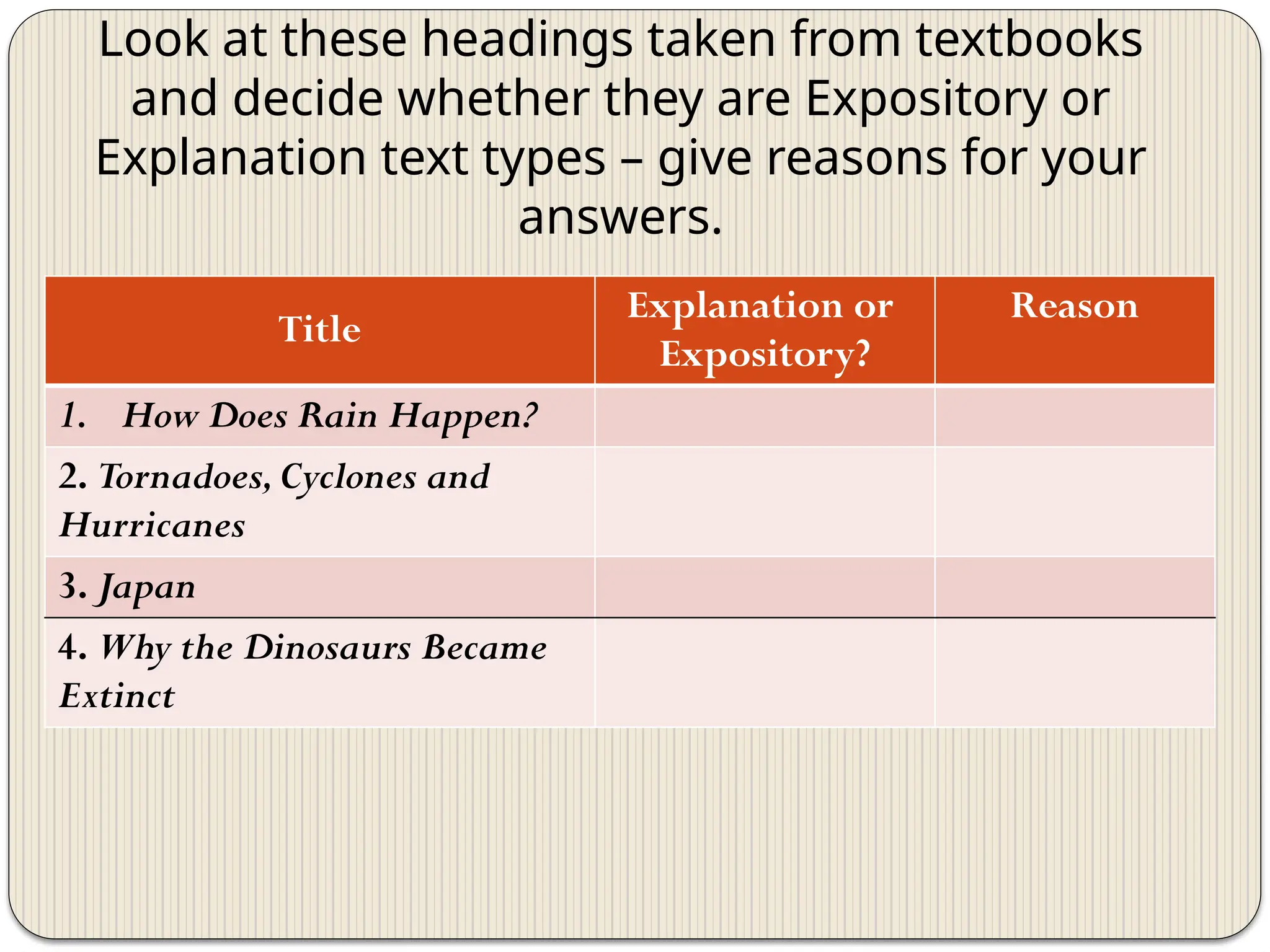
Look at these headings taken from textbooks
and decide whether they are Expository or
Explanation text types – give reasons for your
answers.
Title
Explanation or
Expository?
Reason
1. How Does Rain Happen?
2. Tornadoes,Cyclones and
Hurricanes
3. Japan
4. Why the Dinosaurs Became
Extinct
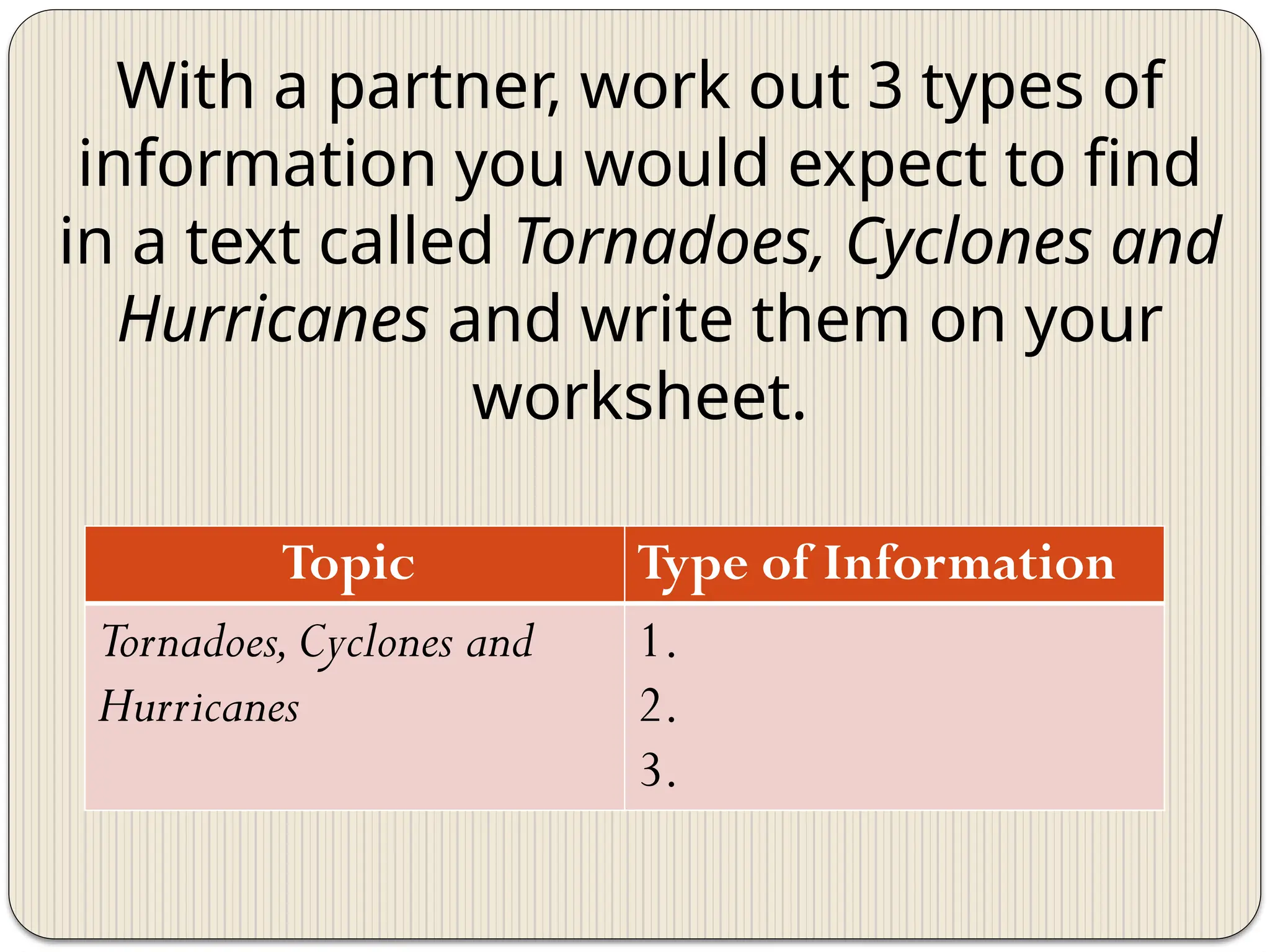
With a partner, work out 3 types of
information you would expect to find
in a text called Tornadoes, Cyclones and
Hurricanes and write them on your
worksheet.
Topic Type of Information
Tornadoes,Cyclones and
Hurricanes
1.
2.
3.
Possible answers:
 Definitions of tornadoes, cyclones and hurricanes;
 differences between them;
 how they formed;
 how they are named;
 features of tornadoes, cyclones and hurricanes; big
ones from the past;
 damage from cyclones, hurricanes etc.
 Expository texts like Information
Reports usually have 2 major
components:
1.A definition of the topic or thing,sometimes called a
CLASSIFICATION.
2.Paragraphs for the each of the various aspects of the topic
or thing.
Some Expository/Information Reports
may have a third feature – a conclusion,
usually in the form of a general statement
about the topic or thing. It’s not always
there though because the main thing about
these types of texts is to give you a lot of
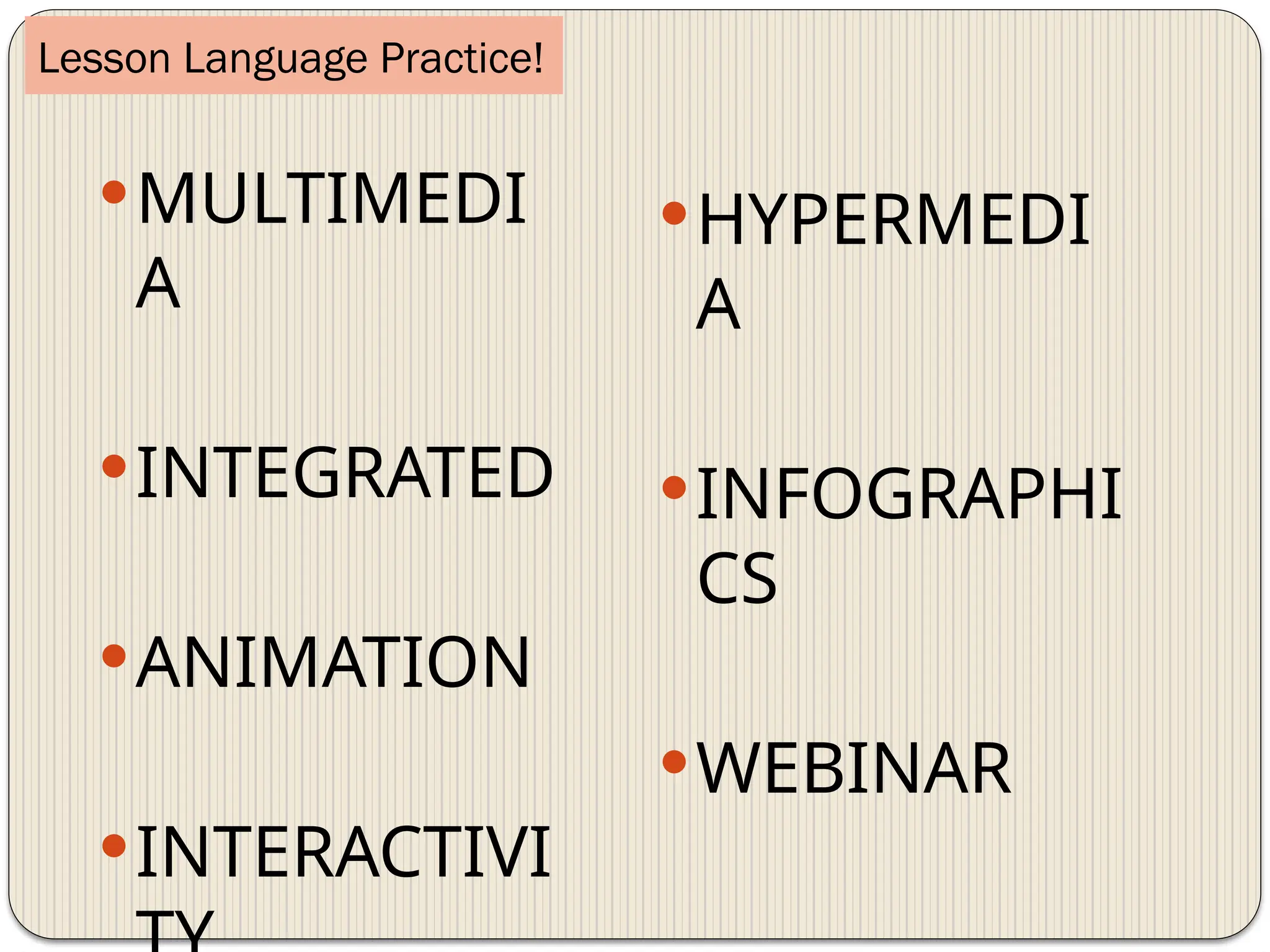
Lesson Language Practice!
MULTIMEDI
A
INTEGRATED
ANIMATION
INTERACTIVI
HYPERMEDI
A
INFOGRAPHI
CS
WEBINAR
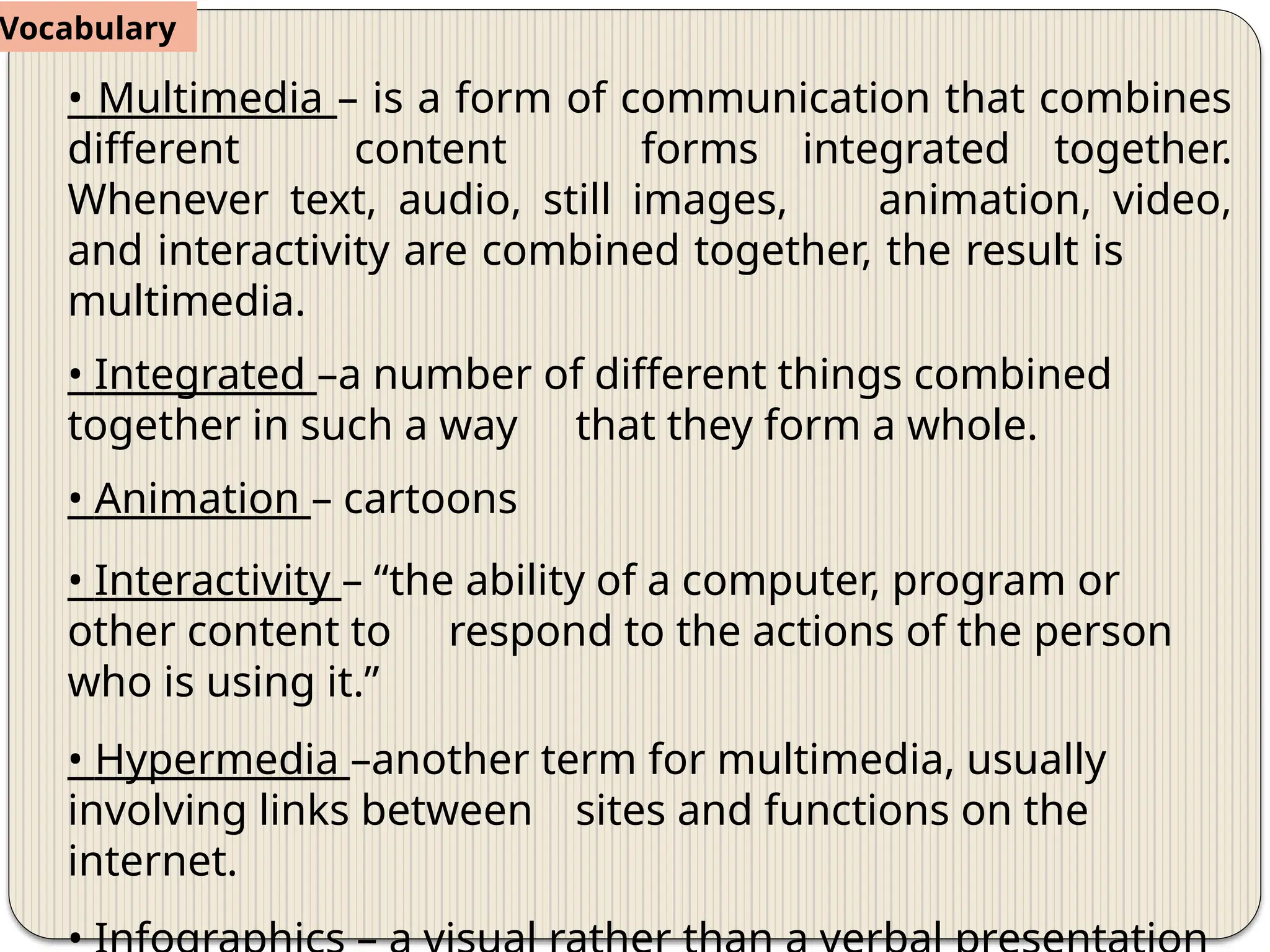
• Multimedia – is a form of communication that combines
different content forms integrated together.
Whenever text, audio, still images, animation, video,
and interactivity are combined together, the result is
multimedia.
• Integrated –a number of different things combined
together in such a way that they form a whole.
• Animation – cartoons
• Interactivity – “the ability of a computer, program or
other content to respond to the actions of the person
who is using it.”
• Hypermedia –another term for multimedia, usually
involving links between sites and functions on the
internet.
Vocabulary
Multimedia
Multimedia is a form of communication that combines different content forms
integrated
together.Whenever text, audio, still images, animation, video, and interactivity are combined
together, the result is multimedia. Other terms that are sometimes used for multimedia include
hypermedia or rich media.
An example of multimedia is a web page with animation. Multimedia can be also an
interactive media such as video games and CDROMS. Slides for example are considered to be
multimedia as they combine text, images, sometimes video and other types.
Below is a list of various multimedia formats used in education.
• Text and Graphics – PowerPoint, diagrams, infographics, slideshow presentation
• Audio – Podcast
• Video – screen capture, lecture capture, talking head, animation, glass screen
• Others – webinar and online meeting, blogs, interactive content.
There are other multimedia formats used in business, entertainments, recreation, and
the likes. Multimedia plays an important role in our society. It enables us to keep up with the times.
[Philippines Department of Education (nd). Multimedia.English 7 Q3Week 1 (p.3).]
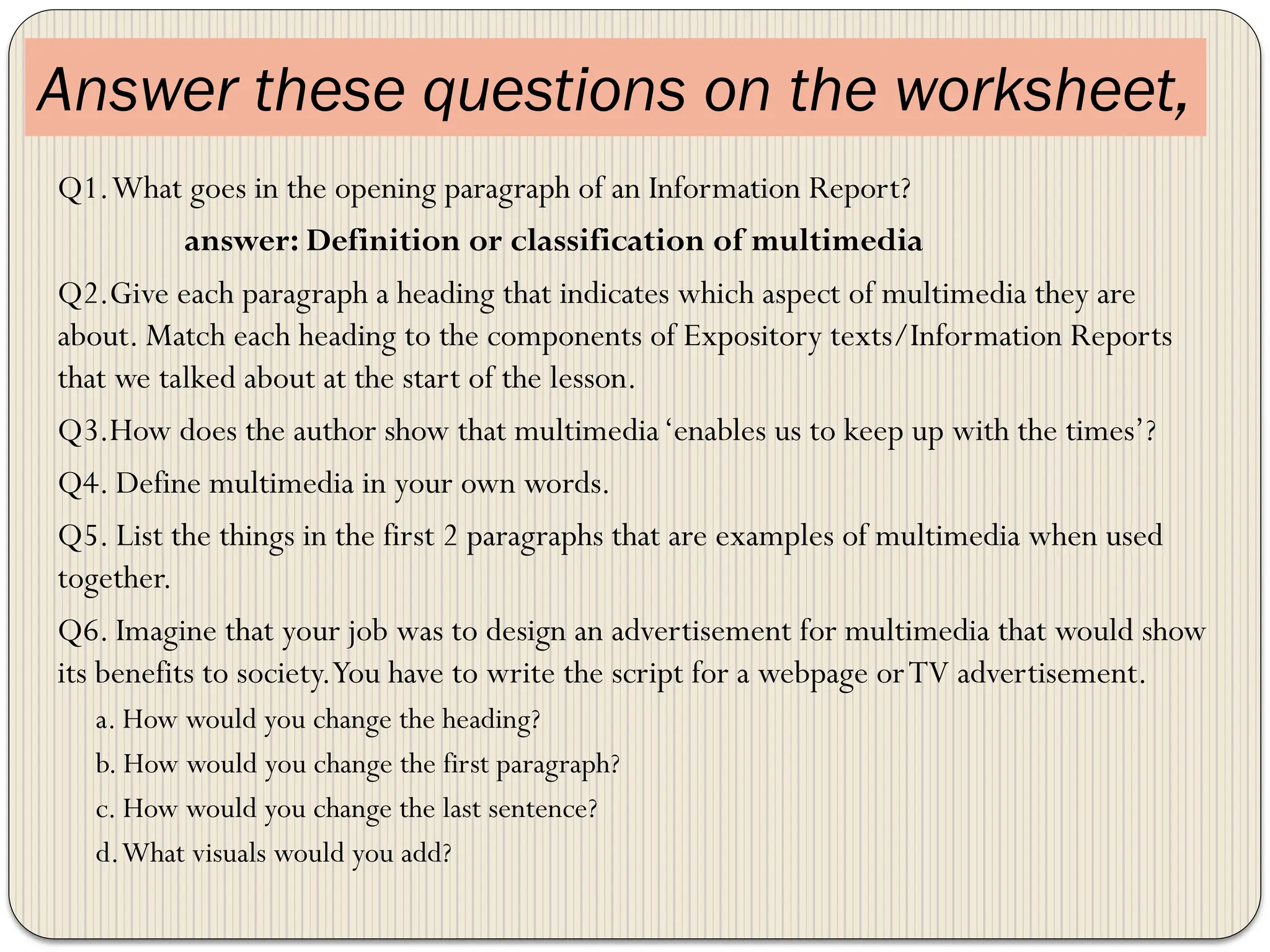
Answer these questions on the worksheet,
Q1.What goes in the opening paragraph of an Information Report?
answer: Definition or classification of multimedia
Q2.Give each paragraph a heading that indicates which aspect of multimedia they are
about. Match each heading to the components of Expository texts/Information Reports
that we talked about at the start of the lesson.
Q3.How does the author show that multimedia‘enables us to keep up with the times’?
Q4. Define multimedia in your own words.
Q5. List the things in the first 2 paragraphs that are examples of multimedia when used
together.
Q6. Imagine that your job was to design an advertisement for multimedia that would show
its benefits to society.You have to write the script for a webpage orTV advertisement.
a. How would you change the heading?
b. How would you change the first paragraph?
c. How would you change the last sentence?
d.What visuals would you add?
Lesson Conclusion
Q1.The focus of the lesson was on learning about
how information is presented in an Expository text
like an Information Report. How has the lesson
helped you to understand this?
Q2.Which questions were easy to answer?Why?
Q3.What strategies did you use to answer the harder
questions?

expository text lesson 7 grade 7 english.pptx

  • 1.
    National Learning Campfor Grade 7 Lesson 7: Features of Expository Texts
  • 2.
    Most Essential LearningCompetencies: • Use appropriate reading strategies to meet one’s purpose (e.g., Scanning, skimming, close reading, etc.) (EN7RC-IV-b-10) • Use appropriate reading strategies for various text types (EN7RC-IV-b-10) • Summarize key information from a text (EN6OL-IVj-3.6) • Cite evidence to support a general statement (EN7RC-IV-g- 10.4) • React to what is asserted or expressed in a text (EN7RC-IIIe- 2.1.7)
  • 3.
    Short Review Last weekwe talked about different types of texts.We learned that they are called Narrative,Expository,Explanation,Recount or Persuasive and we focused on types of text that involved telling a story – sometimes they were factual,they actually happened (recounts) and some of them were fictional,made up, imaginary (narratives).
  • 4.
    Today we aregoing to focus on types of texts that give us information – Expository Texts and Explanation texts.
  • 5.
    Look at theseheadings taken from textbooks and decide whether they are Expository or Explanation text types – give reasons for your answers. Title Explanation or Expository? Reason 1. How Does Rain Happen? 2. Tornadoes,Cyclones and Hurricanes 3. Japan 4. Why the Dinosaurs Became Extinct
  • 6.
    With a partner,work out 3 types of information you would expect to find in a text called Tornadoes, Cyclones and Hurricanes and write them on your worksheet. Topic Type of Information Tornadoes,Cyclones and Hurricanes 1. 2. 3.
  • 7.
    Possible answers:  Definitionsof tornadoes, cyclones and hurricanes;  differences between them;  how they formed;  how they are named;  features of tornadoes, cyclones and hurricanes; big ones from the past;  damage from cyclones, hurricanes etc.
  • 8.
     Expository textslike Information Reports usually have 2 major components: 1.A definition of the topic or thing,sometimes called a CLASSIFICATION. 2.Paragraphs for the each of the various aspects of the topic or thing. Some Expository/Information Reports may have a third feature – a conclusion, usually in the form of a general statement about the topic or thing. It’s not always there though because the main thing about these types of texts is to give you a lot of
  • 9.
  • 10.
    • Multimedia –is a form of communication that combines different content forms integrated together. Whenever text, audio, still images, animation, video, and interactivity are combined together, the result is multimedia. • Integrated –a number of different things combined together in such a way that they form a whole. • Animation – cartoons • Interactivity – “the ability of a computer, program or other content to respond to the actions of the person who is using it.” • Hypermedia –another term for multimedia, usually involving links between sites and functions on the internet. Vocabulary
  • 11.
    Multimedia Multimedia is aform of communication that combines different content forms integrated together.Whenever text, audio, still images, animation, video, and interactivity are combined together, the result is multimedia. Other terms that are sometimes used for multimedia include hypermedia or rich media. An example of multimedia is a web page with animation. Multimedia can be also an interactive media such as video games and CDROMS. Slides for example are considered to be multimedia as they combine text, images, sometimes video and other types. Below is a list of various multimedia formats used in education. • Text and Graphics – PowerPoint, diagrams, infographics, slideshow presentation • Audio – Podcast • Video – screen capture, lecture capture, talking head, animation, glass screen • Others – webinar and online meeting, blogs, interactive content. There are other multimedia formats used in business, entertainments, recreation, and the likes. Multimedia plays an important role in our society. It enables us to keep up with the times. [Philippines Department of Education (nd). Multimedia.English 7 Q3Week 1 (p.3).]
  • 12.
    Answer these questionson the worksheet, Q1.What goes in the opening paragraph of an Information Report? answer: Definition or classification of multimedia Q2.Give each paragraph a heading that indicates which aspect of multimedia they are about. Match each heading to the components of Expository texts/Information Reports that we talked about at the start of the lesson. Q3.How does the author show that multimedia‘enables us to keep up with the times’? Q4. Define multimedia in your own words. Q5. List the things in the first 2 paragraphs that are examples of multimedia when used together. Q6. Imagine that your job was to design an advertisement for multimedia that would show its benefits to society.You have to write the script for a webpage orTV advertisement. a. How would you change the heading? b. How would you change the first paragraph? c. How would you change the last sentence? d.What visuals would you add?
  • 13.
    Lesson Conclusion Q1.The focusof the lesson was on learning about how information is presented in an Expository text like an Information Report. How has the lesson helped you to understand this? Q2.Which questions were easy to answer?Why? Q3.What strategies did you use to answer the harder questions?