


1
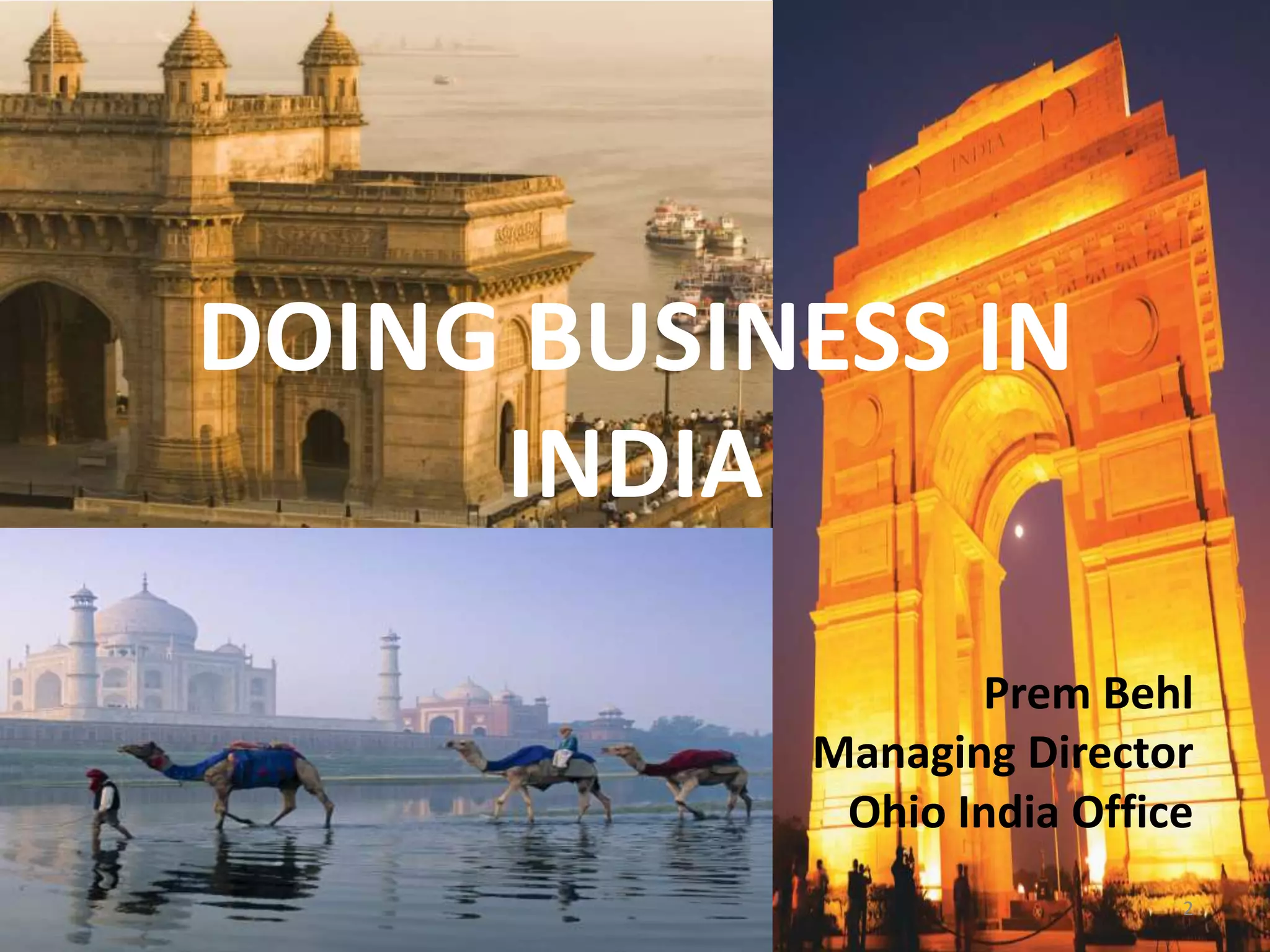
DOING BUSINESS IN
     INDIA

                  Prem Behl
           Managing Director
            Ohio India Office
                            2
INDEX
 1. India: Country Profile
 -Geographical Profile…………………………………………………………………….04
 -Demographic Profile…………………………………………………………………….08
 -Political Profile…………………………………………………………………………….10
 -Economic Profile………………………………………………………………………….11
 2. Key Sectors & Market Opportunities
 a. Aerospace & defense……………………………………………………………….20
 b. Automotive …………………………………………………………………………….24
 c. Heath Sciences…………………………………………………………………………28
 d. Power (Cleantech & Utilities)……………………………………………………32
 3. India-US Trade…………………………………………………..36
 4. Conclusion: Doing Business in India…………………..42


                                                          3
COUNTRY PROFILE

INDIA


                  4
Geographical Profile


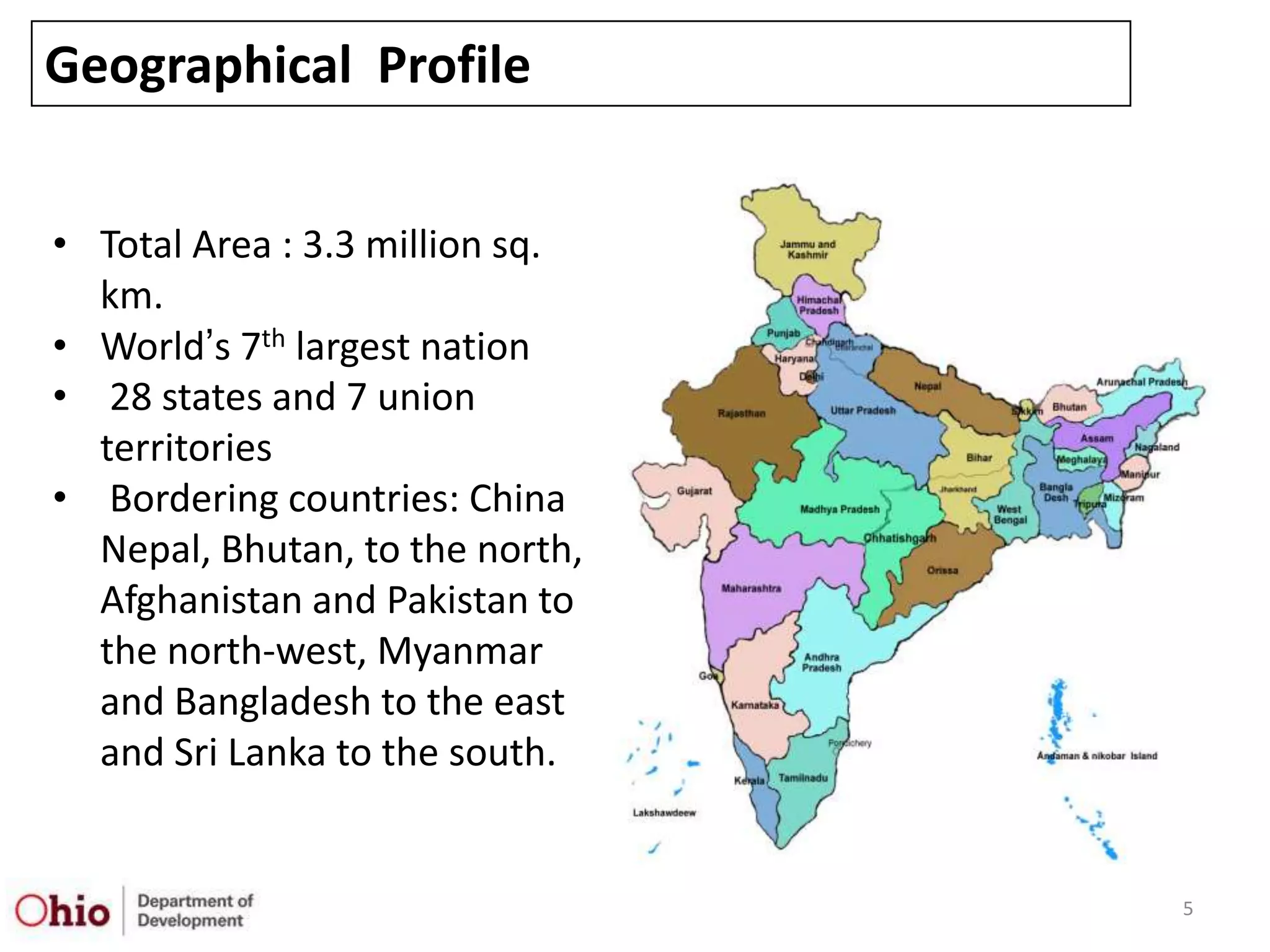
• Total Area : 3.3 million sq.
  km.
• World‟s 7th largest nation
• 28 states and 7 union
  territories
• Bordering countries: China
  Nepal, Bhutan, to the north,
  Afghanistan and Pakistan to
  the north-west, Myanmar
  and Bangladesh to the east
  and Sri Lanka to the south.


                                 5
Geographical Profile


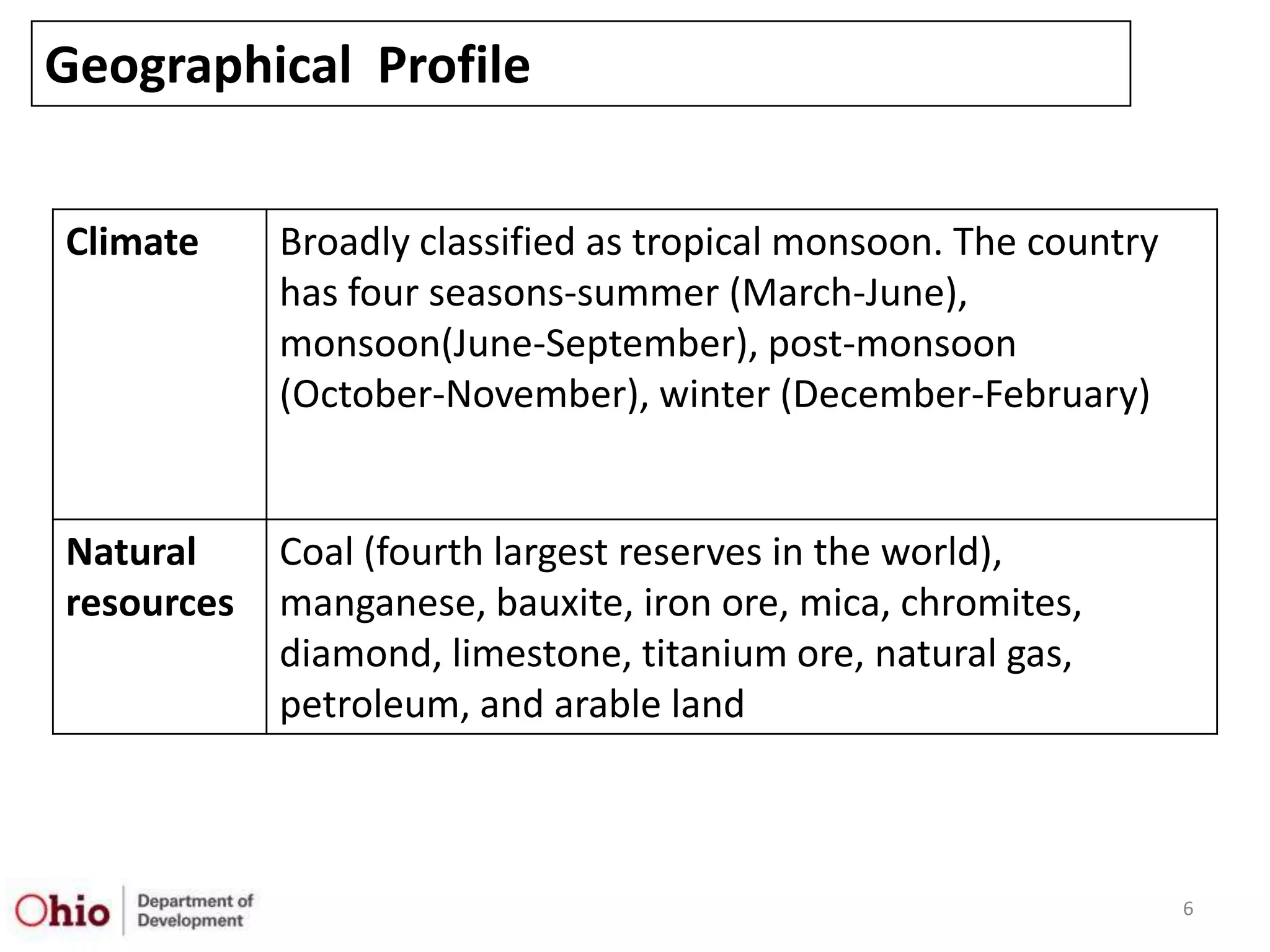
Climate     Broadly classified as tropical monsoon. The country
            has four seasons-summer (March-June),
            monsoon(June-September), post-monsoon
            (October-November), winter (December-February)


Natural     Coal (fourth largest reserves in the world),
resources   manganese, bauxite, iron ore, mica, chromites,
            diamond, limestone, titanium ore, natural gas,
            petroleum, and arable land


                                                                  6
Geographical Profile

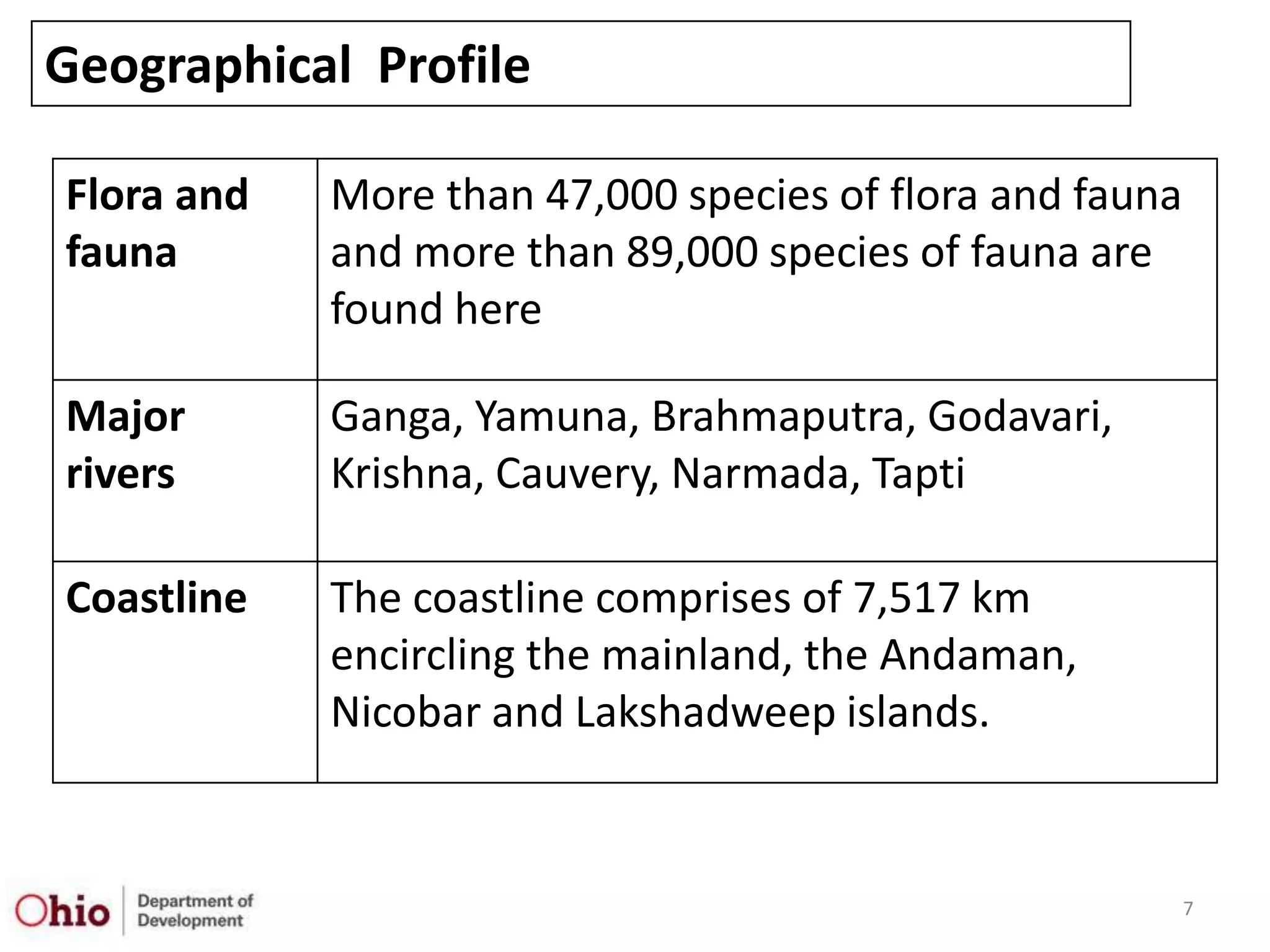
Flora and   More than 47,000 species of flora and fauna
fauna       and more than 89,000 species of fauna are
            found here

Major       Ganga, Yamuna, Brahmaputra, Godavari,
rivers      Krishna, Cauvery, Narmada, Tapti

Coastline   The coastline comprises of 7,517 km
            encircling the mainland, the Andaman,
            Nicobar and Lakshadweep islands.


                                                          7
Geographical Profile


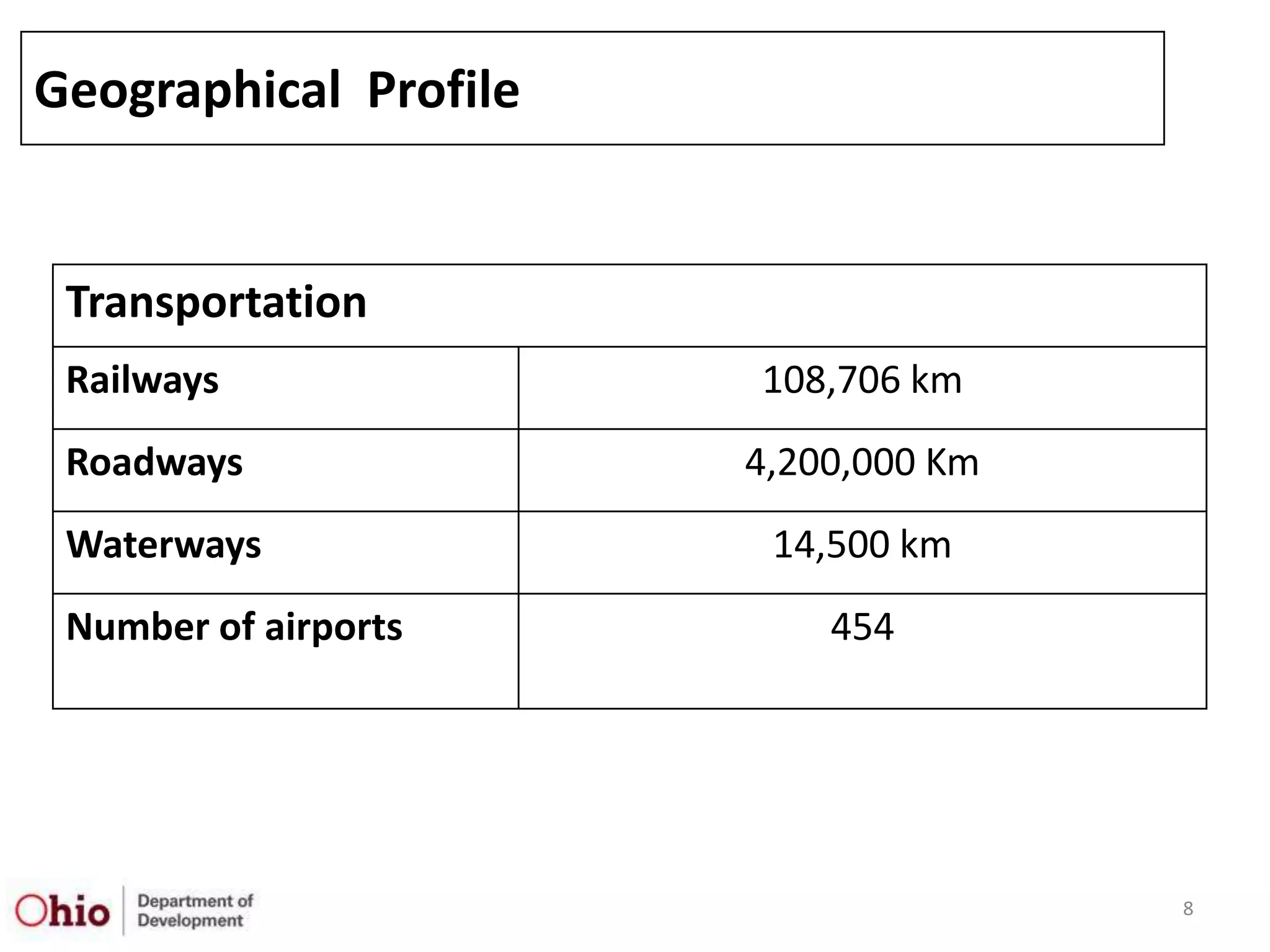
 Transportation
 Railways              108,706 km
 Roadways              4,200,000 Km
 Waterways              14,500 km
 Number of airports        454


                                      8
Demographic Profile

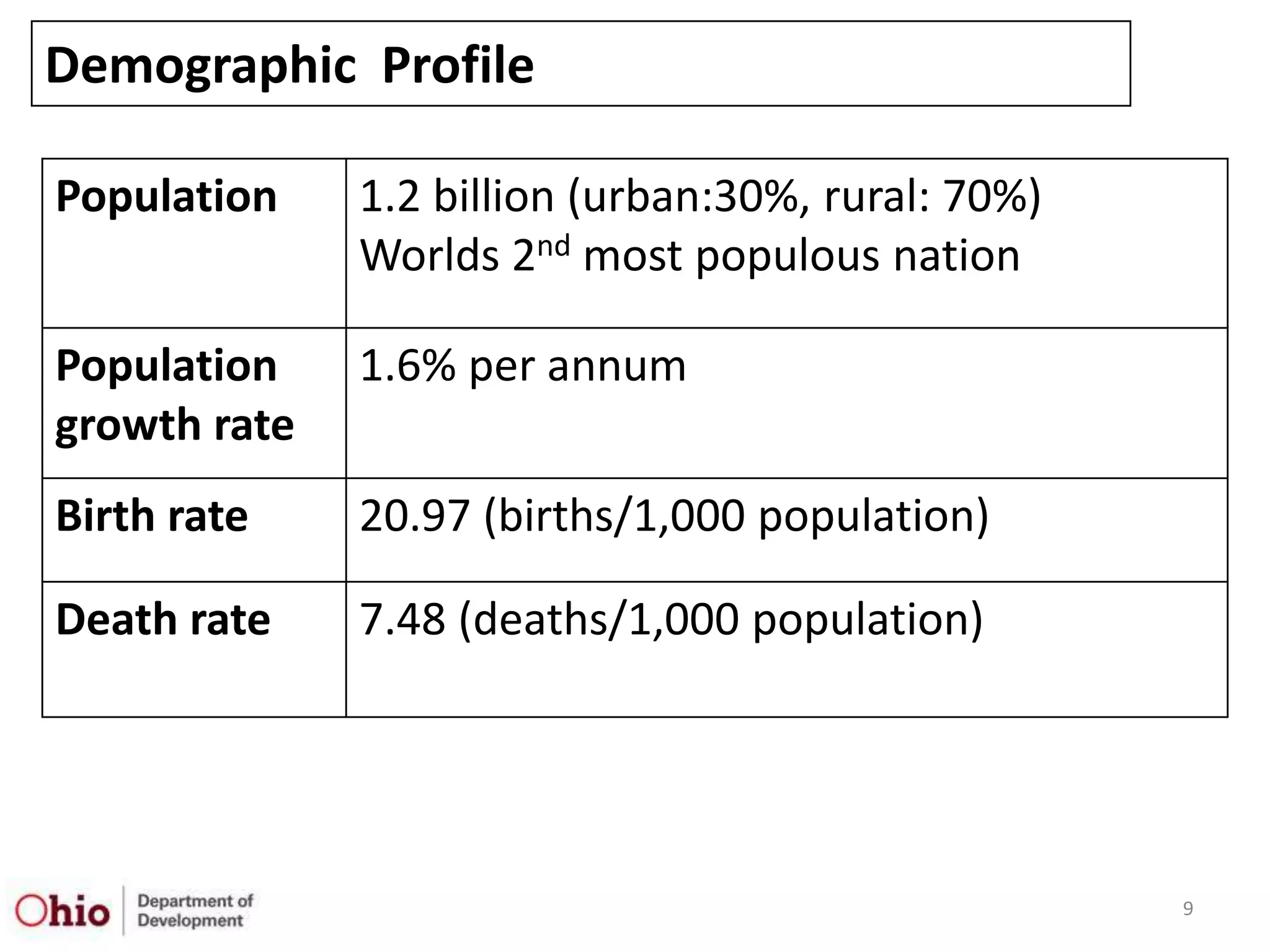
Population    1.2 billion (urban:30%, rural: 70%)
              Worlds 2nd most populous nation

Population    1.6% per annum
growth rate
Birth rate    20.97 (births/1,000 population)

Death rate    7.48 (deaths/1,000 population)


                                                    9
Demographic Profile

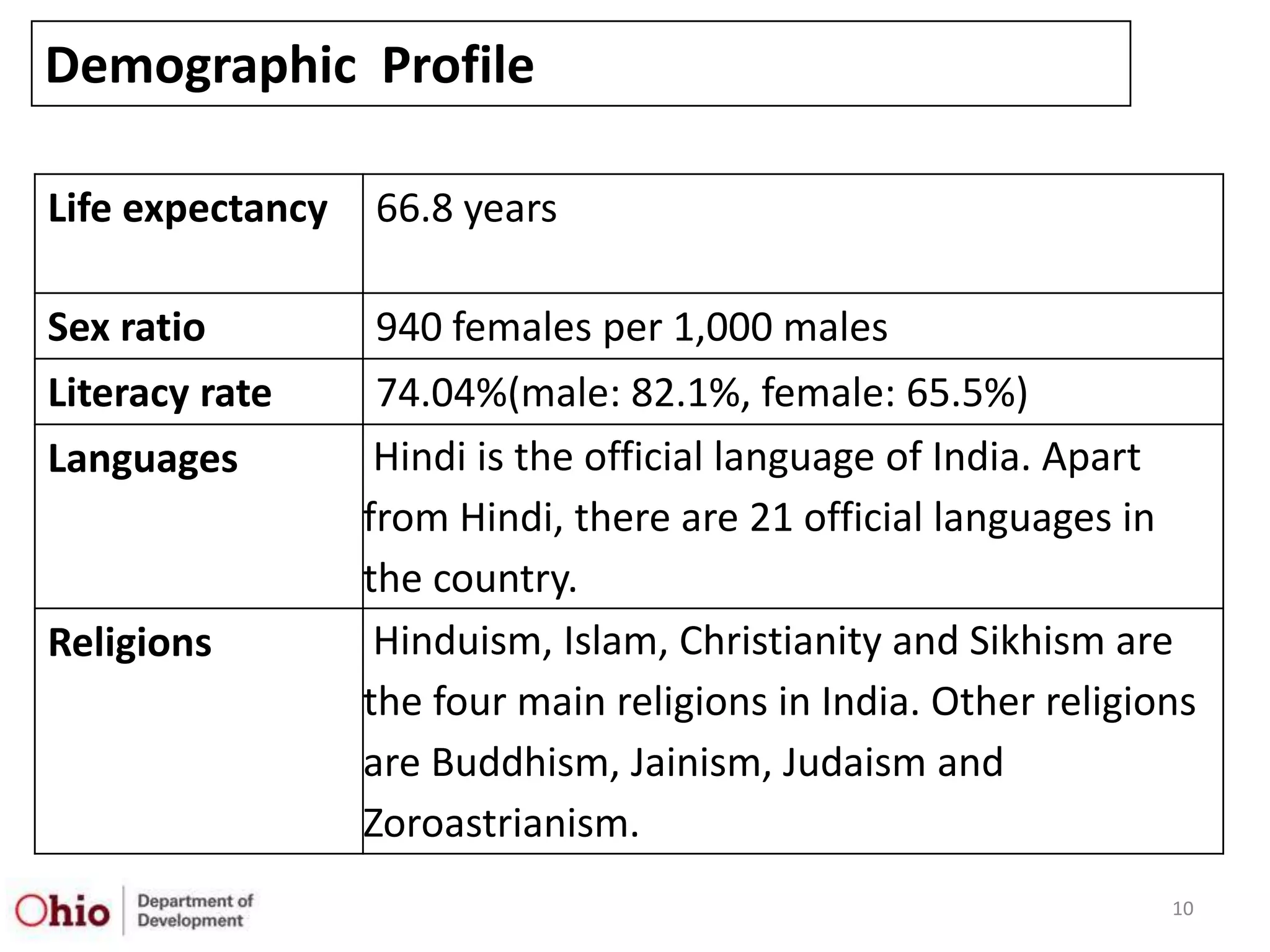
Life expectancy   66.8 years

Sex ratio          940 females per 1,000 males
Literacy rate      74.04%(male: 82.1%, female: 65.5%)
Languages          Hindi is the official language of India. Apart
                  from Hindi, there are 21 official languages in
                  the country.
Religions          Hinduism, Islam, Christianity and Sikhism are
                  the four main religions in India. Other religions
                  are Buddhism, Jainism, Judaism and
                  Zoroastrianism.
                                                                 10
Political Profile
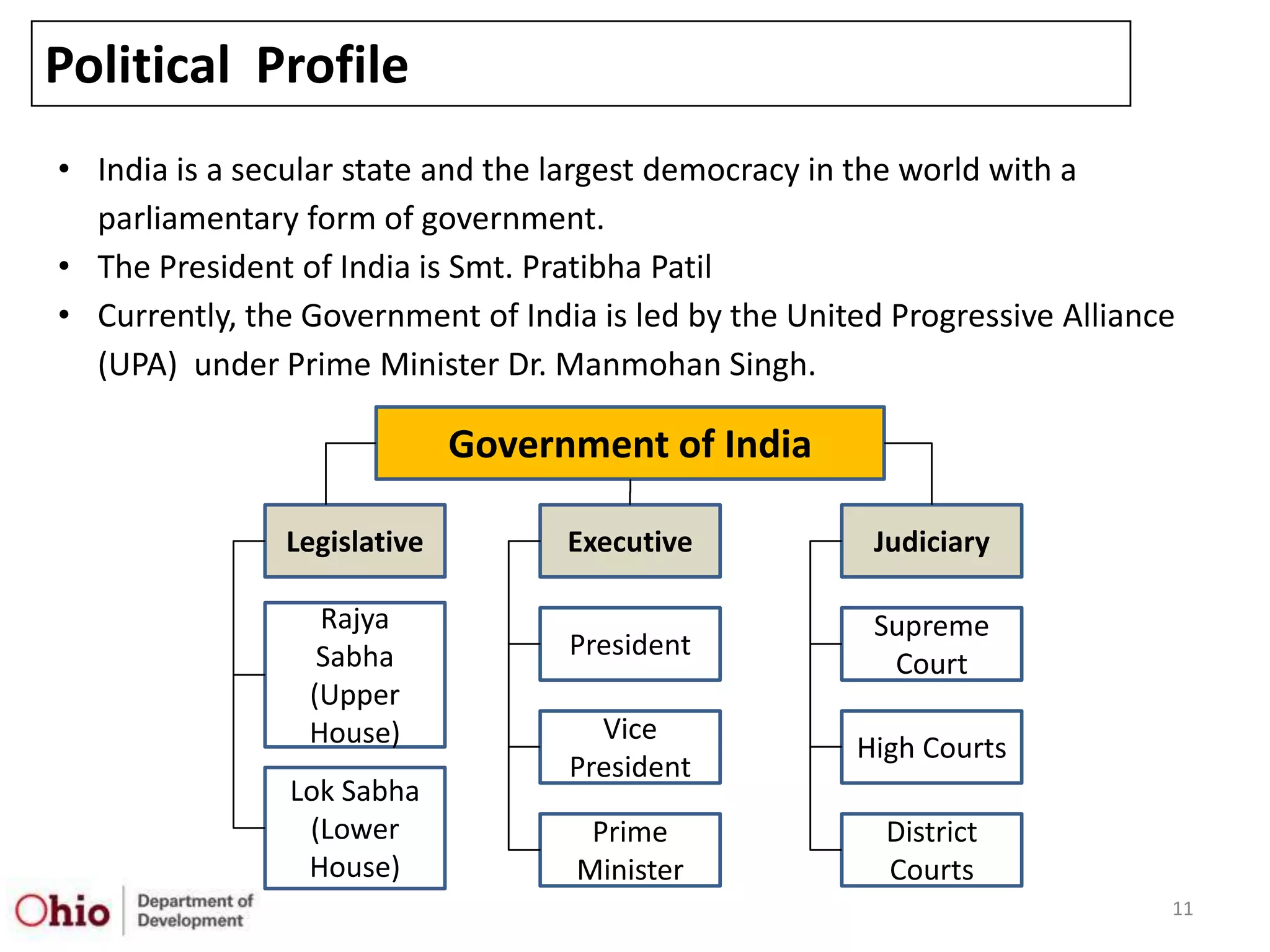
• India is a secular state and the largest democracy in the world with a
  parliamentary form of government.
• The President of India is Smt. Pratibha Patil
• Currently, the Government of India is led by the United Progressive Alliance
  (UPA) under Prime Minister Dr. Manmohan Singh.

                             Government of India

               Legislative         Executive            Judiciary

                  Rajya                                 Supreme
                  Sabha            President
                                                         Court
                 (Upper
                 House)              Vice
                                                       High Courts
                                   President
                Lok Sabha
                 (Lower              Prime               District
                 House)             Minister             Courts
                                                                             11
Economic Profile

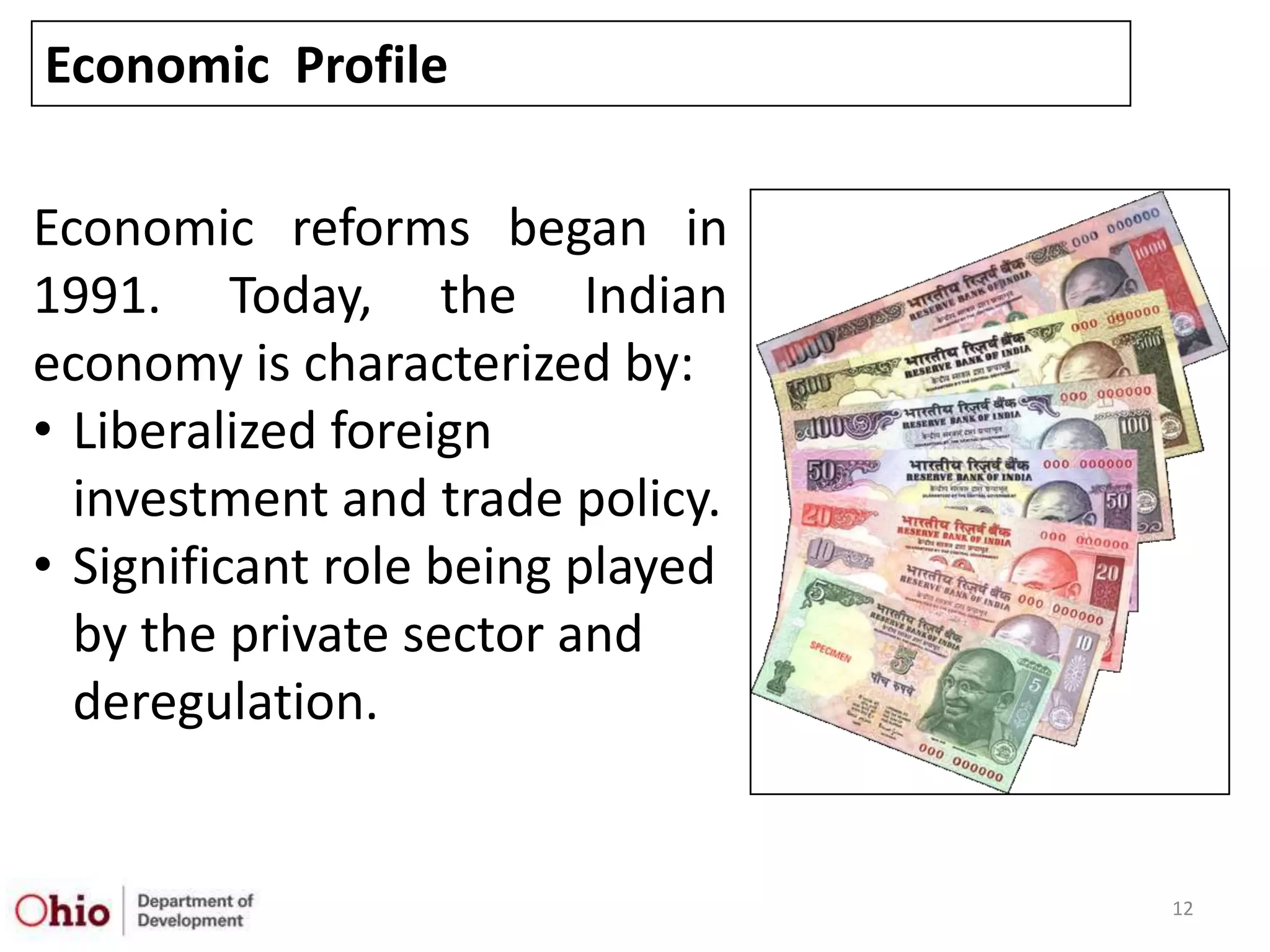
Economic reforms began in
1991. Today, the Indian
economy is characterized by:
• Liberalized foreign
  investment and trade policy.
• Significant role being played
  by the private sector and
  deregulation.


                                  12
Economic Profile


 • India has grown to become a trillion dollar
 economy :
        - Self-sufficient agricultural sector.

      - Diversified industrial base.

      - Stable financial and services sector.


                                                 13
Economic Profile

• The Economy of India is:
     - 9th largest in the world by nominal GDP $1.846
        trillion
     - 3rd largest in PPP terms at $4.469 trillion
• GDP has been growing at an average rate of 8.6% for
  the last 5 years.
• The country's per capita GDP :
     -Nominal was $1,527
     -PPP was $3,703 in 2011, making it a lower-middle
      income economy.


                                                         14
Economic Profile

Domestic consumption fuelling economic growth:

• India has been and continues to be relatively
  insulated from external shocks due to its strong
  domestic consumption pattern
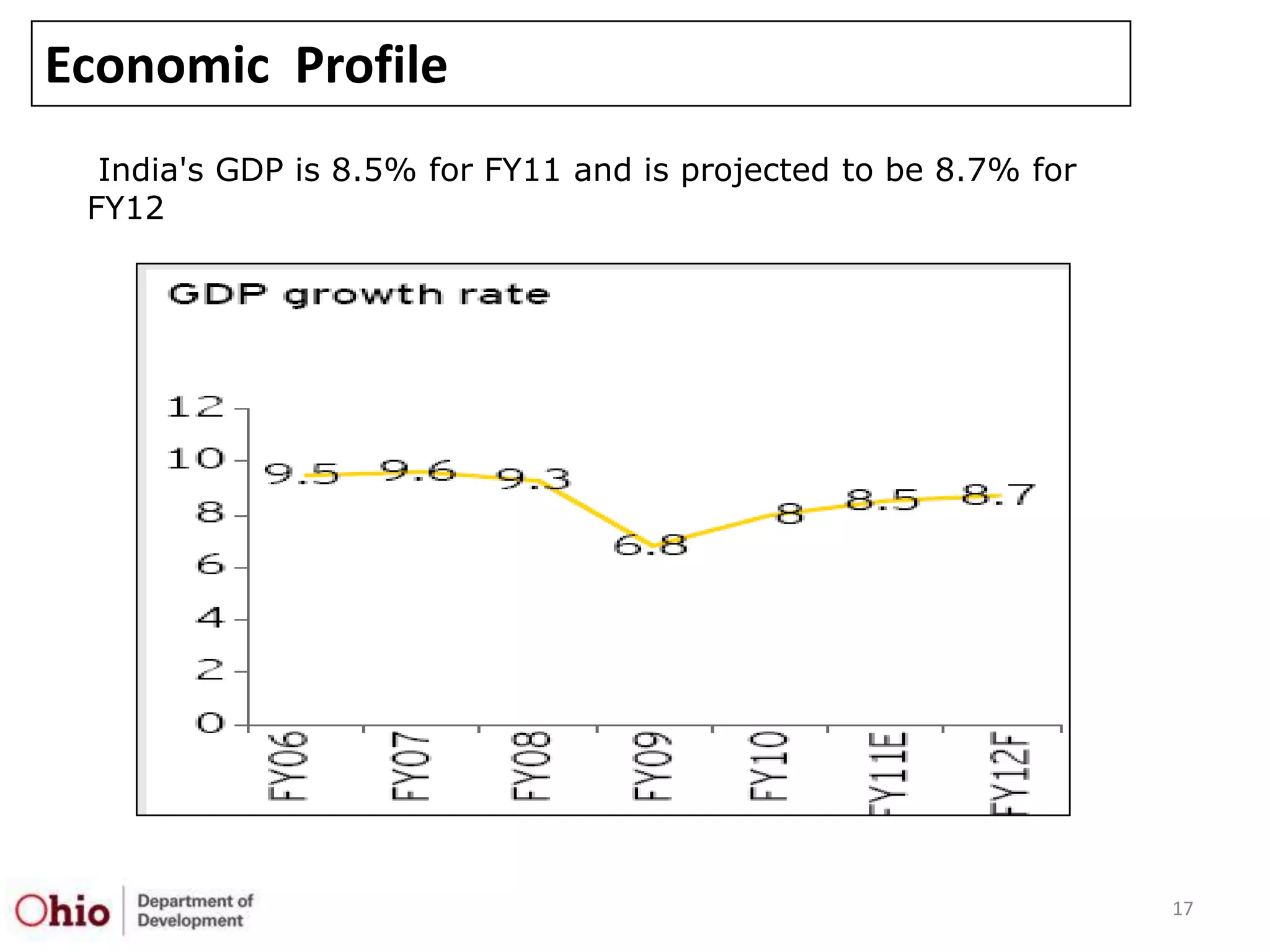
• Consequently, India was relatively unaffected by
  the global recession in 2009, recording a GDP
  growth rate of 6.8%

                                                 15
Economic Profile

Domestic consumption fuelling economic growth:
•Increasing urbanization and modern technology
have brought about a remarkable change in the
lifestyles and consumption pattern of Indians.
•Private domestic consumption accounts for more
than 50% of the country‟s GDP and is one of the key
factors driving overseas investments in the country.


                                                       16
Economic Profile
  India's GDP is 8.5% for FY11 and is projected to be 8.7% for
 FY12


                                                                 17
Economic Profile
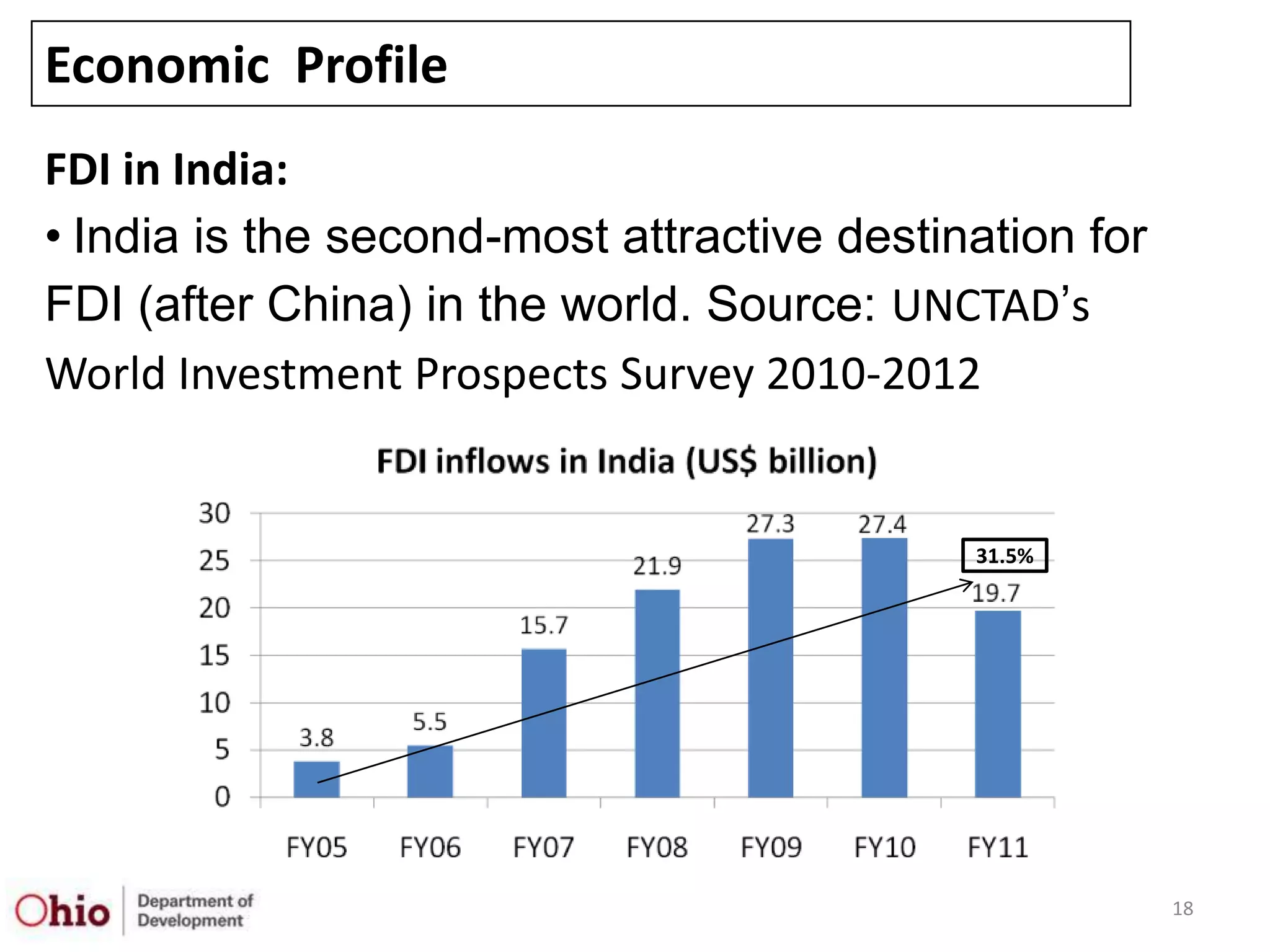
FDI in India:
• India is the second-most attractive destination for
FDI (after China) in the world. Source: UNCTAD‟s
World Investment Prospects Survey 2010-2012


                                            31.5%


                                                        18
Economic Profile

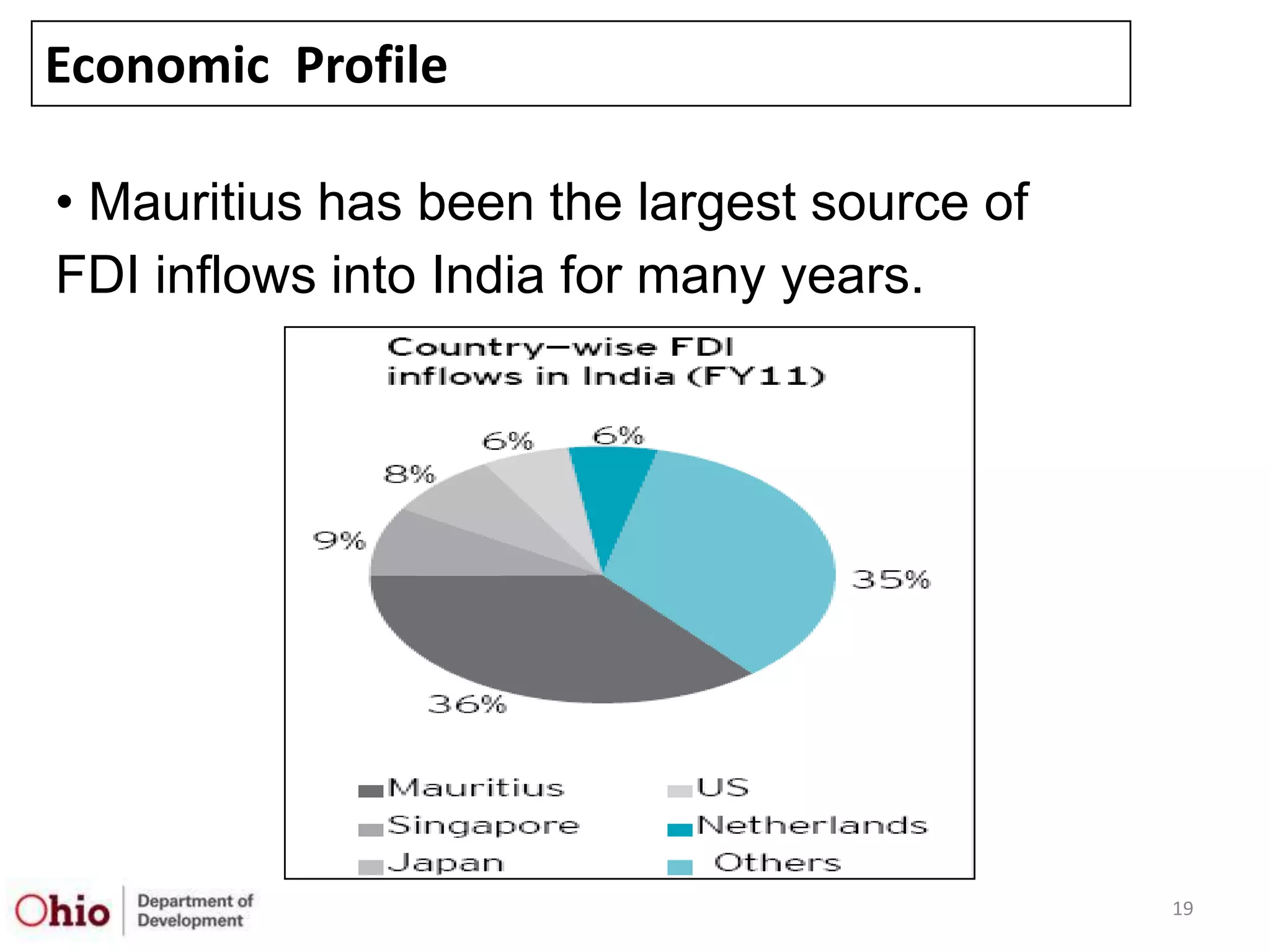
• Mauritius has been the largest source of
FDI inflows into India for many years.


                                             19
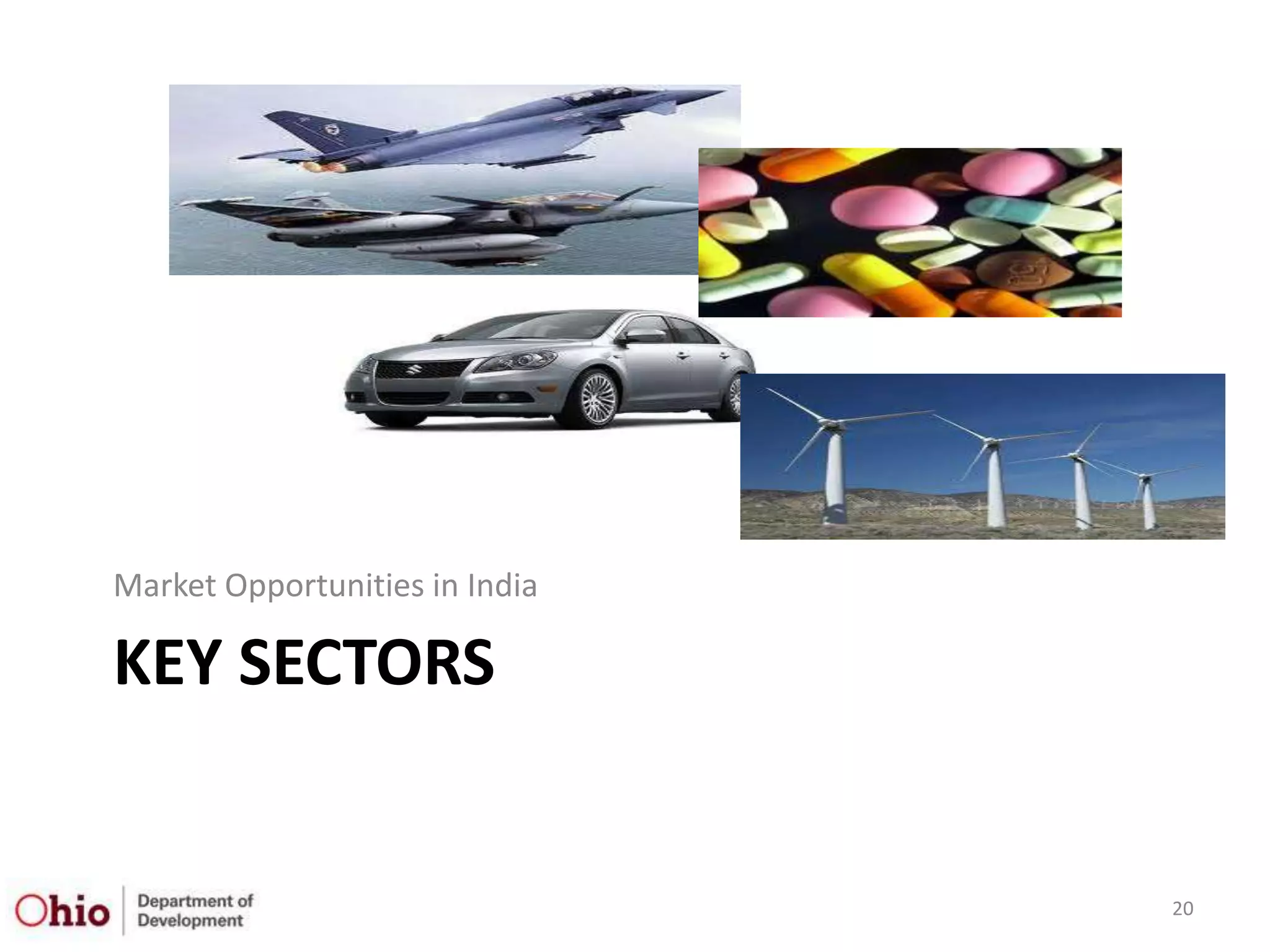
Market Opportunities in India

KEY SECTORS


                                20
Aerospace and Defense


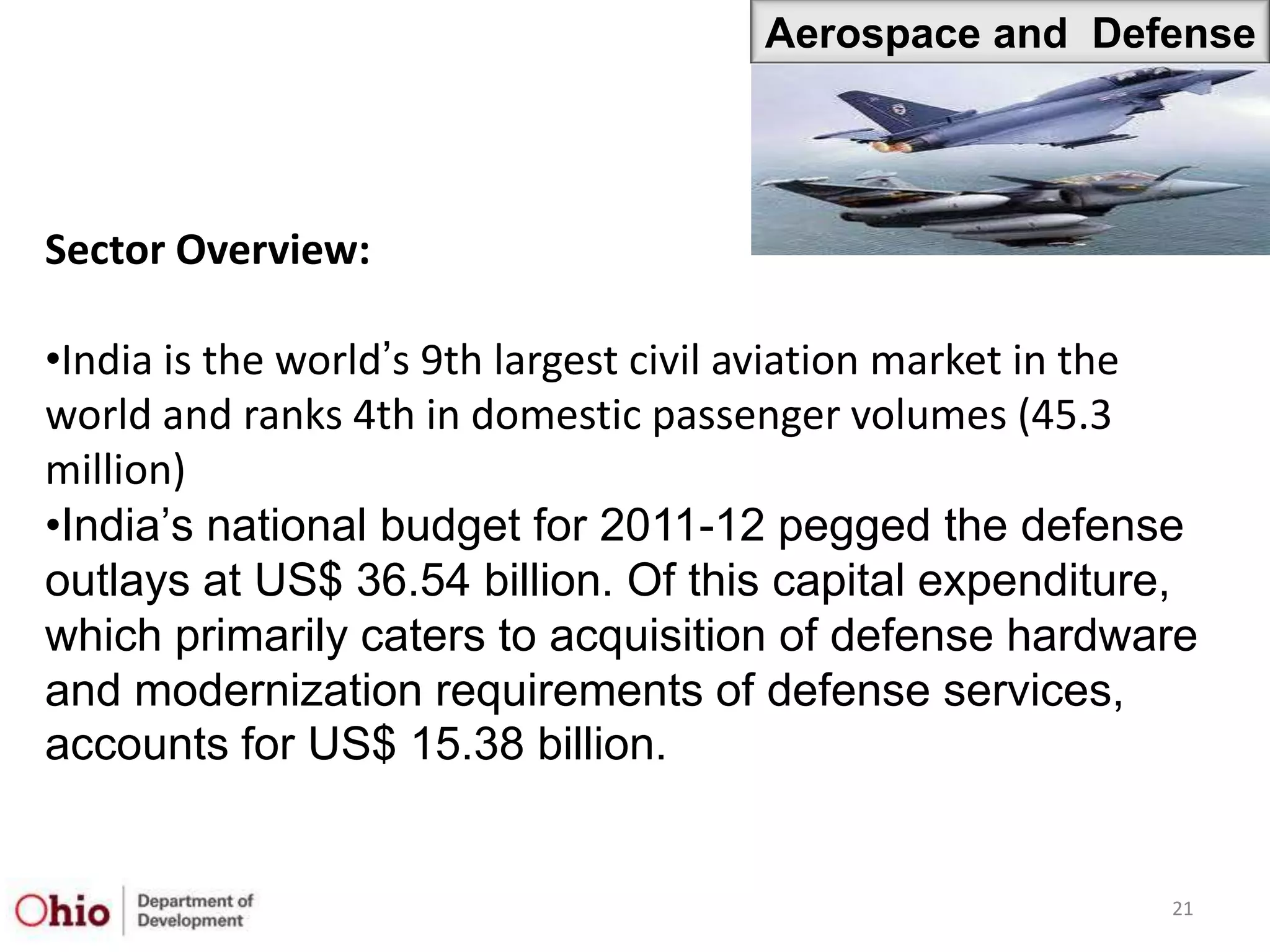
Sector Overview:

•India is the world‟s 9th largest civil aviation market in the
world and ranks 4th in domestic passenger volumes (45.3
million)
•India‟s national budget for 2011-12 pegged the defense
outlays at US$ 36.54 billion. Of this capital expenditure,
which primarily caters to acquisition of defense hardware
and modernization requirements of defense services,
accounts for US$ 15.38 billion.


                                                            21
Aerospace and Defense


Sector Overview:

•The Indian military is expected to spend roughly
around US$ 80 billion over the next four to five
years.
•It ranks among the top 10 countries in the world
in terms of military expenditure.
•India is one of the largest users and importers of
conventional defense equipment.


                                                  22
Aerospace and Defense


Foreign direct investment:

The policy for foreign direct investment (FDI) in
the defense sector is up to 100% for Indian
private sector participation, with FDI permissible
up to 26%, both subject to licensing and GoI
approval.


                                                     23
Aerospace and Defense

Outlook:

Aerospace and Defense Industry growth is
driven by factors:
• Progressive policy changes initiated by the
  Government of India (GoI) to modernize and
  develop its aerospace and defense industry
• Cost advantages
• Talent base
• IT competitiveness


                                                24
Automotive


Sector Overview:

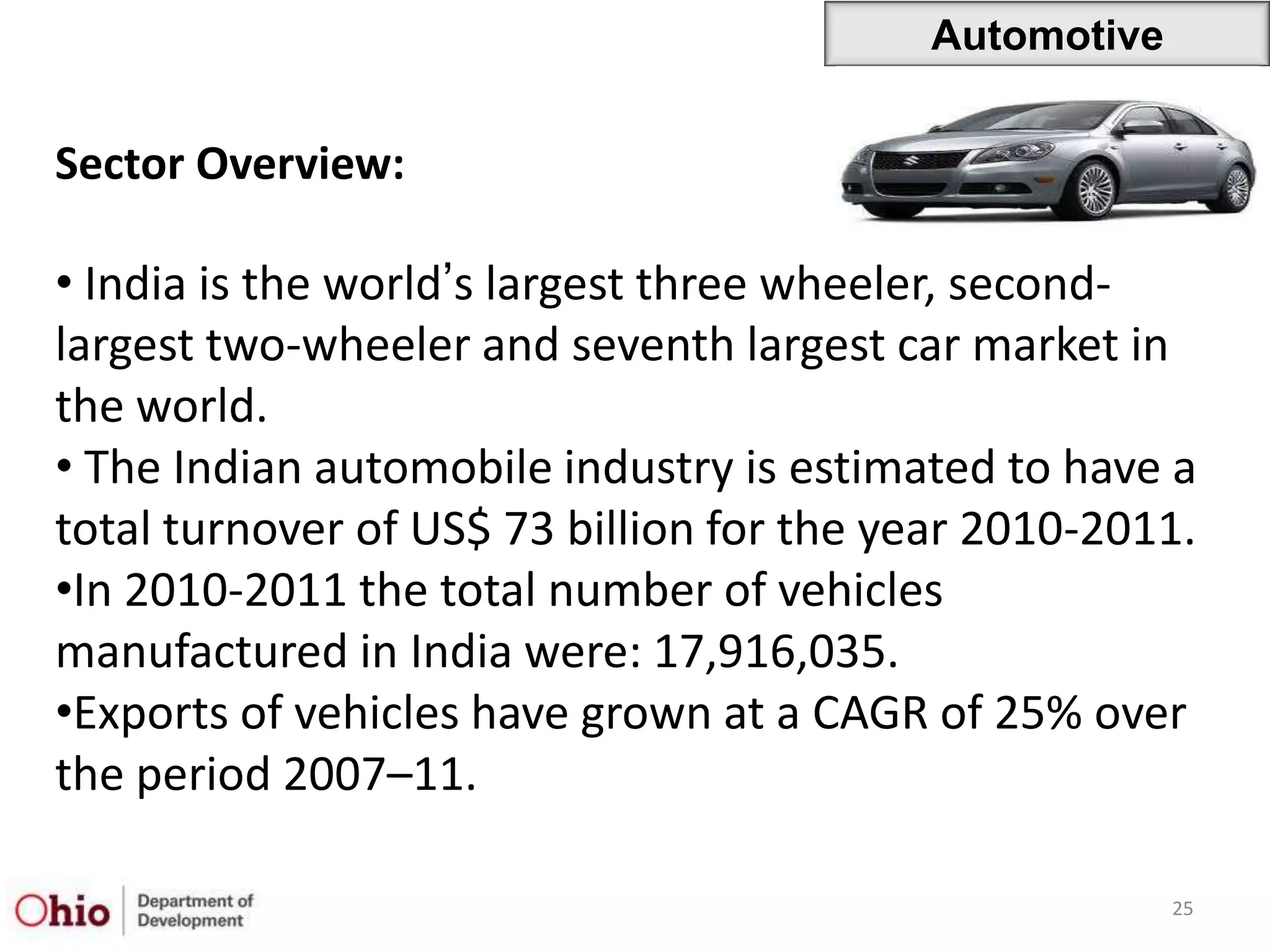
• India is the world‟s largest three wheeler, second-
largest two-wheeler and seventh largest car market in
the world.
• The Indian automobile industry is estimated to have a
total turnover of US$ 73 billion for the year 2010-2011.
•In 2010-2011 the total number of vehicles
manufactured in India were: 17,916,035.
•Exports of vehicles have grown at a CAGR of 25% over
the period 2007–11.

                                                       25
Automotive


Sector Overview:

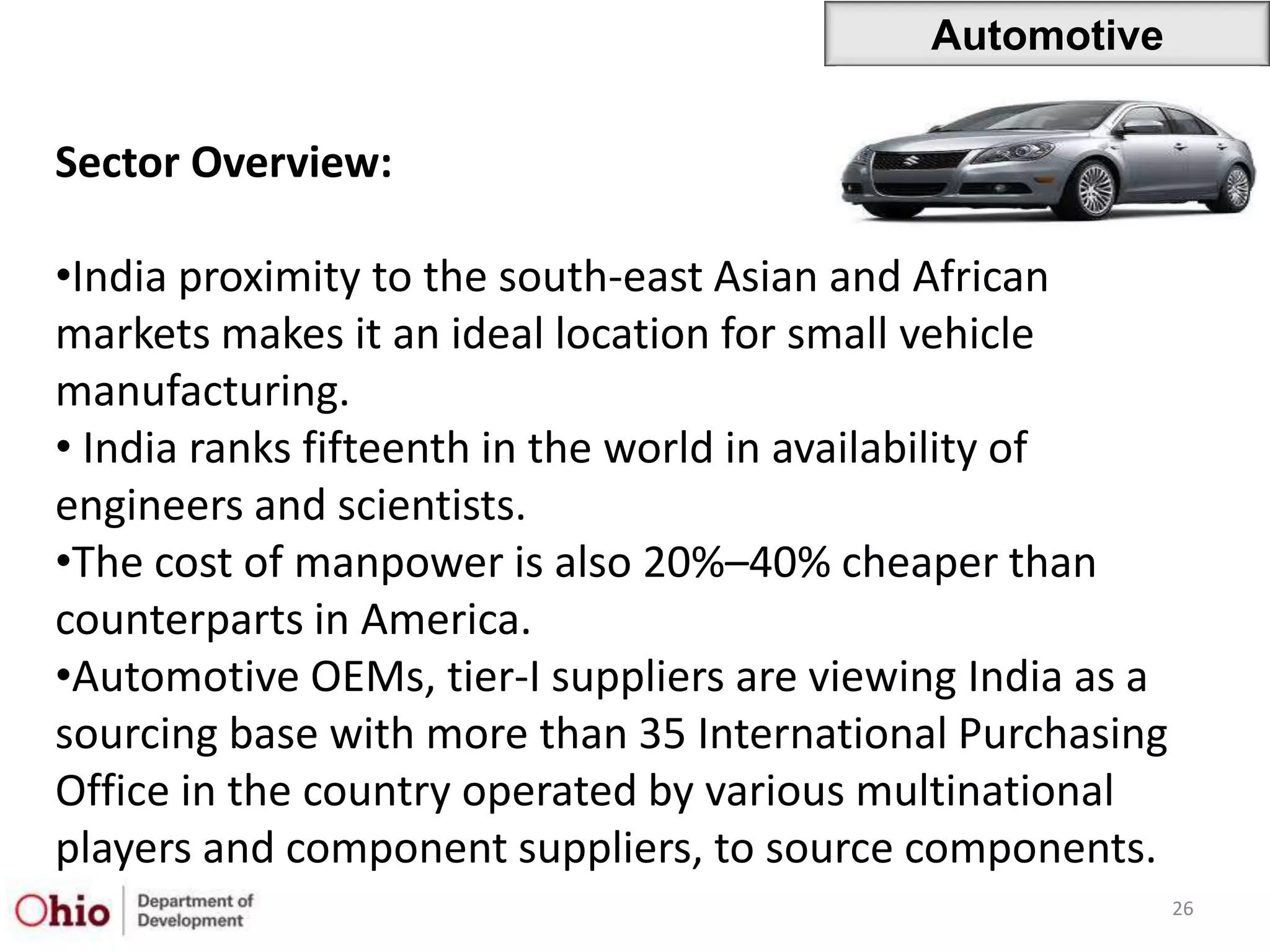
•India proximity to the south-east Asian and African
markets makes it an ideal location for small vehicle
manufacturing.
• India ranks fifteenth in the world in availability of
engineers and scientists.
•The cost of manpower is also 20%–40% cheaper than
counterparts in America.
•Automotive OEMs, tier-I suppliers are viewing India as a
sourcing base with more than 35 International Purchasing
Office in the country operated by various multinational
players and component suppliers, to source components.
                                                            26
Automotive

Foreign direct investment:

•FDI of up to 100% is allowed under the automatic
route.

•200% weighted deduction on R&D expenditure.

•Most state governments offer additional incentives to
vehicle manufacturers, in order to encourage them to
set up manufacturing units in their respective states.


                                                      27
Automotive

Outlook:
•India is the second-fastest growing vehicle market in the world:
-Primarily due to the rising personal disposable income and a
growing middle class.
-The number of households in the middle income group is expected to
rise to 170 million by 2015 providing immense scope for growth in
the passenger car density, which is currently 11 per 1000 people
-The increasing working population, favorable government policies
and availability of low cost finance were the key drivers of domestic
market growth.
-India is poised to become one of the top five vehicle producing
nations.
    - By 2020, vehicle production is set to treble from 2009 levels and
       the size of the component sector is set to grow from US$ 30 to
       US$ 110 billion.
                                                                    28
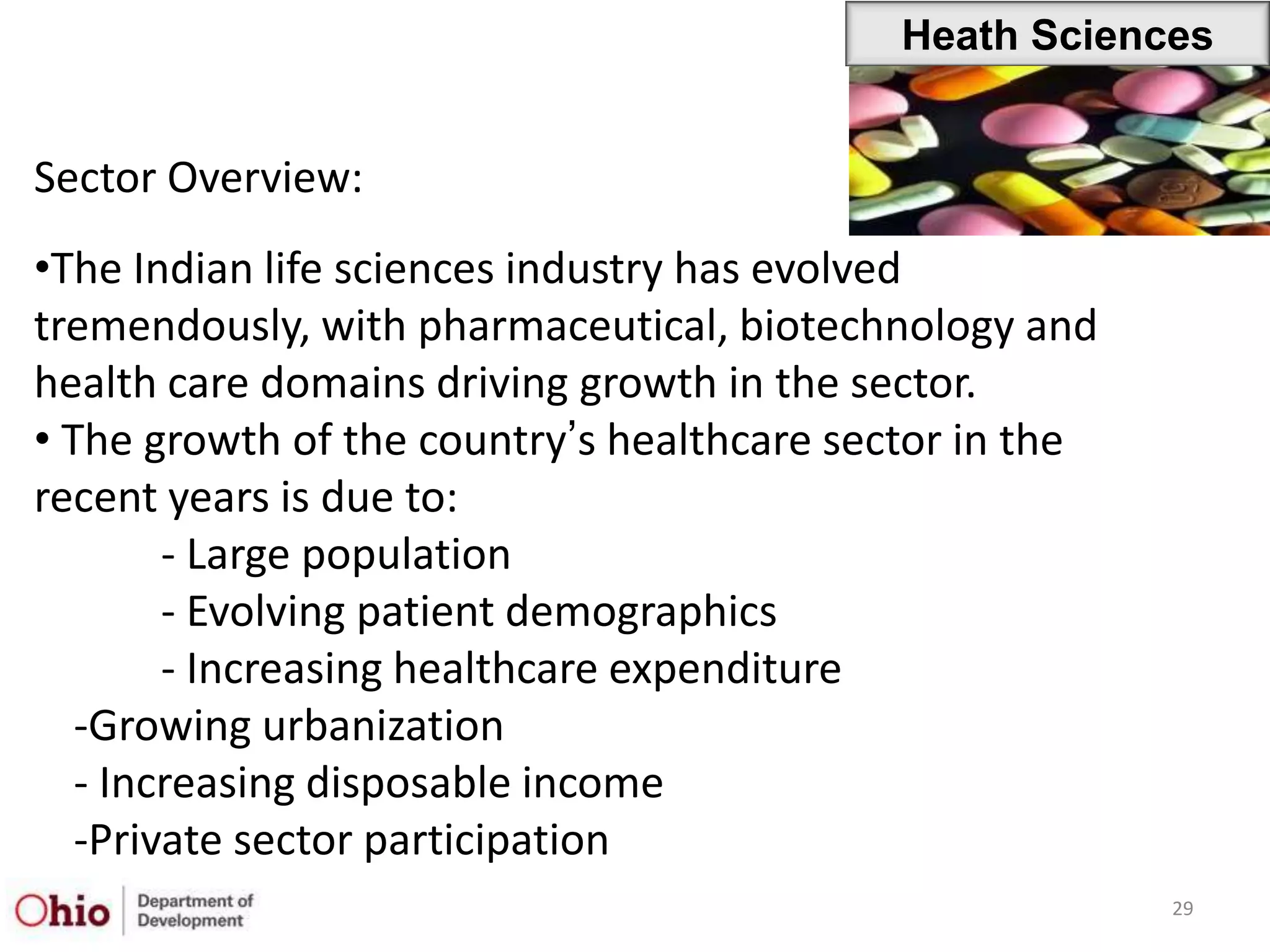
Heath Sciences


Sector Overview:
•The Indian life sciences industry has evolved
tremendously, with pharmaceutical, biotechnology and
health care domains driving growth in the sector.
• The growth of the country‟s healthcare sector in the
recent years is due to:
        - Large population
        - Evolving patient demographics
        - Increasing healthcare expenditure
   -Growing urbanization
   - Increasing disposable income
   -Private sector participation
                                                         29
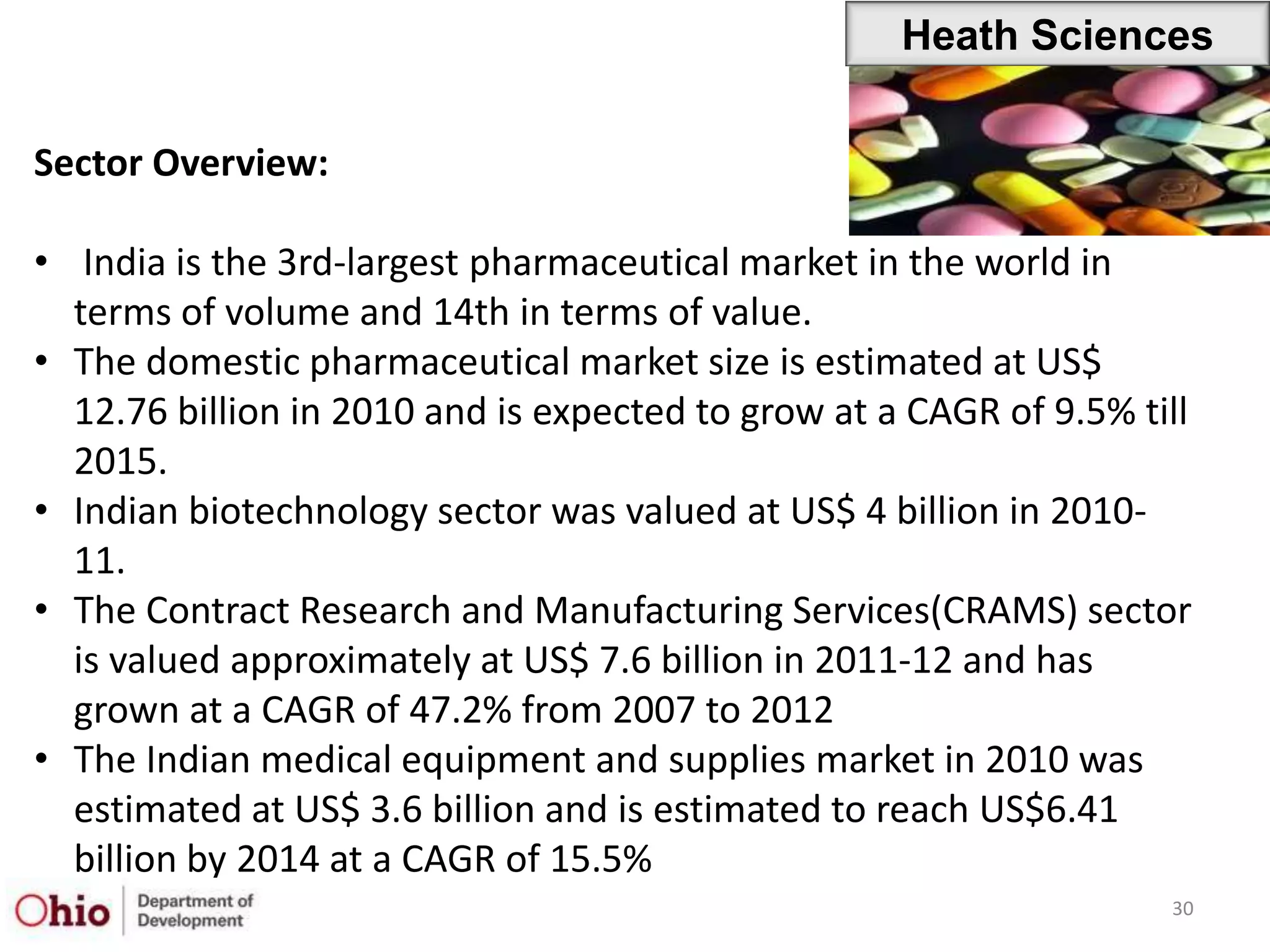
Heath Sciences

Sector Overview:

• India is the 3rd-largest pharmaceutical market in the world in
  terms of volume and 14th in terms of value.
• The domestic pharmaceutical market size is estimated at US$
  12.76 billion in 2010 and is expected to grow at a CAGR of 9.5% till
  2015.
• Indian biotechnology sector was valued at US$ 4 billion in 2010-
  11.
• The Contract Research and Manufacturing Services(CRAMS) sector
  is valued approximately at US$ 7.6 billion in 2011-12 and has
  grown at a CAGR of 47.2% from 2007 to 2012
• The Indian medical equipment and supplies market in 2010 was
  estimated at US$ 3.6 billion and is estimated to reach US$6.41
  billion by 2014 at a CAGR of 15.5%
                                                                    30
Heath Sciences


Outlook:

The key factors contributing to the growth of the Indian health
care market are:
• Rise in the number of middle class households with
  increasing levels of disposable income
• Demand from the urban middle class for better healthcare
  services
• Changing disease patterns: It is estimated that by 2012, 50
  percent of the spending on in-patient beds would be on
  lifestyle related diseases associated with the increasing levels
  of urbanization

                                                              31
Heath Sciences


Outlook:

• Substantial demand from high quality and specialty
  healthcare from tier II and tier III cities.
• Increase in Government spending on healthcare: The
  Union Government has allocated US$ 5.6 billion in
  2011-12 on healthcare, an increase 11% from the
  previous fiscal year.


                                                 32
Power
                                      (Cleantech & Utilities)

Sector Overview:

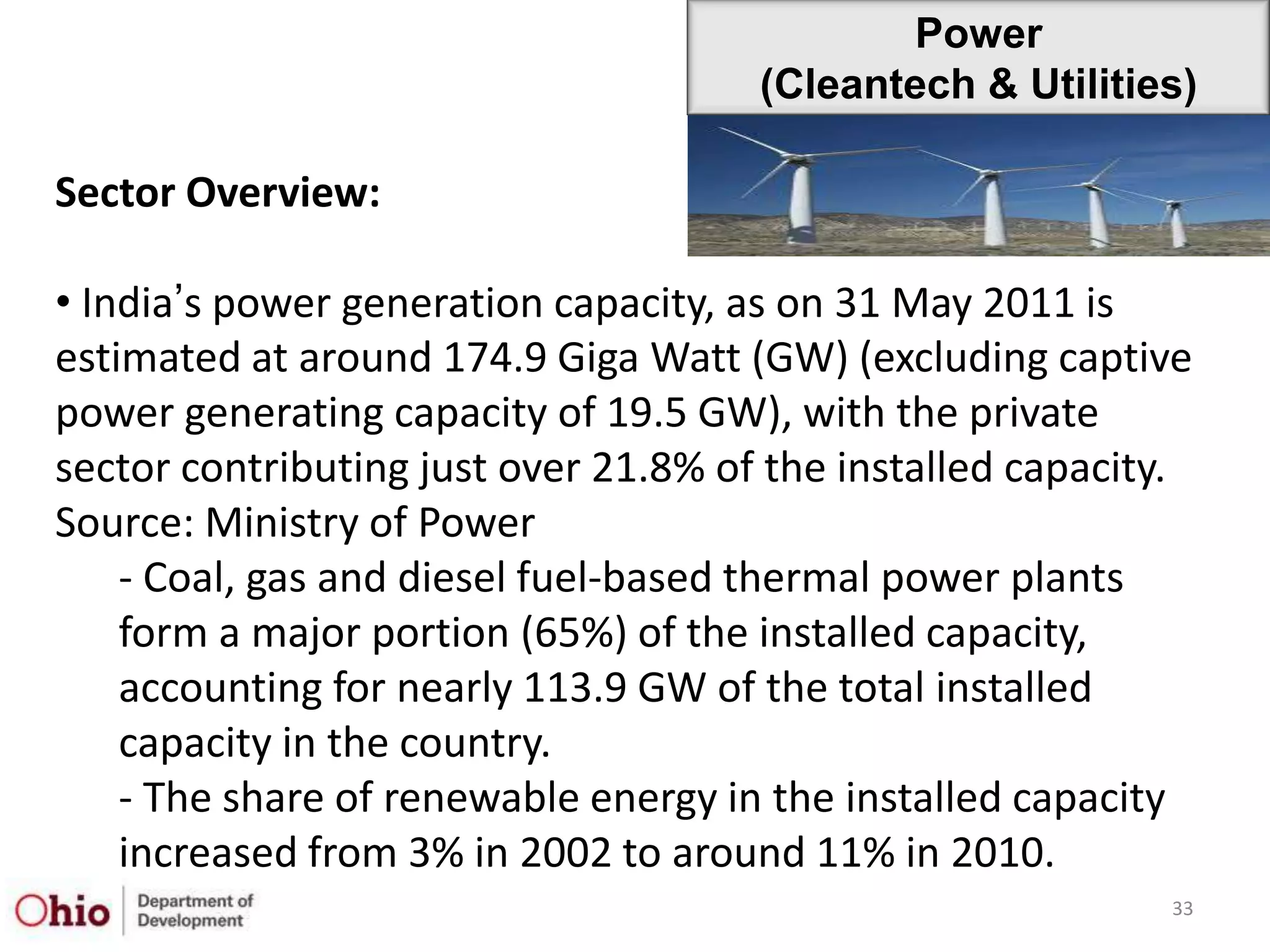
• India‟s power generation capacity, as on 31 May 2011 is
estimated at around 174.9 Giga Watt (GW) (excluding captive
power generating capacity of 19.5 GW), with the private
sector contributing just over 21.8% of the installed capacity.
Source: Ministry of Power
    - Coal, gas and diesel fuel-based thermal power plants
    form a major portion (65%) of the installed capacity,
    accounting for nearly 113.9 GW of the total installed
    capacity in the country.
    - The share of renewable energy in the installed capacity
    increased from 3% in 2002 to around 11% in 2010.
                                                            33
Power
                                 (Cleantech & Utilities)

Sector Overview:

•The total quantum of power generated in the
country has increased from 704.5 billion units (BU) in
FY07–08 to 788.4 BU in FY2010–11, recording a
growth rate of 3.8% in the last four years.
•At the end of FY11, the total electricity peak demand
met was only 110.26 GW, resulting in a peak deficit of
9.8%, while the electricity energy availability was
788.4 BU, which has resulted in an energy deficit of
8.5%
                                                      34
Power
                                   (Cleantech & Utilities)
Foreign direct investment:

• The power sector enjoys a favorable regulatory
environment.
•FDI of up to 100% in all power sector segments
(excluding nuclear)


                                                      35
Power
                                          (Cleantech & Utilities)

Outlook:
• The sector recorded highest ever capacity additions in 2010-11
of around 16 GW. These additions were made mainly across
hydro and thermal projects
• The Government of India released US$ 889 million toward
Accelerated Power Development and Reform Program (RAPDRP).
       -Out of these around US$ 867 million will be disbursed to
       state utilities as loans and the remaining will be given out
       as grants.
• The government‟s independent transmission projects initiative,
along with related state initiatives, is expected to open new
opportunities in the transmission BOT sector, thereby attracting
both Indian and international developers.
                                                               36
Prospects for Export Growth

INDO-US TRADE RELATIONS


                              37
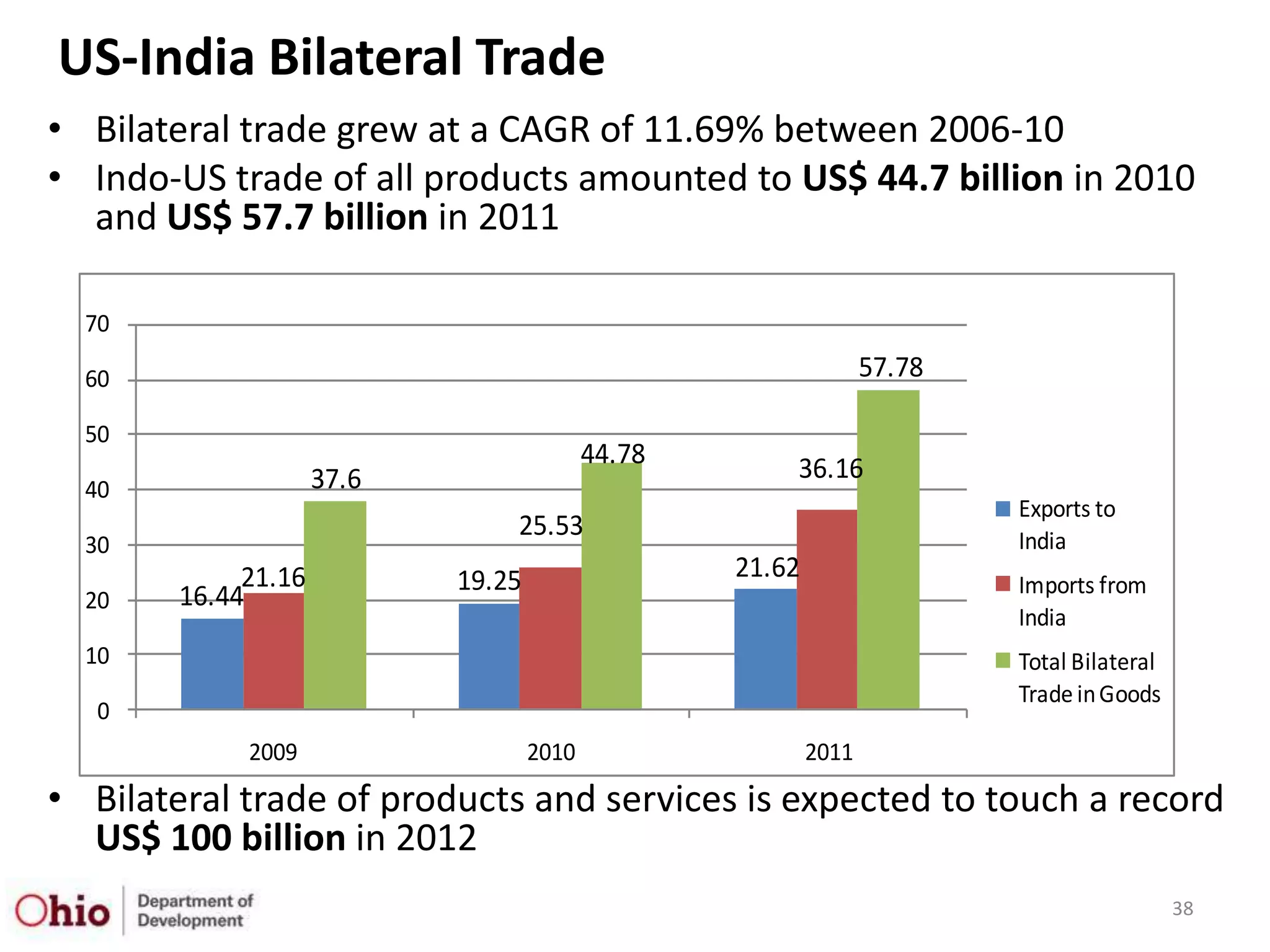
US-India Bilateral Trade
• Bilateral trade grew at a CAGR of 11.69% between 2006-10
• Indo-US trade of all products amounted to US$ 44.7 billion in 2010
  and US$ 57.7 billion in 2011
           India-US Bilateral Trade 2009-2011 (figures in US$ billion)
  70

  60                                                              57.78

  50
                                           44.78       36.16
  40                 37.6
                                                                          Exports to
                                25.53                                     India
  30
             21.16          19.25                  21.62
        16.44                                                             Imports from
  20
                                                                          India
  10                                                                      Total Bilateral
                                                                          Trade in Goods
   0
             2009                   2010                   2011
• Bilateral trade of products and services is expected to touch a record
  US$ 100 billion in 2012
                                                                                            38
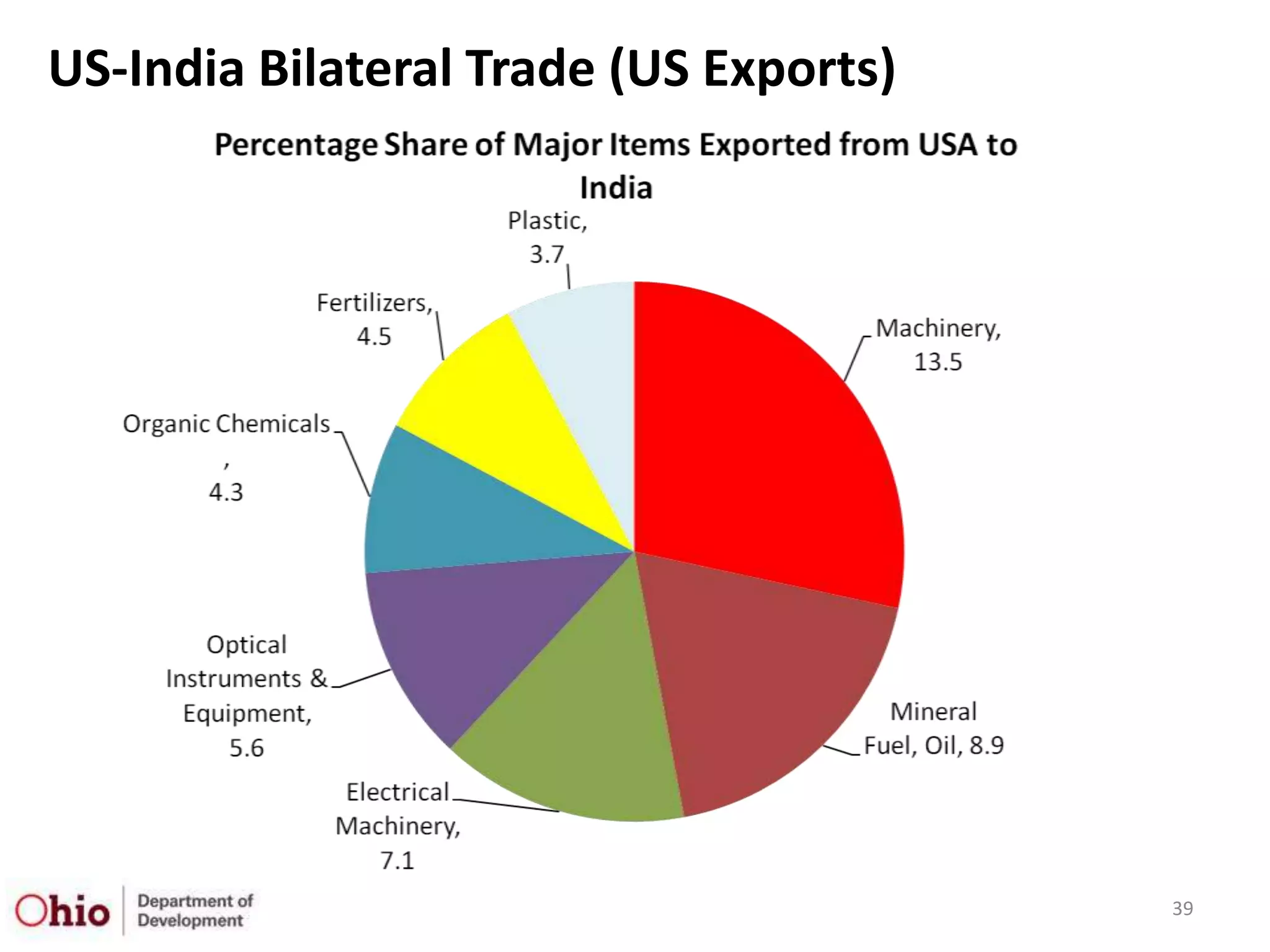
US-India Bilateral Trade (US Exports)


                                        39
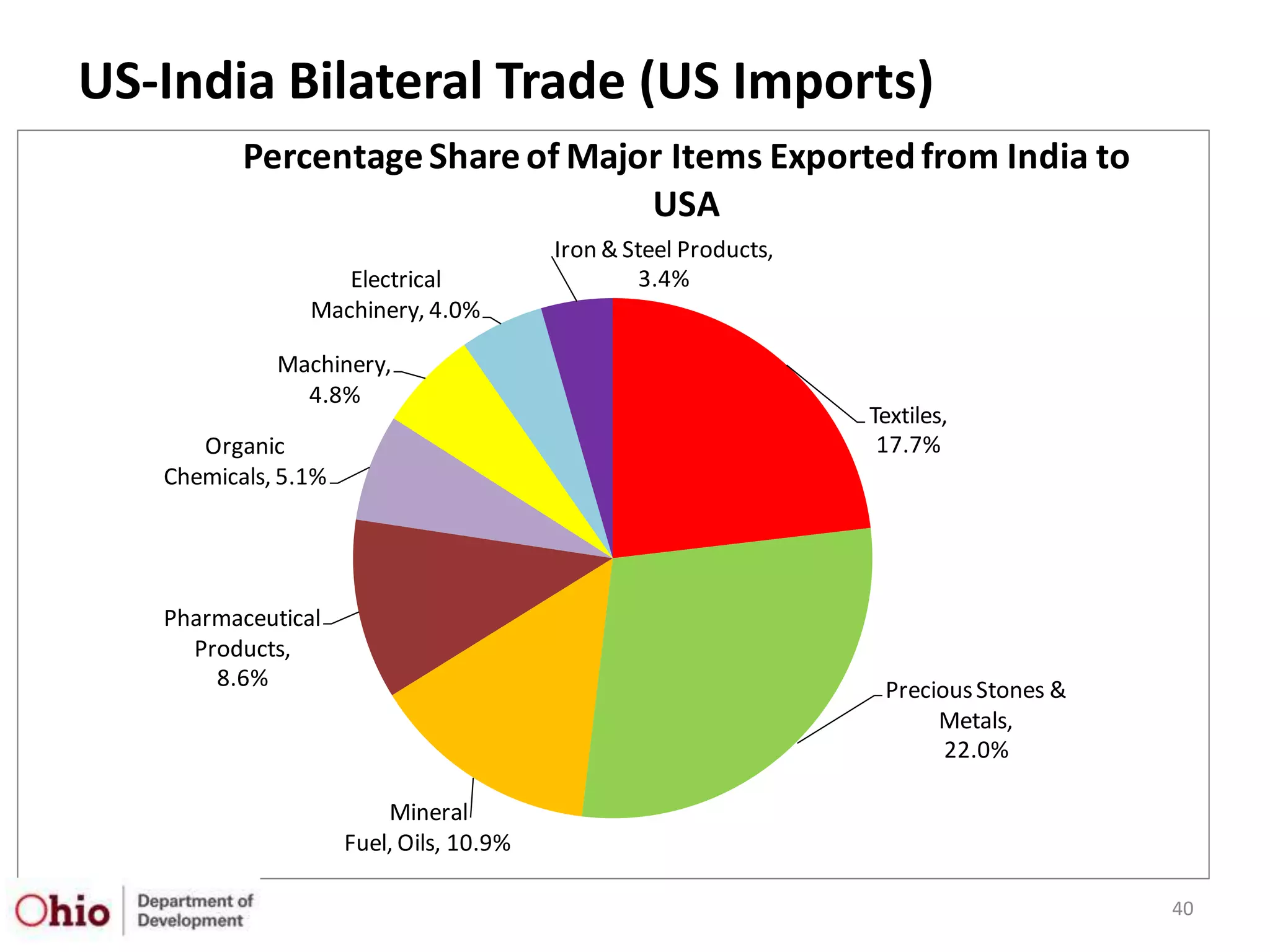
US-India Bilateral Trade (US Imports)
          Percentage Share of Major Items Exported from India to
                                  USA
                                         Iron & Steel Products,
                   Electrical                    3.4%
                Machinery, 4.0%

             Machinery,
               4.8%
                                                                  Textiles,
      Organic                                                      17.7%
   Chemicals, 5.1%


   Pharmaceutical
     Products,
       8.6%                                                        Precious Stones &
                                                                        Metals,
                                                                         22.0%

                         Mineral
                     Fuel, Oils, 10.9%

                                                                                       40
Ohio-India Trade

Growth in Ohio’s Exports
•India emerged as Ohio‟s 12th largest export market in
2010
•Ohio‟s exports to India have grown by almost 50%
from US$ 380 million in 2009 to US$ 566 million in
2010


                                                         41
Ohio-India Trade
Ohio’s Top Exports to India

•Industrial Machinery:                     $ 253 million
•Electric Machinery:                $ 49.4 million
•Optic/Medical Instruments:         $ 41.2 million
•Plastics and Articles thereof:            $ 36.5 million
•Aircraft and Spacecraft:                  $ 29.4 million
•Pearls, Stones, etc.:              $ 24.2 million
•Miscellaneous Chemical Products:   $ 17.1 million
•Articles of Iron or Steel:                $ 14.8 million
•Iron and Steel:                           $ 13.3 million
•Dye, Paint, etc.:                         $ 8.8 million
                                                            42
India: An Growing Market for Ohio Companies

CONCLUSION


                                              43
Conclusion


• Purchasing power growth in India along with advances in
  technology and an increasing focus on quality are factors
  which make India a favorable market for overseas players
• India has emerged as the 12th largest market for Ohio‟s
  exports
• Growth in spending in Indian sectors such as healthcare and
  medical equipment, aerospace and defense and clean energy
  provide good export prospects for Ohio companies


                                                            44
Report prepared by:


Ohio India Office

                      45
Date: 23-02-2012
Understanding the Indian Culture:
 Hofstede Framework & Study Abroad Experience


Presented by: Adrian Inkrott, Amanda Purdy, Andrew
Glotfelty, Cory Miles, Jacqueline Fries-Gomez, Jeremy
Espinoza, Lauren Mathias, Sakiko Okuma, Shoayb Bascal
Faculty Advisor: Dr. Ghose and Professor Gamba
About UF
The University of Findlay (UF) is one of the largest and most diverse private
   educational institution’s in Northwest Ohio
• UF’s College of Business has partnership programs with local corporations
    – Unique emphasis on international business majors
    – MBA program that draws students from different countries; i.e. India
• Top tier of U.S. News & World Report’s “America’s Best Colleges” in the Midwest
• “Best Midwestern College” by the Princeton Review for the past four years
• Professionally qualified professors
    - Real-world international experience
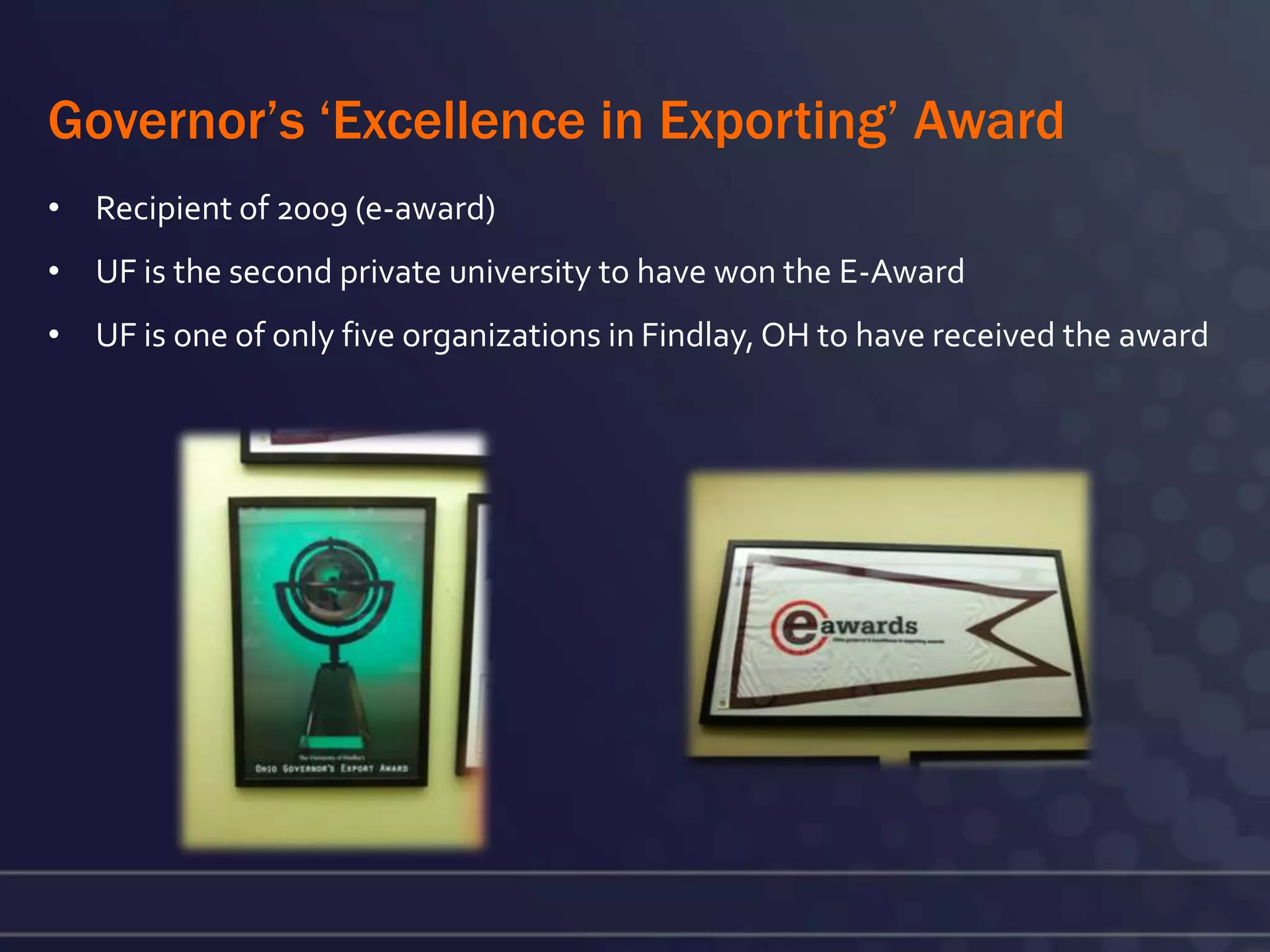
Governor’s ‘Excellence in Exporting’ Award
• Recipient of 2009 (e-award)
• UF is the second private university to have won the E-Award
• UF is one of only five organizations in Findlay, OH to have received the award
Hofstede Framework
 Theory pioneered by Dr. Geert Hofstede
    • The most comprehensive studies of how values in the workplace are
      influenced by culture
    • Paradigm used by numerous researchers
 Model of cultural dimensions (five sub-categories)
    • Hofstede analyzed a large data base of employee values, scores collected
      by IBM between 1967 and 1973 covering more than 70 countries
        - The results found clear patterns of similarity and difference amid the
          responses along these dimensions
 Cultural differences
    • Between nations are found on the deepest level; i.e. on the level of values
    • Among organizations are identified on the level of practices


                                                              *Source: geert-hofstede.com
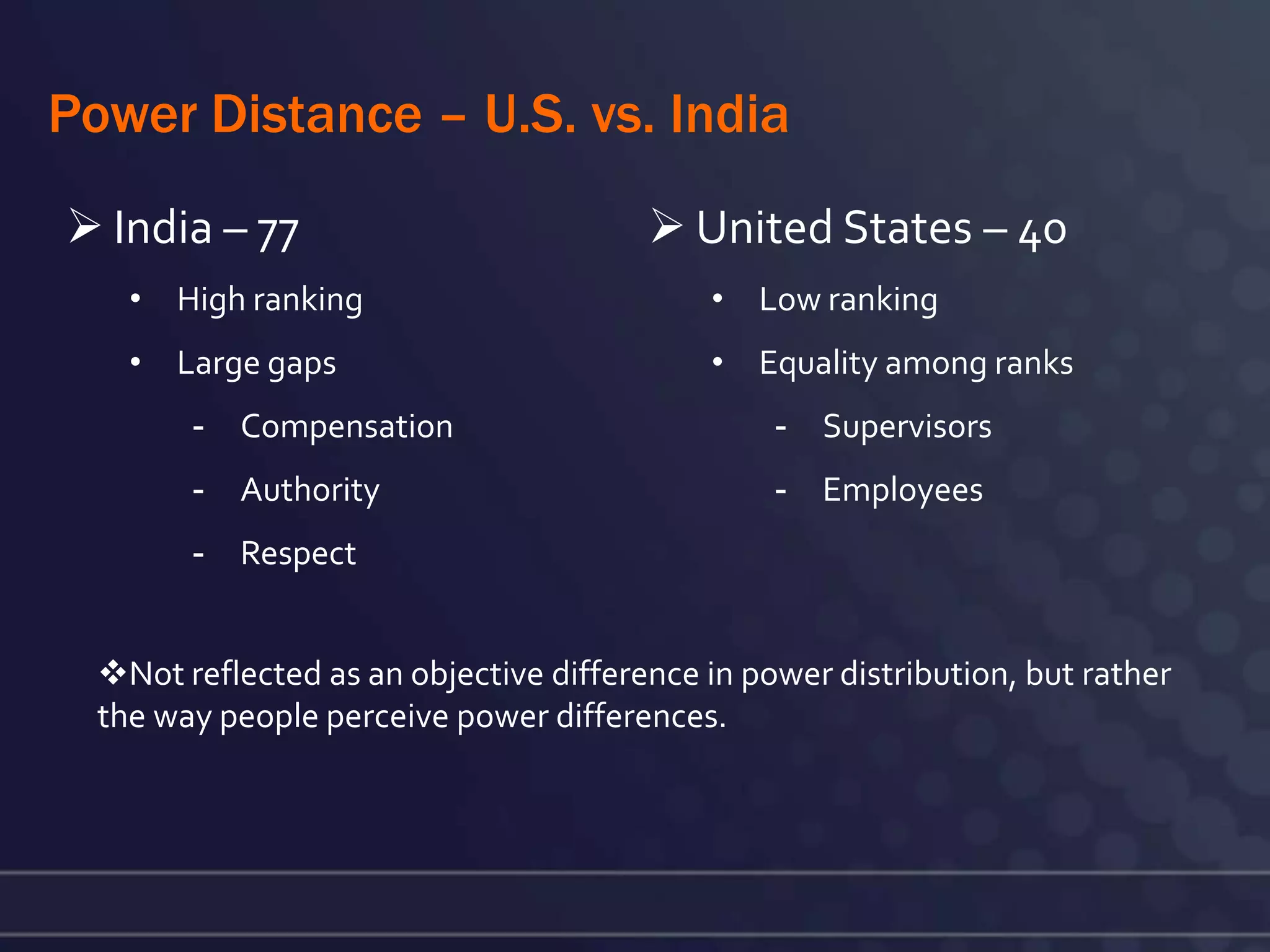
Power Distance – U.S. vs. India
 India – 77                             United States – 40
    • High ranking                          • Low ranking
    • Large gaps                            • Equality among ranks
        -   Compensation                         -   Supervisors
        -   Authority                            -   Employees
        -   Respect


  Not reflected as an objective difference in power distribution, but rather
  the way people perceive power differences.
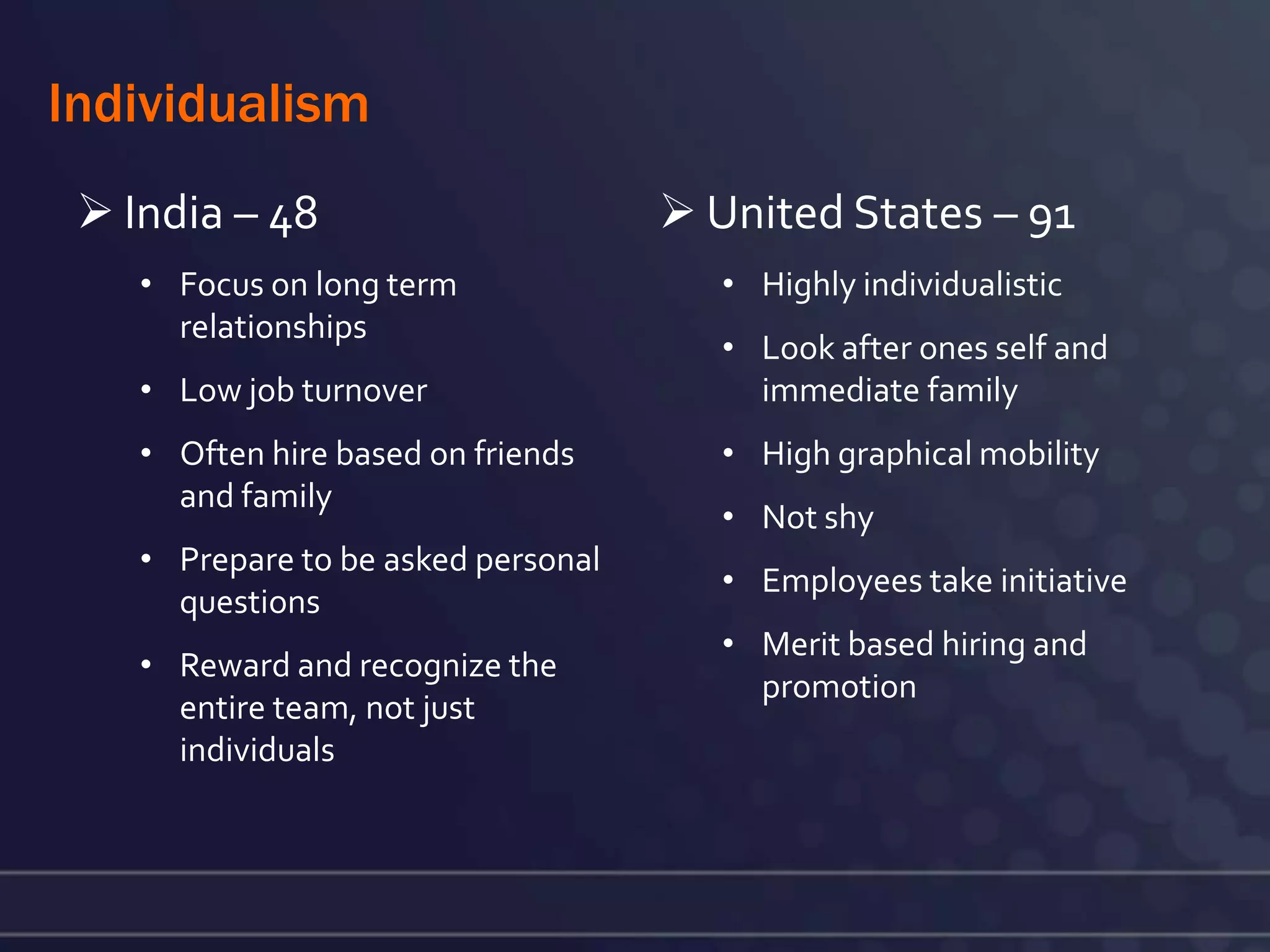
Individualism
  India – 48                         United States – 91
    • Focus on long term                • Highly individualistic
      relationships
                                        • Look after ones self and
    • Low job turnover                    immediate family
    • Often hire based on friends       • High graphical mobility
      and family
                                        • Not shy
    • Prepare to be asked personal
                                        • Employees take initiative
      questions
                                        • Merit based hiring and
    • Reward and recognize the
                                          promotion
      entire team, not just
      individuals
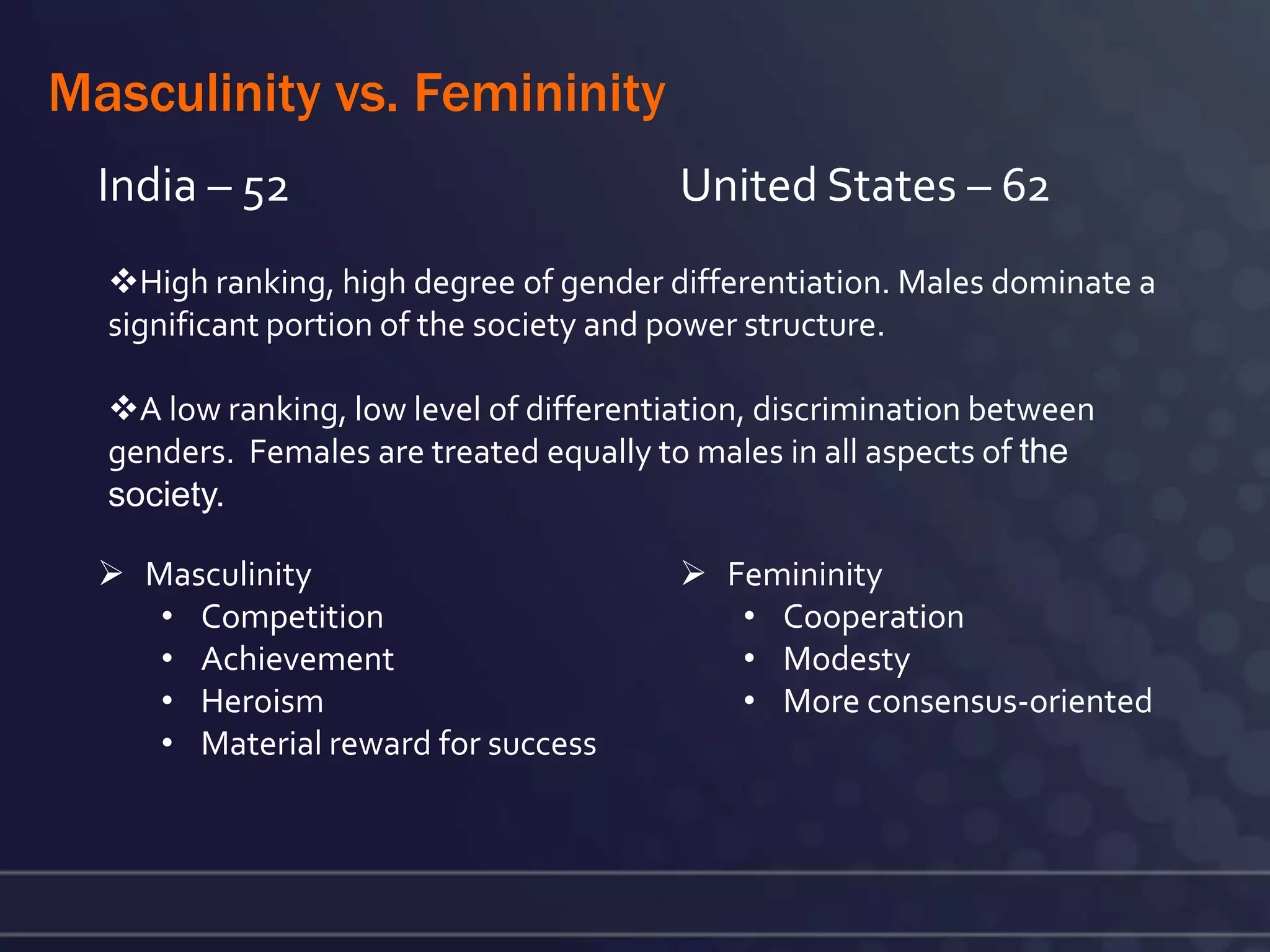
Masculinity vs. Femininity
  India – 52                             United States – 62
  High ranking, high degree of gender differentiation. Males dominate a
  significant portion of the society and power structure.

  A low ranking, low level of differentiation, discrimination between
  genders. Females are treated equally to males in all aspects of the
  society.

   Masculinity                           Femininity
     • Competition                          • Cooperation
     • Achievement                          • Modesty
     • Heroism                              • More consensus-oriented
     • Material reward for success
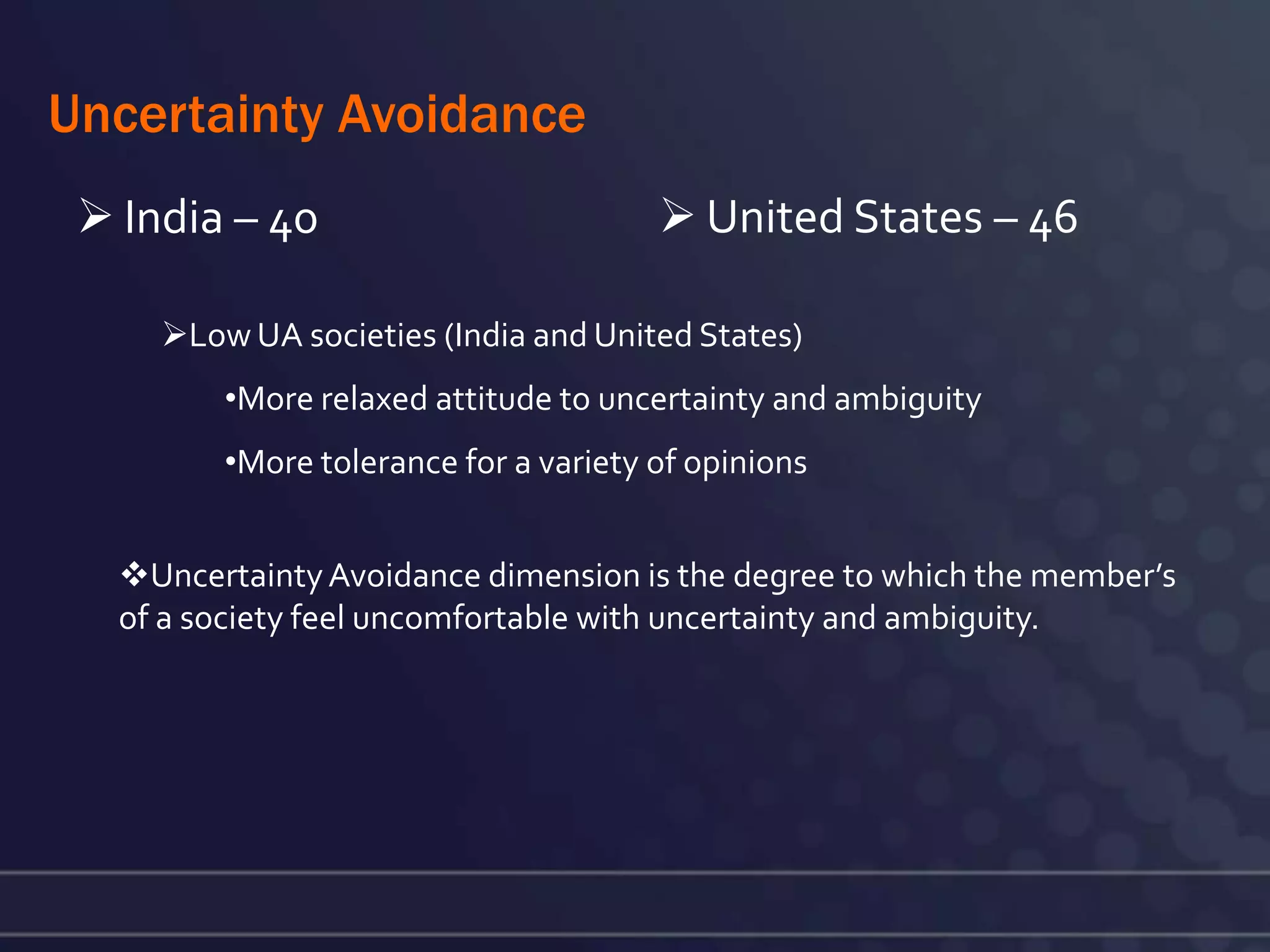
Uncertainty Avoidance
  India – 40                           United States – 46

     Low UA societies (India and United States)
         •More relaxed attitude to uncertainty and ambiguity
         •More tolerance for a variety of opinions


   Uncertainty Avoidance dimension is the degree to which the member’s
   of a society feel uncomfortable with uncertainty and ambiguity.
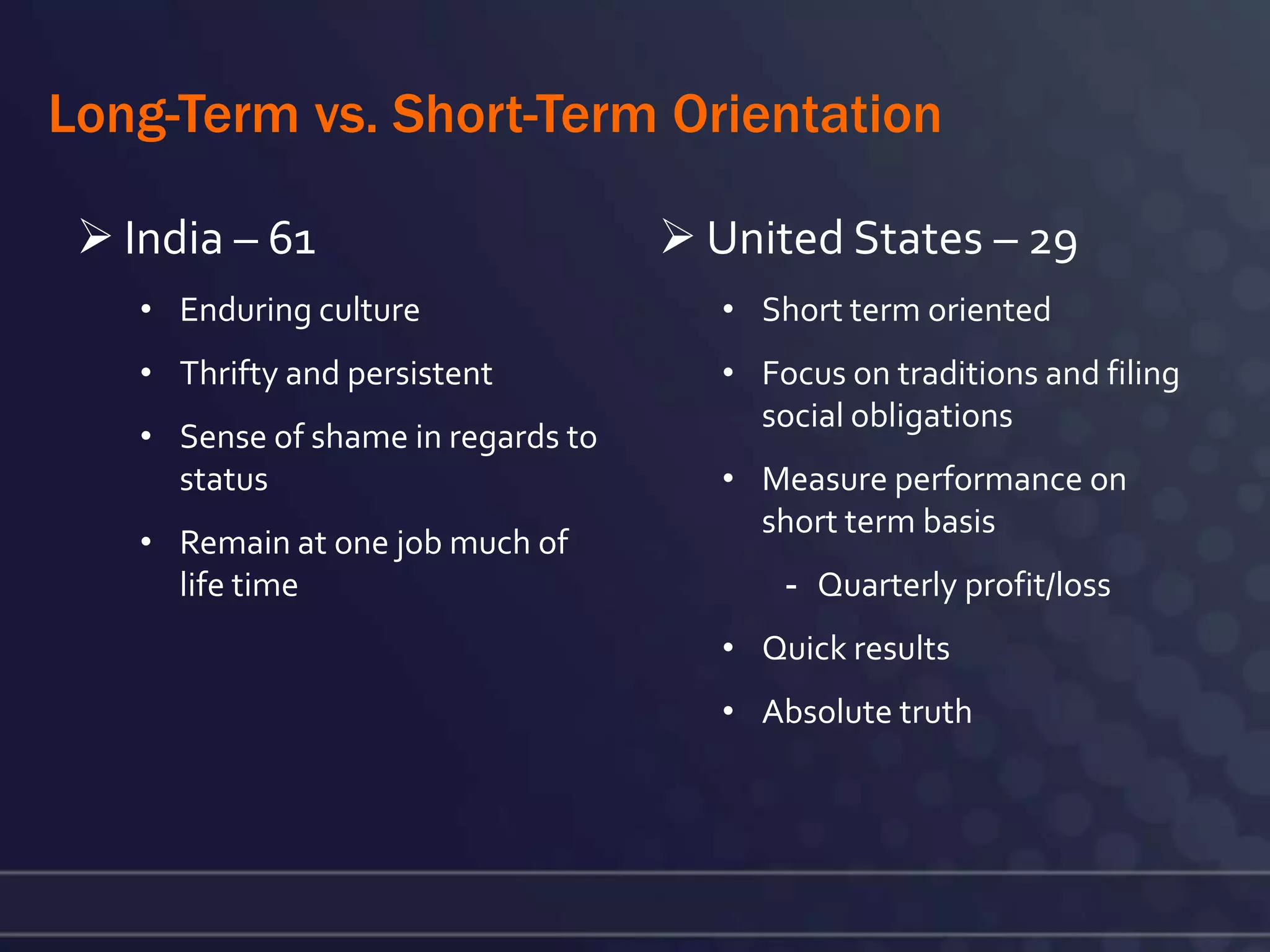
Long-Term vs. Short-Term Orientation

  India – 61                         United States – 29
    • Enduring culture                  • Short term oriented
    • Thrifty and persistent            • Focus on traditions and filing
                                          social obligations
    • Sense of shame in regards to
      status                            • Measure performance on
                                          short term basis
    • Remain at one job much of
      life time                             - Quarterly profit/loss
                                        • Quick results
                                        • Absolute truth
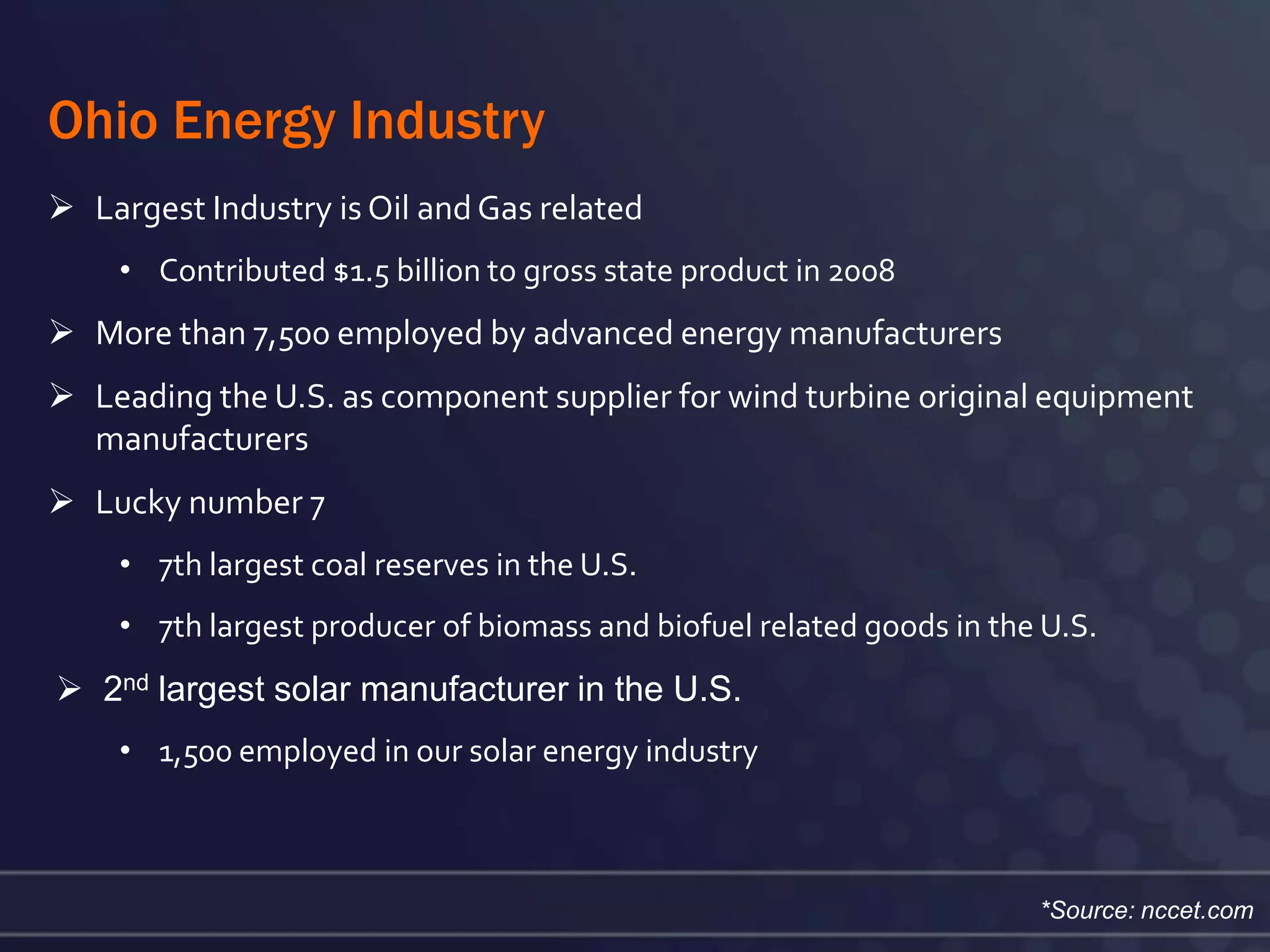
Ohio Energy Industry
 Largest Industry is Oil and Gas related
    • Contributed $1.5 billion to gross state product in 2008
 More than 7,500 employed by advanced energy manufacturers
 Leading the U.S. as component supplier for wind turbine original equipment
  manufacturers
 Lucky number 7
    • 7th largest coal reserves in the U.S.
    • 7th largest producer of biomass and biofuel related goods in the U.S.
 2nd largest solar manufacturer in the U.S.
    • 1,500 employed in our solar energy industry


                                                                      *Source: nccet.com
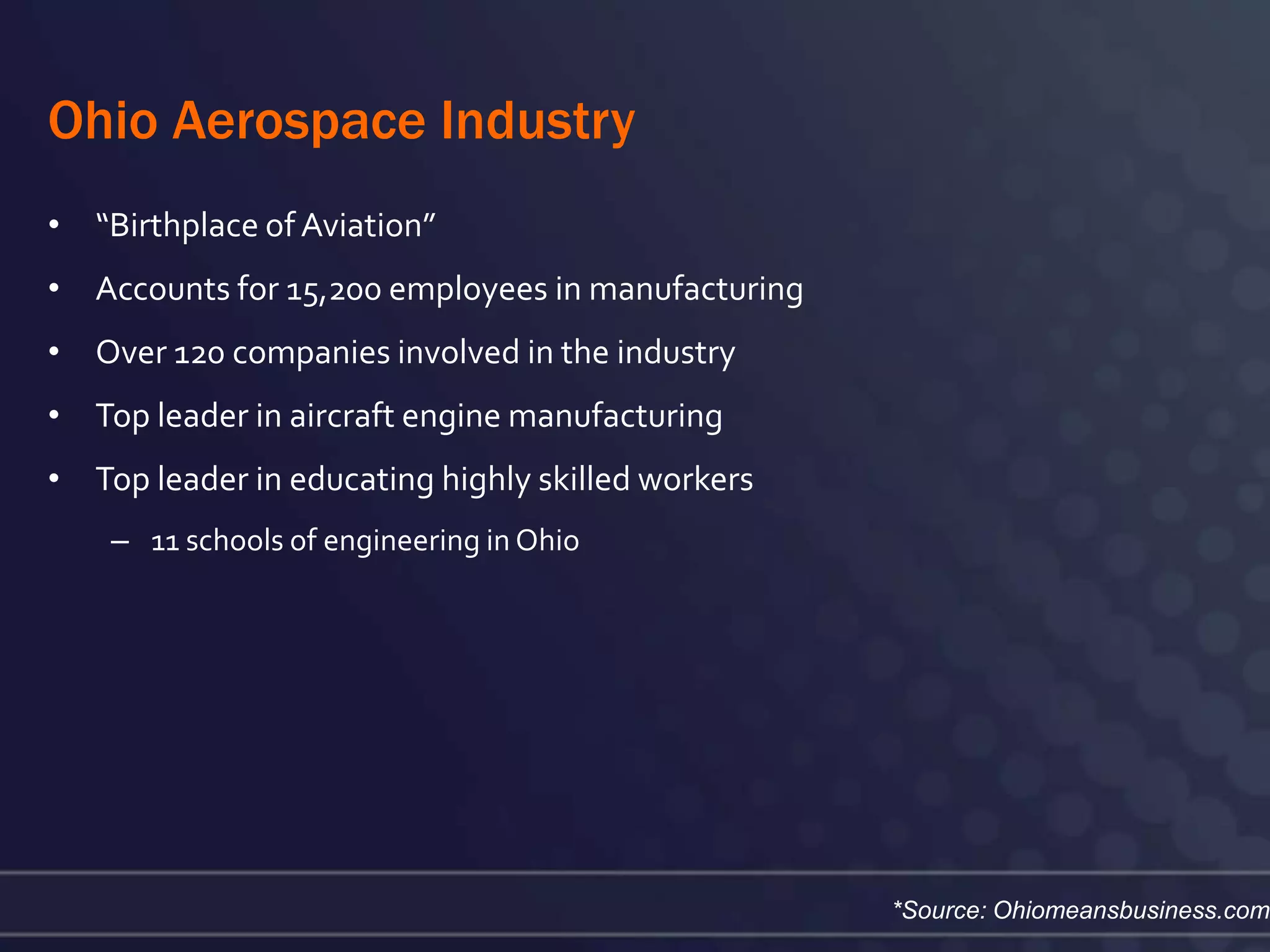
Ohio Aerospace Industry
• “Birthplace of Aviation”
• Accounts for 15,200 employees in manufacturing
• Over 120 companies involved in the industry
• Top leader in aircraft engine manufacturing
• Top leader in educating highly skilled workers
    – 11 schools of engineering in Ohio


                                                   *Source: Ohiomeansbusiness.com
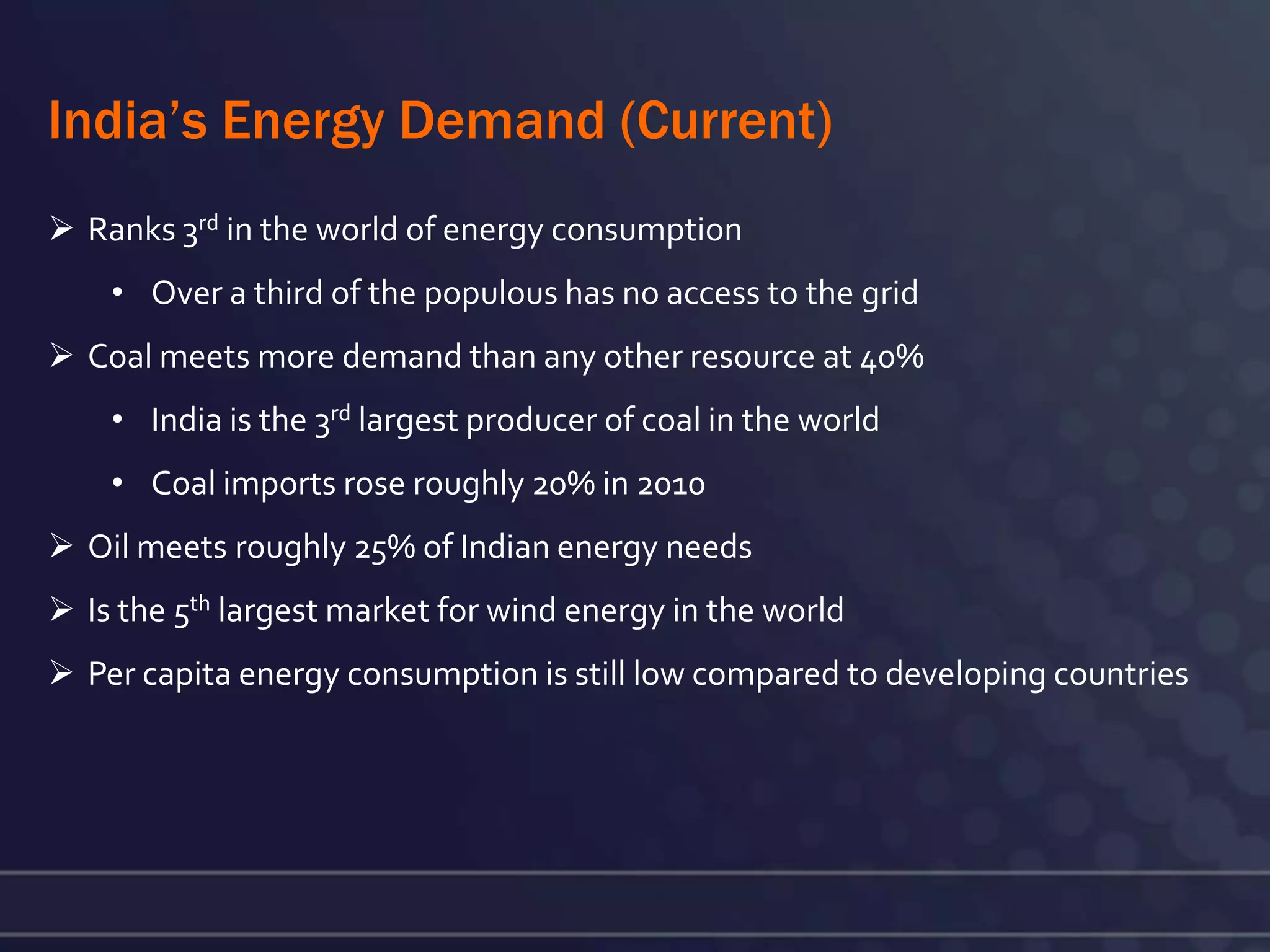
India’s Energy Demand (Current)
 Ranks 3rd in the world of energy consumption
    • Over a third of the populous has no access to the grid
 Coal meets more demand than any other resource at 40%
    • India is the 3rd largest producer of coal in the world
    • Coal imports rose roughly 20% in 2010
 Oil meets roughly 25% of Indian energy needs
 Is the 5th largest market for wind energy in the world
 Per capita energy consumption is still low compared to developing countries
India’s Energy Demand (Future)
 Government hopes to reduce reliance on imports
    • Projected to reach 53% of the supply of energy in India (currently at 30%)
    • Encouraging more efficient supply sources
         - Particularly nuclear, planning to start build 18 nuclear plants by 2025
 55% of rural population has no access to electricity
    • Government-led initiative is called REC
 Government is also encouraging alternative sources of energy
    • Primarily wind and solar through the use of tax breaks
    • Projected to move from 10th to 3rd in G20 countries in clean power
      investments
    • 100% FDI is possible in renewable energy sector
India’s Aerospace Demand
 Like the rest of India, industry is growing rapidly
    • Civil aviation has grown at a rate of 41%
    • Boeing has projected demand for $100 billion worth of commercial
      aircrafts
    • Estimate growth in repairs and parts market expected to grow at 10%
      annually
 Government support
    • There is no duty on imports of aerospace related products
    • Current cap of 26% on FDI in defense sector but this appears to be
      loosening
60
Preparing for Success in India –
     A Legal Perspective
   Presented by Vinita Bahri-Mehra, Esq.
            February 23, 2012


    w w w . k e g l e r b r o w n . c o m
w w w . k e g l e r b r o w n . c o m
Why India?
• India is the 4th largest economy in the world as measured by
  purchasing power.

• India has a consumer base of 1.2 billion people.

• The youngest population of the world – hence sustainable, long term
  growth is assured.

• Modern (organized) retail converging with the consumption boom will
  open up many opportunities for small and mid-size consumer
  companies.

• Rapid growth in the number of middle class consumers.

• Eager and savvy consumer market with growing buying potential.

                w w w . k e g l e r b r o w n . c o m
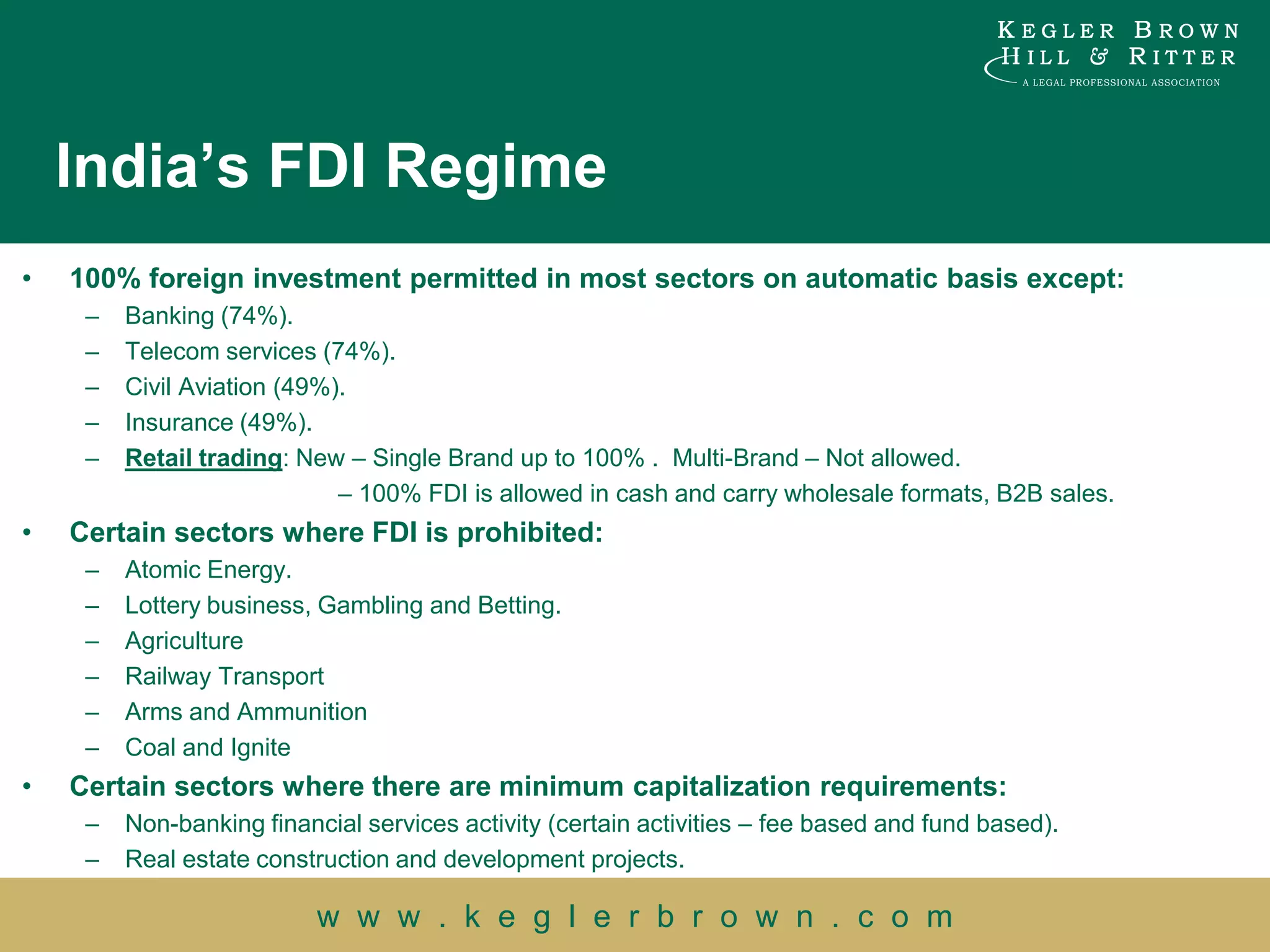
India’s FDI Regime
•   100% foreign investment permitted in most sectors on automatic basis except:
     –   Banking (74%).
     –   Telecom services (74%).
     –   Civil Aviation (49%).
     –   Insurance (49%).
     –   Retail trading: New – Single Brand up to 100% . Multi-Brand – Not allowed.
                             – 100% FDI is allowed in cash and carry wholesale formats, B2B sales.
•   Certain sectors where FDI is prohibited:
     –   Atomic Energy.
     –   Lottery business, Gambling and Betting.
     –   Agriculture
     –   Railway Transport
     –   Arms and Ammunition
     –   Coal and Ignite
•   Certain sectors where there are minimum capitalization requirements:
     –   Non-banking financial services activity (certain activities – fee based and fund based).
     –   Real estate construction and development projects.

                           w w w . k e g l e r b r o w n . c o m
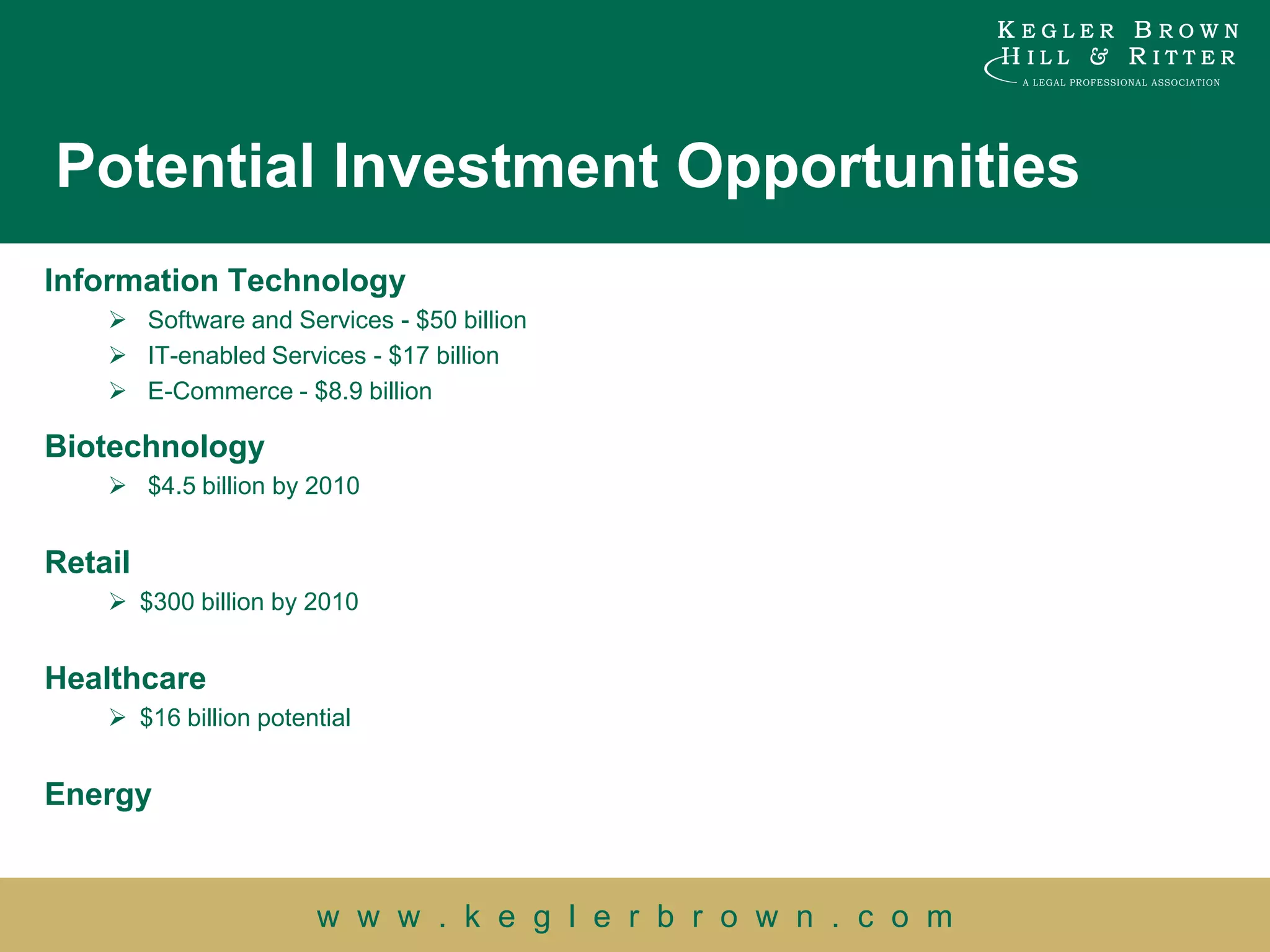
Potential Investment Opportunities
Information Technology
     Software and Services - $50 billion
     IT-enabled Services - $17 billion
     E-Commerce - $8.9 billion

Biotechnology
     $4.5 billion by 2010


Retail
     $300 billion by 2010


Healthcare
     $16 billion potential


Energy


                       w w w . k e g l e r b r o w n . c o m
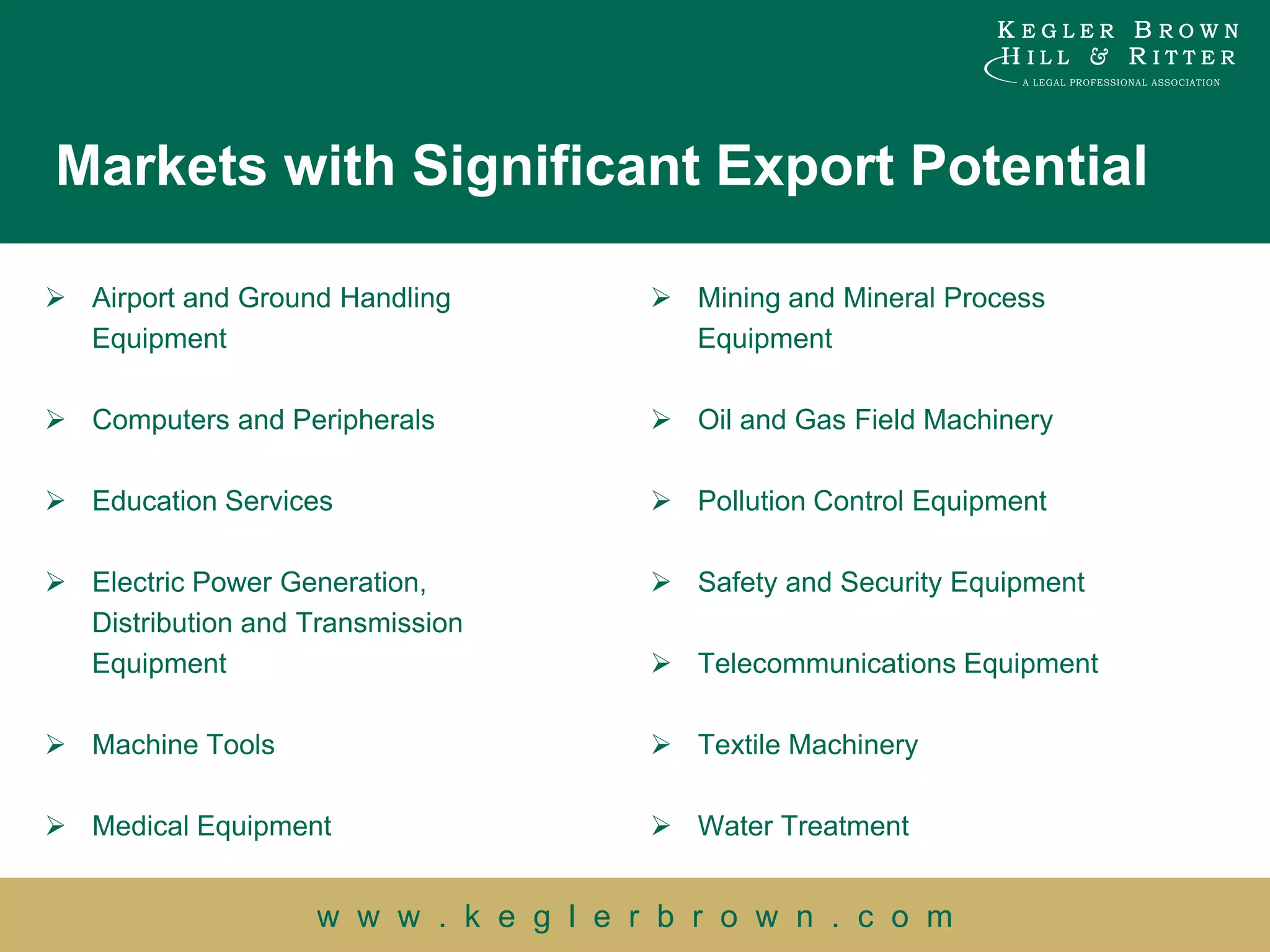
Markets with Significant Export Potential

 Airport and Ground Handling           Mining and Mineral Process
  Equipment                              Equipment

 Computers and Peripherals             Oil and Gas Field Machinery

 Education Services                    Pollution Control Equipment

 Electric Power Generation,            Safety and Security Equipment
  Distribution and Transmission
  Equipment                             Telecommunications Equipment

 Machine Tools                         Textile Machinery

 Medical Equipment                     Water Treatment


                    w w w . k e g l e r b r o w n . c o m
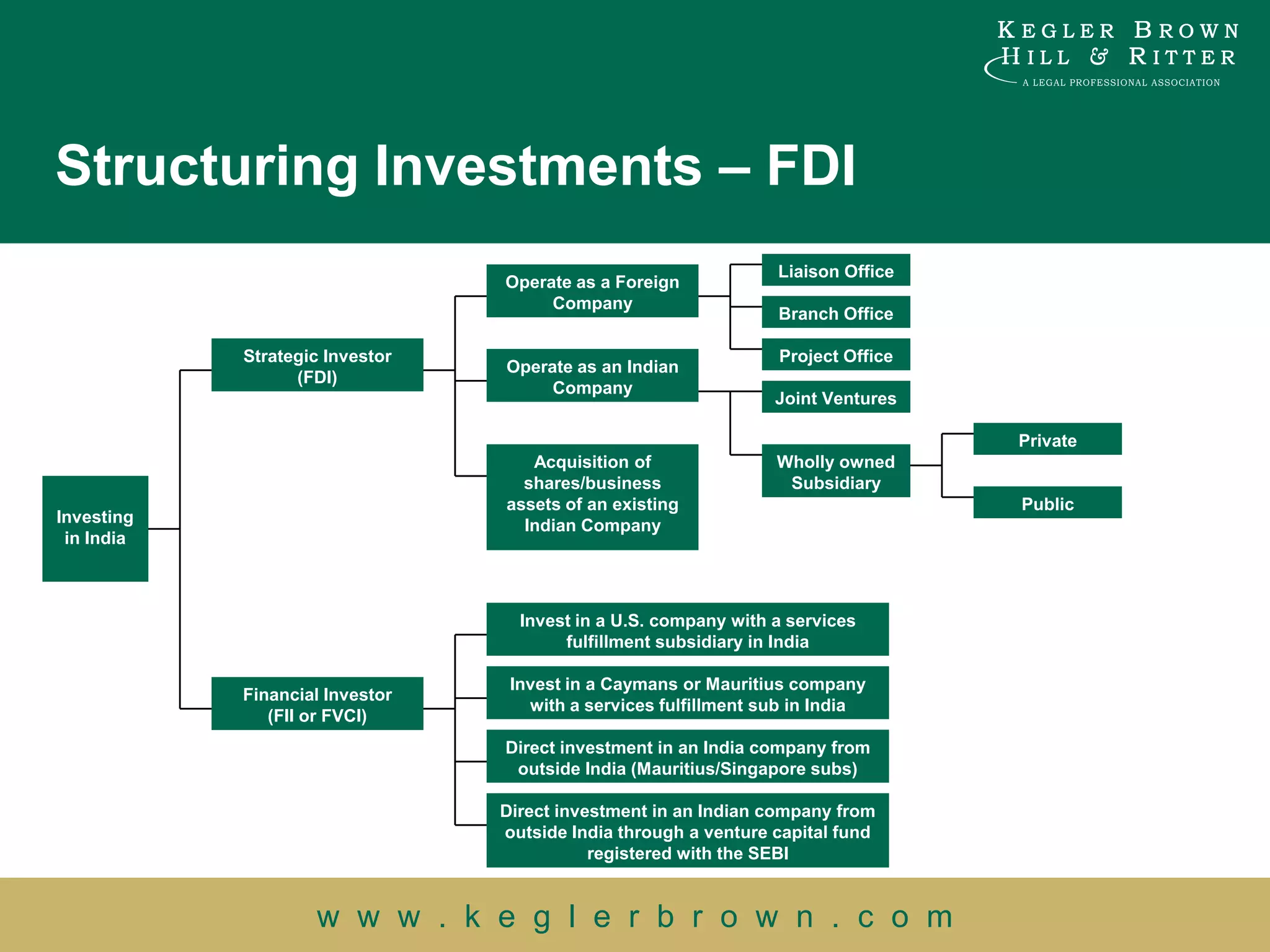
Structuring Investments – FDI
                                                                 Liaison Office
                                 Operate as a Foreign
                                      Company
                                                                 Branch Office

            Strategic Investor                                   Project Office
                                 Operate as an Indian
                  (FDI)
                                      Company
                                                                 Joint Ventures

                                                                                  Private
                                    Acquisition of               Wholly owned
                                   shares/business                Subsidiary
                                 assets of an existing                            Public
Investing                          Indian Company
 in India


                                   Invest in a U.S. company with a services
                                        fulfillment subsidiary in India

                                  Invest in a Caymans or Mauritius company
            Financial Investor
                                    with a services fulfillment sub in India
               (FII or FVCI)
                                 Direct investment in an India company from
                                  outside India (Mauritius/Singapore subs)

                                 Direct investment in an Indian company from
                                 outside India through a venture capital fund
                                            registered with the SEBI


                    w w w . k e g l e r b r o w n . c o m
Other Entry Routes

A.   Direct Sales from U.S. (using freight forwarder).
     Key considerations:

     •Use accurate Incoterms 2010 for international sale or, even better, spell out in detail
     who is responsible for what.
          – Most common terms:
               – EXW, FOB, CIF, DDU, DDP

     •Payment Terms
         • NOT Incoterms!
               • The Incoterms generally indicate WHAT must be paid by each party not WHEN it
                 must be paid.
          • Do not confuse liability with responsibility.


                      w w w . k e g l e r b r o w n . c o m
Other Entry Routes
•    Payment Terms
      – Usually determined in the purchase contract
      – Major options, based upon increasing risk
         • Paid in advance (if exceeds 100,000 additional criteria to be fulfilled and imports
            to be made in 6 months).
         • Letter of credit (must adhere to UCPDC).
         • Documents against payment.
         • Open account (remittance against imports should be completed no later than 6
            months, except for payments withheld for guarantee performance, disputes,
            etc.)
         • Interest on import bills allowed if overdue for less than 3 years at rate
            prescribed for trade credit from time to time.


                       w w w . k e g l e r b r o w n . c o m
Other Entry Routes

•   Decide on-Who is the “importer of record”?

•   Exporting directly can suit high value products or services. However, winning
    new customers is likely to require significant investments in building relations
    and several visits.


                    w w w . k e g l e r b r o w n . c o m
Other Entry Routes
•    Import/Export Process and Timeline:
     (Assumption: standard container of goods to a large city port in India.)
•    India stands at 109 ranking of 183 economies on the ease of trading across borders.
•    Indicator.
      –   Number of Documents to export (e.g. bill of lading, export declaration forms, commercial
          invoice): 8
      –   Time to Export: 16 days
      –   Cost to Export: $1095 per container.


•    Procedures to Export
      –   Document Preparation: 8 days
      –   Custom Clearance: 2 days
      –   Ports and Terminal Handling: 3 days
      –   Inland Transportation: 3 days


                         w w w . k e g l e r b r o w n . c o m
Other Entry Routes
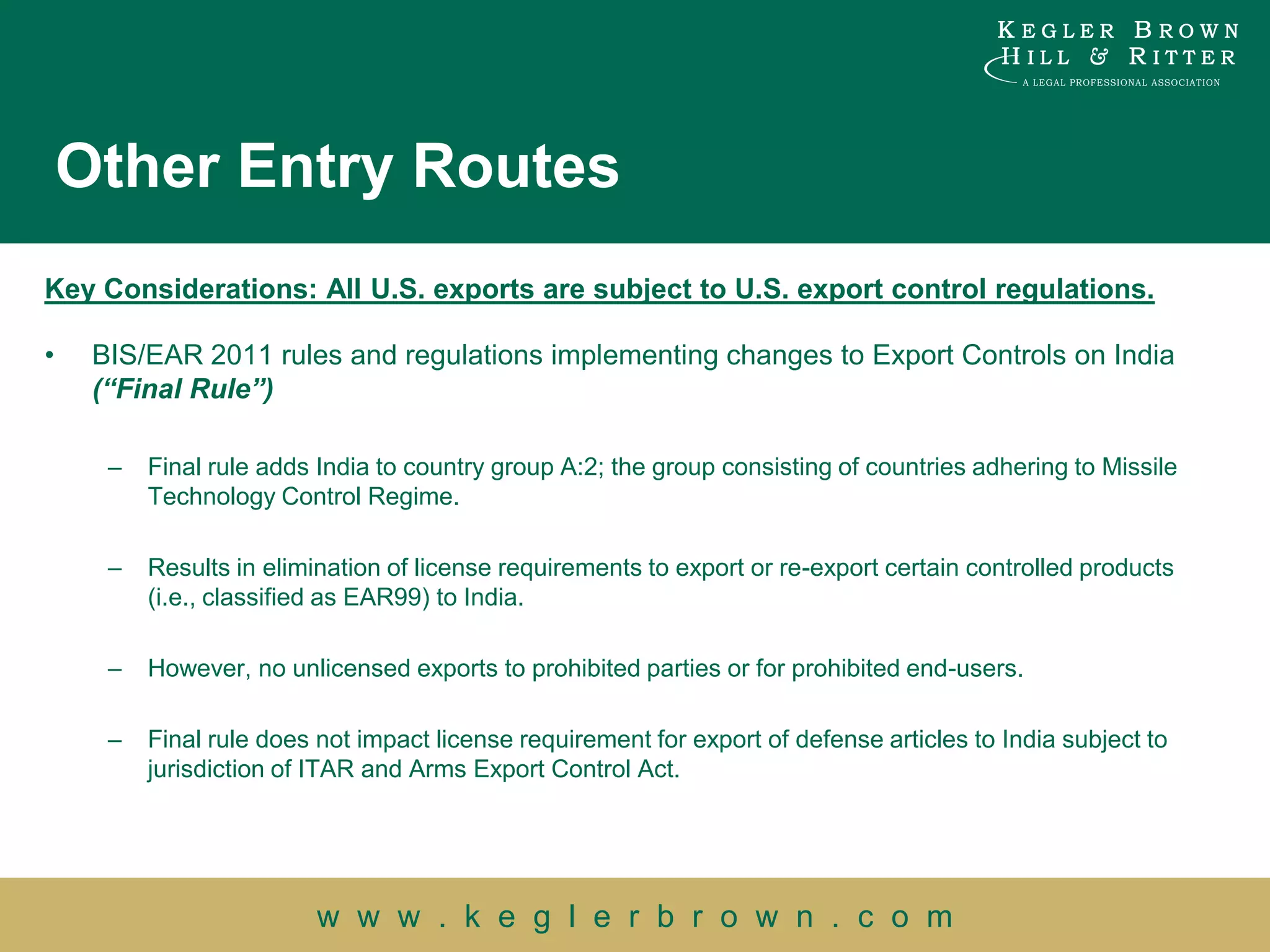
Key Considerations: All U.S. exports are subject to U.S. export control regulations.

•    BIS/EAR 2011 rules and regulations implementing changes to Export Controls on India
     (“Final Rule”)

      –   Final rule adds India to country group A:2; the group consisting of countries adhering to Missile
          Technology Control Regime.

      –   Results in elimination of license requirements to export or re-export certain controlled products
          (i.e., classified as EAR99) to India.

      –   However, no unlicensed exports to prohibited parties or for prohibited end-users.

      –   Final rule does not impact license requirement for export of defense articles to India subject to
          jurisdiction of ITAR and Arms Export Control Act.


                          w w w . k e g l e r b r o w n . c o m
Other Entry Routes
Key Considerations: Labeling and Marking Requirements

•   Labeling is an important element for products being exported to India. All
    packets or even containers should carry pertinent declarations.

•   English or Hindi is the favorable language for labeling.

•   Custom authorities have to ensure that all pre-packaged commodities
    (especially those intended for direct retail sale) have all the legally required
    information before they enter the retail market or sold for consumption.


                     w w w . k e g l e r b r o w n . c o m
Other Entry Routes
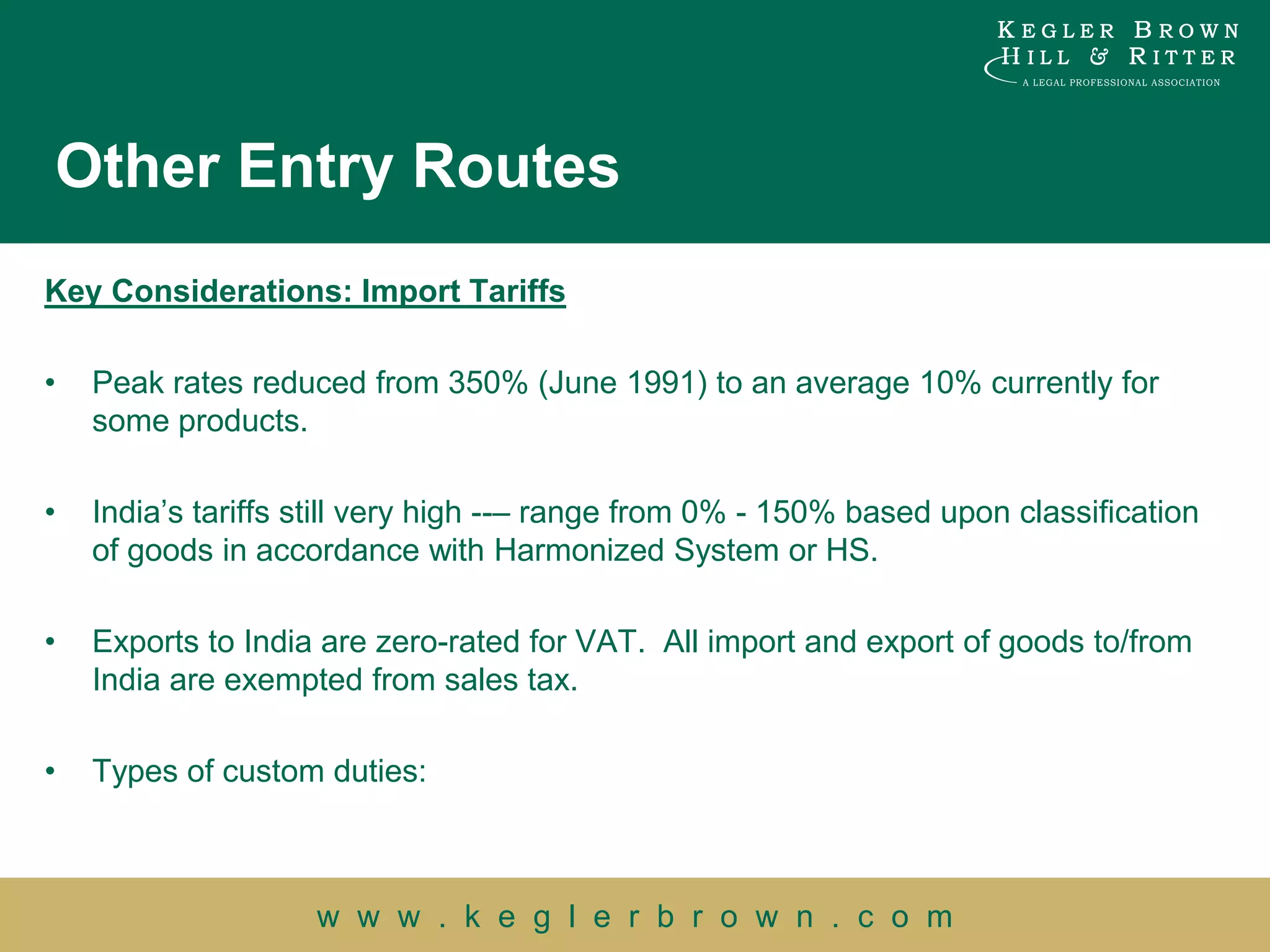
Key Considerations: Import Tariffs

•   Peak rates reduced from 350% (June 1991) to an average 10% currently for
    some products.

•   India‟s tariffs still very high --– range from 0% - 150% based upon classification
    of goods in accordance with Harmonized System or HS.

•   Exports to India are zero-rated for VAT. All import and export of goods to/from
    India are exempted from sales tax.

•   Types of custom duties:


                    w w w . k e g l e r b r o w n . c o m
Other Entry Routes
 –   Basic Customs Duty (BCD): This duty is levied either as 1) a specific rate based on the unit of
     the item (weight, number, etc.), or more commonly, 2) ad-volorem, based on the assessable
     value of the item. In some cases, a combination of the two is used.

 –   Additional Customs Duty (ACD): This duty is typically referred to as Countervailing duty or
     (CVD) and is levied on the assessed value of goods plus BCD. It is payable only if the imported
     product is such as if produce in India it would be liable for an excise duty.

 –   Special Additional Customs Duty (known as Special CVD): Special CVD tax is applicable on
     all items (to offset the disadvantage to like Indian goods due to high excise duty on their input). It
     is levied at the rate of 4 percent of the BCD and the ACD on all imports.

 –   [Anti-dumping Duty: This is levied on specified goods imported from specified countries,
     including the United States, to protect indigenous industry from injury.

 –   Safeguard Duty: The Indian government may by notification impose a safeguard duty on
     articles after concluding that increased imported quantities and under current conditions will
     cause or threaten to cause serious injury to domestic industry.]


                     w w w . k e g l e r b r o w n . c o m
Other Entry Routes
 –   Customs Education Cess: Effective, 2004, India introduced a new education cess (duty)
     assessment. The current rate is 3 percent of BCD and ACD.

 –   Customs Handling Fee: The Indian government assesses a 1 percent customs handling fee
     on all imports in addition to the applied customs duty.

 –   Total Duty Payable = BCD + ACD + Special CVD + Education Cess + Customs Handling Fee.


                   w w w . k e g l e r b r o w n . c o m
Other Entry Routes – Associated Taxes
• Dividends declared can be repatriated freely through an authorized
  Indian bank.

• Dividends are tax-free in the hands of shareholders.
   – A distribution tax of 16 % is payable by company.

• Corporate income tax rate for foreign companies is 41.2%. For
  domestic companies, 30.99%.

• Withholding tax on royalties/technical fees/interest income.
  – Domestic tax law – 10%.
  – Indo-US DTAA – 10% for right to use of any industrial, commercial
     or scientific equipment.
           – 20% in any other case.
                w w w . k e g l e r b r o w n . c o m
Taxation in India
• The tax rate provision of domestic law could be utilized as it is less
  than DTAA.

• Service tax rate is 10.3%.
    – Computed on the “Gross Amount” charged by the service provider.


• Sales tax rate (CST & VAT). Varies from state to state, depending
  upon classification of goods. Varies from 0% to 12.5%.

• Tax incentives are available during a limited time for 100% Export-
  Oriented Unit, under Software Technology Park Scheme and Special
  Economic Zones Units, etc.


                 w w w . k e g l e r b r o w n . c o m
Taxation in India
•   Elaborate Transfer Pricing Regulations

•   These rules govern minimum profit margin to be maintained by the
    Indian companies in transaction associated enterprises.


               w w w . k e g l e r b r o w n . c o m
Other Entry Routes
B.   Technology Collaborations and Trademark License

     •   Foreign entities can provide technical know-how and/or license their trademark to
         Indian companies against payment of fee and royalty.

     •   Key considerations.

     •   Protection of Intellectual Property.
          • Registration of trademarks, copyrights and patents (“first to file” – jurisdiction).
          • Trade Secrets: No statutory protection of trade secrets or confidential information.
            However, several court precedents enforce confidentiality agreement through mandatory
            injunctions.
          • Indian IP laws do not provide for automatic assignments.
          • Advantage of lower withholding taxes on royalty income stream.


                    w w w . k e g l e r b r o w n . c o m
Other Entry Routes
C.   Agency Relationship:

     •   Creation:
          – Relationship between Agent and Principal is primarily contractual in nature and governed
            by terms of contract entered into between them.

          – The Indian Contract Act, 1872 (Act) provides the framework of rules and regulation that
            govern formation and performance of an agency contract.

          – NO WRITTEN CONTRACT---- One may be implied, provisions of Chapter X of the Act (i.e.
            agency law) will provide the framework for governance of performance of the relationship.

          – Agency contract should contain limitations, termination events, territory, products or
            goods, commission structure and time of payment.

          – Depending upon conduct of the parties----exclusivity can be presumed.


                     w w w . k e g l e r b r o w n . c o m
Other Entry Routes
  •   Termination:
       – If Agency is fixed for a term, it can be terminated before the expiring of the term in
         accordance with an express reservation in the contract or for sufficient cause.

       – Reasonable notice must be given of termination without case.

       – Right to indemnity and/or the right to compensation to the Agent in the event of termination
         of the agency contract is subject primarily terms and conditions of the agency contract.

       – Unless the contract provides payment or full indemnity, the indemnity payable to the Agent
         is generally equitable.

       – No limitation on amount of indemnity/compensation to which an Agent is entitled – it is the
         Court, which determines the amount of indemnity/compensation that may be paid.

       – However, Agent needs to prove he has actually incurred a loss or that loss is eminent.


                  w w w . k e g l e r b r o w n . c o m
Other Entry Routes

–   Right to indemnity under agency law entitles an Agent to the following:
      Commission remuneration and all expenses incurred.
      Right to lien over Principal property – received by Agent, until amount due to Agent for
       commission, disbursements and services in respect for same has been paid.


–   Statute of Limitation:
      Agent must bring a suit for claiming compensation and indemnity within a period of 3 years from
       the date of cause of action.


                      w w w . k e g l e r b r o w n . c o m
Other Entry Routes
C. Distributor/ Franchisee Relationship:

• Relationship between Distributor/Franchisee & Principal is contractual in
  nature and governed by the terms of the contract.

• No specific law in India which governs the payment of
  indemnity/compensation to the Distributor/Franchisee and it is open to parties
  to determine the conditions and amount of compensation.

• Avoidance of Permanent Establishment (“PE”) status is critical.

• Restrictive Covenants (i.e. non-compete and non-solicitation) difficult to
  impose post-termination/expiration of the agreement.


                 w w w . k e g l e r b r o w n . c o m
Contract: Enforcement In India

• Legal Jurisdiction: Drafting choice of law and forum
  provision is crucial.
• Remember, certain issues may be subject to a law different
  from one agreed upon by parties. For example: IP
  transfer, registration, protection in vendor territory, real
  estate, labor laws, bankruptcy, enforcement of foreign
  judgment/award.
• If the parties want to quickly end disputes arising from the
  contract, an arbitration clause is necessary to avoid lengthy
  civil procedures.


              w w w . k e g l e r b r o w n . c o m
Contract: Enforcement In India
• Practical Tips:
   – Negotiations: Contract negotiations can be expected to go more
     slowly in India – particularly if dealing with India bureaucracy.
   – Different Approach to Communication: Indian parties may not
     disagree with you directly about contractual issues. Instead, they
     may suggest that the matter be discussed at another time or find
     some way to avoid an outright negative response.
   – Flexibility: It is recommended that U.S. companies build
     considerable flexibility into their approach so that prices and other
     contract conditions can be adjusted.
   – Believe: Relationships and respect. Building a lasting and trusting
     relationship is very important for a successful business venture in
     India.

                w w w . k e g l e r b r o w n . c o m
Practical Advice: Identify the Obstacles

• There are some internal barriers that might provide
  obstacles in doing business or establishing business in
  India. It is necessary to be cognizant about them in order to
  be well prepared. For example:
   – Corruption.
   – Infrastructure mess.
   – Surfacing of stringent Corporate Governance/Corporate Social
     Responsibility.
   – Slow Reform Process.


               w w w . k e g l e r b r o w n . c o m
Things to Ponder
•   Have knowledge of Indian business and market – Evaluate Product Strategies
    and related Pricing.
•   Analyze and identify the region/state most appropriate for your business
    needs.
• Do Business in India…the Indian Way: „Think Global, Act Local‟
     – The Indianized Chinese
     – Kellogg's – no to cold cereals?
     – KFC – Tandoori Chicken preferred to the „KFC experience‟
     – McDonalds – „McVeggie Burger‟ & „McAloo Tikki‟
     – Domino‟s – „Pepper Paneer‟ & „Chicken Chettinad‟
     – Pizza Hut/Pizza Express – spicing it up
•   Due Diligence is the Key.


                  w w w . k e g l e r b r o w n . c o m
Legal Advice

• This presentation is designed to provide an overview of a
  number of legal principles and considerations.

• As each legal issue is fact dependent, this presentation
  should not be used or viewed as legal advice, and your
  legal counsel should be consulted on the application of
  your particular factual situation to the current law.

• Copyright: 2012 Kegler, Brown, Hill & Ritter LPA


              w w w . k e g l e r b r o w n . c o m
Thank You

Vinita Bahri-Mehra, Esq.
Kegler, Brown, Hill & Ritter Co., L.P.A.
65 E. State Street, Suite 1800
Columbus, Ohio 43215, USA

Direct Dial: 1 614 225 5508
Fax: 1 614 464 2634
Email: vmehra@keglerbrown.com
Firm Web Page: www.keglerbrown.com
Global Business page: www.keglerbrownglobal.com


                 w w w . k e g l e r b r o w n . c o m
w w w . k e g l e r b r o w n . c o m
Financing Your Future in India
C O N F I D E N T I A L
A N D
P R I V A T E
ST R I C T L Y


                                                                                 JPMorgan Chase Bank, N.A. Member FDIC
                          © 2010 J.P.Morgan Chase and Co. All rights reserved.
This presentation was prepared exclusively for the benefit and internal use of the J.P. Morgan client to whom it is directly addressed and delivered (including such
                          client’s subsidiaries, the ―Company‖) in order to assist the Company in evaluating, on a preliminary basis, the feasibility of a possible transaction or transactions
                          and does not carry any right of publication or disclosure, in whole or in part, to any other party. This presentation is for discussion purposes only and is incomplete
                          without reference to, and should be viewed solely in conjunction with, the oral briefing provided by J.P. Morgan. Neither this presentation nor any of its contents
                          may be disclosed or used for any other purpose without the prior written consent of J.P. Morgan.
                          The information in this presentation is based upon any management forecasts supplied to us and reflects prevailing conditions and our views as of this date, all of
                          which are accordingly subject to change. J.P. Morgan’s opinions and estimates constitute J.P. Morgan’s judgment and should be regarded as indicative, preliminary
                          and for illustrative purposes only. In preparing this presentation, we have relied upon and assumed, without independent verification, the accuracy and
                          completeness of all information available from public sources or which was provided to us by or on behalf of the Company or which was otherwise reviewed by us.
                          In addition, our analyses are not and do not purport to be appraisals of the assets, stock, or business of the Company or any other entity. J.P. Morgan makes no
                          representations as to the actual value which may be received in connection with a transaction nor the legal, tax or accounting effects of consummating a
C O N F I D E N T I A L


                          transaction. Unless expressly contemplated hereby, the information in this presentation does not take into account the effects of a possible transaction or
                          transactions involving an actual or potential change of control, which may have significant valuation and other effects.
                          Notwithstanding anything herein to the contrary, the Company and each of its employees, representatives or other agents may disclose to any and all persons,
                          without limitation of any kind, the U.S. federal and state income tax treatment and the U.S. federal and state income tax structure of the transactions
                          contemplated hereby and all materials of any kind (including opinions or other tax analyses) that are provided to the Company relating to such tax treatment and
                          tax structure insofar as such treatment and/or structure relates to a U.S. federal or state income tax strategy provided to the Company by J.P. Morgan.
                          J.P. Morgan’s policies prohibit employees from offering, directly or indirectly, a favorable research rating or specific price target, or offering to change a rating or
                          price target, to a subject company as consideration or inducement for the receipt of business or for compensation. J.P. Morgan also prohibits its research analysts
                          from being compensated for involvement in investment banking transactions except to the extent that such participation is intended to benefit investors.
A N D


                          IRS Circular 230 Disclosure: J.P. Morgan Chase & Co. and its affiliates do not provide tax advice. Accordingly, any discussion of U.S. tax matters included
                          herein (including any attachments) is not intended or written to be used, and cannot be used, in connection with the promotion, marketing or
                          recommendation by anyone not affiliated with J.P. Morgan Chase & Co. of any of the matters addressed herein or for the purpose of avoiding U.S. tax-related
P R I V A T E


                          penalties.
                          J.P. Morgan is a marketing name for investment banking businesses of J.P. Morgan Chase & Co. and its subsidiaries worldwide. Securities, syndicated loan arranging,
                          financial advisory and other investment banking activities are performed by a combination of J.P. Morgan Securities Inc., J.P. Morgan plc, J.P. Morgan Securities
                          Ltd. and the appropriately licensed subsidiaries of J.P. Morgan Chase & Co. in Asia-Pacific, and lending, derivatives and other commercial banking activities are
                          performed by J.P. Morgan Chase Bank, N.A. J.P. Morgan deal team members may be employees of any of the foregoing entities.
ST R I C T L Y


                          This presentation does not constitute a commitment by any J.P. Morgan entity to underwrite, subscribe for or place any securities or to extend or arrange credit or
                          to provide any other services.


                          © 2010 J.P.Morgan Chase and Co. All rights reserved.                                                                                                                       93
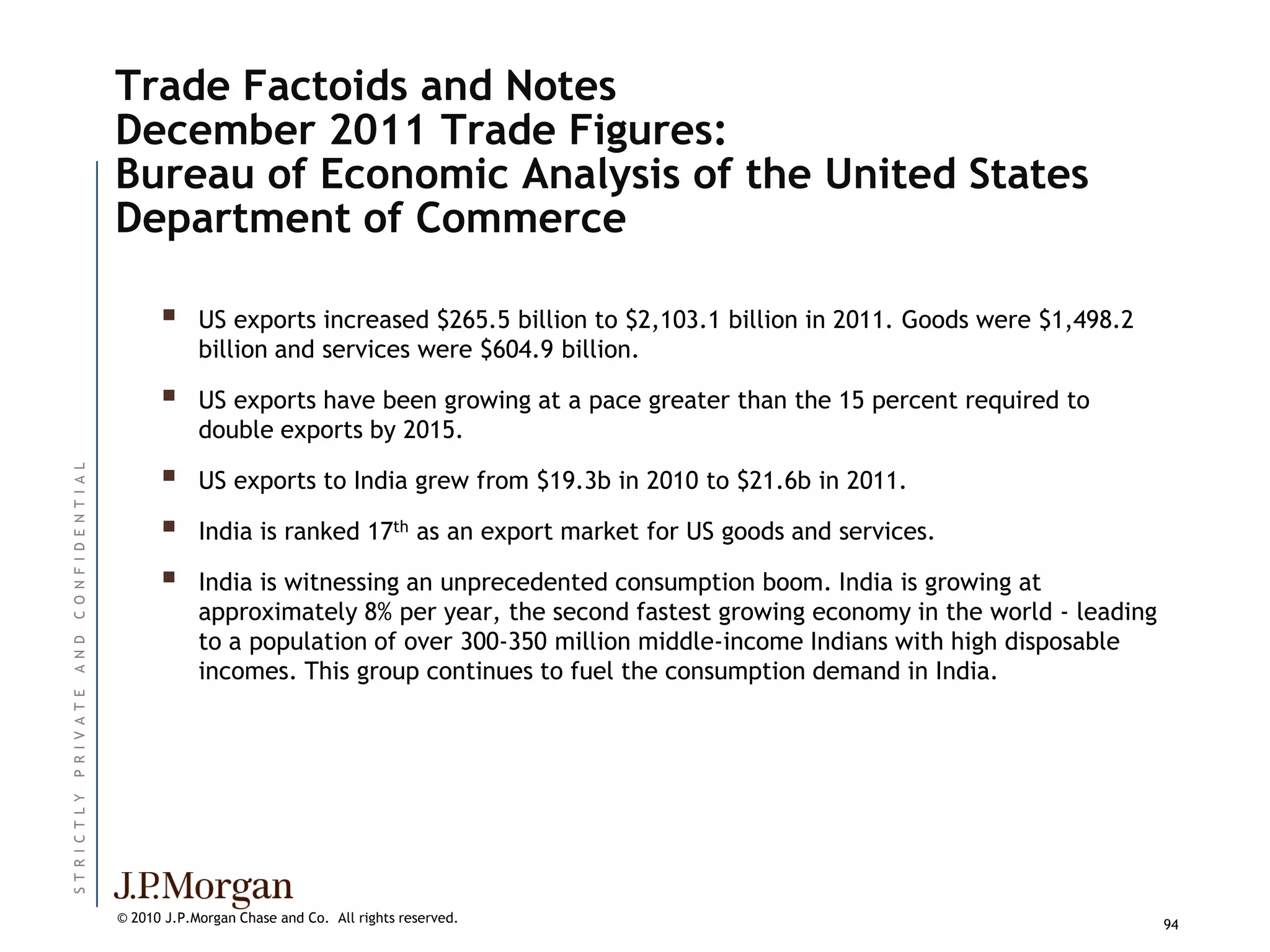
Trade Factoids and Notes
                          December 2011 Trade Figures:
                          Bureau of Economic Analysis of the United States
                          Department of Commerce

                                     US exports increased $265.5 billion to $2,103.1 billion in 2011. Goods were $1,498.2
                                      billion and services were $604.9 billion.

                                     US exports have been growing at a pace greater than the 15 percent required to
                                      double exports by 2015.

                                
C O N F I D E N T I A L


                                      US exports to India grew from $19.3b in 2010 to $21.6b in 2011.

                                     India is ranked 17th as an export market for US goods and services.

                                     India is witnessing an unprecedented consumption boom. India is growing at
                                      approximately 8% per year, the second fastest growing economy in the world - leading
                                      to a population of over 300-350 million middle-income Indians with high disposable
A N D


                                      incomes. This group continues to fuel the consumption demand in India.
P R I V A T E
ST R I C T L Y


                          © 2010 J.P.Morgan Chase and Co. All rights reserved.                                               94
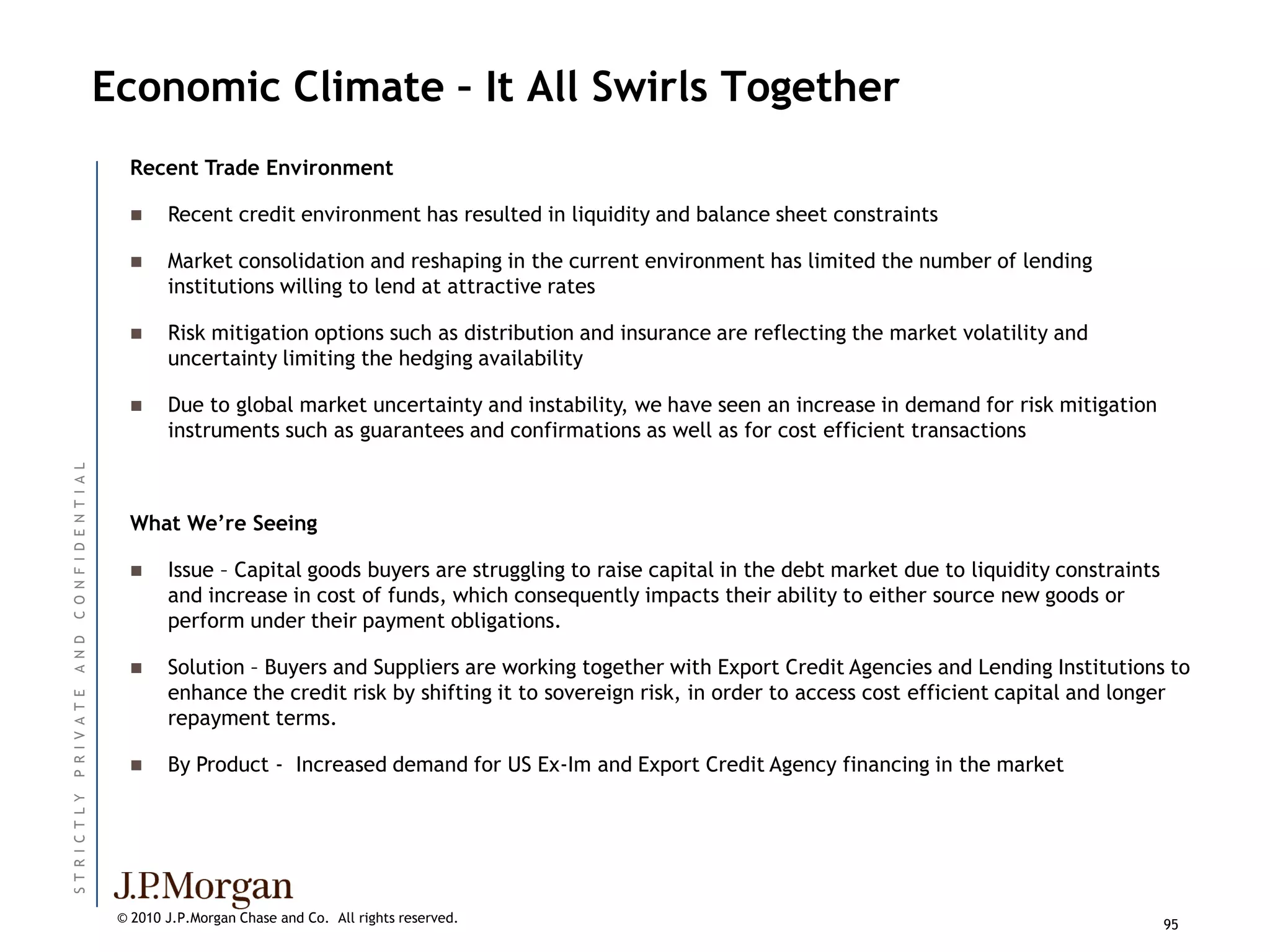
Economic Climate – It All Swirls Together
                            Recent Trade Environment

                                 Recent credit environment has resulted in liquidity and balance sheet constraints

                                 Market consolidation and reshaping in the current environment has limited the number of lending
                                  institutions willing to lend at attractive rates

                                 Risk mitigation options such as distribution and insurance are reflecting the market volatility and
                                  uncertainty limiting the hedging availability

                                 Due to global market uncertainty and instability, we have seen an increase in demand for risk mitigation
                                  instruments such as guarantees and confirmations as well as for cost efficient transactions
C O N F I D E N T I A L


                            What We’re Seeing

                                 Issue – Capital goods buyers are struggling to raise capital in the debt market due to liquidity constraints
                                  and increase in cost of funds, which consequently impacts their ability to either source new goods or
                                  perform under their payment obligations.
A N D


                                 Solution – Buyers and Suppliers are working together with Export Credit Agencies and Lending Institutions to
                                  enhance the credit risk by shifting it to sovereign risk, in order to access cost efficient capital and longer
P R I V A T E


                                  repayment terms.

                                 By Product - Increased demand for US Ex-Im and Export Credit Agency financing in the market
ST R I C T L Y


                           © 2010 J.P.Morgan Chase and Co. All rights reserved.                                                                  95
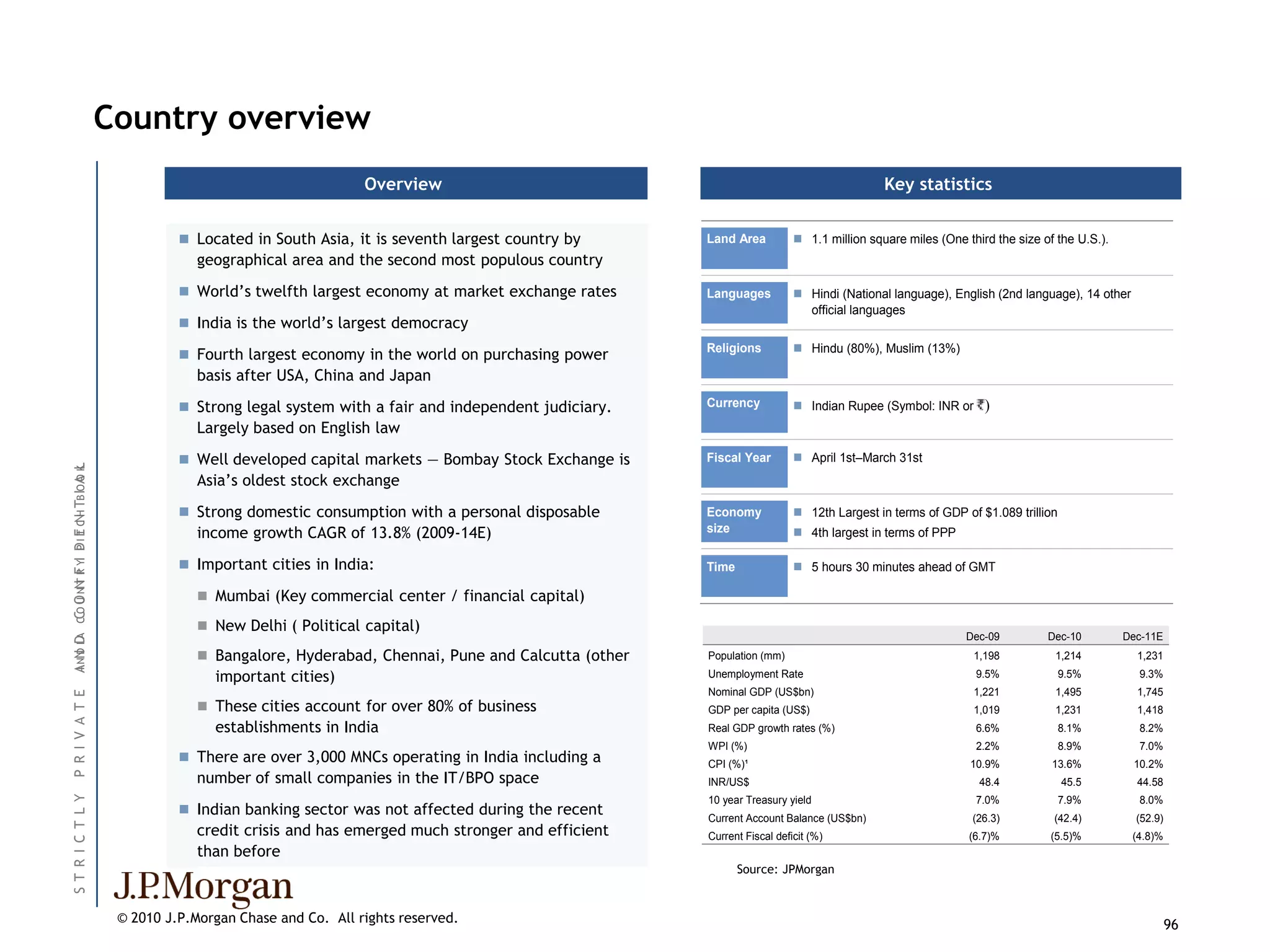
Country overview
                                                                                Overview                                                               Key statistics


                                                     Located in South Asia, it is seventh largest country by      Land Area           1.1 million square miles (One third the size of the U.S.).
                                                       geographical area and the second most populous country
                                                     World’s twelfth largest economy at market exchange rates     Languages           Hindi (National language), English (2nd language), 14 other
                                                                                                                                        official languages
                                                     India is the world’s largest democracy
                                                                                                                   Religions           Hindu (80%), Muslim (13%)
                                                     Fourth largest economy in the world on purchasing power
                                                       basis after USA, China and Japan
                                                     Strong legal system with a fair and independent judiciary.   Currency            Indian Rupee (Symbol: INR or      )
                                                       Largely based on English law
                                                     Well developed capital markets — Bombay Stock Exchange is    Fiscal Year         April 1st–March 31st
                                    O L
ANN ID CC O NN R YI D I E C H TB IO A K


                                                       Asia’s oldest stock exchange
                                                     Strong domestic consumption with a personal disposable       Economy             12th Largest in terms of GDP of $1.089 trillion
                    P T N


                                                       income growth CAGR of 13.8% (2009-14E)                      size                4th largest in terms of PPP

                                                     Important cities in India:                                   Time                5 hours 30 minutes ahead of GMT
         OU TF


                                                        Mumbai (Key commercial center / financial capital)

                                                        New Delhi ( Political capital)
                                                                                                                                                                      Dec-09          Dec-10         Dec-11E
I D A


                                                        Bangalore, Hyderabad, Chennai, Pune and Calcutta (other   Population (mm)                                      1,198          1,214           1,231
                                                         important cities)                                         Unemployment Rate                                    9.5%              9.5%         9.3%
                                                                                                                   Nominal GDP (US$bn)                                  1,221          1,495           1,745
P R I V A T E


                                                        These cities account for over 80% of business             GDP per capita (US$)                                 1,019          1,231           1,418
                                                         establishments in India                                   Real GDP growth rates (%)                            6.6%              8.1%         8.2%
                                                                                                                   WPI (%)                                              2.2%              8.9%         7.0%
                                                     There are over 3,000 MNCs operating in India including a     CPI (%)¹                                            10.9%           13.6%          10.2%
                                                       number of small companies in the IT/BPO space               INR/US$                                               48.4             45.5         44.58
ST R I C T L Y


                                                                                                                   10 year Treasury yield                               7.0%              7.9%         8.0%
                                                     Indian banking sector was not affected during the recent     Current Account Balance (US$bn)                      (26.3)         (42.4)          (52.9)
                                                       credit crisis and has emerged much stronger and efficient   Current Fiscal deficit (%)                          (6.7)%         (5.5)%          (4.8)%
                                                       than before
                                                                                                                          Source: JPMorgan


                                           © 2010 J.P.Morgan Chase and Co. All rights reserved.                                                                                                                 96
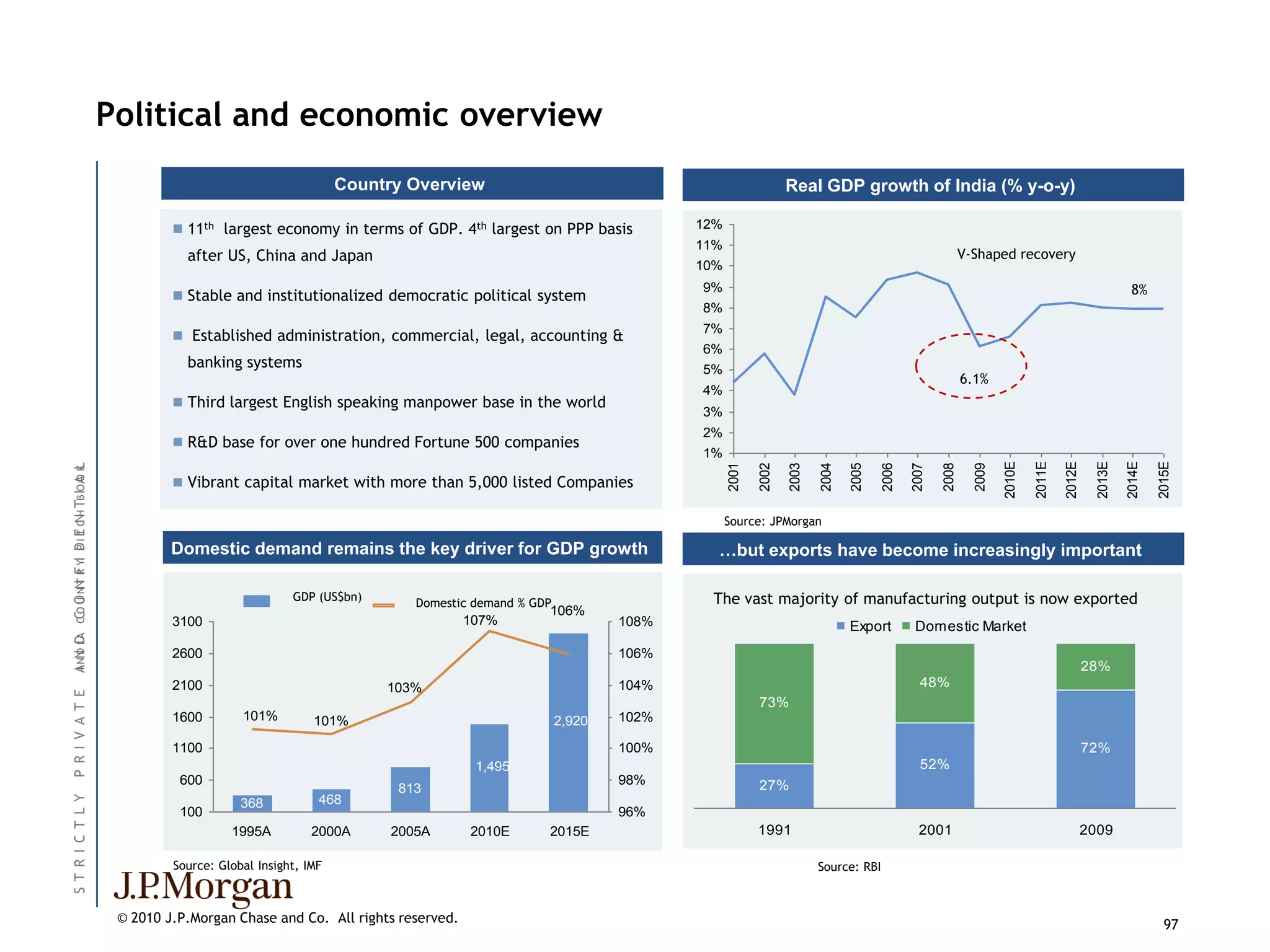
Political and economic overview
                                                                                 Country Overview                                                    Real GDP growth of India (% y-o-y)

                                                    11th largest economy in terms of GDP. 4th largest on PPP basis              12%
                                                                                                                                 11%
                                                     after US, China and Japan                                                                                                                 V-Shaped recovery
                                                                                                                                 10%

                                                    Stable and institutionalized democratic political system
                                                                                                                                 9%                                                                                                        8%
                                                                                                                                 8%
                                                                                                                                 7%
                                                    Established administration, commercial, legal, accounting &
                                                                                                                                 6%
                                                     banking systems                                                             5%
                                                                                                                                                                                               6.1%
                                                                                                                                 4%
                                                    Third largest English speaking manpower base in the world
                                                                                                                                 3%
                                                                                                                                 2%
                                                    R&D base for over one hundred Fortune 500 companies
                                                                                                                                 1%


                                                                                                                                                                                                        2010E

                                                                                                                                                                                                                2011E

                                                                                                                                                                                                                        2012E

                                                                                                                                                                                                                                  2013E

                                                                                                                                                                                                                                          2014E

                                                                                                                                                                                                                                                  2015E
                                                                                                                                       2001

                                                                                                                                              2002

                                                                                                                                                     2003

                                                                                                                                                            2004

                                                                                                                                                                   2005

                                                                                                                                                                          2006

                                                                                                                                                                                 2007

                                                                                                                                                                                        2008

                                                                                                                                                                                                 2009
                                    O L
ANN ID CC O NN R YI D I E C H TB IO A K


                                                    Vibrant capital market with more than 5,000 listed Companies

                                                                                                                                       Source: JPMorgan
                    P T N


                                                   Domestic demand remains the key driver for GDP growth                           …but exports have become increasingly important
         OU TF


                                                                        GDP (US$bn)
                                                                                          Domestic demand % GDP                   The vast majority of manufacturing output is now exported
                                                                                                              106%
                                                   3100                                           107%                    108%                                     Export        Domestic Market
I D A


                                                   2600                                                                   106%
                                                                                                                                                                                                                                28%
                                                   2100                               103%                                104%                                                     48%
P R I V A T E


                                                                                                                                              73%
                                                   1600        101%         101%                                  2,920   102%

                                                   1100                                                                   100%                                                                                                  72%
                                                                                                   1,495                                                                           52%
                                                    600                                                                   98%                 27%
                                                                                       813
ST R I C T L Y


                                                               368           468
                                                    100                                                                   96%
                                                             1995A          2000A      2005A      2010E       2015E                           1991                                 2001                                         2009

                                                   Source: Global Insight, IMF                                                                              Source: RBI


                                           © 2010 J.P.Morgan Chase and Co. All rights reserved.                                                                                                                                                     97
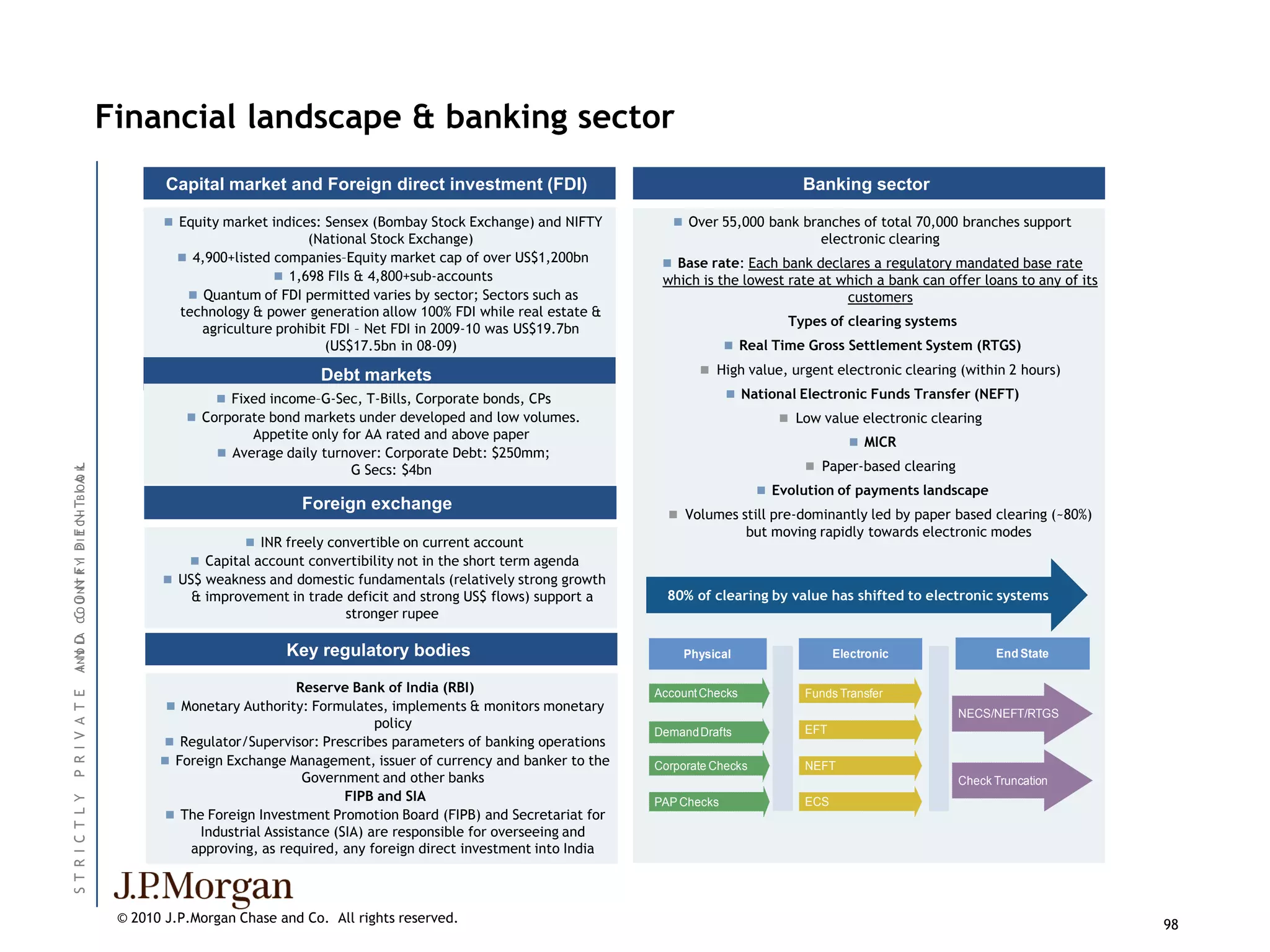
Financial landscape & banking sector
                                                  Capital market and Foreign direct investment (FDI)                                             Banking sector

                                                   Equity market indices: Sensex (Bombay Stock Exchange) and NIFTY         Over 55,000 bank branches of total 70,000 branches support
                                                                        (National Stock Exchange)                                                   electronic clearing
                                                     4,900+listed companies–Equity market cap of over US$1,200bn         Base rate: Each bank declares a regulatory mandated base rate
                                                                    1,698 FIIs & 4,800+sub-accounts                     which is the lowest rate at which a bank can offer loans to any of its
                                                      Quantum of FDI permitted varies by sector; Sectors such as                                     customers
                                                    technology & power generation allow 100% FDI while real estate &
                                                                                                                                               Types of clearing systems
                                                       agriculture prohibit FDI – Net FDI in 2009-10 was US$19.7bn
                                                                           (US$17.5bn in 08-09)                                       Real Time Gross Settlement System (RTGS)

                                                                          Debt markets                                          High value, urgent electronic clearing (within 2 hours)

                                                          Fixed income–G-Sec, T-Bills, Corporate bonds, CPs                          National Electronic Funds Transfer (NEFT)
                                                      Corporate bond markets under developed and low volumes.                                 Low value electronic clearing
                                                               Appetite only for AA rated and above paper
                                                                                                                                                          MICR
                                                           Average daily turnover: Corporate Debt: $250mm;
                                                                              G Secs: $4bn                                                         Paper-based clearing
                                    O L
ANN ID CC O NN R YI D I E C H TB IO A K


                                                                                                                                            Evolution of payments landscape
                                                                       Foreign exchange
                                                                                                                           Volumes still pre-dominantly led by paper based clearing (~80%)
                    P T N


                                                                                                                                         but moving rapidly towards electronic modes
                                                               INR freely convertible on current account
                                                     Capital account convertibility not in the short term agenda
         OU TF


                                                  US$ weakness and domestic fundamentals (relatively strong growth
                                                      & improvement in trade deficit and strong US$ flows) support a      80% of clearing by value has shifted to electronic systems
                                                                             stronger rupee
I D A


                                                                    Key regulatory bodies                                    Physical                  Electronic                End State

                                                                      Reserve Bank of India (RBI)                       Account Checks           Funds Transfer
P R I V A T E


                                                   Monetary Authority: Formulates, implements & monitors monetary
                                                                                                                                                                           NECS/NEFT/RTGS
                                                                                    policy                                                       EFT
                                                                                                                        Demand Drafts
                                                  Regulator/Supervisor: Prescribes parameters of banking operations
                                                  Foreign Exchange Management, issuer of currency and banker to the    Corporate Checks         NEFT
                                                                        Government and other banks                                                                         Check Truncation
                                                                               FIPB and SIA
ST R I C T L Y


                                                                                                                        PAP Checks               ECS
                                                   The Foreign Investment Promotion Board (FIPB) and Secretariat for
                                                       Industrial Assistance (SIA) are responsible for overseeing and
                                                     approving, as required, any foreign direct investment into India


                                           © 2010 J.P.Morgan Chase and Co. All rights reserved.                                                                                                   98
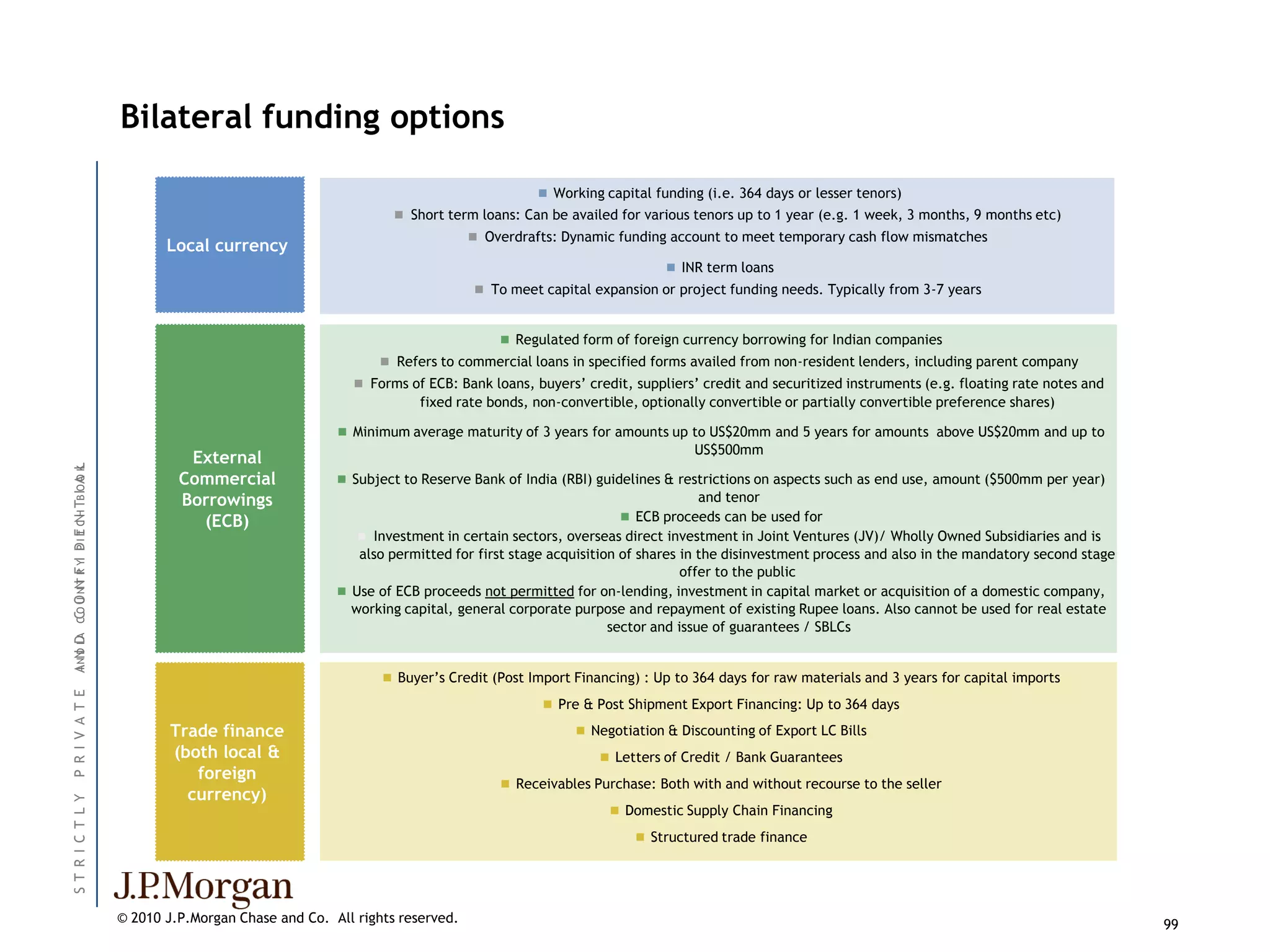
Bilateral funding options

                                                                                                            Working capital funding (i.e. 364 days or lesser tenors)
                                                                                     Short term loans: Can be availed for various tenors up to 1 year (e.g. 1 week, 3 months, 9 months etc)
                                                                                                  Overdrafts: Dynamic funding account to meet temporary cash flow mismatches
                                                 Local currency
                                                                                                                                INR term loans
                                                                                                  To meet capital expansion or project funding needs. Typically from 3-7 years


                                                                                                      Regulated form of foreign currency borrowing for Indian companies
                                                                                   Refers to commercial loans in specified forms availedproducts and Term Funding
                                                                                                   Short Term Loans, Overdraft from non-resident lenders, including parent company
                                                                               Forms of ECB: Bank loans, buyers’ credit, suppliers’ credit and securitized instruments (e.g. floating rate notes and
                                                                                                             Can be availed from local financial institutions
                                                                                        fixed rate bonds, non-convertible, optionally convertible or partially convertible preference shares)

                                                                            Minimum average maturity of 3 years for amounts up to US$20mm and 5 years for amounts above US$20mm and up to
                                                                                                                                    US$500mm
                                                    External
                                    O L
ANN ID CC O NN R YI D I E C H TB IO A K


                                                   Commercial               Subject to Reserve Bank of India (RBI) guidelines & restrictions on aspects such as end use, amount ($500mm per year)
                                                   Borrowings                                                                       and tenor
                                                     (ECB)                                                               ECB proceeds can be used for
                    P T N


                                                                               Investment in certain sectors, overseas direct investment in Joint Ventures (JV)/ Wholly Owned Subsidiaries and is
                                                                              also permitted for first stage acquisition of shares in the disinvestment process and also in the mandatory second stage
                                                                                                                                   offer to the public
         OU TF


                                                                            Use of ECB proceeds not permitted for on-lending, investment in capital market or acquisition of a domestic company,
                                                                             working capital, general corporate purpose and repayment of existing Rupee loans. Also cannot be used for real estate
                                                                                                                       sector and issue of guarantees / SBLCs
I D A


                                                                                   Buyer’s Credit (Post Import Financing) : Up to 364 days for raw materials and 3 years for capital imports
P R I V A T E


                                                                                                             Pre & Post Shipment Export Financing: Up to 364 days

                                                  Trade finance                                                   Negotiation & Discounting of Export LC Bills
                                                  (both local &                                                       Letters of Credit / Bank Guarantees
                                                     foreign
                                                                                                      Receivables Purchase: Both with and without recourse to the seller
                                                    currency)

ST R I C T L Y


                                                                                                                       Domestic Supply Chain Financing

                                                                                                                           Structured trade finance


                                          © 2010 J.P.Morgan Chase and Co. All rights reserved.                                                                                                           99
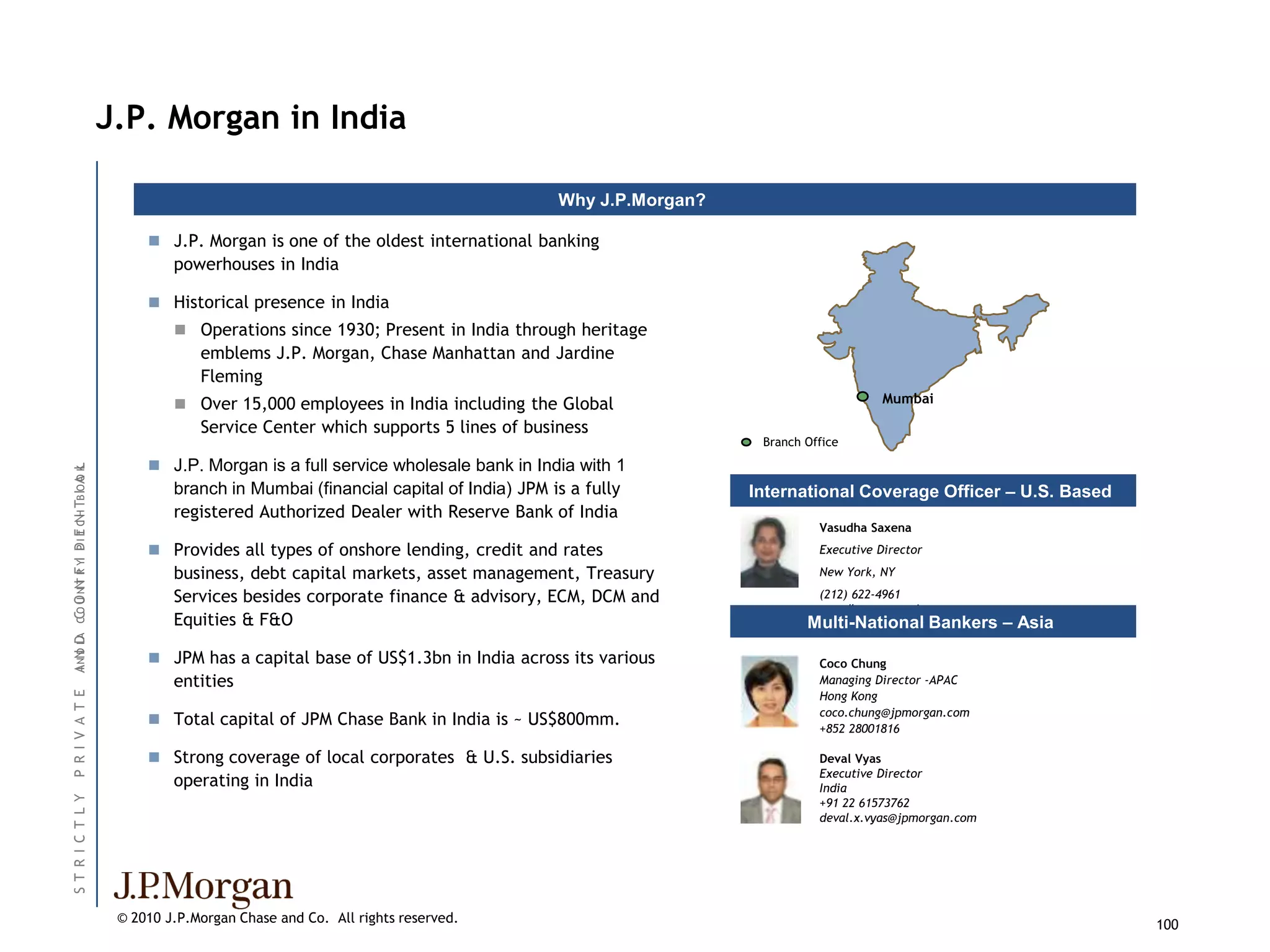
J.P. Morgan in India

                                                                                                      Why J.P.Morgan?

                                                J.P. Morgan is one of the oldest international banking
                                                   powerhouses in India

                                                Historical presence in India
                                                    Operations since 1930; Present in India through heritage
                                                       emblems J.P. Morgan, Chase Manhattan and Jardine
                                                       Fleming
                                                    Over 15,000 employees in India including the Global                                     Mumbai

                                                       Service Center which supports 5 lines of business
                                                                                                                         Branch Office

                                                J.P. Morgan is a full service wholesale bank in India with 1
                                    O L
ANN ID CC O NN R YI D I E C H TB IO A K


                                                   branch in Mumbai (financial capital of India) JPM is a fully         International Coverage Officer – U.S. Based
                                                   registered Authorized Dealer with Reserve Bank of India
                    P T N


                                                                                                                                  Vasudha Saxena
                                                Provides all types of onshore lending, credit and rates                          Executive Director

                                                   business, debt capital markets, asset management, Treasury                     New York, NY
         OU TF


                                                   Services besides corporate finance & advisory, ECM, DCM and                    (212) 622-4961
                                                                                                                                  vasudha.saxena@jpmorgan.com
                                                   Equities & F&O                                                               Multi-National Bankers – Asia
I D A


                                                JPM has a capital base of US$1.3bn in India across its various                   Coco Chung
                                                   entities                                                                       Managing Director -APAC
                                                                                                                                  Hong Kong
P R I V A T E


                                                                                                                                  coco.chung@jpmorgan.com
                                                Total capital of JPM Chase Bank in India is ~ US$800mm.                          +852 28001816

                                                Strong coverage of local corporates & U.S. subsidiaries                          Deval Vyas
                                                                                                                                  Executive Director
                                                   operating in India                                                             India
ST R I C T L Y


                                                                                                                                  +91 22 61573762
                                                                                                                                  deval.x.vyas@jpmorgan.com


                                           © 2010 J.P.Morgan Chase and Co. All rights reserved.                                                                       100
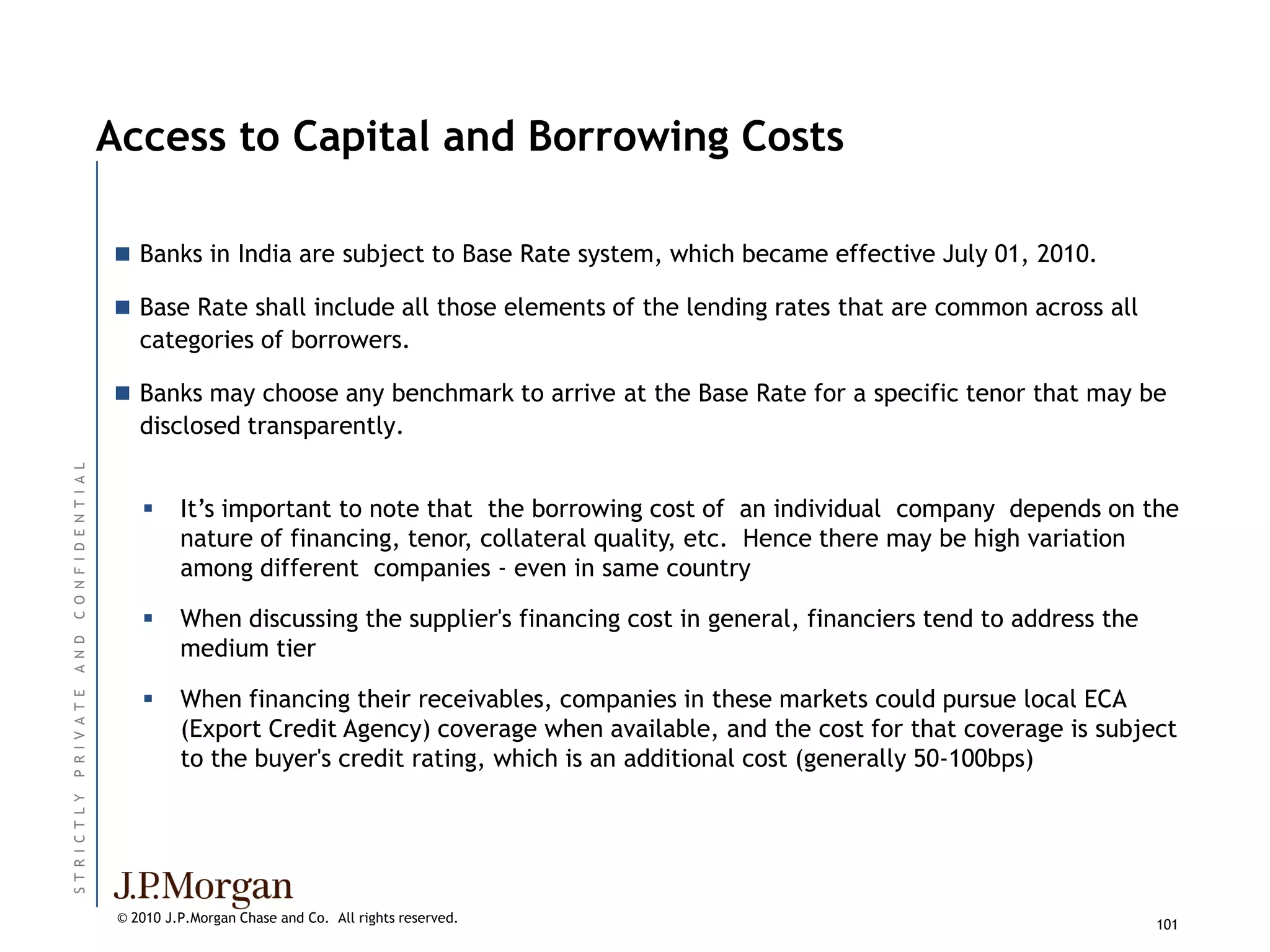
Access to Capital and Borrowing Costs

                           Banks in India are subject to Base Rate system, which became effective July 01, 2010.

                           Base Rate shall include all those elements of the lending rates that are common across all
                              categories of borrowers.

                           Banks may choose any benchmark to arrive at the Base Rate for a specific tenor that may be
                              disclosed transparently.
C O N F I D E N T I A L


                                   It’s important to note that the borrowing cost of an individual company depends on the
                                    nature of financing, tenor, collateral quality, etc. Hence there may be high variation
                                    among different companies - even in same country

                                   When discussing the supplier's financing cost in general, financiers tend to address the
                                    medium tier
A N D


                                   When financing their receivables, companies in these markets could pursue local ECA
P R I V A T E


                                    (Export Credit Agency) coverage when available, and the cost for that coverage is subject
                                    to the buyer's credit rating, which is an additional cost (generally 50-100bps)
ST R I C T L Y


                           © 2010 J.P.Morgan Chase and Co. All rights reserved.                                                101
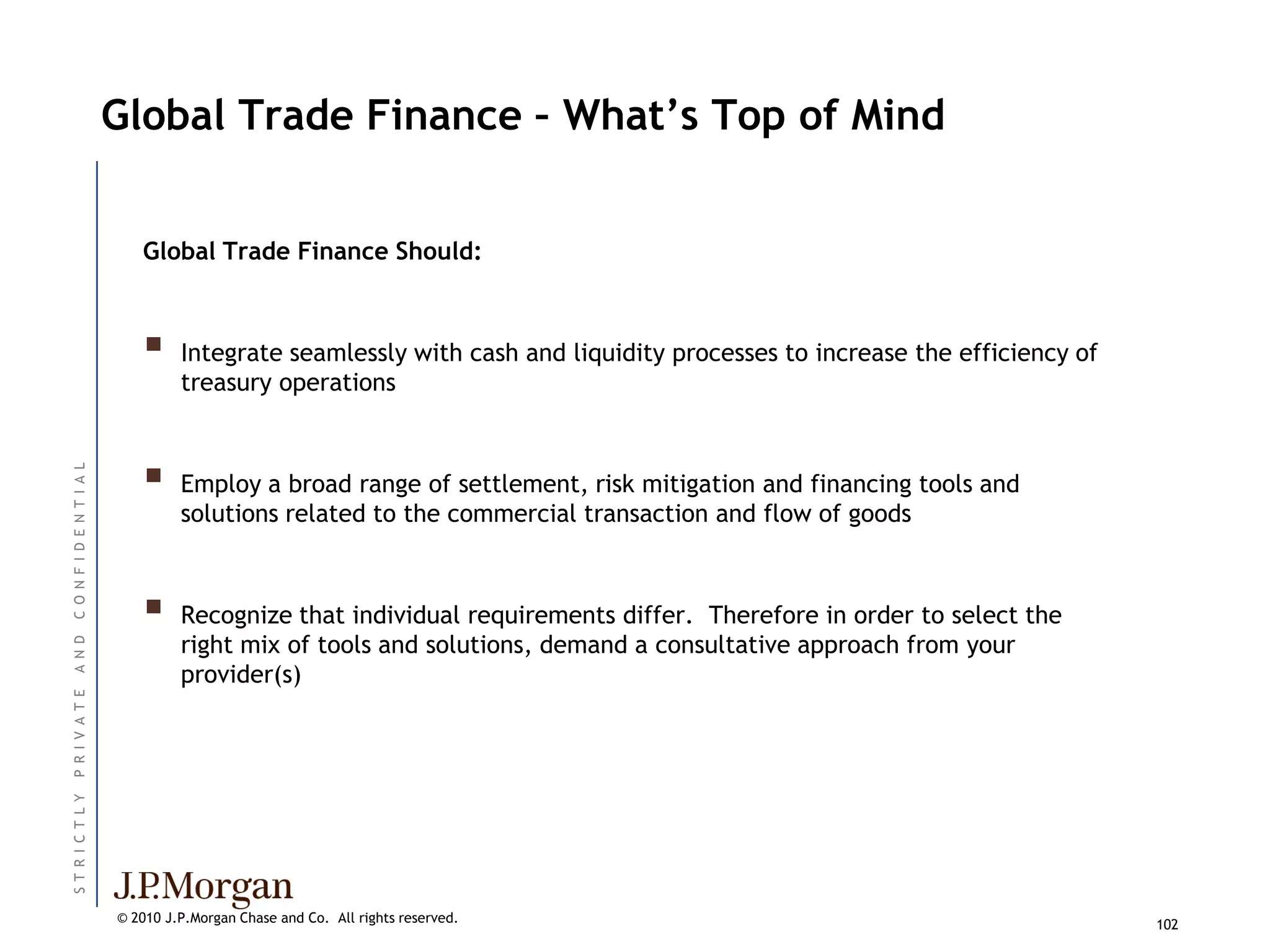
Global Trade Finance – What’s Top of Mind


                             Global Trade Finance Should:


                                  Integrate seamlessly with cash and liquidity processes to increase the efficiency of
                                   treasury operations


                             
C O N F I D E N T I A L


                                   Employ a broad range of settlement, risk mitigation and financing tools and
                                   solutions related to the commercial transaction and flow of goods


                                  Recognize that individual requirements differ. Therefore in order to select the
                                   right mix of tools and solutions, demand a consultative approach from your
A N D


                                   provider(s)
P R I V A T E
ST R I C T L Y


                          © 2010 J.P.Morgan Chase and Co. All rights reserved.                                            102
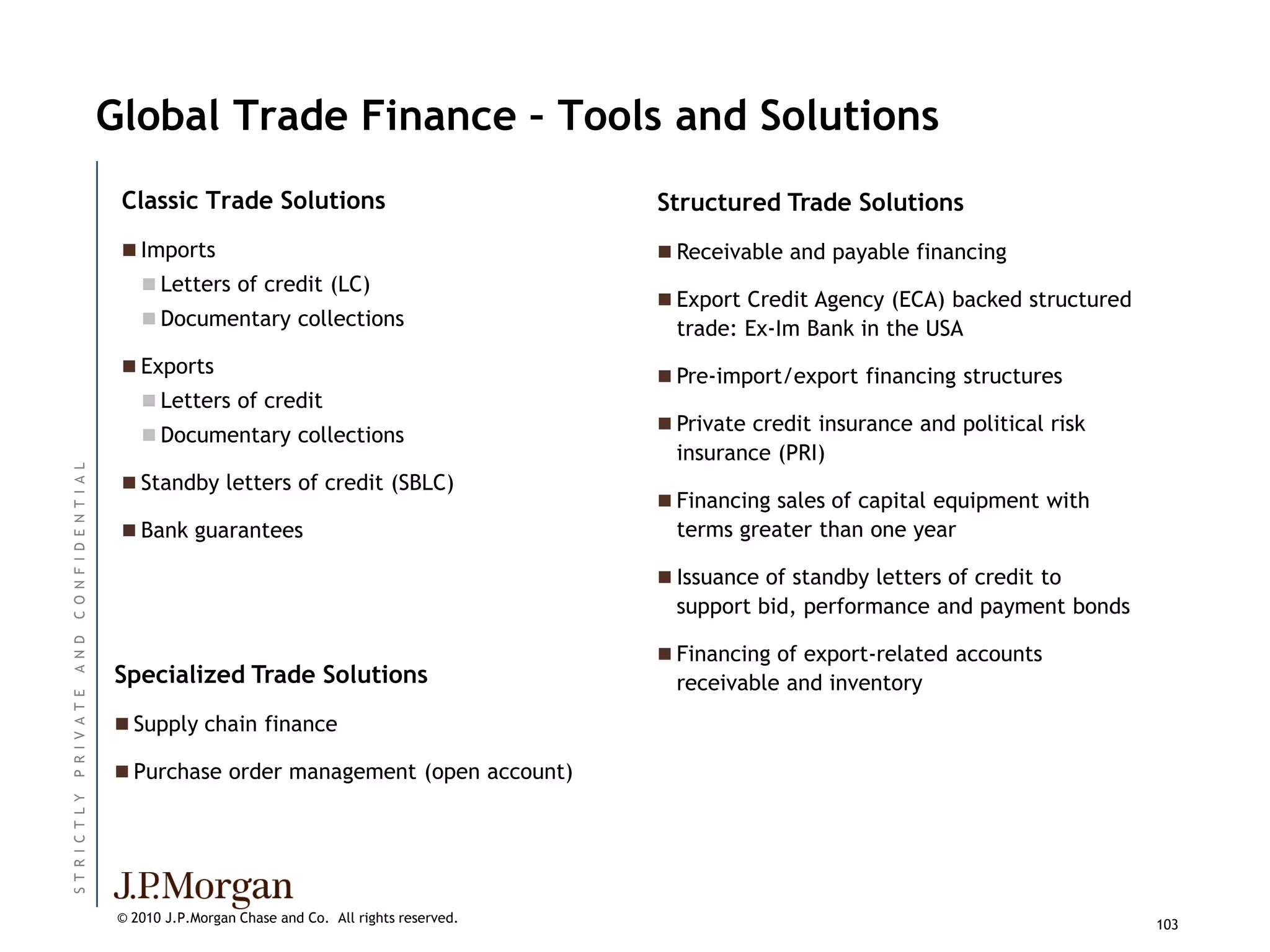
Global Trade Finance – Tools and Solutions
                           Classic Trade Solutions                                Structured Trade Solutions
                            Imports                                               Receivable and payable financing
                               Letters of credit (LC)
                                                                                   Export Credit Agency (ECA) backed structured
                               Documentary collections                             trade: Ex-Im Bank in the USA
                            Exports                                               Pre-import/export financing structures
                               Letters of credit
                                                                                   Private credit insurance and political risk
                               Documentary collections
                                                                                    insurance (PRI)
C O N F I D E N T I A L


                            Standby letters of credit (SBLC)
                                                                                   Financing sales of capital equipment with
                            Bank guarantees                                        terms greater than one year

                                                                                   Issuance of standby letters of credit to
                                                                                    support bid, performance and payment bonds
A N D


                                                                                   Financing of export-related accounts
                          Specialized Trade Solutions                               receivable and inventory
P R I V A T E


                           Supply chain finance

                           Purchase order management (open account)
ST R I C T L Y


                           © 2010 J.P.Morgan Chase and Co. All rights reserved.                                                    103
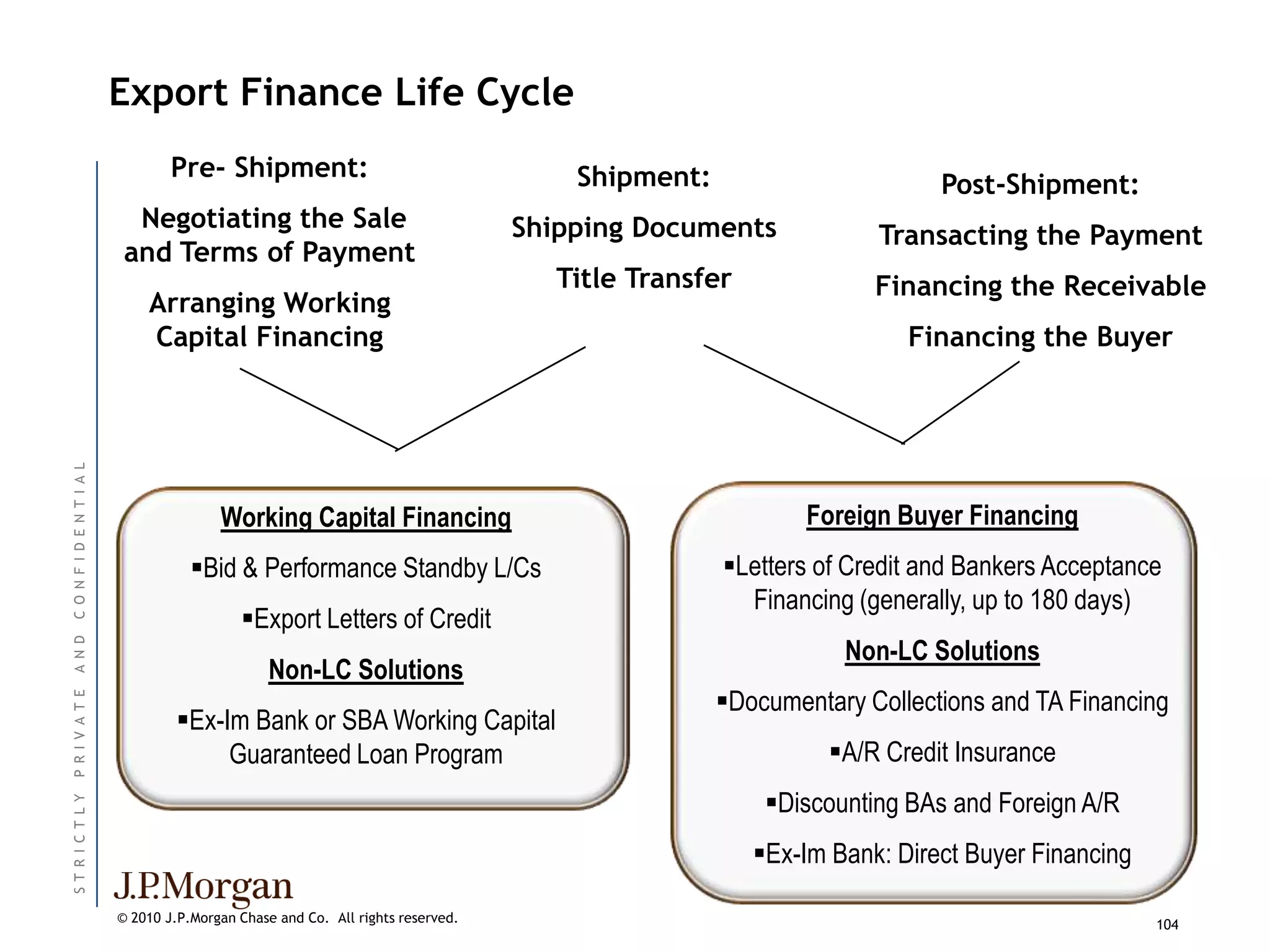
Export Finance Life Cycle                                                       Trade Cycle Financing
                                  Pre- Shipment:                                     Shipment:                        Post-Shipment:
                            Negotiating the Sale                                 Shipping Documents             Transacting the Payment
                           and Terms of Payment
                                                                                    Title Transfer              Financing the Receivable
                              Arranging Working
                              Capital Financing                                                                    Financing the Buyer
C O N F I D E N T I A L


                                         Working Capital Financing                                       Foreign Buyer Financing
                                     Bid & Performance Standby L/Cs                             Letters of Credit and Bankers Acceptance
                                                                                                   Financing (generally, up to 180 days)
                                            Export Letters of Credit
                                                                                                             Non-LC Solutions
A N D


                                                 Non-LC Solutions
                                                                                                 Documentary Collections and TA Financing
P R I V A T E


                                   Ex-Im Bank or SBA Working Capital
                                        Guaranteed Loan Program                                             A/R Credit Insurance
                                                                                                      Discounting BAs and Foreign A/R
ST R I C T L Y


                                                                                                     Ex-Im Bank: Direct Buyer Financing

                          © 2010 J.P.Morgan Chase and Co. All rights reserved.                                                             104
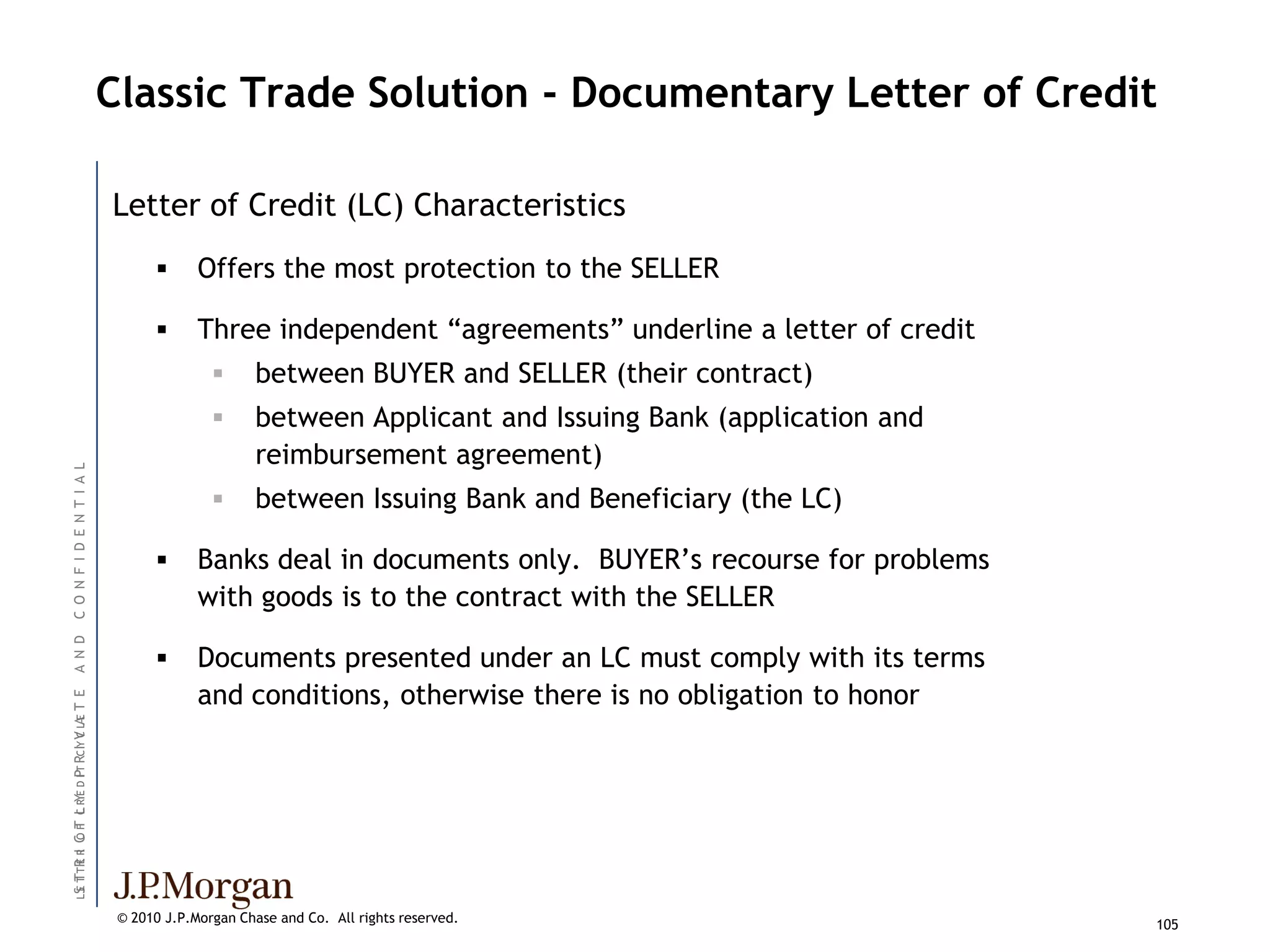
Classic Trade Solution - Documentary Letter of Credit

                                        Letter of Credit (LC) Characteristics
                                                    Offers the most protection to the SELLER

                                                    Three independent ―agreements‖ underline a letter of credit
                                                             between BUYER and SELLER (their contract)
                                                             between Applicant and Issuing Bank (application and
                                                              reimbursement agreement)
C O N F I D E N T I A L


                                                             between Issuing Bank and Beneficiary (the LC)

                                                    Banks deal in documents only. BUYER’s recourse for problems
                                                     with goods is to the contract with the SELLER
A N D


                                                    Documents presented under an LC must comply with its terms
                                                     and conditions, otherwise there is no obligation to honor
T E                              C E
L S T TR R C F C R E D I T RC IY V LA
  E T E I OT L Y       P


                                         © 2010 J.P.Morgan Chase and Co. All rights reserved.                       105
Documentary Letter of Credit: a tool to provide
                               short term finance to your Buyer – Overview
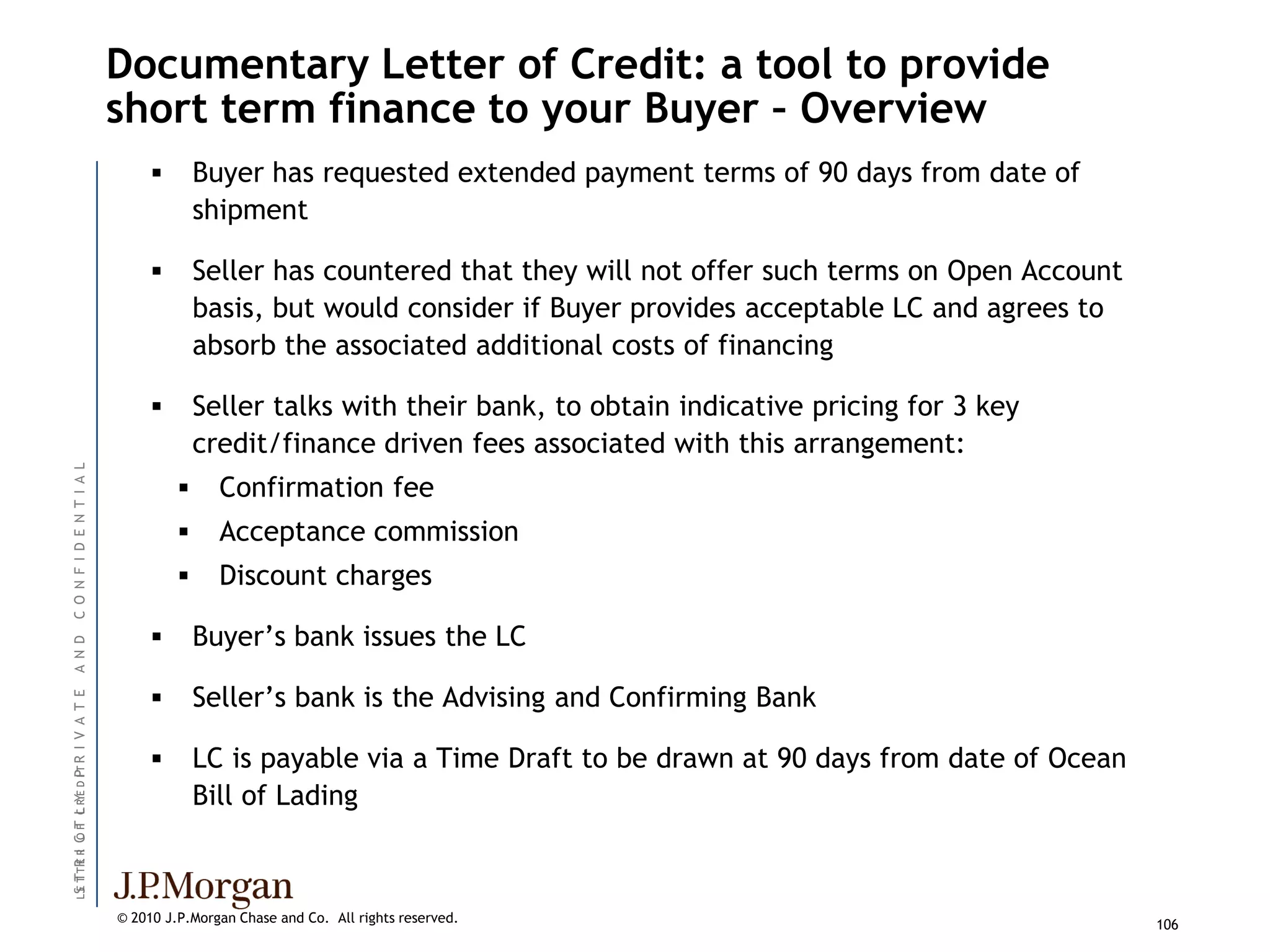
                                           Buyer has requested extended payment terms of 90 days from date of
                                            shipment

                                           Seller has countered that they will not offer such terms on Open Account
                                            basis, but would consider if Buyer provides acceptable LC and agrees to
                                            absorb the associated additional costs of financing

                                           Seller talks with their bank, to obtain indicative pricing for 3 key
                                            credit/finance driven fees associated with this arrangement:
C O N F I D E N T I A L


                                             Confirmation fee
                                             Acceptance commission
                                             Discount charges

                                           Buyer’s bank issues the LC
A N D


                                           Seller’s bank is the Advising and Confirming Bank
I V A T E


                                           LC is payable via a Time Draft to be drawn at 90 days from date of Ocean
L S T TR R C F C R E D I T R
                       P


                                            Bill of Lading
  E T E I OT L Y


                               © 2010 J.P.Morgan Chase and Co. All rights reserved.                                    106
Documentary Letter of Credit: a tool to provide
                               short term finance to your Buyer – The Numbers
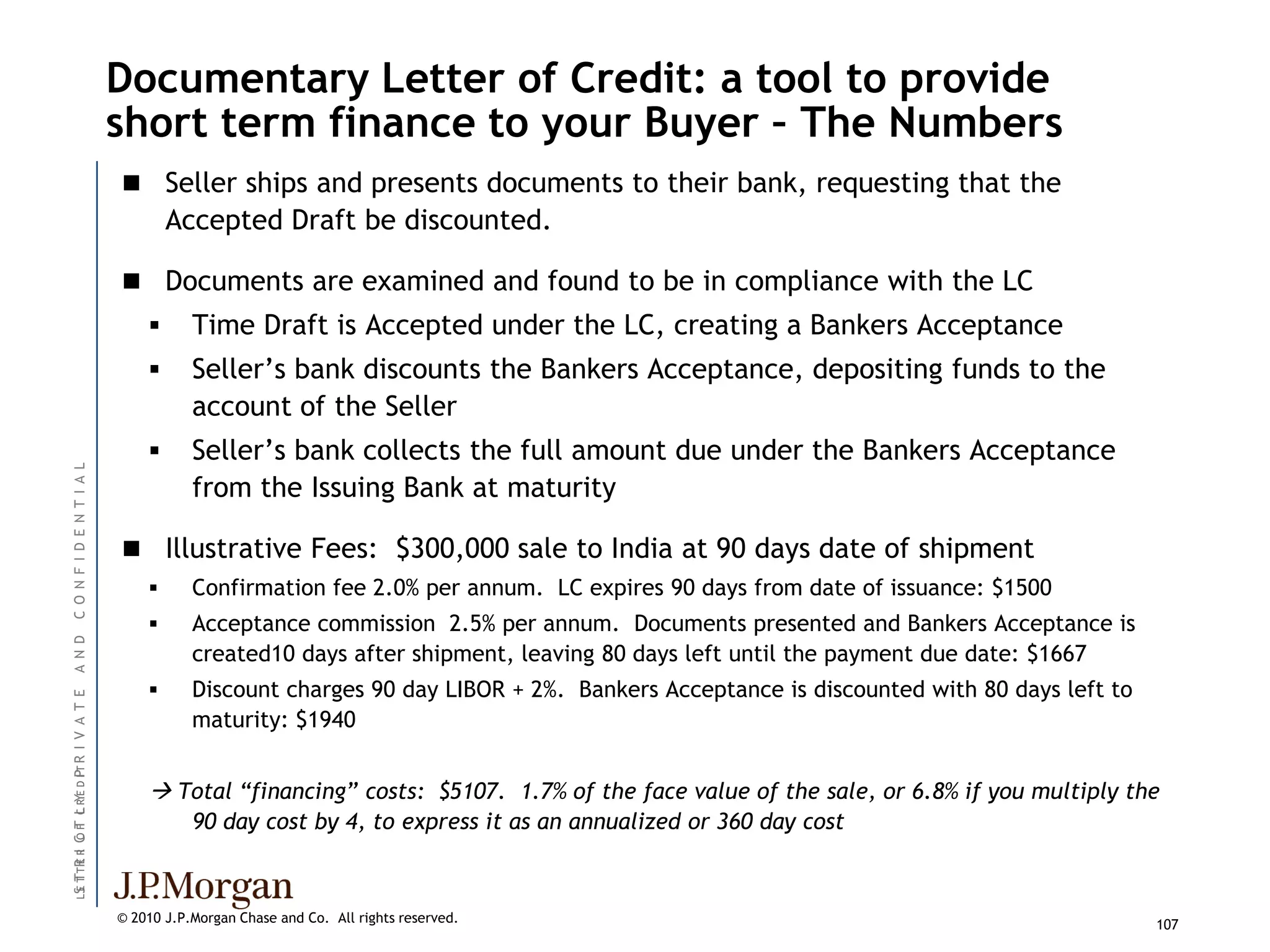
                                Seller ships and presents documents to their bank, requesting that the
                                       Accepted Draft be discounted.

                                Documents are examined and found to be in compliance with the LC
                                         Time Draft is Accepted under the LC, creating a Bankers Acceptance
                                         Seller’s bank discounts the Bankers Acceptance, depositing funds to the
                                          account of the Seller
                                         Seller’s bank collects the full amount due under the Bankers Acceptance
C O N F I D E N T I A L


                                          from the Issuing Bank at maturity

                                Illustrative Fees: $300,000 sale to India at 90 days date of shipment
                                         Confirmation fee 2.0% per annum. LC expires 90 days from date of issuance: $1500
                                         Acceptance commission 2.5% per annum. Documents presented and Bankers Acceptance is
A N D


                                          created10 days after shipment, leaving 80 days left until the payment due date: $1667
                                         Discount charges 90 day LIBOR + 2%. Bankers Acceptance is discounted with 80 days left to
I V A T E


                                          maturity: $1940
L S T TR R C F C R E D I T R
                       P


                                    Total “financing” costs: $5107. 1.7% of the face value of the sale, or 6.8% if you multiply the
  E T E I OT L Y


                                          90 day cost by 4, to express it as an annualized or 360 day cost


                               © 2010 J.P.Morgan Chase and Co. All rights reserved.                                                   107
Structured Trade Solution - Export-Import Bank

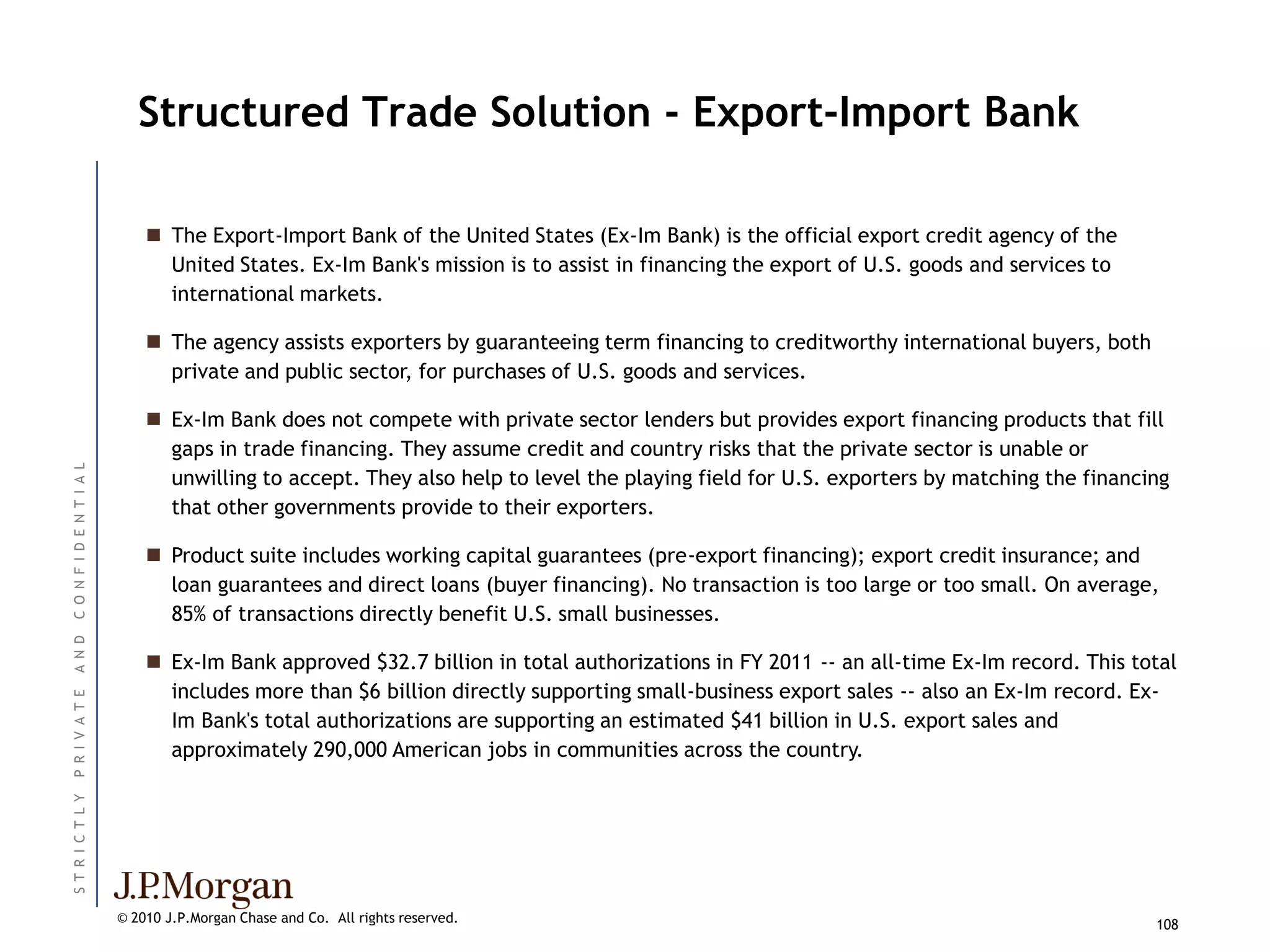
                               The Export-Import Bank of the United States (Ex-Im Bank) is the official export credit agency of the
                                United States. Ex-Im Bank's mission is to assist in financing the export of U.S. goods and services to
                                international markets.

                               The agency assists exporters by guaranteeing term financing to creditworthy international buyers, both
                                private and public sector, for purchases of U.S. goods and services.

                               Ex-Im Bank does not compete with private sector lenders but provides export financing products that fill
                                gaps in trade financing. They assume credit and country risks that the private sector is unable or
C O N F I D E N T I A L


                                unwilling to accept. They also help to level the playing field for U.S. exporters by matching the financing
                                that other governments provide to their exporters.

                               Product suite includes working capital guarantees (pre-export financing); export credit insurance; and
                                loan guarantees and direct loans (buyer financing). No transaction is too large or too small. On average,
                                85% of transactions directly benefit U.S. small businesses.
A N D


                               Ex-Im Bank approved $32.7 billion in total authorizations in FY 2011 -- an all-time Ex-Im record. This total
                                includes more than $6 billion directly supporting small-business export sales -- also an Ex-Im record. Ex-
P R I V A T E


                                Im Bank's total authorizations are supporting an estimated $41 billion in U.S. export sales and
                                approximately 290,000 American jobs in communities across the country.
ST R I C T L Y


                          © 2010 J.P.Morgan Chase and Co. All rights reserved.                                                           108
Access to Solutions – What is “Bankable”?

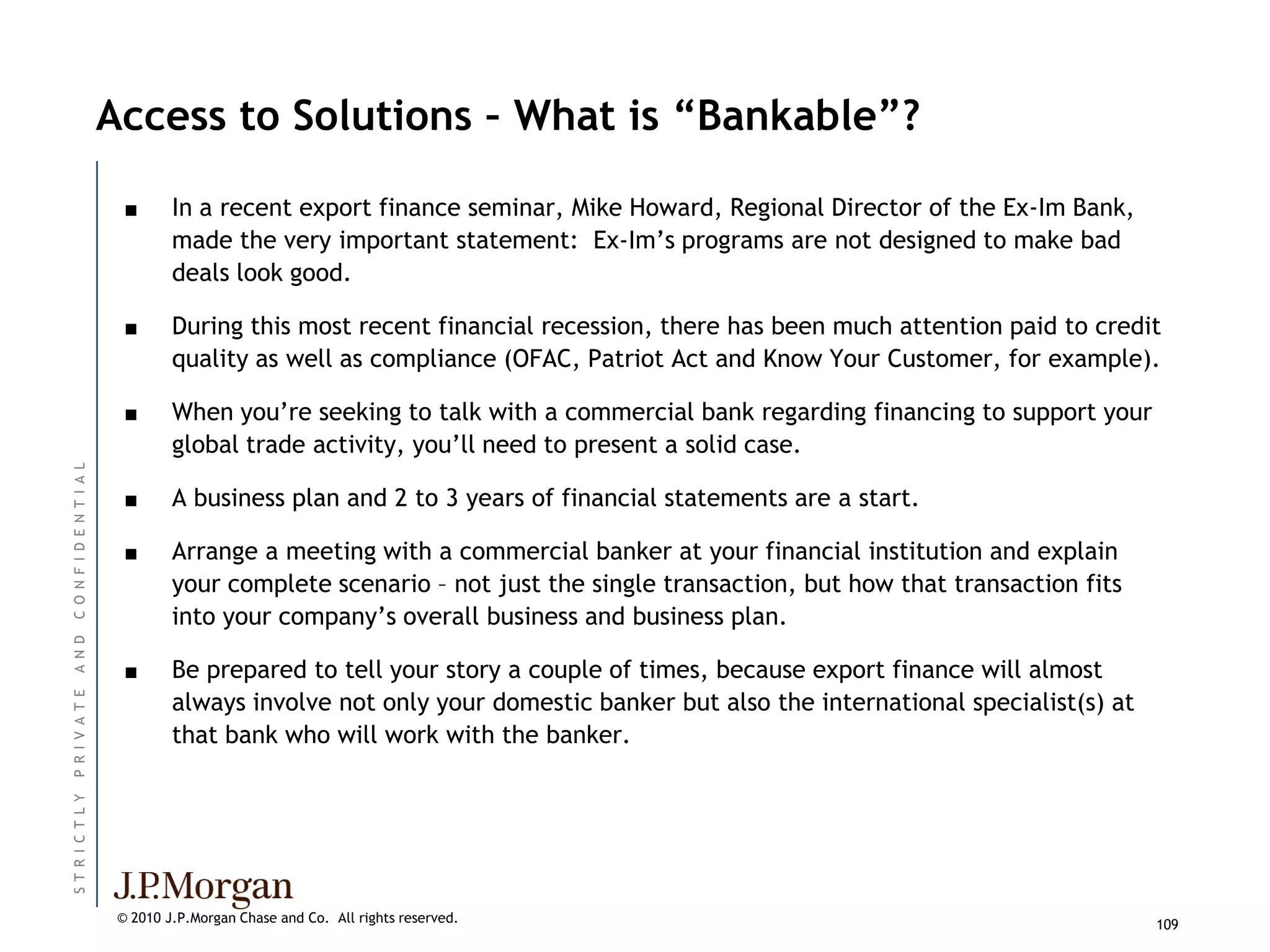
                            ■      In a recent export finance seminar, Mike Howard, Regional Director of the Ex-Im Bank,
                                   made the very important statement: Ex-Im’s programs are not designed to make bad
                                   deals look good.

                            ■      During this most recent financial recession, there has been much attention paid to credit
                                   quality as well as compliance (OFAC, Patriot Act and Know Your Customer, for example).

                            ■      When you’re seeking to talk with a commercial bank regarding financing to support your
                                   global trade activity, you’ll need to present a solid case.
C O N F I D E N T I A L


                            ■      A business plan and 2 to 3 years of financial statements are a start.

                            ■      Arrange a meeting with a commercial banker at your financial institution and explain
                                   your complete scenario – not just the single transaction, but how that transaction fits
                                   into your company’s overall business and business plan.
A N D


                            ■      Be prepared to tell your story a couple of times, because export finance will almost
                                   always involve not only your domestic banker but also the international specialist(s) at
P R I V A T E


                                   that bank who will work with the banker.
ST R I C T L Y


                           © 2010 J.P.Morgan Chase and Co. All rights reserved.                                               109
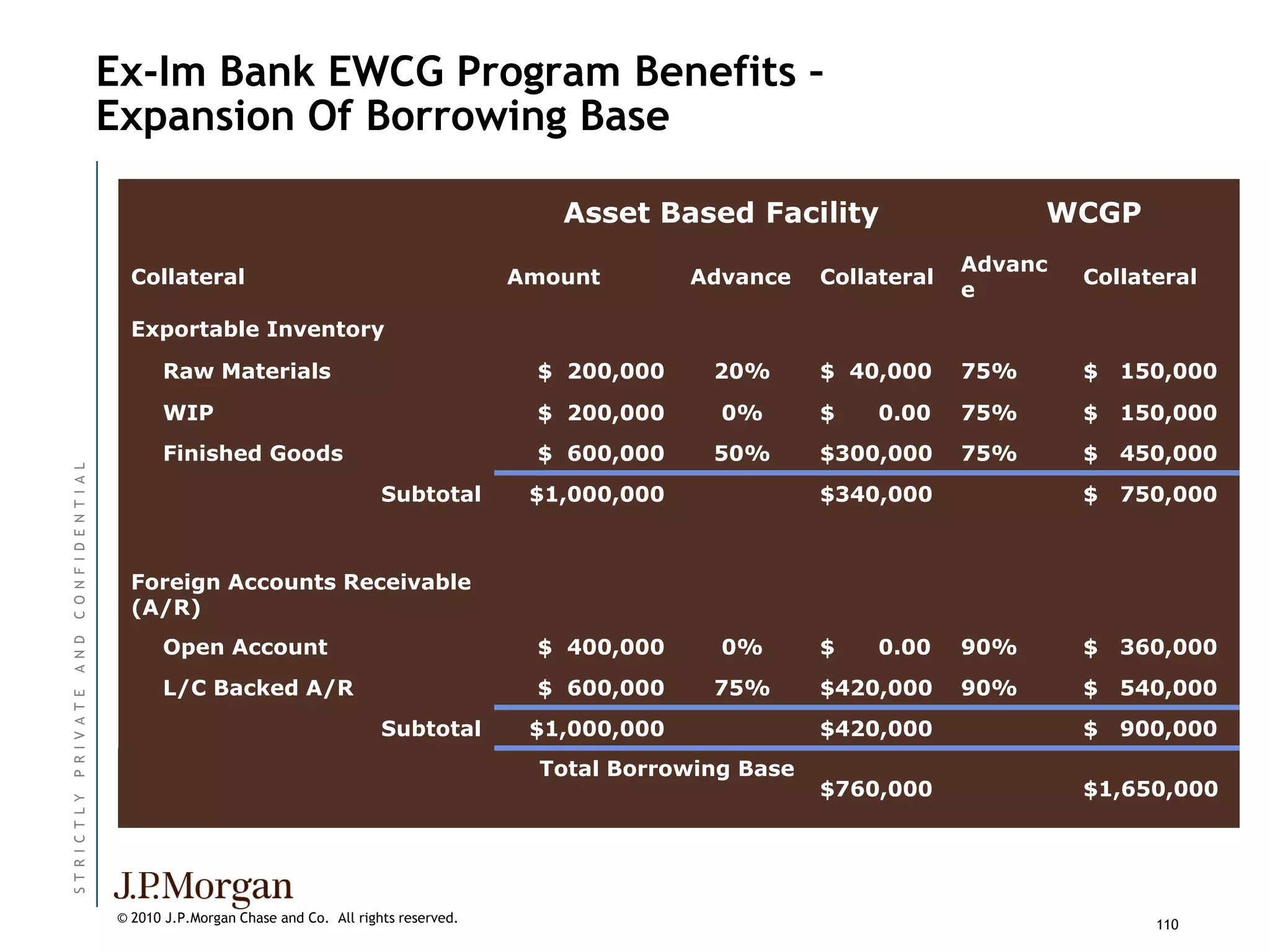
Ex-Im Bank EWCG Program Benefits –
                          Expansion Of Borrowing Base

                                                                                    Asset Based Facility                     WCGP
                                                                                                                       Advanc
                            Collateral                                           Amount        Advance    Collateral            Collateral
                                                                                                                       e
                            Exportable Inventory
                                Raw Materials                                     $ 200,000     20%       $ 40,000     75%      $   150,000
                                WIP                                               $ 200,000      0%       $    0.00    75%      $   150,000
                                Finished Goods                                    $ 600,000     50%       $300,000     75%      $   450,000
C O N F I D E N T I A L


                                                                  Subtotal        $1,000,000              $340,000              $   750,000


                            Foreign Accounts Receivable
                            (A/R)
                                Open Account                                      $ 400,000      0%       $    0.00    90%      $   360,000
A N D


                                L/C Backed A/R                                    $ 600,000     75%       $420,000     90%      $   540,000
P R I V A T E


                                                                  Subtotal        $1,000,000              $420,000              $   900,000
                                                                                   Total Borrowing Base
                                                                                                          $760,000              $1,650,000
ST R I C T L Y


                          © 2010 J.P.Morgan Chase and Co. All rights reserved.                                                        110
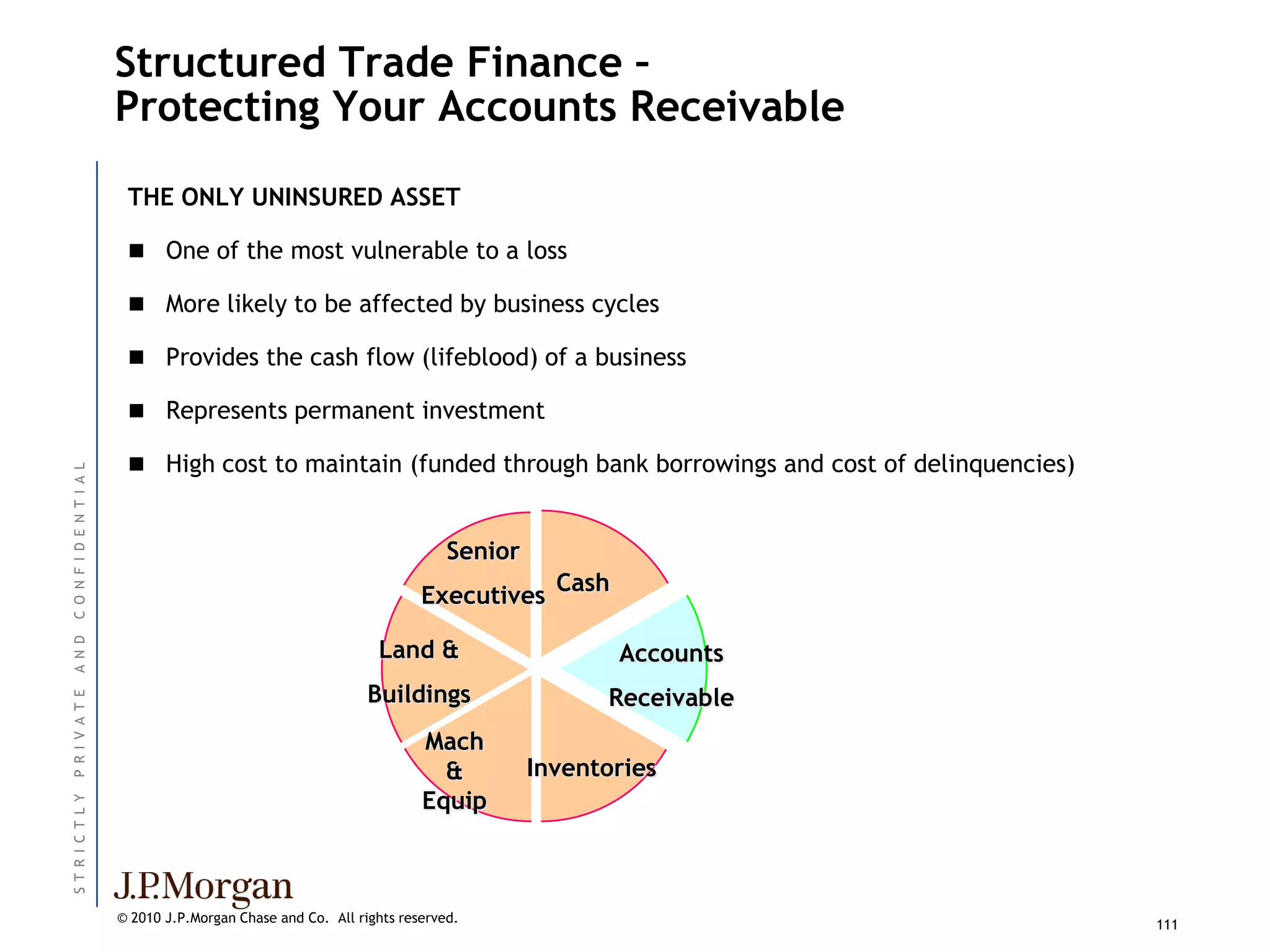
Structured Trade Finance –
                          Protecting Your Accounts Receivable
                           THE ONLY UNINSURED ASSET

                            One of the most vulnerable to a loss

                            More likely to be affected by business cycles

                            Provides the cash flow (lifeblood) of a business

                            Represents permanent investment

                            High cost to maintain (funded through bank borrowings and cost of delinquencies)
C O N F I D E N T I A L


                                                                            Senior
                                                                                       Cash
                                                                        Executives

                                                                 Land &
A N D


                                                                                              Accounts
                                                                Buildings                  Receivable
P R I V A T E


                                                                        Mach
                                                                          &          Inventories
                                                                        Equip
ST R I C T L Y


                          © 2010 J.P.Morgan Chase and Co. All rights reserved.                                  111
Short-Term Export Credit Insurance

                          WHAT:
                          Commercial Risk of Default: Insolvency and Protracted Default
                          Country/Political Risk: Debt Moratorium, Trade Embargo, License Cancellations etc.


                          WHY:
                          Provides coverage against the unforeseen and unexpected
                          Export receivables are usually the riskiest portion of the current asset portfolio yet it is the only one
                          that is unprotected
C O N F I D E N T I A L


                          WHERE:
                          The US Government’s Official Export Credit Agency: Ex-Im Bank
                          The Private Sector: Filling the ―niches‖ and shortfalls in the programs of the ECA’s. Commercially
                          oriented insurance programs
A N D


                          WHEN:
P R I V A T E


                          When you want to mitigate the risk of loss and/or cap it
                          When you want to meet or beat the competition
                          When you want to tap new sources of financing for your company and your buyers
ST R I C T L Y


                          © 2010 J.P.Morgan Chase and Co. All rights reserved.                                                        112
Summary – Global Trade Finance
                          Key Challenges

                          ■     Arranging financing: for you, your suppliers, your customers

                          ■     Navigating regulations: U.S. and foreign

                          ■     Managing counterparty risk: suppliers and customers

                          ■     Controlling and optimizing cash: reducing DSO and extending DPO
C O N F I D E N T I A L


                          ■     Accessing expertise: local market knowledge, best practices


                           Contact
A N D


                           Martha I Gabrielse, Vice President
P R I V A T E


                           JP Morgan Chase Bank, NA
                           616-771-7410
ST R I C T L Y


                           martha.i.gabrielse@jpmchase.com


                          © 2010 J.P.Morgan Chase and Co. All rights reserved.                    113
C O N F I D E N T I A L
A N D
P R I V A T E
ST R I C T L Y


                          © 2010 J.P.Morgan Chase and Co. All rights reserved.   114
C O N F I D E N T I A L
A N D
P R I V A T E
ST R I C T L Y


                          © 2010 J.P.Morgan Chase and Co. All rights reserved.   115

Exporting to India: Strategies for Success

  • 1.
  • 2.
    DOING BUSINESS IN INDIA Prem Behl Managing Director Ohio India Office 2
  • 3.
    INDEX 1. India:Country Profile -Geographical Profile…………………………………………………………………….04 -Demographic Profile…………………………………………………………………….08 -Political Profile…………………………………………………………………………….10 -Economic Profile………………………………………………………………………….11 2. Key Sectors & Market Opportunities a. Aerospace & defense……………………………………………………………….20 b. Automotive …………………………………………………………………………….24 c. Heath Sciences…………………………………………………………………………28 d. Power (Cleantech & Utilities)……………………………………………………32 3. India-US Trade…………………………………………………..36 4. Conclusion: Doing Business in India…………………..42 3
  • 4.
  • 5.
    Geographical Profile • TotalArea : 3.3 million sq. km. • World‟s 7th largest nation • 28 states and 7 union territories • Bordering countries: China Nepal, Bhutan, to the north, Afghanistan and Pakistan to the north-west, Myanmar and Bangladesh to the east and Sri Lanka to the south. 5
  • 6.
    Geographical Profile Climate Broadly classified as tropical monsoon. The country has four seasons-summer (March-June), monsoon(June-September), post-monsoon (October-November), winter (December-February) Natural Coal (fourth largest reserves in the world), resources manganese, bauxite, iron ore, mica, chromites, diamond, limestone, titanium ore, natural gas, petroleum, and arable land 6
  • 7.
    Geographical Profile Flora and More than 47,000 species of flora and fauna fauna and more than 89,000 species of fauna are found here Major Ganga, Yamuna, Brahmaputra, Godavari, rivers Krishna, Cauvery, Narmada, Tapti Coastline The coastline comprises of 7,517 km encircling the mainland, the Andaman, Nicobar and Lakshadweep islands. 7
  • 8.
    Geographical Profile Transportation Railways 108,706 km Roadways 4,200,000 Km Waterways 14,500 km Number of airports 454 8
  • 9.
    Demographic Profile Population 1.2 billion (urban:30%, rural: 70%) Worlds 2nd most populous nation Population 1.6% per annum growth rate Birth rate 20.97 (births/1,000 population) Death rate 7.48 (deaths/1,000 population) 9
  • 10.
    Demographic Profile Life expectancy 66.8 years Sex ratio 940 females per 1,000 males Literacy rate 74.04%(male: 82.1%, female: 65.5%) Languages Hindi is the official language of India. Apart from Hindi, there are 21 official languages in the country. Religions Hinduism, Islam, Christianity and Sikhism are the four main religions in India. Other religions are Buddhism, Jainism, Judaism and Zoroastrianism. 10
  • 11.
    Political Profile • Indiais a secular state and the largest democracy in the world with a parliamentary form of government. • The President of India is Smt. Pratibha Patil • Currently, the Government of India is led by the United Progressive Alliance (UPA) under Prime Minister Dr. Manmohan Singh. Government of India Legislative Executive Judiciary Rajya Supreme Sabha President Court (Upper House) Vice High Courts President Lok Sabha (Lower Prime District House) Minister Courts 11
  • 12.
    Economic Profile Economic reformsbegan in 1991. Today, the Indian economy is characterized by: • Liberalized foreign investment and trade policy. • Significant role being played by the private sector and deregulation. 12
  • 13.
    Economic Profile •India has grown to become a trillion dollar economy : - Self-sufficient agricultural sector. - Diversified industrial base. - Stable financial and services sector. 13
  • 14.
    Economic Profile • TheEconomy of India is: - 9th largest in the world by nominal GDP $1.846 trillion - 3rd largest in PPP terms at $4.469 trillion • GDP has been growing at an average rate of 8.6% for the last 5 years. • The country's per capita GDP : -Nominal was $1,527 -PPP was $3,703 in 2011, making it a lower-middle income economy. 14
  • 15.
    Economic Profile Domestic consumptionfuelling economic growth: • India has been and continues to be relatively insulated from external shocks due to its strong domestic consumption pattern • Consequently, India was relatively unaffected by the global recession in 2009, recording a GDP growth rate of 6.8% 15
  • 16.
    Economic Profile Domestic consumptionfuelling economic growth: •Increasing urbanization and modern technology have brought about a remarkable change in the lifestyles and consumption pattern of Indians. •Private domestic consumption accounts for more than 50% of the country‟s GDP and is one of the key factors driving overseas investments in the country. 16
  • 17.
    Economic Profile India's GDP is 8.5% for FY11 and is projected to be 8.7% for FY12 17
  • 18.
    Economic Profile FDI inIndia: • India is the second-most attractive destination for FDI (after China) in the world. Source: UNCTAD‟s World Investment Prospects Survey 2010-2012 31.5% 18
  • 19.
    Economic Profile • Mauritiushas been the largest source of FDI inflows into India for many years. 19
  • 20.
    Market Opportunities inIndia KEY SECTORS 20
  • 21.
    Aerospace and Defense SectorOverview: •India is the world‟s 9th largest civil aviation market in the world and ranks 4th in domestic passenger volumes (45.3 million) •India‟s national budget for 2011-12 pegged the defense outlays at US$ 36.54 billion. Of this capital expenditure, which primarily caters to acquisition of defense hardware and modernization requirements of defense services, accounts for US$ 15.38 billion. 21
  • 22.
    Aerospace and Defense SectorOverview: •The Indian military is expected to spend roughly around US$ 80 billion over the next four to five years. •It ranks among the top 10 countries in the world in terms of military expenditure. •India is one of the largest users and importers of conventional defense equipment. 22
  • 23.
    Aerospace and Defense Foreigndirect investment: The policy for foreign direct investment (FDI) in the defense sector is up to 100% for Indian private sector participation, with FDI permissible up to 26%, both subject to licensing and GoI approval. 23
  • 24.
    Aerospace and Defense Outlook: Aerospaceand Defense Industry growth is driven by factors: • Progressive policy changes initiated by the Government of India (GoI) to modernize and develop its aerospace and defense industry • Cost advantages • Talent base • IT competitiveness 24
  • 25.
    Automotive Sector Overview: • Indiais the world‟s largest three wheeler, second- largest two-wheeler and seventh largest car market in the world. • The Indian automobile industry is estimated to have a total turnover of US$ 73 billion for the year 2010-2011. •In 2010-2011 the total number of vehicles manufactured in India were: 17,916,035. •Exports of vehicles have grown at a CAGR of 25% over the period 2007–11. 25
  • 26.
    Automotive Sector Overview: •India proximityto the south-east Asian and African markets makes it an ideal location for small vehicle manufacturing. • India ranks fifteenth in the world in availability of engineers and scientists. •The cost of manpower is also 20%–40% cheaper than counterparts in America. •Automotive OEMs, tier-I suppliers are viewing India as a sourcing base with more than 35 International Purchasing Office in the country operated by various multinational players and component suppliers, to source components. 26
  • 27.
    Automotive Foreign direct investment: •FDIof up to 100% is allowed under the automatic route. •200% weighted deduction on R&D expenditure. •Most state governments offer additional incentives to vehicle manufacturers, in order to encourage them to set up manufacturing units in their respective states. 27
  • 28.
    Automotive Outlook: •India is thesecond-fastest growing vehicle market in the world: -Primarily due to the rising personal disposable income and a growing middle class. -The number of households in the middle income group is expected to rise to 170 million by 2015 providing immense scope for growth in the passenger car density, which is currently 11 per 1000 people -The increasing working population, favorable government policies and availability of low cost finance were the key drivers of domestic market growth. -India is poised to become one of the top five vehicle producing nations. - By 2020, vehicle production is set to treble from 2009 levels and the size of the component sector is set to grow from US$ 30 to US$ 110 billion. 28
  • 29.
    Heath Sciences Sector Overview: •TheIndian life sciences industry has evolved tremendously, with pharmaceutical, biotechnology and health care domains driving growth in the sector. • The growth of the country‟s healthcare sector in the recent years is due to: - Large population - Evolving patient demographics - Increasing healthcare expenditure -Growing urbanization - Increasing disposable income -Private sector participation 29
  • 30.
    Heath Sciences Sector Overview: •India is the 3rd-largest pharmaceutical market in the world in terms of volume and 14th in terms of value. • The domestic pharmaceutical market size is estimated at US$ 12.76 billion in 2010 and is expected to grow at a CAGR of 9.5% till 2015. • Indian biotechnology sector was valued at US$ 4 billion in 2010- 11. • The Contract Research and Manufacturing Services(CRAMS) sector is valued approximately at US$ 7.6 billion in 2011-12 and has grown at a CAGR of 47.2% from 2007 to 2012 • The Indian medical equipment and supplies market in 2010 was estimated at US$ 3.6 billion and is estimated to reach US$6.41 billion by 2014 at a CAGR of 15.5% 30
  • 31.
    Heath Sciences Outlook: The keyfactors contributing to the growth of the Indian health care market are: • Rise in the number of middle class households with increasing levels of disposable income • Demand from the urban middle class for better healthcare services • Changing disease patterns: It is estimated that by 2012, 50 percent of the spending on in-patient beds would be on lifestyle related diseases associated with the increasing levels of urbanization 31
  • 32.
    Heath Sciences Outlook: • Substantialdemand from high quality and specialty healthcare from tier II and tier III cities. • Increase in Government spending on healthcare: The Union Government has allocated US$ 5.6 billion in 2011-12 on healthcare, an increase 11% from the previous fiscal year. 32
  • 33.
    Power (Cleantech & Utilities) Sector Overview: • India‟s power generation capacity, as on 31 May 2011 is estimated at around 174.9 Giga Watt (GW) (excluding captive power generating capacity of 19.5 GW), with the private sector contributing just over 21.8% of the installed capacity. Source: Ministry of Power - Coal, gas and diesel fuel-based thermal power plants form a major portion (65%) of the installed capacity, accounting for nearly 113.9 GW of the total installed capacity in the country. - The share of renewable energy in the installed capacity increased from 3% in 2002 to around 11% in 2010. 33
  • 34.
    Power (Cleantech & Utilities) Sector Overview: •The total quantum of power generated in the country has increased from 704.5 billion units (BU) in FY07–08 to 788.4 BU in FY2010–11, recording a growth rate of 3.8% in the last four years. •At the end of FY11, the total electricity peak demand met was only 110.26 GW, resulting in a peak deficit of 9.8%, while the electricity energy availability was 788.4 BU, which has resulted in an energy deficit of 8.5% 34
  • 35.
    Power (Cleantech & Utilities) Foreign direct investment: • The power sector enjoys a favorable regulatory environment. •FDI of up to 100% in all power sector segments (excluding nuclear) 35
  • 36.
    Power (Cleantech & Utilities) Outlook: • The sector recorded highest ever capacity additions in 2010-11 of around 16 GW. These additions were made mainly across hydro and thermal projects • The Government of India released US$ 889 million toward Accelerated Power Development and Reform Program (RAPDRP). -Out of these around US$ 867 million will be disbursed to state utilities as loans and the remaining will be given out as grants. • The government‟s independent transmission projects initiative, along with related state initiatives, is expected to open new opportunities in the transmission BOT sector, thereby attracting both Indian and international developers. 36
  • 37.
    Prospects for ExportGrowth INDO-US TRADE RELATIONS 37
  • 38.
    US-India Bilateral Trade •Bilateral trade grew at a CAGR of 11.69% between 2006-10 • Indo-US trade of all products amounted to US$ 44.7 billion in 2010 and US$ 57.7 billion in 2011 India-US Bilateral Trade 2009-2011 (figures in US$ billion) 70 60 57.78 50 44.78 36.16 40 37.6 Exports to 25.53 India 30 21.16 19.25 21.62 16.44 Imports from 20 India 10 Total Bilateral Trade in Goods 0 2009 2010 2011 • Bilateral trade of products and services is expected to touch a record US$ 100 billion in 2012 38
  • 39.
    US-India Bilateral Trade(US Exports) 39
  • 40.
    US-India Bilateral Trade(US Imports) Percentage Share of Major Items Exported from India to USA Iron & Steel Products, Electrical 3.4% Machinery, 4.0% Machinery, 4.8% Textiles, Organic 17.7% Chemicals, 5.1% Pharmaceutical Products, 8.6% Precious Stones & Metals, 22.0% Mineral Fuel, Oils, 10.9% 40
  • 41.
    Ohio-India Trade Growth inOhio’s Exports •India emerged as Ohio‟s 12th largest export market in 2010 •Ohio‟s exports to India have grown by almost 50% from US$ 380 million in 2009 to US$ 566 million in 2010 41
  • 42.
    Ohio-India Trade Ohio’s TopExports to India •Industrial Machinery: $ 253 million •Electric Machinery: $ 49.4 million •Optic/Medical Instruments: $ 41.2 million •Plastics and Articles thereof: $ 36.5 million •Aircraft and Spacecraft: $ 29.4 million •Pearls, Stones, etc.: $ 24.2 million •Miscellaneous Chemical Products: $ 17.1 million •Articles of Iron or Steel: $ 14.8 million •Iron and Steel: $ 13.3 million •Dye, Paint, etc.: $ 8.8 million 42
  • 43.
    India: An GrowingMarket for Ohio Companies CONCLUSION 43
  • 44.
    Conclusion • Purchasing powergrowth in India along with advances in technology and an increasing focus on quality are factors which make India a favorable market for overseas players • India has emerged as the 12th largest market for Ohio‟s exports • Growth in spending in Indian sectors such as healthcare and medical equipment, aerospace and defense and clean energy provide good export prospects for Ohio companies 44
  • 45.
    Report prepared by: OhioIndia Office 45 Date: 23-02-2012
  • 46.
    Understanding the IndianCulture: Hofstede Framework & Study Abroad Experience Presented by: Adrian Inkrott, Amanda Purdy, Andrew Glotfelty, Cory Miles, Jacqueline Fries-Gomez, Jeremy Espinoza, Lauren Mathias, Sakiko Okuma, Shoayb Bascal Faculty Advisor: Dr. Ghose and Professor Gamba
  • 47.
    About UF The Universityof Findlay (UF) is one of the largest and most diverse private educational institution’s in Northwest Ohio • UF’s College of Business has partnership programs with local corporations – Unique emphasis on international business majors – MBA program that draws students from different countries; i.e. India • Top tier of U.S. News & World Report’s “America’s Best Colleges” in the Midwest • “Best Midwestern College” by the Princeton Review for the past four years • Professionally qualified professors - Real-world international experience
  • 48.
    Governor’s ‘Excellence inExporting’ Award • Recipient of 2009 (e-award) • UF is the second private university to have won the E-Award • UF is one of only five organizations in Findlay, OH to have received the award
  • 49.
    Hofstede Framework  Theorypioneered by Dr. Geert Hofstede • The most comprehensive studies of how values in the workplace are influenced by culture • Paradigm used by numerous researchers  Model of cultural dimensions (five sub-categories) • Hofstede analyzed a large data base of employee values, scores collected by IBM between 1967 and 1973 covering more than 70 countries - The results found clear patterns of similarity and difference amid the responses along these dimensions  Cultural differences • Between nations are found on the deepest level; i.e. on the level of values • Among organizations are identified on the level of practices *Source: geert-hofstede.com
  • 50.
    Power Distance –U.S. vs. India  India – 77  United States – 40 • High ranking • Low ranking • Large gaps • Equality among ranks - Compensation - Supervisors - Authority - Employees - Respect Not reflected as an objective difference in power distribution, but rather the way people perceive power differences.
  • 51.
    Individualism  India– 48  United States – 91 • Focus on long term • Highly individualistic relationships • Look after ones self and • Low job turnover immediate family • Often hire based on friends • High graphical mobility and family • Not shy • Prepare to be asked personal • Employees take initiative questions • Merit based hiring and • Reward and recognize the promotion entire team, not just individuals
  • 52.
    Masculinity vs. Femininity India – 52 United States – 62 High ranking, high degree of gender differentiation. Males dominate a significant portion of the society and power structure. A low ranking, low level of differentiation, discrimination between genders. Females are treated equally to males in all aspects of the society.  Masculinity  Femininity • Competition • Cooperation • Achievement • Modesty • Heroism • More consensus-oriented • Material reward for success
  • 53.
    Uncertainty Avoidance India – 40  United States – 46 Low UA societies (India and United States) •More relaxed attitude to uncertainty and ambiguity •More tolerance for a variety of opinions Uncertainty Avoidance dimension is the degree to which the member’s of a society feel uncomfortable with uncertainty and ambiguity.
  • 54.
    Long-Term vs. Short-TermOrientation  India – 61  United States – 29 • Enduring culture • Short term oriented • Thrifty and persistent • Focus on traditions and filing social obligations • Sense of shame in regards to status • Measure performance on short term basis • Remain at one job much of life time - Quarterly profit/loss • Quick results • Absolute truth
  • 55.
    Ohio Energy Industry Largest Industry is Oil and Gas related • Contributed $1.5 billion to gross state product in 2008  More than 7,500 employed by advanced energy manufacturers  Leading the U.S. as component supplier for wind turbine original equipment manufacturers  Lucky number 7 • 7th largest coal reserves in the U.S. • 7th largest producer of biomass and biofuel related goods in the U.S.  2nd largest solar manufacturer in the U.S. • 1,500 employed in our solar energy industry *Source: nccet.com
  • 56.
    Ohio Aerospace Industry •“Birthplace of Aviation” • Accounts for 15,200 employees in manufacturing • Over 120 companies involved in the industry • Top leader in aircraft engine manufacturing • Top leader in educating highly skilled workers – 11 schools of engineering in Ohio *Source: Ohiomeansbusiness.com
  • 57.
    India’s Energy Demand(Current)  Ranks 3rd in the world of energy consumption • Over a third of the populous has no access to the grid  Coal meets more demand than any other resource at 40% • India is the 3rd largest producer of coal in the world • Coal imports rose roughly 20% in 2010  Oil meets roughly 25% of Indian energy needs  Is the 5th largest market for wind energy in the world  Per capita energy consumption is still low compared to developing countries
  • 58.
    India’s Energy Demand(Future)  Government hopes to reduce reliance on imports • Projected to reach 53% of the supply of energy in India (currently at 30%) • Encouraging more efficient supply sources - Particularly nuclear, planning to start build 18 nuclear plants by 2025  55% of rural population has no access to electricity • Government-led initiative is called REC  Government is also encouraging alternative sources of energy • Primarily wind and solar through the use of tax breaks • Projected to move from 10th to 3rd in G20 countries in clean power investments • 100% FDI is possible in renewable energy sector
  • 59.
    India’s Aerospace Demand Like the rest of India, industry is growing rapidly • Civil aviation has grown at a rate of 41% • Boeing has projected demand for $100 billion worth of commercial aircrafts • Estimate growth in repairs and parts market expected to grow at 10% annually  Government support • There is no duty on imports of aerospace related products • Current cap of 26% on FDI in defense sector but this appears to be loosening
  • 60.
  • 61.
    Preparing for Successin India – A Legal Perspective Presented by Vinita Bahri-Mehra, Esq. February 23, 2012 w w w . k e g l e r b r o w n . c o m
  • 62.
    w w w. k e g l e r b r o w n . c o m
  • 63.
    Why India? • Indiais the 4th largest economy in the world as measured by purchasing power. • India has a consumer base of 1.2 billion people. • The youngest population of the world – hence sustainable, long term growth is assured. • Modern (organized) retail converging with the consumption boom will open up many opportunities for small and mid-size consumer companies. • Rapid growth in the number of middle class consumers. • Eager and savvy consumer market with growing buying potential. w w w . k e g l e r b r o w n . c o m
  • 64.
    India’s FDI Regime • 100% foreign investment permitted in most sectors on automatic basis except: – Banking (74%). – Telecom services (74%). – Civil Aviation (49%). – Insurance (49%). – Retail trading: New – Single Brand up to 100% . Multi-Brand – Not allowed. – 100% FDI is allowed in cash and carry wholesale formats, B2B sales. • Certain sectors where FDI is prohibited: – Atomic Energy. – Lottery business, Gambling and Betting. – Agriculture – Railway Transport – Arms and Ammunition – Coal and Ignite • Certain sectors where there are minimum capitalization requirements: – Non-banking financial services activity (certain activities – fee based and fund based). – Real estate construction and development projects. w w w . k e g l e r b r o w n . c o m
  • 65.
    Potential Investment Opportunities InformationTechnology  Software and Services - $50 billion  IT-enabled Services - $17 billion  E-Commerce - $8.9 billion Biotechnology  $4.5 billion by 2010 Retail  $300 billion by 2010 Healthcare  $16 billion potential Energy w w w . k e g l e r b r o w n . c o m
  • 66.
    Markets with SignificantExport Potential  Airport and Ground Handling  Mining and Mineral Process Equipment Equipment  Computers and Peripherals  Oil and Gas Field Machinery  Education Services  Pollution Control Equipment  Electric Power Generation,  Safety and Security Equipment Distribution and Transmission Equipment  Telecommunications Equipment  Machine Tools  Textile Machinery  Medical Equipment  Water Treatment w w w . k e g l e r b r o w n . c o m
  • 67.
    Structuring Investments –FDI Liaison Office Operate as a Foreign Company Branch Office Strategic Investor Project Office Operate as an Indian (FDI) Company Joint Ventures Private Acquisition of Wholly owned shares/business Subsidiary assets of an existing Public Investing Indian Company in India Invest in a U.S. company with a services fulfillment subsidiary in India Invest in a Caymans or Mauritius company Financial Investor with a services fulfillment sub in India (FII or FVCI) Direct investment in an India company from outside India (Mauritius/Singapore subs) Direct investment in an Indian company from outside India through a venture capital fund registered with the SEBI w w w . k e g l e r b r o w n . c o m
  • 68.
    Other Entry Routes A. Direct Sales from U.S. (using freight forwarder). Key considerations: •Use accurate Incoterms 2010 for international sale or, even better, spell out in detail who is responsible for what. – Most common terms: – EXW, FOB, CIF, DDU, DDP •Payment Terms • NOT Incoterms! • The Incoterms generally indicate WHAT must be paid by each party not WHEN it must be paid. • Do not confuse liability with responsibility. w w w . k e g l e r b r o w n . c o m
  • 69.
    Other Entry Routes • Payment Terms – Usually determined in the purchase contract – Major options, based upon increasing risk • Paid in advance (if exceeds 100,000 additional criteria to be fulfilled and imports to be made in 6 months). • Letter of credit (must adhere to UCPDC). • Documents against payment. • Open account (remittance against imports should be completed no later than 6 months, except for payments withheld for guarantee performance, disputes, etc.) • Interest on import bills allowed if overdue for less than 3 years at rate prescribed for trade credit from time to time. w w w . k e g l e r b r o w n . c o m
  • 70.
    Other Entry Routes • Decide on-Who is the “importer of record”? • Exporting directly can suit high value products or services. However, winning new customers is likely to require significant investments in building relations and several visits. w w w . k e g l e r b r o w n . c o m
  • 71.
    Other Entry Routes • Import/Export Process and Timeline: (Assumption: standard container of goods to a large city port in India.) • India stands at 109 ranking of 183 economies on the ease of trading across borders. • Indicator. – Number of Documents to export (e.g. bill of lading, export declaration forms, commercial invoice): 8 – Time to Export: 16 days – Cost to Export: $1095 per container. • Procedures to Export – Document Preparation: 8 days – Custom Clearance: 2 days – Ports and Terminal Handling: 3 days – Inland Transportation: 3 days w w w . k e g l e r b r o w n . c o m
  • 72.
    Other Entry Routes KeyConsiderations: All U.S. exports are subject to U.S. export control regulations. • BIS/EAR 2011 rules and regulations implementing changes to Export Controls on India (“Final Rule”) – Final rule adds India to country group A:2; the group consisting of countries adhering to Missile Technology Control Regime. – Results in elimination of license requirements to export or re-export certain controlled products (i.e., classified as EAR99) to India. – However, no unlicensed exports to prohibited parties or for prohibited end-users. – Final rule does not impact license requirement for export of defense articles to India subject to jurisdiction of ITAR and Arms Export Control Act. w w w . k e g l e r b r o w n . c o m
  • 73.
    Other Entry Routes KeyConsiderations: Labeling and Marking Requirements • Labeling is an important element for products being exported to India. All packets or even containers should carry pertinent declarations. • English or Hindi is the favorable language for labeling. • Custom authorities have to ensure that all pre-packaged commodities (especially those intended for direct retail sale) have all the legally required information before they enter the retail market or sold for consumption. w w w . k e g l e r b r o w n . c o m
  • 74.
    Other Entry Routes KeyConsiderations: Import Tariffs • Peak rates reduced from 350% (June 1991) to an average 10% currently for some products. • India‟s tariffs still very high --– range from 0% - 150% based upon classification of goods in accordance with Harmonized System or HS. • Exports to India are zero-rated for VAT. All import and export of goods to/from India are exempted from sales tax. • Types of custom duties: w w w . k e g l e r b r o w n . c o m
  • 75.
    Other Entry Routes – Basic Customs Duty (BCD): This duty is levied either as 1) a specific rate based on the unit of the item (weight, number, etc.), or more commonly, 2) ad-volorem, based on the assessable value of the item. In some cases, a combination of the two is used. – Additional Customs Duty (ACD): This duty is typically referred to as Countervailing duty or (CVD) and is levied on the assessed value of goods plus BCD. It is payable only if the imported product is such as if produce in India it would be liable for an excise duty. – Special Additional Customs Duty (known as Special CVD): Special CVD tax is applicable on all items (to offset the disadvantage to like Indian goods due to high excise duty on their input). It is levied at the rate of 4 percent of the BCD and the ACD on all imports. – [Anti-dumping Duty: This is levied on specified goods imported from specified countries, including the United States, to protect indigenous industry from injury. – Safeguard Duty: The Indian government may by notification impose a safeguard duty on articles after concluding that increased imported quantities and under current conditions will cause or threaten to cause serious injury to domestic industry.] w w w . k e g l e r b r o w n . c o m
  • 76.
    Other Entry Routes – Customs Education Cess: Effective, 2004, India introduced a new education cess (duty) assessment. The current rate is 3 percent of BCD and ACD. – Customs Handling Fee: The Indian government assesses a 1 percent customs handling fee on all imports in addition to the applied customs duty. – Total Duty Payable = BCD + ACD + Special CVD + Education Cess + Customs Handling Fee. w w w . k e g l e r b r o w n . c o m
  • 77.
    Other Entry Routes– Associated Taxes • Dividends declared can be repatriated freely through an authorized Indian bank. • Dividends are tax-free in the hands of shareholders. – A distribution tax of 16 % is payable by company. • Corporate income tax rate for foreign companies is 41.2%. For domestic companies, 30.99%. • Withholding tax on royalties/technical fees/interest income. – Domestic tax law – 10%. – Indo-US DTAA – 10% for right to use of any industrial, commercial or scientific equipment. – 20% in any other case. w w w . k e g l e r b r o w n . c o m
  • 78.
    Taxation in India •The tax rate provision of domestic law could be utilized as it is less than DTAA. • Service tax rate is 10.3%. – Computed on the “Gross Amount” charged by the service provider. • Sales tax rate (CST & VAT). Varies from state to state, depending upon classification of goods. Varies from 0% to 12.5%. • Tax incentives are available during a limited time for 100% Export- Oriented Unit, under Software Technology Park Scheme and Special Economic Zones Units, etc. w w w . k e g l e r b r o w n . c o m
  • 79.
    Taxation in India • Elaborate Transfer Pricing Regulations • These rules govern minimum profit margin to be maintained by the Indian companies in transaction associated enterprises. w w w . k e g l e r b r o w n . c o m
  • 80.
    Other Entry Routes B. Technology Collaborations and Trademark License • Foreign entities can provide technical know-how and/or license their trademark to Indian companies against payment of fee and royalty. • Key considerations. • Protection of Intellectual Property. • Registration of trademarks, copyrights and patents (“first to file” – jurisdiction). • Trade Secrets: No statutory protection of trade secrets or confidential information. However, several court precedents enforce confidentiality agreement through mandatory injunctions. • Indian IP laws do not provide for automatic assignments. • Advantage of lower withholding taxes on royalty income stream. w w w . k e g l e r b r o w n . c o m
  • 81.
    Other Entry Routes C. Agency Relationship: • Creation: – Relationship between Agent and Principal is primarily contractual in nature and governed by terms of contract entered into between them. – The Indian Contract Act, 1872 (Act) provides the framework of rules and regulation that govern formation and performance of an agency contract. – NO WRITTEN CONTRACT---- One may be implied, provisions of Chapter X of the Act (i.e. agency law) will provide the framework for governance of performance of the relationship. – Agency contract should contain limitations, termination events, territory, products or goods, commission structure and time of payment. – Depending upon conduct of the parties----exclusivity can be presumed. w w w . k e g l e r b r o w n . c o m
  • 82.
    Other Entry Routes • Termination: – If Agency is fixed for a term, it can be terminated before the expiring of the term in accordance with an express reservation in the contract or for sufficient cause. – Reasonable notice must be given of termination without case. – Right to indemnity and/or the right to compensation to the Agent in the event of termination of the agency contract is subject primarily terms and conditions of the agency contract. – Unless the contract provides payment or full indemnity, the indemnity payable to the Agent is generally equitable. – No limitation on amount of indemnity/compensation to which an Agent is entitled – it is the Court, which determines the amount of indemnity/compensation that may be paid. – However, Agent needs to prove he has actually incurred a loss or that loss is eminent. w w w . k e g l e r b r o w n . c o m
  • 83.
    Other Entry Routes – Right to indemnity under agency law entitles an Agent to the following:  Commission remuneration and all expenses incurred.  Right to lien over Principal property – received by Agent, until amount due to Agent for commission, disbursements and services in respect for same has been paid. – Statute of Limitation:  Agent must bring a suit for claiming compensation and indemnity within a period of 3 years from the date of cause of action. w w w . k e g l e r b r o w n . c o m
  • 84.
    Other Entry Routes C.Distributor/ Franchisee Relationship: • Relationship between Distributor/Franchisee & Principal is contractual in nature and governed by the terms of the contract. • No specific law in India which governs the payment of indemnity/compensation to the Distributor/Franchisee and it is open to parties to determine the conditions and amount of compensation. • Avoidance of Permanent Establishment (“PE”) status is critical. • Restrictive Covenants (i.e. non-compete and non-solicitation) difficult to impose post-termination/expiration of the agreement. w w w . k e g l e r b r o w n . c o m
  • 85.
    Contract: Enforcement InIndia • Legal Jurisdiction: Drafting choice of law and forum provision is crucial. • Remember, certain issues may be subject to a law different from one agreed upon by parties. For example: IP transfer, registration, protection in vendor territory, real estate, labor laws, bankruptcy, enforcement of foreign judgment/award. • If the parties want to quickly end disputes arising from the contract, an arbitration clause is necessary to avoid lengthy civil procedures. w w w . k e g l e r b r o w n . c o m
  • 86.
    Contract: Enforcement InIndia • Practical Tips: – Negotiations: Contract negotiations can be expected to go more slowly in India – particularly if dealing with India bureaucracy. – Different Approach to Communication: Indian parties may not disagree with you directly about contractual issues. Instead, they may suggest that the matter be discussed at another time or find some way to avoid an outright negative response. – Flexibility: It is recommended that U.S. companies build considerable flexibility into their approach so that prices and other contract conditions can be adjusted. – Believe: Relationships and respect. Building a lasting and trusting relationship is very important for a successful business venture in India. w w w . k e g l e r b r o w n . c o m
  • 87.
    Practical Advice: Identifythe Obstacles • There are some internal barriers that might provide obstacles in doing business or establishing business in India. It is necessary to be cognizant about them in order to be well prepared. For example: – Corruption. – Infrastructure mess. – Surfacing of stringent Corporate Governance/Corporate Social Responsibility. – Slow Reform Process. w w w . k e g l e r b r o w n . c o m
  • 88.
    Things to Ponder • Have knowledge of Indian business and market – Evaluate Product Strategies and related Pricing. • Analyze and identify the region/state most appropriate for your business needs. • Do Business in India…the Indian Way: „Think Global, Act Local‟ – The Indianized Chinese – Kellogg's – no to cold cereals? – KFC – Tandoori Chicken preferred to the „KFC experience‟ – McDonalds – „McVeggie Burger‟ & „McAloo Tikki‟ – Domino‟s – „Pepper Paneer‟ & „Chicken Chettinad‟ – Pizza Hut/Pizza Express – spicing it up • Due Diligence is the Key. w w w . k e g l e r b r o w n . c o m
  • 89.
    Legal Advice • Thispresentation is designed to provide an overview of a number of legal principles and considerations. • As each legal issue is fact dependent, this presentation should not be used or viewed as legal advice, and your legal counsel should be consulted on the application of your particular factual situation to the current law. • Copyright: 2012 Kegler, Brown, Hill & Ritter LPA w w w . k e g l e r b r o w n . c o m
  • 90.
    Thank You Vinita Bahri-Mehra,Esq. Kegler, Brown, Hill & Ritter Co., L.P.A. 65 E. State Street, Suite 1800 Columbus, Ohio 43215, USA Direct Dial: 1 614 225 5508 Fax: 1 614 464 2634 Email: vmehra@keglerbrown.com Firm Web Page: www.keglerbrown.com Global Business page: www.keglerbrownglobal.com w w w . k e g l e r b r o w n . c o m
  • 91.
    w w w. k e g l e r b r o w n . c o m
  • 92.
    Financing Your Futurein India C O N F I D E N T I A L A N D P R I V A T E ST R I C T L Y JPMorgan Chase Bank, N.A. Member FDIC © 2010 J.P.Morgan Chase and Co. All rights reserved.
  • 93.
    This presentation wasprepared exclusively for the benefit and internal use of the J.P. Morgan client to whom it is directly addressed and delivered (including such client’s subsidiaries, the ―Company‖) in order to assist the Company in evaluating, on a preliminary basis, the feasibility of a possible transaction or transactions and does not carry any right of publication or disclosure, in whole or in part, to any other party. This presentation is for discussion purposes only and is incomplete without reference to, and should be viewed solely in conjunction with, the oral briefing provided by J.P. Morgan. Neither this presentation nor any of its contents may be disclosed or used for any other purpose without the prior written consent of J.P. Morgan. The information in this presentation is based upon any management forecasts supplied to us and reflects prevailing conditions and our views as of this date, all of which are accordingly subject to change. J.P. Morgan’s opinions and estimates constitute J.P. Morgan’s judgment and should be regarded as indicative, preliminary and for illustrative purposes only. In preparing this presentation, we have relied upon and assumed, without independent verification, the accuracy and completeness of all information available from public sources or which was provided to us by or on behalf of the Company or which was otherwise reviewed by us. In addition, our analyses are not and do not purport to be appraisals of the assets, stock, or business of the Company or any other entity. J.P. Morgan makes no representations as to the actual value which may be received in connection with a transaction nor the legal, tax or accounting effects of consummating a C O N F I D E N T I A L transaction. Unless expressly contemplated hereby, the information in this presentation does not take into account the effects of a possible transaction or transactions involving an actual or potential change of control, which may have significant valuation and other effects. Notwithstanding anything herein to the contrary, the Company and each of its employees, representatives or other agents may disclose to any and all persons, without limitation of any kind, the U.S. federal and state income tax treatment and the U.S. federal and state income tax structure of the transactions contemplated hereby and all materials of any kind (including opinions or other tax analyses) that are provided to the Company relating to such tax treatment and tax structure insofar as such treatment and/or structure relates to a U.S. federal or state income tax strategy provided to the Company by J.P. Morgan. J.P. Morgan’s policies prohibit employees from offering, directly or indirectly, a favorable research rating or specific price target, or offering to change a rating or price target, to a subject company as consideration or inducement for the receipt of business or for compensation. J.P. Morgan also prohibits its research analysts from being compensated for involvement in investment banking transactions except to the extent that such participation is intended to benefit investors. A N D IRS Circular 230 Disclosure: J.P. Morgan Chase & Co. and its affiliates do not provide tax advice. Accordingly, any discussion of U.S. tax matters included herein (including any attachments) is not intended or written to be used, and cannot be used, in connection with the promotion, marketing or recommendation by anyone not affiliated with J.P. Morgan Chase & Co. of any of the matters addressed herein or for the purpose of avoiding U.S. tax-related P R I V A T E penalties. J.P. Morgan is a marketing name for investment banking businesses of J.P. Morgan Chase & Co. and its subsidiaries worldwide. Securities, syndicated loan arranging, financial advisory and other investment banking activities are performed by a combination of J.P. Morgan Securities Inc., J.P. Morgan plc, J.P. Morgan Securities Ltd. and the appropriately licensed subsidiaries of J.P. Morgan Chase & Co. in Asia-Pacific, and lending, derivatives and other commercial banking activities are performed by J.P. Morgan Chase Bank, N.A. J.P. Morgan deal team members may be employees of any of the foregoing entities. ST R I C T L Y This presentation does not constitute a commitment by any J.P. Morgan entity to underwrite, subscribe for or place any securities or to extend or arrange credit or to provide any other services. © 2010 J.P.Morgan Chase and Co. All rights reserved. 93
  • 94.
    Trade Factoids andNotes December 2011 Trade Figures: Bureau of Economic Analysis of the United States Department of Commerce  US exports increased $265.5 billion to $2,103.1 billion in 2011. Goods were $1,498.2 billion and services were $604.9 billion.  US exports have been growing at a pace greater than the 15 percent required to double exports by 2015.  C O N F I D E N T I A L US exports to India grew from $19.3b in 2010 to $21.6b in 2011.  India is ranked 17th as an export market for US goods and services.  India is witnessing an unprecedented consumption boom. India is growing at approximately 8% per year, the second fastest growing economy in the world - leading to a population of over 300-350 million middle-income Indians with high disposable A N D incomes. This group continues to fuel the consumption demand in India. P R I V A T E ST R I C T L Y © 2010 J.P.Morgan Chase and Co. All rights reserved. 94
  • 95.
    Economic Climate –It All Swirls Together Recent Trade Environment  Recent credit environment has resulted in liquidity and balance sheet constraints  Market consolidation and reshaping in the current environment has limited the number of lending institutions willing to lend at attractive rates  Risk mitigation options such as distribution and insurance are reflecting the market volatility and uncertainty limiting the hedging availability  Due to global market uncertainty and instability, we have seen an increase in demand for risk mitigation instruments such as guarantees and confirmations as well as for cost efficient transactions C O N F I D E N T I A L What We’re Seeing  Issue – Capital goods buyers are struggling to raise capital in the debt market due to liquidity constraints and increase in cost of funds, which consequently impacts their ability to either source new goods or perform under their payment obligations. A N D  Solution – Buyers and Suppliers are working together with Export Credit Agencies and Lending Institutions to enhance the credit risk by shifting it to sovereign risk, in order to access cost efficient capital and longer P R I V A T E repayment terms.  By Product - Increased demand for US Ex-Im and Export Credit Agency financing in the market ST R I C T L Y © 2010 J.P.Morgan Chase and Co. All rights reserved. 95
  • 96.
    Country overview Overview Key statistics  Located in South Asia, it is seventh largest country by Land Area  1.1 million square miles (One third the size of the U.S.). geographical area and the second most populous country  World’s twelfth largest economy at market exchange rates Languages  Hindi (National language), English (2nd language), 14 other official languages  India is the world’s largest democracy Religions  Hindu (80%), Muslim (13%)  Fourth largest economy in the world on purchasing power basis after USA, China and Japan  Strong legal system with a fair and independent judiciary. Currency  Indian Rupee (Symbol: INR or ) Largely based on English law  Well developed capital markets — Bombay Stock Exchange is Fiscal Year  April 1st–March 31st O L ANN ID CC O NN R YI D I E C H TB IO A K Asia’s oldest stock exchange  Strong domestic consumption with a personal disposable Economy  12th Largest in terms of GDP of $1.089 trillion P T N income growth CAGR of 13.8% (2009-14E) size  4th largest in terms of PPP  Important cities in India: Time  5 hours 30 minutes ahead of GMT OU TF  Mumbai (Key commercial center / financial capital)  New Delhi ( Political capital) Dec-09 Dec-10 Dec-11E I D A  Bangalore, Hyderabad, Chennai, Pune and Calcutta (other Population (mm) 1,198 1,214 1,231 important cities) Unemployment Rate 9.5% 9.5% 9.3% Nominal GDP (US$bn) 1,221 1,495 1,745 P R I V A T E  These cities account for over 80% of business GDP per capita (US$) 1,019 1,231 1,418 establishments in India Real GDP growth rates (%) 6.6% 8.1% 8.2% WPI (%) 2.2% 8.9% 7.0%  There are over 3,000 MNCs operating in India including a CPI (%)¹ 10.9% 13.6% 10.2% number of small companies in the IT/BPO space INR/US$ 48.4 45.5 44.58 ST R I C T L Y 10 year Treasury yield 7.0% 7.9% 8.0%  Indian banking sector was not affected during the recent Current Account Balance (US$bn) (26.3) (42.4) (52.9) credit crisis and has emerged much stronger and efficient Current Fiscal deficit (%) (6.7)% (5.5)% (4.8)% than before Source: JPMorgan © 2010 J.P.Morgan Chase and Co. All rights reserved. 96
  • 97.
    Political and economicoverview Country Overview Real GDP growth of India (% y-o-y)  11th largest economy in terms of GDP. 4th largest on PPP basis 12% 11% after US, China and Japan V-Shaped recovery 10%  Stable and institutionalized democratic political system 9% 8% 8% 7%  Established administration, commercial, legal, accounting & 6% banking systems 5% 6.1% 4%  Third largest English speaking manpower base in the world 3% 2%  R&D base for over one hundred Fortune 500 companies 1% 2010E 2011E 2012E 2013E 2014E 2015E 2001 2002 2003 2004 2005 2006 2007 2008 2009 O L ANN ID CC O NN R YI D I E C H TB IO A K  Vibrant capital market with more than 5,000 listed Companies Source: JPMorgan P T N Domestic demand remains the key driver for GDP growth …but exports have become increasingly important OU TF GDP (US$bn) Domestic demand % GDP The vast majority of manufacturing output is now exported 106% 3100 107% 108% Export Domestic Market I D A 2600 106% 28% 2100 103% 104% 48% P R I V A T E 73% 1600 101% 101% 2,920 102% 1100 100% 72% 1,495 52% 600 98% 27% 813 ST R I C T L Y 368 468 100 96% 1995A 2000A 2005A 2010E 2015E 1991 2001 2009 Source: Global Insight, IMF Source: RBI © 2010 J.P.Morgan Chase and Co. All rights reserved. 97
  • 98.
    Financial landscape &banking sector Capital market and Foreign direct investment (FDI) Banking sector  Equity market indices: Sensex (Bombay Stock Exchange) and NIFTY  Over 55,000 bank branches of total 70,000 branches support (National Stock Exchange) electronic clearing  4,900+listed companies–Equity market cap of over US$1,200bn  Base rate: Each bank declares a regulatory mandated base rate  1,698 FIIs & 4,800+sub-accounts which is the lowest rate at which a bank can offer loans to any of its  Quantum of FDI permitted varies by sector; Sectors such as customers technology & power generation allow 100% FDI while real estate & Types of clearing systems agriculture prohibit FDI – Net FDI in 2009-10 was US$19.7bn (US$17.5bn in 08-09)  Real Time Gross Settlement System (RTGS) Debt markets  High value, urgent electronic clearing (within 2 hours)  Fixed income–G-Sec, T-Bills, Corporate bonds, CPs  National Electronic Funds Transfer (NEFT)  Corporate bond markets under developed and low volumes.  Low value electronic clearing Appetite only for AA rated and above paper  MICR  Average daily turnover: Corporate Debt: $250mm; G Secs: $4bn  Paper-based clearing O L ANN ID CC O NN R YI D I E C H TB IO A K  Evolution of payments landscape Foreign exchange  Volumes still pre-dominantly led by paper based clearing (~80%) P T N but moving rapidly towards electronic modes  INR freely convertible on current account  Capital account convertibility not in the short term agenda OU TF  US$ weakness and domestic fundamentals (relatively strong growth & improvement in trade deficit and strong US$ flows) support a 80% of clearing by value has shifted to electronic systems stronger rupee I D A Key regulatory bodies Physical Electronic End State Reserve Bank of India (RBI) Account Checks Funds Transfer P R I V A T E  Monetary Authority: Formulates, implements & monitors monetary NECS/NEFT/RTGS policy EFT Demand Drafts  Regulator/Supervisor: Prescribes parameters of banking operations  Foreign Exchange Management, issuer of currency and banker to the Corporate Checks NEFT Government and other banks Check Truncation FIPB and SIA ST R I C T L Y PAP Checks ECS  The Foreign Investment Promotion Board (FIPB) and Secretariat for Industrial Assistance (SIA) are responsible for overseeing and approving, as required, any foreign direct investment into India © 2010 J.P.Morgan Chase and Co. All rights reserved. 98
  • 99.
    Bilateral funding options  Working capital funding (i.e. 364 days or lesser tenors)  Short term loans: Can be availed for various tenors up to 1 year (e.g. 1 week, 3 months, 9 months etc)  Overdrafts: Dynamic funding account to meet temporary cash flow mismatches Local currency  INR term loans  To meet capital expansion or project funding needs. Typically from 3-7 years  Regulated form of foreign currency borrowing for Indian companies  Refers to commercial loans in specified forms availedproducts and Term Funding  Short Term Loans, Overdraft from non-resident lenders, including parent company  Forms of ECB: Bank loans, buyers’ credit, suppliers’ credit and securitized instruments (e.g. floating rate notes and  Can be availed from local financial institutions fixed rate bonds, non-convertible, optionally convertible or partially convertible preference shares)  Minimum average maturity of 3 years for amounts up to US$20mm and 5 years for amounts above US$20mm and up to US$500mm External O L ANN ID CC O NN R YI D I E C H TB IO A K Commercial  Subject to Reserve Bank of India (RBI) guidelines & restrictions on aspects such as end use, amount ($500mm per year) Borrowings and tenor (ECB)  ECB proceeds can be used for P T N  Investment in certain sectors, overseas direct investment in Joint Ventures (JV)/ Wholly Owned Subsidiaries and is also permitted for first stage acquisition of shares in the disinvestment process and also in the mandatory second stage offer to the public OU TF  Use of ECB proceeds not permitted for on-lending, investment in capital market or acquisition of a domestic company, working capital, general corporate purpose and repayment of existing Rupee loans. Also cannot be used for real estate sector and issue of guarantees / SBLCs I D A  Buyer’s Credit (Post Import Financing) : Up to 364 days for raw materials and 3 years for capital imports P R I V A T E  Pre & Post Shipment Export Financing: Up to 364 days Trade finance  Negotiation & Discounting of Export LC Bills (both local &  Letters of Credit / Bank Guarantees foreign  Receivables Purchase: Both with and without recourse to the seller currency) ST R I C T L Y  Domestic Supply Chain Financing  Structured trade finance © 2010 J.P.Morgan Chase and Co. All rights reserved. 99
  • 100.
    J.P. Morgan inIndia Why J.P.Morgan?  J.P. Morgan is one of the oldest international banking powerhouses in India  Historical presence in India  Operations since 1930; Present in India through heritage emblems J.P. Morgan, Chase Manhattan and Jardine Fleming  Over 15,000 employees in India including the Global Mumbai Service Center which supports 5 lines of business Branch Office  J.P. Morgan is a full service wholesale bank in India with 1 O L ANN ID CC O NN R YI D I E C H TB IO A K branch in Mumbai (financial capital of India) JPM is a fully International Coverage Officer – U.S. Based registered Authorized Dealer with Reserve Bank of India P T N Vasudha Saxena  Provides all types of onshore lending, credit and rates Executive Director business, debt capital markets, asset management, Treasury New York, NY OU TF Services besides corporate finance & advisory, ECM, DCM and (212) 622-4961 vasudha.saxena@jpmorgan.com Equities & F&O Multi-National Bankers – Asia I D A  JPM has a capital base of US$1.3bn in India across its various Coco Chung entities Managing Director -APAC Hong Kong P R I V A T E coco.chung@jpmorgan.com  Total capital of JPM Chase Bank in India is ~ US$800mm. +852 28001816  Strong coverage of local corporates & U.S. subsidiaries Deval Vyas Executive Director operating in India India ST R I C T L Y +91 22 61573762 deval.x.vyas@jpmorgan.com © 2010 J.P.Morgan Chase and Co. All rights reserved. 100
  • 101.
    Access to Capitaland Borrowing Costs  Banks in India are subject to Base Rate system, which became effective July 01, 2010.  Base Rate shall include all those elements of the lending rates that are common across all categories of borrowers.  Banks may choose any benchmark to arrive at the Base Rate for a specific tenor that may be disclosed transparently. C O N F I D E N T I A L  It’s important to note that the borrowing cost of an individual company depends on the nature of financing, tenor, collateral quality, etc. Hence there may be high variation among different companies - even in same country  When discussing the supplier's financing cost in general, financiers tend to address the medium tier A N D  When financing their receivables, companies in these markets could pursue local ECA P R I V A T E (Export Credit Agency) coverage when available, and the cost for that coverage is subject to the buyer's credit rating, which is an additional cost (generally 50-100bps) ST R I C T L Y © 2010 J.P.Morgan Chase and Co. All rights reserved. 101
  • 102.
    Global Trade Finance– What’s Top of Mind Global Trade Finance Should:  Integrate seamlessly with cash and liquidity processes to increase the efficiency of treasury operations  C O N F I D E N T I A L Employ a broad range of settlement, risk mitigation and financing tools and solutions related to the commercial transaction and flow of goods  Recognize that individual requirements differ. Therefore in order to select the right mix of tools and solutions, demand a consultative approach from your A N D provider(s) P R I V A T E ST R I C T L Y © 2010 J.P.Morgan Chase and Co. All rights reserved. 102
  • 103.
    Global Trade Finance– Tools and Solutions Classic Trade Solutions Structured Trade Solutions  Imports  Receivable and payable financing  Letters of credit (LC)  Export Credit Agency (ECA) backed structured  Documentary collections trade: Ex-Im Bank in the USA  Exports  Pre-import/export financing structures  Letters of credit  Private credit insurance and political risk  Documentary collections insurance (PRI) C O N F I D E N T I A L  Standby letters of credit (SBLC)  Financing sales of capital equipment with  Bank guarantees terms greater than one year  Issuance of standby letters of credit to support bid, performance and payment bonds A N D  Financing of export-related accounts Specialized Trade Solutions receivable and inventory P R I V A T E  Supply chain finance  Purchase order management (open account) ST R I C T L Y © 2010 J.P.Morgan Chase and Co. All rights reserved. 103
  • 104.
    Export Finance LifeCycle Trade Cycle Financing Pre- Shipment: Shipment: Post-Shipment: Negotiating the Sale Shipping Documents Transacting the Payment and Terms of Payment Title Transfer Financing the Receivable Arranging Working Capital Financing Financing the Buyer C O N F I D E N T I A L Working Capital Financing Foreign Buyer Financing Bid & Performance Standby L/Cs Letters of Credit and Bankers Acceptance Financing (generally, up to 180 days) Export Letters of Credit Non-LC Solutions A N D Non-LC Solutions Documentary Collections and TA Financing P R I V A T E Ex-Im Bank or SBA Working Capital Guaranteed Loan Program A/R Credit Insurance Discounting BAs and Foreign A/R ST R I C T L Y Ex-Im Bank: Direct Buyer Financing © 2010 J.P.Morgan Chase and Co. All rights reserved. 104
  • 105.
    Classic Trade Solution- Documentary Letter of Credit Letter of Credit (LC) Characteristics  Offers the most protection to the SELLER  Three independent ―agreements‖ underline a letter of credit  between BUYER and SELLER (their contract)  between Applicant and Issuing Bank (application and reimbursement agreement) C O N F I D E N T I A L  between Issuing Bank and Beneficiary (the LC)  Banks deal in documents only. BUYER’s recourse for problems with goods is to the contract with the SELLER A N D  Documents presented under an LC must comply with its terms and conditions, otherwise there is no obligation to honor T E C E L S T TR R C F C R E D I T RC IY V LA E T E I OT L Y P © 2010 J.P.Morgan Chase and Co. All rights reserved. 105
  • 106.
    Documentary Letter ofCredit: a tool to provide short term finance to your Buyer – Overview  Buyer has requested extended payment terms of 90 days from date of shipment  Seller has countered that they will not offer such terms on Open Account basis, but would consider if Buyer provides acceptable LC and agrees to absorb the associated additional costs of financing  Seller talks with their bank, to obtain indicative pricing for 3 key credit/finance driven fees associated with this arrangement: C O N F I D E N T I A L  Confirmation fee  Acceptance commission  Discount charges  Buyer’s bank issues the LC A N D  Seller’s bank is the Advising and Confirming Bank I V A T E  LC is payable via a Time Draft to be drawn at 90 days from date of Ocean L S T TR R C F C R E D I T R P Bill of Lading E T E I OT L Y © 2010 J.P.Morgan Chase and Co. All rights reserved. 106
  • 107.
    Documentary Letter ofCredit: a tool to provide short term finance to your Buyer – The Numbers  Seller ships and presents documents to their bank, requesting that the Accepted Draft be discounted.  Documents are examined and found to be in compliance with the LC  Time Draft is Accepted under the LC, creating a Bankers Acceptance  Seller’s bank discounts the Bankers Acceptance, depositing funds to the account of the Seller  Seller’s bank collects the full amount due under the Bankers Acceptance C O N F I D E N T I A L from the Issuing Bank at maturity  Illustrative Fees: $300,000 sale to India at 90 days date of shipment  Confirmation fee 2.0% per annum. LC expires 90 days from date of issuance: $1500  Acceptance commission 2.5% per annum. Documents presented and Bankers Acceptance is A N D created10 days after shipment, leaving 80 days left until the payment due date: $1667  Discount charges 90 day LIBOR + 2%. Bankers Acceptance is discounted with 80 days left to I V A T E maturity: $1940 L S T TR R C F C R E D I T R P  Total “financing” costs: $5107. 1.7% of the face value of the sale, or 6.8% if you multiply the E T E I OT L Y 90 day cost by 4, to express it as an annualized or 360 day cost © 2010 J.P.Morgan Chase and Co. All rights reserved. 107
  • 108.
    Structured Trade Solution- Export-Import Bank  The Export-Import Bank of the United States (Ex-Im Bank) is the official export credit agency of the United States. Ex-Im Bank's mission is to assist in financing the export of U.S. goods and services to international markets.  The agency assists exporters by guaranteeing term financing to creditworthy international buyers, both private and public sector, for purchases of U.S. goods and services.  Ex-Im Bank does not compete with private sector lenders but provides export financing products that fill gaps in trade financing. They assume credit and country risks that the private sector is unable or C O N F I D E N T I A L unwilling to accept. They also help to level the playing field for U.S. exporters by matching the financing that other governments provide to their exporters.  Product suite includes working capital guarantees (pre-export financing); export credit insurance; and loan guarantees and direct loans (buyer financing). No transaction is too large or too small. On average, 85% of transactions directly benefit U.S. small businesses. A N D  Ex-Im Bank approved $32.7 billion in total authorizations in FY 2011 -- an all-time Ex-Im record. This total includes more than $6 billion directly supporting small-business export sales -- also an Ex-Im record. Ex- P R I V A T E Im Bank's total authorizations are supporting an estimated $41 billion in U.S. export sales and approximately 290,000 American jobs in communities across the country. ST R I C T L Y © 2010 J.P.Morgan Chase and Co. All rights reserved. 108
  • 109.
    Access to Solutions– What is “Bankable”? ■ In a recent export finance seminar, Mike Howard, Regional Director of the Ex-Im Bank, made the very important statement: Ex-Im’s programs are not designed to make bad deals look good. ■ During this most recent financial recession, there has been much attention paid to credit quality as well as compliance (OFAC, Patriot Act and Know Your Customer, for example). ■ When you’re seeking to talk with a commercial bank regarding financing to support your global trade activity, you’ll need to present a solid case. C O N F I D E N T I A L ■ A business plan and 2 to 3 years of financial statements are a start. ■ Arrange a meeting with a commercial banker at your financial institution and explain your complete scenario – not just the single transaction, but how that transaction fits into your company’s overall business and business plan. A N D ■ Be prepared to tell your story a couple of times, because export finance will almost always involve not only your domestic banker but also the international specialist(s) at P R I V A T E that bank who will work with the banker. ST R I C T L Y © 2010 J.P.Morgan Chase and Co. All rights reserved. 109
  • 110.
    Ex-Im Bank EWCGProgram Benefits – Expansion Of Borrowing Base Asset Based Facility WCGP Advanc Collateral Amount Advance Collateral Collateral e Exportable Inventory Raw Materials $ 200,000 20% $ 40,000 75% $ 150,000 WIP $ 200,000 0% $ 0.00 75% $ 150,000 Finished Goods $ 600,000 50% $300,000 75% $ 450,000 C O N F I D E N T I A L Subtotal $1,000,000 $340,000 $ 750,000 Foreign Accounts Receivable (A/R) Open Account $ 400,000 0% $ 0.00 90% $ 360,000 A N D L/C Backed A/R $ 600,000 75% $420,000 90% $ 540,000 P R I V A T E Subtotal $1,000,000 $420,000 $ 900,000 Total Borrowing Base $760,000 $1,650,000 ST R I C T L Y © 2010 J.P.Morgan Chase and Co. All rights reserved. 110
  • 111.
    Structured Trade Finance– Protecting Your Accounts Receivable THE ONLY UNINSURED ASSET  One of the most vulnerable to a loss  More likely to be affected by business cycles  Provides the cash flow (lifeblood) of a business  Represents permanent investment  High cost to maintain (funded through bank borrowings and cost of delinquencies) C O N F I D E N T I A L Senior Cash Executives Land & A N D Accounts Buildings Receivable P R I V A T E Mach & Inventories Equip ST R I C T L Y © 2010 J.P.Morgan Chase and Co. All rights reserved. 111
  • 112.
    Short-Term Export CreditInsurance WHAT: Commercial Risk of Default: Insolvency and Protracted Default Country/Political Risk: Debt Moratorium, Trade Embargo, License Cancellations etc. WHY: Provides coverage against the unforeseen and unexpected Export receivables are usually the riskiest portion of the current asset portfolio yet it is the only one that is unprotected C O N F I D E N T I A L WHERE: The US Government’s Official Export Credit Agency: Ex-Im Bank The Private Sector: Filling the ―niches‖ and shortfalls in the programs of the ECA’s. Commercially oriented insurance programs A N D WHEN: P R I V A T E When you want to mitigate the risk of loss and/or cap it When you want to meet or beat the competition When you want to tap new sources of financing for your company and your buyers ST R I C T L Y © 2010 J.P.Morgan Chase and Co. All rights reserved. 112
  • 113.
    Summary – GlobalTrade Finance Key Challenges ■ Arranging financing: for you, your suppliers, your customers ■ Navigating regulations: U.S. and foreign ■ Managing counterparty risk: suppliers and customers ■ Controlling and optimizing cash: reducing DSO and extending DPO C O N F I D E N T I A L ■ Accessing expertise: local market knowledge, best practices Contact A N D Martha I Gabrielse, Vice President P R I V A T E JP Morgan Chase Bank, NA 616-771-7410 ST R I C T L Y martha.i.gabrielse@jpmchase.com © 2010 J.P.Morgan Chase and Co. All rights reserved. 113
  • 114.
    C O NF I D E N T I A L A N D P R I V A T E ST R I C T L Y © 2010 J.P.Morgan Chase and Co. All rights reserved. 114
  • 115.
    C O NF I D E N T I A L A N D P R I V A T E ST R I C T L Y © 2010 J.P.Morgan Chase and Co. All rights reserved. 115

Editor's Notes

  • #48 Study aboard program.
  • #50 We know we are living in a global age. Technology has brought the world much closer together. This means that people of different cultures find themselves working together and communicating more and more. This is exciting and interesting, but it can also be frustrating and fraught with uncertainty.Building connections with people from around the world is just one dimension of cultural diversity. You also have issues like motivating people, structuring projects, and developing strategy.Added the fifth dimension years later.
  • #51 not reflect an objective difference in power distribution, but rather the way people perceive power differences. Power Distance (PDI): This dimension expresses the degree to which the less powerful members of a society accept and expect that power is distributed unequally. The fundamental issue here is how a society handles inequalities among people. People in societies exhibiting a large degree of power distance accept a hierarchical order in which everybody has a place and which needs no further justification. In societies with low power distance, people strive to equalize the distribution of power and demand justification for inequalities of power.
  • #52 ***Both democracy, largest in the world. We choose not to include information regarding collectivism.Individualism versus collectivism (IDV): The high side of this dimension, called Individualism, can be defined as a preference for a loosely-knit social framework in which individuals are expected to take care of themselves and their immediate families only. Its opposite, Collectivism, represents a preference for a tightly-knit framework in society in which individuals can expect their relatives or members of a particular in-group to look after them in exchange for unquestioning loyalty. A society's position on this dimension is reflected in whether people’s self-image is defined in terms of “I” or “we.”
  • #53 Masculinity versus femininity (MAS): The masculinity side of this dimension represents a preference in society for achievement, heroism, assertiveness and material reward for success. Society at large is more competitive. Its opposite, femininity, stands for a preference for cooperation, modesty, caring for the weak and quality of life. Society at large is more consensus-oriented.
  • #54 The members of a society feel uncomfortable with uncertainty and ambiguity.in which practice counts more than principles.Uncertainty avoidance (UAI): The uncertainty avoidance dimension expresses the degree to which the members of a society feel uncomfortable with uncertainty and ambiguity. The fundamental issue here is how a society deals with the fact that the future can never be known: should we try to control the future or just let it happen? Countries exhibiting strong UAI maintain rigid codes of belief and behaviour and are intolerant of unorthodox behaviour and ideas. Weak UAI societies maintain a more relaxed attitude in which practice counts more than principles.
  • #55 Long-term versus short-term orientation (LTO): The long-term orientation dimension can be interpreted as dealing with society’s search for virtue. Societies with a short-term orientation generally have a strong concern with establishing the absolute Truth. They are normative in their thinking. They exhibit great respect for traditions, a relatively small propensity to save for the future, and a focus on achieving quick results. In societies with a long-term orientation, people believe that truth depends very much on situation, context and time. They show an ability to adapt traditions to changed conditions, a strong propensity to save and invest, thriftiness, and perseverance in achieving results.