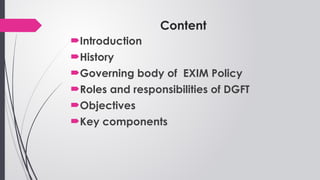
Introduction about EXIM policy , History of EXIM policy ,governing body of EXIM policy , Roles and responsibilities of DGFT, Objectives and key components
Rashtriya Shikshan Mandal’s
N.N. Sattha College of Pharmacy , Ahmednagar
Subject Seminar (Industrial Pharmacognostical Technologies)
Title - Export and Import (EXIM) Policy
Presented by – Ms. Pallavi P. Deshmukh
Sem-I F.Y.M Pharma (Pharmacognosy)
under the guidance - Prof. J. B. Bhande
M Pharma(Pharmacognosy)
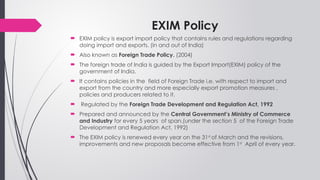
EXIM Policy
EXIMpolicy is export import policy that contains rules and regulations regarding
doing import and exports. (in and out of India)
Also known as Foreign Trade Policy. (2004)
The foreign trade of India is guided by the Export Import(EXIM) policy of the
government of India.
It contains policies in the field of Foreign Trade i.e. with respect to import and
export from the country and more especially export promotion measures ,
policies and producers related to it.
Regulated by the Foreign Trade Development and Regulation Act, 1992
Prepared and announced by the Central Government’s Ministry of Commerce
and Industry for every 5 years of span.(under the section 5 of the Foreign Trade
Development and Regulation Act, 1992)
The EXIM policy is renewed every year on the 31st
of March and the revisions,
improvements and new proposals become effective from 1st
April of every year.
4.
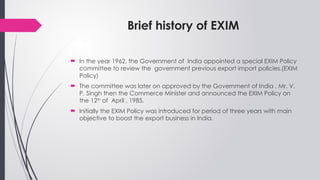
Brief history ofEXIM
In the year 1962, the Government of India appointed a special EXIM Policy
committee to review the government previous export import policies.(EXIM
Policy)
The committee was later on approved by the Government of India . Mr. V.
P. Singh then the Commerce Minister and announced the EXIM Policy on
the 12th
of April , 1985.
Initially the EXIM Policy was introduced for period of three years with main
objective to boost the export business in India.
5.
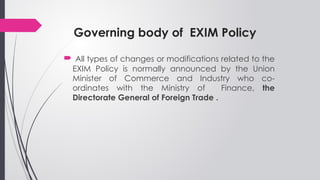
Governing body ofEXIM Policy
All types of changes or modifications related to the
EXIM Policy is normally announced by the Union
Minister of Commerce and Industry who co-
ordinates with the Ministry of Finance, the
Directorate General of Foreign Trade .
6.
Roles and responsibilitiesof DGFT
Implementing the foreign trade or EXIM policy of the government.
Providing a complete database of all exporters and importers in India.
Granting of the Exporter Importer Code (EIC) number to exporters and importers in India.
It has the authority to prohibit, restrict and regulate importers and exporters.
Regulating and permitting the transit of goods from India to adjacent countries
according to the bilateral trade agreements.
Promoting trade between India and her neighbouring countries.
Granting permission of free export wherever necessary.
It plays a vital role in controlling DEPB rates.
DEPB-Duty Entitlement Pass Book
Handling quality complaints of the foreign buyers of Indian export products.
Formulating or adding new codes in the ITC-HS codes.
ITC-HS codes are also known as Indian Trade Clarification based on the Harmonized
System of coding.
7.
Objectives
To establishthe framework for globalisation.
To promote the productivity, competitiveness of Indian industry.
To encourage the attainment of high and internationally accepted
standards of quality .
To increase expert by facilitating access to raw materials, intermediate
components, consumables and capital goods from the international
market .
To generate new employment.
To provide quality consumer products at reasonable prices.
8.
Key components
Traderegulation- EXIM Policies include rules and regulations related to exports and
imports. These can cover areas such as custom duties, tariffs quotas and trade
restrictions.
Promotion of exports- A primary objective of EXIM Policies is to promote and
facilitate exports. This may include imposing import restrictions or tariffs on certain
items to protect domestic industries or to manage the balance of payments.
Control of Imports- On the import side, EXIM Policies can include measures to control
and manage the inflow of foreign goods. This may include imposing import
restrictions or tariffs.
This may include imposing import restrictions or tariffs on certain
items to protect domestic industries or to manage the balance of payments.
Foreign Exchange Management- EXIM Policies often address issues related to
foreign exchange, aiming to ensure the stability of a country’s currency. This rights
involve controls on capital flows, currency exchange rates and foreign exchange
resources.
9.
Cont.…
Quality andstandards- To meet International trade standards, EXIM policies
might include regulations related to product quality, safety and standard
ensuring that goods meet the requirements of foreign market.
Trade Agreements- countries often negotiate between trade agreements
with other nations. EXIM policies can define the country’s position on these
trade acts and the benefits they bring.
Export Promotion Zones- Some countries create special economic zones or
export processing zones or export processing zones with specific rules and
incentives to encourage export oriented industries.
Documentation and procedures- EXIM policies establish the documentation
and procedures required for exporting and importing goods. These include
customs forms, licenses and permits.
10.
Cont..
Export creditand finance – These policies can address export financing and
trade barriers in various countries. This has been particularly beneficial for
Indian exports such as textiles, pharmaceuticals, and information
technology services.
Trade facilitation- The policy may also focus on simplifying and streamlining
trade procedures reducing red tapism and enhancing the ease of doing
business for importers and exporters.
11.
Reference
Slide share(ppt)by Harshita .s and Imran Pasha.
EXIM Policy.ppt by Vansh157601.
TheYoungIndianEconomists.wordpress.com
Slides presented by Karthigeyancll.
EXIM Policy|Foreign Trade Policy|Key components and objectives of
export import Policy by study with Khushi