Exploratory Data Analysis
-Harsh
Introduction
Exploratory Data Analysis (EDA) is a crucial initial step in the data analysis
process aimed at understanding the structure, relationships, and patterns
within a dataset. Through EDA, analysts employ a variety of techniques to
summarize key characteristics of the data, such as central tendencies,
distributions, and correlations, often utilizing statistical measures,
visualizations, and even machine learning algorithms. The primary goals
of EDA are to uncover insights, identify anomalies, and formulate
hypotheses for further investigation, ultimately laying the groundwork
for more advanced analytics and decision-making processes.
Typical Data Formats
Data can come in various formats, each suited to different types of data and analysis. Here are some typical data formats:
1. Tabular Data: This format is perhaps the most common, represented as rows and columns, much like a spreadsheet. Each row
typically represents an observation or data point, while each column represents a variable or attribute. Tabular data is often stored in
formats like CSV (Comma-Separated Values), Excel spreadsheets, or database tables (e.g., SQL databases).
2. JSON (JavaScript Object Notation): JSON is a lightweight data-interchange format that is easy for humans to read and write, and
easy for machines to parse and generate. It's commonly used for representing structured data, especially in web applications and
APIs.
3. XML (eXtensible Markup Language): XML is another markup language similar to HTML but designed to store and transport data,
not to display data. It's often used for representing hierarchical data structures and is commonly found in web services, configuration
files, and data interchange between different systems.
4. Text Data: Text data includes documents, articles, emails, social media posts, and more. Analyzing text data often involves
techniques like natural language processing (NLP) and text mining to extract insights, sentiment analysis, or topic modeling.
5. Time Series Data: Time series data represents observations collected over time, such as stock prices, weather data, or sensor
readings. It typically includes a timestamp for each observation and is often stored in formats like CSV or databases.
6. Spatial Data: Spatial data represents geographical features and their associated attributes, such as maps, GPS coordinates, or
satellite imagery. It's commonly used in geographic information systems (GIS) and can be stored in formats like shapefiles, GeoJSON,
or raster formats like GeoTIFF.
7. Image Data: Image data consists of visual information stored in pixel grids. It's used in various applications like computer vision,
medical imaging, and satellite imagery. Image data can be stored in formats like JPEG, PNG, TIFF, or specialized formats for specific
applications.
8. Graph Data: Graph data represents relationships between entities, with nodes representing entities and edges representing
relationships between them. Graph data is commonly used in social networks, recommendation systems, and network analysis. It can
be stored in formats like adjacency lists, edge lists, or graph databases.
Types of EDA
Exploratory Data Analysis encompasses a variety of techniques and
approaches to uncover insights from data. Some common types of EDA
techniques include summary statistics, which provide a high-level
overview of the dataset's characteristics such as mean, median, and
standard deviation; univariate analysis, focusing on exploring the
distribution and properties of individual variables; bivariate analysis,
examining relationships between pairs of variables through techniques
like correlation analysis and scatter plots; multivariate analysis, which
extends bivariate analysis to explore relationships among multiple
variables simultaneously; and visualization methods such as
histograms, box plots, and heatmaps, which offer intuitive ways to
represent and explore the data graphically. Additionally, techniques like
dimensionality reduction and clustering can also be employed to gain
further insights into complex datasets.
Graphical Methods
In Exploratory Data Analysis (EDA), both graphical and non-graphical methods are utilized to
understand and extract insights from the data.
1. Histograms: Visualizes the distribution of a single variable.
2. Box Plots: Summarizes the distribution of a variable by indicating its median, quartiles, and
outliers.
3. Scatter Plots: Displays the relationship between two variables, useful for identifying patterns or
correlations.
4. Heatmaps: Represents the correlation matrix between variables using colors.
5. Pair Plots: Displays pairwise relationships between variables in a dataset.
6. Violin Plots: Similar to box plots but provides a more detailed representation of the data
distribution.
7. Bar Charts: Useful for categorical variables, showing the frequency distribution of each category.
8. Line Plots: Visualizes trends over time or across ordered categories.
9. Stacked Bar Charts: Shows the composition of a categorical variable by stacking the frequencies
of its categories.
10. Density Plots: Visualizes the distribution of a variable as a continuous probability density.
Non-Graphical Methods
1. Descriptive Statistics: Calculate summary statistics such as mean, median, mode, standard
deviation, etc.
2. Central Tendency Measures: Indicate where the center of the data is located (mean, median,
mode).
3. Variability Measures: Provide information about the spread or dispersion of the data (range,
variance, standard deviation).
4. Correlation Coefficients: Quantify the strength and direction of relationships between variables.
5. Percentiles and Quartiles: Divide the data into equal parts to understand the distribution.
6. Frequency Tables: Tabulate the frequency of occurrences of different values in a dataset.
7. Outlier Detection Methods: Identify data points that deviate significantly from the rest of the
data.
8. Data Transformation Techniques: Normalize or standardize data to make it more suitable for
analysis.
9. Dimensionality Reduction Techniques: Reduce the number of variables while preserving
important information (e.g., PCA, t-SNE).
10. Cluster Analysis: Group similar data points together to identify patterns or clusters in the data.
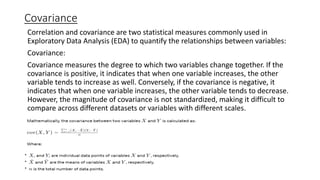
Covariance
Correlation and covariance are two statistical measures commonly used in
Exploratory Data Analysis (EDA) to quantify the relationships between variables:
Covariance:
Covariance measures the degree to which two variables change together. If the
covariance is positive, it indicates that when one variable increases, the other
variable tends to increase as well. Conversely, if the covariance is negative, it
indicates that when one variable increases, the other variable tends to decrease.
However, the magnitude of covariance is not standardized, making it difficult to
compare across different datasets or variables with different scales.
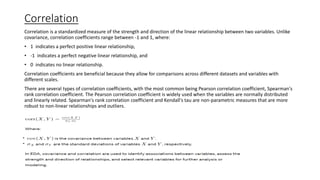
Correlation
Correlation is a standardized measure of the strength and direction of the linear relationship between two variables. Unlike
covariance, correlation coefficients range between -1 and 1, where:
• 1 indicates a perfect positive linear relationship,
• -1 indicates a perfect negative linear relationship, and
• 0 indicates no linear relationship.
Correlation coefficients are beneficial because they allow for comparisons across different datasets and variables with
different scales.
There are several types of correlation coefficients, with the most common being Pearson correlation coefficient, Spearman's
rank correlation coefficient. The Pearson correlation coefficient is widely used when the variables are normally distributed
and linearly related. Spearman's rank correlation coefficient and Kendall's tau are non-parametric measures that are more
robust to non-linear relationships and outliers.
Degree of Freedom
In Exploratory Data Analysis (EDA), the concept of degrees of freedom (df) refers to the number of independent observations
or parameters in a statistical model that are free to vary. The term is used in various statistical techniques and tests, including
hypothesis testing, estimation, and model fitting. Here's how degrees of freedom are typically understood and applied in
different contexts:
1. Hypothesis Testing:
- In hypothesis testing, degrees of freedom are associated with the variability in the data that is available to estimate
parameters or test statistics.
- For example, in a t-test comparing the means of two groups, the degrees of freedom are calculated as the total number of
observations minus the number of parameters estimated from the data. In a one-sample t-test, the degrees of freedom
would typically be n - 1 , where n is the sample size.
2. Linear Models:
- In linear regression models, degrees of freedom are associated with the number of observations minus the number of
parameters estimated in the model.
- For example, in simple linear regression (with one predictor variable), the degrees of freedom for the error term are
calculated as n - 2 , where n is the number of observations and 2 accounts for the intercept and slope coefficients estimated
in the model.
3. Variance Estimation:
- Degrees of freedom are also relevant when estimating variances or standard errors of parameters in statistical models.
- For example, in estimating the variance of a sample mean or regression coefficient, the degrees of freedom often
determine which distribution to use for inference (e.g., t-distribution for small sample sizes).
Data visualization using Matplotlib and Seaborn is a powerful approach to create informative and visually
appealing plots and charts in Python. Both Matplotlib and Seaborn are widely used libraries for data visualization
in the Python ecosystem, offering a variety of plotting functions and customization options. Here's an overview of
each library:
Matplotlib:
Matplotlib is a comprehensive library for creating static, interactive, and animated visualizations in Python. It
provides a MATLAB-like interface for generating a wide range of plots and charts. Some of the key features of
Matplotlib include:
1. Basic Plotting: Matplotlib allows you to create various types of plots, including line plots, scatter plots, bar plots,
histogram plots, pie charts, and more.
2. Customization: You can customize every aspect of your plots, including colors, labels, titles, axes, markers,
linestyle, and more. Matplotlib offers extensive customization options to tailor your visualizations to your specific
needs.
3. Subplots: Matplotlib supports creating multiple plots within the same figure using subplots. This allows you to
display multiple plots side by side for easy comparison.
4. Integration: Matplotlib can be easily integrated with other libraries and frameworks, such as NumPy, Pandas,
and SciPy, making it a versatile tool for data analysis and visualization.
Seaborn:
Seaborn is a high-level visualization library built on top of Matplotlib, designed to create attractive and informative
statistical graphics. It simplifies the process of creating complex visualizations by providing a set of high-level functions
that work seamlessly with Pandas data structures. Some of the key features of Seaborn include:
1. Statistical Plotting: Seaborn offers a variety of statistical plotting functions that make it easy to visualize relationships
between variables in your dataset. This includes functions for visualizing linear relationships (regression plots),
distributions (histograms, kernel density plots), categorical data (bar plots, box plots), and more.
2. Styling: Seaborn comes with built-in themes and color palettes that enhance the aesthetics of your plots. You can
choose from different themes (e.g., darkgrid, whitegrid, dark, white) and color palettes (e.g., deep, muted, bright,
pastel) to customize the look and feel of your visualizations.
3. Integration with Pandas: Seaborn works seamlessly with Pandas data structures, allowing you to pass DataFrame
objects directly to plotting functions. This makes it easy to visualize data stored in Pandas DataFrames without the need
for extensive data manipulation.
4. Complex Plotting: Seaborn simplifies the process of creating complex multi-panel visualizations, such as pair plots,
joint plots, and FacetGrids, which allow you to visualize relationships between multiple variables in your dataset.
Identifying Outliers and Anomalies
The main methods for identifying outliers and anomalies during Exploratory Data Analysis (EDA):
1. Visual Inspection: Examining plots and charts, such as scatter plots, box plots, and histograms, to identify visually unusual data points.
2. Summary Statistics: Calculating measures such as mean, median, standard deviation, and quartiles to identify data points that fall outside
the expected range.
3. Box Plots: Using box plots to visually identify outliers as data points lying outside the whiskers of the plot.
4. Z-Score: Calculating the Z-score for each data point to identify outliers based on the number of standard deviations from the mean.
5. Modified Z-Score: Using a modified version of the Z-score that is less sensitive to outliers in non-normally distributed data.
6. Density-Based Methods: Using density-based clustering algorithms such as DBSCAN to identify outliers based on the density of data points.
7. Isolation Forest: Using an anomaly detection algorithm that isolates outliers in a decision tree-based structure.
8. Domain Knowledge: Leveraging domain knowledge and subject matter expertise to identify outliers that may be indicative of errors or
anomalies in the data.
These methods provide different approaches to identifying outliers and anomalies, allowing analysts to choose the most appropriate
technique based on their specific dataset and analysis goals.
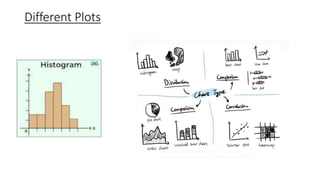
Different Plots
DB Scan / K-means
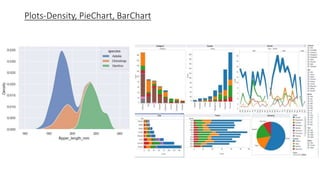
Plots-Density, PieChart, BarChart
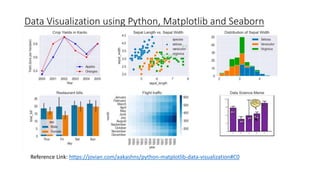
Data Visualization using Python, Matplotlib and Seaborn
Reference Link: https://jovian.com/aakashns/python-matplotlib-data-visualization#C0
Thank You!!

Exploratory Data Analysis.pptx for Data Analytics

  • 1.
  • 2.
    Introduction Exploratory Data Analysis(EDA) is a crucial initial step in the data analysis process aimed at understanding the structure, relationships, and patterns within a dataset. Through EDA, analysts employ a variety of techniques to summarize key characteristics of the data, such as central tendencies, distributions, and correlations, often utilizing statistical measures, visualizations, and even machine learning algorithms. The primary goals of EDA are to uncover insights, identify anomalies, and formulate hypotheses for further investigation, ultimately laying the groundwork for more advanced analytics and decision-making processes.
  • 3.
    Typical Data Formats Datacan come in various formats, each suited to different types of data and analysis. Here are some typical data formats: 1. Tabular Data: This format is perhaps the most common, represented as rows and columns, much like a spreadsheet. Each row typically represents an observation or data point, while each column represents a variable or attribute. Tabular data is often stored in formats like CSV (Comma-Separated Values), Excel spreadsheets, or database tables (e.g., SQL databases). 2. JSON (JavaScript Object Notation): JSON is a lightweight data-interchange format that is easy for humans to read and write, and easy for machines to parse and generate. It's commonly used for representing structured data, especially in web applications and APIs. 3. XML (eXtensible Markup Language): XML is another markup language similar to HTML but designed to store and transport data, not to display data. It's often used for representing hierarchical data structures and is commonly found in web services, configuration files, and data interchange between different systems. 4. Text Data: Text data includes documents, articles, emails, social media posts, and more. Analyzing text data often involves techniques like natural language processing (NLP) and text mining to extract insights, sentiment analysis, or topic modeling. 5. Time Series Data: Time series data represents observations collected over time, such as stock prices, weather data, or sensor readings. It typically includes a timestamp for each observation and is often stored in formats like CSV or databases. 6. Spatial Data: Spatial data represents geographical features and their associated attributes, such as maps, GPS coordinates, or satellite imagery. It's commonly used in geographic information systems (GIS) and can be stored in formats like shapefiles, GeoJSON, or raster formats like GeoTIFF. 7. Image Data: Image data consists of visual information stored in pixel grids. It's used in various applications like computer vision, medical imaging, and satellite imagery. Image data can be stored in formats like JPEG, PNG, TIFF, or specialized formats for specific applications. 8. Graph Data: Graph data represents relationships between entities, with nodes representing entities and edges representing relationships between them. Graph data is commonly used in social networks, recommendation systems, and network analysis. It can be stored in formats like adjacency lists, edge lists, or graph databases.
  • 4.
    Types of EDA ExploratoryData Analysis encompasses a variety of techniques and approaches to uncover insights from data. Some common types of EDA techniques include summary statistics, which provide a high-level overview of the dataset's characteristics such as mean, median, and standard deviation; univariate analysis, focusing on exploring the distribution and properties of individual variables; bivariate analysis, examining relationships between pairs of variables through techniques like correlation analysis and scatter plots; multivariate analysis, which extends bivariate analysis to explore relationships among multiple variables simultaneously; and visualization methods such as histograms, box plots, and heatmaps, which offer intuitive ways to represent and explore the data graphically. Additionally, techniques like dimensionality reduction and clustering can also be employed to gain further insights into complex datasets.
  • 5.
    Graphical Methods In ExploratoryData Analysis (EDA), both graphical and non-graphical methods are utilized to understand and extract insights from the data. 1. Histograms: Visualizes the distribution of a single variable. 2. Box Plots: Summarizes the distribution of a variable by indicating its median, quartiles, and outliers. 3. Scatter Plots: Displays the relationship between two variables, useful for identifying patterns or correlations. 4. Heatmaps: Represents the correlation matrix between variables using colors. 5. Pair Plots: Displays pairwise relationships between variables in a dataset. 6. Violin Plots: Similar to box plots but provides a more detailed representation of the data distribution. 7. Bar Charts: Useful for categorical variables, showing the frequency distribution of each category. 8. Line Plots: Visualizes trends over time or across ordered categories. 9. Stacked Bar Charts: Shows the composition of a categorical variable by stacking the frequencies of its categories. 10. Density Plots: Visualizes the distribution of a variable as a continuous probability density.
  • 6.
    Non-Graphical Methods 1. DescriptiveStatistics: Calculate summary statistics such as mean, median, mode, standard deviation, etc. 2. Central Tendency Measures: Indicate where the center of the data is located (mean, median, mode). 3. Variability Measures: Provide information about the spread or dispersion of the data (range, variance, standard deviation). 4. Correlation Coefficients: Quantify the strength and direction of relationships between variables. 5. Percentiles and Quartiles: Divide the data into equal parts to understand the distribution. 6. Frequency Tables: Tabulate the frequency of occurrences of different values in a dataset. 7. Outlier Detection Methods: Identify data points that deviate significantly from the rest of the data. 8. Data Transformation Techniques: Normalize or standardize data to make it more suitable for analysis. 9. Dimensionality Reduction Techniques: Reduce the number of variables while preserving important information (e.g., PCA, t-SNE). 10. Cluster Analysis: Group similar data points together to identify patterns or clusters in the data.
  • 7.
    Covariance Correlation and covarianceare two statistical measures commonly used in Exploratory Data Analysis (EDA) to quantify the relationships between variables: Covariance: Covariance measures the degree to which two variables change together. If the covariance is positive, it indicates that when one variable increases, the other variable tends to increase as well. Conversely, if the covariance is negative, it indicates that when one variable increases, the other variable tends to decrease. However, the magnitude of covariance is not standardized, making it difficult to compare across different datasets or variables with different scales.
  • 8.
    Correlation Correlation is astandardized measure of the strength and direction of the linear relationship between two variables. Unlike covariance, correlation coefficients range between -1 and 1, where: • 1 indicates a perfect positive linear relationship, • -1 indicates a perfect negative linear relationship, and • 0 indicates no linear relationship. Correlation coefficients are beneficial because they allow for comparisons across different datasets and variables with different scales. There are several types of correlation coefficients, with the most common being Pearson correlation coefficient, Spearman's rank correlation coefficient. The Pearson correlation coefficient is widely used when the variables are normally distributed and linearly related. Spearman's rank correlation coefficient and Kendall's tau are non-parametric measures that are more robust to non-linear relationships and outliers.
  • 9.
    Degree of Freedom InExploratory Data Analysis (EDA), the concept of degrees of freedom (df) refers to the number of independent observations or parameters in a statistical model that are free to vary. The term is used in various statistical techniques and tests, including hypothesis testing, estimation, and model fitting. Here's how degrees of freedom are typically understood and applied in different contexts: 1. Hypothesis Testing: - In hypothesis testing, degrees of freedom are associated with the variability in the data that is available to estimate parameters or test statistics. - For example, in a t-test comparing the means of two groups, the degrees of freedom are calculated as the total number of observations minus the number of parameters estimated from the data. In a one-sample t-test, the degrees of freedom would typically be n - 1 , where n is the sample size. 2. Linear Models: - In linear regression models, degrees of freedom are associated with the number of observations minus the number of parameters estimated in the model. - For example, in simple linear regression (with one predictor variable), the degrees of freedom for the error term are calculated as n - 2 , where n is the number of observations and 2 accounts for the intercept and slope coefficients estimated in the model. 3. Variance Estimation: - Degrees of freedom are also relevant when estimating variances or standard errors of parameters in statistical models. - For example, in estimating the variance of a sample mean or regression coefficient, the degrees of freedom often determine which distribution to use for inference (e.g., t-distribution for small sample sizes).
  • 10.
    Data visualization usingMatplotlib and Seaborn is a powerful approach to create informative and visually appealing plots and charts in Python. Both Matplotlib and Seaborn are widely used libraries for data visualization in the Python ecosystem, offering a variety of plotting functions and customization options. Here's an overview of each library: Matplotlib: Matplotlib is a comprehensive library for creating static, interactive, and animated visualizations in Python. It provides a MATLAB-like interface for generating a wide range of plots and charts. Some of the key features of Matplotlib include: 1. Basic Plotting: Matplotlib allows you to create various types of plots, including line plots, scatter plots, bar plots, histogram plots, pie charts, and more. 2. Customization: You can customize every aspect of your plots, including colors, labels, titles, axes, markers, linestyle, and more. Matplotlib offers extensive customization options to tailor your visualizations to your specific needs. 3. Subplots: Matplotlib supports creating multiple plots within the same figure using subplots. This allows you to display multiple plots side by side for easy comparison. 4. Integration: Matplotlib can be easily integrated with other libraries and frameworks, such as NumPy, Pandas, and SciPy, making it a versatile tool for data analysis and visualization.
  • 11.
    Seaborn: Seaborn is ahigh-level visualization library built on top of Matplotlib, designed to create attractive and informative statistical graphics. It simplifies the process of creating complex visualizations by providing a set of high-level functions that work seamlessly with Pandas data structures. Some of the key features of Seaborn include: 1. Statistical Plotting: Seaborn offers a variety of statistical plotting functions that make it easy to visualize relationships between variables in your dataset. This includes functions for visualizing linear relationships (regression plots), distributions (histograms, kernel density plots), categorical data (bar plots, box plots), and more. 2. Styling: Seaborn comes with built-in themes and color palettes that enhance the aesthetics of your plots. You can choose from different themes (e.g., darkgrid, whitegrid, dark, white) and color palettes (e.g., deep, muted, bright, pastel) to customize the look and feel of your visualizations. 3. Integration with Pandas: Seaborn works seamlessly with Pandas data structures, allowing you to pass DataFrame objects directly to plotting functions. This makes it easy to visualize data stored in Pandas DataFrames without the need for extensive data manipulation. 4. Complex Plotting: Seaborn simplifies the process of creating complex multi-panel visualizations, such as pair plots, joint plots, and FacetGrids, which allow you to visualize relationships between multiple variables in your dataset.
  • 12.
    Identifying Outliers andAnomalies The main methods for identifying outliers and anomalies during Exploratory Data Analysis (EDA): 1. Visual Inspection: Examining plots and charts, such as scatter plots, box plots, and histograms, to identify visually unusual data points. 2. Summary Statistics: Calculating measures such as mean, median, standard deviation, and quartiles to identify data points that fall outside the expected range. 3. Box Plots: Using box plots to visually identify outliers as data points lying outside the whiskers of the plot. 4. Z-Score: Calculating the Z-score for each data point to identify outliers based on the number of standard deviations from the mean. 5. Modified Z-Score: Using a modified version of the Z-score that is less sensitive to outliers in non-normally distributed data. 6. Density-Based Methods: Using density-based clustering algorithms such as DBSCAN to identify outliers based on the density of data points. 7. Isolation Forest: Using an anomaly detection algorithm that isolates outliers in a decision tree-based structure. 8. Domain Knowledge: Leveraging domain knowledge and subject matter expertise to identify outliers that may be indicative of errors or anomalies in the data. These methods provide different approaches to identifying outliers and anomalies, allowing analysts to choose the most appropriate technique based on their specific dataset and analysis goals.
  • 13.
  • 14.
    DB Scan /K-means
  • 15.
  • 17.
    Data Visualization usingPython, Matplotlib and Seaborn Reference Link: https://jovian.com/aakashns/python-matplotlib-data-visualization#C0
  • 18.