Call us on 01420 520521 - Open 7 Days ........... PRICES INCL. VAT
Free Standard Delivery on orders over £50. NEXT DAY delivery available for orders placed before 12:00
Home :: Blog
Saving Light Bulbs - The Energy Saving LED Specialists
LIGHT BULB GENERAL INFORMATION, TECHNOLOGIES
EXPLAINING THE COLOR
RENDERING INDEX (CRI) AND
LEDS
15TH DECEMBER 2018 DENNIS LEAVE A COMMENT
SLB Blog  
CRI, or the Color Rending Index, refers to the quantitative measure of
a light source’s ability to render known colors of materials as well as
objects. The process entails measuring the light emanating from a
test source and monitoring the appearance of re ected light as
compared to 8 known color samples. The CRI is usually rated on a
scale ranging from 0 to 100; the minimum index represents a light
whose colors aren’t distinct while the latter corresponds to daylight
or an ‘ideal’ white light.
Calculating CRI
The CRI of that particular source is calculated by measuring the
difference between the actual color & the known color. The nature of
the reference light source will also vary depending on the kind of light
source that’s being tested. When it comes to testing sources
featuring a correlated color temperature that’s less than 5000 0K
(degrees Kelvin), it’s advisable that a blackbody radiator is utilized as
the reference source. When dealing with test sources featuring a
higher CCT, you should use a spectrum of daylight as the reference
source. Regardless of the light source being tested, it’s always
important to pick the right reference source so as to retrieve accurate
CRI information from the sample colors.
For many decades, the Color Rending Index (CRI) scale has been
considered as an accurate measure of how effective lighting is in
reproducing expected colors through the spectrum. Regardless of
which lighting type is being utilized, it’s essential that you measure
the quantity of light before and after installation.
Uni ed Glare Rating (UGR) explained
Uni ed Glare Rating (abbreviated as UGR) is a measure of the
amount of discomfort emitted by luminaries using a psychometric-
based scale of discomfort. In other countries, UGR is used to
represent VCP (an abbreviation for visual comfort probability). Glare,
which can adversely affect your wellbeing as well as productivity at
work, is common in settings featuring several computer monitors.
The Uni ed Glare Rating starts from 5 and goes all the way to 40. The
lower numbers indicate less glare while the higher ones signify more
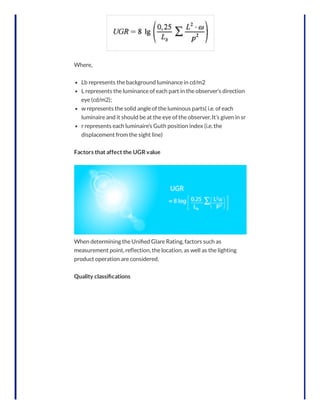
glare. The UGR is usually calculated using the following strict
formula:
Where,
Lb represents the background luminance in cd/m2
L represents the luminance of each part in the observer’s direction
eye (cd/m2);
w represents the solid angle of the luminous parts( i.e. of each
luminaire and it should be at the eye of the observer. It’s given in sr
r represents each luminaire’s Guth position index (i.e. the
displacement from the sight line)
Factors that affect the UGR value
When determining the Uni ed Glare Rating, factors such as
measurement point, re ection, the location, as well as the lighting
product operation are considered.
Quality classi cations
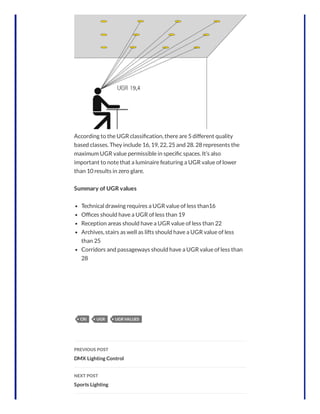
According to the UGR classi cation, there are 5 different quality
based classes. They include 16, 19, 22, 25 and 28. 28 represents the
maximum UGR value permissible in speci c spaces. It’s also
important to note that a luminaire featuring a UGR value of lower
than 10 results in zero glare.
Summary of UGR values
Technical drawing requires a UGR value of less than16
Of ces should have a UGR of less than 19
Reception areas should have a UGR value of less than 22
Archives, stairs as well as lifts should have a UGR value of less
than 25
Corridors and passageways should have a UGR value of less than
28
 
 
PREVIOUS POST
DMX Lighting Control
NEXT POST
Sports Lighting
CRI UGR UGR VALUES
LEAVE A REPLY
Your email address will not be published. Required elds are marked *
Name *
Email *
Website
Comment
You may usetheseHTML tagsand attributes: <a href="" title=""> <abbr
title=""> <acronym title=""> <b> <blockquote cite=""> <cite>
<code> <del datetime=""> <em> <i> <q cite=""> <strike> <strong>
POST COMMENT
Search …
RECENT POSTS
Sports Lighting
Explaining the Color Rendering Index (CRI) and LEDs
DMX Lighting Control
An update on the Light Bulb Ban
An Introduction to DMX Lighting Control
RECENT COMMENTS
saving on The 2D Compact and 2 Pin 4 Pin technical information
saving on How to calculate the LUX level in a Room
saving on LED Ceiling Lights: They Will Rede ne Your Living Room
saving on The 2D Compact and 2 Pin 4 Pin technical information
saving on How to calculate the LUX level in a Room
ARCHIVES
December 2018
July 2018
May 2018
April 2018
March 2018
February 2018
August 2017
July 2017
June 2017
May 2017
February 2017
January 2017
December 2016
June 2016
May 2016
April 2016
March 2016
February 2016
January 2016
November 2015
September 2015
August 2015
July 2015
June 2015
March 2015
October 2014
September 2014
June 2014
April 2014
December 2012
September 2012
July 2012
April 2012
February 2012
January 2012
December 2011
October 2011
September 2011
August 2011
July 2011
May 2011
February 2011
January 2011
October 2010
September 2010
August 2010
July 2010
Desktop Version
:: Traditional Lighting :: Lighting Design :: The Environment :: Eco Schools......
Copyright © 2018Saving Light Bulbs. Powered by Towers ITProfessional Services Ltd
YourIP Address is: 169.54.6.221
CATEGORIES
Light Bulb General Information
Lighting Design
Technologies
The Environment
Uncategorised
Uncategorized
META
Log in
Entries RSS
Comments RSS
WordPress.org
Proudly powered by WordPress

Explaining the color rendering index (cri) and leds saving light bulbs

  • 1.
    Call us on01420 520521 - Open 7 Days ........... PRICES INCL. VAT Free Standard Delivery on orders over £50. NEXT DAY delivery available for orders placed before 12:00 Home :: Blog Saving Light Bulbs - The Energy Saving LED Specialists LIGHT BULB GENERAL INFORMATION, TECHNOLOGIES EXPLAINING THE COLOR RENDERING INDEX (CRI) AND LEDS 15TH DECEMBER 2018 DENNIS LEAVE A COMMENT SLB Blog  
  • 2.
    CRI, or theColor Rending Index, refers to the quantitative measure of a light source’s ability to render known colors of materials as well as objects. The process entails measuring the light emanating from a test source and monitoring the appearance of re ected light as compared to 8 known color samples. The CRI is usually rated on a scale ranging from 0 to 100; the minimum index represents a light whose colors aren’t distinct while the latter corresponds to daylight or an ‘ideal’ white light. Calculating CRI The CRI of that particular source is calculated by measuring the difference between the actual color & the known color. The nature of the reference light source will also vary depending on the kind of light source that’s being tested. When it comes to testing sources featuring a correlated color temperature that’s less than 5000 0K (degrees Kelvin), it’s advisable that a blackbody radiator is utilized as the reference source. When dealing with test sources featuring a higher CCT, you should use a spectrum of daylight as the reference source. Regardless of the light source being tested, it’s always important to pick the right reference source so as to retrieve accurate CRI information from the sample colors. For many decades, the Color Rending Index (CRI) scale has been considered as an accurate measure of how effective lighting is in reproducing expected colors through the spectrum. Regardless of which lighting type is being utilized, it’s essential that you measure the quantity of light before and after installation. Uni ed Glare Rating (UGR) explained Uni ed Glare Rating (abbreviated as UGR) is a measure of the amount of discomfort emitted by luminaries using a psychometric- based scale of discomfort. In other countries, UGR is used to represent VCP (an abbreviation for visual comfort probability). Glare, which can adversely affect your wellbeing as well as productivity at work, is common in settings featuring several computer monitors. The Uni ed Glare Rating starts from 5 and goes all the way to 40. The lower numbers indicate less glare while the higher ones signify more glare. The UGR is usually calculated using the following strict formula:
  • 3.
    Where, Lb represents thebackground luminance in cd/m2 L represents the luminance of each part in the observer’s direction eye (cd/m2); w represents the solid angle of the luminous parts( i.e. of each luminaire and it should be at the eye of the observer. It’s given in sr r represents each luminaire’s Guth position index (i.e. the displacement from the sight line) Factors that affect the UGR value When determining the Uni ed Glare Rating, factors such as measurement point, re ection, the location, as well as the lighting product operation are considered. Quality classi cations
  • 4.
    According to theUGR classi cation, there are 5 different quality based classes. They include 16, 19, 22, 25 and 28. 28 represents the maximum UGR value permissible in speci c spaces. It’s also important to note that a luminaire featuring a UGR value of lower than 10 results in zero glare. Summary of UGR values Technical drawing requires a UGR value of less than16 Of ces should have a UGR of less than 19 Reception areas should have a UGR value of less than 22 Archives, stairs as well as lifts should have a UGR value of less than 25 Corridors and passageways should have a UGR value of less than 28     PREVIOUS POST DMX Lighting Control NEXT POST Sports Lighting CRI UGR UGR VALUES
  • 5.
    LEAVE A REPLY Youremail address will not be published. Required elds are marked * Name * Email * Website Comment You may usetheseHTML tagsand attributes: <a href="" title=""> <abbr title=""> <acronym title=""> <b> <blockquote cite=""> <cite> <code> <del datetime=""> <em> <i> <q cite=""> <strike> <strong> POST COMMENT Search … RECENT POSTS Sports Lighting Explaining the Color Rendering Index (CRI) and LEDs DMX Lighting Control An update on the Light Bulb Ban
  • 6.
    An Introduction toDMX Lighting Control RECENT COMMENTS saving on The 2D Compact and 2 Pin 4 Pin technical information saving on How to calculate the LUX level in a Room saving on LED Ceiling Lights: They Will Rede ne Your Living Room saving on The 2D Compact and 2 Pin 4 Pin technical information saving on How to calculate the LUX level in a Room ARCHIVES December 2018 July 2018 May 2018 April 2018 March 2018 February 2018 August 2017 July 2017 June 2017 May 2017 February 2017 January 2017 December 2016 June 2016 May 2016 April 2016 March 2016 February 2016 January 2016
  • 7.
    November 2015 September 2015 August2015 July 2015 June 2015 March 2015 October 2014 September 2014 June 2014 April 2014 December 2012 September 2012 July 2012 April 2012 February 2012 January 2012 December 2011 October 2011 September 2011 August 2011 July 2011 May 2011 February 2011 January 2011 October 2010 September 2010 August 2010 July 2010
  • 8.
    Desktop Version :: TraditionalLighting :: Lighting Design :: The Environment :: Eco Schools...... Copyright © 2018Saving Light Bulbs. Powered by Towers ITProfessional Services Ltd YourIP Address is: 169.54.6.221 CATEGORIES Light Bulb General Information Lighting Design Technologies The Environment Uncategorised Uncategorized META Log in Entries RSS Comments RSS WordPress.org Proudly powered by WordPress