Lighting Quality
A Deep Dive into Color Accuracy, Consistency, and Visual Comfort
Presented by Mina Anis
Agenda
1.Introduction
2.Color Rendering Index (CRI)
3.How CRI Affects Different Environments
4.Correlated Colour Temperature (CCT)
5.Choosing the Right CCT for Applications
6.Macadam Steps
7.Unified Glare Rating (UGR)
8.Recommended UGR Levels
9.Summary
Back to Agenda
Introduction
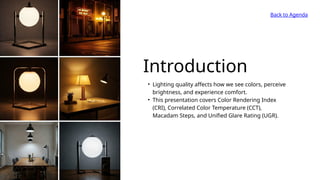
• Lighting quality affects how we see colors, perceive
brightness, and experience comfort.
• This presentation covers Color Rendering Index
(CRI), Correlated Color Temperature (CCT),
Macadam Steps, and Unified Glare Rating (UGR).
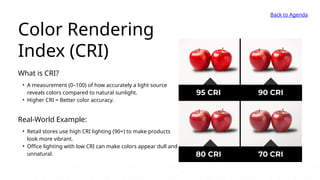
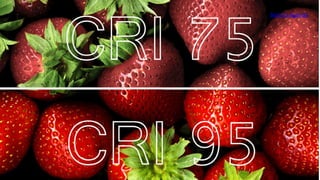
Real-World Example:
• Retail stores use high CRI lighting (90+) to make products
look more vibrant.
• Office lighting with low CRI can make colors appear dull and
unnatural.
What is CRI?
• A measurement (0–100) of how accurately a light source
reveals colors compared to natural sunlight.
• Higher CRI = Better color accuracy.
Color Rendering
Index (CRI)
Back to Agenda
Back to Agenda
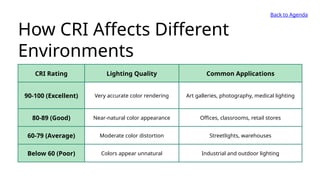
CRI Rating Lighting Quality Common Applications
90-100 (Excellent) Very accurate color rendering Art galleries, photography, medical lighting
80-89 (Good) Near-natural color appearance Offices, classrooms, retail stores
60-79 (Average) Moderate color distortion Streetlights, warehouses
Below 60 (Poor) Colors appear unnatural Industrial and outdoor lighting
How CRI Affects Different
Environments
Back to Agenda
Correlated Color
Temperature (CCT)
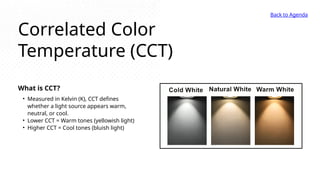
• Measured in Kelvin (K), CCT defines
whether a light source appears warm,
neutral, or cool.
• Lower CCT = Warm tones (yellowish light)
• Higher CCT = Cool tones (bluish light)
What is CCT?
Back to Agenda
CCT (Kelvin) Lighting Appearance Best Applications
2700K - 3000K Warm, cozy Homes, hotels, restaurants
3500K - 4000K Neutral white Offices, classrooms, retail stores
5000K - 6500K Cool, daylight-like Hospitals, factories, outdoor lighting
Choosing the Right CCT for
Applications
Back to Agenda
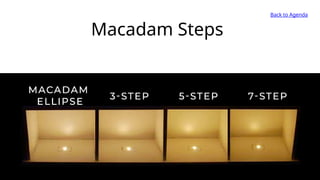
Macadam Steps
Back to Agenda
Back to Agenda
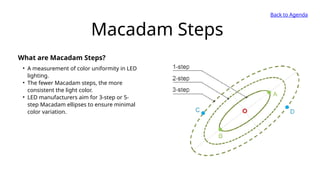
• A measurement of color uniformity in LED
lighting.
• The fewer Macadam steps, the more
consistent the light color.
• LED manufacturers aim for 3-step or 5-
step Macadam ellipses to ensure minimal
color variation.
What are Macadam Steps?
Macadam Steps
Back to Agenda
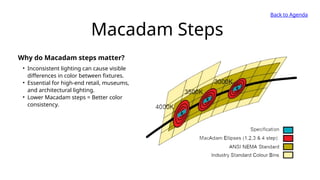
• Inconsistent lighting can cause visible
differences in color between fixtures.
• Essential for high-end retail, museums,
and architectural lighting.
• Lower Macadam steps = Better color
consistency.
Why do Macadam steps matter?
Macadam Steps
Unified Glare
Rating (UGR)
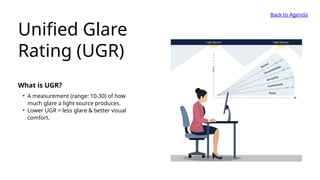
• A measurement (range: 10-30) of how
much glare a light source produces.
• Lower UGR = less glare & better visual
comfort.
What is UGR?
Back to Agenda
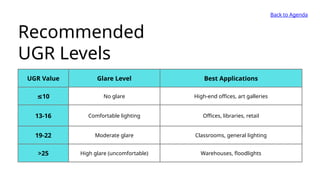
UGR Value Glare Level Best Applications
≤10 No glare High-end offices, art galleries
13-16 Comfortable lighting Offices, libraries, retail
19-22 Moderate glare Classrooms, general lighting
>25 High glare (uncomfortable) Warehouses, floodlights
Recommended
UGR Levels
Back to Agenda
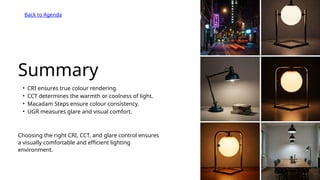
Summary
• CRI ensures true colour rendering.
• CCT determines the warmth or coolness of light.
• Macadam Steps ensure colour consistency.
• UGR measures glare and visual comfort.
Choosing the right CRI, CCT, and glare control ensures
a visually comfortable and efficient lighting
environment.
Back to Agenda

Lighting Quality For Lighting Fixtures .pptx

  • 1.
    Lighting Quality A DeepDive into Color Accuracy, Consistency, and Visual Comfort Presented by Mina Anis
  • 2.
    Agenda 1.Introduction 2.Color Rendering Index(CRI) 3.How CRI Affects Different Environments 4.Correlated Colour Temperature (CCT) 5.Choosing the Right CCT for Applications 6.Macadam Steps 7.Unified Glare Rating (UGR) 8.Recommended UGR Levels 9.Summary
  • 3.
    Back to Agenda Introduction •Lighting quality affects how we see colors, perceive brightness, and experience comfort. • This presentation covers Color Rendering Index (CRI), Correlated Color Temperature (CCT), Macadam Steps, and Unified Glare Rating (UGR).
  • 4.
    Real-World Example: • Retailstores use high CRI lighting (90+) to make products look more vibrant. • Office lighting with low CRI can make colors appear dull and unnatural. What is CRI? • A measurement (0–100) of how accurately a light source reveals colors compared to natural sunlight. • Higher CRI = Better color accuracy. Color Rendering Index (CRI) Back to Agenda
  • 5.
  • 6.
    CRI Rating LightingQuality Common Applications 90-100 (Excellent) Very accurate color rendering Art galleries, photography, medical lighting 80-89 (Good) Near-natural color appearance Offices, classrooms, retail stores 60-79 (Average) Moderate color distortion Streetlights, warehouses Below 60 (Poor) Colors appear unnatural Industrial and outdoor lighting How CRI Affects Different Environments Back to Agenda
  • 7.
    Correlated Color Temperature (CCT) •Measured in Kelvin (K), CCT defines whether a light source appears warm, neutral, or cool. • Lower CCT = Warm tones (yellowish light) • Higher CCT = Cool tones (bluish light) What is CCT? Back to Agenda
  • 8.
    CCT (Kelvin) LightingAppearance Best Applications 2700K - 3000K Warm, cozy Homes, hotels, restaurants 3500K - 4000K Neutral white Offices, classrooms, retail stores 5000K - 6500K Cool, daylight-like Hospitals, factories, outdoor lighting Choosing the Right CCT for Applications Back to Agenda
  • 9.
  • 10.
    Back to Agenda •A measurement of color uniformity in LED lighting. • The fewer Macadam steps, the more consistent the light color. • LED manufacturers aim for 3-step or 5- step Macadam ellipses to ensure minimal color variation. What are Macadam Steps? Macadam Steps
  • 11.
    Back to Agenda •Inconsistent lighting can cause visible differences in color between fixtures. • Essential for high-end retail, museums, and architectural lighting. • Lower Macadam steps = Better color consistency. Why do Macadam steps matter? Macadam Steps
  • 12.
    Unified Glare Rating (UGR) •A measurement (range: 10-30) of how much glare a light source produces. • Lower UGR = less glare & better visual comfort. What is UGR? Back to Agenda
  • 13.
    UGR Value GlareLevel Best Applications ≤10 No glare High-end offices, art galleries 13-16 Comfortable lighting Offices, libraries, retail 19-22 Moderate glare Classrooms, general lighting >25 High glare (uncomfortable) Warehouses, floodlights Recommended UGR Levels Back to Agenda
  • 14.
    Summary • CRI ensurestrue colour rendering. • CCT determines the warmth or coolness of light. • Macadam Steps ensure colour consistency. • UGR measures glare and visual comfort. Choosing the right CRI, CCT, and glare control ensures a visually comfortable and efficient lighting environment. Back to Agenda