Expected Learning Outcome & CCE
RP Training Programme – English(2nd Language)
30th & 31st January 2019
The mind is not a vessel to be filled, but a fire to be ignited.
(Plutarch)
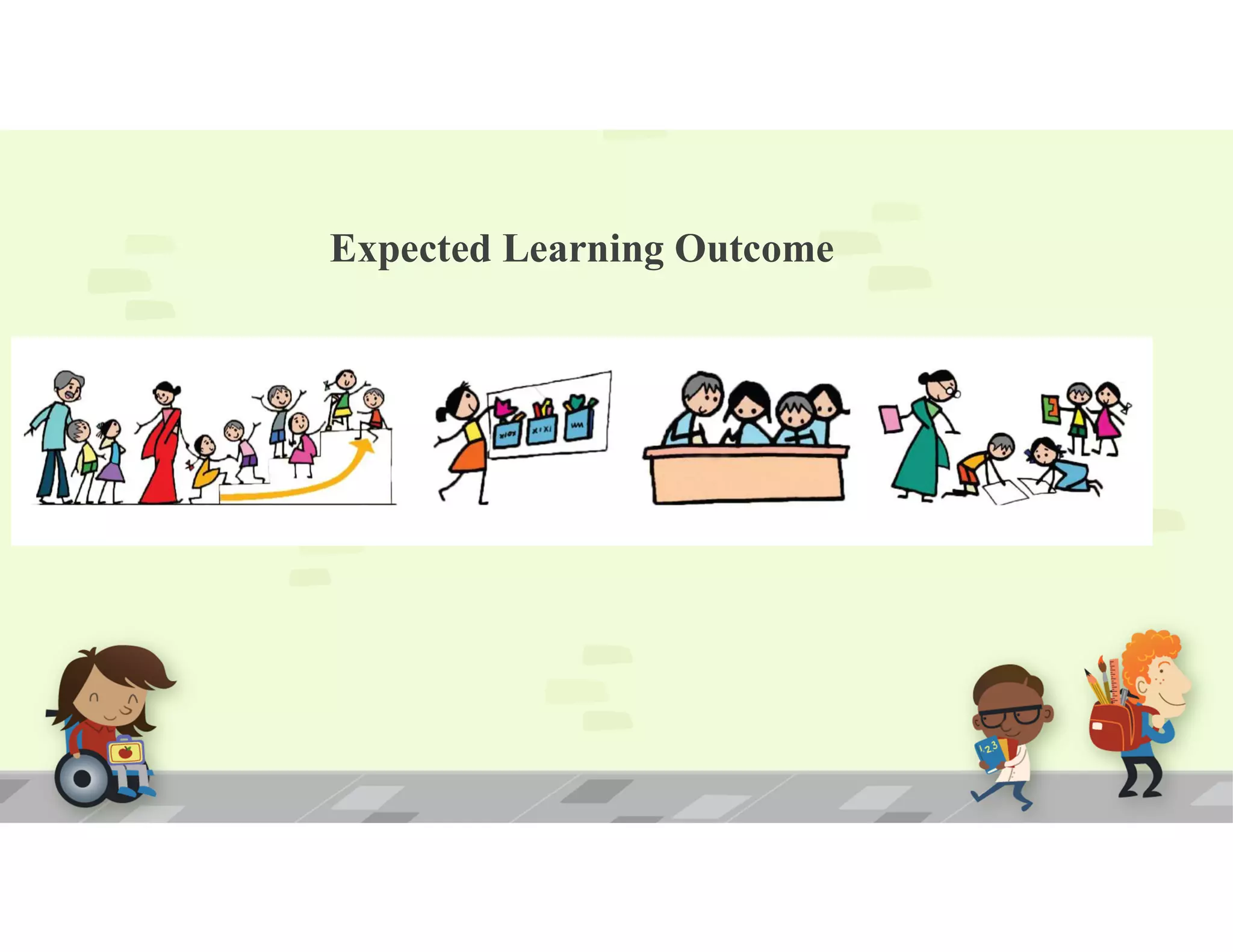
Expected Learning Outcome
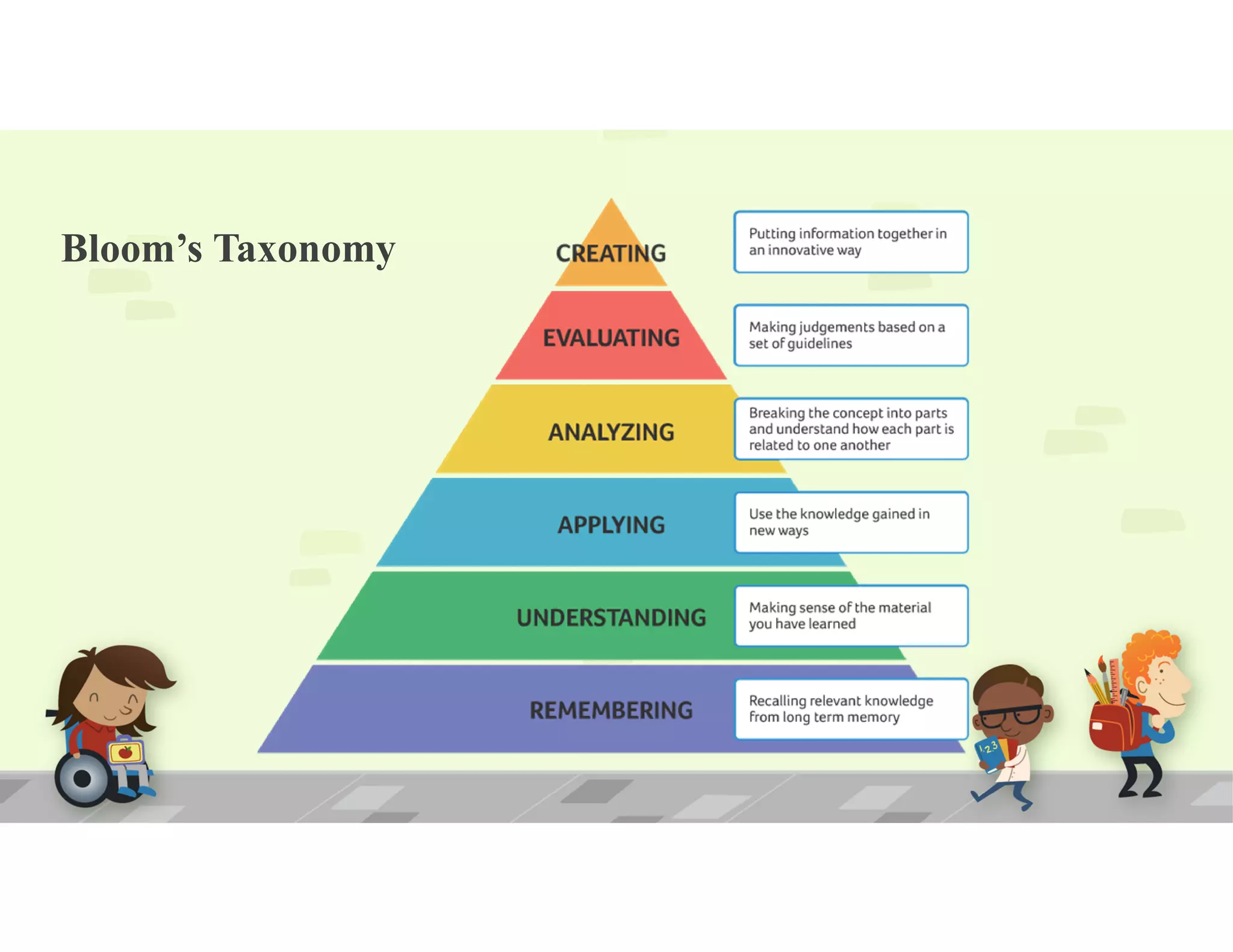
Bloom’s Taxonomy
A turtle makes progress when it sticks its neck out.
Remembering
• The learner is able to recall, restate and remember learned information.
– Recognising – Listing – Describing – Identifying
– Retrieving – Naming – Locating – Finding
•
Classroom Roles for
Remembering
Teacher roles Student roles
• Directs • Responds
• Tells • Absorbs
• Shows • Remembers
• Examines • Recognises
• Questions • Memorises
• Evaluates • Defines
• Describes
• Retells
• Passive recipient
Remembering:
Potential Activities and Products
• Make a story map showing the main events of
the story.
• Make a time line of your typical day.
• Make a concept map of the topic.
• Write a list of keywords you know about….
• What characters were in the story?
• Make a chart showing…
• Recite a poem you have learnt.
Understanding
The learner grasps the meaning of information by interpreting and
translating what has been learned.
– Interpreting
– Illustrating
– Summarising
– Inferring
– Paraphrasing
– Classifying
– Comparing
– Explaining
Classroom Roles for
Understanding
Teacher roles Student roles
• Demonstrates • Explains
• Listens • Describes
• Questions • Outlines
• Compares • Restates
• Contrasts • Translates
• Examines • Demonstrates
• Interprets
• Active participant
Understanding:
Potential Activities and Products
• Write in your own words…
• Cut out, or draw pictures to illustrate a particular event in the story.
• Report to the class…
• Illustrate what you think the main idea may have been.
• Make a cartoon strip showing the sequence of events in the story.
• Write and perform a play based on the story.
• Write a brief outline to explain this story to someone else
• Explain why the character solved the problem in this particular way
• Write a summary report of the event.
• Prepare a flow chart to illustrate the sequence of events.
• Make a colouring book.
• Paraphrase this chapter in the book.
• Retell in your own words.
• Outline the main points.
Applying
The learner makes use of information in a context
different from the one in which it was learned.
– Implementing
– Carrying out
– Using
– Executing
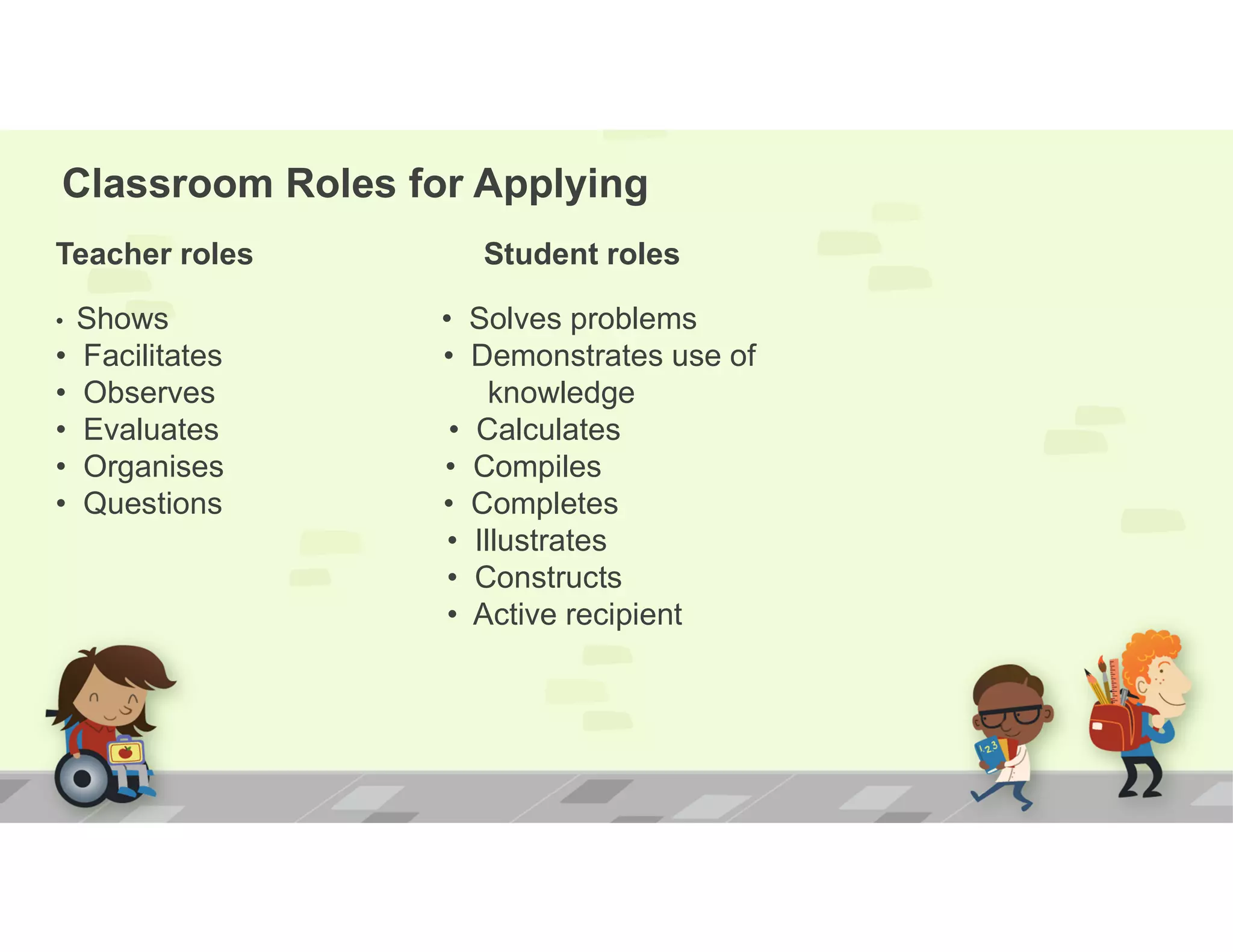
Classroom Roles for Applying
Teacher roles Student roles
• Shows • Solves problems
• Facilitates • Demonstrates use of
• Observes knowledge
• Evaluates • Calculates
• Organises • Compiles
• Questions • Completes
• Illustrates
• Constructs
• Active recipient
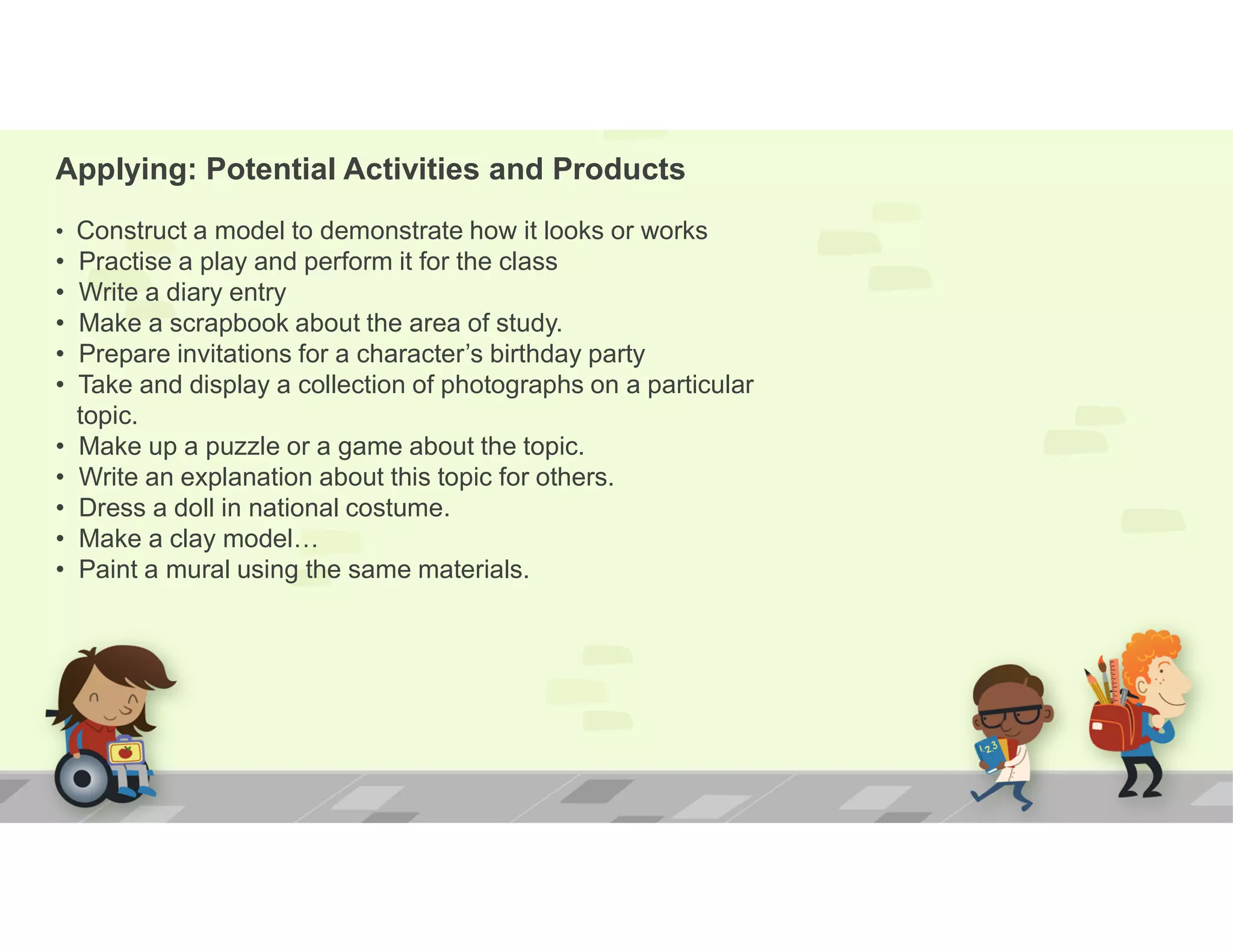
Applying: Potential Activities and Products
• Construct a model to demonstrate how it looks or works
• Practise a play and perform it for the class
• Write a diary entry
• Make a scrapbook about the area of study.
• Prepare invitations for a character’s birthday party
• Take and display a collection of photographs on a particular
topic.
• Make up a puzzle or a game about the topic.
• Write an explanation about this topic for others.
• Dress a doll in national costume.
• Make a clay model…
• Paint a mural using the same materials.
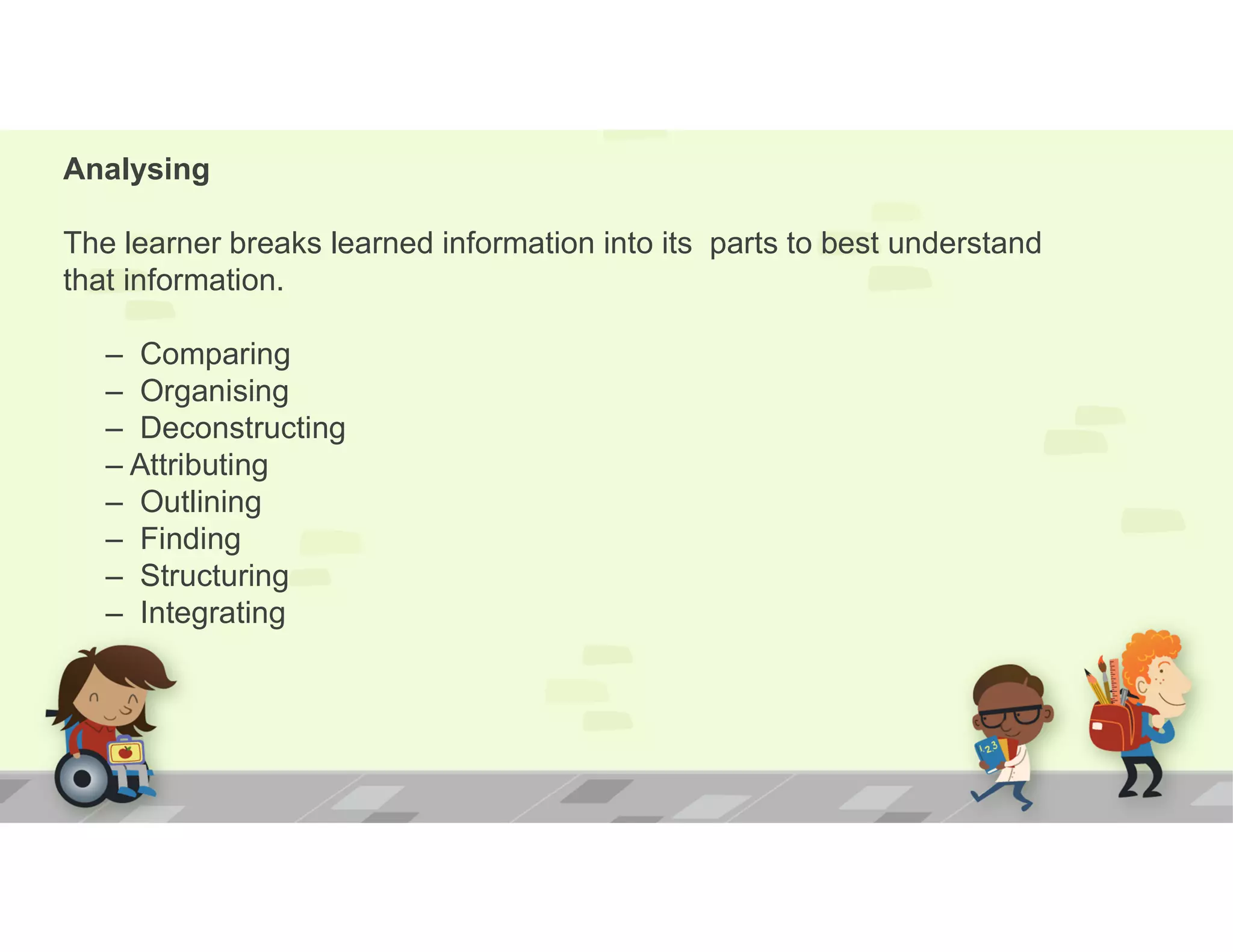
Analysing
The learner breaks learned information into its parts to best understand
that information.
– Comparing
– Organising
– Deconstructing
– Attributing
– Outlining
– Finding
– Structuring
– Integrating
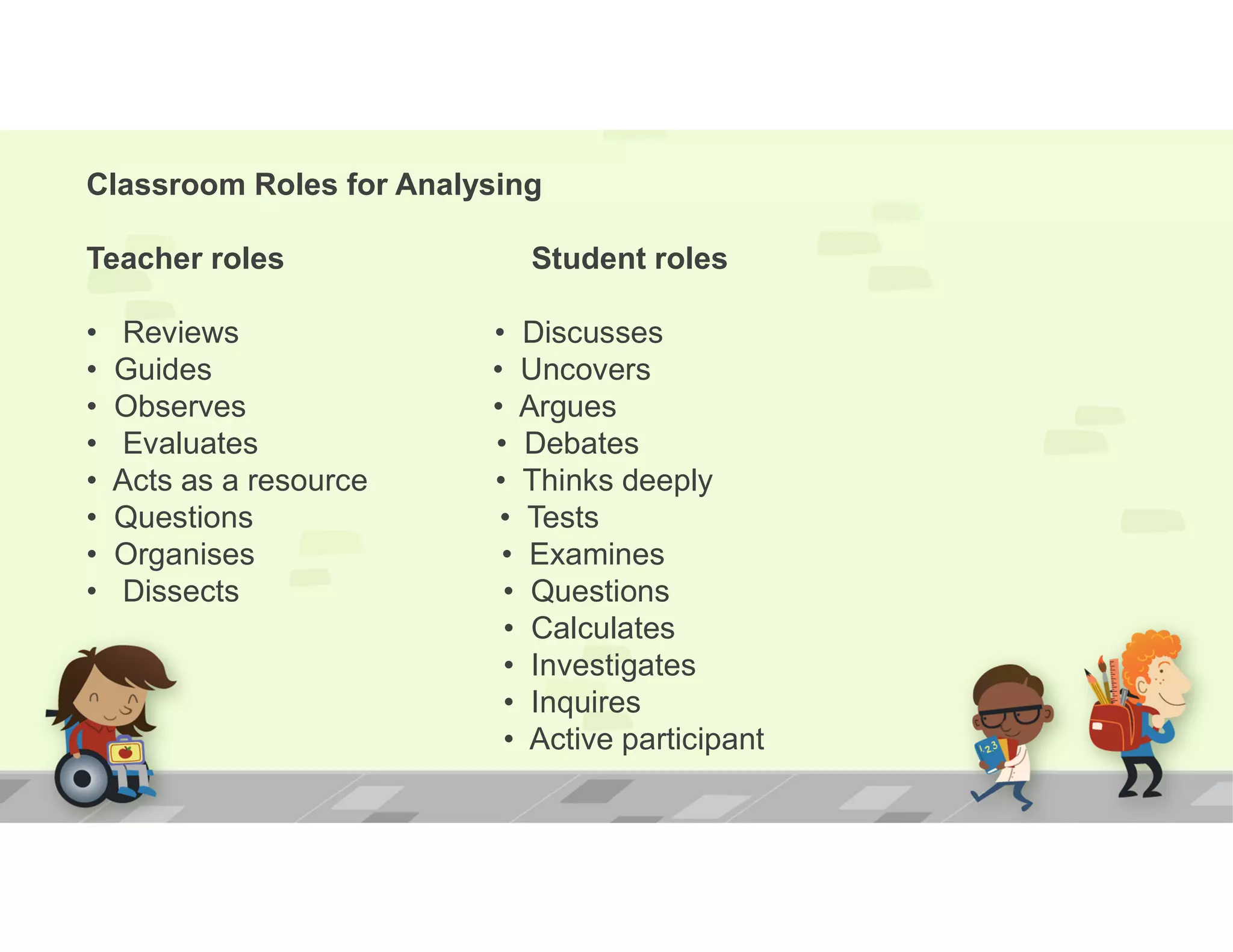
Classroom Roles for Analysing
Teacher roles Student roles
• Reviews • Discusses
• Guides • Uncovers
• Observes • Argues
• Evaluates • Debates
• Acts as a resource • Thinks deeply
• Questions • Tests
• Organises • Examines
• Dissects • Questions
• Calculates
• Investigates
• Inquires
• Active participant
Analysing: Potential Activities and Products
• Design a questionnaire to gather information.
• Survey classmates to find out what they think about a particular topic.
Analyse the results.
• Make a flow chart to show the critical stages.
• Classify the actions of the characters in the book
• Make a family tree showing relationships.
• Devise a roleplay about the study area.
• Write a biography of a person studied.
• Prepare a report about the area of study.
• Conduct an investigation to produce information to support a view.
• Review a work of art in terms of form, colour and texture.
Evaluating
The learner makes decisions based on in-depth
reflection, criticism and assessment.
– Checking
– Hypothesizing
– Critiquing
– Experimenting
– Judging
– Testing
– Detecting
– Monitoring
Classroom Roles for Evaluating
Teacher roles Student roles
• Clarifies • Judges
• Accepts • Disputes
• Guides • Compares
• Critiques
• Questions
• Argues
• Assesses
• Decides
• Selects
• Justifies
• Active participant
Evaluating: Potential Activities and Products
• Write a letter to the editor
• Prepare and conduct a debate
• Prepare a list of criteria to judge…
• Write a convincing speech arguing for/against…
• Make a booklet about five rules you see as important.
Convince others.
• Form a panel to discuss viewpoints on….
• Write a letter to. ..advising on changes needed.
• Prepare a case to present your view about...
• Evaluate the character’s actions in the story
Creating
The learner creates new ideas and
information using what has been previously
learned.
– Designing
– Constructing
– Planning
– Producing
– Inventing
– Making
Classroom Roles for Creating
Teacher roles Student roles
• Facilitates • Designs
• Extends • Formulates
• Reflects • Plans
• Takes risks
• Analyses
• Modifies
• Evaluates
• Creates
• Proposes
• Active participant
Creating: Potential Activities and Products
• Write about your feelings in relation to...
• Write a TV show play, puppet show, role play, song or pantomime
about..
• Develop a menu for a new restaurant using a variety of healthy foods
• Design a record, book or magazine cover for...
• Sell an idea
• Devise a way to...
• Make up a new language and use it in an example
• Write a jingle to advertise a new product.
Sample Unit : Travel
Remembering How many ways can you travel from one place to another? List
and draw all the ways you know. Describe one of the vehicles
from your list, draw a diagram and label the parts. Collect
“transport” pictures from magazines- make a poster with info.
Understanding How do you get from school to home? Explain the method of
travel and draw a map. Write a play about a form of modern
transport. Explain how you felt the first time you rode a bicycle.
Make your desk into a form of transport.
Applying Explain why some vehicles are large and others small. Write a
story about the uses of both. Read a story about “The Little Red
Engine” and make up a play about it. Survey 10 other children
to see what bikes they ride. Display on a chart or graph.
Analysing Make a jigsaw puzzle of children using bikes safely. What
problems are there with modern forms of transport and their
uses- write a report. Use a Diagram to compare boats to
planes, or helicopters to bicycles.
Evaluating What changes would you recommend to road rules to prevent
traffic accidents? Debate whether we should be able to buy fuel
at a cheaper rate. Rate transport from slow to fast etc..
Creating Invent a vehicle. Draw or construct it after careful planning.
What sort of transport will there be in twenty years time?
Discuss, write about it and report to the class. Write a song
about traveling in different forms of transport.
A good teacher makes you think even when you don’t want to.
(Fisher, 1998, Teaching Thinking)
Thank You

Expected learning outcome bloom's taxonomy

  • 1.
    Expected Learning Outcome& CCE RP Training Programme – English(2nd Language) 30th & 31st January 2019
  • 2.
    The mind isnot a vessel to be filled, but a fire to be ignited. (Plutarch)
  • 3.
  • 4.
  • 5.
    A turtle makesprogress when it sticks its neck out.
  • 6.
    Remembering • The learneris able to recall, restate and remember learned information. – Recognising – Listing – Describing – Identifying – Retrieving – Naming – Locating – Finding •
  • 7.
    Classroom Roles for Remembering Teacherroles Student roles • Directs • Responds • Tells • Absorbs • Shows • Remembers • Examines • Recognises • Questions • Memorises • Evaluates • Defines • Describes • Retells • Passive recipient
  • 8.
    Remembering: Potential Activities andProducts • Make a story map showing the main events of the story. • Make a time line of your typical day. • Make a concept map of the topic. • Write a list of keywords you know about…. • What characters were in the story? • Make a chart showing… • Recite a poem you have learnt.
  • 9.
    Understanding The learner graspsthe meaning of information by interpreting and translating what has been learned. – Interpreting – Illustrating – Summarising – Inferring – Paraphrasing – Classifying – Comparing – Explaining
  • 10.
    Classroom Roles for Understanding Teacherroles Student roles • Demonstrates • Explains • Listens • Describes • Questions • Outlines • Compares • Restates • Contrasts • Translates • Examines • Demonstrates • Interprets • Active participant
  • 11.
    Understanding: Potential Activities andProducts • Write in your own words… • Cut out, or draw pictures to illustrate a particular event in the story. • Report to the class… • Illustrate what you think the main idea may have been. • Make a cartoon strip showing the sequence of events in the story. • Write and perform a play based on the story. • Write a brief outline to explain this story to someone else • Explain why the character solved the problem in this particular way • Write a summary report of the event. • Prepare a flow chart to illustrate the sequence of events. • Make a colouring book. • Paraphrase this chapter in the book. • Retell in your own words. • Outline the main points.
  • 12.
    Applying The learner makesuse of information in a context different from the one in which it was learned. – Implementing – Carrying out – Using – Executing
  • 13.
    Classroom Roles forApplying Teacher roles Student roles • Shows • Solves problems • Facilitates • Demonstrates use of • Observes knowledge • Evaluates • Calculates • Organises • Compiles • Questions • Completes • Illustrates • Constructs • Active recipient
  • 14.
    Applying: Potential Activitiesand Products • Construct a model to demonstrate how it looks or works • Practise a play and perform it for the class • Write a diary entry • Make a scrapbook about the area of study. • Prepare invitations for a character’s birthday party • Take and display a collection of photographs on a particular topic. • Make up a puzzle or a game about the topic. • Write an explanation about this topic for others. • Dress a doll in national costume. • Make a clay model… • Paint a mural using the same materials.
  • 15.
    Analysing The learner breakslearned information into its parts to best understand that information. – Comparing – Organising – Deconstructing – Attributing – Outlining – Finding – Structuring – Integrating
  • 16.
    Classroom Roles forAnalysing Teacher roles Student roles • Reviews • Discusses • Guides • Uncovers • Observes • Argues • Evaluates • Debates • Acts as a resource • Thinks deeply • Questions • Tests • Organises • Examines • Dissects • Questions • Calculates • Investigates • Inquires • Active participant
  • 17.
    Analysing: Potential Activitiesand Products • Design a questionnaire to gather information. • Survey classmates to find out what they think about a particular topic. Analyse the results. • Make a flow chart to show the critical stages. • Classify the actions of the characters in the book • Make a family tree showing relationships. • Devise a roleplay about the study area. • Write a biography of a person studied. • Prepare a report about the area of study. • Conduct an investigation to produce information to support a view. • Review a work of art in terms of form, colour and texture.
  • 18.
    Evaluating The learner makesdecisions based on in-depth reflection, criticism and assessment. – Checking – Hypothesizing – Critiquing – Experimenting – Judging – Testing – Detecting – Monitoring
  • 19.
    Classroom Roles forEvaluating Teacher roles Student roles • Clarifies • Judges • Accepts • Disputes • Guides • Compares • Critiques • Questions • Argues • Assesses • Decides • Selects • Justifies • Active participant
  • 20.
    Evaluating: Potential Activitiesand Products • Write a letter to the editor • Prepare and conduct a debate • Prepare a list of criteria to judge… • Write a convincing speech arguing for/against… • Make a booklet about five rules you see as important. Convince others. • Form a panel to discuss viewpoints on…. • Write a letter to. ..advising on changes needed. • Prepare a case to present your view about... • Evaluate the character’s actions in the story
  • 21.
    Creating The learner createsnew ideas and information using what has been previously learned. – Designing – Constructing – Planning – Producing – Inventing – Making
  • 22.
    Classroom Roles forCreating Teacher roles Student roles • Facilitates • Designs • Extends • Formulates • Reflects • Plans • Takes risks • Analyses • Modifies • Evaluates • Creates • Proposes • Active participant
  • 23.
    Creating: Potential Activitiesand Products • Write about your feelings in relation to... • Write a TV show play, puppet show, role play, song or pantomime about.. • Develop a menu for a new restaurant using a variety of healthy foods • Design a record, book or magazine cover for... • Sell an idea • Devise a way to... • Make up a new language and use it in an example • Write a jingle to advertise a new product.
  • 24.
    Sample Unit :Travel Remembering How many ways can you travel from one place to another? List and draw all the ways you know. Describe one of the vehicles from your list, draw a diagram and label the parts. Collect “transport” pictures from magazines- make a poster with info. Understanding How do you get from school to home? Explain the method of travel and draw a map. Write a play about a form of modern transport. Explain how you felt the first time you rode a bicycle. Make your desk into a form of transport.
  • 25.
    Applying Explain whysome vehicles are large and others small. Write a story about the uses of both. Read a story about “The Little Red Engine” and make up a play about it. Survey 10 other children to see what bikes they ride. Display on a chart or graph. Analysing Make a jigsaw puzzle of children using bikes safely. What problems are there with modern forms of transport and their uses- write a report. Use a Diagram to compare boats to planes, or helicopters to bicycles.
  • 26.
    Evaluating What changeswould you recommend to road rules to prevent traffic accidents? Debate whether we should be able to buy fuel at a cheaper rate. Rate transport from slow to fast etc.. Creating Invent a vehicle. Draw or construct it after careful planning. What sort of transport will there be in twenty years time? Discuss, write about it and report to the class. Write a song about traveling in different forms of transport.
  • 27.
    A good teachermakes you think even when you don’t want to. (Fisher, 1998, Teaching Thinking)
  • 28.