Multiplication
  with the Expanded Method

         We are going to learn:
1.02c – Different multiplication strategies
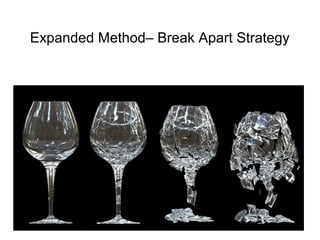
Expanded Method– Break Apart Strategy
Review
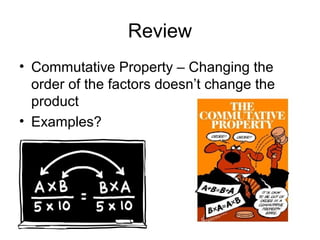
• Commutative Property – Changing the
  order of the factors doesn’t change the
  product
• Examples?
Review
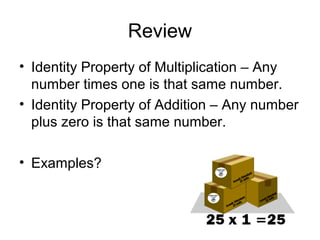
• Identity Property of Multiplication – Any
  number times one is that same number.
• Identity Property of Addition – Any number
  plus zero is that same number.

• Examples?
• Associative Property - Changing the
  grouping of the numbers, doesn’t change
  the answer.
• Remember:
           8 + (9 +7) = (8 + 9) + 7

          (3 x 4) x 5 = 3 x (4 x 5)
Let’s try something new!
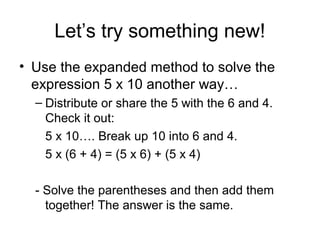
• Use the expanded method to solve the
  expression 5 x 10 another way…
  – Distribute or share the 5 with the 6 and 4.
    Check it out:
    5 x 10…. Break up 10 into 6 and 4.
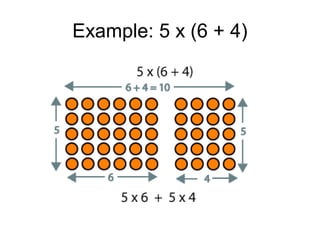
    5 x (6 + 4) = (5 x 6) + (5 x 4)

  - Solve the parentheses and then add them
    together! The answer is the same.
Example: 5 x (6 + 4)
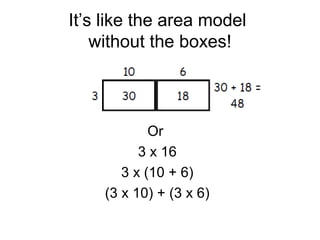
It’s like the area model
    without the boxes!


            Or
          3 x 16
       3 x (10 + 6)
    (3 x 10) + (3 x 6)
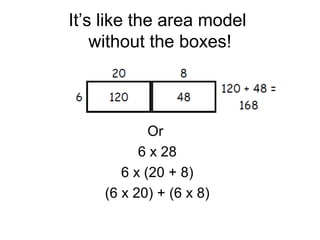
It’s like the area model
    without the boxes!


            Or
          6 x 28
       6 x (20 + 8)
    (6 x 20) + (6 x 8)
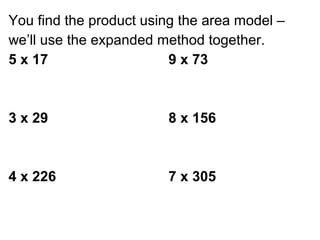
You find the product using the area model –
we’ll use the expanded method together.
5 x 17                   9 x 73


3 x 29                  8 x 156


4 x 226                 7 x 305
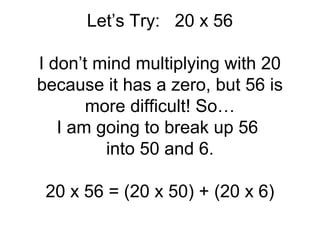
Let’s Try: 20 x 56

I don’t mind multiplying with 20
because it has a zero, but 56 is
       more difficult! So…
   I am going to break up 56
         into 50 and 6.

 20 x 56 = (20 x 50) + (20 x 6)
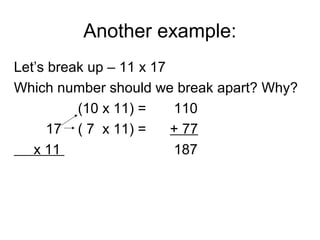
Another example:
Let’s break up – 11 x 17
Which number should we break apart? Why?
          (10 x 11) =    110
     17 ( 7 x 11) =      + 77
   x 11                  187
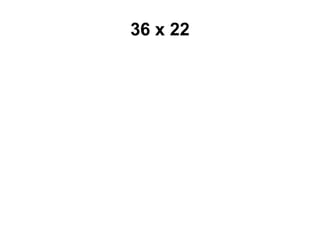
36 x 22
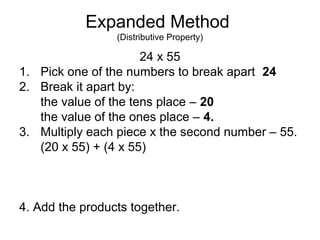
Expanded Method
                 (Distributive Property)

                      24 x 55
1. Pick one of the numbers to break apart 24
2. Break it apart by:
   the value of the tens place – 20
   the value of the ones place – 4.
3. Multiply each piece x the second number – 55.
   (20 x 55) + (4 x 55)


4. Add the products together.
• Now – you try some examples in your
  journal.
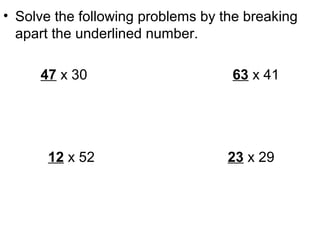
• Solve the following problems by the breaking
  apart the underlined number.

     47 x 30                       63 x 41


       12 x 52                     23 x 29
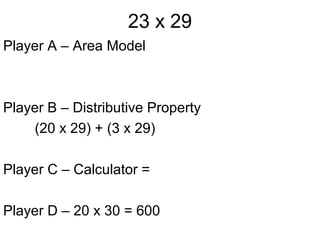
23 x 29
Player A – Area Model


Player B – Distributive Property
    (20 x 29) + (3 x 29)

Player C – Calculator =

Player D – 20 x 30 = 600

Expanded method distributive property

  • 1.
    Multiplication withthe Expanded Method We are going to learn: 1.02c – Different multiplication strategies
  • 2.
  • 3.
    Review • Commutative Property– Changing the order of the factors doesn’t change the product • Examples?
  • 4.
    Review • Identity Propertyof Multiplication – Any number times one is that same number. • Identity Property of Addition – Any number plus zero is that same number. • Examples?
  • 5.
    • Associative Property- Changing the grouping of the numbers, doesn’t change the answer. • Remember: 8 + (9 +7) = (8 + 9) + 7 (3 x 4) x 5 = 3 x (4 x 5)
  • 6.
    Let’s try somethingnew! • Use the expanded method to solve the expression 5 x 10 another way… – Distribute or share the 5 with the 6 and 4. Check it out: 5 x 10…. Break up 10 into 6 and 4. 5 x (6 + 4) = (5 x 6) + (5 x 4) - Solve the parentheses and then add them together! The answer is the same.
  • 7.
    Example: 5 x(6 + 4)
  • 8.
    It’s like thearea model without the boxes! Or 3 x 16 3 x (10 + 6) (3 x 10) + (3 x 6)
  • 9.
    It’s like thearea model without the boxes! Or 6 x 28 6 x (20 + 8) (6 x 20) + (6 x 8)
  • 10.
    You find theproduct using the area model – we’ll use the expanded method together. 5 x 17 9 x 73 3 x 29 8 x 156 4 x 226 7 x 305
  • 11.
    Let’s Try: 20x 56 I don’t mind multiplying with 20 because it has a zero, but 56 is more difficult! So… I am going to break up 56 into 50 and 6. 20 x 56 = (20 x 50) + (20 x 6)
  • 12.
    Another example: Let’s breakup – 11 x 17 Which number should we break apart? Why? (10 x 11) = 110 17 ( 7 x 11) = + 77 x 11 187
  • 13.
  • 14.
    Expanded Method (Distributive Property) 24 x 55 1. Pick one of the numbers to break apart 24 2. Break it apart by: the value of the tens place – 20 the value of the ones place – 4. 3. Multiply each piece x the second number – 55. (20 x 55) + (4 x 55) 4. Add the products together.
  • 15.
    • Now –you try some examples in your journal.
  • 16.
    • Solve thefollowing problems by the breaking apart the underlined number. 47 x 30 63 x 41 12 x 52 23 x 29
  • 17.
    23 x 29 PlayerA – Area Model Player B – Distributive Property (20 x 29) + (3 x 29) Player C – Calculator = Player D – 20 x 30 = 600