FOREIGN TRADE POLICY IN 
INDIA 2009-2014
GROUP MEMBERS 
 2604 ASHWIN 
 2609 JOELLA 
 2611 RICHARD DALVI 
 2615 LIRON 
 2620 JOYICE 
 2623 DELNA 
 2548 TINA
INTRODUCTION 
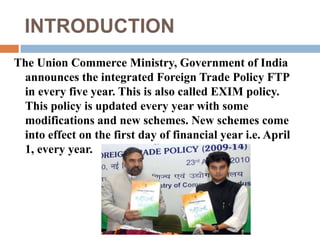
The Union Commerce Ministry, Government of India 
announces the integrated Foreign Trade Policy FTP 
in every five year. This is also called EXIM policy. 
This policy is updated every year with some 
modifications and new schemes. New schemes come 
into effect on the first day of financial year i.e. April 
1, every year.
FOREIGN TRADE POLICY 
 Long term objective of the FTP is to promote exports 
and increase India’s competitiveness globally, leading to 
employment generation particularly in the labor-intensive 
sectors 
 Objective common to both the old and new policies is to 
double India’s exports within 5 years
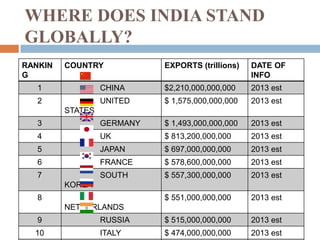
WHERE DOES INDIA STAND 
GLOBALLY? 
RANKIN 
G 
COUNTRY EXPORTS (trillions) DATE OF 
INFO 
1 CHINA $2,210,000,000,000 2013 est 
2 UNITED 
STATES 
$ 1,575,000,000,000 2013 est 
3 GERMANY $ 1,493,000,000,000 2013 est 
4 UK $ 813,200,000,000 2013 est 
5 JAPAN $ 697,000,000,000 2013 est 
6 FRANCE $ 578,600,000,000 2013 est 
7 SOUTH 
KOREA 
$ 557,300,000,000 2013 est 
8 
NETHERLANDS 
$ 551,000,000,000 2013 est 
9 RUSSIA $ 515,000,000,000 2013 est 
10 ITALY $ 474,000,000,000 2013 est
HISTORY 
 Earlier this policy known as Export Import (EXIM) Policy. 
 Union Commerce Ministry, GOI announces integrated FTP 
every five year. 
 updated every year on the 31st of March and the 
modifications, improvements and new schemes becomes 
effective from April month of each year 
 Foreign Trade Policy announced on 27th August 2009 for the 
period 2009-2014
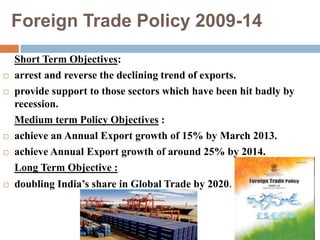
Foreign Trade Policy 2009-14 
Short Term Objectives: 
 arrest and reverse the declining trend of exports. 
 provide support to those sectors which have been hit badly by 
recession. 
Medium term Policy Objectives : 
 achieve an Annual Export growth of 15% by March 2013. 
 achieve Annual Export growth of around 25% by 2014. 
Long Term Objective : 
 doubling India’s share in Global Trade by 2020.
FOREIGN TRADE POLICY 
2009-14 HIGHLIGHTS
ANNOUNCEMENTS FOR 
FPS, FMS, MLFPS 
 26 New markets added under focus market scheme (FMS) 
 Incentives under FMS raised from 2.5% to 3% 
 Incentives available under FPS raised from 1.25% to 2% 
 MLFPS expanded by inclusion of products like 
pharmaceuticals , textile fabrics, rubber products, glass 
products, auto components , etc
AGRICULTURAL SECTOR 
 a single window system to facilitate export of 
perishable agricultural produce has been introduced. 
GEMS AND JEWELLERY 
 planned to establish “Diamond Bourses” 
 import of cut & polished diamonds on consignment basis 
 of personal carriage upto US $ 5 million value units in 
case of participation in overseas exhibition
LEATHER SECTOR 
 re-port of unsold imported rawhides and skins and semi 
finished leather 
 Enhancement of FPS rate to 2 % 
TEA SECTOR 
 DTA (Domestic Tariff Area) sale limit of instant tea by EOU 
units increased from 30% to 50%. 
 Export of tea has been included under VKGUY Scheme 
benefits.
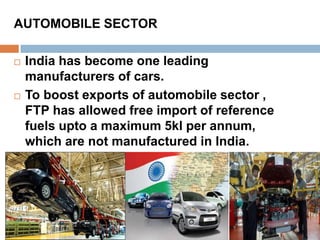
AUTOMOBILE SECTOR 
 India has become one leading 
manufacturers of cars. 
 To boost exports of automobile sector , 
FTP has allowed free import of reference 
fuels upto a maximum 5kl per annum, 
which are not manufactured in India.
STATUS HOLDERS 
 Large export organisations can become export houses and 
trading houses. 
ELIGIBILITY 
 Merchant and manufacturers exporters. 
 Export oriented units. 
 Units located in SEZ, agri export zones. 
 Units located in electronic hardware technology parks 
software tech parks.
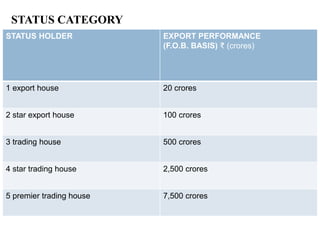
STATUS CATEGORY 
STATUS HOLDER EXPORT PERFORMANCE 
(F.O.B. BASIS) ₹ (crores) 
1 export house 20 crores 
2 star export house 100 crores 
3 trading house 500 crores 
4 star trading house 2,500 crores 
5 premier trading house 7,500 crores
1.INCENTIVE SCRIP FOR IMPORT OF CAPITAL 
GOODS: 
Status holders of specified sectors shall be eligible for 
status holder incentive scrip @ 1% on the FOB. The 
specified sectors are: 
 Basic chemicals (excluding pharma products) 
 Engineering sector (excluding iron & steel) 
 Leather sector (excluding finished leather) 
 Textiles and jute 
 Handicrafts & plastics
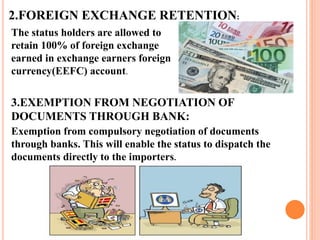
2.FOREIGN EXCHANGE RETENTION: 
The status holders are allowed to 
retain 100% of foreign exchange 
earned in exchange earners foreign 
currency(EEFC) account. 
3.EXEMPTION FROM NEGOTIATION OF 
DOCUMENTS THROUGH BANK: 
Exemption from compulsory negotiation of documents 
through banks. This will enable the status to dispatch the 
documents directly to the importers.
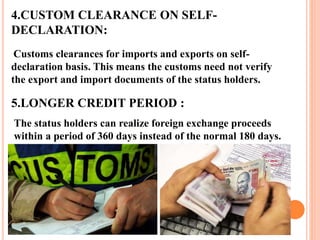
4.CUSTOM CLEARANCE ON SELF-DECLARATION: 
Customs clearances for imports and exports on self-declaration 
basis. This means the customs need not verify 
the export and import documents of the status holders. 
5.LONGER CREDIT PERIOD : 
The status holders can realize foreign exchange proceeds 
within a period of 360 days instead of the normal 180 days.
6.EXEMPTION FROM FURNISHING BANK 
GUARANTEE: 
Exempted from furnishing bank guarantee 
for claiming incentives in respect of various 
schemes under FTP. i.e the exporters can 
get incentives without providing a bank 
guarantee. 
7.AGRI-INFRASTRUCTURE SCRIP BENEFITS: 
Under agri-infrastructure incentive the exporters of 
agricultural items can import capital goods without payment of 
customs duty, subject to certain conditions.
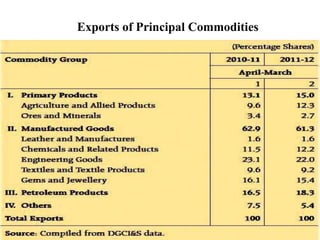
Exports of Principal Commodities
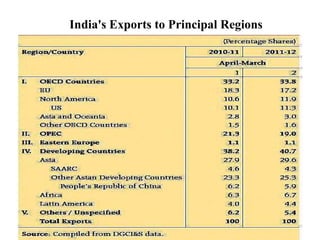
India's Exports to Principal Regions
References 
 http://www.eximkey.com 
 http://www.eximinfo.com 
 http://www.eximbankindia.in/ 
 http://dgft.gov.in 
 http://finmin.nic.in/

Foreign trade policy in india

  • 1.
    FOREIGN TRADE POLICYIN INDIA 2009-2014
  • 2.
    GROUP MEMBERS 2604 ASHWIN  2609 JOELLA  2611 RICHARD DALVI  2615 LIRON  2620 JOYICE  2623 DELNA  2548 TINA
  • 3.
    INTRODUCTION The UnionCommerce Ministry, Government of India announces the integrated Foreign Trade Policy FTP in every five year. This is also called EXIM policy. This policy is updated every year with some modifications and new schemes. New schemes come into effect on the first day of financial year i.e. April 1, every year.
  • 4.
    FOREIGN TRADE POLICY  Long term objective of the FTP is to promote exports and increase India’s competitiveness globally, leading to employment generation particularly in the labor-intensive sectors  Objective common to both the old and new policies is to double India’s exports within 5 years
  • 5.
    WHERE DOES INDIASTAND GLOBALLY? RANKIN G COUNTRY EXPORTS (trillions) DATE OF INFO 1 CHINA $2,210,000,000,000 2013 est 2 UNITED STATES $ 1,575,000,000,000 2013 est 3 GERMANY $ 1,493,000,000,000 2013 est 4 UK $ 813,200,000,000 2013 est 5 JAPAN $ 697,000,000,000 2013 est 6 FRANCE $ 578,600,000,000 2013 est 7 SOUTH KOREA $ 557,300,000,000 2013 est 8 NETHERLANDS $ 551,000,000,000 2013 est 9 RUSSIA $ 515,000,000,000 2013 est 10 ITALY $ 474,000,000,000 2013 est
  • 6.
    HISTORY  Earlierthis policy known as Export Import (EXIM) Policy.  Union Commerce Ministry, GOI announces integrated FTP every five year.  updated every year on the 31st of March and the modifications, improvements and new schemes becomes effective from April month of each year  Foreign Trade Policy announced on 27th August 2009 for the period 2009-2014
  • 7.
    Foreign Trade Policy2009-14 Short Term Objectives:  arrest and reverse the declining trend of exports.  provide support to those sectors which have been hit badly by recession. Medium term Policy Objectives :  achieve an Annual Export growth of 15% by March 2013.  achieve Annual Export growth of around 25% by 2014. Long Term Objective :  doubling India’s share in Global Trade by 2020.
  • 8.
    FOREIGN TRADE POLICY 2009-14 HIGHLIGHTS
  • 9.
    ANNOUNCEMENTS FOR FPS,FMS, MLFPS  26 New markets added under focus market scheme (FMS)  Incentives under FMS raised from 2.5% to 3%  Incentives available under FPS raised from 1.25% to 2%  MLFPS expanded by inclusion of products like pharmaceuticals , textile fabrics, rubber products, glass products, auto components , etc
  • 10.
    AGRICULTURAL SECTOR a single window system to facilitate export of perishable agricultural produce has been introduced. GEMS AND JEWELLERY  planned to establish “Diamond Bourses”  import of cut & polished diamonds on consignment basis  of personal carriage upto US $ 5 million value units in case of participation in overseas exhibition
  • 11.
    LEATHER SECTOR re-port of unsold imported rawhides and skins and semi finished leather  Enhancement of FPS rate to 2 % TEA SECTOR  DTA (Domestic Tariff Area) sale limit of instant tea by EOU units increased from 30% to 50%.  Export of tea has been included under VKGUY Scheme benefits.
  • 12.
    AUTOMOBILE SECTOR India has become one leading manufacturers of cars.  To boost exports of automobile sector , FTP has allowed free import of reference fuels upto a maximum 5kl per annum, which are not manufactured in India.
  • 13.
    STATUS HOLDERS Large export organisations can become export houses and trading houses. ELIGIBILITY  Merchant and manufacturers exporters.  Export oriented units.  Units located in SEZ, agri export zones.  Units located in electronic hardware technology parks software tech parks.
  • 14.
    STATUS CATEGORY STATUSHOLDER EXPORT PERFORMANCE (F.O.B. BASIS) ₹ (crores) 1 export house 20 crores 2 star export house 100 crores 3 trading house 500 crores 4 star trading house 2,500 crores 5 premier trading house 7,500 crores
  • 15.
    1.INCENTIVE SCRIP FORIMPORT OF CAPITAL GOODS: Status holders of specified sectors shall be eligible for status holder incentive scrip @ 1% on the FOB. The specified sectors are:  Basic chemicals (excluding pharma products)  Engineering sector (excluding iron & steel)  Leather sector (excluding finished leather)  Textiles and jute  Handicrafts & plastics
  • 16.
    2.FOREIGN EXCHANGE RETENTION: The status holders are allowed to retain 100% of foreign exchange earned in exchange earners foreign currency(EEFC) account. 3.EXEMPTION FROM NEGOTIATION OF DOCUMENTS THROUGH BANK: Exemption from compulsory negotiation of documents through banks. This will enable the status to dispatch the documents directly to the importers.
  • 17.
    4.CUSTOM CLEARANCE ONSELF-DECLARATION: Customs clearances for imports and exports on self-declaration basis. This means the customs need not verify the export and import documents of the status holders. 5.LONGER CREDIT PERIOD : The status holders can realize foreign exchange proceeds within a period of 360 days instead of the normal 180 days.
  • 18.
    6.EXEMPTION FROM FURNISHINGBANK GUARANTEE: Exempted from furnishing bank guarantee for claiming incentives in respect of various schemes under FTP. i.e the exporters can get incentives without providing a bank guarantee. 7.AGRI-INFRASTRUCTURE SCRIP BENEFITS: Under agri-infrastructure incentive the exporters of agricultural items can import capital goods without payment of customs duty, subject to certain conditions.
  • 19.
  • 20.
    India's Exports toPrincipal Regions
  • 21.
    References  http://www.eximkey.com  http://www.eximinfo.com  http://www.eximbankindia.in/  http://dgft.gov.in  http://finmin.nic.in/