Exegesis and Exposition (A Prolegomena= to speak 
before) 
Textbook Study 
Preliminary Thoughts: 
The goal of the sermon outcome should be that everyone senses so much love and 
forgiveness from God in Christ that they say yes to whatever God wants. 
We are saved from four things: 
1) Sin 
2) Satan 
3) Hell 
4) God 
The gospel is for the believers! Why we do what we do is as important as what we do. 
The Goal of the Preached Sermon: 
· John Newton: Our pleasure and our duty, though opposite before, since we have seen his 
beauty are joined to part no more. 
· Likewise, William Cowper: To see the Law by Christ fulfilled, and hear his pardoning 
voice, changes a slave into a child and duty into choice. 
Thomas Chalmer “The Expulsive Power of Spirits Affection” 
The motto of all true servants of God must be, “We preach Christ; and him crucified.” A 
sermon without Christ in it is like a loaf of bread without any flour in it. No Christ in 
your sermon, sir? Then go home, and never preach again until you have something 
worth preaching. [Charles H. Spurgeon sermon: Exposition of Acts 13:13-49 published 
in 1904] 
Leave Christ out? O my brethren, better leave the pulpit out altogether. If a man can 
preach one sermon without mentioning Christ’s name in it, it ought to be his last, 
certainly the last that any Christian ought to go to hear him preach. [Charles Haddon 
Spurgeon sermon: “A Prayer for the Church” (1867)] 
Leave Christ out of the preaching and you shall do nothing. Only advertize it all over 
London, Mr. Baker, that you are making bread without flour; put it in every paper, 
“Bread without flour” and you may soon shut up your shop, for your customers will 
hurry off to other tradesmen. … A sermon without Christ as its beginning, middle, and 
end is a mistake in conception and a crime in execution. However grand the language it 
will be merely much-ado-about-nothing if Christ be not there. And I mean by Christ not 
merely his example and the ethical precepts of his teaching, but his atoning blood, his 
wondrous satisfaction made for human sin, and the grand doctrine of “believe and live.” 
[Charles Haddon Spurgeon sermon: “Christ the Glory of His People” (3/22/1868)] 
Sooner by far would I go to a bare table, and eat from a wooden porringer something 
that would appease my appetite, than I would go to a well-spread table on which there 
was nothing to eat. Yes, it is Christ, Christ, Christ whom we have to preach; and if we 
leave him out, we leave out the very soul of the gospel. Christless sermons make 
merriment for hell. Christless preachers, Christless Sunday school teachers, Christless 
class leaders, Christless tract distributors—what are all these doing? They are simply 
setting the mill to grind without putting any grist into the hopper, all their labor is in 
vain. If you leave Jesus Christ out, you are simply beating the air, or going to war 
without any weapon with which you can smite the foe. [Charles Haddon Spurgeon
sermon: “Why the Gospel is Hidden” (2/11/1866)] 
I know one who said I was always on the old string, and he would come and hear me no 
more; but if I preached a sermon without Christ in it, he would come. Ah, he will never 
come while this tongue moves, for a sermon without Christ in it—a Christless sermon! A 
brook without water; a cloud without rain; a well which mocks the traveler; a tree twice 
dead, plucked up by the root; a sky without a sun; a night without a star. It were a realm 
of death—a place of mourning for angels and laughter for devils. O Christian, we must 
have Christ! Do see to it that every day when you wake you give a fresh savor of Christ 
upon you by contemplating his person. Live all the day, trying as much as lieth in you, to 
season your hearts with him, and then at night, lie down with him upon your tongue. 
[Charles Haddon Spurgeon sermon: “A Bundle of Myrrh” (3/6/1864)] 
What was the subject? What was Peter preaching upon? He was preaching Christ and 
him crucified. No other subject ever does produce such effects as this. The Spirit of God 
bears no witness to Christless sermons. Leave Jesus out of your preaching, and the Holy 
Spirit will never come upon you. Why should he? Has he not come on purpose that he 
may testify of Christ? Did not Jesus say, “He shall glorify me: for he shall receive of 
mine, and shall shew it unto you”? Yes, the subject was Christ, and nothing but Christ, 
and such is the teaching which the Spirit of God will own. Be it ours never to wander 
from this central point: may we determine to know nothing among men but Christ and 
his cross. (Charles Haddon Spurgeon sermon: “The Mediator, Judge, and Savior” 
(5/30/1880)] 
I believe that those sermons which are fullest of Christ are the most likely to be blessed to 
the conversion of the hearers. Let your sermons be full of Christ, from beginning to end 
crammed full of the gospel. As for myself, brethren, I cannot preach anything else but 
Christ and His cross, for I know nothing else, and long ago, like the apostle Paul, I 
determined not to know anything else save Jesus Christ and Him crucified. People have 
often asked me, “What is the secret of your success?” I always answer that I have no 
other secret but this, that I have preached the gospel,—not about the gospel, but the 
gospel... (Charles, Spurgeon, The Soul Winner, 35). 
The expositor is only to provide mouth and lips for the passage itself, so that the 
Word may advance . . . The really great preachers . . . are, in fact, only the 
servants of the Scriptures. When they have spoken for a time . . . the Word . . . 
gleams within the passage itself and is listened to: the voice makes itself 
heard . . . The passage itself is the voice, the speech of God; the preacher is the 
mouth and the lips, and the congregation . . . the ear in which the voice 
sounds . . . Only in order that the Word may advance—may go out into the 
enemy walls to the prisoners world, and force its way through within—is 
preaching necessary (Gustaf Wingren, quoted in Stott, BTW, pg. 132) 
Sound doctrine (in preaching) doesn’t guarantee better programs or more efficient 
management structures or an answer to the age-old problem of which came first—the 
bigger sanctuary or the bigger parking lot. If it’s answers to questions like these you 
want, you’re going to have to look elsewhere. Doctrine isn’t very useful in a ministry of 
crowd management. But if you want practical help in promoting godliness in your 
church, fostering love and unity, making disciples, and growing in grace, there’s 
nothing more practical than sound theology. Could it be that some of us in ministry 
have lost our interest in sound theology because we’re not really doing Christian
ministry anymore? (Michael Lawrence, Biblical Theology in the Life of the Church, 
94). 
Lectio Continua Method of Preaching] 
1. It is the Reformers in their desire to expose their congregations to the 
whole counsel of God who most effectively developed the lectio continuamethod 
of preaching. That is, the method of preaching verse by verse through books of 
the Bible. 
2. For example, Luther and his clergy colleagues “undertook an extensive campaign of 
religious instruction through the sermon. There were three public services on 
Sunday: from 5-6AM on the Pauline epistles, from 9-10AM on the Gospels . . . On 
Wednesdays on the Gospel of Matthew, Thursdays and Fridays on the apostolic 
letters, and Saturday evening on John’s Gospel (Roland Bainton, Here I Stand(Luther 
also taught through catechisms on Monday and Tuesdays). 
3. John Calvin’s method was similar to Luther’s, yet perhaps even more systematic. 
From 1549 he preached in Geneva twice every Sunday and in alternate weeks at a 
daily evening service. He tended to preach the OT on weekdays and the NT or 
Psalms on Sundays. In the 15 year period from 1549 until he died, he expounded 
Genesis, Deut, Judg, Job, some Psalms, 1 and 2 Sam, 1 Kgs, and all the prophets, and 
from the NT a harmony of the Gospels, Acts, 1 and 2 Cor, Gal, Eph, 1 and 2 Thess, 
the the 3 Pastoral Epistles. 
4. A century later, Matthew Henry in his 25 year ministry (1687-1712) focused on 
the OT on Sunday AM and on the NT each Sunday afternoon. In doing so, he worked 
through the whole Bible twice and during his midweek lectures expounded the whole 
Psalter no less than 5 times (these expositions form the substance of his famous 
commentary). 
Benefits of the Lectio Continua 
(1) Helps the preacher grow personally in knowledge and obedience by his 
disciplined exposure to God’s Word. 
(2) Helps the preacher conserve time and energy used in choosing a sermon for 
each week. 
(3) Balances the preacher’s area of “expertise” and preferred topics with the 
breadth of God’s thoughts in the Bible. In other words, it combats one’s tendency 
to choose a canon within the canon. 
(4) Sensitive matters can be addressed without the appearance of pointing a finger at 
persons or problems in the church. 
(5) Gives the preacher accountability to not avoid skipping over what does suit his 
taste or temperament on any given day. 
(6) Promotes biblical literacy in the preacher’s congregation by teaching them 
through example how to study their Bibles. That is, it teaches a reproducible 
method of Bible study. 
(7) Forces the preacher to address a greater number of issues than what readily 
springs to mind. 
(8) Much research time can be saved because each new sermon does not require a 
new study of the book’s or the passage’s authors, background, context, and cause. 
(Ryken’s Handbook) 
(9) Increases the likelihood of the pastor preaching the whole counsel of God over 
time. 
(10) Increases the pastor’s God-given prophetic authority in the pulpit by
grounding his preaching in the divinely intended meaning of the text. 
(11) Increases the trustworthiness of the pastor’s preaching in the eyes of the 
congregation. 
(12) Increases the pastor’s God-given blessing in the pulpit by remaining faithful 
to the intention of the One who sent him to preach. Presence, authority, 
sovereignty 
(13) Increases the congregation’s trust in the inspiration, inerrancy, clarity, and 
sufficiency of Scripture. Creation, Decreation, Recreation, New Creation 
(14) Decreases their likelihood of being deceived by false teaching. 
(15) Best communicates that we need all 1189 chapters & 31,102 verses of the Bible 
for our salvation. 
What Does It Mean to Preach the Whole Counsel of God? 
The New Testament describes preaching in over sixty different ways. But by far the 
most important word for preaching in the New Testament is the verb kerusso, is 
employed sixty-one times itself while the noun, kerux (preacheror herald) is seen three 
times (1 Tim 2:6; 2 Tim 1:11; 2 Pet 2:5). The term is a kingdom term and refers to the 
proclamation of a message from a king. When the monarch has a message for his 
subjects, he entrusts it to heralds, who announce it to the people without altering it or 
distorting it in any way. Thus, the crowd of citizens gathers to hear from the king thru the 
proclamation of his spokesman. 
But what is this message that the herald is commissioned to proclaim from the king? 
The New Testament makes it clear. The most common message heralded when kerussois 
used is the kingdom(e.g. Mt 3:2; 4:7; Lk 9:2) or the gospel of the kingdom (Mt 9:35; Lk 
8:1). 
As well, other messages preached (kerusso), which are organically related to this 
kingdom message, are the gospel(Mk 1:14), the year of the Lord’s favor(Lk 4:19); the 
Christ(Acts 8:5), Christ crucified(1 Cor 1:23), Christ raised from the dead(1 Cor 15:12), 
Jesus as the appointed judge(Acts 10:42), Son of God, Jesus Christ(2 Cor 1:19), Jesus 
Christ as Lord(2 Cor 4:5), the hope of the gospel(Col 1:23), the gospel of God(1 Thess 
2:9), repentance and forgiveness of sins(Lk 24:47); and the word (2 Tim 4:2). 
When the noun, kerux,is used, we see that the herald proclaims: There is one God, 
and there is one mediator between God and men, the man Christ Jesus, who gave himself 
as a ransomfor sinners (1 Tim 2:5-6). Importantly, the Apostle Paul adds here: For this I 
was appointed a preacher(1 Tim 2:7). Additionally, Paul states elsewhere that the 
message of the herald is that the Savior Christ Jesus…abolished death and brought life 
and immortality to light through the gospel (2 Tim 1:10). Again, Paul adds that it is for 
this proclaimed message he was appointed a preacher(2 Tim 1:11). 
A.A. Alexander: “No man should grow up without opportunity of hearing the great body 
of scriptural truth laid open.” 
Notably, unlike too many sermons today that are preached in the “imperative 
mode”(commands), with the exception of the call for repentance (e.g. Mt 3:2; Lk 24:47), 
the message that is consistently heralded is in the indicative mode.In other words, the 
message(s) preached revealed something about the nature of things. And that great
declaration can be summarized by the announcement that the Kingdom is here because 
the Davidic king himself, Christ Jesus, who conquered sin, death, and the devil through 
his cross and resurrection, is reigning and ruling. 
So the task of heralding/preaching requires centering on the message of the gospel of 
the kingdom, the King of the kingdom, and the terms of the kingdom. 
But how does this narrow message comport with the task of preaching the 
whole counsel of God? 
I did not shrink from declaring to you the whole counsel of God .—Paul to the 
Ephesian elders, Acts 20:27 
D. A. Carson explains what the Apostle meant: 
When Paul attests that this is what he proclaimed to the believers in Ephesus, the 
Ephesian elders to whom he makes this bold asseveration know full well that he 
had managed this remarkable feat in only two and a half years. 
In other words, whatever else Paul did, he certainly did not manage to go through 
every verse of the Old Testament, line by line, with full-bore explanation. He 
simply did not have time. 
What he must mean is that he taught the burden of the whole of God’s revelation, 
the balance of things, leaving nothing out that was of primary importance, never 
ducking the hard bits, helping believers to grasp the whole counsel of God that 
they themselves would become better equipped to read their Bibles intelligently, 
comprehensively. 
It embraced 
God’s purposes in the history of redemption (truths to be believed and a God to be 
worshiped), 
an unpacking of human origin, fall, redemption, and destiny (a worldview that 
shapes all human understanding and a Savior without whom there is no hope),the 
conduct expected of God’s people (commandments to be obeyed and wisdom to be 
pursued, both in our individual existence and in the community of the people of 
God), andthe pledges of transforming power both in this life and in the life to 
come (promises to be trusted and hope to be anticipated). D. A. Carson, 
“Challenges for the Twenty-first-century Pulpit,” in Preach the Word: Essays on 
Expository Preaching: In Honor of R. Kent Hughes, 177-178. 
So to proclaim the gospel of the kingdom is not to ignore all the 
multifarious/diverse aspects of any particular text, but it is to understand that any 
particular text is only a part of a grander, metanarrative that is centered on the 
Kingdom of God. And the sum of these texts synthesizes and harmonizes to 
enhance the melody of Scripture, which is nothing less than the gospel of the 
Kingdom of God. That is, the good news of God’s purpose to glorify himself by
establishing his saving reign, and covenantal presence over all of creation through 
his king, Jesus Christ, and his work of new creation. 
Central Theme (melody of Scripture): “Gods purpose to glorify Himself, by 
establishing His saving reign, authority, and covenantal presence, over all creation, 
through His Messiah.” (Dr. Brian Payne) 
Exegetical Presuppositions : 
(1) The biblical unity is a unity: of source (in God) 
God’s sovereignty produced and guided the human authors and their 
situations, as well as directly influencing & teaching them (2 Pet 
1:21), so the resultant whole has a single mind behind it (McCartney, 
Let the Reader Understand, 41). 
The unity of the Bible is to be found in the first instance in its 
witness to this one God (Scobie, 105). 
“Ever story has a central protagonist, and in the Bible that 
protagonist is God. He is the central character, the actor whose 
presence unifies the story of universal history with its myriads of 
changing characters” (Ryken, How to Read the Bible as Literature, 
p. 178-9). 
(2) Of function (covenantal rule) 
That is, God verbally establishes and formally ratifies the terms of 
the relationship b/t himself and his people. 
A covenant is “a solemn promise made binding by an oath,” and as 
such has the purpose of establishing or formalizing a relationship, 
and bears a historical character, but it also establishes the terms of 
the relationship and the specifies the nature of the parties in the 
covenant. The 10 Commandments are called a covenant in Deut 5:2. 
Note that the commandments start off with a historical reference (v. 
6; also v. 15) and included promises (vv. 10, 16). The 1 
st 
4 
commandments pertain to the maintenance of a relationship w/ God, 
and even the last 6 are tied up with that relationship, for one’s 
relationship with God determines the character of one’s relationship 
with other people. (McCartney, 323-24). 
(3) Of narrative (the fulfillment of promise [which requires a fulfillment exegesis]) 
Luke 24:44 Then he said to them, "These are my words that I spoke to you while I 
was still with you, that everything written about me in the Law of Moses and the 
Prophets and the Psalms must be fulfilled." 45 Then he opened their minds to 
understand the Scriptures, 46 and said to them, "Thus it is written, that the Christ 
should suffer and on the third day rise from the dead, 47 and that repentance and 
forgiveness of sins should be proclaimed in his name to all nations, beginning from 
Jerusalem.] 
3 implications from this passage (D. McCartney, Let the Reader Understand, 41-2): 
A. Jesus seems to be providing a reminder of his earthly teaching (v. 44; see Lk 
9:22). He indicates that the content of his teaching is derived from Scripture 
(which at that time was the OT)—& not just from a few verses, but from the
entirety of Scripture (“Law [Torah], Prophets [Nevi’im], and Psalms 
[Khethuvim]”). Further, rd 
there is no 1 OT text that says that the Messiah would 
be raised on the 3 
day. Just as the church later derived the doctrine of the 
Trinity, not from a particular verse, but from the whole, so Jesus, & the 
apostles (see 1 Cor 15:4), perceived the resurrection of the Christ in the OT as 
a whole. 
B. To understand the OT properly, then, it must be read in the light of the NT 
C. The words “the Christ should suffer and on the third day rise from the dead” 
and “repentance and forgiveness of sins should be proclaimed in his name to 
all nations” are syntactically dependent on “Thus it is written.” In other 
words, “what is written” in the OT consists of 2 main elements: the death and 
resurrection of Jesus and the preaching of this good news to the nations, 
including ring reading. 
The Rules Approach – reading the Bible on the lookout for commands to 
obey to subtly reinforce a sense of personal superiority. Result: Pharisaical 
reading. 
The Artifact Approach – reading the Bible as an ancient document about 
events in the Middle East a few thousand years ago that are irrelevant to 
my life today. Result: bored reading. 
The Guidebook Approach – reading the Bible as a roadmap to tell me 
where to work, whom to marry, and what shampoo to use. Result: anxious 
reading. 
The Doctrine Approach – reading the Bible as a theological repository to 
plunder for ammunition for my next theology debate at Starbucks. Result: 
cold reading. 
There is some truth in each of these approaches. But to make any 
of them the dominant lens is to turn the Bible into a book it was 
never meant to be. A biblical theology approach takes the Bible on 
its own terms—namely, that “all the promises of God find their 
‘Yes’ in Jesus” (2 Corinthians 1:20). Result: transforming reading. 
Biblical theology invites you to read the Bible by plotting 
any passage in the overarching narrative that culminates in 
Christ. The Bible is not mainly commands with stories of 
grace sprinkled in. It is mainly a story of grace with 
commands sprinkled in. 
A biblical theology approach takes the Bible on its own 
terms—namely, that “all the promises of God find their 
‘Yes' in Jesus” (2 Corinthians 1:20). 
What about the weird parts? Some parts of the Bible, of course, seem to have 
nothing to do with this story of grace. 
How, for example, do we read obscure Old Testament records of wayward 
Israelite kings or wicked priests? The answer from the perspective of 
biblical theology is this: We read them as stories increasingly heightening 
our longing for a true king, a final priest, one who will lead as these men 
were meant to—truly representing God to the people (king) and the people 
to God (priest). 
How do we read genealogies? As testimonies to the grace of God to real 
individuals, carrying God’s promises down specific family lines in 
concrete ways, promises that are never derailed, and which ultimately 
come to fruition in Jesus. 
How do we read Proverbs? As good news of wise help from another for 
stumbling disciples like you and me.
A book of good news. Imagine jumping into the middle of a novel, reading a 
sentence, and trying to understand all that the sentence means without 
placing it in the sweep of the novel as a whole. That would confuse the 
reader, obscure the meaning, and insult the author. The Bible is God’s 
autobiographical account of his personal rescue mission to restore a lost 
world through his Son. Every verse contributes to that message. The Bible 
is not a pep talk. Its not good advice. It is good news. 
(2) Of message (the gospel of Jesus Christ). The gospel is the message that God has, 
is and will overcome our sin through the life, death, burial, resurrection and 
continual intercession of his Son, our Savior, Jesus Christ to the praise of God’s 
glorious grace. 
Jensen, “The Revelation of God” (the first 4 basis for unity are Jensen’s.) pg. 224 
Contrast this approach with, for example, John Goldingay who writes: I want to write on 
the Old Testament without looking at it through Christian lenses or even New Testament 
lenses (Old Testament Theology: Israel’s Gospel, 20). Similarly Walter Brueggemann 
(Theology of the Old Testament, 93, 107). But as Jim Hamilton points out, such an 
approach seems akin to a botanist examining an acorn in order to predict what will sprout 
from the seed. How seriouslycould we take such a botanist professing openness to the 
idea that the acorn might make potatoes? (God’s Glory in Salvation Through Judgment, 
46). 
“Proleptic Participation” Sinclair Ferguson = (passed over the sins of those who 
were under the old covenant). 
Said another way, the gospel is the scandalous news that through the death and 
resurrection of Jesus, our disobedience cannot dent God’s approval of us and our 
obedience cannot help God’s approval of us, as we look in trusting faith to Christ 
(Dane Ortlund). 
When the gospel is embraced, it controls. It controls lives, affecting hearts, values, & 
commitments (Chapell, Christ Centered Worship, 85). 
B.B. Warfield on why the gospel is necessary for Christians: There is nothing in us 
or done by us, at any stage of our earthly development, because of which we are 
acceptable to God. We must always be accepted for Christ’s sake, or we cannot ever 
be accepted at all. This is not true of us only when we believe. It is just as true after 
we have believed. It will continue to be true as long as we live. Our need of Christ 
does not cease with our believing; nor does the nature of our relation to Him or to 
God through Him ever alter, no matter what our attainments in Christian graces or 
our achievements in behavior may be. It is always on His “blood and righteousness” 
alone that we can rest. 
5. 1 Cor 15:1-4—15 :1 Now I would remind you, brothers, of the gospel I preached
to you, which you received, in which you stand, 2 and by which you are being 
saved, if you hold fast to the word I preached to you- unless you believed in 
vain. 3 For I delivered to you as of first importance what I also received: that 
Christ died for our sins in accordance with the Scriptures, 4 that he was buried, 
that he was raised on the third day in accordance with the Scriptures (note: the 
gospel is the message in which believers stand). 
6. Acts 20:24 But I do not account my life of any value nor as precious to myself, 
if only I may finish my course and the ministry that I received from the Lord 
Jesus, to testify to the gospel of the grace of God. 
7. Rom 1:1 Paul, a bondservant of Jesus Christ, called to be an apostle, 
separated to the gospel of God. 
8. Rom 1:9 For God is my witness, whom I serve with my spirit in the gospel of 
His Son, that without ceasing I make mention of you always in my prayers, 
9. Rom 1:16 For I am not ashamed of the gospel of Christ, for it is the power of 
God to salvation for everyone who believes, for the Jew first and also for the 
Greek. 
10. Rom 2:16 in the day when God will judge the secrets of men by Jesus Christ, 
according to my gospel. 
11. Rom 15:16 that I might be a minister of Jesus Christ to the Gentiles, 
ministering the gospel of God, that the offering of the Gentiles might be 
acceptable, sanctified by the Holy Spirit. 
12. Rom 15:19 in mighty signs and wonders, by the power of the Spirit of God, so 
that from Jerusalem and round about to Illyricum I have fully preached the 
gospel of Christ. 
13. Rom 16:25 Now to Him who is able to establish (sthri,xai; strengthen; make 
firm) you according to my gospel and the preaching of Jesus Christ, according 
to the revelation of the mystery kept secret since the world began 
14. 1 Cor 9:23 I do it all for the sake of the gospel, that I may share with them in its 
blessings. 
15. 2 Cor 2:12 When I came to Troas to preach the gospel of Christ, even though a 
door was opened for me in the Lord, 
16. 2 Cor 4:4 in whose case the god of this world has blinded the minds of the 
unbelieving so that they might not see the light of the gospel of the glory of 
Christ, who is the image of God. 
17. 2 Cor 11:7 Or did I commit a sin in humbling myself so that you might be 
exalted, because I preached the gospel of God to you without charge? 
18. Eph 6:19 Pray also for me, that whenever I open my mouth, words may be 
given me so that I will fearlessly make known the mystery of the gospel, 
19. Philip 1:12 But I want you to know, brethren, that the things which happened to 
me have actually turned out for the furtherance of the gospel, 
20. Philip 1:17 but the latter out of love, knowing that I am appointed for the defense 
of the gospel. 
21. Philip 2:22 But you know Timothy's proven worth, how as a son with a father he 
has served with me in the gospel. 
22. Col 1:23 if indeed you continue in the faith, grounded and steadfast, and are not 
moved away from the hope of the gospel which you heard, which was preached to 
every creature under heaven, of which I, Paul, became a minister. 
23. 1Thess 2:2 But though we had already suffered and been shamefully treated at 
Philippi, as you know, we had boldness in our God to declare to you the gospel 
of God in the midst of much conflict. 
24. 1 Thess 2:4 but just as we have been approved by God to be entrusted with the 
gospel, so we speak, not to please man, but to please God who tests our hearts. 
25. 1 Thess 2:8 So, being affectionately desirous of you, we were ready to share 
with you not only the gospel of God but also our own selves, because you had
become very dear to us. 1 Thessalonians 2:9 For you remember, brothers, our 
labor and toil: we worked night and day, that we might not be a burden to any 
of you, while we proclaimed to you the gospel of God. 
26. 1 Thess 3:2 and we sent Timothy, our brother and God's coworker in the gospel 
of Christ, to establish and exhort you in your faith, 
27. 2 Thess 2:14 To this he called you through our gospel, so that you may obtain 
the glory of our Lord Jesus Christ. 
28. 1 Tim 1:10 and immoral men and homosexuals and kidnappers and liars and 
perjurers, and whatever else is contrary to sound teaching, 11 according to the 
glorious gospel of the blessed God, with which I have been entrusted. 
29. 2 Tim 1:8 Therefore do not be ashamed of the testimony of our Lord or of me 
His prisoner, but join with me in suffering for the gospel according to the power 
of God 
(2) Of purpose (applying God’s Christocentric redemptive activity in history). 
· How can a book that is focused on Christ apply to us? “The NT operates with a 
principle that believers are identified with Christ.” Consequently, the NT 
frequently extends the OT to apply to Christians (1 Cor 10:11; Rom 15:4) 
(McCartney, 49). 
(3) All Scripture has two authors, “one divine and at least one human.” Sensus Plenior 
(a fuller sense). 
(4) God intends something by what he speaks. He always speaks purposefully (there is a 
perlocutionary goal/effect). b A perlocutionary act is a speech act, as viewed at the 
level of its psychological consequences, such as persuading, convincing, scaring, 
enlightening, inspiring, or otherwise getting someone to do or realize something. 
Unlike the notion of locutionary act, which describes the linguistic function of an 
utterance, a perlocutionary effect is in some sense external to the 
performance. It may be thought of, in a sense, as the effect of the illocutionary 
act via the locutionary act. Therefore, when examining perlocutionary acts, 
the effect on the hearer or reader is emphasized. 
As an example, consider the following utterance: "By the way, I have a CD of 
Debussy; would you like to borrow it?" Its illocutionary function is an offer, 
while its intended perlocutionary effect might be to impress the listener, or to 
show a friendly attitude, or to encourage an interest in a particular type of 
music. 
Saying something will often, or even normally, produce certains 
consequential effects upon the feelings, thoughts, or actions of the 
audience, or of the speaker, or of other persons: and it may be done 
with the design, intention, or purpose of producing them». (How 
true this is in preaching or on Facebook 
(5) By the grace of God and the illumination of the Holy Spirit, Christians may 
adequately discern what God intends to say and do in any passage of Scripture 
by prayerful, careful, and submissive attentiveness to the words human authors 
use, in their respective literary, canonical, historical/cultural, 
redemptive/historical and theological contexts. 
Exegetical/Expositional Goal: Aiming for a Faith Response 
Think for a moment about this question: What one thing should I do to grow more
as a Christian?If someone asked you that question, how would you respond? Would 
you suggest some basic spiritual discipline, such as reading the Bible, praying, 
finding accountability partners, repenting of sin, or learning theology? The crowds 
brought this exact question to Jesus in John 6. His answer: 
Then they asked him, “What must we do to do the works God requires? Jesus 
answered, “The work of God is this: to believe in the one He has sent” (John 6:28- 
29). 
Notice: they are asking Jesus what they must do to live a life that 
pleases God. Jesus answers that the work of God is to believe. other 
words, the Christian life is not about doing, it is about believing. 
Getting this right is crucial to sanctification. Most of us are 
naturally “doers.” We gladly embrace the next project, the next 
challenge, the next assignment. So our pursuit of Christian maturity 
produces a lot of busy effort, but little lasting change. Why? Because 
we are doing too much and believing too little. 
· “What is more consonant with faith than to recognize that we are naked of all virtue, 
in order to be clothed by God? That we are empty of all good, to be filled by him? 
That we are slaves of sin, to be freed by him? Blind, to be illumined by him? Lame, 
to be made straight by him? Weak, to be sustained by him? To take away from us all 
occasion for glorying, that he alone may stand forth gloriously and we glory in him 
(c.f. 1 Cor 1:31; 2 Cor 10:17)” (Calvin’s Institutes, Pref. 2). 
PASSAGES in Scripture that Speak Particularly of the Life of Faith: 
(1 ) Rom 14:23 But whoever has doubts is condemned if he eats, because the eating is 
not from faith. For whatever does not proceed from faith is sin. 
(2) Heb 11:6 And without faith it is impossible to please him . . . 
(3) 1 Tim 1:5 But the goal of our instruction is love from a pure heart and a good 
conscience and a sincere faith. 
(4) Col 1:3 We give thanks to the God and Father of our Lord Jesus Christ, praying 
always for you, 4 since we heard of your faith in Christ Jesus and of your love for 
all the saints; 5 because of the hope which is laid up for you in heaven, of which 
you heard before in the word of the truth of the gospel, 
(5) 1 Thess 1:2 We give thanks to God always for all of you, making mention of you 
in our prayers; 3 constantly bearing in mind your work of faith and labor of love 
and steadfastness of hope in our Lord Jesus Christ in the presence of our God and 
Father 4 For we know, brothers loved by God, that he has chosen you, 5 because 
our gospel came to you not only in word, but also in power and in the Holy Spirit 
and with full conviction. You know what kind of men we proved to be among you 
for your sake. 6 And you became imitators of us and of the Lord, for you received 
the word in much affliction, with the joy of the Holy Spirit, 
(6) 2 Thess 1:3 We ought always to give thanks to God for you, brethren, as is only 
fitting, because your faith is greatly enlarged, and the love of each one of you 
toward one another grows ever greater 
(7) 1 Pet 1:3-7 Praise be to the God and Father of our Lord Jesus Christ! In his great 
mercy he has given us new birth into a living hope through the resurrection of 
Jesus Christ from the dead, 4 and into an inheritance that can never perish, spoil 
or fade-- kept in heaven for you, 5 who through faith are shielded by God's power 
until the coming of the salvation that is ready to be revealed in the last time. 6 In 
this you greatly rejoice, though now for a little while you may have had to suffer
grief in all kinds of trials. 7 These have come so that your faith-- of greater worth 
than gold, which perishes even though refined by fire-- may be proved genuine 
and may result in praise, glory and honor when Jesus Christ is revealed. 
(8) Gal. 2:20"I have been crucified with Christ; and it is no longer I who live, but 
Christ lives in me; and the life which I now live in the flesh I live by faith in the 
Son of God, who loved me and gave Himself up for me.” 
(9) Gal 3:5-6 “Does he who supplies the Spirit to you and works miracles among you 
do so by works of the law, or by hearing with faith. 6. just as Abraham believed 
God, and it was counted to him as righteousness.? 
(10)Gal. 5:6 For in Christ Jesus neither circumcision nor uncircumcision counts for 
anything, but only faith working through love. 
(11)1 Cor 15:11 Whether it was then I or they, so we preached, and so you believed 
(12)2 Cor 5:6 Therefore, being always of good courage, and knowing that while we 
are at home in the body we are absent from the Lord– 7 for we walk by faith, not 
by sight—8 we are of good courage, I say, and prefer rather to be absent from the 
body and to be at home with the Lord. 9 Therefore we also have as our ambition, 
whether at home or absent, to be pleasing to Him. 10 For we must all appear 
before the judgment seat of Christ, so that each one may be recompensed for his 
deeds in the body, according to what he has done, whether good or bad. 
(13 ) 2 Cor 10:15 …Our hope is that as your faith increases, our area of influence 
among you may be greatly enlarged (i.e., as faith grows, apostolic influence 
enlarges). 
(14) R m 1:1 Paul, a servant of Christ Jesus, called to be an apostle, set apart for the 
gospel of God, 2 which he promised beforehand through his prophets in the holy 
Scriptures,3 concerning his Son, who was descended from David according to the 
flesh, 4 and was declared to be the Son of God in power according to the Spirit of 
holiness by his resurrection from the dead, Jesus Christ our Lord, 5 through whom 
we have received grace and apostleship to bring about the obedience of faith 
(u`pakoh.n pi,stewj) for the sake of his name among all the nations, 
15 Rom 16:25 Now to him who is able to strengthen you according to my gospel and 
the preaching of Jesus Christ, according to the revelation of the mystery that was 
kept secret for long ages26 but has now been disclosed and through the prophetic 
writings has been made known to all nations, according to the command of the 
eternal God, to bring about the obedience of faith (u`pakoh.n pi,stewj) (Note that 
these are the bookends of Paul’s most systematic epistle). 
Because the Holy Spirit is received by faith, our hearts are now renewed, and so put on 
new affections, so that they are able to bring forth good works. For thus saith Ambrose: 
“Faith is the begetter of a good will and of good actions.” . . . Hereby every man may see 
that this doctrine [of justification by faith alone] is not to be accused, as forbidding good 
works; but rather is much to be commended, because it showeth after what sort we must 
do good works. For without faith the nature of man can by no means perform the works 
of the First or Second Table. Without faith, it cannot call upon God, hope in God, bear 
the cross; but seeketh help from man, and trusteth in man’s help. So it cometh to pass 
that all lusts and human counsels bear sway in the heart so long as faith and trust in God 
are absent.” (Augsburg Confession. Article XX [written by Phiipp Melanchthon (1497- 
1560)]. Quoted from Philip Schaff, ed., The Creeds of Christendom (Grand Rapids: MI: 
Baker, 1977, orig. 1877), 3:10-11, 24-25.
We come to the great and high deeds of divine grace and the true sanctifying of the 
Holy Spirit not through our merit or powers, but through faith, which is a pure gift 
and favor of God. (The First Helvetic Confession--Article XIII: composed by Swiss 
theologians at Basel Switzerland, 1536). 
From it [faith] love grows as a fruit, and, by this love, come all kinds of virtues and 
good works. . . .This faith comforts itself with the mercy of God, and not its works, 
even though it performs innumerable good works. This faith is the true service which 
pleases God” (The First Helvetic Confession--Article XIV) 
Peter Jensen asserts that the Christian life is the life of faith in the Son of God. “Why 
do you think God chose faith as the salvation point? Why did he not choose love? 
Because faith is the very opposite of pride & exaltation & glory. If he had said love, 
then there would have been something in us that would have made us worthy of 
salvation. Faith is the empty hand grasping hold of the promises of God. 
Case Study: Gossip 
Faith involves learning how to set the affections of our mind and heart on 
God….Faith requires a continual rehearsing and delighting in the many privileges 
that are now in Christ (Steve Childers). 
There are some common heart idols that can manifest themselves in the 
surface sin of gossip: 
The idol of approval (I want the approval of the people I’m talking 
to) 
The idol of control (Using gossip as a way to manipulate/control 
others) 
The idol of reputation (I want to feel important, so I cut someone 
else down verbally) 
The idol of success (Someone is succeeding—and I’m not—so I 
gossip about him) 
The idol of security (Talking about others masks my own insecurity) 
The idol of pleasure (Someone else is enjoying life—and I’m not— 
so I attack him) 
The idol of knowledge (Talking about people is a way of showing I 
know more) 
The idol of recognition (Talking about others gets people to notice 
me) 
The idol of respect (That person disrespected me, so I’m going to 
disrespect him). 
Let’s imagine that I have identified respect as the dominant idol that drives 
me to gossip. After I acknowledge my sin and repent of it, I exercise faith in 
two ways: 
st 
1 
, I pause and worship Jesus because he laid down aside his right to 
be respected, becoming humbled to the point of death (Phil 2:5-11).
nd 
2 
, I remind myself of the gospel truth that I no longer need to crave 
the respect of others because I have the approval of God through faith 
in Jesus (2 Cor 5:17-21). Whether people respect me or not is 
immaterial: God’s grace has freed me from demanding my own 
respect, and now I live for the fame and honor of Jesus (1 Cor 10:31). 
What is exposition? 
Exposition: This is a multidimensional words arising from a Latin root 
expositio, a setting forth. Biblical exposition expounds, expresses, and exposes 
the Bible to an audience. 
To expound a Scripture is to bring out of the text what is there and expose it to 
view. . . . The opposite of exposition is ‘imposition,’ which is to impose on the text 
what is not there” [John Stott, “BTW” pg. 125-26]. 
What is “exegesis”? 
The word is derived from the Greek verb exēgeisthai, which can mean “to lead” 
or “to explain.” In biblical literature it is always used in the sense “to explain, 
interpret, or describe.” 
30. 
ESV Acts 21:19 After greeting them, he related (evxhgei/to) one by one the 
things that God had done among the Gentiles through his ministry. 
31. 
ESV Luke 24:35 Then they told (evxhgou/nto) what had happened on the road, 
and how he was known to them in the breaking of the bread. 
32. 
ESV Judges 7:13 When Gideon came, behold, a man was telling 
(evxhgou,menoj) a dream to his comrade. And he said, "Behold, I dreamed a 
dream, and behold, a cake of barley bread tumbled into the camp of Midian and 
came to the tent and struck it so that it fell and turned it upside down, so that 
the tent lay flat." 
The most illustrative NT use of exēgeisthai is in John 1:18: 
Jn 1:18 No one has ever seen God; the only God, who is at the Father's side, he has 
made him known (evxhgh,sato). 
1. Exegesis” then means “explanation,” nearly always intended as explanation after 
careful consideration. It is the process we go through in explaining any 
communication, whether written or oral. But usually the assumption associated 
with “exegesis” is that this analysis is “scientific,” that one is trained in 
understanding words and their relations, that one is careful to analyze correctly 
and not import meaning illegitimately, and that one is not guilty of eisegesis 
(importing meaning unrelated to the text).
2. More technically, “exegesis” refers to a linguistic-syntactical analysis to discern 
communicative intent . That is, exegesis is the analysis of the significance of words 
and the relations into which they are set to construct meaning. By placing specific 
words in specific contexts, meaning is conveyed, and exegesis seeks to analyze the 
significance the significance of the particular words used and the relations into 
which they are set to discern the intent of communication. 
3. For some, the terms “exegesis,” hermeneutics,” and “interpretation” are synonymous. 
In earlier times the terms were distinguished, with interpretation encompassing both 
other words and including the process of theologizing and application as well. 
Hermeneutics was seen as the rules and procedures 1. governing interpretation, and 
exegesis was limited to a search for past meaning. Exegesis focused on historical 
context and grammatical relations to determine what the text meant at its origin. 
2. Today, hermeneutics may well be the most comprehensive of the three terms in that it 
deals with the whole process of understanding and appropriating texts. Distinctions 
can and should be made between the three terms but with the realization that the 
boundaries between them are blurred. 
3. Hermeneutics: “The science (principles) and art (task) by which the meaning of 
the biblical text is determined. 
4. Exegesis: The determination of the meaning of the biblical text in its historical, 
literary, and redemptive- historical contexts. 
5. Exegesis is rightly assumed to be a foundational task for doing theology. We need to 
understand the intent of the text before we built theological systems on it, but in 
reality the implied objectivity often associated with exegesis is misleading. Theology, 
however primitive, is already at work before we come to the text. We all bring to the 
text theological assumptions and questions that motivate our work and that both allow 
and hinder our efforts to see the significance of the relations in the text. Still, the 
attempt not to impose our theologies on texts is demanded by any fair exegesis. We 
cannot come to the text without presuppositions, but we can come to the text without 
presupposing what its meaning is. 
6. The goal of exegesis is not merely information but a usable understanding. We 
have not understood a text until we understand what it seeks to accomplish in its 
hearers, and exegesis is not successful until it knows how the text should be used. 
4 Necessary Horizons for Exegesis and Exposition: (1) Textual; (2) Epochal; (3) 
Canonical; (4) Contemporary 
1. Revelation never stands by itself, but is always concerned either explicitly or 
implicitly with redemptive accomplishment. God’s speech is invariably related to his 
actions. It is not going too far to say that redemption is the raison d’etre of 
revelation. An unbiblical, quasi-gnostic notion of revelation inevitably results when it 
is considered by itself or as providing self-evident general truths. Consequently, 
revelation is either authentication or interpretation of God’s redemptive action 
(Gaffin, Resurrection and Redemption, pg. 22).
2. For some, however, the Bible is primarily a book that magically supplies guidance for 
personal problems, or a sourcebook for ethics or politics, or a guide to meaningful 
existence. 
3. To be sure, the Bible is much more than William How stated: a golden casket where 
gems of truth are stored. It is more than a bewildering collection of oracles, proverbs, 
poems, architectural directions, annals, and prophecies. The Bible has a story line. It 
traces an unfolding drama (Clowney, The Unfolding Mystery, 11). 
4. Unfortunately, many conservative evangelicals today treat the Bible more like the 
Encyclopedia Britannica. If you know what you are looking for, good—but don’t 
read it as having a central plot. Or, the Bible is treated as a handbook of timeless 
principles: Genesis for science; Leviticus for worship; Deuteronomy for government; 
Proverbs for life; Daniel and Revelation for end-time predictions, etc. 
Unfortunately, in reality, this approach treats the Bible as a patchwork quilt of disparate 
pieces rather than a single fabric. 
As Hans Frei made clear, the blame for not treating the biblical text as a single story 
is not the fault only of the higher critics but of conservatives as well. In other 
words, the reader decides what he is looking for—and then finds it. But, what is 
found is no longer the story of God’s work in Christ. 
· Thus, Frei and his group (“narrative theology”; the Yale Divinity School; e.g. Brevard 
Childs) have called for a return to a pre-critical way of reading Scripture. Of course, 
this doesn’t mean they reject the last 2 centuries of biblical criticism (they embrace 
naturalistic presuppositions). Rather, they argue that the modern way of reading 
Scripture has missed the point. 
Of course, given their somewhat Barthian view of Scripture, there are major 
concerns with this group. However, rightfully, they insist on (1) the Bible as a 
narrative of saving events; (2) its Christ-centered focus, and (c) the unity of the canon 
as a presupposition of the promise-fulfillment pattern of the testaments. 
To be sure, this approach is not novel. Jesus Christ himself, in speaking with the 
religious leaders who highly revered but failed to truly understand the Scriptures, 
said: “You search the Scriptures, for in them you think you have eternal life; and these 
are they which testify of me. But you are not willing to come to me that you may 
have life” (John 5:40). 
Through the Scriptures, Peter says (referring to the Old Testament), the “Spirit of 
Christ” revealed “ . . . the sufferings of Christ and the glories that would follow (1 Pet 
1:11). 
The sermons in Acts reflect this as well: Christ is preached from the OT. The 1 
st 
Christian sermons, therefore, do not proclaim Moses as a great Christian leader, nor is 
the purpose to demonstrate Joshua’s courage or David’s heart for the Lord. Gideon’s 
fleece is not a story of seeking the Lord’s will for our lives. Rather, Scripture is all 
about Christ, from beginning to end. 
As Horton points out, too often in conservative exegesis, there is a biblicism that is 
naïve and unbiblical: the assumption that we’re simply looking for what is there in the
text. Each time we go to the text, we are starting from scratch (no blinders, no 
presuppositions). Unfortunately, this is not only impossible, it blinds us to our 
presuppositions so that we can’t critique them. “To say that all of Scripture is about 
Christ and that, therefore, whatever does not proclaim Christ is not sufficiently 
biblical, is not to impose expectations on the text. Rather, it is to come to have certain 
expectations of the text because it is the text itself which tells us to expect it!” 
That is, if we know what we are looking for (the “big picture”), because the Bible 
itself sets forth that goal, the system that arises naturally from the Bible itself, a 
“coherent discourse concerning God’s redemptive drama” (Horton). Reading the 
parts in the light of that whole (redemptive-historical interpretation), not only 
becomes fruitful but necessary.· Hence, the need for the various horizons when 
doing exegesis. 
The Textual Horizon 
“Spare no pains to seek more and more the most basic original sense of the biblical 
words, and let this be the root-sense of everything additional” (J.T. Beck). 
“Interpretation of the Bible involves both a linguistic side, focusing on the 
language of the Bible, and a historical side, focusing on the events and contexts in 
which they occur. . . . Thus, we may speak of grammatical-historical 
interpretation” . . . which “focuses on the original context” (textual horizon) 
(Poythress). 
“The meaning of words and phrases; the effort to understand the cultural distance b/t 
text & reader; the textual, historical, circumstantial, and social contexts; and the 
identification of genre, are the key elements” of this horizon (McCartney, Let the 
Reader Understand, 158). Kindle Fire $10.00 `0 06 
The Process 
(1) Select a text. Choose a complete text (not a fragment to be used out of its context). 
Of course working through a book of the Bible will greatly assist you here. 
Paragraph preaching is an excellent model to follow when preaching the epistles— 
episode preaching when preaching the narratives. 
(2) Determine the limits of the text. Seek to identify where a passage begins and ends. 
Look for a complete unity of thought (paragraph or pericope). 
A. Check the paragraphing indicated in the English translations. The New 
American Standard Bible, for example, indicates a new paragraph by 
boldfacing the verse number of the first letter in the new paragraph. The NIV 
and NKJV also do this. 
B. Consider how what goes before and after your text influences the 
interpretation of the text. Would broadening the scope of your text by a verse 
or two in either direction alter your understanding of the text?
C. Look for literary clues: introductory statements; indications of time, place, or 
location; and concluding summary statements. 
A. Look for thematic elements that hold a passage together and set if off from 
surrounding verses. Reoccurring phrases or words are a valuable clue. 
B. Finally, consider the way commentators arrange the text into sections. 
(2) Explore the text (read the entire book and the particular passage repeatedly. If you 
have the ability you should read directly from the original languages). This is the 
observation stage. 
(3) Learn as much as possible about the historical, cultural, and literary context of 
the passage . (resource and reference stage) Broadly speaking, this means learning 
as much as possible about the world, which the document emerges. More narrowly, 
the concern is to learn as much as possible about the specific context and content of 
the entire work and then the specific context of the passage being studied. 
Exegesis usually focuses on specific passages of a document, but a given pericope 
can be understood only in light of the whole. Understanding of the whole, 
however, presupposes understanding the individual parts. This is the horizontal 
hermeneutical circle; interpretation takes place in the continual movement of knowing 
the part from the whole and the whole from the part. Attention must be given to the 
purpose and location of the whole document and then to the location within the 
document of the passage in question. The relation to passages immediately 
preceding and following the pericope being studied is among the most important 
relations for understanding. Also involved is the ability to perceive relations to 
other practices or writings, most importantly, quotations or allusions to the OT, but 
also cultural aspects of Judaism or the Greco-Roman world (such as attitudes toward 
impurity or emperor worship). Some people distinguish between the context and the 
cotext of a passage, with the former referring to the historical and sociological setting 
of the text (historical and social context) and the latter referring to the sentences and 
paragraphs surrounding the passage and related to it (literary context). Both aspects 
are necessary before we begin a detailed analysis of a particular passage (Grant 
Osborne) 
Concerning the cotext, unless we can grasp the whole b/4 attempting to dissect the 
parts, interpretation is doomed. Without a situation to give a particular verse or 
passage content, it becomes meaningless. In Scripture, the cotext provides the 
situation behind the text. In fact, there is no meaning apart from context, only several 
possible meanings. (Osborne). 
Literary Context (Cotext) (Daniel Doriani, p. 44 “Getting the Message”) 
Studies the written text 
Can ignore identity of author 
Can study words in themselves 
Considers what any competent reader hears. 
Is accessible to any attentive reader 
Rewards intensive study of one text. 
The most crucial principle of biblical interpretation is that context determines
meaning. The Holy Spirit moved the appointed writers to connect their words, 
sentences, and paragraphs into a literary whole in the normal way that people 
use language to communicate. Envision how a text would appear if the sentences 
weren’t linked together to form a unified message. 
E.g.: We heard some remarkable news on television the other night. The 
referee blew the holding penalty in the end zone to cost the 49ers the 
Super Bowl. Lint on the filter was keeping the dryer from functioning 
efficiently. Ice on the road required the commissioner of the league to 
cancel the games. The deacon got stuck in the elevator because it 
malfunctioned. Monday class has to be cancelled due to the professor’s 
mission trip. 
Communication doesn’t work this way. We don’t string together 
randomly selected truths when we are seeking to communicate. 
Sentences build on previous sentences and lead into subsequent 
sentences in order to create a intelligible message. 
Duvall and Hays (Grasping God’s Word) argues that to ignore this, we can twist 
the Scriptures and “prove” virtually anything. For example, consider a man 
seeking counsel from God’s Word about whether to ask his girlfriend to marry 
him. As he dances around the Bible, he finds a couple of verses that provide the 
answer he desires: 1 Cor 7:36c: “They should get married.” John 13:27: “What 
you are about to do, do quickly.” 
But context protects us from committing this error. Indeed, the 1 
Corinthians’ context reveals that Paul is actually saying that it’s better not 
to marry. And in the passage from John, the phrase refers to Judas’s 
betraying Jesus and has nothing to do with marriage. 
By honoring the literary context, we are honoring what God has to say 
rather than putting words in his mouth. 
Finding the literary context of any passage consists of 3 steps: 
1. Identify how the book is divided into paragraphs or sections 
Things that mark changes or transitions include: 
Conjunctions (e.g. therefore, then, but) 
Change of genre (e.g. from a greeting to a prayer) 
Changes of topic or theme (main idea) 
Changes in time, location or setting. 
Grammatical changes (e.g. subject, object, pronouns, verb 
tense, person or number) 
2. Summarize the main idea of each section. 
In doing this, consider two things: 
The topic or main idea of the section 
What the authors says about the topic or main idea 
3. Explain how your particular passage relates to the surrounding 
sections. 
Ideally (and ministry isn’t typically done in ideal conditions),you 
summarize the main idea of each section of the book before you begin 
the exegetical task.
However, due to time limitations, if you do nothing else besides 
summarizing the idea of what comes before and what comes after your 
passage, most interpretative mistakes can be eliminated. 
Historical Context 
Studies the people and culture receiving a text 
Stresses identity of author and audience 
Stresses author’s intent as he uses words 
Considers what the original audience heard. 
Is accessible to readers who know background 
Rewards cumulative study of many texts. 
The central principle here is that Scripture was “God’s Word to other people 
before it became God’s Word to us. This crucial truth leads us to a fundamental 
interpretive principle: For our interpretation of text of Scripture to be in force, it 
must be consistent with the historical-cultural context of that text. 
The most important thing to know about historical context is why the 
biblical writer is writing his text. 
Having said that, background /historical-cultural context studies are 
helpful as well. This includes information about the author, the audience— 
their background, circumstances, and relationship—as well as 
geographical, social, religious, economic, and political elements linked to 
the text. This exercise includes both the historical cultural context of the 
book that contains the passage and the specific historical-cultural context 
of the passage itself. 
Tools for Identifying Historical-Cultural Context (Background) 
33. Bible Handbooks (Ryken’s is excellent) 
34. Old Testament and New Testament Introductions and Surveys 
35. Commentaries 
36. Bible Atlases 
37. Bible Dictionaries and Encyclopedias 
38. Background Commentaries 
39. Special Studies in Ancient Life and Culture 
40. Dictionary of Biblical Imagery (Ryken, Wilhoit, Longman) 
$40.99 kindle edition. or $78.47 
Amazon 
41. Introductions in Study Bibles (ESV, MacArthur, and Holman)
Journey into God's Word: Your Guide to Understanding and Applying the 
Bible [Kindle Edition] J. Scott Duvall (Author), J. Daniel Hays (Author) $7.99 
bought Special Studies in Ancient Life and Culture 
Grasping God's Word: A Hands-On Approach to Reading, Interpreting, and 
Applying the Bible by J. Scott Duvall, J. Daniel Hays and Kevin J. Vanhoozer 
and Mark L. Strauss (May 8, 2012) $22.96 Kindle Edition Special Studies in 
Ancient Life and Culture 
Invitation to Biblical Interpretation: Exploring the Hermeneutical Triad of 
History, Literature, and Theology... by Andreas J. Köstenberger and Richard 
Patterson (Nov 7, 2011) $35.90 Hardcover 
The Rand-McNally Bible Atlas A Manual of Biblical Geography and History 
[Kindle Edition] 
Jesse Lyman Hurlbut (Author) Kindle Price: $0.00 Got it why not. 
The methods for studying historical and literary context differ considerably, but both 
begin by finding the main themes and purposes of the book to be studied. If you plan 
to study or teach a series of lessons from one book of the Bible, your first step is to 
read your entire book to gain a view of the whole. 
What · is the main theme? 
What are the main divisions? 
What issues come up repeatedly? 
Who is the author? 
What prompted him to write? 
Who is the intended audience? 
Are they believers or not, faithful or not, or Jewish, Gentile, or mixed? 
How much do they know? 
What are their needs and concerns? 
You can answer many of these questions yourself by reading your book carefully, 
noting the author’s statements of purpose. For example, John wrote his gospel to
bring people to faith & eternal life (Jn 20:31). He wrote his 1 
st 
letter to give genuine 
believers assurance of their faith & salvation (1 Jn 5:13). Jude wrote to contend for 
the faith against false teachers (Jude 3). Luke wrote to give his readers an orderly and 
accurate account of the life of Christ, in order to strengthen them in their faith (Luke 
1:1-4). 
If you cannot find a statement of purpose in a book, try to formulate one. For 
example, Paul wrote Galatians to refute false teachers who were perverting his 
gospel, and to reestablish the Galatians in the gospel of grace and justification by 
faith alone. Old Testament books rarely make explicit statements of purpose, but we 
can readily see that Genesis is about the beginnings of humanity and of the covenant 
people, and that Exodus is about Israel’s escape from Egypt and the beginning of her 
national life. 
After you have examined the book yourself, read an introduction that covers the same 
ground and compare notes. If time is short, or you are studying only one text from a 
book rather than doing a series, you may want to go directly to a reference work. 
With regard to the literary context, chapter and verse divisions in our Bible created 
one of the biggest hurdles to the process of interpretation. It wasn’t until the ninth 
and tenth centuries A.D. that verse divisions began to appear on the Hebrew Bible of 
the Jewish Masoretes. “The standard division of the OT into verses which has come 
down to our own day and is found in most translations as well as in the Hebrew 
original was fixed by the Masoretic family of Ben Asher about A.D. 900.” (F.F. 
Bruce, “The Books and the Parchments.”; pg. 118). Bruce adds: “The division into 
chapters, on the other hand, is much later, and was first carried through by Cardinal 
Hugo de Sancto Caro in 1244.” (pg. 118) 
Others attribute the division into chapters to Stephen Langton, professor at the 
University of Paris and later Archbishop of Canterbury, in A.D. 1228. 
The chapter & verse references do help us identify & locate passages 
quickly. They enable us to avoid vague references like these found 
respectively in Heb 2:6; 3:7; and 5:6: “there is a place where someone 
has testified,” introducing Ps 8:4-6; “as the Holy Spirit says,” quoting 
Ps 95:7-11; or “and he (God) says in another place,” indicating Ps 
110:4). (Klein, Blomberg, Hubbard, pg 217). But unfortunately they 
have also contributed to the widespread practice of elevating 
individual verses to the status of independent units of thought. Each 
verse is treated like a complete expression of truth that, like a number 
in a phone book, has no connection to what precedes or follows—each 
is a “quote for the day” or “proof text” considered in isolation from its 
biblical context. 
There is simply no justification for routinely treating individual verses 
as independent thought units that contain autonomous expressions 
of truth.
As written communication, readuers must understand biblical statements 
as integral parts of the larger units where they occur. Detached from 
their contexts, individual verses may take on meanings never intended 
by their writers. 
To qualify as the text’s intended meaning, an interpretation must be 
compatible with the total thought and the specific intention of the 
immediate context and the book context.” (Klein, Hubbard, 217). 
(1) Determine the significance of the Genre both of the whole work and of the 
individual passage . 
· This is important in understanding the Bible for several reasons (see Michael 
Lawrence, Biblical Theology in the Life of the Church, 44): Kindle Edition 
would be $9.39 
st 
1 
, distinct genres tend to have distinct rules/patterns of communicating. For 
instance, a promise and a proverb have quite different functions: the former 
entails a commitment, whereas the latter states what is only generally true. 
Furthermore, certain word patterns are so closely associated with a genre that 
their use almost immediately defines what one is looking at & how to interpret 
it. E.g.: “once upon a time…” signals fairy tale, not history, while “Dear Joe… 
love, Sally” signals epistle, not a legal brief. 
2 
nd 
, the Bible consists of multiple genres. Yes, the whole Bible is true, & it 
needs to be read literally, but reading the legal statues of Exodus literally 
looks different than reading the poetry of Psalm 17 literally. Otherwise, we 
nd 
risk saying that David in Ps 17 contracted the 2 
commandment by 
describing God as having wings like a mother hen under which he could hid. 
rd 
3 
, it helps with books or passages that feel culturally foreign & difficult to 
grasp. Two examples are genealogies & apocalyptic literature. Do we apply 
the rules of genre from narrative or epistle? Some have done that & it 
produces boring genealogies & fantastical apocalyptic. 
Narrative —Makes up 40 % of the OT & 60 % of the NT. Narrative provides the 
overall framework within which we understand all the other genres. How do we 
exegete narrative? 
Preliminary Thoughts: 
The primary goal of narrative analysis is to discern the activity of God as 
he achieves salvation (Doriani, Putting the Truth to Work, 166). Book 
only $15.98 
http://www.amazon.com/gp/reader/1935273124/ref=sr_1_2? 
p=random&ie=UTF8&qid=1412362077#reader_1935273124
$2.51 Kindle Edition from 17.99 Yes got it 10 
03 2014 
Should historical texts be treated mainly for their exemplary value or for their 
contribution to and place in salvation history? In exemplary preaching the 
characters in the narrative serve as examples of godly or godless living as 
the case may be. A particular character, for example, Nehemiah, may be 
chosen as the means of teaching principles of leadership or some quality. 
Yet, to take this approach often involves the preacher in some very big 
assumptions about the character. Are principles of excellent leadership the 
only lessons to learn from Nehemiah? Biblical characters, even major 
ones, are frequently ambiguous as to their exemplary value. It is not 
always clear whether some characteristics or action is recounted 
intentionally as a blemish or as a virtue. We need to evaluate the biblical 
characters, even the great heroes of the faith, in the light of the larger 
perspective of salvation history. In opting for a salvation history approach 
we do not thereby rule out any appeal to biblical characterization. It is a 
matter of the perspective of the text as a whole. 
The gospel thrust of narrative texts come either from the covenant 
promises (epoch A: up to the first part of Solomon’s reign) or the 
prophetic eschatology (epoch B: the split of the kingdom onward), 
both of which provide the biblical-theological context for the texts. 
It is impossible to understand the theological function of a given 
text unless we understand how it relates to the promise of the 
covenant or to the eschatology of the prophets. 
Crucial points in preaching narrative: 
It is crucial to locate the episode into the context of the narratives that 
surround it; likewise relate it to the book as a whole and the redemptive 
historical context. What role does this narrative play in the overall 
narrative (of the book and the canon)? 
To accomplish this, consider the following guidelines: 
a. Be aware of the overall story of the OT. Explore how the character or 
episode fits into the big picture.
b. Study the overall themes and message of the book of the Bible that 
your episode is in. Read a summary statement of the book in your 
dictionary, encyclopedia, handbook, Intro to OT, etc. 
c. Read the entire larger episode. For example, when studying Abraham, 
read the entire Abrahamic narrative (Gen 12-25) 
d. As a minimum, read three chapters: the entire chapter in which 
episode occurs, the chapter that precedes it, and the chapter that 
follows. 
The story is never complete in itself & belongs as part of the one big 
story of salvation culminating in Jesus Christ. Simply telling a 
story based on a piece of historical narrative, however complete in 
itself, is not Christian preaching. A sermon involves the 
application of biblical truths to the present hearers. 
Biblical theology is the antidote to dehistoricizing the biblical 
message. i.e. to separate or remove from history, to deprive of 
historical context. Story-telling sermons can easily be hijacked by 
an existential philosophy. (i.e. assumes that people are entirely 
free and thus responsibile for what they make of them selves.) 
The value of the story according to this approach is not that it tells 
us what actually happened in history, but only that it increases our 
personal self-understanding. 
In short: The exemplary sermon is more inclined to lead us to 
ask, How does this character or event testify to my 
existence? By contrast, the redemptive-historical approach 
is more inclined to lead us to ask, How does this event or 
character testify to Christ? Let us never forget that our 
existence is only properly defined in terms of our being 
either in Christ our outside of Christ. If · we really want 
to know how a text testifies to our existence, it must do so 
via its testimony to Christ. 
We should not necessary ask "How does these men in 
Luke 6 or the events surrounding them testify to my 
existence? But the sermon should lead us to ask, 
"How does this character or event testify to Christ?" 
Why? If we really, really want to know how Luke 6 
testifies to our existence, ity must do so via its 
testimony to Christ. I put on ROJBC FB page 10 03 
2014 
· The approach to OT narrative is similar to that of the Gospels. One of the 
differences, however, is that the episodes in the OT are usually longer than those in 
the New. In the Gospels most of the stories are only a few verses long. Furthermore,
the context analyzed was usually the paragraphs immediately preceding and 
immediately following. So the analysis of the Gospels are fairly (Mark 4:11; Eph 
3:3), and “uncovered secret.” Thus, we use an expositional method. 
(Bock, Scripture citing Scripture, 271ff): (could not find) 
· “Prophetic Fulfillment”: Some texts reflect directly 
prophetic fulfillments. In such cases, the human author and 
the divine author sharcompact. The episodes w/I the OT 
narrative, however, are usually longer, often involving 
entire chapters (Duvall). 
Six crucial elements of narrative: (Duvall) 
(1) Plot : Is an expansion of the What? and the How? questions. Plot is the 
organizing structure that ties narrative together. Plot is also the feature that 
ties individual episodes into a larger coherent story. For example, in the 
narrative about Abraham (Gen 12-25) there are numerous short episodes about 
his life (he receives the promise, he goes to Egypt, he rescues Lot, he sends 
Hagar way, etc). All of these shorter episodes are part of the larger plot of the 
story that deals with God’s promise to Abraham & the fulfillment of that 
promise. Most narrative plots have three basic components. The story starts 
off with exposition, in which the basic setting is described and the main series 
of events begins. Second, is conflict. Usually something in the exposition 
part of the story is characterized by incompleteness, disorder, or unfilled 
desire, and this shortcoming leads to conflict. Third, causality: it explores 
how one event leads logically to the next. 
Example: “The king died and the queen died is a story. “The king 
died and the queen dies of grief, is a plot. “The Babylonians 
conquered Jerusalem, is a simple story, but “God sent Babylon to 
destroy Jerusalem because of Israel’s sin is a plot. (Paul House). 
(2) Setting : Deals with the questions When? And Where? The setting is 
important. The events of the narrative take place against a backdrop, and the 
backdrop affects how we understand the story. Note particularly when anyone 
leaves the Promised Land. It was connected to their covenant relationship 
with God. Third, the place setting is also important, especially since it 
changes several times in the story. Readers should know when the major 
events in the narratives occurred and where they took place. 
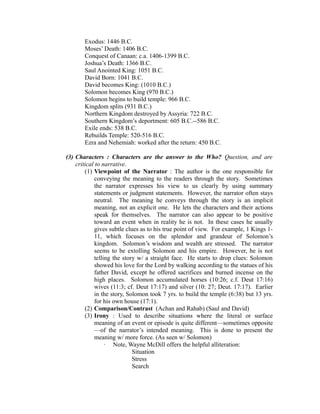
Key dates: 
Abram’s Birth: 2166 B.C. 
Isaac’s Birth: 2066 B.C. 
Jacob’s Birth: 2006 B.C. 
Joseph’s Birth: 1916 B.C. 
Joseph Taken to Egypt: 1899 B.C. 
Joseph’s Death: 1806 B.C. 
Moses’ Birth: 1526 B.C. 
Joshua’s Birth: 1476 B.C.
Exodus: 1446 B.C. 
Moses’ Death: 1406 B.C. 
Conquest of Canaan: c.a. 1406-1399 B.C. 
Joshua’s Death: 1366 B.C. 
Saul Anointed King: 1051 B.C. 
David Born: 1041 B.C. 
David becomes King: (1010 B.C.) 
Solomon becomes King (970 B.C.) 
Solomon begins to build temple: 966 B.C. 
Kingdom splits (931 B.C.) 
Northern Kingdom destroyed by Assyria: 722 B.C. 
Southern Kingdom’s deportment: 605 B.C.--586 B.C. 
Exile ends: 538 B.C. 
Rebuilds Temple: 520-516 B.C. 
Ezra and Nehemiah: worked after the return: 450 B.C. 
(3) Characters : Characters are the answer to the Who? Question, and are 
critical to narrative. 
(1) Viewpoint of the Narrator : The author is the one responsible for 
conveying the meaning to the readers through the story. Sometimes 
the narrator expresses his view to us clearly by using summary 
statements or judgment statements. However, the narrator often stays 
neutral. The meaning he conveys through the story is an implicit 
meaning, not an explicit one. He lets the characters and their actions 
speak for themselves. The narrator can also appear to be positive 
toward an event when in reality he is not. In these cases he usually 
gives subtle clues as to his true point of view. For example, 1 Kings 1- 
11, which focuses on the splendor and grandeur of Solomon’s 
kingdom. Solomon’s wisdom and wealth are stressed. The narrator 
seems to be extolling Solomon and his empire. However, he is not 
telling the story w/ a straight face. He starts to drop clues: Solomon 
showed his love for the Lord by walking according to the statues of his 
father David, except he offered sacrifices and burned incense on the 
high places. Solomon accumulated horses (10:26; c.f. Deut 17:16) 
wives (11:3; cf. Deut 17:17) and silver (10: 27; Deut. 17:17). Earlier 
in the story, Solomon took 7 yrs. to build the temple (6:38) but 13 yrs. 
for his own house (17:1). 
(2) Comparison/Contrast (Achan and Rahab) (Saul and David) 
(3) Irony : Used to describe situations where the literal or surface 
meaning of an event or episode is quite different—sometimes opposite 
—of the narrator’s intended meaning. This is done to present the 
meaning w/ more force. (As seen w/ Solomon) 
· Note, Wayne McDill offers the helpful alliteration: 
Situation 
Stress 
Search
Solution 
New Situation 
Parable —Essentially, a parable is a pictorial comparison between something 
familiar & known a spiritual truth or reality. The picture is typically functional, 
though realistic. How do we exegete parables? 
Most importantly: “What’s the main point or points?” 
Pay attention to repetition, the reversal of expectations, or changes in voice 
from first to third person. 
The conclusion or main point is typically at the end, & usually centers on the 
nature of the kingdom or the King. 
Context is king, so interpret parables in light of the context of the larger 
surrounding narrative. Don’t treat them as if they were a random 
collection. The parables, by their very nature as self-contained stories, can 
easily be separated from their context and end up saying something that 
seems to fly in the face of the gospel emphasis. If the discipline of 
redaction criticism has taught us anything it is that the biblical documents 
in general, and the Gospels in particular, have been carefully crafted to 
convey a message. 
In the case of the parable in question, we should, in our own thinking, place it 
in the context of the Gospel’s linking of Jesus to the salvation history of 
the Old Testament, and all that such a link implies. The preacher should 
read and reread the several chapters that surround the parable and note 
how impossible it is to deal with it in any other way that as part of the 
message of what Jesus has come to do for us. 
Poetry —One third of the OT (which is more than the whole NT) is poetry. It exists 
by itself (the Psalms), but is also found throughout other genres (e.g. Wisdom & 
Prophecy). How do we exegete poetry? 
The most common feature of Hebrew poetic structure is parallelism in three 
different forms—synonymous (an idea is repeated for emphasis), synthetic 
(one idea builds upon another), & antithetical (one idea is contrasted with 
another). 
Other features include word play, alliteration & alphabetic acrostic, repetition, 
hyperbole, contrast, metonymy (substitution), & synecdoche (the whole 
stands for the part or vice versa). 
It uses metaphor & simile, figurative images, irony, & euphemism 
Key: remember it’s a poem. A literal reading will look different than a 
literal reading of narrative 
Wisdom —Wisdom literature is about skill at living in God’s world & in light 
of God’s character. Wisdom is the fruit of the fear of the Lord, which 
means being correctly oriented toward God & the creation he’s made, 
including other people. It speaks of what is generally true, but it also 
addresses what appear to be the exceptions to that general truth. How do 
we exegete wisdom literature?
We need to recognize that wisdom literature comes to us in multiple forms, or 
sub-genres. 
Drama (Job, SOS) 
Sayings (Prov 9-31) 
Autobiographical confession & admonition (Ecc, Prov 1-8) 
Whatever the form, the key in interpretation is to read it in context & 
according to its stated purpose. 
Job intends to address the problem of unjust suffering 
Ecclesiastes intends to realistically address the point of life. 
The Proverbs intends to engender the fear of God & then show that 
fear (or lack of it) demonstrates itself in all sorts of contexts. It is 
emphatically not law code. 
Song of Solomon is a celebration of human love in marriage that 
points beyond itself to God’s love for his people. 
Prophecy -Contains both narrative & poetry, but what sets them apart as their own 
genre is the presence of the prophetic oracle: Thus says the Lord. The prophets 
arrive on the biblical scene as attorneys for the prosecution, arguing God’s case in 
a covenant lawsuit against Israel for breaking the covenant. But not only do they 
make the case, they prophetically warn of the judgment to come (calling for 
repentance) & prophetically proclaim the salvation to come (calling for faith). 
How do we exegete prophecy? 
The basic feature—and problem-of interpretation is the promise-fulfillment 
dynamic. This is what divides interpreters. When, where, and how a 
prophecy is fulfilled helps us understand its meaning. 
One important aspect of prophecy is the prophetic foreshortening of events. 
The prophets see the mountains on the distant horizon as a single, two-dimensional 
line. Once we actually get there in history & travel into those 
mountains, we discover that there are multiple ranges broad distances 
apart. This means that most, if not all, prophecies have multiple horizons 
of fulfillment. 
A common feature of prophecy is to use the language & images of the past in 
order to describe the future. Creation, garden of Eden imagery, the flood, 
Sodom & Gomorrah, & the exodus are all used to describe future events. 
These provide a theological understanding of what’s happening, not 
necessarily a literal understanding. 
Quite a bit of prophecy is not predictive, but descriptive (typological). For 
example, the NT understands that much of King David’s life anticipates 
the Messiah. 
As always, context is king. In the case of prophecy, the shape of the story of 
the Bible as a whole is crucial. Revelation is progressive, & in the 
revelation of Jesus Christ, we’ve been given both the main point & the end 
of the story. This means that we have an advantage over OT readers. We 
work from the story of the whole Bible back to the prophecy, not the other 
way around. As 1 Pet 1:10-13 asserts, the gospel gives us clearer vision 
than even the OT prophets had. Therefore the NT determines the ultimate
meaning of OT prophecy, not the other way around.] 
Epistles-- To generalize, the Gospels tell the story of Jesus’ life and the Epistles 
interpret it. The apostles self-consciously understood themselves to be the 
recipients of & the fulfillment of the OT promises in light of what Christ had 
done. Therefore the primary “context” of NT epistles is the OT. How do we 
exegete epistles? 
Preaching the Epistles in View of Their Occasional Nature— More than 
the Gospels, Acts, or the Book of Revelation, the Epistles are singularly 
aimed at a particular church, churches, or individuals, and in each case 
they address specific situations or problems. 
The occasional nature of the Epistles means that they are not to be 
preached in the same way that one would read & preach universal 
maxims, which are based on what unifies people in their common 
human experience and written to a broad, largely unknown 
audience. As a result of their occasional nature, preaching the 
Epistles thus demands that one understand & expound the letter 
against its own historical backdrop in order to make sense of the 
letter itself and to make sense of it for the congregation. 
Practically this means that in ascertaining the particular point of a 
passage, the preacher must be careful to interpret it against the 
backdrop to which it was written, in order to ascertain not only its 
meaning, but its significance as well. For in the Epistles, it is the 
application of the author’s theology to a concrete situation which 
provides the clue to the larger theological import of the text. 
The more one understands the letter’s historical context, the 
more the meaning and significance of the letter become 
clear, and vice versa. 
Preaching the Epistles in view of their occasional nature thus 
requires that one ask, first, what is being said in a given 
passage, understood in its literary context. Having 
ascertained as well as possible the content and flow of the 
argument, the interpreter must then go on to ask why it was 
said, and why it was said this particular way, given its 
historical context. 
Preaching the Epistles in View of Their Discursive Structure-- This is the 
second aspect which makes preaching the Epistles distinct. Unlike the 
other biblical genres, in which there are periodic discursive sections, the 
epistles are characterized by their propositional argumentation. This 
means that the flow of the argument of the Epistles is established by a 
series of interrelated assertions in which the various statements are related 
to one another logically. 
Preaching the Epistles in View of Their Main Points— The main point of
the text is that one assertion which may be restated ways in various ways 
throughout the passage, which is supported by all of the other propositions 
in the paragraph, and which itself supports no other proposition in the 
passage. One is ready to preach from the Epistles when one can state 
explicitly what the main point of the text is, and how it is supported 
throughout the text. 
Preaching the Epistles in View of Their Imperative Exhortations- -The 
danger in preaching the Epistles is that the imperatives of the text will 
be separated from the indicative theological statements upon which they 
are inseparably based, or from the fulfillment of the promises to which 
they inevitably lead. When this occurs, the gospel of God’s grace is 
perverted either into a demand for a life lived out before God on the basis 
of human achievement on the one hand (legalism), or into the kind of 
“easy believism” which fails to recognize that the growing life of 
obedience which inextricably flows from trusting in God’s promises in 
the power of the Spirit is the evidence of genuine conversion on the 
other hand (license). 
Thus, in preaching in the Epistles, the imperatives of the text must always be 
grounded in their indicative substantiation. {Confirmaton: additional 
proof that something that was believed (some fact ) is correct.} 
Preaching the Epistles in View of Their Whole-- Preaching from the 
epistles demands of the preacher that the message of the document be 
taken as a whole even if only a selection of texts, or just one verse, is to 
be expounded. It is no good to say that we dealt with the justification 
element three weeks ago & now we are following Paul into the 
imperatives & injunctions for Christian living. Paul wasn’t anticipating a 
three week gap between his exposition of the gospel & his defining of the 
implications of the gospel in our lives. Nor was he anticipating that some 
people would not be present for the reading of the whole epistle and would 
hear part of its message out of context. 
Apocalyptic —The point & purpose of apocalyptic literature is to give God’s people 
hope in the midst of present sufferings based on god’s certain victory over their 
enemies, both now & in the future. To do that, apocalyptic draws heavily on the 
images of the past, as well as other stylized imagery. The point is to review the 
sweep of history & show it’s culmination in the victory of God’s kingdom. How 
do we exegete apocalyptic? 
Two main examples in the Bible are Daniel & Revelation. But neither is 
merely apocalyptic. Daniel is prophetic literature & Revelation is a 
prophetic epistle. 
Literary context is important. Biblical apocalyptic draws specifically on 
biblical images from the OT (Babylon, plagues), as well as “stock” images 
from the wider genre (the horn, celestial bodies, etc).
Apocalyptic provides a schematization of history, but that scheme isn’t 
necessarily chronological. For example, each series of seven plagues in 
Revelation (seals, trumpets, bowls) ends with the end of the world. And 
yet, it would be easy to read the series as sequential. So how many times 
does the world end? In fact, there is a pattern in these series. 
History is recapitulated from different perspectives, leading to the climax of 
the last two chapters. 
Without going into a detailed treatment of the various approaches to 
interpreting Revelation, the main point is clear. God’s people can endure 
present suffering because of their confidence that God wins. And they 
know he wins, not because of prophetic revelation, but because of what 
Christ has already accomplished in the past, through his death & 
resurrection. 
(1) Determine the structure of a passage. Thought is always structured or it is 
nonsensical. In discerning the structure of a passage, we are able to follow the flow 
of the author’s logic and come to understanding. Some structures are set by 
convention (such as letters) or chronology (narratives). Others provide insight 
through creative arrangement, using such features as parallelism, etc. One of the 
most important questions to keep asking the text is “What has prominence”? What 
has the author emphasized by repetition, placement, or some other device? 
(2) Determine the syntax of the passage . If analysis of structure deals w/ the general 
flow of the thought in a passage, syntax is concerned with the flow of thought in 
detail and how individual clauses, phrases, and words relate to each other. With 
narrative texts, the overall syntax may be rather straightforward and obvious. With 
more discursive material, often the syntax is quite complex (cf. Eph 1:3-14). 
(3) Determine the significance of individual words or constructions (Semantics). 
Discerning how specific words convey meaning is crucial, but exegesis is more than 
word studies (word studies are often misleading). Words have a conventional range of 
meaning, ways we expect them to be used. These meanings (dictionary definitions) 
make up the semantic field of a word. Any aspect of a word’s meaning—but not all of 
it—may be used in a given context, or the word may be even used creatively in a new 
way. Word studies show the etymology of words, which may be of no significance 
for later meaning. Such work must be done, but it does not show what a word means 
in a given context. One can only know that meaning by discerning the relations in 
the context. 
(4) Do Discourse Analysis. Discourse (units of connected text that are longer than 
paragraphs) Analysis: the study of the way authors put sentences and paragraphs 
together to make their points. It discovers the main ideas of sections of the Bible and 
explores the way authors present and defend their ideas through logic and rhetoric. 
Each discourse, deals w/ a single topic or story & has a beginning, development, & 
conclusion. Naturally, we relate to the larger discourses
A. To begin this analysis, it helps to begin w/ a least a rough idea of the theme 
before the detailed analysis begins. Authors scatter clues that help readers 
find their main topics and ideas (Doriani, 79ff): 
(a) Location—The main idea frequently occurs in the first or the last 
sentence of a section or a paragraph, or in both. 
(b) Restatement—Authors restate, repeat, or return to the main concept. 
For example, James says 3 times in 2:14-26, in slightly different 
ways, that faith w/o works is dead. 
(c) Direct Address—Authors may address their hearers before stating a 
main idea. (Hear O Israel, Brothers, Dear Friends) 
(d) Introductory Formulas—To draw attention to their chief points, 
authors introduce them w/ phrases like “I— want you to know,” or “I 
write these things to you so that.” 
(e) Concluding Formulas—Look for words that summarize a discussion, 
such as therefore, thus, etc. 
B. General Principles for Discourse Analysis (Doriani, 81ff) 
(a) Look for words & phrases that explicitly connect one idea to another 
(and, but, if, then, therefore, for, so that, because, so, since, when, 
just as, in order that, while, after, etc). 
(b) Look for implicit and understated connections 
(c) To capture the message of the Bible, we need to study paragraphs 
more than single words or even sentences. That is, discourse 
analysis works on paragraphs, whole chapters, and even larger 
segments of books, as well as sentences. 
(d) Consider Galatians: Paul wrote it to a group of churches he founded 
in the Roman province of Galatia during his 1 
st 
missionary journey. 
They were healthy until the Judaizers visited them preaching the law 
and the claim that Paul’s gospel lacked authority since he was not 
really an apostle and so Paul responded w/ a letter. It is possible to 
see the whole book as a simple discourse where Paul defends his 
apostleship and asserts the true purpose of the law. 
(5) Transcend the historical-critical approach with a theological-canonical 
interpretation. 
Biblical exegesis does not deal merely with individual books but also with the relations 
between them (biblical theology) in coming to understand the parts in light of the 
whole. 
This step requires both the epochal horizon & the canonical horizon. That is, a 
purely analytical/synchronic approach (which concentrates on the details of 
revelation at any given point like a series of still shots—Historical Horizon) 
very easily leads to the fragmentation of the Bible that distorts the unity 
created by the divine Author (Goldsworthy, PTWB, 26).
For instance, in 1980 a book appeared where in the opening pages the 
author argues that the best way to refute Christians who argue that 
Jesus is prophesied in the OT is to use grammatical-historical exegesis 
to determine what the text really means. The author argues that this 
procedure will conclusively demonstrate that the original meaning of 
the OT prophecies have nothing to do with Jesus. Ironically, the 
advocates the same exegetical method espoused in most Christian 
books on biblical interpretation (S. Levine, You Take Jesus, I’ll Take 
God: How to Refute Christian Missionaries). 
Textual Horizon: The word ‘text’ refers to the biblical text. At the textual level the 
interpreter 
seeks to understand the grammatical , historical, and cultural aspects of a particular 
passage of 
Scripture. Horizon simply refers to a particular level of interpretation. The textual 
horizon is the 
first level of interpretation 
The Epochal Horizon The word ‘epochal’ refers to a partic nular time (epoch) in God’s 
redemptive plan. The interpreter seeks to discern where they are in the biblical 
storyline as they read the Bible in order to better understand God and his promises. 
There are many epochal divisions(e.g., Old Testament, New Testament, pre-fall, post-fall, 
patriarchs, exile, post-exile, gospels, post-resurrection, formation of the church, etc). The 
epochal horizon is the second level of interpretation. 
Canonical Horizon: The word ‘canon’ refers to the whole of Scripture. Therefore, the 
word canonical means understanding the individual texts and epochs in light of the entire 
story of Scripture; specifically with respect to God’s promises fulfilled in Christ Jesus. 
The canonical horizon is the final and most important step of interpretation. 
Biblical Theology Glossary 
http://theroadtoemmaus.files.wordpress.com/2007/07/word-definitions-for-biblical-theology.pdf 
42. It is at this stage one considers the diachronic unity of revelation (synthetic 
approach). This is where the details begin to be put together in sequence to 
form the big picture (Goldsworthy, PWB, 27). 
43. As Clowney points out, God did not accomplish his purpose all at once. He did 
not send Christ to be born of Eve by the gates of Eden, nor did he inscribe the 
whole Bible on the tablets of stone given to Moses at Sinai. Rather, God showed 
himself to be the Lord of times and seasons (Acts 1:7). The story of God’s 
saving work is framed in epochs, in periods of history that God determines by 
his word of promise (Clowney, The Unfolding Mystery, 12). 
44. This horizon is concerned with how the revelation of God was understood in its 
time, and what the total picture is that was built up over the whole historical 
process.
45. Where is the passage in redemptive-history and what is the significance of that? 
The most obvious epochal division is b/t the OT and the NT. But there are also 
other divisions. 
46. Knowing this horizon is important for at least two reasons: first, if this question 
were asked each time, it could clear up the tendency to convert a significant event 
in redemptive history into an unhistorical pattern for us today (e.g. theocracy in 
Israel, temple worship, tongues in Acts, etc). 
47. Secondly, by knowing this horizon, one can come to terms with the “gospel” hope 
in the particular text in question. 
48. With regard to the OT, the “gospel” thrust of narrative texts comes either from 
the covenant promises (epoch A) or the prophetic eschatology (epoch B), both of 
which provide the biblical-theological context for the texts (Goldsworthy). 
49. It is impossible to understand the theological function of a given text unless we 
understand how it relates to the promises of the covenant or to the eschatology 
of the prophets. 
50. When we consider the nature of prophetic eschatology in more detail, we see that 
it is like a second-stage rocket propelling the Abrahamic covenant towards its 
fulfillment. 
51. Helpful in this regard is Vaughan Roberts’ work in dividing the Bible into eight 
main epochs in God’s plan to restore his kingdom. 
(1) The pattern of the kingdom —The Garden of Eden. Here we see the world as 
God designed it to be. God’s people, Adam and Eve, live in God’s place, the 
garden, under his rule as they submit to his word. 
(2) The perished kingdom —The results of Adam and Eve’s defiance against God 
are disastrous. They are no longer God’s people (they turn away from him and he 
turns away from them). They are no longer in God’s place (they are exiled from 
the garden). They are no longer under God’s rule, so they do not enjoy his 
blessing. Instead they face his curse and judgment. 
Actually, the entire discourse and canonical position of Genesis 3-11 is 
highly significant b/c these chapters offer not one but 4 pictures of 
humankind’s rebellion against and alienation from God (as Genesis 
1-2 in its portrayal of the pattern of the kingdom describes the 
relationship b/t God, man and creation was it was originally · 
intended to be), which communicate the need for God’s gracious 
intervention. The 4 pictures: 
i. Genesis is the classic account of the fall. From a literary point of view, 
it can be seen as “the prototypical biblical tragedy,” with the basic 
temptation to “be like God” (Gen 3:5). This rebellion results in 
alienation from God. 
ii. Genesis 4 illustrates how alienation from God produces alienation from 
one’s fellow human beings. 
iii.The longer story of the flood (Gen 6-8) represents God’s righteous 
judgment on a creation that has become corrupt. 
iv. The story of the Tower of Babel (Gen 11) is a variant on the theme of 
human beings wishing themselves in the place of God, with disastrous
results. Humankind is a fragmented into different languages and 
nations; yet among these are the ancestors of Abram through whom 
God will being to work out his plan for the salvation of the human race. 
· In short, these 4 stories speak of the solidarity with which all men 
are bound together in sin. But they also point forward to God’s 
plan of salvation. They prepare the way for the promise of the 
eschatological kingdom. 
(2) The promised kingdom —God, in his grace and mercy, determines to restore 
his kingdom. He calls Abraham and makes some unconditional promises to 
him: through Abraham’s descendents God will re-establish his kingdom. 
Abraham’s seed will be God’s people, living in his land and enjoying God’s 
blessing, and through them all peoples on earth will be blessed. Scobie points 
out that it is highly significant that the account of God’s dealings with Israel 
(beginning with the promised kingdom) is preceded by the account of the 
creation of all things and of the origins and prehistory of humankind as a 
whole. That is, God’s dealings with Israel in the historical order are placed in 
the broader context of God’ concern for all humankind (The Ways of Our God, 
149). 
(3)The partial kingdom —Through the exodus from Egypt, God makes 
Abraham’s descendents his very own people. God gives them his law so that 
they might live under his rule and enjoy his blessing, as Adam and Eve had 
done before sin. The blessing is marked primarily by God’s presence w/ his 
people in the tabernacle. Under Joshua they entered the land and by the time 
of David and Solomon, one sees the highest expression of God’s kingdom 
under the Old Covenant. Israel was God’s people in God’s place, under God’s 
rule. Yet, the promises to Abraham had not been completely fulfilled. The 
problem was sin, which lead to the dismantling of the partial kingdom. 
(4)The prophesied kingdom —The kingdom is split (931B.C) with Israel in the 
north and Judah in the south. Eventually, the Assyrians depopulate the north 
(722 B.C) and the southern kingdom is exiled to Babylon (605-586 B.C). 
During this time, God spoke to the people of Israel and Judah through the 
prophets. The prophets point forward to a time (“in that day”) when God 
would act decisively through his Davidic king (2 Sam 7), to fulfill all his 
promises. The uniqueness of this hope is that it continuously links God’s 
kingship with the Davidic vice-regency. 
As for the eschatological hopes of a people for the kingdom: a remnant 
(Isa 10:20-21); a new exodus (Jer 16:14-15); the servant (Isa 49:5-6; 
52:13-53:12); the inclusion of the nations (Isa 49:6; Isa 60:1-3). As for 
the eschatological hopes of God’s place in the kingdom: a new temple 
(Ezek 40-48); new creation (Isa 65:17-18). As for the eschatological 
hopes of God’s rule: a new covenant (Jer 31:31-33; Ezek 36:26-27; Joel 
2:28-32); new king (2 Sam 7:12-16; Isa 9:6-7; Ps 110:1) 
.
(5)The proximate kingdom — God’s people: embodied in the prophets 
(Zechariah and Haggai), the priest (Joshua); and the king (the governor 
Zerubbabel who is the last heir to David). God’s place: Canaan, penultimately 
Jerusalem, and ultimately the rebuilt temple. God’s rule: through the prophets. 
50 thousand Jews were redeemed out of exile (which is a penultimate antitype 
of the Exodus b/c this time it was exile from sin, which means this fulfillment 
is heightened). This temple rebuilding activity points to the one who will be 
both lord and servant of the temple (and the fulfillment to that which the 
temple points). This is not to say that the rebuilding of the physical temple was 
not crucial, even though God’s intention was to transition from a physical to a 
spiritual temple. It is crucial to remember that the timeline of the history of 
redemption is not the same as the history of revelation. The temporal interval 
b/t Zechariah’s time and the coming of Jesus (520 yrs) is more than the interval 
b/t Zechariah’s time and the kingship of David (450 yrs). Although 
canonically we may feel as if we are on the cusp of the NT era, historically we 
are far from it. 
God restores his people to life in the land and provides priests to sustain this 
community for many yrs. until the arrival of Jesus. The NT reveals the role of 
the temple and its worship in nurturing messianic hope. Thus in Lk 2:21-40 
we meet 2 people in the temple courts who are awaiting the arrival of Christ: 
Simeon and Anna. They are reps. of the remnant community who were 
sustained through the ministry of the temple and priests established in Zech.’s 
time. 
(6)The present kingdom—Mark 1:14 Now after John had been taken into 
custody, Jesus came into Galilee, preaching the gospel of God, 1:15 and 
saying, "The time is fulfilled, and the kingdom of God is at hand; repent and 
believe in the gospel." Gal 4:4 But when the fullness of the time came, God 
sent forth His Son, born of a woman, born under the Law. Eph1:9-10 He 
made known to us the mystery of His will, according to His kind intention 
which He purposed in Him with a view to an administration suitable to the 
fullness of the times, that is, the summing up of all things in Christ, things in 
the heavens and things on the earth. In Him. Christ, though his humiliation 
and exaltation, inaugurates the kingdom. The resurrection proved the success 
of Jesus’ rescue mission on the cross and signal the dawn of the “new 
creation.” 
(7)The proclaimed kingdom —During these “last days,” the redemptive 
kingdom of Christ, inaugurated in his person and work, is extended 
(instrumentally speaking) to the ends of the earth through God’s restored vice-regents/ 
ambassadors, the church. 
(8)The perfected kingdom —Revelation 21-22 describes a fully restored 
kingdom: God’s people, Christians from all nations, in God’s place, the new 
heavens and earth, under God’s rule.
The Canonical Horizon 
Crucial to this horizon is the continuity b/t the promises of God and his fulfillment 
of those promises. This is the essential glue holding the diverse epochs 
together. The promise-fulfillment motif (design) is fundamental and the 
authors write with the knowledge that God has been faithful to his promises 
in times past, and so will be in the future. 
TYPOLOGY: (remember some about typology in BBS 1966 
One important biblical means of presenting promise-fulfillment is through the use 
of typology. 
52. Typology allows for the promises of God to often have two or more 
fulfillment horizons. The many Old and New Testament prophecies about 
the future and their fulfillments accustom us to expect a “gradual” filling 
up of a foretold event. “Prophecy, in the sense that it reveals some part of 
God’s redemptive purpose, is capable of being filled, of a achieving a 
fullness, so that when it is filled full it is fulfilled. If we understand 
prophecy in this sense, we no longer ask the question, ‘Is prophecy 
capable of more than one fulfillment?’ It is capable of more and more 
filling until it is entirely fulfilled” William LaSor, Tyndale Bulletin 29 
(1978): 55. 
For example, the promise to Abraham regarding descendants and a great nation 
was fulfilled in Isaac, later in the nation of Israel, supremely in Jesus (church), 
and ultimately in the new heavens and the new earth (Gen 12; 13; Exod 3; 33; 
Jn 8; Acts 7; Gal 3; Rev 21-22). 
53. Typology rests on the recognition that the way God spoke & acted in the 
OT was preparatory & anticipatory of the definitive word & act of God in 
Christ (Goldsworthy, GCH, 243). 
54. Typology Defined: “The interpretation of earlier events, persons, and 
institutions in biblical history which become proleptic entities, or ‘types,’ 
anticipating later events, persons, and institutions, which are their 
antitypes. It is thus actually a way of looking at history. . . it requires a 
history that is under God’s sovereign control and is proceeding 
according to divine plan.” Duvall’s Definition of Typology: “A biblical 
event, person or institution which serves as an example or 
pattern for other events, persons, or institutions.” 
55. “Typology implies that, just as earlier revelation is ultimately understood 
only in light of later revelation, so the later revelation can only be 
understood in relation to the earlier.” 
56. Goldsworthy: “The essence of typology is the recognition that w/i 
Scripture itself certain events, people, and institutions in biblical history 
bear a particular relationship to later events, people, or institutions. The 
relationship is such that the earlier foreshadows the later, and the later fills 
out or completes the earlier” (Goldsworthy, 77). “It is a way of saying that 
“this is that,” that is, that a later significant event is what an earlier one 
points to (Acts 2:16). (Goldsworthy, 77).
57. “Typology is sometimes written off as just a form of allegory that is thus 
uncontrolled and invalid. . . . There are some similarities in that allegory 
and typology both recognize some kind of correspondences. The 
difference, however, is vital. On the one hand, allegory was a method that 
saw the old events and images as largely unimportant in themselves. The 
real task was to get behind them to the deeper spiritual meaning” which 
was “often quite unrelated to the original historical meaning.” 
(Goldsworthy, 77) 
58. “Typology, on the other hand, recognizes that the original historical 
meaning of the text is theologically related to the later expression that fills 
it out and usually completes it. . . . 
59. Typology helps us to deal w/ questions of how God actually ‘saved’ 
people before the one and only saving event of Jesus Christ was 
revealed. While allegory sees mainly a superficial conceptual relationship 
b/t OT events and the Christian gospel, typology sees the type as part of 
the theological process of revelation that leads to the antitype or 
fulfillment in the gospel. . . . It is theologically bound up w/ the antitype in 
a unity that means that those who related to the type are similarly related 
to the antitype” (Goldsworthy, 77) 
60. Typology : The idea that persons (e.g., Moses), events (e.g., the exodus) & 
institutions (e.g., the temple) can—in the plan of God—prefigure a later 
stage in that plan & provide the conceptuality necessary for understanding 
the divine intent (e.g., the coming of Christ to be the new Moses, to effect 
the new exodus & to be the new temple)—G Cole, He Who Gives life, P. 
289. 
But identifying types is somewhat risky, unless one has controls: 
(1) To be identified as a type, an event’s redemptive-historical function must be known, 
and must show an organic relationship to the later redemptive history that it 
foreshadows. 
(2) The nature of the type must lie in the main message of the material, not in some 
incidental detail (Goldsworthy adds: “If the person or event is so incidental to the 
main narrative that it is difficult to perceive the theological significance of the event 
in its own epoch, there is probably not a lot to be gained (McCartney, 1-3, pg. 167) 
(3) The antitype (fulfillment) must be greater than the type (an intensification) 
(4) Some evidence that the type is ordained by God to foreshadow the antitype must be 
present (John Currid, in Goldworthy, pg. 111) 
(5) It must be grounded in history; both type and antitype must be actual historical 
events, persons, or institutions (John Currid in Goldsworthy, 111) 
(6) Typology deals not w/ words, but historical events (David Baker in Goldsworthy, 
111) 
(7) It identifies real correspondences b/t historical events (David Baker in Goldsworthy, 
111) 
The Use of the OT in the NT
Methods characteristic of the NT’s Use of the OT (McCartney, 68-9; see E.E. Ellis, “How 
the NT Uses the Old”) 
(1) Generally, the NT cites from the LXX, but not exclusively. Thus, we have warrant 
for using translations. 
(2) Often introductory formulas are used, such as “it is written” or “the Holy Spirit says,” 
indicating that (OT) Scripture confirms NT revelation, & that the OT is therefore 
prophetic in character. Thus the NT indicates a high regard for Scripture as God’s 
speech. 
(3) The NT treats OT events are genuine history, constitutive for the present state of 
affairs. Thus, the NT warrants a grammatical-historical method. 
(4) History is understood as being under divine control; it is going somewhere. God 
accomplishes salvation in history. Thus, we look for a redemptive-historical 
meaning. 
(5) OT history is understood as indicating where it was going. Thus, the OT should be 
understood typologically & eschatologically. 
(6) As in the OT, man is regarded both individually & corporately (the body of Christ) in 
the NT. Thus, we apply a covenantal understanding. 
(7) Christ fulfills the role & character of the corporate entities, mankind (Adam) & Israel 
(see Heb 2:8; Rom 5:12ff; 1 Cor 15:27), and thus those who are united to him become 
the true Israel (Gal 6:16; Phil 3:3) & the perfect man (Eph 4:13; Col 1:28). Thus 
Scripture is interpreted Christocentrically & ecclesiologically. 
(8) Scripture is regarded as a mystery that is now revealed e the expectation, and only 
one event or series of events is in view. The NT fulfillment of Dan 7:13-14 is an 
example of such a fulfillment (cf. Luke 21:27, 22:69; Mark 14:62) 
· “Typological-Prophetic”: This means that pattern and promise are present, 
so that a short-term event pictures and mirrors a long-term fulfillment. 2 
Types of typological-prophetic fulfillment: 
A. Typological-Prophetic fulfillment. In these texts, there is a short-term 
historical referent, and yet the promise’s initial fulfillment is such that an 
expectation remains that more of the pattern needs “filling up” to be 
completely fulfilled. An example is Isaiah 65-66 where the descriptions of 
victory over the enemies are so idyllically portrayed as a new creation that the 
expectation arose of a greater, ultimate fulfillment. Perhaps the best 
Christological example of this category is the Servant figure of Isaiah (42:1-9; 
49:1-13; 50:4-11; 52:13-53:12). In Is 49:3, this figure is explicitly called 
“Israel.” Even Jewish hope saw a future for a glorified servant figure, viewed 
in terms of the nation; but they did not know how to integrate his suffering 
into the image or how to deal with the individuality of the expression in Is 52- 
53. 
B. “Typological-prophetic” fulfillment. Here the pattern is not anticipated by 
the language, but is seen once the decisive pattern occurs. Only then does the 
connection of design become clear. It works differently from the previous
category in that the pattern is not anticipated or looked for until the fulfillment 
makes the working out of a pattern apparent. The outstanding illustration here 
is the use of Hos 11:1 in Matt 2:15 (“out of Egypt I have called my Son”). 
In Hosea, when the book is read historically-exegetically, this remark apples 
to Israel as she was called out in the Exodus. Everything about the passage 
looks to the past, although it is important to observe that Hos 11:8-11 does not 
give up hope for Israel. So the review of history is set in a larger context that 
does remind the nation that God’s care for her will not end, despite her past 
unfaithfulness in the face of his faithfulness. Jesus’ reenactment of the 
nation’s Exodus experience invokes the pattern of God working for his people 
again so that the connection can be made when one recognizes that the 
Exodus itself is a pattern image for salvation and that Jesus as King (and as 
the one in the many) is able to represent (and thus recapitulate) the nation’s 
history. 
‘Authoritative Illustration”. The term is reflected in the example of the Exodus 
used by Paul in 1 Cor 10:1-13, where Paul explicitly spoke of Exodus events 
as ‘types’. Here the goal is not a prophetic use but one of exhortation. The 
Corinthians are to learn from a past example about behavior to avoid, namely, 
associating closely with activities related to idolatry. The use simply points to 
the lessons of the past. 
Ideas or Summaries: Here no specific text is cited, but the teaching of the 
OT is summarized and stated in fresh words in a proposition. An example is 
Luke 24:44-47, where the OT is said to teach about Christ’s death and 
resurrection and the promise that repentance shall be preached to all the 
nations in Jesus’ name. No texts are cited explicitly, but one senses that all 
texts Luke uses in Luke-Acts stand behind the remark. 
Preaching Christ Organically from the Old Testament when there is no type 
(Insights from Keller and Several Others) 
“Most of the preaching I hear and too much that I do attempts to build upon 
‘common human experience.’ ‘Are you depressed? Everyone has been 
depressed at one time or another. Down in the dumps. There is a story of 
someone who was down in the dumps, in the pit, so to speak. His name was 
Joseph. He was thrown into a pit. . . .’” The consequence of such preaching is 
lamentable: “Unable to preach Christ and him crucified, we preach humanity 
and it improved” (William Willimon “Peculiar Speech: Preaching to the 
Baptized”). 
The temptation to be human centered in preaching is always a tendency, given 
the preacher’s desire to be relevant to his listener. One of the prevalent 
tendencies in preaching the Old Testament is biographical preaching (or 
character preaching). This approach tends to look for attitudes and actions of 
biblical characters which the hearers should imitate or avoid. 
Example: A sermon on Genesis 22 called “Parents and children must
worship the Lord together.” The sermon has four points: 
i. Father and son walked together 
ii. Father and son talked together 
iii. Father and son worked together 
iv. Father and son sacrificed 
together. 
On the contrary, very passage in the Old Testament has its burden, echoed in 
various ways, the message: “God is acting! God is coming! God is faithful to 
his covenant promises! His mercy indeed endures forever! God will not cast 
off His chosen people! God is preparing salvation!” (Herbert Mayer in 
Concordia Theological Monthly 1964) 
(1) Theme Resolution—There are at least 20 inter-canonical (D.A. Carson) or 
longitudinal (Greidanus) themes that move across the biblical corpus. These 
themes have thickening plots that like all good stories have a dramatic tension within 
the theme that as the plot continues on appears irreconcilable. Only in Christ are the 
themes reconciled and fulfilled (as Alex Motyer states: the answer in the back of the 
book). 
Example: 
a. Kingdom and King. God created Adam and Eve as the image of God (which 
in the Ancient Near East is kingly language) to rule has his viceregents. The 
essence of God’s kingdom expression on earth is God’s people (his 
viceregents) in God’s place (where his revelatory presence dwells) under 
God’s rule (faith and obedience). Adam and Eve had the task of extending the 
boundaries of Eden (where his kingdom was expressed) in order to fill the 
earth (extending the kingdom borders). As the narrative proceeds through 
Abraham and Israel, it is apparent that the depth of their brokenness and 
enslavement reveals no mere human king is enough. Only God becoming a 
man would a big enough king to deal with the brokenness and fulfill 
humankind’s calling as the supreme viceregent who extends God’s glory 
presence to the end of the earth, which is the eschatological hope (Num 14:21; 
Hab 2:14; Ps 72:19; Ps 85:9; Isa 11:9). Therefore, everyone in leadership in 
Israel points to the fact they don’t have the true king. 
b. Grace and Law (Influenced by Ray Dillard)—How the holiness and the love 
of God can relate in a covenant. From the giving of the Law to Chronicles, 
there is a tension that propels the narrative. God is absolutely holy and 
merciful but how can he be both? Israel’s history is caught in a tension. We 
are caught in a dilemma between whether God’s covenant is conditional or 
unconditional. How can God be holy and still remain faithful to the covenant? 
That’s the question. What you have in many place is that God seems to be 
saying his covenant is conditional. You must obey or I will cut you off. Other 
places he seems to indicate his covenant is unconditional. No matter what “I 
will be your God.” The biggest mistake interpreters make is the tendency to 
try to resolve the tension by basically saying that you will not be happy unless 
you obey. The promises of the Old Testament are conditional. Unless you
live right your children won’t turn out right. This is a legalistic way to read 
the Old Testament. 
There is also a liberal way to read the OT as well. The covenant is completely 
unconditional. God loves everybody and no matter how you live God is going 
to accept you. However, the tension will not be resolve in the OT and so the 
question of how God can still be holy and faithful to his people can’t be 
answered either by the conservative or liberal approach. The answer is in the 
cross where the law of God and the love of God are fulfilled. So is the 
covenant conditional or unconditional? Yes. Its only yes if Christ can and 
fulfilled the covenant so that we can be saved by grace through faith. The 
cross means we have a God far more holy than any legalists dare to believe in 
because you have to be absolutely perfect; yet, we also have a God far more 
loving than any liberal dare to believe in because he had to die and liberals 
don’t believe he had to die to accept us. 
(2) Law Completion—Paul says that the Law is meant to lead us to Christ. Gal 3:24: 
Therefore the Law has become our tutor to lead us to Christ, so that we may be 
justified by faith. 1 Tim 1:5-11 is another crucial passage where Paul makes it clear 
that the purpose of the Law is to drive sinners to Christ. In 1 Tim 1:5, Paul’s focus is 
on what the Gospel does to people in their hearts, faith, and conscience. This gives 
rise to love. But if we turn it around and start using the law as the direct means of 
sanctification we fall under the criticism of 1 Tim 1:7. Thus, when we take an ethical 
principle or a command/law, if we really consider it, it is apparent that it is impossible 
to keep it. If you don’t preach Christo-centrically, you will always pull your punches 
in preaching ethical themes. You might say “you can do it” but in reality you aren’t 
really listening to the law. In Christ-centered preaching we realize Christ will have to 
fulfill the ethical principles for us or we are dead. That means you can always get to 
Christ from any ethical principle. Jesus is the only way to take the law seriously. The 
law demands that we be perfectly holy so we aren’t really listening to the law if we 
think we can obey it. The law is saying, in effect, that you can never fulfill me. You 
need a savior. 
Example: the Tithe in the Old Testament. What about the NT? As recipients of 
the New Covenant and the full revelation of God in Jesus Christ (Heb 1:1), are we 
more indebted to the grace of God or less indebted?—more. Therefore, is it 
possible that God would expect us to give less than 10%?—No. We should be 
giving sacrificially but we will never do it. But look at the generosity of Christ (2 
Cor 8:9). 
Unless you emphasize the saving work of Christ (in whatever ethical principle, 
including giving), you will never have your heart melted enough by faith to 
even begin to fulfill this ethical principle. 
It is lack of faith in Christ’s finished work that precludes us from ever 
beginning to fulfill/obey the ethical principle.
We might call this mediated application. Jesus is the fulfiller of the ethical 
principle both objectively and subjectively in that the former gives us the basis 
to be right with God and seeing him fulfill the principle gives us the desire to 
obey it our own lives. 
Example: Don’t commit sexual immorality. We can’t explain what “thou shall not 
commit adultery” is until we look at the jealous love Jesus showed us in his holy 
life and the cross. His jealous love defines sexual fidelity so that unless we have 
his jealous love we will never be able to practice jealous love. 
Unless we know what he has done “for us” we will never have the moral 
fortitude to be as sexually faithful as we ought. Jesus is, therefore, not just the 
example of sexual fidelity, he is the fulfiller “for us” both objectively and 
subjectively. 
(3) Story Insertion—Here you take any particular narrative and put it into the bigger 
story. 
A. All the individual stories in the Bible point to 
Jesus especially as you insert them into the 
bigger story: the history of redemption . (Comment: 
maybe I am getting this point) 
61. For instance, Jesus is the true and better Adam who passed the temptation 
test and whose obedience is imputed to us. 
62. He is the true and better Abel, though innocently slain, has blood now that 
cries out not for our condemnation but for our acquittal. 
63. He is the true Abraham who answered the call of God to leave home to a 
foreign land. 
64. He is the true Isaac who is the true Son of laughter offered up for us all. 
65. He is the true Jacob who wrestled with God, took the blow of justice we 
deserve, so we, like Jacob, only receive the wounds of grace just to wake 
us up. 
66. He is the true Joseph who sits at the right hand of the king, mediates 
salvation for his brothers and the nations, and who forgives those who 
betrayed him using his power to save them. 
67. He is the true and better Moses who stands in the gap between the people 
and the Lord and mediates a new covenant. 
68. He is the true rock of Moses, who is struck with the hand of God’s justice 
and gives us water in the desert. 
69. He is the true Joshua who is the general of the Lord’s army. 
70. He is the true and better Job who is the only real innocent sufferer who 
intercedes from his friends. 
71. He is the true and better Samson whose death accomplishes salvation for 
his people and judgment on his enemies. 
72. He is the true and better David whose head crushing victory becomes his 
people’s victory though they never lifted a stone to accomplish victory for
themselves. 
73. He is the true Ecclesiastes teacher because he leads us through despair to 
help us fear God. 
74. He is the true Jonah who went into the belly of the whale so people could 
be saved. 
75. Now I need to continue through the rest of the Old Testament..... 
B. But this is not just true of individuals. Its also true of corporate story lines. 
He is the leader of a community so its not just the story of individuals but the 
story of the “people of God.” That is, the story of the people of God is a type of 
Christ. All the major events in the formation of the people of God point us to 
Christ. Jesus is the one through whom all people are created thus the creation 
story itself points to the new creation in Christ. Jesus went through temptation in 
the wilderness; thus is the Israel who went through the forty days in the 
wilderness. Therefore, the story of the fall and the wilderness testing points to the 
active obedience of Christ. The Exodus points to the true Exodus Jesus led for his 
people (Luke 9:31). Whereas Moses only delivered them out of economic and 
political bondage, Jesus brings us out of the bondage of sin and death itself. The 
Exile points to Jesus being taken outside the gate to suffer. He went into exile at 
Mr. Calvary. Jesus is the true Israel. He is the one faithful to the covenant. He is 
the remnant of one. God will save a remnant of faithful people. This is one of the 
ways the conditional/unconditional aspects of the covenant are satisfied in Christ. 
He earns all of the conditions of the covenant for all who believe in him. When 
Hosea talks about the exodus he calls all of Israel “my son” but when Matthew 
quotes this verse (2:15; c.f. Hos 11:1), he is talking about Jesus. 
Note: The New Testament, in fact, moves back and forth between the individual and 
corporate types that Jesus fulfilled. 
For instance, it is not an arbitrary detail that the New Testament story commences with a 
genealogy. 
76. Interestingly, Matthew’s genealogy begins with the Greek expression biblos 
geneseōs, which can be translated “the book of genesis or genealogy.” This 
expression appears in two places in the LXX: Genesis 2:4, which is the book of 
the genesis of the heaven and earth; and Genesis 5:1-2, which is the book of the 
genesis or genealogy of Adam. In other words, Matthew is elucidating the record 
of the new age, the new creation, procured by the new Adam. 
77. Furthermore, Matthew’s genealogy recapitulates (summarize and states the 
main points of) the entire history of Israel, a genealogy that surmises (supposes 
that something is true) with “Jesus Christ the son of David” (Matt 1:1-17); thus 
immediately placing kingship on his schema. That is, by tracing Jesus’ lineage all 
the way to Abraham, Matthew seems to be alluding that it is through this “seed” 
of Abraham that the restoration of God’s kingdom on earth will be procured. 
Matthew wants his Jewish audience to know that this one is the “anointed” 
Davidic king; the faithful servant, the one who will rule as God’s representative 
human king on earth.
Stephen Motyer argues that Jesus here is portrayed as the embodiment of Israel as they 
should be. Matthew communicates this idea first by demonstrating that Jesus’ birth 
brings light to the Gentiles: “his star” is seen rising in the east by the Magi (2:2), 
which means his being “a light for the nations,” and the crushing of the enemy’s head 
(Num 24:17). Jesus’ fulfilling the goal of Israel is also seen by Matthew’s applying 
the Exodus verse Hosea 11:1 to Jesus (Matt 2:15), and then by conveying the 
narrative in a way that makes Jesus re-enact Israel’s history: the Exodus from Egypt 
(2:19-20), the crossing of the Red Sea (3:13-17), and the temptations in the desert 
(4:1-11). 
The forty days and nights of Jesus temptation in the wilderness echo Israel’s forty years 
in the wilderness (Matt 4:2). Moreover, each response by Jesus to Satan corresponds 
to Moses’ response to Israel’s failures in the wilderness (Matt 4:4, Deut 8:3; Matt 4:7, 
Deut 6:16; 4:10, Deut 6:13). “Jesus, as true Israel, is the micro-Israel who has 
replaced the macro-national Israel.” 
After Jesus’ encounter with Satan, he immediately goes to Capernaum near the borders of 
Zebulun and Naphtali, where his mission is depicted as the Davidic king in Isaiah 9 
who will bring light to the nations (Matt 4:12-17; c.f. Is 9:1-2). Undoubtedly, 
Matthew is clear that this Jesus is the remnant, the “true Israel,” the hope of the 
nations (c.f. Matt 5:13-16; 8:11; 12:18-21; 13:47; 21:42-44; 24:14; 25:32-34; 28:19). 
Everything Jesus is “in his perfect humanity, he is on our behalf as our representative 
and substitute.” 
After the Sermon on the Mount, which is depicted as a new Torah by a new 
Servant of God who transcends Moses (Matt 5:21-22, 27-28, 31-32, 38-39, 43-44), 
Jesus heals a leper, a Gentile centurion’s servant (Matt 8:1-13), and many others who 
were sick or afflicted by demons (Matt 8:14-16). Notably, Matthew links Jesus’ 
actions with that of the suffering servant of Isaiah (Matt 8:17; c.f. Is 53:5-6). 
Matthew also depicts Jesus as the new Davidic shepherd who has come to restore 
the lost sheep of Israel (Matt 9:36; 10:6; c.f. Ezek 34:23); which also seems to be an 
allusion to the servant whose mission was to restore Jacob (Is 49:5). 
As Matthew continues, three titles are given to Jesus that underscores his role: Son of 
Man (Matt 16:27; 17:22, note here where “Son of Man” is used instead of “Servant”, 
which seems to combine Daniel 7 and Isaiah 53), Servant (Matt 20:25-29), and Son 
of David (Matt 15:32; 20:30, 31). 
Luke’s narrative also presents a royal Davidic Christology: Jesus’ legal father 
was “of the house of David” (1:27); Gabriel adapts the Davidic covenant text (2 Sam 
7:1-17) to describe Jesus to Mary; 
78. Zechariah praises God for having “raised up a horn of salvation for us in the 
house of his servant David” (1:69; c.f. Ps 132:17);
79. Jesus birthplace is called the “City of David” (2:4, 11); Joseph’s Davidic lineage 
is repeated for emphasis (2:4); the first witnesses to the birth of the of the Son of 
David are “shepherds” (2:8-20) possibly alluding to Micah 5:1-3; 
80. The Spirit descends on and anoints Jesus at his baptism (Luke 3:22), words 
reminiscent of Psalm 2:7, the royal coronation hymn of the Davidic kings and 
Isaiah 42:1-4, which was an appointment to viceregency; 
81. Luke traces Jesus’ genealogy through David (3:23-28); Jesus compares himself 
and his disciples to David and his men (Luke 6:1-5); at the transfiguration, the 
divine voice repeats the royal coronation hymn (Ps 2:7): “This is my Son, my 
chosen one”(9:35); 
82. Jesus’ statement “All things have been delivered to me by my Father” recalls the 
father-son relationship of God to the Davidic monarch (Ps 2:7-8; 8:4-8; 72:8; 
89;25-27); upon entry to Jericho, Jesus is declared twice by a blind man as “Son 
of David” (18:35-43); 
83. Jesus’ triumphal entry (19:28-48) corresponds to Zechariah 9:9-10, which in turn 
uses images of Solomon’s coronation procession in order to describe the coming 
eschatological king, most certainly a Davidide (c.f. Zech 12:7-13:1); 
84. at the Last Supper, Jesus speaks of a “new covenant,” echoing Jeremiah 31:31 and 
the broader context (Jer 30-33), which foresees a new covenant uniting Israel and 
Judah under the Davidic monarchy; 
85. Luke 22:29-30 suggests several Davidic images: the bestowing of a kingdom by 
covenant (Ps 89:3-4); eating at the king’s table (2 Sam 9:9-13); and ruling from 
thrones over Israel (Ps 122:3-5); and Davidic titles are used of Jesus (with 
contempt but accurately): “King of the Jews” (23:37-38; c.f. 2 Sam 2:11) and 
“Chosen One” (23:35; c.f. Ps 89:3-4). 
86. Not only is Luke consistent with Matthew in portraying Jesus as the faithful “Son 
of David,” Luke also portrays him as the faithful Israelite (3:22). 
87. The Spirit’s descending on Jesus is notable because the prophetic expectation was 
of an outpouring of the Spirit upon Israel (Is 44:2-3; Ezek 36:25-27). “Here, at 
last, is a Son with whom God is truly pleased.” 
88. Like David upon his anointing by Samuel, Jesus, as the people of God’s 
representative, marches into battle against the enemy of God (Luke 4:1-13; Matt 
4:1-13). Luke is inferring, along with both Matthew and Mark (Mark 1:12-14), 
that Jesus is the long awaited son of David, the māšîah, who embodies Israel’s 
eschatological hopes and calling. 
89. Finally, Luke depicts Jesus as the new Adam. Whereas Matthew and Mark place 
the temptations immediately after the baptism of Jesus, Luke intriguingly places 
the genealogy of Jesus between the baptism and the temptations. Moreover, 
unlike Matthew who begins with Abraham and works down toward Jesus, Luke 
begins with Jesus and works back to Adam, with which it ends: “the son of Adam, 
the son of God” (3:38). Luke is emphasizing that Jesus is the Last Adam. In 
other words, the wilderness temptations are a rerun of the Garden. The new 
Adam is doing what the first Adam did not, taking dominion and subduing the 
serpent. 
90. This notion can be supported by reflecting on Satan’s last temptation, which 
involves a quotation from Psalm 91:11-12: “they will lift you up on their hands,
so that you will not strike your foot against a stone.” Beal helpfully points out 
that the next verse in the Psalm states: “You will tread upon the lion and the 
cobra; you will trample the great lion and the serpent” (91:13). The allusion is 
clear: Psalm 91:13 is Genesis 3:15 language. Jesus as the new Adam, the seed of 
the woman, was coming to crush the head of the serpent and his refusal to given 
into Satan’s temptations was the first step, but also a proleptic step, of victory that 
includes the vanquishing of the enemy and the restoration of God’s kingdom on 
earth the imago Dei, as his viceregents. 
C. Its not just individual types and corporate types that point us to Christ. Sometimes 
there is no type at all but it’s the way the story works itself, which signals the way God 
saves us in Christ. That is, the narrative pattern of life through death or triumph through 
weakness where God turns things upside down as he works through the weak or apparent 
defeat, that points us to Christ. 
Example: in the narrative of Naaman (2 Kgs 5), every person with power and 
status is clueless about salvation. On the other hand, every servant, ever marginal 
person knows what’s going on. This is a major pattern in the Bible. It’s the grace 
story line. For instance, the law is given only after the redemption out of Exodus. 
God saves them then gives them the 10 commandments. They are saved in order 
to obey-not vice-versa. 
It’s the narrative pattern of the Gospel. The Gospel reverses the values of the 
world. 
(4) Symbol Fulfillment—A sampling of eight Old Testament themes 
fulfilled in Christ proves this contention. 
91. First, Jesus exceeds and accomplishes in full the ministries of Israel’s leaders. 
92. Second, Jesus is the completion of old covenant institutions. 
93. Third, Christ is the supreme purpose of creation as he is the one in whom, 
through whom and for whom all things were created (Col 1:15-20; c.f. Eph 1:9- 
11). 
94. Fourth, Christ is the terminus (a final point) of the Old Testament covenants 
and laws (Luke 1:46-55, 68-79, 2:29-32; Matt 5:17; Rom 10:4). 
95. Fifth, Christ is the fulfillment of prophecy (Matt 5:17). 
96. Sixth, Christ is the meaning of the believer’s existence (Col 3:4; Phil 1:21). 
97. Seventh, the coming of the Spirit on the (1) Day of Pentecost is a 
Christological event, and its pneumatological (Holy Spirit) import should be 
seen in that light. 
98. Eighth and finally, Christ himself is the very significance of his second coming. 
(2) NT Scripture Using OT Scripture— Related to the aforementioned one, if one is 
looking at an OT verse/passage that is referred to in the NT, it is important to see how 
the NT writer is using the passage; this will often indicate how the OT passage may 
be Christologically focused and ecclesiologically applied. For instance, when we 
read Gen 2:2-3, we learn that God’s finishing of the creative work established the
divine pattern that led to the hallowing of the 7 
th 
day. But we might not see the 
connection to the Israelites’ typological entry into the Promised Land and the final 
entry into the eternal rest of the true people of God, if it were not for Hebrews 4. 
Hebrews gives us a better understanding of the meaning of God’s rest on the 7 
th 
day 
in Genesis (McCarntey, “Let the Reader Understand” 200). 
The Gospel Coaltion Asks About Cautions for Christ-Centered OT Teaching 
Tim Keller: 
1. Don’t “get to Christ” so soon in the sermon that you don’t unfold the 
meaning and application of the text to the original hearers. If you “jump to 
Christ” too soon that often means you inspire people but you don’t give them 
concrete application for how they are supposed to live. 
2. Don’t “get to Christ” so late in the sermon that he seems like an add-on, a mere 
devotional appendix. If you wait too long to get to Christ listeners won’t see how 
Jesus’ work is crucial if the listeners are going to obey or heed the text. 
3. Don’t get to Christ artificially. This is a big subject of course, but I believe two 
of the best ways are (a) by identifying in your text one of the many inner-canonical 
themes that all climax in Christ (Don Carson’s language), and (b) 
identifying in your text some “Fallen Condition Focus,” some lack in humanity 
that only Christ can fill (Bryan Chapell’s language). 
Don Carson: 
1. Study constantly how the NT writers use the OT. That will give you insight into how 
you should move from the Old to the New. 
2. Make good use of available tools, not least the Commentary on the New 
Testament Use of the Old Testament. For even when you are preaching from the 
OT, the indexes in the volume will alert you to any use of your OT passage within 
the NT. Commentary on the New Testament Use of the Old Testament by G. K. 
Beale and D. A. Carson (Nov 1, 2007) - Kindle eBook $59.99 Print Price 
$34.49 Kindle Edition 
3. Ensure that this sort of study does not overlook or set aside complementary 
disciplines—e.g., understanding what genre of literature you are dealing with and 
how it makes its appeals, where this literature falls along the axis of redemptive 
history, and so forth. 
David Murray, professor of Old Testament and practical theology at Puritan 
Reformed Theological Seminary in Grand Rapids, Michigan:
99. I’m massively encouraged by the church’s renewed interest in preaching Christ 
from the Old Testament, and especially by the increased willingness to see how 
Old Testament people, places, events, etc., point forward to Christ. This “types 
and trajectories” (or redemptive-historical) hermeneutic has many strengths. 
100. However, I’m a bit concerned that an overuse of this tool can give the 
impression that Christ is merely the end of redemptive history rather than an 
active participant throughout. 
101. Puritans such as Jonathan Edwards were masters of balance here. In his 
History of the Work of Redemption, Edwards shows Christ as not only the end of 
redemptive history, but actively and savingly involved from the first chapter to the 
last. He did not view Old Testament people, events, etc., as only stepping-stones 
to Christ; he saw Christ in the stepping-stones themselves. He did not see the need 
to relate everything to “the big picture”; he found the “big picture” even in the 
“small pictures.” 
I’d also like to encourage preachers and teachers to be clear and consistent on the 
question: “How were Old Testament believers saved?” The most common options seem 
to be: 
1. They were saved by obeying the law. 
2. They were saved by offering sacrifices. 
3. They were saved by a general faith in God. 
4. They were saved by faith in the Messiah. 
Unless we consistently answer #4, we end up portraying heaven as not only populated by 
lovers of Christ, but also by legalists, ritualists, and mere theists who never knew Christ 
until they got there. Turning back again in order to go forwards, may I recommend 
Calvin’s Institutes Book 2 (chapters 9-11) to help remove some of the blur that often 
surrounds this question. 
102. In Genesis, Jesus is the seed of the Woman. 
103. In Exodus, He is the Passover Lamb. 
104. In Leviticus, He is the Priest, the Altar and the Lamb of Sacrifice. 
105. In Numbers, He is the pillar of cloud by day, and the pillar of fire by night. 
106. In Deuteronomy, Jesus is the Prophet like Moses. 
107. In Joshua, Jesus is the Captain of our salvation. 
108. In Judges, He is our Judge and Law-Giver. 
109. In Ruth, He is our Kinsman and Redeemer.
110. In 1 & 2 Samuel, He is our trusted Prophet. 
111. In Kings & Chronicles, He is our reigning King. 
112. In Ezra, He is the rebuilder of the broken-down walls of human life. 
113. In Nehemiah, Jesus is our Restorer. 
114. In Esther, He is our Advocate. 
115. In Job, Jesus is our Ever-Living Redeemer. 
116. In Psalms, He is our Shepherd. 
117. In Proverbs, He is our Wisdom. 
118. In Ecclesiastes, He is our hope of resurrection. 
119. In the Song of Songs, He is our loving Bridegroom. 
120. In Isaiah, Jesus is the suffering Servant. 
121. In Jeremiah, He is the righteous wronged. 
122. In Lamentations, He is our weeping prophet. 
123. In Ezekiel, He is the one with the right to rule. 
124. In Daniel, Jesus is the fourth man in the fiery furnace. 
125. In Hosea, Jesus is the faithful husband forever married to the sinner. 
126. In Joel, He is the one who baptises with the Holy Spirit, fire. 
127. In Amos, He is the restorer of Justice. 
128. In Obadiah, He is mighty to save. 
129. In Jonah, He is our great foreign missionary. 
130. In Micah, Jesus is the feet of one who brings good news. 
131. In Nahum, Jesus is our stronghold in the day of trouble. 
132. In Habakkuk, He is God my Saviour.
133. In Zephaniah, He is the King of Israel. 
134. In Haggai, He is the signet ring. 
135. In Zecharish, He is our humble King riding on a colt. 
136. In Malachi, Jesus is the son of righteousness. 
137. In Matthew, Jesus is God-with-us. 
138. In Mark, He is the Son of God. 
139. In Luke, He is the Son of Mary, feeling what you feel. 
140. In John, He is the Bread of Life. 
141. In Acts, Jesus is the Savior of the world. 
142. In Romans, Jesus is the righteousness of God. 
143. In 1 Corinthians, He is the Resurrection. 
144. In 2 Corinthians, He is the God of all comfort. 
145. In Galatians, He is your liberty, He sets you free. 
146. In Ephesians, Jesus is the Head of the Church. 
147. In Philippians, Jesus is your joy. 
148. In Colossians, He is your completeness. 
149. In 1 & 2 Thessalonians, He is your hope. 
150. In 1 Timothy, He is your faith. 
151. In 2 Timothy, Jesus is your stability. 
152. In Titus, Jesus is Truth. 
153. In Philemon, He is your benefactor. 
154. In Hebrews, He is your perfection.
155. In James, He is the power behind your faith. 
156. In 1 Peter, He is your example. 
157. In 2 Peter, Jesus is your purity. 
158. In 1 John, Jesus is your life. 
159. In 2 John, He is your pattern. 
160. In 3 John, He is your motivation. 
161. In Jude, He is the foundation of your faith. 
162. In Revelation, Jesus is your coming King. 
He is the First and the Last, the Beginning and the End. 
He is the Keeper of Creation and the Creator of all. 
He is the Architect of the Universe and the Manager of all Time. 
He always Was, He always Is and He always Will Be, 
Unmoved, Unchanged, Undefeated and never undone. 
He was bruised and brought healing, 
He was pierced and eased pain, 
He was persecuted and brought freedom, 
He was dead and brought life. 
He is risen and brings power, 
He reigns and brings peace. 
The world can’t understand Him, 
Armies can’t defeat Him, 
Schools can’t explain Him
And the leaders can’t ignore Him. 
Herod couldn’t kill Him, 
The Pharisees couldn’t confuse Him, 
The people couldn’t hold Him, 
Nero couldn’t crush Him, 
Hitler couldn’t find Him, 
The New Age can’t replace Him 
And Oprah can’t explain Him away. 
He is Life, Love, Longevity and Law. 
He is goodness, kindness, gentleness and love. 
He is holy, righteous, mighty, powerful, good. 
His Way is Right, His Words Eternal. 
His rules unchanging, and His mind is on me. 
He is my Redeemer, His is my Savior, He is my God, He is my Priest, 
He is my Joy, He is my Comfort, He is my Law, and He rules my life. 
Maybe you’re like me. I’m not a great memorizer like the young boy in the following 
video, but you could use this anonymous piece as a helpful outline to meditate on Jesus 
as you read the Bible through. Allow God to teach you more about Himself in each book 
of the Bible. 
=============================================================== 
========== 
According to Sidney Griedanus, author of Preaching Christ from the Old Testament, 
there are seven ways of preaching Christ from the Old Testament, including: 
1. Redemptive-historical progression 
2. Promise-fulfillment 
3. Typology
4. Analogy 
5. Longitudinal themes 
6. New Testament reference 
7. Contrast 
In his seminar taught with Edmund Clowney, “Preaching Christ in a Postmodern World,” 
Tim Keller presents four ways of getting to Christ from the Old Testament: 
1. Theme resolution (i.e. image of God, kingdom, Sabbath rest, judgment, and 
justice themes that only resolve in Christ) 
2. Law reception (focusing on the impossibility of keeping the law apart from 
Christ) 
3. Story completion (not just stories of individual people but also the story of the 
people of God, i.e. life through death, triumph through weakness) 
4. Symbol fulfillment (i.e. Passover, bronze snake, prophets, priests, kings, 
sacrifices, temple, cleanliness laws) 
In his paper “Preaching Christ from the Old Testament,” Sinclair Ferguson writes 
that while we want to develop an instinct to preach Christ, it can be broken down 
into four subordinate principles: 
1. The relationship between promise and fulfillment 
2. The relationship between type and antitype 
3. The relationship between the covenant and Christ 
4. Proleptic participation and subsequent realization 
All of these have been profoundly helpful to me, and I’m sure to many others who seek to 
present Christ from all the Scriptures. But I also knew that while these lists may be 
preacher-friendly, they would likely not be lay-person friendly, especially for those for 
whom the idea of seeing Christ in the Old Testament is a new concept. I needed a lay-friendly 
list of ways that the Old Testament points to and prepares us for Christ. Here’s 
the list I came up with, and I welcome your suggestions for refining and improving 
upon it: 
1. A problem that only Christ can solve (the curse, our inability to keep the law, 
our alienation from God) 
2. A promise only Christ can fulfill (blessing, presence of God with us) 
3. A need that only Christ can meet (salvation from judgment, life beyond death) 
4. A pattern or theme that only comes to resolution in Christ (kingdom, rest) 
5. A story that only comes to its conclusion through Christ (the people of God, 
creation/fall/redemption/consummation) 
6. A person who prefigures an aspect of who Christ will be or what he will do by 
analogy and/or contrast (Joseph, Moses, David) 
7. An event or symbol that pictures an aspect of who Christ will be or what he will 
do (ark, exodus, sacrifices) 
8. A revelation of the pre-incarnate Christ (wrestling with Jacob, commander of
the Lord’s army) 
The reality is that we need biblical theology not only preached from the pulpit on 
Sundays, but also taught and embraced in the men’s and women’s Bible studies that meet 
throughout the week. So we have to learn not only how to present Christ from all the 
Scriptures, but also how to help our listeners to develop an instinct for seeing Christ 
throughout the whole of the Bible as they read and study on their own. 
Contemporary Horizon--Bridging between the world 
of the Bible and the contemporary world. 
163. Our goal in preaching should be to produce (instrumentally 
speaking), true piety that results in “willing service” (Calvin, Institutes,1.2.1) 
and “willing reverence” (Institutes,1.2.2). Indeed, unless our people “establish 
their complete happiness in him, they will never give themselves truly and 
sincerely to him” (Institutes,1.2.1). 
164. This piety “is not so terrifed by the awareness of his judgment as to wish 
to withdraw, even if some way of escape were open. But it embraces him no less 
as punisher of the wicked than as benefactor of the pious. For the pious mind 
realizes that the punishment of the impious and wicked and the reward of life 
eternal for the righteous equally pertain to God’s glory. Besides, this mind 
restrains itself from sinning, not out of dread of punishment alone; but, because it 
loves and revers God . . . it worships and adores him as Lord, Even if there were 
no hell, it would still shudder at offending him alone” (Institutes,1.2.2). 
165. In short, “true piety” only comes through knowing “the only true God” 
through Jesus Christ (John 17:3). Therefore, it stands to reason that our preaching 
must center upon this goal: knowing God through Jesus Christ. 
166. As Peter Jensen argues: “The knowledge of God depends upon the gospel 
of Jesus Christ” (“The Revelation of God” p. 31). 
167. Indeed: “The supreme revelation of God’s purpose in history is . . . the 
coming of Jesus Christ into the world: It is the purpose and will of the Creator that 
give history its pattern, and the intrusion of the eternal in the fullness of the time 
was nothing else than the assertion, in the history, of the eternal purpose of God” 
(Hoekema, The Bible and the Future , 28-29.) 
168. This truth is affirmed by the Apostle who asserts that Jesus is the “alpha 
and omega” (Rev 1:8; 21:6; 22:13), the “beginning and the end” (22:13), and the 
“first and the last” (1:17; 2:8; 22:13). 
169. To be sure, the person & work of Christ “do not merely crown God’s work 
of revelation and redemption as a sort of splendid ornament or even as the best 
example of God’s activity in the world. The person and work of Christ constitute 
the defining chapter of the whole narrative, the hinge of history, the basis upon 
which everything else in creation makes sense” (Stackhouse, Jr., Evangelical 
Landscapes: Facing Critical Issues of the Day. P. 166). 
170. Therefore, “If you preach a sermon that would be acceptable to the 
members of a Jewish synagogue or to a Unitarian congregation, there is 
something radically wrong with it. Preaching, when it is truly Christian, is
distinctive. And what makes it distinctive is the all-pervading presence of a 
saving and sanctifying Christ. Jesus Christ must be at the heart of every sermon 
you preach (Adams). 
171. “The Scriptures are full of moral instruction and ethical exhortation, but 
the ground and motivation of all is found in the mercy of Jesus Christ. We are to 
preach all the riches of Scripture, but unless the center holds, all the bits and 
pieces of our pulpit counseling, of our thundering at social sins, of our positive or 
negative thinking—all fly off into the Sunday morning air. . . . Let others develop 
the pulpit fads of the passing seasons. Specialize in preaching Jesus” (Clowney). 
172. “Christ-centered preaching rightly understood does not seek to discover 
where Christ is mentioned in every text but to disclose where every text stands 
in relation to Christ. . . . The goal of the preacher is not to find novel ways of 
identifying Christ in every text but to show how each text manifests God’s grace 
in order to prepare and enable his people to embrace the hope provided by 
Christ” (Chappell). 
173. “Jesus said that all Scripture is about him [Luke 24:27; John 5:39, 46]. 
This does not mean that every phrase, punctuation mark, or verse directly 
reveals Christ but rather that all passages in their context disclose his nature 
and/or necessity” (Chappell) 
174. Gospel Conduct: Phil 1:27: “Only let your conduct be worthy of the gospel 
of Christ. ”The gospel informs behavior. We need to study our Bible w/ a special 
eye to connecting the gospel w/ behavior. 1 Cor 6 Paul appeals to them to flee 
sexual immorality. Notice that he wants the gospel to function as it should. He 
reminds them of the gospel (1 Cor 6:20). W/o connecting it to the gospel, it will 
fail. Eph 4:32-5:2. Eph 5:25; 2 Cor 8:9. A big part of your job in preaching is to 
make the connections. This defines effectiveness in preaching. Gal 2:14; Phil 2:1- 
11 
The Importance of Application in Exposition 
a. An expository sermon is not merely an exegetical exercise. “The nature of 
the sermon is to apply the word of God to the wills of the hearers with a 
view to moving them to want to conform to that word. Exegesis is an 
important aspect of the preparation of any sermon, but exegesis is not the 
sermon. Exegesis seeks to understand what the text means in its own 
immediate context. A sermon must move from the meaning of the text to the 
legitimate application of that meaning to our contemporary context in the 
light of the gospel” (Goldsworthy, PWB, 121-2) 
b. Ramesh Richard: By the end of the sermon the audience must have the 
answers to three important questions: (1) What did the preacher speak about? 
(Explanation); (2) So what difference does or should it make? (argumentation) 
(3) Now what do I do w/ God’s claims in this sermon (application) 
c. Yet as Haddon Robinson asserts, more heresy is spread in the preacher’s 
attempt to apply Scripture than in his presentation of Scripture’s meaning. 
Preachers want to be faithful to the Scriptures, and going through seminary, 
they have learned exegesis. But they may not have learned how to make the
journey from the biblical text to the modern world. . . . Sometimes we apply 
the text in ways that might make the biblical writer say, ‘Wait a minute, that a 
wrong use of what I said.’ This is the heresy of a good truth applied in a 
wrong way’ (Robinson, “The Heresy of Application” Leadership Journal vol 
18, no. 4, Fall 1997, pg. 21). 
d. The most dangerous misapplication is one that promotes some form of 
synergism in the sanctification process. 
e. That is, no matter how true, moral, or practical your application is, it is sub- 
Christian if it fails to present Jesus Christ & our union with him as the means 
of justification & sanctification. 
f. There are two ways to focus on Christ: the “fallen condition focus (FCF) 
(what aspect of the fallen condition of mankind does this passage address) and 
the “redemptive-historical focus” (God has a gracious, sovereign plan to 
redeem his people; “What aspect of the divine plan does this passage reveal?) 
g. The FCF is a more experiential path; the RHF is the more theological 
perspective. 
General Principles for Application using the FCF and the RHF (Doriani, 170ff): 
(1) Every passage in the Bible presents Christ both as the remedy for human fallenness 
and as the end point of God’s plan of salvation. 
(2) Every passage of the Bible touches on some aspect of the fallen human condition and 
presents part of God’s remedy in Christ. 
(3) Since Jesus himself says the entire Bible speaks of him, then every Christian lesson 
should, in its own way, present Jesus as Redeemer and Lord. 
Comparing and Contrasting the FCF and the RHF: 
Theological Emphasis: FCF (Doctrine of man: the Fall and Sin); RHF (Doctrine 
of God: grace and sovereignty) 
Initial appeal: FCF (The experience of human need); RHF (The unfolding of the 
divine plan) 
Special Insight: FCF (Every text shows how Christ meets a universal human); 
RHF (Every text manifests a need for a redeemer, the work of the Redeemer, 
or the consequences of redemption). 
Final Goal: FCF (To present Christ from every text); RHF (To present Christ from 
every text) 
Applicational Questions using the FCF and the RHF: 
RHF: Centers on Christ by observing how each text of the Bible presents some aspect of 
his person and work. It examines the unfolding of God’s saving plan in space and 
time. Within that plan, every prophecy, every event, every law, and every song plays 
its role. The essential insight of the RHF is that Jesus is the focal point of Scripture. 
Lk 24:44 Then he said to them, "These are my words that I spoke to you while I 
was still with you, that everything written about me in the Law of Moses and the 
Prophets and the Psalms must be fulfilled."45 Then he opened their minds to
understand the Scriptures, 46 and said to them, "Thus it is written, that the Christ 
should suffer and on the third day rise from the dead,47 and that repentance and 
forgiveness of sins should be proclaimed in his name to all nations, beginning from 
Jerusalem. 
Unique salvation-historical—Does the main point address a text that thrusts forward 
the unfolding plot of redemption in history? 
FCF: Dwells on the person and work of Christ by observing the many ways in 
which people need him. “Fallen condition” means any aspect of human 
nature that requires God’s grace. FCF is the mutual human condition that 
contemporary believers share with those to or about whom the text was 
written that requires the grace of the passage for God’s people to glorify and 
enjoy him” (Chapell, 48-50). It is too easy to preach on a doctrinal topic or 
an exegetical insight w/o considering the spiritual burden of the text for real 
people in the daily struggles of life. . . . The greater intellectual and spiritual 
task is to discern the human concern that caused the Holy Spirit to inspire this 
aspect of Scripture so that God would be properly glorified by His people. 
Consideration of a passage’s purpose ultimately forces us to ask, ‘Why are 
these concerns addressed? What caused this account, these facts, or the 
recording of these ideas? What was the intent of the author? For what 
purpose did the Holy Spirit include these words in Scripture? . . . We do not 
have to guess whether there is a purpose for a particular text” (2 Tim 3:16- 
17). . . Since God designed the Bible to complete us for the purposes of his 
glory, the necessary implication is that in some sense we are incomplete. We 
lack the equipment required for every good work. Our lack of wholeness is a 
consequence of the fallen condition in which we live. . . . The corrupted state 
of our world and our beings cries for God’s aid. He responds with the truths 
of Scriptrue and gives us hope by focusing his grace on a facet of our fallen 
condition in every portion of his Word. No text was written merely for those 
in the past; God intends for each passage to give us the ‘endurance and the 
encouragement’ we need today [c.f. 1 Cor 10:13]. Preaching that is true to 
these purposes (1) focuses on the fallen condition that necessitated the writing 
of the passage & (2) uses the text’s features to explain how the Holy Spirit 
address that concern then & now. The FCF present in every text 
demonstrates God’s refusal to leave his frail and sinful children without guide 
or defense in a world atagonistic to their spiritual well-being. However, an 
FCF not only provides the human context needed for a passage’s explanation 
but also indicates the biblical solutions must be be divine and not merely 
human. . . . Ultimately, a sermon is about how a text says we are to respond 
biblically to the FCF as it is experienced in our lave—identifying the gracious 
means that God provides for us to deal with the human brokenness that 
deprives us of the full experience and expression of his glory” (Chapell, 50- 
51). 
Motivation in Application: 
“The consequence of making personal gain our primary motivation for obedience
is that our seemingly moral activities will become a transgression of the first 
commandment to have no other gods before God. The motivations that spring 
from full apprehension of God’s grace do not change the rules but do change the 
reasons for our obedience. Grace encourages and enables us to serve God out of 
love for him and for his glory. Grace makes true obedience possible because a 
thankful response to unearned merit is motivated more by love for God than by 
love for self. Guilt drives sinners to the cross, but grace must lead us from there 
or we cannot serve God. . . . The application of an expository sermon . . . is not 
complete until the pastor has disclosed the grace in the text that rightly motivates 
obedience. Listeners who fully apprehend the grace of God toward them will also 
discover their greatest strength for obedience, which is a greater love for God that 
produces a desire to please him—a desire that also provides their greatest 
satisfaction when it is fulfilled” [Chapell, 220]. 
Recognizing Nonredemptive Messages (Chapell, 288—295) 
“Messages that are not Christ-centered inevitably become human-centered . . . 
These preachers do not deliberately exclude Christ’s ministry from their own, but 
by consistently preaching messages on the order of “Five Steps to a Better 
Marriage,” “How to Make God Answer Your Prayer,” they present godliness 
entirely as a product of human endeavor. . . . No message is more damaging to 
true faith. By making human efforts alone the measure and the cause of 
godliness, evangelicals fall victim to the twin assaults of theological legalism and 
liberalism—which despite their perceived opposition are actually identical in 
making one’s relationship with God dependent on human goodness” (Chapell, 
289). 
The Deadly Be’s [Chapell, 289] 
(1) “Be Like” Messages “focuses the attention of listeners on the accomplishments of a 
particular biblical character. “A difficulty with much biographical preaching . . . is 
that it typically fails to honor the care that the Bible also takes to tarnish almost 
every patriarch or saint within its pages. Without blushing, the Bible honestly 
prevents the human frailties of its most significant characters so that we will not 
expect to fin, within fallen humanity, any whose model behavior merits divine 
acceptance. . . . To be faithful to Scripture, we must not shy away from passages that 
encourage us to use people in the Bible as examples [1 Cor 11:1; Heb 11:39]. Still, 
before we preach on such passages, we must be sure to identify the source of the 
character quality that Scripture commends. Since the source of any holy trait is 
God’s grace, we must echo the biblical caution, “Where then is boasting?” 
“The commendable aspect of biblical characters function in Scripture like aspects 
of God’s law. They are necessary to know, proper to follow, and are the 
instruments of God’s blessing in our lives. But these same righteous standards 
become spiritually deadly when they are perceived or honored as the basis of 
God’s acceptance” [Chapell, 289-90].
(2) “Be Good” Messages “When the focus of a sermon becomes a moralistic ‘Don’t 
smoke or chew or go with those who do’ [or even a more sophisticated ‘Renew your 
heart by doing what God commands’], listeners will most likely assume that they can 
secure or renew their relationship with God through proper behaviors. Even when 
the behaviors advocated are reasonable, biblical, and correct, a sermon that does not 
move from expounding standards of obedience to explaining the source, motives, and 
results of obedience places persons’ hopes in their actions. . . . Preaching of this sort 
sound biblical because the Bible can be quoted at length to support the exhortations. 
As it runs its course, however, such preaching destroys all Christian distinctives. . . . 
ringing clearly through such preaching is the implied promise, ‘Obey God because he 
will love you if you do and 0our obedience not only undermines the work of God in 
sanctification but ultimately casts doubt on the nature of God and thus makes 
salvation itself suspect when we honestly assess our imperfections. . . . Yet the truth of 
the gospel is that sanctification is based on what Jesus did eternally. Because Jesus 
died and rose again on our behalf, we are cleansed of our sin and reconciled to God. 
‘There is now no condemnation for those who are in Christ Jesus’ [Rom 8:1], and we 
progressively live for God in the confidence that we are in union with his life and 
power solely on the basis of what he has fully and finally accomplished on the cross 
[Gal 2:20]. Our experience of his blessings, pleasure, and nearness still relies on 
our obedience, but the reality of our relationship is not and never was based on our 
goodness. God has fully and completely applied to us the merits of Christ’s 
righteousness, even though we are striving to live in conformity with his law in loving 
response to his redeeming work [Rom 5:15-21; 1 Cor 6:1; Eph 5:25-27]. . . . 
Preaching applications should readily and vigorously exhort obedience to God’s 
commands, but such exhortations should be based primarily on responding in love to 
God’s grace, not on trying to gain or maintain it [Rom 12:1].” [Chapell, 291-2] 
(3) “Be Disciplined” Messages “Close kin to ‘be good’ messages are sermons that exhort 
believers to improve their relationship with God through more diligent use of the 
means of grace. . . . disciplines that allegedly lift them to higher planes of divine 
approval. . . . Spiritual disciplines enable those made righteous by Christ’s work to 
breathe more deeply the resources that God freely and lovingly provides for the 
wisdom, joy, and strength of Christian living. Through disciplines, we inhale more 
deeply the air God provides for the Christian race, but such disciplines do not 
produce or maintain the oxygen of God’s love. Preachers should encourage more 
prayer, stewardship, study, and fellowship not to manufacture blessing but so that 
believers can experience more fully the benefits of union with Christ that God freely 
offers. With this perspective, disciplines become regular refreshment for those who 
hunger and thirst for ever deeper fellowship with the God they love [Ps 19:10]. The 
same disciplines, however, will become distasteful duty of bitter pride for those who 
think that their devotion keeps them on the good side of a God whose measure of love 
is determined by the grade of their performance” [Chapell, 293]. “It is important to 
stress that these are means of grace, not means to grace” [Chapell, 324]. 
In short: “Be messages are not wrong in themselves; they are wrong by themselves” 
[Chapell, 294].
“In Christ-centered preaching, the rules of Christian obedience to not change; the 
reasons do. Believers are exhorted to serve God in response to his sure mercy rather 
than in payment for his conditional favor” (Chapell, 312). 
Sanctification by faith in Christ: From Doctrine (God’s Deeds in Christ) to 
Doxology (Our Thankful Worship) to Duties (Our Reasonable Service) 
175. At the end of “The Abolition of Man,” C.S. Lewis demonstrates how the 
major religions agree on moral absolutes. Christians find that in today’s 
culture wars, they often are on the same side with believing Jews, Muslims, 
and Hindus. In other words, when a Christian preacher resorts to mere 
moralistic oriented sermons he is joining exponents of other philosophies. But 
when we ask, “Why be moral?” the other systems say, “In order to find God,” 
but Christianity must say, “Because God has found you.” That is, instead of 
obeying to make God indebted to them, Christians obey because they are 
indebted to him 
176. Unfortunately, in much contemporary preaching application equals law— 
to do lists—rather than employing the text to “absolve sinners of their guilt & 
rescript them in their new roles as those who have been transferred from the 
covenantal headship of Adam to Christ” (Horton, CC, 145). 
177. J. Gresham Machen: “What I need first of all is not exhortation, but a 
gospel, not directions for saving myself but knowledge of how God has saved 
me” (“Christian Faith in the Modern World” pg. 37). 
178. Of course, Machen’s charge was directed at liberalism but could clearly be 
addressed to contemporary evangelicals. 
179. As Horton warns, much of our preaching today is law without gospel, 
“exhortation without news, instructions, without an announcement, deeds 
without creeds, with the accent on “What Would Jesus Do?” rather than 
“What Has Jesus Done?” (CC, 106) 
180. Likewise, Goldsworthy there is the lamentable tendency to separate ethics 
and godly living from their roots in the gospel. By way of example, a preacher 
may describe the qualities of a mature church, which is like describing what a 
healthy oak tree should be. The implication is that the church needs to be 
more diligent in producing these marks of maturity. However, what is missing 
is the exposition of the gospel. The primary focus is law, not gospel. That is, 
describing a healthy tree doesn’t help us grow one, it only enable us to 
recognize one if we should see it. To grow one, we need to know about the 
soil, the seed, and the forces that actually produce the tree. Without the 
gospel all the exhortations of the New Testament become not just law, but 
legalistic (PWB, 20). 
181. “The Law is natural to man. . . . But the gospel is a supernatural doctrine 
which our nature would never have been able to approve without a special 
grace of God” (Theodore Beza).· 
182. Its important to remember that we are not justified by faith in Christ’s 
work but we are also sanctified by faith in Christ’s work. 
183. But what we often do is that we say to sinners that you have to trust in
Christ, not your works and he will save you but when talking to Christians 
about how to grow we basically exhort them to try really hard to live like 
Jesus. 
184. Yet, “even as a Christian, my faith will actually be weakened 
when it is assumed that I already know the gospel and now I just 
need a steady diet of instructions. I will naturally revert to my 
moralistic impulse and conclude either that I am fully surrendered 
or that I cannot pull this off and might as well stop trying. When 
my conscience leads me to despair, the exhortation to try harder 
will only deepen either my self-righteousness or my spiritual 
depression. In other words, it will draw me away from my location 
in Christ and gradually bring me back to that place where I am 
turned in on myself” (Horton, CC 130). 
185. “Our intuition tells us that if we just hear more practical 
preaching (that is, moving exhortations to follow Jesus), we will 
improve. When this becomes the main diet, however, we do not find 
ourselves improving. We neither mourn nor dance. But bring me 
into the chamber of a holy God, where I am completely undone, and 
tell me about what God has done in Christ to save me; tell me about 
the marvelous indicatives of the gospel—God’s surprising 
interventions of salvation on the stage of history despite human 
rebellion—and the flickering candle of faith is inflamed, giving light 
to others” (Horton, CC 132). 
186. “As counterintuitive as it may seem, being grounded in the gospel of 
Christ relieves stress in deeper places than we even knew we had inside 
ourselves, and I have witnessed countless examples of young people liberated 
from boredom induced addictions and sinful patterns by becoming captivated 
with God’s amazing grace in his Son. Nobody had to tell them that drugs 
were wrong; they knew that. And all the banal lectures on self-esteem and 
emotional summer camp calls to ‘surrender all’ only made them more 
cynical.” (Horton, CC, 145) 
187. Gnuine sanctification, let it be repeated, stands or falls with its continued 
orientation towards justification and the remission of sins” (Berkouwer) 
188. The bond between sanctification and faith alone in justification has been 
neglected and the impression created today is that sanctification is the 
humanly operated successor to the work of justification. 
189. A failure to live a holy life is not just due to a lack of commitment but 
most fundamentally that I am not living in faith that Christ is my Savior. So 
we have to exhort morally but we have to preach Christ as Savior in the 
particular way this text is revealing him. 
190. “Start with Christ (that is, the gospel) and you get sanctification in the 
bargain; begin with Christ and move on to something else, and you lose both” 
(Horton, Christless Christianity, p. 62).
191. How does it work? All sin is rooted in inordinate lust for something that 
we are trusting in rather than Christ for our salvation (functionally speaking). 
Unless we believe the Gospel we will be driven in all we do either by pride or 
fear 
192. Unless we understand justification by faith, we can’t do a good work. 
Ironically, until we know our works aren’t any good, they aren’t any good. As 
soon as we know they aren’t any good, they begin to have a germ of 
something real—we are doing it for God’s sake (faith, not fear [that I’m going 
to lose something] or pride [now I know that I’m better than other people]). 
193. Therefore, moral effort with hopes that God will bless me and give me a 
happy life actually restrains the heart from doing bad things but it doesn’t 
really change the heart. Moral effort jury rigs the evil, pride, selfishness, etc. 
of the heart to produce moral effort motivated by self interest but it’s only a 
matter of time before it will collapse. 
194. Furthermore, moralism assumes that we are not helpless sinners who need 
rescue but good, decent people who just need some good examples, 
exhortations, instructions. Certainly, unbelievers need to be saved by the 
gospel but believers merely need prodding with good examples (Horton, CC 
151). This term refers to a temporary mast raised when the normal mast has 
been lost due to storm or battle. 
Common Virtue and True Virtue 
According to Jonathan Edwards, there is a common virtue and a true virtue. The 
former is motivated by self interests and the latter animated by the highest good— 
the glory of God. 
For example, there is a common virtue honesty. There is a secular version 
(irreligious) inspired by fear. “Be honest or it will cost you.” It can also be 
inspired by pride: “Be honest, it pays” or “don’t be like those dishonest people 
who hurt others and have no virtue.” There is also a religious version inspired 
by fear: “if you aren’t honest God will punish you.” Or inspired by pride: 
“Don’t be like the sinners; be a good person who doesn’t lie.” Edwards says 
that common virtue is a form of common grace and is God’s means of keeping 
the world from being as bad a place as it would be. This is how God continues 
to take us Cains with murderess hearts and protect us from imploding. But 
what’s the main reason we are dishonest? This is important for preaching. 
Why does a person lie? (or commit any other sin). We don’t just sin simply 
because we are sinners but we sin because something other than Jesus Christ 
at that moment has become my functional savior (my real trust). We are 
st 
breaking the 1 
Commandment or we wouldn’t be breaking any of the other 
commandments. In common virtue you restrain the heart but you have not 
changed the heart. So one may lie because they have an approval idolatry (or 
something else). So as preachers, we aren’t dealing with lying at the 
fundamental level unless we communicate that (in this case), Christ’s approval 
is all a person needs, which animates them not to lie to get man’s approval.
That’s what will save the one seeking approval; not the approval of man. That 
is, our life is hidden with Christ, not men (Col 3:1-4). It all comes from lack 
of faith. If you tell people they better tell the truth or God is going to get 
them, that’s actually true but your people will hear it moralistically. What 
they will do is have their hearts restrained, not changed. Furthermore, at some 
point they will find that honesty is not practical or humiliating and they will 
end up lying. 
With true virtue, you are honest (as an example) not because it profits 
you or makes you feel better but only because you are smitten with the 
beauty of God and you have come to love truth telling not for your 
sake but God’s sake. It grows when I see Christ being my substitute. 
This destroys both fear and pride (he did it for me when I was an 
enemy [this slays pride], which means there is nothing I can do to wear 
out his love for me [slays fear]. 
Christ/Gospel-centered Application: Not Just Moralism— 
Preliminary Thoughts: 
“Because all of us are inclined by nature to hypocrisy, a kind of empty 
image of righteousness in place of righteousness itself abundantly satisfies 
us. And because nothing appears within or around us that has not been 
contaminated by great immorality, what is a little less vile pleases us as a 
thing most pure—so long as we confine our minds within the limits of human 
corruption. Just so, an eye to which nothing is shown but black objects judges 
something dirty white or even rather darkly mottled to be whiteness itself. . . . 
For if in broad daylight we either look down upon the ground or survey 
whatever meets our view round about, we seem to ourselves endowed with the 
strongest and keenest sight; yet when we look up to the sun and gaze straight 
at it, that power of sight which was particularly strong on earth is at once 
blunted and confused by a great brilliance, and thus we are compelled to admit 
that our keenness in looking upon things earthly is sheer dullness when it 
comes to the sun. So it happens in estimating our spiritual goods. As long as 
we do not look beyond the earth, being quite content with our own 
righteousness, wisdom, and virtue, we flatter ourselves most sweetly, and 
fancy ourselves all but demigods. Suppose we but once begin to raise our 
thoughts to God, and to ponder his nature, and how completely perfect are his 
righteousness, wisdom, and power—the straightedge to which we must be 
shaped. Then, what masquerading earlier as righteousness was pleasing in us 
will soon grow filthy in its consummate wickedness. What wonderfully 
impressed us under the name of wisdom will stink in its very foolishness. 
What wore the face of power will prove itself the most miserable weakness. 
That is, what in us seems perfection itself corresponds ill to the purity of God” 
(Calvin, Institutes, 1.1.3). 
“The gospel is the heart of the Bible. Everything in Scripture is either
preparation for the gospel, presentation of the gospel, or participation in the 
gospel. . . . Accurately understanding and continually applying the gospel is 
the Christian life” (Dave Hunt). 
5 Macro-Strategies (Keller [the first three] Frame [the fourth]; Michael 
Lawrence [the fifth) 
I. Critiquing Religion and Irreligion— 
195. Religion (as seen for instance in the legalism rampant beginning the early 
th 
20 
century) substitutes its own regulations for the weighty matters actually 
commanded by God. Sin is not a condition that corrupts even our best 
works but the violation of certain taboos. “We didn’t necessarily have to 
love God & our neighbor perfectly, but we had to stay out of bars and pool 
halls” (Horton CC, 108). 
196. On the other hand, irreligion is a rebellion against fixed doctrines & 
norms. Horton points out that thanks to the Boomer generation, which 
blossomed into adulthood in the 60’s & 70’s, there seems to a reaction against 
this older legalism in the direction of irreligion (Christless Christianity, 108). 
197. The Gospel is neither religion or irreligion; that is, it is neither mere 
morality or immorality—rather,it is a 3 
rd 
way. In Galatians 2:14 Peter wasn’t 
walking in line with the truth of the Gospel. Paul didn’t say “you are breaking 
the racism rule” (that that’s not wrong in itself). Paul is saying though if you 
are in line with the Gospel you shouldn’t feel superior to other people. In fact, 
if you do obey after a mere moralistic injunction, you will feel superior to 
racists. Of, if you don’t live up to it you will feel crushed. 
198. But the Gospel changes the things in the heart that causes racism—the 
need to feel superior in order to make a name for myself. 
199. One of the great threats in evangelical churches is the “assumed gospel” 
(David Gibson, “Assumed Evangelicalism: Some Reflections En Route to 
Denying the Gospel”). This is the idea that the gospel is necessary for getting 
saved, but after we sign on, the remainder of the Christian life is all the fine 
print: conditional forgiveness. That is, we got in by grace but now we stay in 
(or at least to be victorious fully surrendered Christians) by following steps 
and principles. (Horton, 120). 
200. Religion is outside in. If I work hard God will bless me. The problem 
with this approach is that even when we have done the right thing as far as 
other people are concerned, if our sincerity were weighed, it would actually 
count against our righteousness. 
201. The Gospel is inside out. Christ does not come merely to improve my 
existence in Adam but to end it (Horton). God has accepted me in Christ 
therefore I obey. 
202. Being immersed in the gospel’s story of Christ’s life, death, & 
resurrection works to dislocate us (from Adam & the reign of sin & death) and 
relocate us (in Christ) (Horton,118). 
203. The average Christian bases his/her justification on his/her sanctification
rather than the other way around. Intellectually and theologically we may not 
do this but functionally we do. 
204. There are also 3 practical reasons why religion needs to be critiqued 
(1) There are many professing Christians who aren’t believers at all. They 
are pure elder brothers who are geographically there with the Father but 
spiritually are fare away; 
(2) There are many true Christians who are elder brother(ish). They need to 
have their practice (justification based on their sanctification) brought in line 
with their theology (sanctification based on justification). This is the way of 
true renewal; 
(3) Most people in this country who think they have rejected Christianity 
havn’t really rejected Christianity but rather moralism. Unless we show them 
this they won’t be open. 
Legalism (moralism) is under-realized eschatology, because you are under realizing 
the future vindication of God that is present now in Christ. 
205. Irreligion (relativism) is over-realized eschatology because the law isn’t 
necessary. God accepts us as is. 
206. On the one hand, moralism (religion) stresses truth over grace. We have to 
obey the truth in order to get grace. This is well exemplified in the censorious 
tone of Dana Carvey’s “Church Lady” (of SNL fame). 
207. On the other hand, irreligion (relativists) stress grace over truth. We are 
accepted by God-truth or no truth. This is exemplified in Al Franken’s “Stuart 
Smalley” (of SNL fame). 
208. Of course, for the irreligious (secular people), there is still belief in sin, 
judgment, and punishment but irreligion denies any universal standard established 
by God, much less moral culpability before this God. Of course, people make 
mistakes and hurt each other. “But if people are held guilty, the punishment, of 
course, has to be in this world, not the next. Secular people don’t burn in hell, 
they burn in the court of public opinion” (Barry Kosmin, a public policy professor 
who studies secularism in Cathy Lynn Grossman, “Is Sin Dead” USA Today, 
March 19, 2008). 
Jesus came full of grace and truth. 
Propitiation is the key doctrine to critique both groups. It is the heart of the 
Gospel. If you ask a religionist if God loves him/her. The response may be “yes, 
I’m working very hard.” This denies the glory of the cross. If you ask the 
irreligionist if God loves him/her. The response may be “yes, God accepts 
everyone.” But does this kind of God sacrifice for love in any way? In short, 
both approaches deny the power of the Gospel in their own ways. 
If your preaching of the Gospel doesn’t turn off moralists and intrigue (arouse 
the curiosity or interest,) outsiders then you aren’t preaching it like Jesus 
preached. 
Examples: 
Discouragement : the moralistic approach is that you are in disobedience—
therefore repent. The relativist approach to discouragement is that you need to 
love and accept yourself and loosen up. The Gospel approach is to expose 
that one is trusting in something besides Jesus Christ too much. The person 
doesn’t believe in what Jesus says he is for us. He/she has something in his 
life that is too important to him—a pseudo Savior. Therefore, one needs to 
repent for unbelief. In short, the moralist tends to look at behavior and the 
relativist emotions but the Gospel goes to the heart. 
Suffering: Moralists feel God owes them. If you contribute to your salvation 
(even in a small way) then you feel there is a limit to what God can ask of 
you. You are like a tax payer who has paid his dues. But if you are saved by 
grace alone, there is nothing he can’t ask of you. Thus, if you believe you 
play a role in your salvation then you won’t be able to handle suffering. God 
owes you. God is at your debt. So the moralist will either say “I hate Thee” 
or he may feel he has deserved the suffering because of his lack of 
performance and says “I hate me.” 
On the other hand, for the relativist, there is no “I hate me.” It’s all “I 
hate Thee.” We are all good and God owes us a good life. The cross 
shows us that we have a suffering God. On the one hand we see him 
suffering without complaint for us. This eliminates self pity. 
On the other hand, when the Gospel is believed, it teaches us that we 
aren’t “punished” for our sin. The “I hate Thee” is taken away because 
we deserve what Jesus experienced “for us” but the “I hate me” is also 
taken away because God demonstrates his value for us in dying for us. 
Family: Moralism can make you a slave to parental expectations. The 
family can become everything. You end up putting your hopes in the family. 
Or you feel your children have to live up to your expectations so that they 
won’t make you look bad or so that you can reach your untapped dreams 
through them. Relativism sees no need for keeping family covenant at all 
if they don’t meet my needs. But the Gospel frees us from making parental 
approval or individual autonomy the thing I have to have. If God is my 
ultimate Father, that frees me from being too dependent or hostile to my 
parents. 
Critiquing the Motivation behind the Behavior 
209. The goal in reaching the moralist/religionist is to show them they aren’t 
living up to God’s standard, nor can they. We naturally think that if you want 
people to do the right thing, you tell them what to do w/ passion. This 
however, avoids both the law & the gospel. ‘If we really come to grips w/ 
God’s righteous will, we are undone” (Horton, CC, 123). 
210. The goal in reaching the relativist/irreligious is to show them they are 
actually religious. They are self justifiers in that they are looking to 
something to justify their existence. They have relationships in their lives: 
e.g. work, lover, hobbies, etc., that have to be characterized as
adoration/worship. 
211. The key here to expose the heart motives takes 4 parts: 
(1) Here is what the text says we have to do/or be. 
(2) But here is why we can’t do it. 
(3) However, there is one who did do this in a perfect and holy way 
“for us.” In other words, God does not relax his righteousness that it 
revealed in his law but imputes Christ’s righteousness to every 
believer. In this way, God’s justice is not satisfied to his love; rather, 
his love and his justice are mutually satisfied. 
(4) Here is how knowing and rejoicing in what he did ( and melted by 
what he did), how you can do it too. 
212. There is always in every text a moral principle even though there may not 
be a direct command. It might come out of the character of God displayed in 
the text or a good example or bad example. This principle says “you need to 
be like this” (More loving for example). But there is a crisis you create in the 
listener if you are going to be an effective Gospel preacher. You say: “if you 
are really going to listen to this principle there are insurmountable problems 
with trying to do this.” This is the plot thickening. Even without a narrative 
you can still develop tension which is what a narrative is. But then you show 
light by demonstrating how Christ has accomplished this for us. Its here you 
move from lecture to sermon. They are getting a sense of the need for 
Christ. 
If it’s a narrative you show how Christ is the ultimate example or if its 
didactic you show how he is the embodiment of the principle. Here 
we show that our inability to do what the text says stems from a lack 
of faith in him, not just a lack of effort (that gets us away from 
moralism and points them to the Gospel). 
Example: Gospel analysis of why we lie in a particular situation 
reveals that we usually lie if there is something we feel we need at that 
moment besides Jesus Christ to be truly happy. We won’t get over 
lying by simply saying “you shouldn’t lie. You are a Christian.” 
Actually, we need to repent of our failure to believe the Gospel. 
For the moralist, Jesus may be used merely as an example “so go out 
and tell the truth like Jesus.” Or with the relativist, there may be the 
god of the gaps where even though we fall down time and time again 
God accepts us anyway. 
Jesus may be in these sermons but we aren’t applying the Gospel to 
stimulate their faith. We are either using Jesus as a whip or a band-aid 
(“there there, he loves you anyway). 
One key is to provide the biblical motive. We want to give love 
over fear as motive; that is, we must take way both self-protection and
personal gain as the primary reasons people are doing something. To 
answer “why I should do what God requires?” the mode of hierarchy is 
this: The first reason is love for God, b/c of the mercy of his Son. 
Second is love for others. We tell people to do things b/c God loves 
other people, and if you love God, you’ll love those he loves. The last 
reason is love of self. 
II. Considering 3 Perspectives in Application: (1) Doctrinalistic; (2) Pietistic; (3) 
Cultural Transformationist. 
Vern Poythress argues that when we are applying a text, there are three perspectives 
to consider or you will inevitably be out of balance. 
(1) Doctrinal—This perspective looks at a text to see how it supports sound 
doctrine. If you only do this then you are making the Enlightenment mistake 
that you can have objective knowledge without making it personal. 
(2) The Pietist—This perspective looks at a text as it relates to me 
psychologically and devotionally. The text is used to answer questions of how 
it helps me relate to the Lord; how does it help my prayer life?; how does it 
help the non-believer trust Christ; how to handle personal problems. 
(3) The Cultural Transformationist—This perspective looks at a text as it 
relates to cultural and corporate issues. How does it help us deal with social 
justice, community building, economic fairness, etc. It looks at the cross 
reversing the values of the world in God’s plan to renew the whole world 
through the inauguration of the kingdom. 
Example: Luke 4:31-37 
The Doctrinalist in this passage would teach the deity of Christ b/c the 
passage calls him “the Holy One of God.” It also demonstrates his 
complete sovereignty over evil spirits as well as the grace of God to 
those in bondage. 
The Pietist would teach, based on the fact that this view emphasizes 
that a central purpose of the Bible is to promote a life of intimate 
personal devotion to the Lord, that in this passage Christ can solve my 
problems if I let him and that I have to tell my friends about what he 
has done in my deliverance (v. 37). 
The Cultural-Transformationist would teach from this passage that 
Jesus has an active presence in the world liberating people from 
oppressive structures and that the miracle signals the coming 
transformation of creation. The passage show Christ transforming the 
world, so that we ourselves my engage in active transformation under 
the authority of Christ.
Important Caveat: Christ-centered Application Does Not Mean There is No 
Christian Duty 
213. We have a duty before the Lord God because his lordship involves his 
authority over our lives. 
214. Thus, we teach people what God says to do, and we teach what God says 
don’t do. The chief means to do what God requires is consistent adulation of 
the mercy of God in Christ. Our greatest way of enabling people is to adore 
the mercy of God before them, so they’re constantly getting the message of 
how wondrous and beautiful his love is. Their primary power is the faith God 
has put in them. Faith is confidence that I am a new creature in Christ Jesus. 
My identity is that of a child of God. I have that privilege now. I am a 
fundamentally different creature. By faith I don’t have to listen to the lie of 
Satan that says I can’t change. It’s teaching people that they are new creatures 
in Christ Jesus; by virtue of their union w/ him they have the power to do what 
God requires. This leads to Frame’s proposal that the Bible gives three 
reasons to do good works. 
Biblical Reasons To Do Good Works: the Lordship of God: 
(1) The History of Redemption (Sovereignty)—There are basically three 
ways in which Scripture encourages believers to do good works. First, it 
appeals to the history of redemption. This is the chief motivation in the 
Decalogue itself: God has redeemed Israel from slavery in Egypt; therefore, 
his people should obey him. In the New Testament, the writers often urge us 
to do good works b/c of what Christ did to redeem us (John 13:34; Col 3:1-3; 
Rom 6:1-23; 13:11-12; 1 Cor 6:20; 10:11; 15:58; Eph 4:1-5, 25, 32; 5:25-33; 
Phil 2:1-11; Heb 12:1-28; 1 Pet 2:1-3; 4:1-6). However, our focus on the 
history of redemption is not limited to the past. It is also an anticipation of 
what God will do for us in the future. God’s promises of future blessing also 
motivate us to obey him (Matt 6:33; Future Grace [Piper]). 
(2) The Authority of God’s Commands (Authority)—Scripture also 
motivates our good works by calling attention to God’s commands (Rom 8:4; 
13:8-10; 1 Cor 9:8-9; 14:34, 37; Gal 4:21-22; Eph 4:20-24; 6:1-3; 1 Thess 4:1; 
2 Tim 3:16-17; Tit 2:1; James 1:22-25; 2:8-13; 1 Pet 1:16; 1 Jn 2;3-5; 3:24; 
5:2). 
(3) The Presence of the Spirit (Covenant Presence)—Scrpture calls us to a 
godly life, based on the activity of the Spirit within us (Gal 5:16-17; Eph 5:8- 
11; Rom 8:1-17; Gal 5:22-26). 
A Shepherd’s Taxonomy 
First, everyone listening to you falls into the following three pairs:
215. Christian or non-Christian: We need to address both in every 
sermon. 
216. Complacent or Anxious: The complacent need warnings more 
than promises, because God’s promises don’t mean much to them. 
They’re content in this world, like the rich young ruler (Matt 19). The 
anxious needs promises, because they’re already feeling what they 
lack, & they need hope. Lord, help me to see. I do believe. Help my 
unbelief (Mark 9:24). We don’t want to tempt the fearful to 
discouragement or the proud to self-sufficiency. 
217. Legalistic or Licentious: The legalistic will listen intently for 
anything you say about law & rules, but may overlook the gospel 
promises. The licentious will be eager to hear the gospel promises of 
grace, but may not appreciate teaching on repentance & Christ’s 
lordship. 
Second, assume the following is true of everyone listening: 
218. Idolatry: Everyone is struggling with idolatry in one way or another. As 
John Calvin said, our hearts are idol-factories. Therefore try to specifically 
identify some of the idols the passage speaks to, as they are expressed in our 
culture—power, pleasure, pride, security, wealth, etc. 
219. Self Justification: Ever since the Garden of Eden, we have attempted to 
justify our idols, to excuse ourselves from our sin & commend ourselves to 
God. We see it in our desire for praise from this world. But we need to 
understand that our desire for the praise of men is simply part of a larger 
conspiracy. Though we were made to give praise to God, in our hearts we long 
to receive praise from God based on our merits. 
220. Love of the World: Love of the world takes a multitude of forms: sex, 
money, power, possessions, entertainment, beauty, etc. The list is endless, but 
underneath the variation lays the constant theme of worshiping the creature 
rather than the Creator (1 John 2:15-17). 
Third, there are different kinds of errant sheep that need the Word (1 Thess 
5:12-14): 
221. The idle: These aren’t lazy sheep so much as headstrong & impulsive 
sheep; they reject disciple & insist on going their own way. Paul says these 
worldly brothers & sisters need to be warned. This may well include 
preaching in the second person at times, rather than always using the softer, 
gentler first-person plural. 
222. The timid: These are sheep who aren’t obeying the Word, but not because 
they’ve rejected it outright. Rather they are fearful of the consequences, & 
perhaps responsibilities, that come with faithful obedience. These sheep need 
to be encouraged with the promises of the gospel & the worth of our 
inheritance in Christ. 
223. The weak: In one sense all of us are weak, but here Paul seems to have in 
mind those whose lack of faith & obedience stems from spiritual weakness 
that is the result of poor teaching. A diet of milk without meat might keep a
sheep alive, but it won’t grow them into the strength of maturity. These sheep 
need to be helped, says Paul, & we help them most through sound instruction. 
Fourth, and finally, pay attention to the physical, as well as the spiritual 
circumstances of your hearers. How does the text speak specifically, & perhaps 
differently to these categories? 
Men & women 
Single, married, & widowed 
The elderly, middle-aged, & children 
Employed, unemployed, & retired 
Wealthy & poor 
Educated & un(der)educated 
oEmployers & employees 
Application Arenas of Life (Richard 117) 
There are five arenas of life where truth must apply (“so what?”) and be specified 
(now what?). Think through these five arenas in developing your applications to 
discover how God’s truth will make a difference and how it will call His people to 
obedience. 
What kind of a person does God want us to become in: 
(1) Personal life 
(2) Home life 
(3) Work or study life 
(4) Church life 
(5) Community life. 
Application Avenues of Life (Richard 117) 
How should this truth affect our: 
(1) Attitudes—toward God, others, circumstances 
(2) Knowledge of God 
(3) Behavior—habits to develop, habits to change, habits to confirm 
(4) Relationships—where do I need to forgive, seek forgiveness, encourage, 
rebuke, submit, lead? 
(5) Motives—Am I doing right for the wrong reasons? 
(6) Values and Priorities—who are what comes first? Who or what should? 
(7) Character 
5 Ways the Biblical Text Generates Applications for the Contemporary Audience 
(See Doriani who actually gives 7 ways, 82ff) 
(1) Rules—summons obedience to specific commands. They require definite 
action in narrowly defined cases. E.g., Jesus said that when one disciple sins
against another, the offended party should go in private and correct him so as 
to win his repentance (Matt 18:15). 
(2) Ideals—Guide a wide range of behavior without specifying particular 
deed. E.g.: “Love your neighbor as yourself” (Matt 22:39); “Seek firs the 
kingdom of God and his righteousness” Matt 6:33); “Be holy, for I am holy” 
(Lev 11:44; 19:2; 20:7; 1 Pet 1:15-16); “If it is possible, as much depends on 
you, live at peace with all men” (Rom 12:18). Like rules, ideals need not have 
the form of a command. For example, God says, “I desire mercy, not 
sacrifice” (Hos 6:6; Matt 9:13). 
(3) Doctrines— states the cardinal truths of the faith, the fundamentals of the 
Christian belief system. The form of applying doctrinal statements is “if 
doctrine X is true, what follows?” 
(4) Redemptive Acts in Narratives—When teaching narrative, we should 
focus first on the redeeming work of God. 
(5) Exemplary Acts in Narratives—If some rush to draw ethical points from 
Scripture, others so fear moralism that they resist the idea of using narratives 
for moral lessons. But Jesus himself justifies the search for ethical principles 
from biblical narratives. In the temptation, his replies to Satan draw lessons 
from Israel’s experience in the wilderness (Matt 4:4, 7). Similarly, when the 
Pharisees’ questioned Jesus’ Sabbath observance, he justified himself by 
drawing upon David’s ritually illegal act in taking the priest’s showbread 
when he fled from Saul. Biblical narratives generally show moral lessons 
rather than spelling them out. The books of Kings & Chronicles label the 
action of kings “right” or “not right” before the Lord about 20 times, but 
otherwise the Bible rarely spells out its lessons. A key to guarding against 
moralism here is that the moral lesson is often related to the subject’s posture 
toward the covenant (their gospel). This is clearly seen in Hebrews 11 where 
the writer in seeking to encourage Jewish Christians to persevere in the faith 
(12:1-3), considers those who actually did persevere in the faith—that is, faith 
in the promises (11:8-40). 
Caveat: Yet, even with this five-fold approach, we must be extremely careful to 
guard against any kind of works-based sanctification. After all, we are hard-wired for 
law. As Doriani asserts, there are 4 classes of legalism: 
(1) Class-one legalists are auto-soterists; they declare what one must do in order to 
obtain God’s favor (rich young ruler; elder brother). 
(2) Class-two legalists declare what good deeds or spiritual disciplines one must 
perform to “retain” God’s favor. 
(3) Class-three legalists love the law so much they create new laws, laws not found in 
Scripture, and require submission to them (Pharisees). 
(4) Class-four legalists avoid these gross errors, but they so accentuate obedience to 
the law of God that other ideas shrivel up. It reflects an emphasis on duty—a “just do 
it” approach. In short, all four ways, in varying degrees, undermine the gospel of 
grace, which is the only power effectual for salvation (Rom 1:16). “If obedience were 
merely a defensive posture that listeners assume to avert divine wrath or to curry 
divine favor, then human holiness would be but a euphemism for selfishness. When
self-protection and self-promotion become the primary motivations of Christian 
obedience or preaching, then we have inadvertantly made self-satisfaction the Lord 
of our faith” (Chapell, 314). 
Why we serve God is also how we serve him. Overwhelming love based on an 
understanding of the sufficiency, efficacy & majesty of his grace makes us willing & 
able to obey God (Chapell, 326). 
“Generic Principle” in Application [a biblical standard that applies to later 
situations (Robert J. McQuilkin “Understanding and Applying the Bible, 1983; 
pg. 258-65) 
(1) It might be stated directly in the text, as in “You shall love your neighbor 
as yourself” (Lev 19:18; Mk 12:31) 
(2) In historical portions it might be implied on the basis of the text’s explicit 
interpretation of the event, as when Scripture itself commends the occurrence 
(Acts 2:42-47). 
(3) It may apply indirectly in terms of general principles rather than the 
specific situation if the cultural/supracultural indicators so dictate (such as the 
holy kiss being the same as the loving greeting of Christ). 
Principles for Application (Fabarez, 40-42) 
(1) Put yourself in their sandals. This means we consider the historical, 
grammatical, and literary context of the passage we are studying. When Satan came 
to Jesus in the wilderness, he quoted Psalm 91 to tempt Jesus to throw Himself from 
the temple. Jesus exposed this misapplication of the passage. In the psalm, Yahweh 
is hailed as the loving protector and refuge for those who trust Him. Satan quotes the 
part of the psalm which promises that Yahweh “shall give His angels charge over you, 
to keep you in all your ways. They shall bear you up in their hands, lest you dash 
your foot against a stone” [91:11-12]. Satan’s application suggests it would be the 
“biblical thing” to jump from the pinnacle of the temple, just as though it would have 
been the biblical thing for the psalmist to throw himself in the path of an oncoming 
spear. Satan extracted the verses of Psalm 91 from their context to precipitate action 
that was unrelated to the initial purpose for that Scripture. The psalmist placed 
examples in the context of Psalm 91 to help discover his intended application: 
protection from sickness and disease [vv. 3, 6]; dangers in battle [vv. 5, 7]; and 
hazards of traversing the wilderness [v. 13]. These have nothing in common with 
throwing oneself in front of an oncoming arrow—or jumping from the pinnacle of the 
temple. 
In short, believe that every Scripture was given for a purpose and persevere until you 
find it. 
(2) Target the imperatives. When imperative verbs are encountered, especially in the 
epistles, the application is usually obvious 
(3) Decide if a narrative passage was given to serve as a Template for them to
follow. For instance, Luke wrote in Acts 8:4 that “those were scattered went 
everywhere preaching the word. It is important to determine whether this statement 
was simply made to explain the situation, or presented to serve as an example to those 
who received his book. On the other hand, Jesus said, “Sell all that you have and 
distribute to the poor” [Luke 18:22]. The application here must be carefully 
considered to avoid creating problems the passage never intended. 
(4) Use and Compare Other Clear Imperatives to Keep Your Determinations on 
Track. For instance, studying the list of widows eliminated from the financial rolls of 
the church at Ephesus [1 Tim 5:4-16], may lead you to conclude these first century 
Christians were to help as few people as possible. Hoever, by consulting other parts 
of Scripture we conclude this could not have been an accurate or intended application 
for the early church. 
Note the Factors That Limit the Transfer of Application (Fabarez, pp. 43-45) 
(1) Does the Immediate Context Limit the Target of the Application? 
The Pastoral Epistles are a good example. Many of the commands to Timothy and 
Titus are universal and timeless in scope. Yet note that some of the application is 
directed specifically to pastors and ministerial leadership in the church. 
(2) Does Any Part of the Bible Limit the Target of the Application? 
For instance, the application of Leviticus to your audience is removed from the 
immediate context of the epistles because the rest of the Bible shows us that the 
sacrificial and ceremonial system of Leviticus has been fulfilled in Christ (Heb 10:1- 
14; Matt 5:17). 
(3) Does a Cultural Condition Limit the Target of the Application? 
An example is Paul’s instruction to Timothy to “use a little wine” for his stomach and 
frequent illnesses [1 Tim 5:23]. Wine was used in the first century for medicinal 
purposes. In this case it is appropriate to modify the application in light of the first-century 
culture of medicine dna that of today’s. 
(4) Does a Unique Historical Condition Limit the Target of the Application? 
When Jesus called the rich young ruler to follow Him with “sell all that you have . . .” 
(Luke 18:22), the historical setting and its comparison with the rest of Scripture 
provide clues as to the reason for this kind of summons. Jesus did not require the 
others he called to sell everything they had, nor does the rest of New Testament 
teaching. In this case Jesus demanded a break from the hold that money had on the 
rich man, hence this distinctive command. 
Note the Facts That Call for the Direct Transfer of Application (Fabarez, 46-48) 
(1) What Aspect of the Application is Rooted in God’s Character? 
For instance, when Jesus taught, “Love your enemies, bless those who curse 
you,” He rooted His lesson in the nature of God’s character: “that you may be
sons of your Father in heaven . . .” [Matt 5:44-45]. The application of this 
passage will be directly transferable because Scripture bases its practice on the 
nature of God. This is an elaboration on the theme that we are to be “holy 
because God is holy” [Lev 11:45; 1 Pet 1:16], and is specifically linked to 
timeless application of several biblical teacings [e.g., love, 1 Jn 4:7; 
forgiveness, Col 3:13; acceptance, Rom 15:1]. 
(1) What Aspect of the Application is Addressing Man’s Depravity? 
Preaching the Bible is designed to equip people for every good work [2 Tim 
3:16]. That kind of preaching is used by God to accomplish a progressive 
pattern of sanctification. 
FCF [see Chapell] 
(2) What Aspect of the Application is Reflecting God’s Created Order? 
In Matthew 19:5 Jesus quotes Gen 2:24 in His defense of monogamy, as does 
Paul in Ephesians 5:31. This argument is rooted in God’s created order and 
applies to every age. 
(3) What Aspect of the Application is Delivered as Counter-cultural? 
Jesus pointed out to the crowd in the Sermon on the Mount, “you have 
heard that it was said,” but quickly raised the bar by adding “But I say to 
you . . .” [Matt 5:21, 27, 33, 38, 43]. The specific life change He was 
calling for in these passages ran against the grain of the culturally accepted 
mores of the day. This is a helpful indication suggesting the application 
He was seeking was not bound to the specific context in which it was 
delivered. If the application was originally counter-cultural, then it often 
calls us to make a relevant transfer to our audience regardless of its 
cultural stance. 
Add Your Knowledge of Your Audience to the Application [Fabarez, pp. 48-51] 
(1) What Specifically Does Your Audience Have in Common with the Original 
Audience? 
For instance, Colossians 2:16-17 states: “Therefore let no one judge you in food 
or in drink, or regarding a festival or a new moon or sabbaths, which are a shadow 
of the things to come, but the substance is of Christ.” Commonalities: both 
audiences are professing Christians; both are exposed to religious forms that are 
not biblically pertinent, etc. 
(2) In What Specific Areas Does Your Audience Lack Commonality with the Original 
Audience? 
Unlike the original audience, your audience is not pressure to engage in Jewish or 
OT customs, etc. 
(3) How Is My Audience Practicing the Application? 
Spending too much time exhorting them to do what they already do, or to believe 
what they already believe, will cause you to lose valuable time as well as the 
interest level necessary to effect change. Yet, remember, it is important to preach
“the same things . . . again . . . as a safeguard” [Phil 3:1]. Moreover, even when 
he exhorts is readers in an area in which they excel, as he does in 1 Thess 4:2, his 
call invilves clear direction as to how they are to do so “more and more.” 
(4) How is My Audience Currently Neglecting or Abusing the Application? 
When Paul initially told the Corinthians to avoid associating with sexually 
immoral people in 1 Corinthians 5:9-11, some believers apparently misunderstood 
his intent and withdrew from any and all sexually immoral people. The intended 
application had limitations that, when missed, led to abuse of the principle. 
Crystallize How You Will Target Your Audience with the Application [Fabarez, pp. 
51-54] 
(1) What is the Greatest Need My Audience Has as It Relates to the Application? 
Pondering an appropriate pattern of obedience can be helpful step in guiding the 
contemporary application. Ask yourself, “How will the hearer act, talk, think, or 
behave if he loves people who are irritating in the way Christ would love them?” 
If you can’t provide a solid answer, chances are your hearers can’t either. 
(2) What Should My Audience Know About the Application? 
I might conclude that if my hearers are going to love irritating people the way 
Christ loves them, then they must understand something of the quality of divine 
love as set against the backdrop of their sin. 
(3) What Should My Audience Feel About the Application? 
(4) What Should My Audience Do About the Application? 
I want my audience to identify the irritating people in their lives and start 
extending tangible expressions of Christ-like love to them beginning this week. 
Make is something that can be acted upon; something concrete. 
Preach to the Ignorant, the Doubtful, and Sinners 
By Mark Dever 
I often hear the question, "how do you apply the text in an expositional 
sermon?" 
Behind this question may be many questionable assumptions. The questioner may be 
remembering "expositional" sermons he has heard (or maybe preached) that were no 
different from some Bible lectures at seminary—well-structured and accurate but 
demonstrating little godly urgency or pastoral wisdom. These expositional sermons may 
have had little if any application. On the other hand, the questioner may simply not know 
how to recognize application when he hears it. 
William Perkins, the great sixteenth-century puritan theologian in Cambridge, instructed 
preachers to imagine the various kinds of hearers and to think through applications for
each—hardened sinners, questioning doubters, weary saints, young enthusiasts, and so 
on. 
Perkins’ advice is very helpful, but hopefully we do that already. I want to approach the 
topic of application slightly differently: not only are there different kinds of hearers, there 
are also different kinds of application. As we take a passage of God’s Word and explain it 
clearly, compellingly, even urgently, there are at least three different kinds of application 
which reflect three different kinds of problems encountered in the Christian pilgrimage. 
First, we struggle under the blight of ignorance. Second, we wrestle with doubt, often 
more than we at first realize. Third, we still struggle with sin—whether through direct 
disobedient acts or through sinful negligence. As preachers, we long to see changes in all 
three ways, both in ourselves and in our hearers every time we preach God’s Word. And 
all three problems give rise to a different kind of legitimate application. 
IGNORANCE 
Ignorance is a fundamental problem in a fallen world. We have alienated God from us. 
We have cut ourselves off from direct fellowship with our Creator. It is not surprising, 
then, that informingpeople of the truth about God is itself a powerful type of application 
—and one that we desperately need. 
This is not an excuse for cold or passionless sermons. I can be every bit as excited (and 
more) by indicative statements as I can be by imperative commands. The commands of 
the gospel to repent and believe mean nothing apart from the indicative statements 
concerning God, ourselves, and Christ. Information is vital. We are called to teach the 
truth and to proclaim a great message about God. We want people who hear our messages 
to move from being ignorant to being knowledgeable about the truth. Such heartfelt 
informing is application. 
DOUBT 
Doubt is different from ignorance. In doubt, we take ideas or truths familiar to us and we 
question them. This kind of questioning is not rare among Christians. In fact, doubt may 
be one of the most important issues to be thoughtfully explored and thoroughly 
challenged in our preaching. Addressing doubt is not something a preacher takes up with 
non-believers for a little pre-conversion apologetics. Some people who sit listening to 
sermons week after week may well know all the facts that the preacher mentions about 
Christ, or God, or Onesimus; but they may well have struggled with whether or not they 
really believe those facts are true. Sometimes people may not even be aware of their 
doubts, much less be able to articulate them as doubts. 
But when we begin to consider Scripture searchingly, we find lingering in the shadows 
questions, uncertainties, and hesitancies, all of which make us sadly aware of that 
gravitational pull of doubt off there in the distance drawing us away from the faithful 
pilgrim’s path. To such people—perhaps to such parts of our own hearts—we want to 
argue for and to urge the truthfulness of God’s Word and the urgency of believing it. We 
are called to urge on hearers the truthfulness of God’s Word. We want people who hear 
our messages to change from doubt to full-hearted belief in the truth. Such urgent, 
searching preaching of the truth is application.
SIN 
Sin, too, is a problem in this fallen world. Ignorance and doubt may be themselves 
specific sins, the result of specific sins, or neither. But sin is certainly more than neglect 
or doubt. 
Be assured that people listening to your sermons will have struggled with disobeying God 
in the week just passed, and they will almost certainly struggle with disobeying him in 
the week that they are just beginning. 
The sins will be various. Some will be a disobedience of action; others will be a 
disobedience of inaction. But whether of commission or omission, sins are disobedience 
to God. 
Part of preaching is to challenge God’s people to a holiness of life that will reflect the 
holiness of God himself. So part of applying the passage of Scripture is to draw out the 
implications of that passage for our actions this week. We as preachers are called to 
exhort God’s people to obedience to his Word. We want our hearers to change from sinful 
disobedience to joyful, glad obedience to God according to his will as revealed in his 
Word. Such exhortation to obedience is certainly application. 
THE GOSPEL 
The main message that we need to apply every time we preach is the gospel. Some 
people do not yet know the good news of Jesus Christ. And some of them may have even 
been sitting under your preaching for a time—distracted or asleep or day-dreaming or 
otherwise not paying attention. They need to be informed of the gospel. They need to be 
told. 
Others may have heard, understood, and perhaps even accepted the truth, but now find 
themselves struggling with doubting the very matters you are addressing (or assuming) in 
your message. Such people need to be urged to believe the truth of the good news of 
Christ. 
And, also, people may have heard and understood, but remain slow to repent of their sins. 
They may even accept the truth of the gospel message, but not want to give up their sins 
and trust in Christ. For such hearers, the most powerful application you can make is to 
exhort them to hate their sins and flee to Christ. In all our sermons, we should seek to 
apply the gospel by more often or more thoroughly, it is not wrong for you to preach to 
those who need to be informed or who need to be exhorted to forsake sin, even if the 
person talking to you isn’t so aware of that need. 
One final note. Proverbs 23:12 says, "Apply heart to instruction and your ears to words of 
knowledge." In English translations, it seems that the words translated "apply" in the 
Bible almost always (maybe always?) have reference not to the preacher’s work (as 
homiletics teaches us) nor even to the Holy Spirit’s (as systematics rightly teaches us) but 
to the work of the one who hears the Word. We are called to apply the word to our own 
hearts, and to apply ourselves to that work. 
That, perhaps, is the single most important application we could make next Sunday for
the benefit of all of God’s peopleinforming, urging, and exhorting. 
One common challenge we preachers face in applying God’s Word in our sermons is that 
individuals who experience problems in one pronounced area will think that you are not 
applying Scripture in your preaching because you are not addressing their particular 
problem. Are they right? Not necessarily. While your preaching might improve if you 
start addressing every category. 
Appendix 1 
“Word of God” can be parsed in several different yet legitimate ways: (1) a divine 
communication via human language [Mark 1:11]; (2) the person of Jesus Christ [John 
1:14-18]; (3) the preaching of the Gospel, especially by the apostles [Acts 4:31]; (4) the 
words of Scripture [2 Tim 3:16]. It is the last sense that informs the burden of this essay. 
The doctrine of the Bible controls all other doctrines of the Christian faith. That is, any 
diluting of this emphasis will remove the Bible as the authoritative voice in theology, 
thereby endangering central principles such as salvation by grace and even the authority 
of Jesus Christ. The Bible is the means by which the apostolic memory of what God was 
doing in Christ is given specificity and substance. Yet, in these Postmodern times in the 
West, there are challenges to the “Claim” of Scripture. For instance, neo-liberal James 
Barr asserts that there is no “the Bible” that claims to be divinely inspired; that is, there is 
no “it” that has a “view of itself.” There is only this or that source, like 2 Timothy or 2 
Peter, which makes statements about certain other writings, these rather undefined. No 
doubt, Barr is correct that merely to cite 2 Timothy 3:16 is not enough. It begs the 
question since: (1) Paul here refers to the OT, not the entire Christian canon; (2) Evidence 
must then be offered that 2 Timothy 3:16 is itself Scripture, to show that it gives 
Scripture’s view of Scripture; (3) Evidence must be furnished what Paul claims in 2 
Timothy 3:16 can also be applied to the NT canon. However, even w/ that admission, it 
must be stated that Barr is wrong. The doctrine of Scripture is not found only in a few 
isolated texts of Scripture. Rather, it pervades the entire Scriptures. When we read 
Scripture on its own terms [intra-textually], there is a canonical-self consciousness from 
Genesis to Revelation. From what we witness of God’s activity in redemptive-history, it 
is evident that God intends to rule his people thru a book, a written constitution, which is 
nothing less than his Word. That is why any discussion of Scripture must begin w/ the 
Bible’s view of itself for as w/ any doctrine of the Christian faith, including our doctrine 
of Scripture, we must substantiate it by an appeal to Scripture as it is the constitution by 
which God rules his people. 
The Scripture’ view of itself may be summarized in four propositions. 
(1) There is evidence w/I the OT of a canonical self-consciousness; a recognition that 
what is written is given by God to rule and direct his people . This is indicated by 
the fact that God’s covenantal relationship w/ his people is always accompanied by 
written documentation and is intended to rule and direct their lives [see Deut 5:22, 32;
29:9; 30:9-16; 31:24-29; Josh 1:7-8; 8:34]. The rest of the books are written, in 
various ways, in exposition of this authoritative, canonical, covenantal word. Out of 
this flows, in part, the Chronicler’s covenantal, canonical interpretation of history and 
the confidence of the prophetic “Thus says the Lord.” New Scripture is written in the 
confidence that it is Scripture only b/c of its inherent relationship to what God has 
already given. 
(a) When God brought Israel out of Egypt and gathered them at Sinai he entered 
into a covenant relation w/ them. Covenant is a literary form of the ancient 
Near East, sometimes called the Suzerain Treaty. Here a great king imposes 
on a lesser king the status of servant-ally. The great king speaks as the author. 
He begins by giving his name. Then there is a historical prologue—he 
explains how he helped the servant king in the past. Then he sets forth his 
law, the obligations the servant must perform. Then comes the sanctions: 
blessings or curses. [e.g. Ex 20]. 
(b) The written document is not peripheral to the covenant; indeed, being the 
provisions of the covenant it is the covenant. The disobey the document is to 
disobey the covenant and vice-versa. The covenant is written by the great 
king and is kept in 2 places: the sanctuary of the great king and the sanctuary 
of the lesser king. At first, the document that God gives Israel includes only 
the 2 tablets of the 10 commandments. In that document, God speaks as 
author, giving his name in the usual location for the great king. The passage 
strongly emphasizes his authorship in that it is written by God’s own finger 
[Ex 24:12; 31:18]. Later more words are added. In Deut 32, God teaches his 
people a song by which they are to remember his mercies and remember to 
obey him. It is God’s song, and Moses writes it down [31:22]. It is a song of 
witness [31:19]. When Israel sins, the song will accuse and convict them. 
(c) The entire law is placed in the ark of the covenant as a witness against the 
people [31:26]. It is holy b/c it is God’s own word. For that reason, no one 
may add to or subtract from these words [Deut 4:2; 12:32; Josh 1:7; Prov 
30:6; cf. Rev 22:19-20]. From time to time until Malichi, God adds new 
words to the canon of Scripture. Prophets have God’s word in their mouths 
[Deut 18] and many of their prophecies are written down [Is 8:1; 30:8ff; 
34:16-17; Jer 25:13] 
(2) There is in the NT the clear recognition of the divinely given canon we now know 
as the OT . Throughout the NT the writers assert from the OT canon “It is written” in 
perfect tense [Matt 4:4; Mark 1:2; Luke 4:4; 24:26; John 8:17; Acts 1:20; Rom 1:17; 
1 Cor 1:19, 31; 2 Cor 8:15; Gal 3:10, 13; 1 Pet 1:16; Heb 10:17]. In Jesus’ life, 
Scripture must be fulfilled b/c it is Scripture [Matt 5:17-19]. When Jesus makes 
belief in Moses the prerequisite to belief in his own word [Jn 5:45] and when he 
denies that Scripture should ever be broken [Jn 10:33-36; he calls Scripture “law” and 
was quoting from Psalm 82:6, which is not in the Pentateuch or in any portion of 
Scripture of “formally legal contents.” In other words, Jesus, with this statement, 
attributes legal authority to the entirety of Scripture.], he is adding his witness to the 
teaching of the written old covenant. When Paul speaks in 2 Tim 3:16 and when 
Peter speaks in 2 Pet 1:21 they are referring to the OT. Furthermore, Scripture 
Equated With God. Two examples of these include: (1) Galatians 3:8, “The Scripture,
foreseeing that God would justify the heathen through faith, preached the gospel unto 
Abraham, saying, “In thee shall all the nations be blessed” (cf. Gen 12:1-3); (2) 
Romans 9:17, “The Scripture saith unto Pharaoh, even for this same purpose have I 
raised thee up” (cf. Ex 9:16). Finally, there is God Equated with Scripture. A couple 
of examples include: (1) Matthew 19:4-5, “An he answered and said, ‘Have ye not 
read that he which made them from the beginning made them male and female, and 
said, for this cause shall a man leave his father and mother, and shall cleave to his 
wife, and the twain shall become one flesh?” (cf. Gen 2:24); (2) Acts 4:24,25, “Thou 
art God, who by the mouth of thy servant David hast said, ‘Why do the heathen rage 
and the people imagine vain things” (cf. Ps 2:1). It is also beneficial here to see that 
even minor details in the OT were seen to be historically true by NT authors [Matt 
12:3-4, David ate the bread of presence; Matt 12:40, Jonah was in the whale; Matt 
12:41, The men of Ninevah repented; Matt 12:42, the Queen of the South came to 
hear Solomon; Luke 4:25-26, Elijah was sent to the widow of Zarephath, Luke 4:27, 
Naaman the Syrian was cleansed of leprosy, Hebrews 11, many details of the lives of 
OT saints, Rom 5:12, Adam; 2 Pet 2:16, Balaam’s donkey spoke]. 
(3) There is in the NT a consciousness among authors that the authority of their own 
writing is on a par w/ that of the OT and that the content of the revelation given to 
them is, in some sense, superior to it, not in terms of inspiration, but in the clarity 
and progress of the revelation recorded . [cf. Eph 3:2-6]. This consciousness is 
tantamount to a deliberate addition to the canon in order to bring it to completion in 
the light of Christ’s coming. In this sense, the NT canon is virtually demanded by the 
coming of Christ. If the older revelation, which was incomplete and fragmentary 
[Heb 1:1-2], was inscripturated, how much more is inscrupturation anticipated of the 
consummation of revelation? [Heb 2:2-3]. We have no gospel w/o the apostles [Rom 
2:16; 1 Thess 4:2; Jude 17ff; Col 4:16: 1 Thess 5:27; 2 Thess 3:14; 1 Cor 14:37; 2 Pet 
3:16]. Like the old, the NT records a covenant [ 1 Cor 11:25]. And since covenants 
are verbal, we expect nothing less than a NT canon. This canon-consciousness 
emerges in the opening and closing sections of Revelation. It assumed that it will be 
read in public to the church [1:3]. Both reader and hearer are promised blessing; i.e. a 
divine, covenantal benediction. In view of this, a similarly covenant warning closes 
the book [22:18-19]. These words reflect the apex of canon-consciousness in the NT. 
They echo the warning of the OT [Deut 4:2; 12:32]. 
(4) In the NT we also notice that some sources express a sense not only of their own 
canonical character but of the existence of a class of literature sharing that status. 
1 Tim 5:18 quotes both Deut 25:4 and Luke 10:7 as Scripture. 2 Pet 3:16 Peter 
affirms Paul’s writings as Scripture. 
It is out of this self-attesting canonical, covenantal consciousness that one can begin a 
doctrine of Scripture. Of course, this leads to a kind of “circularity” in our 
formulation but when it comes to ultimate criterions and highest authorities in 
anyone’s WV, a kind of circularity is unavoidable. The truth of a fundamental 
principle [principium] cannot be proved; it can only be recognized. 
In constructing a doctrine of Scripture, fundamental is the discussion on its attributes.
Everything that exists has attributes that define it, make it what it is, and distinguish it 
from everything else, and so the Holy Scripture has attributes that define it, make it what 
it is, and distinguish if from all other writings. 
Appendix 2 
Narrow Sense (forgiveness of sins through Christ’s substitution) 
1. ESV Acts 10:36-43 As for the word that he sent to Israel, preaching good news of 
peace through Jesus Christ ( he is Lord of all), . . . To him all the prophets bear witness 
that everyone who believes in him receives forgiveness of sins through his name." Peter 
says that the gospel he preaches is that of “peace through Jesus Christ,” by which he 
means specifically the good news “that everyone who believes in him receives 
forgiveness of sins through his name.” 
2. ESV Romans 1:16-17 For I am not ashamed of the gospel, for it is the power 
of God for salvation to everyone who believes, to the Jew first and also to the 
17 
Greek. 
For in it the righteousness of God is revealed from faith for faith, as it 
is written, "The righteous shall live by faith." Paul defines the gospel in terms of 
“salvation” and the righteousness of God being revealed through faith. It 
becomes clear through the rest of the book that he’s talking here about 
forgiveness of sins (justification) being through faith, not works. His focus in 
Romans is not on the coming kingdom, but on how one becomes a part of it. And 
that he calls “gospel.” 
3. ESV 1 Corinthians 1:17-18 For Christ did not send me to baptize but to 
preach the gospel, and not with words of eloquent wisdom, lest the cross of 
18 
Christ be emptied of its power. 
For the word of the cross is folly to those who 
are perishing, but to us who are being saved it is the power of God. The gospel 
Paul is sent to preach is “the word of the cross.” 
4. ESV 1 Corinthians 15:1-5 Now I would remind you, brothers, of the gospel I 
preached to you, which you received, in which you stand, 
2 
and by which you are 
being saved, if you hold fast to the word I preached to you- unless you believed 
in vain. 
3 
For I delivered to you as of first importance what I also received: that 
Christ died for our sins in accordance with the Scriptures, 
4 
that he was buried, 
that he was raised on the third day in accordance with the Scriptures, 
5 
and that
he appeared to Cephas, then to the twelve. 
The gospel Paul preached to them and which they received 
was that “Christ died for our sins . . . was buried . . . [and] was 
raised.” The continuing references to the appearances 
shouldn’t be taken as part of “the gospel,” as if we have to tell 
someone that Jesus appeared to Peter, the Twelve, and James 
or we’re not telling them the gospel. Those references are 
meant to establish the resurrection as real and historical. 
Broad Sense: 
1. ESV Matthew 4:23 And he went throughout all Galilee, teaching in their 
synagogues and proclaiming the gospel of the kingdom and healing every disease 
and every affliction among the people. 
This is the first mention of the word “gospel” in Matthew’s account, so 
we should expect some contours to be given to the term. To fill in the 
content of the “gospel of the kingdom” which Jesus preached, we look 
back to verse 17, the first mention of “kingdom.” There, Jesus is recorded 
as preaching, “Repent, for the kingdom of heaven is at hand!” 
The gospel of the kingdom that Jesus preached was the message that a) the 
kingdom had dawned, and b) those who repent could enter it. 
2. ESV Mark 1:14-15 Now after John was arrested, Jesus came into Galilee, 
proclaiming the gospel of God, and saying, “The time is fulfilled, and the 
kingdom of God is at hand; repent and believe in the gospel.” With the exception 
of the very first verse, this is the first use of the word in Mark’s account. The 
“gospel of God” which Jesus proclaimed was: “The time is fulfilled, and the 
kingdom of God is at hand; repent and believe in the gospel.” The gospel of God 
is the message that a) the kingdom has dawned, and b) those who repent and 
believe can enter it. 
3. ESV Luke 4:18 “The Spirit of the Lord is upon me, because he has anointed 
me to proclaim good news to the poor. He has sent me to proclaim liberty to the 
captives and recovering of sight to the blind, to set at liberty those who are 
oppressed,This is the OT passage from which Jesus launches his public ministry. 
The word “good news,” as it’s used in Isaiah 61, is I think referring to the full-orbed 
establishment of God’s kingdom-rule.
4. ESV Acts 13:32 And we bring you the good news that what God promised to 
33 
the fathers, 
this he has fulfilled to us their children by raising Jesus, . . .Verse 
38 is very clear that the good news Paul brought was that forgiveness of sin 
comes through “this man.” But also, in verse 32 the “good news” is said to be 
“that what God promised to the fathers, this he has fulfilled . . . by raising Jesus.” 
Surely God’s promises to the fathers, now fulfilled in Jesus, included but were 
not limited to forgiveness of sins? 
So looking carefully into the New Testament, it seems that the word "gospel" is 
used in both a broad way and in a more narrow way. Broadly, as in Matthew 4, 
Mark 1, Luke 4, and Acts 13, it refers to all the promises made to us through the 
work of Jesus—not only forgiveness of sins, but also resurrection, reconciliation 
with both God and others, sanctification, glorification, coming Kingdom, new 
heavens and new earth, and so forth. You might say that in those cases, “gospel” 
refers to the whole complex of God’s promises secured through the life and work 
of Christ. In the narrow sense, such as we see in Acts 10, the whole book of 
Romans, 1 Corinthians 1 and 1 Corinthians 15, “gospel” refers specifically to the 
atoning death and resurrection of Jesus and the call to all people to repent and 
believe in him. 
Now let me make two other things explicit. 
First, the broad use of the word “gospel” necessarily includes the narrow. 
Look at those examples from Matthew and Mark. Jesus doesn’t just proclaim the 
onset of the kingdom, as many have said. He proclaims the onset of the kingdom 
and proclaims the means of entering it. Look closely: Jesus did not preach the 
gospel saying “The kingdom of heaven has come!” He preached the gospel 
saying, “The kingdom of heaven has come. Therefore repent and believe!” This is 
crucial, the difference indeed between Gospel and not-Gospel: To proclaim the 
inauguration of the kingdom and the new creation and all the rest without 
proclaiming how people can enter it---by repenting and being forgiven of 
their sins through faith in Christ and his atoning death---is to preach a non- 
Gospel. Indeed, it is to preach bad news, since you give people no hope of being 
included in that new creation. The broad sense of “gospel” is not merely the 
proclamation of the kingdom. It is the proclamation of the kingdom together with 
the proclamation that people may enter it by repentance and faith in Christ. 
Second, it’s worth noting explicitly, again, the fact that the New Testament 
calls the specific, narrow message of forgiveness of sins through Christ “The 
Gospel.” Therefore, those who would argue something like, “If you’re just 
preaching the forgiveness of sins through Christ, and not God’s intention to 
remake the world, you’re not preaching the gospel,” are wrong. Both Paul and 
Peter (just to grab names from the above examples) seem quite happy to say that 
they have preached “The Gospel” if they have told people about the forgiveness
of sins through the substitutionary death of Jesus, full stop. 
What is the Gospel? 
224. "...Teacher, what good deed must I do to have eternal life?...If you would 
enter life, keep the commandments." - Matthew19:15-17 
225. "God bids us do what we cannot, that we may know what we ought to 
seek from him." 
- Augustine"For by works of the law no human being will be justified in his sight, 
since through the law comes knowledge of sin." Rom 3:20 
In short, the Gospel is the life-altering news that Jesus Christ, the eternal Son 
of God, became man, lived a sinless life under the Law, died for sinners and 
rose again to reconcile them to himself, eternally victorious over every enemy 
that stood between God and man. Now, because of this redemptive work, 
there is nothing that separates those who believe from their Creator and all 
the benefits that He promises in him. 
D.A. Carson says the gospel centers "upon Jesus Christ and what God has done 
through him. The essential points of the gospel are Jesus Christ's status as the Son 
of God, his genuine humanity, his death for our sins, his burial, resurrection, 
subsequent appearances, and future coming in judgment. That no one is justified 
but in the gracious work of Jesus Christ in his death and resurrection. It is not 
merely a recital of theological truths and historical events; rather, it relates these 
truths and events to situations of every individual believer." 
But in order to fully understand what the Gospel is, it is important to understand 
why the Gospel is needed. 
226. It is helpful to see the gospel in the context of human history starting with 
God's creation of all things, man's rebellion against the Creator, his subsequent 
fall into corruption and God's redemption of that which was lost. Adam, the first 
man, had the capacity to do every good work the law required; which men, since 
the fall, have not. Having fallen headlong into sin, God cursed Adam with death 
(Gen 2:17, 3:19-22), and with the removal of His Spirit (1 Cor 2:14), a penalty he 
passed on to all his posterity. Man squandered his stewardship and put himself in 
the position of a moral debt he cannot repay. Now mankind's spiritually bankrupt 
condition and fallen nature, which is beyond repair, render it necessary that if he 
is to be restored, the help will have to come from the outside. That redemption 
comes from God and comes in the form of the gospel. This gospel is not 
something man made up or a well-informed opinion, but is good news directly 
revealed from Almighty God regarding what He has done in Jesus Christ to rescue 
all those who have called on His name. Yes, it is a divine rescue, a complete 
deliverance ... not advice, not a moral improvement program, nor a philosophy of 
life, since we need sovereign mercy, not assistance. The proud, or those who fail
to see their moral impotence to save themselves, will reject this gospel. But this is 
GOOD NEWS to the poor and broken hearted, (the spiritual bankrupt who have 
lost all confidence in their own efforts) ... So all you poor, broken sinners, 
abandon despair and banish your laments because of what God has done in His 
Son, Jesus Christ the Messiah to deliver His people from their sins. 
227. I once heard it said that there are two religions in the world: 1) human 
attainment and 2) Divine accomplishment. Lets consider the first one; human 
attainment, which is the natural inclination of us all. In His Law, God calls us to 
perfect obedience to His holy commands, yet an honest assessment of ourselves 
will force us to acknowledge that we all fall woefully short of doing so, leaving 
no hope in ourselves. But in the Gospel, Jesus mercifully obeys the commands for 
us. Christ’s full obedience to all the prescriptions of the divine law…and His 
willing obedience in bearing all the sanctions imposed for our disobedience to that 
law is both the ground of God’s justification of sinners like us and makes 
available a perfect righteousness that is imputed or reckoned to those who put 
their trust in him. In other words, The gospel is not about any merit I have, but is 
based upon Jesus' Person and merit alone. It is not what we have done for Jesus, 
but what Jesus has done for us (Rom 5:19, 2 Cor 5:21, Phil 2:8). Where Adam 
failed, Jesus prevailed. It is God's promise to us, not our ability to keep our 
promise to Him. In the covenant rainbow sign with Noah, God says He 
"remembers" never to flood the world again, so likewise in the covenant in 
Christ's blood, God "remembers" not to treat us as we justly deserve for our sins. 
The mystery of God has been made manifest in the Person and work of the Son, 
who, in his wrath absorbing sacrifice, frees the prisoners, gives sight to the blind, 
breaks loose the chains and changes hearts of stone into hearts of flesh. We were 
once taken captive to do Satan's will and could not escape using our own 
resources, but Christ has set us free. Christ, in His cross work, does for us what 
we could not do for ourselves. He lived the perfect life that we should have lived 
and died the death we should have died, in order to free us so that we might then 
proclaim His excellencies, make known his gospel and spread justice and mercy 
to the poor. 
228. Dr. Tim Keller once said "...the gospel is news about what God has already 
been done for you, rather than instruction and advice about what you are to do for 
God. The primacy of his work, not our work, is part of the essence of faith. In 
other religions, God reveals to us how we can find or achieve salvation. In 
Christianity, God achieves salvation for us. The gospel brings news primarily, 
rather than instruction. " ...the gospel is all about historic events, and thus it has a 
public character. "It identifies Christian faith as news that has significance for all 
people, indeed for the whole world, not merely as esoteric understanding or 
insight." [Brownson, p. 46] ...if Jesus is not risen from the dead, Christianity does 
not "work". The gospel is that Jesus died and rose for us. If the historic events of 
his life did not happen, then Christianity does not "work" for the good news is that 
God has entered the human "now" (history) with the life of the world to
come....the gospel is news about what God has done in history to save us, rather 
than advice about what we must do to reach God. The gospel is news that Jesus' 
life, death, and resurrection in history has achieved our salvation...Jesus does not 
just bring good news; he is the good news." 
229. There is no salvation outside of the Lord Jesus Christ. So trust in Christ 
and not in your own righteousness. But some refuse the free gift of God because 
they trust in their own goodness. As the Puritan Thomas Watson once said: 
[Some people think] ...they are so good, that they scorn God's offer of mercy. 
Indeed these are often in the worst condition: these are they who think they need 
no repentance (Luke 15:7). Their morality undoes them. They make a "savior" of 
it, and so on this rock they suffer shipwreck. Morality shoots short of heaven. It is 
only nature refined. A moral man is but old Adam dressed in fine clothes. The 
king's image counterfeited and stamped upon brass will not go current. The moral 
person seems to have the image of God—but he is only brass metal, which will 
never pass for current. Morality is insufficient for salvation. Though the life is 
moralized, the lust may be unmortified. The heart may be full of pride and 
atheism. Under the fair leaves of a tree, there may be a worm. I am not saying, 
repent that you are moral—but that you are no more than moral. Satan entered 
into the house that had just been swept and garnished (Luke 11:26). This is the 
emblem of a moral man, who is swept by civility and garnished with common 
gifts—but is not washed by true repentance. The unclean spirit enters into such a 
one. If morality were sufficient to salvation, Christ need not have died. The moral 
man has a fair lamp—but it lacks the oil of grace." 
Jesus is Lord and creator - the only rightful king of all creation ... king of all things both 
seen and unseen. To those who worship the false idols of their hearts (any God-replacement) 
take heed ... Jesus will soon be invading with His armies and will overthrow 
his enemies and all injustice with the breath of His mouth. But He is offering pardon in 
advance of His invasion to all those who receive Him (John 1:12, 13). Those who have 
joined themselves to Him now before He invades will be considered His ally and He will 
raise them up to be co-heirs with Christ as sons. The alternative is to be under the wrath 
of the king. We herald this announcement: that the True King is on the throne and he'll be 
invading. The gospel is not merely an invitation it is a command to all those going their 
own ways. Will you heed the command? Jesus is Lord, repent and believe."(Bill Wilder) 
But because of the blindness sin has cast over us, Jesus says, no one can believe in Him 
unless the Father grants it through the regenerating work of the Holy Spirit (John 6:63- 
65). So those who, by the grace of God, trust in Jesus and His work can be assured, on 
the sure testimony of Scripture, that their sins are forgiven and have the promise of God: 
eternal life. 
To Summarize: 
Man was created to glorify God & Enjoy Him forever 
"Worthy are you, our Lord and our God to receive glory and honor and power, for
You created all things." (Rev 4:11) "Do all to the glory of God" (1 Cor 10:31) 
Man has failed to glorify God & is under His just condemnation 
"For all have sinned..." (Rom 3:23) The wages of sin is death (Rom 6:23) "These 
will pay the penalty of eternal destruction" (2 Thes 1:9) 
Jesus fully bore the wrath and suffered the punishment sinners deserve 
Not wishing that sinners perish forever, God determined to save a people for 
Himself in the Eternal Son who became a man and lived the life we should have 
lived and died the death we justly deserve. God loves sinners and sent His Son to 
be the wrath absorbing sacrifice for their sin (1 John 4:10; John 6:37) he "...gave 
His life as a ransom for many" (Mk 10:45) & "rose again" from the dead (2 Cor 
5:15) on their behalf. 
All who, by the grace of God, turn to Jesus in submissive faith are forgiven 
If you confess you are a sinner in need of Christ then God has begun to work in 
you a life-changing, eternally satisfying relationship with Himself! "Repent and 
believe the gospel (Mk 1:5) "In Your presence is fullness of Joy (Ps 16:11). So 
leave your self-righteousness, and your sins. Fly unto the Lord Jesus Christ, and 
receive his righteousness to be your covering, and his blood to be your atonement. 
If your trust is in Jesus alone for your salvation (that is, if you have no hope save 
for Christ's mercy alone) then you can be assured that your sins are forgiven and 
He has granted you eternal life. 
Appendix 3 
The Bible’s Central Theme: Various Views 
230. Greg Beale :The OT storyline appears best to be summarized as: the 
historical story of God who progressively reestablishes his new creational 
kingdom out of chaos over a sinful people by his word and Spirit through 
promise, covenant, and redemption, resulting in worldwide commission to the 
faithful to extend that new creation rule and resulting in judgment for the 
unfaithful (defeat and exile), all of which issues into his glory; the NT storyline 
can be summarized as: Jesus’ life of covenantal obedience, trials, judgmental 
death for sinners, and especially resurrection by the Spirit has launched the 
fulfillment of the eschatological already-and-not-yet promised new creation reign, 
bestowed by grace through faith and resulting in worldwide commission to the 
faithful to extend this new creation rule and resulting in judgment for the 
unfaithful, unto God’s glory. 
231. Dan Block :God was so covenantally committed to the world that he gave 
his one and only Son that whoever believes in him may have eternal life! 
232. Craig Blomberg :God is in the process of recreating the universe which 
has been corrupted by sin and has made it possible for all those and only those 
who follow Jesus to be a part of the magnificent, eternal community that will
result. 
233. Darrell Bock :The Bible tells how the loving Creator God restored a lost 
humanity and cosmos through reestablishing his rule through Jesus Christ and the 
provision of life to His honor. 
234. Mark Dever :God has made promises to bring His people to Himself and 
He is fulfilling them all through Christ. 
235. Kevin DeYoung :A holy God sends his righteous Son to die for 
unrighteous sinners so we can be holy and live happily with God forever. 
236. Zack Eswine :Apprenticing with Jesus to become human again. 
237. John Frame :God glorifies himself in the redemption of sinners. 
238. Scott Hafemann :The Triune God is the beginning, middle, and end of 
everything, 'for from him (as Creator) and through him (as Sustainer and 
Redeemer) and to him (as Judge) are all things' (Rom 11:36). 
239. David Helm :Jesus is the promised Savior-King. 
240. Paul House :The movement in history from cretion to new creation 
through the redemptive work of Father, Son, and Spirit who saves and changes 
corrupted people and places for his glory and their good 
241. Gordon Hugenberger :The message of the Bible in one sentence is that 
genuine truth, unlike every human philosophy, is far too luxuriant, too enthralling, 
too personal, too all-encompassing, too sovereign, and too life-changing to be 
reducible to one sentence (or, as Einstein once put it, the challenge is to 'make 
everything as simple as possible, but not simpler'). 
242. Kent Hughes :God is redeeming his creation by bringing it under the 
lordship of Jesus Christ. 
243. Andreas Kostenberger :'God so loved the world that the gave his one and 
only Son that whosoever believes in him should not perish but have eternal life' 
(John 3:16). 
244. Phil Long :God, who made us and everything else, loves us and gave 
himself for us that we might live forever with him as new creatures in a new 
creation—the news is good! 
245. Sean Lucas :The message of the Bible is the transforming grace of God 
displayed preeminently in Jesus Christ 
246. .Ray Ortlund :The Lover of our souls won't let the romance die, but is 
rekindling it forever. 
247. Grant Osborne :God created mankind in order to love them, but we all 
rejected his love, so God sent His Son to bear our sins on the cross in order that 
by believing in His sacrificial atonement, we might have life. 
248. George Robertson :The Bible is the record of God's promise of and 
deliverance through Jesus Christ. 
249. Leland Ryken :The message of the Bible is twofold: to show how people 
can be saved from their sins through faith in Christ's atonement AND how to live 
all of life as a follower of God. 
250. Tom Schreiner :God reigns over all things for his glory, but we will only 
enjoy his saving reign in the new heavens and the new earth if we repent and 
believe in the gospel of Jesus Christ, who is the crucified and risen Lord and who 
gave himself on the cross for our salvation.
251. Mark Seifrid :Verbum caro factum est. 
252. Jay Sklar :The first sentence that comes to mind is that of my colleague 
Michael D. Williams, who describes the Bible's story about the world as follows: 
God made it, we broke it, Jesus fixes it! 
253. Erik Thoennes :The main message of the Bible is that the one true God is 
displaying his glory primarily in redeeming and restoring his fallen creation by 
fulfilling his covenant promises and commands through the glorious person and 
atoning work of Christ. 
254. Doug Wilson :Scripture tells us the story of how a Garden is transformed 
into a Garden City, but only after a dragon had turned that Garden into a howling 
wilderness, a haunt of owls and jackals, which lasted until an appointed warrior 
came to slay the dragon, giving up his life in the process, but with his blood 
effecting the transformation of the wilderness into the Garden City. 
255. Bob Yarbrough :He—God in Christ—shall reign forever and ever; so 
today if you hear his voice, do not harden your heart but believing the good news 
take up your cross and follow Jesus. 
The Gospel as a Three-Legged Stool 
Trevin Wax Counterfeit Gospels,Gospel, Gospel Definitions 
From an exegetical standpoint, the word “gospel” is used in the New Testament 
primarily when speaking of the announcement of Jesus Christ. So, at its core, the 
gospel is the specific announcement about what God has done through the life, 
death, and resurrection of Jesus to bring about our salvation. The announcement 
of Jesus is the gospel. 
Yet this Jesus-centered message needs context. The “Story for the individual” 
group is right to insist that the back story (God’s character, our sin, etc.) is needed 
if the gospel announcement is to make sense. And the New Creation crowd is 
right to insist that we place our individual salvation within the bigger picture of 
God’s glory in the renewal of all things and the calling out of a people. This 
discussion brings us to the image that forms the heart of my book on the 
[4] 
gospel 
. 
The Three-Legged Stool 
I propose that the gospel is like a three-legged stool. Each leg of the stool is important to 
understanding the message.- The Gospel Story 
First, there is the gospel story, the overarching grand narrative found in the 
Scriptures. The Bible tells us about God’s creation of a good world which was 
subjected to futility because of human sin. God gave the Law to reveal his 
holiness and our need for a perfect sacrifice, which is provided by the death of 
Jesus Christ. This same Jesus will one day return to this earth to judge the living 
and the dead and thus renew all things. The gospel story is the Scriptural narrative
that takes us from creation to new creation, climaxing with the death and 
resurrection of Jesus at the center. 
- The Gospel Announcement 
The second leg of the stool is the gospel announcement, namely that God – in 
the person of Jesus Christ – lived a perfect life in our place, bore the penalty for 
our sin through his death on the cross, was raised from the dead to launch God’s 
new creation, and is now exalted as Lord of the world. The announcement centers 
upon Jesus and what he has done to reconcile us to God. Our response to this 
announcement is to repent of our sins and put our complete trust in the work he 
has accomplished on our behalf. 
- The Gospel Community 
The third leg of the stool is the gospel community. Our response to the gospel 
announcement (repentance and faith) is not a one-time event, but a lifelong 
expression of gratitude that wells up from the bottom of our hearts and overflows 
into love for God and his beloved community. We are shaped by the gospel into 
the kind of people who herald the grace of God and spread the news of Jesus 
Christ. God has commissioned the church to be the community that embodies the 
message of the gospel. Through our corporate life together, we “obey the gospel” 
by living according to the truth of the message that Jesus Christ is our Savior and 
the Lord of the world. 
How They Relate 
Here’s how the relationship between the gospel story, announcement, and 
community work: 
STORY: Creation-Fall-Redemption-Restoration. This is the grand narrative of 
Scripture that provides context for the announcement. 
ANNOUNCEMENT: Jesus Christ. The announcement of his perfect life, 
substitutionary death, resurrection, and exaltation is made within the context of 
the Story. 
COMMUNITY: The gospel announcement calls for the response (repentance and 
faith) that God uses to birth the church. The church is the embodiment of the 
gospel. Though the church is not the “good news,” it puts on display the good 
news. Thus, the church is a resultof the gospel, but I want to reiterate that it is a 
necessary . 
Why It’s Helpful to Think of the Gospel This Way
Thinking within the framework of the three-legged stool has helped me rethink 
lots of areas, including missiology. When we witness to the gospel, we need all 
three legs of the stool. We need to begin with the big story of Scripture, make the 
announcement of Jesus within that context, and then invite people to witness the 
gospel community in action, as we provide an embodied apologetic of the truth of 
the announcement. 
Thinking within this framework has also helped me spot potential pitfalls in 
taking one leg of the stool to the exclusion of the others. The “story for the 
individual” can give the impression that the church is an optional implication of 
the gospel, not the necessary result of the announcement. Likewise, some can 
emphasize the vastness of God’s redemptive work in a way that pushes out the 
cross and diminishes the practice of urging people to repent of sin and trust in 
Christ. 
This framework has also made sense of my experience in times of suffering. 
When I’m facing a trial, the gospel story explains the fallenness of our world and 
reminds me of the future hope. The gospel announcement gives me the tools to 
deal with suffering, and also reminds me that my life has significance in relation 
to (not apart from) Christ as the focal point of human history. The gospel 
community has embodied the gospel to me during suffering by holding me up and 
reminding me of the promises I have in Christ. 
In the next few weeks, I’ll give you a peek into my my book 
[4] 
, where I analyze 
“counterfeit gospels” by showing the damage they do to the three-legged stool. 
For now, I look forward to your feedback. Does the three-legged stool approach 
help you think about the gospel and its implications? If so, how? 
GOSPEL DEFINITIONS 
Compiled by Trevin Wax 
Definitions from Christians in the Past 
Gilbert Beebe 
Like so many Bible terms, the word GOSPEL has been given various definitions 
contrary to its 
original and proper meaning. 
The word has its origin “in Christ before the foundation of the world.” This was 
contained in the 
“promise” God made before the foundation of the world. (Tit. 1:2) The “gospel,” 
the “good 
news” or “good tidings” is the declared fulfilment of that promise. 
In Isaiah 61:1 3 is found the outstanding proclamation ‐ made by the Sum and 
Substance of the
good tidings, — Jesus Christ Himself: 
“The Spirit of the Lord God is upon Me, because the Lord has anointed Me to 
preach good 
tidings to the meek, He has sent Me to bind up the broken hearted, to proclaim 
liberty to the 
captives, and the opening of the prison to them that are bound. To proclaim the 
acceptable 
year of the Lord, and the day of vengeance of our God, to comfort all that mourn. 
To appoint to 
them that mourn in Zion, to give to them beauty for ashes, the oil of joy for 
mourning, the 
garment of praise for the spirit of heaviness; that they might be called trees of 
righteousness, 
the planting of the Lord, that He might be glorified.” 
The Redeemer repeated this same proclamation of Himself in the synagogue. 
While this prophetical statement is often quoted, its full significance is rarely 
understood. In 
this one sweeping declaration, there is encouched – not the beginning of the 
gospel, not a part 
of its fulfilment, – the grand total of what the Son of Man declared on the cross: 
“IT IS 
FINISHED”! 
The Greek word “evanggelion” is translated “gospel” in the King James Version. 
This word, 
together with its rendering of “good tidings,” glad tidings” and “preach the 
gospel” occurs some 
one hundred and eight times in the New Testament, none of which intimate 
anything less than 
“finished redemption” in Christ. 
F.F. Bruce 
“Only one saving message is attested by the NT. The “gospel to the circumcision” 
preached by 
Peter and his colleagues did not differ in content from the “gospel to the 
uncircumcised” 
entrusted to Paul (Gal. 2:7), though the form of presentation might vary according 
to the 
audience. Paul’s testimony is, “Whether therefore it was I or they [Peter and his 
colleagues], so 
we preach, and so you believed” (1 Cor. 15:11). 
The basic elements in the message were these: 
1. the prophecies have been fulfilled and the new age inaugurated by the coming 
of Christ; 
2. he was born into the family of David; 
3. he died according to the Scriptures, to deliver his people from this evil age;
4. he was buried, and raised again the third day, according to the Scriptures; 
5. he is exalted at God’s right hand as Son of God, Lord of living and dead; 
6. he will come again, to judge the world and consummate his saving work.” 
Jeremiah Burroughs 
The gospel of Christ in general is this: 
It is the good tidings that God has revealed concerning Christ. 
More largely it is this: 
As all mankind was lost in Adam and became the children of wrath, put under the 
sentence of 
death, God, though He left His fallen angels and has reserved them in the chains 
of eternal 
darkness, yet He has thought upon the children of men and has provided a way of 
atonement 
to reconcile them to Himself again…Namely, the second person of the Trinity 
takes man’s 
nature upon Himself, and becomes the Head of a second covenant, standing 
charged with sin. 
He answers for it by suffering what the law and divine justice required, and by 
making 
satisfaction by keeping the law perfectly, which satisfaction and righteousness He 
tenders up to 
the Father as a sweet savor of rest for the souls that are given to Him…And now 
this mediation 
of Christ is, by the appointment of the Father, preached to the children of men, of 
whatever 
nation or rank, freely offering this atonement unto sinners for atonement, 
requiring them to 
believe in Him and, upon believing, promising not only a discharge of all their 
former sins, but 
that they shall not enter into condemnation, that none of their sins or unworthiness 
shall ever 
hinder the peace of God with them, but that they shall through Him be received 
into the 
number of those who shall have the image of God again to be renewed unto them, 
and they 
they shall be kept by the power of God through faith unto salvation. 
C.H. Dodd “The Gospel” Summarized in 6 Parts 
1. The Age of Fulfillment has dawned, the “latter days” foretold by the prophets. 
(Acts 
3:18‐26) 
2. This has taken place through the birth, life, ministry, death and resurrection of 
Jesus 
Christ. (Acts 2:22‐31) 
3. By virtue of the resurrection, Jesus has been exalted at the right hand of God as
Messianic head of the new Israel. (Acts 2:32‐36) 
4. The Holy Spirit in the church is the sign of Christ’s present power and glory. 
(Acts 10:44‐ 
48) 
5. The Messianic Age will reach its consummation in the return of Christ. (Acts 
3:20‐21) 
6. An appeal is made for repentance with the offer of forgiveness, the Holy Spirit, 
and 
salvation. (Acts 2:37‐41) 
Robert A. Guelich 
‘The answer to our dilemma of how the gospel of the Kingdom and the gospel of 
the cross 
relate is that the gospel of the cross is integral to the gospel of the Kingdom if we 
understand 
both to mean expression of the same “gospel,” namely, Isaiah’s promised 
“gospel” of God. 
The “gospel” then is the message that God acted in and through Jesus Messiah, 
God’s anointed 
one, to effect God’s promise of shalom, salvation, God’s reign.’ 
‐ ‘What is the Gospel?’ 
Inaugural Address, Fuller Theological Seminary (9 May 1989) 
J. Hampton Keathley 8 Aspects to ”The Gospel” 
1. The gospel of Jesus Christ (Mark 1:1; 1 Cor. 9:12) or the gospel of God’s 
Son (Rom. 1:9). 
These two descriptions speak of the good news of salvation that comes through 
the 
person and work of Jesus Christ who is the very Son of God in human flesh. 
Again, this is 
a good news of deliverance from sin’s penalty, power and presence through the 
two 
advents of Christ. 
2. The gospel of the grace of God (Acts 20:24) emphasizes that salvation in all 
of its 
aspects is on the basis of grace rather than on some meritorious system of works. 
3. The gospel of the kingdom (Matt. 4:23; 9:35; 24:14) is the good news that 
God will 
establish His kingdom on earth through the two advents of the Lord Jesus Christ. 
4. The gospel of peace (Eph. 6:15) describes how this good news of salvation in 
Christ 
brings peace in all its many aspects (peace with God, the peace of God, peace 
with 
others, and world peace) through the victory accomplished by the Savior.
5. The eternal or everlasting gospel (Rev. 14:6) expands our perspective of 
gospel as we 
normally think of it. This gospel as proclaimed by the angel has several key 
elements of 
gloriously good news that are developed in three commands and two reasons: 
Command #1: “Fear God.” This refers to a holy reverence that recognizes the 
sovereign 
authority and power of God to deal with man in His holy wrath and thus, to bring 
an end 
to the world of sin as we now know it. To fear God is to recognize Him as the true 
God 
who can destroy the soul and not just the body as God will do with the beast of 
Revelation and His anti‐God system. 
Command #2: “Give Him glory.” This refers to the praise and honor that should 
accrue 
to God from mankind due to our recognition and high estimation of God as the 
sovereign Creator of the universe. 
Command #3: “And worship Him who made …” The word “worship” means to 
show 
reverence or respect. This word emphasizes the external display as seen in our 
obedience, prayer, singing, and formal worship. The word “fear” emphasizes the 
reverential mental attitude behind the worship. In the Tribulation people will be 
forced 
to fear and formally acknowledge the beast and his image. In this message the 
angel is 
demanding that mankind reject the beast and formally turn to God to worship Him 
(cf. 
Rev. 14:11). 
Reason #1: “The hour of his judgment has come” is a reference to the final 
judgments of 
the Tribulation—the bowl judgments—which are about to occur that will put an 
end to 
the system of the beast and bring the rule the Lord Jesus, the King of kings. These 
will 
conclude with the return of Christ Himself (Rev. 19) and lead to the removal of all 
unbelievers from the earth. The emphasis is to not delay because the time is short. 
Reason #2: This is seen in the reference to God as the Creator in verse 7b. Here 
we are 
called to pay attention to the ageless and universal message of the creation itself. 
Age 
after age creation has called mankind to recognize God’s existence and to seek 
after 
Him (cf. Acts 17:26‐27 with Psalm 19:1‐6). This means people are without 
excuse and 
that, when the angel proclaims this gospel, the hour of the Creator’s judgment is 
about
to fall (see Rom. 1:18f). Though this is the essential and primary element of the 
angel’s 
everlasting gospel, perhaps he will say more than this for from age to age a 
person’s 
capacity to reverence, glorify and worship God has come only through believing 
and 
knowing Christ (cf. John 14:6 with Acts 4:12; John 4:23‐24). 
George Eldon Ladd 
“I can only bear witness at this point to what Heilsgeschichte means to me. My 
sense of God’s 
love and acceptance is grounded not only in the resurrected Christ but also in the 
Jesus of 
history. He taught something about God that was utterly novel to his Jewish 
auditors: that God 
is not only gracious and forgiving to the repentant sinner but is also a seeking God 
who, in 
Jesus’ person and mission, has come to seek and to save the lost… 
God has shown me that he loves me in that while I was yet a sinner, Christ died 
for me (Rom. 
5:8). This is not faith in history; it is not faith in the kerygma; it is not faith in the 
Bible. It is faith 
in God who has revealed himself to me in the historical event of the person, works 
and words 
of Jesus of Nazareth who continues to speak to me though the prophetic word of 
the Bible.” 
‐ “The Search for Perspective,” Interpretation 25 (Jan. 1971), 56 and 57. 
“This is the good news about the kingdom of God. How men need this gospel! 
Everywhere one 
goes he finds the gaping graves swallowing up the dying. Tears of loss, of 
separation, of final 
departure stain every face. Every table sooner or later has an empty chair, every 
fireside its 
vacant place. Death is the great leveller. Wealth or poverty, fame or oblivion, 
power or futility, 
success or failure, race, creed or culture — all our human distinctions mean 
nothing before the 
ultimate irresistible sweep of the scythe of death which cuts us all down. And 
whether the 
mausoleum is a fabulous Taj Mahal, a massive pyramid, an unmarked spot of 
ragged grass or 
the unplotted depths of the sea one fact stands: death reigns. 
“Apart from the gospel of the kingdom, death is the mighty conqueror before
whom we are all 
helpless. We can only beat our fists in utter futility against this unyielding and 
unresponding 
tomb. But the good news is this: death has been defeated; our conqueror has been 
conquered. 
In the face of the power of the kingdom of God in Christ, death was helpless. It 
could not hold 
him, death has been defeated; life and immortality have been brought to life. An 
empty tomb in 
Jerusalem is proof of it. This is the gospel of the kingdom.” 
‐ from The Gospel of the Kingdom 
Martin Luther 
At its briefest, the gospel is a discourse about Christ, that he is the Son of God and 
became man 
for us, that he died and was raised, and that he has been established as Lord over 
all things. 
This much St. Paul takes in hand and spins out in his epistles. He bypasses all the 
miracles and 
incidents (in Christ’s ministry) which are set forth in the four Gospels, yet he 
includes the whole 
gospel adequately and abundantly. This may be seen clearly and well in his 
greeting to the 
Romans, where he says what the gospel is, and then declares: 
“Paul, a servant of Jesus Christ, called to be an apostle, set apart for the gospel of 
God which he 
promised beforehand through his prophets in the holy Scriptures, the gospel 
concerning his 
Son, who was descended from David according to the flesh and designated Son of 
God in power 
according to the Spirit of holiness by his resurrection from the dead, Jesus Christ 
our Lord,” etc. 
There you have it. The gospel is a story about Christ, God’s and David’s son, 
who died and was 
raised, and is established as Lord. This is the gospel in a nutshell. 
‐ Martin Luther’s Basic Theological Writings , pg. 94 
M.F. Sadler 
“The word ‘gospel’ in the New Testament is applied exclusively to the announcement of 
certain 
events occurring at a particular time in the history of the world. These are, the 
Incarnation,
Birth, Baptism, Temptation, Ministry, Miracles, Betrayal, Condemnation, Death, Burial, 
and 
Resurrection of Jesus. This is the meaning of the word ‘gospel’ in the opening sentence of 
St. 
Mark’s Gospel. This is its meaning in the opening sentence of St. Paul’s Epistle to the 
Romans… 
When St. Paul in another place, sets forth in so many words the gospel which he 
preached, and 
by which his converts were saved, he declares it to be the record of three facts… 
“If this be the aspect under which the Gospel is set before us in the New Testament, then a 
Church which would set forth the Gospel as it is contained in Scripture must adhere to 
this 
Scripture form of it. It is not given to any Church to assume to be more spiritual than 
God’s Holy 
Spirit—so as, in place of the sequence of events recorded in Scripture as ” the Gospel,” 
virtually 
to substitute a sequence of certain doctrines beginning (say) with the secret decree of God 
respecting the election of the individual soul, proceeding to set forth the effectual calling, 
conversion, and justification of that soul so elected, and culminating in the present 
assurance of 
its salvation. 
“Presenting the Gospel under such a form as this would not be scriptural, for the 
Scriptures do 
not set forth this as the Gospel. I am not now denying that all this (or something like it) 
respecting individual election, calling, justification, and sanctification, is to be found in 
Scripture, or to be inferred from some Scripture statements. I am pronouncing no opinion 
upon 
it, except that it is not presented in Scripture as ‘the Gospel.’ 
“The Gospel does not appear in Scripture under the aspect of certain dealings of God with 
the 
individual soul apart from its fellow souls. It does appear as certain events or outward 
facts 
having to do with the Second Person in the ever Blessed Trinity, ‐ which facts are—the 
Incarnation, Birth, Life, Death, Burial, Resurrection, and Ascension of the Son of God.” 
M.F. Sadler, Church Doctrine, Bible Truth 1867 
Richard Sibbes 
“What is the gospel itself but a merciful moderation, in which Christ’s obedience 
is esteemed 
ours, and our sins laid upon him, wherein God, from being a judge, becomes our 
Father,
pardoning our sins and accepting our obedience, though feeble and 
blemished? We are now 
brought to heaven under the covenant of grace by a way of love and mercy.” 
‐ Richard Sibbes, The Bruised Reed 
William Tyndale 
“Evangelion (that we call the gospel) is a Greek word and signifieth good, merry, 
glad and joyful 
tidings, that maketh a man’s heart glad and maketh him sing, dance, and leap for 
joy… [This 
gospel is] all of Christ the right David, how that he hath fought with sin, with 
death, and the 
devil, and overcome them: whereby all men that were in bondage to sin, wounded 
with death, 
overcome of the devil are without their own merits or deservings loosed, justified, 
restored to 
life and saved, brought to liberty and reconciled unto the favor of God and set at 
one with him 
again: which tidings as many as believe laud, praise and thank God, are glad, sing 
and dance for 
joy.” 
‐ William Tyndale, A Pathway into the Holy Scripture, 1531 
Zacharias Ursinus 
The gospel is… the doctrine which the Son of God, our Mediator, revealed from 
heaven in 
Paradise, immediately after the fall, and which he brought from the bosom of the 
Eternal 
Father; which promises, and announces, in view of the free grace and mercy of 
God, to all those 
that repent and believe, deliverance from sin, death, condemnation, and the wrath 
of God; 
which is the same thing as to say that it promises and proclaims the remission of 
sin, salvation, 
and eternal life, by and for the sake of the Son of God, the Mediator; and is that 
through which 
the Holy Spirit works effectually in the hearts of the faithful, kindling and 
exciting in them, faith, 
repentance, and the beginning of eternal life. 
Or, we may, in accordance with the eighteenth, nineteenth, and twentieth 
questions of the 
Catechism, define the gospel to be the doctrine which God revealed first in
Paradise, and 
afterwards published by the Patriarchs and Prophets, which he was pleased to 
represent by the 
shadows of sacrifices, and the other ceremonies of the law, and which he has 
accomplished by 
his only begotten Son; teaching that the Son of God, our Lord Jesus Christ, is 
made unto us 
wisdom, righteousness, sanctification, and redemption; which is to say that he is a 
perfect 
Mediator, satisfying for the sins of the human race, restoring righteousness and 
eternal life to 
all those who by a true faith are ingrafted into him, and embrace his benefits. 
‐ Zacharius Ursinus, Commentary on the Heidelberg Catechism, 1534‐83 
Definitions from Christians in the Present 
Danny Akin 
“I define the gospel in my Axioms message as being the good news that Jesus 
Christ came from 
heaven, died on the cross having lived a perfect sinless life, bore then in His body 
the full 
penalty of our sins, was raised from the dead. Those who repent of sin and place 
their faith in 
the perfect work of Christ can and will be saved. There’s the gospel.” 
‐ Dr. Danny Akin, President of Southeastern Seminary, from 2009 interview at 
Kingdom 
People 
Craig Bartholomew 
“Gospel (from the Old English godspel, ‘good tale’) means ‘good news,’ and this 
is the best news 
there can be: in Jesus, the kingdom of God has come!” 
‐ The Drama of Scripture: Finding Our Place in the Biblical Story 
Alistair Begg 
Here’s the gospel in a phrase. Because Christ died for us, those who trust in him 
may know that 
their guilt has been pardoned once and for all. What will we have to say before the 
bar of God’s 
judgment? Only one thing. Christ died in my place. That’s the gospel. 
‐ from Jesus, Keep Me Near the Cross: Experiencing the Passion and Power of 
Easter
Jim Belcher 
“The ‘gospel’ is the good news that through Jesus, the Messiah, the power of 
God’s kingdom 
has entered history to renew the whole world. Through the Savior God has 
established his 
reign. When we believe and rely on Jesus’ work and record (rather than ours) for 
our 
relationship to God, that kingdom power comes upon us and begins to work 
through us. We 
witness this radical new way of living by our renewed lives, beautiful community, 
social justice, 
and cultural transformation. The good news brings new life. The gospel 
motivates, guides, and 
empowers every aspect of our living and worship.” 
‐ Jim Belcher, Deep Church: A Third Way Beyond Emerging and Traditional 
Pope Benedict XVI 
“The term has recently been translated as ‘good news.’ That sounds attractive, but it falls 
far 
short of the order of magnitude of what is actually meant by the word evangelion. 
This term 
figures in the vocabulary of the Roman emperors, who understood themselves as 
lords, saviors, 
and redeemers of the world…. The idea was that what comes from the emperor is 
a saving 
message, that it is not just a piece of news, but a changing of the world for the 
better. 
“When the Evangelists adopt this word, and it thereby becomes the generic name 
for their 
writings, what they mean to tell us is this: What the emperors, who pretend to be 
gods, 
illegitimately claim, really occurs here – a message endowed with plenary 
authority, a message 
that is not just talk but reality…. the Gospel is not just informative speech, but 
performative 
speech – not just the imparting of information, but action, efficacious power that 
enters into 
the world to save and transform. Mark speaks of the ‘Gospel of God,’ the point 
being that it is 
not the emperors who can save the world, but God. And it is here that God’s word, 
which is at 
once word and deed, appears; it is here that what the emperors merely assert, but 
cannot 
actually perform, truly takes place. For here it is the real Lord of the world – the
Living God – 
who goes into action. 
“The core of the Gospel is this: The Kingdom of God is at hand.” 
‐ Pope Benedict XVI, from Jesus of Nazareth, pgs. 46‐47. 
Michael Bird 
“Taken together we can infer from I Corinthians 15:3 – 5, Romans 1:1‐4 and II 
Timothy 2:8, that 
the gospel is both about the person and work of Christ. 
“God promised in the scriptures that He would renew creation and restore Israel. 
The gospel is 
the good news that God has made these promises good in Jesus, the Messiah and 
Lord. Jesus 
died and rose for the purpose of atoning for sins, and through faith in Him and His 
work 
believers are reconciled to God. 
“The new age has been launched and God has revealed His saving righteousness 
in the gospel 
so that He justifies and delivers persons from the penalty and power of sin and 
death.” 
‐ Michael Bird, Introducing Paul: The Man, His Mission and His Message 
John Blanchard 
“The gospel is a glorious declaration of the mighty acts of God when he invaded 
this earth in 
the person of his eternal Son, the Lord Jesus Christ.” 
Lorraine Boettner 
The Gospel is the good news about the great salvation purchased by Jesus Christ, 
by which He 
reconciled sinful men to a holy God. 
C.C. Broyles 
Gospel, or “good news,” designates Jesus’ message of the appearance of God’s 
kingdom, a 
message entailing liberty for those held captive to any form of affliction and 
demonstrated 
most dramatically in acts of healing. In some instances the term encompasses the 
whole story 
of the life, death, and resurrection of Jesus…
The reader of the Gospels must be wary of reading a post‐Easter definition into 
the Evangelists’ 
use of the term gospel (such as is found in Pauline writings). In the Synoptics, it 
is found in the 
mouth of Jesus at the beginning of his ministry… They use the term to designate 
Jesus’ message 
without prior definition, implying that it was a term known to their audience. 
‐ IVP Dictionary of Jesus and the Gospels, pg 282, 283 
Robert F. Capon 
“Christianity is NOT a religion; it is the proclamation of the end of religion. 
Religion is a human 
activity dedicated to the job of reconciling God to humanity and humanity to 
itself. The Gospel, 
however – the Good News of our Lord and Savior, Jesus Christ, is the astonishing 
announcement that God has done the whole work of reconciliation without a scrap 
of human 
assistance. It is the bizarre proclamation that religion is over – period.” 
D.A. Carson 
The gospel is integrally tied to the Bible’s story‐line. Indeed, it is 
incomprehensible without understanding that story‐line. God is the sovereign, 
transcendent and personal God who has made the universe, including us, his 
image‐bearers. Our misery lies in our rebellion, our alienation from God, which, 
despite his forbearance, attracts his implacable wrath. But God, precisely because 
love is of the very essence of his character, takes the initiative and prepared for 
the coming of his own Son by raising up a people who, by covenantal stipulations, 
temple worship, systems of sacrifice and of priesthood, by kings and by prophets, 
are taught something of what God is planning and what he expects. In the fullness 
of time his Son comes and takes on human nature. He comes not, in the first 
instance, to judge but to save: he dies the death of his people, rises from the grave 
and, in returning to his heavenly Father, bequeaths the Holy Spirit as the down 
payment and guarantee of the ultimate gift he has secured for them—an eternity 
of bliss in the presence of God himself, in a new heaven and a new earth, the 
home of righteousness. The only alternative is to be shut out from the presence of 
this God forever, in the torments of hell. What men and women must do, before it 
is too late, is repent and trust Christ; the alternative is to disobey the gospel. 
Summarizing 1 Corinthians 15 
1. The gospel is Christological. 
2. The gospel is theological. 
3. The gospel is biblical. 
4. The gospel is apostolic. 
5. The gospel is historical. 
6. The gospel is personal.
7. The gospel is universal. 
8. The gospel is eschatological. 
D.A. Carson, from “What is the ‐ Gospel?” – Gospel Coalition Address 
Knox Chamblin 
“[Paul's] gospel is ‘the word of the cross’ (1 Cor. 1:17‐18); nowhere is there a 
comparable 
reference to ‘the word of the resurrection.’ In I Corinthians 1:23‐24 it is ‘Christ 
crucified’ who is 
identified as ‘the power of God and the wisdom of God,’ not as we might have 
expected 
(especially in the case of ‘power’), Christ resurrected…. Both the cross and the 
resurrection are 
‘of first importance’ in Paul’s gospel (I Cor. 15:3‐4). Unless Christ has risen from 
the dead, the 
preaching of the cross (and of the resurrection) is a waste of time (15:14); but 
once the 
resurrection has occurred, the cross remains central.” 
Andy Crouch 
“The gospel is the proclamation of Jesus, in [two] senses. It is the proclamation 
announced by 
Jesus – the arrival of God’s realm of possibility (his “kingdom”) in the midst of 
human structures 
of possibility. But it is also the proclamation about Jesus – the good news that in 
dying and 
rising, Jesus has made the kingdom he proclaimed available to us.” 
‐ Andy Crouch, Culture Making, page 146 
Mark Dever 
“Here is what I understand the good news to be: the good news is that the one and 
only God, 
who is holy, made us in his image to know him. But we sinned and cut ourselves 
off from him. 
In his great love, God became a man in Jesus, lived a perfect life, and died on the 
cross, thus 
fulfilling the law himself and taking on himself the punishment for the sins of all 
those who 
would ever turn and trust in him. He rose again from the dead, showing that God 
accepted 
Christ’s sacrifice and that God’s wrath against us had been exhausted. He now 
calls us to repent 
of our sins and to trust in Christ alone for our forgiveness. If we repent of our sins 
and trust in 
Christ, we are born again into a new life, an eternal life with God. Now that is 
good news.”
‐ from The Gospel and Personal Evangelism 
David Dockery 
“The heart of genuine gospel proclamation must be a firm theological 
understanding of what 
God has done in the person and work of Jesus Christ… The basic themes that help 
us 
understand the biblical and theological aspects of the gospel message. 
1. God as Creator and the place of men and women in God’s creation 
2. The fall of humanity into sin 
3. God’s provision in Jesus Christ 
4. God’s salvation of men and women from their estranged, guilty, and dreadful 
plight 
5. God’s ultimate work of redemption 
“In conclusion, we confess and affirm that Jesus Christ, as the God‐man, has fully 
revealed God 
to men and women. Having lived a sinless life, Christ, as our substitute, died a 
death for the sins 
of the world. Having been raised from the dead, he now sits exalted at God’s right 
hand, a 
position of honor and exaltation, exercising his rule and dominion. We gladly 
acknowledge 
Jesus Christ as Lord, our prophet, priest, and king who has fully revealed God, 
who has 
reconciled men and women to God, and who now sits enthroned as ruler of God’s 
kingdom and 
head of his Church. In him we place our trust and hope, offering our thanksgiving, 
praise, and 
worship for the gift of salvation he has provided for us by grace through faith.” 
‐ David Dockery, Southern Baptist Consensus and Renewal, pg 70, 95. 
Graeme Goldsworthy 
“The gospel is the word about Jesus Christ and what he did for us in order to 
restore us to a 
right relationship with God.” 
‐ Graeme Goldsworthy, According to Plan 
“The gospel is the event (or the proclamation of that event) of Jesus Christ that 
begins with his 
incarnation and earthly life, and concludes with his death, resurrection and 
ascension to the 
right hand of the Father. This historical event is interpreted by God as his 
preordained 
programme for the salvation of the world… 
“It cannot be stressed too much that to confuse the gospel with certain important 
things that
go hand in hand with it is to invite theological, hermeneutical and spiritual 
confusion. Such 
ingredients of preaching and teaching that we might want to link with the gospel 
would include 
the need for the gospel (sin and judgment), the means of receiving the benefits of 
the gospel 
(faith and repentance), the results or fruit of the gospel (regeneration, conversion, 
sanctification, glorification) and the results of rejecting it (wrath, judgment, hell). 
These, 
however we define and proclaim them, are not in themselves the gospel. If 
something is not 
what God did in and through the historical Jesus two thousand years ago, it is not 
the gospel. 
Thus Christians cannot ‘live the gospel,’ as they are often exhorted to do. They 
can only believe 
it, proclaim it and seek to live consistently with it. Only Jesus lived (and died) the 
gospel. It is a 
once for all finished a ‐ ‐ nd perfect event done for us by another.” 
‐ Graeme Goldsworthy, Gospel‐Centered Hermeneutics: Foundations and 
Principles of 
Evangelical Biblical Interpretation (Downers Grove, IL: InterVarsity Press, 
2006), 58‐59. 
“First, in order to understand the place of the gospel in biblical theology, tentative 
definitions of 
both gospel and biblical theology are called for. One way to define the gospel is in the 
terms 
Paul uses in Romans 1:1‐4. Here he states four crucial things about the gospel. 
“Verse 1. Paul, a servant of Christ Jesus, called to be an apostle, set apart for the gospel of 
God, 
First point: it is God’s gospel, which is probably self‐evident. However, the epistle to the 
Romans implies that this gospel is God’s solution to his own problem of how to justify 
the 
ungodly. Verse 2. [The gospel] which he promised beforehand through his prophets in the 
holy 
Scriptures, Second point: it is the gospel of the Old Testament prophets and cannot be 
regarded 
as replacing or discarding the Old Testament antecedents to the coming of Jesus. It means 
that 
Jesus is the fulfilment of prophecy. This fact alone makes biblical theology necessary. 
Verse 3. 
[The gospel] concerning his Son, who was descended from David according to the flesh 
Third 
point: it concerns the Son of God whose lineage goes back to the theologically significant
figure 
of David. We may infer from this that, though there can be no gospel without the Father 
or the 
Holy Spirit, its focus is on the incarnate Son. This Davidic lineage also points to the 
structure of 
biblical theology in redemptive covenant and kingdom history. Verse 4. and [he is the Son 
who] 
was declared to be the Son of God in power according to the Spirit of holiness by his 
resurrection from the dead. 
“Fourth point: the defining moment is the resurrection which, of course, implies the death 
of 
Jesus which, in turn, implies the life of Jesus. The resurrection fulfils the promises 
concerning 
the rule of the son of David. The gospel, then, is God’s message of the person and work 
of 
Jesus, testified to by the Old Testament, and coming to its climax in the exaltation of 
Jesus.” 
‐ Graeme Goldsworthy, from his lecture at Southern Seminary titled “The Necessity and 
Viability of Biblical Theology” 
Tim Keller 
The ‘gospel’ is the good news that through Christ the power of God’s kingdom 
has entered 
history to renew the whole world. When we believe and rely on Jesus’ 
work and record (rather 
than ours) for our relationship to God, that kingdom power comes upon us and 
begins to work 
through us.” 
“Through the person and work of Jesus Christ, God fully accomplishes salvation 
for us, rescuing 
us from judgment for sin into fellowship with him, and then restores the creation 
in which we 
can enjoy our new life together with him forever.” 
‐ Tim Keller, from Christianity Today 
A.B. Luter, Jr. 
The Greek word euangelion, frequently translated “gospel,” means “glad 
tidings,” or “good 
news,” and in Pauline usage it refers to the message of God’s saving work in Jesus 
Christ. Of the 
seventy‐six instances of “gospel” in the NT, sixty are found in the Pauline 
corpus… Euangelion is 
for Paul the classic expression of the grace of God, responded to by faith. 
‐ IVP Dictionary of Paul and His Letters
Rick McKinley 
“Sometimes it seems as though we find two gospels in the New Testament–the 
gospel of Jesus 
and the gospel about Jesus. The gospel of Jesus is usually taken to mean His 
announcement of 
the kingdom and the life He embodied in His loving actions toward the world. 
The gospel about 
Jesus refers to his atoning work on the cross and His resurrection, through which 
we can 
receieve the forgiveness of sin through our faith and repentance. 
“I believe, however, that the two are actually one gospel and that when we lose 
the tension 
that comes from holding both together, we experience an unhealthy and unbiblical 
pendulum 
swing in our faith. 
“If all we value is the salvation gospel, we tend to miss the rest of Christ’s 
message. Taken out 
of context of the kingdom, the call to faith in Christ gets reduced to something 
less than what 
the New Testament teaches. The reverse is also true: if we value a kingdom gospel 
at the 
expense of the liberating message of the Cross and the empty tomb and a call to 
repentance, 
we miss a central tenet of kingdom life. Without faith in Jesus, there is no 
transferring of our 
lives into the new world of the kingdom.” 
‐ Rick McKinley, This Beautiful Mess 
Scot McKnight 
“The gospel is the work of God to restore humans to union with God and 
communion with 
others, in the context of a community, for the good of others and the world.” 
‐ Scot McKnight, Embracing Grace 
“God loves you and everyone else and has a plan for us: the kingdom community. 
But you and everyone else have a sin problem that separates you and everyone 
else from God, 
from yourselves, from one another, and from the good world God made for you. 
The good news is that Jesus lived for you, died for you, was raised for you, and 
sent the Spirit 
for you – so you all can live as the beloved community. 
If you enter into Jesus’ story, by repentance and faith, you can be reconnected to 
God, to 
yourself, to others, and to this world. 
Those who are reconnected like this will live now as God’s community and will
find themselves 
eternally in union with God and communion with others. 
Those who preach this gospel will not deconstruct the church. Instead, they will 
participate in 
what God is doing: constructing the kingdom community even now.” 
Josh Moody 
The gospel – the central message of Christianity – is that Jesus was born, and he 
died and rose 
again, and that his death was for our sins that we might receive forgiveness and 
new life in 
relationship to God now and forever through faith alone. 
Roger Nicole 
Moved by His incomprehensible love for mankind, the Triune God was pleased 
not to abandon 
our rebellious and corrupt race to the misery and hell that it justly deserved, but to 
undertake 
to save a great multitude of human beings who had absolutely no claim on His 
mercy. 
In order to bring this plan into execution, the second Person of the Godhead, the 
Son, took 
unto himself a full human nature, becoming in all things like his brethren and 
sisters, sin 
excepted. Thus he became the Second Adam, the head of a new covenant, and he 
lived a life of 
perfect obedience to the Divine Law. 
Identifying with his own, he bore the penalty of human sin on the cross of 
Calvary, suffering in 
the place of the sinner, the just for the unjust, the holy Son of God for the guilty 
and corrupt 
children of man. 
By his death and resurrection he has provided the basis 
· for the reconciliation of God to humans and of humans to God; 
· for the propitiation of a righteous Trinity, justly angry at our sins; 
· for the redemption of a multitude of captives of sin whose liberty was secured at 
the 
great price of His own blood. 
He offered himself as an expiatory sacrifice sufficient to blot out the sins of the 
whole world 
and secured the utmost triumph over the enemies of our soul: sin, death, and 
Satan. 
Those who repent of their sins and believe in Jesus Christ are thus to be absolved 
from the guilt 
of all their sins and are adorned with the perfect righteousness of Christ himself.
In gratitude to 
him they are to live lives of obedience and service to their Savior and are 
increasingly renewed 
into the image of Christ by the power of the Holy Spirit. 
This good news of salvation by grace through faith is to be proclaimed 
indiscriminately to 
mankind, that is to every man, woman, and child whom we can possibly reach. 
J.I. Packer 
“I formulate the Gospel this way: it is information issuing in invitation; it is 
proclamation issuing 
in persuasion. It is an admonitory message embracing five themes. First, God: the 
God whom 
Paul proclaimed to the Athenians in Acts 17, the God of Christian theism. 
Second, humankind: made in God’s image but now totally unable to respond to 
God or do 
anything right by reason of sin in their moral and spiritual system. Third, the 
person and work of 
Christ: God incarnate, who by dying wrought atonement and who now lives to 
impart the 
blessing that flows form his work of atonement. 
Fourth, repentance, that is, turning from sin to God, from self‐will to Jesus 
Christ. And fifthly, 
new community: a new family, a new pattern of human togetherness which results 
from the 
unity of the Lord’s people in the Lord, henceforth to function under the one Father 
as a family 
and a fellowship.” (44, emphasis added) 
‐ Packer, J.I. Serving the People of God: Collected Shorter Writings of J.I. 
Packer. Vol. 2. 
Carlisle, UK: Paternoster, 1998. 
Darrin Patrick 
Fundamentally, the gospel is the good news that the eternal Son of God entered 
our sinful 
world and lived a life of perfect obedience to the Father, died as a sacrifice in the 
place of 
sinners, and rose triumphantly as a sign of sin’s defeat and the Father’s 
acceptance. In all this, 
the Son established a righteousness for those who had no righteousness of their 
own. 
Therefore, there is “now no condemnation” for those who trust in Christ alone. 
Jesus’ death 
and resurrection are the permanent placeholders for the sinner’s right standing 
before the holy
God. 
Michael Patton 
The Gospel is “good news.” It is good news only to the degree that the bad news 
can be 
understood first. The world is a messed up place. It is ‐ not just our generation that 
is notices this, but every generation has had to deal with their share of problems. 
Today is not really any worse than it was 100 years ago or 1000 years ago. The 
good news is that God is fixing what is broken in every generation. This is called 
redemption. Redemption means to “buy back” or restore to a previous condition. 
God is in the process of putting his messed up creation back in order. The Gospel 
is the good 
news that that which was broken is being fixed. 
But the brokenness had its genesis in us, mankind. God is different. He is perfect 
and demands 
perfection because of his character. In other words, as the Bible puts it, God is 
righteous. Our 
brokenness is due to choices that we have made. All of us have messed things up. 
This is called 
“sin.” 
We have sinned through our selfishness, pride, hatred, and perversion of his 
creation. It is not 
the way it was supposed to be. 
God allows us to reject him and suffer the consequences, but he also offers us 
hope. This hope 
is the Good news. It is the hope that God has not abandoned us. It is the hope for 
redemption. 
God loves us in spite of our perversion of good. God loves us in spite of our 
rejection of him. He 
did not wait for us to live up to his standard, which can never happen, but he sent 
his Son, Jesus 
Christ, 2000 years ago to live a life that we could not. 
God the Son became man and never failed, never perverted, and showed us who 
God is. 
Because Christ lived a sinless life, he could take the place of man, creating a new 
race . . . a redeemed race. 
Christ was rejected and killed on a cross by man. But God allowed this so that 
Christ could take 
the punishment that man—that you and I—deserved. In doing this, he died instead 
of you. He 
took your penalty of death and separation from God on a execution cross. 
But since he was God the Son and since he never sinned, he did not stay dead. 
After three days 
he came back to life and proclaimed victory over all the death, perversion, sin, 
and penalties 
that man had afforded creation.
But this Good News does not apply to everyone. It is only for those who believe 
and trust in 
what Christ did for them. If you believe in him, you will have life. If you trust in 
him, not in yourself or your works, but in him alone, you will live forever, 
witnessing and being a part of a redeemed creation. 
One day Christ will come back to call into account all people. You can either 
stand on your own, giving account for your own sin or you can accept the free gift 
of salvation and stand with 
Christ. The bad news is that without Christ, you stand alone and hopeless. The 
Good News—the 
Gospel—is that you can stand with Christ full of hope. 
‐ Michael Patton, director of Reclaiming the Mind Ministries 
John Piper 
“The heart of the gospel is the good news that Christ died for our sins and was 
raised from the dead. What makes this good news is that Christ’s death 
accomplished a perfect righteousness before God and suffered a perfect 
condemnation from God, both of which are counted as ours through faith alone, 
so that we have eternal life with God in the new heavens and the new earth.” 
– Christianity Today, June 2009 
“The gospel of Christ is the good news that at the cost of his Son’s life, God has 
done everything 
necessary to enthrall us with what will make us eternally and ever‐increasingly 
happy, namely, himself.” 
‐ John Piper, The Passion of Jesus Christ 
“The Gospel is the news that Jesus Christ, the Righteous One, died for our sins 
and rose again, 
eternally triumphant over all his enemies, so that there is now no condemnation 
for those who 
believe, but only everlasting joy.” 
‐ John Piper, The Gospel in 6 Minutes 
The Gospel is the good news of our final and full enjoyment of the glory of God 
in the face of 
Christ. That this enjoyment had to be purchased for sinners at the cost of Christ’s 
life makes his 
glory shine all the more brightly. And that this enjoyment is a free and unmerited 
gift makes it 
shine more brightly still. But the price Jesus paid for the gift and the unmerited 
freedom of the 
gift are not the gift. The gift is Christ himself as the glorious image of God – seen 
and savored 
with everlasting joy. 
‐ John Piper, God is the Gospel 
Jeff Purswell 
“The gospel is the good news of God’s saving activity in the person and work of
Christ. This 
includes his incarnation in which he took to himself full (yet sinless) human 
nature; his sinless 
life which fulfilled the perfect law of God; his substitutionary death which paid 
the penalty for 
man’s sin and satisfied the righteous wrath of God; his resurrection demonstrating 
God’s 
satisfaction with his sacrifice; and his glorification and ascension to the right hand 
of the Father 
where he now reigns and intercedes for the church. 
“Such news is specific: there is a defined ‘thatness’ to the gospel which sets forth 
the content of 
both our saving faith and our proclamation. It is objective, and not to be confused 
with our 
response. It is sufficient: we can add nothing to what Christ has accomplished for 
us–it falls to 
us simply to believe this news, turning from our sins and receiving by faith all that 
God has done 
for us in Christ.” 
Chris Seay 
The gospel is the good news that God is calling out all people to be redeemed by 
the power 
residing in the life, death, and ultimate resurrection of Jesus the Liberating King. 
These “calledout 
ones” are rescued from a life of slavery, sin, and failure to become emissaries in a 
new 
kingdom set to join the redemption of the entire creation, groaning and longing to 
be 
redeemed. 
R.C. Sproul 
“There is no greater message to be heard than that which we call the Gospel. But 
as important 
as that is, it is often given to massive distortions or over simplifications. People 
think they’re 
preaching the Gospel to you when they tell you, ‘you can have a purpose to your 
life’, or that 
‘you can have meaning to your life’, or that ‘you can have a personal relationship 
with Jesus.’ All of those things are true, and they’re all important, but they don’t 
get to the heart of the Gospel. 
The Gospel is called the ‘good news’ because it addresses the most serious 
problem that you 
and I have as human beings, and that problem is simply this: God is holy and He 
is just, and I’m
not. And at the end of my life, I’m going to stand before a just and holy God, and 
I’ll be judged. 
And I’ll be judged either on the basis of my own righteousness – or lack of it – or 
the 
righteousness of another. 
The good news of the Gospel is that Jesus lived a life of perfect righteousness, of 
perfect 
obedience to God, not for His own well being but for His people. He has done for 
me what I 
couldn’t possibly do for myself. But not only has He lived that life of perfect 
obedience, He 
offered Himself as a perfect sacrifice to satisfy the justice and the righteousness of 
God. 
The great misconception in our day is this: that God isn’t concerned to protect His 
own 
integrity. He’s a kind of wishy washy deity, who ‐ just waves a wand of 
forgiveness over 
everybody. No. For God to forgive you is a very costly matter. It cost the sacrifice 
of His own 
Son. So valuable was that sacrifice that God pronounced it valuable by raising 
Him from the 
dead – so that Christ died for us, He was raised for our justification. So the Gospel 
is something 
objective. It is the message of who Jesus is and what He did. 
And it also has a subjective dimension. How are the benefits of Jesus subjectively 
appropriated 
to us? How do I get it? The Bible makes it clear that we are justified not by our 
works, not by 
our efforts, not by our deeds, but by faith – and by faith alone. The only way you 
can receive 
the benefit of Christ’s life and death is by putting your trust in Him – and in Him 
alone. You do 
that, you’re declared just by God, you’re adopted into His family, you’re forgiven 
of all of your 
sins, and you have begun your pilgrimage for eternity.” 
Ed Stetzer 
The gospel is the good news that God, who is more holy than we can imagine, 
looked upon with 
compassion, people, who are more sinful than we would possibly admit, and sent 
Jesus into 
history to establish his Kingdom and reconcile people and the world to himself. 
Jesus, whose 
love is more extravagant than we can measure, came to sacrificially die for us so
that, by His 
death and resurrection, we might gain through His grace what the Bible defines as 
new and 
eternal life. 
Tullian Tchividjian 
”The Gospel is the the good news that in and through Christ’s life, death, and 
resurrection, God 
makes all things new.” 
‐ from Tullian’s Blog 
“The good news of the gospel is simply this: in the midst of our hopeless and 
helpless 
circumstance, God sent his Son, Jesus Christ, to save sinners like you and me.” 
‐ Tullian Tchividjian, Do I Know God? 
Derek Thomas 
“The gospel is not ‘God loves us,’ but ‘God loves us at the cost of his Son.’” 
Steve Timmis 
“Jesus Christ, God’s promised rescuer and ruler lived our life, died our death and 
rose again in 
triumphant vindication as the first‐fruits of the new creation to bring forgiven 
sinners together 
by the Holy Spirit to live under his gracious reign as His Kingdom people.” 
Allen Wakabayashi 
“So what is the gospel? According to the Synoptic Gospels, the good news of 
Jesus Christ is 
primarily that Jesus has come to inaugurate the kingdom of God, to establish 
God’s good reign 
over all of creation. In the same way that Aslan drew near and brought springtime 
into the 
bitter winter of Narnia, Jesus has drawn near to bring the springtime of his 
redemption into the 
bitter winter of our fallen world. He died to pay the price for our rebellion and to 
free creation 
from Satan’s dominion. He will return one day to bring it all to completion and 
fully establish 
the kingdom of God. This is good news. This is the gospel!” Allen Mitsuo 
Wakabayashi, Kingdom Come 
Derek Webb 
“What a great question. I guess I’d probably…my instinct is to say that it’s Jesus 
coming, living, 
dying, and being resurrected and his inaugurating the already and the not yet of all 
things being
restored to himself…and that happening by way of himself…the being made right 
of all 
things…that process both beginning and being a reality in the lives and hearts of 
believers and 
yet a day coming when it will be more fully realized. But the good news, the 
gospel, the 
speaking of the good news, I would say is the news of his kingdom coming the 
inaugurating of 
his kingdom coming…that’s my instinct.” 
‐ from Said at Southern podcast #2 
N.T. Wright 
“The gospel is the royal announcement that the crucified and risen Jesus, who 
died for our sins 
and rose again according to the Scriptures, has been enthroned as the true Lord of 
the world. 
When this gospel is preached, God calls people to salvation, out of sheer grace, 
leading them to 
repentance and faith in Jesus Christ as the risen Lord.” 
– Christianity Today, June 2009 
“The whole Christian gospel could be summed up in this point: that when the 
living God looks 
at us, at every baptized and believing Christian, he says to us what he said to Jesus 
on [the day 
of his baptism]. He sees us, not as we are in ourselves, but as we are in Jesus 
Christ.” 
– Mark for Everyone, pg. 4. 
“The gospel itself refers to the proclamation that Jesus, the crucified and risen 
Messiah, is the 
one, true and only Lord of the world.” 
‐ from “Paul in Different Perspectives: Lecture 1″ 
“The idea of ‘good news,’ for which an older English word is ‘gospel,’ had two 
principal 
meanings for first‐century Jews. First, with roots in Isaiah, it mean the news of 
YHWH’s long awaited 
victory over evil and rescue of his people. Second, it was used in the Roman 
world of 
the accession, or birthday, of the emperor. Since for Jesus and Paul the 
announcement of God’s 
inbreaking kingdom was both the fulfillment of prophecy and a challenge to the 
world’s present 
rulers, ‘gospel’ became an important shorthand for both the message of Jesus 
himself, and the 
apostolic message about him. Paul saw this message as itself the vehicle of God’s 
saving power 
(Romans 1:16, 1 Thessalonians 2:13).
‐ from the Glossary in Wright’s For Everyone series 
Trevin Wax: Could you give us a brief definition of “the gospel”? 
N.T. Wright: 
I could try taking a Pauline angle. When Paul talks about “the gospel,” he 
means 
“the good news that the crucified and risen Jesus is the Messiah of Israel and 
therefore the Lord 
of the world.” Now, that’s about as brief as you can do it.The reason that’s good 
news… In the Roman Empire, when a new emperor came to the throne,there’d 
obviously been a time of uncertainty. Somebody’s just died. Is there going to be 
chaos? 
Is society going to collapse? Are we going to have pirates ruling the seas? Are we 
going to have 
no food to eat? And the good news is, we have an emperor and his name is such 
and such. So, 
we’re going to have justice and peace and prosperity, and isn’t that great?! 
Now, of course, most people in the Roman Empire knew that was rubbish because 
it was just 
another old jumped‐up aristocrat who was going to do the same as the other ones 
had done. 
But that was the rhetoric. 
Paul slices straight in with the Isaianic message: Good news! God is becoming 
King and he is 
doing it through Jesus! And therefore, phew! God’s justice, God’s peace, God’s 
world is going to 
be renewed. 
And in the middle of that, of course, it’s good news for you and me. But that’s the 
derivative 
from, or the corollary of the good news which is a message about Jesus that has a 
second‐order 
effect on me and you and us. But the gospel is not itself about you are this sort of 
a person and 
this can happen to you . That’s the result of the gospel rather than the gospel 
itself. 
It’s very clear in Romans. Romans 1:3‐4: This is the gospel. It’s the message 
about Jesus Christ 
descended from David, designated Son of God in power, and then Romans 1:16‐ 
17 which says 
very clearly: “I am not ashamed of the gospel because it is the power of God 
unto salvation.” 
That is, salvation is the result of the gospel, not the center of the gospel itself.
from my interview ‐ with N.T. Wright, November 2007 
Organizational and Corporate Definitions 
Antioch Network 
The gospel is the story about Christ, God’s and David’s Son, who died and was 
raised and is 
established as Lord. Churches forming the Antioch Network desire to join 
together to proclaim 
the good news that God’s Kingdom has come in the life, death, and resurrection of 
Jesus of 
Nazareth, the Lord and Messiah, in fulfillment of the Word of God. 
The gospel we declare evokes faith, repentance and discipleship — its 
accompanying effects 
include the forgiveness of sins, justification, reconciliation, adoption, wisdom and 
the gift of the 
Holy Spirit. We accompany our proclamation of the gospel with cooperative 
works of 
compassion and mercy for those in need or distress. 
‐ Antioch Network of Churches Doctrinal Confession 
An Evangelical Celebration 
This Gospel of Jesus Christ which God sets forth in the infallible Scriptures 
combines Jesus’ own 
declaration of the present reality of the kingdom of God with the apostles’ account 
of the 
person, place, and work of Christ, and how sinful humans benefit from it. The 
Patristic Rule of 
Faith, the historic creeds, the Reformation confessions, and the doctrinal bases of 
later 
evangelical bodies all witness to the substance of this biblical message. 
The heart of the Gospel is that our holy, loving Creator, confronted with human 
hostility and 
rebellion, has chosen in his own freedom and faithfulness to become our holy, 
loving Redeemer 
and Restorer. The Father has sent the Son to be the Savior of the world(1 John 
4:14): it is 
through his one and only Son that God’s one and only plan of salvation is 
implemented. So 
Peter announced: “Salvation is found in no one else, for there is no other name 
under heaven 
given to men by which we must be saved” (Acts 4:12). And Christ himself taught: 
“I am the way, 
the truth and the life. No one comes to the Father except through me” 
(John 14:6).
Through the Gospel we learn that we human beings, who were made for 
fellowship with God, 
are by nature—that is, “in Adam” (1 Cor. 15:22)—dead in sin, unresponsive to 
and separated 
from our Maker. We are constantly twisting his truth, breaking his law, belittling 
his goals and 
standards, and offending his holiness by our unholiness, so that we truly are 
“without hope and 
without God in the world” (Rom. 1:18 32, 3:9 20; ‐ ‐ Eph. 2:1‐3, 12). Yet God in 
grace took the 
initiative to reconcile us to himself through the sinless life and vicarious death of 
his beloved 
Son (Eph. 2:4‐10; Rom. 3:21‐24). 
The Father sent the Son to free us from the dominion of sin and Satan, and to 
make us God’s 
children and friends. Jesus paid our penalty in our place on his cross, satisfying 
the retributive 
demands of divine justice by shedding his blood in sacrifice and so making 
possible justification 
for all who trust in him (Rom. 3:25‐26). The Bible describes this mighty 
substitutionary 
transaction as the achieving of ransom, reconciliation, redemption, propitiation, 
and conquest 
of evil powers (Matt. 20:28; 2 Cor. 5:18‐21; Rom. 3:23‐25; John 12:31; Col. 
2:15). It secures for 
us a restored relationship with God that brings pardon and peace, acceptance and 
access, and 
adoption into God’s family (Col. 1:20, 2:13‐14; Rom. 5:1‐2; Gal. 4:4‐7; 1 Pet. 
3:18). The faith in 
God and in Christ to which the Gospel calls us is a trustful outgoing of our hearts 
to lay hold of 
these promised and proffered benefits. 
This Gospel further proclaims the bodily resurrection, ascension, and 
enthronement of Jesus as 
evidence of the efficacy of his once‐for‐all sacrifice for us, of the reality of his 
present personal 
ministry to us, and of the certainty of his future return to glorify us (1 Cor. 15; 
Heb. 1:1‐4, 2:1‐ 
18, 4:14‐16, 7:1‐10:25). In the life of faith as the Gospel presents it, believers are 
united with 
their risen Lord, communing with him, and looking to him in repentance and hope 
for 
empowering through the Holy Spirit, so that henceforth they may not sin but serve
him truly. 
God’s justification of those who trust him, according to the Gospel, is a decisive 
transition, here 
and now, from a state of condemnation and wrath because of their sins to one of 
acceptance 
and favor by virtue of Jesus’ flawless obedience culminating in his voluntary sin‐bearing 
death. 
God “justifies the wicked” (ungodly: Rom. 4:5) by imputing (reckoning, 
crediting, counting, 
accounting) righteousness to them and ceasing to count their sins against them 
(Rom. 4:1‐8). 
Sinners receive through faith in Christ alone “the gift of righteousness” (Rom. 
1:17, 5:17; Phil. 
3:9) and thus be come “the righteousness of God” in him who was “made sin” for 
them (2 Cor. 
5:21). 
As our sins were reckoned to Christ, so Christ’s righteousness is reckoned to us. 
This is justification by the imputation of Christ’s righteousness. All we bring to 
the transaction is our need of it. Our faith in the God who bestows it, the Father, 
the Son, and the Holy Spirit, is itself the fruit of God’s grace. Faith links us 
savingly to Jesus, but inasmuch as it involves an acknowledgment that we have no 
merit of our own, it is confessedly not a meritorious work. 
The Gospel assures us that all who have en trusted their lives to Jesus Christ are 
born‐again children of God (John 1:12), indwelt, empowered, and assured of their 
status and hope by the Holy Spirit (Rom. 7:6, 8:9‐17). The moment we truly 
believe in Christ, the Father declares us righteous in him and begins conforming 
us to his likeness. Genuine faith acknowledges and depends upon Jesus as Lord 
and shows itself in growing obedience to the divine commands, though this 
contributes nothing to the ground of our justification (James 2:14‐26; Heb. 6:1‐ 
12). By his sanctifying grace, Christ works within us through faith, renewing our 
fallen nature and leading us to real maturity, that measure of development which 
is meant by “the fullness of Christ” (Eph. 4:13). The Gospel calls us to live as 
obedient servants of Christ and as his emissaries in the world, doing justice, 
loving mercy, and helping all in need, thus seeking to bear witness to the kingdom 
of Christ. At death, Christ takes the believer to himself (Phil. 1:21) for 
unimaginable joy in the ceaseless worship of God (Rev. 22:1‐5). Salvation in its 
full sense is from the guilt of sin in the past, the power of sin in the present, and 
the presence of sin in the future. Thus, while in foretaste believers enjoy salvation 
now, they still await its fullness (Mark 14:61‐62; Heb. 9:28). Salvation is a 
Trinitarian reality, initiated by the Father, implemented by the Son, and applied by 
the Holy Spirit. It has a global dimension, for God’s plan is to save believers out 
of every tribe and tongue (Rev. 5:9) to be his church, a new humanity, the people 
of God, the body and bride of Christ, and the community of the Holy Spirit. All 
the heirs of final salvation are called here and now to serve their Lord and each
other in love, to share in the fellowship of Jesus’ sufferings, and to work together 
to make Christ known to the whole world. 
We learn from the Gospel that, as all have sinned, so all who do not receive Christ 
will be judged according to their just deserts as measured by God’s holy law, and 
face eternal retributive punishment. 
‐ The Gospel of Jesus Christ: An Evangelical Celebration 
Dictionary.Com 
Noun 
1. the teachings of Jesus and the apostles; the Christian revelation. 
2. the story of Christ’s life and teachings, esp. as contained in the first four books 
of the New 
Testament, namely Matthew, Mark, Luke, and John. 
3. (usually initial capital letter) any of these four books. 
4. something regarded as true and implicitly believed: to take his report for 
gospel. 
5. a doctrine regarded as of prime importance: political gospel. 
6. glad tidings, esp. concerning salvation and the kingdom of God as announced 
to the world by 
Christ. 
7. (often initial capital letter) Ecclesiastical. an extract from one of the four 
Gospels, forming 
part of the Eucharistic service in certain churches. 
8. gospel music. 
Adjective 
9. of, pertaining to, or proclaiming the gospel or its teachings: a gospel preacher. 
10. in accordance with the gospel; evangelical. 
11. of or pertaining to gospel music: a gospel singer. 
The Gospel Coalition 
We believe that the gospel is the good news of Jesus Christ—God’s very wisdom. 
Utter folly to the world, even though it is the power of God to those who are being 
saved, this 
good news is christological, centering on the cross and resurrection: the gospel is 
not 
proclaimed if Christ is not proclaimed, and the authentic Christ has not been 
proclaimed if his 
death and resurrection are not central (the message is “Christ died for our sins . . . 
[and] was 
raised”).
This good news is biblical (his death and resurrection are according to the 
Scriptures), 
theological and salvific (Christ died for our sins, to reconcile us to God), 
historical (if the saving 
events did not happen, our faith is worthless, we are still in our sins, and we are to 
be pitied 
more than all others), apostolic (the message was entrusted to and transmitted by 
the apostles, 
who were witnesses of these saving events), and intensely personal (where it is 
received, 
believed, and held firmly, individual persons are saved). 
Evangelical Dictionary of Theology 
“The gospel is the joyous proclamation of God’s redemptive activity in Christ 
Jesus on behalf of 
man enslaved by sin.” 
‐ R.H. Mounce. Evangelical Dictionary of Theology. 
HeartCry Missionary Society 
The Gospel is the power of God for salvation (Romans 1:16) and the preaching of 
the Gospel is 
the great “means” and “methodology” of missions. The Gospel is, first and 
foremost, God in 
Christ reconciling the world to Himself (II Corinthians 5:19). It answers the 
eternal question of 
how a just God can rightly justify wicked men (Romans 3:26). It points to Christ 
alone, who bore 
the sins of His people upon the cross, was forsaken of God, and crushed under the 
full force of 
His just wrath against sin. The Good News of the Gospel is that through Christ’s 
death, the 
justice of God was satisfied, and salvation was won for a great multitude of 
people. This is 
evidenced by the resurrection of Jesus Christ from the dead – “He who was 
delivered over 
because of our transgressions, and was raised because of our justification” 
(Romans 4:25). 
IVP Dictionary of the New Testament 
GOSPEL (Good News) – See “Kingdom of God” 
Daniel G. Reed, The IVP Dictionary of the New Testament, Dowers Grove, IL: 
InterVarsity 
Press, 2004. page 457
Sovereign Grace Ministries 
“Jesus Christ is the gospel. 
“The good news is revealed in his birth, life, death, resurrection, and ascension. 
Christ’s 
crucifixion is the heart of the gospel, his resurrection is the power of the gospel, 
and his 
ascension is the glory of the gospel. Christ’s death is a substitutionary and 
propitiatory sacrifice 
to God for our sins. It satisfies the demands of God’s holy justice and appeases his 
holy wrath. It 
also demonstrates his mysterious love and reveals his amazing grace. 
“Jesus Christ is the only mediator between God and man. There is no other name 
by which men 
must be saved. At the heart of all sound doctrine is the cross of Jesus Christ and 
the infinite 
privilege that redeemed sinners have of glorifying God because of what he has 
accomplished. 
Therefore, we want all that takes place in our hearts, churches, and ministries to 
proceed from 
and be related to the cross.” 
‐ Sovereign Grace Ministries 
Wycliffe Bible Encyclopedia 
“The central truth of the gospel is that God has provided a way of salvation for 
men through the 
gift of His son to the world. He suffered as a sacrifice for sin, overcame death, and 
now offers a 
share in His triumph to all who will accept it. The gospel is good news because it 
is a gift of God, 
not something that must be earned by penance or by self‐improvement.” 
‐ Wycliffe Bible Encyclopedia 
You are standing on stage before 100,000 people 
from every nation on earth and asked to share the 
gospel in 100 words or less. What would you say? 
You are standing before a small crowd from your church's neighborhood and asked to 
share the gospel in 100 words or less. What would you say? [Authors were asked to 
include a couple of words describing their neighborhood. We have included these in 
italics when provided.] 
Answers from
· Peter Adams —Melbourne, Australia 
· Greg Gilbert —Louisville, KY 
· Liam Goligher —London, England 
· Michael Horton —Escondido, CA 
· Michael Nazir-Ali —Rochester, England 
· Frank Retief —Cape Town, South Africa 
· "Ed Roberts"—Central Asia 
· Mack Stiles —Dubai, United Arab Emirates 
· Adrian Warnock —London, England 
Answers from 
Peter Adams (1) God made everything and everyone. He rules the universe, and made 
us in his image. He made us to know and serve him, and we will have to account for our 
lives. 
Because we do not know and serve God, God sent his Son the Lord Jesus Christ to show 
us how to live, teach us about God, and die in our place, taking on himself the judgment 
we deserved. He then rose from the dead, and rules with God. We should turn to trust in 
God’s Son, join his people, receive his Spirit, and live for his glory. 
(2) Same as above. Peter Adam is the Principal of Ridley College in Melbourne. His next 
book is entitled, Written for Us: Receiving God's Words in the Bible, to be published by 
IVP in 
January 2008. 
Greg Gilbert (1) There is only one God, who created the world and everything in it. 
Though God intended humans to rule the world under him, each of us has sinned against 
him, the penalty for which is death and hell. But because he loves us, God sent his Son 
Jesus to live a perfect life and die on a cross as a substitute for his people. On the third 
day, he rose bodily from the grave and now reigns in heaven, offering forgiveness, 
righteousness, and eternal life to all those who repent of their sin and trust solely in him 
for salvation. (2) To an audience of mixed races and socioeconomic classes, from college 
students to professionals to retirees: Same as above Greg Gilbert serves as an elder at 
Third Avenue Baptist Church in Louisville, KY. He is also the director of theological 
research for the president at The Southern Baptist Theological Seminary, and a writer for 
Kairos Journal, an online journal for pastors. 
Liam Goligher (1) God can often seem absent, distant, or indifferent to us. But suppose 
he were to visit us, become one of us? Would we welcome him, or ignore or even murder 
him as people did Jesus Christ? God would then be justified in destroying us. The good 
news is that God the creator loves us his creatures and has come in Jesus to take the place
of guilty people, died to bear their deserved punishment, and rose again; and that by 
receiving Christ, people might have a living relationship with God now and enjoy him 
and all he has made for eternity. 
(2) Richmond is an upscale area of London with an upwardly mobile, young professional, 
socially progressive demographic: Wehave been debating "God" recently, but what does 
God think about us? A look at Jesus (his life, death, and resurrection) reveals what God 
looks like with skin on. It immediately confirms that he is grieved by us. We’re prepared 
to believe anything rather than the God who is there. We’re even prepared to murder our 
Maker. We deserve hell! Yet instead of wiping us out he has taken our humanity, endured 
our deserved punishment, and won our freedom. He calls us into a right relationship with 
himself through trusting in Christ, so that we might enjoy him forever. Liam Goligher is 
the senior pastor of Duke Street Church in Richmond, London, and is the author, most 
recently, of The Jesus Gospel. 
Michael Horton (1) What is your greatest fear? If I were asking that question in many 
parts of the world, answers would probably cluster around basic needs such as running 
water, food, vaccines, and shelter. For most of us in the United States, though, our 
greatest fears are more likely to be things like the fear of loneliness, some cataclysmic 
event that throws me off the ladder of upward mobility, divorce, or the inability to find 
any ultimate meaning in life. None of these fears is illegitimate, yet none is ultimate. 
These fears haunt us only because we have the luxury of having them haunt us. Until we 
are confronted with the reality of God—in all of his blinding majesty, weightiness, 
and frightful claim on our lives—we are overwhelmed by secondary troubles. But when 
for some reason there is the slightest glimpse of God in his holiness, we either do our best 
to domesticate him, turn him into a pet by suppressing the truth, or run for the hills to 
escape the confrontation. 
God should be your greatest fear. Yet there is no salvation from God's just judgment from 
anywhere else than God himself. Only the same God who fills us with fear is able also to 
give us peace. If we are to escape this judgment, it will only be the result of the greatness 
in God's heart and not something in our own. That God has moved toward us—even 
lunged toward us—not in judgment, as we should have expected, but in loving embrace 
and reconciliation, clothing us in Christ's righteousness so that we can be acceptable in 
his holy presence, is the good news that you are called here and now to embrace. Christ 
lived a perfect life in the place of sinners, bore their sins on the cross, and was raised 
again for our justification. This means that "there is therefore now no condemnation for 
those who are in Christ Jesus." Not because of anything that you have done, experienced, 
attempted, or decided, but because of what he has accomplished for you, can you be 
assured of God's favor. It is good news, not good advice. It is not a call to self-improvement, 
but to die to self altogether and be raised a new person, in Christ. It is the 
free gift of forgiveness of sins, right standing with God, adoption as his heirs, and 
liberation from the tyranny of sin. As his ambassador, I am calling you in his name to be 
reconciled to God by turning away from all other saviors and lords and embracing Jesus 
Christ as your righteousness, holiness, and redemption. Come to him now. His love is 
greater than your enmity toward him; his grace is greater than your sin; his peace is
greater than your fears. 
(2) The same thing.Michael Horton is the J. Gresham Machen Professor of Systematic 
Theology and Apologetics at Westminster Seminary California in Escondido, CA, and is 
the author of the upcoming, Covenant and Salvation: Union with Christ, to be published 
in September 2007 by Westminster John Knox. 
Michael Nazir-Ali (1) In the midst of our darkness and failure, Jesus Christ shines as a 
bright light, showing us God’s truth and love. He stands in our place, does what we 
cannot do together and are unwilling to do personally and so turns away God’s anger 
from all our wrong doing and our abuse of others, ourselves, and God’s world. His 
sacrifice on the cross is the climax of his mission which is to make us friends again with 
God. Let us accept for ourselves what he has done. Let us be friends with God with him 
and so share the new life which God has given him and which he shares with us. 
(2) Angry and rebellious people killed Jesus but he could not be held by the bonds of 
death. He came back to life and met with people personally. These people were changed 
into a world-changing force. Today also, he wants to meet with you personally. Open 
your hearts, minds and homes to him and know the power of the new life he brings. He 
will not let you down. Put your trust in him and you will experience the strength and 
comfort he brings. Being with him will show you which way to go, what sort of life to 
lead and how to bring others to friendship with him. 
The Rt. Revd. Dr Michael Nazir-Ali is the Bishop of Rochester, has acted as a consultant 
to the British prime minister on Muslim affairs, and is the author of multiple books, 
including Conviction and Conflict: Islam, Christianity, and World Order. 
Frank Retief (1) the Creator of the Universe has sent his Son Jesus Christ into the world. 
He died to make the impossible possible – a doorway back to God for lost people. All 
people, whether aware of it or not, are alienated from God and under his judgment. But 
he has sent a Saviour and King Jesus Christ to offer forgiveness and life to all who will 
repent of their unbelief and turn to Jesus in repentance and faith. If you turn to Jesus 
Christ you will receive a welcome from the Father himself and you will be made a 
member of a new family who shares many blessings here and will participate in the world 
to come. 
(2) Drawing from 31 years experience at St James Church Kenilworth Cape Town, South 
Africa, which experienced a massacre by terrorists in 1993: is a God who rules from a 
place greater than Johannesburg, Cape Town, and Durban; who has more knowledge in 
his tiny finger than all the college-educated in Africa: who is totally unimpressed with our 
ideologies, obsessions with racism, group hatreds and constant fighting. He sweeps up 
into his love every ethnic and national group, for he created them all, and his plan for the 
future is more socially progressive than you could ever imagine. Where is this God, 
especially in our disease-ridden and war-plagued continent? He is to be found in Jesus 
Christ his Son whose great and grand promise is to accept all who come to him in faith,
leaving behind all their sins, failures, and successes. He is the One Saviour who is above 
all our beliefs and superstitions and introduces you to none less than the Creator of the 
Whole Creation, including Africa with all her troubles. What privilege. What love. And 
all this through a Cross. 
Frank Retief is the presiding bishop of the Church of England in South Africa. He is the 
author of several books. 
"Ed Roberts" (real name hidden for security purposes)1) In the name of Jesus Christ, 
the only living Savior of all peoples, be reconciled to your Creator! Live under the kind, 
gracious rule of Jesus Christ. He is the only way to have a right relationship with God, 
with his world and with other people. There is only one God. Turning away from him, we 
deserve his wrath. Humble yourself, agreeing with God that you have rebelled against 
him, choosing your own way, believing your own ideas, rejecting God’s demands. In 
Jesus Christ’s life, death, and resurrection, rebels find forgiveness. So, stop rebelling. 
Believe with your heart; confess with your mouth: Jesus Christ is Lord! 
2.) For an urban, middle class Asian context, that is "progressively" Islamic, mildly 
superstitious/animistic, mostly weekly mosque-attending (males that is, women would not 
attend), not terribly familiar with Koranic teaching, contemptuous of America, largely 
ignorant of but scorning Christianity, and suspicious of outsiders, especially Christian 
outsiders: of Jesus believe that: the Lord our God is the one and only Lord God, that we 
should love him with all our heart, with all our soul, with all our mind and with all our 
strength. Also, we should love our neighbor as ourselves. And this is love, not that we 
loved God, but that he loved us and sent Jesus Christ as the atoning sacrifice for our sins. 
So, this is eternal life, that we might know the One True God and Jesus Christ whom he 
has sent. Jesus claims to be the Way, the Truth, the Life. Do you know this Jesus? 
Mr. Roberts has planted a church in the U.S. and has been planting churches and doing 
leadership development in Central Asia for awhile. 
Mack Stiles (1) Maybe you don’t know, but there is a heavenly dilemma over you. You 
are loved as God’s special creation. But because God is also holy you are cut off from 
him by your wickedness and under his judgment. The Bible tells of God’s one solution: 
Jesus, fully God and fully sinless man, ransomed us to God through his death on the 
cross. He paid our sin-debt and rose from the dead as proof that he is the way and the 
truth. Eliminate the dilemma! Turn from sin; follow Jesus by putting your complete faith 
and trust in him. 
(2) Allah commands you to read the Injil. But what does it say? It says salvation comes 
from Allah’s love, not Allah’s rules! It says the straight path to Allah is faith in the Jesus 
of the Injil. The Injil gives only one path: Jesus, fully God – fully man and perfect, 
ransomed us to God through his death on the cross. He paid our sin-debt. He rose from 
the dead as proof that he is the path to heaven. Does Allah’s strength not protect his 
word? The Injil says repent; follow Jesus; put your complete faith and trust in him.
[Editor's note: in further conversation with Mr. Stiles, he said he often will use this story 
with unbelievers (which he says is not original to him): men went to the mosque to pray. 
One was a rich man, the other a poor man. The rich man went through his libations and 
prayers as he did five times a day. As he was praying, he began to have a sexual fantasy 
about the young wife who lived next door to his home. But he finished his prayers and 
went home. The poor man stood off at a distance. He came so infrequently to the mosque, 
that he couldn't remember the positions for prayer or his libations. But he looked up to 
heaven, beat his breast, and said, "Forgive me, O Lord, for I'm a sinner." Who went home 
justified? Mr Stiles says that every Muslim he has asked this question has answered "The 
rich man."] 
Mack Stiles is a businessman in Dubai, UAE, and is the author of Speaking of Jesus,17 
Things My Kids Taught Me About God, andMack & Leeanne's Guide to Short-Term 
Missions. His son is a member of Capitol Hill Baptist Church. 
Adrian Warnock (1) Despite our differences, we are similar in many ways — longing 
for the elusive peace and happiness found only in the God who made everything. We are 
both victims and perpetrators of evil that cannot be justly overlooked, rebels living as 
enemies of God. Only one man lived a perfect life — Jesus, who died our death, suffered 
our punishment, and was resurrected so that we could be reborn. Please read 2 
Corinthians 5:17-21, especially verse 21: "For our sake he made him to be sin who knew 
no sin, so that in him we might become the righteousness of God." 
(2) For a multicultural British audience: In 1 Corinthians 15, Paul warns it is possible to 
believe in vain. Today many believe in God but do not belong to him or his church. If it is 
true that "Christ died for our sins . . . was buried . . . was raised," we need a radical 
change of direction in our lives—our own resurrection (Eph. 2:1-9). Believing in God 
isn’t enough — Satan does. How tragic if Jesus sent you away forever saying, "I never 
knew you!" (Matthew 7:23) I urge you—have faith in Jesus, entrust yourself to him 
completely and make him your Lord. (Romans 10:9) 
For one passage, where would you turn? 
If you had the opportunity to open up one simple Bible passage, and briefly explain 
to someone what it meant to be a Christian, where would you turn? 
Tony Payne asserts that he would turn to 1 Thess1:8-10: 
For not only has the word of the Lord sounded forth from you in Macedonia and 
Achaia, but your faith in God has gone forth everywhere, so that we need not say 
anything. For they themselves report concerning us the kind of reception we had 
among you, and how you turned to God from idols to serve the living and true 
God, and to wait for his Son from heaven, whom he raised from the dead, Jesus 
who delivers us from the wrath to come. 
And with all the boldness, fluency and clarity that I wish I had in real life but only
ever have in scenarios, I would read the passage with my new friend, and then say 
something like this: 
"This part of the Bible is a letter written by one of the early Christian teachers 
(named Paul) to some people who had become Christians after he had shared the 
Christian message with them. And as he writes to them, he reminds them exactly 
what they did to become Christians. So it gives us a very neat summary of what 
the Bible says it means to become a Christian. 
"It basically meant doing three things. 
"The first thing that these people did was to turn away from their religion and 
culture. They used to worship idols — fake gods. But then they turned their backs 
on all this. Becoming a Christian requires you to turn away from your old life, 
from all the things that are not really god that you used to worship and live for. 
"The second thing follows on from the first. They stopped serving and living for 
false gods, and started serving the true and living God—the one, real and true 
God, who made everything and who is in charge of everything. To become a 
Christian is to put yourself at God’s service; to acknowledge that he is the one and 
only God, and that you are one of his servants. 
"But there’s a third aspect. Even if they turned back to God to serve him, 
why would he accept them? After all, they’d been worshipping the 
opposition, ignoring him, sinning against him. He would have every right 
to be angry with them. So why should he accept them back? Because of 
what it says there in verse 10: God’s Son Jesus died to deliver them from 
the anger that was to come (that’s what ‘wrath’ means). 
"That’s what it means when Christians talk about Jesus ‘dying for our sins’. It 
means that when we stand before God at the end, and give account for our lives, 
we don’t have to fear God’s anger or judgement, because Jesus died to deliver us 
from that. So these guys were waiting confidently for the end, for when Jesus 
would return, knowing that he would rescue them and save them when they stood 
before God. 
"So there you go—a quick summary of what the Bible says it means to be a 
Christian: turn your back on the false gods you used to worship, start serving the 
true and living God instead, and put your trust in Jesus who will rescue us from 
God’s anger." "Now when you said to me before that you were a Christian, is that 
what you meant 
The Ultimate Aim of All Christian Preaching 
John Piper offers ten theses to explain how all preaching should be gospel 
preaching, proclaiming Christ crucified: 
1. Whatever lasting good God ever does or ever did or ever will do for any
individual person, he does and did and will do because of his free, utterly 
undeserved grace. 
2. This free grace, that gives every lasting good to people, can benefit us justly 
only because of Jesus’ wrath-absorbing, righteousness-providing, sin-atoning, 
guilt-removing, substitutionary death for us. 
3. Without this kind of atoning death of Christ, God’s grace would not save us, but 
only increase our condemnation because of the hardness of our hearts. 
4. But by the blood of Christ, God really purchased us for himself and secured not 
only every lasting good that we receive, but also the gift of repentance and faith 
through which we receive everything else. 
5. Therefore every sermon that holds out any lasting good to any person (as every 
Christian sermon must) should be based on, and interwoven with, the gospel of 
the living Christ’s substitutionary death. 
6. This gospel basis and gospel interweaving of our sermons should be clear 
enough so that gospel-deniers (like Muslims, Jews, Hindus, Buddhists, atheists, 
legalists, libertines, etc) will not approve of our sermons. There should be 
enough of Christ and of his cross that those who deny the gospel don’t approve 
the sermon. 
7. This gospel basis and gospel interweaving of our sermons should be clear 
enough so that the living Jesus will be honored as the ground and goal of the 
message because of his grace-securing sacrifice for us. 
8. This gospel basis and gospel interweaving of our sermons should be clear 
enough so that the imperative that flows from the message is, first and foremost, 
faith in the blood-bought reality that God is 100% for us in Christ (that is, faith 
in the justifying work of Christ), and then, secondly, the obedience that comes 
from this faith (that is, the fruit of the sanctifying work of the Spirit). 
9. In this sense then every sermon proclaims Christ. His atoning work is the 
ground of all it offers. His glory is the ultimate goal of all it aims to achieve. 
And the written revelation of Christ’s unfolding ways in history (that is, 
Scripture) is the only authoritative source from which we bring this work and 
ground and this glory to light (expository exultation). 
10. Thus with Christ-crucified as the ground and goal and matter of every sermon 
(and all of life) the ultimate aim of God in creation is advanced: the praise of the 
glory of God’s grace, through the joy of his people in him. 
My Biggest Regret 
By Chuck Collins 
I marvel when someone says, “I have no regrets.” That’s not me; I have plenty. Perhaps 
my biggest regret, outside of not spending more time with my kids when they were 
growing up and not discovering Irish whiskey sooner, is that for much of my 30 years of 
ordained ministry I have not preached “the gospel.” By-and-large I have been a nice man 
standing in front of nice people, telling them that God calls them to be nicer (S. Brown). 
And just about none of it was life-changing. 
I have come to see that there are really just two ways to preach: one is the gospel, the
other is get-better messages. The first is based on God’s goodness; the second on self-improvement. 
Gospel preaching presupposes that, even though we deserve punishment 
for our sins, Jesus Christ suffered the punishment in our place on the cross. Get-better 
sermons, on the other hand, is moralistic advice in which a preacher mounts a pulpit to 
scold the people for not doing more or getting better (F Allison). 
For more years than I care to think I preached get-better messages. I cringe thinking 
about my old sermons. I regret the lost opportunities of those messages that pounded 
home the idea that we just need to be better, try harder, pray and give more, read the 
Bible every day, attend church every week, and be nicer. It was plain ole Phariseeism, 
works-righteousness under the guise of preaching – “an easy-listening version of 
salvation by self-help” (M Horton). Those who came were vaguely entertained, I think, 
because I am a fairly entertaining personality (so they tell me on their way out of church), 
but they left mostly feeling beat up and like they don’t measure up. Instead of relieving 
guilt, get-better sermons reinforced guilt and our inadequacies. They didn’t touch people 
where they need most. “Whenever you feel comforted or elated or absolved as ‘fresh as a 
foal in new mowed hay,’ then you know you are hearing the gospel” (P Zahl). 
My conversion to gospel preaching was gradual. I don’t remember what the initial 
catalyst was, except that people weren’t getting better with sermons on discipline and 
how to improve your marriage. Those moralistic sermons doled out plenty of advice 
about what to do, but it totally missed what God has done for us in his Son. Christ came, 
not to help religious people get better, but to help sinners realize that forgiveness and 
salvation is outside themselves: in Jesus Christ. 
St. Paul, in Romans, explains the gospel as God’s power and God’s righteousness (1:16, 
17). This is exactly opposite of repairing your nature by a determined will. It is what 
God has done for us when we couldn’t do it ourselves. He fulfilled the law. He took upon 
himself our sins. He burst the bonds of death to give us new life. When this message of 
one-way love – God’s love without strings attached – love when we are not lovely – 
reaches our hearts, it causes our spirits to come alive to God and it fills us with meaning 
and purpose. The gospel speaks to our heart’s deepest need. 
When you get to church to find out that the preacher is in the third of a 10-sermon series 
on “10 steps to cure depression” get up and run out of there as fast as your depressed legs 
can take you. It’s self-help, not the gospel. Chalk it up to a well meaning preacher who 
hasn’t yet realized that our real hope is in God, in the sufficiency of his work on the cross 
and in the salvation that is not found in get-better sermons. 
The Sufficiency of the Gospel 
Charles Haddon Spurgeon 
Are you afraid that preaching the gospel will not win souls? Are you despondent 
as to success in God’s way? Is this why you pine for clever oratory? Is this why 
you must have music, and architecture, and flowers and millinery? After all, is it
by might and power, and not by the Spirit of God? It is even so in the opinion of 
many. 
Brethren beloved, there are many things which I might allow to other worshippers 
which I have denied myself in conducting the worship of this congregation. I have 
long worked out before your very eyes the experiment of the unaided 
attractiveness of the gospel of Jesus. Our service is severely plain. No man ever 
comes hither to gratify his eye with art, or his ear with music. I have set before 
you, these many years, nothing but Christ crucified, and the simplicity of the 
gospel; yet where will you find such a crowd as this gathered together this 
morning? Where will you find such a multitude as this meeting Sabbath after 
Sabbath, for five-and-thirty years? I have shown you nothing but the cross, the 
cross without flowers of oratory, the cross without diamonds of ecclesiastical 
rank, the cross without the buttress of boastful science. It is abundantly sufficient 
to attract men first to itself, and afterwards to eternal life! 
In this house we have proved successfully, these many years, this great truth, that 
the gospel plainly preached will gain an audience, convert sinners, and build up 
and sustain a church. We beseech the people of God to mark that there is no need 
to try doubtful expedients and questionable methods. God will save by the gospel 
still: only let it be the gospel in its purity. This grand old sword will cleave a 
man’s chine [i.e., spine], and split a rock in halves. 
How is it that it does so little of its old conquering work? I will tell you. Do you 
see the scabbard of artistic work, so wonderfully elaborated? Full many keep the 
sword in this scabbard, and therefore its edge never gets to its work. Pull off that 
scabbard. Fling that fine sheath to Hades, and then see how, in the Lord’s hands, 
that glorious two-handed sword will mow down fields of men as mowers level the 
grass with their scythes. 
There is no need to go down to Egypt for help. To invite the devil to help Christ is 
shameful. Please God, we shall see prosperity yet, when the church of God is 
resolved never to seek it except in God’s own way. 
Metropolitan Tabernacle Pulpit, 1888, vol. 34, p. 563 
Jesus Christ, the Conquering King 
by Sinclair B. Ferguson & Alistair Begg 
This is chapter 4 of the book Name Above All Names by Alistair Begg and 
Sinclair Ferguson 
“Now after John was arrested, Jesus came into Galilee, proclaiming the gospel of 
God, and saying, ‘The time is fulfilled, and the kingdom of God is at hand; repent 
and believe in the gospel’” (Mark 1:14–15). The ministry of Jesus began with this 
announcement.
Jesus often spoke about the kingdom of God—it is a central theme in his message. 
He both preached and demonstrated that the kingdom of God had broken into the 
world in his coming. In his preaching he taught his disciples how to enter the 
kingdom and the kind of lifestyle to which this would lead. Through his miracles 
he gave visual, physical demonstration of the restoring and transforming power of 
the kingdom. 
A week or so prior to his crucifixion he did something that made it clear that he 
himself was the king in the kingdom of God. Here is John’s description of 
the event: 
The next day the large crowd that had come to the feast heard that Jesus was 
coming to Jerusalem. So they took branches of palm trees and went out to meet 
him, crying out, “Hosanna! Blessed is he who comes in the name of the Lord, 
even the King of Israel!” And Jesus found a young donkey and sat on it, just as it 
is written, 
“Fear not, daughter of Zion; 
behold, your king is coming, 
sitting on a donkey’s colt!” 
His disciples did not understand these things at first, but when Jesus was glorified, 
then they remembered that these things had been written about him and had been 
done to him. The crowd that had been with him when he called Lazarus out of the 
tomb and raised him from the dead continued to bear witness. The reason why the 
crowd went to meet him was that they heard he had done this sign. So the 
Pharisees said to one another, “You see that you are gaining nothing. Look, the 
world has gone after him.”1 
These melodic lines in the Bible’s portrayal of Jesus—the seed of the woman, the 
prophet, and the priest—not only run all the way from Genesis through 
Revelation, but they also, in a sense, intersect with one another. 
You might think of these various themes in terms of a Venn diagram, those 
interlocking circles we learned about in math in high school. The point at which 
they all meet with one another centers on the person of the Lord Jesus Christ and 
on his work of salvation and restoration. 
As boys in Sunday school, our teachers constantly reminded us that the Bible is a 
book all about Jesus: 
In the Old Testament Jesus is predicted. 
In the Gospels Jesus is revealed. 
In the Acts of the Apostles Jesus is preached. 
In the Letters Jesus is explained. 
In the book of Revelation Jesus is expected. 
Actually that’s quite a useful little summary for grown-ups as well as youngsters! 
It may not be exhaustive or sophisticated, but it certainly helps us as we move
around the Bible. For the truth is that the Bible will be an impenetrable mystery at 
every point where we take our eyes away from Christ. We will lose our way 
around the Bible when we fail to look to Jesus. 
The story of Jesus’ entry into Jerusalem on the first Palm Sunday is a case in 
point. What is happening in this familiar passage? 
Sometimes the most familiar verses can be the occasion for our most superficial 
reading. This particular passage is routinely read on Palm Sunday. But despite our 
familiarity with the Triumphal Entry scene, we may not have grasped its 
significance. 
So—what is the message? What does it mean? Why does it matter? 
I. Slow Learners 
If we are honest about our uncertainty, we should not be unduly disheartened. We 
are in good company—with Jesus’ own disciples. John says: “His disciples did 
not understand these things at first.”2 Hardly complimentary to them, is it? 
Incidentally, one of the marks of the authenticity of the Gospels is, surely, the 
number of times the authors tell us what the disciples didn’t know! They were not 
written to commend to the church the natural gifts of the apostles! 
It is helpful—and can be wonderfully encouraging—to notice these little details. 
They remind us that we are on a pilgrimage, and we have not yet arrived at our 
destination. Jesus is transforming us, but our lives are still under construction. We 
too have much to learn. That simply underscores what a privilege it is to be able 
to possess Scripture and to live under its tutelage. 
The disciples just weren’t getting it, were they? Nor was this the only time John 
recorded their lack of spiritual intelligence. 
Later, in the upper room, Jesus told them, “I am going to prepare a place for you, I 
will come back and I will take you to be where I am,” and he added: “and you 
know the way to where I am going.” Then Thomas said, “But we don’t! We don’t 
understand you, Jesus. We don’t know where you’re going, so how can we know 
the way?” Jesus replies, “Well, you know, I am the way, and if you really knew 
me you’d know the Father.” And then dear Philip says, “Well, Jesus, why don’t 
you just show us the Father, and that will be enough for us.” He still did not 
understand that the Father was revealing himself in Jesus! “Have I been with you 
so long,” replied the Lord, “and you still do not know me, Philip? Whoever has 
seen me has seen the Father.”3 
Jesus tells them that they should be encouraged by the fact that when the Spirit of 
truth comes, he will guide them into all truth. He will not speak on his own; he 
will speak only what he hears, and he will tell you what is yet to come. In “a little 
while . . . you will see me no longer; and again a little while, and you will see
me.”4 That’s not particularly difficult, is it? “I’m going to be going away, and you 
won’t see me. And then I’ll be coming back, and you will see me.” But some of 
his disciples said to one another, “What is this that he says to us, ‘A little while, 
and you will not see me, and again a little while, and you will see me?’ ”5 
Of course it seems perfectly plain to us, because we have been able to read the 
end of the story. We have the New Testament Letters to explain it all to us. But as 
you listen to the disciples, it isn’t a surprise to discover that later Jesus is calling 
out, in prayer, “Father! Father!”—as if he is saying: “Look at these characters you 
have given me. I’ve had them in Sunday school for three years, and they’re still 
absolutely hopeless! One after another they keep asking me these simple and 
basic questions. O, Father, I have kept them. Will you please keep them?”6 
All of this underlines for us that when we read the Scriptures we need to guard 
ourselves from thinking, “Oh, I know a lot about this; I know all about the 
meaning of this passage. It’s the Palm Sunday passage. I know that one. Yes, 
we’ve done that one already. I’ve been at any number of Palm Sunday services. 
There can’t be anything for me to learn now. Now, Jesus, he’s a king, isn’t he?” 
No! Our starting place should be, “Lord, you know, I really don’t know much 
about this.” Then we’re more likely to think: “I wonder, what is exciting and 
dramatic and interesting here, and what I can discover that’s fresh this morning 
out of this passage?” 
II. Use Your Imagination 
If it were possible for us to go back in time and observe a family preparing for the 
Passover, we might overhear a conversation between a boy and his father:“Dad, I 
can’t wait for tomorrow. I’ve already got my palm branches, Dad. I’m all ready. I 
don’t know if I’m going to be able to sleep tonight, Dad. Because tomorrow . . . 
it’s that wonderful time, isn’t it?” 
“Oh, yes, son. It is,” the father replies.“Father, sing me a song before I go to sleep. 
Can we sing together that one I like?”“Which one do you mean?”“Well, isn’t it 
one of those Psalms of Ascent? 7 The one that begins, ‘I rejoiced with those who 
said to me . . . ’ That one about how our feet are standing inside Jerusalem! Can 
we sing that one?” 
You may know this psalm in Isaac Watts’s version: 
How pleased and blest was I To hear the people cry, “Come, let us seek our God 
today!” Yes, with a cheerful zeal We haste to Zion’s hill, And there our vows and 
honors pay.8 
It is important for us to keep in mind that the material in the Gospels is set within 
the warp and woof of ordinary life. Granted, we see this little boy only in our 
imaginations; but many excited little boys just like him were there with their
families on Palm Sunday—like children lining the streets for a presidential 
inauguration or a British coronation. The Jerusalem crowds, however, gathered to 
celebrate God’s saving interventions in their nation’s past. They had also learned 
from the Old Testament of a new age, a new day that would dawn, when all that 
had been lost and forfeited would be restored and when all that they longed to see 
would be revealed. In the crowd of bystanders and palm branch wavers, there 
would be multiple layers of anticipation built into the expectation and enjoyment 
of that day. 
III. Behind the Scenes 
In John’s record of the Triumphal Entry, however, the immediate context 
for what happens on Palm Sunday is the raising of Lazarus from the dead. 
Jesus had come to the village of Bethany a few days after Lazarus had 
died. He had gone to his tomb—probably a cave—and had told some men 
to roll the stone away, and had called, “Lazarus, come forth!” His dead 
friend had come walking out of the grave. More likely he “tottered out”— 
he was still bound in his grave clothes. 
When Lazarus came out of the tomb, Jesus gave a command that his grave clothes 
should be removed. Then we are told that many of the Jews who were there to 
visit Mary, and had seen what Jesus did, put their faith in him. That is followed by 
the frustration of the religious leaders, which leads to the hatching of a plot to kill 
Jesus.9 Can you imagine the “buzz” there was in this community? 
They kept looking for Jesus, and as they stood in the temple area they asked one 
another, What do you think? That he will not come to the feast at all?10 But a few 
verses later on, when Jesus had returned to Bethany, we are told that by the time 
the large crowd of Jews found out that he was there,they came, not only on 
account of him but also to see Lazarus, whom he had raised from the dead.11 But 
this was not all that was happening. Because of this the chief priests made plans to 
put Lazarus to death as well, because on account of him many of the Jews were 
going away and believing in Jesus.12What a remarkable statement! Small wonder 
that Jesus had looked over Jerusalem and said: 
Would that you, even you, had known on this day the things that make for peace! 
But now they are hidden from your eyes.13 
Think of it. All of these people, with their deeply religious background, with their 
amazing heritage, with their knowledge of the Scriptures—but as they tried to 
weave together the strands of their messianic expectation, they got it all 
dreadfully wrong. Here, in the most unexpected way, is the answer to all their 
expectations; but they could not recognize him. Truly “he came to his own, and 
his own people did not receive him.”14 
It would take us on too long a journey to show how they misread hint after hint, 
prophecy after prophecy, as the Old Testament pointed to Jesus. But it is worth 
pausing to set out some pointers.
IV. The Big Picture 
One of the disadvantages about digital—in distinction from Polaroid—cameras is 
that we do not get any pictures in our hands. Not actual pictures. But one of 
the advantages is in being able to immediately create a collage and to see how the 
individual moments are all part of an extended narrative leading up to the final 
frame. We can look back on a complete vacation or the growth of a child from 
kindergarten to high school. The same is true of video. We can zip through all 
kinds of scenes that help to explain how we reached the final scene. 
In the same way, as we scroll through the Scriptures we discover the layers that 
precede the moment in time when Jesus arrives in Jerusalem as king. 
For example, we could scroll back to Luke 1:26–38 and the appearance of the 
angel Gabriel to Mary. Remember how she was troubled at the greeting, and the 
angel said, “You shouldn’t really be troubled”: 
You have found favor with God. And behold, you will conceive in your womb 
and bear a son, and you shall call his name Jesus. He will be great and will be 
called the Son of the Most High. And the Lord God [notice that!] will give to him 
the throne of his father David, and he will reign over the house of Jacob forever, 
and of his kingdom there will be no end.”15 
This is one of those little snapshots. Here we have the announcement of a future 
birth. But there is so much more—including the nature and identity of the child 
who is going to be born. He will be given the throne of his father David. He is a 
king, and he will have a kingdom! 
Mary was an ordinary young woman, probably a teenager. Small wonder that she 
pondered these things!16 She must have mulled them over many a day. Think of 
Mary watching her Jesus grow, seeing him coming back into the house after being 
outside, and asking him, “What have you been up to today, Jesus?” Think of her 
watching him in his little triumphs when he had copied the work of Joseph and so 
on. And always at the back of her mind the echo of the angelic announcement, 
“And he will reign on the throne of his father David.” 
Phillips Brooks captures something of that in his Christmas carol: 
O little town of Bethlehem,How still we see thee lie,Above thy deep and 
dreamless sleep 
The silent stars go by.Yet in thy dark streets shinethThe everlasting Light;The 
hopes and fears of all the yearsAre met in thee tonight.17 
Here it is! All the hopes and fears, all the anticipations, all the dreams, all the Old 
Testament promises of the one who would come and embody the great prophetic
announcements about the Messiah—they are now all somehow coming to 
fulfillment there in Bethlehem. 
And then—fast-forward thirty years—to find the same thing in this triumphant 
scene on the road up to Jerusalem. The King is coming! 
Here is the fulfillment of the prophecy of Zechariah: “Rejoice greatly, O daughter 
of Zion! . . . Your king is coming to you.”18 And of Isaiah 32: “Behold, a king 
will reign in righteousness.”19 And of 2 Samuel 7 and the promise that God gave 
to David that an eternal and universal king would come from his line.20 
All of these we discover by scrolling through the biblical record. Further back to 
Genesis 49 we read the prophetic words of Jacob as he blesses his sons: 
The scepter shall not depart from Judah, nor the ruler’s staff from between his 
feet, until tribute comes to him; and to him shall be the obedience of the 
peoples.21 
Now, imagine an Old Testament believer reading these—and many more— 
passages. They would naturally ask, “How will this be? Who can this be?”22 As 
we move forward through the Bible, we find the people longing for a king, hoping 
that this will be the answer to all their dilemmas. But none of the kings fulfills 
their expectations; none of them is able to bring real salvation. And so the Old 
Testament people were left at the end of it all looking for the “Someone” who 
would be the great king. The prophetic ministry of the entire Old Testament ends 
with silence—several hundred years of silence—waiting for this unknown 
Someone who would come to be the embodiment of the prophetic word. 
All this and more is on the hard drive of God’s unfolding revelation, and then we 
come to the picture to which all the others have been pointing. 
V. What Kind of King? 
Jesus mounts a donkey and rides into Jerusalem surrounded by this huge, noisy 
crowd. We do not have any other record of Jesus riding anywhere, do we? This is 
the only place it happens. 
It isn’t because Jesus is tired that he is riding on the donkey. He had deliberately 
sent his disciples into the city to get it on this particular day.23 He wanted to 
make a point. 
But what point? 
Jesus is here confronting the community by his actions. He is deliberately 
entering the jurisdictions of Annas and Caiphas the Jewish high priests, and of the 
Jewish ruling council (the Sanhedrin), and of Pontius Pilate the governor who
represented all the might of the Roman Empire. Later, Pilate will ask him, “Who 
in the world are you?” At one point he will ask directly, “Are you then the King of 
the Jews? Let’s just get this sorted out, Jesus. Are you the King of the Jews?” And 
Jesus replies, “You have said so.”24 
But what kind of king is he? What kind of king rides on a donkey? What kind of 
king wears a crown that is woven with thorns? What kind of king is dressed up in 
someone else’s robe and made to look foolish and a figure of fun and is cruelly 
mocked by his ill-disciplined military custodians?25 Here we see the great 
paradox that confronts any intelligent reader of the Bible. 
It is also the paradox that threw off many of the people who were looking for the 
coming one. They cried, “Save us, we pray, O LORD! O LORD, we pray, give us 
success!”26 But then they witnessed a whole series of scenes in which Jesus was 
“despised and rejected . . . a man of sorrows . . . acquainted with grief.”27 What 
possibility was there that he could bring salvation, safety, and success when he 
could not apparently secure his own safety? His ministry had led him to such an 
ignominious end. 
VI. How Does Jesus Reign? 
The Shorter Catechism is famous because of its opening question: “What is the 
chief end of man?” (Answer: “Man’s chief end is to glorify God and to enjoy him 
forever.”)28 But later in its exposition of the gospel it asks another important 
question, this time about Jesus: How doth Christ execute the office [ministry] of 
a king? That is precisely the question these scenes force us to ask. Here is the 
Catechism’s answer: In subduing us to himself, in ruling and defending us, and in 
restraining and conquering all his and our enemies.29 
We have considered how Christ came as a prophet to oust our ignorance and as a 
priest to deal with our alienation and to lead us into God’s presence. Now we see 
him as a king who subdues all the tyrannical forces that are arraigned against us, 
and, yes, those that fight within us too. 
But how does King Jesus do this? Here we must limit our discussion to three 
dimensions and consider each of them in summary form. First, how he is king in 
relation to our salvation, then in relation to the cosmos, and finally in relation to 
the future. 
VII. Salvation 
How does Jesus exercise his reign for our salvation? We will need to consider this 
further when we think about him as the Son of Man. But for the moment we need 
to understand that the cross is the crisis point of his reign. There he accomplished 
everything necessary to deal with our sin: 
And you, who were dead in your trespasses and the uncircumcision of your flesh,
God made alive together with him, having forgiven us all our trespasses, by 
canceling the record of debt that stood against us with its legal demands. This he 
set aside, nailing it to the cross. He disarmed the rulers and authorities and put 
them to open shame, by triumphing over them in him.30 
Earlier in his ministry the apostle Paul explained to the Galatians that this—death 
on a cross—meant that Jesus had borne the curse that we deserve for our sin.31 
More than this, Jesus has done everything necessary to deliver us from the power 
of death. 
The tyranny of sin and guilt is made visible in our death. God had said to Adam 
and Eve, “In the day that you eat of it [the tree of the knowledge of good and evil] 
you shall surely die.”32 That is now our inherited condition. Our death is the 
corrosive, degenerative impact of sin and judgment. The weakness, frailty, 
disintegration, and loss involved in death are the final evidences in this world that 
we have sinned and fallen short of the glory of God. 
But, in addition, listen to what the author of Hebrews has to say: Since therefore 
the children share in flesh and blood, he himself likewise partook of the same 
things, that through death he might destroy the one who has the power of death, 
that is, the devil, and deliver all those who through fear of death were subject to 
lifelong slavery.33 
So Jesus has done everything that we needed to be saved from sin. He has done 
everything we needed in order for us to be saved from thejudgment of death. And 
he has done everything necessary to set us free from the bondage of the Devil. In 
a word, he has done everything we need done for us but could never do for 
ourselves. 
The evidence for his victory is, of course, the resurrection. It is like a loud “amen” 
being pronounced on his work by his Father. 
Jesus was raised physically from the dead as a sign that his sacrifice for sin had 
been accepted. It was as if the Judge were saying, “You have paid the penalty the 
law demanded; you are now free to go!” Clearly it was also the sign that he had 
broken the power of death, because it was not possible for him to be held in its 
grip.34 
Having crushed the power of Satan, Jesus then spent a period of forty days 
meeting with his disciples. What a seminar on biblical teaching and resurrection 
life that must have been! Imagine being taught about new life, resurrection life, by 
the one who had said, “I am the resurrection and the life. Whoever believes in me, 
though he die, yet shall he live. Whoever, and everyone who lives and believes in 
me shall never die.”35
But how is it that Jesus’ resurrection leads to the resurrection of those who believe 
in him? How can it be—as Scripture makes clear—that because Jesus rose from 
the grave, it is an ontological impossibility for believers not to be raised? 
Here is the biblical logic: 
· We are “in Christ.” · We are therefore united to him. · 
We can never be separated from Christ. · Christ has 
been raised from the dead. 
· Therefore, because we are in him we have been raised and we will be 
raised!36 
This is why his resurrection is described as the “firstfruits”—it is the pledge and 
assurance of a final harvest.37 
So, Jesus reigns as king in our salvation. 
VIII. The Cosmos 
Scripture teaches us to think of the kingly reign of Christ in cosmic terms. Here a 
key text is Colossians 1:15–17: “He is the image of the invisible God, the 
firstborn of all creation. For by him all things were created, in heaven and on 
earth.” 
Just think about this in relation to the average class in anthropology at almost any 
secular university. Or think about our young students who are reading history, or 
those who are studying medicine and will become physicians. Does it make any 
difference there to be a Christian? Does it affect their view of things? 
Does it? If Paul’s words mean anything, it certainly does: 
For by him all things were created, in heaven and on earth, visible and invisible, 
whether thrones or dominions or rulers or authorities—all things were created 
through him and for him. And he is before all things, and in him all things hold 
together.38 
There is, then, this great cosmic dimension to the kingship of Jesus. He is the 
source, the sustainer, and the goal of all created reality. “The universe was made 
by Him, is providentially sustained by Him and is utterly dependent on Him.”39 
As Christians we must learn to think properly, biblically. Then we may watch 
CNN or BBC News, or read the New York Times, or make our way through 
the Wall Street Journal without joining the ranks of the gloomy or singing in the 
choir of the fearful. To be in Christ is mind stretching and life transforming. It is a 
mind-altering experience to bow before the authority of what is said concerning
this cosmic Christ, who reigns over all. It changes our perspective on everything. 
We were not stellar students in the physics class in high school. Our report cards 
at the end of the year contained such statements as: “He has decided that physics 
is not for him—and he is very firm in this decision.” But although we are in 
dangerous territory when it comes to science, we are able to look up at the night 
sky, and see the stars and planets, and stare in wonder at the Milky Way. 
If the Milky Way contains, as astronomers now tell us, three hundred to four 
hundred billion stars, and if it is only one galaxy among possibly hundreds of 
billions of galaxies—then we little people are in need of Colossians 1:16–17 just 
to be able to get to bed at night and to wake up in the morning and feel we have 
any security at all in the universe. 
We are helped by reading the prophet Isaiah’s great words:Lift up your eyes on 
high and see:who created these?He who brings out their host by number,calling 
them all by name.40 
And by this reminder from the prologue to the Gospel of John:All things were 
made through him, and without him was not any thing made that was made.41 
In a cosmos of otherwise impenetrable mystery, we are greatly helped by knowing 
that Jesus is king in the cosmos. 
IX. The Future 
In addition to seeing Christ’s kingship salvifically and cosmically, we also need to 
think of it in futuristic terms. 
Go back to the earlier illustration of the Venn diagram with its circles. We now 
begin to see how the various biblical descriptions of the Lord Jesus intersect with 
each another. The same Bible themes and passages keep recurring. 
So in 1 Corinthians 15, we discover that there is an order to resurrection. First, 
Christ the first fruits, then, when he comes, those who belong to him. 
Then comes the end, when he delivers the kingdom to God the Father after 
destroying every rule and every authority and power. For he must reign until he 
has put all his enemies under his feet. The last enemy to be destroyed is death.42 
See then this magnificent tapestry into which images of Christ as the ascended king are 
woven. Truly, “the head that once was crowned with thorns is crowned with glory 
now.”43 
The “spillage” from his ascension is seen in the outpouring of the Holy Spirit so 
that he indwells the people of God. Jesus ascended in order to ask his Father to 
keep his promise to send the Spirit to his people so that they might experience 
every spiritual blessing.44 When he, the Holy Spirit, comes, he makes much of 
the Word of God in our lives and points us constantly to the Son of God.45 All
this comprises the glorious benefits of Christ’s triumph and kingship. 
This—with all of these elements included—ought to be central in our thinking as 
Christians. Indeed this future dimension should control our perspective on 
everything, and certainly the way in which we view the world. 
But how should the Christian view the world? 
X. Worldview 
The Christian views the world in terms of “the good, the 
bad, and the new, and the perfect.” Yes—the new and the perfect! 
When God created the cosmos he made everything in it. And he made everything 
good. Then came the fall of man, and everything went bad. But in the Lord Jesus 
Christ it is made new. Indeed, says Paul, “If anyone is in Christ, he is a new 
creation.”46 More literally what he says is, “If any in Christ—new creation.” In 
Christ’s resurrection there took place a renewal process that will eventually 
involve the whole cosmos. “The creation itself will be set free from its bondage to 
corruption.”47 
We live in anticipation of the day the new creation will be realized in all its 
perfection. Then those who are underneath Christ’s footstool will at last fall down, 
along with many more, and acknowledge that he is king.48 
So we may learn to begin the day affirming that “Christ is King. Jesus is Lord!” It 
is important to develop the practice of affirming central gospel truths as we waken 
to the new day, saying to ourselves, “The Lord God omnipotent reigns. This is the 
twenty-fifth of January (or whatever); today the Lord God omnipotent reigns. Yes, 
I saw the New York Times before I went to sleep last night. I have it on my 
iTouch. I did look at the BBC report before I went to bed last night. I saw all 
about Gaza. I saw all about Zimbabwe. I saw so much to disturb and distress. But 
Christ reigns from the beginning of the day to its end—every single day of 
my life.” 
This is why we love to sing at the end of the day: The day Thou gavest, Lord, is 
ended, 
The darkness falls at Thy behest; 
To Thee our morning hymns ascended, 
Thy praise shall sanctify our rest. 
We thank Thee that Thy church, unsleeping, 
While earth rolls onward into light, 
Through all the world her watch is keeping, 
And rests not now by day or night. 
As o’er each continent and island
The dawn leads on another day, 
The voice of prayer is never silent, 
Nor dies the strain of praise away. 
The sun that bids us rest is waking 
Our brethren ’neath the western sky, 
And hour by hour fresh lips are making 
Thy wondrous doings heard on high.49 
What an amazing picture that is! Here are God’s people throughout the world. 
And as those in one time zone are going to sleep, those in another time zone are 
waking. And as they do, they are saying, “The Lord God omnipotent reigns. Here 
I am in North Korea. I can hardly function in many areas of my life, but Jesus 
Christ is King. Here I am in Kuala Lumpur. Here I am in the heartlands of India. 
Here I am.” And so God’s people rise at every hour of the day to praise him in 
every time zone in the world. Why? Because he reigns. 
And then comes the final, triumphant stanza: 
So be it, Lord; Thy throne shall never, 
Like earth’s proud empires, pass away: 
Thy kingdom stands, and grows forever, 
Till all Thy creatures own Thy sway. 
That’s it! Earth’s proud empires will all pass away. But the kingdom of Jesus 
Christ will continue, grow, triumph—and last forever. 
XI. Implications 
Now, as we begin to grasp all this, we see that the kingship of Jesus changes the 
way in which we view the world. And the kingship of Jesus will then control how 
we live in that world. 
We must not affirm that “Jesus Christ is King” or trot out phrases like “Jesus 
Christ is Lord” as if these are merely expressions of personal devotion. That 
would show that we had failed to understand their real meaning. When Paul wrote 
of the day when, “at the name of Jesus every knee should bow . . . and every 
tongue confess that Jesus Christ is Lord,”50 he was not describing the devotion of 
the worshiper but the identity of the one who is worshiped. He is proclaiming the 
divine identity of Jesus. Jesus is Lord. This isn’t a statement about my attitude to 
Jesus; it is a statement about who Jesus is. He is Lord. Kurios is the Greek word 
he uses. In the Greek version of the Old Testament current in Paul’s world, that 
was the standard way of translating the great covenant name for God, “Yahweh.” 
And since Jesus is Lord and God, King and Savior, this impacts all of life. 
For example, I have no right to develop convictions or practice a lifestyle contrary
to my King’s word. That is why I cannot, for example, invent new views of 
marriage, or reengineer human sexuality, because I bow beneath the rule of 
the King. 
I cannot rewrite the New Testament documents. I dare not play fast and loose with 
the historical narrative in Genesis 1–11. Why? Because Jesus is King, and this is 
the King’s Word. Nor do I have the right to behave in any way I please. My 
behavior must be marked by obedience to my King. 
The reign of Jesus will also influence my business practices. It will affect the way 
in which I go to work tomorrow morning. It affects my relationship as a child 
with my parents, or as a parent with my children, or as a husband with my wife, 
and so on. 
In addition, I have no right to think that I can be disenfranchised or disengaged 
from the people of God, because my Lord and King is also the head of the body, 
the church. It is in company with others who have been brought under his lordship 
that I both benefit and make a contribution. 
Not only do we obey his commands, but we also enjoy his company. He is a King 
who has made himself accessible and who is wonderfully approachable. 
We have no right of immediate access to the British monarch in Buckingham 
Palace in London. But we do have immediate access to the King of kings and 
Lord of lords. Moreover, he is not only our King—he is our Savior. And he is not 
only our Savior; he is our friend! It’s true: “There’s not a friend like the lowly 
Jesus. No, not one!”51 So we can come to him with all our fears, with all our 
failures, with all our stresses, with all our disappointments, with all our losses, 
and with all the needs of our loved ones and say, “Jesus, you’re the King over all 
of this. There’s so much that we can’t handle. There are so many aspects of this 
that are overwhelming us. But we come before you now.” And then we can rise to 
our feet and go out into the day—and into all of our days—to declare these great 
and amazing truths. 
Back again to Sunday school in Scotland! Our teachers used to teach us some of 
the most amazing songs. They are etched into our memories—and some of them 
really were marvelous. Here is one that drives home the nitty-gritty, day-to-day, 
practical difference it makes to know that Jesus is King. In its child-friendly, 
child-attractive fun way (and surely children had fun with Jesus?), it underscores 
the power of the gospel. It says: “Come on now, you don’t have to be bedeviled 
and overwhelmed by all of these things that are coming at you.” Here are 
the words: 
Come leave your house on Grumble Street 
And move to Sunshine Square. 
For that’s the place where Jesus lives, 
And you’ll be happy there! 
Well, you say, “That isn’t exactly a brilliant lyric. What were they doing teaching 
mischievous little boys that kind of poetry?”
Yes, but we got the message of these choruses. It wasn’t necessary to master a 
systematic theology textbook to see the point: “Come on now; we say that Jesus 
Christ is King. Why then are our faces sad? Jesus Christ is King. Where then is 
our hope? Jesus Christ is King and Lord; where is our enthusiasm for the Lord 
Jesus? We do need to leave our house in Grumble Street and move to Sunshine 
Square. That’s the place where Jesus is. We’ll be happy there.” 
And then as we grew up we learned the great “grown-up” words of Isaac Watts, in 
his wonderful paraphrase of Psalm 72: “Jesus shall reign where’er the sun.” It has 
a special association for us because of the story of Eric Liddell. 
In 1925 Eric Liddell was leaving Scotland to go to China as a missionary teacher. 
He was both a Scottish Rugby internationalist and an Olympic gold medalist in 
the 1924 Olympics in Paris (memorialized in the movie Chariots of Fire). 
When Eric Liddell boarded his train in Waverley Station, Edinburgh, on the first 
leg of his journey to China, a vast crowd had gathered to bid him farewell. He was 
the great sports superstar of his day. Family and friends intermingled with folks 
just off the street. Liddell lowered the window of his compartment, put his head 
out of the window, and shouted, “Christ for the world, for the world needs 
Christ!” And then he led this massive throng in singing the hymn “Jesus Shall 
Reign Where’er the Sun.” 
Here is the vision of Christ’s reign that the people of God have shared since time 
immemorial: 
Jesus shall reign where’er the sun 
Does his successive journeys run; 
His kingdom stretch from shore to shore, 
Till moons shall wax and wane no more. 
To Him shall endless prayer be made, 
And praises throng to crown His head; 
His Name like sweet perfume shall rise 
With every morning sacrifice. 
People and realms of every tongue 
Dwell on His love with sweetest song; 
And infant voices shall proclaim 
Their early blessings on His Name. 
Blessings abound where’er He reigns; 
The prisoner leaps to lose his chains; 
The weary find eternal rest, 
And all the sons of want are blessed. 
Where He displays His healing power, 
Death and the curse are known no more: 
In Him the tribes of Adam boast 
More blessings than their father lost. 
Let every creature rise and bring 
Peculiar honors to our King; 
Angels descend with songs again,
And earth repeat the loud amen! 
That was the 1920s in Edinburgh.52 
It is now a century later. 
Jesus Christ was King then. 
Jesus Christ is still King now. 
Cheer up, you saints of God. 
This is chapter 4 of the book Name Above All Names by Alistair Begg and 
Sinclair Ferguson 
1 John 12:12–19 . 
2 John 12:16. 
3 See John 14:1–11 . 
4 John 16:16 . 
5 John 16:17 . 
6 See John 17:11–15 . 
7 Psalms 120–134 seem to belong together as a kind of songbook for pilgrims at 
the Jerusalem festivals. 
8 Isaac Watts’s “How Pleased and Blest Was I” is a paraphrase of Psalm 122. 
9 See John 11:44–45, 48, 53. 
10 John 11:56 . 
11 John 12:9. 
12 John 12:10–11 . 
13 Luke 19:42 . 
14 John 1:11 . 
15 Luke 1:30–33 . 
16 Luke 2:19 . 
17 The opening verse of Phillips Brooks’s hymn “O Little Town of Bethlehem,” 
1867. 
18 Zech. 9:9 . 
19 Isa. 32:1 . 
20 2 Sam. 7:12–16; cf. Ps. 72:1–19. 
21 Gen. 49:10 . 
22 See 1 Pet. 1:10–12 . 
23 Matt. 21:1–11 . 
24 Matt. 27:11 . 
25 John 19:1–3 . 
26 Ps. 118:25 . 
27 Isa. 53:3 . 
28 Published in 1648 by the Westminster Assembl y

Exegesis and exposition textbook

  • 1.
    Exegesis and Exposition(A Prolegomena= to speak before) Textbook Study Preliminary Thoughts: The goal of the sermon outcome should be that everyone senses so much love and forgiveness from God in Christ that they say yes to whatever God wants. We are saved from four things: 1) Sin 2) Satan 3) Hell 4) God The gospel is for the believers! Why we do what we do is as important as what we do. The Goal of the Preached Sermon: · John Newton: Our pleasure and our duty, though opposite before, since we have seen his beauty are joined to part no more. · Likewise, William Cowper: To see the Law by Christ fulfilled, and hear his pardoning voice, changes a slave into a child and duty into choice. Thomas Chalmer “The Expulsive Power of Spirits Affection” The motto of all true servants of God must be, “We preach Christ; and him crucified.” A sermon without Christ in it is like a loaf of bread without any flour in it. No Christ in your sermon, sir? Then go home, and never preach again until you have something worth preaching. [Charles H. Spurgeon sermon: Exposition of Acts 13:13-49 published in 1904] Leave Christ out? O my brethren, better leave the pulpit out altogether. If a man can preach one sermon without mentioning Christ’s name in it, it ought to be his last, certainly the last that any Christian ought to go to hear him preach. [Charles Haddon Spurgeon sermon: “A Prayer for the Church” (1867)] Leave Christ out of the preaching and you shall do nothing. Only advertize it all over London, Mr. Baker, that you are making bread without flour; put it in every paper, “Bread without flour” and you may soon shut up your shop, for your customers will hurry off to other tradesmen. … A sermon without Christ as its beginning, middle, and end is a mistake in conception and a crime in execution. However grand the language it will be merely much-ado-about-nothing if Christ be not there. And I mean by Christ not merely his example and the ethical precepts of his teaching, but his atoning blood, his wondrous satisfaction made for human sin, and the grand doctrine of “believe and live.” [Charles Haddon Spurgeon sermon: “Christ the Glory of His People” (3/22/1868)] Sooner by far would I go to a bare table, and eat from a wooden porringer something that would appease my appetite, than I would go to a well-spread table on which there was nothing to eat. Yes, it is Christ, Christ, Christ whom we have to preach; and if we leave him out, we leave out the very soul of the gospel. Christless sermons make merriment for hell. Christless preachers, Christless Sunday school teachers, Christless class leaders, Christless tract distributors—what are all these doing? They are simply setting the mill to grind without putting any grist into the hopper, all their labor is in vain. If you leave Jesus Christ out, you are simply beating the air, or going to war without any weapon with which you can smite the foe. [Charles Haddon Spurgeon
  • 2.
    sermon: “Why theGospel is Hidden” (2/11/1866)] I know one who said I was always on the old string, and he would come and hear me no more; but if I preached a sermon without Christ in it, he would come. Ah, he will never come while this tongue moves, for a sermon without Christ in it—a Christless sermon! A brook without water; a cloud without rain; a well which mocks the traveler; a tree twice dead, plucked up by the root; a sky without a sun; a night without a star. It were a realm of death—a place of mourning for angels and laughter for devils. O Christian, we must have Christ! Do see to it that every day when you wake you give a fresh savor of Christ upon you by contemplating his person. Live all the day, trying as much as lieth in you, to season your hearts with him, and then at night, lie down with him upon your tongue. [Charles Haddon Spurgeon sermon: “A Bundle of Myrrh” (3/6/1864)] What was the subject? What was Peter preaching upon? He was preaching Christ and him crucified. No other subject ever does produce such effects as this. The Spirit of God bears no witness to Christless sermons. Leave Jesus out of your preaching, and the Holy Spirit will never come upon you. Why should he? Has he not come on purpose that he may testify of Christ? Did not Jesus say, “He shall glorify me: for he shall receive of mine, and shall shew it unto you”? Yes, the subject was Christ, and nothing but Christ, and such is the teaching which the Spirit of God will own. Be it ours never to wander from this central point: may we determine to know nothing among men but Christ and his cross. (Charles Haddon Spurgeon sermon: “The Mediator, Judge, and Savior” (5/30/1880)] I believe that those sermons which are fullest of Christ are the most likely to be blessed to the conversion of the hearers. Let your sermons be full of Christ, from beginning to end crammed full of the gospel. As for myself, brethren, I cannot preach anything else but Christ and His cross, for I know nothing else, and long ago, like the apostle Paul, I determined not to know anything else save Jesus Christ and Him crucified. People have often asked me, “What is the secret of your success?” I always answer that I have no other secret but this, that I have preached the gospel,—not about the gospel, but the gospel... (Charles, Spurgeon, The Soul Winner, 35). The expositor is only to provide mouth and lips for the passage itself, so that the Word may advance . . . The really great preachers . . . are, in fact, only the servants of the Scriptures. When they have spoken for a time . . . the Word . . . gleams within the passage itself and is listened to: the voice makes itself heard . . . The passage itself is the voice, the speech of God; the preacher is the mouth and the lips, and the congregation . . . the ear in which the voice sounds . . . Only in order that the Word may advance—may go out into the enemy walls to the prisoners world, and force its way through within—is preaching necessary (Gustaf Wingren, quoted in Stott, BTW, pg. 132) Sound doctrine (in preaching) doesn’t guarantee better programs or more efficient management structures or an answer to the age-old problem of which came first—the bigger sanctuary or the bigger parking lot. If it’s answers to questions like these you want, you’re going to have to look elsewhere. Doctrine isn’t very useful in a ministry of crowd management. But if you want practical help in promoting godliness in your church, fostering love and unity, making disciples, and growing in grace, there’s nothing more practical than sound theology. Could it be that some of us in ministry have lost our interest in sound theology because we’re not really doing Christian
  • 3.
    ministry anymore? (MichaelLawrence, Biblical Theology in the Life of the Church, 94). Lectio Continua Method of Preaching] 1. It is the Reformers in their desire to expose their congregations to the whole counsel of God who most effectively developed the lectio continuamethod of preaching. That is, the method of preaching verse by verse through books of the Bible. 2. For example, Luther and his clergy colleagues “undertook an extensive campaign of religious instruction through the sermon. There were three public services on Sunday: from 5-6AM on the Pauline epistles, from 9-10AM on the Gospels . . . On Wednesdays on the Gospel of Matthew, Thursdays and Fridays on the apostolic letters, and Saturday evening on John’s Gospel (Roland Bainton, Here I Stand(Luther also taught through catechisms on Monday and Tuesdays). 3. John Calvin’s method was similar to Luther’s, yet perhaps even more systematic. From 1549 he preached in Geneva twice every Sunday and in alternate weeks at a daily evening service. He tended to preach the OT on weekdays and the NT or Psalms on Sundays. In the 15 year period from 1549 until he died, he expounded Genesis, Deut, Judg, Job, some Psalms, 1 and 2 Sam, 1 Kgs, and all the prophets, and from the NT a harmony of the Gospels, Acts, 1 and 2 Cor, Gal, Eph, 1 and 2 Thess, the the 3 Pastoral Epistles. 4. A century later, Matthew Henry in his 25 year ministry (1687-1712) focused on the OT on Sunday AM and on the NT each Sunday afternoon. In doing so, he worked through the whole Bible twice and during his midweek lectures expounded the whole Psalter no less than 5 times (these expositions form the substance of his famous commentary). Benefits of the Lectio Continua (1) Helps the preacher grow personally in knowledge and obedience by his disciplined exposure to God’s Word. (2) Helps the preacher conserve time and energy used in choosing a sermon for each week. (3) Balances the preacher’s area of “expertise” and preferred topics with the breadth of God’s thoughts in the Bible. In other words, it combats one’s tendency to choose a canon within the canon. (4) Sensitive matters can be addressed without the appearance of pointing a finger at persons or problems in the church. (5) Gives the preacher accountability to not avoid skipping over what does suit his taste or temperament on any given day. (6) Promotes biblical literacy in the preacher’s congregation by teaching them through example how to study their Bibles. That is, it teaches a reproducible method of Bible study. (7) Forces the preacher to address a greater number of issues than what readily springs to mind. (8) Much research time can be saved because each new sermon does not require a new study of the book’s or the passage’s authors, background, context, and cause. (Ryken’s Handbook) (9) Increases the likelihood of the pastor preaching the whole counsel of God over time. (10) Increases the pastor’s God-given prophetic authority in the pulpit by
  • 4.
    grounding his preachingin the divinely intended meaning of the text. (11) Increases the trustworthiness of the pastor’s preaching in the eyes of the congregation. (12) Increases the pastor’s God-given blessing in the pulpit by remaining faithful to the intention of the One who sent him to preach. Presence, authority, sovereignty (13) Increases the congregation’s trust in the inspiration, inerrancy, clarity, and sufficiency of Scripture. Creation, Decreation, Recreation, New Creation (14) Decreases their likelihood of being deceived by false teaching. (15) Best communicates that we need all 1189 chapters & 31,102 verses of the Bible for our salvation. What Does It Mean to Preach the Whole Counsel of God? The New Testament describes preaching in over sixty different ways. But by far the most important word for preaching in the New Testament is the verb kerusso, is employed sixty-one times itself while the noun, kerux (preacheror herald) is seen three times (1 Tim 2:6; 2 Tim 1:11; 2 Pet 2:5). The term is a kingdom term and refers to the proclamation of a message from a king. When the monarch has a message for his subjects, he entrusts it to heralds, who announce it to the people without altering it or distorting it in any way. Thus, the crowd of citizens gathers to hear from the king thru the proclamation of his spokesman. But what is this message that the herald is commissioned to proclaim from the king? The New Testament makes it clear. The most common message heralded when kerussois used is the kingdom(e.g. Mt 3:2; 4:7; Lk 9:2) or the gospel of the kingdom (Mt 9:35; Lk 8:1). As well, other messages preached (kerusso), which are organically related to this kingdom message, are the gospel(Mk 1:14), the year of the Lord’s favor(Lk 4:19); the Christ(Acts 8:5), Christ crucified(1 Cor 1:23), Christ raised from the dead(1 Cor 15:12), Jesus as the appointed judge(Acts 10:42), Son of God, Jesus Christ(2 Cor 1:19), Jesus Christ as Lord(2 Cor 4:5), the hope of the gospel(Col 1:23), the gospel of God(1 Thess 2:9), repentance and forgiveness of sins(Lk 24:47); and the word (2 Tim 4:2). When the noun, kerux,is used, we see that the herald proclaims: There is one God, and there is one mediator between God and men, the man Christ Jesus, who gave himself as a ransomfor sinners (1 Tim 2:5-6). Importantly, the Apostle Paul adds here: For this I was appointed a preacher(1 Tim 2:7). Additionally, Paul states elsewhere that the message of the herald is that the Savior Christ Jesus…abolished death and brought life and immortality to light through the gospel (2 Tim 1:10). Again, Paul adds that it is for this proclaimed message he was appointed a preacher(2 Tim 1:11). A.A. Alexander: “No man should grow up without opportunity of hearing the great body of scriptural truth laid open.” Notably, unlike too many sermons today that are preached in the “imperative mode”(commands), with the exception of the call for repentance (e.g. Mt 3:2; Lk 24:47), the message that is consistently heralded is in the indicative mode.In other words, the message(s) preached revealed something about the nature of things. And that great
  • 5.
    declaration can besummarized by the announcement that the Kingdom is here because the Davidic king himself, Christ Jesus, who conquered sin, death, and the devil through his cross and resurrection, is reigning and ruling. So the task of heralding/preaching requires centering on the message of the gospel of the kingdom, the King of the kingdom, and the terms of the kingdom. But how does this narrow message comport with the task of preaching the whole counsel of God? I did not shrink from declaring to you the whole counsel of God .—Paul to the Ephesian elders, Acts 20:27 D. A. Carson explains what the Apostle meant: When Paul attests that this is what he proclaimed to the believers in Ephesus, the Ephesian elders to whom he makes this bold asseveration know full well that he had managed this remarkable feat in only two and a half years. In other words, whatever else Paul did, he certainly did not manage to go through every verse of the Old Testament, line by line, with full-bore explanation. He simply did not have time. What he must mean is that he taught the burden of the whole of God’s revelation, the balance of things, leaving nothing out that was of primary importance, never ducking the hard bits, helping believers to grasp the whole counsel of God that they themselves would become better equipped to read their Bibles intelligently, comprehensively. It embraced God’s purposes in the history of redemption (truths to be believed and a God to be worshiped), an unpacking of human origin, fall, redemption, and destiny (a worldview that shapes all human understanding and a Savior without whom there is no hope),the conduct expected of God’s people (commandments to be obeyed and wisdom to be pursued, both in our individual existence and in the community of the people of God), andthe pledges of transforming power both in this life and in the life to come (promises to be trusted and hope to be anticipated). D. A. Carson, “Challenges for the Twenty-first-century Pulpit,” in Preach the Word: Essays on Expository Preaching: In Honor of R. Kent Hughes, 177-178. So to proclaim the gospel of the kingdom is not to ignore all the multifarious/diverse aspects of any particular text, but it is to understand that any particular text is only a part of a grander, metanarrative that is centered on the Kingdom of God. And the sum of these texts synthesizes and harmonizes to enhance the melody of Scripture, which is nothing less than the gospel of the Kingdom of God. That is, the good news of God’s purpose to glorify himself by
  • 6.
    establishing his savingreign, and covenantal presence over all of creation through his king, Jesus Christ, and his work of new creation. Central Theme (melody of Scripture): “Gods purpose to glorify Himself, by establishing His saving reign, authority, and covenantal presence, over all creation, through His Messiah.” (Dr. Brian Payne) Exegetical Presuppositions : (1) The biblical unity is a unity: of source (in God) God’s sovereignty produced and guided the human authors and their situations, as well as directly influencing & teaching them (2 Pet 1:21), so the resultant whole has a single mind behind it (McCartney, Let the Reader Understand, 41). The unity of the Bible is to be found in the first instance in its witness to this one God (Scobie, 105). “Ever story has a central protagonist, and in the Bible that protagonist is God. He is the central character, the actor whose presence unifies the story of universal history with its myriads of changing characters” (Ryken, How to Read the Bible as Literature, p. 178-9). (2) Of function (covenantal rule) That is, God verbally establishes and formally ratifies the terms of the relationship b/t himself and his people. A covenant is “a solemn promise made binding by an oath,” and as such has the purpose of establishing or formalizing a relationship, and bears a historical character, but it also establishes the terms of the relationship and the specifies the nature of the parties in the covenant. The 10 Commandments are called a covenant in Deut 5:2. Note that the commandments start off with a historical reference (v. 6; also v. 15) and included promises (vv. 10, 16). The 1 st 4 commandments pertain to the maintenance of a relationship w/ God, and even the last 6 are tied up with that relationship, for one’s relationship with God determines the character of one’s relationship with other people. (McCartney, 323-24). (3) Of narrative (the fulfillment of promise [which requires a fulfillment exegesis]) Luke 24:44 Then he said to them, "These are my words that I spoke to you while I was still with you, that everything written about me in the Law of Moses and the Prophets and the Psalms must be fulfilled." 45 Then he opened their minds to understand the Scriptures, 46 and said to them, "Thus it is written, that the Christ should suffer and on the third day rise from the dead, 47 and that repentance and forgiveness of sins should be proclaimed in his name to all nations, beginning from Jerusalem.] 3 implications from this passage (D. McCartney, Let the Reader Understand, 41-2): A. Jesus seems to be providing a reminder of his earthly teaching (v. 44; see Lk 9:22). He indicates that the content of his teaching is derived from Scripture (which at that time was the OT)—& not just from a few verses, but from the
  • 7.
    entirety of Scripture(“Law [Torah], Prophets [Nevi’im], and Psalms [Khethuvim]”). Further, rd there is no 1 OT text that says that the Messiah would be raised on the 3 day. Just as the church later derived the doctrine of the Trinity, not from a particular verse, but from the whole, so Jesus, & the apostles (see 1 Cor 15:4), perceived the resurrection of the Christ in the OT as a whole. B. To understand the OT properly, then, it must be read in the light of the NT C. The words “the Christ should suffer and on the third day rise from the dead” and “repentance and forgiveness of sins should be proclaimed in his name to all nations” are syntactically dependent on “Thus it is written.” In other words, “what is written” in the OT consists of 2 main elements: the death and resurrection of Jesus and the preaching of this good news to the nations, including ring reading. The Rules Approach – reading the Bible on the lookout for commands to obey to subtly reinforce a sense of personal superiority. Result: Pharisaical reading. The Artifact Approach – reading the Bible as an ancient document about events in the Middle East a few thousand years ago that are irrelevant to my life today. Result: bored reading. The Guidebook Approach – reading the Bible as a roadmap to tell me where to work, whom to marry, and what shampoo to use. Result: anxious reading. The Doctrine Approach – reading the Bible as a theological repository to plunder for ammunition for my next theology debate at Starbucks. Result: cold reading. There is some truth in each of these approaches. But to make any of them the dominant lens is to turn the Bible into a book it was never meant to be. A biblical theology approach takes the Bible on its own terms—namely, that “all the promises of God find their ‘Yes’ in Jesus” (2 Corinthians 1:20). Result: transforming reading. Biblical theology invites you to read the Bible by plotting any passage in the overarching narrative that culminates in Christ. The Bible is not mainly commands with stories of grace sprinkled in. It is mainly a story of grace with commands sprinkled in. A biblical theology approach takes the Bible on its own terms—namely, that “all the promises of God find their ‘Yes' in Jesus” (2 Corinthians 1:20). What about the weird parts? Some parts of the Bible, of course, seem to have nothing to do with this story of grace. How, for example, do we read obscure Old Testament records of wayward Israelite kings or wicked priests? The answer from the perspective of biblical theology is this: We read them as stories increasingly heightening our longing for a true king, a final priest, one who will lead as these men were meant to—truly representing God to the people (king) and the people to God (priest). How do we read genealogies? As testimonies to the grace of God to real individuals, carrying God’s promises down specific family lines in concrete ways, promises that are never derailed, and which ultimately come to fruition in Jesus. How do we read Proverbs? As good news of wise help from another for stumbling disciples like you and me.
  • 8.
    A book ofgood news. Imagine jumping into the middle of a novel, reading a sentence, and trying to understand all that the sentence means without placing it in the sweep of the novel as a whole. That would confuse the reader, obscure the meaning, and insult the author. The Bible is God’s autobiographical account of his personal rescue mission to restore a lost world through his Son. Every verse contributes to that message. The Bible is not a pep talk. Its not good advice. It is good news. (2) Of message (the gospel of Jesus Christ). The gospel is the message that God has, is and will overcome our sin through the life, death, burial, resurrection and continual intercession of his Son, our Savior, Jesus Christ to the praise of God’s glorious grace. Jensen, “The Revelation of God” (the first 4 basis for unity are Jensen’s.) pg. 224 Contrast this approach with, for example, John Goldingay who writes: I want to write on the Old Testament without looking at it through Christian lenses or even New Testament lenses (Old Testament Theology: Israel’s Gospel, 20). Similarly Walter Brueggemann (Theology of the Old Testament, 93, 107). But as Jim Hamilton points out, such an approach seems akin to a botanist examining an acorn in order to predict what will sprout from the seed. How seriouslycould we take such a botanist professing openness to the idea that the acorn might make potatoes? (God’s Glory in Salvation Through Judgment, 46). “Proleptic Participation” Sinclair Ferguson = (passed over the sins of those who were under the old covenant). Said another way, the gospel is the scandalous news that through the death and resurrection of Jesus, our disobedience cannot dent God’s approval of us and our obedience cannot help God’s approval of us, as we look in trusting faith to Christ (Dane Ortlund). When the gospel is embraced, it controls. It controls lives, affecting hearts, values, & commitments (Chapell, Christ Centered Worship, 85). B.B. Warfield on why the gospel is necessary for Christians: There is nothing in us or done by us, at any stage of our earthly development, because of which we are acceptable to God. We must always be accepted for Christ’s sake, or we cannot ever be accepted at all. This is not true of us only when we believe. It is just as true after we have believed. It will continue to be true as long as we live. Our need of Christ does not cease with our believing; nor does the nature of our relation to Him or to God through Him ever alter, no matter what our attainments in Christian graces or our achievements in behavior may be. It is always on His “blood and righteousness” alone that we can rest. 5. 1 Cor 15:1-4—15 :1 Now I would remind you, brothers, of the gospel I preached
  • 9.
    to you, whichyou received, in which you stand, 2 and by which you are being saved, if you hold fast to the word I preached to you- unless you believed in vain. 3 For I delivered to you as of first importance what I also received: that Christ died for our sins in accordance with the Scriptures, 4 that he was buried, that he was raised on the third day in accordance with the Scriptures (note: the gospel is the message in which believers stand). 6. Acts 20:24 But I do not account my life of any value nor as precious to myself, if only I may finish my course and the ministry that I received from the Lord Jesus, to testify to the gospel of the grace of God. 7. Rom 1:1 Paul, a bondservant of Jesus Christ, called to be an apostle, separated to the gospel of God. 8. Rom 1:9 For God is my witness, whom I serve with my spirit in the gospel of His Son, that without ceasing I make mention of you always in my prayers, 9. Rom 1:16 For I am not ashamed of the gospel of Christ, for it is the power of God to salvation for everyone who believes, for the Jew first and also for the Greek. 10. Rom 2:16 in the day when God will judge the secrets of men by Jesus Christ, according to my gospel. 11. Rom 15:16 that I might be a minister of Jesus Christ to the Gentiles, ministering the gospel of God, that the offering of the Gentiles might be acceptable, sanctified by the Holy Spirit. 12. Rom 15:19 in mighty signs and wonders, by the power of the Spirit of God, so that from Jerusalem and round about to Illyricum I have fully preached the gospel of Christ. 13. Rom 16:25 Now to Him who is able to establish (sthri,xai; strengthen; make firm) you according to my gospel and the preaching of Jesus Christ, according to the revelation of the mystery kept secret since the world began 14. 1 Cor 9:23 I do it all for the sake of the gospel, that I may share with them in its blessings. 15. 2 Cor 2:12 When I came to Troas to preach the gospel of Christ, even though a door was opened for me in the Lord, 16. 2 Cor 4:4 in whose case the god of this world has blinded the minds of the unbelieving so that they might not see the light of the gospel of the glory of Christ, who is the image of God. 17. 2 Cor 11:7 Or did I commit a sin in humbling myself so that you might be exalted, because I preached the gospel of God to you without charge? 18. Eph 6:19 Pray also for me, that whenever I open my mouth, words may be given me so that I will fearlessly make known the mystery of the gospel, 19. Philip 1:12 But I want you to know, brethren, that the things which happened to me have actually turned out for the furtherance of the gospel, 20. Philip 1:17 but the latter out of love, knowing that I am appointed for the defense of the gospel. 21. Philip 2:22 But you know Timothy's proven worth, how as a son with a father he has served with me in the gospel. 22. Col 1:23 if indeed you continue in the faith, grounded and steadfast, and are not moved away from the hope of the gospel which you heard, which was preached to every creature under heaven, of which I, Paul, became a minister. 23. 1Thess 2:2 But though we had already suffered and been shamefully treated at Philippi, as you know, we had boldness in our God to declare to you the gospel of God in the midst of much conflict. 24. 1 Thess 2:4 but just as we have been approved by God to be entrusted with the gospel, so we speak, not to please man, but to please God who tests our hearts. 25. 1 Thess 2:8 So, being affectionately desirous of you, we were ready to share with you not only the gospel of God but also our own selves, because you had
  • 10.
    become very dearto us. 1 Thessalonians 2:9 For you remember, brothers, our labor and toil: we worked night and day, that we might not be a burden to any of you, while we proclaimed to you the gospel of God. 26. 1 Thess 3:2 and we sent Timothy, our brother and God's coworker in the gospel of Christ, to establish and exhort you in your faith, 27. 2 Thess 2:14 To this he called you through our gospel, so that you may obtain the glory of our Lord Jesus Christ. 28. 1 Tim 1:10 and immoral men and homosexuals and kidnappers and liars and perjurers, and whatever else is contrary to sound teaching, 11 according to the glorious gospel of the blessed God, with which I have been entrusted. 29. 2 Tim 1:8 Therefore do not be ashamed of the testimony of our Lord or of me His prisoner, but join with me in suffering for the gospel according to the power of God (2) Of purpose (applying God’s Christocentric redemptive activity in history). · How can a book that is focused on Christ apply to us? “The NT operates with a principle that believers are identified with Christ.” Consequently, the NT frequently extends the OT to apply to Christians (1 Cor 10:11; Rom 15:4) (McCartney, 49). (3) All Scripture has two authors, “one divine and at least one human.” Sensus Plenior (a fuller sense). (4) God intends something by what he speaks. He always speaks purposefully (there is a perlocutionary goal/effect). b A perlocutionary act is a speech act, as viewed at the level of its psychological consequences, such as persuading, convincing, scaring, enlightening, inspiring, or otherwise getting someone to do or realize something. Unlike the notion of locutionary act, which describes the linguistic function of an utterance, a perlocutionary effect is in some sense external to the performance. It may be thought of, in a sense, as the effect of the illocutionary act via the locutionary act. Therefore, when examining perlocutionary acts, the effect on the hearer or reader is emphasized. As an example, consider the following utterance: "By the way, I have a CD of Debussy; would you like to borrow it?" Its illocutionary function is an offer, while its intended perlocutionary effect might be to impress the listener, or to show a friendly attitude, or to encourage an interest in a particular type of music. Saying something will often, or even normally, produce certains consequential effects upon the feelings, thoughts, or actions of the audience, or of the speaker, or of other persons: and it may be done with the design, intention, or purpose of producing them». (How true this is in preaching or on Facebook (5) By the grace of God and the illumination of the Holy Spirit, Christians may adequately discern what God intends to say and do in any passage of Scripture by prayerful, careful, and submissive attentiveness to the words human authors use, in their respective literary, canonical, historical/cultural, redemptive/historical and theological contexts. Exegetical/Expositional Goal: Aiming for a Faith Response Think for a moment about this question: What one thing should I do to grow more
  • 11.
    as a Christian?Ifsomeone asked you that question, how would you respond? Would you suggest some basic spiritual discipline, such as reading the Bible, praying, finding accountability partners, repenting of sin, or learning theology? The crowds brought this exact question to Jesus in John 6. His answer: Then they asked him, “What must we do to do the works God requires? Jesus answered, “The work of God is this: to believe in the one He has sent” (John 6:28- 29). Notice: they are asking Jesus what they must do to live a life that pleases God. Jesus answers that the work of God is to believe. other words, the Christian life is not about doing, it is about believing. Getting this right is crucial to sanctification. Most of us are naturally “doers.” We gladly embrace the next project, the next challenge, the next assignment. So our pursuit of Christian maturity produces a lot of busy effort, but little lasting change. Why? Because we are doing too much and believing too little. · “What is more consonant with faith than to recognize that we are naked of all virtue, in order to be clothed by God? That we are empty of all good, to be filled by him? That we are slaves of sin, to be freed by him? Blind, to be illumined by him? Lame, to be made straight by him? Weak, to be sustained by him? To take away from us all occasion for glorying, that he alone may stand forth gloriously and we glory in him (c.f. 1 Cor 1:31; 2 Cor 10:17)” (Calvin’s Institutes, Pref. 2). PASSAGES in Scripture that Speak Particularly of the Life of Faith: (1 ) Rom 14:23 But whoever has doubts is condemned if he eats, because the eating is not from faith. For whatever does not proceed from faith is sin. (2) Heb 11:6 And without faith it is impossible to please him . . . (3) 1 Tim 1:5 But the goal of our instruction is love from a pure heart and a good conscience and a sincere faith. (4) Col 1:3 We give thanks to the God and Father of our Lord Jesus Christ, praying always for you, 4 since we heard of your faith in Christ Jesus and of your love for all the saints; 5 because of the hope which is laid up for you in heaven, of which you heard before in the word of the truth of the gospel, (5) 1 Thess 1:2 We give thanks to God always for all of you, making mention of you in our prayers; 3 constantly bearing in mind your work of faith and labor of love and steadfastness of hope in our Lord Jesus Christ in the presence of our God and Father 4 For we know, brothers loved by God, that he has chosen you, 5 because our gospel came to you not only in word, but also in power and in the Holy Spirit and with full conviction. You know what kind of men we proved to be among you for your sake. 6 And you became imitators of us and of the Lord, for you received the word in much affliction, with the joy of the Holy Spirit, (6) 2 Thess 1:3 We ought always to give thanks to God for you, brethren, as is only fitting, because your faith is greatly enlarged, and the love of each one of you toward one another grows ever greater (7) 1 Pet 1:3-7 Praise be to the God and Father of our Lord Jesus Christ! In his great mercy he has given us new birth into a living hope through the resurrection of Jesus Christ from the dead, 4 and into an inheritance that can never perish, spoil or fade-- kept in heaven for you, 5 who through faith are shielded by God's power until the coming of the salvation that is ready to be revealed in the last time. 6 In this you greatly rejoice, though now for a little while you may have had to suffer
  • 12.
    grief in allkinds of trials. 7 These have come so that your faith-- of greater worth than gold, which perishes even though refined by fire-- may be proved genuine and may result in praise, glory and honor when Jesus Christ is revealed. (8) Gal. 2:20"I have been crucified with Christ; and it is no longer I who live, but Christ lives in me; and the life which I now live in the flesh I live by faith in the Son of God, who loved me and gave Himself up for me.” (9) Gal 3:5-6 “Does he who supplies the Spirit to you and works miracles among you do so by works of the law, or by hearing with faith. 6. just as Abraham believed God, and it was counted to him as righteousness.? (10)Gal. 5:6 For in Christ Jesus neither circumcision nor uncircumcision counts for anything, but only faith working through love. (11)1 Cor 15:11 Whether it was then I or they, so we preached, and so you believed (12)2 Cor 5:6 Therefore, being always of good courage, and knowing that while we are at home in the body we are absent from the Lord– 7 for we walk by faith, not by sight—8 we are of good courage, I say, and prefer rather to be absent from the body and to be at home with the Lord. 9 Therefore we also have as our ambition, whether at home or absent, to be pleasing to Him. 10 For we must all appear before the judgment seat of Christ, so that each one may be recompensed for his deeds in the body, according to what he has done, whether good or bad. (13 ) 2 Cor 10:15 …Our hope is that as your faith increases, our area of influence among you may be greatly enlarged (i.e., as faith grows, apostolic influence enlarges). (14) R m 1:1 Paul, a servant of Christ Jesus, called to be an apostle, set apart for the gospel of God, 2 which he promised beforehand through his prophets in the holy Scriptures,3 concerning his Son, who was descended from David according to the flesh, 4 and was declared to be the Son of God in power according to the Spirit of holiness by his resurrection from the dead, Jesus Christ our Lord, 5 through whom we have received grace and apostleship to bring about the obedience of faith (u`pakoh.n pi,stewj) for the sake of his name among all the nations, 15 Rom 16:25 Now to him who is able to strengthen you according to my gospel and the preaching of Jesus Christ, according to the revelation of the mystery that was kept secret for long ages26 but has now been disclosed and through the prophetic writings has been made known to all nations, according to the command of the eternal God, to bring about the obedience of faith (u`pakoh.n pi,stewj) (Note that these are the bookends of Paul’s most systematic epistle). Because the Holy Spirit is received by faith, our hearts are now renewed, and so put on new affections, so that they are able to bring forth good works. For thus saith Ambrose: “Faith is the begetter of a good will and of good actions.” . . . Hereby every man may see that this doctrine [of justification by faith alone] is not to be accused, as forbidding good works; but rather is much to be commended, because it showeth after what sort we must do good works. For without faith the nature of man can by no means perform the works of the First or Second Table. Without faith, it cannot call upon God, hope in God, bear the cross; but seeketh help from man, and trusteth in man’s help. So it cometh to pass that all lusts and human counsels bear sway in the heart so long as faith and trust in God are absent.” (Augsburg Confession. Article XX [written by Phiipp Melanchthon (1497- 1560)]. Quoted from Philip Schaff, ed., The Creeds of Christendom (Grand Rapids: MI: Baker, 1977, orig. 1877), 3:10-11, 24-25.
  • 13.
    We come tothe great and high deeds of divine grace and the true sanctifying of the Holy Spirit not through our merit or powers, but through faith, which is a pure gift and favor of God. (The First Helvetic Confession--Article XIII: composed by Swiss theologians at Basel Switzerland, 1536). From it [faith] love grows as a fruit, and, by this love, come all kinds of virtues and good works. . . .This faith comforts itself with the mercy of God, and not its works, even though it performs innumerable good works. This faith is the true service which pleases God” (The First Helvetic Confession--Article XIV) Peter Jensen asserts that the Christian life is the life of faith in the Son of God. “Why do you think God chose faith as the salvation point? Why did he not choose love? Because faith is the very opposite of pride & exaltation & glory. If he had said love, then there would have been something in us that would have made us worthy of salvation. Faith is the empty hand grasping hold of the promises of God. Case Study: Gossip Faith involves learning how to set the affections of our mind and heart on God….Faith requires a continual rehearsing and delighting in the many privileges that are now in Christ (Steve Childers). There are some common heart idols that can manifest themselves in the surface sin of gossip: The idol of approval (I want the approval of the people I’m talking to) The idol of control (Using gossip as a way to manipulate/control others) The idol of reputation (I want to feel important, so I cut someone else down verbally) The idol of success (Someone is succeeding—and I’m not—so I gossip about him) The idol of security (Talking about others masks my own insecurity) The idol of pleasure (Someone else is enjoying life—and I’m not— so I attack him) The idol of knowledge (Talking about people is a way of showing I know more) The idol of recognition (Talking about others gets people to notice me) The idol of respect (That person disrespected me, so I’m going to disrespect him). Let’s imagine that I have identified respect as the dominant idol that drives me to gossip. After I acknowledge my sin and repent of it, I exercise faith in two ways: st 1 , I pause and worship Jesus because he laid down aside his right to be respected, becoming humbled to the point of death (Phil 2:5-11).
  • 14.
    nd 2 ,I remind myself of the gospel truth that I no longer need to crave the respect of others because I have the approval of God through faith in Jesus (2 Cor 5:17-21). Whether people respect me or not is immaterial: God’s grace has freed me from demanding my own respect, and now I live for the fame and honor of Jesus (1 Cor 10:31). What is exposition? Exposition: This is a multidimensional words arising from a Latin root expositio, a setting forth. Biblical exposition expounds, expresses, and exposes the Bible to an audience. To expound a Scripture is to bring out of the text what is there and expose it to view. . . . The opposite of exposition is ‘imposition,’ which is to impose on the text what is not there” [John Stott, “BTW” pg. 125-26]. What is “exegesis”? The word is derived from the Greek verb exēgeisthai, which can mean “to lead” or “to explain.” In biblical literature it is always used in the sense “to explain, interpret, or describe.” 30. ESV Acts 21:19 After greeting them, he related (evxhgei/to) one by one the things that God had done among the Gentiles through his ministry. 31. ESV Luke 24:35 Then they told (evxhgou/nto) what had happened on the road, and how he was known to them in the breaking of the bread. 32. ESV Judges 7:13 When Gideon came, behold, a man was telling (evxhgou,menoj) a dream to his comrade. And he said, "Behold, I dreamed a dream, and behold, a cake of barley bread tumbled into the camp of Midian and came to the tent and struck it so that it fell and turned it upside down, so that the tent lay flat." The most illustrative NT use of exēgeisthai is in John 1:18: Jn 1:18 No one has ever seen God; the only God, who is at the Father's side, he has made him known (evxhgh,sato). 1. Exegesis” then means “explanation,” nearly always intended as explanation after careful consideration. It is the process we go through in explaining any communication, whether written or oral. But usually the assumption associated with “exegesis” is that this analysis is “scientific,” that one is trained in understanding words and their relations, that one is careful to analyze correctly and not import meaning illegitimately, and that one is not guilty of eisegesis (importing meaning unrelated to the text).
  • 15.
    2. More technically,“exegesis” refers to a linguistic-syntactical analysis to discern communicative intent . That is, exegesis is the analysis of the significance of words and the relations into which they are set to construct meaning. By placing specific words in specific contexts, meaning is conveyed, and exegesis seeks to analyze the significance the significance of the particular words used and the relations into which they are set to discern the intent of communication. 3. For some, the terms “exegesis,” hermeneutics,” and “interpretation” are synonymous. In earlier times the terms were distinguished, with interpretation encompassing both other words and including the process of theologizing and application as well. Hermeneutics was seen as the rules and procedures 1. governing interpretation, and exegesis was limited to a search for past meaning. Exegesis focused on historical context and grammatical relations to determine what the text meant at its origin. 2. Today, hermeneutics may well be the most comprehensive of the three terms in that it deals with the whole process of understanding and appropriating texts. Distinctions can and should be made between the three terms but with the realization that the boundaries between them are blurred. 3. Hermeneutics: “The science (principles) and art (task) by which the meaning of the biblical text is determined. 4. Exegesis: The determination of the meaning of the biblical text in its historical, literary, and redemptive- historical contexts. 5. Exegesis is rightly assumed to be a foundational task for doing theology. We need to understand the intent of the text before we built theological systems on it, but in reality the implied objectivity often associated with exegesis is misleading. Theology, however primitive, is already at work before we come to the text. We all bring to the text theological assumptions and questions that motivate our work and that both allow and hinder our efforts to see the significance of the relations in the text. Still, the attempt not to impose our theologies on texts is demanded by any fair exegesis. We cannot come to the text without presuppositions, but we can come to the text without presupposing what its meaning is. 6. The goal of exegesis is not merely information but a usable understanding. We have not understood a text until we understand what it seeks to accomplish in its hearers, and exegesis is not successful until it knows how the text should be used. 4 Necessary Horizons for Exegesis and Exposition: (1) Textual; (2) Epochal; (3) Canonical; (4) Contemporary 1. Revelation never stands by itself, but is always concerned either explicitly or implicitly with redemptive accomplishment. God’s speech is invariably related to his actions. It is not going too far to say that redemption is the raison d’etre of revelation. An unbiblical, quasi-gnostic notion of revelation inevitably results when it is considered by itself or as providing self-evident general truths. Consequently, revelation is either authentication or interpretation of God’s redemptive action (Gaffin, Resurrection and Redemption, pg. 22).
  • 16.
    2. For some,however, the Bible is primarily a book that magically supplies guidance for personal problems, or a sourcebook for ethics or politics, or a guide to meaningful existence. 3. To be sure, the Bible is much more than William How stated: a golden casket where gems of truth are stored. It is more than a bewildering collection of oracles, proverbs, poems, architectural directions, annals, and prophecies. The Bible has a story line. It traces an unfolding drama (Clowney, The Unfolding Mystery, 11). 4. Unfortunately, many conservative evangelicals today treat the Bible more like the Encyclopedia Britannica. If you know what you are looking for, good—but don’t read it as having a central plot. Or, the Bible is treated as a handbook of timeless principles: Genesis for science; Leviticus for worship; Deuteronomy for government; Proverbs for life; Daniel and Revelation for end-time predictions, etc. Unfortunately, in reality, this approach treats the Bible as a patchwork quilt of disparate pieces rather than a single fabric. As Hans Frei made clear, the blame for not treating the biblical text as a single story is not the fault only of the higher critics but of conservatives as well. In other words, the reader decides what he is looking for—and then finds it. But, what is found is no longer the story of God’s work in Christ. · Thus, Frei and his group (“narrative theology”; the Yale Divinity School; e.g. Brevard Childs) have called for a return to a pre-critical way of reading Scripture. Of course, this doesn’t mean they reject the last 2 centuries of biblical criticism (they embrace naturalistic presuppositions). Rather, they argue that the modern way of reading Scripture has missed the point. Of course, given their somewhat Barthian view of Scripture, there are major concerns with this group. However, rightfully, they insist on (1) the Bible as a narrative of saving events; (2) its Christ-centered focus, and (c) the unity of the canon as a presupposition of the promise-fulfillment pattern of the testaments. To be sure, this approach is not novel. Jesus Christ himself, in speaking with the religious leaders who highly revered but failed to truly understand the Scriptures, said: “You search the Scriptures, for in them you think you have eternal life; and these are they which testify of me. But you are not willing to come to me that you may have life” (John 5:40). Through the Scriptures, Peter says (referring to the Old Testament), the “Spirit of Christ” revealed “ . . . the sufferings of Christ and the glories that would follow (1 Pet 1:11). The sermons in Acts reflect this as well: Christ is preached from the OT. The 1 st Christian sermons, therefore, do not proclaim Moses as a great Christian leader, nor is the purpose to demonstrate Joshua’s courage or David’s heart for the Lord. Gideon’s fleece is not a story of seeking the Lord’s will for our lives. Rather, Scripture is all about Christ, from beginning to end. As Horton points out, too often in conservative exegesis, there is a biblicism that is naïve and unbiblical: the assumption that we’re simply looking for what is there in the
  • 17.
    text. Each timewe go to the text, we are starting from scratch (no blinders, no presuppositions). Unfortunately, this is not only impossible, it blinds us to our presuppositions so that we can’t critique them. “To say that all of Scripture is about Christ and that, therefore, whatever does not proclaim Christ is not sufficiently biblical, is not to impose expectations on the text. Rather, it is to come to have certain expectations of the text because it is the text itself which tells us to expect it!” That is, if we know what we are looking for (the “big picture”), because the Bible itself sets forth that goal, the system that arises naturally from the Bible itself, a “coherent discourse concerning God’s redemptive drama” (Horton). Reading the parts in the light of that whole (redemptive-historical interpretation), not only becomes fruitful but necessary.· Hence, the need for the various horizons when doing exegesis. The Textual Horizon “Spare no pains to seek more and more the most basic original sense of the biblical words, and let this be the root-sense of everything additional” (J.T. Beck). “Interpretation of the Bible involves both a linguistic side, focusing on the language of the Bible, and a historical side, focusing on the events and contexts in which they occur. . . . Thus, we may speak of grammatical-historical interpretation” . . . which “focuses on the original context” (textual horizon) (Poythress). “The meaning of words and phrases; the effort to understand the cultural distance b/t text & reader; the textual, historical, circumstantial, and social contexts; and the identification of genre, are the key elements” of this horizon (McCartney, Let the Reader Understand, 158). Kindle Fire $10.00 `0 06 The Process (1) Select a text. Choose a complete text (not a fragment to be used out of its context). Of course working through a book of the Bible will greatly assist you here. Paragraph preaching is an excellent model to follow when preaching the epistles— episode preaching when preaching the narratives. (2) Determine the limits of the text. Seek to identify where a passage begins and ends. Look for a complete unity of thought (paragraph or pericope). A. Check the paragraphing indicated in the English translations. The New American Standard Bible, for example, indicates a new paragraph by boldfacing the verse number of the first letter in the new paragraph. The NIV and NKJV also do this. B. Consider how what goes before and after your text influences the interpretation of the text. Would broadening the scope of your text by a verse or two in either direction alter your understanding of the text?
  • 18.
    C. Look forliterary clues: introductory statements; indications of time, place, or location; and concluding summary statements. A. Look for thematic elements that hold a passage together and set if off from surrounding verses. Reoccurring phrases or words are a valuable clue. B. Finally, consider the way commentators arrange the text into sections. (2) Explore the text (read the entire book and the particular passage repeatedly. If you have the ability you should read directly from the original languages). This is the observation stage. (3) Learn as much as possible about the historical, cultural, and literary context of the passage . (resource and reference stage) Broadly speaking, this means learning as much as possible about the world, which the document emerges. More narrowly, the concern is to learn as much as possible about the specific context and content of the entire work and then the specific context of the passage being studied. Exegesis usually focuses on specific passages of a document, but a given pericope can be understood only in light of the whole. Understanding of the whole, however, presupposes understanding the individual parts. This is the horizontal hermeneutical circle; interpretation takes place in the continual movement of knowing the part from the whole and the whole from the part. Attention must be given to the purpose and location of the whole document and then to the location within the document of the passage in question. The relation to passages immediately preceding and following the pericope being studied is among the most important relations for understanding. Also involved is the ability to perceive relations to other practices or writings, most importantly, quotations or allusions to the OT, but also cultural aspects of Judaism or the Greco-Roman world (such as attitudes toward impurity or emperor worship). Some people distinguish between the context and the cotext of a passage, with the former referring to the historical and sociological setting of the text (historical and social context) and the latter referring to the sentences and paragraphs surrounding the passage and related to it (literary context). Both aspects are necessary before we begin a detailed analysis of a particular passage (Grant Osborne) Concerning the cotext, unless we can grasp the whole b/4 attempting to dissect the parts, interpretation is doomed. Without a situation to give a particular verse or passage content, it becomes meaningless. In Scripture, the cotext provides the situation behind the text. In fact, there is no meaning apart from context, only several possible meanings. (Osborne). Literary Context (Cotext) (Daniel Doriani, p. 44 “Getting the Message”) Studies the written text Can ignore identity of author Can study words in themselves Considers what any competent reader hears. Is accessible to any attentive reader Rewards intensive study of one text. The most crucial principle of biblical interpretation is that context determines
  • 19.
    meaning. The HolySpirit moved the appointed writers to connect their words, sentences, and paragraphs into a literary whole in the normal way that people use language to communicate. Envision how a text would appear if the sentences weren’t linked together to form a unified message. E.g.: We heard some remarkable news on television the other night. The referee blew the holding penalty in the end zone to cost the 49ers the Super Bowl. Lint on the filter was keeping the dryer from functioning efficiently. Ice on the road required the commissioner of the league to cancel the games. The deacon got stuck in the elevator because it malfunctioned. Monday class has to be cancelled due to the professor’s mission trip. Communication doesn’t work this way. We don’t string together randomly selected truths when we are seeking to communicate. Sentences build on previous sentences and lead into subsequent sentences in order to create a intelligible message. Duvall and Hays (Grasping God’s Word) argues that to ignore this, we can twist the Scriptures and “prove” virtually anything. For example, consider a man seeking counsel from God’s Word about whether to ask his girlfriend to marry him. As he dances around the Bible, he finds a couple of verses that provide the answer he desires: 1 Cor 7:36c: “They should get married.” John 13:27: “What you are about to do, do quickly.” But context protects us from committing this error. Indeed, the 1 Corinthians’ context reveals that Paul is actually saying that it’s better not to marry. And in the passage from John, the phrase refers to Judas’s betraying Jesus and has nothing to do with marriage. By honoring the literary context, we are honoring what God has to say rather than putting words in his mouth. Finding the literary context of any passage consists of 3 steps: 1. Identify how the book is divided into paragraphs or sections Things that mark changes or transitions include: Conjunctions (e.g. therefore, then, but) Change of genre (e.g. from a greeting to a prayer) Changes of topic or theme (main idea) Changes in time, location or setting. Grammatical changes (e.g. subject, object, pronouns, verb tense, person or number) 2. Summarize the main idea of each section. In doing this, consider two things: The topic or main idea of the section What the authors says about the topic or main idea 3. Explain how your particular passage relates to the surrounding sections. Ideally (and ministry isn’t typically done in ideal conditions),you summarize the main idea of each section of the book before you begin the exegetical task.
  • 20.
    However, due totime limitations, if you do nothing else besides summarizing the idea of what comes before and what comes after your passage, most interpretative mistakes can be eliminated. Historical Context Studies the people and culture receiving a text Stresses identity of author and audience Stresses author’s intent as he uses words Considers what the original audience heard. Is accessible to readers who know background Rewards cumulative study of many texts. The central principle here is that Scripture was “God’s Word to other people before it became God’s Word to us. This crucial truth leads us to a fundamental interpretive principle: For our interpretation of text of Scripture to be in force, it must be consistent with the historical-cultural context of that text. The most important thing to know about historical context is why the biblical writer is writing his text. Having said that, background /historical-cultural context studies are helpful as well. This includes information about the author, the audience— their background, circumstances, and relationship—as well as geographical, social, religious, economic, and political elements linked to the text. This exercise includes both the historical cultural context of the book that contains the passage and the specific historical-cultural context of the passage itself. Tools for Identifying Historical-Cultural Context (Background) 33. Bible Handbooks (Ryken’s is excellent) 34. Old Testament and New Testament Introductions and Surveys 35. Commentaries 36. Bible Atlases 37. Bible Dictionaries and Encyclopedias 38. Background Commentaries 39. Special Studies in Ancient Life and Culture 40. Dictionary of Biblical Imagery (Ryken, Wilhoit, Longman) $40.99 kindle edition. or $78.47 Amazon 41. Introductions in Study Bibles (ESV, MacArthur, and Holman)
  • 21.
    Journey into God'sWord: Your Guide to Understanding and Applying the Bible [Kindle Edition] J. Scott Duvall (Author), J. Daniel Hays (Author) $7.99 bought Special Studies in Ancient Life and Culture Grasping God's Word: A Hands-On Approach to Reading, Interpreting, and Applying the Bible by J. Scott Duvall, J. Daniel Hays and Kevin J. Vanhoozer and Mark L. Strauss (May 8, 2012) $22.96 Kindle Edition Special Studies in Ancient Life and Culture Invitation to Biblical Interpretation: Exploring the Hermeneutical Triad of History, Literature, and Theology... by Andreas J. Köstenberger and Richard Patterson (Nov 7, 2011) $35.90 Hardcover The Rand-McNally Bible Atlas A Manual of Biblical Geography and History [Kindle Edition] Jesse Lyman Hurlbut (Author) Kindle Price: $0.00 Got it why not. The methods for studying historical and literary context differ considerably, but both begin by finding the main themes and purposes of the book to be studied. If you plan to study or teach a series of lessons from one book of the Bible, your first step is to read your entire book to gain a view of the whole. What · is the main theme? What are the main divisions? What issues come up repeatedly? Who is the author? What prompted him to write? Who is the intended audience? Are they believers or not, faithful or not, or Jewish, Gentile, or mixed? How much do they know? What are their needs and concerns? You can answer many of these questions yourself by reading your book carefully, noting the author’s statements of purpose. For example, John wrote his gospel to
  • 22.
    bring people tofaith & eternal life (Jn 20:31). He wrote his 1 st letter to give genuine believers assurance of their faith & salvation (1 Jn 5:13). Jude wrote to contend for the faith against false teachers (Jude 3). Luke wrote to give his readers an orderly and accurate account of the life of Christ, in order to strengthen them in their faith (Luke 1:1-4). If you cannot find a statement of purpose in a book, try to formulate one. For example, Paul wrote Galatians to refute false teachers who were perverting his gospel, and to reestablish the Galatians in the gospel of grace and justification by faith alone. Old Testament books rarely make explicit statements of purpose, but we can readily see that Genesis is about the beginnings of humanity and of the covenant people, and that Exodus is about Israel’s escape from Egypt and the beginning of her national life. After you have examined the book yourself, read an introduction that covers the same ground and compare notes. If time is short, or you are studying only one text from a book rather than doing a series, you may want to go directly to a reference work. With regard to the literary context, chapter and verse divisions in our Bible created one of the biggest hurdles to the process of interpretation. It wasn’t until the ninth and tenth centuries A.D. that verse divisions began to appear on the Hebrew Bible of the Jewish Masoretes. “The standard division of the OT into verses which has come down to our own day and is found in most translations as well as in the Hebrew original was fixed by the Masoretic family of Ben Asher about A.D. 900.” (F.F. Bruce, “The Books and the Parchments.”; pg. 118). Bruce adds: “The division into chapters, on the other hand, is much later, and was first carried through by Cardinal Hugo de Sancto Caro in 1244.” (pg. 118) Others attribute the division into chapters to Stephen Langton, professor at the University of Paris and later Archbishop of Canterbury, in A.D. 1228. The chapter & verse references do help us identify & locate passages quickly. They enable us to avoid vague references like these found respectively in Heb 2:6; 3:7; and 5:6: “there is a place where someone has testified,” introducing Ps 8:4-6; “as the Holy Spirit says,” quoting Ps 95:7-11; or “and he (God) says in another place,” indicating Ps 110:4). (Klein, Blomberg, Hubbard, pg 217). But unfortunately they have also contributed to the widespread practice of elevating individual verses to the status of independent units of thought. Each verse is treated like a complete expression of truth that, like a number in a phone book, has no connection to what precedes or follows—each is a “quote for the day” or “proof text” considered in isolation from its biblical context. There is simply no justification for routinely treating individual verses as independent thought units that contain autonomous expressions of truth.
  • 23.
    As written communication,readuers must understand biblical statements as integral parts of the larger units where they occur. Detached from their contexts, individual verses may take on meanings never intended by their writers. To qualify as the text’s intended meaning, an interpretation must be compatible with the total thought and the specific intention of the immediate context and the book context.” (Klein, Hubbard, 217). (1) Determine the significance of the Genre both of the whole work and of the individual passage . · This is important in understanding the Bible for several reasons (see Michael Lawrence, Biblical Theology in the Life of the Church, 44): Kindle Edition would be $9.39 st 1 , distinct genres tend to have distinct rules/patterns of communicating. For instance, a promise and a proverb have quite different functions: the former entails a commitment, whereas the latter states what is only generally true. Furthermore, certain word patterns are so closely associated with a genre that their use almost immediately defines what one is looking at & how to interpret it. E.g.: “once upon a time…” signals fairy tale, not history, while “Dear Joe… love, Sally” signals epistle, not a legal brief. 2 nd , the Bible consists of multiple genres. Yes, the whole Bible is true, & it needs to be read literally, but reading the legal statues of Exodus literally looks different than reading the poetry of Psalm 17 literally. Otherwise, we nd risk saying that David in Ps 17 contracted the 2 commandment by describing God as having wings like a mother hen under which he could hid. rd 3 , it helps with books or passages that feel culturally foreign & difficult to grasp. Two examples are genealogies & apocalyptic literature. Do we apply the rules of genre from narrative or epistle? Some have done that & it produces boring genealogies & fantastical apocalyptic. Narrative —Makes up 40 % of the OT & 60 % of the NT. Narrative provides the overall framework within which we understand all the other genres. How do we exegete narrative? Preliminary Thoughts: The primary goal of narrative analysis is to discern the activity of God as he achieves salvation (Doriani, Putting the Truth to Work, 166). Book only $15.98 http://www.amazon.com/gp/reader/1935273124/ref=sr_1_2? p=random&ie=UTF8&qid=1412362077#reader_1935273124
  • 24.
    $2.51 Kindle Editionfrom 17.99 Yes got it 10 03 2014 Should historical texts be treated mainly for their exemplary value or for their contribution to and place in salvation history? In exemplary preaching the characters in the narrative serve as examples of godly or godless living as the case may be. A particular character, for example, Nehemiah, may be chosen as the means of teaching principles of leadership or some quality. Yet, to take this approach often involves the preacher in some very big assumptions about the character. Are principles of excellent leadership the only lessons to learn from Nehemiah? Biblical characters, even major ones, are frequently ambiguous as to their exemplary value. It is not always clear whether some characteristics or action is recounted intentionally as a blemish or as a virtue. We need to evaluate the biblical characters, even the great heroes of the faith, in the light of the larger perspective of salvation history. In opting for a salvation history approach we do not thereby rule out any appeal to biblical characterization. It is a matter of the perspective of the text as a whole. The gospel thrust of narrative texts come either from the covenant promises (epoch A: up to the first part of Solomon’s reign) or the prophetic eschatology (epoch B: the split of the kingdom onward), both of which provide the biblical-theological context for the texts. It is impossible to understand the theological function of a given text unless we understand how it relates to the promise of the covenant or to the eschatology of the prophets. Crucial points in preaching narrative: It is crucial to locate the episode into the context of the narratives that surround it; likewise relate it to the book as a whole and the redemptive historical context. What role does this narrative play in the overall narrative (of the book and the canon)? To accomplish this, consider the following guidelines: a. Be aware of the overall story of the OT. Explore how the character or episode fits into the big picture.
  • 25.
    b. Study theoverall themes and message of the book of the Bible that your episode is in. Read a summary statement of the book in your dictionary, encyclopedia, handbook, Intro to OT, etc. c. Read the entire larger episode. For example, when studying Abraham, read the entire Abrahamic narrative (Gen 12-25) d. As a minimum, read three chapters: the entire chapter in which episode occurs, the chapter that precedes it, and the chapter that follows. The story is never complete in itself & belongs as part of the one big story of salvation culminating in Jesus Christ. Simply telling a story based on a piece of historical narrative, however complete in itself, is not Christian preaching. A sermon involves the application of biblical truths to the present hearers. Biblical theology is the antidote to dehistoricizing the biblical message. i.e. to separate or remove from history, to deprive of historical context. Story-telling sermons can easily be hijacked by an existential philosophy. (i.e. assumes that people are entirely free and thus responsibile for what they make of them selves.) The value of the story according to this approach is not that it tells us what actually happened in history, but only that it increases our personal self-understanding. In short: The exemplary sermon is more inclined to lead us to ask, How does this character or event testify to my existence? By contrast, the redemptive-historical approach is more inclined to lead us to ask, How does this event or character testify to Christ? Let us never forget that our existence is only properly defined in terms of our being either in Christ our outside of Christ. If · we really want to know how a text testifies to our existence, it must do so via its testimony to Christ. We should not necessary ask "How does these men in Luke 6 or the events surrounding them testify to my existence? But the sermon should lead us to ask, "How does this character or event testify to Christ?" Why? If we really, really want to know how Luke 6 testifies to our existence, ity must do so via its testimony to Christ. I put on ROJBC FB page 10 03 2014 · The approach to OT narrative is similar to that of the Gospels. One of the differences, however, is that the episodes in the OT are usually longer than those in the New. In the Gospels most of the stories are only a few verses long. Furthermore,
  • 26.
    the context analyzedwas usually the paragraphs immediately preceding and immediately following. So the analysis of the Gospels are fairly (Mark 4:11; Eph 3:3), and “uncovered secret.” Thus, we use an expositional method. (Bock, Scripture citing Scripture, 271ff): (could not find) · “Prophetic Fulfillment”: Some texts reflect directly prophetic fulfillments. In such cases, the human author and the divine author sharcompact. The episodes w/I the OT narrative, however, are usually longer, often involving entire chapters (Duvall). Six crucial elements of narrative: (Duvall) (1) Plot : Is an expansion of the What? and the How? questions. Plot is the organizing structure that ties narrative together. Plot is also the feature that ties individual episodes into a larger coherent story. For example, in the narrative about Abraham (Gen 12-25) there are numerous short episodes about his life (he receives the promise, he goes to Egypt, he rescues Lot, he sends Hagar way, etc). All of these shorter episodes are part of the larger plot of the story that deals with God’s promise to Abraham & the fulfillment of that promise. Most narrative plots have three basic components. The story starts off with exposition, in which the basic setting is described and the main series of events begins. Second, is conflict. Usually something in the exposition part of the story is characterized by incompleteness, disorder, or unfilled desire, and this shortcoming leads to conflict. Third, causality: it explores how one event leads logically to the next. Example: “The king died and the queen died is a story. “The king died and the queen dies of grief, is a plot. “The Babylonians conquered Jerusalem, is a simple story, but “God sent Babylon to destroy Jerusalem because of Israel’s sin is a plot. (Paul House). (2) Setting : Deals with the questions When? And Where? The setting is important. The events of the narrative take place against a backdrop, and the backdrop affects how we understand the story. Note particularly when anyone leaves the Promised Land. It was connected to their covenant relationship with God. Third, the place setting is also important, especially since it changes several times in the story. Readers should know when the major events in the narratives occurred and where they took place. Key dates: Abram’s Birth: 2166 B.C. Isaac’s Birth: 2066 B.C. Jacob’s Birth: 2006 B.C. Joseph’s Birth: 1916 B.C. Joseph Taken to Egypt: 1899 B.C. Joseph’s Death: 1806 B.C. Moses’ Birth: 1526 B.C. Joshua’s Birth: 1476 B.C.
  • 27.
    Exodus: 1446 B.C. Moses’ Death: 1406 B.C. Conquest of Canaan: c.a. 1406-1399 B.C. Joshua’s Death: 1366 B.C. Saul Anointed King: 1051 B.C. David Born: 1041 B.C. David becomes King: (1010 B.C.) Solomon becomes King (970 B.C.) Solomon begins to build temple: 966 B.C. Kingdom splits (931 B.C.) Northern Kingdom destroyed by Assyria: 722 B.C. Southern Kingdom’s deportment: 605 B.C.--586 B.C. Exile ends: 538 B.C. Rebuilds Temple: 520-516 B.C. Ezra and Nehemiah: worked after the return: 450 B.C. (3) Characters : Characters are the answer to the Who? Question, and are critical to narrative. (1) Viewpoint of the Narrator : The author is the one responsible for conveying the meaning to the readers through the story. Sometimes the narrator expresses his view to us clearly by using summary statements or judgment statements. However, the narrator often stays neutral. The meaning he conveys through the story is an implicit meaning, not an explicit one. He lets the characters and their actions speak for themselves. The narrator can also appear to be positive toward an event when in reality he is not. In these cases he usually gives subtle clues as to his true point of view. For example, 1 Kings 1- 11, which focuses on the splendor and grandeur of Solomon’s kingdom. Solomon’s wisdom and wealth are stressed. The narrator seems to be extolling Solomon and his empire. However, he is not telling the story w/ a straight face. He starts to drop clues: Solomon showed his love for the Lord by walking according to the statues of his father David, except he offered sacrifices and burned incense on the high places. Solomon accumulated horses (10:26; c.f. Deut 17:16) wives (11:3; cf. Deut 17:17) and silver (10: 27; Deut. 17:17). Earlier in the story, Solomon took 7 yrs. to build the temple (6:38) but 13 yrs. for his own house (17:1). (2) Comparison/Contrast (Achan and Rahab) (Saul and David) (3) Irony : Used to describe situations where the literal or surface meaning of an event or episode is quite different—sometimes opposite —of the narrator’s intended meaning. This is done to present the meaning w/ more force. (As seen w/ Solomon) · Note, Wayne McDill offers the helpful alliteration: Situation Stress Search
  • 28.
    Solution New Situation Parable —Essentially, a parable is a pictorial comparison between something familiar & known a spiritual truth or reality. The picture is typically functional, though realistic. How do we exegete parables? Most importantly: “What’s the main point or points?” Pay attention to repetition, the reversal of expectations, or changes in voice from first to third person. The conclusion or main point is typically at the end, & usually centers on the nature of the kingdom or the King. Context is king, so interpret parables in light of the context of the larger surrounding narrative. Don’t treat them as if they were a random collection. The parables, by their very nature as self-contained stories, can easily be separated from their context and end up saying something that seems to fly in the face of the gospel emphasis. If the discipline of redaction criticism has taught us anything it is that the biblical documents in general, and the Gospels in particular, have been carefully crafted to convey a message. In the case of the parable in question, we should, in our own thinking, place it in the context of the Gospel’s linking of Jesus to the salvation history of the Old Testament, and all that such a link implies. The preacher should read and reread the several chapters that surround the parable and note how impossible it is to deal with it in any other way that as part of the message of what Jesus has come to do for us. Poetry —One third of the OT (which is more than the whole NT) is poetry. It exists by itself (the Psalms), but is also found throughout other genres (e.g. Wisdom & Prophecy). How do we exegete poetry? The most common feature of Hebrew poetic structure is parallelism in three different forms—synonymous (an idea is repeated for emphasis), synthetic (one idea builds upon another), & antithetical (one idea is contrasted with another). Other features include word play, alliteration & alphabetic acrostic, repetition, hyperbole, contrast, metonymy (substitution), & synecdoche (the whole stands for the part or vice versa). It uses metaphor & simile, figurative images, irony, & euphemism Key: remember it’s a poem. A literal reading will look different than a literal reading of narrative Wisdom —Wisdom literature is about skill at living in God’s world & in light of God’s character. Wisdom is the fruit of the fear of the Lord, which means being correctly oriented toward God & the creation he’s made, including other people. It speaks of what is generally true, but it also addresses what appear to be the exceptions to that general truth. How do we exegete wisdom literature?
  • 29.
    We need torecognize that wisdom literature comes to us in multiple forms, or sub-genres. Drama (Job, SOS) Sayings (Prov 9-31) Autobiographical confession & admonition (Ecc, Prov 1-8) Whatever the form, the key in interpretation is to read it in context & according to its stated purpose. Job intends to address the problem of unjust suffering Ecclesiastes intends to realistically address the point of life. The Proverbs intends to engender the fear of God & then show that fear (or lack of it) demonstrates itself in all sorts of contexts. It is emphatically not law code. Song of Solomon is a celebration of human love in marriage that points beyond itself to God’s love for his people. Prophecy -Contains both narrative & poetry, but what sets them apart as their own genre is the presence of the prophetic oracle: Thus says the Lord. The prophets arrive on the biblical scene as attorneys for the prosecution, arguing God’s case in a covenant lawsuit against Israel for breaking the covenant. But not only do they make the case, they prophetically warn of the judgment to come (calling for repentance) & prophetically proclaim the salvation to come (calling for faith). How do we exegete prophecy? The basic feature—and problem-of interpretation is the promise-fulfillment dynamic. This is what divides interpreters. When, where, and how a prophecy is fulfilled helps us understand its meaning. One important aspect of prophecy is the prophetic foreshortening of events. The prophets see the mountains on the distant horizon as a single, two-dimensional line. Once we actually get there in history & travel into those mountains, we discover that there are multiple ranges broad distances apart. This means that most, if not all, prophecies have multiple horizons of fulfillment. A common feature of prophecy is to use the language & images of the past in order to describe the future. Creation, garden of Eden imagery, the flood, Sodom & Gomorrah, & the exodus are all used to describe future events. These provide a theological understanding of what’s happening, not necessarily a literal understanding. Quite a bit of prophecy is not predictive, but descriptive (typological). For example, the NT understands that much of King David’s life anticipates the Messiah. As always, context is king. In the case of prophecy, the shape of the story of the Bible as a whole is crucial. Revelation is progressive, & in the revelation of Jesus Christ, we’ve been given both the main point & the end of the story. This means that we have an advantage over OT readers. We work from the story of the whole Bible back to the prophecy, not the other way around. As 1 Pet 1:10-13 asserts, the gospel gives us clearer vision than even the OT prophets had. Therefore the NT determines the ultimate
  • 30.
    meaning of OTprophecy, not the other way around.] Epistles-- To generalize, the Gospels tell the story of Jesus’ life and the Epistles interpret it. The apostles self-consciously understood themselves to be the recipients of & the fulfillment of the OT promises in light of what Christ had done. Therefore the primary “context” of NT epistles is the OT. How do we exegete epistles? Preaching the Epistles in View of Their Occasional Nature— More than the Gospels, Acts, or the Book of Revelation, the Epistles are singularly aimed at a particular church, churches, or individuals, and in each case they address specific situations or problems. The occasional nature of the Epistles means that they are not to be preached in the same way that one would read & preach universal maxims, which are based on what unifies people in their common human experience and written to a broad, largely unknown audience. As a result of their occasional nature, preaching the Epistles thus demands that one understand & expound the letter against its own historical backdrop in order to make sense of the letter itself and to make sense of it for the congregation. Practically this means that in ascertaining the particular point of a passage, the preacher must be careful to interpret it against the backdrop to which it was written, in order to ascertain not only its meaning, but its significance as well. For in the Epistles, it is the application of the author’s theology to a concrete situation which provides the clue to the larger theological import of the text. The more one understands the letter’s historical context, the more the meaning and significance of the letter become clear, and vice versa. Preaching the Epistles in view of their occasional nature thus requires that one ask, first, what is being said in a given passage, understood in its literary context. Having ascertained as well as possible the content and flow of the argument, the interpreter must then go on to ask why it was said, and why it was said this particular way, given its historical context. Preaching the Epistles in View of Their Discursive Structure-- This is the second aspect which makes preaching the Epistles distinct. Unlike the other biblical genres, in which there are periodic discursive sections, the epistles are characterized by their propositional argumentation. This means that the flow of the argument of the Epistles is established by a series of interrelated assertions in which the various statements are related to one another logically. Preaching the Epistles in View of Their Main Points— The main point of
  • 31.
    the text isthat one assertion which may be restated ways in various ways throughout the passage, which is supported by all of the other propositions in the paragraph, and which itself supports no other proposition in the passage. One is ready to preach from the Epistles when one can state explicitly what the main point of the text is, and how it is supported throughout the text. Preaching the Epistles in View of Their Imperative Exhortations- -The danger in preaching the Epistles is that the imperatives of the text will be separated from the indicative theological statements upon which they are inseparably based, or from the fulfillment of the promises to which they inevitably lead. When this occurs, the gospel of God’s grace is perverted either into a demand for a life lived out before God on the basis of human achievement on the one hand (legalism), or into the kind of “easy believism” which fails to recognize that the growing life of obedience which inextricably flows from trusting in God’s promises in the power of the Spirit is the evidence of genuine conversion on the other hand (license). Thus, in preaching in the Epistles, the imperatives of the text must always be grounded in their indicative substantiation. {Confirmaton: additional proof that something that was believed (some fact ) is correct.} Preaching the Epistles in View of Their Whole-- Preaching from the epistles demands of the preacher that the message of the document be taken as a whole even if only a selection of texts, or just one verse, is to be expounded. It is no good to say that we dealt with the justification element three weeks ago & now we are following Paul into the imperatives & injunctions for Christian living. Paul wasn’t anticipating a three week gap between his exposition of the gospel & his defining of the implications of the gospel in our lives. Nor was he anticipating that some people would not be present for the reading of the whole epistle and would hear part of its message out of context. Apocalyptic —The point & purpose of apocalyptic literature is to give God’s people hope in the midst of present sufferings based on god’s certain victory over their enemies, both now & in the future. To do that, apocalyptic draws heavily on the images of the past, as well as other stylized imagery. The point is to review the sweep of history & show it’s culmination in the victory of God’s kingdom. How do we exegete apocalyptic? Two main examples in the Bible are Daniel & Revelation. But neither is merely apocalyptic. Daniel is prophetic literature & Revelation is a prophetic epistle. Literary context is important. Biblical apocalyptic draws specifically on biblical images from the OT (Babylon, plagues), as well as “stock” images from the wider genre (the horn, celestial bodies, etc).
  • 32.
    Apocalyptic provides aschematization of history, but that scheme isn’t necessarily chronological. For example, each series of seven plagues in Revelation (seals, trumpets, bowls) ends with the end of the world. And yet, it would be easy to read the series as sequential. So how many times does the world end? In fact, there is a pattern in these series. History is recapitulated from different perspectives, leading to the climax of the last two chapters. Without going into a detailed treatment of the various approaches to interpreting Revelation, the main point is clear. God’s people can endure present suffering because of their confidence that God wins. And they know he wins, not because of prophetic revelation, but because of what Christ has already accomplished in the past, through his death & resurrection. (1) Determine the structure of a passage. Thought is always structured or it is nonsensical. In discerning the structure of a passage, we are able to follow the flow of the author’s logic and come to understanding. Some structures are set by convention (such as letters) or chronology (narratives). Others provide insight through creative arrangement, using such features as parallelism, etc. One of the most important questions to keep asking the text is “What has prominence”? What has the author emphasized by repetition, placement, or some other device? (2) Determine the syntax of the passage . If analysis of structure deals w/ the general flow of the thought in a passage, syntax is concerned with the flow of thought in detail and how individual clauses, phrases, and words relate to each other. With narrative texts, the overall syntax may be rather straightforward and obvious. With more discursive material, often the syntax is quite complex (cf. Eph 1:3-14). (3) Determine the significance of individual words or constructions (Semantics). Discerning how specific words convey meaning is crucial, but exegesis is more than word studies (word studies are often misleading). Words have a conventional range of meaning, ways we expect them to be used. These meanings (dictionary definitions) make up the semantic field of a word. Any aspect of a word’s meaning—but not all of it—may be used in a given context, or the word may be even used creatively in a new way. Word studies show the etymology of words, which may be of no significance for later meaning. Such work must be done, but it does not show what a word means in a given context. One can only know that meaning by discerning the relations in the context. (4) Do Discourse Analysis. Discourse (units of connected text that are longer than paragraphs) Analysis: the study of the way authors put sentences and paragraphs together to make their points. It discovers the main ideas of sections of the Bible and explores the way authors present and defend their ideas through logic and rhetoric. Each discourse, deals w/ a single topic or story & has a beginning, development, & conclusion. Naturally, we relate to the larger discourses
  • 33.
    A. To beginthis analysis, it helps to begin w/ a least a rough idea of the theme before the detailed analysis begins. Authors scatter clues that help readers find their main topics and ideas (Doriani, 79ff): (a) Location—The main idea frequently occurs in the first or the last sentence of a section or a paragraph, or in both. (b) Restatement—Authors restate, repeat, or return to the main concept. For example, James says 3 times in 2:14-26, in slightly different ways, that faith w/o works is dead. (c) Direct Address—Authors may address their hearers before stating a main idea. (Hear O Israel, Brothers, Dear Friends) (d) Introductory Formulas—To draw attention to their chief points, authors introduce them w/ phrases like “I— want you to know,” or “I write these things to you so that.” (e) Concluding Formulas—Look for words that summarize a discussion, such as therefore, thus, etc. B. General Principles for Discourse Analysis (Doriani, 81ff) (a) Look for words & phrases that explicitly connect one idea to another (and, but, if, then, therefore, for, so that, because, so, since, when, just as, in order that, while, after, etc). (b) Look for implicit and understated connections (c) To capture the message of the Bible, we need to study paragraphs more than single words or even sentences. That is, discourse analysis works on paragraphs, whole chapters, and even larger segments of books, as well as sentences. (d) Consider Galatians: Paul wrote it to a group of churches he founded in the Roman province of Galatia during his 1 st missionary journey. They were healthy until the Judaizers visited them preaching the law and the claim that Paul’s gospel lacked authority since he was not really an apostle and so Paul responded w/ a letter. It is possible to see the whole book as a simple discourse where Paul defends his apostleship and asserts the true purpose of the law. (5) Transcend the historical-critical approach with a theological-canonical interpretation. Biblical exegesis does not deal merely with individual books but also with the relations between them (biblical theology) in coming to understand the parts in light of the whole. This step requires both the epochal horizon & the canonical horizon. That is, a purely analytical/synchronic approach (which concentrates on the details of revelation at any given point like a series of still shots—Historical Horizon) very easily leads to the fragmentation of the Bible that distorts the unity created by the divine Author (Goldsworthy, PTWB, 26).
  • 34.
    For instance, in1980 a book appeared where in the opening pages the author argues that the best way to refute Christians who argue that Jesus is prophesied in the OT is to use grammatical-historical exegesis to determine what the text really means. The author argues that this procedure will conclusively demonstrate that the original meaning of the OT prophecies have nothing to do with Jesus. Ironically, the advocates the same exegetical method espoused in most Christian books on biblical interpretation (S. Levine, You Take Jesus, I’ll Take God: How to Refute Christian Missionaries). Textual Horizon: The word ‘text’ refers to the biblical text. At the textual level the interpreter seeks to understand the grammatical , historical, and cultural aspects of a particular passage of Scripture. Horizon simply refers to a particular level of interpretation. The textual horizon is the first level of interpretation The Epochal Horizon The word ‘epochal’ refers to a partic nular time (epoch) in God’s redemptive plan. The interpreter seeks to discern where they are in the biblical storyline as they read the Bible in order to better understand God and his promises. There are many epochal divisions(e.g., Old Testament, New Testament, pre-fall, post-fall, patriarchs, exile, post-exile, gospels, post-resurrection, formation of the church, etc). The epochal horizon is the second level of interpretation. Canonical Horizon: The word ‘canon’ refers to the whole of Scripture. Therefore, the word canonical means understanding the individual texts and epochs in light of the entire story of Scripture; specifically with respect to God’s promises fulfilled in Christ Jesus. The canonical horizon is the final and most important step of interpretation. Biblical Theology Glossary http://theroadtoemmaus.files.wordpress.com/2007/07/word-definitions-for-biblical-theology.pdf 42. It is at this stage one considers the diachronic unity of revelation (synthetic approach). This is where the details begin to be put together in sequence to form the big picture (Goldsworthy, PWB, 27). 43. As Clowney points out, God did not accomplish his purpose all at once. He did not send Christ to be born of Eve by the gates of Eden, nor did he inscribe the whole Bible on the tablets of stone given to Moses at Sinai. Rather, God showed himself to be the Lord of times and seasons (Acts 1:7). The story of God’s saving work is framed in epochs, in periods of history that God determines by his word of promise (Clowney, The Unfolding Mystery, 12). 44. This horizon is concerned with how the revelation of God was understood in its time, and what the total picture is that was built up over the whole historical process.
  • 35.
    45. Where isthe passage in redemptive-history and what is the significance of that? The most obvious epochal division is b/t the OT and the NT. But there are also other divisions. 46. Knowing this horizon is important for at least two reasons: first, if this question were asked each time, it could clear up the tendency to convert a significant event in redemptive history into an unhistorical pattern for us today (e.g. theocracy in Israel, temple worship, tongues in Acts, etc). 47. Secondly, by knowing this horizon, one can come to terms with the “gospel” hope in the particular text in question. 48. With regard to the OT, the “gospel” thrust of narrative texts comes either from the covenant promises (epoch A) or the prophetic eschatology (epoch B), both of which provide the biblical-theological context for the texts (Goldsworthy). 49. It is impossible to understand the theological function of a given text unless we understand how it relates to the promises of the covenant or to the eschatology of the prophets. 50. When we consider the nature of prophetic eschatology in more detail, we see that it is like a second-stage rocket propelling the Abrahamic covenant towards its fulfillment. 51. Helpful in this regard is Vaughan Roberts’ work in dividing the Bible into eight main epochs in God’s plan to restore his kingdom. (1) The pattern of the kingdom —The Garden of Eden. Here we see the world as God designed it to be. God’s people, Adam and Eve, live in God’s place, the garden, under his rule as they submit to his word. (2) The perished kingdom —The results of Adam and Eve’s defiance against God are disastrous. They are no longer God’s people (they turn away from him and he turns away from them). They are no longer in God’s place (they are exiled from the garden). They are no longer under God’s rule, so they do not enjoy his blessing. Instead they face his curse and judgment. Actually, the entire discourse and canonical position of Genesis 3-11 is highly significant b/c these chapters offer not one but 4 pictures of humankind’s rebellion against and alienation from God (as Genesis 1-2 in its portrayal of the pattern of the kingdom describes the relationship b/t God, man and creation was it was originally · intended to be), which communicate the need for God’s gracious intervention. The 4 pictures: i. Genesis is the classic account of the fall. From a literary point of view, it can be seen as “the prototypical biblical tragedy,” with the basic temptation to “be like God” (Gen 3:5). This rebellion results in alienation from God. ii. Genesis 4 illustrates how alienation from God produces alienation from one’s fellow human beings. iii.The longer story of the flood (Gen 6-8) represents God’s righteous judgment on a creation that has become corrupt. iv. The story of the Tower of Babel (Gen 11) is a variant on the theme of human beings wishing themselves in the place of God, with disastrous
  • 36.
    results. Humankind isa fragmented into different languages and nations; yet among these are the ancestors of Abram through whom God will being to work out his plan for the salvation of the human race. · In short, these 4 stories speak of the solidarity with which all men are bound together in sin. But they also point forward to God’s plan of salvation. They prepare the way for the promise of the eschatological kingdom. (2) The promised kingdom —God, in his grace and mercy, determines to restore his kingdom. He calls Abraham and makes some unconditional promises to him: through Abraham’s descendents God will re-establish his kingdom. Abraham’s seed will be God’s people, living in his land and enjoying God’s blessing, and through them all peoples on earth will be blessed. Scobie points out that it is highly significant that the account of God’s dealings with Israel (beginning with the promised kingdom) is preceded by the account of the creation of all things and of the origins and prehistory of humankind as a whole. That is, God’s dealings with Israel in the historical order are placed in the broader context of God’ concern for all humankind (The Ways of Our God, 149). (3)The partial kingdom —Through the exodus from Egypt, God makes Abraham’s descendents his very own people. God gives them his law so that they might live under his rule and enjoy his blessing, as Adam and Eve had done before sin. The blessing is marked primarily by God’s presence w/ his people in the tabernacle. Under Joshua they entered the land and by the time of David and Solomon, one sees the highest expression of God’s kingdom under the Old Covenant. Israel was God’s people in God’s place, under God’s rule. Yet, the promises to Abraham had not been completely fulfilled. The problem was sin, which lead to the dismantling of the partial kingdom. (4)The prophesied kingdom —The kingdom is split (931B.C) with Israel in the north and Judah in the south. Eventually, the Assyrians depopulate the north (722 B.C) and the southern kingdom is exiled to Babylon (605-586 B.C). During this time, God spoke to the people of Israel and Judah through the prophets. The prophets point forward to a time (“in that day”) when God would act decisively through his Davidic king (2 Sam 7), to fulfill all his promises. The uniqueness of this hope is that it continuously links God’s kingship with the Davidic vice-regency. As for the eschatological hopes of a people for the kingdom: a remnant (Isa 10:20-21); a new exodus (Jer 16:14-15); the servant (Isa 49:5-6; 52:13-53:12); the inclusion of the nations (Isa 49:6; Isa 60:1-3). As for the eschatological hopes of God’s place in the kingdom: a new temple (Ezek 40-48); new creation (Isa 65:17-18). As for the eschatological hopes of God’s rule: a new covenant (Jer 31:31-33; Ezek 36:26-27; Joel 2:28-32); new king (2 Sam 7:12-16; Isa 9:6-7; Ps 110:1) .
  • 37.
    (5)The proximate kingdom— God’s people: embodied in the prophets (Zechariah and Haggai), the priest (Joshua); and the king (the governor Zerubbabel who is the last heir to David). God’s place: Canaan, penultimately Jerusalem, and ultimately the rebuilt temple. God’s rule: through the prophets. 50 thousand Jews were redeemed out of exile (which is a penultimate antitype of the Exodus b/c this time it was exile from sin, which means this fulfillment is heightened). This temple rebuilding activity points to the one who will be both lord and servant of the temple (and the fulfillment to that which the temple points). This is not to say that the rebuilding of the physical temple was not crucial, even though God’s intention was to transition from a physical to a spiritual temple. It is crucial to remember that the timeline of the history of redemption is not the same as the history of revelation. The temporal interval b/t Zechariah’s time and the coming of Jesus (520 yrs) is more than the interval b/t Zechariah’s time and the kingship of David (450 yrs). Although canonically we may feel as if we are on the cusp of the NT era, historically we are far from it. God restores his people to life in the land and provides priests to sustain this community for many yrs. until the arrival of Jesus. The NT reveals the role of the temple and its worship in nurturing messianic hope. Thus in Lk 2:21-40 we meet 2 people in the temple courts who are awaiting the arrival of Christ: Simeon and Anna. They are reps. of the remnant community who were sustained through the ministry of the temple and priests established in Zech.’s time. (6)The present kingdom—Mark 1:14 Now after John had been taken into custody, Jesus came into Galilee, preaching the gospel of God, 1:15 and saying, "The time is fulfilled, and the kingdom of God is at hand; repent and believe in the gospel." Gal 4:4 But when the fullness of the time came, God sent forth His Son, born of a woman, born under the Law. Eph1:9-10 He made known to us the mystery of His will, according to His kind intention which He purposed in Him with a view to an administration suitable to the fullness of the times, that is, the summing up of all things in Christ, things in the heavens and things on the earth. In Him. Christ, though his humiliation and exaltation, inaugurates the kingdom. The resurrection proved the success of Jesus’ rescue mission on the cross and signal the dawn of the “new creation.” (7)The proclaimed kingdom —During these “last days,” the redemptive kingdom of Christ, inaugurated in his person and work, is extended (instrumentally speaking) to the ends of the earth through God’s restored vice-regents/ ambassadors, the church. (8)The perfected kingdom —Revelation 21-22 describes a fully restored kingdom: God’s people, Christians from all nations, in God’s place, the new heavens and earth, under God’s rule.
  • 38.
    The Canonical Horizon Crucial to this horizon is the continuity b/t the promises of God and his fulfillment of those promises. This is the essential glue holding the diverse epochs together. The promise-fulfillment motif (design) is fundamental and the authors write with the knowledge that God has been faithful to his promises in times past, and so will be in the future. TYPOLOGY: (remember some about typology in BBS 1966 One important biblical means of presenting promise-fulfillment is through the use of typology. 52. Typology allows for the promises of God to often have two or more fulfillment horizons. The many Old and New Testament prophecies about the future and their fulfillments accustom us to expect a “gradual” filling up of a foretold event. “Prophecy, in the sense that it reveals some part of God’s redemptive purpose, is capable of being filled, of a achieving a fullness, so that when it is filled full it is fulfilled. If we understand prophecy in this sense, we no longer ask the question, ‘Is prophecy capable of more than one fulfillment?’ It is capable of more and more filling until it is entirely fulfilled” William LaSor, Tyndale Bulletin 29 (1978): 55. For example, the promise to Abraham regarding descendants and a great nation was fulfilled in Isaac, later in the nation of Israel, supremely in Jesus (church), and ultimately in the new heavens and the new earth (Gen 12; 13; Exod 3; 33; Jn 8; Acts 7; Gal 3; Rev 21-22). 53. Typology rests on the recognition that the way God spoke & acted in the OT was preparatory & anticipatory of the definitive word & act of God in Christ (Goldsworthy, GCH, 243). 54. Typology Defined: “The interpretation of earlier events, persons, and institutions in biblical history which become proleptic entities, or ‘types,’ anticipating later events, persons, and institutions, which are their antitypes. It is thus actually a way of looking at history. . . it requires a history that is under God’s sovereign control and is proceeding according to divine plan.” Duvall’s Definition of Typology: “A biblical event, person or institution which serves as an example or pattern for other events, persons, or institutions.” 55. “Typology implies that, just as earlier revelation is ultimately understood only in light of later revelation, so the later revelation can only be understood in relation to the earlier.” 56. Goldsworthy: “The essence of typology is the recognition that w/i Scripture itself certain events, people, and institutions in biblical history bear a particular relationship to later events, people, or institutions. The relationship is such that the earlier foreshadows the later, and the later fills out or completes the earlier” (Goldsworthy, 77). “It is a way of saying that “this is that,” that is, that a later significant event is what an earlier one points to (Acts 2:16). (Goldsworthy, 77).
  • 39.
    57. “Typology issometimes written off as just a form of allegory that is thus uncontrolled and invalid. . . . There are some similarities in that allegory and typology both recognize some kind of correspondences. The difference, however, is vital. On the one hand, allegory was a method that saw the old events and images as largely unimportant in themselves. The real task was to get behind them to the deeper spiritual meaning” which was “often quite unrelated to the original historical meaning.” (Goldsworthy, 77) 58. “Typology, on the other hand, recognizes that the original historical meaning of the text is theologically related to the later expression that fills it out and usually completes it. . . . 59. Typology helps us to deal w/ questions of how God actually ‘saved’ people before the one and only saving event of Jesus Christ was revealed. While allegory sees mainly a superficial conceptual relationship b/t OT events and the Christian gospel, typology sees the type as part of the theological process of revelation that leads to the antitype or fulfillment in the gospel. . . . It is theologically bound up w/ the antitype in a unity that means that those who related to the type are similarly related to the antitype” (Goldsworthy, 77) 60. Typology : The idea that persons (e.g., Moses), events (e.g., the exodus) & institutions (e.g., the temple) can—in the plan of God—prefigure a later stage in that plan & provide the conceptuality necessary for understanding the divine intent (e.g., the coming of Christ to be the new Moses, to effect the new exodus & to be the new temple)—G Cole, He Who Gives life, P. 289. But identifying types is somewhat risky, unless one has controls: (1) To be identified as a type, an event’s redemptive-historical function must be known, and must show an organic relationship to the later redemptive history that it foreshadows. (2) The nature of the type must lie in the main message of the material, not in some incidental detail (Goldsworthy adds: “If the person or event is so incidental to the main narrative that it is difficult to perceive the theological significance of the event in its own epoch, there is probably not a lot to be gained (McCartney, 1-3, pg. 167) (3) The antitype (fulfillment) must be greater than the type (an intensification) (4) Some evidence that the type is ordained by God to foreshadow the antitype must be present (John Currid, in Goldworthy, pg. 111) (5) It must be grounded in history; both type and antitype must be actual historical events, persons, or institutions (John Currid in Goldsworthy, 111) (6) Typology deals not w/ words, but historical events (David Baker in Goldsworthy, 111) (7) It identifies real correspondences b/t historical events (David Baker in Goldsworthy, 111) The Use of the OT in the NT
  • 40.
    Methods characteristic ofthe NT’s Use of the OT (McCartney, 68-9; see E.E. Ellis, “How the NT Uses the Old”) (1) Generally, the NT cites from the LXX, but not exclusively. Thus, we have warrant for using translations. (2) Often introductory formulas are used, such as “it is written” or “the Holy Spirit says,” indicating that (OT) Scripture confirms NT revelation, & that the OT is therefore prophetic in character. Thus the NT indicates a high regard for Scripture as God’s speech. (3) The NT treats OT events are genuine history, constitutive for the present state of affairs. Thus, the NT warrants a grammatical-historical method. (4) History is understood as being under divine control; it is going somewhere. God accomplishes salvation in history. Thus, we look for a redemptive-historical meaning. (5) OT history is understood as indicating where it was going. Thus, the OT should be understood typologically & eschatologically. (6) As in the OT, man is regarded both individually & corporately (the body of Christ) in the NT. Thus, we apply a covenantal understanding. (7) Christ fulfills the role & character of the corporate entities, mankind (Adam) & Israel (see Heb 2:8; Rom 5:12ff; 1 Cor 15:27), and thus those who are united to him become the true Israel (Gal 6:16; Phil 3:3) & the perfect man (Eph 4:13; Col 1:28). Thus Scripture is interpreted Christocentrically & ecclesiologically. (8) Scripture is regarded as a mystery that is now revealed e the expectation, and only one event or series of events is in view. The NT fulfillment of Dan 7:13-14 is an example of such a fulfillment (cf. Luke 21:27, 22:69; Mark 14:62) · “Typological-Prophetic”: This means that pattern and promise are present, so that a short-term event pictures and mirrors a long-term fulfillment. 2 Types of typological-prophetic fulfillment: A. Typological-Prophetic fulfillment. In these texts, there is a short-term historical referent, and yet the promise’s initial fulfillment is such that an expectation remains that more of the pattern needs “filling up” to be completely fulfilled. An example is Isaiah 65-66 where the descriptions of victory over the enemies are so idyllically portrayed as a new creation that the expectation arose of a greater, ultimate fulfillment. Perhaps the best Christological example of this category is the Servant figure of Isaiah (42:1-9; 49:1-13; 50:4-11; 52:13-53:12). In Is 49:3, this figure is explicitly called “Israel.” Even Jewish hope saw a future for a glorified servant figure, viewed in terms of the nation; but they did not know how to integrate his suffering into the image or how to deal with the individuality of the expression in Is 52- 53. B. “Typological-prophetic” fulfillment. Here the pattern is not anticipated by the language, but is seen once the decisive pattern occurs. Only then does the connection of design become clear. It works differently from the previous
  • 41.
    category in thatthe pattern is not anticipated or looked for until the fulfillment makes the working out of a pattern apparent. The outstanding illustration here is the use of Hos 11:1 in Matt 2:15 (“out of Egypt I have called my Son”). In Hosea, when the book is read historically-exegetically, this remark apples to Israel as she was called out in the Exodus. Everything about the passage looks to the past, although it is important to observe that Hos 11:8-11 does not give up hope for Israel. So the review of history is set in a larger context that does remind the nation that God’s care for her will not end, despite her past unfaithfulness in the face of his faithfulness. Jesus’ reenactment of the nation’s Exodus experience invokes the pattern of God working for his people again so that the connection can be made when one recognizes that the Exodus itself is a pattern image for salvation and that Jesus as King (and as the one in the many) is able to represent (and thus recapitulate) the nation’s history. ‘Authoritative Illustration”. The term is reflected in the example of the Exodus used by Paul in 1 Cor 10:1-13, where Paul explicitly spoke of Exodus events as ‘types’. Here the goal is not a prophetic use but one of exhortation. The Corinthians are to learn from a past example about behavior to avoid, namely, associating closely with activities related to idolatry. The use simply points to the lessons of the past. Ideas or Summaries: Here no specific text is cited, but the teaching of the OT is summarized and stated in fresh words in a proposition. An example is Luke 24:44-47, where the OT is said to teach about Christ’s death and resurrection and the promise that repentance shall be preached to all the nations in Jesus’ name. No texts are cited explicitly, but one senses that all texts Luke uses in Luke-Acts stand behind the remark. Preaching Christ Organically from the Old Testament when there is no type (Insights from Keller and Several Others) “Most of the preaching I hear and too much that I do attempts to build upon ‘common human experience.’ ‘Are you depressed? Everyone has been depressed at one time or another. Down in the dumps. There is a story of someone who was down in the dumps, in the pit, so to speak. His name was Joseph. He was thrown into a pit. . . .’” The consequence of such preaching is lamentable: “Unable to preach Christ and him crucified, we preach humanity and it improved” (William Willimon “Peculiar Speech: Preaching to the Baptized”). The temptation to be human centered in preaching is always a tendency, given the preacher’s desire to be relevant to his listener. One of the prevalent tendencies in preaching the Old Testament is biographical preaching (or character preaching). This approach tends to look for attitudes and actions of biblical characters which the hearers should imitate or avoid. Example: A sermon on Genesis 22 called “Parents and children must
  • 42.
    worship the Lordtogether.” The sermon has four points: i. Father and son walked together ii. Father and son talked together iii. Father and son worked together iv. Father and son sacrificed together. On the contrary, very passage in the Old Testament has its burden, echoed in various ways, the message: “God is acting! God is coming! God is faithful to his covenant promises! His mercy indeed endures forever! God will not cast off His chosen people! God is preparing salvation!” (Herbert Mayer in Concordia Theological Monthly 1964) (1) Theme Resolution—There are at least 20 inter-canonical (D.A. Carson) or longitudinal (Greidanus) themes that move across the biblical corpus. These themes have thickening plots that like all good stories have a dramatic tension within the theme that as the plot continues on appears irreconcilable. Only in Christ are the themes reconciled and fulfilled (as Alex Motyer states: the answer in the back of the book). Example: a. Kingdom and King. God created Adam and Eve as the image of God (which in the Ancient Near East is kingly language) to rule has his viceregents. The essence of God’s kingdom expression on earth is God’s people (his viceregents) in God’s place (where his revelatory presence dwells) under God’s rule (faith and obedience). Adam and Eve had the task of extending the boundaries of Eden (where his kingdom was expressed) in order to fill the earth (extending the kingdom borders). As the narrative proceeds through Abraham and Israel, it is apparent that the depth of their brokenness and enslavement reveals no mere human king is enough. Only God becoming a man would a big enough king to deal with the brokenness and fulfill humankind’s calling as the supreme viceregent who extends God’s glory presence to the end of the earth, which is the eschatological hope (Num 14:21; Hab 2:14; Ps 72:19; Ps 85:9; Isa 11:9). Therefore, everyone in leadership in Israel points to the fact they don’t have the true king. b. Grace and Law (Influenced by Ray Dillard)—How the holiness and the love of God can relate in a covenant. From the giving of the Law to Chronicles, there is a tension that propels the narrative. God is absolutely holy and merciful but how can he be both? Israel’s history is caught in a tension. We are caught in a dilemma between whether God’s covenant is conditional or unconditional. How can God be holy and still remain faithful to the covenant? That’s the question. What you have in many place is that God seems to be saying his covenant is conditional. You must obey or I will cut you off. Other places he seems to indicate his covenant is unconditional. No matter what “I will be your God.” The biggest mistake interpreters make is the tendency to try to resolve the tension by basically saying that you will not be happy unless you obey. The promises of the Old Testament are conditional. Unless you
  • 43.
    live right yourchildren won’t turn out right. This is a legalistic way to read the Old Testament. There is also a liberal way to read the OT as well. The covenant is completely unconditional. God loves everybody and no matter how you live God is going to accept you. However, the tension will not be resolve in the OT and so the question of how God can still be holy and faithful to his people can’t be answered either by the conservative or liberal approach. The answer is in the cross where the law of God and the love of God are fulfilled. So is the covenant conditional or unconditional? Yes. Its only yes if Christ can and fulfilled the covenant so that we can be saved by grace through faith. The cross means we have a God far more holy than any legalists dare to believe in because you have to be absolutely perfect; yet, we also have a God far more loving than any liberal dare to believe in because he had to die and liberals don’t believe he had to die to accept us. (2) Law Completion—Paul says that the Law is meant to lead us to Christ. Gal 3:24: Therefore the Law has become our tutor to lead us to Christ, so that we may be justified by faith. 1 Tim 1:5-11 is another crucial passage where Paul makes it clear that the purpose of the Law is to drive sinners to Christ. In 1 Tim 1:5, Paul’s focus is on what the Gospel does to people in their hearts, faith, and conscience. This gives rise to love. But if we turn it around and start using the law as the direct means of sanctification we fall under the criticism of 1 Tim 1:7. Thus, when we take an ethical principle or a command/law, if we really consider it, it is apparent that it is impossible to keep it. If you don’t preach Christo-centrically, you will always pull your punches in preaching ethical themes. You might say “you can do it” but in reality you aren’t really listening to the law. In Christ-centered preaching we realize Christ will have to fulfill the ethical principles for us or we are dead. That means you can always get to Christ from any ethical principle. Jesus is the only way to take the law seriously. The law demands that we be perfectly holy so we aren’t really listening to the law if we think we can obey it. The law is saying, in effect, that you can never fulfill me. You need a savior. Example: the Tithe in the Old Testament. What about the NT? As recipients of the New Covenant and the full revelation of God in Jesus Christ (Heb 1:1), are we more indebted to the grace of God or less indebted?—more. Therefore, is it possible that God would expect us to give less than 10%?—No. We should be giving sacrificially but we will never do it. But look at the generosity of Christ (2 Cor 8:9). Unless you emphasize the saving work of Christ (in whatever ethical principle, including giving), you will never have your heart melted enough by faith to even begin to fulfill this ethical principle. It is lack of faith in Christ’s finished work that precludes us from ever beginning to fulfill/obey the ethical principle.
  • 44.
    We might callthis mediated application. Jesus is the fulfiller of the ethical principle both objectively and subjectively in that the former gives us the basis to be right with God and seeing him fulfill the principle gives us the desire to obey it our own lives. Example: Don’t commit sexual immorality. We can’t explain what “thou shall not commit adultery” is until we look at the jealous love Jesus showed us in his holy life and the cross. His jealous love defines sexual fidelity so that unless we have his jealous love we will never be able to practice jealous love. Unless we know what he has done “for us” we will never have the moral fortitude to be as sexually faithful as we ought. Jesus is, therefore, not just the example of sexual fidelity, he is the fulfiller “for us” both objectively and subjectively. (3) Story Insertion—Here you take any particular narrative and put it into the bigger story. A. All the individual stories in the Bible point to Jesus especially as you insert them into the bigger story: the history of redemption . (Comment: maybe I am getting this point) 61. For instance, Jesus is the true and better Adam who passed the temptation test and whose obedience is imputed to us. 62. He is the true and better Abel, though innocently slain, has blood now that cries out not for our condemnation but for our acquittal. 63. He is the true Abraham who answered the call of God to leave home to a foreign land. 64. He is the true Isaac who is the true Son of laughter offered up for us all. 65. He is the true Jacob who wrestled with God, took the blow of justice we deserve, so we, like Jacob, only receive the wounds of grace just to wake us up. 66. He is the true Joseph who sits at the right hand of the king, mediates salvation for his brothers and the nations, and who forgives those who betrayed him using his power to save them. 67. He is the true and better Moses who stands in the gap between the people and the Lord and mediates a new covenant. 68. He is the true rock of Moses, who is struck with the hand of God’s justice and gives us water in the desert. 69. He is the true Joshua who is the general of the Lord’s army. 70. He is the true and better Job who is the only real innocent sufferer who intercedes from his friends. 71. He is the true and better Samson whose death accomplishes salvation for his people and judgment on his enemies. 72. He is the true and better David whose head crushing victory becomes his people’s victory though they never lifted a stone to accomplish victory for
  • 45.
    themselves. 73. Heis the true Ecclesiastes teacher because he leads us through despair to help us fear God. 74. He is the true Jonah who went into the belly of the whale so people could be saved. 75. Now I need to continue through the rest of the Old Testament..... B. But this is not just true of individuals. Its also true of corporate story lines. He is the leader of a community so its not just the story of individuals but the story of the “people of God.” That is, the story of the people of God is a type of Christ. All the major events in the formation of the people of God point us to Christ. Jesus is the one through whom all people are created thus the creation story itself points to the new creation in Christ. Jesus went through temptation in the wilderness; thus is the Israel who went through the forty days in the wilderness. Therefore, the story of the fall and the wilderness testing points to the active obedience of Christ. The Exodus points to the true Exodus Jesus led for his people (Luke 9:31). Whereas Moses only delivered them out of economic and political bondage, Jesus brings us out of the bondage of sin and death itself. The Exile points to Jesus being taken outside the gate to suffer. He went into exile at Mr. Calvary. Jesus is the true Israel. He is the one faithful to the covenant. He is the remnant of one. God will save a remnant of faithful people. This is one of the ways the conditional/unconditional aspects of the covenant are satisfied in Christ. He earns all of the conditions of the covenant for all who believe in him. When Hosea talks about the exodus he calls all of Israel “my son” but when Matthew quotes this verse (2:15; c.f. Hos 11:1), he is talking about Jesus. Note: The New Testament, in fact, moves back and forth between the individual and corporate types that Jesus fulfilled. For instance, it is not an arbitrary detail that the New Testament story commences with a genealogy. 76. Interestingly, Matthew’s genealogy begins with the Greek expression biblos geneseōs, which can be translated “the book of genesis or genealogy.” This expression appears in two places in the LXX: Genesis 2:4, which is the book of the genesis of the heaven and earth; and Genesis 5:1-2, which is the book of the genesis or genealogy of Adam. In other words, Matthew is elucidating the record of the new age, the new creation, procured by the new Adam. 77. Furthermore, Matthew’s genealogy recapitulates (summarize and states the main points of) the entire history of Israel, a genealogy that surmises (supposes that something is true) with “Jesus Christ the son of David” (Matt 1:1-17); thus immediately placing kingship on his schema. That is, by tracing Jesus’ lineage all the way to Abraham, Matthew seems to be alluding that it is through this “seed” of Abraham that the restoration of God’s kingdom on earth will be procured. Matthew wants his Jewish audience to know that this one is the “anointed” Davidic king; the faithful servant, the one who will rule as God’s representative human king on earth.
  • 46.
    Stephen Motyer arguesthat Jesus here is portrayed as the embodiment of Israel as they should be. Matthew communicates this idea first by demonstrating that Jesus’ birth brings light to the Gentiles: “his star” is seen rising in the east by the Magi (2:2), which means his being “a light for the nations,” and the crushing of the enemy’s head (Num 24:17). Jesus’ fulfilling the goal of Israel is also seen by Matthew’s applying the Exodus verse Hosea 11:1 to Jesus (Matt 2:15), and then by conveying the narrative in a way that makes Jesus re-enact Israel’s history: the Exodus from Egypt (2:19-20), the crossing of the Red Sea (3:13-17), and the temptations in the desert (4:1-11). The forty days and nights of Jesus temptation in the wilderness echo Israel’s forty years in the wilderness (Matt 4:2). Moreover, each response by Jesus to Satan corresponds to Moses’ response to Israel’s failures in the wilderness (Matt 4:4, Deut 8:3; Matt 4:7, Deut 6:16; 4:10, Deut 6:13). “Jesus, as true Israel, is the micro-Israel who has replaced the macro-national Israel.” After Jesus’ encounter with Satan, he immediately goes to Capernaum near the borders of Zebulun and Naphtali, where his mission is depicted as the Davidic king in Isaiah 9 who will bring light to the nations (Matt 4:12-17; c.f. Is 9:1-2). Undoubtedly, Matthew is clear that this Jesus is the remnant, the “true Israel,” the hope of the nations (c.f. Matt 5:13-16; 8:11; 12:18-21; 13:47; 21:42-44; 24:14; 25:32-34; 28:19). Everything Jesus is “in his perfect humanity, he is on our behalf as our representative and substitute.” After the Sermon on the Mount, which is depicted as a new Torah by a new Servant of God who transcends Moses (Matt 5:21-22, 27-28, 31-32, 38-39, 43-44), Jesus heals a leper, a Gentile centurion’s servant (Matt 8:1-13), and many others who were sick or afflicted by demons (Matt 8:14-16). Notably, Matthew links Jesus’ actions with that of the suffering servant of Isaiah (Matt 8:17; c.f. Is 53:5-6). Matthew also depicts Jesus as the new Davidic shepherd who has come to restore the lost sheep of Israel (Matt 9:36; 10:6; c.f. Ezek 34:23); which also seems to be an allusion to the servant whose mission was to restore Jacob (Is 49:5). As Matthew continues, three titles are given to Jesus that underscores his role: Son of Man (Matt 16:27; 17:22, note here where “Son of Man” is used instead of “Servant”, which seems to combine Daniel 7 and Isaiah 53), Servant (Matt 20:25-29), and Son of David (Matt 15:32; 20:30, 31). Luke’s narrative also presents a royal Davidic Christology: Jesus’ legal father was “of the house of David” (1:27); Gabriel adapts the Davidic covenant text (2 Sam 7:1-17) to describe Jesus to Mary; 78. Zechariah praises God for having “raised up a horn of salvation for us in the house of his servant David” (1:69; c.f. Ps 132:17);
  • 47.
    79. Jesus birthplaceis called the “City of David” (2:4, 11); Joseph’s Davidic lineage is repeated for emphasis (2:4); the first witnesses to the birth of the of the Son of David are “shepherds” (2:8-20) possibly alluding to Micah 5:1-3; 80. The Spirit descends on and anoints Jesus at his baptism (Luke 3:22), words reminiscent of Psalm 2:7, the royal coronation hymn of the Davidic kings and Isaiah 42:1-4, which was an appointment to viceregency; 81. Luke traces Jesus’ genealogy through David (3:23-28); Jesus compares himself and his disciples to David and his men (Luke 6:1-5); at the transfiguration, the divine voice repeats the royal coronation hymn (Ps 2:7): “This is my Son, my chosen one”(9:35); 82. Jesus’ statement “All things have been delivered to me by my Father” recalls the father-son relationship of God to the Davidic monarch (Ps 2:7-8; 8:4-8; 72:8; 89;25-27); upon entry to Jericho, Jesus is declared twice by a blind man as “Son of David” (18:35-43); 83. Jesus’ triumphal entry (19:28-48) corresponds to Zechariah 9:9-10, which in turn uses images of Solomon’s coronation procession in order to describe the coming eschatological king, most certainly a Davidide (c.f. Zech 12:7-13:1); 84. at the Last Supper, Jesus speaks of a “new covenant,” echoing Jeremiah 31:31 and the broader context (Jer 30-33), which foresees a new covenant uniting Israel and Judah under the Davidic monarchy; 85. Luke 22:29-30 suggests several Davidic images: the bestowing of a kingdom by covenant (Ps 89:3-4); eating at the king’s table (2 Sam 9:9-13); and ruling from thrones over Israel (Ps 122:3-5); and Davidic titles are used of Jesus (with contempt but accurately): “King of the Jews” (23:37-38; c.f. 2 Sam 2:11) and “Chosen One” (23:35; c.f. Ps 89:3-4). 86. Not only is Luke consistent with Matthew in portraying Jesus as the faithful “Son of David,” Luke also portrays him as the faithful Israelite (3:22). 87. The Spirit’s descending on Jesus is notable because the prophetic expectation was of an outpouring of the Spirit upon Israel (Is 44:2-3; Ezek 36:25-27). “Here, at last, is a Son with whom God is truly pleased.” 88. Like David upon his anointing by Samuel, Jesus, as the people of God’s representative, marches into battle against the enemy of God (Luke 4:1-13; Matt 4:1-13). Luke is inferring, along with both Matthew and Mark (Mark 1:12-14), that Jesus is the long awaited son of David, the māšîah, who embodies Israel’s eschatological hopes and calling. 89. Finally, Luke depicts Jesus as the new Adam. Whereas Matthew and Mark place the temptations immediately after the baptism of Jesus, Luke intriguingly places the genealogy of Jesus between the baptism and the temptations. Moreover, unlike Matthew who begins with Abraham and works down toward Jesus, Luke begins with Jesus and works back to Adam, with which it ends: “the son of Adam, the son of God” (3:38). Luke is emphasizing that Jesus is the Last Adam. In other words, the wilderness temptations are a rerun of the Garden. The new Adam is doing what the first Adam did not, taking dominion and subduing the serpent. 90. This notion can be supported by reflecting on Satan’s last temptation, which involves a quotation from Psalm 91:11-12: “they will lift you up on their hands,
  • 48.
    so that youwill not strike your foot against a stone.” Beal helpfully points out that the next verse in the Psalm states: “You will tread upon the lion and the cobra; you will trample the great lion and the serpent” (91:13). The allusion is clear: Psalm 91:13 is Genesis 3:15 language. Jesus as the new Adam, the seed of the woman, was coming to crush the head of the serpent and his refusal to given into Satan’s temptations was the first step, but also a proleptic step, of victory that includes the vanquishing of the enemy and the restoration of God’s kingdom on earth the imago Dei, as his viceregents. C. Its not just individual types and corporate types that point us to Christ. Sometimes there is no type at all but it’s the way the story works itself, which signals the way God saves us in Christ. That is, the narrative pattern of life through death or triumph through weakness where God turns things upside down as he works through the weak or apparent defeat, that points us to Christ. Example: in the narrative of Naaman (2 Kgs 5), every person with power and status is clueless about salvation. On the other hand, every servant, ever marginal person knows what’s going on. This is a major pattern in the Bible. It’s the grace story line. For instance, the law is given only after the redemption out of Exodus. God saves them then gives them the 10 commandments. They are saved in order to obey-not vice-versa. It’s the narrative pattern of the Gospel. The Gospel reverses the values of the world. (4) Symbol Fulfillment—A sampling of eight Old Testament themes fulfilled in Christ proves this contention. 91. First, Jesus exceeds and accomplishes in full the ministries of Israel’s leaders. 92. Second, Jesus is the completion of old covenant institutions. 93. Third, Christ is the supreme purpose of creation as he is the one in whom, through whom and for whom all things were created (Col 1:15-20; c.f. Eph 1:9- 11). 94. Fourth, Christ is the terminus (a final point) of the Old Testament covenants and laws (Luke 1:46-55, 68-79, 2:29-32; Matt 5:17; Rom 10:4). 95. Fifth, Christ is the fulfillment of prophecy (Matt 5:17). 96. Sixth, Christ is the meaning of the believer’s existence (Col 3:4; Phil 1:21). 97. Seventh, the coming of the Spirit on the (1) Day of Pentecost is a Christological event, and its pneumatological (Holy Spirit) import should be seen in that light. 98. Eighth and finally, Christ himself is the very significance of his second coming. (2) NT Scripture Using OT Scripture— Related to the aforementioned one, if one is looking at an OT verse/passage that is referred to in the NT, it is important to see how the NT writer is using the passage; this will often indicate how the OT passage may be Christologically focused and ecclesiologically applied. For instance, when we read Gen 2:2-3, we learn that God’s finishing of the creative work established the
  • 49.
    divine pattern thatled to the hallowing of the 7 th day. But we might not see the connection to the Israelites’ typological entry into the Promised Land and the final entry into the eternal rest of the true people of God, if it were not for Hebrews 4. Hebrews gives us a better understanding of the meaning of God’s rest on the 7 th day in Genesis (McCarntey, “Let the Reader Understand” 200). The Gospel Coaltion Asks About Cautions for Christ-Centered OT Teaching Tim Keller: 1. Don’t “get to Christ” so soon in the sermon that you don’t unfold the meaning and application of the text to the original hearers. If you “jump to Christ” too soon that often means you inspire people but you don’t give them concrete application for how they are supposed to live. 2. Don’t “get to Christ” so late in the sermon that he seems like an add-on, a mere devotional appendix. If you wait too long to get to Christ listeners won’t see how Jesus’ work is crucial if the listeners are going to obey or heed the text. 3. Don’t get to Christ artificially. This is a big subject of course, but I believe two of the best ways are (a) by identifying in your text one of the many inner-canonical themes that all climax in Christ (Don Carson’s language), and (b) identifying in your text some “Fallen Condition Focus,” some lack in humanity that only Christ can fill (Bryan Chapell’s language). Don Carson: 1. Study constantly how the NT writers use the OT. That will give you insight into how you should move from the Old to the New. 2. Make good use of available tools, not least the Commentary on the New Testament Use of the Old Testament. For even when you are preaching from the OT, the indexes in the volume will alert you to any use of your OT passage within the NT. Commentary on the New Testament Use of the Old Testament by G. K. Beale and D. A. Carson (Nov 1, 2007) - Kindle eBook $59.99 Print Price $34.49 Kindle Edition 3. Ensure that this sort of study does not overlook or set aside complementary disciplines—e.g., understanding what genre of literature you are dealing with and how it makes its appeals, where this literature falls along the axis of redemptive history, and so forth. David Murray, professor of Old Testament and practical theology at Puritan Reformed Theological Seminary in Grand Rapids, Michigan:
  • 50.
    99. I’m massivelyencouraged by the church’s renewed interest in preaching Christ from the Old Testament, and especially by the increased willingness to see how Old Testament people, places, events, etc., point forward to Christ. This “types and trajectories” (or redemptive-historical) hermeneutic has many strengths. 100. However, I’m a bit concerned that an overuse of this tool can give the impression that Christ is merely the end of redemptive history rather than an active participant throughout. 101. Puritans such as Jonathan Edwards were masters of balance here. In his History of the Work of Redemption, Edwards shows Christ as not only the end of redemptive history, but actively and savingly involved from the first chapter to the last. He did not view Old Testament people, events, etc., as only stepping-stones to Christ; he saw Christ in the stepping-stones themselves. He did not see the need to relate everything to “the big picture”; he found the “big picture” even in the “small pictures.” I’d also like to encourage preachers and teachers to be clear and consistent on the question: “How were Old Testament believers saved?” The most common options seem to be: 1. They were saved by obeying the law. 2. They were saved by offering sacrifices. 3. They were saved by a general faith in God. 4. They were saved by faith in the Messiah. Unless we consistently answer #4, we end up portraying heaven as not only populated by lovers of Christ, but also by legalists, ritualists, and mere theists who never knew Christ until they got there. Turning back again in order to go forwards, may I recommend Calvin’s Institutes Book 2 (chapters 9-11) to help remove some of the blur that often surrounds this question. 102. In Genesis, Jesus is the seed of the Woman. 103. In Exodus, He is the Passover Lamb. 104. In Leviticus, He is the Priest, the Altar and the Lamb of Sacrifice. 105. In Numbers, He is the pillar of cloud by day, and the pillar of fire by night. 106. In Deuteronomy, Jesus is the Prophet like Moses. 107. In Joshua, Jesus is the Captain of our salvation. 108. In Judges, He is our Judge and Law-Giver. 109. In Ruth, He is our Kinsman and Redeemer.
  • 51.
    110. In 1& 2 Samuel, He is our trusted Prophet. 111. In Kings & Chronicles, He is our reigning King. 112. In Ezra, He is the rebuilder of the broken-down walls of human life. 113. In Nehemiah, Jesus is our Restorer. 114. In Esther, He is our Advocate. 115. In Job, Jesus is our Ever-Living Redeemer. 116. In Psalms, He is our Shepherd. 117. In Proverbs, He is our Wisdom. 118. In Ecclesiastes, He is our hope of resurrection. 119. In the Song of Songs, He is our loving Bridegroom. 120. In Isaiah, Jesus is the suffering Servant. 121. In Jeremiah, He is the righteous wronged. 122. In Lamentations, He is our weeping prophet. 123. In Ezekiel, He is the one with the right to rule. 124. In Daniel, Jesus is the fourth man in the fiery furnace. 125. In Hosea, Jesus is the faithful husband forever married to the sinner. 126. In Joel, He is the one who baptises with the Holy Spirit, fire. 127. In Amos, He is the restorer of Justice. 128. In Obadiah, He is mighty to save. 129. In Jonah, He is our great foreign missionary. 130. In Micah, Jesus is the feet of one who brings good news. 131. In Nahum, Jesus is our stronghold in the day of trouble. 132. In Habakkuk, He is God my Saviour.
  • 52.
    133. In Zephaniah,He is the King of Israel. 134. In Haggai, He is the signet ring. 135. In Zecharish, He is our humble King riding on a colt. 136. In Malachi, Jesus is the son of righteousness. 137. In Matthew, Jesus is God-with-us. 138. In Mark, He is the Son of God. 139. In Luke, He is the Son of Mary, feeling what you feel. 140. In John, He is the Bread of Life. 141. In Acts, Jesus is the Savior of the world. 142. In Romans, Jesus is the righteousness of God. 143. In 1 Corinthians, He is the Resurrection. 144. In 2 Corinthians, He is the God of all comfort. 145. In Galatians, He is your liberty, He sets you free. 146. In Ephesians, Jesus is the Head of the Church. 147. In Philippians, Jesus is your joy. 148. In Colossians, He is your completeness. 149. In 1 & 2 Thessalonians, He is your hope. 150. In 1 Timothy, He is your faith. 151. In 2 Timothy, Jesus is your stability. 152. In Titus, Jesus is Truth. 153. In Philemon, He is your benefactor. 154. In Hebrews, He is your perfection.
  • 53.
    155. In James,He is the power behind your faith. 156. In 1 Peter, He is your example. 157. In 2 Peter, Jesus is your purity. 158. In 1 John, Jesus is your life. 159. In 2 John, He is your pattern. 160. In 3 John, He is your motivation. 161. In Jude, He is the foundation of your faith. 162. In Revelation, Jesus is your coming King. He is the First and the Last, the Beginning and the End. He is the Keeper of Creation and the Creator of all. He is the Architect of the Universe and the Manager of all Time. He always Was, He always Is and He always Will Be, Unmoved, Unchanged, Undefeated and never undone. He was bruised and brought healing, He was pierced and eased pain, He was persecuted and brought freedom, He was dead and brought life. He is risen and brings power, He reigns and brings peace. The world can’t understand Him, Armies can’t defeat Him, Schools can’t explain Him
  • 54.
    And the leaderscan’t ignore Him. Herod couldn’t kill Him, The Pharisees couldn’t confuse Him, The people couldn’t hold Him, Nero couldn’t crush Him, Hitler couldn’t find Him, The New Age can’t replace Him And Oprah can’t explain Him away. He is Life, Love, Longevity and Law. He is goodness, kindness, gentleness and love. He is holy, righteous, mighty, powerful, good. His Way is Right, His Words Eternal. His rules unchanging, and His mind is on me. He is my Redeemer, His is my Savior, He is my God, He is my Priest, He is my Joy, He is my Comfort, He is my Law, and He rules my life. Maybe you’re like me. I’m not a great memorizer like the young boy in the following video, but you could use this anonymous piece as a helpful outline to meditate on Jesus as you read the Bible through. Allow God to teach you more about Himself in each book of the Bible. =============================================================== ========== According to Sidney Griedanus, author of Preaching Christ from the Old Testament, there are seven ways of preaching Christ from the Old Testament, including: 1. Redemptive-historical progression 2. Promise-fulfillment 3. Typology
  • 55.
    4. Analogy 5.Longitudinal themes 6. New Testament reference 7. Contrast In his seminar taught with Edmund Clowney, “Preaching Christ in a Postmodern World,” Tim Keller presents four ways of getting to Christ from the Old Testament: 1. Theme resolution (i.e. image of God, kingdom, Sabbath rest, judgment, and justice themes that only resolve in Christ) 2. Law reception (focusing on the impossibility of keeping the law apart from Christ) 3. Story completion (not just stories of individual people but also the story of the people of God, i.e. life through death, triumph through weakness) 4. Symbol fulfillment (i.e. Passover, bronze snake, prophets, priests, kings, sacrifices, temple, cleanliness laws) In his paper “Preaching Christ from the Old Testament,” Sinclair Ferguson writes that while we want to develop an instinct to preach Christ, it can be broken down into four subordinate principles: 1. The relationship between promise and fulfillment 2. The relationship between type and antitype 3. The relationship between the covenant and Christ 4. Proleptic participation and subsequent realization All of these have been profoundly helpful to me, and I’m sure to many others who seek to present Christ from all the Scriptures. But I also knew that while these lists may be preacher-friendly, they would likely not be lay-person friendly, especially for those for whom the idea of seeing Christ in the Old Testament is a new concept. I needed a lay-friendly list of ways that the Old Testament points to and prepares us for Christ. Here’s the list I came up with, and I welcome your suggestions for refining and improving upon it: 1. A problem that only Christ can solve (the curse, our inability to keep the law, our alienation from God) 2. A promise only Christ can fulfill (blessing, presence of God with us) 3. A need that only Christ can meet (salvation from judgment, life beyond death) 4. A pattern or theme that only comes to resolution in Christ (kingdom, rest) 5. A story that only comes to its conclusion through Christ (the people of God, creation/fall/redemption/consummation) 6. A person who prefigures an aspect of who Christ will be or what he will do by analogy and/or contrast (Joseph, Moses, David) 7. An event or symbol that pictures an aspect of who Christ will be or what he will do (ark, exodus, sacrifices) 8. A revelation of the pre-incarnate Christ (wrestling with Jacob, commander of
  • 56.
    the Lord’s army) The reality is that we need biblical theology not only preached from the pulpit on Sundays, but also taught and embraced in the men’s and women’s Bible studies that meet throughout the week. So we have to learn not only how to present Christ from all the Scriptures, but also how to help our listeners to develop an instinct for seeing Christ throughout the whole of the Bible as they read and study on their own. Contemporary Horizon--Bridging between the world of the Bible and the contemporary world. 163. Our goal in preaching should be to produce (instrumentally speaking), true piety that results in “willing service” (Calvin, Institutes,1.2.1) and “willing reverence” (Institutes,1.2.2). Indeed, unless our people “establish their complete happiness in him, they will never give themselves truly and sincerely to him” (Institutes,1.2.1). 164. This piety “is not so terrifed by the awareness of his judgment as to wish to withdraw, even if some way of escape were open. But it embraces him no less as punisher of the wicked than as benefactor of the pious. For the pious mind realizes that the punishment of the impious and wicked and the reward of life eternal for the righteous equally pertain to God’s glory. Besides, this mind restrains itself from sinning, not out of dread of punishment alone; but, because it loves and revers God . . . it worships and adores him as Lord, Even if there were no hell, it would still shudder at offending him alone” (Institutes,1.2.2). 165. In short, “true piety” only comes through knowing “the only true God” through Jesus Christ (John 17:3). Therefore, it stands to reason that our preaching must center upon this goal: knowing God through Jesus Christ. 166. As Peter Jensen argues: “The knowledge of God depends upon the gospel of Jesus Christ” (“The Revelation of God” p. 31). 167. Indeed: “The supreme revelation of God’s purpose in history is . . . the coming of Jesus Christ into the world: It is the purpose and will of the Creator that give history its pattern, and the intrusion of the eternal in the fullness of the time was nothing else than the assertion, in the history, of the eternal purpose of God” (Hoekema, The Bible and the Future , 28-29.) 168. This truth is affirmed by the Apostle who asserts that Jesus is the “alpha and omega” (Rev 1:8; 21:6; 22:13), the “beginning and the end” (22:13), and the “first and the last” (1:17; 2:8; 22:13). 169. To be sure, the person & work of Christ “do not merely crown God’s work of revelation and redemption as a sort of splendid ornament or even as the best example of God’s activity in the world. The person and work of Christ constitute the defining chapter of the whole narrative, the hinge of history, the basis upon which everything else in creation makes sense” (Stackhouse, Jr., Evangelical Landscapes: Facing Critical Issues of the Day. P. 166). 170. Therefore, “If you preach a sermon that would be acceptable to the members of a Jewish synagogue or to a Unitarian congregation, there is something radically wrong with it. Preaching, when it is truly Christian, is
  • 57.
    distinctive. And whatmakes it distinctive is the all-pervading presence of a saving and sanctifying Christ. Jesus Christ must be at the heart of every sermon you preach (Adams). 171. “The Scriptures are full of moral instruction and ethical exhortation, but the ground and motivation of all is found in the mercy of Jesus Christ. We are to preach all the riches of Scripture, but unless the center holds, all the bits and pieces of our pulpit counseling, of our thundering at social sins, of our positive or negative thinking—all fly off into the Sunday morning air. . . . Let others develop the pulpit fads of the passing seasons. Specialize in preaching Jesus” (Clowney). 172. “Christ-centered preaching rightly understood does not seek to discover where Christ is mentioned in every text but to disclose where every text stands in relation to Christ. . . . The goal of the preacher is not to find novel ways of identifying Christ in every text but to show how each text manifests God’s grace in order to prepare and enable his people to embrace the hope provided by Christ” (Chappell). 173. “Jesus said that all Scripture is about him [Luke 24:27; John 5:39, 46]. This does not mean that every phrase, punctuation mark, or verse directly reveals Christ but rather that all passages in their context disclose his nature and/or necessity” (Chappell) 174. Gospel Conduct: Phil 1:27: “Only let your conduct be worthy of the gospel of Christ. ”The gospel informs behavior. We need to study our Bible w/ a special eye to connecting the gospel w/ behavior. 1 Cor 6 Paul appeals to them to flee sexual immorality. Notice that he wants the gospel to function as it should. He reminds them of the gospel (1 Cor 6:20). W/o connecting it to the gospel, it will fail. Eph 4:32-5:2. Eph 5:25; 2 Cor 8:9. A big part of your job in preaching is to make the connections. This defines effectiveness in preaching. Gal 2:14; Phil 2:1- 11 The Importance of Application in Exposition a. An expository sermon is not merely an exegetical exercise. “The nature of the sermon is to apply the word of God to the wills of the hearers with a view to moving them to want to conform to that word. Exegesis is an important aspect of the preparation of any sermon, but exegesis is not the sermon. Exegesis seeks to understand what the text means in its own immediate context. A sermon must move from the meaning of the text to the legitimate application of that meaning to our contemporary context in the light of the gospel” (Goldsworthy, PWB, 121-2) b. Ramesh Richard: By the end of the sermon the audience must have the answers to three important questions: (1) What did the preacher speak about? (Explanation); (2) So what difference does or should it make? (argumentation) (3) Now what do I do w/ God’s claims in this sermon (application) c. Yet as Haddon Robinson asserts, more heresy is spread in the preacher’s attempt to apply Scripture than in his presentation of Scripture’s meaning. Preachers want to be faithful to the Scriptures, and going through seminary, they have learned exegesis. But they may not have learned how to make the
  • 58.
    journey from thebiblical text to the modern world. . . . Sometimes we apply the text in ways that might make the biblical writer say, ‘Wait a minute, that a wrong use of what I said.’ This is the heresy of a good truth applied in a wrong way’ (Robinson, “The Heresy of Application” Leadership Journal vol 18, no. 4, Fall 1997, pg. 21). d. The most dangerous misapplication is one that promotes some form of synergism in the sanctification process. e. That is, no matter how true, moral, or practical your application is, it is sub- Christian if it fails to present Jesus Christ & our union with him as the means of justification & sanctification. f. There are two ways to focus on Christ: the “fallen condition focus (FCF) (what aspect of the fallen condition of mankind does this passage address) and the “redemptive-historical focus” (God has a gracious, sovereign plan to redeem his people; “What aspect of the divine plan does this passage reveal?) g. The FCF is a more experiential path; the RHF is the more theological perspective. General Principles for Application using the FCF and the RHF (Doriani, 170ff): (1) Every passage in the Bible presents Christ both as the remedy for human fallenness and as the end point of God’s plan of salvation. (2) Every passage of the Bible touches on some aspect of the fallen human condition and presents part of God’s remedy in Christ. (3) Since Jesus himself says the entire Bible speaks of him, then every Christian lesson should, in its own way, present Jesus as Redeemer and Lord. Comparing and Contrasting the FCF and the RHF: Theological Emphasis: FCF (Doctrine of man: the Fall and Sin); RHF (Doctrine of God: grace and sovereignty) Initial appeal: FCF (The experience of human need); RHF (The unfolding of the divine plan) Special Insight: FCF (Every text shows how Christ meets a universal human); RHF (Every text manifests a need for a redeemer, the work of the Redeemer, or the consequences of redemption). Final Goal: FCF (To present Christ from every text); RHF (To present Christ from every text) Applicational Questions using the FCF and the RHF: RHF: Centers on Christ by observing how each text of the Bible presents some aspect of his person and work. It examines the unfolding of God’s saving plan in space and time. Within that plan, every prophecy, every event, every law, and every song plays its role. The essential insight of the RHF is that Jesus is the focal point of Scripture. Lk 24:44 Then he said to them, "These are my words that I spoke to you while I was still with you, that everything written about me in the Law of Moses and the Prophets and the Psalms must be fulfilled."45 Then he opened their minds to
  • 59.
    understand the Scriptures,46 and said to them, "Thus it is written, that the Christ should suffer and on the third day rise from the dead,47 and that repentance and forgiveness of sins should be proclaimed in his name to all nations, beginning from Jerusalem. Unique salvation-historical—Does the main point address a text that thrusts forward the unfolding plot of redemption in history? FCF: Dwells on the person and work of Christ by observing the many ways in which people need him. “Fallen condition” means any aspect of human nature that requires God’s grace. FCF is the mutual human condition that contemporary believers share with those to or about whom the text was written that requires the grace of the passage for God’s people to glorify and enjoy him” (Chapell, 48-50). It is too easy to preach on a doctrinal topic or an exegetical insight w/o considering the spiritual burden of the text for real people in the daily struggles of life. . . . The greater intellectual and spiritual task is to discern the human concern that caused the Holy Spirit to inspire this aspect of Scripture so that God would be properly glorified by His people. Consideration of a passage’s purpose ultimately forces us to ask, ‘Why are these concerns addressed? What caused this account, these facts, or the recording of these ideas? What was the intent of the author? For what purpose did the Holy Spirit include these words in Scripture? . . . We do not have to guess whether there is a purpose for a particular text” (2 Tim 3:16- 17). . . Since God designed the Bible to complete us for the purposes of his glory, the necessary implication is that in some sense we are incomplete. We lack the equipment required for every good work. Our lack of wholeness is a consequence of the fallen condition in which we live. . . . The corrupted state of our world and our beings cries for God’s aid. He responds with the truths of Scriptrue and gives us hope by focusing his grace on a facet of our fallen condition in every portion of his Word. No text was written merely for those in the past; God intends for each passage to give us the ‘endurance and the encouragement’ we need today [c.f. 1 Cor 10:13]. Preaching that is true to these purposes (1) focuses on the fallen condition that necessitated the writing of the passage & (2) uses the text’s features to explain how the Holy Spirit address that concern then & now. The FCF present in every text demonstrates God’s refusal to leave his frail and sinful children without guide or defense in a world atagonistic to their spiritual well-being. However, an FCF not only provides the human context needed for a passage’s explanation but also indicates the biblical solutions must be be divine and not merely human. . . . Ultimately, a sermon is about how a text says we are to respond biblically to the FCF as it is experienced in our lave—identifying the gracious means that God provides for us to deal with the human brokenness that deprives us of the full experience and expression of his glory” (Chapell, 50- 51). Motivation in Application: “The consequence of making personal gain our primary motivation for obedience
  • 60.
    is that ourseemingly moral activities will become a transgression of the first commandment to have no other gods before God. The motivations that spring from full apprehension of God’s grace do not change the rules but do change the reasons for our obedience. Grace encourages and enables us to serve God out of love for him and for his glory. Grace makes true obedience possible because a thankful response to unearned merit is motivated more by love for God than by love for self. Guilt drives sinners to the cross, but grace must lead us from there or we cannot serve God. . . . The application of an expository sermon . . . is not complete until the pastor has disclosed the grace in the text that rightly motivates obedience. Listeners who fully apprehend the grace of God toward them will also discover their greatest strength for obedience, which is a greater love for God that produces a desire to please him—a desire that also provides their greatest satisfaction when it is fulfilled” [Chapell, 220]. Recognizing Nonredemptive Messages (Chapell, 288—295) “Messages that are not Christ-centered inevitably become human-centered . . . These preachers do not deliberately exclude Christ’s ministry from their own, but by consistently preaching messages on the order of “Five Steps to a Better Marriage,” “How to Make God Answer Your Prayer,” they present godliness entirely as a product of human endeavor. . . . No message is more damaging to true faith. By making human efforts alone the measure and the cause of godliness, evangelicals fall victim to the twin assaults of theological legalism and liberalism—which despite their perceived opposition are actually identical in making one’s relationship with God dependent on human goodness” (Chapell, 289). The Deadly Be’s [Chapell, 289] (1) “Be Like” Messages “focuses the attention of listeners on the accomplishments of a particular biblical character. “A difficulty with much biographical preaching . . . is that it typically fails to honor the care that the Bible also takes to tarnish almost every patriarch or saint within its pages. Without blushing, the Bible honestly prevents the human frailties of its most significant characters so that we will not expect to fin, within fallen humanity, any whose model behavior merits divine acceptance. . . . To be faithful to Scripture, we must not shy away from passages that encourage us to use people in the Bible as examples [1 Cor 11:1; Heb 11:39]. Still, before we preach on such passages, we must be sure to identify the source of the character quality that Scripture commends. Since the source of any holy trait is God’s grace, we must echo the biblical caution, “Where then is boasting?” “The commendable aspect of biblical characters function in Scripture like aspects of God’s law. They are necessary to know, proper to follow, and are the instruments of God’s blessing in our lives. But these same righteous standards become spiritually deadly when they are perceived or honored as the basis of God’s acceptance” [Chapell, 289-90].
  • 61.
    (2) “Be Good”Messages “When the focus of a sermon becomes a moralistic ‘Don’t smoke or chew or go with those who do’ [or even a more sophisticated ‘Renew your heart by doing what God commands’], listeners will most likely assume that they can secure or renew their relationship with God through proper behaviors. Even when the behaviors advocated are reasonable, biblical, and correct, a sermon that does not move from expounding standards of obedience to explaining the source, motives, and results of obedience places persons’ hopes in their actions. . . . Preaching of this sort sound biblical because the Bible can be quoted at length to support the exhortations. As it runs its course, however, such preaching destroys all Christian distinctives. . . . ringing clearly through such preaching is the implied promise, ‘Obey God because he will love you if you do and 0our obedience not only undermines the work of God in sanctification but ultimately casts doubt on the nature of God and thus makes salvation itself suspect when we honestly assess our imperfections. . . . Yet the truth of the gospel is that sanctification is based on what Jesus did eternally. Because Jesus died and rose again on our behalf, we are cleansed of our sin and reconciled to God. ‘There is now no condemnation for those who are in Christ Jesus’ [Rom 8:1], and we progressively live for God in the confidence that we are in union with his life and power solely on the basis of what he has fully and finally accomplished on the cross [Gal 2:20]. Our experience of his blessings, pleasure, and nearness still relies on our obedience, but the reality of our relationship is not and never was based on our goodness. God has fully and completely applied to us the merits of Christ’s righteousness, even though we are striving to live in conformity with his law in loving response to his redeeming work [Rom 5:15-21; 1 Cor 6:1; Eph 5:25-27]. . . . Preaching applications should readily and vigorously exhort obedience to God’s commands, but such exhortations should be based primarily on responding in love to God’s grace, not on trying to gain or maintain it [Rom 12:1].” [Chapell, 291-2] (3) “Be Disciplined” Messages “Close kin to ‘be good’ messages are sermons that exhort believers to improve their relationship with God through more diligent use of the means of grace. . . . disciplines that allegedly lift them to higher planes of divine approval. . . . Spiritual disciplines enable those made righteous by Christ’s work to breathe more deeply the resources that God freely and lovingly provides for the wisdom, joy, and strength of Christian living. Through disciplines, we inhale more deeply the air God provides for the Christian race, but such disciplines do not produce or maintain the oxygen of God’s love. Preachers should encourage more prayer, stewardship, study, and fellowship not to manufacture blessing but so that believers can experience more fully the benefits of union with Christ that God freely offers. With this perspective, disciplines become regular refreshment for those who hunger and thirst for ever deeper fellowship with the God they love [Ps 19:10]. The same disciplines, however, will become distasteful duty of bitter pride for those who think that their devotion keeps them on the good side of a God whose measure of love is determined by the grade of their performance” [Chapell, 293]. “It is important to stress that these are means of grace, not means to grace” [Chapell, 324]. In short: “Be messages are not wrong in themselves; they are wrong by themselves” [Chapell, 294].
  • 62.
    “In Christ-centered preaching,the rules of Christian obedience to not change; the reasons do. Believers are exhorted to serve God in response to his sure mercy rather than in payment for his conditional favor” (Chapell, 312). Sanctification by faith in Christ: From Doctrine (God’s Deeds in Christ) to Doxology (Our Thankful Worship) to Duties (Our Reasonable Service) 175. At the end of “The Abolition of Man,” C.S. Lewis demonstrates how the major religions agree on moral absolutes. Christians find that in today’s culture wars, they often are on the same side with believing Jews, Muslims, and Hindus. In other words, when a Christian preacher resorts to mere moralistic oriented sermons he is joining exponents of other philosophies. But when we ask, “Why be moral?” the other systems say, “In order to find God,” but Christianity must say, “Because God has found you.” That is, instead of obeying to make God indebted to them, Christians obey because they are indebted to him 176. Unfortunately, in much contemporary preaching application equals law— to do lists—rather than employing the text to “absolve sinners of their guilt & rescript them in their new roles as those who have been transferred from the covenantal headship of Adam to Christ” (Horton, CC, 145). 177. J. Gresham Machen: “What I need first of all is not exhortation, but a gospel, not directions for saving myself but knowledge of how God has saved me” (“Christian Faith in the Modern World” pg. 37). 178. Of course, Machen’s charge was directed at liberalism but could clearly be addressed to contemporary evangelicals. 179. As Horton warns, much of our preaching today is law without gospel, “exhortation without news, instructions, without an announcement, deeds without creeds, with the accent on “What Would Jesus Do?” rather than “What Has Jesus Done?” (CC, 106) 180. Likewise, Goldsworthy there is the lamentable tendency to separate ethics and godly living from their roots in the gospel. By way of example, a preacher may describe the qualities of a mature church, which is like describing what a healthy oak tree should be. The implication is that the church needs to be more diligent in producing these marks of maturity. However, what is missing is the exposition of the gospel. The primary focus is law, not gospel. That is, describing a healthy tree doesn’t help us grow one, it only enable us to recognize one if we should see it. To grow one, we need to know about the soil, the seed, and the forces that actually produce the tree. Without the gospel all the exhortations of the New Testament become not just law, but legalistic (PWB, 20). 181. “The Law is natural to man. . . . But the gospel is a supernatural doctrine which our nature would never have been able to approve without a special grace of God” (Theodore Beza).· 182. Its important to remember that we are not justified by faith in Christ’s work but we are also sanctified by faith in Christ’s work. 183. But what we often do is that we say to sinners that you have to trust in
  • 63.
    Christ, not yourworks and he will save you but when talking to Christians about how to grow we basically exhort them to try really hard to live like Jesus. 184. Yet, “even as a Christian, my faith will actually be weakened when it is assumed that I already know the gospel and now I just need a steady diet of instructions. I will naturally revert to my moralistic impulse and conclude either that I am fully surrendered or that I cannot pull this off and might as well stop trying. When my conscience leads me to despair, the exhortation to try harder will only deepen either my self-righteousness or my spiritual depression. In other words, it will draw me away from my location in Christ and gradually bring me back to that place where I am turned in on myself” (Horton, CC 130). 185. “Our intuition tells us that if we just hear more practical preaching (that is, moving exhortations to follow Jesus), we will improve. When this becomes the main diet, however, we do not find ourselves improving. We neither mourn nor dance. But bring me into the chamber of a holy God, where I am completely undone, and tell me about what God has done in Christ to save me; tell me about the marvelous indicatives of the gospel—God’s surprising interventions of salvation on the stage of history despite human rebellion—and the flickering candle of faith is inflamed, giving light to others” (Horton, CC 132). 186. “As counterintuitive as it may seem, being grounded in the gospel of Christ relieves stress in deeper places than we even knew we had inside ourselves, and I have witnessed countless examples of young people liberated from boredom induced addictions and sinful patterns by becoming captivated with God’s amazing grace in his Son. Nobody had to tell them that drugs were wrong; they knew that. And all the banal lectures on self-esteem and emotional summer camp calls to ‘surrender all’ only made them more cynical.” (Horton, CC, 145) 187. Gnuine sanctification, let it be repeated, stands or falls with its continued orientation towards justification and the remission of sins” (Berkouwer) 188. The bond between sanctification and faith alone in justification has been neglected and the impression created today is that sanctification is the humanly operated successor to the work of justification. 189. A failure to live a holy life is not just due to a lack of commitment but most fundamentally that I am not living in faith that Christ is my Savior. So we have to exhort morally but we have to preach Christ as Savior in the particular way this text is revealing him. 190. “Start with Christ (that is, the gospel) and you get sanctification in the bargain; begin with Christ and move on to something else, and you lose both” (Horton, Christless Christianity, p. 62).
  • 64.
    191. How doesit work? All sin is rooted in inordinate lust for something that we are trusting in rather than Christ for our salvation (functionally speaking). Unless we believe the Gospel we will be driven in all we do either by pride or fear 192. Unless we understand justification by faith, we can’t do a good work. Ironically, until we know our works aren’t any good, they aren’t any good. As soon as we know they aren’t any good, they begin to have a germ of something real—we are doing it for God’s sake (faith, not fear [that I’m going to lose something] or pride [now I know that I’m better than other people]). 193. Therefore, moral effort with hopes that God will bless me and give me a happy life actually restrains the heart from doing bad things but it doesn’t really change the heart. Moral effort jury rigs the evil, pride, selfishness, etc. of the heart to produce moral effort motivated by self interest but it’s only a matter of time before it will collapse. 194. Furthermore, moralism assumes that we are not helpless sinners who need rescue but good, decent people who just need some good examples, exhortations, instructions. Certainly, unbelievers need to be saved by the gospel but believers merely need prodding with good examples (Horton, CC 151). This term refers to a temporary mast raised when the normal mast has been lost due to storm or battle. Common Virtue and True Virtue According to Jonathan Edwards, there is a common virtue and a true virtue. The former is motivated by self interests and the latter animated by the highest good— the glory of God. For example, there is a common virtue honesty. There is a secular version (irreligious) inspired by fear. “Be honest or it will cost you.” It can also be inspired by pride: “Be honest, it pays” or “don’t be like those dishonest people who hurt others and have no virtue.” There is also a religious version inspired by fear: “if you aren’t honest God will punish you.” Or inspired by pride: “Don’t be like the sinners; be a good person who doesn’t lie.” Edwards says that common virtue is a form of common grace and is God’s means of keeping the world from being as bad a place as it would be. This is how God continues to take us Cains with murderess hearts and protect us from imploding. But what’s the main reason we are dishonest? This is important for preaching. Why does a person lie? (or commit any other sin). We don’t just sin simply because we are sinners but we sin because something other than Jesus Christ at that moment has become my functional savior (my real trust). We are st breaking the 1 Commandment or we wouldn’t be breaking any of the other commandments. In common virtue you restrain the heart but you have not changed the heart. So one may lie because they have an approval idolatry (or something else). So as preachers, we aren’t dealing with lying at the fundamental level unless we communicate that (in this case), Christ’s approval is all a person needs, which animates them not to lie to get man’s approval.
  • 65.
    That’s what willsave the one seeking approval; not the approval of man. That is, our life is hidden with Christ, not men (Col 3:1-4). It all comes from lack of faith. If you tell people they better tell the truth or God is going to get them, that’s actually true but your people will hear it moralistically. What they will do is have their hearts restrained, not changed. Furthermore, at some point they will find that honesty is not practical or humiliating and they will end up lying. With true virtue, you are honest (as an example) not because it profits you or makes you feel better but only because you are smitten with the beauty of God and you have come to love truth telling not for your sake but God’s sake. It grows when I see Christ being my substitute. This destroys both fear and pride (he did it for me when I was an enemy [this slays pride], which means there is nothing I can do to wear out his love for me [slays fear]. Christ/Gospel-centered Application: Not Just Moralism— Preliminary Thoughts: “Because all of us are inclined by nature to hypocrisy, a kind of empty image of righteousness in place of righteousness itself abundantly satisfies us. And because nothing appears within or around us that has not been contaminated by great immorality, what is a little less vile pleases us as a thing most pure—so long as we confine our minds within the limits of human corruption. Just so, an eye to which nothing is shown but black objects judges something dirty white or even rather darkly mottled to be whiteness itself. . . . For if in broad daylight we either look down upon the ground or survey whatever meets our view round about, we seem to ourselves endowed with the strongest and keenest sight; yet when we look up to the sun and gaze straight at it, that power of sight which was particularly strong on earth is at once blunted and confused by a great brilliance, and thus we are compelled to admit that our keenness in looking upon things earthly is sheer dullness when it comes to the sun. So it happens in estimating our spiritual goods. As long as we do not look beyond the earth, being quite content with our own righteousness, wisdom, and virtue, we flatter ourselves most sweetly, and fancy ourselves all but demigods. Suppose we but once begin to raise our thoughts to God, and to ponder his nature, and how completely perfect are his righteousness, wisdom, and power—the straightedge to which we must be shaped. Then, what masquerading earlier as righteousness was pleasing in us will soon grow filthy in its consummate wickedness. What wonderfully impressed us under the name of wisdom will stink in its very foolishness. What wore the face of power will prove itself the most miserable weakness. That is, what in us seems perfection itself corresponds ill to the purity of God” (Calvin, Institutes, 1.1.3). “The gospel is the heart of the Bible. Everything in Scripture is either
  • 66.
    preparation for thegospel, presentation of the gospel, or participation in the gospel. . . . Accurately understanding and continually applying the gospel is the Christian life” (Dave Hunt). 5 Macro-Strategies (Keller [the first three] Frame [the fourth]; Michael Lawrence [the fifth) I. Critiquing Religion and Irreligion— 195. Religion (as seen for instance in the legalism rampant beginning the early th 20 century) substitutes its own regulations for the weighty matters actually commanded by God. Sin is not a condition that corrupts even our best works but the violation of certain taboos. “We didn’t necessarily have to love God & our neighbor perfectly, but we had to stay out of bars and pool halls” (Horton CC, 108). 196. On the other hand, irreligion is a rebellion against fixed doctrines & norms. Horton points out that thanks to the Boomer generation, which blossomed into adulthood in the 60’s & 70’s, there seems to a reaction against this older legalism in the direction of irreligion (Christless Christianity, 108). 197. The Gospel is neither religion or irreligion; that is, it is neither mere morality or immorality—rather,it is a 3 rd way. In Galatians 2:14 Peter wasn’t walking in line with the truth of the Gospel. Paul didn’t say “you are breaking the racism rule” (that that’s not wrong in itself). Paul is saying though if you are in line with the Gospel you shouldn’t feel superior to other people. In fact, if you do obey after a mere moralistic injunction, you will feel superior to racists. Of, if you don’t live up to it you will feel crushed. 198. But the Gospel changes the things in the heart that causes racism—the need to feel superior in order to make a name for myself. 199. One of the great threats in evangelical churches is the “assumed gospel” (David Gibson, “Assumed Evangelicalism: Some Reflections En Route to Denying the Gospel”). This is the idea that the gospel is necessary for getting saved, but after we sign on, the remainder of the Christian life is all the fine print: conditional forgiveness. That is, we got in by grace but now we stay in (or at least to be victorious fully surrendered Christians) by following steps and principles. (Horton, 120). 200. Religion is outside in. If I work hard God will bless me. The problem with this approach is that even when we have done the right thing as far as other people are concerned, if our sincerity were weighed, it would actually count against our righteousness. 201. The Gospel is inside out. Christ does not come merely to improve my existence in Adam but to end it (Horton). God has accepted me in Christ therefore I obey. 202. Being immersed in the gospel’s story of Christ’s life, death, & resurrection works to dislocate us (from Adam & the reign of sin & death) and relocate us (in Christ) (Horton,118). 203. The average Christian bases his/her justification on his/her sanctification
  • 67.
    rather than theother way around. Intellectually and theologically we may not do this but functionally we do. 204. There are also 3 practical reasons why religion needs to be critiqued (1) There are many professing Christians who aren’t believers at all. They are pure elder brothers who are geographically there with the Father but spiritually are fare away; (2) There are many true Christians who are elder brother(ish). They need to have their practice (justification based on their sanctification) brought in line with their theology (sanctification based on justification). This is the way of true renewal; (3) Most people in this country who think they have rejected Christianity havn’t really rejected Christianity but rather moralism. Unless we show them this they won’t be open. Legalism (moralism) is under-realized eschatology, because you are under realizing the future vindication of God that is present now in Christ. 205. Irreligion (relativism) is over-realized eschatology because the law isn’t necessary. God accepts us as is. 206. On the one hand, moralism (religion) stresses truth over grace. We have to obey the truth in order to get grace. This is well exemplified in the censorious tone of Dana Carvey’s “Church Lady” (of SNL fame). 207. On the other hand, irreligion (relativists) stress grace over truth. We are accepted by God-truth or no truth. This is exemplified in Al Franken’s “Stuart Smalley” (of SNL fame). 208. Of course, for the irreligious (secular people), there is still belief in sin, judgment, and punishment but irreligion denies any universal standard established by God, much less moral culpability before this God. Of course, people make mistakes and hurt each other. “But if people are held guilty, the punishment, of course, has to be in this world, not the next. Secular people don’t burn in hell, they burn in the court of public opinion” (Barry Kosmin, a public policy professor who studies secularism in Cathy Lynn Grossman, “Is Sin Dead” USA Today, March 19, 2008). Jesus came full of grace and truth. Propitiation is the key doctrine to critique both groups. It is the heart of the Gospel. If you ask a religionist if God loves him/her. The response may be “yes, I’m working very hard.” This denies the glory of the cross. If you ask the irreligionist if God loves him/her. The response may be “yes, God accepts everyone.” But does this kind of God sacrifice for love in any way? In short, both approaches deny the power of the Gospel in their own ways. If your preaching of the Gospel doesn’t turn off moralists and intrigue (arouse the curiosity or interest,) outsiders then you aren’t preaching it like Jesus preached. Examples: Discouragement : the moralistic approach is that you are in disobedience—
  • 68.
    therefore repent. Therelativist approach to discouragement is that you need to love and accept yourself and loosen up. The Gospel approach is to expose that one is trusting in something besides Jesus Christ too much. The person doesn’t believe in what Jesus says he is for us. He/she has something in his life that is too important to him—a pseudo Savior. Therefore, one needs to repent for unbelief. In short, the moralist tends to look at behavior and the relativist emotions but the Gospel goes to the heart. Suffering: Moralists feel God owes them. If you contribute to your salvation (even in a small way) then you feel there is a limit to what God can ask of you. You are like a tax payer who has paid his dues. But if you are saved by grace alone, there is nothing he can’t ask of you. Thus, if you believe you play a role in your salvation then you won’t be able to handle suffering. God owes you. God is at your debt. So the moralist will either say “I hate Thee” or he may feel he has deserved the suffering because of his lack of performance and says “I hate me.” On the other hand, for the relativist, there is no “I hate me.” It’s all “I hate Thee.” We are all good and God owes us a good life. The cross shows us that we have a suffering God. On the one hand we see him suffering without complaint for us. This eliminates self pity. On the other hand, when the Gospel is believed, it teaches us that we aren’t “punished” for our sin. The “I hate Thee” is taken away because we deserve what Jesus experienced “for us” but the “I hate me” is also taken away because God demonstrates his value for us in dying for us. Family: Moralism can make you a slave to parental expectations. The family can become everything. You end up putting your hopes in the family. Or you feel your children have to live up to your expectations so that they won’t make you look bad or so that you can reach your untapped dreams through them. Relativism sees no need for keeping family covenant at all if they don’t meet my needs. But the Gospel frees us from making parental approval or individual autonomy the thing I have to have. If God is my ultimate Father, that frees me from being too dependent or hostile to my parents. Critiquing the Motivation behind the Behavior 209. The goal in reaching the moralist/religionist is to show them they aren’t living up to God’s standard, nor can they. We naturally think that if you want people to do the right thing, you tell them what to do w/ passion. This however, avoids both the law & the gospel. ‘If we really come to grips w/ God’s righteous will, we are undone” (Horton, CC, 123). 210. The goal in reaching the relativist/irreligious is to show them they are actually religious. They are self justifiers in that they are looking to something to justify their existence. They have relationships in their lives: e.g. work, lover, hobbies, etc., that have to be characterized as
  • 69.
    adoration/worship. 211. Thekey here to expose the heart motives takes 4 parts: (1) Here is what the text says we have to do/or be. (2) But here is why we can’t do it. (3) However, there is one who did do this in a perfect and holy way “for us.” In other words, God does not relax his righteousness that it revealed in his law but imputes Christ’s righteousness to every believer. In this way, God’s justice is not satisfied to his love; rather, his love and his justice are mutually satisfied. (4) Here is how knowing and rejoicing in what he did ( and melted by what he did), how you can do it too. 212. There is always in every text a moral principle even though there may not be a direct command. It might come out of the character of God displayed in the text or a good example or bad example. This principle says “you need to be like this” (More loving for example). But there is a crisis you create in the listener if you are going to be an effective Gospel preacher. You say: “if you are really going to listen to this principle there are insurmountable problems with trying to do this.” This is the plot thickening. Even without a narrative you can still develop tension which is what a narrative is. But then you show light by demonstrating how Christ has accomplished this for us. Its here you move from lecture to sermon. They are getting a sense of the need for Christ. If it’s a narrative you show how Christ is the ultimate example or if its didactic you show how he is the embodiment of the principle. Here we show that our inability to do what the text says stems from a lack of faith in him, not just a lack of effort (that gets us away from moralism and points them to the Gospel). Example: Gospel analysis of why we lie in a particular situation reveals that we usually lie if there is something we feel we need at that moment besides Jesus Christ to be truly happy. We won’t get over lying by simply saying “you shouldn’t lie. You are a Christian.” Actually, we need to repent of our failure to believe the Gospel. For the moralist, Jesus may be used merely as an example “so go out and tell the truth like Jesus.” Or with the relativist, there may be the god of the gaps where even though we fall down time and time again God accepts us anyway. Jesus may be in these sermons but we aren’t applying the Gospel to stimulate their faith. We are either using Jesus as a whip or a band-aid (“there there, he loves you anyway). One key is to provide the biblical motive. We want to give love over fear as motive; that is, we must take way both self-protection and
  • 70.
    personal gain asthe primary reasons people are doing something. To answer “why I should do what God requires?” the mode of hierarchy is this: The first reason is love for God, b/c of the mercy of his Son. Second is love for others. We tell people to do things b/c God loves other people, and if you love God, you’ll love those he loves. The last reason is love of self. II. Considering 3 Perspectives in Application: (1) Doctrinalistic; (2) Pietistic; (3) Cultural Transformationist. Vern Poythress argues that when we are applying a text, there are three perspectives to consider or you will inevitably be out of balance. (1) Doctrinal—This perspective looks at a text to see how it supports sound doctrine. If you only do this then you are making the Enlightenment mistake that you can have objective knowledge without making it personal. (2) The Pietist—This perspective looks at a text as it relates to me psychologically and devotionally. The text is used to answer questions of how it helps me relate to the Lord; how does it help my prayer life?; how does it help the non-believer trust Christ; how to handle personal problems. (3) The Cultural Transformationist—This perspective looks at a text as it relates to cultural and corporate issues. How does it help us deal with social justice, community building, economic fairness, etc. It looks at the cross reversing the values of the world in God’s plan to renew the whole world through the inauguration of the kingdom. Example: Luke 4:31-37 The Doctrinalist in this passage would teach the deity of Christ b/c the passage calls him “the Holy One of God.” It also demonstrates his complete sovereignty over evil spirits as well as the grace of God to those in bondage. The Pietist would teach, based on the fact that this view emphasizes that a central purpose of the Bible is to promote a life of intimate personal devotion to the Lord, that in this passage Christ can solve my problems if I let him and that I have to tell my friends about what he has done in my deliverance (v. 37). The Cultural-Transformationist would teach from this passage that Jesus has an active presence in the world liberating people from oppressive structures and that the miracle signals the coming transformation of creation. The passage show Christ transforming the world, so that we ourselves my engage in active transformation under the authority of Christ.
  • 71.
    Important Caveat: Christ-centeredApplication Does Not Mean There is No Christian Duty 213. We have a duty before the Lord God because his lordship involves his authority over our lives. 214. Thus, we teach people what God says to do, and we teach what God says don’t do. The chief means to do what God requires is consistent adulation of the mercy of God in Christ. Our greatest way of enabling people is to adore the mercy of God before them, so they’re constantly getting the message of how wondrous and beautiful his love is. Their primary power is the faith God has put in them. Faith is confidence that I am a new creature in Christ Jesus. My identity is that of a child of God. I have that privilege now. I am a fundamentally different creature. By faith I don’t have to listen to the lie of Satan that says I can’t change. It’s teaching people that they are new creatures in Christ Jesus; by virtue of their union w/ him they have the power to do what God requires. This leads to Frame’s proposal that the Bible gives three reasons to do good works. Biblical Reasons To Do Good Works: the Lordship of God: (1) The History of Redemption (Sovereignty)—There are basically three ways in which Scripture encourages believers to do good works. First, it appeals to the history of redemption. This is the chief motivation in the Decalogue itself: God has redeemed Israel from slavery in Egypt; therefore, his people should obey him. In the New Testament, the writers often urge us to do good works b/c of what Christ did to redeem us (John 13:34; Col 3:1-3; Rom 6:1-23; 13:11-12; 1 Cor 6:20; 10:11; 15:58; Eph 4:1-5, 25, 32; 5:25-33; Phil 2:1-11; Heb 12:1-28; 1 Pet 2:1-3; 4:1-6). However, our focus on the history of redemption is not limited to the past. It is also an anticipation of what God will do for us in the future. God’s promises of future blessing also motivate us to obey him (Matt 6:33; Future Grace [Piper]). (2) The Authority of God’s Commands (Authority)—Scripture also motivates our good works by calling attention to God’s commands (Rom 8:4; 13:8-10; 1 Cor 9:8-9; 14:34, 37; Gal 4:21-22; Eph 4:20-24; 6:1-3; 1 Thess 4:1; 2 Tim 3:16-17; Tit 2:1; James 1:22-25; 2:8-13; 1 Pet 1:16; 1 Jn 2;3-5; 3:24; 5:2). (3) The Presence of the Spirit (Covenant Presence)—Scrpture calls us to a godly life, based on the activity of the Spirit within us (Gal 5:16-17; Eph 5:8- 11; Rom 8:1-17; Gal 5:22-26). A Shepherd’s Taxonomy First, everyone listening to you falls into the following three pairs:
  • 72.
    215. Christian ornon-Christian: We need to address both in every sermon. 216. Complacent or Anxious: The complacent need warnings more than promises, because God’s promises don’t mean much to them. They’re content in this world, like the rich young ruler (Matt 19). The anxious needs promises, because they’re already feeling what they lack, & they need hope. Lord, help me to see. I do believe. Help my unbelief (Mark 9:24). We don’t want to tempt the fearful to discouragement or the proud to self-sufficiency. 217. Legalistic or Licentious: The legalistic will listen intently for anything you say about law & rules, but may overlook the gospel promises. The licentious will be eager to hear the gospel promises of grace, but may not appreciate teaching on repentance & Christ’s lordship. Second, assume the following is true of everyone listening: 218. Idolatry: Everyone is struggling with idolatry in one way or another. As John Calvin said, our hearts are idol-factories. Therefore try to specifically identify some of the idols the passage speaks to, as they are expressed in our culture—power, pleasure, pride, security, wealth, etc. 219. Self Justification: Ever since the Garden of Eden, we have attempted to justify our idols, to excuse ourselves from our sin & commend ourselves to God. We see it in our desire for praise from this world. But we need to understand that our desire for the praise of men is simply part of a larger conspiracy. Though we were made to give praise to God, in our hearts we long to receive praise from God based on our merits. 220. Love of the World: Love of the world takes a multitude of forms: sex, money, power, possessions, entertainment, beauty, etc. The list is endless, but underneath the variation lays the constant theme of worshiping the creature rather than the Creator (1 John 2:15-17). Third, there are different kinds of errant sheep that need the Word (1 Thess 5:12-14): 221. The idle: These aren’t lazy sheep so much as headstrong & impulsive sheep; they reject disciple & insist on going their own way. Paul says these worldly brothers & sisters need to be warned. This may well include preaching in the second person at times, rather than always using the softer, gentler first-person plural. 222. The timid: These are sheep who aren’t obeying the Word, but not because they’ve rejected it outright. Rather they are fearful of the consequences, & perhaps responsibilities, that come with faithful obedience. These sheep need to be encouraged with the promises of the gospel & the worth of our inheritance in Christ. 223. The weak: In one sense all of us are weak, but here Paul seems to have in mind those whose lack of faith & obedience stems from spiritual weakness that is the result of poor teaching. A diet of milk without meat might keep a
  • 73.
    sheep alive, butit won’t grow them into the strength of maturity. These sheep need to be helped, says Paul, & we help them most through sound instruction. Fourth, and finally, pay attention to the physical, as well as the spiritual circumstances of your hearers. How does the text speak specifically, & perhaps differently to these categories? Men & women Single, married, & widowed The elderly, middle-aged, & children Employed, unemployed, & retired Wealthy & poor Educated & un(der)educated oEmployers & employees Application Arenas of Life (Richard 117) There are five arenas of life where truth must apply (“so what?”) and be specified (now what?). Think through these five arenas in developing your applications to discover how God’s truth will make a difference and how it will call His people to obedience. What kind of a person does God want us to become in: (1) Personal life (2) Home life (3) Work or study life (4) Church life (5) Community life. Application Avenues of Life (Richard 117) How should this truth affect our: (1) Attitudes—toward God, others, circumstances (2) Knowledge of God (3) Behavior—habits to develop, habits to change, habits to confirm (4) Relationships—where do I need to forgive, seek forgiveness, encourage, rebuke, submit, lead? (5) Motives—Am I doing right for the wrong reasons? (6) Values and Priorities—who are what comes first? Who or what should? (7) Character 5 Ways the Biblical Text Generates Applications for the Contemporary Audience (See Doriani who actually gives 7 ways, 82ff) (1) Rules—summons obedience to specific commands. They require definite action in narrowly defined cases. E.g., Jesus said that when one disciple sins
  • 74.
    against another, theoffended party should go in private and correct him so as to win his repentance (Matt 18:15). (2) Ideals—Guide a wide range of behavior without specifying particular deed. E.g.: “Love your neighbor as yourself” (Matt 22:39); “Seek firs the kingdom of God and his righteousness” Matt 6:33); “Be holy, for I am holy” (Lev 11:44; 19:2; 20:7; 1 Pet 1:15-16); “If it is possible, as much depends on you, live at peace with all men” (Rom 12:18). Like rules, ideals need not have the form of a command. For example, God says, “I desire mercy, not sacrifice” (Hos 6:6; Matt 9:13). (3) Doctrines— states the cardinal truths of the faith, the fundamentals of the Christian belief system. The form of applying doctrinal statements is “if doctrine X is true, what follows?” (4) Redemptive Acts in Narratives—When teaching narrative, we should focus first on the redeeming work of God. (5) Exemplary Acts in Narratives—If some rush to draw ethical points from Scripture, others so fear moralism that they resist the idea of using narratives for moral lessons. But Jesus himself justifies the search for ethical principles from biblical narratives. In the temptation, his replies to Satan draw lessons from Israel’s experience in the wilderness (Matt 4:4, 7). Similarly, when the Pharisees’ questioned Jesus’ Sabbath observance, he justified himself by drawing upon David’s ritually illegal act in taking the priest’s showbread when he fled from Saul. Biblical narratives generally show moral lessons rather than spelling them out. The books of Kings & Chronicles label the action of kings “right” or “not right” before the Lord about 20 times, but otherwise the Bible rarely spells out its lessons. A key to guarding against moralism here is that the moral lesson is often related to the subject’s posture toward the covenant (their gospel). This is clearly seen in Hebrews 11 where the writer in seeking to encourage Jewish Christians to persevere in the faith (12:1-3), considers those who actually did persevere in the faith—that is, faith in the promises (11:8-40). Caveat: Yet, even with this five-fold approach, we must be extremely careful to guard against any kind of works-based sanctification. After all, we are hard-wired for law. As Doriani asserts, there are 4 classes of legalism: (1) Class-one legalists are auto-soterists; they declare what one must do in order to obtain God’s favor (rich young ruler; elder brother). (2) Class-two legalists declare what good deeds or spiritual disciplines one must perform to “retain” God’s favor. (3) Class-three legalists love the law so much they create new laws, laws not found in Scripture, and require submission to them (Pharisees). (4) Class-four legalists avoid these gross errors, but they so accentuate obedience to the law of God that other ideas shrivel up. It reflects an emphasis on duty—a “just do it” approach. In short, all four ways, in varying degrees, undermine the gospel of grace, which is the only power effectual for salvation (Rom 1:16). “If obedience were merely a defensive posture that listeners assume to avert divine wrath or to curry divine favor, then human holiness would be but a euphemism for selfishness. When
  • 75.
    self-protection and self-promotionbecome the primary motivations of Christian obedience or preaching, then we have inadvertantly made self-satisfaction the Lord of our faith” (Chapell, 314). Why we serve God is also how we serve him. Overwhelming love based on an understanding of the sufficiency, efficacy & majesty of his grace makes us willing & able to obey God (Chapell, 326). “Generic Principle” in Application [a biblical standard that applies to later situations (Robert J. McQuilkin “Understanding and Applying the Bible, 1983; pg. 258-65) (1) It might be stated directly in the text, as in “You shall love your neighbor as yourself” (Lev 19:18; Mk 12:31) (2) In historical portions it might be implied on the basis of the text’s explicit interpretation of the event, as when Scripture itself commends the occurrence (Acts 2:42-47). (3) It may apply indirectly in terms of general principles rather than the specific situation if the cultural/supracultural indicators so dictate (such as the holy kiss being the same as the loving greeting of Christ). Principles for Application (Fabarez, 40-42) (1) Put yourself in their sandals. This means we consider the historical, grammatical, and literary context of the passage we are studying. When Satan came to Jesus in the wilderness, he quoted Psalm 91 to tempt Jesus to throw Himself from the temple. Jesus exposed this misapplication of the passage. In the psalm, Yahweh is hailed as the loving protector and refuge for those who trust Him. Satan quotes the part of the psalm which promises that Yahweh “shall give His angels charge over you, to keep you in all your ways. They shall bear you up in their hands, lest you dash your foot against a stone” [91:11-12]. Satan’s application suggests it would be the “biblical thing” to jump from the pinnacle of the temple, just as though it would have been the biblical thing for the psalmist to throw himself in the path of an oncoming spear. Satan extracted the verses of Psalm 91 from their context to precipitate action that was unrelated to the initial purpose for that Scripture. The psalmist placed examples in the context of Psalm 91 to help discover his intended application: protection from sickness and disease [vv. 3, 6]; dangers in battle [vv. 5, 7]; and hazards of traversing the wilderness [v. 13]. These have nothing in common with throwing oneself in front of an oncoming arrow—or jumping from the pinnacle of the temple. In short, believe that every Scripture was given for a purpose and persevere until you find it. (2) Target the imperatives. When imperative verbs are encountered, especially in the epistles, the application is usually obvious (3) Decide if a narrative passage was given to serve as a Template for them to
  • 76.
    follow. For instance,Luke wrote in Acts 8:4 that “those were scattered went everywhere preaching the word. It is important to determine whether this statement was simply made to explain the situation, or presented to serve as an example to those who received his book. On the other hand, Jesus said, “Sell all that you have and distribute to the poor” [Luke 18:22]. The application here must be carefully considered to avoid creating problems the passage never intended. (4) Use and Compare Other Clear Imperatives to Keep Your Determinations on Track. For instance, studying the list of widows eliminated from the financial rolls of the church at Ephesus [1 Tim 5:4-16], may lead you to conclude these first century Christians were to help as few people as possible. Hoever, by consulting other parts of Scripture we conclude this could not have been an accurate or intended application for the early church. Note the Factors That Limit the Transfer of Application (Fabarez, pp. 43-45) (1) Does the Immediate Context Limit the Target of the Application? The Pastoral Epistles are a good example. Many of the commands to Timothy and Titus are universal and timeless in scope. Yet note that some of the application is directed specifically to pastors and ministerial leadership in the church. (2) Does Any Part of the Bible Limit the Target of the Application? For instance, the application of Leviticus to your audience is removed from the immediate context of the epistles because the rest of the Bible shows us that the sacrificial and ceremonial system of Leviticus has been fulfilled in Christ (Heb 10:1- 14; Matt 5:17). (3) Does a Cultural Condition Limit the Target of the Application? An example is Paul’s instruction to Timothy to “use a little wine” for his stomach and frequent illnesses [1 Tim 5:23]. Wine was used in the first century for medicinal purposes. In this case it is appropriate to modify the application in light of the first-century culture of medicine dna that of today’s. (4) Does a Unique Historical Condition Limit the Target of the Application? When Jesus called the rich young ruler to follow Him with “sell all that you have . . .” (Luke 18:22), the historical setting and its comparison with the rest of Scripture provide clues as to the reason for this kind of summons. Jesus did not require the others he called to sell everything they had, nor does the rest of New Testament teaching. In this case Jesus demanded a break from the hold that money had on the rich man, hence this distinctive command. Note the Facts That Call for the Direct Transfer of Application (Fabarez, 46-48) (1) What Aspect of the Application is Rooted in God’s Character? For instance, when Jesus taught, “Love your enemies, bless those who curse you,” He rooted His lesson in the nature of God’s character: “that you may be
  • 77.
    sons of yourFather in heaven . . .” [Matt 5:44-45]. The application of this passage will be directly transferable because Scripture bases its practice on the nature of God. This is an elaboration on the theme that we are to be “holy because God is holy” [Lev 11:45; 1 Pet 1:16], and is specifically linked to timeless application of several biblical teacings [e.g., love, 1 Jn 4:7; forgiveness, Col 3:13; acceptance, Rom 15:1]. (1) What Aspect of the Application is Addressing Man’s Depravity? Preaching the Bible is designed to equip people for every good work [2 Tim 3:16]. That kind of preaching is used by God to accomplish a progressive pattern of sanctification. FCF [see Chapell] (2) What Aspect of the Application is Reflecting God’s Created Order? In Matthew 19:5 Jesus quotes Gen 2:24 in His defense of monogamy, as does Paul in Ephesians 5:31. This argument is rooted in God’s created order and applies to every age. (3) What Aspect of the Application is Delivered as Counter-cultural? Jesus pointed out to the crowd in the Sermon on the Mount, “you have heard that it was said,” but quickly raised the bar by adding “But I say to you . . .” [Matt 5:21, 27, 33, 38, 43]. The specific life change He was calling for in these passages ran against the grain of the culturally accepted mores of the day. This is a helpful indication suggesting the application He was seeking was not bound to the specific context in which it was delivered. If the application was originally counter-cultural, then it often calls us to make a relevant transfer to our audience regardless of its cultural stance. Add Your Knowledge of Your Audience to the Application [Fabarez, pp. 48-51] (1) What Specifically Does Your Audience Have in Common with the Original Audience? For instance, Colossians 2:16-17 states: “Therefore let no one judge you in food or in drink, or regarding a festival or a new moon or sabbaths, which are a shadow of the things to come, but the substance is of Christ.” Commonalities: both audiences are professing Christians; both are exposed to religious forms that are not biblically pertinent, etc. (2) In What Specific Areas Does Your Audience Lack Commonality with the Original Audience? Unlike the original audience, your audience is not pressure to engage in Jewish or OT customs, etc. (3) How Is My Audience Practicing the Application? Spending too much time exhorting them to do what they already do, or to believe what they already believe, will cause you to lose valuable time as well as the interest level necessary to effect change. Yet, remember, it is important to preach
  • 78.
    “the same things. . . again . . . as a safeguard” [Phil 3:1]. Moreover, even when he exhorts is readers in an area in which they excel, as he does in 1 Thess 4:2, his call invilves clear direction as to how they are to do so “more and more.” (4) How is My Audience Currently Neglecting or Abusing the Application? When Paul initially told the Corinthians to avoid associating with sexually immoral people in 1 Corinthians 5:9-11, some believers apparently misunderstood his intent and withdrew from any and all sexually immoral people. The intended application had limitations that, when missed, led to abuse of the principle. Crystallize How You Will Target Your Audience with the Application [Fabarez, pp. 51-54] (1) What is the Greatest Need My Audience Has as It Relates to the Application? Pondering an appropriate pattern of obedience can be helpful step in guiding the contemporary application. Ask yourself, “How will the hearer act, talk, think, or behave if he loves people who are irritating in the way Christ would love them?” If you can’t provide a solid answer, chances are your hearers can’t either. (2) What Should My Audience Know About the Application? I might conclude that if my hearers are going to love irritating people the way Christ loves them, then they must understand something of the quality of divine love as set against the backdrop of their sin. (3) What Should My Audience Feel About the Application? (4) What Should My Audience Do About the Application? I want my audience to identify the irritating people in their lives and start extending tangible expressions of Christ-like love to them beginning this week. Make is something that can be acted upon; something concrete. Preach to the Ignorant, the Doubtful, and Sinners By Mark Dever I often hear the question, "how do you apply the text in an expositional sermon?" Behind this question may be many questionable assumptions. The questioner may be remembering "expositional" sermons he has heard (or maybe preached) that were no different from some Bible lectures at seminary—well-structured and accurate but demonstrating little godly urgency or pastoral wisdom. These expositional sermons may have had little if any application. On the other hand, the questioner may simply not know how to recognize application when he hears it. William Perkins, the great sixteenth-century puritan theologian in Cambridge, instructed preachers to imagine the various kinds of hearers and to think through applications for
  • 79.
    each—hardened sinners, questioningdoubters, weary saints, young enthusiasts, and so on. Perkins’ advice is very helpful, but hopefully we do that already. I want to approach the topic of application slightly differently: not only are there different kinds of hearers, there are also different kinds of application. As we take a passage of God’s Word and explain it clearly, compellingly, even urgently, there are at least three different kinds of application which reflect three different kinds of problems encountered in the Christian pilgrimage. First, we struggle under the blight of ignorance. Second, we wrestle with doubt, often more than we at first realize. Third, we still struggle with sin—whether through direct disobedient acts or through sinful negligence. As preachers, we long to see changes in all three ways, both in ourselves and in our hearers every time we preach God’s Word. And all three problems give rise to a different kind of legitimate application. IGNORANCE Ignorance is a fundamental problem in a fallen world. We have alienated God from us. We have cut ourselves off from direct fellowship with our Creator. It is not surprising, then, that informingpeople of the truth about God is itself a powerful type of application —and one that we desperately need. This is not an excuse for cold or passionless sermons. I can be every bit as excited (and more) by indicative statements as I can be by imperative commands. The commands of the gospel to repent and believe mean nothing apart from the indicative statements concerning God, ourselves, and Christ. Information is vital. We are called to teach the truth and to proclaim a great message about God. We want people who hear our messages to move from being ignorant to being knowledgeable about the truth. Such heartfelt informing is application. DOUBT Doubt is different from ignorance. In doubt, we take ideas or truths familiar to us and we question them. This kind of questioning is not rare among Christians. In fact, doubt may be one of the most important issues to be thoughtfully explored and thoroughly challenged in our preaching. Addressing doubt is not something a preacher takes up with non-believers for a little pre-conversion apologetics. Some people who sit listening to sermons week after week may well know all the facts that the preacher mentions about Christ, or God, or Onesimus; but they may well have struggled with whether or not they really believe those facts are true. Sometimes people may not even be aware of their doubts, much less be able to articulate them as doubts. But when we begin to consider Scripture searchingly, we find lingering in the shadows questions, uncertainties, and hesitancies, all of which make us sadly aware of that gravitational pull of doubt off there in the distance drawing us away from the faithful pilgrim’s path. To such people—perhaps to such parts of our own hearts—we want to argue for and to urge the truthfulness of God’s Word and the urgency of believing it. We are called to urge on hearers the truthfulness of God’s Word. We want people who hear our messages to change from doubt to full-hearted belief in the truth. Such urgent, searching preaching of the truth is application.
  • 80.
    SIN Sin, too,is a problem in this fallen world. Ignorance and doubt may be themselves specific sins, the result of specific sins, or neither. But sin is certainly more than neglect or doubt. Be assured that people listening to your sermons will have struggled with disobeying God in the week just passed, and they will almost certainly struggle with disobeying him in the week that they are just beginning. The sins will be various. Some will be a disobedience of action; others will be a disobedience of inaction. But whether of commission or omission, sins are disobedience to God. Part of preaching is to challenge God’s people to a holiness of life that will reflect the holiness of God himself. So part of applying the passage of Scripture is to draw out the implications of that passage for our actions this week. We as preachers are called to exhort God’s people to obedience to his Word. We want our hearers to change from sinful disobedience to joyful, glad obedience to God according to his will as revealed in his Word. Such exhortation to obedience is certainly application. THE GOSPEL The main message that we need to apply every time we preach is the gospel. Some people do not yet know the good news of Jesus Christ. And some of them may have even been sitting under your preaching for a time—distracted or asleep or day-dreaming or otherwise not paying attention. They need to be informed of the gospel. They need to be told. Others may have heard, understood, and perhaps even accepted the truth, but now find themselves struggling with doubting the very matters you are addressing (or assuming) in your message. Such people need to be urged to believe the truth of the good news of Christ. And, also, people may have heard and understood, but remain slow to repent of their sins. They may even accept the truth of the gospel message, but not want to give up their sins and trust in Christ. For such hearers, the most powerful application you can make is to exhort them to hate their sins and flee to Christ. In all our sermons, we should seek to apply the gospel by more often or more thoroughly, it is not wrong for you to preach to those who need to be informed or who need to be exhorted to forsake sin, even if the person talking to you isn’t so aware of that need. One final note. Proverbs 23:12 says, "Apply heart to instruction and your ears to words of knowledge." In English translations, it seems that the words translated "apply" in the Bible almost always (maybe always?) have reference not to the preacher’s work (as homiletics teaches us) nor even to the Holy Spirit’s (as systematics rightly teaches us) but to the work of the one who hears the Word. We are called to apply the word to our own hearts, and to apply ourselves to that work. That, perhaps, is the single most important application we could make next Sunday for
  • 81.
    the benefit ofall of God’s peopleinforming, urging, and exhorting. One common challenge we preachers face in applying God’s Word in our sermons is that individuals who experience problems in one pronounced area will think that you are not applying Scripture in your preaching because you are not addressing their particular problem. Are they right? Not necessarily. While your preaching might improve if you start addressing every category. Appendix 1 “Word of God” can be parsed in several different yet legitimate ways: (1) a divine communication via human language [Mark 1:11]; (2) the person of Jesus Christ [John 1:14-18]; (3) the preaching of the Gospel, especially by the apostles [Acts 4:31]; (4) the words of Scripture [2 Tim 3:16]. It is the last sense that informs the burden of this essay. The doctrine of the Bible controls all other doctrines of the Christian faith. That is, any diluting of this emphasis will remove the Bible as the authoritative voice in theology, thereby endangering central principles such as salvation by grace and even the authority of Jesus Christ. The Bible is the means by which the apostolic memory of what God was doing in Christ is given specificity and substance. Yet, in these Postmodern times in the West, there are challenges to the “Claim” of Scripture. For instance, neo-liberal James Barr asserts that there is no “the Bible” that claims to be divinely inspired; that is, there is no “it” that has a “view of itself.” There is only this or that source, like 2 Timothy or 2 Peter, which makes statements about certain other writings, these rather undefined. No doubt, Barr is correct that merely to cite 2 Timothy 3:16 is not enough. It begs the question since: (1) Paul here refers to the OT, not the entire Christian canon; (2) Evidence must then be offered that 2 Timothy 3:16 is itself Scripture, to show that it gives Scripture’s view of Scripture; (3) Evidence must be furnished what Paul claims in 2 Timothy 3:16 can also be applied to the NT canon. However, even w/ that admission, it must be stated that Barr is wrong. The doctrine of Scripture is not found only in a few isolated texts of Scripture. Rather, it pervades the entire Scriptures. When we read Scripture on its own terms [intra-textually], there is a canonical-self consciousness from Genesis to Revelation. From what we witness of God’s activity in redemptive-history, it is evident that God intends to rule his people thru a book, a written constitution, which is nothing less than his Word. That is why any discussion of Scripture must begin w/ the Bible’s view of itself for as w/ any doctrine of the Christian faith, including our doctrine of Scripture, we must substantiate it by an appeal to Scripture as it is the constitution by which God rules his people. The Scripture’ view of itself may be summarized in four propositions. (1) There is evidence w/I the OT of a canonical self-consciousness; a recognition that what is written is given by God to rule and direct his people . This is indicated by the fact that God’s covenantal relationship w/ his people is always accompanied by written documentation and is intended to rule and direct their lives [see Deut 5:22, 32;
  • 82.
    29:9; 30:9-16; 31:24-29;Josh 1:7-8; 8:34]. The rest of the books are written, in various ways, in exposition of this authoritative, canonical, covenantal word. Out of this flows, in part, the Chronicler’s covenantal, canonical interpretation of history and the confidence of the prophetic “Thus says the Lord.” New Scripture is written in the confidence that it is Scripture only b/c of its inherent relationship to what God has already given. (a) When God brought Israel out of Egypt and gathered them at Sinai he entered into a covenant relation w/ them. Covenant is a literary form of the ancient Near East, sometimes called the Suzerain Treaty. Here a great king imposes on a lesser king the status of servant-ally. The great king speaks as the author. He begins by giving his name. Then there is a historical prologue—he explains how he helped the servant king in the past. Then he sets forth his law, the obligations the servant must perform. Then comes the sanctions: blessings or curses. [e.g. Ex 20]. (b) The written document is not peripheral to the covenant; indeed, being the provisions of the covenant it is the covenant. The disobey the document is to disobey the covenant and vice-versa. The covenant is written by the great king and is kept in 2 places: the sanctuary of the great king and the sanctuary of the lesser king. At first, the document that God gives Israel includes only the 2 tablets of the 10 commandments. In that document, God speaks as author, giving his name in the usual location for the great king. The passage strongly emphasizes his authorship in that it is written by God’s own finger [Ex 24:12; 31:18]. Later more words are added. In Deut 32, God teaches his people a song by which they are to remember his mercies and remember to obey him. It is God’s song, and Moses writes it down [31:22]. It is a song of witness [31:19]. When Israel sins, the song will accuse and convict them. (c) The entire law is placed in the ark of the covenant as a witness against the people [31:26]. It is holy b/c it is God’s own word. For that reason, no one may add to or subtract from these words [Deut 4:2; 12:32; Josh 1:7; Prov 30:6; cf. Rev 22:19-20]. From time to time until Malichi, God adds new words to the canon of Scripture. Prophets have God’s word in their mouths [Deut 18] and many of their prophecies are written down [Is 8:1; 30:8ff; 34:16-17; Jer 25:13] (2) There is in the NT the clear recognition of the divinely given canon we now know as the OT . Throughout the NT the writers assert from the OT canon “It is written” in perfect tense [Matt 4:4; Mark 1:2; Luke 4:4; 24:26; John 8:17; Acts 1:20; Rom 1:17; 1 Cor 1:19, 31; 2 Cor 8:15; Gal 3:10, 13; 1 Pet 1:16; Heb 10:17]. In Jesus’ life, Scripture must be fulfilled b/c it is Scripture [Matt 5:17-19]. When Jesus makes belief in Moses the prerequisite to belief in his own word [Jn 5:45] and when he denies that Scripture should ever be broken [Jn 10:33-36; he calls Scripture “law” and was quoting from Psalm 82:6, which is not in the Pentateuch or in any portion of Scripture of “formally legal contents.” In other words, Jesus, with this statement, attributes legal authority to the entirety of Scripture.], he is adding his witness to the teaching of the written old covenant. When Paul speaks in 2 Tim 3:16 and when Peter speaks in 2 Pet 1:21 they are referring to the OT. Furthermore, Scripture Equated With God. Two examples of these include: (1) Galatians 3:8, “The Scripture,
  • 83.
    foreseeing that Godwould justify the heathen through faith, preached the gospel unto Abraham, saying, “In thee shall all the nations be blessed” (cf. Gen 12:1-3); (2) Romans 9:17, “The Scripture saith unto Pharaoh, even for this same purpose have I raised thee up” (cf. Ex 9:16). Finally, there is God Equated with Scripture. A couple of examples include: (1) Matthew 19:4-5, “An he answered and said, ‘Have ye not read that he which made them from the beginning made them male and female, and said, for this cause shall a man leave his father and mother, and shall cleave to his wife, and the twain shall become one flesh?” (cf. Gen 2:24); (2) Acts 4:24,25, “Thou art God, who by the mouth of thy servant David hast said, ‘Why do the heathen rage and the people imagine vain things” (cf. Ps 2:1). It is also beneficial here to see that even minor details in the OT were seen to be historically true by NT authors [Matt 12:3-4, David ate the bread of presence; Matt 12:40, Jonah was in the whale; Matt 12:41, The men of Ninevah repented; Matt 12:42, the Queen of the South came to hear Solomon; Luke 4:25-26, Elijah was sent to the widow of Zarephath, Luke 4:27, Naaman the Syrian was cleansed of leprosy, Hebrews 11, many details of the lives of OT saints, Rom 5:12, Adam; 2 Pet 2:16, Balaam’s donkey spoke]. (3) There is in the NT a consciousness among authors that the authority of their own writing is on a par w/ that of the OT and that the content of the revelation given to them is, in some sense, superior to it, not in terms of inspiration, but in the clarity and progress of the revelation recorded . [cf. Eph 3:2-6]. This consciousness is tantamount to a deliberate addition to the canon in order to bring it to completion in the light of Christ’s coming. In this sense, the NT canon is virtually demanded by the coming of Christ. If the older revelation, which was incomplete and fragmentary [Heb 1:1-2], was inscripturated, how much more is inscrupturation anticipated of the consummation of revelation? [Heb 2:2-3]. We have no gospel w/o the apostles [Rom 2:16; 1 Thess 4:2; Jude 17ff; Col 4:16: 1 Thess 5:27; 2 Thess 3:14; 1 Cor 14:37; 2 Pet 3:16]. Like the old, the NT records a covenant [ 1 Cor 11:25]. And since covenants are verbal, we expect nothing less than a NT canon. This canon-consciousness emerges in the opening and closing sections of Revelation. It assumed that it will be read in public to the church [1:3]. Both reader and hearer are promised blessing; i.e. a divine, covenantal benediction. In view of this, a similarly covenant warning closes the book [22:18-19]. These words reflect the apex of canon-consciousness in the NT. They echo the warning of the OT [Deut 4:2; 12:32]. (4) In the NT we also notice that some sources express a sense not only of their own canonical character but of the existence of a class of literature sharing that status. 1 Tim 5:18 quotes both Deut 25:4 and Luke 10:7 as Scripture. 2 Pet 3:16 Peter affirms Paul’s writings as Scripture. It is out of this self-attesting canonical, covenantal consciousness that one can begin a doctrine of Scripture. Of course, this leads to a kind of “circularity” in our formulation but when it comes to ultimate criterions and highest authorities in anyone’s WV, a kind of circularity is unavoidable. The truth of a fundamental principle [principium] cannot be proved; it can only be recognized. In constructing a doctrine of Scripture, fundamental is the discussion on its attributes.
  • 84.
    Everything that existshas attributes that define it, make it what it is, and distinguish it from everything else, and so the Holy Scripture has attributes that define it, make it what it is, and distinguish if from all other writings. Appendix 2 Narrow Sense (forgiveness of sins through Christ’s substitution) 1. ESV Acts 10:36-43 As for the word that he sent to Israel, preaching good news of peace through Jesus Christ ( he is Lord of all), . . . To him all the prophets bear witness that everyone who believes in him receives forgiveness of sins through his name." Peter says that the gospel he preaches is that of “peace through Jesus Christ,” by which he means specifically the good news “that everyone who believes in him receives forgiveness of sins through his name.” 2. ESV Romans 1:16-17 For I am not ashamed of the gospel, for it is the power of God for salvation to everyone who believes, to the Jew first and also to the 17 Greek. For in it the righteousness of God is revealed from faith for faith, as it is written, "The righteous shall live by faith." Paul defines the gospel in terms of “salvation” and the righteousness of God being revealed through faith. It becomes clear through the rest of the book that he’s talking here about forgiveness of sins (justification) being through faith, not works. His focus in Romans is not on the coming kingdom, but on how one becomes a part of it. And that he calls “gospel.” 3. ESV 1 Corinthians 1:17-18 For Christ did not send me to baptize but to preach the gospel, and not with words of eloquent wisdom, lest the cross of 18 Christ be emptied of its power. For the word of the cross is folly to those who are perishing, but to us who are being saved it is the power of God. The gospel Paul is sent to preach is “the word of the cross.” 4. ESV 1 Corinthians 15:1-5 Now I would remind you, brothers, of the gospel I preached to you, which you received, in which you stand, 2 and by which you are being saved, if you hold fast to the word I preached to you- unless you believed in vain. 3 For I delivered to you as of first importance what I also received: that Christ died for our sins in accordance with the Scriptures, 4 that he was buried, that he was raised on the third day in accordance with the Scriptures, 5 and that
  • 85.
    he appeared toCephas, then to the twelve. The gospel Paul preached to them and which they received was that “Christ died for our sins . . . was buried . . . [and] was raised.” The continuing references to the appearances shouldn’t be taken as part of “the gospel,” as if we have to tell someone that Jesus appeared to Peter, the Twelve, and James or we’re not telling them the gospel. Those references are meant to establish the resurrection as real and historical. Broad Sense: 1. ESV Matthew 4:23 And he went throughout all Galilee, teaching in their synagogues and proclaiming the gospel of the kingdom and healing every disease and every affliction among the people. This is the first mention of the word “gospel” in Matthew’s account, so we should expect some contours to be given to the term. To fill in the content of the “gospel of the kingdom” which Jesus preached, we look back to verse 17, the first mention of “kingdom.” There, Jesus is recorded as preaching, “Repent, for the kingdom of heaven is at hand!” The gospel of the kingdom that Jesus preached was the message that a) the kingdom had dawned, and b) those who repent could enter it. 2. ESV Mark 1:14-15 Now after John was arrested, Jesus came into Galilee, proclaiming the gospel of God, and saying, “The time is fulfilled, and the kingdom of God is at hand; repent and believe in the gospel.” With the exception of the very first verse, this is the first use of the word in Mark’s account. The “gospel of God” which Jesus proclaimed was: “The time is fulfilled, and the kingdom of God is at hand; repent and believe in the gospel.” The gospel of God is the message that a) the kingdom has dawned, and b) those who repent and believe can enter it. 3. ESV Luke 4:18 “The Spirit of the Lord is upon me, because he has anointed me to proclaim good news to the poor. He has sent me to proclaim liberty to the captives and recovering of sight to the blind, to set at liberty those who are oppressed,This is the OT passage from which Jesus launches his public ministry. The word “good news,” as it’s used in Isaiah 61, is I think referring to the full-orbed establishment of God’s kingdom-rule.
  • 86.
    4. ESV Acts13:32 And we bring you the good news that what God promised to 33 the fathers, this he has fulfilled to us their children by raising Jesus, . . .Verse 38 is very clear that the good news Paul brought was that forgiveness of sin comes through “this man.” But also, in verse 32 the “good news” is said to be “that what God promised to the fathers, this he has fulfilled . . . by raising Jesus.” Surely God’s promises to the fathers, now fulfilled in Jesus, included but were not limited to forgiveness of sins? So looking carefully into the New Testament, it seems that the word "gospel" is used in both a broad way and in a more narrow way. Broadly, as in Matthew 4, Mark 1, Luke 4, and Acts 13, it refers to all the promises made to us through the work of Jesus—not only forgiveness of sins, but also resurrection, reconciliation with both God and others, sanctification, glorification, coming Kingdom, new heavens and new earth, and so forth. You might say that in those cases, “gospel” refers to the whole complex of God’s promises secured through the life and work of Christ. In the narrow sense, such as we see in Acts 10, the whole book of Romans, 1 Corinthians 1 and 1 Corinthians 15, “gospel” refers specifically to the atoning death and resurrection of Jesus and the call to all people to repent and believe in him. Now let me make two other things explicit. First, the broad use of the word “gospel” necessarily includes the narrow. Look at those examples from Matthew and Mark. Jesus doesn’t just proclaim the onset of the kingdom, as many have said. He proclaims the onset of the kingdom and proclaims the means of entering it. Look closely: Jesus did not preach the gospel saying “The kingdom of heaven has come!” He preached the gospel saying, “The kingdom of heaven has come. Therefore repent and believe!” This is crucial, the difference indeed between Gospel and not-Gospel: To proclaim the inauguration of the kingdom and the new creation and all the rest without proclaiming how people can enter it---by repenting and being forgiven of their sins through faith in Christ and his atoning death---is to preach a non- Gospel. Indeed, it is to preach bad news, since you give people no hope of being included in that new creation. The broad sense of “gospel” is not merely the proclamation of the kingdom. It is the proclamation of the kingdom together with the proclamation that people may enter it by repentance and faith in Christ. Second, it’s worth noting explicitly, again, the fact that the New Testament calls the specific, narrow message of forgiveness of sins through Christ “The Gospel.” Therefore, those who would argue something like, “If you’re just preaching the forgiveness of sins through Christ, and not God’s intention to remake the world, you’re not preaching the gospel,” are wrong. Both Paul and Peter (just to grab names from the above examples) seem quite happy to say that they have preached “The Gospel” if they have told people about the forgiveness
  • 87.
    of sins throughthe substitutionary death of Jesus, full stop. What is the Gospel? 224. "...Teacher, what good deed must I do to have eternal life?...If you would enter life, keep the commandments." - Matthew19:15-17 225. "God bids us do what we cannot, that we may know what we ought to seek from him." - Augustine"For by works of the law no human being will be justified in his sight, since through the law comes knowledge of sin." Rom 3:20 In short, the Gospel is the life-altering news that Jesus Christ, the eternal Son of God, became man, lived a sinless life under the Law, died for sinners and rose again to reconcile them to himself, eternally victorious over every enemy that stood between God and man. Now, because of this redemptive work, there is nothing that separates those who believe from their Creator and all the benefits that He promises in him. D.A. Carson says the gospel centers "upon Jesus Christ and what God has done through him. The essential points of the gospel are Jesus Christ's status as the Son of God, his genuine humanity, his death for our sins, his burial, resurrection, subsequent appearances, and future coming in judgment. That no one is justified but in the gracious work of Jesus Christ in his death and resurrection. It is not merely a recital of theological truths and historical events; rather, it relates these truths and events to situations of every individual believer." But in order to fully understand what the Gospel is, it is important to understand why the Gospel is needed. 226. It is helpful to see the gospel in the context of human history starting with God's creation of all things, man's rebellion against the Creator, his subsequent fall into corruption and God's redemption of that which was lost. Adam, the first man, had the capacity to do every good work the law required; which men, since the fall, have not. Having fallen headlong into sin, God cursed Adam with death (Gen 2:17, 3:19-22), and with the removal of His Spirit (1 Cor 2:14), a penalty he passed on to all his posterity. Man squandered his stewardship and put himself in the position of a moral debt he cannot repay. Now mankind's spiritually bankrupt condition and fallen nature, which is beyond repair, render it necessary that if he is to be restored, the help will have to come from the outside. That redemption comes from God and comes in the form of the gospel. This gospel is not something man made up or a well-informed opinion, but is good news directly revealed from Almighty God regarding what He has done in Jesus Christ to rescue all those who have called on His name. Yes, it is a divine rescue, a complete deliverance ... not advice, not a moral improvement program, nor a philosophy of life, since we need sovereign mercy, not assistance. The proud, or those who fail
  • 88.
    to see theirmoral impotence to save themselves, will reject this gospel. But this is GOOD NEWS to the poor and broken hearted, (the spiritual bankrupt who have lost all confidence in their own efforts) ... So all you poor, broken sinners, abandon despair and banish your laments because of what God has done in His Son, Jesus Christ the Messiah to deliver His people from their sins. 227. I once heard it said that there are two religions in the world: 1) human attainment and 2) Divine accomplishment. Lets consider the first one; human attainment, which is the natural inclination of us all. In His Law, God calls us to perfect obedience to His holy commands, yet an honest assessment of ourselves will force us to acknowledge that we all fall woefully short of doing so, leaving no hope in ourselves. But in the Gospel, Jesus mercifully obeys the commands for us. Christ’s full obedience to all the prescriptions of the divine law…and His willing obedience in bearing all the sanctions imposed for our disobedience to that law is both the ground of God’s justification of sinners like us and makes available a perfect righteousness that is imputed or reckoned to those who put their trust in him. In other words, The gospel is not about any merit I have, but is based upon Jesus' Person and merit alone. It is not what we have done for Jesus, but what Jesus has done for us (Rom 5:19, 2 Cor 5:21, Phil 2:8). Where Adam failed, Jesus prevailed. It is God's promise to us, not our ability to keep our promise to Him. In the covenant rainbow sign with Noah, God says He "remembers" never to flood the world again, so likewise in the covenant in Christ's blood, God "remembers" not to treat us as we justly deserve for our sins. The mystery of God has been made manifest in the Person and work of the Son, who, in his wrath absorbing sacrifice, frees the prisoners, gives sight to the blind, breaks loose the chains and changes hearts of stone into hearts of flesh. We were once taken captive to do Satan's will and could not escape using our own resources, but Christ has set us free. Christ, in His cross work, does for us what we could not do for ourselves. He lived the perfect life that we should have lived and died the death we should have died, in order to free us so that we might then proclaim His excellencies, make known his gospel and spread justice and mercy to the poor. 228. Dr. Tim Keller once said "...the gospel is news about what God has already been done for you, rather than instruction and advice about what you are to do for God. The primacy of his work, not our work, is part of the essence of faith. In other religions, God reveals to us how we can find or achieve salvation. In Christianity, God achieves salvation for us. The gospel brings news primarily, rather than instruction. " ...the gospel is all about historic events, and thus it has a public character. "It identifies Christian faith as news that has significance for all people, indeed for the whole world, not merely as esoteric understanding or insight." [Brownson, p. 46] ...if Jesus is not risen from the dead, Christianity does not "work". The gospel is that Jesus died and rose for us. If the historic events of his life did not happen, then Christianity does not "work" for the good news is that God has entered the human "now" (history) with the life of the world to
  • 89.
    come....the gospel isnews about what God has done in history to save us, rather than advice about what we must do to reach God. The gospel is news that Jesus' life, death, and resurrection in history has achieved our salvation...Jesus does not just bring good news; he is the good news." 229. There is no salvation outside of the Lord Jesus Christ. So trust in Christ and not in your own righteousness. But some refuse the free gift of God because they trust in their own goodness. As the Puritan Thomas Watson once said: [Some people think] ...they are so good, that they scorn God's offer of mercy. Indeed these are often in the worst condition: these are they who think they need no repentance (Luke 15:7). Their morality undoes them. They make a "savior" of it, and so on this rock they suffer shipwreck. Morality shoots short of heaven. It is only nature refined. A moral man is but old Adam dressed in fine clothes. The king's image counterfeited and stamped upon brass will not go current. The moral person seems to have the image of God—but he is only brass metal, which will never pass for current. Morality is insufficient for salvation. Though the life is moralized, the lust may be unmortified. The heart may be full of pride and atheism. Under the fair leaves of a tree, there may be a worm. I am not saying, repent that you are moral—but that you are no more than moral. Satan entered into the house that had just been swept and garnished (Luke 11:26). This is the emblem of a moral man, who is swept by civility and garnished with common gifts—but is not washed by true repentance. The unclean spirit enters into such a one. If morality were sufficient to salvation, Christ need not have died. The moral man has a fair lamp—but it lacks the oil of grace." Jesus is Lord and creator - the only rightful king of all creation ... king of all things both seen and unseen. To those who worship the false idols of their hearts (any God-replacement) take heed ... Jesus will soon be invading with His armies and will overthrow his enemies and all injustice with the breath of His mouth. But He is offering pardon in advance of His invasion to all those who receive Him (John 1:12, 13). Those who have joined themselves to Him now before He invades will be considered His ally and He will raise them up to be co-heirs with Christ as sons. The alternative is to be under the wrath of the king. We herald this announcement: that the True King is on the throne and he'll be invading. The gospel is not merely an invitation it is a command to all those going their own ways. Will you heed the command? Jesus is Lord, repent and believe."(Bill Wilder) But because of the blindness sin has cast over us, Jesus says, no one can believe in Him unless the Father grants it through the regenerating work of the Holy Spirit (John 6:63- 65). So those who, by the grace of God, trust in Jesus and His work can be assured, on the sure testimony of Scripture, that their sins are forgiven and have the promise of God: eternal life. To Summarize: Man was created to glorify God & Enjoy Him forever "Worthy are you, our Lord and our God to receive glory and honor and power, for
  • 90.
    You created allthings." (Rev 4:11) "Do all to the glory of God" (1 Cor 10:31) Man has failed to glorify God & is under His just condemnation "For all have sinned..." (Rom 3:23) The wages of sin is death (Rom 6:23) "These will pay the penalty of eternal destruction" (2 Thes 1:9) Jesus fully bore the wrath and suffered the punishment sinners deserve Not wishing that sinners perish forever, God determined to save a people for Himself in the Eternal Son who became a man and lived the life we should have lived and died the death we justly deserve. God loves sinners and sent His Son to be the wrath absorbing sacrifice for their sin (1 John 4:10; John 6:37) he "...gave His life as a ransom for many" (Mk 10:45) & "rose again" from the dead (2 Cor 5:15) on their behalf. All who, by the grace of God, turn to Jesus in submissive faith are forgiven If you confess you are a sinner in need of Christ then God has begun to work in you a life-changing, eternally satisfying relationship with Himself! "Repent and believe the gospel (Mk 1:5) "In Your presence is fullness of Joy (Ps 16:11). So leave your self-righteousness, and your sins. Fly unto the Lord Jesus Christ, and receive his righteousness to be your covering, and his blood to be your atonement. If your trust is in Jesus alone for your salvation (that is, if you have no hope save for Christ's mercy alone) then you can be assured that your sins are forgiven and He has granted you eternal life. Appendix 3 The Bible’s Central Theme: Various Views 230. Greg Beale :The OT storyline appears best to be summarized as: the historical story of God who progressively reestablishes his new creational kingdom out of chaos over a sinful people by his word and Spirit through promise, covenant, and redemption, resulting in worldwide commission to the faithful to extend that new creation rule and resulting in judgment for the unfaithful (defeat and exile), all of which issues into his glory; the NT storyline can be summarized as: Jesus’ life of covenantal obedience, trials, judgmental death for sinners, and especially resurrection by the Spirit has launched the fulfillment of the eschatological already-and-not-yet promised new creation reign, bestowed by grace through faith and resulting in worldwide commission to the faithful to extend this new creation rule and resulting in judgment for the unfaithful, unto God’s glory. 231. Dan Block :God was so covenantally committed to the world that he gave his one and only Son that whoever believes in him may have eternal life! 232. Craig Blomberg :God is in the process of recreating the universe which has been corrupted by sin and has made it possible for all those and only those who follow Jesus to be a part of the magnificent, eternal community that will
  • 91.
    result. 233. DarrellBock :The Bible tells how the loving Creator God restored a lost humanity and cosmos through reestablishing his rule through Jesus Christ and the provision of life to His honor. 234. Mark Dever :God has made promises to bring His people to Himself and He is fulfilling them all through Christ. 235. Kevin DeYoung :A holy God sends his righteous Son to die for unrighteous sinners so we can be holy and live happily with God forever. 236. Zack Eswine :Apprenticing with Jesus to become human again. 237. John Frame :God glorifies himself in the redemption of sinners. 238. Scott Hafemann :The Triune God is the beginning, middle, and end of everything, 'for from him (as Creator) and through him (as Sustainer and Redeemer) and to him (as Judge) are all things' (Rom 11:36). 239. David Helm :Jesus is the promised Savior-King. 240. Paul House :The movement in history from cretion to new creation through the redemptive work of Father, Son, and Spirit who saves and changes corrupted people and places for his glory and their good 241. Gordon Hugenberger :The message of the Bible in one sentence is that genuine truth, unlike every human philosophy, is far too luxuriant, too enthralling, too personal, too all-encompassing, too sovereign, and too life-changing to be reducible to one sentence (or, as Einstein once put it, the challenge is to 'make everything as simple as possible, but not simpler'). 242. Kent Hughes :God is redeeming his creation by bringing it under the lordship of Jesus Christ. 243. Andreas Kostenberger :'God so loved the world that the gave his one and only Son that whosoever believes in him should not perish but have eternal life' (John 3:16). 244. Phil Long :God, who made us and everything else, loves us and gave himself for us that we might live forever with him as new creatures in a new creation—the news is good! 245. Sean Lucas :The message of the Bible is the transforming grace of God displayed preeminently in Jesus Christ 246. .Ray Ortlund :The Lover of our souls won't let the romance die, but is rekindling it forever. 247. Grant Osborne :God created mankind in order to love them, but we all rejected his love, so God sent His Son to bear our sins on the cross in order that by believing in His sacrificial atonement, we might have life. 248. George Robertson :The Bible is the record of God's promise of and deliverance through Jesus Christ. 249. Leland Ryken :The message of the Bible is twofold: to show how people can be saved from their sins through faith in Christ's atonement AND how to live all of life as a follower of God. 250. Tom Schreiner :God reigns over all things for his glory, but we will only enjoy his saving reign in the new heavens and the new earth if we repent and believe in the gospel of Jesus Christ, who is the crucified and risen Lord and who gave himself on the cross for our salvation.
  • 92.
    251. Mark Seifrid:Verbum caro factum est. 252. Jay Sklar :The first sentence that comes to mind is that of my colleague Michael D. Williams, who describes the Bible's story about the world as follows: God made it, we broke it, Jesus fixes it! 253. Erik Thoennes :The main message of the Bible is that the one true God is displaying his glory primarily in redeeming and restoring his fallen creation by fulfilling his covenant promises and commands through the glorious person and atoning work of Christ. 254. Doug Wilson :Scripture tells us the story of how a Garden is transformed into a Garden City, but only after a dragon had turned that Garden into a howling wilderness, a haunt of owls and jackals, which lasted until an appointed warrior came to slay the dragon, giving up his life in the process, but with his blood effecting the transformation of the wilderness into the Garden City. 255. Bob Yarbrough :He—God in Christ—shall reign forever and ever; so today if you hear his voice, do not harden your heart but believing the good news take up your cross and follow Jesus. The Gospel as a Three-Legged Stool Trevin Wax Counterfeit Gospels,Gospel, Gospel Definitions From an exegetical standpoint, the word “gospel” is used in the New Testament primarily when speaking of the announcement of Jesus Christ. So, at its core, the gospel is the specific announcement about what God has done through the life, death, and resurrection of Jesus to bring about our salvation. The announcement of Jesus is the gospel. Yet this Jesus-centered message needs context. The “Story for the individual” group is right to insist that the back story (God’s character, our sin, etc.) is needed if the gospel announcement is to make sense. And the New Creation crowd is right to insist that we place our individual salvation within the bigger picture of God’s glory in the renewal of all things and the calling out of a people. This discussion brings us to the image that forms the heart of my book on the [4] gospel . The Three-Legged Stool I propose that the gospel is like a three-legged stool. Each leg of the stool is important to understanding the message.- The Gospel Story First, there is the gospel story, the overarching grand narrative found in the Scriptures. The Bible tells us about God’s creation of a good world which was subjected to futility because of human sin. God gave the Law to reveal his holiness and our need for a perfect sacrifice, which is provided by the death of Jesus Christ. This same Jesus will one day return to this earth to judge the living and the dead and thus renew all things. The gospel story is the Scriptural narrative
  • 93.
    that takes usfrom creation to new creation, climaxing with the death and resurrection of Jesus at the center. - The Gospel Announcement The second leg of the stool is the gospel announcement, namely that God – in the person of Jesus Christ – lived a perfect life in our place, bore the penalty for our sin through his death on the cross, was raised from the dead to launch God’s new creation, and is now exalted as Lord of the world. The announcement centers upon Jesus and what he has done to reconcile us to God. Our response to this announcement is to repent of our sins and put our complete trust in the work he has accomplished on our behalf. - The Gospel Community The third leg of the stool is the gospel community. Our response to the gospel announcement (repentance and faith) is not a one-time event, but a lifelong expression of gratitude that wells up from the bottom of our hearts and overflows into love for God and his beloved community. We are shaped by the gospel into the kind of people who herald the grace of God and spread the news of Jesus Christ. God has commissioned the church to be the community that embodies the message of the gospel. Through our corporate life together, we “obey the gospel” by living according to the truth of the message that Jesus Christ is our Savior and the Lord of the world. How They Relate Here’s how the relationship between the gospel story, announcement, and community work: STORY: Creation-Fall-Redemption-Restoration. This is the grand narrative of Scripture that provides context for the announcement. ANNOUNCEMENT: Jesus Christ. The announcement of his perfect life, substitutionary death, resurrection, and exaltation is made within the context of the Story. COMMUNITY: The gospel announcement calls for the response (repentance and faith) that God uses to birth the church. The church is the embodiment of the gospel. Though the church is not the “good news,” it puts on display the good news. Thus, the church is a resultof the gospel, but I want to reiterate that it is a necessary . Why It’s Helpful to Think of the Gospel This Way
  • 94.
    Thinking within theframework of the three-legged stool has helped me rethink lots of areas, including missiology. When we witness to the gospel, we need all three legs of the stool. We need to begin with the big story of Scripture, make the announcement of Jesus within that context, and then invite people to witness the gospel community in action, as we provide an embodied apologetic of the truth of the announcement. Thinking within this framework has also helped me spot potential pitfalls in taking one leg of the stool to the exclusion of the others. The “story for the individual” can give the impression that the church is an optional implication of the gospel, not the necessary result of the announcement. Likewise, some can emphasize the vastness of God’s redemptive work in a way that pushes out the cross and diminishes the practice of urging people to repent of sin and trust in Christ. This framework has also made sense of my experience in times of suffering. When I’m facing a trial, the gospel story explains the fallenness of our world and reminds me of the future hope. The gospel announcement gives me the tools to deal with suffering, and also reminds me that my life has significance in relation to (not apart from) Christ as the focal point of human history. The gospel community has embodied the gospel to me during suffering by holding me up and reminding me of the promises I have in Christ. In the next few weeks, I’ll give you a peek into my my book [4] , where I analyze “counterfeit gospels” by showing the damage they do to the three-legged stool. For now, I look forward to your feedback. Does the three-legged stool approach help you think about the gospel and its implications? If so, how? GOSPEL DEFINITIONS Compiled by Trevin Wax Definitions from Christians in the Past Gilbert Beebe Like so many Bible terms, the word GOSPEL has been given various definitions contrary to its original and proper meaning. The word has its origin “in Christ before the foundation of the world.” This was contained in the “promise” God made before the foundation of the world. (Tit. 1:2) The “gospel,” the “good news” or “good tidings” is the declared fulfilment of that promise. In Isaiah 61:1 3 is found the outstanding proclamation ‐ made by the Sum and Substance of the
  • 95.
    good tidings, —Jesus Christ Himself: “The Spirit of the Lord God is upon Me, because the Lord has anointed Me to preach good tidings to the meek, He has sent Me to bind up the broken hearted, to proclaim liberty to the captives, and the opening of the prison to them that are bound. To proclaim the acceptable year of the Lord, and the day of vengeance of our God, to comfort all that mourn. To appoint to them that mourn in Zion, to give to them beauty for ashes, the oil of joy for mourning, the garment of praise for the spirit of heaviness; that they might be called trees of righteousness, the planting of the Lord, that He might be glorified.” The Redeemer repeated this same proclamation of Himself in the synagogue. While this prophetical statement is often quoted, its full significance is rarely understood. In this one sweeping declaration, there is encouched – not the beginning of the gospel, not a part of its fulfilment, – the grand total of what the Son of Man declared on the cross: “IT IS FINISHED”! The Greek word “evanggelion” is translated “gospel” in the King James Version. This word, together with its rendering of “good tidings,” glad tidings” and “preach the gospel” occurs some one hundred and eight times in the New Testament, none of which intimate anything less than “finished redemption” in Christ. F.F. Bruce “Only one saving message is attested by the NT. The “gospel to the circumcision” preached by Peter and his colleagues did not differ in content from the “gospel to the uncircumcised” entrusted to Paul (Gal. 2:7), though the form of presentation might vary according to the audience. Paul’s testimony is, “Whether therefore it was I or they [Peter and his colleagues], so we preach, and so you believed” (1 Cor. 15:11). The basic elements in the message were these: 1. the prophecies have been fulfilled and the new age inaugurated by the coming of Christ; 2. he was born into the family of David; 3. he died according to the Scriptures, to deliver his people from this evil age;
  • 96.
    4. he wasburied, and raised again the third day, according to the Scriptures; 5. he is exalted at God’s right hand as Son of God, Lord of living and dead; 6. he will come again, to judge the world and consummate his saving work.” Jeremiah Burroughs The gospel of Christ in general is this: It is the good tidings that God has revealed concerning Christ. More largely it is this: As all mankind was lost in Adam and became the children of wrath, put under the sentence of death, God, though He left His fallen angels and has reserved them in the chains of eternal darkness, yet He has thought upon the children of men and has provided a way of atonement to reconcile them to Himself again…Namely, the second person of the Trinity takes man’s nature upon Himself, and becomes the Head of a second covenant, standing charged with sin. He answers for it by suffering what the law and divine justice required, and by making satisfaction by keeping the law perfectly, which satisfaction and righteousness He tenders up to the Father as a sweet savor of rest for the souls that are given to Him…And now this mediation of Christ is, by the appointment of the Father, preached to the children of men, of whatever nation or rank, freely offering this atonement unto sinners for atonement, requiring them to believe in Him and, upon believing, promising not only a discharge of all their former sins, but that they shall not enter into condemnation, that none of their sins or unworthiness shall ever hinder the peace of God with them, but that they shall through Him be received into the number of those who shall have the image of God again to be renewed unto them, and they they shall be kept by the power of God through faith unto salvation. C.H. Dodd “The Gospel” Summarized in 6 Parts 1. The Age of Fulfillment has dawned, the “latter days” foretold by the prophets. (Acts 3:18‐26) 2. This has taken place through the birth, life, ministry, death and resurrection of Jesus Christ. (Acts 2:22‐31) 3. By virtue of the resurrection, Jesus has been exalted at the right hand of God as
  • 97.
    Messianic head ofthe new Israel. (Acts 2:32‐36) 4. The Holy Spirit in the church is the sign of Christ’s present power and glory. (Acts 10:44‐ 48) 5. The Messianic Age will reach its consummation in the return of Christ. (Acts 3:20‐21) 6. An appeal is made for repentance with the offer of forgiveness, the Holy Spirit, and salvation. (Acts 2:37‐41) Robert A. Guelich ‘The answer to our dilemma of how the gospel of the Kingdom and the gospel of the cross relate is that the gospel of the cross is integral to the gospel of the Kingdom if we understand both to mean expression of the same “gospel,” namely, Isaiah’s promised “gospel” of God. The “gospel” then is the message that God acted in and through Jesus Messiah, God’s anointed one, to effect God’s promise of shalom, salvation, God’s reign.’ ‐ ‘What is the Gospel?’ Inaugural Address, Fuller Theological Seminary (9 May 1989) J. Hampton Keathley 8 Aspects to ”The Gospel” 1. The gospel of Jesus Christ (Mark 1:1; 1 Cor. 9:12) or the gospel of God’s Son (Rom. 1:9). These two descriptions speak of the good news of salvation that comes through the person and work of Jesus Christ who is the very Son of God in human flesh. Again, this is a good news of deliverance from sin’s penalty, power and presence through the two advents of Christ. 2. The gospel of the grace of God (Acts 20:24) emphasizes that salvation in all of its aspects is on the basis of grace rather than on some meritorious system of works. 3. The gospel of the kingdom (Matt. 4:23; 9:35; 24:14) is the good news that God will establish His kingdom on earth through the two advents of the Lord Jesus Christ. 4. The gospel of peace (Eph. 6:15) describes how this good news of salvation in Christ brings peace in all its many aspects (peace with God, the peace of God, peace with others, and world peace) through the victory accomplished by the Savior.
  • 98.
    5. The eternalor everlasting gospel (Rev. 14:6) expands our perspective of gospel as we normally think of it. This gospel as proclaimed by the angel has several key elements of gloriously good news that are developed in three commands and two reasons: Command #1: “Fear God.” This refers to a holy reverence that recognizes the sovereign authority and power of God to deal with man in His holy wrath and thus, to bring an end to the world of sin as we now know it. To fear God is to recognize Him as the true God who can destroy the soul and not just the body as God will do with the beast of Revelation and His anti‐God system. Command #2: “Give Him glory.” This refers to the praise and honor that should accrue to God from mankind due to our recognition and high estimation of God as the sovereign Creator of the universe. Command #3: “And worship Him who made …” The word “worship” means to show reverence or respect. This word emphasizes the external display as seen in our obedience, prayer, singing, and formal worship. The word “fear” emphasizes the reverential mental attitude behind the worship. In the Tribulation people will be forced to fear and formally acknowledge the beast and his image. In this message the angel is demanding that mankind reject the beast and formally turn to God to worship Him (cf. Rev. 14:11). Reason #1: “The hour of his judgment has come” is a reference to the final judgments of the Tribulation—the bowl judgments—which are about to occur that will put an end to the system of the beast and bring the rule the Lord Jesus, the King of kings. These will conclude with the return of Christ Himself (Rev. 19) and lead to the removal of all unbelievers from the earth. The emphasis is to not delay because the time is short. Reason #2: This is seen in the reference to God as the Creator in verse 7b. Here we are called to pay attention to the ageless and universal message of the creation itself. Age after age creation has called mankind to recognize God’s existence and to seek after Him (cf. Acts 17:26‐27 with Psalm 19:1‐6). This means people are without excuse and that, when the angel proclaims this gospel, the hour of the Creator’s judgment is about
  • 99.
    to fall (seeRom. 1:18f). Though this is the essential and primary element of the angel’s everlasting gospel, perhaps he will say more than this for from age to age a person’s capacity to reverence, glorify and worship God has come only through believing and knowing Christ (cf. John 14:6 with Acts 4:12; John 4:23‐24). George Eldon Ladd “I can only bear witness at this point to what Heilsgeschichte means to me. My sense of God’s love and acceptance is grounded not only in the resurrected Christ but also in the Jesus of history. He taught something about God that was utterly novel to his Jewish auditors: that God is not only gracious and forgiving to the repentant sinner but is also a seeking God who, in Jesus’ person and mission, has come to seek and to save the lost… God has shown me that he loves me in that while I was yet a sinner, Christ died for me (Rom. 5:8). This is not faith in history; it is not faith in the kerygma; it is not faith in the Bible. It is faith in God who has revealed himself to me in the historical event of the person, works and words of Jesus of Nazareth who continues to speak to me though the prophetic word of the Bible.” ‐ “The Search for Perspective,” Interpretation 25 (Jan. 1971), 56 and 57. “This is the good news about the kingdom of God. How men need this gospel! Everywhere one goes he finds the gaping graves swallowing up the dying. Tears of loss, of separation, of final departure stain every face. Every table sooner or later has an empty chair, every fireside its vacant place. Death is the great leveller. Wealth or poverty, fame or oblivion, power or futility, success or failure, race, creed or culture — all our human distinctions mean nothing before the ultimate irresistible sweep of the scythe of death which cuts us all down. And whether the mausoleum is a fabulous Taj Mahal, a massive pyramid, an unmarked spot of ragged grass or the unplotted depths of the sea one fact stands: death reigns. “Apart from the gospel of the kingdom, death is the mighty conqueror before
  • 100.
    whom we areall helpless. We can only beat our fists in utter futility against this unyielding and unresponding tomb. But the good news is this: death has been defeated; our conqueror has been conquered. In the face of the power of the kingdom of God in Christ, death was helpless. It could not hold him, death has been defeated; life and immortality have been brought to life. An empty tomb in Jerusalem is proof of it. This is the gospel of the kingdom.” ‐ from The Gospel of the Kingdom Martin Luther At its briefest, the gospel is a discourse about Christ, that he is the Son of God and became man for us, that he died and was raised, and that he has been established as Lord over all things. This much St. Paul takes in hand and spins out in his epistles. He bypasses all the miracles and incidents (in Christ’s ministry) which are set forth in the four Gospels, yet he includes the whole gospel adequately and abundantly. This may be seen clearly and well in his greeting to the Romans, where he says what the gospel is, and then declares: “Paul, a servant of Jesus Christ, called to be an apostle, set apart for the gospel of God which he promised beforehand through his prophets in the holy Scriptures, the gospel concerning his Son, who was descended from David according to the flesh and designated Son of God in power according to the Spirit of holiness by his resurrection from the dead, Jesus Christ our Lord,” etc. There you have it. The gospel is a story about Christ, God’s and David’s son, who died and was raised, and is established as Lord. This is the gospel in a nutshell. ‐ Martin Luther’s Basic Theological Writings , pg. 94 M.F. Sadler “The word ‘gospel’ in the New Testament is applied exclusively to the announcement of certain events occurring at a particular time in the history of the world. These are, the Incarnation,
  • 101.
    Birth, Baptism, Temptation,Ministry, Miracles, Betrayal, Condemnation, Death, Burial, and Resurrection of Jesus. This is the meaning of the word ‘gospel’ in the opening sentence of St. Mark’s Gospel. This is its meaning in the opening sentence of St. Paul’s Epistle to the Romans… When St. Paul in another place, sets forth in so many words the gospel which he preached, and by which his converts were saved, he declares it to be the record of three facts… “If this be the aspect under which the Gospel is set before us in the New Testament, then a Church which would set forth the Gospel as it is contained in Scripture must adhere to this Scripture form of it. It is not given to any Church to assume to be more spiritual than God’s Holy Spirit—so as, in place of the sequence of events recorded in Scripture as ” the Gospel,” virtually to substitute a sequence of certain doctrines beginning (say) with the secret decree of God respecting the election of the individual soul, proceeding to set forth the effectual calling, conversion, and justification of that soul so elected, and culminating in the present assurance of its salvation. “Presenting the Gospel under such a form as this would not be scriptural, for the Scriptures do not set forth this as the Gospel. I am not now denying that all this (or something like it) respecting individual election, calling, justification, and sanctification, is to be found in Scripture, or to be inferred from some Scripture statements. I am pronouncing no opinion upon it, except that it is not presented in Scripture as ‘the Gospel.’ “The Gospel does not appear in Scripture under the aspect of certain dealings of God with the individual soul apart from its fellow souls. It does appear as certain events or outward facts having to do with the Second Person in the ever Blessed Trinity, ‐ which facts are—the Incarnation, Birth, Life, Death, Burial, Resurrection, and Ascension of the Son of God.” M.F. Sadler, Church Doctrine, Bible Truth 1867 Richard Sibbes “What is the gospel itself but a merciful moderation, in which Christ’s obedience is esteemed ours, and our sins laid upon him, wherein God, from being a judge, becomes our Father,
  • 102.
    pardoning our sinsand accepting our obedience, though feeble and blemished? We are now brought to heaven under the covenant of grace by a way of love and mercy.” ‐ Richard Sibbes, The Bruised Reed William Tyndale “Evangelion (that we call the gospel) is a Greek word and signifieth good, merry, glad and joyful tidings, that maketh a man’s heart glad and maketh him sing, dance, and leap for joy… [This gospel is] all of Christ the right David, how that he hath fought with sin, with death, and the devil, and overcome them: whereby all men that were in bondage to sin, wounded with death, overcome of the devil are without their own merits or deservings loosed, justified, restored to life and saved, brought to liberty and reconciled unto the favor of God and set at one with him again: which tidings as many as believe laud, praise and thank God, are glad, sing and dance for joy.” ‐ William Tyndale, A Pathway into the Holy Scripture, 1531 Zacharias Ursinus The gospel is… the doctrine which the Son of God, our Mediator, revealed from heaven in Paradise, immediately after the fall, and which he brought from the bosom of the Eternal Father; which promises, and announces, in view of the free grace and mercy of God, to all those that repent and believe, deliverance from sin, death, condemnation, and the wrath of God; which is the same thing as to say that it promises and proclaims the remission of sin, salvation, and eternal life, by and for the sake of the Son of God, the Mediator; and is that through which the Holy Spirit works effectually in the hearts of the faithful, kindling and exciting in them, faith, repentance, and the beginning of eternal life. Or, we may, in accordance with the eighteenth, nineteenth, and twentieth questions of the Catechism, define the gospel to be the doctrine which God revealed first in
  • 103.
    Paradise, and afterwardspublished by the Patriarchs and Prophets, which he was pleased to represent by the shadows of sacrifices, and the other ceremonies of the law, and which he has accomplished by his only begotten Son; teaching that the Son of God, our Lord Jesus Christ, is made unto us wisdom, righteousness, sanctification, and redemption; which is to say that he is a perfect Mediator, satisfying for the sins of the human race, restoring righteousness and eternal life to all those who by a true faith are ingrafted into him, and embrace his benefits. ‐ Zacharius Ursinus, Commentary on the Heidelberg Catechism, 1534‐83 Definitions from Christians in the Present Danny Akin “I define the gospel in my Axioms message as being the good news that Jesus Christ came from heaven, died on the cross having lived a perfect sinless life, bore then in His body the full penalty of our sins, was raised from the dead. Those who repent of sin and place their faith in the perfect work of Christ can and will be saved. There’s the gospel.” ‐ Dr. Danny Akin, President of Southeastern Seminary, from 2009 interview at Kingdom People Craig Bartholomew “Gospel (from the Old English godspel, ‘good tale’) means ‘good news,’ and this is the best news there can be: in Jesus, the kingdom of God has come!” ‐ The Drama of Scripture: Finding Our Place in the Biblical Story Alistair Begg Here’s the gospel in a phrase. Because Christ died for us, those who trust in him may know that their guilt has been pardoned once and for all. What will we have to say before the bar of God’s judgment? Only one thing. Christ died in my place. That’s the gospel. ‐ from Jesus, Keep Me Near the Cross: Experiencing the Passion and Power of Easter
  • 104.
    Jim Belcher “The‘gospel’ is the good news that through Jesus, the Messiah, the power of God’s kingdom has entered history to renew the whole world. Through the Savior God has established his reign. When we believe and rely on Jesus’ work and record (rather than ours) for our relationship to God, that kingdom power comes upon us and begins to work through us. We witness this radical new way of living by our renewed lives, beautiful community, social justice, and cultural transformation. The good news brings new life. The gospel motivates, guides, and empowers every aspect of our living and worship.” ‐ Jim Belcher, Deep Church: A Third Way Beyond Emerging and Traditional Pope Benedict XVI “The term has recently been translated as ‘good news.’ That sounds attractive, but it falls far short of the order of magnitude of what is actually meant by the word evangelion. This term figures in the vocabulary of the Roman emperors, who understood themselves as lords, saviors, and redeemers of the world…. The idea was that what comes from the emperor is a saving message, that it is not just a piece of news, but a changing of the world for the better. “When the Evangelists adopt this word, and it thereby becomes the generic name for their writings, what they mean to tell us is this: What the emperors, who pretend to be gods, illegitimately claim, really occurs here – a message endowed with plenary authority, a message that is not just talk but reality…. the Gospel is not just informative speech, but performative speech – not just the imparting of information, but action, efficacious power that enters into the world to save and transform. Mark speaks of the ‘Gospel of God,’ the point being that it is not the emperors who can save the world, but God. And it is here that God’s word, which is at once word and deed, appears; it is here that what the emperors merely assert, but cannot actually perform, truly takes place. For here it is the real Lord of the world – the
  • 105.
    Living God – who goes into action. “The core of the Gospel is this: The Kingdom of God is at hand.” ‐ Pope Benedict XVI, from Jesus of Nazareth, pgs. 46‐47. Michael Bird “Taken together we can infer from I Corinthians 15:3 – 5, Romans 1:1‐4 and II Timothy 2:8, that the gospel is both about the person and work of Christ. “God promised in the scriptures that He would renew creation and restore Israel. The gospel is the good news that God has made these promises good in Jesus, the Messiah and Lord. Jesus died and rose for the purpose of atoning for sins, and through faith in Him and His work believers are reconciled to God. “The new age has been launched and God has revealed His saving righteousness in the gospel so that He justifies and delivers persons from the penalty and power of sin and death.” ‐ Michael Bird, Introducing Paul: The Man, His Mission and His Message John Blanchard “The gospel is a glorious declaration of the mighty acts of God when he invaded this earth in the person of his eternal Son, the Lord Jesus Christ.” Lorraine Boettner The Gospel is the good news about the great salvation purchased by Jesus Christ, by which He reconciled sinful men to a holy God. C.C. Broyles Gospel, or “good news,” designates Jesus’ message of the appearance of God’s kingdom, a message entailing liberty for those held captive to any form of affliction and demonstrated most dramatically in acts of healing. In some instances the term encompasses the whole story of the life, death, and resurrection of Jesus…
  • 106.
    The reader ofthe Gospels must be wary of reading a post‐Easter definition into the Evangelists’ use of the term gospel (such as is found in Pauline writings). In the Synoptics, it is found in the mouth of Jesus at the beginning of his ministry… They use the term to designate Jesus’ message without prior definition, implying that it was a term known to their audience. ‐ IVP Dictionary of Jesus and the Gospels, pg 282, 283 Robert F. Capon “Christianity is NOT a religion; it is the proclamation of the end of religion. Religion is a human activity dedicated to the job of reconciling God to humanity and humanity to itself. The Gospel, however – the Good News of our Lord and Savior, Jesus Christ, is the astonishing announcement that God has done the whole work of reconciliation without a scrap of human assistance. It is the bizarre proclamation that religion is over – period.” D.A. Carson The gospel is integrally tied to the Bible’s story‐line. Indeed, it is incomprehensible without understanding that story‐line. God is the sovereign, transcendent and personal God who has made the universe, including us, his image‐bearers. Our misery lies in our rebellion, our alienation from God, which, despite his forbearance, attracts his implacable wrath. But God, precisely because love is of the very essence of his character, takes the initiative and prepared for the coming of his own Son by raising up a people who, by covenantal stipulations, temple worship, systems of sacrifice and of priesthood, by kings and by prophets, are taught something of what God is planning and what he expects. In the fullness of time his Son comes and takes on human nature. He comes not, in the first instance, to judge but to save: he dies the death of his people, rises from the grave and, in returning to his heavenly Father, bequeaths the Holy Spirit as the down payment and guarantee of the ultimate gift he has secured for them—an eternity of bliss in the presence of God himself, in a new heaven and a new earth, the home of righteousness. The only alternative is to be shut out from the presence of this God forever, in the torments of hell. What men and women must do, before it is too late, is repent and trust Christ; the alternative is to disobey the gospel. Summarizing 1 Corinthians 15 1. The gospel is Christological. 2. The gospel is theological. 3. The gospel is biblical. 4. The gospel is apostolic. 5. The gospel is historical. 6. The gospel is personal.
  • 107.
    7. The gospelis universal. 8. The gospel is eschatological. D.A. Carson, from “What is the ‐ Gospel?” – Gospel Coalition Address Knox Chamblin “[Paul's] gospel is ‘the word of the cross’ (1 Cor. 1:17‐18); nowhere is there a comparable reference to ‘the word of the resurrection.’ In I Corinthians 1:23‐24 it is ‘Christ crucified’ who is identified as ‘the power of God and the wisdom of God,’ not as we might have expected (especially in the case of ‘power’), Christ resurrected…. Both the cross and the resurrection are ‘of first importance’ in Paul’s gospel (I Cor. 15:3‐4). Unless Christ has risen from the dead, the preaching of the cross (and of the resurrection) is a waste of time (15:14); but once the resurrection has occurred, the cross remains central.” Andy Crouch “The gospel is the proclamation of Jesus, in [two] senses. It is the proclamation announced by Jesus – the arrival of God’s realm of possibility (his “kingdom”) in the midst of human structures of possibility. But it is also the proclamation about Jesus – the good news that in dying and rising, Jesus has made the kingdom he proclaimed available to us.” ‐ Andy Crouch, Culture Making, page 146 Mark Dever “Here is what I understand the good news to be: the good news is that the one and only God, who is holy, made us in his image to know him. But we sinned and cut ourselves off from him. In his great love, God became a man in Jesus, lived a perfect life, and died on the cross, thus fulfilling the law himself and taking on himself the punishment for the sins of all those who would ever turn and trust in him. He rose again from the dead, showing that God accepted Christ’s sacrifice and that God’s wrath against us had been exhausted. He now calls us to repent of our sins and to trust in Christ alone for our forgiveness. If we repent of our sins and trust in Christ, we are born again into a new life, an eternal life with God. Now that is good news.”
  • 108.
    ‐ from TheGospel and Personal Evangelism David Dockery “The heart of genuine gospel proclamation must be a firm theological understanding of what God has done in the person and work of Jesus Christ… The basic themes that help us understand the biblical and theological aspects of the gospel message. 1. God as Creator and the place of men and women in God’s creation 2. The fall of humanity into sin 3. God’s provision in Jesus Christ 4. God’s salvation of men and women from their estranged, guilty, and dreadful plight 5. God’s ultimate work of redemption “In conclusion, we confess and affirm that Jesus Christ, as the God‐man, has fully revealed God to men and women. Having lived a sinless life, Christ, as our substitute, died a death for the sins of the world. Having been raised from the dead, he now sits exalted at God’s right hand, a position of honor and exaltation, exercising his rule and dominion. We gladly acknowledge Jesus Christ as Lord, our prophet, priest, and king who has fully revealed God, who has reconciled men and women to God, and who now sits enthroned as ruler of God’s kingdom and head of his Church. In him we place our trust and hope, offering our thanksgiving, praise, and worship for the gift of salvation he has provided for us by grace through faith.” ‐ David Dockery, Southern Baptist Consensus and Renewal, pg 70, 95. Graeme Goldsworthy “The gospel is the word about Jesus Christ and what he did for us in order to restore us to a right relationship with God.” ‐ Graeme Goldsworthy, According to Plan “The gospel is the event (or the proclamation of that event) of Jesus Christ that begins with his incarnation and earthly life, and concludes with his death, resurrection and ascension to the right hand of the Father. This historical event is interpreted by God as his preordained programme for the salvation of the world… “It cannot be stressed too much that to confuse the gospel with certain important things that
  • 109.
    go hand inhand with it is to invite theological, hermeneutical and spiritual confusion. Such ingredients of preaching and teaching that we might want to link with the gospel would include the need for the gospel (sin and judgment), the means of receiving the benefits of the gospel (faith and repentance), the results or fruit of the gospel (regeneration, conversion, sanctification, glorification) and the results of rejecting it (wrath, judgment, hell). These, however we define and proclaim them, are not in themselves the gospel. If something is not what God did in and through the historical Jesus two thousand years ago, it is not the gospel. Thus Christians cannot ‘live the gospel,’ as they are often exhorted to do. They can only believe it, proclaim it and seek to live consistently with it. Only Jesus lived (and died) the gospel. It is a once for all finished a ‐ ‐ nd perfect event done for us by another.” ‐ Graeme Goldsworthy, Gospel‐Centered Hermeneutics: Foundations and Principles of Evangelical Biblical Interpretation (Downers Grove, IL: InterVarsity Press, 2006), 58‐59. “First, in order to understand the place of the gospel in biblical theology, tentative definitions of both gospel and biblical theology are called for. One way to define the gospel is in the terms Paul uses in Romans 1:1‐4. Here he states four crucial things about the gospel. “Verse 1. Paul, a servant of Christ Jesus, called to be an apostle, set apart for the gospel of God, First point: it is God’s gospel, which is probably self‐evident. However, the epistle to the Romans implies that this gospel is God’s solution to his own problem of how to justify the ungodly. Verse 2. [The gospel] which he promised beforehand through his prophets in the holy Scriptures, Second point: it is the gospel of the Old Testament prophets and cannot be regarded as replacing or discarding the Old Testament antecedents to the coming of Jesus. It means that Jesus is the fulfilment of prophecy. This fact alone makes biblical theology necessary. Verse 3. [The gospel] concerning his Son, who was descended from David according to the flesh Third point: it concerns the Son of God whose lineage goes back to the theologically significant
  • 110.
    figure of David.We may infer from this that, though there can be no gospel without the Father or the Holy Spirit, its focus is on the incarnate Son. This Davidic lineage also points to the structure of biblical theology in redemptive covenant and kingdom history. Verse 4. and [he is the Son who] was declared to be the Son of God in power according to the Spirit of holiness by his resurrection from the dead. “Fourth point: the defining moment is the resurrection which, of course, implies the death of Jesus which, in turn, implies the life of Jesus. The resurrection fulfils the promises concerning the rule of the son of David. The gospel, then, is God’s message of the person and work of Jesus, testified to by the Old Testament, and coming to its climax in the exaltation of Jesus.” ‐ Graeme Goldsworthy, from his lecture at Southern Seminary titled “The Necessity and Viability of Biblical Theology” Tim Keller The ‘gospel’ is the good news that through Christ the power of God’s kingdom has entered history to renew the whole world. When we believe and rely on Jesus’ work and record (rather than ours) for our relationship to God, that kingdom power comes upon us and begins to work through us.” “Through the person and work of Jesus Christ, God fully accomplishes salvation for us, rescuing us from judgment for sin into fellowship with him, and then restores the creation in which we can enjoy our new life together with him forever.” ‐ Tim Keller, from Christianity Today A.B. Luter, Jr. The Greek word euangelion, frequently translated “gospel,” means “glad tidings,” or “good news,” and in Pauline usage it refers to the message of God’s saving work in Jesus Christ. Of the seventy‐six instances of “gospel” in the NT, sixty are found in the Pauline corpus… Euangelion is for Paul the classic expression of the grace of God, responded to by faith. ‐ IVP Dictionary of Paul and His Letters
  • 111.
    Rick McKinley “Sometimesit seems as though we find two gospels in the New Testament–the gospel of Jesus and the gospel about Jesus. The gospel of Jesus is usually taken to mean His announcement of the kingdom and the life He embodied in His loving actions toward the world. The gospel about Jesus refers to his atoning work on the cross and His resurrection, through which we can receieve the forgiveness of sin through our faith and repentance. “I believe, however, that the two are actually one gospel and that when we lose the tension that comes from holding both together, we experience an unhealthy and unbiblical pendulum swing in our faith. “If all we value is the salvation gospel, we tend to miss the rest of Christ’s message. Taken out of context of the kingdom, the call to faith in Christ gets reduced to something less than what the New Testament teaches. The reverse is also true: if we value a kingdom gospel at the expense of the liberating message of the Cross and the empty tomb and a call to repentance, we miss a central tenet of kingdom life. Without faith in Jesus, there is no transferring of our lives into the new world of the kingdom.” ‐ Rick McKinley, This Beautiful Mess Scot McKnight “The gospel is the work of God to restore humans to union with God and communion with others, in the context of a community, for the good of others and the world.” ‐ Scot McKnight, Embracing Grace “God loves you and everyone else and has a plan for us: the kingdom community. But you and everyone else have a sin problem that separates you and everyone else from God, from yourselves, from one another, and from the good world God made for you. The good news is that Jesus lived for you, died for you, was raised for you, and sent the Spirit for you – so you all can live as the beloved community. If you enter into Jesus’ story, by repentance and faith, you can be reconnected to God, to yourself, to others, and to this world. Those who are reconnected like this will live now as God’s community and will
  • 112.
    find themselves eternallyin union with God and communion with others. Those who preach this gospel will not deconstruct the church. Instead, they will participate in what God is doing: constructing the kingdom community even now.” Josh Moody The gospel – the central message of Christianity – is that Jesus was born, and he died and rose again, and that his death was for our sins that we might receive forgiveness and new life in relationship to God now and forever through faith alone. Roger Nicole Moved by His incomprehensible love for mankind, the Triune God was pleased not to abandon our rebellious and corrupt race to the misery and hell that it justly deserved, but to undertake to save a great multitude of human beings who had absolutely no claim on His mercy. In order to bring this plan into execution, the second Person of the Godhead, the Son, took unto himself a full human nature, becoming in all things like his brethren and sisters, sin excepted. Thus he became the Second Adam, the head of a new covenant, and he lived a life of perfect obedience to the Divine Law. Identifying with his own, he bore the penalty of human sin on the cross of Calvary, suffering in the place of the sinner, the just for the unjust, the holy Son of God for the guilty and corrupt children of man. By his death and resurrection he has provided the basis · for the reconciliation of God to humans and of humans to God; · for the propitiation of a righteous Trinity, justly angry at our sins; · for the redemption of a multitude of captives of sin whose liberty was secured at the great price of His own blood. He offered himself as an expiatory sacrifice sufficient to blot out the sins of the whole world and secured the utmost triumph over the enemies of our soul: sin, death, and Satan. Those who repent of their sins and believe in Jesus Christ are thus to be absolved from the guilt of all their sins and are adorned with the perfect righteousness of Christ himself.
  • 113.
    In gratitude to him they are to live lives of obedience and service to their Savior and are increasingly renewed into the image of Christ by the power of the Holy Spirit. This good news of salvation by grace through faith is to be proclaimed indiscriminately to mankind, that is to every man, woman, and child whom we can possibly reach. J.I. Packer “I formulate the Gospel this way: it is information issuing in invitation; it is proclamation issuing in persuasion. It is an admonitory message embracing five themes. First, God: the God whom Paul proclaimed to the Athenians in Acts 17, the God of Christian theism. Second, humankind: made in God’s image but now totally unable to respond to God or do anything right by reason of sin in their moral and spiritual system. Third, the person and work of Christ: God incarnate, who by dying wrought atonement and who now lives to impart the blessing that flows form his work of atonement. Fourth, repentance, that is, turning from sin to God, from self‐will to Jesus Christ. And fifthly, new community: a new family, a new pattern of human togetherness which results from the unity of the Lord’s people in the Lord, henceforth to function under the one Father as a family and a fellowship.” (44, emphasis added) ‐ Packer, J.I. Serving the People of God: Collected Shorter Writings of J.I. Packer. Vol. 2. Carlisle, UK: Paternoster, 1998. Darrin Patrick Fundamentally, the gospel is the good news that the eternal Son of God entered our sinful world and lived a life of perfect obedience to the Father, died as a sacrifice in the place of sinners, and rose triumphantly as a sign of sin’s defeat and the Father’s acceptance. In all this, the Son established a righteousness for those who had no righteousness of their own. Therefore, there is “now no condemnation” for those who trust in Christ alone. Jesus’ death and resurrection are the permanent placeholders for the sinner’s right standing before the holy
  • 114.
    God. Michael Patton The Gospel is “good news.” It is good news only to the degree that the bad news can be understood first. The world is a messed up place. It is ‐ not just our generation that is notices this, but every generation has had to deal with their share of problems. Today is not really any worse than it was 100 years ago or 1000 years ago. The good news is that God is fixing what is broken in every generation. This is called redemption. Redemption means to “buy back” or restore to a previous condition. God is in the process of putting his messed up creation back in order. The Gospel is the good news that that which was broken is being fixed. But the brokenness had its genesis in us, mankind. God is different. He is perfect and demands perfection because of his character. In other words, as the Bible puts it, God is righteous. Our brokenness is due to choices that we have made. All of us have messed things up. This is called “sin.” We have sinned through our selfishness, pride, hatred, and perversion of his creation. It is not the way it was supposed to be. God allows us to reject him and suffer the consequences, but he also offers us hope. This hope is the Good news. It is the hope that God has not abandoned us. It is the hope for redemption. God loves us in spite of our perversion of good. God loves us in spite of our rejection of him. He did not wait for us to live up to his standard, which can never happen, but he sent his Son, Jesus Christ, 2000 years ago to live a life that we could not. God the Son became man and never failed, never perverted, and showed us who God is. Because Christ lived a sinless life, he could take the place of man, creating a new race . . . a redeemed race. Christ was rejected and killed on a cross by man. But God allowed this so that Christ could take the punishment that man—that you and I—deserved. In doing this, he died instead of you. He took your penalty of death and separation from God on a execution cross. But since he was God the Son and since he never sinned, he did not stay dead. After three days he came back to life and proclaimed victory over all the death, perversion, sin, and penalties that man had afforded creation.
  • 115.
    But this GoodNews does not apply to everyone. It is only for those who believe and trust in what Christ did for them. If you believe in him, you will have life. If you trust in him, not in yourself or your works, but in him alone, you will live forever, witnessing and being a part of a redeemed creation. One day Christ will come back to call into account all people. You can either stand on your own, giving account for your own sin or you can accept the free gift of salvation and stand with Christ. The bad news is that without Christ, you stand alone and hopeless. The Good News—the Gospel—is that you can stand with Christ full of hope. ‐ Michael Patton, director of Reclaiming the Mind Ministries John Piper “The heart of the gospel is the good news that Christ died for our sins and was raised from the dead. What makes this good news is that Christ’s death accomplished a perfect righteousness before God and suffered a perfect condemnation from God, both of which are counted as ours through faith alone, so that we have eternal life with God in the new heavens and the new earth.” – Christianity Today, June 2009 “The gospel of Christ is the good news that at the cost of his Son’s life, God has done everything necessary to enthrall us with what will make us eternally and ever‐increasingly happy, namely, himself.” ‐ John Piper, The Passion of Jesus Christ “The Gospel is the news that Jesus Christ, the Righteous One, died for our sins and rose again, eternally triumphant over all his enemies, so that there is now no condemnation for those who believe, but only everlasting joy.” ‐ John Piper, The Gospel in 6 Minutes The Gospel is the good news of our final and full enjoyment of the glory of God in the face of Christ. That this enjoyment had to be purchased for sinners at the cost of Christ’s life makes his glory shine all the more brightly. And that this enjoyment is a free and unmerited gift makes it shine more brightly still. But the price Jesus paid for the gift and the unmerited freedom of the gift are not the gift. The gift is Christ himself as the glorious image of God – seen and savored with everlasting joy. ‐ John Piper, God is the Gospel Jeff Purswell “The gospel is the good news of God’s saving activity in the person and work of
  • 116.
    Christ. This includeshis incarnation in which he took to himself full (yet sinless) human nature; his sinless life which fulfilled the perfect law of God; his substitutionary death which paid the penalty for man’s sin and satisfied the righteous wrath of God; his resurrection demonstrating God’s satisfaction with his sacrifice; and his glorification and ascension to the right hand of the Father where he now reigns and intercedes for the church. “Such news is specific: there is a defined ‘thatness’ to the gospel which sets forth the content of both our saving faith and our proclamation. It is objective, and not to be confused with our response. It is sufficient: we can add nothing to what Christ has accomplished for us–it falls to us simply to believe this news, turning from our sins and receiving by faith all that God has done for us in Christ.” Chris Seay The gospel is the good news that God is calling out all people to be redeemed by the power residing in the life, death, and ultimate resurrection of Jesus the Liberating King. These “calledout ones” are rescued from a life of slavery, sin, and failure to become emissaries in a new kingdom set to join the redemption of the entire creation, groaning and longing to be redeemed. R.C. Sproul “There is no greater message to be heard than that which we call the Gospel. But as important as that is, it is often given to massive distortions or over simplifications. People think they’re preaching the Gospel to you when they tell you, ‘you can have a purpose to your life’, or that ‘you can have meaning to your life’, or that ‘you can have a personal relationship with Jesus.’ All of those things are true, and they’re all important, but they don’t get to the heart of the Gospel. The Gospel is called the ‘good news’ because it addresses the most serious problem that you and I have as human beings, and that problem is simply this: God is holy and He is just, and I’m
  • 117.
    not. And atthe end of my life, I’m going to stand before a just and holy God, and I’ll be judged. And I’ll be judged either on the basis of my own righteousness – or lack of it – or the righteousness of another. The good news of the Gospel is that Jesus lived a life of perfect righteousness, of perfect obedience to God, not for His own well being but for His people. He has done for me what I couldn’t possibly do for myself. But not only has He lived that life of perfect obedience, He offered Himself as a perfect sacrifice to satisfy the justice and the righteousness of God. The great misconception in our day is this: that God isn’t concerned to protect His own integrity. He’s a kind of wishy washy deity, who ‐ just waves a wand of forgiveness over everybody. No. For God to forgive you is a very costly matter. It cost the sacrifice of His own Son. So valuable was that sacrifice that God pronounced it valuable by raising Him from the dead – so that Christ died for us, He was raised for our justification. So the Gospel is something objective. It is the message of who Jesus is and what He did. And it also has a subjective dimension. How are the benefits of Jesus subjectively appropriated to us? How do I get it? The Bible makes it clear that we are justified not by our works, not by our efforts, not by our deeds, but by faith – and by faith alone. The only way you can receive the benefit of Christ’s life and death is by putting your trust in Him – and in Him alone. You do that, you’re declared just by God, you’re adopted into His family, you’re forgiven of all of your sins, and you have begun your pilgrimage for eternity.” Ed Stetzer The gospel is the good news that God, who is more holy than we can imagine, looked upon with compassion, people, who are more sinful than we would possibly admit, and sent Jesus into history to establish his Kingdom and reconcile people and the world to himself. Jesus, whose love is more extravagant than we can measure, came to sacrificially die for us so
  • 118.
    that, by His death and resurrection, we might gain through His grace what the Bible defines as new and eternal life. Tullian Tchividjian ”The Gospel is the the good news that in and through Christ’s life, death, and resurrection, God makes all things new.” ‐ from Tullian’s Blog “The good news of the gospel is simply this: in the midst of our hopeless and helpless circumstance, God sent his Son, Jesus Christ, to save sinners like you and me.” ‐ Tullian Tchividjian, Do I Know God? Derek Thomas “The gospel is not ‘God loves us,’ but ‘God loves us at the cost of his Son.’” Steve Timmis “Jesus Christ, God’s promised rescuer and ruler lived our life, died our death and rose again in triumphant vindication as the first‐fruits of the new creation to bring forgiven sinners together by the Holy Spirit to live under his gracious reign as His Kingdom people.” Allen Wakabayashi “So what is the gospel? According to the Synoptic Gospels, the good news of Jesus Christ is primarily that Jesus has come to inaugurate the kingdom of God, to establish God’s good reign over all of creation. In the same way that Aslan drew near and brought springtime into the bitter winter of Narnia, Jesus has drawn near to bring the springtime of his redemption into the bitter winter of our fallen world. He died to pay the price for our rebellion and to free creation from Satan’s dominion. He will return one day to bring it all to completion and fully establish the kingdom of God. This is good news. This is the gospel!” Allen Mitsuo Wakabayashi, Kingdom Come Derek Webb “What a great question. I guess I’d probably…my instinct is to say that it’s Jesus coming, living, dying, and being resurrected and his inaugurating the already and the not yet of all things being
  • 119.
    restored to himself…andthat happening by way of himself…the being made right of all things…that process both beginning and being a reality in the lives and hearts of believers and yet a day coming when it will be more fully realized. But the good news, the gospel, the speaking of the good news, I would say is the news of his kingdom coming the inaugurating of his kingdom coming…that’s my instinct.” ‐ from Said at Southern podcast #2 N.T. Wright “The gospel is the royal announcement that the crucified and risen Jesus, who died for our sins and rose again according to the Scriptures, has been enthroned as the true Lord of the world. When this gospel is preached, God calls people to salvation, out of sheer grace, leading them to repentance and faith in Jesus Christ as the risen Lord.” – Christianity Today, June 2009 “The whole Christian gospel could be summed up in this point: that when the living God looks at us, at every baptized and believing Christian, he says to us what he said to Jesus on [the day of his baptism]. He sees us, not as we are in ourselves, but as we are in Jesus Christ.” – Mark for Everyone, pg. 4. “The gospel itself refers to the proclamation that Jesus, the crucified and risen Messiah, is the one, true and only Lord of the world.” ‐ from “Paul in Different Perspectives: Lecture 1″ “The idea of ‘good news,’ for which an older English word is ‘gospel,’ had two principal meanings for first‐century Jews. First, with roots in Isaiah, it mean the news of YHWH’s long awaited victory over evil and rescue of his people. Second, it was used in the Roman world of the accession, or birthday, of the emperor. Since for Jesus and Paul the announcement of God’s inbreaking kingdom was both the fulfillment of prophecy and a challenge to the world’s present rulers, ‘gospel’ became an important shorthand for both the message of Jesus himself, and the apostolic message about him. Paul saw this message as itself the vehicle of God’s saving power (Romans 1:16, 1 Thessalonians 2:13).
  • 120.
    ‐ from theGlossary in Wright’s For Everyone series Trevin Wax: Could you give us a brief definition of “the gospel”? N.T. Wright: I could try taking a Pauline angle. When Paul talks about “the gospel,” he means “the good news that the crucified and risen Jesus is the Messiah of Israel and therefore the Lord of the world.” Now, that’s about as brief as you can do it.The reason that’s good news… In the Roman Empire, when a new emperor came to the throne,there’d obviously been a time of uncertainty. Somebody’s just died. Is there going to be chaos? Is society going to collapse? Are we going to have pirates ruling the seas? Are we going to have no food to eat? And the good news is, we have an emperor and his name is such and such. So, we’re going to have justice and peace and prosperity, and isn’t that great?! Now, of course, most people in the Roman Empire knew that was rubbish because it was just another old jumped‐up aristocrat who was going to do the same as the other ones had done. But that was the rhetoric. Paul slices straight in with the Isaianic message: Good news! God is becoming King and he is doing it through Jesus! And therefore, phew! God’s justice, God’s peace, God’s world is going to be renewed. And in the middle of that, of course, it’s good news for you and me. But that’s the derivative from, or the corollary of the good news which is a message about Jesus that has a second‐order effect on me and you and us. But the gospel is not itself about you are this sort of a person and this can happen to you . That’s the result of the gospel rather than the gospel itself. It’s very clear in Romans. Romans 1:3‐4: This is the gospel. It’s the message about Jesus Christ descended from David, designated Son of God in power, and then Romans 1:16‐ 17 which says very clearly: “I am not ashamed of the gospel because it is the power of God unto salvation.” That is, salvation is the result of the gospel, not the center of the gospel itself.
  • 121.
    from my interview‐ with N.T. Wright, November 2007 Organizational and Corporate Definitions Antioch Network The gospel is the story about Christ, God’s and David’s Son, who died and was raised and is established as Lord. Churches forming the Antioch Network desire to join together to proclaim the good news that God’s Kingdom has come in the life, death, and resurrection of Jesus of Nazareth, the Lord and Messiah, in fulfillment of the Word of God. The gospel we declare evokes faith, repentance and discipleship — its accompanying effects include the forgiveness of sins, justification, reconciliation, adoption, wisdom and the gift of the Holy Spirit. We accompany our proclamation of the gospel with cooperative works of compassion and mercy for those in need or distress. ‐ Antioch Network of Churches Doctrinal Confession An Evangelical Celebration This Gospel of Jesus Christ which God sets forth in the infallible Scriptures combines Jesus’ own declaration of the present reality of the kingdom of God with the apostles’ account of the person, place, and work of Christ, and how sinful humans benefit from it. The Patristic Rule of Faith, the historic creeds, the Reformation confessions, and the doctrinal bases of later evangelical bodies all witness to the substance of this biblical message. The heart of the Gospel is that our holy, loving Creator, confronted with human hostility and rebellion, has chosen in his own freedom and faithfulness to become our holy, loving Redeemer and Restorer. The Father has sent the Son to be the Savior of the world(1 John 4:14): it is through his one and only Son that God’s one and only plan of salvation is implemented. So Peter announced: “Salvation is found in no one else, for there is no other name under heaven given to men by which we must be saved” (Acts 4:12). And Christ himself taught: “I am the way, the truth and the life. No one comes to the Father except through me” (John 14:6).
  • 122.
    Through the Gospelwe learn that we human beings, who were made for fellowship with God, are by nature—that is, “in Adam” (1 Cor. 15:22)—dead in sin, unresponsive to and separated from our Maker. We are constantly twisting his truth, breaking his law, belittling his goals and standards, and offending his holiness by our unholiness, so that we truly are “without hope and without God in the world” (Rom. 1:18 32, 3:9 20; ‐ ‐ Eph. 2:1‐3, 12). Yet God in grace took the initiative to reconcile us to himself through the sinless life and vicarious death of his beloved Son (Eph. 2:4‐10; Rom. 3:21‐24). The Father sent the Son to free us from the dominion of sin and Satan, and to make us God’s children and friends. Jesus paid our penalty in our place on his cross, satisfying the retributive demands of divine justice by shedding his blood in sacrifice and so making possible justification for all who trust in him (Rom. 3:25‐26). The Bible describes this mighty substitutionary transaction as the achieving of ransom, reconciliation, redemption, propitiation, and conquest of evil powers (Matt. 20:28; 2 Cor. 5:18‐21; Rom. 3:23‐25; John 12:31; Col. 2:15). It secures for us a restored relationship with God that brings pardon and peace, acceptance and access, and adoption into God’s family (Col. 1:20, 2:13‐14; Rom. 5:1‐2; Gal. 4:4‐7; 1 Pet. 3:18). The faith in God and in Christ to which the Gospel calls us is a trustful outgoing of our hearts to lay hold of these promised and proffered benefits. This Gospel further proclaims the bodily resurrection, ascension, and enthronement of Jesus as evidence of the efficacy of his once‐for‐all sacrifice for us, of the reality of his present personal ministry to us, and of the certainty of his future return to glorify us (1 Cor. 15; Heb. 1:1‐4, 2:1‐ 18, 4:14‐16, 7:1‐10:25). In the life of faith as the Gospel presents it, believers are united with their risen Lord, communing with him, and looking to him in repentance and hope for empowering through the Holy Spirit, so that henceforth they may not sin but serve
  • 123.
    him truly. God’sjustification of those who trust him, according to the Gospel, is a decisive transition, here and now, from a state of condemnation and wrath because of their sins to one of acceptance and favor by virtue of Jesus’ flawless obedience culminating in his voluntary sin‐bearing death. God “justifies the wicked” (ungodly: Rom. 4:5) by imputing (reckoning, crediting, counting, accounting) righteousness to them and ceasing to count their sins against them (Rom. 4:1‐8). Sinners receive through faith in Christ alone “the gift of righteousness” (Rom. 1:17, 5:17; Phil. 3:9) and thus be come “the righteousness of God” in him who was “made sin” for them (2 Cor. 5:21). As our sins were reckoned to Christ, so Christ’s righteousness is reckoned to us. This is justification by the imputation of Christ’s righteousness. All we bring to the transaction is our need of it. Our faith in the God who bestows it, the Father, the Son, and the Holy Spirit, is itself the fruit of God’s grace. Faith links us savingly to Jesus, but inasmuch as it involves an acknowledgment that we have no merit of our own, it is confessedly not a meritorious work. The Gospel assures us that all who have en trusted their lives to Jesus Christ are born‐again children of God (John 1:12), indwelt, empowered, and assured of their status and hope by the Holy Spirit (Rom. 7:6, 8:9‐17). The moment we truly believe in Christ, the Father declares us righteous in him and begins conforming us to his likeness. Genuine faith acknowledges and depends upon Jesus as Lord and shows itself in growing obedience to the divine commands, though this contributes nothing to the ground of our justification (James 2:14‐26; Heb. 6:1‐ 12). By his sanctifying grace, Christ works within us through faith, renewing our fallen nature and leading us to real maturity, that measure of development which is meant by “the fullness of Christ” (Eph. 4:13). The Gospel calls us to live as obedient servants of Christ and as his emissaries in the world, doing justice, loving mercy, and helping all in need, thus seeking to bear witness to the kingdom of Christ. At death, Christ takes the believer to himself (Phil. 1:21) for unimaginable joy in the ceaseless worship of God (Rev. 22:1‐5). Salvation in its full sense is from the guilt of sin in the past, the power of sin in the present, and the presence of sin in the future. Thus, while in foretaste believers enjoy salvation now, they still await its fullness (Mark 14:61‐62; Heb. 9:28). Salvation is a Trinitarian reality, initiated by the Father, implemented by the Son, and applied by the Holy Spirit. It has a global dimension, for God’s plan is to save believers out of every tribe and tongue (Rev. 5:9) to be his church, a new humanity, the people of God, the body and bride of Christ, and the community of the Holy Spirit. All the heirs of final salvation are called here and now to serve their Lord and each
  • 124.
    other in love,to share in the fellowship of Jesus’ sufferings, and to work together to make Christ known to the whole world. We learn from the Gospel that, as all have sinned, so all who do not receive Christ will be judged according to their just deserts as measured by God’s holy law, and face eternal retributive punishment. ‐ The Gospel of Jesus Christ: An Evangelical Celebration Dictionary.Com Noun 1. the teachings of Jesus and the apostles; the Christian revelation. 2. the story of Christ’s life and teachings, esp. as contained in the first four books of the New Testament, namely Matthew, Mark, Luke, and John. 3. (usually initial capital letter) any of these four books. 4. something regarded as true and implicitly believed: to take his report for gospel. 5. a doctrine regarded as of prime importance: political gospel. 6. glad tidings, esp. concerning salvation and the kingdom of God as announced to the world by Christ. 7. (often initial capital letter) Ecclesiastical. an extract from one of the four Gospels, forming part of the Eucharistic service in certain churches. 8. gospel music. Adjective 9. of, pertaining to, or proclaiming the gospel or its teachings: a gospel preacher. 10. in accordance with the gospel; evangelical. 11. of or pertaining to gospel music: a gospel singer. The Gospel Coalition We believe that the gospel is the good news of Jesus Christ—God’s very wisdom. Utter folly to the world, even though it is the power of God to those who are being saved, this good news is christological, centering on the cross and resurrection: the gospel is not proclaimed if Christ is not proclaimed, and the authentic Christ has not been proclaimed if his death and resurrection are not central (the message is “Christ died for our sins . . . [and] was raised”).
  • 125.
    This good newsis biblical (his death and resurrection are according to the Scriptures), theological and salvific (Christ died for our sins, to reconcile us to God), historical (if the saving events did not happen, our faith is worthless, we are still in our sins, and we are to be pitied more than all others), apostolic (the message was entrusted to and transmitted by the apostles, who were witnesses of these saving events), and intensely personal (where it is received, believed, and held firmly, individual persons are saved). Evangelical Dictionary of Theology “The gospel is the joyous proclamation of God’s redemptive activity in Christ Jesus on behalf of man enslaved by sin.” ‐ R.H. Mounce. Evangelical Dictionary of Theology. HeartCry Missionary Society The Gospel is the power of God for salvation (Romans 1:16) and the preaching of the Gospel is the great “means” and “methodology” of missions. The Gospel is, first and foremost, God in Christ reconciling the world to Himself (II Corinthians 5:19). It answers the eternal question of how a just God can rightly justify wicked men (Romans 3:26). It points to Christ alone, who bore the sins of His people upon the cross, was forsaken of God, and crushed under the full force of His just wrath against sin. The Good News of the Gospel is that through Christ’s death, the justice of God was satisfied, and salvation was won for a great multitude of people. This is evidenced by the resurrection of Jesus Christ from the dead – “He who was delivered over because of our transgressions, and was raised because of our justification” (Romans 4:25). IVP Dictionary of the New Testament GOSPEL (Good News) – See “Kingdom of God” Daniel G. Reed, The IVP Dictionary of the New Testament, Dowers Grove, IL: InterVarsity Press, 2004. page 457
  • 126.
    Sovereign Grace Ministries “Jesus Christ is the gospel. “The good news is revealed in his birth, life, death, resurrection, and ascension. Christ’s crucifixion is the heart of the gospel, his resurrection is the power of the gospel, and his ascension is the glory of the gospel. Christ’s death is a substitutionary and propitiatory sacrifice to God for our sins. It satisfies the demands of God’s holy justice and appeases his holy wrath. It also demonstrates his mysterious love and reveals his amazing grace. “Jesus Christ is the only mediator between God and man. There is no other name by which men must be saved. At the heart of all sound doctrine is the cross of Jesus Christ and the infinite privilege that redeemed sinners have of glorifying God because of what he has accomplished. Therefore, we want all that takes place in our hearts, churches, and ministries to proceed from and be related to the cross.” ‐ Sovereign Grace Ministries Wycliffe Bible Encyclopedia “The central truth of the gospel is that God has provided a way of salvation for men through the gift of His son to the world. He suffered as a sacrifice for sin, overcame death, and now offers a share in His triumph to all who will accept it. The gospel is good news because it is a gift of God, not something that must be earned by penance or by self‐improvement.” ‐ Wycliffe Bible Encyclopedia You are standing on stage before 100,000 people from every nation on earth and asked to share the gospel in 100 words or less. What would you say? You are standing before a small crowd from your church's neighborhood and asked to share the gospel in 100 words or less. What would you say? [Authors were asked to include a couple of words describing their neighborhood. We have included these in italics when provided.] Answers from
  • 127.
    · Peter Adams—Melbourne, Australia · Greg Gilbert —Louisville, KY · Liam Goligher —London, England · Michael Horton —Escondido, CA · Michael Nazir-Ali —Rochester, England · Frank Retief —Cape Town, South Africa · "Ed Roberts"—Central Asia · Mack Stiles —Dubai, United Arab Emirates · Adrian Warnock —London, England Answers from Peter Adams (1) God made everything and everyone. He rules the universe, and made us in his image. He made us to know and serve him, and we will have to account for our lives. Because we do not know and serve God, God sent his Son the Lord Jesus Christ to show us how to live, teach us about God, and die in our place, taking on himself the judgment we deserved. He then rose from the dead, and rules with God. We should turn to trust in God’s Son, join his people, receive his Spirit, and live for his glory. (2) Same as above. Peter Adam is the Principal of Ridley College in Melbourne. His next book is entitled, Written for Us: Receiving God's Words in the Bible, to be published by IVP in January 2008. Greg Gilbert (1) There is only one God, who created the world and everything in it. Though God intended humans to rule the world under him, each of us has sinned against him, the penalty for which is death and hell. But because he loves us, God sent his Son Jesus to live a perfect life and die on a cross as a substitute for his people. On the third day, he rose bodily from the grave and now reigns in heaven, offering forgiveness, righteousness, and eternal life to all those who repent of their sin and trust solely in him for salvation. (2) To an audience of mixed races and socioeconomic classes, from college students to professionals to retirees: Same as above Greg Gilbert serves as an elder at Third Avenue Baptist Church in Louisville, KY. He is also the director of theological research for the president at The Southern Baptist Theological Seminary, and a writer for Kairos Journal, an online journal for pastors. Liam Goligher (1) God can often seem absent, distant, or indifferent to us. But suppose he were to visit us, become one of us? Would we welcome him, or ignore or even murder him as people did Jesus Christ? God would then be justified in destroying us. The good news is that God the creator loves us his creatures and has come in Jesus to take the place
  • 128.
    of guilty people,died to bear their deserved punishment, and rose again; and that by receiving Christ, people might have a living relationship with God now and enjoy him and all he has made for eternity. (2) Richmond is an upscale area of London with an upwardly mobile, young professional, socially progressive demographic: Wehave been debating "God" recently, but what does God think about us? A look at Jesus (his life, death, and resurrection) reveals what God looks like with skin on. It immediately confirms that he is grieved by us. We’re prepared to believe anything rather than the God who is there. We’re even prepared to murder our Maker. We deserve hell! Yet instead of wiping us out he has taken our humanity, endured our deserved punishment, and won our freedom. He calls us into a right relationship with himself through trusting in Christ, so that we might enjoy him forever. Liam Goligher is the senior pastor of Duke Street Church in Richmond, London, and is the author, most recently, of The Jesus Gospel. Michael Horton (1) What is your greatest fear? If I were asking that question in many parts of the world, answers would probably cluster around basic needs such as running water, food, vaccines, and shelter. For most of us in the United States, though, our greatest fears are more likely to be things like the fear of loneliness, some cataclysmic event that throws me off the ladder of upward mobility, divorce, or the inability to find any ultimate meaning in life. None of these fears is illegitimate, yet none is ultimate. These fears haunt us only because we have the luxury of having them haunt us. Until we are confronted with the reality of God—in all of his blinding majesty, weightiness, and frightful claim on our lives—we are overwhelmed by secondary troubles. But when for some reason there is the slightest glimpse of God in his holiness, we either do our best to domesticate him, turn him into a pet by suppressing the truth, or run for the hills to escape the confrontation. God should be your greatest fear. Yet there is no salvation from God's just judgment from anywhere else than God himself. Only the same God who fills us with fear is able also to give us peace. If we are to escape this judgment, it will only be the result of the greatness in God's heart and not something in our own. That God has moved toward us—even lunged toward us—not in judgment, as we should have expected, but in loving embrace and reconciliation, clothing us in Christ's righteousness so that we can be acceptable in his holy presence, is the good news that you are called here and now to embrace. Christ lived a perfect life in the place of sinners, bore their sins on the cross, and was raised again for our justification. This means that "there is therefore now no condemnation for those who are in Christ Jesus." Not because of anything that you have done, experienced, attempted, or decided, but because of what he has accomplished for you, can you be assured of God's favor. It is good news, not good advice. It is not a call to self-improvement, but to die to self altogether and be raised a new person, in Christ. It is the free gift of forgiveness of sins, right standing with God, adoption as his heirs, and liberation from the tyranny of sin. As his ambassador, I am calling you in his name to be reconciled to God by turning away from all other saviors and lords and embracing Jesus Christ as your righteousness, holiness, and redemption. Come to him now. His love is greater than your enmity toward him; his grace is greater than your sin; his peace is
  • 129.
    greater than yourfears. (2) The same thing.Michael Horton is the J. Gresham Machen Professor of Systematic Theology and Apologetics at Westminster Seminary California in Escondido, CA, and is the author of the upcoming, Covenant and Salvation: Union with Christ, to be published in September 2007 by Westminster John Knox. Michael Nazir-Ali (1) In the midst of our darkness and failure, Jesus Christ shines as a bright light, showing us God’s truth and love. He stands in our place, does what we cannot do together and are unwilling to do personally and so turns away God’s anger from all our wrong doing and our abuse of others, ourselves, and God’s world. His sacrifice on the cross is the climax of his mission which is to make us friends again with God. Let us accept for ourselves what he has done. Let us be friends with God with him and so share the new life which God has given him and which he shares with us. (2) Angry and rebellious people killed Jesus but he could not be held by the bonds of death. He came back to life and met with people personally. These people were changed into a world-changing force. Today also, he wants to meet with you personally. Open your hearts, minds and homes to him and know the power of the new life he brings. He will not let you down. Put your trust in him and you will experience the strength and comfort he brings. Being with him will show you which way to go, what sort of life to lead and how to bring others to friendship with him. The Rt. Revd. Dr Michael Nazir-Ali is the Bishop of Rochester, has acted as a consultant to the British prime minister on Muslim affairs, and is the author of multiple books, including Conviction and Conflict: Islam, Christianity, and World Order. Frank Retief (1) the Creator of the Universe has sent his Son Jesus Christ into the world. He died to make the impossible possible – a doorway back to God for lost people. All people, whether aware of it or not, are alienated from God and under his judgment. But he has sent a Saviour and King Jesus Christ to offer forgiveness and life to all who will repent of their unbelief and turn to Jesus in repentance and faith. If you turn to Jesus Christ you will receive a welcome from the Father himself and you will be made a member of a new family who shares many blessings here and will participate in the world to come. (2) Drawing from 31 years experience at St James Church Kenilworth Cape Town, South Africa, which experienced a massacre by terrorists in 1993: is a God who rules from a place greater than Johannesburg, Cape Town, and Durban; who has more knowledge in his tiny finger than all the college-educated in Africa: who is totally unimpressed with our ideologies, obsessions with racism, group hatreds and constant fighting. He sweeps up into his love every ethnic and national group, for he created them all, and his plan for the future is more socially progressive than you could ever imagine. Where is this God, especially in our disease-ridden and war-plagued continent? He is to be found in Jesus Christ his Son whose great and grand promise is to accept all who come to him in faith,
  • 130.
    leaving behind alltheir sins, failures, and successes. He is the One Saviour who is above all our beliefs and superstitions and introduces you to none less than the Creator of the Whole Creation, including Africa with all her troubles. What privilege. What love. And all this through a Cross. Frank Retief is the presiding bishop of the Church of England in South Africa. He is the author of several books. "Ed Roberts" (real name hidden for security purposes)1) In the name of Jesus Christ, the only living Savior of all peoples, be reconciled to your Creator! Live under the kind, gracious rule of Jesus Christ. He is the only way to have a right relationship with God, with his world and with other people. There is only one God. Turning away from him, we deserve his wrath. Humble yourself, agreeing with God that you have rebelled against him, choosing your own way, believing your own ideas, rejecting God’s demands. In Jesus Christ’s life, death, and resurrection, rebels find forgiveness. So, stop rebelling. Believe with your heart; confess with your mouth: Jesus Christ is Lord! 2.) For an urban, middle class Asian context, that is "progressively" Islamic, mildly superstitious/animistic, mostly weekly mosque-attending (males that is, women would not attend), not terribly familiar with Koranic teaching, contemptuous of America, largely ignorant of but scorning Christianity, and suspicious of outsiders, especially Christian outsiders: of Jesus believe that: the Lord our God is the one and only Lord God, that we should love him with all our heart, with all our soul, with all our mind and with all our strength. Also, we should love our neighbor as ourselves. And this is love, not that we loved God, but that he loved us and sent Jesus Christ as the atoning sacrifice for our sins. So, this is eternal life, that we might know the One True God and Jesus Christ whom he has sent. Jesus claims to be the Way, the Truth, the Life. Do you know this Jesus? Mr. Roberts has planted a church in the U.S. and has been planting churches and doing leadership development in Central Asia for awhile. Mack Stiles (1) Maybe you don’t know, but there is a heavenly dilemma over you. You are loved as God’s special creation. But because God is also holy you are cut off from him by your wickedness and under his judgment. The Bible tells of God’s one solution: Jesus, fully God and fully sinless man, ransomed us to God through his death on the cross. He paid our sin-debt and rose from the dead as proof that he is the way and the truth. Eliminate the dilemma! Turn from sin; follow Jesus by putting your complete faith and trust in him. (2) Allah commands you to read the Injil. But what does it say? It says salvation comes from Allah’s love, not Allah’s rules! It says the straight path to Allah is faith in the Jesus of the Injil. The Injil gives only one path: Jesus, fully God – fully man and perfect, ransomed us to God through his death on the cross. He paid our sin-debt. He rose from the dead as proof that he is the path to heaven. Does Allah’s strength not protect his word? The Injil says repent; follow Jesus; put your complete faith and trust in him.
  • 131.
    [Editor's note: infurther conversation with Mr. Stiles, he said he often will use this story with unbelievers (which he says is not original to him): men went to the mosque to pray. One was a rich man, the other a poor man. The rich man went through his libations and prayers as he did five times a day. As he was praying, he began to have a sexual fantasy about the young wife who lived next door to his home. But he finished his prayers and went home. The poor man stood off at a distance. He came so infrequently to the mosque, that he couldn't remember the positions for prayer or his libations. But he looked up to heaven, beat his breast, and said, "Forgive me, O Lord, for I'm a sinner." Who went home justified? Mr Stiles says that every Muslim he has asked this question has answered "The rich man."] Mack Stiles is a businessman in Dubai, UAE, and is the author of Speaking of Jesus,17 Things My Kids Taught Me About God, andMack & Leeanne's Guide to Short-Term Missions. His son is a member of Capitol Hill Baptist Church. Adrian Warnock (1) Despite our differences, we are similar in many ways — longing for the elusive peace and happiness found only in the God who made everything. We are both victims and perpetrators of evil that cannot be justly overlooked, rebels living as enemies of God. Only one man lived a perfect life — Jesus, who died our death, suffered our punishment, and was resurrected so that we could be reborn. Please read 2 Corinthians 5:17-21, especially verse 21: "For our sake he made him to be sin who knew no sin, so that in him we might become the righteousness of God." (2) For a multicultural British audience: In 1 Corinthians 15, Paul warns it is possible to believe in vain. Today many believe in God but do not belong to him or his church. If it is true that "Christ died for our sins . . . was buried . . . was raised," we need a radical change of direction in our lives—our own resurrection (Eph. 2:1-9). Believing in God isn’t enough — Satan does. How tragic if Jesus sent you away forever saying, "I never knew you!" (Matthew 7:23) I urge you—have faith in Jesus, entrust yourself to him completely and make him your Lord. (Romans 10:9) For one passage, where would you turn? If you had the opportunity to open up one simple Bible passage, and briefly explain to someone what it meant to be a Christian, where would you turn? Tony Payne asserts that he would turn to 1 Thess1:8-10: For not only has the word of the Lord sounded forth from you in Macedonia and Achaia, but your faith in God has gone forth everywhere, so that we need not say anything. For they themselves report concerning us the kind of reception we had among you, and how you turned to God from idols to serve the living and true God, and to wait for his Son from heaven, whom he raised from the dead, Jesus who delivers us from the wrath to come. And with all the boldness, fluency and clarity that I wish I had in real life but only
  • 132.
    ever have inscenarios, I would read the passage with my new friend, and then say something like this: "This part of the Bible is a letter written by one of the early Christian teachers (named Paul) to some people who had become Christians after he had shared the Christian message with them. And as he writes to them, he reminds them exactly what they did to become Christians. So it gives us a very neat summary of what the Bible says it means to become a Christian. "It basically meant doing three things. "The first thing that these people did was to turn away from their religion and culture. They used to worship idols — fake gods. But then they turned their backs on all this. Becoming a Christian requires you to turn away from your old life, from all the things that are not really god that you used to worship and live for. "The second thing follows on from the first. They stopped serving and living for false gods, and started serving the true and living God—the one, real and true God, who made everything and who is in charge of everything. To become a Christian is to put yourself at God’s service; to acknowledge that he is the one and only God, and that you are one of his servants. "But there’s a third aspect. Even if they turned back to God to serve him, why would he accept them? After all, they’d been worshipping the opposition, ignoring him, sinning against him. He would have every right to be angry with them. So why should he accept them back? Because of what it says there in verse 10: God’s Son Jesus died to deliver them from the anger that was to come (that’s what ‘wrath’ means). "That’s what it means when Christians talk about Jesus ‘dying for our sins’. It means that when we stand before God at the end, and give account for our lives, we don’t have to fear God’s anger or judgement, because Jesus died to deliver us from that. So these guys were waiting confidently for the end, for when Jesus would return, knowing that he would rescue them and save them when they stood before God. "So there you go—a quick summary of what the Bible says it means to be a Christian: turn your back on the false gods you used to worship, start serving the true and living God instead, and put your trust in Jesus who will rescue us from God’s anger." "Now when you said to me before that you were a Christian, is that what you meant The Ultimate Aim of All Christian Preaching John Piper offers ten theses to explain how all preaching should be gospel preaching, proclaiming Christ crucified: 1. Whatever lasting good God ever does or ever did or ever will do for any
  • 133.
    individual person, hedoes and did and will do because of his free, utterly undeserved grace. 2. This free grace, that gives every lasting good to people, can benefit us justly only because of Jesus’ wrath-absorbing, righteousness-providing, sin-atoning, guilt-removing, substitutionary death for us. 3. Without this kind of atoning death of Christ, God’s grace would not save us, but only increase our condemnation because of the hardness of our hearts. 4. But by the blood of Christ, God really purchased us for himself and secured not only every lasting good that we receive, but also the gift of repentance and faith through which we receive everything else. 5. Therefore every sermon that holds out any lasting good to any person (as every Christian sermon must) should be based on, and interwoven with, the gospel of the living Christ’s substitutionary death. 6. This gospel basis and gospel interweaving of our sermons should be clear enough so that gospel-deniers (like Muslims, Jews, Hindus, Buddhists, atheists, legalists, libertines, etc) will not approve of our sermons. There should be enough of Christ and of his cross that those who deny the gospel don’t approve the sermon. 7. This gospel basis and gospel interweaving of our sermons should be clear enough so that the living Jesus will be honored as the ground and goal of the message because of his grace-securing sacrifice for us. 8. This gospel basis and gospel interweaving of our sermons should be clear enough so that the imperative that flows from the message is, first and foremost, faith in the blood-bought reality that God is 100% for us in Christ (that is, faith in the justifying work of Christ), and then, secondly, the obedience that comes from this faith (that is, the fruit of the sanctifying work of the Spirit). 9. In this sense then every sermon proclaims Christ. His atoning work is the ground of all it offers. His glory is the ultimate goal of all it aims to achieve. And the written revelation of Christ’s unfolding ways in history (that is, Scripture) is the only authoritative source from which we bring this work and ground and this glory to light (expository exultation). 10. Thus with Christ-crucified as the ground and goal and matter of every sermon (and all of life) the ultimate aim of God in creation is advanced: the praise of the glory of God’s grace, through the joy of his people in him. My Biggest Regret By Chuck Collins I marvel when someone says, “I have no regrets.” That’s not me; I have plenty. Perhaps my biggest regret, outside of not spending more time with my kids when they were growing up and not discovering Irish whiskey sooner, is that for much of my 30 years of ordained ministry I have not preached “the gospel.” By-and-large I have been a nice man standing in front of nice people, telling them that God calls them to be nicer (S. Brown). And just about none of it was life-changing. I have come to see that there are really just two ways to preach: one is the gospel, the
  • 134.
    other is get-bettermessages. The first is based on God’s goodness; the second on self-improvement. Gospel preaching presupposes that, even though we deserve punishment for our sins, Jesus Christ suffered the punishment in our place on the cross. Get-better sermons, on the other hand, is moralistic advice in which a preacher mounts a pulpit to scold the people for not doing more or getting better (F Allison). For more years than I care to think I preached get-better messages. I cringe thinking about my old sermons. I regret the lost opportunities of those messages that pounded home the idea that we just need to be better, try harder, pray and give more, read the Bible every day, attend church every week, and be nicer. It was plain ole Phariseeism, works-righteousness under the guise of preaching – “an easy-listening version of salvation by self-help” (M Horton). Those who came were vaguely entertained, I think, because I am a fairly entertaining personality (so they tell me on their way out of church), but they left mostly feeling beat up and like they don’t measure up. Instead of relieving guilt, get-better sermons reinforced guilt and our inadequacies. They didn’t touch people where they need most. “Whenever you feel comforted or elated or absolved as ‘fresh as a foal in new mowed hay,’ then you know you are hearing the gospel” (P Zahl). My conversion to gospel preaching was gradual. I don’t remember what the initial catalyst was, except that people weren’t getting better with sermons on discipline and how to improve your marriage. Those moralistic sermons doled out plenty of advice about what to do, but it totally missed what God has done for us in his Son. Christ came, not to help religious people get better, but to help sinners realize that forgiveness and salvation is outside themselves: in Jesus Christ. St. Paul, in Romans, explains the gospel as God’s power and God’s righteousness (1:16, 17). This is exactly opposite of repairing your nature by a determined will. It is what God has done for us when we couldn’t do it ourselves. He fulfilled the law. He took upon himself our sins. He burst the bonds of death to give us new life. When this message of one-way love – God’s love without strings attached – love when we are not lovely – reaches our hearts, it causes our spirits to come alive to God and it fills us with meaning and purpose. The gospel speaks to our heart’s deepest need. When you get to church to find out that the preacher is in the third of a 10-sermon series on “10 steps to cure depression” get up and run out of there as fast as your depressed legs can take you. It’s self-help, not the gospel. Chalk it up to a well meaning preacher who hasn’t yet realized that our real hope is in God, in the sufficiency of his work on the cross and in the salvation that is not found in get-better sermons. The Sufficiency of the Gospel Charles Haddon Spurgeon Are you afraid that preaching the gospel will not win souls? Are you despondent as to success in God’s way? Is this why you pine for clever oratory? Is this why you must have music, and architecture, and flowers and millinery? After all, is it
  • 135.
    by might andpower, and not by the Spirit of God? It is even so in the opinion of many. Brethren beloved, there are many things which I might allow to other worshippers which I have denied myself in conducting the worship of this congregation. I have long worked out before your very eyes the experiment of the unaided attractiveness of the gospel of Jesus. Our service is severely plain. No man ever comes hither to gratify his eye with art, or his ear with music. I have set before you, these many years, nothing but Christ crucified, and the simplicity of the gospel; yet where will you find such a crowd as this gathered together this morning? Where will you find such a multitude as this meeting Sabbath after Sabbath, for five-and-thirty years? I have shown you nothing but the cross, the cross without flowers of oratory, the cross without diamonds of ecclesiastical rank, the cross without the buttress of boastful science. It is abundantly sufficient to attract men first to itself, and afterwards to eternal life! In this house we have proved successfully, these many years, this great truth, that the gospel plainly preached will gain an audience, convert sinners, and build up and sustain a church. We beseech the people of God to mark that there is no need to try doubtful expedients and questionable methods. God will save by the gospel still: only let it be the gospel in its purity. This grand old sword will cleave a man’s chine [i.e., spine], and split a rock in halves. How is it that it does so little of its old conquering work? I will tell you. Do you see the scabbard of artistic work, so wonderfully elaborated? Full many keep the sword in this scabbard, and therefore its edge never gets to its work. Pull off that scabbard. Fling that fine sheath to Hades, and then see how, in the Lord’s hands, that glorious two-handed sword will mow down fields of men as mowers level the grass with their scythes. There is no need to go down to Egypt for help. To invite the devil to help Christ is shameful. Please God, we shall see prosperity yet, when the church of God is resolved never to seek it except in God’s own way. Metropolitan Tabernacle Pulpit, 1888, vol. 34, p. 563 Jesus Christ, the Conquering King by Sinclair B. Ferguson & Alistair Begg This is chapter 4 of the book Name Above All Names by Alistair Begg and Sinclair Ferguson “Now after John was arrested, Jesus came into Galilee, proclaiming the gospel of God, and saying, ‘The time is fulfilled, and the kingdom of God is at hand; repent and believe in the gospel’” (Mark 1:14–15). The ministry of Jesus began with this announcement.
  • 136.
    Jesus often spokeabout the kingdom of God—it is a central theme in his message. He both preached and demonstrated that the kingdom of God had broken into the world in his coming. In his preaching he taught his disciples how to enter the kingdom and the kind of lifestyle to which this would lead. Through his miracles he gave visual, physical demonstration of the restoring and transforming power of the kingdom. A week or so prior to his crucifixion he did something that made it clear that he himself was the king in the kingdom of God. Here is John’s description of the event: The next day the large crowd that had come to the feast heard that Jesus was coming to Jerusalem. So they took branches of palm trees and went out to meet him, crying out, “Hosanna! Blessed is he who comes in the name of the Lord, even the King of Israel!” And Jesus found a young donkey and sat on it, just as it is written, “Fear not, daughter of Zion; behold, your king is coming, sitting on a donkey’s colt!” His disciples did not understand these things at first, but when Jesus was glorified, then they remembered that these things had been written about him and had been done to him. The crowd that had been with him when he called Lazarus out of the tomb and raised him from the dead continued to bear witness. The reason why the crowd went to meet him was that they heard he had done this sign. So the Pharisees said to one another, “You see that you are gaining nothing. Look, the world has gone after him.”1 These melodic lines in the Bible’s portrayal of Jesus—the seed of the woman, the prophet, and the priest—not only run all the way from Genesis through Revelation, but they also, in a sense, intersect with one another. You might think of these various themes in terms of a Venn diagram, those interlocking circles we learned about in math in high school. The point at which they all meet with one another centers on the person of the Lord Jesus Christ and on his work of salvation and restoration. As boys in Sunday school, our teachers constantly reminded us that the Bible is a book all about Jesus: In the Old Testament Jesus is predicted. In the Gospels Jesus is revealed. In the Acts of the Apostles Jesus is preached. In the Letters Jesus is explained. In the book of Revelation Jesus is expected. Actually that’s quite a useful little summary for grown-ups as well as youngsters! It may not be exhaustive or sophisticated, but it certainly helps us as we move
  • 137.
    around the Bible.For the truth is that the Bible will be an impenetrable mystery at every point where we take our eyes away from Christ. We will lose our way around the Bible when we fail to look to Jesus. The story of Jesus’ entry into Jerusalem on the first Palm Sunday is a case in point. What is happening in this familiar passage? Sometimes the most familiar verses can be the occasion for our most superficial reading. This particular passage is routinely read on Palm Sunday. But despite our familiarity with the Triumphal Entry scene, we may not have grasped its significance. So—what is the message? What does it mean? Why does it matter? I. Slow Learners If we are honest about our uncertainty, we should not be unduly disheartened. We are in good company—with Jesus’ own disciples. John says: “His disciples did not understand these things at first.”2 Hardly complimentary to them, is it? Incidentally, one of the marks of the authenticity of the Gospels is, surely, the number of times the authors tell us what the disciples didn’t know! They were not written to commend to the church the natural gifts of the apostles! It is helpful—and can be wonderfully encouraging—to notice these little details. They remind us that we are on a pilgrimage, and we have not yet arrived at our destination. Jesus is transforming us, but our lives are still under construction. We too have much to learn. That simply underscores what a privilege it is to be able to possess Scripture and to live under its tutelage. The disciples just weren’t getting it, were they? Nor was this the only time John recorded their lack of spiritual intelligence. Later, in the upper room, Jesus told them, “I am going to prepare a place for you, I will come back and I will take you to be where I am,” and he added: “and you know the way to where I am going.” Then Thomas said, “But we don’t! We don’t understand you, Jesus. We don’t know where you’re going, so how can we know the way?” Jesus replies, “Well, you know, I am the way, and if you really knew me you’d know the Father.” And then dear Philip says, “Well, Jesus, why don’t you just show us the Father, and that will be enough for us.” He still did not understand that the Father was revealing himself in Jesus! “Have I been with you so long,” replied the Lord, “and you still do not know me, Philip? Whoever has seen me has seen the Father.”3 Jesus tells them that they should be encouraged by the fact that when the Spirit of truth comes, he will guide them into all truth. He will not speak on his own; he will speak only what he hears, and he will tell you what is yet to come. In “a little while . . . you will see me no longer; and again a little while, and you will see
  • 138.
    me.”4 That’s notparticularly difficult, is it? “I’m going to be going away, and you won’t see me. And then I’ll be coming back, and you will see me.” But some of his disciples said to one another, “What is this that he says to us, ‘A little while, and you will not see me, and again a little while, and you will see me?’ ”5 Of course it seems perfectly plain to us, because we have been able to read the end of the story. We have the New Testament Letters to explain it all to us. But as you listen to the disciples, it isn’t a surprise to discover that later Jesus is calling out, in prayer, “Father! Father!”—as if he is saying: “Look at these characters you have given me. I’ve had them in Sunday school for three years, and they’re still absolutely hopeless! One after another they keep asking me these simple and basic questions. O, Father, I have kept them. Will you please keep them?”6 All of this underlines for us that when we read the Scriptures we need to guard ourselves from thinking, “Oh, I know a lot about this; I know all about the meaning of this passage. It’s the Palm Sunday passage. I know that one. Yes, we’ve done that one already. I’ve been at any number of Palm Sunday services. There can’t be anything for me to learn now. Now, Jesus, he’s a king, isn’t he?” No! Our starting place should be, “Lord, you know, I really don’t know much about this.” Then we’re more likely to think: “I wonder, what is exciting and dramatic and interesting here, and what I can discover that’s fresh this morning out of this passage?” II. Use Your Imagination If it were possible for us to go back in time and observe a family preparing for the Passover, we might overhear a conversation between a boy and his father:“Dad, I can’t wait for tomorrow. I’ve already got my palm branches, Dad. I’m all ready. I don’t know if I’m going to be able to sleep tonight, Dad. Because tomorrow . . . it’s that wonderful time, isn’t it?” “Oh, yes, son. It is,” the father replies.“Father, sing me a song before I go to sleep. Can we sing together that one I like?”“Which one do you mean?”“Well, isn’t it one of those Psalms of Ascent? 7 The one that begins, ‘I rejoiced with those who said to me . . . ’ That one about how our feet are standing inside Jerusalem! Can we sing that one?” You may know this psalm in Isaac Watts’s version: How pleased and blest was I To hear the people cry, “Come, let us seek our God today!” Yes, with a cheerful zeal We haste to Zion’s hill, And there our vows and honors pay.8 It is important for us to keep in mind that the material in the Gospels is set within the warp and woof of ordinary life. Granted, we see this little boy only in our imaginations; but many excited little boys just like him were there with their
  • 139.
    families on PalmSunday—like children lining the streets for a presidential inauguration or a British coronation. The Jerusalem crowds, however, gathered to celebrate God’s saving interventions in their nation’s past. They had also learned from the Old Testament of a new age, a new day that would dawn, when all that had been lost and forfeited would be restored and when all that they longed to see would be revealed. In the crowd of bystanders and palm branch wavers, there would be multiple layers of anticipation built into the expectation and enjoyment of that day. III. Behind the Scenes In John’s record of the Triumphal Entry, however, the immediate context for what happens on Palm Sunday is the raising of Lazarus from the dead. Jesus had come to the village of Bethany a few days after Lazarus had died. He had gone to his tomb—probably a cave—and had told some men to roll the stone away, and had called, “Lazarus, come forth!” His dead friend had come walking out of the grave. More likely he “tottered out”— he was still bound in his grave clothes. When Lazarus came out of the tomb, Jesus gave a command that his grave clothes should be removed. Then we are told that many of the Jews who were there to visit Mary, and had seen what Jesus did, put their faith in him. That is followed by the frustration of the religious leaders, which leads to the hatching of a plot to kill Jesus.9 Can you imagine the “buzz” there was in this community? They kept looking for Jesus, and as they stood in the temple area they asked one another, What do you think? That he will not come to the feast at all?10 But a few verses later on, when Jesus had returned to Bethany, we are told that by the time the large crowd of Jews found out that he was there,they came, not only on account of him but also to see Lazarus, whom he had raised from the dead.11 But this was not all that was happening. Because of this the chief priests made plans to put Lazarus to death as well, because on account of him many of the Jews were going away and believing in Jesus.12What a remarkable statement! Small wonder that Jesus had looked over Jerusalem and said: Would that you, even you, had known on this day the things that make for peace! But now they are hidden from your eyes.13 Think of it. All of these people, with their deeply religious background, with their amazing heritage, with their knowledge of the Scriptures—but as they tried to weave together the strands of their messianic expectation, they got it all dreadfully wrong. Here, in the most unexpected way, is the answer to all their expectations; but they could not recognize him. Truly “he came to his own, and his own people did not receive him.”14 It would take us on too long a journey to show how they misread hint after hint, prophecy after prophecy, as the Old Testament pointed to Jesus. But it is worth pausing to set out some pointers.
  • 140.
    IV. The BigPicture One of the disadvantages about digital—in distinction from Polaroid—cameras is that we do not get any pictures in our hands. Not actual pictures. But one of the advantages is in being able to immediately create a collage and to see how the individual moments are all part of an extended narrative leading up to the final frame. We can look back on a complete vacation or the growth of a child from kindergarten to high school. The same is true of video. We can zip through all kinds of scenes that help to explain how we reached the final scene. In the same way, as we scroll through the Scriptures we discover the layers that precede the moment in time when Jesus arrives in Jerusalem as king. For example, we could scroll back to Luke 1:26–38 and the appearance of the angel Gabriel to Mary. Remember how she was troubled at the greeting, and the angel said, “You shouldn’t really be troubled”: You have found favor with God. And behold, you will conceive in your womb and bear a son, and you shall call his name Jesus. He will be great and will be called the Son of the Most High. And the Lord God [notice that!] will give to him the throne of his father David, and he will reign over the house of Jacob forever, and of his kingdom there will be no end.”15 This is one of those little snapshots. Here we have the announcement of a future birth. But there is so much more—including the nature and identity of the child who is going to be born. He will be given the throne of his father David. He is a king, and he will have a kingdom! Mary was an ordinary young woman, probably a teenager. Small wonder that she pondered these things!16 She must have mulled them over many a day. Think of Mary watching her Jesus grow, seeing him coming back into the house after being outside, and asking him, “What have you been up to today, Jesus?” Think of her watching him in his little triumphs when he had copied the work of Joseph and so on. And always at the back of her mind the echo of the angelic announcement, “And he will reign on the throne of his father David.” Phillips Brooks captures something of that in his Christmas carol: O little town of Bethlehem,How still we see thee lie,Above thy deep and dreamless sleep The silent stars go by.Yet in thy dark streets shinethThe everlasting Light;The hopes and fears of all the yearsAre met in thee tonight.17 Here it is! All the hopes and fears, all the anticipations, all the dreams, all the Old Testament promises of the one who would come and embody the great prophetic
  • 141.
    announcements about theMessiah—they are now all somehow coming to fulfillment there in Bethlehem. And then—fast-forward thirty years—to find the same thing in this triumphant scene on the road up to Jerusalem. The King is coming! Here is the fulfillment of the prophecy of Zechariah: “Rejoice greatly, O daughter of Zion! . . . Your king is coming to you.”18 And of Isaiah 32: “Behold, a king will reign in righteousness.”19 And of 2 Samuel 7 and the promise that God gave to David that an eternal and universal king would come from his line.20 All of these we discover by scrolling through the biblical record. Further back to Genesis 49 we read the prophetic words of Jacob as he blesses his sons: The scepter shall not depart from Judah, nor the ruler’s staff from between his feet, until tribute comes to him; and to him shall be the obedience of the peoples.21 Now, imagine an Old Testament believer reading these—and many more— passages. They would naturally ask, “How will this be? Who can this be?”22 As we move forward through the Bible, we find the people longing for a king, hoping that this will be the answer to all their dilemmas. But none of the kings fulfills their expectations; none of them is able to bring real salvation. And so the Old Testament people were left at the end of it all looking for the “Someone” who would be the great king. The prophetic ministry of the entire Old Testament ends with silence—several hundred years of silence—waiting for this unknown Someone who would come to be the embodiment of the prophetic word. All this and more is on the hard drive of God’s unfolding revelation, and then we come to the picture to which all the others have been pointing. V. What Kind of King? Jesus mounts a donkey and rides into Jerusalem surrounded by this huge, noisy crowd. We do not have any other record of Jesus riding anywhere, do we? This is the only place it happens. It isn’t because Jesus is tired that he is riding on the donkey. He had deliberately sent his disciples into the city to get it on this particular day.23 He wanted to make a point. But what point? Jesus is here confronting the community by his actions. He is deliberately entering the jurisdictions of Annas and Caiphas the Jewish high priests, and of the Jewish ruling council (the Sanhedrin), and of Pontius Pilate the governor who
  • 142.
    represented all themight of the Roman Empire. Later, Pilate will ask him, “Who in the world are you?” At one point he will ask directly, “Are you then the King of the Jews? Let’s just get this sorted out, Jesus. Are you the King of the Jews?” And Jesus replies, “You have said so.”24 But what kind of king is he? What kind of king rides on a donkey? What kind of king wears a crown that is woven with thorns? What kind of king is dressed up in someone else’s robe and made to look foolish and a figure of fun and is cruelly mocked by his ill-disciplined military custodians?25 Here we see the great paradox that confronts any intelligent reader of the Bible. It is also the paradox that threw off many of the people who were looking for the coming one. They cried, “Save us, we pray, O LORD! O LORD, we pray, give us success!”26 But then they witnessed a whole series of scenes in which Jesus was “despised and rejected . . . a man of sorrows . . . acquainted with grief.”27 What possibility was there that he could bring salvation, safety, and success when he could not apparently secure his own safety? His ministry had led him to such an ignominious end. VI. How Does Jesus Reign? The Shorter Catechism is famous because of its opening question: “What is the chief end of man?” (Answer: “Man’s chief end is to glorify God and to enjoy him forever.”)28 But later in its exposition of the gospel it asks another important question, this time about Jesus: How doth Christ execute the office [ministry] of a king? That is precisely the question these scenes force us to ask. Here is the Catechism’s answer: In subduing us to himself, in ruling and defending us, and in restraining and conquering all his and our enemies.29 We have considered how Christ came as a prophet to oust our ignorance and as a priest to deal with our alienation and to lead us into God’s presence. Now we see him as a king who subdues all the tyrannical forces that are arraigned against us, and, yes, those that fight within us too. But how does King Jesus do this? Here we must limit our discussion to three dimensions and consider each of them in summary form. First, how he is king in relation to our salvation, then in relation to the cosmos, and finally in relation to the future. VII. Salvation How does Jesus exercise his reign for our salvation? We will need to consider this further when we think about him as the Son of Man. But for the moment we need to understand that the cross is the crisis point of his reign. There he accomplished everything necessary to deal with our sin: And you, who were dead in your trespasses and the uncircumcision of your flesh,
  • 143.
    God made alivetogether with him, having forgiven us all our trespasses, by canceling the record of debt that stood against us with its legal demands. This he set aside, nailing it to the cross. He disarmed the rulers and authorities and put them to open shame, by triumphing over them in him.30 Earlier in his ministry the apostle Paul explained to the Galatians that this—death on a cross—meant that Jesus had borne the curse that we deserve for our sin.31 More than this, Jesus has done everything necessary to deliver us from the power of death. The tyranny of sin and guilt is made visible in our death. God had said to Adam and Eve, “In the day that you eat of it [the tree of the knowledge of good and evil] you shall surely die.”32 That is now our inherited condition. Our death is the corrosive, degenerative impact of sin and judgment. The weakness, frailty, disintegration, and loss involved in death are the final evidences in this world that we have sinned and fallen short of the glory of God. But, in addition, listen to what the author of Hebrews has to say: Since therefore the children share in flesh and blood, he himself likewise partook of the same things, that through death he might destroy the one who has the power of death, that is, the devil, and deliver all those who through fear of death were subject to lifelong slavery.33 So Jesus has done everything that we needed to be saved from sin. He has done everything we needed in order for us to be saved from thejudgment of death. And he has done everything necessary to set us free from the bondage of the Devil. In a word, he has done everything we need done for us but could never do for ourselves. The evidence for his victory is, of course, the resurrection. It is like a loud “amen” being pronounced on his work by his Father. Jesus was raised physically from the dead as a sign that his sacrifice for sin had been accepted. It was as if the Judge were saying, “You have paid the penalty the law demanded; you are now free to go!” Clearly it was also the sign that he had broken the power of death, because it was not possible for him to be held in its grip.34 Having crushed the power of Satan, Jesus then spent a period of forty days meeting with his disciples. What a seminar on biblical teaching and resurrection life that must have been! Imagine being taught about new life, resurrection life, by the one who had said, “I am the resurrection and the life. Whoever believes in me, though he die, yet shall he live. Whoever, and everyone who lives and believes in me shall never die.”35
  • 144.
    But how isit that Jesus’ resurrection leads to the resurrection of those who believe in him? How can it be—as Scripture makes clear—that because Jesus rose from the grave, it is an ontological impossibility for believers not to be raised? Here is the biblical logic: · We are “in Christ.” · We are therefore united to him. · We can never be separated from Christ. · Christ has been raised from the dead. · Therefore, because we are in him we have been raised and we will be raised!36 This is why his resurrection is described as the “firstfruits”—it is the pledge and assurance of a final harvest.37 So, Jesus reigns as king in our salvation. VIII. The Cosmos Scripture teaches us to think of the kingly reign of Christ in cosmic terms. Here a key text is Colossians 1:15–17: “He is the image of the invisible God, the firstborn of all creation. For by him all things were created, in heaven and on earth.” Just think about this in relation to the average class in anthropology at almost any secular university. Or think about our young students who are reading history, or those who are studying medicine and will become physicians. Does it make any difference there to be a Christian? Does it affect their view of things? Does it? If Paul’s words mean anything, it certainly does: For by him all things were created, in heaven and on earth, visible and invisible, whether thrones or dominions or rulers or authorities—all things were created through him and for him. And he is before all things, and in him all things hold together.38 There is, then, this great cosmic dimension to the kingship of Jesus. He is the source, the sustainer, and the goal of all created reality. “The universe was made by Him, is providentially sustained by Him and is utterly dependent on Him.”39 As Christians we must learn to think properly, biblically. Then we may watch CNN or BBC News, or read the New York Times, or make our way through the Wall Street Journal without joining the ranks of the gloomy or singing in the choir of the fearful. To be in Christ is mind stretching and life transforming. It is a mind-altering experience to bow before the authority of what is said concerning
  • 145.
    this cosmic Christ,who reigns over all. It changes our perspective on everything. We were not stellar students in the physics class in high school. Our report cards at the end of the year contained such statements as: “He has decided that physics is not for him—and he is very firm in this decision.” But although we are in dangerous territory when it comes to science, we are able to look up at the night sky, and see the stars and planets, and stare in wonder at the Milky Way. If the Milky Way contains, as astronomers now tell us, three hundred to four hundred billion stars, and if it is only one galaxy among possibly hundreds of billions of galaxies—then we little people are in need of Colossians 1:16–17 just to be able to get to bed at night and to wake up in the morning and feel we have any security at all in the universe. We are helped by reading the prophet Isaiah’s great words:Lift up your eyes on high and see:who created these?He who brings out their host by number,calling them all by name.40 And by this reminder from the prologue to the Gospel of John:All things were made through him, and without him was not any thing made that was made.41 In a cosmos of otherwise impenetrable mystery, we are greatly helped by knowing that Jesus is king in the cosmos. IX. The Future In addition to seeing Christ’s kingship salvifically and cosmically, we also need to think of it in futuristic terms. Go back to the earlier illustration of the Venn diagram with its circles. We now begin to see how the various biblical descriptions of the Lord Jesus intersect with each another. The same Bible themes and passages keep recurring. So in 1 Corinthians 15, we discover that there is an order to resurrection. First, Christ the first fruits, then, when he comes, those who belong to him. Then comes the end, when he delivers the kingdom to God the Father after destroying every rule and every authority and power. For he must reign until he has put all his enemies under his feet. The last enemy to be destroyed is death.42 See then this magnificent tapestry into which images of Christ as the ascended king are woven. Truly, “the head that once was crowned with thorns is crowned with glory now.”43 The “spillage” from his ascension is seen in the outpouring of the Holy Spirit so that he indwells the people of God. Jesus ascended in order to ask his Father to keep his promise to send the Spirit to his people so that they might experience every spiritual blessing.44 When he, the Holy Spirit, comes, he makes much of the Word of God in our lives and points us constantly to the Son of God.45 All
  • 146.
    this comprises theglorious benefits of Christ’s triumph and kingship. This—with all of these elements included—ought to be central in our thinking as Christians. Indeed this future dimension should control our perspective on everything, and certainly the way in which we view the world. But how should the Christian view the world? X. Worldview The Christian views the world in terms of “the good, the bad, and the new, and the perfect.” Yes—the new and the perfect! When God created the cosmos he made everything in it. And he made everything good. Then came the fall of man, and everything went bad. But in the Lord Jesus Christ it is made new. Indeed, says Paul, “If anyone is in Christ, he is a new creation.”46 More literally what he says is, “If any in Christ—new creation.” In Christ’s resurrection there took place a renewal process that will eventually involve the whole cosmos. “The creation itself will be set free from its bondage to corruption.”47 We live in anticipation of the day the new creation will be realized in all its perfection. Then those who are underneath Christ’s footstool will at last fall down, along with many more, and acknowledge that he is king.48 So we may learn to begin the day affirming that “Christ is King. Jesus is Lord!” It is important to develop the practice of affirming central gospel truths as we waken to the new day, saying to ourselves, “The Lord God omnipotent reigns. This is the twenty-fifth of January (or whatever); today the Lord God omnipotent reigns. Yes, I saw the New York Times before I went to sleep last night. I have it on my iTouch. I did look at the BBC report before I went to bed last night. I saw all about Gaza. I saw all about Zimbabwe. I saw so much to disturb and distress. But Christ reigns from the beginning of the day to its end—every single day of my life.” This is why we love to sing at the end of the day: The day Thou gavest, Lord, is ended, The darkness falls at Thy behest; To Thee our morning hymns ascended, Thy praise shall sanctify our rest. We thank Thee that Thy church, unsleeping, While earth rolls onward into light, Through all the world her watch is keeping, And rests not now by day or night. As o’er each continent and island
  • 147.
    The dawn leadson another day, The voice of prayer is never silent, Nor dies the strain of praise away. The sun that bids us rest is waking Our brethren ’neath the western sky, And hour by hour fresh lips are making Thy wondrous doings heard on high.49 What an amazing picture that is! Here are God’s people throughout the world. And as those in one time zone are going to sleep, those in another time zone are waking. And as they do, they are saying, “The Lord God omnipotent reigns. Here I am in North Korea. I can hardly function in many areas of my life, but Jesus Christ is King. Here I am in Kuala Lumpur. Here I am in the heartlands of India. Here I am.” And so God’s people rise at every hour of the day to praise him in every time zone in the world. Why? Because he reigns. And then comes the final, triumphant stanza: So be it, Lord; Thy throne shall never, Like earth’s proud empires, pass away: Thy kingdom stands, and grows forever, Till all Thy creatures own Thy sway. That’s it! Earth’s proud empires will all pass away. But the kingdom of Jesus Christ will continue, grow, triumph—and last forever. XI. Implications Now, as we begin to grasp all this, we see that the kingship of Jesus changes the way in which we view the world. And the kingship of Jesus will then control how we live in that world. We must not affirm that “Jesus Christ is King” or trot out phrases like “Jesus Christ is Lord” as if these are merely expressions of personal devotion. That would show that we had failed to understand their real meaning. When Paul wrote of the day when, “at the name of Jesus every knee should bow . . . and every tongue confess that Jesus Christ is Lord,”50 he was not describing the devotion of the worshiper but the identity of the one who is worshiped. He is proclaiming the divine identity of Jesus. Jesus is Lord. This isn’t a statement about my attitude to Jesus; it is a statement about who Jesus is. He is Lord. Kurios is the Greek word he uses. In the Greek version of the Old Testament current in Paul’s world, that was the standard way of translating the great covenant name for God, “Yahweh.” And since Jesus is Lord and God, King and Savior, this impacts all of life. For example, I have no right to develop convictions or practice a lifestyle contrary
  • 148.
    to my King’sword. That is why I cannot, for example, invent new views of marriage, or reengineer human sexuality, because I bow beneath the rule of the King. I cannot rewrite the New Testament documents. I dare not play fast and loose with the historical narrative in Genesis 1–11. Why? Because Jesus is King, and this is the King’s Word. Nor do I have the right to behave in any way I please. My behavior must be marked by obedience to my King. The reign of Jesus will also influence my business practices. It will affect the way in which I go to work tomorrow morning. It affects my relationship as a child with my parents, or as a parent with my children, or as a husband with my wife, and so on. In addition, I have no right to think that I can be disenfranchised or disengaged from the people of God, because my Lord and King is also the head of the body, the church. It is in company with others who have been brought under his lordship that I both benefit and make a contribution. Not only do we obey his commands, but we also enjoy his company. He is a King who has made himself accessible and who is wonderfully approachable. We have no right of immediate access to the British monarch in Buckingham Palace in London. But we do have immediate access to the King of kings and Lord of lords. Moreover, he is not only our King—he is our Savior. And he is not only our Savior; he is our friend! It’s true: “There’s not a friend like the lowly Jesus. No, not one!”51 So we can come to him with all our fears, with all our failures, with all our stresses, with all our disappointments, with all our losses, and with all the needs of our loved ones and say, “Jesus, you’re the King over all of this. There’s so much that we can’t handle. There are so many aspects of this that are overwhelming us. But we come before you now.” And then we can rise to our feet and go out into the day—and into all of our days—to declare these great and amazing truths. Back again to Sunday school in Scotland! Our teachers used to teach us some of the most amazing songs. They are etched into our memories—and some of them really were marvelous. Here is one that drives home the nitty-gritty, day-to-day, practical difference it makes to know that Jesus is King. In its child-friendly, child-attractive fun way (and surely children had fun with Jesus?), it underscores the power of the gospel. It says: “Come on now, you don’t have to be bedeviled and overwhelmed by all of these things that are coming at you.” Here are the words: Come leave your house on Grumble Street And move to Sunshine Square. For that’s the place where Jesus lives, And you’ll be happy there! Well, you say, “That isn’t exactly a brilliant lyric. What were they doing teaching mischievous little boys that kind of poetry?”
  • 149.
    Yes, but wegot the message of these choruses. It wasn’t necessary to master a systematic theology textbook to see the point: “Come on now; we say that Jesus Christ is King. Why then are our faces sad? Jesus Christ is King. Where then is our hope? Jesus Christ is King and Lord; where is our enthusiasm for the Lord Jesus? We do need to leave our house in Grumble Street and move to Sunshine Square. That’s the place where Jesus is. We’ll be happy there.” And then as we grew up we learned the great “grown-up” words of Isaac Watts, in his wonderful paraphrase of Psalm 72: “Jesus shall reign where’er the sun.” It has a special association for us because of the story of Eric Liddell. In 1925 Eric Liddell was leaving Scotland to go to China as a missionary teacher. He was both a Scottish Rugby internationalist and an Olympic gold medalist in the 1924 Olympics in Paris (memorialized in the movie Chariots of Fire). When Eric Liddell boarded his train in Waverley Station, Edinburgh, on the first leg of his journey to China, a vast crowd had gathered to bid him farewell. He was the great sports superstar of his day. Family and friends intermingled with folks just off the street. Liddell lowered the window of his compartment, put his head out of the window, and shouted, “Christ for the world, for the world needs Christ!” And then he led this massive throng in singing the hymn “Jesus Shall Reign Where’er the Sun.” Here is the vision of Christ’s reign that the people of God have shared since time immemorial: Jesus shall reign where’er the sun Does his successive journeys run; His kingdom stretch from shore to shore, Till moons shall wax and wane no more. To Him shall endless prayer be made, And praises throng to crown His head; His Name like sweet perfume shall rise With every morning sacrifice. People and realms of every tongue Dwell on His love with sweetest song; And infant voices shall proclaim Their early blessings on His Name. Blessings abound where’er He reigns; The prisoner leaps to lose his chains; The weary find eternal rest, And all the sons of want are blessed. Where He displays His healing power, Death and the curse are known no more: In Him the tribes of Adam boast More blessings than their father lost. Let every creature rise and bring Peculiar honors to our King; Angels descend with songs again,
  • 150.
    And earth repeatthe loud amen! That was the 1920s in Edinburgh.52 It is now a century later. Jesus Christ was King then. Jesus Christ is still King now. Cheer up, you saints of God. This is chapter 4 of the book Name Above All Names by Alistair Begg and Sinclair Ferguson 1 John 12:12–19 . 2 John 12:16. 3 See John 14:1–11 . 4 John 16:16 . 5 John 16:17 . 6 See John 17:11–15 . 7 Psalms 120–134 seem to belong together as a kind of songbook for pilgrims at the Jerusalem festivals. 8 Isaac Watts’s “How Pleased and Blest Was I” is a paraphrase of Psalm 122. 9 See John 11:44–45, 48, 53. 10 John 11:56 . 11 John 12:9. 12 John 12:10–11 . 13 Luke 19:42 . 14 John 1:11 . 15 Luke 1:30–33 . 16 Luke 2:19 . 17 The opening verse of Phillips Brooks’s hymn “O Little Town of Bethlehem,” 1867. 18 Zech. 9:9 . 19 Isa. 32:1 . 20 2 Sam. 7:12–16; cf. Ps. 72:1–19. 21 Gen. 49:10 . 22 See 1 Pet. 1:10–12 . 23 Matt. 21:1–11 . 24 Matt. 27:11 . 25 John 19:1–3 . 26 Ps. 118:25 . 27 Isa. 53:3 . 28 Published in 1648 by the Westminster Assembl y