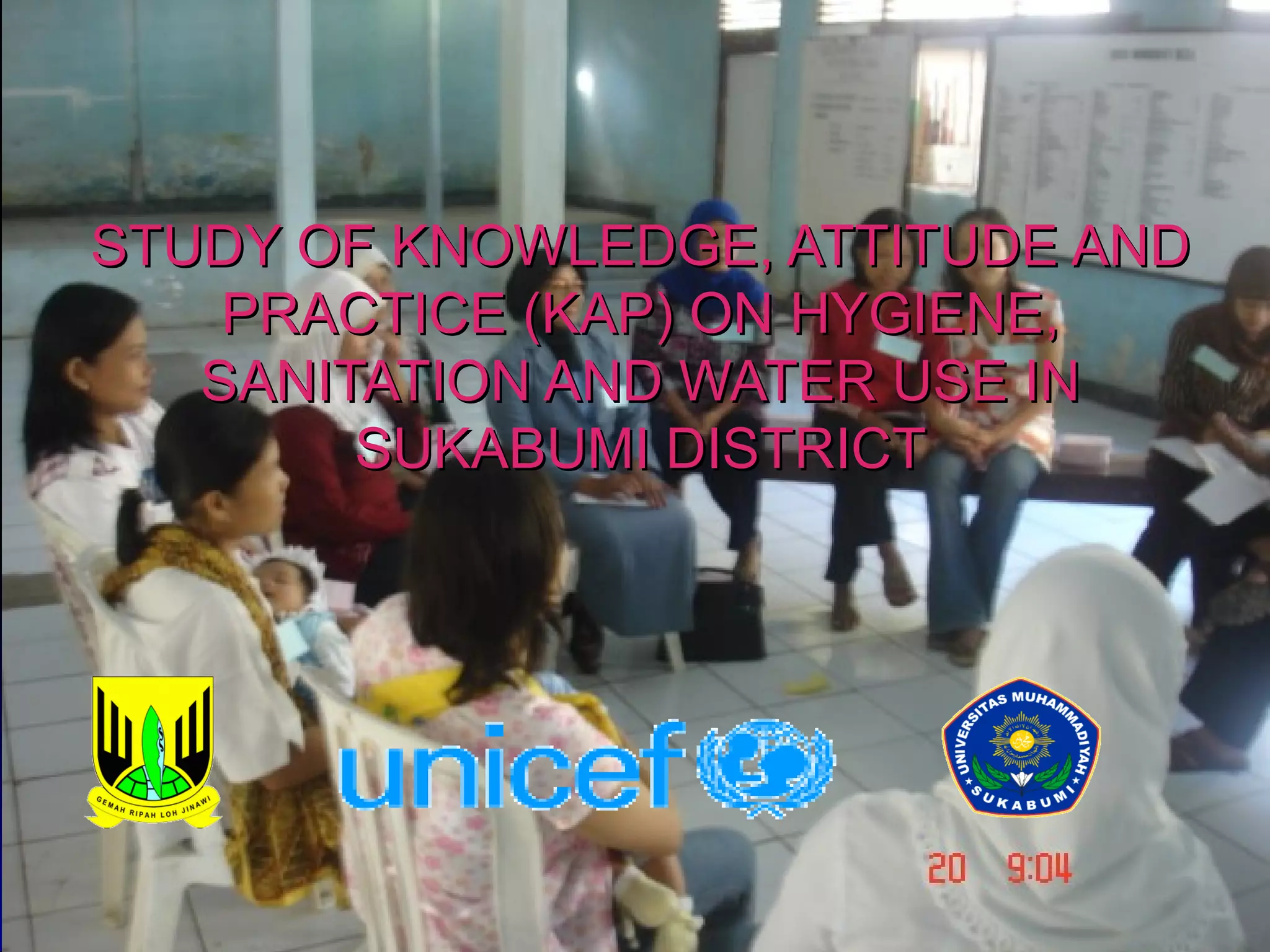
STUDY OF KNOWLEDGE, ATTITUDE AND
    PRACTICE (KAP) ON HYGIENE,
   SANITATION AND WATER USE IN
        SUKABUMI DISTRICT
THE PURPOSES OF THE STUDY

 To find out the extent of the people’s
  knowledge on hygiene, sanitation and
  water use
 To find out the attitude of the people on
  hygiene, sanitation and water use
 To find out the practice of the people on
  hygiene, sanitation and water use
THE SIGNIFICANCES OF THE
             STUDY
   To develop an effective campaign model in
    promoting people’s knowledge and awareness
    on healthy life
   To develop intervension program in overcoming
    the problem of sanitation facilities especially
    water and latrine
   To enhance the people’s participation in health
    program
   To enhance health service quality for the
    community
   To promote health extent in Sukabumi District
RESEARCH
       METHODOLOGY

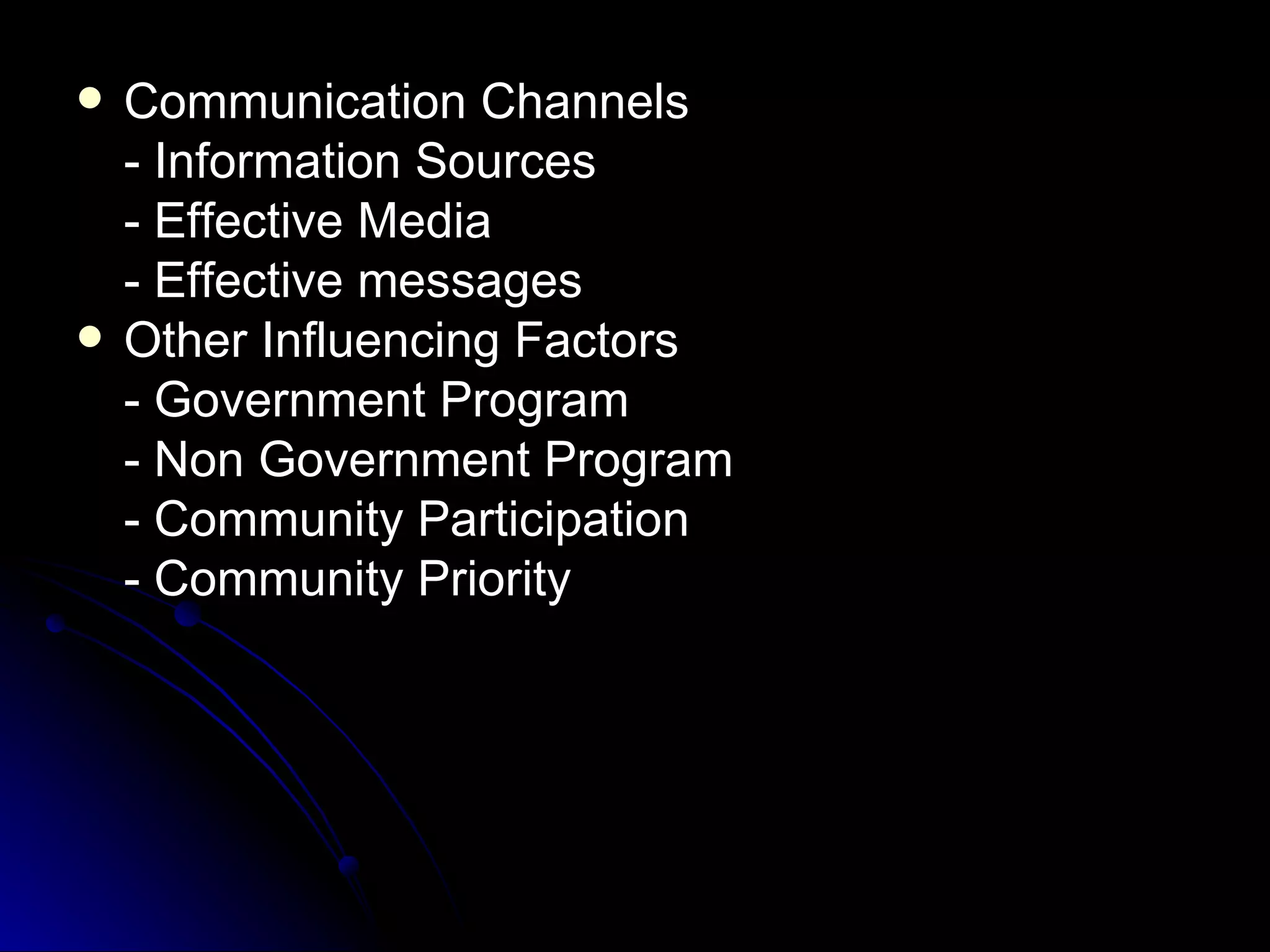
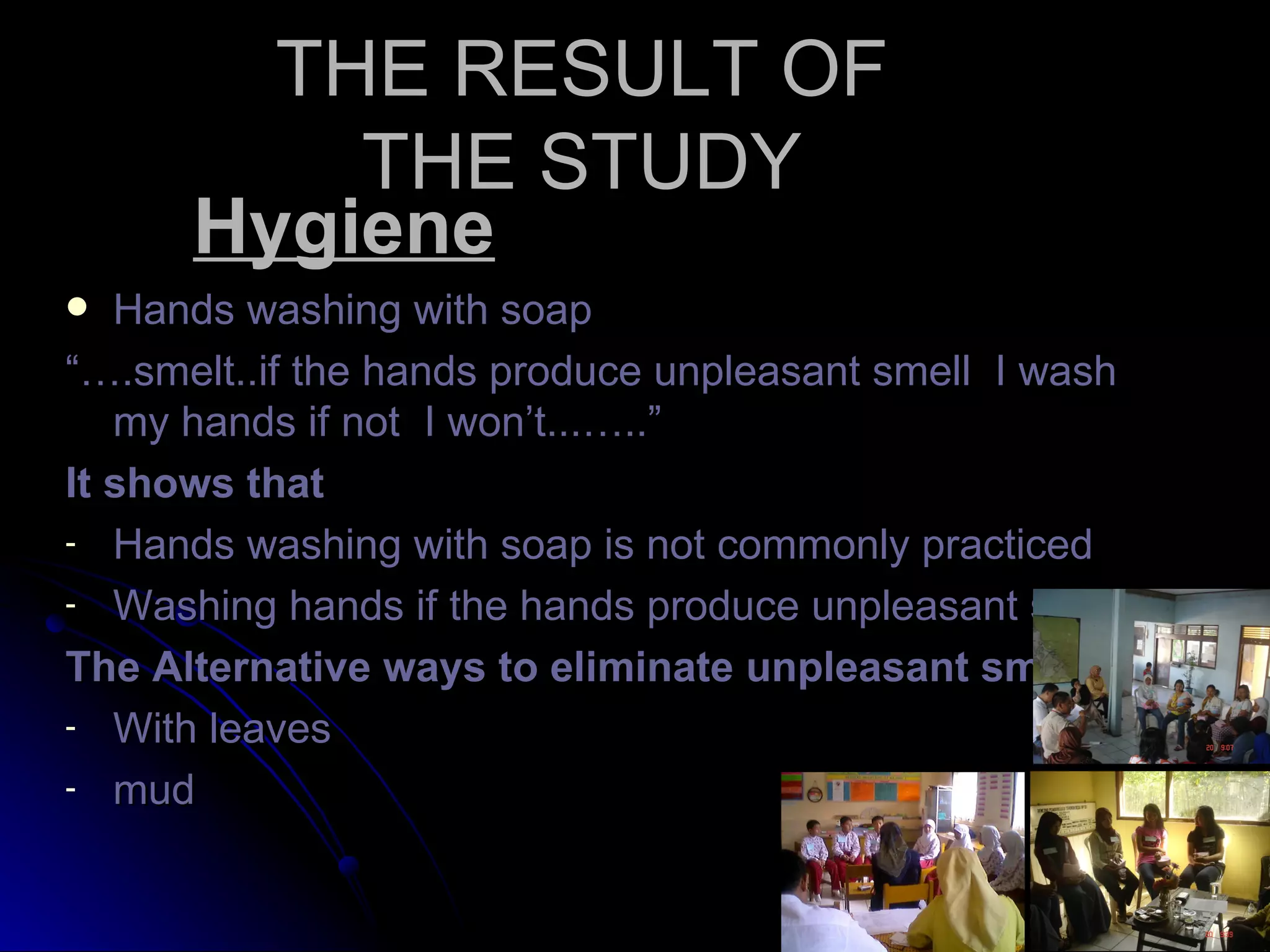
The research conducted used FGD
(Focused Group Discussion)
method, a focus discussion on the
aspects studied to the group
consisted of ten people maximum.
THE ASPECTS OF THE STUDY
   Hygiene
    - Hands washing with soap
    - Toothbrushing
    - Bathing
    - Shampooing
    - Nail Cutting
   Sanitation
    - Defecation
    - Latrine (latrine cleanliness & septic tank)
   Water Use
    - Water Sources
    - Water Collecting
    - Water Management

   Environment Sanitation
    - Solid Waste
    - Liquid Waste
    - Animal Stable
   Communication Channels
    - Information Sources
    - Effective Media
    - Effective messages
   Other Influencing Factors
    - Government Program
    - Non Government Program
    - Community Participation
    - Community Priority
THE RESULT OF
          THE STUDY
      Hygiene
  Hands washing with soap
“….smelt..if the hands produce unpleasant smell I wash
   my hands if not I won’t...…..”
It shows that
- Hands washing with soap is not commonly practiced
- Washing hands if the hands produce unpleasant smell

The Alternative ways to eliminate unpleasant smell
- With leaves
- mud
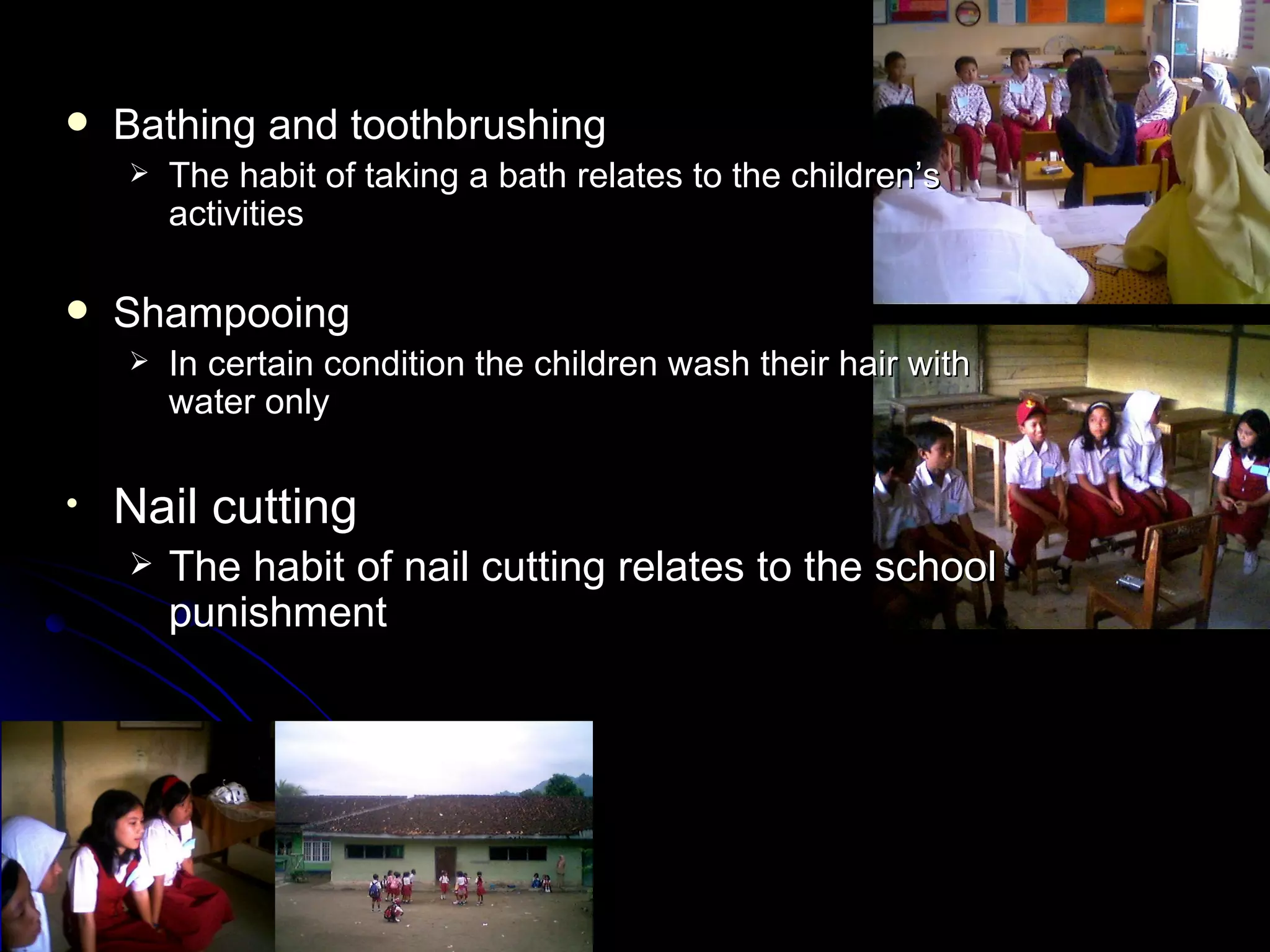
   Bathing and toothbrushing
       The habit of taking a bath relates to the children’s
        activities

   Shampooing
       In certain condition the children wash their hair with
        water only

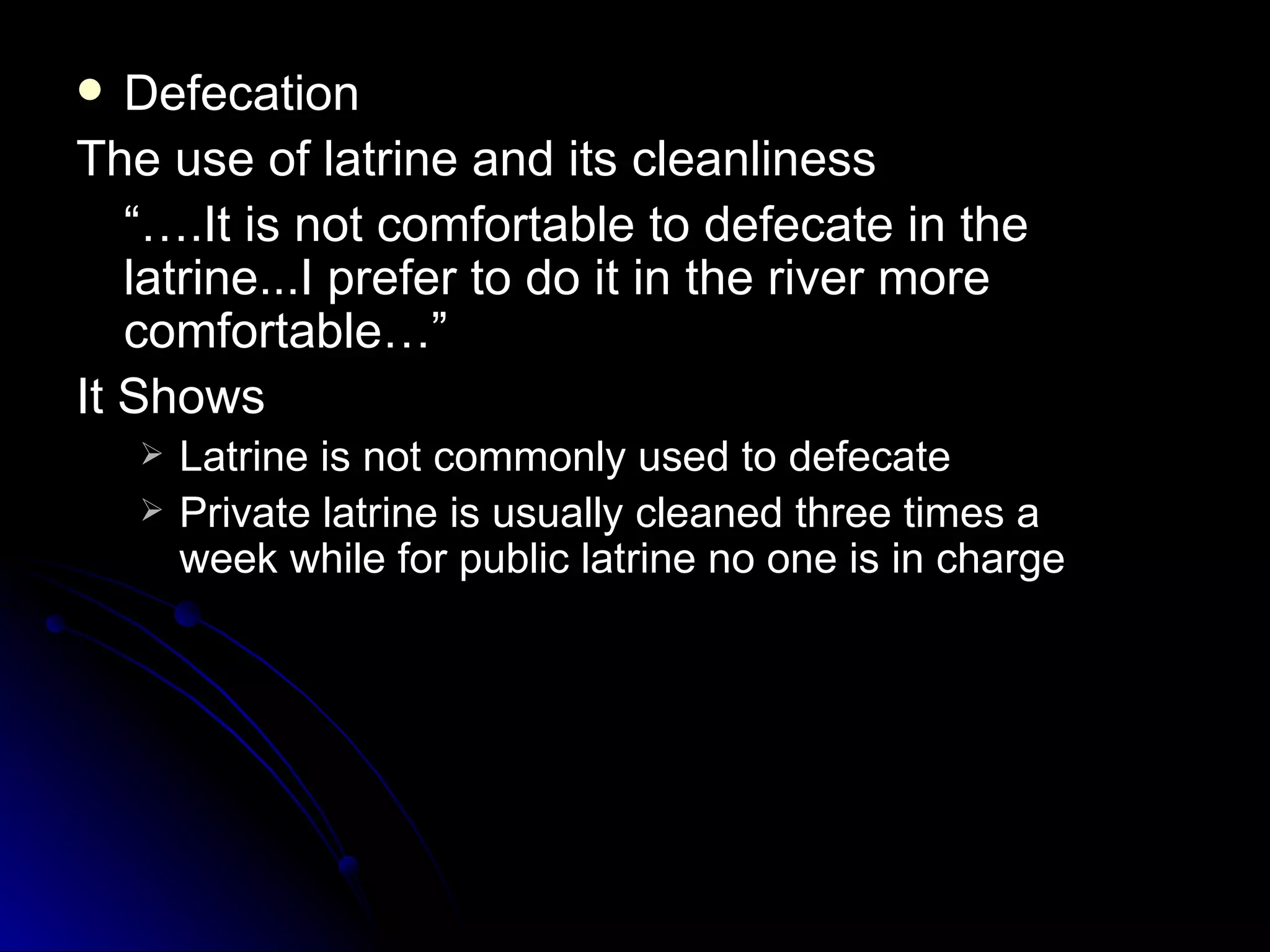
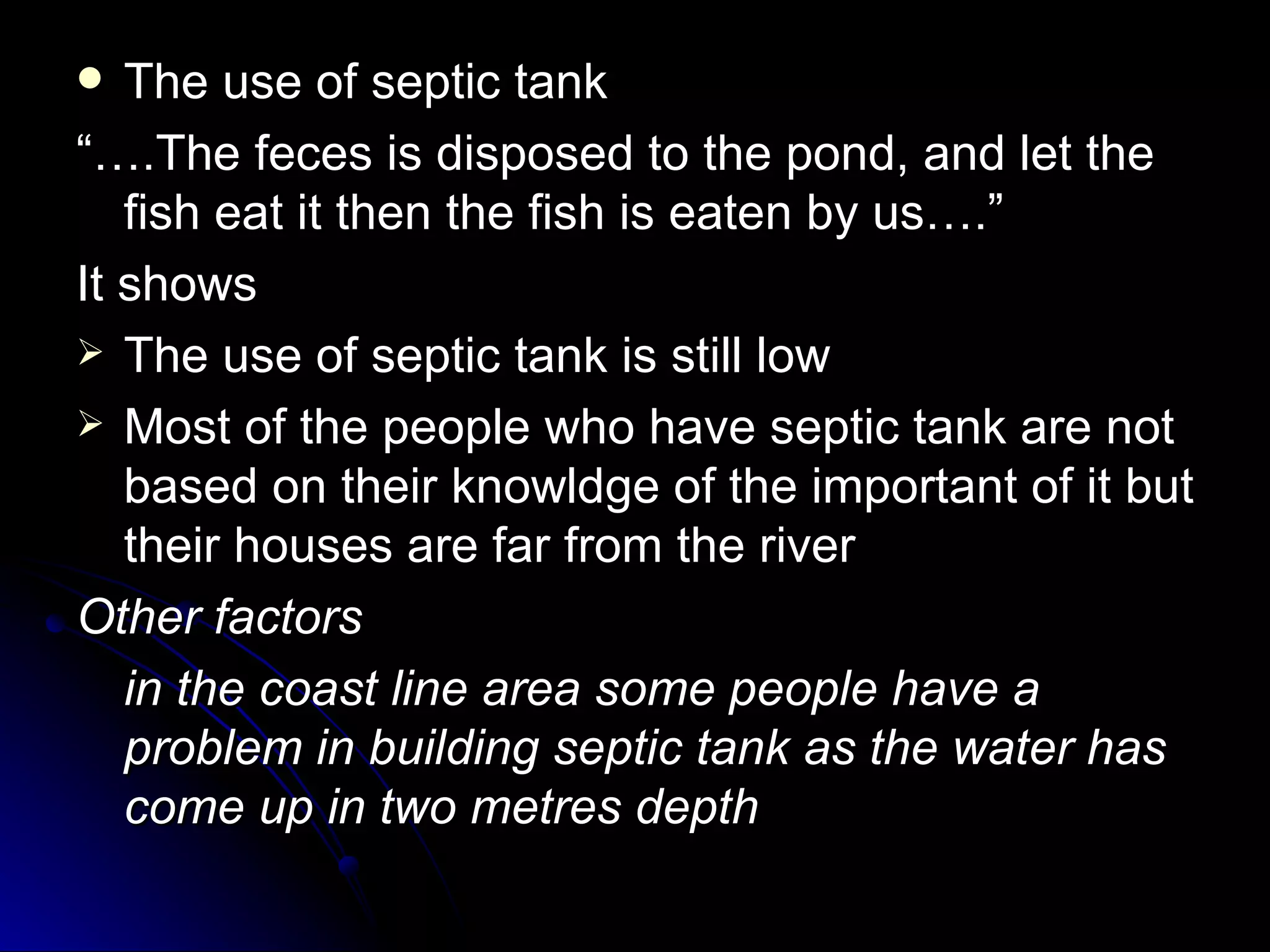
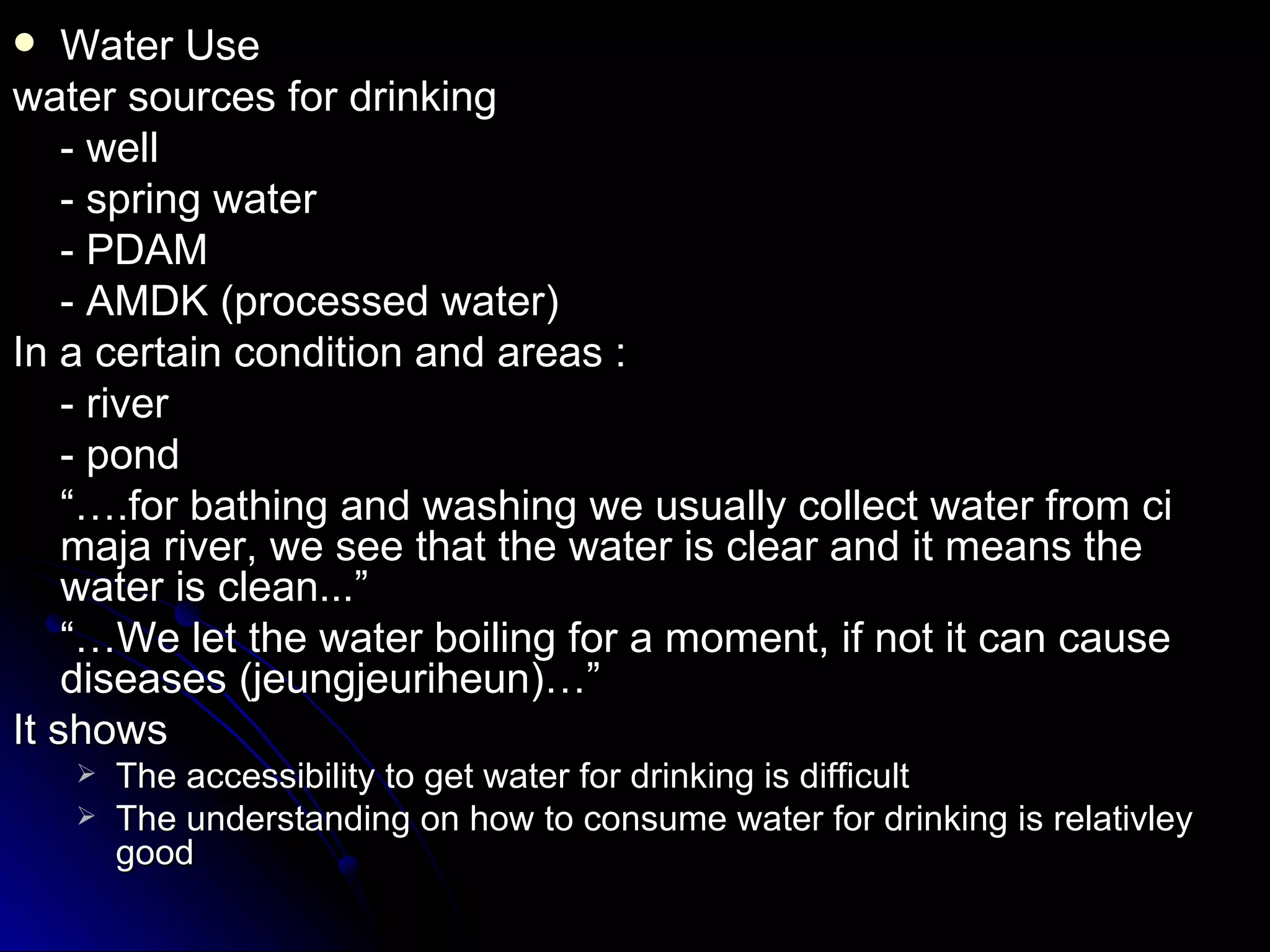
•   Nail cutting
       The habit of nail cutting relates to the school
        punishment
  Defecation
The use of latrine and its cleanliness
   “….It is not comfortable to defecate in the
   latrine...I prefer to do it in the river more
   comfortable…”
It Shows
       Latrine is not commonly used to defecate
       Private latrine is usually cleaned three times a
        week while for public latrine no one is in charge
  The use of septic tank
“….The feces is disposed to the pond, and let the
   fish eat it then the fish is eaten by us….”
It shows
 The use of septic tank is still low
 Most of the people who have septic tank are not
   based on their knowldge of the important of it but
   their houses are far from the river
Other factors
   in the coast line area some people have a
   problem in building septic tank as the water has
   come up in two metres depth
   Water Use
water sources for drinking
    - well
    - spring water
    - PDAM
    - AMDK (processed water)
In a certain condition and areas :
    - river
    - pond
    “….for bathing and washing we usually collect water from ci
    maja river, we see that the water is clear and it means the
    water is clean...”
    “…We let the water boiling for a moment, if not it can cause
    diseases (jeungjeuriheun)…”
It shows
       The accessibility to get water for drinking is difficult
       The understanding on how to consume water for drinking is relativley
        good
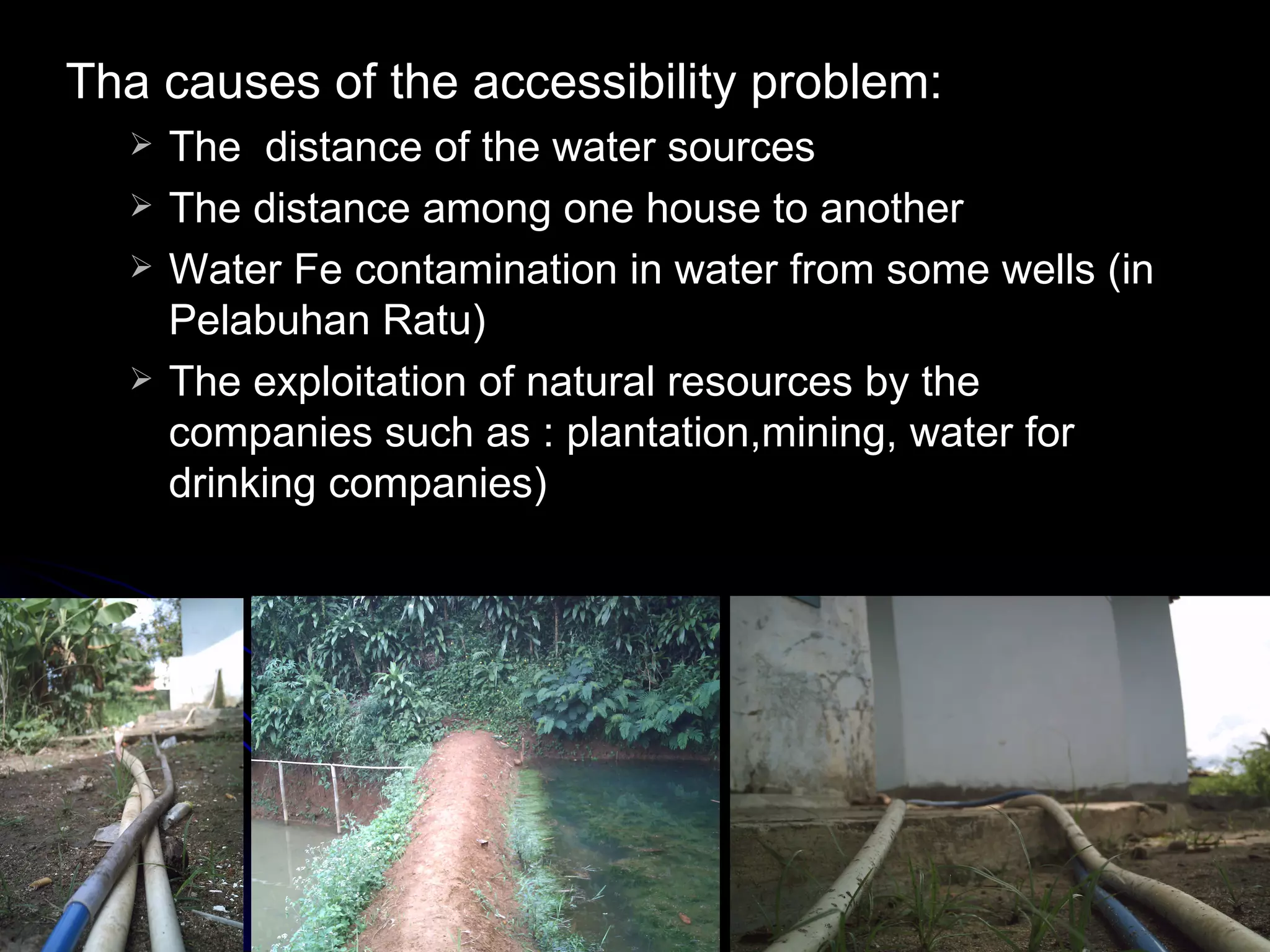
Tha causes of the accessibility problem:
     The distance of the water sources
     The distance among one house to another
     Water Fe contamination in water from some wells (in
      Pelabuhan Ratu)
     The exploitation of natural resources by the
      companies such as : plantation,mining, water for
      drinking companies)
Water Quality

 The knowledge of people of safe water is
 only judged from its appearance, no color,
 no odor and no taste. If the water is clear,
 they think it safe.
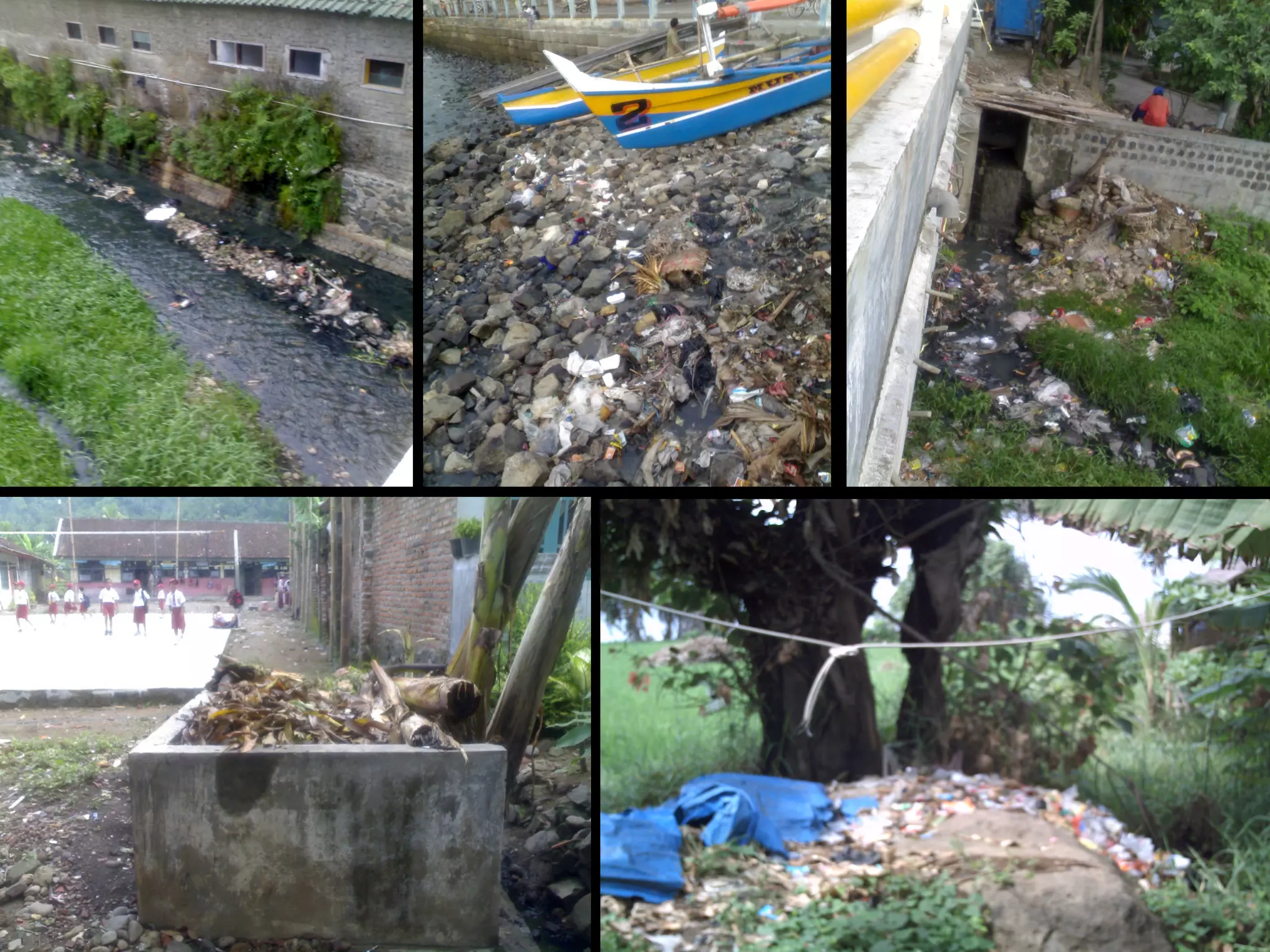
   Environment Sanitation
   Soild Waste
    “….the garbage is disposed to the
    backyard...then burn it....but there are many
    people who dispose it to the river ….”

It shows that:
       The awareness of disposing garbage to its proper
        place is still low
       The understanding of waste management is still low
   Liquid Waste
    The liquid waste from the household is usually
    disposed or connected to the ditch, river and
    yard

   Animal Stable
    “….I have stable near to my house for then
    years and so far i haven’t got any problem….”

It indicates:
     The understanding of safe distance between
      house and stable is still low
     People tend to keep their bad habits and will
      change until something bad happens to them
   Communication Channels
Information Media
    - Television
    - Radio
Some People in the field study get information from:
    - Newspaper
    - Magazine
    “…well from the radio we only listen to the music,
    and from tv sinetron ….”
    “…..in the community the messages (health
    messages) are not more than slogans….”
It indicates:
       People’s anthusiasm on health information is still low
       There is only small portion for health information in the
        information media
       People tend to be apatic to the health information
 Effective Media
  Base on the result of the study, the
  effective media is direct information from
  health office officers
Hindrance factors:
 Key people have not given significant
  contribution to convey health messages
 The amount of health office officers is not
  equal to the amount of the people and the
  area
  Effective Messages
   There is no effective message in the community
    “…..in the community the messages (health
   messages) are not more than slogans….”
It shows:Menunjukan
   People tendd to be apatic to the health
   messages
The example of health meassages in the
   community
“....Leuweung weuteuh, taneuh maneh, cai moal
   euweuh.....”
“...Al-aqli salim fii nafsi saliim....”
   Other infleuncing factors:
    “….Economic first...then health….”
    “….It is difficult to ask people to clean the surrounding
    environment....they says ‘let them who get BLT do it’....”
It shows:
       Health has not become their priority
       The decrease of social capital ‘communal work’
       Individualistic
Other faactors:
       The government programs seem to overlap to one
        another and no continuous evalution and supervision
       Less coordination between government and non
        government organization
       The companies around the filed study have not given real
        contribution to promote people’s health condition

Study of Knowledge, Attitude and Practice (KAP) on Hygiene, Sanitation and Water Use in Sukabumi District

  • 1.
    STUDY OF KNOWLEDGE,ATTITUDE AND PRACTICE (KAP) ON HYGIENE, SANITATION AND WATER USE IN SUKABUMI DISTRICT
  • 2.
    THE PURPOSES OFTHE STUDY  To find out the extent of the people’s knowledge on hygiene, sanitation and water use  To find out the attitude of the people on hygiene, sanitation and water use  To find out the practice of the people on hygiene, sanitation and water use
  • 3.
    THE SIGNIFICANCES OFTHE STUDY  To develop an effective campaign model in promoting people’s knowledge and awareness on healthy life  To develop intervension program in overcoming the problem of sanitation facilities especially water and latrine  To enhance the people’s participation in health program  To enhance health service quality for the community  To promote health extent in Sukabumi District
  • 4.
    RESEARCH METHODOLOGY The research conducted used FGD (Focused Group Discussion) method, a focus discussion on the aspects studied to the group consisted of ten people maximum.
  • 5.
    THE ASPECTS OFTHE STUDY  Hygiene - Hands washing with soap - Toothbrushing - Bathing - Shampooing - Nail Cutting  Sanitation - Defecation - Latrine (latrine cleanliness & septic tank)
  • 6.
    Water Use - Water Sources - Water Collecting - Water Management  Environment Sanitation - Solid Waste - Liquid Waste - Animal Stable
  • 7.
    Communication Channels - Information Sources - Effective Media - Effective messages  Other Influencing Factors - Government Program - Non Government Program - Community Participation - Community Priority
  • 8.
    THE RESULT OF THE STUDY Hygiene  Hands washing with soap “….smelt..if the hands produce unpleasant smell I wash my hands if not I won’t...…..” It shows that - Hands washing with soap is not commonly practiced - Washing hands if the hands produce unpleasant smell The Alternative ways to eliminate unpleasant smell - With leaves - mud
  • 9.
    Bathing and toothbrushing  The habit of taking a bath relates to the children’s activities  Shampooing  In certain condition the children wash their hair with water only • Nail cutting  The habit of nail cutting relates to the school punishment
  • 10.
     Defecation Theuse of latrine and its cleanliness “….It is not comfortable to defecate in the latrine...I prefer to do it in the river more comfortable…” It Shows  Latrine is not commonly used to defecate  Private latrine is usually cleaned three times a week while for public latrine no one is in charge
  • 11.
     Theuse of septic tank “….The feces is disposed to the pond, and let the fish eat it then the fish is eaten by us….” It shows  The use of septic tank is still low  Most of the people who have septic tank are not based on their knowldge of the important of it but their houses are far from the river Other factors in the coast line area some people have a problem in building septic tank as the water has come up in two metres depth
  • 12.
    Water Use water sources for drinking - well - spring water - PDAM - AMDK (processed water) In a certain condition and areas : - river - pond “….for bathing and washing we usually collect water from ci maja river, we see that the water is clear and it means the water is clean...” “…We let the water boiling for a moment, if not it can cause diseases (jeungjeuriheun)…” It shows  The accessibility to get water for drinking is difficult  The understanding on how to consume water for drinking is relativley good
  • 13.
    Tha causes ofthe accessibility problem:  The distance of the water sources  The distance among one house to another  Water Fe contamination in water from some wells (in Pelabuhan Ratu)  The exploitation of natural resources by the companies such as : plantation,mining, water for drinking companies)
  • 14.
    Water Quality Theknowledge of people of safe water is only judged from its appearance, no color, no odor and no taste. If the water is clear, they think it safe.
  • 15.
    Environment Sanitation  Soild Waste “….the garbage is disposed to the backyard...then burn it....but there are many people who dispose it to the river ….” It shows that:  The awareness of disposing garbage to its proper place is still low  The understanding of waste management is still low
  • 16.
    Liquid Waste The liquid waste from the household is usually disposed or connected to the ditch, river and yard  Animal Stable “….I have stable near to my house for then years and so far i haven’t got any problem….” It indicates:  The understanding of safe distance between house and stable is still low  People tend to keep their bad habits and will change until something bad happens to them
  • 18.
    Communication Channels Information Media - Television - Radio Some People in the field study get information from: - Newspaper - Magazine “…well from the radio we only listen to the music, and from tv sinetron ….” “…..in the community the messages (health messages) are not more than slogans….” It indicates:  People’s anthusiasm on health information is still low  There is only small portion for health information in the information media  People tend to be apatic to the health information
  • 19.
     Effective Media Base on the result of the study, the effective media is direct information from health office officers Hindrance factors:  Key people have not given significant contribution to convey health messages  The amount of health office officers is not equal to the amount of the people and the area
  • 20.
     EffectiveMessages There is no effective message in the community “…..in the community the messages (health messages) are not more than slogans….” It shows:Menunjukan People tendd to be apatic to the health messages The example of health meassages in the community “....Leuweung weuteuh, taneuh maneh, cai moal euweuh.....” “...Al-aqli salim fii nafsi saliim....”
  • 21.
    Other infleuncing factors: “….Economic first...then health….” “….It is difficult to ask people to clean the surrounding environment....they says ‘let them who get BLT do it’....” It shows:  Health has not become their priority  The decrease of social capital ‘communal work’  Individualistic Other faactors:  The government programs seem to overlap to one another and no continuous evalution and supervision  Less coordination between government and non government organization  The companies around the filed study have not given real contribution to promote people’s health condition