board matters


   Your Board and Executive Compensation
            Here are answers to some of your directors’ most common questions.
                                                     Edited By Koya M. Bakare


I
    n a challenging economy, it is impera-      the results have included both increased        and process that increase transparency on
    tive for bank boards to sustain good        regulation and increased outrage, regardless    how pay decisions are made from the C suite
    corporate governance practices,             of whether a bank took TARP money.              to the teller line. Many banks need more
which may mean examining your execu-              According to Watson Wyatt’s October           methodology as they develop or modify
tive compensation plan. As discussions          2009 Executive Pay survey, 94 percent           a compensation philosophy and ensure
about executive compensation continue           of companies expect more scrutiny of            there is ample data to determine if the actual
to develop in boardrooms just like yours,       executive pay in the next two years as a        compensation practice is accomplishing the
          many questions have been raised.      result of new legislation, Securities and       stated compensation philosophy.
           During ABA’s Directors’ Forum        Exchange Commission regulations and                I have spoken to hundreds of banks in
           in October, Christie Summervill,
           vice president and practice leader         The objective is to ensure that poor performers
           for Wichita, Kan.-based Koker
           Goodwin & Associates, identi-              are not rewarded when the market is rising,
                                                      and good performers are not hurt when the
           fied and addressed some of the
           most common questions bank
           directors have posed to her.
                                                      sector is suffering.
Q: Why has the topic of executive
compensation become such a nation-              public pressure—both internal and exter-        the past 10 years whose written materials
al focus?                                       nal. Shareholders, who have experienced         said they paid competitive to the market. In
   Summervill: Excessive compensation           losses, don’t expect to see the compensation    reality, the human resources director was
first surfaced as a national concern in the     for the executives they view as responsible     only given permission to purchase one or
early 1980s, about the same time that deep      for those losses to increase.                   two state or industry surveys, with too few
cuts in the top marginal federal income tax       Employees who have had salary freez-          respondents to build a market-based pay
rate took effect. Until 1964, the top-bracket   es, benefits reduced, and their workloads       structure that was reliable.
federal income tax rate was 91 percent on       increased as co-workers are laid off, don’t        •	 More	board	governance.	A bank
income over $400,000. It was reduced to         want to read about how executives are be-       should have an independent compensation
70 percent on income over $200,000 un-          ing fired for doing a poor job and walking      committee that is educated on compensation
til 1981. When the bulk of any pay more         away with millions. That isn’t always the       principles and can participate and add value
than the top-bracket income floor was taxed     case, but it is stereotyped that way. Politi-   to the discussion of how pay decisions are
away, the lure of million-dollar pay pack-      cians looking to stay in the headlines are      made for the C Suite and what results are
ages quickly faded. Today, the top marginal     using these examples as fodder for cre-         expected in return. One of the biggest errors
tax rate sits at 35 percent.                    ating new agencies and legislation and          I have seen in my career is that many board
   Compensation for top executives in the       giving themselves more power to serve           members discuss compensation from their
United States has soared from 30 to 40          as the citizens’ watchdog.                      own experience rather than having solid
times average worker pay a generation ago                                                       information on compensation within the
to more than 400 times the average worker       Q: How do you recommend banks                   industry.
compensation today. This alone could be a       respond?                                           •	 More	policy.	Develop a stated policy
catalyst for class envy, but [when the public     Summervill:                                   on expenditures for the executive or their
perceived that the] American banking sys-         •	 More	methodology.	Proactively              spouse – aviation services, office redeco-
tem needed to be bailed out by taxpayers,       create compensation structures, practices       ration, entertainment, holiday parties,

22 Community Banker | December 2009
board matters
conferences and events that fall outside of             down to executive and exempt levels and
normal business.                                        weighted appropriately depending on the
                                                        position’s ability to impact the accomplish-
Q:		What	trends	are	you	seeing	in	the	                  ment of the goals.
industry?                                                  By developing and integrating a linked
   Summervill: The most important trend                 compensation and performance manage-
has to do with performance management.                  ment plan for the CEO and every other
With a mandate to more successfully link                position in the bank, a balance is achieved
pay and performance, there has been a                   between the best interest of the stakehold-
renewed commitment to creating and mod-                 er and the employee. This approach better
ifying performance metrics and linking                  aligns an employer’s compensation in-
the accomplishments of these goals to                   vestment with organization performance.
variable pay.                                           The type of CEO who will be motivated
   In the ’90s, the SEC gave a strong sig-              and focused by this approach is probably
nal that total shareholder reward was the               the same type that will be needed to suc-
primary measure of company success. As                  cessfully steer your bank through these
the markets soared, long-term incentives                difficult political and economically chal-
made up 75 percent of CEO compensation                  lenging times.
in the United States. Today, we are see-
ing corporate scorecards reflect the shift              Koker Goodwin & Associates is a
                                                        compensation consulting firm that
in the balance sheet structure.
                                                        specializes in working with financial
   The objective is to ensure that poor per-            institutions with assets from $100 million
formers are not rewarded when the market                to $5 billion to build strategic
is rising, and good performers are not hurt             performance-based compensation
when the sector is suffering. Doing this                strategies. Christie Summervill can be
well is absolutely critical because the mea-            reached at 800-897-3308 or christie@
sures set for the CEO should be transferred             kgassociates.com.


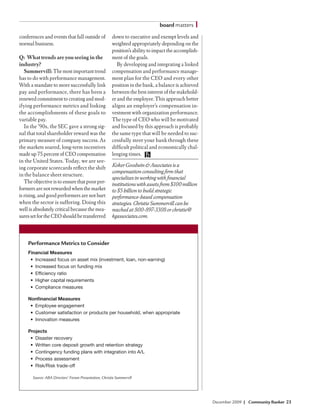
    Performance Metrics to Consider
    Financial Measures
     •	 Increased focus on asset mix (investment, loan, non-earning)
     •	 Increased focus on funding mix
     •	 Efficiency ratio
     •	 Higher capital requirements
     •	 Compliance measures

    Nonfinancial Measures
     •	 Employee engagement
     •	 Customer satisfaction or products per household, when appropriate
     •	 Innovation measures

    Projects
     •	 Disaster recovery
     •	 Written core deposit growth and retention strategy
     •	 Contingency funding plans with integration into A/L
     •	 Process assessment
     •	 Risk/Risk trade-off

       Source: ABA Directors’ Forum Presentation, Christie Summervill


                                                                                                       December 2009 | Community Banker 23
24 Community Banker | December 2009

Executive Compensation for bankers 2010

  • 1.
    board matters Your Board and Executive Compensation Here are answers to some of your directors’ most common questions. Edited By Koya M. Bakare I n a challenging economy, it is impera- the results have included both increased and process that increase transparency on tive for bank boards to sustain good regulation and increased outrage, regardless how pay decisions are made from the C suite corporate governance practices, of whether a bank took TARP money. to the teller line. Many banks need more which may mean examining your execu- According to Watson Wyatt’s October methodology as they develop or modify tive compensation plan. As discussions 2009 Executive Pay survey, 94 percent a compensation philosophy and ensure about executive compensation continue of companies expect more scrutiny of there is ample data to determine if the actual to develop in boardrooms just like yours, executive pay in the next two years as a compensation practice is accomplishing the many questions have been raised. result of new legislation, Securities and stated compensation philosophy. During ABA’s Directors’ Forum Exchange Commission regulations and I have spoken to hundreds of banks in in October, Christie Summervill, vice president and practice leader The objective is to ensure that poor performers for Wichita, Kan.-based Koker Goodwin & Associates, identi- are not rewarded when the market is rising, and good performers are not hurt when the fied and addressed some of the most common questions bank directors have posed to her. sector is suffering. Q: Why has the topic of executive compensation become such a nation- public pressure—both internal and exter- the past 10 years whose written materials al focus? nal. Shareholders, who have experienced said they paid competitive to the market. In Summervill: Excessive compensation losses, don’t expect to see the compensation reality, the human resources director was first surfaced as a national concern in the for the executives they view as responsible only given permission to purchase one or early 1980s, about the same time that deep for those losses to increase. two state or industry surveys, with too few cuts in the top marginal federal income tax Employees who have had salary freez- respondents to build a market-based pay rate took effect. Until 1964, the top-bracket es, benefits reduced, and their workloads structure that was reliable. federal income tax rate was 91 percent on increased as co-workers are laid off, don’t • More board governance. A bank income over $400,000. It was reduced to want to read about how executives are be- should have an independent compensation 70 percent on income over $200,000 un- ing fired for doing a poor job and walking committee that is educated on compensation til 1981. When the bulk of any pay more away with millions. That isn’t always the principles and can participate and add value than the top-bracket income floor was taxed case, but it is stereotyped that way. Politi- to the discussion of how pay decisions are away, the lure of million-dollar pay pack- cians looking to stay in the headlines are made for the C Suite and what results are ages quickly faded. Today, the top marginal using these examples as fodder for cre- expected in return. One of the biggest errors tax rate sits at 35 percent. ating new agencies and legislation and I have seen in my career is that many board Compensation for top executives in the giving themselves more power to serve members discuss compensation from their United States has soared from 30 to 40 as the citizens’ watchdog. own experience rather than having solid times average worker pay a generation ago information on compensation within the to more than 400 times the average worker Q: How do you recommend banks industry. compensation today. This alone could be a respond? • More policy. Develop a stated policy catalyst for class envy, but [when the public Summervill: on expenditures for the executive or their perceived that the] American banking sys- • More methodology. Proactively spouse – aviation services, office redeco- tem needed to be bailed out by taxpayers, create compensation structures, practices ration, entertainment, holiday parties, 22 Community Banker | December 2009
  • 2.
    board matters conferences andevents that fall outside of down to executive and exempt levels and normal business. weighted appropriately depending on the position’s ability to impact the accomplish- Q: What trends are you seeing in the ment of the goals. industry? By developing and integrating a linked Summervill: The most important trend compensation and performance manage- has to do with performance management. ment plan for the CEO and every other With a mandate to more successfully link position in the bank, a balance is achieved pay and performance, there has been a between the best interest of the stakehold- renewed commitment to creating and mod- er and the employee. This approach better ifying performance metrics and linking aligns an employer’s compensation in- the accomplishments of these goals to vestment with organization performance. variable pay. The type of CEO who will be motivated In the ’90s, the SEC gave a strong sig- and focused by this approach is probably nal that total shareholder reward was the the same type that will be needed to suc- primary measure of company success. As cessfully steer your bank through these the markets soared, long-term incentives difficult political and economically chal- made up 75 percent of CEO compensation lenging times. in the United States. Today, we are see- ing corporate scorecards reflect the shift Koker Goodwin & Associates is a compensation consulting firm that in the balance sheet structure. specializes in working with financial The objective is to ensure that poor per- institutions with assets from $100 million formers are not rewarded when the market to $5 billion to build strategic is rising, and good performers are not hurt performance-based compensation when the sector is suffering. Doing this strategies. Christie Summervill can be well is absolutely critical because the mea- reached at 800-897-3308 or christie@ sures set for the CEO should be transferred kgassociates.com. Performance Metrics to Consider Financial Measures • Increased focus on asset mix (investment, loan, non-earning) • Increased focus on funding mix • Efficiency ratio • Higher capital requirements • Compliance measures Nonfinancial Measures • Employee engagement • Customer satisfaction or products per household, when appropriate • Innovation measures Projects • Disaster recovery • Written core deposit growth and retention strategy • Contingency funding plans with integration into A/L • Process assessment • Risk/Risk trade-off Source: ABA Directors’ Forum Presentation, Christie Summervill December 2009 | Community Banker 23
  • 3.
    24 Community Banker| December 2009