Angie Fidler, CPA, CGMA | Bader Martin, PS 1
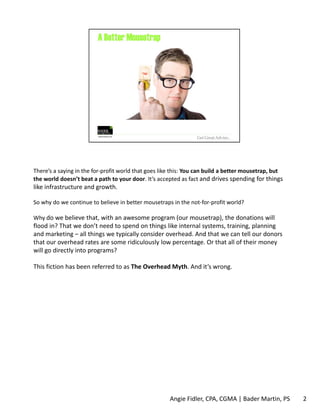
There’s a saying in the for‐profit world that goes like this: You can build a better mousetrap, but 
the world doesn’t beat a path to your door. It’s accepted as fact and drives spending for things 
like infrastructure and growth. 
So why do we continue to believe in better mousetraps in the not‐for‐profit world? 
Why do we believe that, with an awesome program (our mousetrap), the donations will 
flood in? That we don’t need to spend on things like internal systems, training, planning 
and marketing – all things we typically consider overhead. And that we can tell our donors 
that our overhead rates are some ridiculously low percentage. Or that all of their money 
will go directly into programs? 
This fiction has been referred to as The Overhead Myth. And it’s wrong. 
Angie Fidler, CPA, CGMA | Bader Martin, PS 2
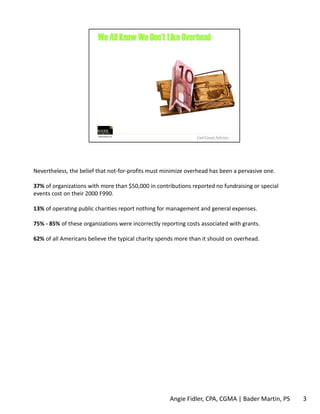
Nevertheless, the belief that not‐for‐profits must minimize overhead has been a pervasive one. 
37% of organizations with more than $50,000 in contributions reported no fundraising or special 
events cost on their 2000 F990. 
13% of operating public charities report nothing for management and general expenses. 
75% ‐ 85% of these organizations were incorrectly reporting costs associated with grants. 
62% of all Americans believe the typical charity spends more than it should on overhead. 
Angie Fidler, CPA, CGMA | Bader Martin, PS 3
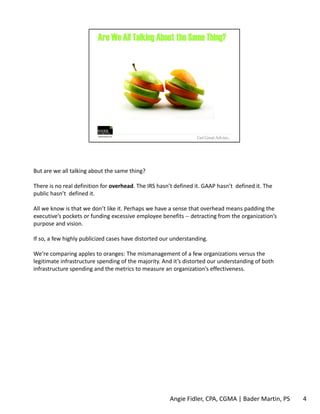
But are we all talking about the same thing? 
There is no real definition for overhead. The IRS hasn’t defined it. GAAP hasn’t defined it. The 
public hasn’t defined it. 
All we know is that we don’t like it. Perhaps we have a sense that overhead means padding the 
executive’s pockets or funding excessive employee benefits ‐‐ detracting from the organization’s 
purpose and vision. 
If so, a few highly publicized cases have distorted our understanding. 
We’re comparing apples to oranges: The mismanagement of a few organizations versus the 
legitimate infrastructure spending of the majority. And it’s distorted our understanding of both 
infrastructure spending and the metrics to measure an organization’s effectiveness. 
Angie Fidler, CPA, CGMA | Bader Martin, PS 4
At least that’s the perspective of organizations like BBB Wise Giving Alliance, Guidestar and Charity 
Navigator. 
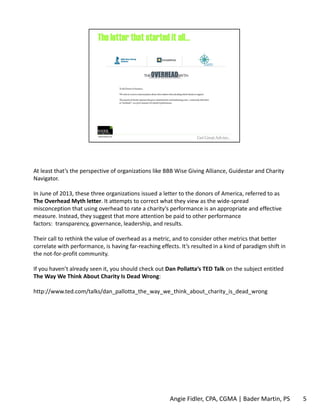
In June of 2013, these three organizations issued a letter to the donors of America, referred to as 
The Overhead Myth letter. It attempts to correct what they view as the wide‐spread 
misconception that using overhead to rate a charity’s performance is an appropriate and effective 
measure. Instead, they suggest that more attention be paid to other performance 
factors: transparency, governance, leadership, and results. 
Their call to rethink the value of overhead as a metric, and to consider other metrics that better 
correlate with performance, is having far‐reaching effects. It’s resulted in a kind of paradigm shift in 
the not‐for‐profit community. 
If you haven’t already seen it, you should check out Dan Pollatta‘s TED Talk on the subject entitled 
The Way We Think About Charity Is Dead Wrong: 
http://www.ted.com/talks/dan_pallotta_the_way_we_think_about_charity_is_dead_wrong 
Angie Fidler, CPA, CGMA | Bader Martin, PS 5
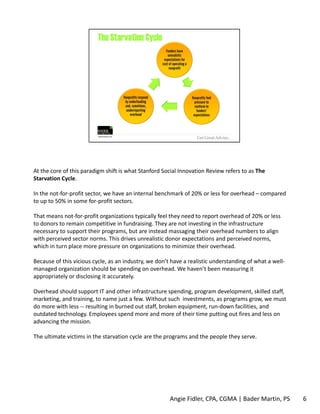
At the core of this paradigm shift is what Stanford Social Innovation Review refers to as The 
Starvation Cycle. 
In the not‐for‐profit sector, we have an internal benchmark of 20% or less for overhead – compared 
to up to 50% in some for‐profit sectors. 
That means not‐for‐profit organizations typically feel they need to report overhead of 20% or less 
to donors to remain competitive in fundraising. They are not investing in the infrastructure 
necessary to support their programs, but are instead massaging their overhead numbers to align 
with perceived sector norms. This drives unrealistic donor expectations and perceived norms, 
which in turn place more pressure on organizations to minimize their overhead. 
Because of this vicious cycle, as an industry, we don’t have a realistic understanding of what a well‐managed 
organization should be spending on overhead. We haven’t been measuring it 
appropriately or disclosing it accurately. 
Overhead should support IT and other infrastructure spending, program development, skilled staff, 
marketing, and training, to name just a few. Without such investments, as programs grow, we must 
do more with less ‐‐ resulting in burned out staff, broken equipment, run‐down facilities, and 
outdated technology. Employees spend more and more of their time putting out fires and less on 
advancing the mission. 
The ultimate victims in the starvation cycle are the programs and the people they serve. 
Angie Fidler, CPA, CGMA | Bader Martin, PS 6
To begin evolving to a more realistic view of overhead spending ‐‐ and a better set of metrics for 
evaluating performance ‐‐ we need to foster improved communications between those of us in the 
industry and our donors. 
I have three primary suggestions for initiating change: 
Angie Fidler, CPA, CGMA | Bader Martin, PS 7
Overhead isn’t a dirty word. Don’t be afraid to talk about your overhead spending and the value it 
provides. Talk about it in the board room. In discussions with donors. And with staff. 
Most importantly when developing your organization’s five‐year plan, evaluate the overhead‐related 
tools and expenditures that you need to accomplish your goals. They include things like 
marketing expenditures – maybe a new or enhanced website or e‐newsletter ‐‐ staff training, and 
infrastructure spending. Then build them into the plan and tell donors how they help to accomplish 
your overall goals. 
Angie Fidler, CPA, CGMA | Bader Martin, PS 8
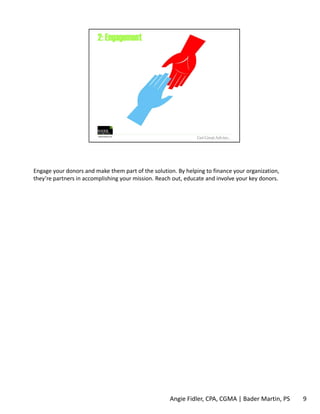
Engage your donors and make them part of the solution. By helping to finance your organization, 
they’re partners in accomplishing your mission. Reach out, educate and involve your key donors. 
Angie Fidler, CPA, CGMA | Bader Martin, PS 9
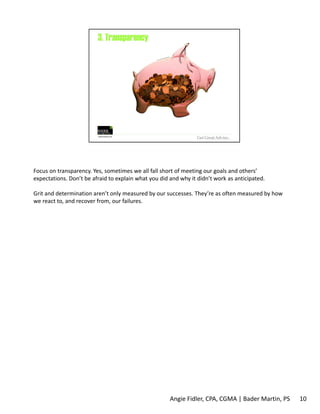
Focus on transparency. Yes, sometimes we all fall short of meeting our goals and others’ 
expectations. Don’t be afraid to explain what you did and why it didn’t work as anticipated. 
Grit and determination aren’t only measured by our successes. They’re as often measured by how 
we react to, and recover from, our failures. 
Angie Fidler, CPA, CGMA | Bader Martin, PS 10
Now that we’re all committed to a more realistic view of the role of overhead as a performance 
indicator, what do we replace it with? What set of metrics should we use? And what’s the end 
game of our evolving understanding of performance measures? 
Our big‐picture goal is to develop a better way to grade organizations according to how well‐managed 
they are, and how sustainable and impactful. And we’d like to base it on readily available 
information. 
Toward that end, I suggest we look to IRS Form 990 as the most accessible source of data to begin 
the transition from a single‐metric system to a multi‐metric system. Admittedly, the resulting 
metrics would have limitations, but consider them as a transition to a more robust set of metrics 
over time. 
Form 990‐based metrics are subject to the following limitations: 
1. Depth Nonprofits are fairly unique. The Form 990 allows room for explanation; however 
explanations are usually on Schedule O at the end of the return. 
2. Timeliness By the time an organization’s Form 990 is publicly available, it is…well…it’s old 
news. But it’s still useful. 
3. Comparability We are not in an apples‐to‐apples situation yet. The form is long and onerous. It 
can be expensive to outsource and prep. As a CPA I know we work hard to make it affordable. 
But the truth is, the penalties for failure to file a complete and accurate return are hard to 
impose without obvious errors or omissions. 
Angie Fidler, CPA, CGMA | Bader Martin, PS 11
When the IRS revamped Form 990, they placed enhanced increased emphasis on governance. In 
their experience, organizations with active boards that conformed to certain governance policies 
were more often compliant with tax rules. 
Governance‐related information on Form 990 incudes the following: 
Form 990, Page 1 – Board Members and Potential Conflicts 
This data describes the voting members of the board and indicates how many board members are 
free of conflicts. Possible business‐related conflicts include providing services to the organization – 
as a paid employee of the organization or as an owner of a business that provides services, as the 
family member of a paid employee, or as a participant in a joint venture, among others. The 
informal recommendation is to ensure that at least 2/3 of the board are without conflicts. 
Form 990, Page 6, Part VI – Policies 
IRS‐suggested policies include conflict of interest, whistleblower, and document retention and 
destruction, as well as board review processes for approval of Form 990 and executive 
compensation. These are not legally mandated but are considered to be best practices. 
Form 990, Page 7, Part VII ‐ Board Member Detail 
This section of the form describes all those who served on the board at any point during the filing 
year. It includes name, title, hours and position, as well as salary information. For example, how 
many hours on average is the board putting in? Are officers of the board (e.g., president, vice 
president) putting in more time than the directors? 
Angie Fidler, CPA, CGMA | Bader Martin, PS 12
Liquidity ratios tell us the story of an organization’s short‐term financial viability – its ability to 
meet short‐term liabilities with short‐term assets. For example, can the organization pay it’s bills 
using cash on hand for the short term? If not, can it access cash quickly enough to pay its bills for 
the short term? Is it leveraged appropriately? Is it using debt‐financing to move forward or relying 
on it to sustain operations? 
Form 990, Page 11, Part X 
Liquidity ratios are quickly and easily computed from the Form 990’s balance sheet, including the 
working capital ratio, quick ratio, cash ratio, and operation cash‐flow ratio. 
Working Capital Ratio = Current Assets / Current Liabilities 
Quick Ratio = [Current Assets – (Inventories + Prepayments)] / Current Liabilities 
Cash Ratio = Cash and Marketable Securities / Current Liabilities 
Operation Cash Flow Ratio = Operating Cash Flow / Total Debts 
Angie Fidler, CPA, CGMA | Bader Martin, PS 13
It’s also important to understand whether the organization has sufficient resources to cover a loss 
from operations or other cash shortage. 
Form 990, Pages 10 and 11 
The unrestricted net assets ratio, calculated by dividing the amount on page 11 line 27 by the 
amount on page 10 line 25, measures the amount of unrestricted, spendable equity available to 
fund the organization’s annual operating expenses. If low, the organization has little unrestricted, 
spendable equity available to meet temporary cash shortages or deficit. 
Unrestricted Net Assets / Total Functional Expenses 
Form 990, Pages 10 and 11 
Information on page 11 can also tell us whether the executive compensation is appropriate given 
the size and complexity of the organization. 
Executive Compensation / Total Expenses 
Executive Compensation / Unrestricted Assets 
Form 990, Page 9 
How reliant is the organization on one revenue stream? Does it need to diversify? Indicators are 
earned revenue as a portion of total revenue or contributed revenue as a portion of total 
revenue, which can be calculated from information on this page. 
Earned Revenue / Total Revenue 
Contributed Revenue / Total Revenue 
Angie Fidler, CPA, CGMA | Bader Martin, PS 14
Form 990, Page 10, Part IX 
How is the organization allocating expenses and does that allocation further it’s mission? 
On Page 10, the 990 presents total expenses and the portion of those expenses allocated to 
program services, management and general, and fundraising categories. 
Page 2 addresses program service accomplishments by expenditure. This is a narrative section that 
can and should be used to describe a program and its impact for the year, including such things as 
number of people served and accomplishments. It also allocates program expenses and revenues, 
so it is a quick means of looking at the profitability of a specific program. 
Angie Fidler, CPA, CGMA | Bader Martin, PS 15
Angie Fidler, CPA, CGMA | Bader Martin, PS 16

After the Overhead Myth

  • 1.
    Angie Fidler, CPA,CGMA | Bader Martin, PS 1
  • 2.
    There’s a sayingin the for‐profit world that goes like this: You can build a better mousetrap, but the world doesn’t beat a path to your door. It’s accepted as fact and drives spending for things like infrastructure and growth. So why do we continue to believe in better mousetraps in the not‐for‐profit world? Why do we believe that, with an awesome program (our mousetrap), the donations will flood in? That we don’t need to spend on things like internal systems, training, planning and marketing – all things we typically consider overhead. And that we can tell our donors that our overhead rates are some ridiculously low percentage. Or that all of their money will go directly into programs? This fiction has been referred to as The Overhead Myth. And it’s wrong. Angie Fidler, CPA, CGMA | Bader Martin, PS 2
  • 3.
    Nevertheless, the beliefthat not‐for‐profits must minimize overhead has been a pervasive one. 37% of organizations with more than $50,000 in contributions reported no fundraising or special events cost on their 2000 F990. 13% of operating public charities report nothing for management and general expenses. 75% ‐ 85% of these organizations were incorrectly reporting costs associated with grants. 62% of all Americans believe the typical charity spends more than it should on overhead. Angie Fidler, CPA, CGMA | Bader Martin, PS 3
  • 4.
    But are weall talking about the same thing? There is no real definition for overhead. The IRS hasn’t defined it. GAAP hasn’t defined it. The public hasn’t defined it. All we know is that we don’t like it. Perhaps we have a sense that overhead means padding the executive’s pockets or funding excessive employee benefits ‐‐ detracting from the organization’s purpose and vision. If so, a few highly publicized cases have distorted our understanding. We’re comparing apples to oranges: The mismanagement of a few organizations versus the legitimate infrastructure spending of the majority. And it’s distorted our understanding of both infrastructure spending and the metrics to measure an organization’s effectiveness. Angie Fidler, CPA, CGMA | Bader Martin, PS 4
  • 5.
    At least that’sthe perspective of organizations like BBB Wise Giving Alliance, Guidestar and Charity Navigator. In June of 2013, these three organizations issued a letter to the donors of America, referred to as The Overhead Myth letter. It attempts to correct what they view as the wide‐spread misconception that using overhead to rate a charity’s performance is an appropriate and effective measure. Instead, they suggest that more attention be paid to other performance factors: transparency, governance, leadership, and results. Their call to rethink the value of overhead as a metric, and to consider other metrics that better correlate with performance, is having far‐reaching effects. It’s resulted in a kind of paradigm shift in the not‐for‐profit community. If you haven’t already seen it, you should check out Dan Pollatta‘s TED Talk on the subject entitled The Way We Think About Charity Is Dead Wrong: http://www.ted.com/talks/dan_pallotta_the_way_we_think_about_charity_is_dead_wrong Angie Fidler, CPA, CGMA | Bader Martin, PS 5
  • 6.
    At the coreof this paradigm shift is what Stanford Social Innovation Review refers to as The Starvation Cycle. In the not‐for‐profit sector, we have an internal benchmark of 20% or less for overhead – compared to up to 50% in some for‐profit sectors. That means not‐for‐profit organizations typically feel they need to report overhead of 20% or less to donors to remain competitive in fundraising. They are not investing in the infrastructure necessary to support their programs, but are instead massaging their overhead numbers to align with perceived sector norms. This drives unrealistic donor expectations and perceived norms, which in turn place more pressure on organizations to minimize their overhead. Because of this vicious cycle, as an industry, we don’t have a realistic understanding of what a well‐managed organization should be spending on overhead. We haven’t been measuring it appropriately or disclosing it accurately. Overhead should support IT and other infrastructure spending, program development, skilled staff, marketing, and training, to name just a few. Without such investments, as programs grow, we must do more with less ‐‐ resulting in burned out staff, broken equipment, run‐down facilities, and outdated technology. Employees spend more and more of their time putting out fires and less on advancing the mission. The ultimate victims in the starvation cycle are the programs and the people they serve. Angie Fidler, CPA, CGMA | Bader Martin, PS 6
  • 7.
    To begin evolvingto a more realistic view of overhead spending ‐‐ and a better set of metrics for evaluating performance ‐‐ we need to foster improved communications between those of us in the industry and our donors. I have three primary suggestions for initiating change: Angie Fidler, CPA, CGMA | Bader Martin, PS 7
  • 8.
    Overhead isn’t adirty word. Don’t be afraid to talk about your overhead spending and the value it provides. Talk about it in the board room. In discussions with donors. And with staff. Most importantly when developing your organization’s five‐year plan, evaluate the overhead‐related tools and expenditures that you need to accomplish your goals. They include things like marketing expenditures – maybe a new or enhanced website or e‐newsletter ‐‐ staff training, and infrastructure spending. Then build them into the plan and tell donors how they help to accomplish your overall goals. Angie Fidler, CPA, CGMA | Bader Martin, PS 8
  • 9.
    Engage your donorsand make them part of the solution. By helping to finance your organization, they’re partners in accomplishing your mission. Reach out, educate and involve your key donors. Angie Fidler, CPA, CGMA | Bader Martin, PS 9
  • 10.
    Focus on transparency.Yes, sometimes we all fall short of meeting our goals and others’ expectations. Don’t be afraid to explain what you did and why it didn’t work as anticipated. Grit and determination aren’t only measured by our successes. They’re as often measured by how we react to, and recover from, our failures. Angie Fidler, CPA, CGMA | Bader Martin, PS 10
  • 11.
    Now that we’reall committed to a more realistic view of the role of overhead as a performance indicator, what do we replace it with? What set of metrics should we use? And what’s the end game of our evolving understanding of performance measures? Our big‐picture goal is to develop a better way to grade organizations according to how well‐managed they are, and how sustainable and impactful. And we’d like to base it on readily available information. Toward that end, I suggest we look to IRS Form 990 as the most accessible source of data to begin the transition from a single‐metric system to a multi‐metric system. Admittedly, the resulting metrics would have limitations, but consider them as a transition to a more robust set of metrics over time. Form 990‐based metrics are subject to the following limitations: 1. Depth Nonprofits are fairly unique. The Form 990 allows room for explanation; however explanations are usually on Schedule O at the end of the return. 2. Timeliness By the time an organization’s Form 990 is publicly available, it is…well…it’s old news. But it’s still useful. 3. Comparability We are not in an apples‐to‐apples situation yet. The form is long and onerous. It can be expensive to outsource and prep. As a CPA I know we work hard to make it affordable. But the truth is, the penalties for failure to file a complete and accurate return are hard to impose without obvious errors or omissions. Angie Fidler, CPA, CGMA | Bader Martin, PS 11
  • 12.
    When the IRSrevamped Form 990, they placed enhanced increased emphasis on governance. In their experience, organizations with active boards that conformed to certain governance policies were more often compliant with tax rules. Governance‐related information on Form 990 incudes the following: Form 990, Page 1 – Board Members and Potential Conflicts This data describes the voting members of the board and indicates how many board members are free of conflicts. Possible business‐related conflicts include providing services to the organization – as a paid employee of the organization or as an owner of a business that provides services, as the family member of a paid employee, or as a participant in a joint venture, among others. The informal recommendation is to ensure that at least 2/3 of the board are without conflicts. Form 990, Page 6, Part VI – Policies IRS‐suggested policies include conflict of interest, whistleblower, and document retention and destruction, as well as board review processes for approval of Form 990 and executive compensation. These are not legally mandated but are considered to be best practices. Form 990, Page 7, Part VII ‐ Board Member Detail This section of the form describes all those who served on the board at any point during the filing year. It includes name, title, hours and position, as well as salary information. For example, how many hours on average is the board putting in? Are officers of the board (e.g., president, vice president) putting in more time than the directors? Angie Fidler, CPA, CGMA | Bader Martin, PS 12
  • 13.
    Liquidity ratios tellus the story of an organization’s short‐term financial viability – its ability to meet short‐term liabilities with short‐term assets. For example, can the organization pay it’s bills using cash on hand for the short term? If not, can it access cash quickly enough to pay its bills for the short term? Is it leveraged appropriately? Is it using debt‐financing to move forward or relying on it to sustain operations? Form 990, Page 11, Part X Liquidity ratios are quickly and easily computed from the Form 990’s balance sheet, including the working capital ratio, quick ratio, cash ratio, and operation cash‐flow ratio. Working Capital Ratio = Current Assets / Current Liabilities Quick Ratio = [Current Assets – (Inventories + Prepayments)] / Current Liabilities Cash Ratio = Cash and Marketable Securities / Current Liabilities Operation Cash Flow Ratio = Operating Cash Flow / Total Debts Angie Fidler, CPA, CGMA | Bader Martin, PS 13
  • 14.
    It’s also importantto understand whether the organization has sufficient resources to cover a loss from operations or other cash shortage. Form 990, Pages 10 and 11 The unrestricted net assets ratio, calculated by dividing the amount on page 11 line 27 by the amount on page 10 line 25, measures the amount of unrestricted, spendable equity available to fund the organization’s annual operating expenses. If low, the organization has little unrestricted, spendable equity available to meet temporary cash shortages or deficit. Unrestricted Net Assets / Total Functional Expenses Form 990, Pages 10 and 11 Information on page 11 can also tell us whether the executive compensation is appropriate given the size and complexity of the organization. Executive Compensation / Total Expenses Executive Compensation / Unrestricted Assets Form 990, Page 9 How reliant is the organization on one revenue stream? Does it need to diversify? Indicators are earned revenue as a portion of total revenue or contributed revenue as a portion of total revenue, which can be calculated from information on this page. Earned Revenue / Total Revenue Contributed Revenue / Total Revenue Angie Fidler, CPA, CGMA | Bader Martin, PS 14
  • 15.
    Form 990, Page10, Part IX How is the organization allocating expenses and does that allocation further it’s mission? On Page 10, the 990 presents total expenses and the portion of those expenses allocated to program services, management and general, and fundraising categories. Page 2 addresses program service accomplishments by expenditure. This is a narrative section that can and should be used to describe a program and its impact for the year, including such things as number of people served and accomplishments. It also allocates program expenses and revenues, so it is a quick means of looking at the profitability of a specific program. Angie Fidler, CPA, CGMA | Bader Martin, PS 15
  • 16.
    Angie Fidler, CPA,CGMA | Bader Martin, PS 16