Learning Objectives
Students willbe able to identify the main organs of
the excretory system and describe their individual
functions, including the kidneys, lungs, skin, and
liver.
They will explain the role of excretion in
maintaining homeostasis, focusing on the removal
of waste products like urea, carbon dioxide, and
excess water.
Students will also trace the path of urine from its
formation in the kidneys to its exit from the body
and understand how different organs work
3.
The excretory systemis the body’s way of
removing waste that builds up inside us.
These wastes come from the food we eat,
the air we breathe, and the cells in our
body doing their jobs. If waste stays in our
body too long, it can be harmful. That’s
why the excretory system is so important it
helps keep our internal environment clean
and balanced, also known as homeostasis.
What Is the Excretory System?
4.
What Is Excretion?
Excretionis the process of removing
harmful or unnecessary substances
from the body. It’s different from
egestion, which is removing
undigested food (poop) through the
digestive system. Excretion removes
wastes that are created inside the
body, like excess water, salts, and a
waste chemical called urea, which
comes from breaking down proteins.
Getting Rid of Waste
5.
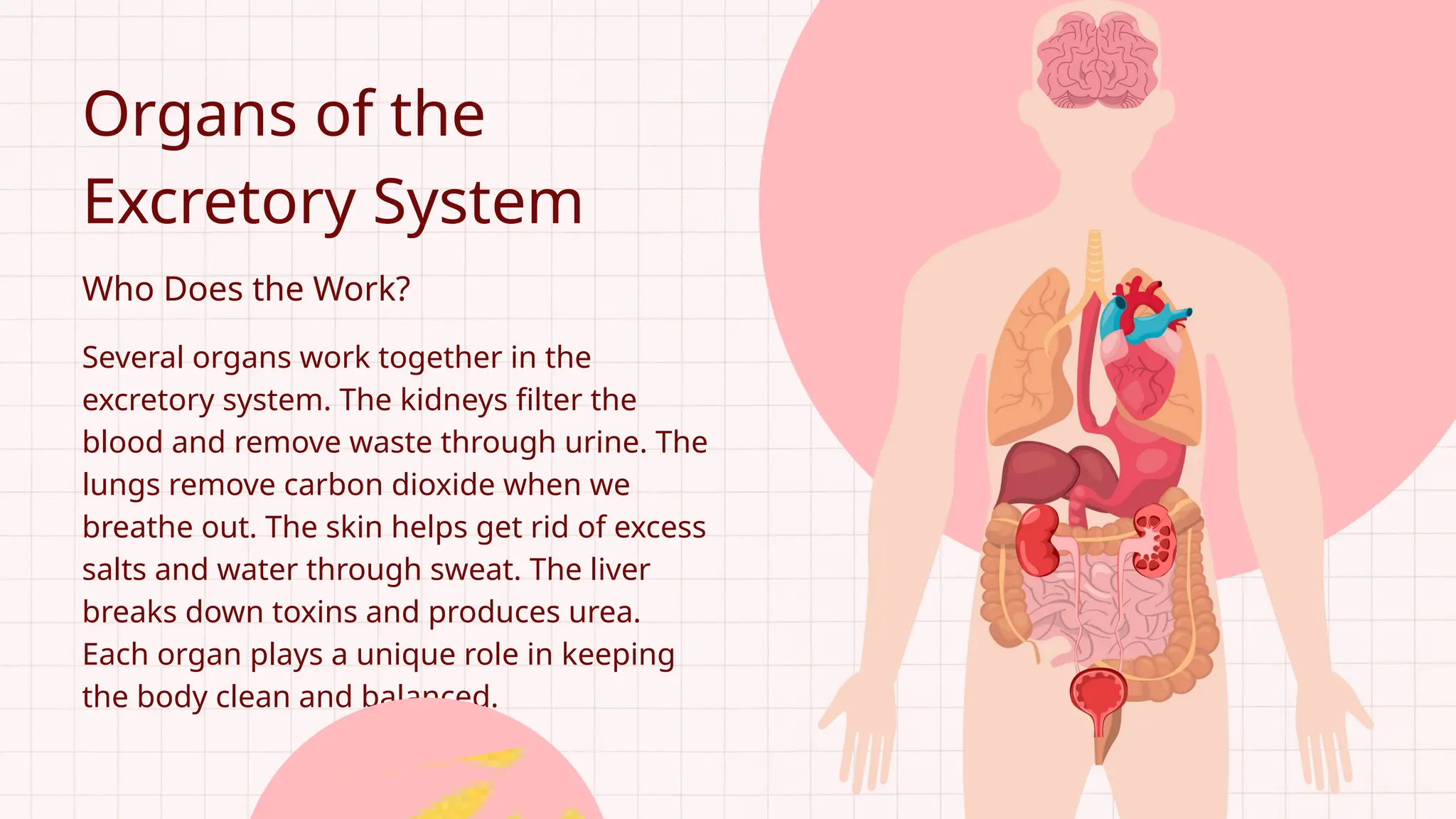
Organs of the
ExcretorySystem
Several organs work together in the
excretory system. The kidneys filter the
blood and remove waste through urine. The
lungs remove carbon dioxide when we
breathe out. The skin helps get rid of excess
salts and water through sweat. The liver
breaks down toxins and produces urea.
Each organ plays a unique role in keeping
the body clean and balanced.
Who Does the Work?
6.
Urine Pathway
Once thekidneys make urine, it
travels through thin tubes called
ureters to the bladder, where it is
stored. When the bladder gets full,
nerves tell your brain it’s time to go to
the bathroom. Urine leaves the body
through the urethra. This process
helps remove waste and extra fluid.
How Urine Leaves the Body
7.
The Lungs
The lungsare also part of the
excretory system because they
remove carbon dioxide, a waste gas
produced during respiration. When
you breathe in, you take in oxygen,
and when you breathe out, you get rid
of carbon dioxide. This gas exchange
helps keep your blood at the right pH
and keeps your cells working properly.
Exhaling Carbon Dioxide
8.
The Skin
Your skinhelps remove waste through
sweat. Sweat contains water, salt, and
small amounts of urea. When your
body gets hot, sweat also helps cool
you down. Although sweating doesn’t
remove large amounts of waste, it
plays an important role in
temperature control and getting rid of
some unwanted substances.
Skin and the Sweat Glands
9.
The Liver
The liveris a large organ with many
jobs, including breaking down
harmful substances like drugs and
alcohol. It also changes extra amino
acids from food into urea, which then
goes to the kidneys. While the liver
doesn’t remove waste itself, it makes
sure that toxic substances can be
safely filtered out by the kidneys.
Processing Toxins
10.
Why the ExcretorySystem Matters
The excretory system keeps your
body’s internal environment stable.
Without it, waste would build up and
damage cells and organs. Excretion
helps regulate water, salt, and pH
levels in your blood. This process is
crucial for maintaining homeostasis,
which is when your body stays
balanced and healthy.
Keeping Your Body in Balance