EXCRETION
It’s not only to get rid of wastes, it’s the maintenance of
constant equilibrium to preserve health.
www.naturalbornscientist.com
How do we keep ourselves in
equilibrium?
HOMEOSTASIS: Includes the processes by which organisms
maintain their internal environment within a narrow range of
conditions necessary for cells to function properly under
changing conditions.
These changes include
• Temperature
• Water and salt concentrations
• Glucose concentrations
• pH
• Oxygen and carbon dioxide concentration
www.naturalbornscientist.com
Excretion=filtering
Cell membranes in excretory structures serve as filters for
extracellular fluids. In animals it helps filtering blood too.
Through this process, the system keeps osmolarity which
means proper concentration of substances in cells and their
environment (water balance)
www.naturalbornscientist.com
Urinary systems remove wastes from
cellular metabolism
• Water and small molecules are filtered both from blood or
extracellular fluids.
• Nutrients are selectively reabsorbed back from the filtered
fluid.
• Excess of water, nutrients and disolved wastes are excreted
from the body in urine.
www.naturalbornscientist.com
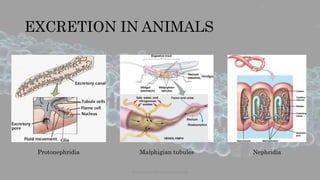
EXCRETION IN ANIMALS
www.naturalbornscientist.com
Protonephridia Malphigian tubules Nephridia
HUMAN URINARY SYSTEM
What kidneys are for…
• Regulate blood levels of ions such as Na, K, Cl and Ca.
• Maintain pH of blood by regulating H and H2CO3
• Regulate water contents.
• Retain important nutrients such as glucose and aminoacids.
• Eliminate cellular waste such as urea.
• Secreting hormones
www.naturalbornscientist.com
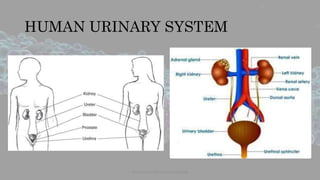
HUMAN URINARY SYSTEM
www.naturalbornscientist.com
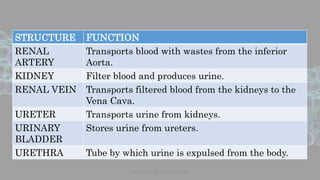
STRUCTURE FUNCTION
RENAL
ARTERY
Transports blood with wastes from the inferior
Aorta.
KIDNEY Filter blood and produces urine.
RENAL VEIN Transports filtered blood from the kidneys to the
Vena Cava.
URETER Transports urine from kidneys.
URINARY
BLADDER
Stores urine from ureters.
URETHRA Tube by which urine is expulsed from the body.
www.naturalbornscientist.com
In the
inside…
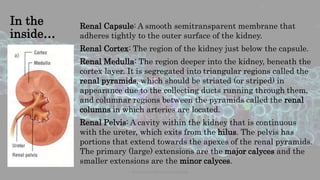
Renal Capsule: A smooth semitransparent membrane that
adheres tightly to the outer surface of the kidney.
Renal Cortex: The region of the kidney just below the capsule.
Renal Medulla: The region deeper into the kidney, beneath the
cortex layer. It is segregated into triangular regions called the
renal pyramids, which should be striated (or striped) in
appearance due to the collecting ducts running through them,
and columnar regions between the pyramids called the renal
columns in which arteries are located.
Renal Pelvis: A cavity within the kidney that is continuous
with the ureter, which exits from the hilus. The pelvis has
portions that extend towards the apexes of the renal pyramids.
The primary (large) extensions are the major calyces and the
smaller extensions are the minor calyces.
www.naturalbornscientist.com
Within the pyramids
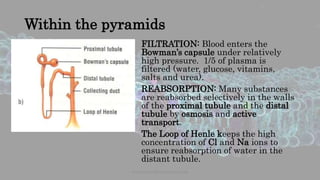
FILTRATION: Blood enters the
Bowman’s capsule under relatively
high pressure. 1/5 of plasma is
filtered (water, glucose, vitamins,
salts and urea).
REABSORPTION: Many substances
are reabsorbed selectively in the walls
of the proximal tubule and the distal
tubule by osmosis and active
transport.
The Loop of Henle keeps the high
concentration of Cl and Na ions to
ensure reabsorption of water in the
distant tubule.
www.naturalbornscientist.com
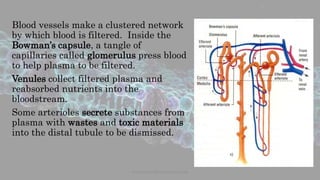
Blood vessels make a clustered network
by which blood is filtered. Inside the
Bowman’s capsule, a tangle of
capillaries called glomerulus press blood
to help plasma to be filtered.
Venules collect filtered plasma and
reabsorbed nutrients into the
bloodstream.
Some arterioles secrete substances from
plasma with wastes and toxic materials
into the distal tubule to be dismissed.
www.naturalbornscientist.com
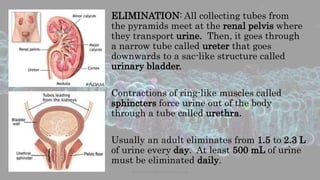
ELIMINATION: All collecting tubes from
the pyramids meet at the renal pelvis where
they transport urine. Then, it goes through
a narrow tube called ureter that goes
downwards to a sac-like structure called
urinary bladder.
Contractions of ring-like muscles called
sphincters force urine out of the body
through a tube called urethra.
Usually an adult eliminates from 1.5 to 2.3 L
of urine every day. At least 500 mL of urine
must be eliminated daily.
www.naturalbornscientist.com

Excretion

  • 1.
    EXCRETION It’s not onlyto get rid of wastes, it’s the maintenance of constant equilibrium to preserve health. www.naturalbornscientist.com
  • 2.
    How do wekeep ourselves in equilibrium? HOMEOSTASIS: Includes the processes by which organisms maintain their internal environment within a narrow range of conditions necessary for cells to function properly under changing conditions. These changes include • Temperature • Water and salt concentrations • Glucose concentrations • pH • Oxygen and carbon dioxide concentration www.naturalbornscientist.com
  • 3.
    Excretion=filtering Cell membranes inexcretory structures serve as filters for extracellular fluids. In animals it helps filtering blood too. Through this process, the system keeps osmolarity which means proper concentration of substances in cells and their environment (water balance) www.naturalbornscientist.com
  • 4.
    Urinary systems removewastes from cellular metabolism • Water and small molecules are filtered both from blood or extracellular fluids. • Nutrients are selectively reabsorbed back from the filtered fluid. • Excess of water, nutrients and disolved wastes are excreted from the body in urine. www.naturalbornscientist.com
  • 5.
  • 6.
    HUMAN URINARY SYSTEM Whatkidneys are for… • Regulate blood levels of ions such as Na, K, Cl and Ca. • Maintain pH of blood by regulating H and H2CO3 • Regulate water contents. • Retain important nutrients such as glucose and aminoacids. • Eliminate cellular waste such as urea. • Secreting hormones www.naturalbornscientist.com
  • 7.
  • 8.
    STRUCTURE FUNCTION RENAL ARTERY Transports bloodwith wastes from the inferior Aorta. KIDNEY Filter blood and produces urine. RENAL VEIN Transports filtered blood from the kidneys to the Vena Cava. URETER Transports urine from kidneys. URINARY BLADDER Stores urine from ureters. URETHRA Tube by which urine is expulsed from the body. www.naturalbornscientist.com
  • 9.
    In the inside… Renal Capsule:A smooth semitransparent membrane that adheres tightly to the outer surface of the kidney. Renal Cortex: The region of the kidney just below the capsule. Renal Medulla: The region deeper into the kidney, beneath the cortex layer. It is segregated into triangular regions called the renal pyramids, which should be striated (or striped) in appearance due to the collecting ducts running through them, and columnar regions between the pyramids called the renal columns in which arteries are located. Renal Pelvis: A cavity within the kidney that is continuous with the ureter, which exits from the hilus. The pelvis has portions that extend towards the apexes of the renal pyramids. The primary (large) extensions are the major calyces and the smaller extensions are the minor calyces. www.naturalbornscientist.com
  • 10.
    Within the pyramids FILTRATION:Blood enters the Bowman’s capsule under relatively high pressure. 1/5 of plasma is filtered (water, glucose, vitamins, salts and urea). REABSORPTION: Many substances are reabsorbed selectively in the walls of the proximal tubule and the distal tubule by osmosis and active transport. The Loop of Henle keeps the high concentration of Cl and Na ions to ensure reabsorption of water in the distant tubule. www.naturalbornscientist.com
  • 11.
    Blood vessels makea clustered network by which blood is filtered. Inside the Bowman’s capsule, a tangle of capillaries called glomerulus press blood to help plasma to be filtered. Venules collect filtered plasma and reabsorbed nutrients into the bloodstream. Some arterioles secrete substances from plasma with wastes and toxic materials into the distal tubule to be dismissed. www.naturalbornscientist.com
  • 12.
    ELIMINATION: All collectingtubes from the pyramids meet at the renal pelvis where they transport urine. Then, it goes through a narrow tube called ureter that goes downwards to a sac-like structure called urinary bladder. Contractions of ring-like muscles called sphincters force urine out of the body through a tube called urethra. Usually an adult eliminates from 1.5 to 2.3 L of urine every day. At least 500 mL of urine must be eliminated daily. www.naturalbornscientist.com