1/9/2014

Slides excerpted from my upcoming class in Colombus, Ohio on Fracturing.
(There are some slides left out, so the slides may not "flow" from one to the
next).

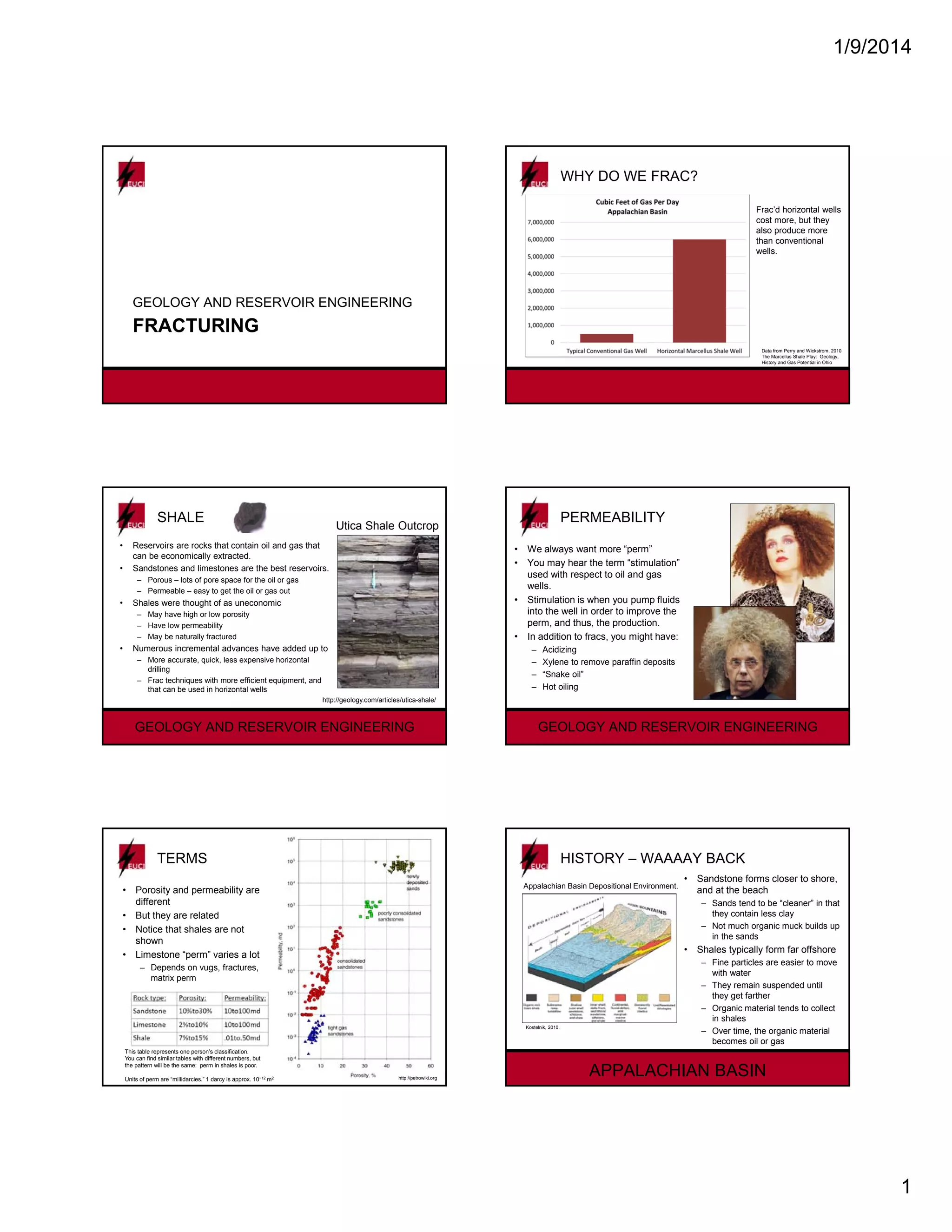
WHY DO WE FRAC?
Frac’d horizontal wells
cost more, but they
also produce more
than conventional
wells.

GEOLOGY AND RESERVOIR ENGINEERING

FRACTURING
Data from Perry and Wickstrom, 2010
The Marcellus Shale Play: Geology,
History and Gas Potential in Ohio

SHALE
•
•

Reservoirs are rocks that contain oil and gas that
can be economically extracted.
Sandstones and limestones are the best reservoirs.

• We always want more “perm”
• You may hear the term “stimulation”
used with respect to oil and gas
wells.
• Stimulation is when you pump fluids
into the well in order to improve the
perm, and thus, the production.
• In addition to fracs, you might have:

– Porous – lots of pore space for the oil or gas
– Permeable – easy to get the oil or gas out

•

Shales were thought of as uneconomic
– May have high or low porosity
– Have low permeability
– May be naturally fractured

•

PERMEABILITY

Utica Shale Outcrop

Numerous incremental advances have added up to

–
–
–
–

– More accurate, quick, less expensive horizontal
drilling
– Frac techniques with more efficient equipment, and
that can be used in horizontal wells

Acidizing
Xylene to remove paraffin deposits
“Snake oil”
Hot oiling

http://geology.com/articles/utica-shale/

GEOLOGY AND RESERVOIR ENGINEERING

GEOLOGY AND RESERVOIR ENGINEERING

TERMS

HISTORY – WAAAAY BACK
Appalachian Basin Depositional Environment.

• Porosity and permeability are
different
• But they are related
• Notice that shales are not
shown
• Limestone “perm” varies a lot

– Sands tend to be “cleaner” in that
they contain less clay
– Not much organic muck builds up
in the sands

• Shales typically form far offshore

– Depends on vugs, fractures,
matrix perm

Kostelnik, 2010.

This table represents one person’s classification.
You can find similar tables with different numbers, but
the pattern will be the same: perm in shales is poor.
Units of perm are “millidarcies.” 1 darcy is approx. 10−12 m2

• Sandstone forms closer to shore,
and at the beach

http://petrowiki.org

– Fine particles are easier to move
with water
– They remain suspended until
they get farther
– Organic material tends to collect
in shales
– Over time, the organic material
becomes oil or gas

APPALACHIAN BASIN

1
Slides excerpted from my upcoming class in Colombus, Ohio on Fracturing.
(There are some slides left out, so the slides may not "flow" from one to the
next).

FRACTURING
• Suffice it to say that the
geologists and reservoir
engineers figure out where the
fracs need to be
– Some considerations will be
on next slide

• The drilling and completions
engineers then figure out
where to put the well in order
to accomplish this scope

1/9/2014

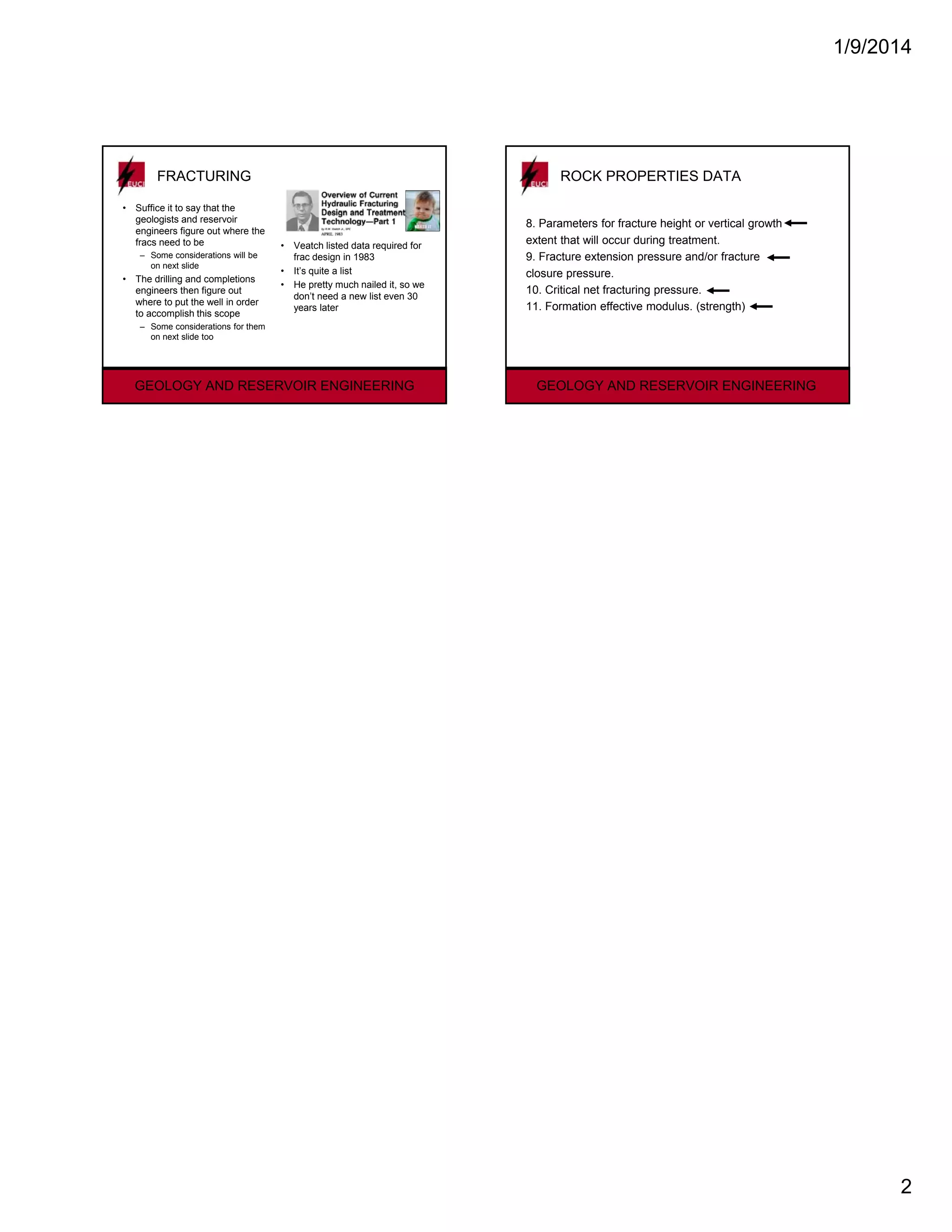
ROCK PROPERTIES DATA

• Veatch listed data required for
frac design in 1983
• It’s quite a list
• He pretty much nailed it, so we
don’t need a new list even 30
years later

8. Parameters for fracture height or vertical growth
extent that will occur during treatment.
9. Fracture extension pressure and/or fracture
closure pressure.
10. Critical net fracturing pressure.
11. Formation effective modulus. (strength)

– Some considerations for them
on next slide too

GEOLOGY AND RESERVOIR ENGINEERING

GEOLOGY AND RESERVOIR ENGINEERING

2

Examples from frac presentation: geology

  • 1.
    1/9/2014 Slides excerpted frommy upcoming class in Colombus, Ohio on Fracturing. (There are some slides left out, so the slides may not "flow" from one to the next). WHY DO WE FRAC? Frac’d horizontal wells cost more, but they also produce more than conventional wells. GEOLOGY AND RESERVOIR ENGINEERING FRACTURING Data from Perry and Wickstrom, 2010 The Marcellus Shale Play: Geology, History and Gas Potential in Ohio SHALE • • Reservoirs are rocks that contain oil and gas that can be economically extracted. Sandstones and limestones are the best reservoirs. • We always want more “perm” • You may hear the term “stimulation” used with respect to oil and gas wells. • Stimulation is when you pump fluids into the well in order to improve the perm, and thus, the production. • In addition to fracs, you might have: – Porous – lots of pore space for the oil or gas – Permeable – easy to get the oil or gas out • Shales were thought of as uneconomic – May have high or low porosity – Have low permeability – May be naturally fractured • PERMEABILITY Utica Shale Outcrop Numerous incremental advances have added up to – – – – – More accurate, quick, less expensive horizontal drilling – Frac techniques with more efficient equipment, and that can be used in horizontal wells Acidizing Xylene to remove paraffin deposits “Snake oil” Hot oiling http://geology.com/articles/utica-shale/ GEOLOGY AND RESERVOIR ENGINEERING GEOLOGY AND RESERVOIR ENGINEERING TERMS HISTORY – WAAAAY BACK Appalachian Basin Depositional Environment. • Porosity and permeability are different • But they are related • Notice that shales are not shown • Limestone “perm” varies a lot – Sands tend to be “cleaner” in that they contain less clay – Not much organic muck builds up in the sands • Shales typically form far offshore – Depends on vugs, fractures, matrix perm Kostelnik, 2010. This table represents one person’s classification. You can find similar tables with different numbers, but the pattern will be the same: perm in shales is poor. Units of perm are “millidarcies.” 1 darcy is approx. 10−12 m2 • Sandstone forms closer to shore, and at the beach http://petrowiki.org – Fine particles are easier to move with water – They remain suspended until they get farther – Organic material tends to collect in shales – Over time, the organic material becomes oil or gas APPALACHIAN BASIN 1
  • 2.
    Slides excerpted frommy upcoming class in Colombus, Ohio on Fracturing. (There are some slides left out, so the slides may not "flow" from one to the next). FRACTURING • Suffice it to say that the geologists and reservoir engineers figure out where the fracs need to be – Some considerations will be on next slide • The drilling and completions engineers then figure out where to put the well in order to accomplish this scope 1/9/2014 ROCK PROPERTIES DATA • Veatch listed data required for frac design in 1983 • It’s quite a list • He pretty much nailed it, so we don’t need a new list even 30 years later 8. Parameters for fracture height or vertical growth extent that will occur during treatment. 9. Fracture extension pressure and/or fracture closure pressure. 10. Critical net fracturing pressure. 11. Formation effective modulus. (strength) – Some considerations for them on next slide too GEOLOGY AND RESERVOIR ENGINEERING GEOLOGY AND RESERVOIR ENGINEERING 2