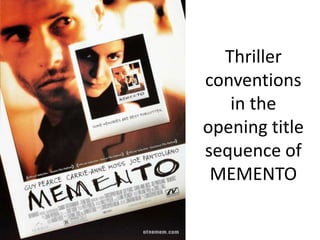
Thriller
conventions
   in the
opening title
sequence of
 MEMENTO
Introduction to the film
• Memento is a 2000 American neo-noir
  psychological thriller film written and directed
  by Christopher Nolan, adapted from his
  younger brother Jonathan's short story
  "Memento Mori".
• A man, suffering from short-term memory
  loss, uses notes, Polaroid's and tattoos to hunt
  for the man he thinks killed his wife.
Memento Opening Sequence and
      Thriller Conventions
• http://youtu.be/8HnW_930nmQ
• A series of/ one important enigma(s) are/is set up in the opening
  sequence of the film, is further complicated during the first part of
  the film and only resolved at the very end.
• The narrative centre's around a crime e.g.. a theft or a murder.
• The protagonist is fallible and has an 'Achilles heel' that is exploited
  by the antagonist.
• The antagonist ensnares the protagonist in an increasingly complex
  web, until the protagonist feels isolated and helpless.
• Micro elements combine in a build up of suspense.
• Themes of seeing, reflection and mirroring. Manipulation of
  perspectives, visual McGuffins, and optical illusions are common.
• Themes of identity are common: mistaken identity,
  doubling/doppelgangers, amnesia.
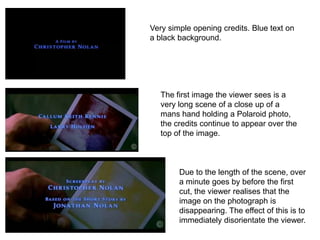
Very simple opening credits. Blue text on
a black background.


   The first image the viewer sees is a
   very long scene of a close up of a
   mans hand holding a Polaroid photo,
   the credits continue to appear over the
   top of the image.


        Due to the length of the scene, over
        a minute goes by before the first
        cut, the viewer realises that the
        image on the photograph is
        disappearing. The effect of this is to
        immediately disorientate the viewer.
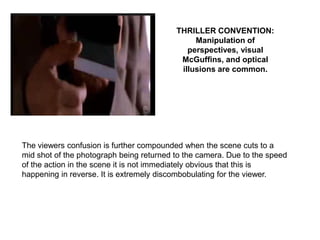
THRILLER CONVENTION:
                                               Manipulation of
                                             perspectives, visual
                                           McGuffins, and optical
                                           illusions are common.


The viewers confusion is further compounded when the scene cuts to a
mid shot of the photograph being returned to the camera. Due to the speed
of the action in the scene it is not immediately obvious that this is
happening in reverse. It is extremely discombobulating for the viewer.
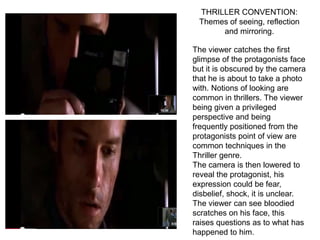
THRILLER CONVENTION:
 Themes of seeing, reflection
      and mirroring.

The viewer catches the first
glimpse of the protagonists face
but it is obscured by the camera
that he is about to take a photo
with. Notions of looking are
common in thrillers. The viewer
being given a privileged
perspective and being
frequently positioned from the
protagonists point of view are
common techniques in the
Thriller genre.
The camera is then lowered to
reveal the protagonist, his
expression could be fear,
disbelief, shock, it is unclear.
The viewer can see bloodied
scratches on his face, this
raises questions as to what has
happened to him.
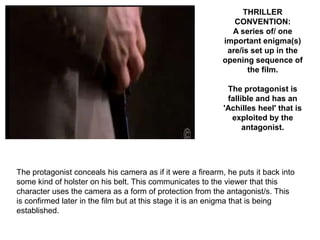
THRILLER
                                                               CONVENTION:
                                                              A series of/ one
                                                            important enigma(s)
                                                             are/is set up in the
                                                            opening sequence of
                                                                   the film.

                                                             The protagonist is
                                                             fallible and has an
                                                            'Achilles heel' that is
                                                              exploited by the
                                                                  antagonist.


The protagonist conceals his camera as if it were a firearm, he puts it back into
some kind of holster on his belt. This communicates to the viewer that this
character uses the camera as a form of protection from the antagonist/s. This
is confirmed later in the film but at this stage it is an enigma that is being
established.
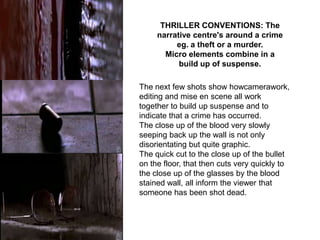
THRILLER CONVENTIONS: The
     narrative centre's around a crime
          eg. a theft or a murder.
       Micro elements combine in a
           build up of suspense.

The next few shots show howcamerawork,
editing and mise en scene all work
together to build up suspense and to
indicate that a crime has occurred.
The close up of the blood very slowly
seeping back up the wall is not only
disorientating but quite graphic.
The quick cut to the close up of the bullet
on the floor, that then cuts very quickly to
the close up of the glasses by the blood
stained wall, all inform the viewer that
someone has been shot dead.
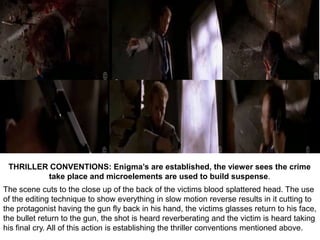
THRILLER CONVENTIONS: Enigma’s are established, the viewer sees the crime
         take place and microelements are used to build suspense.
The scene cuts to the close up of the back of the victims blood splattered head. The use
of the editing technique to show everything in slow motion reverse results in it cutting to
the protagonist having the gun fly back in his hand, the victims glasses return to his face,
the bullet return to the gun, the shot is heard reverberating and the victim is heard taking
his final cry. All of this action is establishing the thriller conventions mentioned above.
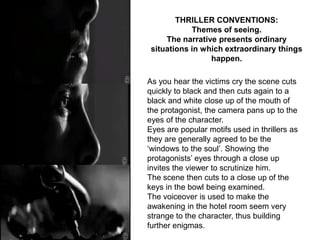
THRILLER CONVENTIONS:
            Themes of seeing.
     The narrative presents ordinary
 situations in which extraordinary things
                 happen.

As you hear the victims cry the scene cuts
quickly to black and then cuts again to a
black and white close up of the mouth of
the protagonist, the camera pans up to the
eyes of the character.
Eyes are popular motifs used in thrillers as
they are generally agreed to be the
‘windows to the soul’. Showing the
protagonists’ eyes through a close up
invites the viewer to scrutinize him.
The scene then cuts to a close up of the
keys in the bowl being examined.
The voiceover is used to make the
awakening in the hotel room seem very
strange to the character, thus building
further enigmas.
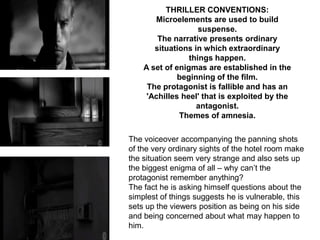
THRILLER CONVENTIONS:
       Microelements are used to build
                    suspense.
        The narrative presents ordinary
       situations in which extraordinary
                 things happen.
    A set of enigmas are established in the
              beginning of the film.
     The protagonist is fallible and has an
     'Achilles heel' that is exploited by the
                   antagonist.
              Themes of amnesia.

The voiceover accompanying the panning shots
of the very ordinary sights of the hotel room make
the situation seem very strange and also sets up
the biggest enigma of all – why can’t the
protagonist remember anything?
The fact he is asking himself questions about the
simplest of things suggests he is vulnerable, this
sets up the viewers position as being on his side
and being concerned about what may happen to
him.
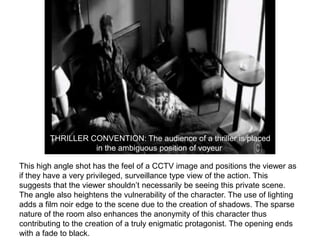
THRILLER CONVENTION: The audience of a thriller is placed
                  in the ambiguous position of voyeur.

This high angle shot has the feel of a CCTV image and positions the viewer as
if they have a very privileged, surveillance type view of the action. This
suggests that the viewer shouldn’t necessarily be seeing this private scene.
The angle also heightens the vulnerability of the character. The use of lighting
adds a film noir edge to the scene due to the creation of shadows. The sparse
nature of the room also enhances the anonymity of this character thus
contributing to the creation of a truly enigmatic protagonist. The opening ends
with a fade to black.
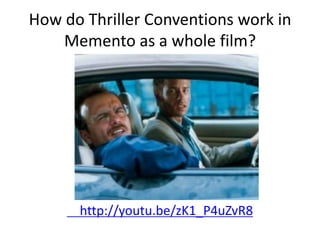
How do Thriller Conventions work in
    Memento as a whole film?


      http://youtu.be/zK1_P4uZvR8

Memento & thriller conventions

  • 1.
    Thriller conventions in the opening title sequence of MEMENTO
  • 2.
    Introduction to thefilm • Memento is a 2000 American neo-noir psychological thriller film written and directed by Christopher Nolan, adapted from his younger brother Jonathan's short story "Memento Mori". • A man, suffering from short-term memory loss, uses notes, Polaroid's and tattoos to hunt for the man he thinks killed his wife.
  • 3.
    Memento Opening Sequenceand Thriller Conventions • http://youtu.be/8HnW_930nmQ • A series of/ one important enigma(s) are/is set up in the opening sequence of the film, is further complicated during the first part of the film and only resolved at the very end. • The narrative centre's around a crime e.g.. a theft or a murder. • The protagonist is fallible and has an 'Achilles heel' that is exploited by the antagonist. • The antagonist ensnares the protagonist in an increasingly complex web, until the protagonist feels isolated and helpless. • Micro elements combine in a build up of suspense. • Themes of seeing, reflection and mirroring. Manipulation of perspectives, visual McGuffins, and optical illusions are common. • Themes of identity are common: mistaken identity, doubling/doppelgangers, amnesia.
  • 4.
    Very simple openingcredits. Blue text on a black background. The first image the viewer sees is a very long scene of a close up of a mans hand holding a Polaroid photo, the credits continue to appear over the top of the image. Due to the length of the scene, over a minute goes by before the first cut, the viewer realises that the image on the photograph is disappearing. The effect of this is to immediately disorientate the viewer.
  • 5.
    THRILLER CONVENTION: Manipulation of perspectives, visual McGuffins, and optical illusions are common. The viewers confusion is further compounded when the scene cuts to a mid shot of the photograph being returned to the camera. Due to the speed of the action in the scene it is not immediately obvious that this is happening in reverse. It is extremely discombobulating for the viewer.
  • 6.
    THRILLER CONVENTION: Themesof seeing, reflection and mirroring. The viewer catches the first glimpse of the protagonists face but it is obscured by the camera that he is about to take a photo with. Notions of looking are common in thrillers. The viewer being given a privileged perspective and being frequently positioned from the protagonists point of view are common techniques in the Thriller genre. The camera is then lowered to reveal the protagonist, his expression could be fear, disbelief, shock, it is unclear. The viewer can see bloodied scratches on his face, this raises questions as to what has happened to him.
  • 7.
    THRILLER CONVENTION: A series of/ one important enigma(s) are/is set up in the opening sequence of the film. The protagonist is fallible and has an 'Achilles heel' that is exploited by the antagonist. The protagonist conceals his camera as if it were a firearm, he puts it back into some kind of holster on his belt. This communicates to the viewer that this character uses the camera as a form of protection from the antagonist/s. This is confirmed later in the film but at this stage it is an enigma that is being established.
  • 8.
    THRILLER CONVENTIONS: The narrative centre's around a crime eg. a theft or a murder. Micro elements combine in a build up of suspense. The next few shots show howcamerawork, editing and mise en scene all work together to build up suspense and to indicate that a crime has occurred. The close up of the blood very slowly seeping back up the wall is not only disorientating but quite graphic. The quick cut to the close up of the bullet on the floor, that then cuts very quickly to the close up of the glasses by the blood stained wall, all inform the viewer that someone has been shot dead.
  • 9.
    THRILLER CONVENTIONS: Enigma’sare established, the viewer sees the crime take place and microelements are used to build suspense. The scene cuts to the close up of the back of the victims blood splattered head. The use of the editing technique to show everything in slow motion reverse results in it cutting to the protagonist having the gun fly back in his hand, the victims glasses return to his face, the bullet return to the gun, the shot is heard reverberating and the victim is heard taking his final cry. All of this action is establishing the thriller conventions mentioned above.
  • 10.
    THRILLER CONVENTIONS: Themes of seeing. The narrative presents ordinary situations in which extraordinary things happen. As you hear the victims cry the scene cuts quickly to black and then cuts again to a black and white close up of the mouth of the protagonist, the camera pans up to the eyes of the character. Eyes are popular motifs used in thrillers as they are generally agreed to be the ‘windows to the soul’. Showing the protagonists’ eyes through a close up invites the viewer to scrutinize him. The scene then cuts to a close up of the keys in the bowl being examined. The voiceover is used to make the awakening in the hotel room seem very strange to the character, thus building further enigmas.
  • 11.
    THRILLER CONVENTIONS: Microelements are used to build suspense. The narrative presents ordinary situations in which extraordinary things happen. A set of enigmas are established in the beginning of the film. The protagonist is fallible and has an 'Achilles heel' that is exploited by the antagonist. Themes of amnesia. The voiceover accompanying the panning shots of the very ordinary sights of the hotel room make the situation seem very strange and also sets up the biggest enigma of all – why can’t the protagonist remember anything? The fact he is asking himself questions about the simplest of things suggests he is vulnerable, this sets up the viewers position as being on his side and being concerned about what may happen to him.
  • 12.
    THRILLER CONVENTION: Theaudience of a thriller is placed in the ambiguous position of voyeur. This high angle shot has the feel of a CCTV image and positions the viewer as if they have a very privileged, surveillance type view of the action. This suggests that the viewer shouldn’t necessarily be seeing this private scene. The angle also heightens the vulnerability of the character. The use of lighting adds a film noir edge to the scene due to the creation of shadows. The sparse nature of the room also enhances the anonymity of this character thus contributing to the creation of a truly enigmatic protagonist. The opening ends with a fade to black.
  • 13.
    How do ThrillerConventions work in Memento as a whole film? http://youtu.be/zK1_P4uZvR8