Teacher Training: Exam Papers
Refresher
Secondary Section
Date: Wednesday, 4th September
2024
Introduction
• Background: Secondary school teachers play a
crucial role in preparing students for their
exams. However, regular refreshers on exam
paper setting, grading, and analysis are
essential to maintain high standards and
ensure consistency in assessment.
• Purpose: The purpose of this training proposal
is to provide a refresher course for secondary
school teachers on the preparation,
Objectives
• • To update teachers on the latest
examination guidelines and standards.
• • To enhance teachers' skills in designing fair
and balanced exam papers.
• • To improve consistency and accuracy in
grading and marking.
• • To develop teachers' ability to analyze exam
results for student performance insights.
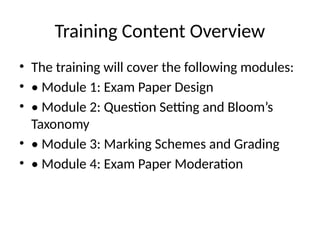
Training Content Overview
• The training will cover the following modules:
• • Module 1: Exam Paper Design
• • Module 2: Question Setting and Bloom’s
Taxonomy
• • Module 3: Marking Schemes and Grading
• • Module 4: Exam Paper Moderation
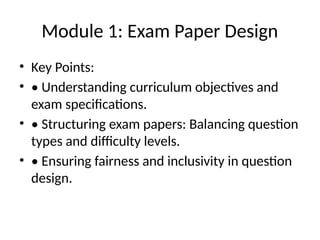
Module 1: Exam Paper Design
• Key Points:
• • Understanding curriculum objectives and
exam specifications.
• • Structuring exam papers: Balancing question
types and difficulty levels.
• • Ensuring fairness and inclusivity in question
design.
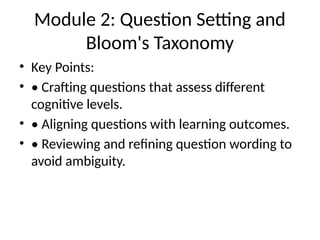
Module 2: Question Setting and
Bloom's Taxonomy
• Key Points:
• • Crafting questions that assess different
cognitive levels.
• • Aligning questions with learning outcomes.
• • Reviewing and refining question wording to
avoid ambiguity.
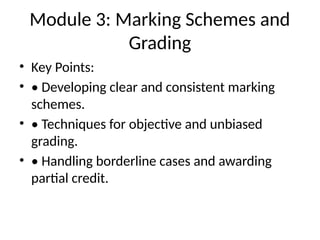
Module 3: Marking Schemes and
Grading
• Key Points:
• • Developing clear and consistent marking
schemes.
• • Techniques for objective and unbiased
grading.
• • Handling borderline cases and awarding
partial credit.
Module 4: Exam Paper Moderation
• Key Points:
• • Peer review processes for exam papers.
• • Ensuring alignment with curriculum and
assessment standards.
• • Addressing common errors and improving
exam quality.
Training Methodology
• • Workshops: Interactive sessions with
practical exercises in exam paper design and
grading.
• • Case Studies: Analysis of sample exam
papers and grading scenarios.
• • Peer Review Sessions: Collaborative
moderation and feedback exercises.
• • Discussion Groups: Focused discussions on
challenges and solutions in exam preparation.
Duration and Schedule
• Total Duration: 1 day
• Schedule:
• Section 1: Exam Paper Design
• Section 2: Question Setting
• Section 3: Marking Schemes and Moderation
Resources Required
• • Sample exam papers and marking schemes
for practice.
• • Computers/tablets for access to curriculum
guides and assessment standards.
• • Venue equipped with presentation tools
(projector, whiteboard).
Evaluation
• • Pre-Training Assessment: Survey to assess
teachers' current practices in exam
preparation.
• • Post-Training Assessment: Evaluation
through quizzes and practical exercises.
• • Feedback Surveys: Collecting feedback on
the effectiveness of the training.
Expected Outcomes
• • Teachers will be proficient in designing well-
structured and fair exam papers.
• • Enhanced consistency in grading and
marking across the department.
• • Improved ability to analyze exam results and
apply insights to teaching.
• • Standardization of exam preparation
processes across the school.
Conclusion
• • Emphasize the importance of continuous
professional development in maintaining high
assessment standards.
• • Highlight the anticipated positive impact on
student outcomes and teaching quality.
Questions and Answers
• Please feel free to ask any questions you may
have.
Thank You!
• Contact Information:
• [Your Email/Phone]

Exam_Papers_Refresher_Training_Presentation.pptx

  • 1.
    Teacher Training: ExamPapers Refresher Secondary Section Date: Wednesday, 4th September 2024
  • 2.
    Introduction • Background: Secondaryschool teachers play a crucial role in preparing students for their exams. However, regular refreshers on exam paper setting, grading, and analysis are essential to maintain high standards and ensure consistency in assessment. • Purpose: The purpose of this training proposal is to provide a refresher course for secondary school teachers on the preparation,
  • 3.
    Objectives • • Toupdate teachers on the latest examination guidelines and standards. • • To enhance teachers' skills in designing fair and balanced exam papers. • • To improve consistency and accuracy in grading and marking. • • To develop teachers' ability to analyze exam results for student performance insights.
  • 4.
    Training Content Overview •The training will cover the following modules: • • Module 1: Exam Paper Design • • Module 2: Question Setting and Bloom’s Taxonomy • • Module 3: Marking Schemes and Grading • • Module 4: Exam Paper Moderation
  • 5.
    Module 1: ExamPaper Design • Key Points: • • Understanding curriculum objectives and exam specifications. • • Structuring exam papers: Balancing question types and difficulty levels. • • Ensuring fairness and inclusivity in question design.
  • 6.
    Module 2: QuestionSetting and Bloom's Taxonomy • Key Points: • • Crafting questions that assess different cognitive levels. • • Aligning questions with learning outcomes. • • Reviewing and refining question wording to avoid ambiguity.
  • 7.
    Module 3: MarkingSchemes and Grading • Key Points: • • Developing clear and consistent marking schemes. • • Techniques for objective and unbiased grading. • • Handling borderline cases and awarding partial credit.
  • 8.
    Module 4: ExamPaper Moderation • Key Points: • • Peer review processes for exam papers. • • Ensuring alignment with curriculum and assessment standards. • • Addressing common errors and improving exam quality.
  • 9.
    Training Methodology • •Workshops: Interactive sessions with practical exercises in exam paper design and grading. • • Case Studies: Analysis of sample exam papers and grading scenarios. • • Peer Review Sessions: Collaborative moderation and feedback exercises. • • Discussion Groups: Focused discussions on challenges and solutions in exam preparation.
  • 10.
    Duration and Schedule •Total Duration: 1 day • Schedule: • Section 1: Exam Paper Design • Section 2: Question Setting • Section 3: Marking Schemes and Moderation
  • 11.
    Resources Required • •Sample exam papers and marking schemes for practice. • • Computers/tablets for access to curriculum guides and assessment standards. • • Venue equipped with presentation tools (projector, whiteboard).
  • 12.
    Evaluation • • Pre-TrainingAssessment: Survey to assess teachers' current practices in exam preparation. • • Post-Training Assessment: Evaluation through quizzes and practical exercises. • • Feedback Surveys: Collecting feedback on the effectiveness of the training.
  • 13.
    Expected Outcomes • •Teachers will be proficient in designing well- structured and fair exam papers. • • Enhanced consistency in grading and marking across the department. • • Improved ability to analyze exam results and apply insights to teaching. • • Standardization of exam preparation processes across the school.
  • 14.
    Conclusion • • Emphasizethe importance of continuous professional development in maintaining high assessment standards. • • Highlight the anticipated positive impact on student outcomes and teaching quality.
  • 15.
    Questions and Answers •Please feel free to ask any questions you may have.
  • 16.
    Thank You! • ContactInformation: • [Your Email/Phone]