• What is press freedom?
• Identify one element of press freedom.
• What is the editors’ code of practice?
• Identify and explain two reasons for press regulation as listed in the editors’
code of practice.
Exam style questions: Regulation
• Who regulates the press in the UK?
• Who regulated the press in the UK before?
• What happened in the UK that prompted the change in regulators? Explain your
answer.
Exam style questions: Regulation
Exam style questions: Ownership
• Identify which of the following describes who is allowed to set up and run a
newspaper in a country with a free press:
• anybody
• people registered by the state
• people registered by the regulator.
Exam style questions: Ownership
• Who is the owner of The Observer? Explain a bit of its background history.
• What other publications does this company produce?
• How is The Observer funded? Explain two ways newspapers are funded.
• Identify one advantage of reading online newspapers for its audience?
• Identify one advantage for newspaper publishers to go online and drop their
paper editions?
• How are online newspapers funded?
Exam style questions: Online press
• What are the uses and gratifications for newspaper audiences? Explain your
answer.
Exam style questions: Audiences
• What is the political ideology of The Observer?
• What is the primary target audience of The Observer? Provide a
demographic, socio-economic and psychographic profile.
Exam style questions: Audiences
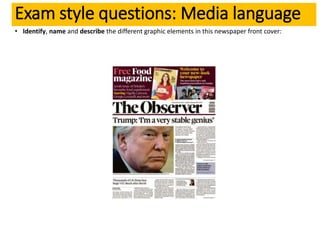
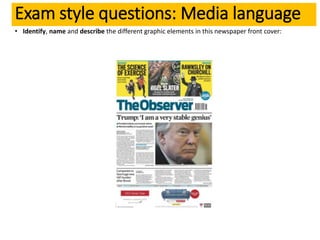
• Identify, name and describe the different graphic elements in this newspaper front cover:
Exam style questions: Media language
• Identify, name and describe the different graphic elements in this newspaper front cover:
Exam style questions: Media language
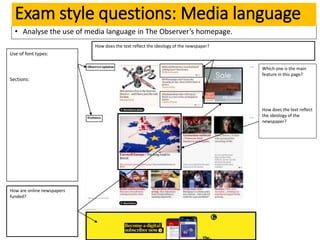
• Analyse the use of media language in The Observer’s homepage.
Exam style questions: Media language
Use of font types:
Sections:
How does the text reflect the ideology of the newspaper?
How are online newspapers
funded?
Which one is the main
feature in this page?
How does the text reflect
the ideology of the
newspaper?
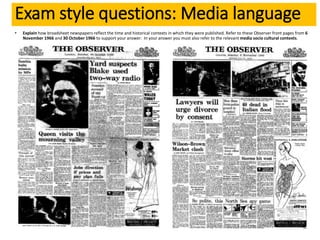
• Explain how broadsheet newspapers reflect the time and historical contexts in which they were published. Refer to these Observer front pages from 6
November 1966 and 30 October 1966 to support your answer. In your answer you must also refer to the relevant media socio cultural contexts.
Exam style questions: Media language
Explain how broadsheet newspapers reflect the time and historical contexts in which they were published. Refer to these Observer front pages from 6 November 1966
and 30 October 1966 to support your answer. In your answer you must also refer to the relevant media socio cultural contexts.
Example OF A Level 3 answer:
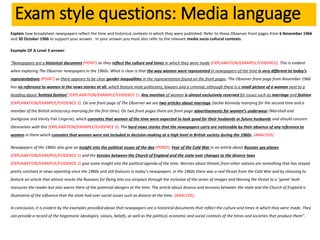
“Newspapers are a historical document (POINT) as they reflect the culture and times in which they were made (EXPLANATION/EXAMPLE/EVIDENCE). This is evident
when exploring The Observer newspapers in the 1960s. What is clear is that the way women were represented in newspapers of the time is very different to today’s
representations (POINT) as there appears to be clear gender inequalities in the representation found on the front pages. The Observer front page from November 1966
has no reference to women in the news stories at all, which feature male politicians, lawyers and a criminal, although there is a small picture of a woman next to a
heading about ‘knitted fashion’ (EXPLANATION/EXAMPLE/EVIDENCE 1). Any mention of women is almost exclusively reserved for issues such as marriage and fashion
(EXPLANATION/EXAMPLE/EVIDENCE 2). On one front page of The Observer we see two articles about marriage (Jackie Kennedy marrying for the second time and a
member of the British aristocracy marrying for the first time). On two front pages there are front page advertisements for women’s underwear (Marshall and
Snellgrove and Vanity Fair Lingerie), which connotes that women of the time were expected to look good for their husbands or future husbands and should concern
themselves with this (EXPLANATION/EXAMPLE/EVIDENCE 3). The hard news stories that the newspapers carry are noticeable by their absence of any reference to
women in them which connotes that women were not included in decision-making at a high level in British society during the 1960s. (ANALYSIS).
Newspapers of the 1960s also give an insight into the political issues of the day (POINT). Fear of the Cold War in an article about Russian spy planes
(EXPLANATION/EXAMPLE/EVIDENCE 1) and the tension between the Church of England and the state over changes to the divorce laws
(EXPLANATION/EXAMPLE/EVIDENCE 2) give some insight into the political agenda of the time. Worries about threats from other nations are something that has stayed
pretty constant in news reporting since the 1960s and still features in today’s newspapers. In the 1960s there was a real threat from the Cold War and by choosing to
feature an article that almost mocks the Russians for flying into our airspace through the inclusion of the series of images and likening the threat to a ‘game’ both
reassures the reader but also warns them of the potential dangers at the time. The article about divorce and tensions between the state and the Church of England is
illustrative of the influence that the state had over social issues such as divorce at the time. (ANALYSIS).
In conclusion, it is evident by the examples provided above that newspapers are a historical documents that reflect the culture and times in which they were made. They
can provide a record of the hegemonic ideologies, values, beliefs, as well as the political, economic and social contexts of the times and societies that produce them”.
Exam style questions: Media language
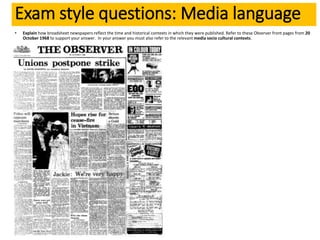
• Explain how broadsheet newspapers reflect the time and historical contexts in which they were published. Refer to these Observer front pages from 20
October 1968 to support your answer. In your answer you must also refer to the relevant media socio cultural contexts.
Exam style questions: Media language
• Explain how broadsheet newspapers reflect the time and historical contexts in which they were published. Refer to these Observer front pages
from 20 October 1968 to support your answer. In your answer you must also refer to the relevant media socio cultural contexts.
• Your answer here:
Exam style questions: Media language

Exam style questions Newspapers

  • 1.
    • What ispress freedom? • Identify one element of press freedom. • What is the editors’ code of practice? • Identify and explain two reasons for press regulation as listed in the editors’ code of practice. Exam style questions: Regulation
  • 2.
    • Who regulatesthe press in the UK? • Who regulated the press in the UK before? • What happened in the UK that prompted the change in regulators? Explain your answer. Exam style questions: Regulation
  • 3.
    Exam style questions:Ownership • Identify which of the following describes who is allowed to set up and run a newspaper in a country with a free press: • anybody • people registered by the state • people registered by the regulator.
  • 4.
    Exam style questions:Ownership • Who is the owner of The Observer? Explain a bit of its background history. • What other publications does this company produce? • How is The Observer funded? Explain two ways newspapers are funded.
  • 5.
    • Identify oneadvantage of reading online newspapers for its audience? • Identify one advantage for newspaper publishers to go online and drop their paper editions? • How are online newspapers funded? Exam style questions: Online press
  • 6.
    • What arethe uses and gratifications for newspaper audiences? Explain your answer. Exam style questions: Audiences
  • 7.
    • What isthe political ideology of The Observer? • What is the primary target audience of The Observer? Provide a demographic, socio-economic and psychographic profile. Exam style questions: Audiences
  • 8.
    • Identify, nameand describe the different graphic elements in this newspaper front cover: Exam style questions: Media language
  • 9.
    • Identify, nameand describe the different graphic elements in this newspaper front cover: Exam style questions: Media language
  • 10.
    • Analyse theuse of media language in The Observer’s homepage. Exam style questions: Media language Use of font types: Sections: How does the text reflect the ideology of the newspaper? How are online newspapers funded? Which one is the main feature in this page? How does the text reflect the ideology of the newspaper?
  • 11.
    • Explain howbroadsheet newspapers reflect the time and historical contexts in which they were published. Refer to these Observer front pages from 6 November 1966 and 30 October 1966 to support your answer. In your answer you must also refer to the relevant media socio cultural contexts. Exam style questions: Media language
  • 12.
    Explain how broadsheetnewspapers reflect the time and historical contexts in which they were published. Refer to these Observer front pages from 6 November 1966 and 30 October 1966 to support your answer. In your answer you must also refer to the relevant media socio cultural contexts. Example OF A Level 3 answer: “Newspapers are a historical document (POINT) as they reflect the culture and times in which they were made (EXPLANATION/EXAMPLE/EVIDENCE). This is evident when exploring The Observer newspapers in the 1960s. What is clear is that the way women were represented in newspapers of the time is very different to today’s representations (POINT) as there appears to be clear gender inequalities in the representation found on the front pages. The Observer front page from November 1966 has no reference to women in the news stories at all, which feature male politicians, lawyers and a criminal, although there is a small picture of a woman next to a heading about ‘knitted fashion’ (EXPLANATION/EXAMPLE/EVIDENCE 1). Any mention of women is almost exclusively reserved for issues such as marriage and fashion (EXPLANATION/EXAMPLE/EVIDENCE 2). On one front page of The Observer we see two articles about marriage (Jackie Kennedy marrying for the second time and a member of the British aristocracy marrying for the first time). On two front pages there are front page advertisements for women’s underwear (Marshall and Snellgrove and Vanity Fair Lingerie), which connotes that women of the time were expected to look good for their husbands or future husbands and should concern themselves with this (EXPLANATION/EXAMPLE/EVIDENCE 3). The hard news stories that the newspapers carry are noticeable by their absence of any reference to women in them which connotes that women were not included in decision-making at a high level in British society during the 1960s. (ANALYSIS). Newspapers of the 1960s also give an insight into the political issues of the day (POINT). Fear of the Cold War in an article about Russian spy planes (EXPLANATION/EXAMPLE/EVIDENCE 1) and the tension between the Church of England and the state over changes to the divorce laws (EXPLANATION/EXAMPLE/EVIDENCE 2) give some insight into the political agenda of the time. Worries about threats from other nations are something that has stayed pretty constant in news reporting since the 1960s and still features in today’s newspapers. In the 1960s there was a real threat from the Cold War and by choosing to feature an article that almost mocks the Russians for flying into our airspace through the inclusion of the series of images and likening the threat to a ‘game’ both reassures the reader but also warns them of the potential dangers at the time. The article about divorce and tensions between the state and the Church of England is illustrative of the influence that the state had over social issues such as divorce at the time. (ANALYSIS). In conclusion, it is evident by the examples provided above that newspapers are a historical documents that reflect the culture and times in which they were made. They can provide a record of the hegemonic ideologies, values, beliefs, as well as the political, economic and social contexts of the times and societies that produce them”. Exam style questions: Media language
  • 13.
    • Explain howbroadsheet newspapers reflect the time and historical contexts in which they were published. Refer to these Observer front pages from 20 October 1968 to support your answer. In your answer you must also refer to the relevant media socio cultural contexts. Exam style questions: Media language
  • 14.
    • Explain howbroadsheet newspapers reflect the time and historical contexts in which they were published. Refer to these Observer front pages from 20 October 1968 to support your answer. In your answer you must also refer to the relevant media socio cultural contexts. • Your answer here: Exam style questions: Media language