Economics 
Final Exam Review
Goods or services whose benefits 
are available to everyone and are 
paid for collectively 
• Public goods- ex. Highways, national defense, 
police, fire, etc. 
Ch. 7
The study of how people try to satisfy 
their needs through the careful use of 
scarce resources 
Economics 
1.1
Gross domestic product after 
adjustments for inflation 
• Real GDP 
12.1
A “strong” market with the prices 
moving up for several months or years 
in a row 
• Bull Market 
11.5
The condition of not having enough 
resources to produce all the things 
people want 
Scarcity 
1.2
The cost of the next-best alternative 
use of money, time, or resources 
when one choice is made rather than 
another 
• Opportunity cost 1.7
The situation in which some necessities 
have little value while some non-necessities 
have a much higher value is 
known as 
a. paradox of value 
b. opportunity cost 
c. trade-offs 
d. economic interdependence 
• A 1.3
The study of economics is important because it enables 
us to 
a. describe our standard of living. 
b. increase our consumption of 
consumer goods 
c. become better decision makers. 
d. determine what goods ought to be produced. 
• C 1.5
Alternative choices made by 
consumers in the marketplace 
• Trade-offs 1.7
A popular model used to illustrate the concept 
of opportunity cost is 
a. the production possibilities frontier. 
b. the paradox of value. 
c. entrepreneurship. 
d. the factors of production. 
• A 1.8
What are the four factors of 
production? 
• Land, labor, capital, entrepreneurs 1.9
Personal income minus individual 
taxes 
• Disposable income 
12.3
When firms that produce the same kind of 
product join forces. 
• Horizontal merger 
3.1
What three economic questions must 
every society answer? 
1. What to produce 
2. How to produce 
3. For whom to produce 
1.10
Characteristics of a traditional 
economy 
• Economic activities based on ritual, habit or 
custom 
• Little innovation 
• Everyone knows what role to play
The purpose of government in a command 
economy is to 
a. ensure the availability of consumer products. 
b. encourage entrepreneurs. 
c. make major economic decisions. 
d. promote economic freedom. 
• B 2.1
Which group of people ultimately determines 
the products that a free enterprise economy 
produces? 
a. Congress 
b. local government 
c. property owners 
d. consumers 
• D 2.2
Characteristics of the American 
economy 
• Economic freedom 
• Private property rights 
• Voluntary exchange 
• Profit motive 
• Competition
What is the role of an 
entrepreneur in a free enterprise 
economy 
• Organize land, capital and labor for profit 
• Accept the risk of loss 
• Decide how to produce 
• Are innovators and catalysts 
2.5
What is the role of the government 
in a free enterprise economy? 
• Protector, provider and regulator of economic 
and social goals 
• Large consumer in economy 
2.5
What is the role of consumers in a 
free enterprise economy? 
• Decide what is produced by how they spend 
their money 
• Spur development of new products by 
changing wants 
2.5
If a modest price increase has little or no effect, the 
demand for the product is 
a. Complementary 
b. Inelastic 
c. Elastic 
d. Unit elastic 
• B 
4.4
When companies involved in different stages of 
manufacturing or marketing join together 
• Vertical Merger 
3.2
Advantages of a sole 
proprietorship 
• Owned and run by a single owner 
• Easy to set up 
• Owner earns all profits
Part of economic theory that deals 
with behavior and decision making 
by individual units. 
• Microeconomics 
4.1
The quantity demanded varies inversely with 
the price of a product. 
• The Law of Demand 
4.2
Which statement reflects the inverse relationship 
between quantity demanded and price? 
a. As the price goes up, quantity demanded goes 
down 
b. As the price goes down, quantity demanded goes 
down 
c. As the supply goes up, the price goes up. 
d. As the supply goes up, the demand goes down. 
• A 
4.6
The customers will have a tendency to replace a 
more costly item with a less costly item 
• Substitution Effect 
4.3
The principle that more will be 
offered for sale at higher prices 
than at lower prices 
• The Law of Supply 
5.1
The amount offered for sale at a 
given price 
• Quantity supplied 
5.10
A market structure with many 
well-informed and independent 
buyers and sellers who exchange 
identical products 
• Perfect Competition 
7.1
The change in the amount offered 
for sale when the prices change 
• Change in quantity supplied 
5.10
Only one seller for a particular 
product 
• Monopoly 
7.4
A few very large sellers dominate 
the industry 
• Oligopoly 
7.4
The supply and demand for a worker’s skills and 
services determine the wage or salary 
• Market theory of wage determination 
8.2
Percentage of income paid in taxes 
stays the same regardless of 
income- ex. Medicare 
• Proportional tax 
5.9
Percentage of income paid in taxes 
goes up as income goes up- ex. 
Individual income tax 
• Progressive tax 
9.5
Percentage of income paid in taxes 
goes down as income goes up- ex. 
Sales tax 
• Regressive tax 
9.5
A point in time when real GDP 
stops declining and begins to 
expand 
• Trough 
13.3
To estimate elasticity, we look at 
the amount a consumer will spend 
on a product at a particular price 
• Expenditure test
Economic policies designed to 
stimulate the economy by 
increasing production 
• Supply-side policies 
15.7
A country’s ability to produce more 
of a given product than another 
country can produce 
• Absolute Advantage 
16.1
A country’s ability to produce a 
given product relatively more 
efficiently than another country by 
doing it at a lower opportunity cost 
• Comparative Advantage 
16.2
An agreement signed in 1993 to 
reduce tariffs and increase trade 
among the U.S., Canada and 
Mexico 
• NAFTA 
16.7
The most important source of 
income for the federal government 
• Individual income tax
The measure of stock market 
performance based on 30 
representative stocks 
• The Dow Jones Industrial Average 
11.4
Advantages of a mutual fund 
• Less risky 
• Allows investor to diversify
State of the economy with large 
numbers of unemployed people, 
declining incomes, overcapacity in 
manufacturing plants and economic 
hardship. 
• Depression 
13.1
Committee that has 12 voting 
members and makes decisions 
about the level of interest rates 
• FOMC- Federal Open Market Committee 
14.7
Programs that automatically 
provides benefits to offset a 
change in people’s incomes- ex. 
Medicaid, welfare 
• Automatic stabilizers 
15.6
The use of government spending 
and revenue collection measures 
to influence the economy 
• Fiscal Policy 
15.5
The first stage of economic 
development during which the 
economy is stagnant 
• Primitive Equilibrium 
17.3
The fourth stage of economic 
development where the makeup of 
the country’s economy changes and 
income is growing faster than 
population 
• Semi development 
17.3
The dollar value of all final goods, 
services, and structures produced 
within a country’s national borders 
during a one-year period 
• Gross Domestic Product 
12.1
Costs that remain the same 
regardless of level of production or 
services offered 
• Fixed Costs 
5.3
Production costs that change when 
production levels change 
• Variable costs 
5.4
The sum of fixed costs and variable 
costs 
• Total Cost 
5.5
Extra cost of producing one 
additional unit of production 
• Marginal Cost 
5.7
Extra revenue from the sale of one 
additional unit of output 
• Marginal revenue 
5.7
This organization determines 
monetary policy by increasing or 
decreasing the money supply. 
• The Federal Reserve System 
14.1
Gross domestic product measure 
in current prices, unadjusted for 
inflation 
• Nominal GDP 
12.1
Institution that channels savings to 
investors 
• Financial intermediary 
• 11.2
A fund that collects and invests 
income until payments are made 
to eligible recipients 
• Pension fund 
Ch. 11
A firm that makes loans directly to 
consumers and specializes in buying 
installment contracts from merchants 
who sell on credit 
• Finance Company 
Ch. 11
A “mean” or “nasty” market with 
the prices of equities falling 
sharply 
Bear Market 
11.5
Four factors one should consider when 
investing 
1. Consistency- The amount invested is not as 
important as investing on a regular basis 
2. Simplicity- Stick with what you know! Ignore any 
investment that seems too complicated. If it seems too 
good to be true it probably is!! 
3. The Risk-Return Relationship- Consider the level of 
risk you are willing to tolerate. 
4. Investment Objectives- Consider your reason for 
investing. Are you trying to cover living expenses or 
saving for retirement? 
11.6
Tax-deferred investment and savings plan that 
acts as a personal pension fund for employees. 
Employees authorize regular payroll deductions. 
The money from all employees is pooled and 
invested in mutual funds or other investments. 
• 401(k) Plan 
11.3
Tax on an imported product 
designed to protect less-efficient 
domestic producers 
• Protective Tariff 
16.6
Tax placed on imp0rted goods to 
raise revenue 
• Revenue Tariff 
16.6
When revenues received from 
exports exceed spending on 
imports. 
• Trade surplus 
16.4
When spending on imports 
exceeds revenues received from 
exports 
• Trade deficit 
16.3
Functions of the Fed 
• Maintaining the money supply 
• Regulating and supervising banks 
• Preparing consumer legislation 
• Serving as the federal governments bank 
14.8
Actions by the Federal Reserve 
System to expand or contract he 
money supply 
• Monetary Policy 
14.2
Monetary policy that results in 
lower interest rates and greater 
access to credit 
• Easy money policy 
14.4
3 functions of money 
• Medium of exchange 
• Measure of value 
• Store of value 
14.6
4 possible causes of the business 
cycle 
1. Changes in capital expenditures- Businesses expand because they 
anticipate future growth then cut back on expansions and layoffs and 
cutbacks may occur. 
2. Innovation and Imitation- A business innovates and gains an edge 
on the competitor, the competitor then copies the innovation, an 
investment boom follows, eventually economic activity will slow down. 
3.Monetary Policy Decisions- Interest rates are low and loans are easy to get, 
the economy is stimulated by the loans, then the increased demand for loans 
causes interest rates to rise, new borrowers are discouraged and the level of 
economic activity will decline. 
4. External Shocks- Increases in oil prices, wars, and international conflict 
can have a negative or positive affect on the economy. 13.9
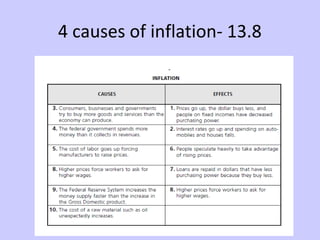
4 causes of inflation- 13.8
A statistical series that tracks monthly changes 
in prices paid by urban 
consumers for a representative “basket” of 
goods and services. 
• Consumer Price Index (CPI) 
13.7
What is excluded from the GDP? 
• Intermediate Products Goods used to make other products 
already counted in the GDP Replacement tires- NOT the tires 
on your new car 
• Secondhand Sales No new production is created Used cars, 
homes, etc. 
• Nonmarket Transactions They are so difficult to measure and 
do not generate expenditures in the market Homemakers, 
mowing own lawn, etc. 
• Underground Economic Transactions They are difficult to 
measure and are not socially acceptable Gambling, drug 
trade, income not reported to IRS. 
12.4
Hypothesis that the supply of money 
directly affects the price level over the 
long run 
• Quantity theory of money 
14.3
5 largest federal government 
expenditures 
• Social Security 
• National defense 
• Income security 
• Medicare 
• Health 
10.7
4 ways in which government spending 
can impact the economy 
• Resource Allocation 
• Redistributing Income 
• Increasing the Tax burden 
• Competing with the private sector 
10.6
Advantage of Value Added Tax 
• Hard to avoid 
• Incidence widely spread 
• Easy to collect 
9.6
Advantage of Flat Tax 
• Easy 
• Close most tax loopholes

REVIEW

  • 1.
  • 2.
    Goods or serviceswhose benefits are available to everyone and are paid for collectively • Public goods- ex. Highways, national defense, police, fire, etc. Ch. 7
  • 3.
    The study ofhow people try to satisfy their needs through the careful use of scarce resources Economics 1.1
  • 4.
    Gross domestic productafter adjustments for inflation • Real GDP 12.1
  • 5.
    A “strong” marketwith the prices moving up for several months or years in a row • Bull Market 11.5
  • 6.
    The condition ofnot having enough resources to produce all the things people want Scarcity 1.2
  • 7.
    The cost ofthe next-best alternative use of money, time, or resources when one choice is made rather than another • Opportunity cost 1.7
  • 8.
    The situation inwhich some necessities have little value while some non-necessities have a much higher value is known as a. paradox of value b. opportunity cost c. trade-offs d. economic interdependence • A 1.3
  • 9.
    The study ofeconomics is important because it enables us to a. describe our standard of living. b. increase our consumption of consumer goods c. become better decision makers. d. determine what goods ought to be produced. • C 1.5
  • 10.
    Alternative choices madeby consumers in the marketplace • Trade-offs 1.7
  • 11.
    A popular modelused to illustrate the concept of opportunity cost is a. the production possibilities frontier. b. the paradox of value. c. entrepreneurship. d. the factors of production. • A 1.8
  • 12.
    What are thefour factors of production? • Land, labor, capital, entrepreneurs 1.9
  • 13.
    Personal income minusindividual taxes • Disposable income 12.3
  • 14.
    When firms thatproduce the same kind of product join forces. • Horizontal merger 3.1
  • 15.
    What three economicquestions must every society answer? 1. What to produce 2. How to produce 3. For whom to produce 1.10
  • 16.
    Characteristics of atraditional economy • Economic activities based on ritual, habit or custom • Little innovation • Everyone knows what role to play
  • 17.
    The purpose ofgovernment in a command economy is to a. ensure the availability of consumer products. b. encourage entrepreneurs. c. make major economic decisions. d. promote economic freedom. • B 2.1
  • 18.
    Which group ofpeople ultimately determines the products that a free enterprise economy produces? a. Congress b. local government c. property owners d. consumers • D 2.2
  • 19.
    Characteristics of theAmerican economy • Economic freedom • Private property rights • Voluntary exchange • Profit motive • Competition
  • 20.
    What is therole of an entrepreneur in a free enterprise economy • Organize land, capital and labor for profit • Accept the risk of loss • Decide how to produce • Are innovators and catalysts 2.5
  • 21.
    What is therole of the government in a free enterprise economy? • Protector, provider and regulator of economic and social goals • Large consumer in economy 2.5
  • 22.
    What is therole of consumers in a free enterprise economy? • Decide what is produced by how they spend their money • Spur development of new products by changing wants 2.5
  • 23.
    If a modestprice increase has little or no effect, the demand for the product is a. Complementary b. Inelastic c. Elastic d. Unit elastic • B 4.4
  • 24.
    When companies involvedin different stages of manufacturing or marketing join together • Vertical Merger 3.2
  • 25.
    Advantages of asole proprietorship • Owned and run by a single owner • Easy to set up • Owner earns all profits
  • 26.
    Part of economictheory that deals with behavior and decision making by individual units. • Microeconomics 4.1
  • 27.
    The quantity demandedvaries inversely with the price of a product. • The Law of Demand 4.2
  • 28.
    Which statement reflectsthe inverse relationship between quantity demanded and price? a. As the price goes up, quantity demanded goes down b. As the price goes down, quantity demanded goes down c. As the supply goes up, the price goes up. d. As the supply goes up, the demand goes down. • A 4.6
  • 29.
    The customers willhave a tendency to replace a more costly item with a less costly item • Substitution Effect 4.3
  • 30.
    The principle thatmore will be offered for sale at higher prices than at lower prices • The Law of Supply 5.1
  • 31.
    The amount offeredfor sale at a given price • Quantity supplied 5.10
  • 32.
    A market structurewith many well-informed and independent buyers and sellers who exchange identical products • Perfect Competition 7.1
  • 33.
    The change inthe amount offered for sale when the prices change • Change in quantity supplied 5.10
  • 34.
    Only one sellerfor a particular product • Monopoly 7.4
  • 35.
    A few verylarge sellers dominate the industry • Oligopoly 7.4
  • 36.
    The supply anddemand for a worker’s skills and services determine the wage or salary • Market theory of wage determination 8.2
  • 37.
    Percentage of incomepaid in taxes stays the same regardless of income- ex. Medicare • Proportional tax 5.9
  • 38.
    Percentage of incomepaid in taxes goes up as income goes up- ex. Individual income tax • Progressive tax 9.5
  • 39.
    Percentage of incomepaid in taxes goes down as income goes up- ex. Sales tax • Regressive tax 9.5
  • 40.
    A point intime when real GDP stops declining and begins to expand • Trough 13.3
  • 41.
    To estimate elasticity,we look at the amount a consumer will spend on a product at a particular price • Expenditure test
  • 42.
    Economic policies designedto stimulate the economy by increasing production • Supply-side policies 15.7
  • 43.
    A country’s abilityto produce more of a given product than another country can produce • Absolute Advantage 16.1
  • 44.
    A country’s abilityto produce a given product relatively more efficiently than another country by doing it at a lower opportunity cost • Comparative Advantage 16.2
  • 45.
    An agreement signedin 1993 to reduce tariffs and increase trade among the U.S., Canada and Mexico • NAFTA 16.7
  • 46.
    The most importantsource of income for the federal government • Individual income tax
  • 47.
    The measure ofstock market performance based on 30 representative stocks • The Dow Jones Industrial Average 11.4
  • 48.
    Advantages of amutual fund • Less risky • Allows investor to diversify
  • 49.
    State of theeconomy with large numbers of unemployed people, declining incomes, overcapacity in manufacturing plants and economic hardship. • Depression 13.1
  • 50.
    Committee that has12 voting members and makes decisions about the level of interest rates • FOMC- Federal Open Market Committee 14.7
  • 51.
    Programs that automatically provides benefits to offset a change in people’s incomes- ex. Medicaid, welfare • Automatic stabilizers 15.6
  • 52.
    The use ofgovernment spending and revenue collection measures to influence the economy • Fiscal Policy 15.5
  • 53.
    The first stageof economic development during which the economy is stagnant • Primitive Equilibrium 17.3
  • 54.
    The fourth stageof economic development where the makeup of the country’s economy changes and income is growing faster than population • Semi development 17.3
  • 55.
    The dollar valueof all final goods, services, and structures produced within a country’s national borders during a one-year period • Gross Domestic Product 12.1
  • 56.
    Costs that remainthe same regardless of level of production or services offered • Fixed Costs 5.3
  • 57.
    Production costs thatchange when production levels change • Variable costs 5.4
  • 58.
    The sum offixed costs and variable costs • Total Cost 5.5
  • 59.
    Extra cost ofproducing one additional unit of production • Marginal Cost 5.7
  • 60.
    Extra revenue fromthe sale of one additional unit of output • Marginal revenue 5.7
  • 61.
    This organization determines monetary policy by increasing or decreasing the money supply. • The Federal Reserve System 14.1
  • 62.
    Gross domestic productmeasure in current prices, unadjusted for inflation • Nominal GDP 12.1
  • 63.
    Institution that channelssavings to investors • Financial intermediary • 11.2
  • 64.
    A fund thatcollects and invests income until payments are made to eligible recipients • Pension fund Ch. 11
  • 65.
    A firm thatmakes loans directly to consumers and specializes in buying installment contracts from merchants who sell on credit • Finance Company Ch. 11
  • 66.
    A “mean” or“nasty” market with the prices of equities falling sharply Bear Market 11.5
  • 67.
    Four factors oneshould consider when investing 1. Consistency- The amount invested is not as important as investing on a regular basis 2. Simplicity- Stick with what you know! Ignore any investment that seems too complicated. If it seems too good to be true it probably is!! 3. The Risk-Return Relationship- Consider the level of risk you are willing to tolerate. 4. Investment Objectives- Consider your reason for investing. Are you trying to cover living expenses or saving for retirement? 11.6
  • 68.
    Tax-deferred investment andsavings plan that acts as a personal pension fund for employees. Employees authorize regular payroll deductions. The money from all employees is pooled and invested in mutual funds or other investments. • 401(k) Plan 11.3
  • 69.
    Tax on animported product designed to protect less-efficient domestic producers • Protective Tariff 16.6
  • 70.
    Tax placed onimp0rted goods to raise revenue • Revenue Tariff 16.6
  • 71.
    When revenues receivedfrom exports exceed spending on imports. • Trade surplus 16.4
  • 72.
    When spending onimports exceeds revenues received from exports • Trade deficit 16.3
  • 73.
    Functions of theFed • Maintaining the money supply • Regulating and supervising banks • Preparing consumer legislation • Serving as the federal governments bank 14.8
  • 74.
    Actions by theFederal Reserve System to expand or contract he money supply • Monetary Policy 14.2
  • 75.
    Monetary policy thatresults in lower interest rates and greater access to credit • Easy money policy 14.4
  • 76.
    3 functions ofmoney • Medium of exchange • Measure of value • Store of value 14.6
  • 77.
    4 possible causesof the business cycle 1. Changes in capital expenditures- Businesses expand because they anticipate future growth then cut back on expansions and layoffs and cutbacks may occur. 2. Innovation and Imitation- A business innovates and gains an edge on the competitor, the competitor then copies the innovation, an investment boom follows, eventually economic activity will slow down. 3.Monetary Policy Decisions- Interest rates are low and loans are easy to get, the economy is stimulated by the loans, then the increased demand for loans causes interest rates to rise, new borrowers are discouraged and the level of economic activity will decline. 4. External Shocks- Increases in oil prices, wars, and international conflict can have a negative or positive affect on the economy. 13.9
  • 78.
    4 causes ofinflation- 13.8
  • 79.
    A statistical seriesthat tracks monthly changes in prices paid by urban consumers for a representative “basket” of goods and services. • Consumer Price Index (CPI) 13.7
  • 80.
    What is excludedfrom the GDP? • Intermediate Products Goods used to make other products already counted in the GDP Replacement tires- NOT the tires on your new car • Secondhand Sales No new production is created Used cars, homes, etc. • Nonmarket Transactions They are so difficult to measure and do not generate expenditures in the market Homemakers, mowing own lawn, etc. • Underground Economic Transactions They are difficult to measure and are not socially acceptable Gambling, drug trade, income not reported to IRS. 12.4
  • 81.
    Hypothesis that thesupply of money directly affects the price level over the long run • Quantity theory of money 14.3
  • 82.
    5 largest federalgovernment expenditures • Social Security • National defense • Income security • Medicare • Health 10.7
  • 83.
    4 ways inwhich government spending can impact the economy • Resource Allocation • Redistributing Income • Increasing the Tax burden • Competing with the private sector 10.6
  • 84.
    Advantage of ValueAdded Tax • Hard to avoid • Incidence widely spread • Easy to collect 9.6
  • 85.
    Advantage of FlatTax • Easy • Close most tax loopholes