EXAM NOTES for the Certified in Homeland Security
Developed as a courtesy by:
Dave Sweigert, CEH, CISA, CISSP, HCISPP, PMP, SEC+
Quadrennial Homeland Security Review (QHSR)
The purpose of the first-ever Quadrennial Homeland Security Review (QHSR) is to
outline the strategic framework to guide the activities of participants in homeland
security toward a common end. A safe and secure homeland must mean more than
preventing terrorist attacks from being carried out. It must also ensure that the liberties
of all Americans are assured, privacy is protected, and the means by which we
interchange with the world—through travel, lawful immigration, trade, commerce, and
exchange—are secured.
https://www.dhs.gov/quadrennial-homeland-security-review#
2014 Quadrennial Homeland Security Review
THE FIVE HOMELAND SECURITY MISSIONS
The first quadrennial review established the five enduring missions of homeland
security. This review reaffirms the five-mission structure and updates the missions
(detailed in the Mission Framework In Depth section). The updated missions are:
 Prevent Terrorism and Enhance Security;
 Secure and Manage Our Borders;
 Enforce and Administer Our Immigration Laws;
 Safeguard and Secure Cyberspace; and
 Strengthen National Preparedness and Resilience.
https://www.dhs.gov/sites/default/files/publications/2014-qhsr-final-508.pdf
National Security Presidential Directive 38 (NSPD 38)
NSPD 38 was issued on July 7, 2004, as the National Strategy to Secure Cyberspace.
The contents of this classified directive have never been released, but prior to the
issuance of NSPD 38, the Whitehouse released a different document also entitled
"National Strategy to Secure Cyberspace" that detailed five priorities to secure
cyberspace:
1. A National Cyberspace Security Response System.
2. A National Cyberspace Security Threat and Vulnerability Reduction Program.
3. A National Cyberspace Security Awareness and Training Program.
4. Securing Governments' Cyberspace
5. National Security and International Cyberspace Security Cooperation
https://epic.org/privacy/cybersecurity/presidential-directives/cybersecurity.html
SAFE Port Act
The port security provisions were one of 20 bills introduced to Congress in the wake of
the Dubai Ports World controversy that aimed to block Dubai Ports World acquiring
P&O Ports, and more generally to stop key US ports falling into the hands of foreign
owners by changing the Exon-Florio Amendment.[4] The act codified into law a number
of programs to improve security of U.S. ports, such as:
 Additional requirements for maritime facilities
 Creation of the Transportation Worker Identification Credential
 Establishment of Interagency Operations Centers for port security
 Port Security Grant Program
 Container Security Initiative
 Foreign port assessments
 Customs Trade Partnership against Terrorism
In addition, the Act created the Domestic Nuclear Detection Office within the
Department of Homeland Security and appropriated funds toward the Integrated
Deepwater System Program, a long-term U.S. Coast Guard modernization program.
https://en.wikipedia.org/wiki/SAFE_Port_Act
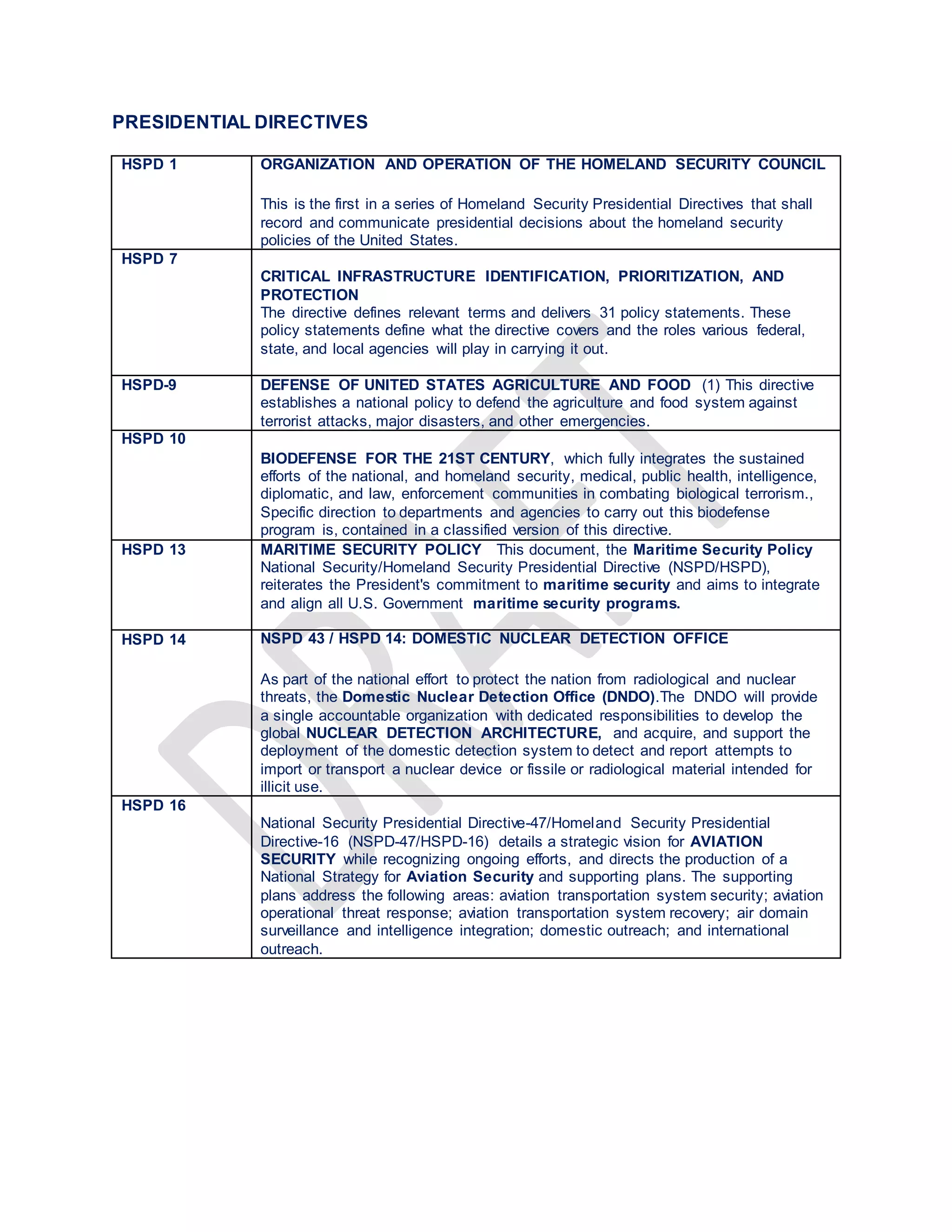
PRESIDENTIAL DIRECTIVES
HSPD 1 ORGANIZATION AND OPERATION OF THE HOMELAND SECURITY COUNCIL
This is the first in a series of Homeland Security Presidential Directives that shall
record and communicate presidential decisions about the homeland security
policies of the United States.
HSPD 7
CRITICAL INFRASTRUCTURE IDENTIFICATION, PRIORITIZATION, AND
PROTECTION
The directive defines relevant terms and delivers 31 policy statements. These
policy statements define what the directive covers and the roles various federal,
state, and local agencies will play in carrying it out.
HSPD-9 DEFENSE OF UNITED STATES AGRICULTURE AND FOOD (1) This directive
establishes a national policy to defend the agriculture and food system against
terrorist attacks, major disasters, and other emergencies.
HSPD 10
BIODEFENSE FOR THE 21ST CENTURY, which fully integrates the sustained
efforts of the national, and homeland security, medical, public health, intelligence,
diplomatic, and law, enforcement communities in combating biological terrorism.,
Specific direction to departments and agencies to carry out this biodefense
program is, contained in a classified version of this directive.
HSPD 13 MARITIME SECURITY POLICY This document, the Maritime Security Policy
National Security/Homeland Security Presidential Directive (NSPD/HSPD),
reiterates the President's commitment to maritime security and aims to integrate
and align all U.S. Government maritime security programs.
HSPD 14 NSPD 43 / HSPD 14: DOMESTIC NUCLEAR DETECTION OFFICE
As part of the national effort to protect the nation from radiological and nuclear
threats, the Domestic Nuclear Detection Office (DNDO).The DNDO will provide
a single accountable organization with dedicated responsibilities to develop the
global NUCLEAR DETECTION ARCHITECTURE, and acquire, and support the
deployment of the domestic detection system to detect and report attempts to
import or transport a nuclear device or fissile or radiological material intended for
illicit use.
HSPD 16
National Security Presidential Directive-47/Homeland Security Presidential
Directive-16 (NSPD-47/HSPD-16) details a strategic vision for AVIATION
SECURITY while recognizing ongoing efforts, and directs the production of a
National Strategy for Aviation Security and supporting plans. The supporting
plans address the following areas: aviation transportation system security; aviation
operational threat response; aviation transportation system recovery; air domain
surveillance and intelligence integration; domestic outreach; and international
outreach.
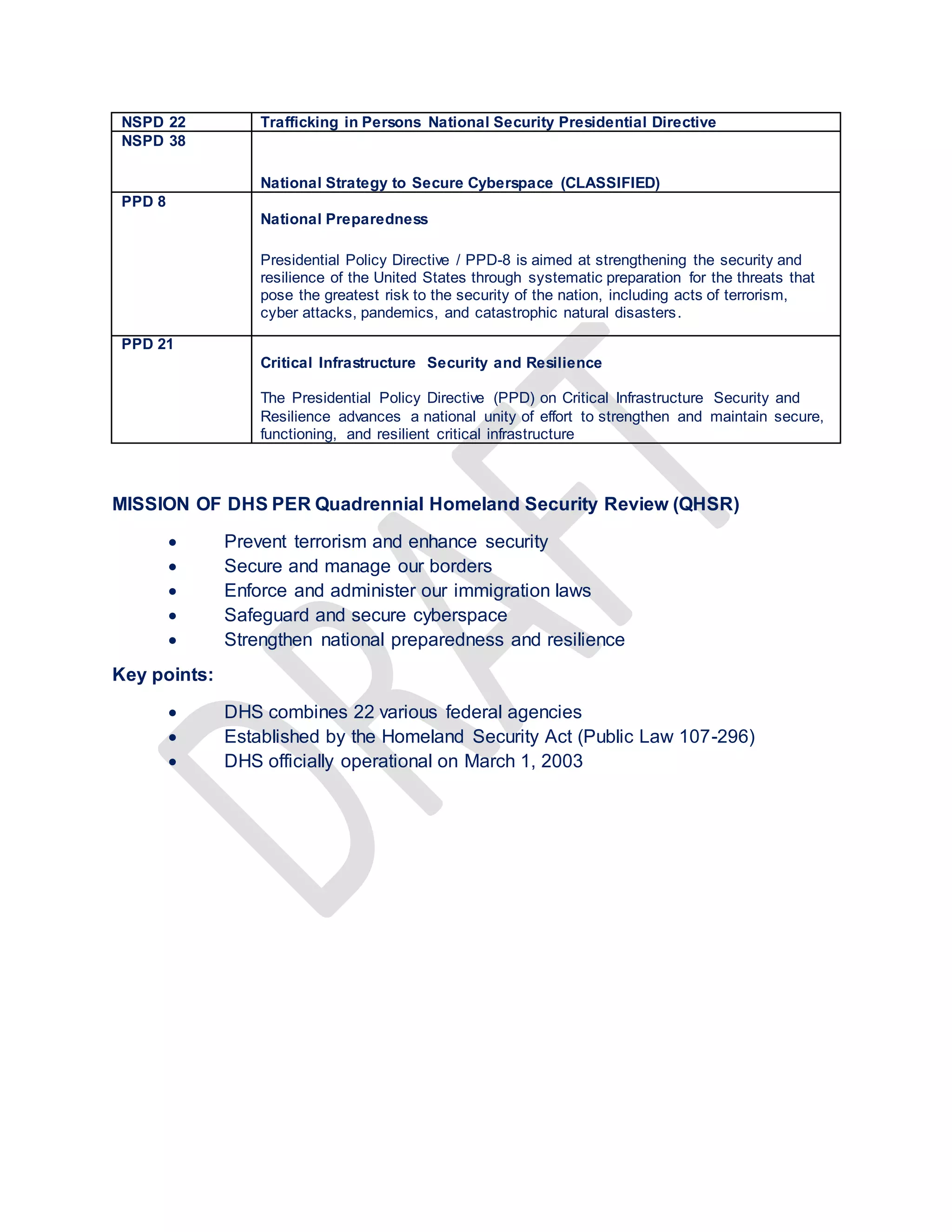
NSPD 22 Trafficking in Persons National Security Presidential Directive
NSPD 38
National Strategy to Secure Cyberspace (CLASSIFIED)
PPD 8
National Preparedness
Presidential Policy Directive / PPD-8 is aimed at strengthening the security and
resilience of the United States through systematic preparation for the threats that
pose the greatest risk to the security of the nation, including acts of terrorism,
cyber attacks, pandemics, and catastrophic natural disasters.
PPD 21
Critical Infrastructure Security and Resilience
The Presidential Policy Directive (PPD) on Critical Infrastructure Security and
Resilience advances a national unity of effort to strengthen and maintain secure,
functioning, and resilient critical infrastructure
MISSION OF DHS PER Quadrennial Homeland Security Review (QHSR)
 Prevent terrorism and enhance security
 Secure and manage our borders
 Enforce and administer our immigration laws
 Safeguard and secure cyberspace
 Strengthen national preparedness and resilience
Key points:
 DHS combines 22 various federal agencies
 Established by the Homeland Security Act (Public Law 107-296)
 DHS officially operational on March 1, 2003
KNOWLEDGE POINTS:
Blue Campaign
The Blue Campaign is the unified voice for the U.S. Department of Homeland
Security’s (DHS) efforts to combat human trafficking. Working in collaboration with
law enforcement, government, non-governmental and private organizations, the Blue
Campaign strives to protect the basic right of freedom and to bring those who exploit
human lives to justice.
Executive Order 13260
Establishment and Membership. I hereby establish the President's Homeland Security
Advisory Council (PHSAC). The PHSAC shall be composed of not more than 21
members appointed by the President. March 19, 2002.
National Strategy for Homeland Security
The United States National Strategy for Homeland Security is a formal government
response to the events of September 11, 2001 at the Pentagon and World Trade
Center. The document issued by President George W. Bush outlines the overall
strategic considerations for cooperation between the federal government, states,
private enterprises, and ordinary citizens in anticipating future terrorism attacks as
well as natural disasters and other incidents of national significance.[1] The National
Response Framework is the part of the homeland security national strategy that is a
Comprehensive Emergency Management guideline for implementing scalable
responses to disasters and other incidents of national significance.
https://en.wikipedia.org/wiki/National_Strategy_for_Homeland_Security
VNSA
Violent non-state actors (VNSA), also known as armed non-state actors, are non-
state actors, i.e. "individuals or organizations that have economic, political or social
power and are able to influence at a national and sometimes international level but do
not belong to or ally themselves to any particular country or state,"[1] who employ
violence in pursuit of their objectives. The term has been used in several papers
published by the U.S. military.[2][3][4][5] There are many reasons why violent non-state
actors develop.
https://en.wikipedia.org/wiki/Violent_non-state_actor
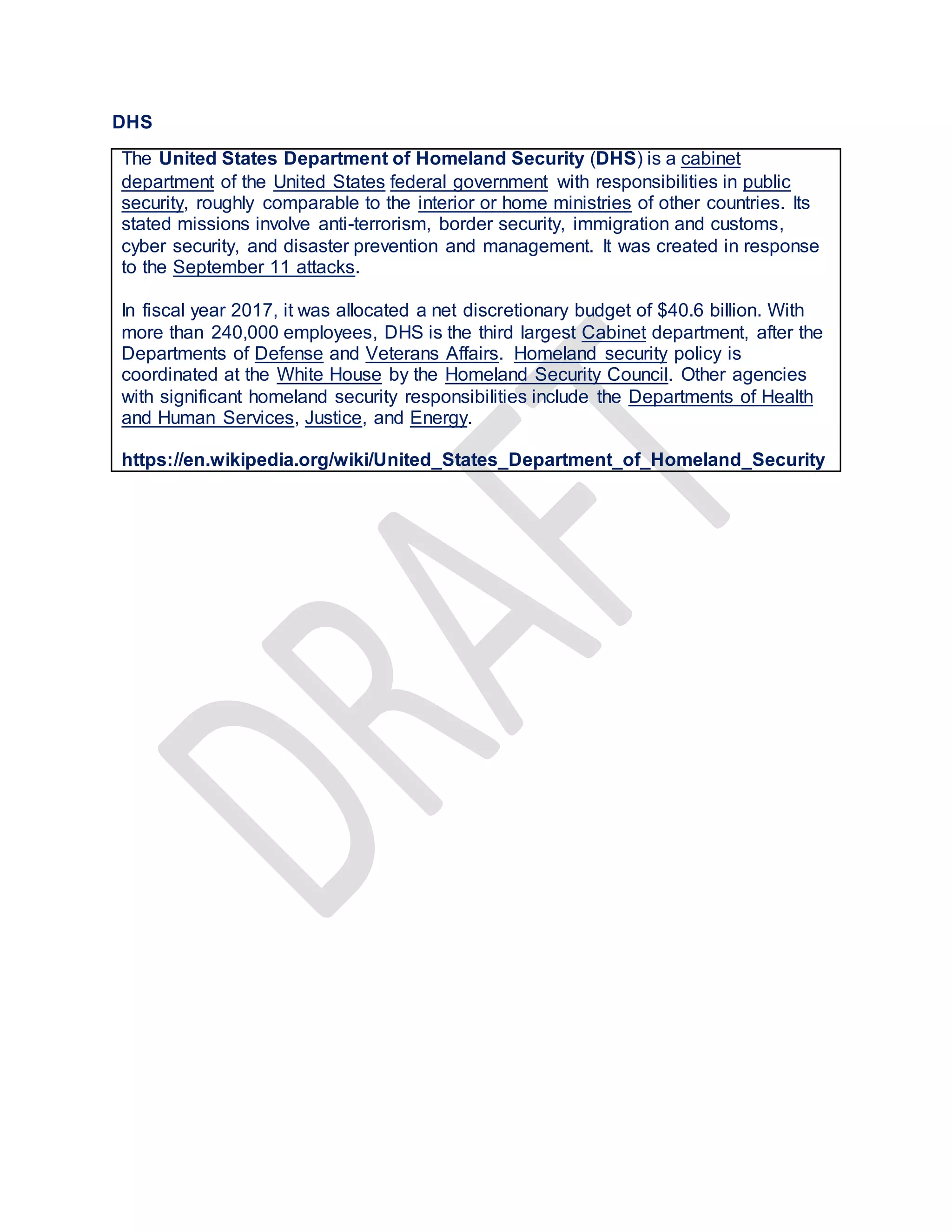
DHS
The United States Department of Homeland Security (DHS) is a cabinet
department of the United States federal government with responsibilities in public
security, roughly comparable to the interior or home ministries of other countries. Its
stated missions involve anti-terrorism, border security, immigration and customs,
cyber security, and disaster prevention and management. It was created in response
to the September 11 attacks.
In fiscal year 2017, it was allocated a net discretionary budget of $40.6 billion. With
more than 240,000 employees, DHS is the third largest Cabinet department, after the
Departments of Defense and Veterans Affairs. Homeland security policy is
coordinated at the White House by the Homeland Security Council. Other agencies
with significant homeland security responsibilities include the Departments of Health
and Human Services, Justice, and Energy.
https://en.wikipedia.org/wiki/United_States_Department_of_Homeland_Security
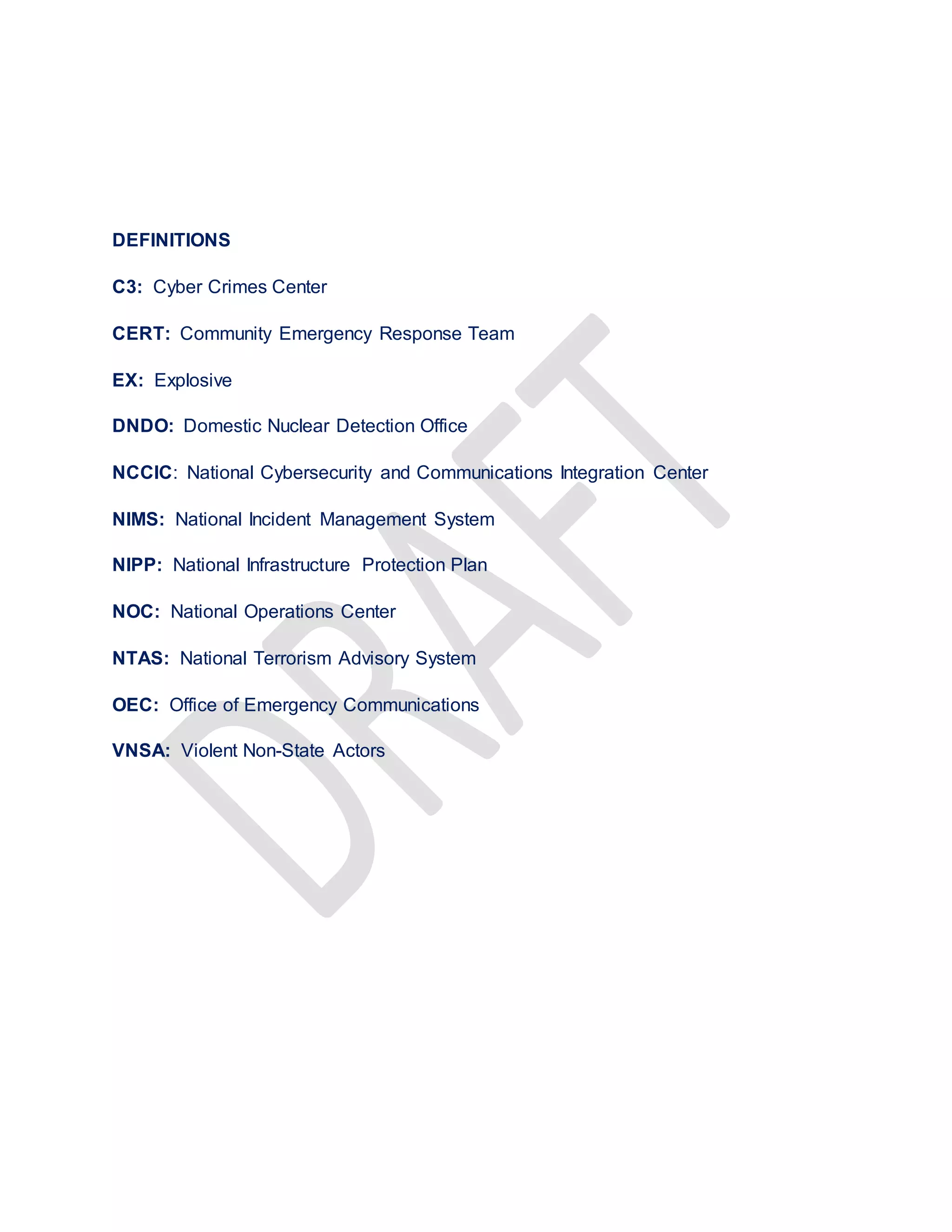
DEFINITIONS
C3: Cyber Crimes Center
CERT: Community Emergency Response Team
EX: Explosive
DNDO: Domestic Nuclear Detection Office
NCCIC: National Cybersecurity and Communications Integration Center
NIMS: National Incident Management System
NIPP: National Infrastructure Protection Plan
NOC: National Operations Center
NTAS: National Terrorism Advisory System
OEC: Office of Emergency Communications
VNSA: Violent Non-State Actors

EXAM NOTES for Certificate in Homeland Security CHS-I

  • 1.
    EXAM NOTES forthe Certified in Homeland Security Developed as a courtesy by: Dave Sweigert, CEH, CISA, CISSP, HCISPP, PMP, SEC+ Quadrennial Homeland Security Review (QHSR) The purpose of the first-ever Quadrennial Homeland Security Review (QHSR) is to outline the strategic framework to guide the activities of participants in homeland security toward a common end. A safe and secure homeland must mean more than preventing terrorist attacks from being carried out. It must also ensure that the liberties of all Americans are assured, privacy is protected, and the means by which we interchange with the world—through travel, lawful immigration, trade, commerce, and exchange—are secured. https://www.dhs.gov/quadrennial-homeland-security-review# 2014 Quadrennial Homeland Security Review THE FIVE HOMELAND SECURITY MISSIONS The first quadrennial review established the five enduring missions of homeland security. This review reaffirms the five-mission structure and updates the missions (detailed in the Mission Framework In Depth section). The updated missions are:  Prevent Terrorism and Enhance Security;  Secure and Manage Our Borders;  Enforce and Administer Our Immigration Laws;  Safeguard and Secure Cyberspace; and  Strengthen National Preparedness and Resilience. https://www.dhs.gov/sites/default/files/publications/2014-qhsr-final-508.pdf
  • 2.
    National Security PresidentialDirective 38 (NSPD 38) NSPD 38 was issued on July 7, 2004, as the National Strategy to Secure Cyberspace. The contents of this classified directive have never been released, but prior to the issuance of NSPD 38, the Whitehouse released a different document also entitled "National Strategy to Secure Cyberspace" that detailed five priorities to secure cyberspace: 1. A National Cyberspace Security Response System. 2. A National Cyberspace Security Threat and Vulnerability Reduction Program. 3. A National Cyberspace Security Awareness and Training Program. 4. Securing Governments' Cyberspace 5. National Security and International Cyberspace Security Cooperation https://epic.org/privacy/cybersecurity/presidential-directives/cybersecurity.html SAFE Port Act The port security provisions were one of 20 bills introduced to Congress in the wake of the Dubai Ports World controversy that aimed to block Dubai Ports World acquiring P&O Ports, and more generally to stop key US ports falling into the hands of foreign owners by changing the Exon-Florio Amendment.[4] The act codified into law a number of programs to improve security of U.S. ports, such as:  Additional requirements for maritime facilities  Creation of the Transportation Worker Identification Credential  Establishment of Interagency Operations Centers for port security  Port Security Grant Program  Container Security Initiative  Foreign port assessments  Customs Trade Partnership against Terrorism In addition, the Act created the Domestic Nuclear Detection Office within the Department of Homeland Security and appropriated funds toward the Integrated Deepwater System Program, a long-term U.S. Coast Guard modernization program. https://en.wikipedia.org/wiki/SAFE_Port_Act
  • 3.
    PRESIDENTIAL DIRECTIVES HSPD 1ORGANIZATION AND OPERATION OF THE HOMELAND SECURITY COUNCIL This is the first in a series of Homeland Security Presidential Directives that shall record and communicate presidential decisions about the homeland security policies of the United States. HSPD 7 CRITICAL INFRASTRUCTURE IDENTIFICATION, PRIORITIZATION, AND PROTECTION The directive defines relevant terms and delivers 31 policy statements. These policy statements define what the directive covers and the roles various federal, state, and local agencies will play in carrying it out. HSPD-9 DEFENSE OF UNITED STATES AGRICULTURE AND FOOD (1) This directive establishes a national policy to defend the agriculture and food system against terrorist attacks, major disasters, and other emergencies. HSPD 10 BIODEFENSE FOR THE 21ST CENTURY, which fully integrates the sustained efforts of the national, and homeland security, medical, public health, intelligence, diplomatic, and law, enforcement communities in combating biological terrorism., Specific direction to departments and agencies to carry out this biodefense program is, contained in a classified version of this directive. HSPD 13 MARITIME SECURITY POLICY This document, the Maritime Security Policy National Security/Homeland Security Presidential Directive (NSPD/HSPD), reiterates the President's commitment to maritime security and aims to integrate and align all U.S. Government maritime security programs. HSPD 14 NSPD 43 / HSPD 14: DOMESTIC NUCLEAR DETECTION OFFICE As part of the national effort to protect the nation from radiological and nuclear threats, the Domestic Nuclear Detection Office (DNDO).The DNDO will provide a single accountable organization with dedicated responsibilities to develop the global NUCLEAR DETECTION ARCHITECTURE, and acquire, and support the deployment of the domestic detection system to detect and report attempts to import or transport a nuclear device or fissile or radiological material intended for illicit use. HSPD 16 National Security Presidential Directive-47/Homeland Security Presidential Directive-16 (NSPD-47/HSPD-16) details a strategic vision for AVIATION SECURITY while recognizing ongoing efforts, and directs the production of a National Strategy for Aviation Security and supporting plans. The supporting plans address the following areas: aviation transportation system security; aviation operational threat response; aviation transportation system recovery; air domain surveillance and intelligence integration; domestic outreach; and international outreach.
  • 4.
    NSPD 22 Traffickingin Persons National Security Presidential Directive NSPD 38 National Strategy to Secure Cyberspace (CLASSIFIED) PPD 8 National Preparedness Presidential Policy Directive / PPD-8 is aimed at strengthening the security and resilience of the United States through systematic preparation for the threats that pose the greatest risk to the security of the nation, including acts of terrorism, cyber attacks, pandemics, and catastrophic natural disasters. PPD 21 Critical Infrastructure Security and Resilience The Presidential Policy Directive (PPD) on Critical Infrastructure Security and Resilience advances a national unity of effort to strengthen and maintain secure, functioning, and resilient critical infrastructure MISSION OF DHS PER Quadrennial Homeland Security Review (QHSR)  Prevent terrorism and enhance security  Secure and manage our borders  Enforce and administer our immigration laws  Safeguard and secure cyberspace  Strengthen national preparedness and resilience Key points:  DHS combines 22 various federal agencies  Established by the Homeland Security Act (Public Law 107-296)  DHS officially operational on March 1, 2003
  • 5.
    KNOWLEDGE POINTS: Blue Campaign TheBlue Campaign is the unified voice for the U.S. Department of Homeland Security’s (DHS) efforts to combat human trafficking. Working in collaboration with law enforcement, government, non-governmental and private organizations, the Blue Campaign strives to protect the basic right of freedom and to bring those who exploit human lives to justice. Executive Order 13260 Establishment and Membership. I hereby establish the President's Homeland Security Advisory Council (PHSAC). The PHSAC shall be composed of not more than 21 members appointed by the President. March 19, 2002. National Strategy for Homeland Security The United States National Strategy for Homeland Security is a formal government response to the events of September 11, 2001 at the Pentagon and World Trade Center. The document issued by President George W. Bush outlines the overall strategic considerations for cooperation between the federal government, states, private enterprises, and ordinary citizens in anticipating future terrorism attacks as well as natural disasters and other incidents of national significance.[1] The National Response Framework is the part of the homeland security national strategy that is a Comprehensive Emergency Management guideline for implementing scalable responses to disasters and other incidents of national significance. https://en.wikipedia.org/wiki/National_Strategy_for_Homeland_Security VNSA Violent non-state actors (VNSA), also known as armed non-state actors, are non- state actors, i.e. "individuals or organizations that have economic, political or social power and are able to influence at a national and sometimes international level but do not belong to or ally themselves to any particular country or state,"[1] who employ violence in pursuit of their objectives. The term has been used in several papers published by the U.S. military.[2][3][4][5] There are many reasons why violent non-state actors develop. https://en.wikipedia.org/wiki/Violent_non-state_actor
  • 6.
    DHS The United StatesDepartment of Homeland Security (DHS) is a cabinet department of the United States federal government with responsibilities in public security, roughly comparable to the interior or home ministries of other countries. Its stated missions involve anti-terrorism, border security, immigration and customs, cyber security, and disaster prevention and management. It was created in response to the September 11 attacks. In fiscal year 2017, it was allocated a net discretionary budget of $40.6 billion. With more than 240,000 employees, DHS is the third largest Cabinet department, after the Departments of Defense and Veterans Affairs. Homeland security policy is coordinated at the White House by the Homeland Security Council. Other agencies with significant homeland security responsibilities include the Departments of Health and Human Services, Justice, and Energy. https://en.wikipedia.org/wiki/United_States_Department_of_Homeland_Security
  • 7.
    DEFINITIONS C3: Cyber CrimesCenter CERT: Community Emergency Response Team EX: Explosive DNDO: Domestic Nuclear Detection Office NCCIC: National Cybersecurity and Communications Integration Center NIMS: National Incident Management System NIPP: National Infrastructure Protection Plan NOC: National Operations Center NTAS: National Terrorism Advisory System OEC: Office of Emergency Communications VNSA: Violent Non-State Actors