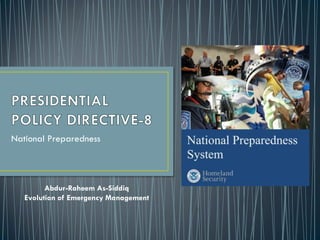
National Preparedness
Abdur-Raheem As-Siddiq
Evolution of Emergency Management
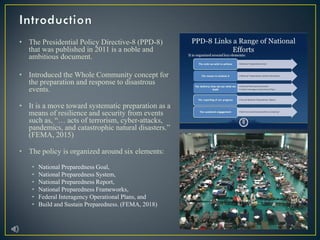
• The Presidential Policy Directive-8 (PPD-8)
that was published in 2011 is a noble and
ambitious document.
• Introduced the Whole Community concept for
the preparation and response to disastrous
events.
• It is a move toward systematic preparation as a
means of resilience and security from events
such as, “… acts of terrorism, cyber-attacks,
pandemics, and catastrophic natural disasters.”
(FEMA, 2015)
• The policy is organized around six elements:
• National Preparedness Goal,
• National Preparedness System,
• National Preparedness Report,
• National Preparedness Frameworks,
• Federal Interagency Operational Plans, and
• Build and Sustain Preparedness. (FEMA, 2018)
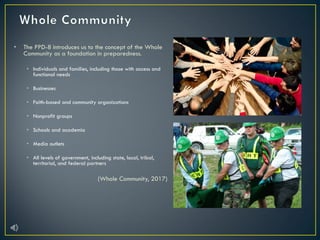
• The PPD-8 introduces us to the concept of the Whole
Community as a foundation in preparedness.
• Individuals and families, including those with access and
functional needs
• Businesses
• Faith-based and community organizations
• Nonprofit groups
• Schools and academia
• Media outlets
• All levels of government, including state, local, tribal,
territorial, and federal partners
(Whole Community, 2017)
• The National Preparedness Goal aims to provide, “A
secure and resilient nation with the capabilities
required across the whole community to prevent,
protect against, mitigate, respond to, and recover
from the threats and hazards that pose the greatest
risk.”
(FEMA, 2017)
• Shall be informed by the risk of specific threats and
vulnerabilities
• Shall define the core capabilities necessary to prepare
for the specific types of incidents that pose the greatest
risk to the security of the Nation
• Shall emphasize actions aimed at achieving an
integrated, layered, and all-of-Nation preparedness
approach that optimizes the use of available resources.
• Shall reflect the policy direction outlined in the
applicable published mandates
• Shall be reviewed regularly to evaluate consistency with
these policies, evolving conditions, and the National
Incident Management System.
(FEMA, 2015)
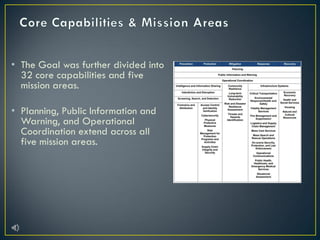
• The Goal was further divided into
32 core capabilities and five
mission areas.
• Planning, Public Information and
Warning, and Operational
Coordination extend across all
five mission areas.
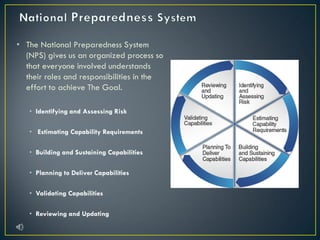
• The National Preparedness System
(NPS) gives us an organized process so
that everyone involved understands
their roles and responsibilities in the
effort to achieve The Goal.
• Identifying and Assessing Risk
• Estimating Capability Requirements
• Building and Sustaining Capabilities
• Planning to Deliver Capabilities
• Validating Capabilities
• Reviewing and Updating
• The Post Katrina Act requires that the NPR is
accomplished annually and is a key element of the
National Preparedness System.
(NPR, 2017)
• It’s a joint effort report coordinated and consulted
with the executive departments and agencies along
with the Whole Community.
• Summarizes the progress being made toward
developing and maintaining the performance
objectives related to the core capabilities in The
Goal.
• It is prepared so that we are aware of the strengths
and opportunities for improvement in our
comprehensive emergency management (CEM) plan.
(FEMA, 2013)
• Highlights persistent and emerging issues that hinder
progress with The Goal
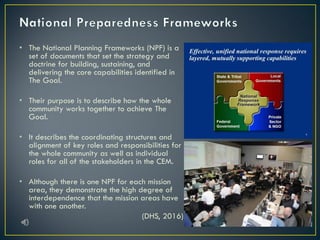
• The National Planning Frameworks (NPF) is a
set of documents that set the strategy and
doctrine for building, sustaining, and
delivering the core capabilities identified in
The Goal.
• Their purpose is to describe how the whole
community works together to achieve The
Goal.
• It describes the coordinating structures and
alignment of key roles and responsibilities for
the whole community as well as individual
roles for all of the stakeholders in the CEM.
• Although there is one NPF for each mission
area, they demonstrate the high degree of
interdependence that the mission areas have
with one another.
(DHS, 2016)
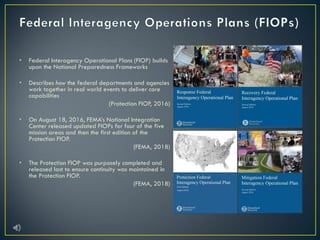
• Federal Interagency Operational Plans (FIOP) builds
upon the National Preparedness Frameworks
• Describes how the federal departments and agencies
work together in real world events to deliver core
capabilities
(Protection FIOP, 2016)
• On August 18, 2016, FEMA’s National Integration
Center released updated FIOPs for four of the five
mission areas and then the first edition of the
Protection FIOP.
(FEMA, 2018)
• The Protection FIOP was purposely completed and
released last to ensure continuity was maintained in
the Protection FIOP.
(FEMA, 2018)
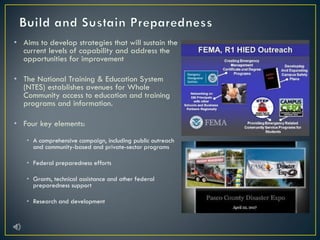
• Aims to develop strategies that will sustain the
current levels of capability and address the
opportunities for improvement
• The National Training & Education System
(NTES) establishes avenues for Whole
Community access to education and training
programs and information.
• Four key elements:
• A comprehensive campaign, including public outreach
and community-based and private-sector programs
• Federal preparedness efforts
• Grants, technical assistance and other federal
preparedness support
• Research and development
• The Presidential Policy Directive -8 mandates the completion of an ambitious and noble goal.
• This goal seeks to establish, “A secure and resilient nation with the capabilities required across the
Whole Community to prevent, protect against, mitigate, respond to, and recover from the threats and
hazards that pose the greatest risk.”
(FEMA, 2017)
• The decision to separate the effort into six elements was insightful and very effective.
• The elements inter-lock and build upon one another and they strengthen the entire campaign.
• This plan, initiated by the PPD-8 will keep us learning and advancing as we move forward in executing
our core capabilities through the five mission areas: Prevention, Protection, Mitigation, Response, and
Recovery.
• We are definitely ready for the next focus event, but we should understand that perfection is an
awesome goal that is rarely, if ever achieved.
DHS. (2011, November). National preparedness system. Retrieved from https://www.fema.gov/media-library-data/20130726-1828-
25045-9792/national_preparedness_system_2011.pdf
DHS. (2015, September). National Preparedness Goal (2nd Edition). Retrieved from https://www.fema.gov/media-library-
data/1443799615171-2aae90be55041740f97e8532fc680d40/National_Preparedness_Goal_2nd_Edition.pdf
DHS. (2016, June). Overview of the national planning frameworks. Retrieved from https://www.fema.gov/media-library-
data/1466016288879-63f68f6dced909f08cf8687deaa8e718/Overview_of_National_Planning_Frameworks.pdf
DHS. (2016, August). Protection federal interagency operational plan, 1st Edition. Retrieved from https://www.fema.gov/media-
library-data/1472581208497-42ba23c551f5a502c4f0eab69c3c741b/Protection_FIOP_1st_v3.pdf
FEMA. (2013, January 16). PPD-8 overview presentation. Retrieved from https://www.fema.gov/media-library-data/20130726-
1904-25045-2748/draft_ppd_8_eric_runnels_cfscc_20120928_fd_.pdf
FEMA. (2015, September 23). Presidential Policy Directive / PPD-8: National Preparedness. Retrieved from
https://www.dhs.gov/presidential-policy-directive-8-national-preparedness
FEMA. (2017, August 9). National preparedness goal. Retrieved from https://www.fema.gov/national-preparedness-goal
FEMA. (2017, August 21). Whole community. Retrieved from https://www.fema.gov/whole-community
FEMA. (2018, January 16). Learn about presidential policy directive-8. Retrieved from https://www.fema.gov/learn-about-
presidential-policy-directive-8
NPR. (2017). Executive summary 2017 national preparedness report. Retrieved from https://www.fema.gov/media-library-
data/1504579176894-b152bab1e18d821779d3c9ae5c2235c8/2017NationalPreparednessReportExecutiveSummary.pdf

PPD-8 National Preparedness System

  • 1.
  • 2.
    • The PresidentialPolicy Directive-8 (PPD-8) that was published in 2011 is a noble and ambitious document. • Introduced the Whole Community concept for the preparation and response to disastrous events. • It is a move toward systematic preparation as a means of resilience and security from events such as, “… acts of terrorism, cyber-attacks, pandemics, and catastrophic natural disasters.” (FEMA, 2015) • The policy is organized around six elements: • National Preparedness Goal, • National Preparedness System, • National Preparedness Report, • National Preparedness Frameworks, • Federal Interagency Operational Plans, and • Build and Sustain Preparedness. (FEMA, 2018)
  • 3.
    • The PPD-8introduces us to the concept of the Whole Community as a foundation in preparedness. • Individuals and families, including those with access and functional needs • Businesses • Faith-based and community organizations • Nonprofit groups • Schools and academia • Media outlets • All levels of government, including state, local, tribal, territorial, and federal partners (Whole Community, 2017)
  • 4.
    • The NationalPreparedness Goal aims to provide, “A secure and resilient nation with the capabilities required across the whole community to prevent, protect against, mitigate, respond to, and recover from the threats and hazards that pose the greatest risk.” (FEMA, 2017) • Shall be informed by the risk of specific threats and vulnerabilities • Shall define the core capabilities necessary to prepare for the specific types of incidents that pose the greatest risk to the security of the Nation • Shall emphasize actions aimed at achieving an integrated, layered, and all-of-Nation preparedness approach that optimizes the use of available resources. • Shall reflect the policy direction outlined in the applicable published mandates • Shall be reviewed regularly to evaluate consistency with these policies, evolving conditions, and the National Incident Management System. (FEMA, 2015)
  • 5.
    • The Goalwas further divided into 32 core capabilities and five mission areas. • Planning, Public Information and Warning, and Operational Coordination extend across all five mission areas.
  • 6.
    • The NationalPreparedness System (NPS) gives us an organized process so that everyone involved understands their roles and responsibilities in the effort to achieve The Goal. • Identifying and Assessing Risk • Estimating Capability Requirements • Building and Sustaining Capabilities • Planning to Deliver Capabilities • Validating Capabilities • Reviewing and Updating
  • 7.
    • The PostKatrina Act requires that the NPR is accomplished annually and is a key element of the National Preparedness System. (NPR, 2017) • It’s a joint effort report coordinated and consulted with the executive departments and agencies along with the Whole Community. • Summarizes the progress being made toward developing and maintaining the performance objectives related to the core capabilities in The Goal. • It is prepared so that we are aware of the strengths and opportunities for improvement in our comprehensive emergency management (CEM) plan. (FEMA, 2013) • Highlights persistent and emerging issues that hinder progress with The Goal
  • 8.
    • The NationalPlanning Frameworks (NPF) is a set of documents that set the strategy and doctrine for building, sustaining, and delivering the core capabilities identified in The Goal. • Their purpose is to describe how the whole community works together to achieve The Goal. • It describes the coordinating structures and alignment of key roles and responsibilities for the whole community as well as individual roles for all of the stakeholders in the CEM. • Although there is one NPF for each mission area, they demonstrate the high degree of interdependence that the mission areas have with one another. (DHS, 2016)
  • 9.
    • Federal InteragencyOperational Plans (FIOP) builds upon the National Preparedness Frameworks • Describes how the federal departments and agencies work together in real world events to deliver core capabilities (Protection FIOP, 2016) • On August 18, 2016, FEMA’s National Integration Center released updated FIOPs for four of the five mission areas and then the first edition of the Protection FIOP. (FEMA, 2018) • The Protection FIOP was purposely completed and released last to ensure continuity was maintained in the Protection FIOP. (FEMA, 2018)
  • 10.
    • Aims todevelop strategies that will sustain the current levels of capability and address the opportunities for improvement • The National Training & Education System (NTES) establishes avenues for Whole Community access to education and training programs and information. • Four key elements: • A comprehensive campaign, including public outreach and community-based and private-sector programs • Federal preparedness efforts • Grants, technical assistance and other federal preparedness support • Research and development
  • 11.
    • The PresidentialPolicy Directive -8 mandates the completion of an ambitious and noble goal. • This goal seeks to establish, “A secure and resilient nation with the capabilities required across the Whole Community to prevent, protect against, mitigate, respond to, and recover from the threats and hazards that pose the greatest risk.” (FEMA, 2017) • The decision to separate the effort into six elements was insightful and very effective. • The elements inter-lock and build upon one another and they strengthen the entire campaign. • This plan, initiated by the PPD-8 will keep us learning and advancing as we move forward in executing our core capabilities through the five mission areas: Prevention, Protection, Mitigation, Response, and Recovery. • We are definitely ready for the next focus event, but we should understand that perfection is an awesome goal that is rarely, if ever achieved.
  • 12.
    DHS. (2011, November).National preparedness system. Retrieved from https://www.fema.gov/media-library-data/20130726-1828- 25045-9792/national_preparedness_system_2011.pdf DHS. (2015, September). National Preparedness Goal (2nd Edition). Retrieved from https://www.fema.gov/media-library- data/1443799615171-2aae90be55041740f97e8532fc680d40/National_Preparedness_Goal_2nd_Edition.pdf DHS. (2016, June). Overview of the national planning frameworks. Retrieved from https://www.fema.gov/media-library- data/1466016288879-63f68f6dced909f08cf8687deaa8e718/Overview_of_National_Planning_Frameworks.pdf DHS. (2016, August). Protection federal interagency operational plan, 1st Edition. Retrieved from https://www.fema.gov/media- library-data/1472581208497-42ba23c551f5a502c4f0eab69c3c741b/Protection_FIOP_1st_v3.pdf FEMA. (2013, January 16). PPD-8 overview presentation. Retrieved from https://www.fema.gov/media-library-data/20130726- 1904-25045-2748/draft_ppd_8_eric_runnels_cfscc_20120928_fd_.pdf FEMA. (2015, September 23). Presidential Policy Directive / PPD-8: National Preparedness. Retrieved from https://www.dhs.gov/presidential-policy-directive-8-national-preparedness FEMA. (2017, August 9). National preparedness goal. Retrieved from https://www.fema.gov/national-preparedness-goal
  • 13.
    FEMA. (2017, August21). Whole community. Retrieved from https://www.fema.gov/whole-community FEMA. (2018, January 16). Learn about presidential policy directive-8. Retrieved from https://www.fema.gov/learn-about- presidential-policy-directive-8 NPR. (2017). Executive summary 2017 national preparedness report. Retrieved from https://www.fema.gov/media-library- data/1504579176894-b152bab1e18d821779d3c9ae5c2235c8/2017NationalPreparednessReportExecutiveSummary.pdf