1.0    TITLE


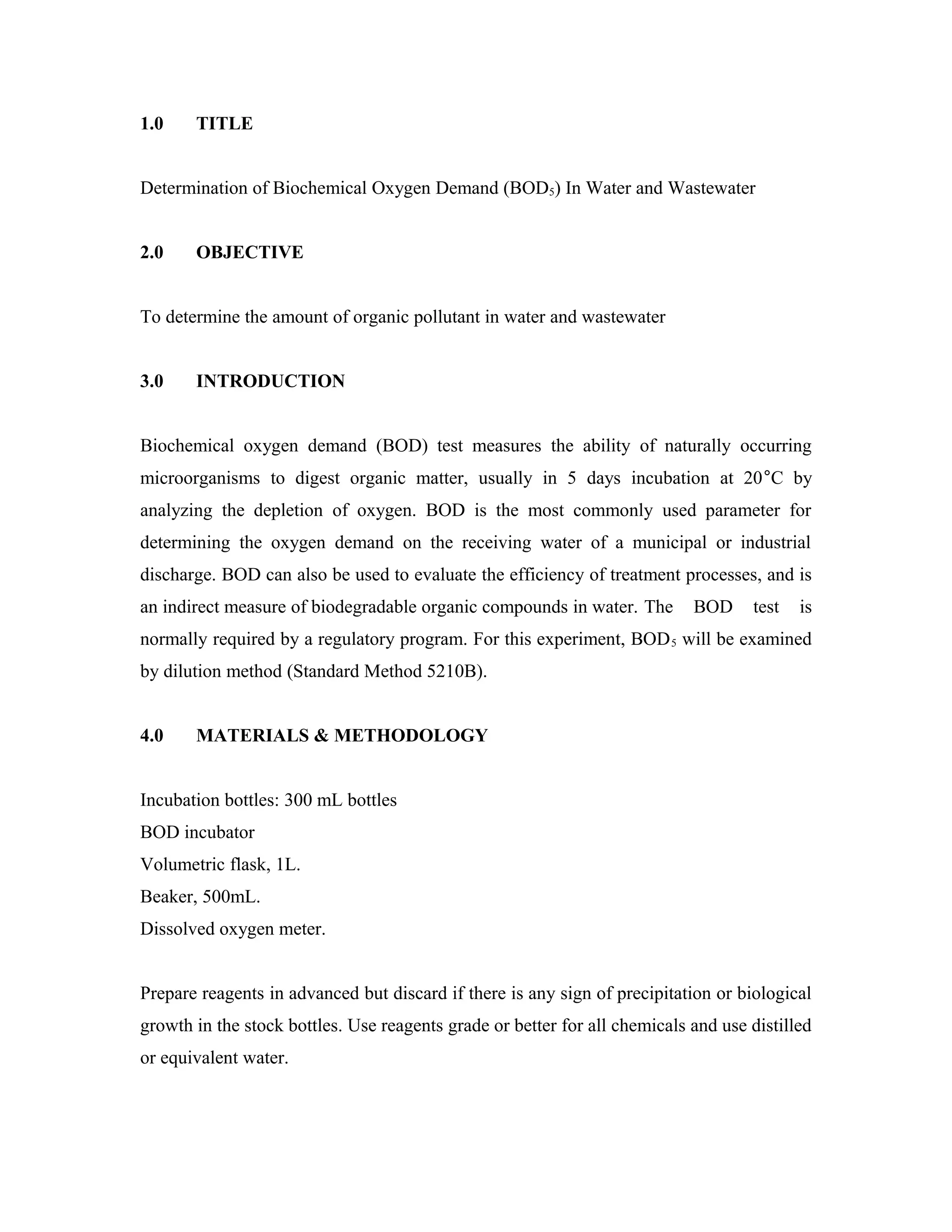
Determination of Biochemical Oxygen Demand (BOD5) In Water and Wastewater


2.0    OBJECTIVE


To determine the amount of organic pollutant in water and wastewater


3.0    INTRODUCTION


Biochemical oxygen demand (BOD) test measures the ability of naturally occurring
microorganisms to digest organic matter, usually in 5 days incubation at 20°C by
analyzing the depletion of oxygen. BOD is the most commonly used parameter for
determining the oxygen demand on the receiving water of a municipal or industrial
discharge. BOD can also be used to evaluate the efficiency of treatment processes, and is
an indirect measure of biodegradable organic compounds in water. The        BOD     test   is
normally required by a regulatory program. For this experiment, BOD 5 will be examined
by dilution method (Standard Method 5210B).


4.0    MATERIALS & METHODOLOGY


Incubation bottles: 300 mL bottles
BOD incubator
Volumetric flask, 1L.
Beaker, 500mL.
Dissolved oxygen meter.


Prepare reagents in advanced but discard if there is any sign of precipitation or biological
growth in the stock bottles. Use reagents grade or better for all chemicals and use distilled
or equivalent water.
a. Phosphate buffer solution
     Dissolve 8.5 g KH2PO4, 21.75 g K2HPO4, 33.4 g Na2HPO4·7H2O, and 1.7 g NH4CI in
     about 500 mL distilled water and dilute to 1L. The pH should be 7.2 without further
     adjustment.


     b. Magnesium sulfate solution
     Dissolve 22.5 g MgSO4·7H2O in distilled water and dilute to 1L.


     c. Calcium chloride solution
     Dissolve 27.5 g CaCI2 in distilled water and dilute to 1L.


     d. Ferric chloride solution
     Dissolve 0.25 g FeCI3·6H2O in distilled water and dilute to 1L.


     e. Acid and alkali solutions, 1N for neutralization of caustic or acidic waste samples.
     i.       Acid-Slowly and while stirring, add 28 mL concentrated sulfuric acid to
              distilled water. Dilute to 1L.
     ii.      Alkali-Dissolve 40 g sodium hydroxide in distilled water. Dilute to 1L.


1.         Preparation of dilution water: Add 1mL each of phosphate buffer, magnesium
           sulfate, calcium chloride, ferric chloride solution into 1L volumetric flask. Add
           distilled water to 1L.
2.         Add 10mL wastewater sample (refer Appendix) into a 500mL beaker.
3.         Add dilution water up to 300mL into the same beaker.
4.         Adjust pH value to 6.5 to 7.5 by adding acid/alkali.
5.         Prepare 300mL dilution water as control in another 500mL beaker.
6.         Put all prepared samples and control in 300mL-incubation bottle each.
7.         Measure and record dissolved oxygen (DO) concentration for each sample using
           Dissolved Oxygen Meter.
8.         Add water to the flared mouth of bottle and cover with an aluminum foil.
9.         Put all the bottles in BOD Incubator for five days. Set the temperature at 20°C.
10.    Measure final DO value after five days.
11.           Calculate BOD5 according to the formula below;


              BOD5, mg/L = (D1 – D2) / P


              Where;
              D1 = DO value in initial sample
              D2 = DO value in final sample
              P = Decimal volumetric fraction of sample used


              Or;


              BOD5, mg/L = (D1 – D2) x Dilution factor
              Dilution factor = Bottle volume (300mL) / Sample volume


5.0    RESULTS & DISCUSSIONS


                           DO1, mg/L               DO2, mg/L        BOD5, mg/L
       Control
       Sample

You discussion may include the following questions:
       1. Discuss your results by comparing with Standard A or Standard B as stated in
       Environmental Quality Act 1974.
       2. What is the purpose of adding water to the flared mouth of bottle? Why the
       flared mouth of bottle should be covered?
       3. Why the light must be excluding from air incubator?
       4. Samples of BOD analysis may degrade significantly during storage between
       collection and analysis, resulting in low BOD values. Suggest one step to
       minimize the reduction of BOD.
6.0       REFERENCES


Andrew, D. E., Lenore, S.C., Eugene, W. R. & Arnold, E. G. 2005. Standard Methods
For The Examination Of Water & Wastewater. 21 st Edition. APHA. AWWA. WEF.
United States of America


Howard, S. P., Donald, R. R. & George, T. 1985. Environmental Engineering. McGraw
Hill. Singapore


Fahid, R. Biological Wastewater Treatment-Lecture Notes in Advanced Sanitary
Engineering. Faculty of Engineering. Islamic University of Gaza. 2005-2006.


APPENDIX


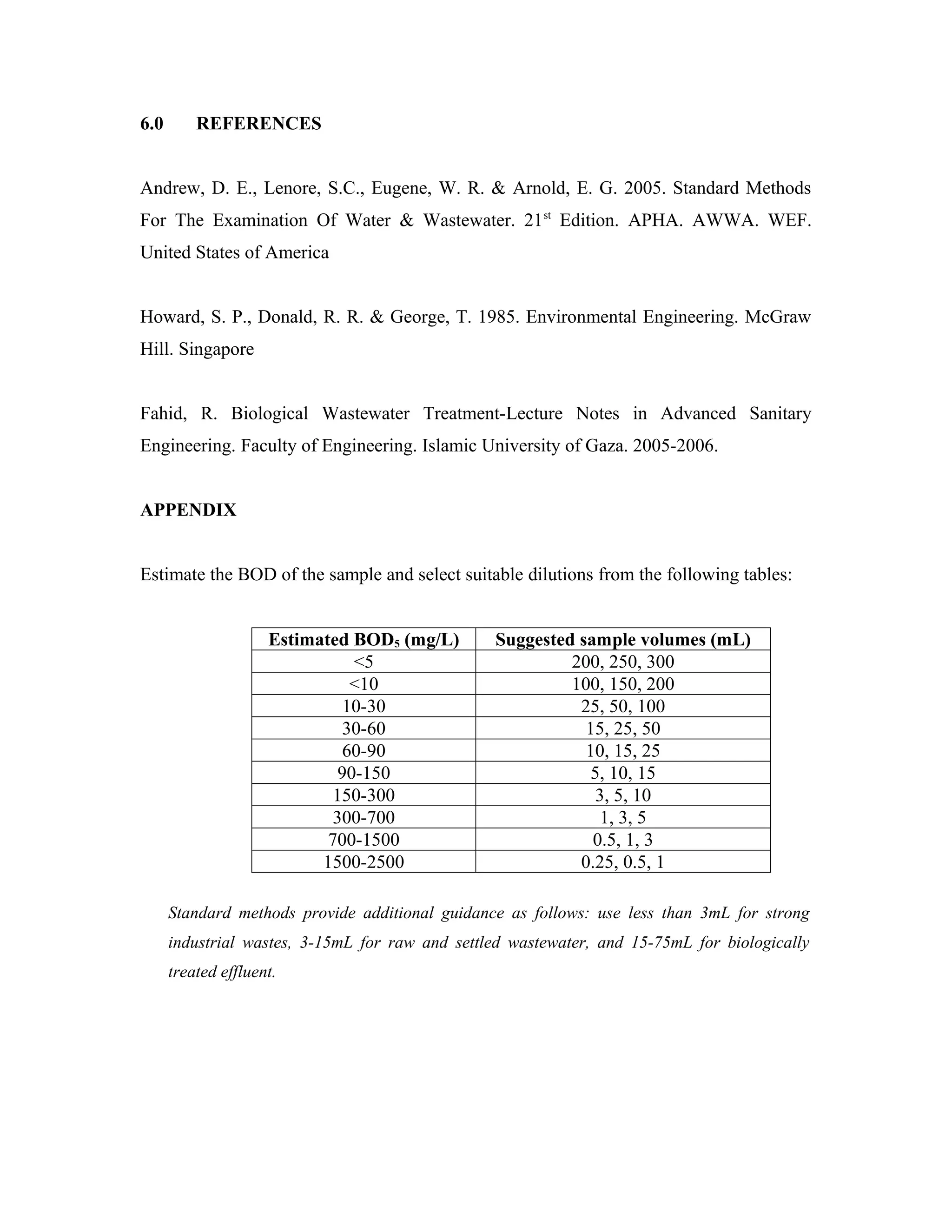
Estimate the BOD of the sample and select suitable dilutions from the following tables:


                     Estimated BOD5 (mg/L)       Suggested sample volumes (mL)
                                <5                        200, 250, 300
                                <10                       100, 150, 200
                               10-30                       25, 50, 100
                               30-60                        15, 25, 50
                               60-90                        10, 15, 25
                              90-150                         5, 10, 15
                             150-300                          3, 5, 10
                             300-700                           1, 3, 5
                            700-1500                         0.5, 1, 3
                           1500-2500                       0.25, 0.5, 1

      Standard methods provide additional guidance as follows: use less than 3mL for strong
      industrial wastes, 3-15mL for raw and settled wastewater, and 15-75mL for biologically
      treated effluent.

Ex 6 bod

  • 1.
    1.0 TITLE Determination of Biochemical Oxygen Demand (BOD5) In Water and Wastewater 2.0 OBJECTIVE To determine the amount of organic pollutant in water and wastewater 3.0 INTRODUCTION Biochemical oxygen demand (BOD) test measures the ability of naturally occurring microorganisms to digest organic matter, usually in 5 days incubation at 20°C by analyzing the depletion of oxygen. BOD is the most commonly used parameter for determining the oxygen demand on the receiving water of a municipal or industrial discharge. BOD can also be used to evaluate the efficiency of treatment processes, and is an indirect measure of biodegradable organic compounds in water. The BOD test is normally required by a regulatory program. For this experiment, BOD 5 will be examined by dilution method (Standard Method 5210B). 4.0 MATERIALS & METHODOLOGY Incubation bottles: 300 mL bottles BOD incubator Volumetric flask, 1L. Beaker, 500mL. Dissolved oxygen meter. Prepare reagents in advanced but discard if there is any sign of precipitation or biological growth in the stock bottles. Use reagents grade or better for all chemicals and use distilled or equivalent water.
  • 2.
    a. Phosphate buffersolution Dissolve 8.5 g KH2PO4, 21.75 g K2HPO4, 33.4 g Na2HPO4·7H2O, and 1.7 g NH4CI in about 500 mL distilled water and dilute to 1L. The pH should be 7.2 without further adjustment. b. Magnesium sulfate solution Dissolve 22.5 g MgSO4·7H2O in distilled water and dilute to 1L. c. Calcium chloride solution Dissolve 27.5 g CaCI2 in distilled water and dilute to 1L. d. Ferric chloride solution Dissolve 0.25 g FeCI3·6H2O in distilled water and dilute to 1L. e. Acid and alkali solutions, 1N for neutralization of caustic or acidic waste samples. i. Acid-Slowly and while stirring, add 28 mL concentrated sulfuric acid to distilled water. Dilute to 1L. ii. Alkali-Dissolve 40 g sodium hydroxide in distilled water. Dilute to 1L. 1. Preparation of dilution water: Add 1mL each of phosphate buffer, magnesium sulfate, calcium chloride, ferric chloride solution into 1L volumetric flask. Add distilled water to 1L. 2. Add 10mL wastewater sample (refer Appendix) into a 500mL beaker. 3. Add dilution water up to 300mL into the same beaker. 4. Adjust pH value to 6.5 to 7.5 by adding acid/alkali. 5. Prepare 300mL dilution water as control in another 500mL beaker. 6. Put all prepared samples and control in 300mL-incubation bottle each. 7. Measure and record dissolved oxygen (DO) concentration for each sample using Dissolved Oxygen Meter. 8. Add water to the flared mouth of bottle and cover with an aluminum foil. 9. Put all the bottles in BOD Incubator for five days. Set the temperature at 20°C.
  • 3.
    10. Measure final DO value after five days. 11. Calculate BOD5 according to the formula below; BOD5, mg/L = (D1 – D2) / P Where; D1 = DO value in initial sample D2 = DO value in final sample P = Decimal volumetric fraction of sample used Or; BOD5, mg/L = (D1 – D2) x Dilution factor Dilution factor = Bottle volume (300mL) / Sample volume 5.0 RESULTS & DISCUSSIONS DO1, mg/L DO2, mg/L BOD5, mg/L Control Sample You discussion may include the following questions: 1. Discuss your results by comparing with Standard A or Standard B as stated in Environmental Quality Act 1974. 2. What is the purpose of adding water to the flared mouth of bottle? Why the flared mouth of bottle should be covered? 3. Why the light must be excluding from air incubator? 4. Samples of BOD analysis may degrade significantly during storage between collection and analysis, resulting in low BOD values. Suggest one step to minimize the reduction of BOD.
  • 4.
    6.0 REFERENCES Andrew, D. E., Lenore, S.C., Eugene, W. R. & Arnold, E. G. 2005. Standard Methods For The Examination Of Water & Wastewater. 21 st Edition. APHA. AWWA. WEF. United States of America Howard, S. P., Donald, R. R. & George, T. 1985. Environmental Engineering. McGraw Hill. Singapore Fahid, R. Biological Wastewater Treatment-Lecture Notes in Advanced Sanitary Engineering. Faculty of Engineering. Islamic University of Gaza. 2005-2006. APPENDIX Estimate the BOD of the sample and select suitable dilutions from the following tables: Estimated BOD5 (mg/L) Suggested sample volumes (mL) <5 200, 250, 300 <10 100, 150, 200 10-30 25, 50, 100 30-60 15, 25, 50 60-90 10, 15, 25 90-150 5, 10, 15 150-300 3, 5, 10 300-700 1, 3, 5 700-1500 0.5, 1, 3 1500-2500 0.25, 0.5, 1 Standard methods provide additional guidance as follows: use less than 3mL for strong industrial wastes, 3-15mL for raw and settled wastewater, and 15-75mL for biologically treated effluent.