EWRT 1C CLASS 21
ONLINE
Email me if
you need
help!
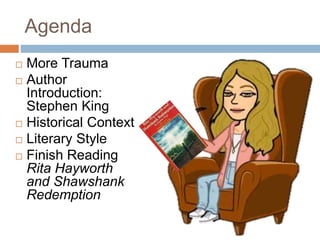
Agenda
 More Trauma
 Author
Introduction:
Stephen King
 Historical Context
 Literary Style
 Finish Reading
Rita Hayworth
and Shawshank
Redemption
 Cathy Caruth defines PTSD as “a
response, sometimes delayed, to an
overwhelming event or events, which
takes the form of repeated, intrusive
hallucinations, dreams, thoughts or
behaviors stemming from the event [.
. .] [T]he event is not assimilated or
experienced fully at the time, but only
belatedly [. . .] To be traumatized is
precisely to be possessed by an
image or event.” (Caruth 3-5)Cathy Caruth is a Cornell
Professor of English and German
Romanticism. She specializes in
trauma theory; psychoanalytic
theory. Unclaimed Experience:
Trauma, Narrative and History;
Empirical Truths and Critical
Fictions: Locke Wordsworth, Kant,
Freud.
From Cathy Caruth (ed.) (1995) 'Trauma
And Experience: Introduction’, Trauma:
Explorations in Memory.” Baltimore, MD:
Johns Hopkins University Press.
WHY IS LITERATURE SO IMPORTANT IN
TRAUMA THEORY?
Truth for anyone is a very complex
thing. For a writer, what you leave out
says as much as those things you
include. What lies beyond the margin
of the text? ...When we tell a story we
exercise control, but in such a way as
to leave a gap, an opening. It is a
version, but never the final one. And
perhaps we hope that the silences will
be heard by someone else, and the
story can continue, can be retold.
When we write we offer the silence as
much as the story. Words are the part
of silence that can be spoken. …Do
you remember the story of Philomel
who is raped and then has her tongue
ripped out by the rapist so that she
can never tell? I believe in fiction and
the power of stories because that way
we speak in tongues.
Jeanette Winterson,
Why Be Happy When You Could Be
Normal?
Trauma theorists deem
literature important because
of its ability to accommodate
both the comprehensible and
the incomprehensible.
Literary language
simultaneously defies as well
as claims understanding,
and all the pioneer trauma
theorists—beginning with
Freud and including Cathy
Caruth and Shoshana
Felman—turned to literature
for theoretical support.
Literature accommodates the known and the
unknown:
`Kurtz got the tribe to
follow him, did he?' I
suggested. He fidgeted a
little. `They adored him,' he
said. The tone of these
words was so
extraordinary that I looked
at him searchingly. It was
curious to see his mingled
eagerness and reluctance
to speak of Kurtz.
Heart of Darkness,
Joseph Conrad
Literature can contain
knowing and not knowing,
the known and unknown, the
knowable and unknowable
all at once in language, a
medium that itself oscillates
between the expressible and
inexpressible, the possible
and impossible.
Psychoanalysis, in its
extension to trauma theory,
makes use of this strange
nature of literature and its
medium.
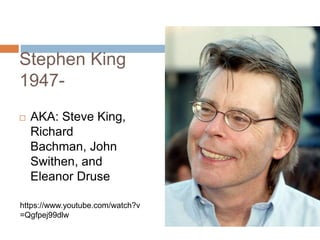
Stephen King
1947-
 AKA: Steve King,
Richard
Bachman, John
Swithen, and
Eleanor Druse
https://www.youtube.com/watch?v
=Qgfpej99dlw
Stephen King: Brief Biography
 King was born in Portland, Maine, and
except for his elementary school years,
he lived much of the rest of his life there.
He received a B.A. in English from the
University of Maine at Orono in 1970,
prepared to teach high school English. A
draft board examination immediately post-
graduation found him 4-F on grounds of
high blood pressure, limited vision, flat
feet, and punctured eardrums.
 King ended his high-school teaching
career with the success of Carrie,
Published in 1974.
Genre
 King is best known for writing Horror, but
he does venture into a more mainstream
genre with some of his novels and
stories. King himself compares his writing
to medieval morality plays [allegorical
drama popular in Europe especially
during the 15th and 16th centuries, in
which the characters personify moral
qualities (such as charity or vice) or
abstractions (as death or youth) and in
which moral lessons are taught.] The
Green Mile, for example, is often referred
to as both a tragedy and a morality play. I
will leave you to figure out if Shawshank
fits the description of a morality play.
Historical Context: Shawshank
 Alcatraz operated as a prison from 1934 to 1963. A little
over 1,500 men were housed there during its relatively
brief stint as one of America’s most notorious prisons.
One of the more famous prisoners was Robert
“Birdman” Stroud who got his nickname while in prison
at Leavenworth. Stroud became an ornithologist while
at Leavenworth and became very well-known in birding
circles, though few knew he was a prisoner for much of
the time. Stroud was an avid reader and lived much of
his life in solitary confinement. Books and birds were his
best friends.
 Stroud may be the inspiration for King’s
character, Brooks Hatlen, the only other prisoner we
meet with a college degree.
Historical Context: The Great
Escape
 They launched into the San Francisco Bay in a
raft made of prison raincoats. Some think that
one or more of them escaped to Central or
South America due to their library records and
attempts to learn Spanish. More think they
drowned.
One summer night in 1962, Frank Morris, John Anglin, and Clarence
Anglin escaped from Alcatraz. They chiseled away sections of the
wall around the air vent in the rear of their cells with the handles of
steel spoons. While inmates played instruments loudly at a concert,
Morris and the Anglin brothers broke through the backs of their cells
and into the utility tunnel. They climbed the pipes and made it to the
roof of Alcatraz prison.
Homework
Edit Essay #2: Due Sunday, week 8 at Noon via Kaizena
Post #18:Choose one
1. Who is the narrator? How did the first-person narrative affect the story?
Why does the author choose to tell the story through Red’s eyes and not
Andy’s? Is he reliable? Why or why not?
2. Discuss one or more themes or symbols in the story.
Post #19 Choose one
1 QHQ: Rita Hayworth and Shawshank Redemption.
2 Discuss trauma (Bloom and Baelev) as it applies to any one character in
Rita Hayworth and the Shawshank Redemption. Use textual support to
make a case that the traumatic
3 incident has long term ramifications.
4 Using a psychoanalytic lens, do a character profile of any character in
Shawshank Redemption.9

Ewrt 1 c class 21 online

  • 1.
    EWRT 1C CLASS21 ONLINE Email me if you need help!
  • 2.
    Agenda  More Trauma Author Introduction: Stephen King  Historical Context  Literary Style  Finish Reading Rita Hayworth and Shawshank Redemption
  • 3.
     Cathy Caruthdefines PTSD as “a response, sometimes delayed, to an overwhelming event or events, which takes the form of repeated, intrusive hallucinations, dreams, thoughts or behaviors stemming from the event [. . .] [T]he event is not assimilated or experienced fully at the time, but only belatedly [. . .] To be traumatized is precisely to be possessed by an image or event.” (Caruth 3-5)Cathy Caruth is a Cornell Professor of English and German Romanticism. She specializes in trauma theory; psychoanalytic theory. Unclaimed Experience: Trauma, Narrative and History; Empirical Truths and Critical Fictions: Locke Wordsworth, Kant, Freud. From Cathy Caruth (ed.) (1995) 'Trauma And Experience: Introduction’, Trauma: Explorations in Memory.” Baltimore, MD: Johns Hopkins University Press.
  • 4.
    WHY IS LITERATURESO IMPORTANT IN TRAUMA THEORY? Truth for anyone is a very complex thing. For a writer, what you leave out says as much as those things you include. What lies beyond the margin of the text? ...When we tell a story we exercise control, but in such a way as to leave a gap, an opening. It is a version, but never the final one. And perhaps we hope that the silences will be heard by someone else, and the story can continue, can be retold. When we write we offer the silence as much as the story. Words are the part of silence that can be spoken. …Do you remember the story of Philomel who is raped and then has her tongue ripped out by the rapist so that she can never tell? I believe in fiction and the power of stories because that way we speak in tongues. Jeanette Winterson, Why Be Happy When You Could Be Normal? Trauma theorists deem literature important because of its ability to accommodate both the comprehensible and the incomprehensible. Literary language simultaneously defies as well as claims understanding, and all the pioneer trauma theorists—beginning with Freud and including Cathy Caruth and Shoshana Felman—turned to literature for theoretical support.
  • 5.
    Literature accommodates theknown and the unknown: `Kurtz got the tribe to follow him, did he?' I suggested. He fidgeted a little. `They adored him,' he said. The tone of these words was so extraordinary that I looked at him searchingly. It was curious to see his mingled eagerness and reluctance to speak of Kurtz. Heart of Darkness, Joseph Conrad Literature can contain knowing and not knowing, the known and unknown, the knowable and unknowable all at once in language, a medium that itself oscillates between the expressible and inexpressible, the possible and impossible. Psychoanalysis, in its extension to trauma theory, makes use of this strange nature of literature and its medium.
  • 6.
    Stephen King 1947-  AKA:Steve King, Richard Bachman, John Swithen, and Eleanor Druse https://www.youtube.com/watch?v =Qgfpej99dlw
  • 7.
    Stephen King: BriefBiography  King was born in Portland, Maine, and except for his elementary school years, he lived much of the rest of his life there. He received a B.A. in English from the University of Maine at Orono in 1970, prepared to teach high school English. A draft board examination immediately post- graduation found him 4-F on grounds of high blood pressure, limited vision, flat feet, and punctured eardrums.  King ended his high-school teaching career with the success of Carrie, Published in 1974.
  • 8.
    Genre  King isbest known for writing Horror, but he does venture into a more mainstream genre with some of his novels and stories. King himself compares his writing to medieval morality plays [allegorical drama popular in Europe especially during the 15th and 16th centuries, in which the characters personify moral qualities (such as charity or vice) or abstractions (as death or youth) and in which moral lessons are taught.] The Green Mile, for example, is often referred to as both a tragedy and a morality play. I will leave you to figure out if Shawshank fits the description of a morality play.
  • 9.
    Historical Context: Shawshank Alcatraz operated as a prison from 1934 to 1963. A little over 1,500 men were housed there during its relatively brief stint as one of America’s most notorious prisons. One of the more famous prisoners was Robert “Birdman” Stroud who got his nickname while in prison at Leavenworth. Stroud became an ornithologist while at Leavenworth and became very well-known in birding circles, though few knew he was a prisoner for much of the time. Stroud was an avid reader and lived much of his life in solitary confinement. Books and birds were his best friends.  Stroud may be the inspiration for King’s character, Brooks Hatlen, the only other prisoner we meet with a college degree.
  • 10.
    Historical Context: TheGreat Escape  They launched into the San Francisco Bay in a raft made of prison raincoats. Some think that one or more of them escaped to Central or South America due to their library records and attempts to learn Spanish. More think they drowned. One summer night in 1962, Frank Morris, John Anglin, and Clarence Anglin escaped from Alcatraz. They chiseled away sections of the wall around the air vent in the rear of their cells with the handles of steel spoons. While inmates played instruments loudly at a concert, Morris and the Anglin brothers broke through the backs of their cells and into the utility tunnel. They climbed the pipes and made it to the roof of Alcatraz prison.
  • 11.
    Homework Edit Essay #2:Due Sunday, week 8 at Noon via Kaizena Post #18:Choose one 1. Who is the narrator? How did the first-person narrative affect the story? Why does the author choose to tell the story through Red’s eyes and not Andy’s? Is he reliable? Why or why not? 2. Discuss one or more themes or symbols in the story. Post #19 Choose one 1 QHQ: Rita Hayworth and Shawshank Redemption. 2 Discuss trauma (Bloom and Baelev) as it applies to any one character in Rita Hayworth and the Shawshank Redemption. Use textual support to make a case that the traumatic 3 incident has long term ramifications. 4 Using a psychoanalytic lens, do a character profile of any character in Shawshank Redemption.9