EWRT 1C
Class 20
AGENDA
Exam grades
Author Introduction:
Stephen King
Discussion: Rita
Hayworth and
Shawshank Redemption
 Historical Context
 Literary Style
 POV
 Narrator
 Themes and Concepts
Average 81/100
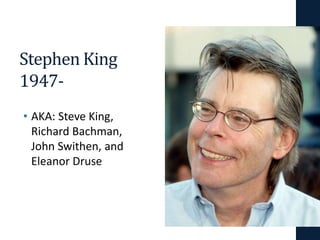
Stephen King
1947-
• AKA: Steve King,
Richard Bachman,
John Swithen, and
Eleanor Druse
Stephen King: Brief Biography
• King was born in Portland, Maine, and except for his
elementary school years, he lived much of the rest of his life
there. He received a B.A. in English from the University of
Maine at Orono in 1970, prepared to teach high school
English. A draft board examination immediately post-
graduation found him 4-F on grounds of high blood pressure,
limited vision, flat feet, and punctured eardrums.
• King ended his high-school teaching career with the success of
Carrie, Published in 1974.
Genre
• King is best known for writing Horror, but he does venture into
a more mainstream genre with some of his novels and stories.
King himself compares his writing to medieval morality plays
[allegorical drama popular in Europe especially during the
15th and 16th centuries, in which the characters personify
moral qualities (such as charity or vice) or abstractions (as
death or youth) and in which moral lessons are taught.] The
Green Mile, for example, is often referred to as both a tragedy
and a morality play. I will leave you to figure out if Shawshank
fits the description of a morality play.
Historical Context
• Alcatraz operated as a prison from 1934 to 1963. A little over
1,500 men were housed there during its relatively brief stint as
one of America’s most notorious prisons. One of the more
famous prisoners was Robert “Birdman” Stroud who got his
nickname while in prison at Leavenworth. Stroud became an
ornithologist while at Leavenworth and became very well-
known in birding circles, though few knew he was a prisoner
for much of the time. Stroud was an avid reader and lived
much of his life in solitary confinement. Books and birds were
his best friends.
• Stroud may be the inspiration for King’s character, Brooks
Hatlen, the only other prisoner we meet with a college degree.
Historical Context: The Great
Escape
• One summer night in 1962, Frank Morris, John Anglin, and
Clarence Anglin escaped from Alcatraz. They chiseled away
sections of the wall around the air vent in the rear of their cells
with the handles of steel spoons. While inmates played
instruments loudly at a concert, Morris and the Anglin brothers
broke through the backs of their cells and into the utility
tunnel. They climbed the pipes and made it to the roof of
Alcatraz prison. They launched into the San Francisco Bay in a
raft made of prison raincoats. Some think that one or more of
them escaped to Central or South America due to their library
records and attempts to learn Spanish. More think they
drowned.
Group Discussion: Shawshank
Point of view:
The Narrator
Reliable or not?
Themes/Concep
ts
Symbols
Major
Characters
QHQs
Major Characters
• Red
• Andy Dufresne
• Samuel Norton
• Tommy Williams
• Byron Hadley
• The Sisters
LITERARY STYLE
• Who is the narrator?
1. Reading the story through the perspective of
the prisoner who was known for being able to
get things from the outside world for the other
inmates that they weren’t allowed to have
gives the reader an insight into several
inmates lives because he has a connection
with so many of them.
2. Having the perspective in Red’s voice, the
“outside man” that can get just about anything
for anyone, gives us a connection with so
many other inmates, especially Andy. By using
Red’s voice, we get a bigger background of
what goes on within Shawshank and how it
affects Andy, or even how Andy affects the
prison itself over the years.
Is he reliable? why
1. The first person narration makes us question whether Red is
credible or not, and he does state “In some cases I’ve simplified it
even more than it really was, and have repeated or will repeat
fourth – or fifth- hand information. That’s the way it is here. The
grapevine is very real” (King 24).
2. Part of the reason telling the story through Red’s perspective adds
so much to the story is because he gives you a sense that he’s
trustworthy and honest about what he’s saying. […]The fact that he
admit[s] that he was responsible for the death of his wife and the
two other passengers in the car that he tampered with gave me the
sense that he’s not one to lie. Another thing that persuaded me
that Red is more real than other characters is where he says “You
have to know how to pick out the grains of truth from the chaff of
lies, rumors, and wish-it-had-beens” (24).
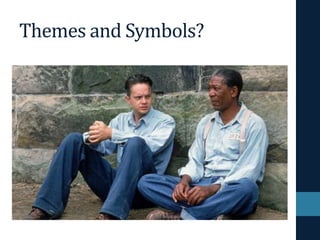
Themes and Symbols?
Themes: Queerness?
• In Stephen King’s Rita Hayworth and Shawshank Redemption,
I find a queer theme in Red and Andy’s relationship. According
to heteronormativity, people would say it is a bromance, not a
romance, but for me, their relationship seems quite romantic.
Considering that both of them have miserable marriages, we
can also assume that they suffered from heteronormativity.
They rely on each other more than anyone else. I need to find
more textual evidence, but when we remove the “straight”
lens, I think it’s pretty straight forward.
Themes: Queerness?
• Throughout the course of 11 years from 1955-66, [Andy’s] posters changed
from Rita Hayworth, Marilyn Monroe, Jayne Mansfield, Hazel Court,
Raquel Welch, to Linda Ronstadt. Before his escape from the enclosed and
isolated space of his cell (which signifies his “coming out”), Andy has
changed his poster from one female celebrity to another repeatedly, as if
he is incapable of being satiated by the traditional means of arousal —
through desirable physical features of the opposite sex. He then projects
this dissatisfaction by using the rock hammer (a phallic allusion, also
significant in that it was given to him by Red) to force an unnatural
entrance to an escape chamber that Tremont describes as “smell[ing] like
shit” (70). When all these factors are combined, a clear sequence of Andy
“coming out” as a homosexual man can be realized: Andy’s indecisiveness
with female form leads to his frustration to identify with traditional
sexuality, and this leads to his metaphorical “coming out” with the
depiction of an anal intercourse (achieving freedom by penetrating a “back
exit” with Red’s “rock hammer”/penis to leave an enclosed space.
Themes
1. Sex and Sexuality:
• How did Andy’s traumatizing experience with the Sisters
affect his sexuality? How does Stephen King reflect this in
terms of symbols?
• I ended by asking myself, Does the pipe through which
Andy escaped represent his struggle to once again find a
sense of sexuality after imprisonment?
2. Corruption
• How does “Rita Hayworth and the Shawshank
Redemption” by Stephen King depict the correctional
system through the narrator Red?
• Hope
• Red on the other hand did murder but he has a chance to
redeem himself and takes Andy’s advice, “hope is a good
thing.”
• Red’s description of Andy is that “there was none of that
sullen desperation about him that seems to afflict most lifers
after awhile; you could never smell hopelessness on him.”
• Crime
• Red readily admits to the murders he committed and he
knows he deserves to be in prison.
• When we first get introduced to Andy we learn that he was
charged for the murder of his wife and her lover. However, we
also learn through Red’s narration that Andy denies ever
committing the murders, and that he was just an unlucky guy.
1. Isolation and Imprisonment
• Q: What does the setting (Shawshank state prison)
contribute to the overall theme and any crucial meaning
that the story has behind it? How does the matter of
isolation affect the characters and their actions in this
story?
Symbols
1. Rita Hayworth
2. Andy Dufresne
• What is Andy Dufresne is symbolic of and what does he represent to Red and to
the rest of the inmates at Shawshank?
3. Warden Norton
• Warden Norton represents the faults of the prison system.
4. The Bird
• What did Sherwood Bolton’s bird, Jake, represent? What did it symbolize when the
Red found it dead after it had been released?
5. Rocks
• These rocks end up being a symbol of hope for Red
• the rocks seem to associate more with Andy since he has been sentenced to life
imprisonment which is something constant, and unchanging for him. The rocks
give him control in the sense that he gets to maneuver the outcome of the rock
into something shiny and beautiful.
6. The Rock Hammer:
• In a way, the rock hammer represents Andy’s aspirations for freedom and who he
is as a person.
Symbols
1. Rocks
• These rocks end up being a symbol of hope for Red
• the rocks seem to associate more with Andy since he has been
sentenced to life imprisonment which is something constant, and
unchanging for him. The rocks give him control in the sense that he
gets to maneuver the outcome of the rock into something shiny and
beautiful.
2. The Rock Hammer:
• In a way, the rock hammer represents Andy’s aspirations for freedom
and who he is as a person.
• The rock hammer is a symbol of persistence, nothing can withstand
the ravages of time. The hammer is presumably made of steel, strong
and forged to break through rocks, but over the years even a rock
hammer will wear down to a nub. Much like the hammer, in prison a
man will wear down too.
Symbols
1. Water:
• I took an interest in the role of water in this novella:
especially the idea of filth in water. At the beginning of
Andy’s ordeal, he throws his gun into the water—washing
away the (supposed) evidence of his innocence, and he ends
up (possibly) by the ocean, on the border of Mexico. Before
that, Andy “waded in shit and came out clean on the other
side,” attesting perhaps to the purity of Andy’s innocence
untarnished by the sullying world of Shawshank.
Even the narrator, Red, says that “Writing about yourself
seems to be a lot like sticking a branch into clear river-water
and roiling up the muddy bottom.”
QHQs
1. Q: Does this story make a judgment on which of the two
men in the anecdote about moving priceless paintings out
of a mansion in the event of a hurricane is right, and which
is wrong?
2. Q1: As the second type of man, if Andy made his own luck,
is luck even a factor in his life? What does the story say
about the role of fate in someone’s life. After all, both of
these men were caught for crimes and put in prison. Even if
one of them was a murderer, didn’t they just have bad luck?
20 years of Women’s Studies at
De Anza
HOMEWORK
 Read Bloom’s “Trauma
Theory Abbreviated”
 Read Balaev’s “Trends
in Literary Trauma
Theory”
 Post # 18: QHQ Bloom
or Balaev
 Work on Essay #2: Due
Wednesday, week 9
before class.

Ewrt 1 c class 20

  • 1.
  • 2.
    AGENDA Exam grades Author Introduction: StephenKing Discussion: Rita Hayworth and Shawshank Redemption  Historical Context  Literary Style  POV  Narrator  Themes and Concepts
  • 3.
  • 4.
    Stephen King 1947- • AKA:Steve King, Richard Bachman, John Swithen, and Eleanor Druse
  • 5.
    Stephen King: BriefBiography • King was born in Portland, Maine, and except for his elementary school years, he lived much of the rest of his life there. He received a B.A. in English from the University of Maine at Orono in 1970, prepared to teach high school English. A draft board examination immediately post- graduation found him 4-F on grounds of high blood pressure, limited vision, flat feet, and punctured eardrums. • King ended his high-school teaching career with the success of Carrie, Published in 1974.
  • 6.
    Genre • King isbest known for writing Horror, but he does venture into a more mainstream genre with some of his novels and stories. King himself compares his writing to medieval morality plays [allegorical drama popular in Europe especially during the 15th and 16th centuries, in which the characters personify moral qualities (such as charity or vice) or abstractions (as death or youth) and in which moral lessons are taught.] The Green Mile, for example, is often referred to as both a tragedy and a morality play. I will leave you to figure out if Shawshank fits the description of a morality play.
  • 7.
    Historical Context • Alcatrazoperated as a prison from 1934 to 1963. A little over 1,500 men were housed there during its relatively brief stint as one of America’s most notorious prisons. One of the more famous prisoners was Robert “Birdman” Stroud who got his nickname while in prison at Leavenworth. Stroud became an ornithologist while at Leavenworth and became very well- known in birding circles, though few knew he was a prisoner for much of the time. Stroud was an avid reader and lived much of his life in solitary confinement. Books and birds were his best friends. • Stroud may be the inspiration for King’s character, Brooks Hatlen, the only other prisoner we meet with a college degree.
  • 8.
    Historical Context: TheGreat Escape • One summer night in 1962, Frank Morris, John Anglin, and Clarence Anglin escaped from Alcatraz. They chiseled away sections of the wall around the air vent in the rear of their cells with the handles of steel spoons. While inmates played instruments loudly at a concert, Morris and the Anglin brothers broke through the backs of their cells and into the utility tunnel. They climbed the pipes and made it to the roof of Alcatraz prison. They launched into the San Francisco Bay in a raft made of prison raincoats. Some think that one or more of them escaped to Central or South America due to their library records and attempts to learn Spanish. More think they drowned.
  • 9.
    Group Discussion: Shawshank Pointof view: The Narrator Reliable or not? Themes/Concep ts Symbols Major Characters QHQs
  • 10.
    Major Characters • Red •Andy Dufresne • Samuel Norton • Tommy Williams • Byron Hadley • The Sisters
  • 11.
  • 12.
    • Who isthe narrator? 1. Reading the story through the perspective of the prisoner who was known for being able to get things from the outside world for the other inmates that they weren’t allowed to have gives the reader an insight into several inmates lives because he has a connection with so many of them. 2. Having the perspective in Red’s voice, the “outside man” that can get just about anything for anyone, gives us a connection with so many other inmates, especially Andy. By using Red’s voice, we get a bigger background of what goes on within Shawshank and how it affects Andy, or even how Andy affects the prison itself over the years.
  • 13.
    Is he reliable?why 1. The first person narration makes us question whether Red is credible or not, and he does state “In some cases I’ve simplified it even more than it really was, and have repeated or will repeat fourth – or fifth- hand information. That’s the way it is here. The grapevine is very real” (King 24). 2. Part of the reason telling the story through Red’s perspective adds so much to the story is because he gives you a sense that he’s trustworthy and honest about what he’s saying. […]The fact that he admit[s] that he was responsible for the death of his wife and the two other passengers in the car that he tampered with gave me the sense that he’s not one to lie. Another thing that persuaded me that Red is more real than other characters is where he says “You have to know how to pick out the grains of truth from the chaff of lies, rumors, and wish-it-had-beens” (24).
  • 14.
  • 15.
    Themes: Queerness? • InStephen King’s Rita Hayworth and Shawshank Redemption, I find a queer theme in Red and Andy’s relationship. According to heteronormativity, people would say it is a bromance, not a romance, but for me, their relationship seems quite romantic. Considering that both of them have miserable marriages, we can also assume that they suffered from heteronormativity. They rely on each other more than anyone else. I need to find more textual evidence, but when we remove the “straight” lens, I think it’s pretty straight forward.
  • 16.
    Themes: Queerness? • Throughoutthe course of 11 years from 1955-66, [Andy’s] posters changed from Rita Hayworth, Marilyn Monroe, Jayne Mansfield, Hazel Court, Raquel Welch, to Linda Ronstadt. Before his escape from the enclosed and isolated space of his cell (which signifies his “coming out”), Andy has changed his poster from one female celebrity to another repeatedly, as if he is incapable of being satiated by the traditional means of arousal — through desirable physical features of the opposite sex. He then projects this dissatisfaction by using the rock hammer (a phallic allusion, also significant in that it was given to him by Red) to force an unnatural entrance to an escape chamber that Tremont describes as “smell[ing] like shit” (70). When all these factors are combined, a clear sequence of Andy “coming out” as a homosexual man can be realized: Andy’s indecisiveness with female form leads to his frustration to identify with traditional sexuality, and this leads to his metaphorical “coming out” with the depiction of an anal intercourse (achieving freedom by penetrating a “back exit” with Red’s “rock hammer”/penis to leave an enclosed space.
  • 17.
    Themes 1. Sex andSexuality: • How did Andy’s traumatizing experience with the Sisters affect his sexuality? How does Stephen King reflect this in terms of symbols? • I ended by asking myself, Does the pipe through which Andy escaped represent his struggle to once again find a sense of sexuality after imprisonment? 2. Corruption • How does “Rita Hayworth and the Shawshank Redemption” by Stephen King depict the correctional system through the narrator Red?
  • 18.
    • Hope • Redon the other hand did murder but he has a chance to redeem himself and takes Andy’s advice, “hope is a good thing.” • Red’s description of Andy is that “there was none of that sullen desperation about him that seems to afflict most lifers after awhile; you could never smell hopelessness on him.” • Crime • Red readily admits to the murders he committed and he knows he deserves to be in prison. • When we first get introduced to Andy we learn that he was charged for the murder of his wife and her lover. However, we also learn through Red’s narration that Andy denies ever committing the murders, and that he was just an unlucky guy.
  • 19.
    1. Isolation andImprisonment • Q: What does the setting (Shawshank state prison) contribute to the overall theme and any crucial meaning that the story has behind it? How does the matter of isolation affect the characters and their actions in this story?
  • 20.
    Symbols 1. Rita Hayworth 2.Andy Dufresne • What is Andy Dufresne is symbolic of and what does he represent to Red and to the rest of the inmates at Shawshank? 3. Warden Norton • Warden Norton represents the faults of the prison system. 4. The Bird • What did Sherwood Bolton’s bird, Jake, represent? What did it symbolize when the Red found it dead after it had been released? 5. Rocks • These rocks end up being a symbol of hope for Red • the rocks seem to associate more with Andy since he has been sentenced to life imprisonment which is something constant, and unchanging for him. The rocks give him control in the sense that he gets to maneuver the outcome of the rock into something shiny and beautiful. 6. The Rock Hammer: • In a way, the rock hammer represents Andy’s aspirations for freedom and who he is as a person.
  • 21.
    Symbols 1. Rocks • Theserocks end up being a symbol of hope for Red • the rocks seem to associate more with Andy since he has been sentenced to life imprisonment which is something constant, and unchanging for him. The rocks give him control in the sense that he gets to maneuver the outcome of the rock into something shiny and beautiful. 2. The Rock Hammer: • In a way, the rock hammer represents Andy’s aspirations for freedom and who he is as a person. • The rock hammer is a symbol of persistence, nothing can withstand the ravages of time. The hammer is presumably made of steel, strong and forged to break through rocks, but over the years even a rock hammer will wear down to a nub. Much like the hammer, in prison a man will wear down too.
  • 22.
    Symbols 1. Water: • Itook an interest in the role of water in this novella: especially the idea of filth in water. At the beginning of Andy’s ordeal, he throws his gun into the water—washing away the (supposed) evidence of his innocence, and he ends up (possibly) by the ocean, on the border of Mexico. Before that, Andy “waded in shit and came out clean on the other side,” attesting perhaps to the purity of Andy’s innocence untarnished by the sullying world of Shawshank. Even the narrator, Red, says that “Writing about yourself seems to be a lot like sticking a branch into clear river-water and roiling up the muddy bottom.”
  • 23.
    QHQs 1. Q: Doesthis story make a judgment on which of the two men in the anecdote about moving priceless paintings out of a mansion in the event of a hurricane is right, and which is wrong? 2. Q1: As the second type of man, if Andy made his own luck, is luck even a factor in his life? What does the story say about the role of fate in someone’s life. After all, both of these men were caught for crimes and put in prison. Even if one of them was a murderer, didn’t they just have bad luck?
  • 24.
    20 years ofWomen’s Studies at De Anza
  • 25.
    HOMEWORK  Read Bloom’s“Trauma Theory Abbreviated”  Read Balaev’s “Trends in Literary Trauma Theory”  Post # 18: QHQ Bloom or Balaev  Work on Essay #2: Due Wednesday, week 9 before class.