UNIT-III
NATURAL
RESOURCES
FROM UNSUSTAINABLE TO
SUSTAINABLE DEVELOPMENT
Sustainable development has been defined as
“Development that meets the needs of the present
without compromising the ability of future
generations to meet their own needs” (The World
Commission on Environment and Development,
Brundtland Commission 1987).
 In other words, when people make decisions about
how to use the Earth’s resources such as forests,
water, minerals, wildlife, etc. they must take into
account not only how much of these resources they
are using, what processes they used to get these
resources, and who has access to these resources.
Are enough resources going to be left for our
future generations to use and will the environment
be left as we know it today?
Is it true sustainable
development
 .
Sustainable Development
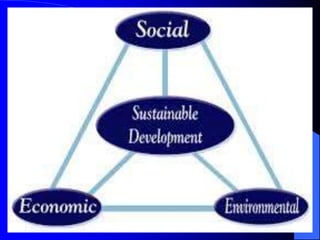
 The sustainable development is a process of
betterment of life, in all sectors of society
i.e. social, economic, educational, health,
national security, food and education”
Need for Sustainable Development
 Almost all environmental problems are the results of
unsustainable development
 Overuse of natural resources leads to pollution, cutting of
trees has created global warming
 Laws for Air, Water, Land, Wild Life, Forest have failed to
control environmental losses
 Only way is to accept the concept of sustainable
development by making people aware about the needs and
methods to control their demands and control over the
overuse of resources
World summit on sustainable
development
Aspects (or) aim of sustainable
development
a) inter- generational equity: it states that we should
hand over a safe, healthy, and resourceful
environment to our future generations.
b) intra – generational equity: it states that the
technological development of rich countries should
support the economic growth of the poor countries
and help in narrowing the wealth gap lead to
sustainability.
Concept or Approaches or significance for
sustainable development
 Developing appropriate technology
 Reduce , Reuse, Recycle approach
 Providing environmental education and awareness
 Consumption of renewable resources
 Conservation of non renewable resources
 Population control
Urban problems related to
energy
 Urbanization is the movement of human
population from rural areas to urban areas
for the want of better education,
communication, health, employment.
Causes of urbanization
 Cities are main centers of economic growth, trade,
transportation, education, medical facilities and
employment
 Urban sprawl: Urban growth is fast , so difficult to
accommodate with their limited area .So cities
spread into rural areas
 Urban energy requirement:
 Residential and commercial lighting
 Public and private transportation
 Electrical and electronic appliances

Energy demanding activities
 In developing countries, urban growth is
very fast and pollution is uncontrollable and
unplanned growth. When compared to rural
people, urban people consumes a lot of
energy and materials and generates a lot of
waste. This is because urban people have a
higher standard of life and their life style
demands more energy inputs.
Example for energy demanding activities
 Residential and commercial lightings
 Transportation means including, motor cycle, car
and public transport for moving from residence to
work place.
 Industries using a large proportion of energy
 Modern life style using a large number of electrical
gadgets( fan, fridge, washing machine, A/C, water
heater,etc) in everyday life.
 Control and prevention of pollution, need more
energy dependent technologies.
Solution:
 Use public transport instead of motor cycles
Energy consumption must be minimized
Use solar and wind energy Impose strict
laws, penalty, and energy audit
Water conservation:
 Process of saving water for future utilization
 Water source:
 Fresh water
 River
 Stream
 Pond
 Ocean
 Lakes
Need for water conservation:
 Population increases water requirement also
increases
 Due to deforestation annual rainfall decreases
 Over exploitation of ground water
Ways of water conservation
 Reducing evaporation loss
 Reducing irrigation loss
 Reuse of water
 Preventing wastage of water
 Decreasing run-off losses
 Avoid sewage discharge
Water conservation method
Rain water harvesting
Watershed management
Rain water harvesting
 Objective: To meet increasing demands of water
Raise water table by recharging ground water
Reduce ground water contamination from salt
water intrusion.
 Roof top rainwater harvesting
 Involves collecting water that falls on roof of
house
 Rainwater from roof top, road surface, play
ground diverted to surface tank
Advantages of rainwater harvesting
 Increases the well water availability
Raise ground water level
Minimizes soil erosion
Watershed management:
 It is defined as land area bounded by divide line
from which water drains under influence of
gravity in to stream, lakes, reservoir. Eg. Pits,
dams, Farm, ponds, Himalaya
 Types
 1. Micro
 2. Mini
 3. Macro
 Watershed Management; The management of
rainfall & resultant runoff.
 Forestry
Halt deforestation, provide vegetative cover,
degraded land and supplement folder and fuel
wood resources available to rural communities
Agriculture
 Aims to increase agricultural productivity in
sustained manner and to diversify crop production
 - Major objective shall be achieved through
organizing farmers, training camps and exposure
visits.
 - Construct check dams, water harvesting tanks,
storage tanks and channels , repair of old channels ,
implementing measures to check soil erosion
Horticulture
 establishment of private orchard
 Rejuvenation of existing orchards
 Distribution of horticulture plant for home
garden planting.
 Animal husbandry
 Energy conservation
 Community participation
 Training and awareness programme.
Advantages of Watershed projects
 Improved access to drinking water in project areas during
drought
 - Increase in cultivation area leading to increase in
employment
 - Increase in crop yield, resulting better income to rural
population
 - Improved availability of fodder for animals and increase
in milk yield
 - Increase in employment & involvement of women
 - Increase in net returns from all crops.
 Decrease in soil erosion.
 - Restoration of ecological balance.
Resettlement and Rehabilitation of people:
 Resettlement – simple relocation or displacement
of human population.
 Rehabilitation – making, system to work again by
allowing, system to function naturally. Includes
replacing the lost economic assets, Safeguard
Employment, Provide safe land for building
Causes of displacement of people
 Due to developmental activities- hirakund dam,
tehri dam.
 Due to disaster- natural disaster, manmade
disaster
 Due to conservation initiatives- park, sanctuary,
forest reserve, biosphere reserve,
Effects:
 Loss of land
 Loss of recourse
 Unsatisfactory comp[enasation
 Social and cultura problems
 Changes in tradition of indigenous people
 Spread of disease
 Submergence of valuable forest
 Waterlogging
 Extinction of wild life
Rehabilitation issues
 Tribal's are usually the most affected among the
displaced , who are already very poor,
displacement further increases their poverty due
to loss of home, land, jobs, food, security and
social isolation.
 The land acquisition laws ignore the communal
ownership of property, which is an built system
among the tribal's.
 Marriages, social and cultural functions, their folk
songs, dances and activities vanish with their
displacement.
Environmental ethics:-
 Environmental ethics refers to the issues,
principles, and guidelines relating to human
interactions with their environment.
 Functions of environment:
 It is the life supporting medium for all organisms
 It provides food, air, water, and other important
natural resources to the human beings.
 It disintegrates all the waste materials discharged
by the modern society
 It moderates the climatic conditions of the soil
Environmental problems
 Deforestation activities
 Population growth and urbanization
 Pollution due to discharge of effluent and smoke
discharge from the industries.
 Water scarcity
 Land degradation and degradation of soil fertility
Solutions to environmental problems
 Reduce the waste of matter and energy resources.
 Recycle and reuse as many of our waste products
and resources as possible.
 Over exploitation of natural resources must be
reduced
 Soil degradation must be minimized
 Biodiversity of the earth must be protected
 Reduce population and increase the economic
growth of our country.
climate
 Climate is the average weather of an area. It
is the general weather conditions, seasonal
variations of a region. The average of such
conditions over a long period is called
climate.
Causes of climate change
 Presence of green house gases in the
atmosphere increases the global
temperature.
 Depletion of ozone layer also increases the
global temperature.
 Un even distribution of rainfall
 Rotation of earth on its axis
 Seasonal changes
Effect of climate change
 Even small changes in climate conditions
may disturb agriculture that would lead to
migration of animals including humans.
 Climate change may upset the hydrological
cycle, results in floods and droughts in
different regions of the world
 Global pattern of winds and ocean currents
also gets disturbed by climate.
Green House Effect and Global Warming:
 The raise of earth‟s surface temperature due to
intense green house effect is called global
warming.
 Causes:
 Over the last century, the level of carbon dioxide in the
atm. Has increase by 25%, the level of nitrous oxide by
19% and the level of methane by 100%. These 3 major
global warming gases are released into the atm. by
burning of fossil fuels, industrialization, mining,
deforestation, exhaust from increasing automobiles and
other anthropogenic activities.
Effects:
 1. Increase evaporation of surface water – influence climate
change
 2. Leads to declining biodiversity
 3. Melting of mountain glaciers and polar ice, which cause rise
in sea level
 4. Change the climate and rainfall – reduction in food production
 5. The biological productivity of ocean also decreased due to
warming of earth‟s surface
 6. With more carbon dioxide in the air, the plants will grow
bigger with increase in yield and resulting in the soils getting
poor quality
 7. If proper precautions are not taken, the conc. Of green house
gases may double in the atom. with in next 50 years, and will
makes the average global temp. to 450 C.
Ozone layer depletion
 Ozone is an important chemical species present in
the stratosphere. Its conc. is about 10 ppm. It acts
as a protective shield for the life on the earth.
Ozone is produced and also broken down by
photochemical reactions, thus maintaining
equilibrium.
Causes for ozone layer depletion:
 1Chlorine released from CFC and Bromine released from
halogens are the most important chemicals associated with
ozone layer depletion
 2. The halogens are used in fore extinguishers and CFC are
extensively used in air conditioners and refrigerators.
 3. Methyl bromide used during packaging of fruits to prevent
bacterial action flows out into the atmosphere as soon as the
packing is opened. This cause heavy damage to ozone.
 4. High altitude aircrafts and chemicals emitted by industrial
plants and automobiles.
Effects:
 Marked rise in cause skin cancer
 Damage immune system
 Eye ailment such as cataract
 Shorter life of paints and plastics
 Restricted growth and crop damage
 Destruction of aquatic life
EVS UNIT-4.ppt

EVS UNIT-4.ppt

  • 1.
  • 2.
    FROM UNSUSTAINABLE TO SUSTAINABLEDEVELOPMENT Sustainable development has been defined as “Development that meets the needs of the present without compromising the ability of future generations to meet their own needs” (The World Commission on Environment and Development, Brundtland Commission 1987).
  • 3.
     In otherwords, when people make decisions about how to use the Earth’s resources such as forests, water, minerals, wildlife, etc. they must take into account not only how much of these resources they are using, what processes they used to get these resources, and who has access to these resources. Are enough resources going to be left for our future generations to use and will the environment be left as we know it today?
  • 4.
    Is it truesustainable development  .
  • 5.
    Sustainable Development  Thesustainable development is a process of betterment of life, in all sectors of society i.e. social, economic, educational, health, national security, food and education”
  • 6.
    Need for SustainableDevelopment  Almost all environmental problems are the results of unsustainable development  Overuse of natural resources leads to pollution, cutting of trees has created global warming  Laws for Air, Water, Land, Wild Life, Forest have failed to control environmental losses  Only way is to accept the concept of sustainable development by making people aware about the needs and methods to control their demands and control over the overuse of resources
  • 7.
    World summit onsustainable development
  • 9.
    Aspects (or) aimof sustainable development a) inter- generational equity: it states that we should hand over a safe, healthy, and resourceful environment to our future generations. b) intra – generational equity: it states that the technological development of rich countries should support the economic growth of the poor countries and help in narrowing the wealth gap lead to sustainability.
  • 10.
    Concept or Approachesor significance for sustainable development  Developing appropriate technology  Reduce , Reuse, Recycle approach  Providing environmental education and awareness  Consumption of renewable resources  Conservation of non renewable resources  Population control
  • 11.
    Urban problems relatedto energy  Urbanization is the movement of human population from rural areas to urban areas for the want of better education, communication, health, employment.
  • 12.
    Causes of urbanization Cities are main centers of economic growth, trade, transportation, education, medical facilities and employment  Urban sprawl: Urban growth is fast , so difficult to accommodate with their limited area .So cities spread into rural areas  Urban energy requirement:  Residential and commercial lighting  Public and private transportation  Electrical and electronic appliances 
  • 13.
    Energy demanding activities In developing countries, urban growth is very fast and pollution is uncontrollable and unplanned growth. When compared to rural people, urban people consumes a lot of energy and materials and generates a lot of waste. This is because urban people have a higher standard of life and their life style demands more energy inputs.
  • 14.
    Example for energydemanding activities  Residential and commercial lightings  Transportation means including, motor cycle, car and public transport for moving from residence to work place.  Industries using a large proportion of energy  Modern life style using a large number of electrical gadgets( fan, fridge, washing machine, A/C, water heater,etc) in everyday life.  Control and prevention of pollution, need more energy dependent technologies.
  • 15.
    Solution:  Use publictransport instead of motor cycles Energy consumption must be minimized Use solar and wind energy Impose strict laws, penalty, and energy audit
  • 16.
    Water conservation:  Processof saving water for future utilization  Water source:  Fresh water  River  Stream  Pond  Ocean  Lakes
  • 17.
    Need for waterconservation:  Population increases water requirement also increases  Due to deforestation annual rainfall decreases  Over exploitation of ground water
  • 18.
    Ways of waterconservation  Reducing evaporation loss  Reducing irrigation loss  Reuse of water  Preventing wastage of water  Decreasing run-off losses  Avoid sewage discharge Water conservation method Rain water harvesting Watershed management
  • 19.
    Rain water harvesting Objective: To meet increasing demands of water Raise water table by recharging ground water Reduce ground water contamination from salt water intrusion.  Roof top rainwater harvesting  Involves collecting water that falls on roof of house  Rainwater from roof top, road surface, play ground diverted to surface tank
  • 20.
    Advantages of rainwaterharvesting  Increases the well water availability Raise ground water level Minimizes soil erosion Watershed management:  It is defined as land area bounded by divide line from which water drains under influence of gravity in to stream, lakes, reservoir. Eg. Pits, dams, Farm, ponds, Himalaya
  • 21.
     Types  1.Micro  2. Mini  3. Macro  Watershed Management; The management of rainfall & resultant runoff.  Forestry Halt deforestation, provide vegetative cover, degraded land and supplement folder and fuel wood resources available to rural communities
  • 22.
    Agriculture  Aims toincrease agricultural productivity in sustained manner and to diversify crop production  - Major objective shall be achieved through organizing farmers, training camps and exposure visits.  - Construct check dams, water harvesting tanks, storage tanks and channels , repair of old channels , implementing measures to check soil erosion
  • 23.
    Horticulture  establishment ofprivate orchard  Rejuvenation of existing orchards  Distribution of horticulture plant for home garden planting.  Animal husbandry  Energy conservation  Community participation  Training and awareness programme.
  • 24.
    Advantages of Watershedprojects  Improved access to drinking water in project areas during drought  - Increase in cultivation area leading to increase in employment  - Increase in crop yield, resulting better income to rural population  - Improved availability of fodder for animals and increase in milk yield  - Increase in employment & involvement of women  - Increase in net returns from all crops.  Decrease in soil erosion.  - Restoration of ecological balance.
  • 25.
    Resettlement and Rehabilitationof people:  Resettlement – simple relocation or displacement of human population.  Rehabilitation – making, system to work again by allowing, system to function naturally. Includes replacing the lost economic assets, Safeguard Employment, Provide safe land for building
  • 26.
    Causes of displacementof people  Due to developmental activities- hirakund dam, tehri dam.  Due to disaster- natural disaster, manmade disaster  Due to conservation initiatives- park, sanctuary, forest reserve, biosphere reserve,
  • 27.
    Effects:  Loss ofland  Loss of recourse  Unsatisfactory comp[enasation  Social and cultura problems  Changes in tradition of indigenous people  Spread of disease  Submergence of valuable forest  Waterlogging  Extinction of wild life
  • 28.
    Rehabilitation issues  Tribal'sare usually the most affected among the displaced , who are already very poor, displacement further increases their poverty due to loss of home, land, jobs, food, security and social isolation.  The land acquisition laws ignore the communal ownership of property, which is an built system among the tribal's.  Marriages, social and cultural functions, their folk songs, dances and activities vanish with their displacement.
  • 29.
    Environmental ethics:-  Environmentalethics refers to the issues, principles, and guidelines relating to human interactions with their environment.  Functions of environment:  It is the life supporting medium for all organisms  It provides food, air, water, and other important natural resources to the human beings.  It disintegrates all the waste materials discharged by the modern society  It moderates the climatic conditions of the soil
  • 30.
    Environmental problems  Deforestationactivities  Population growth and urbanization  Pollution due to discharge of effluent and smoke discharge from the industries.  Water scarcity  Land degradation and degradation of soil fertility
  • 31.
    Solutions to environmentalproblems  Reduce the waste of matter and energy resources.  Recycle and reuse as many of our waste products and resources as possible.  Over exploitation of natural resources must be reduced  Soil degradation must be minimized  Biodiversity of the earth must be protected  Reduce population and increase the economic growth of our country.
  • 32.
    climate  Climate isthe average weather of an area. It is the general weather conditions, seasonal variations of a region. The average of such conditions over a long period is called climate.
  • 33.
    Causes of climatechange  Presence of green house gases in the atmosphere increases the global temperature.  Depletion of ozone layer also increases the global temperature.  Un even distribution of rainfall  Rotation of earth on its axis  Seasonal changes
  • 34.
    Effect of climatechange  Even small changes in climate conditions may disturb agriculture that would lead to migration of animals including humans.  Climate change may upset the hydrological cycle, results in floods and droughts in different regions of the world  Global pattern of winds and ocean currents also gets disturbed by climate.
  • 35.
    Green House Effectand Global Warming:  The raise of earth‟s surface temperature due to intense green house effect is called global warming.  Causes:  Over the last century, the level of carbon dioxide in the atm. Has increase by 25%, the level of nitrous oxide by 19% and the level of methane by 100%. These 3 major global warming gases are released into the atm. by burning of fossil fuels, industrialization, mining, deforestation, exhaust from increasing automobiles and other anthropogenic activities.
  • 36.
    Effects:  1. Increaseevaporation of surface water – influence climate change  2. Leads to declining biodiversity  3. Melting of mountain glaciers and polar ice, which cause rise in sea level  4. Change the climate and rainfall – reduction in food production  5. The biological productivity of ocean also decreased due to warming of earth‟s surface  6. With more carbon dioxide in the air, the plants will grow bigger with increase in yield and resulting in the soils getting poor quality  7. If proper precautions are not taken, the conc. Of green house gases may double in the atom. with in next 50 years, and will makes the average global temp. to 450 C.
  • 37.
    Ozone layer depletion Ozone is an important chemical species present in the stratosphere. Its conc. is about 10 ppm. It acts as a protective shield for the life on the earth. Ozone is produced and also broken down by photochemical reactions, thus maintaining equilibrium.
  • 38.
    Causes for ozonelayer depletion:  1Chlorine released from CFC and Bromine released from halogens are the most important chemicals associated with ozone layer depletion  2. The halogens are used in fore extinguishers and CFC are extensively used in air conditioners and refrigerators.  3. Methyl bromide used during packaging of fruits to prevent bacterial action flows out into the atmosphere as soon as the packing is opened. This cause heavy damage to ozone.  4. High altitude aircrafts and chemicals emitted by industrial plants and automobiles.
  • 39.
    Effects:  Marked risein cause skin cancer  Damage immune system  Eye ailment such as cataract  Shorter life of paints and plastics  Restricted growth and crop damage  Destruction of aquatic life