Module-5
Social Issues and the Environment
Contents to be covered:
• Definition
• Sources
• Causes
• Control
• Case study
• At the end of report students are
requested to write their names & USN’s.
Urban Problem Related to Energy:
• Urban Energy crisis
• Issues on Energy Utilization Planning
• Renewable Energy
Urban Energy Crisis:
• The finite natural reserves of such energy
• Its detrimental effects on the global
environment
• The threat to long-term sustainability
Three key issues that are likely to define the shape &
future of energy in cities are the following:
• Sustainability
• Efficiency
• Equity
Some important issues on Energy
Utilization in Urban Planning:
• Urban planning with concern for the efficient use of energy will create an
effective urban environment.
• Urban planning with concern for the urban anatomy can create efficient
system that can support each other effectively, such as a transportation
network that alleviates traffic congestion.
• Urban planning with concern for the natural physical conditions can create
an urban environment that would not be adversely affected by natural
constraints, such as land surface below sea level that does not allow for
proper drainage of water pools left by rain fall.
The move towards reduction in use of fossil
fuels has to go hand-in-hand with the
following:
• Exploring alternative energy sources
• Linking energy with global environmental issues (ex:
climate change, global warming)
• Co-relating environmental management efficiency
with energy efficiency
• Changes in lifestyles & increase in community
involvement
Renewable Energy:
• Solar thermal
• Solar photovoltaic
• Wind power generation & water pumping
• Biomass combustion/ co-generation
• Small, mini & micro hydro power
• Solar power
• Utilization of biomass- Gasifiers, briquetting, biogas, improved chulha
(cook-stoves)
• Geothermal for heat applications
• Power generation/energy recovery from urban, municipal & industrial
wastes
• Chemical sources of energy
• Fuel cells
• Alternative fuel for surface transportation & hydrogen energy
Water Conservation:
• Ancient Indian methods of water Conservation & Harvesting
– 5000 years ago (Mahenjodaro & Harappa)
– Dholavira: Khadir bet, Rann: Gujarat
– Oldest water harvesting system 130 km long from pune to western
Ghats
– At each fort area water harvesting & storage system is made in the
form of rock-cut cisterns, ponds, tanks & wells.
– Underground baked pipes & tunnels found in Madhya Pradesh,
Karnataka & Maharashtra.
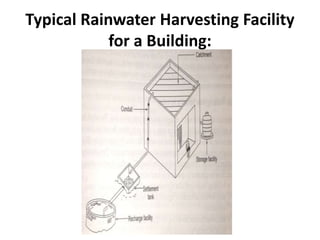
• Rainwater Harvesting
– It means collecting rain water on the roofs of buildings & storing it
in under ground for later use.
• Reducing water demand in Agriculture
• Water Conservation Methods
Reducing water demand in Agriculture:
• Mulching: The usage of organic & inorganic materials such
as plant debris & compost, which slow down surface run-
off, improves soil moisture & improves soil fertility.
• Soil should be covered by crops, slow down run-off &
minimizes evaporation losses.
• Ploughing: Retain more water & reduce evaporation.
• Shelter belts of trees & bushes along the edge agricultural
fields slow down the wind speed & reduce erosion.
• Planting of trees, grass & bushes breaks force of rain&
helps rain water penetrate the soil.
• Salt-resistant varieties of crops have also been developed
recently. Because these grow in saline areas, overall
agricultural productivity is increased without making
additional demands on fresh water sources.
• Desalination technologies such as distillation, electrolysis &
reverse osmosis are available.
Water Conservation Methods:
• Form a group of water-conscious people & encourage your
friends & neighbors to be part of this group.
• Encourage your family to keep looking for new ways to
conserve water in & around your home.
• Do not leave the tap running while you are brushing your
teeth or soap your face.
• See that there are no leaks in the toilet tank.
• Avoid flushing the toilet unnecessarily.
• When washing vehicles use water from bucket & not a hose
pipe.
• Do not throw away water that has been used for washing
vegetables, rice or dals, use it to water plants or to clean
the floors etc.
Rain water harvesting:
• Artificial Recharging
– Absorption Pit method
– Absorption well method
– Well cum Bore method
– Recharge trench cum injection well
• Rain water Harvesting
– Percolation Pit method
– Bore well with settlement tank
– Open well method with filter bed sump
– Percolation pit with Bore method
Typical Rainwater Harvesting Facility
for a Building:
Watershed Management:
• The term describes an area of land that drains down slope to the lowest
points.
• The water moves through a network of drainage pathways, both underground
& surface.
• Watershed Management is an iterative process of integrated decision making
regarding uses & modifications of lands & water within a watershed.
• Human modifications lands & water bodies directly alter delivery of water,
sediments & nutrients & thus fundamentally alter aquatic system.
• Watershed management provides a frame work for integrated decision
making, where we strive to:
– Assess the nature & status of the watershed ecosystem
– Define short-term & long-term goals for the system
– Determine objectives & actions needed to achieve selected goals
– Assess both benefits & costs of each action
– Implement desired actions
– Re-evaluate goals & objectives as part of an iterative process.
List of advantages of watershed
management:
• It provides a context for integration
– Using practical, tangible management units that people understand
– Focusing & coordinating efforts
– Finding common ground & meeting multiple needs
• It provides a better understanding & appreciation of nature
– Understanding nature’s interrelated processes
– Helping to answer the question, “what are we trying to protect?”
– Linking human activities to nature’s response
– Appreciating how nature’s processes can benefits people
– Identifying ways we can work & watershed processes
• It yields better management
– Generating ecologically-based, innovative, cost effective solutions
– Forging stronger working relationships.
– Supporting consistent, continuous management
Resettlement & Rehabilitation:
• In India the National Policy on Resettlement & Rehabilitation for Projected
Affected Families, 2003, was gazatted on February 17 2004, by the
National Democratic Alliance’s (NDA’s) ministry of rural development.
• The following are some of the stark realities relating to the issue of
rehabilitation & resettlement in India:
– Often the people affected by the dam receive better rehabilitation packages
than those affected by canals & other works
– The Indian Constitution dictates that resettlement & rehabilitations is the
responsibility of individual union stated
– Only 3 states have separate laws on rehabilitation : Maharashtra, Madhya
Pradesh & Karnataka.
– Two public sector companies have formulated policies on resettlement &
rehabilitation: Indian National Thermal Power Corporation & Coal India Ltd.
– The draft National Policy on Rehabilitation from 1998 acknowledges that
displacement results in “state-induced impoverishment”
– In 1998, the Government of India rejected the draft policy on rehabilitation &
approved the Land Acquisition (Amendment) Bill.
Environmental Ethics:
• Environmental ethics, is the discipline that studies the moral
relationship of human beings to, & also the value & moral status of
the environment & its nonhuman contents.
• The following typical list of questions investigated by environmental
ethics:
– Suppose that putting out natural fires or destroying some individual
members of overpopulated indigenous species is necessary for the
protection of the integrity of a certain ecosystem. Will these actions
be morally permissible or even required?
– Is it Acceptable for farmers in non-industrial countries to practice slash
& burn techniques to clear areas for agriculture?
– Consider a mining company which has performed open pit mining in
some previously unspoiled are. Does the company have a moral
obligation to restore the landform & surface ecology?
– What is the value of a humanly restored environment compared with
the originally natural environment?
Ozone Depletion:
• Ozone occurs naturally in atmosphere.
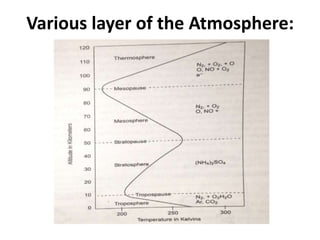
• Atmosphere is composed of several layers.
• We live in the Troposphere where most of
weather occurs: such as rain, snow & clouds.
• Stratosphere (above Troposphere): An important
region in which effects such as Ozone Hole &
Global Warming originate.
• Supersonic Jets airlines fly in the lower
stratosphere where as subsonic commercial
airlines are usually in the troposphere.
Various layer of the Atmosphere:
USN :
Vidyavardhaka College of Engineering Gokulam 3rd stage, Mysore – 570 002
Department of Mechanical Engineering
Subject Energy & Environment Third Module Test
Fifth Semester
“A” Section
Date 12/10/2017
Subject
Code 15ME562 Time 12:00AM -01:00PM
Faculty
Name Prof. Amruth E
Max.
Marks
20
Note: Answer all the questions. Max
Marks
CO
Mapping
Blooms
Level
MODULE 5
1. With a neat sketch explain rain water harvesting 8
2. Draw the neat sketch of various layer of the atmosphere &
explain the process of depletion of ozone layer.
8
3. Write a short note on Resettlement & Rehabilitation. 4
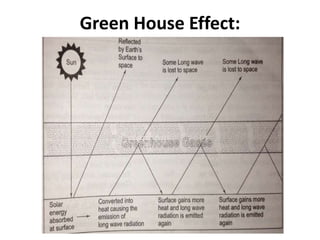
Green House Effect:
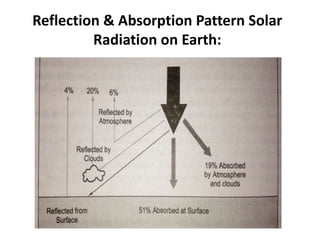
Reflection & Absorption Pattern Solar
Radiation on Earth:
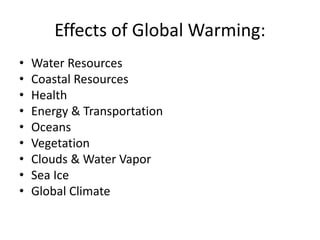
Effects of Global Warming:
• Water Resources
• Coastal Resources
• Health
• Energy & Transportation
• Oceans
• Vegetation
• Clouds & Water Vapor
• Sea Ice
• Global Climate
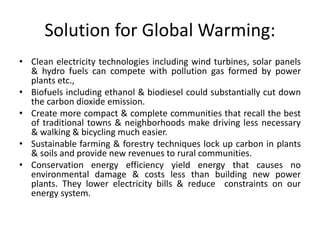
Solution for Global Warming:
• Clean electricity technologies including wind turbines, solar panels
& hydro fuels can compete with pollution gas formed by power
plants etc.,
• Biofuels including ethanol & biodiesel could substantially cut down
the carbon dioxide emission.
• Create more compact & complete communities that recall the best
of traditional towns & neighborhoods make driving less necessary
& walking & bicycling much easier.
• Sustainable farming & forestry techniques lock up carbon in plants
& soils and provide new revenues to rural communities.
• Conservation energy efficiency yield energy that causes no
environmental damage & costs less than building new power
plants. They lower electricity bills & reduce constraints on our
energy system.
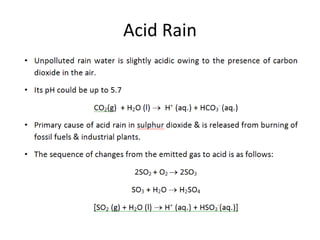
Acid Rain
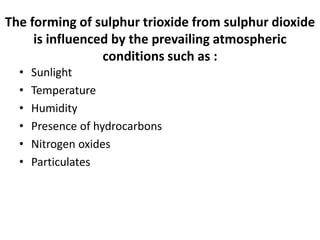
The forming of sulphur trioxide from sulphur dioxide
is influenced by the prevailing atmospheric
conditions such as :
• Sunlight
• Temperature
• Humidity
• Presence of hydrocarbons
• Nitrogen oxides
• Particulates
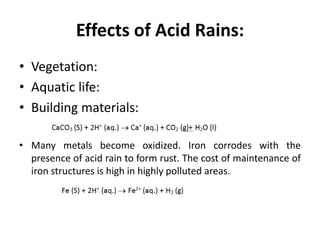
Effects of Acid Rains:
• Vegetation:
• Aquatic life:
• Building materials:
• Many metals become oxidized. Iron corrodes with the
presence of acid rain to form rust. The cost of maintenance of
iron structures is high in highly polluted areas.
Central Pollution Control Board
(CPCB):
• A salutary organization was constituted in September, 1974
under Water (Prevention Control of Pollution) Act, 1974.
• It was entrusted with the power & functions under the Air
(Prevention & Control of Pollution) Act, 1981.
• It serves as a field formation provide technical services to
the ministry of Environment & Forests of the provisions of
the Environment (Protection) Act, 1986.
• The principle functions of CPCB are:
– To promote cleanliness of streams & wells in different areas of
the states by prevention, control & abatement of water
pollution.
– To improve the quality of air & to prevent, control or abate air
pollution in the country.
Functions of the Central Board at the
National Level:
• Advise the Central Government on any matter concerning prevention & control of
water & air pollution and improvement of the quality of air.
• Plan & execute a nation wide programme for the prevention, control or abatement
of water and air pollution.
• Provide technical assistance & guidance to the state Board, carry out and sponsor
investigation & research relating to problems of water & air pollution, and for their
prevention, control or abatement of water and air pollution.
• Plan & organize training of persons engaged in programme on the prevention,
control or abatement of water & air pollution.
• Collect, compile and publish technical and statistical data relating to water and air
pollution and the measures devises for their effective prevention, control or
abatement.
• Disseminate information in respect of matters relating to water and air pollution
and their prevention and control.
• Lay down, modify or annual, in consultation with the state Governments
Concerned, the standards for stream or well and lay down standards for the
quality of air.
• Perform such other function as may be prescribed by the Government of India.
The Water (Prevention & Control of
Pollution) Act, 1974:
• The water act was enacted by Parliament Act, 1974 purpose to provide for
prevention of control of water pollution and the maintaining or restoring of
wholesomeness of water.
• Some of the salient features of this act are:
– NO person shall knowingly cause or permit any poisonous, noxious or pollution
matter determined in accordance with such standards as may be laid down by the
State Board to enter (directly or indirectly) into any stream or well or sewer or on
land.
– No person shall knowingly cause or permit to enter into any stream any other matter
which may tend, either directly or in combination with similar matters, to impede
the proper flow of the water of the stream in a matter leading or likely to lead to a
substantial aggravation of pollution due to other causes or of its consequences.
– No person shall, without the previous consent of the State Board:
a. establish or take any steps to establish any industry, operation or process, or any treatment and
disposal system or an extension or addition there to which is likely to discharge sewage or trade
effluent into a stream or well or sewage or on land or
b. bring into use any new or altered outlets for the discharge of sewage or
c. begin to make any new discharge of sewage.
• An investor intending to set up an industry is required to apply in the prescribed
form to the SPCB concerned to obtain the consent to establish as well as the
consent to operate the industry after establishment.
The Air (Prevention and Control of
Pollution)Act, 1981
• This act was promulgated inline with the decisions taken at the United Nations
Conference on the Human Environment held in Stockholm in June, 1972, in which India
participated, to take steps for preservation of the natural resources of the earth.
• This is an act to provide for the prevention, control and abatement of air pollution, for the
establishment of boards with a view to carrying out the air pollution control and for
conferring on and assigning to such Boards powers and functions relating there to and for
matters connected therewith.
• In considered necessary to implement the decisions aforesaid in so far as they relate to
preservation of the quality of air and control of air pollution.
• The objective of the Air Act is to prevent, control and reduce air pollution including noise
pollution and to establish Boards at the States/UTs for this.
• Under the provisions of this Act, no person shall establish or operate any industrial plant
without the consent of the SPCB/PCC.
• For obtaining consent to establish an industry, the investor has to apply to the SPCB/PCC
in the prescribed form accompanied by the prescribed fees.
• The Board is required to grant consent within 4 months of receipt of the application.
• The consent would contain conditions relating to specifications of pollution control
equipment to be installed.
The Environment (Protection) Act:
• In the wake of Bhopal Tragedy, the Government of India enacted the Environment
(Protection) Act, 1986 (EPA) under article 253 of the constitution.
• The scope of the Act is broad, with environment defined to include water, air and
land and inter-relationships which exist among water, air and land, and human
beings and other living creatures.
• Several sets of rules relating to various aspects of management of hazardous
chemicals, wastes, micro-organisms have to be notified under this Act.
• Some of the important features of this Act:
– The central Government may also put restrictions on an area in which any industry, operation
or process or class of industries or operations shall not be carried out. If they are to be carried
out, they may be permitted with certain safe guards.
– Emissions and effluent standards in respect of 61 categories of industries have been evolved
and notified so far.
– The standards in respect of pollutants are to be achieved within a period of one year from the
date of their notification, specially by those industries identified as highly polluting.
– Those industries who require consent under the Water act, Air act or both, or authorization
under the Hazardous Waste (Management & Handling) rules, 1989, are required to submit an
environmental audit report to the concerned SPCB/PCC on or before 30th September every
year.
The Wildlife Protection Act 1971:
• It emphasizes protection of wild & other animals within a broad
ecological prospective.
• It provides for establishment of sanctuaries and national parks.
• It has provisions for dealing with zoos, trade in wild animals and for
taking action for the specific protection of certain species.
• A brief summery of the contents of the Wildlife (Protection) Act:
– Wildlife may include any animal, bees, butterflies, crustacean, fish and
moths; and vegetation, which form part of any habitat.
– Habitat would include land, water or vegetation which is the natural home
of any wild animal.
– Haunting would include the capturing, killing, poisoning, snaring and
trapping of any wild animal and includes an attempt to do so or even
driving an animal for the purpose.
– Injuring or destroying or taking any part of the body of such animals or
birds or replies or even damaging their eggs or disturbing their nests would
also mean hunting.
– Trophy would include the whole or part of any captive wild animal other
than vermin, preserved by natural or artificial means and includes rugs,
skins and specimen of such animals mounted in whole or part by taxidemy.
The Forest (Conservation) Act 1980:
• It came into force with effect from October 25, 1980.
• Under the provision of this Act, prior approval of the
Central Government is essential for diversion of forest
lands for the non-forestry purposes.
• In the national interest and in the interest of future
generations, this Act, therefore, regulates the diversion
of forest lands to non-forestry purposes.
• The basic objective of this Act is, to regulate the
indiscriminate diversion of forest lands to non-forestry
uses and to maintain a logical balance between the
developmental needs of the country and the
conservation of natural heritage.

Module-5.pptx

  • 1.
  • 2.
    Contents to becovered: • Definition • Sources • Causes • Control • Case study • At the end of report students are requested to write their names & USN’s.
  • 3.
    Urban Problem Relatedto Energy: • Urban Energy crisis • Issues on Energy Utilization Planning • Renewable Energy
  • 4.
    Urban Energy Crisis: •The finite natural reserves of such energy • Its detrimental effects on the global environment • The threat to long-term sustainability
  • 5.
    Three key issuesthat are likely to define the shape & future of energy in cities are the following: • Sustainability • Efficiency • Equity
  • 6.
    Some important issueson Energy Utilization in Urban Planning: • Urban planning with concern for the efficient use of energy will create an effective urban environment. • Urban planning with concern for the urban anatomy can create efficient system that can support each other effectively, such as a transportation network that alleviates traffic congestion. • Urban planning with concern for the natural physical conditions can create an urban environment that would not be adversely affected by natural constraints, such as land surface below sea level that does not allow for proper drainage of water pools left by rain fall.
  • 7.
    The move towardsreduction in use of fossil fuels has to go hand-in-hand with the following: • Exploring alternative energy sources • Linking energy with global environmental issues (ex: climate change, global warming) • Co-relating environmental management efficiency with energy efficiency • Changes in lifestyles & increase in community involvement
  • 8.
    Renewable Energy: • Solarthermal • Solar photovoltaic • Wind power generation & water pumping • Biomass combustion/ co-generation • Small, mini & micro hydro power • Solar power • Utilization of biomass- Gasifiers, briquetting, biogas, improved chulha (cook-stoves) • Geothermal for heat applications • Power generation/energy recovery from urban, municipal & industrial wastes • Chemical sources of energy • Fuel cells • Alternative fuel for surface transportation & hydrogen energy
  • 9.
    Water Conservation: • AncientIndian methods of water Conservation & Harvesting – 5000 years ago (Mahenjodaro & Harappa) – Dholavira: Khadir bet, Rann: Gujarat – Oldest water harvesting system 130 km long from pune to western Ghats – At each fort area water harvesting & storage system is made in the form of rock-cut cisterns, ponds, tanks & wells. – Underground baked pipes & tunnels found in Madhya Pradesh, Karnataka & Maharashtra. • Rainwater Harvesting – It means collecting rain water on the roofs of buildings & storing it in under ground for later use. • Reducing water demand in Agriculture • Water Conservation Methods
  • 10.
    Reducing water demandin Agriculture: • Mulching: The usage of organic & inorganic materials such as plant debris & compost, which slow down surface run- off, improves soil moisture & improves soil fertility. • Soil should be covered by crops, slow down run-off & minimizes evaporation losses. • Ploughing: Retain more water & reduce evaporation. • Shelter belts of trees & bushes along the edge agricultural fields slow down the wind speed & reduce erosion. • Planting of trees, grass & bushes breaks force of rain& helps rain water penetrate the soil. • Salt-resistant varieties of crops have also been developed recently. Because these grow in saline areas, overall agricultural productivity is increased without making additional demands on fresh water sources. • Desalination technologies such as distillation, electrolysis & reverse osmosis are available.
  • 11.
    Water Conservation Methods: •Form a group of water-conscious people & encourage your friends & neighbors to be part of this group. • Encourage your family to keep looking for new ways to conserve water in & around your home. • Do not leave the tap running while you are brushing your teeth or soap your face. • See that there are no leaks in the toilet tank. • Avoid flushing the toilet unnecessarily. • When washing vehicles use water from bucket & not a hose pipe. • Do not throw away water that has been used for washing vegetables, rice or dals, use it to water plants or to clean the floors etc.
  • 12.
    Rain water harvesting: •Artificial Recharging – Absorption Pit method – Absorption well method – Well cum Bore method – Recharge trench cum injection well • Rain water Harvesting – Percolation Pit method – Bore well with settlement tank – Open well method with filter bed sump – Percolation pit with Bore method
  • 13.
    Typical Rainwater HarvestingFacility for a Building:
  • 14.
    Watershed Management: • Theterm describes an area of land that drains down slope to the lowest points. • The water moves through a network of drainage pathways, both underground & surface. • Watershed Management is an iterative process of integrated decision making regarding uses & modifications of lands & water within a watershed. • Human modifications lands & water bodies directly alter delivery of water, sediments & nutrients & thus fundamentally alter aquatic system. • Watershed management provides a frame work for integrated decision making, where we strive to: – Assess the nature & status of the watershed ecosystem – Define short-term & long-term goals for the system – Determine objectives & actions needed to achieve selected goals – Assess both benefits & costs of each action – Implement desired actions – Re-evaluate goals & objectives as part of an iterative process.
  • 15.
    List of advantagesof watershed management: • It provides a context for integration – Using practical, tangible management units that people understand – Focusing & coordinating efforts – Finding common ground & meeting multiple needs • It provides a better understanding & appreciation of nature – Understanding nature’s interrelated processes – Helping to answer the question, “what are we trying to protect?” – Linking human activities to nature’s response – Appreciating how nature’s processes can benefits people – Identifying ways we can work & watershed processes • It yields better management – Generating ecologically-based, innovative, cost effective solutions – Forging stronger working relationships. – Supporting consistent, continuous management
  • 16.
    Resettlement & Rehabilitation: •In India the National Policy on Resettlement & Rehabilitation for Projected Affected Families, 2003, was gazatted on February 17 2004, by the National Democratic Alliance’s (NDA’s) ministry of rural development. • The following are some of the stark realities relating to the issue of rehabilitation & resettlement in India: – Often the people affected by the dam receive better rehabilitation packages than those affected by canals & other works – The Indian Constitution dictates that resettlement & rehabilitations is the responsibility of individual union stated – Only 3 states have separate laws on rehabilitation : Maharashtra, Madhya Pradesh & Karnataka. – Two public sector companies have formulated policies on resettlement & rehabilitation: Indian National Thermal Power Corporation & Coal India Ltd. – The draft National Policy on Rehabilitation from 1998 acknowledges that displacement results in “state-induced impoverishment” – In 1998, the Government of India rejected the draft policy on rehabilitation & approved the Land Acquisition (Amendment) Bill.
  • 17.
    Environmental Ethics: • Environmentalethics, is the discipline that studies the moral relationship of human beings to, & also the value & moral status of the environment & its nonhuman contents. • The following typical list of questions investigated by environmental ethics: – Suppose that putting out natural fires or destroying some individual members of overpopulated indigenous species is necessary for the protection of the integrity of a certain ecosystem. Will these actions be morally permissible or even required? – Is it Acceptable for farmers in non-industrial countries to practice slash & burn techniques to clear areas for agriculture? – Consider a mining company which has performed open pit mining in some previously unspoiled are. Does the company have a moral obligation to restore the landform & surface ecology? – What is the value of a humanly restored environment compared with the originally natural environment?
  • 18.
    Ozone Depletion: • Ozoneoccurs naturally in atmosphere. • Atmosphere is composed of several layers. • We live in the Troposphere where most of weather occurs: such as rain, snow & clouds. • Stratosphere (above Troposphere): An important region in which effects such as Ozone Hole & Global Warming originate. • Supersonic Jets airlines fly in the lower stratosphere where as subsonic commercial airlines are usually in the troposphere.
  • 19.
    Various layer ofthe Atmosphere:
  • 20.
    USN : Vidyavardhaka Collegeof Engineering Gokulam 3rd stage, Mysore – 570 002 Department of Mechanical Engineering Subject Energy & Environment Third Module Test Fifth Semester “A” Section Date 12/10/2017 Subject Code 15ME562 Time 12:00AM -01:00PM Faculty Name Prof. Amruth E Max. Marks 20 Note: Answer all the questions. Max Marks CO Mapping Blooms Level MODULE 5 1. With a neat sketch explain rain water harvesting 8 2. Draw the neat sketch of various layer of the atmosphere & explain the process of depletion of ozone layer. 8 3. Write a short note on Resettlement & Rehabilitation. 4
  • 21.
  • 22.
    Reflection & AbsorptionPattern Solar Radiation on Earth:
  • 23.
    Effects of GlobalWarming: • Water Resources • Coastal Resources • Health • Energy & Transportation • Oceans • Vegetation • Clouds & Water Vapor • Sea Ice • Global Climate
  • 24.
    Solution for GlobalWarming: • Clean electricity technologies including wind turbines, solar panels & hydro fuels can compete with pollution gas formed by power plants etc., • Biofuels including ethanol & biodiesel could substantially cut down the carbon dioxide emission. • Create more compact & complete communities that recall the best of traditional towns & neighborhoods make driving less necessary & walking & bicycling much easier. • Sustainable farming & forestry techniques lock up carbon in plants & soils and provide new revenues to rural communities. • Conservation energy efficiency yield energy that causes no environmental damage & costs less than building new power plants. They lower electricity bills & reduce constraints on our energy system.
  • 25.
  • 26.
    The forming ofsulphur trioxide from sulphur dioxide is influenced by the prevailing atmospheric conditions such as : • Sunlight • Temperature • Humidity • Presence of hydrocarbons • Nitrogen oxides • Particulates
  • 28.
    Effects of AcidRains: • Vegetation: • Aquatic life: • Building materials: • Many metals become oxidized. Iron corrodes with the presence of acid rain to form rust. The cost of maintenance of iron structures is high in highly polluted areas.
  • 29.
    Central Pollution ControlBoard (CPCB): • A salutary organization was constituted in September, 1974 under Water (Prevention Control of Pollution) Act, 1974. • It was entrusted with the power & functions under the Air (Prevention & Control of Pollution) Act, 1981. • It serves as a field formation provide technical services to the ministry of Environment & Forests of the provisions of the Environment (Protection) Act, 1986. • The principle functions of CPCB are: – To promote cleanliness of streams & wells in different areas of the states by prevention, control & abatement of water pollution. – To improve the quality of air & to prevent, control or abate air pollution in the country.
  • 30.
    Functions of theCentral Board at the National Level: • Advise the Central Government on any matter concerning prevention & control of water & air pollution and improvement of the quality of air. • Plan & execute a nation wide programme for the prevention, control or abatement of water and air pollution. • Provide technical assistance & guidance to the state Board, carry out and sponsor investigation & research relating to problems of water & air pollution, and for their prevention, control or abatement of water and air pollution. • Plan & organize training of persons engaged in programme on the prevention, control or abatement of water & air pollution. • Collect, compile and publish technical and statistical data relating to water and air pollution and the measures devises for their effective prevention, control or abatement. • Disseminate information in respect of matters relating to water and air pollution and their prevention and control. • Lay down, modify or annual, in consultation with the state Governments Concerned, the standards for stream or well and lay down standards for the quality of air. • Perform such other function as may be prescribed by the Government of India.
  • 31.
    The Water (Prevention& Control of Pollution) Act, 1974: • The water act was enacted by Parliament Act, 1974 purpose to provide for prevention of control of water pollution and the maintaining or restoring of wholesomeness of water. • Some of the salient features of this act are: – NO person shall knowingly cause or permit any poisonous, noxious or pollution matter determined in accordance with such standards as may be laid down by the State Board to enter (directly or indirectly) into any stream or well or sewer or on land. – No person shall knowingly cause or permit to enter into any stream any other matter which may tend, either directly or in combination with similar matters, to impede the proper flow of the water of the stream in a matter leading or likely to lead to a substantial aggravation of pollution due to other causes or of its consequences. – No person shall, without the previous consent of the State Board: a. establish or take any steps to establish any industry, operation or process, or any treatment and disposal system or an extension or addition there to which is likely to discharge sewage or trade effluent into a stream or well or sewage or on land or b. bring into use any new or altered outlets for the discharge of sewage or c. begin to make any new discharge of sewage. • An investor intending to set up an industry is required to apply in the prescribed form to the SPCB concerned to obtain the consent to establish as well as the consent to operate the industry after establishment.
  • 32.
    The Air (Preventionand Control of Pollution)Act, 1981 • This act was promulgated inline with the decisions taken at the United Nations Conference on the Human Environment held in Stockholm in June, 1972, in which India participated, to take steps for preservation of the natural resources of the earth. • This is an act to provide for the prevention, control and abatement of air pollution, for the establishment of boards with a view to carrying out the air pollution control and for conferring on and assigning to such Boards powers and functions relating there to and for matters connected therewith. • In considered necessary to implement the decisions aforesaid in so far as they relate to preservation of the quality of air and control of air pollution. • The objective of the Air Act is to prevent, control and reduce air pollution including noise pollution and to establish Boards at the States/UTs for this. • Under the provisions of this Act, no person shall establish or operate any industrial plant without the consent of the SPCB/PCC. • For obtaining consent to establish an industry, the investor has to apply to the SPCB/PCC in the prescribed form accompanied by the prescribed fees. • The Board is required to grant consent within 4 months of receipt of the application. • The consent would contain conditions relating to specifications of pollution control equipment to be installed.
  • 33.
    The Environment (Protection)Act: • In the wake of Bhopal Tragedy, the Government of India enacted the Environment (Protection) Act, 1986 (EPA) under article 253 of the constitution. • The scope of the Act is broad, with environment defined to include water, air and land and inter-relationships which exist among water, air and land, and human beings and other living creatures. • Several sets of rules relating to various aspects of management of hazardous chemicals, wastes, micro-organisms have to be notified under this Act. • Some of the important features of this Act: – The central Government may also put restrictions on an area in which any industry, operation or process or class of industries or operations shall not be carried out. If they are to be carried out, they may be permitted with certain safe guards. – Emissions and effluent standards in respect of 61 categories of industries have been evolved and notified so far. – The standards in respect of pollutants are to be achieved within a period of one year from the date of their notification, specially by those industries identified as highly polluting. – Those industries who require consent under the Water act, Air act or both, or authorization under the Hazardous Waste (Management & Handling) rules, 1989, are required to submit an environmental audit report to the concerned SPCB/PCC on or before 30th September every year.
  • 34.
    The Wildlife ProtectionAct 1971: • It emphasizes protection of wild & other animals within a broad ecological prospective. • It provides for establishment of sanctuaries and national parks. • It has provisions for dealing with zoos, trade in wild animals and for taking action for the specific protection of certain species. • A brief summery of the contents of the Wildlife (Protection) Act: – Wildlife may include any animal, bees, butterflies, crustacean, fish and moths; and vegetation, which form part of any habitat. – Habitat would include land, water or vegetation which is the natural home of any wild animal. – Haunting would include the capturing, killing, poisoning, snaring and trapping of any wild animal and includes an attempt to do so or even driving an animal for the purpose. – Injuring or destroying or taking any part of the body of such animals or birds or replies or even damaging their eggs or disturbing their nests would also mean hunting. – Trophy would include the whole or part of any captive wild animal other than vermin, preserved by natural or artificial means and includes rugs, skins and specimen of such animals mounted in whole or part by taxidemy.
  • 35.
    The Forest (Conservation)Act 1980: • It came into force with effect from October 25, 1980. • Under the provision of this Act, prior approval of the Central Government is essential for diversion of forest lands for the non-forestry purposes. • In the national interest and in the interest of future generations, this Act, therefore, regulates the diversion of forest lands to non-forestry purposes. • The basic objective of this Act is, to regulate the indiscriminate diversion of forest lands to non-forestry uses and to maintain a logical balance between the developmental needs of the country and the conservation of natural heritage.