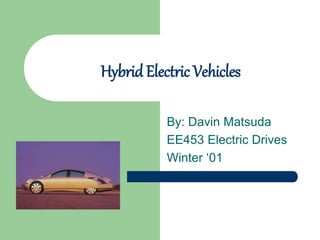
Hybrid Electric Vehicles
By: Davin Matsuda
EE453 Electric Drives
Winter ‘01
Overview
 What is an HEV?
 HEV objectives
 HEV advantages over conventional engines
 Motor components
 Vehicle propulsion
 Examples
 HEV Challenges
 Review
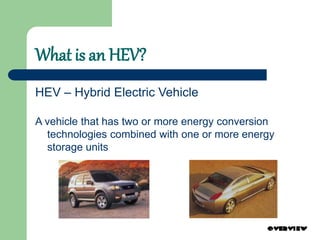
What is an HEV?
HEV – Hybrid Electric Vehicle
A vehicle that has two or more energy conversion
technologies combined with one or more energy
storage units
HEV Objectives
Objectives the HEV wants to obtain:
 Maximize fuel economy
 Minimize fuel emissions
 Minimize propulsion system cost to keep affordable
 Maintain acceptable performance with a reasonable
cost
 Reduce the conventional car weight
HEV Advantages Over Conventional Engines
 Regenerative Braking
 Reduction in engine and vehicle weight
 Fuel efficiency is increased
 Emissions are decreased
 Cut emissions of global warming pollutants by 1/3 or
1/2
 Reduce the dependency on fossil fuels
 Some states offer incentives with owning an HEV
 ~2 times more efficient than conventional engines
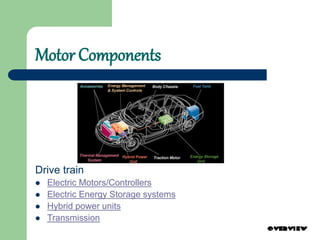
Motor Components
Drive train
 Electric Motors/Controllers
 Electric Energy Storage systems
 Hybrid power units
 Transmission
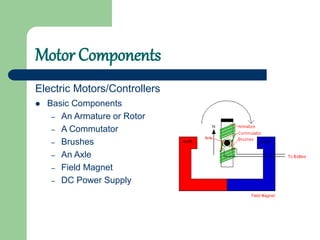
Motor Components
 Basic Components
– An Armature or Rotor
– A Commutator
– Brushes
– An Axle
– Field Magnet
– DC Power Supply
Electric Motors/Controllers
Motor Components
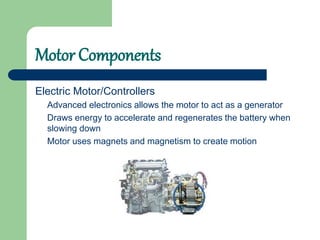
Electric Motor/Controllers
Advanced electronics allows the motor to act as a generator
Draws energy to accelerate and regenerates the battery when
slowing down
Motor uses magnets and magnetism to create motion
Motor Components
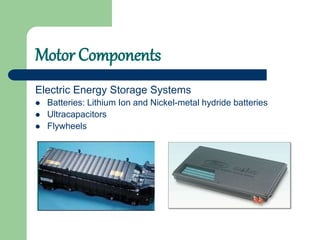
Electric Energy Storage Systems
 Batteries: Lithium Ion and Nickel-metal hydride batteries
 Ultracapacitors
 Flywheels
Motor Components
Electric Energy Storage Systems
Desirable attributes:
High-peak and pulse specific power
High specific energy at pulse power
High charge to maximize regenerative braking
Long life
Challenges:
Accurate techniques to determine battery state of
charge
Develop abuse-tolerant batteries
Recycleability
Motor Components
Batteries Nickel-Metal Hydride Lithium Ion
Current Uses Computer and Medical equipment Laptops and Cell phones
Life Cycle Much larger than lead acid batteries Low
Current
contribution
Used successfully in low production
of HEVs
Challenges High Cost
High self-discharge
Heat generation
Control losses of hydrogen
Low cell efficiency
Life cycle
Cell and battery safety
Abuse tolerant
Acceptable cost
Miscellaneous Reasonable specific energy and
power
Components are recyclable
Abuse-tolerant
High specific energy and power
High energy efficiency
Good high-temperature
performance
Low elf-discharge
Recyclable parts
NA
Motor Components
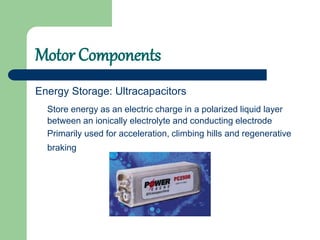
Energy Storage: Ultracapacitors
Store energy as an electric charge in a polarized liquid layer
between an ionically electrolyte and conducting electrode
Primarily used for acceleration, climbing hills and regenerative
braking
Motor Components
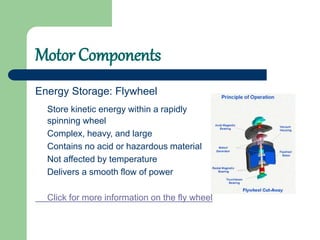
Energy Storage: Flywheel
Store kinetic energy within a rapidly
spinning wheel
Complex, heavy, and large
Contains no acid or hazardous material
Not affected by temperature
Delivers a smooth flow of power
Click for more information on the fly wheel
Motor Components
Charging/Discharging the Battery
The following are some links to visually display the characteristics of
the motor and engine during different scenarios
 Driving at low speeds
 City driving
 Highway driving
 Uphill driving
 Coasting/Slowing/Stopping
Motor Components
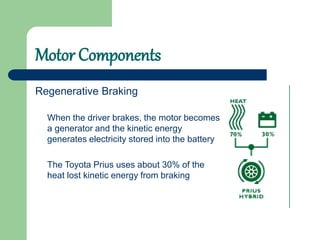
Regenerative Braking
When the driver brakes, the motor becomes
a generator and the kinetic energy
generates electricity stored into the battery
The Toyota Prius uses about 30% of the
heat lost kinetic energy from braking
Motor Components
 Compression Ignition Direct Injection Engines (CIDI)
 Spark Ignition Engines
 Gas Turbines
 Fuel Cells
Hybrid Power Units
4 Types:
Motor Components
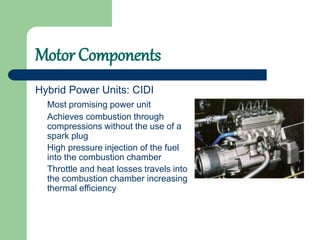
Hybrid Power Units: CIDI
Most promising power unit
Achieves combustion through
compressions without the use of a
spark plug
High pressure injection of the fuel
into the combustion chamber
Throttle and heat losses travels into
the combustion chamber increasing
thermal efficiency
Motor Components
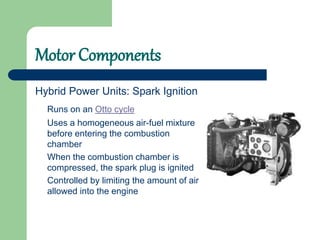
Hybrid Power Units: Spark Ignition
Runs on an Otto cycle
Uses a homogeneous air-fuel mixture
before entering the combustion
chamber
When the combustion chamber is
compressed, the spark plug is ignited
Controlled by limiting the amount of air
allowed into the engine
Motor Components
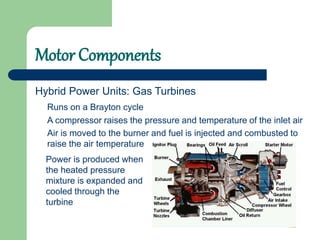
Hybrid Power Units: Gas Turbines
Runs on a Brayton cycle
A compressor raises the pressure and temperature of the inlet air
Air is moved to the burner and fuel is injected and combusted to
raise the air temperature
Power is produced when
the heated pressure
mixture is expanded and
cooled through the
turbine
Motor Components
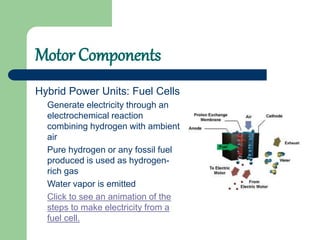
Hybrid Power Units: Fuel Cells
Generate electricity through an
electrochemical reaction
combining hydrogen with ambient
air
Pure hydrogen or any fossil fuel
produced is used as hydrogen-
rich gas
Water vapor is emitted
Click to see an animation of the
steps to make electricity from a
fuel cell.
Motor Components
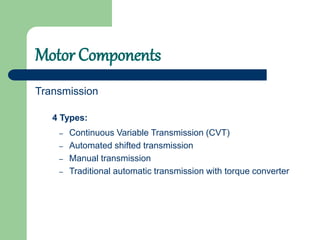
– Continuous Variable Transmission (CVT)
– Automated shifted transmission
– Manual transmission
– Traditional automatic transmission with torque converter
Transmission
4 Types:
Motor Components
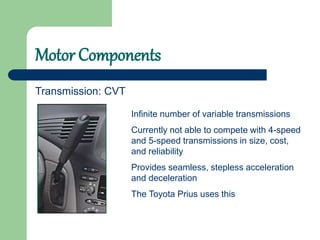
Transmission: CVT
Infinite number of variable transmissions
Currently not able to compete with 4-speed
and 5-speed transmissions in size, cost,
and reliability
Provides seamless, stepless acceleration
and deceleration
The Toyota Prius uses this
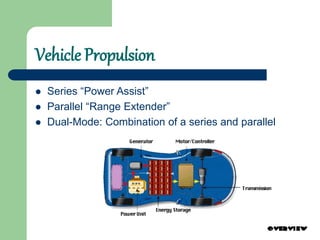
Vehicle Propulsion
 Series “Power Assist”
 Parallel “Range Extender”
 Dual-Mode: Combination of a series and parallel
Vehicle Propulsion
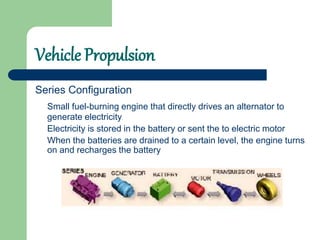
Series Configuration
Small fuel-burning engine that directly drives an alternator to
generate electricity
Electricity is stored in the battery or sent the to electric motor
When the batteries are drained to a certain level, the engine turns
on and recharges the battery
Vehicle Propulsion
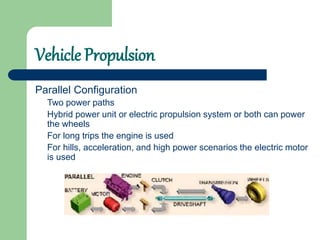
Parallel Configuration
Two power paths
Hybrid power unit or electric propulsion system or both can power
the wheels
For long trips the engine is used
For hills, acceleration, and high power scenarios the electric motor
is used
Vehicle Propulsion
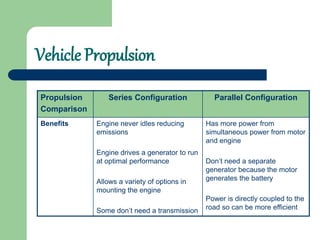
Propulsion
Comparison
Series Configuration Parallel Configuration
Benefits Engine never idles reducing
emissions
Engine drives a generator to run
at optimal performance
Allows a variety of options in
mounting the engine
Some don’t need a transmission
Has more power from
simultaneous power from motor
and engine
Don’t need a separate
generator because the motor
generates the battery
Power is directly coupled to the
road so can be more efficient
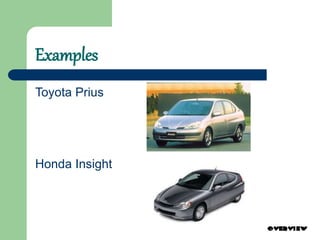
Examples
Toyota Prius
Honda Insight
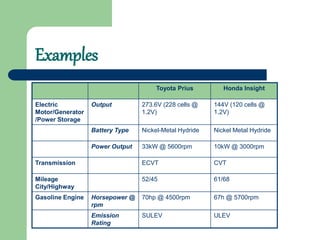
Examples
Toyota Prius Honda Insight
Electric
Motor/Generator
/Power Storage
Output 273.6V (228 cells @
1.2V)
144V (120 cells @
1.2V)
Battery Type Nickel-Metal Hydride Nickel Metal Hydride
Power Output 33kW @ 5600rpm 10kW @ 3000rpm
Transmission ECVT CVT
Mileage
City/Highway
52/45 61/68
Gasoline Engine Horsepower @
rpm
70hp @ 4500rpm 67h @ 5700rpm
Emission
Rating
SULEV ULEV
HEV Challenges
 Energy storage devices with high power-to-energy
ratios
 Frequent shut down and start up of the HEV
 Reduce the size, weight, and cost
 Higher efficiency in the conversion of fuel to useful
power
 Advanced configurations for the propulsion system
components
Review
 What is an HEV?
 HEV objectives
 HEV advantages over conventional engines
 Motor components
 Vehicle propulsion
 Examples
 HEV Challenges
Sources
http://www.ott.doe.gov/hev/hev.html
http://www.howthingswork.com
http://www.hjonda2001.com/models/insight/index.html?honda=intro
http://www.prius.toyota.com
http://www.nfcrc.uci.edu/fuelcellinfo_index.htm
http://www.geocities.com/MotorCity/Factory/1723/Different_Kinds_of_
EVs.htm
http://www.udel.edu/chem/C465/senior/fall00/HybridCars/future.html
http://techni.tachemie.uni-leipzig.de/otto/index_e.html
http://www.satcon.com/sub/beacon/index.html
http://www.autoalliance.org/hybrids.htm

ev.ppt

  • 1.
    Hybrid Electric Vehicles By:Davin Matsuda EE453 Electric Drives Winter ‘01
  • 2.
    Overview  What isan HEV?  HEV objectives  HEV advantages over conventional engines  Motor components  Vehicle propulsion  Examples  HEV Challenges  Review
  • 3.
    What is anHEV? HEV – Hybrid Electric Vehicle A vehicle that has two or more energy conversion technologies combined with one or more energy storage units
  • 4.
    HEV Objectives Objectives theHEV wants to obtain:  Maximize fuel economy  Minimize fuel emissions  Minimize propulsion system cost to keep affordable  Maintain acceptable performance with a reasonable cost  Reduce the conventional car weight
  • 5.
    HEV Advantages OverConventional Engines  Regenerative Braking  Reduction in engine and vehicle weight  Fuel efficiency is increased  Emissions are decreased  Cut emissions of global warming pollutants by 1/3 or 1/2  Reduce the dependency on fossil fuels  Some states offer incentives with owning an HEV  ~2 times more efficient than conventional engines
  • 6.
    Motor Components Drive train Electric Motors/Controllers  Electric Energy Storage systems  Hybrid power units  Transmission
  • 7.
    Motor Components  BasicComponents – An Armature or Rotor – A Commutator – Brushes – An Axle – Field Magnet – DC Power Supply Electric Motors/Controllers
  • 8.
    Motor Components Electric Motor/Controllers Advancedelectronics allows the motor to act as a generator Draws energy to accelerate and regenerates the battery when slowing down Motor uses magnets and magnetism to create motion
  • 9.
    Motor Components Electric EnergyStorage Systems  Batteries: Lithium Ion and Nickel-metal hydride batteries  Ultracapacitors  Flywheels
  • 10.
    Motor Components Electric EnergyStorage Systems Desirable attributes: High-peak and pulse specific power High specific energy at pulse power High charge to maximize regenerative braking Long life Challenges: Accurate techniques to determine battery state of charge Develop abuse-tolerant batteries Recycleability
  • 11.
    Motor Components Batteries Nickel-MetalHydride Lithium Ion Current Uses Computer and Medical equipment Laptops and Cell phones Life Cycle Much larger than lead acid batteries Low Current contribution Used successfully in low production of HEVs Challenges High Cost High self-discharge Heat generation Control losses of hydrogen Low cell efficiency Life cycle Cell and battery safety Abuse tolerant Acceptable cost Miscellaneous Reasonable specific energy and power Components are recyclable Abuse-tolerant High specific energy and power High energy efficiency Good high-temperature performance Low elf-discharge Recyclable parts NA
  • 12.
    Motor Components Energy Storage:Ultracapacitors Store energy as an electric charge in a polarized liquid layer between an ionically electrolyte and conducting electrode Primarily used for acceleration, climbing hills and regenerative braking
  • 13.
    Motor Components Energy Storage:Flywheel Store kinetic energy within a rapidly spinning wheel Complex, heavy, and large Contains no acid or hazardous material Not affected by temperature Delivers a smooth flow of power Click for more information on the fly wheel
  • 14.
    Motor Components Charging/Discharging theBattery The following are some links to visually display the characteristics of the motor and engine during different scenarios  Driving at low speeds  City driving  Highway driving  Uphill driving  Coasting/Slowing/Stopping
  • 15.
    Motor Components Regenerative Braking Whenthe driver brakes, the motor becomes a generator and the kinetic energy generates electricity stored into the battery The Toyota Prius uses about 30% of the heat lost kinetic energy from braking
  • 16.
    Motor Components  CompressionIgnition Direct Injection Engines (CIDI)  Spark Ignition Engines  Gas Turbines  Fuel Cells Hybrid Power Units 4 Types:
  • 17.
    Motor Components Hybrid PowerUnits: CIDI Most promising power unit Achieves combustion through compressions without the use of a spark plug High pressure injection of the fuel into the combustion chamber Throttle and heat losses travels into the combustion chamber increasing thermal efficiency
  • 18.
    Motor Components Hybrid PowerUnits: Spark Ignition Runs on an Otto cycle Uses a homogeneous air-fuel mixture before entering the combustion chamber When the combustion chamber is compressed, the spark plug is ignited Controlled by limiting the amount of air allowed into the engine
  • 19.
    Motor Components Hybrid PowerUnits: Gas Turbines Runs on a Brayton cycle A compressor raises the pressure and temperature of the inlet air Air is moved to the burner and fuel is injected and combusted to raise the air temperature Power is produced when the heated pressure mixture is expanded and cooled through the turbine
  • 20.
    Motor Components Hybrid PowerUnits: Fuel Cells Generate electricity through an electrochemical reaction combining hydrogen with ambient air Pure hydrogen or any fossil fuel produced is used as hydrogen- rich gas Water vapor is emitted Click to see an animation of the steps to make electricity from a fuel cell.
  • 21.
    Motor Components – ContinuousVariable Transmission (CVT) – Automated shifted transmission – Manual transmission – Traditional automatic transmission with torque converter Transmission 4 Types:
  • 22.
    Motor Components Transmission: CVT Infinitenumber of variable transmissions Currently not able to compete with 4-speed and 5-speed transmissions in size, cost, and reliability Provides seamless, stepless acceleration and deceleration The Toyota Prius uses this
  • 23.
    Vehicle Propulsion  Series“Power Assist”  Parallel “Range Extender”  Dual-Mode: Combination of a series and parallel
  • 24.
    Vehicle Propulsion Series Configuration Smallfuel-burning engine that directly drives an alternator to generate electricity Electricity is stored in the battery or sent the to electric motor When the batteries are drained to a certain level, the engine turns on and recharges the battery
  • 25.
    Vehicle Propulsion Parallel Configuration Twopower paths Hybrid power unit or electric propulsion system or both can power the wheels For long trips the engine is used For hills, acceleration, and high power scenarios the electric motor is used
  • 26.
    Vehicle Propulsion Propulsion Comparison Series ConfigurationParallel Configuration Benefits Engine never idles reducing emissions Engine drives a generator to run at optimal performance Allows a variety of options in mounting the engine Some don’t need a transmission Has more power from simultaneous power from motor and engine Don’t need a separate generator because the motor generates the battery Power is directly coupled to the road so can be more efficient
  • 27.
  • 28.
    Examples Toyota Prius HondaInsight Electric Motor/Generator /Power Storage Output 273.6V (228 cells @ 1.2V) 144V (120 cells @ 1.2V) Battery Type Nickel-Metal Hydride Nickel Metal Hydride Power Output 33kW @ 5600rpm 10kW @ 3000rpm Transmission ECVT CVT Mileage City/Highway 52/45 61/68 Gasoline Engine Horsepower @ rpm 70hp @ 4500rpm 67h @ 5700rpm Emission Rating SULEV ULEV
  • 29.
    HEV Challenges  Energystorage devices with high power-to-energy ratios  Frequent shut down and start up of the HEV  Reduce the size, weight, and cost  Higher efficiency in the conversion of fuel to useful power  Advanced configurations for the propulsion system components
  • 30.
    Review  What isan HEV?  HEV objectives  HEV advantages over conventional engines  Motor components  Vehicle propulsion  Examples  HEV Challenges
  • 31.