
Evolution of a Tech Product
Organization
Thinking Lean While Innovating in an Existing
Business
Valerie Gofman
valgofman@gmail.com
Challenge:
Your company is: Established in the market!

You want to:

Build new product
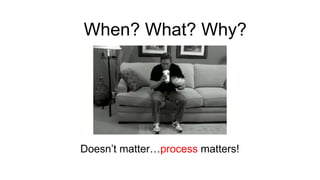
When? What? Why?

Doesn’t matter…process matters!
Let’s think
about…engineering/development
Why?

Well, they build the product (duh!)
engineering/development
Why not?

New hires
Brand new team
engineering/development
Maintaining
resources
means…

• Tacit knowledge
• Least disruptive
engineering/development
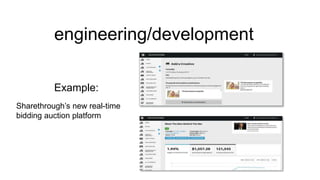
Example:
Sharethrough’s new real-time
bidding auction platform
engineering/development
What we did:

• Two teams
• Existing
• “Innovate”
• Increased priority of innovation
• 2 groups  1 team
engineering/development
What were
challenges:

• Experimenting
• Knowledge Transfer

• Communication
engineering/development
Why/what was
effective:

• Small team = foundation
• Business priority

• Rapid cycles
engineering/development
• 80/20 rule

Takeaways!

• Iterate on communication
• Respect
engineering/development
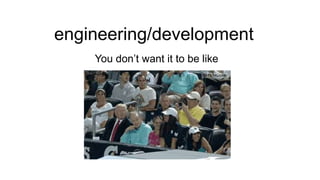
You don’t want it to be like
Let’s think about…sales/biz
dev/marketing
Why?

Revenue & customers
sales/biz dev/marketing
Why not…?

Forward-sell?
Embellish?
Say yes?
sales/biz dev/marketing
Relationships
& Positioning

• Customer dev
• Brand story
• Competitors
sales/biz dev/marketing
Example

• Opportunity (sales/exec)

• But…disrupting new dev
Sharethrough for
Publishers!

• Minimal, lightweight
sales/biz dev/marketing
• Lay out all req’s

What we did:
• Big picture

• Basics
sales/biz dev/marketing
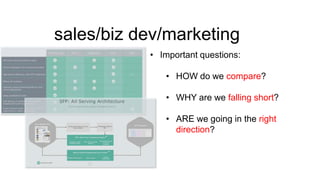
• Important questions:
• HOW do we compare?
• WHY are we falling short?
• ARE we going in the right
direction?
sales/biz dev/marketing
• Market changing

Challenges
• Focus = reality ?
• Customer support
sales/biz dev/marketing
• Narrow MVP scope

Takeaways!

• Re-evaluate and re-confirm direction
• Partnership with sales/biz dev
Let’s think about…operations
Why?

They run the biz!
operations
Why not…

Increase headcount?

New process/training?
operations
• First usage

Get Shit Done

• Internal customer
• Actual customer contact
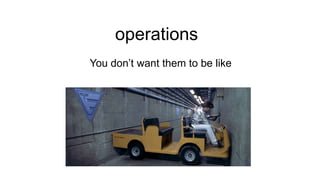
operations
You don’t want them to be like
operations
• Wizard-of-Oz manual workarounds

What works:

• Early product adopter
• Feedback
Is that it?
I don’t think so.
“MVV” - Minimum Viable Vision

same process as MVP, but thinking about
the overall company story and vision
mvv
What does it
really mean?

• Different iterations
• Important to think about the overall UX
• Business Side
• Dev Side
• How?
• Branding, experience, story consistent
• Everyone is part of QA
MVV = product keeping company in mind

• No process is set in stone
• Overcommunicate

• Stakeholders in the loop and in mind
• Company vision
Thanks!
Valerie Gofman
valgofman@gmail.com

Evolving and Growing with Lean Startup by Valerie Gofman

Editor's Notes

  • #3 Company is: Established in the market, mature sales team, repeat clients, solid partnerships You want to Break out with a brand new product, while maintaining existing business
  • #4 External decision: customer requestsInternal decision: company decides to test hypothesis based on research
  • #5 Highest cost center, strategic headcount allocation, product-minded, developing for the future
  • #6 Can’t you hire more people? Build a new team for the new product?OK, what if you get more funding? We can budget for it, come on!
  • #7 Having new people on the team at once is more disruptive and keeps existing members constantly thinking about future integration of new product
  • #9 Split into two uneven teams:One: maintain existing businessOne: innovate, build/break/ship quicklyEventually, measured positive business success, increased priority of innovationTwo teams incorporated into one team, after many iterations of the organization. It wasn’t a silver bullet approach, but we continued to reevaluate
  • #10 Knowledge transfer/ learning curveExperimenting with different structure organizationCommunication, communication, communication! Obviously, one product team with two business focuses keeping priorities and comunication straight between two engineering organizations is immensely challenging.
  • #11 Initial small team sets foundation of new productResource allocation parallels business priority at any given timeContinuing customer development cycle with incorporated teams
  • #12 Keep in mind 80/20 resource : revenueUtilize existing team members to your benefit!Keep iterating on communicationRespect the team, product development will flow
  • #14 Interact with customers, bring in revenue, represent company brand and show off products
  • #15 Can’t the team just forward-sell? What’s the big deal, why wouldn’t you just embellish the product story?
  • #16 Important players in customer developmentCommon interest: driving more $$$Balance brand message with realityCompetitors
  • #17 Sharethrough for Publishers– tool allowing our partners to leverage our technologyDiscovered opportunity for existing + to acquire new publishers (sales/exec driven)As prod/eng, focus was on rapid BML cycles of our new auction platformBig question: what is minimal set of features, lightest way to build them while continuing to build new platform?
  • #18 Started with large list of requirements from sales & publishersFrom large list of req’s, what were minimum “can’t live without” set of featuresOn dev side: what is most lightweight, least disruptive way to build the tool?
  • #19 Answer important questions:HOW do we compare? - Competitive feature set matrix (ongoing)WHY are we falling short? – Customer development learnings (weekly)ARE we going in the right direction? – Re-evaluate strategically per market/revenue goals (3-6 month)
  • #20 Continuing to re-evaluate position of new product in rapidly evolving marketKeeping eng/devfocus in check alongside novel customer requests Customer development. It’s hard!
  • #21 Narrow down scope of MVP, make sure that it makes sense with current and foreseeable iteration of devSet aside time to re-evaluate and confirm directionCustomer development involves a partnership with sales/biz dev
  • #22 Run the innerworkings of the business, feedback source about new product, internal customers
  • #23 Can’t you just increase headcount to execute the new product ops?How do you keep cognitive load low with new process/training?
  • #24 May have first usage of new product (esp. if software)Internal customer = feedback + discern (who is design target?)Have customer’s needs in mind
  • #26 Wizard-of-Oz manual workaroundsBefore training entire team, enlist early product adopter/super user (close to product team)Continue to suss out feedback to iterate on features
  • #29 Can and should go through different iterationsImportant to think about the overall UXProcess on the (business side)New, low effort features aka Low Hanging Fruit(development side)Examples/details: Keeping branding consistent, cohesive experience and story for the customerGood QA (everyone in the company is part of the QA process)
  • #30 No process is set in stoneOvercommunicateKeep each stakeholder engineering / sales&marketing / operations in the loop and in mindCompany (not just product/feature set) vision/goals front and center