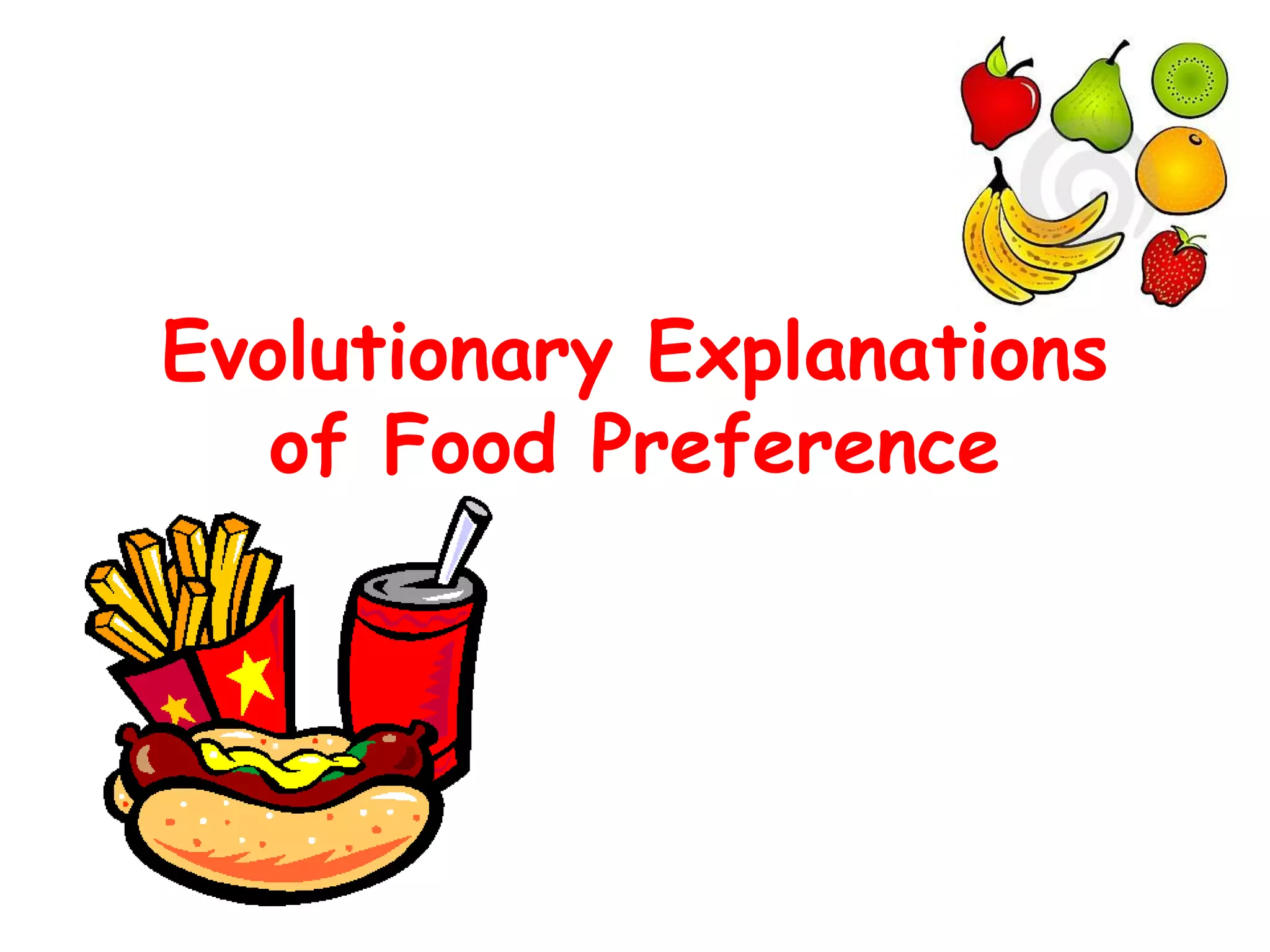
Evolutionary Explanations
   of Food Preference
Evolutionary Theory of Food
          Preference


    What foods do you prefer.
•When you get home from college tonight what
foods might you reach for if you need a snack?

•When you go to the supermarket and you’re hungry,
what foods would you tend to buy to satisfy this
hunger?
Evolutionary Theory of Food
                 Preference
      What does the Evolutionary Theory suggest about human behaviour?

                                                                        Good for
        Adaptive
                                                                        Survival

 Evolutionary theory suggests that:
 • Organisms should behave so as to maximise the survival of their genes or
 their inclusive fitness (the probability that their biological relatives will
 survive).
 •Therefore, Natural Selection (survival and reproduction of the fittest)
 occurs.
                       How is this relevant to eating behaviour?

•Those who are best equipped to obtain sufficient food and remain health were more likely
to survive.
•This means that humans have evolved to have certain food preferences that give them
the best chance of choosing good food with enough necessary nutrient to promote
survival.
Learning Objectives:
      Evolutionary Explanation of Food Preference.

(1)The tendency to binge eat (why do we prefer foods
   that are high in fat?)

(2) Why do we have a preference for sweet foods?

(3) Why do we have a preference for salty foods?

(4) Is there any research supporting these food
  preferences?
A01
 (1) Tendency to Binge Eat
 In our evolutionary past food supplies were limited or erratic. Our ancestors couldn’t rely on a
 continual source of food for their daily nutritional needs. It is believed by evolutionary
 psychologists that such times encouraged maximisation of stored energy i.e. binge eating would
 have been considered adaptive.
      -Sweet, fatty or salty foods would be particularly sought after since they are vital
      requirements to our diet and relatively rare in the ancestral environment.
      Any human that quickly learned that such high fat foods provide more energy, deliberately
      sought these foods out and consumed as much as possible would be most likely
      to survive. Thus, it would be advantageous to overeat in times of plenty and
      then expend as little of those calories as possible in readiness for times of
      scarcity.


Commentary:                A02
•The obesity problems encountered by much of the western world in today’s society are testament to
an inability to escape this evolutionary pressure. (Steven and Price, 2000).
•Nowadays many people have a problem with overeating and gaining weight. The increased levels of
obesity in the developed world suggests that people as predicted by Evolutionary Theory find it
hard to ignore high fat food offerings now that they are readily and cheaply available.
•Furthermore, although exercise could alleviate these evolutionarily led behaviours,
another evolutionary hangover is to conserve energy and people now do this
by not exercising and using labour-saving devices such as lifts, cars and dishwasher etc.
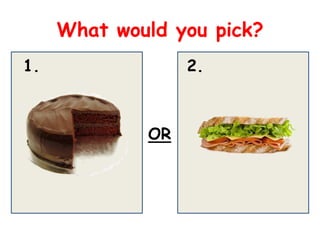
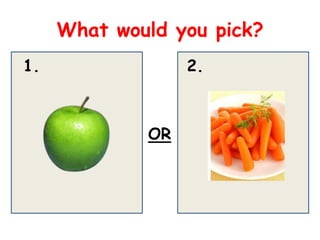
What would you pick?
1.                2.


             OR
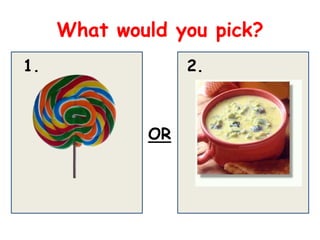
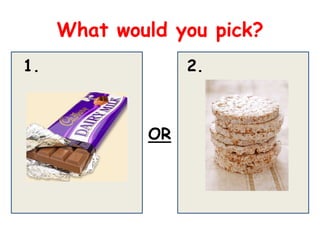
What would you pick?
1.                2.


             OR
What would you pick?
1.                2.


             OR
What would you pick?
1.                2.


             OR
What would you pick?
1.                2.


             OR
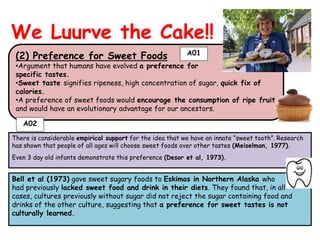
We Luurve the Cake!!
                                                           A01
 (2) Preference for Sweet Foods
 •Argument that humans have evolved a preference for
 specific tastes.
 •Sweet taste signifies ripeness, high concentration of sugar, quick fix of
 calories.
 •A preference of sweet foods would encourage the consumption of ripe fruit
 and would have an evolutionary advantage for our ancestors.

   A02

There is considerable empirical support for the idea that we have an innate “sweet tooth”. Research
has shown that people of all ages will choose sweet foods over other tastes (Meiselman, 1977).
Even 3 day old infants demonstrate this preference (Desor et al, 1973).


Bell et al (1973) gave sweet sugary foods to Eskimos in Northern Alaska who
had previously lacked sweet food and drink in their diets. They found that, in all
cases, cultures previously without sugar did not reject the sugar containing food and
drinks of the other culture, suggesting that a preference for sweet tastes is not
culturally learned.
Preference for Sweet
A02             Foods...
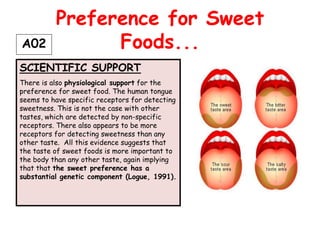
SCIENTIFIC SUPPORT
There is also physiological support for the
preference for sweet food. The human tongue
seems to have specific receptors for detecting
sweetness. This is not the case with other
tastes, which are detected by non-specific
receptors. There also appears to be more
receptors for detecting sweetness than any
other taste. All this evidence suggests that
the taste of sweet foods is more important to
the body than any other taste, again implying
that that the sweet preference has a
substantial genetic component (Logue, 1991).
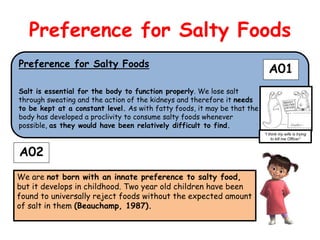
Preference for Salty Foods
                                                                            A01
Salt is essential for the body to function properly. We lose salt
through sweating and the action of the kidneys and therefore it needs
to be kept at a constant level. As with fatty foods, it may be that the
body has developed a proclivity to consume salty foods whenever
possible, as they would have been relatively difficult to find.
                                                                          “I think my wife is trying
                                                                               to kill me Officer”


A02
We are not born with an innate preference to salty food,
but it develops in childhood. Two year old children have been
found to universally reject foods without the expected amount
of salt in them (Beauchamp, 1987).
Evolutionary Avoidance of
            Dangerous Foods    A01
Humans are omnivores- we eat a wide ranging diet that includes meat. In many ways
this is hugely advantageous, as it allows us to exploit many different food sources.
However, it also leaves us open to a variety of plant toxins and infections from
food that has gone off. This is particularly true of meat, which is still a major source
of food poisoning today.


           The main problem with                                               A02
         Evolutionary theory is the
        inability to test it. Evidence
          has to instead be gained
            from observations of
           species change, fossil
           records or studies on
                   primates.
As a species we have evolved several
 methods to cope with this problem…
Cooking
This was introduced a least half a million years ago and solves this problem by
killing bacteria in meat during the cooking process. In addition, cooking also
makes meat tender and easier to chew.
                                        This is evidenced by the fact that
                                        our chewing teeth, the molars, have
                                       significantly decreased in size during
                                          evolution (Lucas et al, 2006).


Taste Aversion Learning
Garcia, Rusiniak & Brett (1977) made wolves sick with lamb’s meat
contaminated with a mild poison wrapped in sheepskin, when allowed to
approach live sheep the wolves would approach, sniff and then leave the
sheep alone
                                       **ELABORATION** Why is it an
                                       evolutionary advantage that we
                                       avoid foods that have made us sick?
As a species we have evolved several
 methods to cope with this problem…

Food Neophobia (neophobia means ‘fear of the new’)
Animals have a powerful tendency to avoid foods they have not come across
before, although this may become dull, Frost (2006) identified that we tend
to show greater likings for foods as they become more familiar.


                                            **ELABORATION** How does this
                                             support the evolutionary theory?


Morning sickness is most common in early pregnancy, when the baby’s organs are still
forming and it is most vulnerable. The foods most avoided by pregnant women due
to their ability to trigger sickness are those which appear to have the greatest
chance of damaging the embryo. For example, alcohol, coffee and tea all contain
caffeine which can damage the developing organs and meat and eggs are common
sources of bacteria which could lead to harmful infections. This sickness reaction
therefore helps the mother avoid foods that may be detrimental to her pregnancy,
while the vomiting prevents any toxins entering the bloodstream and affecting her baby
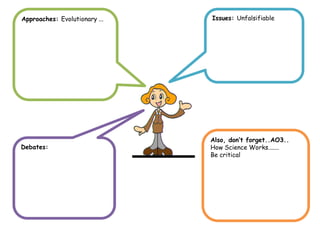
Approaches: Evolutionary ...   Issues: Unfalsifiable


                               Also, don’t forget..AO3..
Debates:                       How Science Works.......
                               Be critical

Evolutionary explanations of food preference

  • 1.
    Evolutionary Explanations of Food Preference
  • 2.
    Evolutionary Theory ofFood Preference What foods do you prefer. •When you get home from college tonight what foods might you reach for if you need a snack? •When you go to the supermarket and you’re hungry, what foods would you tend to buy to satisfy this hunger?
  • 3.
    Evolutionary Theory ofFood Preference What does the Evolutionary Theory suggest about human behaviour? Good for Adaptive Survival Evolutionary theory suggests that: • Organisms should behave so as to maximise the survival of their genes or their inclusive fitness (the probability that their biological relatives will survive). •Therefore, Natural Selection (survival and reproduction of the fittest) occurs. How is this relevant to eating behaviour? •Those who are best equipped to obtain sufficient food and remain health were more likely to survive. •This means that humans have evolved to have certain food preferences that give them the best chance of choosing good food with enough necessary nutrient to promote survival.
  • 4.
    Learning Objectives: Evolutionary Explanation of Food Preference. (1)The tendency to binge eat (why do we prefer foods that are high in fat?) (2) Why do we have a preference for sweet foods? (3) Why do we have a preference for salty foods? (4) Is there any research supporting these food preferences?
  • 5.
    A01 (1) Tendencyto Binge Eat In our evolutionary past food supplies were limited or erratic. Our ancestors couldn’t rely on a continual source of food for their daily nutritional needs. It is believed by evolutionary psychologists that such times encouraged maximisation of stored energy i.e. binge eating would have been considered adaptive. -Sweet, fatty or salty foods would be particularly sought after since they are vital requirements to our diet and relatively rare in the ancestral environment. Any human that quickly learned that such high fat foods provide more energy, deliberately sought these foods out and consumed as much as possible would be most likely to survive. Thus, it would be advantageous to overeat in times of plenty and then expend as little of those calories as possible in readiness for times of scarcity. Commentary: A02 •The obesity problems encountered by much of the western world in today’s society are testament to an inability to escape this evolutionary pressure. (Steven and Price, 2000). •Nowadays many people have a problem with overeating and gaining weight. The increased levels of obesity in the developed world suggests that people as predicted by Evolutionary Theory find it hard to ignore high fat food offerings now that they are readily and cheaply available. •Furthermore, although exercise could alleviate these evolutionarily led behaviours, another evolutionary hangover is to conserve energy and people now do this by not exercising and using labour-saving devices such as lifts, cars and dishwasher etc.
  • 6.
    What would youpick? 1. 2. OR
  • 7.
    What would youpick? 1. 2. OR
  • 8.
    What would youpick? 1. 2. OR
  • 9.
    What would youpick? 1. 2. OR
  • 10.
    What would youpick? 1. 2. OR
  • 11.
    We Luurve theCake!! A01 (2) Preference for Sweet Foods •Argument that humans have evolved a preference for specific tastes. •Sweet taste signifies ripeness, high concentration of sugar, quick fix of calories. •A preference of sweet foods would encourage the consumption of ripe fruit and would have an evolutionary advantage for our ancestors. A02 There is considerable empirical support for the idea that we have an innate “sweet tooth”. Research has shown that people of all ages will choose sweet foods over other tastes (Meiselman, 1977). Even 3 day old infants demonstrate this preference (Desor et al, 1973). Bell et al (1973) gave sweet sugary foods to Eskimos in Northern Alaska who had previously lacked sweet food and drink in their diets. They found that, in all cases, cultures previously without sugar did not reject the sugar containing food and drinks of the other culture, suggesting that a preference for sweet tastes is not culturally learned.
  • 12.
    Preference for Sweet A02 Foods... SCIENTIFIC SUPPORT There is also physiological support for the preference for sweet food. The human tongue seems to have specific receptors for detecting sweetness. This is not the case with other tastes, which are detected by non-specific receptors. There also appears to be more receptors for detecting sweetness than any other taste. All this evidence suggests that the taste of sweet foods is more important to the body than any other taste, again implying that that the sweet preference has a substantial genetic component (Logue, 1991).
  • 13.
    Preference for SaltyFoods Preference for Salty Foods A01 Salt is essential for the body to function properly. We lose salt through sweating and the action of the kidneys and therefore it needs to be kept at a constant level. As with fatty foods, it may be that the body has developed a proclivity to consume salty foods whenever possible, as they would have been relatively difficult to find. “I think my wife is trying to kill me Officer” A02 We are not born with an innate preference to salty food, but it develops in childhood. Two year old children have been found to universally reject foods without the expected amount of salt in them (Beauchamp, 1987).
  • 14.
    Evolutionary Avoidance of Dangerous Foods A01 Humans are omnivores- we eat a wide ranging diet that includes meat. In many ways this is hugely advantageous, as it allows us to exploit many different food sources. However, it also leaves us open to a variety of plant toxins and infections from food that has gone off. This is particularly true of meat, which is still a major source of food poisoning today. The main problem with A02 Evolutionary theory is the inability to test it. Evidence has to instead be gained from observations of species change, fossil records or studies on primates.
  • 15.
    As a specieswe have evolved several methods to cope with this problem… Cooking This was introduced a least half a million years ago and solves this problem by killing bacteria in meat during the cooking process. In addition, cooking also makes meat tender and easier to chew. This is evidenced by the fact that our chewing teeth, the molars, have significantly decreased in size during evolution (Lucas et al, 2006). Taste Aversion Learning Garcia, Rusiniak & Brett (1977) made wolves sick with lamb’s meat contaminated with a mild poison wrapped in sheepskin, when allowed to approach live sheep the wolves would approach, sniff and then leave the sheep alone **ELABORATION** Why is it an evolutionary advantage that we avoid foods that have made us sick?
  • 16.
    As a specieswe have evolved several methods to cope with this problem… Food Neophobia (neophobia means ‘fear of the new’) Animals have a powerful tendency to avoid foods they have not come across before, although this may become dull, Frost (2006) identified that we tend to show greater likings for foods as they become more familiar. **ELABORATION** How does this support the evolutionary theory? Morning sickness is most common in early pregnancy, when the baby’s organs are still forming and it is most vulnerable. The foods most avoided by pregnant women due to their ability to trigger sickness are those which appear to have the greatest chance of damaging the embryo. For example, alcohol, coffee and tea all contain caffeine which can damage the developing organs and meat and eggs are common sources of bacteria which could lead to harmful infections. This sickness reaction therefore helps the mother avoid foods that may be detrimental to her pregnancy, while the vomiting prevents any toxins entering the bloodstream and affecting her baby
  • 17.
    Approaches: Evolutionary ... Issues: Unfalsifiable Also, don’t forget..AO3.. Debates: How Science Works....... Be critical