Evolution of a Mythic Creature DRAGONS!
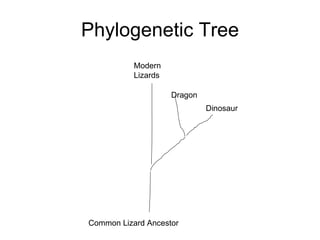
Ancestry Related to modern reptiles (dinosaurs, modern alligators and crocodiles)
Phylogenetic Tree Common Lizard Ancestor Modern Lizards Dinosaur Dragon
Environmental Conditions Dragons are generally they are found in rocky or mountainous environments either at high altitudes or living near seaside cliffs
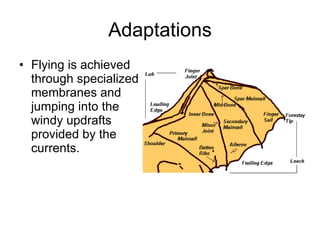
Adaptations Flying is achieved through specialized membranes and jumping into the windy updrafts provided by the currents.
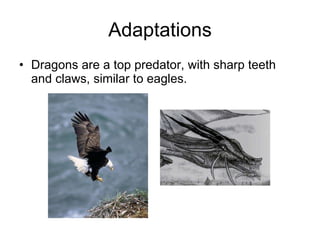
Adaptations Dragons are a top predator, with sharp teeth and claws, similar to eagles.
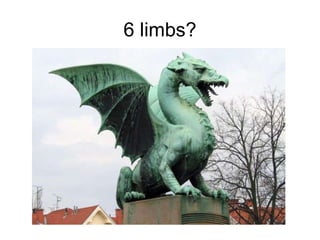
6 limbs?
Where did the 3 rd  pair come from?
Homologous Structures Common ancestry with other reptile species is evident with leathery skin and cold blooded nature.  Komodo Dragon Skin (Type of Lizard)
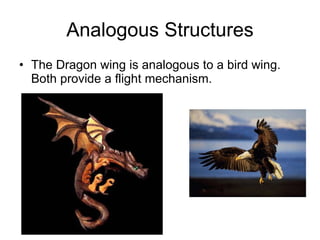
Analogous Structures The Dragon wing is analogous to a bird wing.  Both provide a flight mechanism.
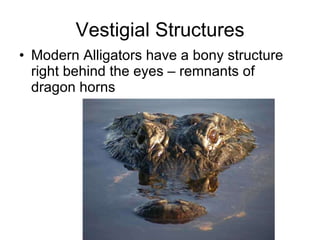
Vestigial Structures Modern Alligators have a bony structure right behind the eyes – remnants of dragon horns
Extinction Top/large predators will always have a low population level as the amount of prey to needed sustain them will be correspondingly high. Dragons required hundreds of square miles to obtain enough prey. Global population was very low Dragons Deer Plants
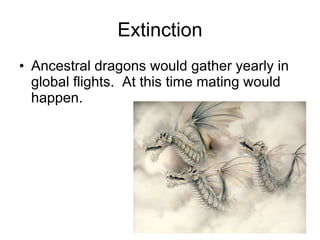
Extinction Ancestral dragons would gather yearly in global flights.  At this time mating would happen.
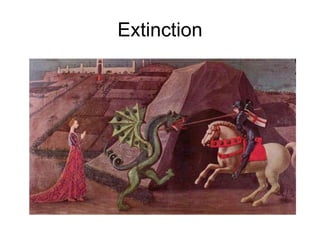
Extinction As humans encroached further and further into their remote territories, they removed the dragon’s natural food sources and brought new ones – cattle and sheep.  Subsequent predation (hunting) of the cattle and sheep meant the dragons became the hunted.
Extinction
Extinction Removal of individual dragons from the gene pool lead to increased inbreeding among the remaining dragons. Eventual extinction resulted from a loss of habitat, genetic weakness and human competition.
Could you believe in dragons now?

Evolution Of Dragons

  • 1.
    Evolution of aMythic Creature DRAGONS!
  • 2.
    Ancestry Related tomodern reptiles (dinosaurs, modern alligators and crocodiles)
  • 3.
    Phylogenetic Tree CommonLizard Ancestor Modern Lizards Dinosaur Dragon
  • 4.
    Environmental Conditions Dragonsare generally they are found in rocky or mountainous environments either at high altitudes or living near seaside cliffs
  • 5.
    Adaptations Flying isachieved through specialized membranes and jumping into the windy updrafts provided by the currents.
  • 6.
    Adaptations Dragons area top predator, with sharp teeth and claws, similar to eagles.
  • 7.
  • 8.
    Where did the3 rd pair come from?
  • 9.
    Homologous Structures Commonancestry with other reptile species is evident with leathery skin and cold blooded nature. Komodo Dragon Skin (Type of Lizard)
  • 10.
    Analogous Structures TheDragon wing is analogous to a bird wing. Both provide a flight mechanism.
  • 11.
    Vestigial Structures ModernAlligators have a bony structure right behind the eyes – remnants of dragon horns
  • 12.
    Extinction Top/large predatorswill always have a low population level as the amount of prey to needed sustain them will be correspondingly high. Dragons required hundreds of square miles to obtain enough prey. Global population was very low Dragons Deer Plants
  • 13.
    Extinction Ancestral dragonswould gather yearly in global flights. At this time mating would happen.
  • 14.
    Extinction As humansencroached further and further into their remote territories, they removed the dragon’s natural food sources and brought new ones – cattle and sheep. Subsequent predation (hunting) of the cattle and sheep meant the dragons became the hunted.
  • 15.
  • 16.
    Extinction Removal ofindividual dragons from the gene pool lead to increased inbreeding among the remaining dragons. Eventual extinction resulted from a loss of habitat, genetic weakness and human competition.
  • 17.
    Could you believein dragons now?