Evolution Lauren Kelly
What is Evolution? One of the most respected evolutionary biologists has defined biological evolution as follows:  “ In the broadest sense, evolution is merely change, and… biological evolution... is change in the properties of populations of organisms that transcend the lifetime of a single individual… The changes in populations that are considered evolutionary are those that are inheritable via the genetic material from one generation to the next. Biological evolution may be slight or substantial; it embraces everything from slight changes in the proportion of different alleles within a population (such as those determining blood types) to the successive alterations that led from the earliest [life forms] to snails, bees, giraffes, and dandelions.” - Douglas J. Futuyma in  Evolutionary Biology , Sinauer  Associates 1986
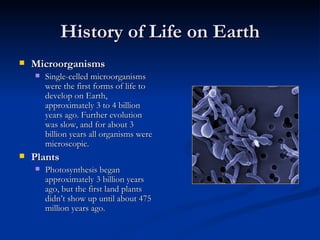
History of Life on Earth Microorganisms Single-celled microorganisms were the first forms of life to develop on Earth, approximately 3 to 4 billion years ago. Further evolution was slow, and for about 3 billion years all organisms were microscopic. Plants Photosynthesis began approximately 3 billion years ago, but the first land plants didn’t show up until about 475 million years ago.
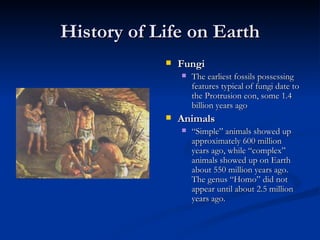
History of Life on Earth Fungi The earliest fossils possessing features typical of fungi date to the Protrusion eon, some 1.4 billion years ago  Animals “ Simple” animals showed up approximately 600 million years ago, while “complex” animals showed up on Earth about 550 million years ago. The genus “Homo” did not appear until about 2.5 million years ago.
Natural and Artificial Selection Natural Selection: A process in nature in which organisms possessing certain genotypic characteristics that make them better adjusted to an environment tend to survive, reproduce, increase in number or frequency, and therefore, are able to transmit and perpetuate their essential genotypic qualities to succeeding generations  Example : When male rams right each other to prove which is stronger and better fit to breed with the female. Artificial Selection: More commonly known as selective Breeding, where professionals study the genotype and phenotype of parent organisms in the hope of producing a hybrid that possesses many of the desirable characteristics found in their parents.  Example : When dog breeders take a male and female of a certain breed that display the most desirable/typical physical and emotional characteristics in that breed.
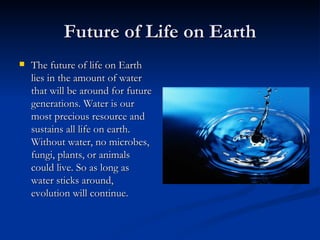
Future of Life on Earth The future of life on Earth lies in the amount of water that will be around for future generations. Water is our most precious resource and sustains all life on earth. Without water, no microbes, fungi, plants, or animals could live. So as long as water sticks around, evolution will continue.
Bibliography http://www.talkorigins.org/faqs/evolution-definition.html http://en.wikipedia.org/wiki/Timeline_of_evolution http://www.biology-online.org/dictionary/Artificial_Selection http://www.biology-online.org/dictionary/Natural_selection http://www.sfu.ca/cs/science/water.htm

Evolution

  • 1.
  • 2.
    What is Evolution?One of the most respected evolutionary biologists has defined biological evolution as follows: “ In the broadest sense, evolution is merely change, and… biological evolution... is change in the properties of populations of organisms that transcend the lifetime of a single individual… The changes in populations that are considered evolutionary are those that are inheritable via the genetic material from one generation to the next. Biological evolution may be slight or substantial; it embraces everything from slight changes in the proportion of different alleles within a population (such as those determining blood types) to the successive alterations that led from the earliest [life forms] to snails, bees, giraffes, and dandelions.” - Douglas J. Futuyma in Evolutionary Biology , Sinauer Associates 1986
  • 3.
    History of Lifeon Earth Microorganisms Single-celled microorganisms were the first forms of life to develop on Earth, approximately 3 to 4 billion years ago. Further evolution was slow, and for about 3 billion years all organisms were microscopic. Plants Photosynthesis began approximately 3 billion years ago, but the first land plants didn’t show up until about 475 million years ago.
  • 4.
    History of Lifeon Earth Fungi The earliest fossils possessing features typical of fungi date to the Protrusion eon, some 1.4 billion years ago Animals “ Simple” animals showed up approximately 600 million years ago, while “complex” animals showed up on Earth about 550 million years ago. The genus “Homo” did not appear until about 2.5 million years ago.
  • 5.
    Natural and ArtificialSelection Natural Selection: A process in nature in which organisms possessing certain genotypic characteristics that make them better adjusted to an environment tend to survive, reproduce, increase in number or frequency, and therefore, are able to transmit and perpetuate their essential genotypic qualities to succeeding generations Example : When male rams right each other to prove which is stronger and better fit to breed with the female. Artificial Selection: More commonly known as selective Breeding, where professionals study the genotype and phenotype of parent organisms in the hope of producing a hybrid that possesses many of the desirable characteristics found in their parents. Example : When dog breeders take a male and female of a certain breed that display the most desirable/typical physical and emotional characteristics in that breed.
  • 6.
    Future of Lifeon Earth The future of life on Earth lies in the amount of water that will be around for future generations. Water is our most precious resource and sustains all life on earth. Without water, no microbes, fungi, plants, or animals could live. So as long as water sticks around, evolution will continue.
  • 7.
    Bibliography http://www.talkorigins.org/faqs/evolution-definition.html http://en.wikipedia.org/wiki/Timeline_of_evolutionhttp://www.biology-online.org/dictionary/Artificial_Selection http://www.biology-online.org/dictionary/Natural_selection http://www.sfu.ca/cs/science/water.htm