The EVITA International Cooperation Program on  e -Business Promotion for SMEs Hatzakis Ilias  Project Manager,  GRNET Diana   Krievina,  Project Manager,   LTC   EVITA , Baltic Dynamics 16/09/2010
EVITA – INTERREG IVC  E xchange,  V alorisation and Transfer of regional best practice policy measures for SME support on  IT  and e-business  A doption Riga, Baltic Dynamics, September 16 th ,  2010
Why EVITA?
EVITA  main rationale LISBON STRATEGY/ Europe 2020-digital agenda: stimulation of SMEs for IT and e-business Necessity of exchange between countries/ stakeholders Necessity for the right learning tools for SMEs Riga, September 16 th , 2010
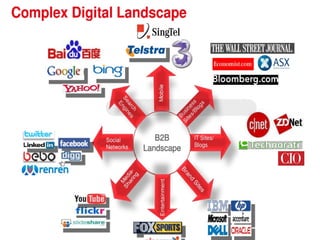
a world in transmission: The financial crisis/ especially affects new EU members Revolutionary technology trends both in infrastructure and services terms (cloud computing, grid technology, terra bps networks) Opening of PSI and the e-participation Web 2.0/ user generated content/ Social media revolution New business models/ globalization Media convergence Complex digital landscpape … But then also … … we already live  IN the cloud… (a social cloud) Riga, 16 September 2010
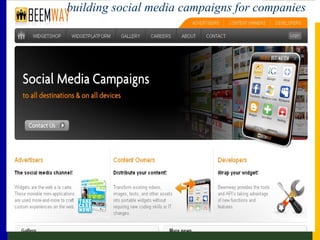
building social media campaigns for companies
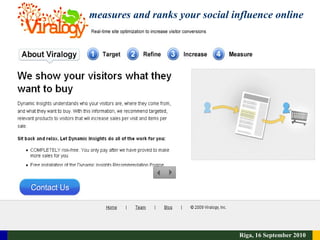
measures and ranks your social influence online Riga, 16 September 2010
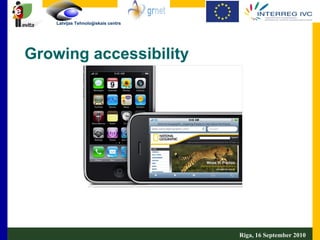
Growing accessibility Riga, 16 September 2010
Athens, 8 December 2008
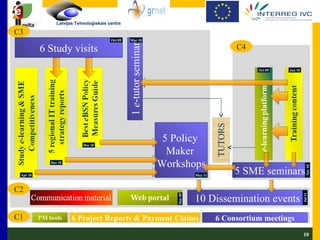
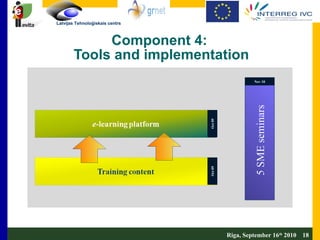
C1 C2 6 Study visits C3 5 Policy  Maker  Workshops C4 1  e -tutor seminar 5 SME seminars  10 Dissemination events 6 Consortium meetings Mar 09 Apr 10 Dec 10 Dec 10 Oct 09 May 11 Mar 10 Oct 09 Jan 10 Nov 10 Jul 11 6 Project Reports & Payment Claims
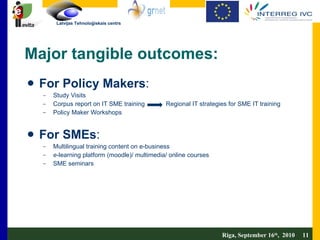
Major tangible outcomes:  For Policy Makers :  Study Visits Corpus report on IT SME training  Regional IT strategies for SME IT training Policy Maker Workshops For SMEs :  Multilingual training content on e-business e -learning platform (moodle)/ multimedia/ online courses SME seminars Riga, September 16 th ,  2010
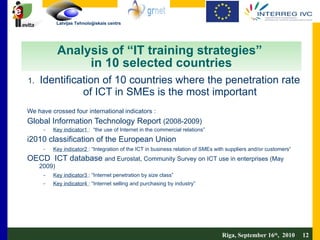
Analysis of “IT training strategies”  in 10 selected countries Identification of 10 countries where the penetration rate of ICT in SMEs is the most important We have crossed four international indicators :  Global Information Technology Report  (2008-2009)  Key indicator1  :  “the use of Internet in the commercial relations” i2010 classification of the European Union  Key indicator2  : “Integration of the ICT in business relation of SMEs with suppliers and/or customers” OECD  ICT database  and Eurostat, Community Survey on ICT use in enterprises (May 2009) Key indicator3  : “Internet penetration by size class” Key indicator4  : “Internet selling and purchasing by industry” Riga, September 16 th ,  2010
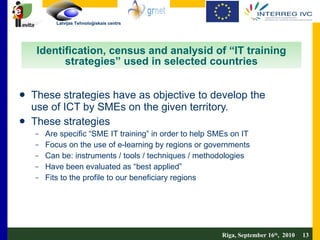
Identification, census and analysid of “IT training strategies” used in selected countries These strategies have as objective to develop the use of ICT by SMEs on the given territory. These strategies Are specific “SME IT training” in order to help SMEs on IT  Focus on the use of e-learning by regions or governments Can be: instruments / tools / techniques / methodologies Have been evaluated as “best applied” Fits to the profile to our beneficiary regions Riga, September 16 th ,  2010
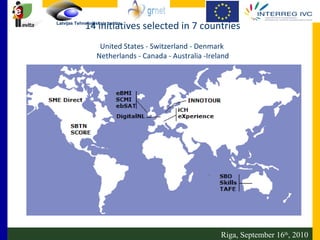
14 initiatives selected in 7 countries United States - Switzerland - Denmark  Netherlands - Canada - Australia -Ireland Riga, September 16 th , 2010
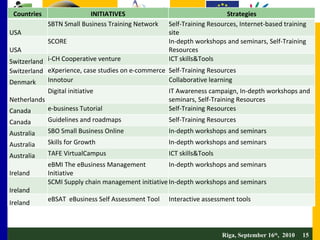
Riga, September 16 th ,  2010  Countries INITIATIVES Strategies USA SBTN Small Business Training Network  Self-Training Resources, Internet-based training site USA SCORE In-depth workshops and seminars, Self-Training Resources Switzerland i-CH Cooperative venture  ICT skills&Tools Switzerland eXperience, case studies on e-commerce  Self-Training Resources Denmark Innotour  Collaborative learning Netherlands Digital initiative IT Awareness campaign, In-depth workshops and seminars, Self-Training Resources Canada e-business Tutorial Self-Training Resources Canada Guidelines and roadmaps  Self-Training Resources Australia SBO Small Business Online  In-depth workshops and seminars Australia Skills for Growth  In-depth workshops and seminars Australia TAFE VirtualCampus  ICT skills&Tools Ireland eBMI The eBusiness Management Initiative  In-depth workshops and seminars Ireland SCMI Supply chain management initiative  In-depth workshops and seminars Ireland eBSAT  eBusiness Self Assessment Tool  Interactive assessment tools
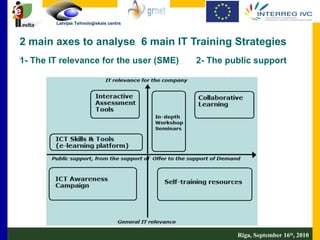
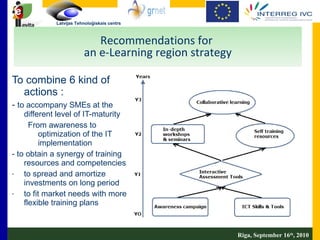
2 main axes to analyse  6 main IT Training Strategies 1- The IT relevance for the user (SME)  2- The public support Riga, September 16 th , 2010
To combine 6 kind of actions : -  to accompany SMEs at the different level of IT-maturity From awareness to optimization of the IT implementation - to obtain a synergy of training resources and competencies to spread and amortize investments on long period to fit market needs with more flexible training plans  Recommendations for  an e-Learning region strategy Riga, September 16 th , 2010
Component 4:  Tools and implementation Riga, September 16 th  2010  5 SME seminars  Oct 09 Nov 10 Oct 09
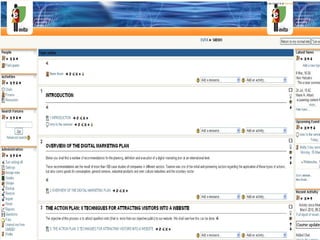
The e-learning platform A multilingual, interactive and user-friendly  e-learning platform  enriched with the training content. It is a strategic choice to focus on technology enhanced professional learning, having in mind that in the very close future, the technological possibilities, especially mobile and broadband solutions, will change today's learning scenarios and that the provision of e-learning services will grow substantially, to satisfy the growing demand of professionals in SMEs.  Riga, September 16 th , 2010
Athens, 8 December 2008
SME pilot seminars At least 30 SMEs Duration: case by case/ at least 10h SME selection procedure Implementation of an  e -learning deployment scenario Local language Multimedia classes/ personal computers
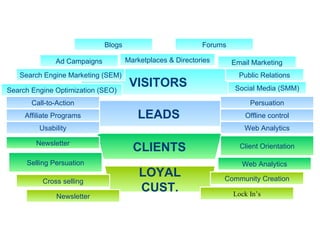
The training package for SMEs A  training content on e-business  and the benefits to SME competitiveness. This content aims at improving managerial understanding and skills in e-business by entrepreneurs, based on best practices, local e-government services and is written in easy “business” language.  Basic IT knowledge for SMEs,  Introduction to e-business models and practices The digital marketing plan Techniques for attracting visitors to a website Techniques that convert visits into business contacts Techniques that convert business contacts into customers Techniques that create loyalty and develop customers Riga, September 16 th , 2010
 
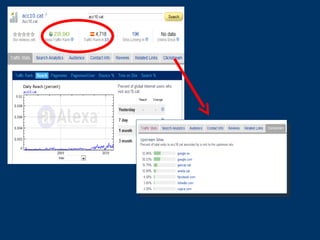
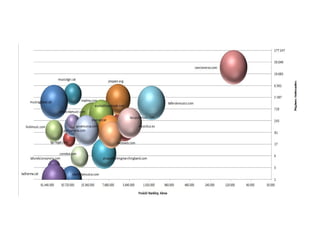
Benchmarking Graph
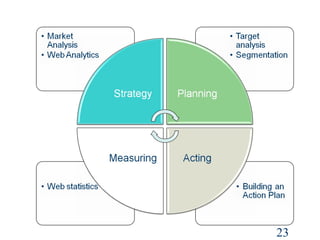
VISITORS LEADS CLIENTS LOYAL CUST. Search Engine Optimization (SEO) Search Engine Marketing (SEM) Ad Campaigns Marketplaces & Directories Email Marketing Public Relations Social Media (SMM) Blogs Forums Call-to-Action Affiliate Programs Usability Persuation Offline control Web Analytics Newsletter Selling Persuation Client Orientation Web Analytics Cross selling Newsletter Community Creation Lock In’s
 
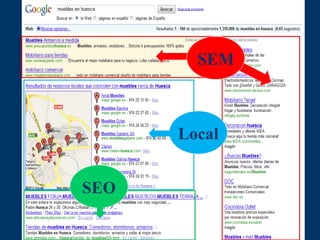
SEM Local SEO
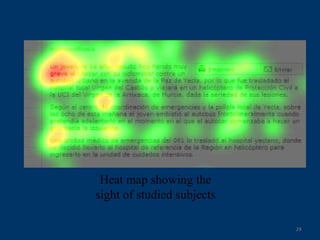
Heat map showing the sight of studied subjects
Dissemination event “E-commerce – policy and development trends in Latvia” – April 29, 2010 Target audience:   micro, small and medium companies, individual entrepreneur s /merchants, state institutions responsible  for e-commerce policy - 65 participants  Speakers:   experts in e-commerce (LTC/EEN, Ministries and State institutions responsible e-commerce: EM, RAPLM, SME – expert in web marketing, the Latvian ICT Association, Mortgage Bank, Investment and Development Agency of Latvia) Topics:  E-commerce State Policy and development; E-State potentialities for entrepreneurs; E-signature development and application; Opportunities and obstacles for e-commerce development from the point of entrepreneurs; Successful web marketing development in SME (SEO, SEM, Affiliate etc.); Open EU Structural Fund programms for entrepreneurs; The Mortgage Bank offers for new entrepreneurs. Riga, September 16 th , 2010
Practical training seminar for SMEs “Web marketing”  – May 27  and 2 8, 2010 Target audience:   micro, small and medium companies, individual entrepreneurs/merchants from different industries, who doesn’t have expertise & experience in web marketing (15 participants each day, laptop and internet access) no consultants, no representatives from Ministries and State organization, no experienced companies in web marketing; Speakers:   e-tutors from LTC + 2 external experts in Web marketing  Topics:  Practical use of the EVITA platform - training material “E-commerce strategy in SMEs” (11 Moduls in Latvian)  SEO – web page optimization; Google AdWords campaign and account creation; Online social marketing strategy; E-mail marketing Riga, September 16 th , 2010
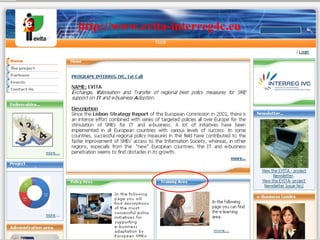
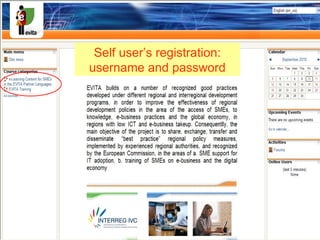
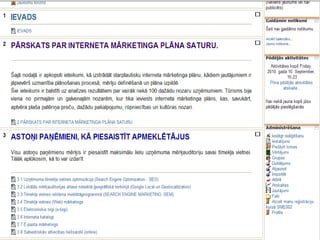
E-learning platform  - http://www.evita-interreg4c.eu –  training material “E-commerce strategy in SMEs” 11 Modules translated and localized into Latvian: Introduction to e-business models and practises; The digital marketing plan; Techniques how to attract visitors to a website; Techniques how to convert visitors to business contacts; Techniques how to convert business contacts into loyal customers; Online social media inclusion into company’s digital marketing plan; SEO strategies using Web 2.00; Online company’s reputation management plan. Riga, September 16 th , 2010
Riga, September 16 th , 2010 http://www.evita-interreg4c.eu
Riga, September 16 th , 2010 Self user’s registration: username and password
Riga, September 16 th , 2010
Next steps: Dissemination event in Liepaja – November, 2010 IT training strategy reports for SMEs (Latvia) – December, 2010 The workshop for Policy Makers – spring, 2011 Riga, September 16 th , 2010
Lead Partner:   Hatzakis Ilias ,  Project Manager ,   GRNET Contacts:   + 30 210 7474268, e-mail: hatzakis@grnet.lv Partner in Latvia:  Diana   Krievina, Project Manager, LTC Contacts:  + 371 67558754, e:mail: dianak@edi.lv EVITA , Baltic Dynamics, Riga 16/09/2010 Thank you    http://www.evita-interreg4c.eu

Evita Baltic dynamics, Riga@16sep2010

  • 1.
    The EVITA InternationalCooperation Program on e -Business Promotion for SMEs Hatzakis Ilias Project Manager, GRNET Diana Krievina, Project Manager, LTC EVITA , Baltic Dynamics 16/09/2010
  • 2.
    EVITA – INTERREGIVC E xchange, V alorisation and Transfer of regional best practice policy measures for SME support on IT and e-business A doption Riga, Baltic Dynamics, September 16 th , 2010
  • 3.
  • 4.
    EVITA mainrationale LISBON STRATEGY/ Europe 2020-digital agenda: stimulation of SMEs for IT and e-business Necessity of exchange between countries/ stakeholders Necessity for the right learning tools for SMEs Riga, September 16 th , 2010
  • 5.
    a world intransmission: The financial crisis/ especially affects new EU members Revolutionary technology trends both in infrastructure and services terms (cloud computing, grid technology, terra bps networks) Opening of PSI and the e-participation Web 2.0/ user generated content/ Social media revolution New business models/ globalization Media convergence Complex digital landscpape … But then also … … we already live IN the cloud… (a social cloud) Riga, 16 September 2010
  • 6.
    building social mediacampaigns for companies
  • 7.
    measures and ranksyour social influence online Riga, 16 September 2010
  • 8.
    Growing accessibility Riga,16 September 2010
  • 9.
  • 10.
    C1 C2 6Study visits C3 5 Policy Maker Workshops C4 1 e -tutor seminar 5 SME seminars 10 Dissemination events 6 Consortium meetings Mar 09 Apr 10 Dec 10 Dec 10 Oct 09 May 11 Mar 10 Oct 09 Jan 10 Nov 10 Jul 11 6 Project Reports & Payment Claims
  • 11.
    Major tangible outcomes: For Policy Makers : Study Visits Corpus report on IT SME training Regional IT strategies for SME IT training Policy Maker Workshops For SMEs : Multilingual training content on e-business e -learning platform (moodle)/ multimedia/ online courses SME seminars Riga, September 16 th , 2010
  • 12.
    Analysis of “ITtraining strategies” in 10 selected countries Identification of 10 countries where the penetration rate of ICT in SMEs is the most important We have crossed four international indicators : Global Information Technology Report (2008-2009) Key indicator1 : “the use of Internet in the commercial relations” i2010 classification of the European Union Key indicator2 : “Integration of the ICT in business relation of SMEs with suppliers and/or customers” OECD ICT database and Eurostat, Community Survey on ICT use in enterprises (May 2009) Key indicator3 : “Internet penetration by size class” Key indicator4 : “Internet selling and purchasing by industry” Riga, September 16 th , 2010
  • 13.
    Identification, census andanalysid of “IT training strategies” used in selected countries These strategies have as objective to develop the use of ICT by SMEs on the given territory. These strategies Are specific “SME IT training” in order to help SMEs on IT Focus on the use of e-learning by regions or governments Can be: instruments / tools / techniques / methodologies Have been evaluated as “best applied” Fits to the profile to our beneficiary regions Riga, September 16 th , 2010
  • 14.
    14 initiatives selectedin 7 countries United States - Switzerland - Denmark Netherlands - Canada - Australia -Ireland Riga, September 16 th , 2010
  • 15.
    Riga, September 16th , 2010 Countries INITIATIVES Strategies USA SBTN Small Business Training Network Self-Training Resources, Internet-based training site USA SCORE In-depth workshops and seminars, Self-Training Resources Switzerland i-CH Cooperative venture ICT skills&Tools Switzerland eXperience, case studies on e-commerce Self-Training Resources Denmark Innotour Collaborative learning Netherlands Digital initiative IT Awareness campaign, In-depth workshops and seminars, Self-Training Resources Canada e-business Tutorial Self-Training Resources Canada Guidelines and roadmaps Self-Training Resources Australia SBO Small Business Online In-depth workshops and seminars Australia Skills for Growth In-depth workshops and seminars Australia TAFE VirtualCampus ICT skills&Tools Ireland eBMI The eBusiness Management Initiative In-depth workshops and seminars Ireland SCMI Supply chain management initiative In-depth workshops and seminars Ireland eBSAT eBusiness Self Assessment Tool Interactive assessment tools
  • 16.
    2 main axesto analyse 6 main IT Training Strategies 1- The IT relevance for the user (SME) 2- The public support Riga, September 16 th , 2010
  • 17.
    To combine 6kind of actions : - to accompany SMEs at the different level of IT-maturity From awareness to optimization of the IT implementation - to obtain a synergy of training resources and competencies to spread and amortize investments on long period to fit market needs with more flexible training plans Recommendations for an e-Learning region strategy Riga, September 16 th , 2010
  • 18.
    Component 4: Tools and implementation Riga, September 16 th 2010 5 SME seminars Oct 09 Nov 10 Oct 09
  • 19.
    The e-learning platformA multilingual, interactive and user-friendly e-learning platform enriched with the training content. It is a strategic choice to focus on technology enhanced professional learning, having in mind that in the very close future, the technological possibilities, especially mobile and broadband solutions, will change today's learning scenarios and that the provision of e-learning services will grow substantially, to satisfy the growing demand of professionals in SMEs. Riga, September 16 th , 2010
  • 20.
  • 21.
    SME pilot seminarsAt least 30 SMEs Duration: case by case/ at least 10h SME selection procedure Implementation of an e -learning deployment scenario Local language Multimedia classes/ personal computers
  • 22.
    The training packagefor SMEs A training content on e-business and the benefits to SME competitiveness. This content aims at improving managerial understanding and skills in e-business by entrepreneurs, based on best practices, local e-government services and is written in easy “business” language. Basic IT knowledge for SMEs, Introduction to e-business models and practices The digital marketing plan Techniques for attracting visitors to a website Techniques that convert visits into business contacts Techniques that convert business contacts into customers Techniques that create loyalty and develop customers Riga, September 16 th , 2010
  • 24.
  • 25.
  • 26.
    VISITORS LEADS CLIENTSLOYAL CUST. Search Engine Optimization (SEO) Search Engine Marketing (SEM) Ad Campaigns Marketplaces & Directories Email Marketing Public Relations Social Media (SMM) Blogs Forums Call-to-Action Affiliate Programs Usability Persuation Offline control Web Analytics Newsletter Selling Persuation Client Orientation Web Analytics Cross selling Newsletter Community Creation Lock In’s
  • 27.
  • 28.
  • 29.
    Heat map showingthe sight of studied subjects
  • 30.
    Dissemination event “E-commerce– policy and development trends in Latvia” – April 29, 2010 Target audience: micro, small and medium companies, individual entrepreneur s /merchants, state institutions responsible for e-commerce policy - 65 participants Speakers: experts in e-commerce (LTC/EEN, Ministries and State institutions responsible e-commerce: EM, RAPLM, SME – expert in web marketing, the Latvian ICT Association, Mortgage Bank, Investment and Development Agency of Latvia) Topics: E-commerce State Policy and development; E-State potentialities for entrepreneurs; E-signature development and application; Opportunities and obstacles for e-commerce development from the point of entrepreneurs; Successful web marketing development in SME (SEO, SEM, Affiliate etc.); Open EU Structural Fund programms for entrepreneurs; The Mortgage Bank offers for new entrepreneurs. Riga, September 16 th , 2010
  • 31.
    Practical training seminarfor SMEs “Web marketing” – May 27 and 2 8, 2010 Target audience: micro, small and medium companies, individual entrepreneurs/merchants from different industries, who doesn’t have expertise & experience in web marketing (15 participants each day, laptop and internet access) no consultants, no representatives from Ministries and State organization, no experienced companies in web marketing; Speakers: e-tutors from LTC + 2 external experts in Web marketing Topics: Practical use of the EVITA platform - training material “E-commerce strategy in SMEs” (11 Moduls in Latvian) SEO – web page optimization; Google AdWords campaign and account creation; Online social marketing strategy; E-mail marketing Riga, September 16 th , 2010
  • 32.
    E-learning platform - http://www.evita-interreg4c.eu – training material “E-commerce strategy in SMEs” 11 Modules translated and localized into Latvian: Introduction to e-business models and practises; The digital marketing plan; Techniques how to attract visitors to a website; Techniques how to convert visitors to business contacts; Techniques how to convert business contacts into loyal customers; Online social media inclusion into company’s digital marketing plan; SEO strategies using Web 2.00; Online company’s reputation management plan. Riga, September 16 th , 2010
  • 33.
    Riga, September 16th , 2010 http://www.evita-interreg4c.eu
  • 34.
    Riga, September 16th , 2010 Self user’s registration: username and password
  • 35.
  • 36.
    Next steps: Disseminationevent in Liepaja – November, 2010 IT training strategy reports for SMEs (Latvia) – December, 2010 The workshop for Policy Makers – spring, 2011 Riga, September 16 th , 2010
  • 37.
    Lead Partner: Hatzakis Ilias , Project Manager , GRNET Contacts: + 30 210 7474268, e-mail: hatzakis@grnet.lv Partner in Latvia: Diana Krievina, Project Manager, LTC Contacts: + 371 67558754, e:mail: dianak@edi.lv EVITA , Baltic Dynamics, Riga 16/09/2010 Thank you  http://www.evita-interreg4c.eu