EmmettEnsuresEducationalExcellense
Every Day Math New Teacher
Training
Everyday Mathematics curriculum is non-
traditional curriculum.
EVERYDAY MATH
• Teaches children the way they actually
learn mathematics. Once a new skill
is introduced, the curriculum
strategically revisits it over time to
reinforce recent and past learning,
guide students towards mastery, and
promote long-term retention (spiral
curriculum).
• Emphasizes conceptual understanding
while building a mastery of basic skills
• Explores a broad mathematics
spectrum, not just basic arithmetic
Everyday Math and Common Core State
Standards
Everyday Math was built on a foundation from the
National Council of Teachers of Mathematics(NCTM).
The CCSS are based on process standards identified by
the NCTM, therefore, the standards and practices for
those who use EM will be much easier to implement.
Best Friend:
TEACHER’S
REFERENCE
MANUAL
Locate your
TRM to
complete the
next section.
Program Highlights
• Problem solving in everyday situations
• Developing readiness through hands-on
activities
• Establishing links between past experiences and
explorations of new concepts
• Sharing ideas through discussion
• Cooperative learning through partner and small
group activities
• Practice through games
• Ongoing review throughout the year
• Daily routines
Prof. Dev. Videos
 There are 199 videos that are extremely helpful in helping you
learn how to teach EDM. Please go to this website and register
by clicking login by clicking BECOME A NEW MEMBER.:
http://vlc.cemseprojects.org
 On the HOME page it looks like this:
 Log in and click the orange box (WATCH EM LESSONS IN ACTION)
watch 4 or 5 videos related to your grade level.
 Bookmark this page so you can return to it throughout the year
 Go to the Discussion Board and respond to the thread about
these videos.
Managing the Curriculum
Open your TRM and read
page 8-22
3 General Types of
Routines:
1) Daily Routines
2) Program Routines
3) Math Modeling
Management
Managing the Curriculum
In your Course Sites
Journal describe in your
own words: 1)
Explorations, 2) Games
3) Math Boxes
4) Math Modeling
Routines
Management
Daily Routines
• Introduced in Unit 1
• Take time-teach them well and
you will save yourself time in
the future
• Examples: class calendar,
money, calculator routines,
patterns, etc.
Management
Program Routines
• Activities that are built into
lessons in the Teacher’s Lesson
Guide, and maintained across
units and grade levels
(explorations, games, etc.)
Management
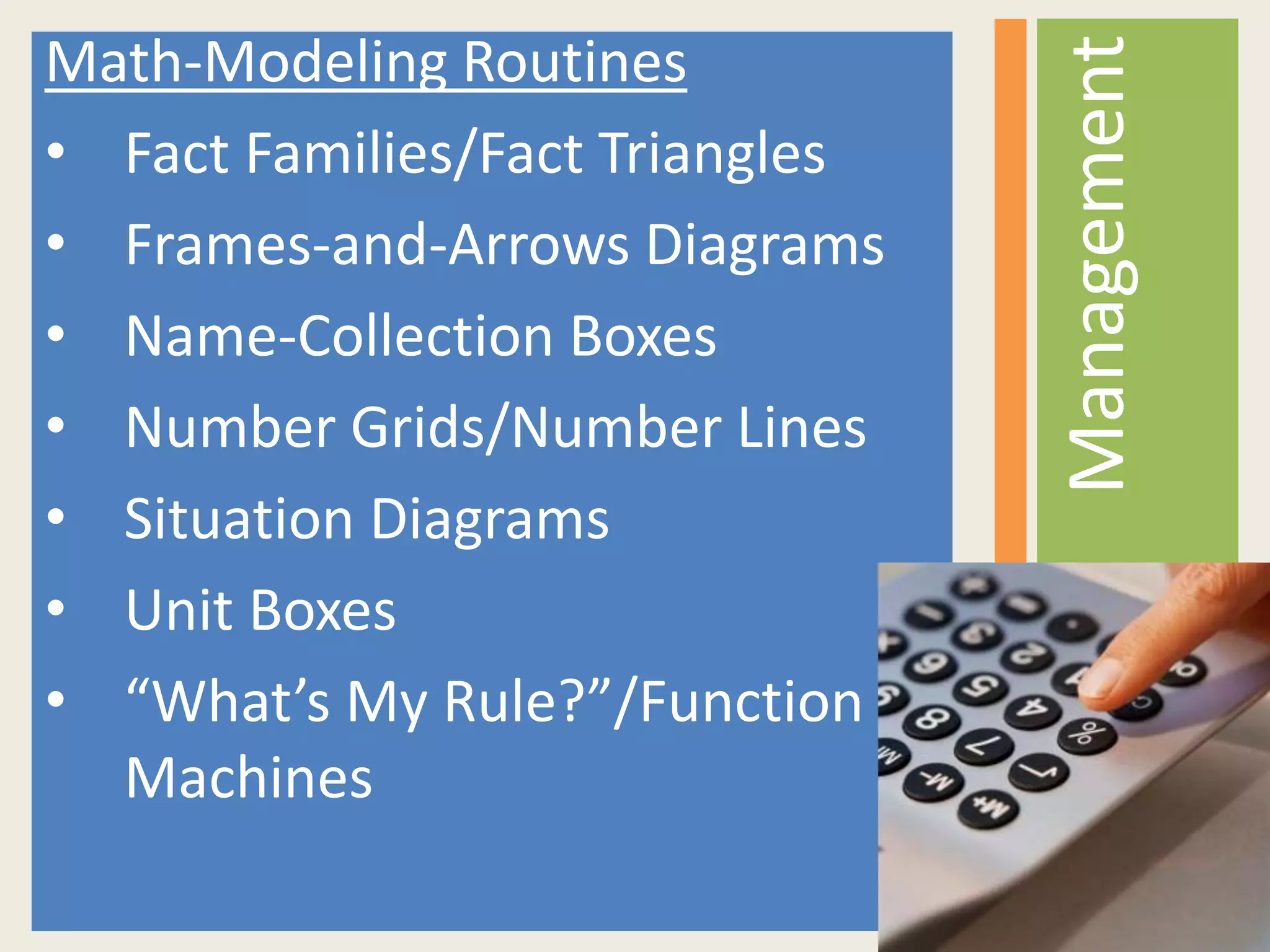
Math-Modeling Routines
• Fact Families/Fact Triangles
• Frames-and-Arrows Diagrams
• Name-Collection Boxes
• Number Grids/Number Lines
• Situation Diagrams
• Unit Boxes
• “What’s My Rule?”/Function
Machines
Management
Parents & Homework
• Home-links are provided with the
curriculum
• These are often hard and confusing for
parents. We do NOT require that you
send these
• Some teachers send some but don’t
send home-links that are extremely
difficult or confusing.
• Some teachers send home fluency
practice instead-that’s ok and we
support with research that says that the
only kind of homework that provides an
effect size on student achievement is
fact fluency practice.
Mastery
Fact Fluency
Math Games
• Are essential component to the
curriculum and a fun and engaging
way for students to become fluent
in math computation
• Each grade level has a
supplemental way to assess facts
• Do not skip the games. Each team
usually has a plan for how to use
games. Talk to your co-teachers.
Mastery
Assessment
• Every grade gives a Unit Test. ONLY
PART A is given a grade-it is a
summative assessment. Part B is
formative for future planning. You
score it but it should not effect a
student’s report card.
• This data is turned in for data entry
and data team meetings. As with
HM Tests, never send them home
until the office has recorded data
on a spreadsheet first.
Management
Assessment (cont’d)
Math Boxes
• In every lesson
• Not intended to reinforce the
objective of the lesson, but,
they provide continuous
distributed practice of skills.
• Math Boxes that reinforce
previously learned skills can be
used as a daily grade.
Management
Intervention: Focus Group
• Use your data (Unit Tests and Math
Boxes)
• Pull small groups-use the same format
that you learned in the HM module
(UA). Use 21 Day plan here too.
• Independent workers can do math
games, workbook pages from the day’s
lesson, PLATO, Khan Academy, projects
in EM
• Use your Differentiation Handbook for
EM
Mastery
Make Math Real
-Engaging
-Accessible to all students
-Dig deep-don’t make kids do every
problem because it’s on the
worksheet
-Strive for deep understanding and
learning
MOTVATION
http://www.ted.com/talks/dan_meyer_math_
curriculum_makeover.html
Reflection Time
• Go to your EDM Reflection Journal. Do you
have questions that are still unanswered?
• How do you feel about sending
homework—I know you haven’t talked to
your team yet but what type of homework,
if any, are you thinking of sending? (This is
good to sort out before Open House—
parents will ask)

Everyday Math Basics

  • 1.
  • 2.
    Everyday Mathematics curriculumis non- traditional curriculum. EVERYDAY MATH • Teaches children the way they actually learn mathematics. Once a new skill is introduced, the curriculum strategically revisits it over time to reinforce recent and past learning, guide students towards mastery, and promote long-term retention (spiral curriculum). • Emphasizes conceptual understanding while building a mastery of basic skills • Explores a broad mathematics spectrum, not just basic arithmetic
  • 3.
    Everyday Math andCommon Core State Standards Everyday Math was built on a foundation from the National Council of Teachers of Mathematics(NCTM). The CCSS are based on process standards identified by the NCTM, therefore, the standards and practices for those who use EM will be much easier to implement.
  • 4.
  • 5.
    Program Highlights • Problemsolving in everyday situations • Developing readiness through hands-on activities • Establishing links between past experiences and explorations of new concepts • Sharing ideas through discussion • Cooperative learning through partner and small group activities • Practice through games • Ongoing review throughout the year • Daily routines
  • 6.
    Prof. Dev. Videos There are 199 videos that are extremely helpful in helping you learn how to teach EDM. Please go to this website and register by clicking login by clicking BECOME A NEW MEMBER.: http://vlc.cemseprojects.org  On the HOME page it looks like this:  Log in and click the orange box (WATCH EM LESSONS IN ACTION) watch 4 or 5 videos related to your grade level.  Bookmark this page so you can return to it throughout the year  Go to the Discussion Board and respond to the thread about these videos.
  • 7.
    Managing the Curriculum Openyour TRM and read page 8-22 3 General Types of Routines: 1) Daily Routines 2) Program Routines 3) Math Modeling Management
  • 8.
    Managing the Curriculum Inyour Course Sites Journal describe in your own words: 1) Explorations, 2) Games 3) Math Boxes 4) Math Modeling Routines Management
  • 9.
    Daily Routines • Introducedin Unit 1 • Take time-teach them well and you will save yourself time in the future • Examples: class calendar, money, calculator routines, patterns, etc. Management
  • 10.
    Program Routines • Activitiesthat are built into lessons in the Teacher’s Lesson Guide, and maintained across units and grade levels (explorations, games, etc.) Management
  • 11.
    Math-Modeling Routines • FactFamilies/Fact Triangles • Frames-and-Arrows Diagrams • Name-Collection Boxes • Number Grids/Number Lines • Situation Diagrams • Unit Boxes • “What’s My Rule?”/Function Machines Management
  • 12.
    Parents & Homework •Home-links are provided with the curriculum • These are often hard and confusing for parents. We do NOT require that you send these • Some teachers send some but don’t send home-links that are extremely difficult or confusing. • Some teachers send home fluency practice instead-that’s ok and we support with research that says that the only kind of homework that provides an effect size on student achievement is fact fluency practice. Mastery
  • 13.
    Fact Fluency Math Games •Are essential component to the curriculum and a fun and engaging way for students to become fluent in math computation • Each grade level has a supplemental way to assess facts • Do not skip the games. Each team usually has a plan for how to use games. Talk to your co-teachers. Mastery
  • 14.
    Assessment • Every gradegives a Unit Test. ONLY PART A is given a grade-it is a summative assessment. Part B is formative for future planning. You score it but it should not effect a student’s report card. • This data is turned in for data entry and data team meetings. As with HM Tests, never send them home until the office has recorded data on a spreadsheet first. Management
  • 15.
    Assessment (cont’d) Math Boxes •In every lesson • Not intended to reinforce the objective of the lesson, but, they provide continuous distributed practice of skills. • Math Boxes that reinforce previously learned skills can be used as a daily grade. Management
  • 16.
    Intervention: Focus Group •Use your data (Unit Tests and Math Boxes) • Pull small groups-use the same format that you learned in the HM module (UA). Use 21 Day plan here too. • Independent workers can do math games, workbook pages from the day’s lesson, PLATO, Khan Academy, projects in EM • Use your Differentiation Handbook for EM Mastery
  • 17.
    Make Math Real -Engaging -Accessibleto all students -Dig deep-don’t make kids do every problem because it’s on the worksheet -Strive for deep understanding and learning MOTVATION http://www.ted.com/talks/dan_meyer_math_ curriculum_makeover.html
  • 18.
    Reflection Time • Goto your EDM Reflection Journal. Do you have questions that are still unanswered? • How do you feel about sending homework—I know you haven’t talked to your team yet but what type of homework, if any, are you thinking of sending? (This is good to sort out before Open House— parents will ask)

Editor's Notes

  • #10 R.G. pg. 8
  • #11 Make copies of page 8 of Management Guide
  • #12 Make copies of page 8 of Management Guide- Do 4 Corners activity-copy the definition from the book to put in 4 corners—assign Situation Diagrams, Unit Boxes, and What’s My Rule as homework—make copies for teachers
  • #13 Make copies of page 8 of Management Guide- Do 4 Corners activity-copy the definition from the book to put in 4 corners—assign Situation Diagrams, Unit Boxes, and What’s My Rule as homework—make copies for teachers
  • #14 Make copies of page 8 of Management Guide- Do 4 Corners activity-copy the definition from the book to put in 4 corners—assign Situation Diagrams, Unit Boxes, and What’s My Rule as homework—make copies for teachers
  • #15 Make copies of page 8 of Management Guide- Do 4 Corners activity-copy the definition from the book to put in 4 corners—assign Situation Diagrams, Unit Boxes, and What’s My Rule as homework—make copies for teachers
  • #16 Make copies of page 8 of Management Guide- Do 4 Corners activity-copy the definition from the book to put in 4 corners—assign Situation Diagrams, Unit Boxes, and What’s My Rule as homework—make copies for teachers
  • #17 Make copies of page 8 of Management Guide- Do 4 Corners activity-copy the definition from the book to put in 4 corners—assign Situation Diagrams, Unit Boxes, and What’s My Rule as homework—make copies for teachers