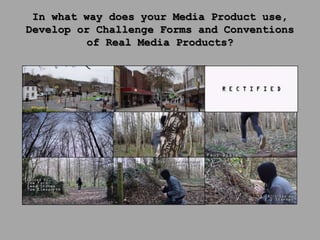
In what way does your Media Product use,
Develop or Challenge Forms and Conventions
of Real Media Products?
Voiceover
During our research, we analysed
the opening sequence for ‘Moon’,
which contains a voice-over, played
over the top of an advertisement for
an energy company. When looking at
other opening sequences for sci-fi
films, we discovered that voice-overs
were also used in ‘Transformers’,
‘Mad Max: Fury Road’, and ‘The
Hunger Games: Mockingjay Part
One’. From this research, we were
inspired to use this convention, and
create our own voice-over for the
‘Rectified’ opening sequence.
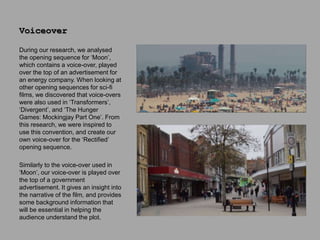
Similarly to the voice-over used in
‘Moon’, our voice-over is played over
the top of a government
advertisement. It gives an insight into
the narrative of the film, and provides
some background information that
will be essential in helping the
audience understand the plot.
In every sci-fi opening sequence we looked
at during our research, we noticed that all of
them featured a sans-serif font style for the
credits, and often the titles too.
When planning our opening sequence, we
did consider using a serif font to challenge
this particular convention. However, we
decided to use a sans-serif font as we
realised it would work much better with the
themes and narrative of our opening
sequence.
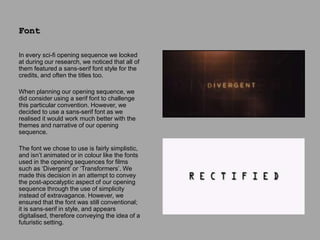
The font we chose to use is fairly simplistic,
and isn’t animated or in colour like the fonts
used in the opening sequences for films
such as ‘Divergent’ or ‘Transformers’. We
made this decision in an attempt to convey
the post-apocalyptic aspect of our opening
sequence through the use of simplicity
instead of extravagance. However, we
ensured that the font was still conventional;
it is sans-serif in style, and appears
digitalised, therefore conveying the idea of a
futuristic setting.
Font
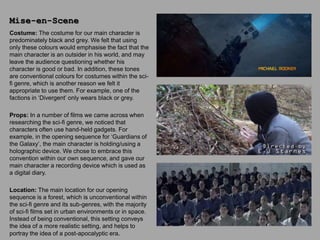
Costume: The costume for our main character is
predominately black and grey. We felt that using
only these colours would emphasise the fact that the
main character is an outsider in his world, and may
leave the audience questioning whether his
character is good or bad. In addition, these tones
are conventional colours for costumes within the sci-
fi genre, which is another reason we felt it
appropriate to use them. For example, one of the
factions in ‘Divergent’ only wears black or grey.
Props: In a number of films we came across when
researching the sci-fi genre, we noticed that
characters often use hand-held gadgets. For
example, in the opening sequence for ‘Guardians of
the Galaxy’, the main character is holding/using a
holographic device. We chose to embrace this
convention within our own sequence, and gave our
main character a recording device which is used as
a digital diary.
Location: The main location for our opening
sequence is a forest, which is unconventional within
the sci-fi genre and its sub-genres, with the majority
of sci-fi films set in urban environments or in space.
Instead of being conventional, this setting conveys
the idea of a more realistic setting, and helps to
portray the idea of a post-apocalyptic era.
Mise-en-Scene
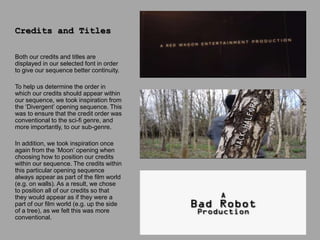
Both our credits and titles are
displayed in our selected font in order
to give our sequence better continuity.
To help us determine the order in
which our credits should appear within
our sequence, we took inspiration from
the ‘Divergent’ opening sequence. This
was to ensure that the credit order was
conventional to the sci-fi genre, and
more importantly, to our sub-genre.
In addition, we took inspiration once
again from the ‘Moon’ opening when
choosing how to position our credits
within our sequence. The credits within
this particular opening sequence
always appear as part of the film world
(e.g. on walls). As a result, we chose
to position all of our credits so that
they would appear as if they were a
part of our film world (e.g. up the side
of a tree), as we felt this was more
conventional.
Credits and Titles
We felt that the non-diegetic music we chose
to use in our opening sequence was
conventional to the sci-fi genre. The track
features orchestral instruments such as strings
and drums, and the tempo is similar to that of
tracks conventionally used in sci-fi films.
We had considered using an alternative track
which heavily featured piano, and had a much
slower tempo, as we felt that this would
challenge conventions. However, after some
consideration, we decided that the track didn’t
fit particularly well with our sequence, and
didn’t create the atmosphere we were looking
for.
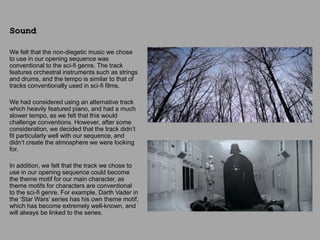
In addition, we felt that the track we chose to
use in our opening sequence could become
the theme motif for our main character, as
theme motifs for characters are conventional
to the sci-fi genre. For example, Darth Vader in
the ‘Star Wars’ series has his own theme motif,
which has become extremely well-known, and
will always be linked to the series.
Sound

Evaluation Question 1

  • 1.
    In what waydoes your Media Product use, Develop or Challenge Forms and Conventions of Real Media Products?
  • 2.
    Voiceover During our research,we analysed the opening sequence for ‘Moon’, which contains a voice-over, played over the top of an advertisement for an energy company. When looking at other opening sequences for sci-fi films, we discovered that voice-overs were also used in ‘Transformers’, ‘Mad Max: Fury Road’, and ‘The Hunger Games: Mockingjay Part One’. From this research, we were inspired to use this convention, and create our own voice-over for the ‘Rectified’ opening sequence. Similarly to the voice-over used in ‘Moon’, our voice-over is played over the top of a government advertisement. It gives an insight into the narrative of the film, and provides some background information that will be essential in helping the audience understand the plot.
  • 3.
    In every sci-fiopening sequence we looked at during our research, we noticed that all of them featured a sans-serif font style for the credits, and often the titles too. When planning our opening sequence, we did consider using a serif font to challenge this particular convention. However, we decided to use a sans-serif font as we realised it would work much better with the themes and narrative of our opening sequence. The font we chose to use is fairly simplistic, and isn’t animated or in colour like the fonts used in the opening sequences for films such as ‘Divergent’ or ‘Transformers’. We made this decision in an attempt to convey the post-apocalyptic aspect of our opening sequence through the use of simplicity instead of extravagance. However, we ensured that the font was still conventional; it is sans-serif in style, and appears digitalised, therefore conveying the idea of a futuristic setting. Font
  • 4.
    Costume: The costumefor our main character is predominately black and grey. We felt that using only these colours would emphasise the fact that the main character is an outsider in his world, and may leave the audience questioning whether his character is good or bad. In addition, these tones are conventional colours for costumes within the sci- fi genre, which is another reason we felt it appropriate to use them. For example, one of the factions in ‘Divergent’ only wears black or grey. Props: In a number of films we came across when researching the sci-fi genre, we noticed that characters often use hand-held gadgets. For example, in the opening sequence for ‘Guardians of the Galaxy’, the main character is holding/using a holographic device. We chose to embrace this convention within our own sequence, and gave our main character a recording device which is used as a digital diary. Location: The main location for our opening sequence is a forest, which is unconventional within the sci-fi genre and its sub-genres, with the majority of sci-fi films set in urban environments or in space. Instead of being conventional, this setting conveys the idea of a more realistic setting, and helps to portray the idea of a post-apocalyptic era. Mise-en-Scene
  • 5.
    Both our creditsand titles are displayed in our selected font in order to give our sequence better continuity. To help us determine the order in which our credits should appear within our sequence, we took inspiration from the ‘Divergent’ opening sequence. This was to ensure that the credit order was conventional to the sci-fi genre, and more importantly, to our sub-genre. In addition, we took inspiration once again from the ‘Moon’ opening when choosing how to position our credits within our sequence. The credits within this particular opening sequence always appear as part of the film world (e.g. on walls). As a result, we chose to position all of our credits so that they would appear as if they were a part of our film world (e.g. up the side of a tree), as we felt this was more conventional. Credits and Titles
  • 6.
    We felt thatthe non-diegetic music we chose to use in our opening sequence was conventional to the sci-fi genre. The track features orchestral instruments such as strings and drums, and the tempo is similar to that of tracks conventionally used in sci-fi films. We had considered using an alternative track which heavily featured piano, and had a much slower tempo, as we felt that this would challenge conventions. However, after some consideration, we decided that the track didn’t fit particularly well with our sequence, and didn’t create the atmosphere we were looking for. In addition, we felt that the track we chose to use in our opening sequence could become the theme motif for our main character, as theme motifs for characters are conventional to the sci-fi genre. For example, Darth Vader in the ‘Star Wars’ series has his own theme motif, which has become extremely well-known, and will always be linked to the series. Sound