CAMERA
‱ For my magazine photos, I decided to use my personal camera - a Panasonic GX7 – since I felt that I would be
more comfortable using it: I could easily navigate the camera and use “manual” mode effectively for the images I
wanted to produce. As well as this, the lens on my camera was perfect for the photography needed for my
magazine; the focal length allowed for a good range of shots (from extreme close up to long/mid). I feel that my
photography skills have improved from taking these photos, since I was required to think about each image
carefully in terms of styling and appearance – something that I don’t always do when taking photos.
‱ I decided not to use a tripod for my images, since I felt I was competent at producing photographs without one –
street photography is a hobby of mine and so I felt more natural/comfortable without the use of a tripod. The set
for my photographs was also somewhat small and so a tripod would be highly impractical and clumsy.
‱ When taking my photos I felt that it was key to experiment with my images by using different shutter speeds and
trying different aperture values – this resulted in a range of exposures and effects. I then had wide range of
images that I could choose from to use in my draft/final magazine.
LIGHTING
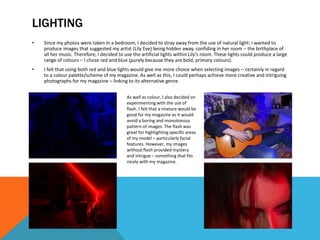
‱ Since my photos were taken in a bedroom, I decided to stray away from the use of natural light: I wanted to
produce images that suggested my artist (Lily Eve) being hidden away, confiding in her room – the birthplace of
all her music. Therefore, I decided to use the artificial lights within Lily’s room. These lights could produce a large
range of colours – I chose red and blue (purely because they are bold, primary colours).
‱ I felt that using both red and blue lights would give me more choice when selecting images – certainly in regard
to a colour palette/scheme of my magazine. As well as this, I could perhaps achieve more creative and intriguing
photographs for my magazine – linking to its alternative genre.
As well as colour, I also decided on
experimenting with the use of
flash. I felt that a mixture would be
good for my magazine as it would
avoid a boring and monotonous
pattern of images. The flash was
great for highlighting specific areas
of my model – particularly facial
features. However, my images
without flash provided mystery
and intrigue – something that fits
nicely with my magazine.
PHOTOSHOP
‱ Photoshop was a massively important piece of my coursework, since it was the software I used to create my
magazine. At first, I was fairly incompetent at using it: I was completely new to the software and therefore had
very little idea on how to use it effectively. This is highlighted with the contrast between the standard of my
preliminary task ad my final magazine.
‱ I didn’t use Photoshop for the editing of my images, since I wanted them to appear natural. However, I became
far more experienced in tools that were useful for the construction of my actual magazine. Using rulers and grids
were a massive help in achieving a professional look - aiding in continuity.
‱ I felt that Photoshop allowed me to express myself creatively, since there were few limitations to what I could
experiment with.
PRESENTATION
‱ The entirety of my coursework is located on the website Blogger. This allowed for me to keep all my work in one easily
accessible area.
‱ For the presentation of my work, I was required to use a variety of platforms to show my creativity and make my
responses a visually intriguing experience – as well as highlighting my range of skills that have developed over the
coursework period.
‱ I decided to to use:
‱ Slideshare
‱ Piktochart
‱ Scribd
‱ Prezi
‱ Animoto

Evaluation 6

  • 2.
    CAMERA ‱ For mymagazine photos, I decided to use my personal camera - a Panasonic GX7 – since I felt that I would be more comfortable using it: I could easily navigate the camera and use “manual” mode effectively for the images I wanted to produce. As well as this, the lens on my camera was perfect for the photography needed for my magazine; the focal length allowed for a good range of shots (from extreme close up to long/mid). I feel that my photography skills have improved from taking these photos, since I was required to think about each image carefully in terms of styling and appearance – something that I don’t always do when taking photos. ‱ I decided not to use a tripod for my images, since I felt I was competent at producing photographs without one – street photography is a hobby of mine and so I felt more natural/comfortable without the use of a tripod. The set for my photographs was also somewhat small and so a tripod would be highly impractical and clumsy. ‱ When taking my photos I felt that it was key to experiment with my images by using different shutter speeds and trying different aperture values – this resulted in a range of exposures and effects. I then had wide range of images that I could choose from to use in my draft/final magazine.
  • 3.
    LIGHTING ‱ Since myphotos were taken in a bedroom, I decided to stray away from the use of natural light: I wanted to produce images that suggested my artist (Lily Eve) being hidden away, confiding in her room – the birthplace of all her music. Therefore, I decided to use the artificial lights within Lily’s room. These lights could produce a large range of colours – I chose red and blue (purely because they are bold, primary colours). ‱ I felt that using both red and blue lights would give me more choice when selecting images – certainly in regard to a colour palette/scheme of my magazine. As well as this, I could perhaps achieve more creative and intriguing photographs for my magazine – linking to its alternative genre. As well as colour, I also decided on experimenting with the use of flash. I felt that a mixture would be good for my magazine as it would avoid a boring and monotonous pattern of images. The flash was great for highlighting specific areas of my model – particularly facial features. However, my images without flash provided mystery and intrigue – something that fits nicely with my magazine.
  • 4.
    PHOTOSHOP ‱ Photoshop wasa massively important piece of my coursework, since it was the software I used to create my magazine. At first, I was fairly incompetent at using it: I was completely new to the software and therefore had very little idea on how to use it effectively. This is highlighted with the contrast between the standard of my preliminary task ad my final magazine. ‱ I didn’t use Photoshop for the editing of my images, since I wanted them to appear natural. However, I became far more experienced in tools that were useful for the construction of my actual magazine. Using rulers and grids were a massive help in achieving a professional look - aiding in continuity. ‱ I felt that Photoshop allowed me to express myself creatively, since there were few limitations to what I could experiment with.
  • 5.
    PRESENTATION ‱ The entiretyof my coursework is located on the website Blogger. This allowed for me to keep all my work in one easily accessible area. ‱ For the presentation of my work, I was required to use a variety of platforms to show my creativity and make my responses a visually intriguing experience – as well as highlighting my range of skills that have developed over the coursework period. ‱ I decided to to use: ‱ Slideshare ‱ Piktochart ‱ Scribd ‱ Prezi ‱ Animoto