WEBSITE EVALUATION
FOR THE CLASSROOM
Start
Created by Susan Moore
Navigation
You are able to move through the course at your
own pace. Feel free to go back and review
information at any time. The icons below will help
you navigate.
BACK HOME NEXT END
Content
This learning module should take approximately
20 minutes to complete. As an instructor of high
school or first year college students, you already
recognize the need for students to critically
evaluate sources. This learning module will cover
criteria and teaching techniques for website
evaluation. As you move through the learning
module, think about how you can apply this
information to your classroom.
BACK HOME NEXT END
GOALS
1. Identify individual letters for the acronym
CRAAP.
2. Identify the meaning of a domain ending.
3. Identify the website with the most
authoritative information.
4. Identify the website with the most accurate
information.
5. Evaluate websites for accuracy and authority.
Introduction: Criteria of Website Evaluation
We will begin with a short video to explain
the criteria this learning module uses for
critical evaluation of websites. This would
also be a good video to share with your
students.
CRAAP: Evaluating Websites
Introduction: Criteria of Website Evaluation
To teach this method of website
evaluation we will use a handout titled
the CRAAP Test (students love the
name and don’t forget it).
The CRAAP Test was developed by
librarians at California State University
to help students understand important
factors when evaluating a website.
The acronym is memorable, but it’s
important to understand that you do
not have to use the criteria in any
specific order and you do not have to
use all five criteria. It all depends on
the information need.
What is CRAAP?
The CRAAP Test lists five criteria to
consider when evaluating a
website:
I. Currency
II. Relevance
III. Authority
IV. Accuracy
V. Purpose
I. Currency
When was the information
published, and how much does
the date matter?
When looking for information for
technology or science the
publication date is important, but
the date is not as important when
looking for information about
historical events or literature
criticism.
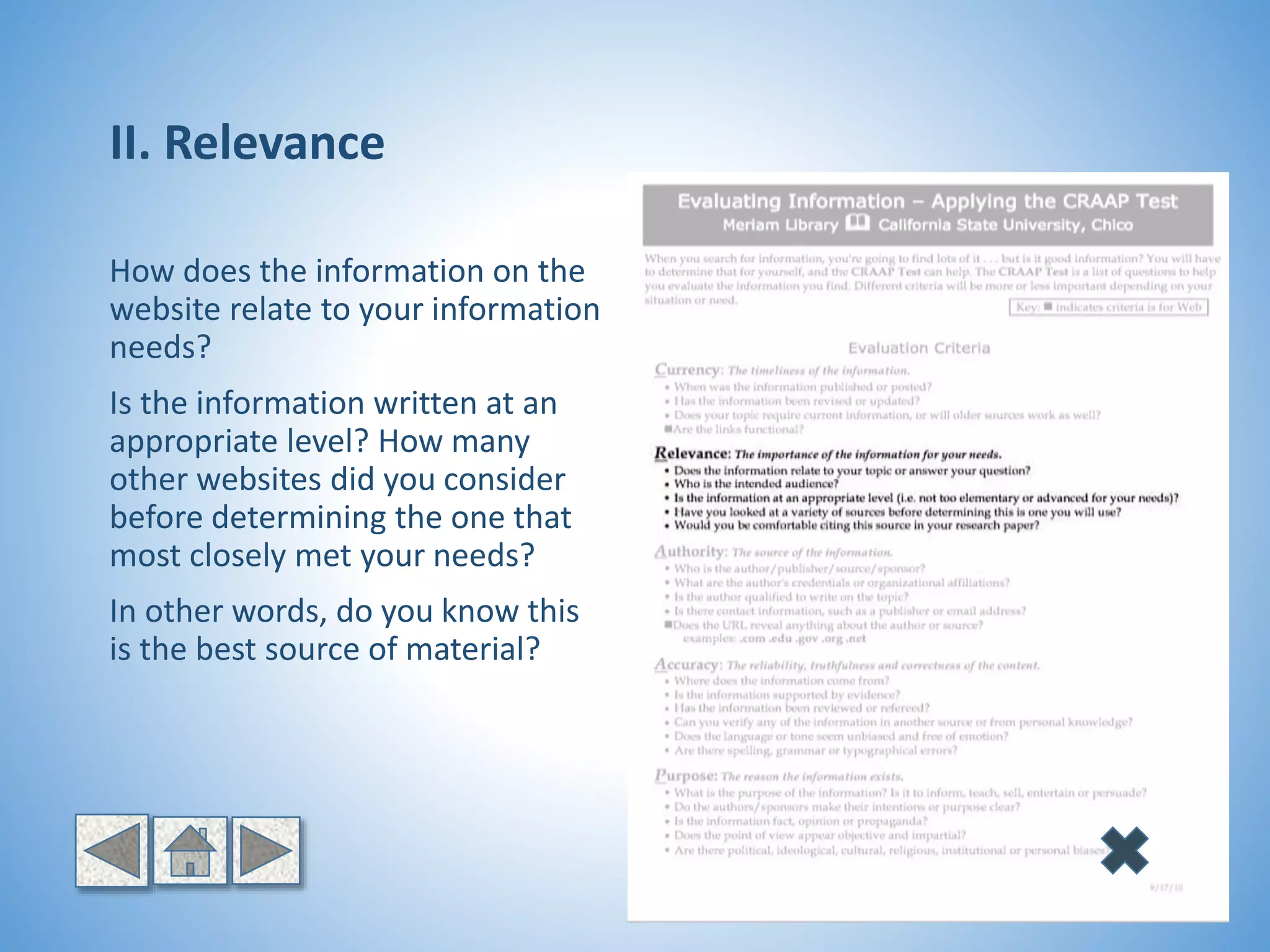
II. Relevance
How does the information on the
website relate to your information
needs?
Is the information written at an
appropriate level? How many
other websites did you consider
before determining the one that
most closely met your needs?
In other words, do you know this
is the best source of material?
III. Authority
Does the author have first-hand
experience?
Knowing the author’s background
is a vital step in determining if a
website is authoritative.
IV. Accuracy
Where does the information
originate?
Is the information fact or opinion?
Can you verify the information
through citations within in the
webpage, or is a reference list
provided?
V. Purpose
Why was this particular website
produced?
Is the intent to sell a product?
Is there an identifiable purpose
for publishing the information?
Does the language seem biased or
free of emotion?
1. Identify individual letters for the acronym CRAAP.
C urrency
R elevence
A uthority
A ccuracy
urpose
Check Your Understanding:
True or False: R stands for relevance of the
website information.
A
B
True
False
Domain Endings and Purposes
We often place a lot of value on website domain endings, but
those endings don't actually carry as much weight as you
might think.
The domain endings .com and .org can be purchased by
anyone, only .gov, .mil, and .edu are restricted for purchase.
Let's take a look at some of the common domain endings and
the types of websites you can find.
Domain Endings and Purposes
.com stands for commercial sites, but can really be anything.
Often an instructor will ban the use of .com sites, however,
that may exclude a good information source.
Let’s look at some examples of .com sites you are probably
familiar with and that your students may use in their research.
Domain Endings and Purposes
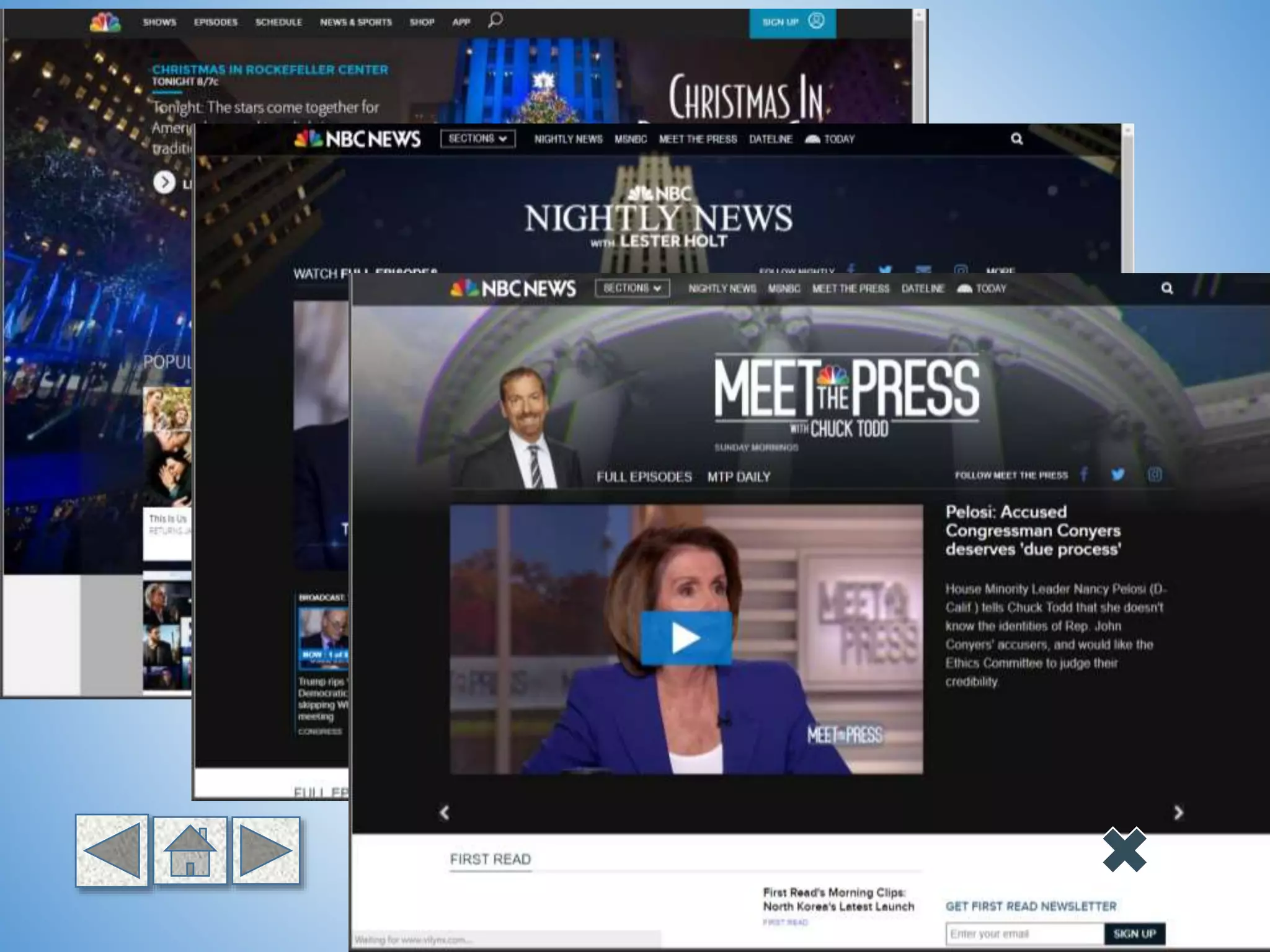
NBC.com – The National Broadcasting Company is a
television network with information about news and
current events; not always guaranteed to be
accurate, but in general a credible .com website.
Domain Endings and Purposes
Glamour.com - may have occasional articles that are
relevant for specific topics. It depends on the context
and the assignment needs. If a student is preparing a
speech on a popular culture topic, Glamour may be
an acceptable source of information.
Domain Endings and Purposes
.org websites should be organizations, but
remember, they can really be anything since the
purchase of .org domain names is not restricted.
The Modern Language Association, American Cancer
Society, NRA and the American Medical Association
are all examples of respected, well known websites
and are considered to be "the" organization that
drives the discipline.
Domain Endings and Purposes
Wikipedia.org - often students are allowed to use
.org websites but not Wikipedia. This creates a little
conflict in the information relayed to students.
Is Wikipedia the only .org site that is unacceptable,
or is it just the easiest one to identify?
Domain Endings and Purposes
.edu websites should contain credible materials, at least that
is our expectation.
The domain .edu is restricted for purchase, however, there are
a few sites that have been grandfathered in (not legitimate
schools), but the other general information to keep in mind is
that schools often offer web space to students for student
work.
Many schools also offer a digital commons to share student
and faculty work, that has not been peer-reviewed. The sites
look professional, so it is important to understand what type
of information you are viewing.
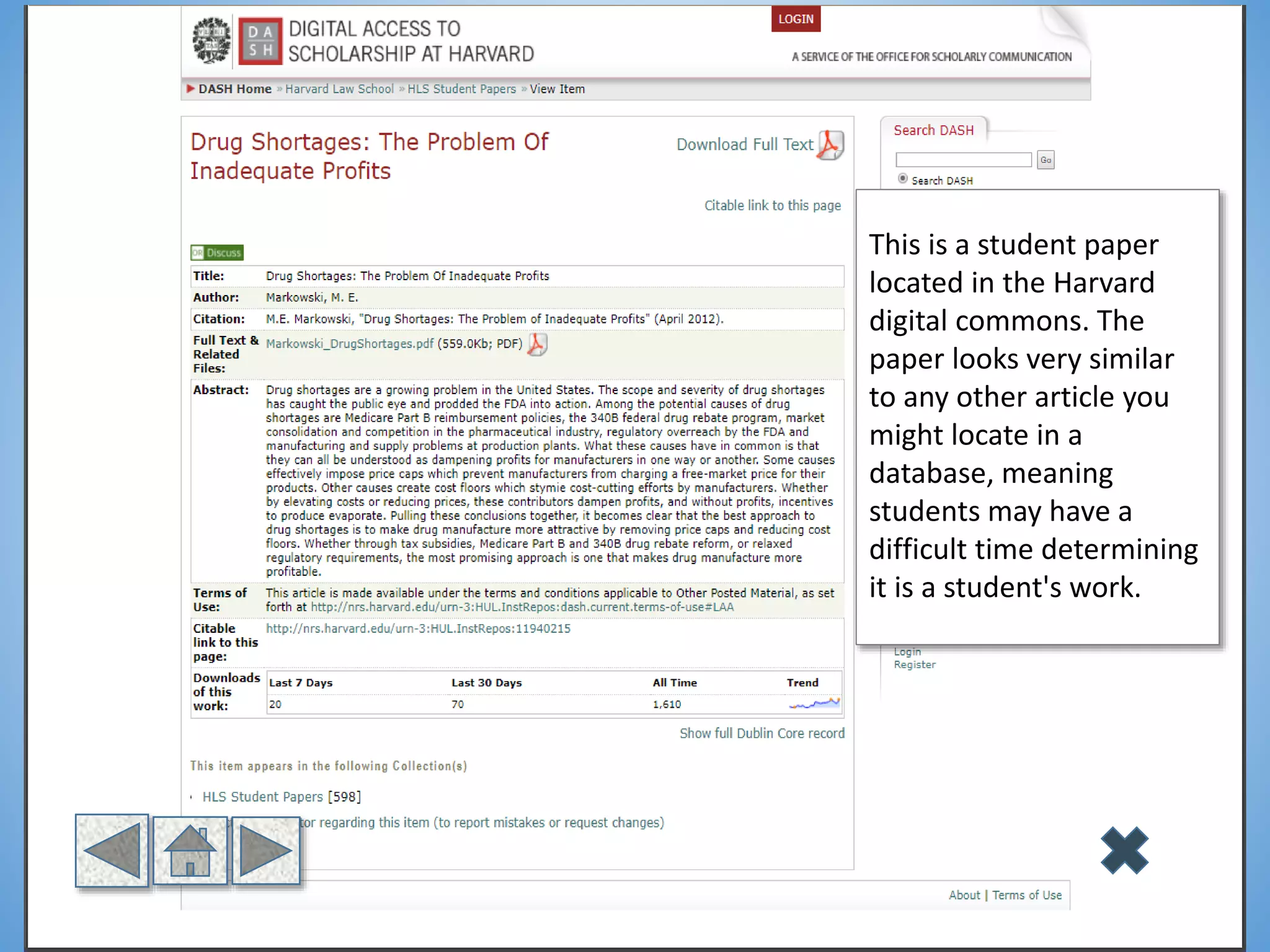
This is a student paper
located in the Harvard
digital commons. The
paper looks very similar
to any other article you
might locate in a
database, meaning
students may have a
difficult time determining
it is a student's work.
Domain Endings and Purposes
Miscellaneous domain endings have a lot of variety,
this should help us remember not to throw the baby
out with the bathwater, so to speak. We will only
look at a two good examples:
1. NATO: https://www.nato.int/
2. World Health Organization: http://www.who.int/
Domain Endings and Purposes
.net - could be any type of website, but for our
example of a credible site we will use the Institute of
War and Peace Reporting, a charitable foundation
that reports on the safety and events occurring in
countries in upheaval around the world.
2. Identify the meaning of a domain ending.
We often place a lot of value on website
domain endings, but those endings don't
actually carry as much weight as you might
think.
The domain endings .com and .org can be
purchased by anyone, only .gov, .mil, and
.edu are restricted for purchase.
Check Your Understanding:
When evaluating a website with a domain ending of
.com, which answer best explains the intended purpose
of the site?
A
B
C
D commanded
commons
commercial
complete
Skills for Determining Authority
For the purposes of this learning module, we are going to focus on two criteria
from the CRAAP Test based on the survey results. These two criteria were
indicated on the preliminary survey as being the most important evaluation skills
needed by your students. Future learning modules will address the remaining
criteria.
The first criteria we will examine is Authority.
Let’s review what we read earlier about authority. To determine authority, we
need to know about the author or in the case of no author attribution, the
publisher.
 Who wrote the website article? What is their knowledge on the subject? Are they
experts, or is this an avocation?
 Are credentials provided for the author or are there affiliates for the publisher listed?
 What is the domain ending, and does that indicate anything about the website
author/publishers?
Let’s look at a website example. Keep in mind the questions
concerning authority when looking over the site.
Hint: this is not an authoritative website. Your job is to determine why it is not
considered authoritative.
Skills for Determining Authority
What’s this
statement?
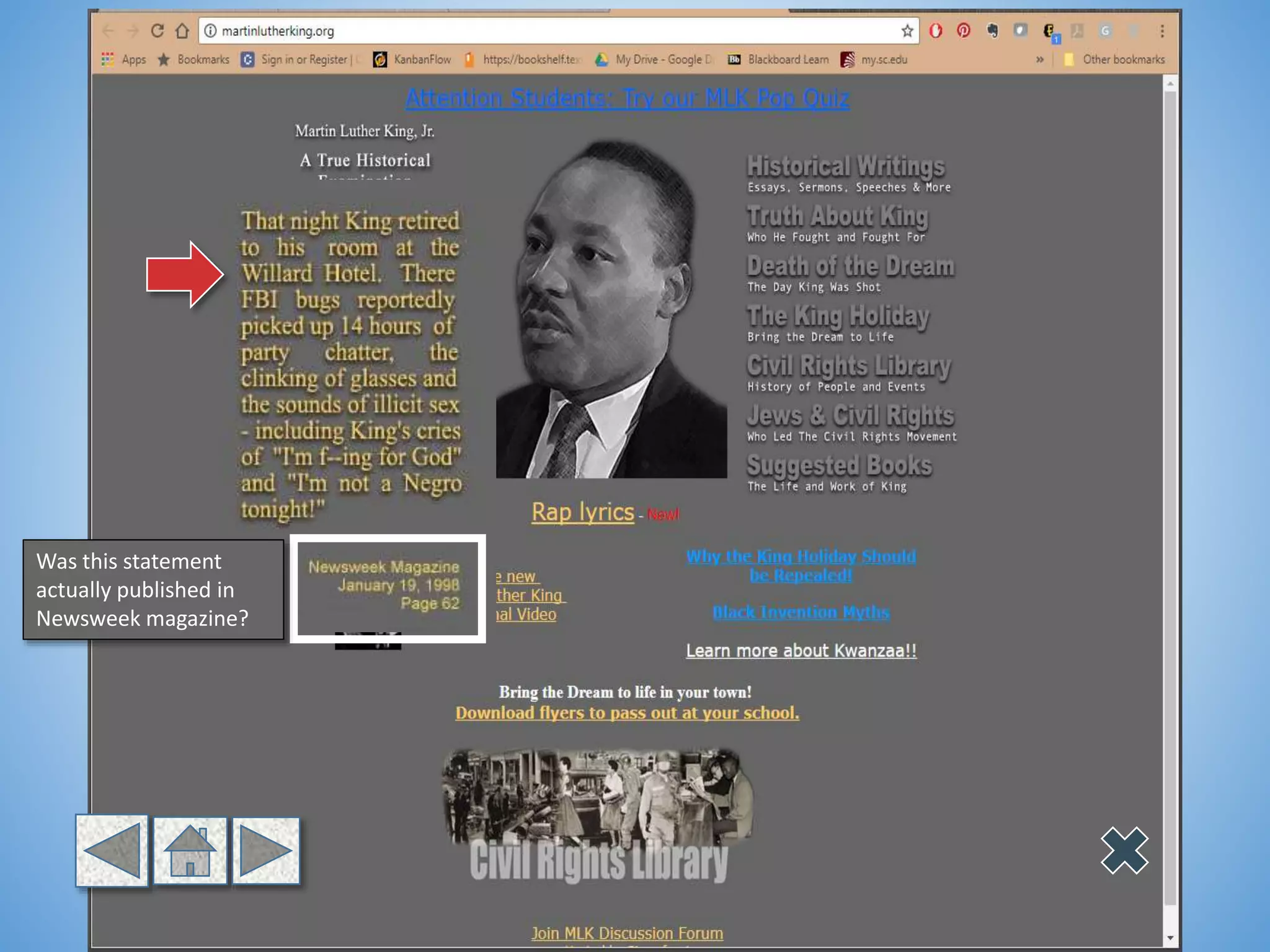
Was this statement
actually published in
Newsweek magazine?
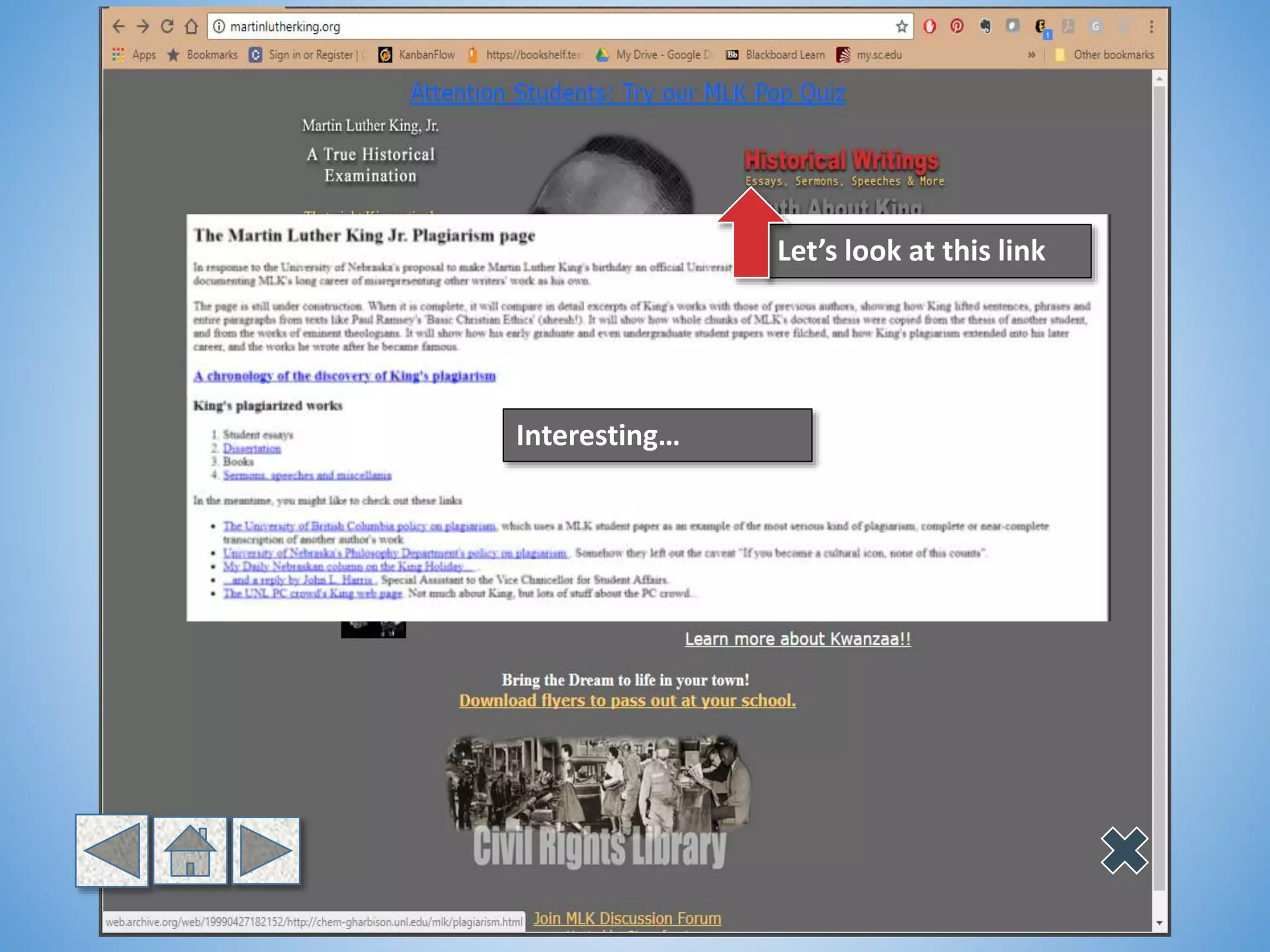
Let’s look at this link
Interesting…
Let’s check the
forum…
What did you decide?
The website title sounds like an
appropriate source of
information on Dr. Martin Luther
King, Jr. It is a .org designation,
which means it could be a non-
profit organization dedicated to
honoring Dr. King’s memory or
philosophies.
It's not obvious when you first
visit the website, but if you look
into the publisher of the site,
you will find the group,
Stormfront, is a white nationalist
organization with a very biased
opinion of Dr. King. This website
is not authoritative.
3. Identify the website with the most authoritative information.
To determine authority, we need to
know about the author or in the case
of no author attribution, the publisher.
Check Your Understanding:
Choose the best option for an authoritative website
article about Dr. Martin Luther King, Jr.
A
B
C A website article by a Ph.D. in African American Studies for the
MLK, Jr. Research and Education Institute at Stanford.
A website article written by a M.Div. in Theology for the National
Museum of African American History and Culture.
A website article written by a professor with a Master’s Degree
in Public History for the Memphis Historical Association.
Skills for Determining Accuracy
The second criteria we will examine is Accuracy.
Let’s review what we read earlier about accuracy. We need to
find out where the information originates.
 Is the information fact or opinion?
 Is the information verifiable? If citations are provided, try to locate those
sources to verify the accuracy of the information published on the website.
 Are there grammatical errors or typos?
 Do all the links work?
 Where do the links take you?
 What is the domain ending, and does that indicate anything about the
website author/publishers?
Now we will look at a website example. Keep in mind
the questions concerning accuracy when looking at the
site.
Hint: this is not an accurate website. Your job is to determine why it is not
considered accurate.
Skills for Determining Accuracy
Let’s look at this section
Interesting…
Let’s look at this link
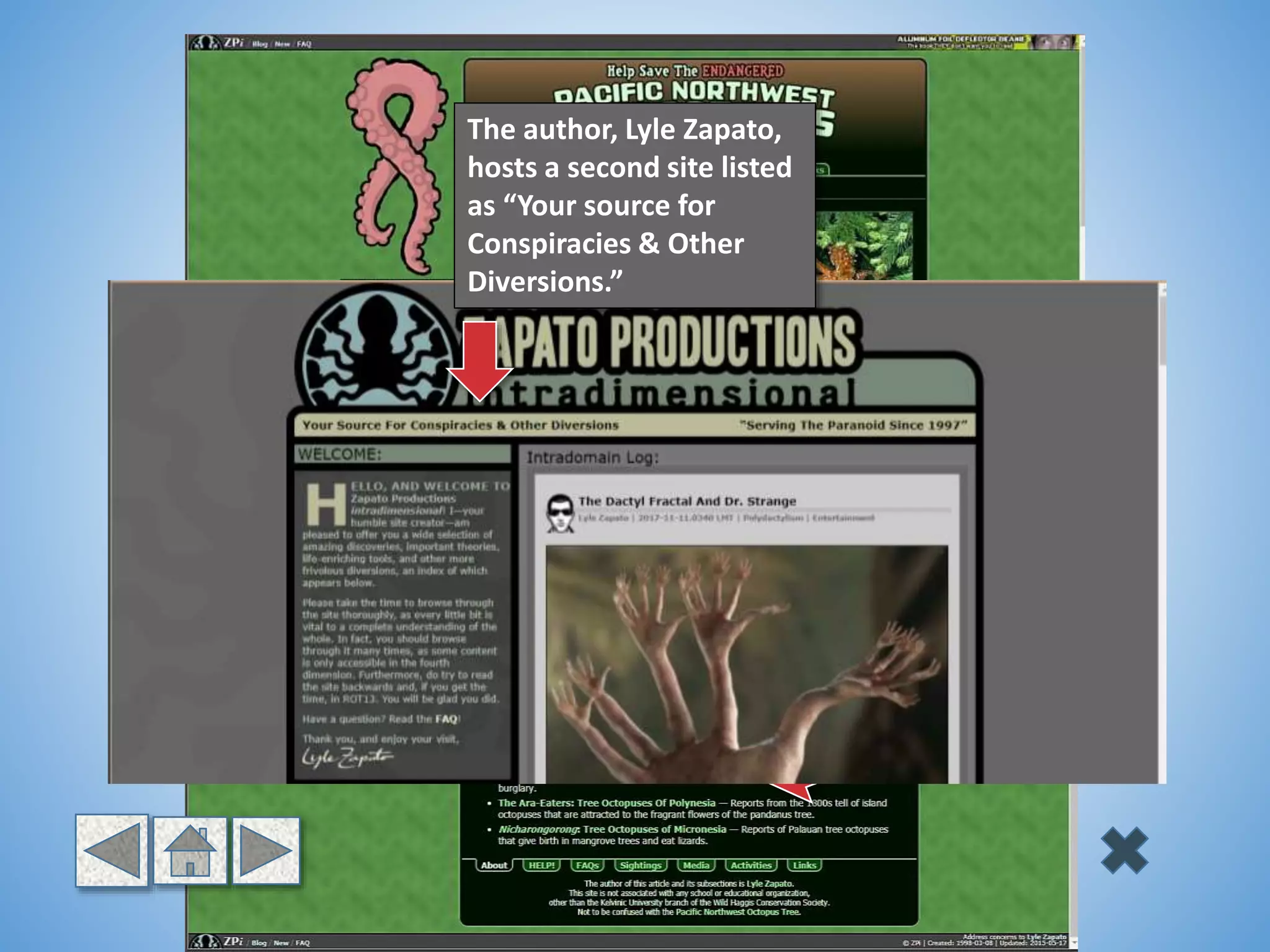
The author, Lyle Zapato,
hosts a second site listed
as “Your source for
Conspiracies & Other
Diversions.”
What did you decide?
The website title sounds a
little odd. Is there really a
Pacific Northwest Tree
Octopus?
If you scroll to the bottom of
the page you will see a
reference to the Pacific
Northwest Octopus Tree. The
website author has purposely
reversed the name to suggest
that an octopus can live in
trees.
If you select the links to learn
more about the author you
will find another equally
confusing website tagged as
“Your source for conspiracies
& other diversions.” This
website is not accurate.
3. Identify the website with the most accurate information.
To determine accuracy, we need to
verify the information reported on
the website in some way.
Check Your Understanding:
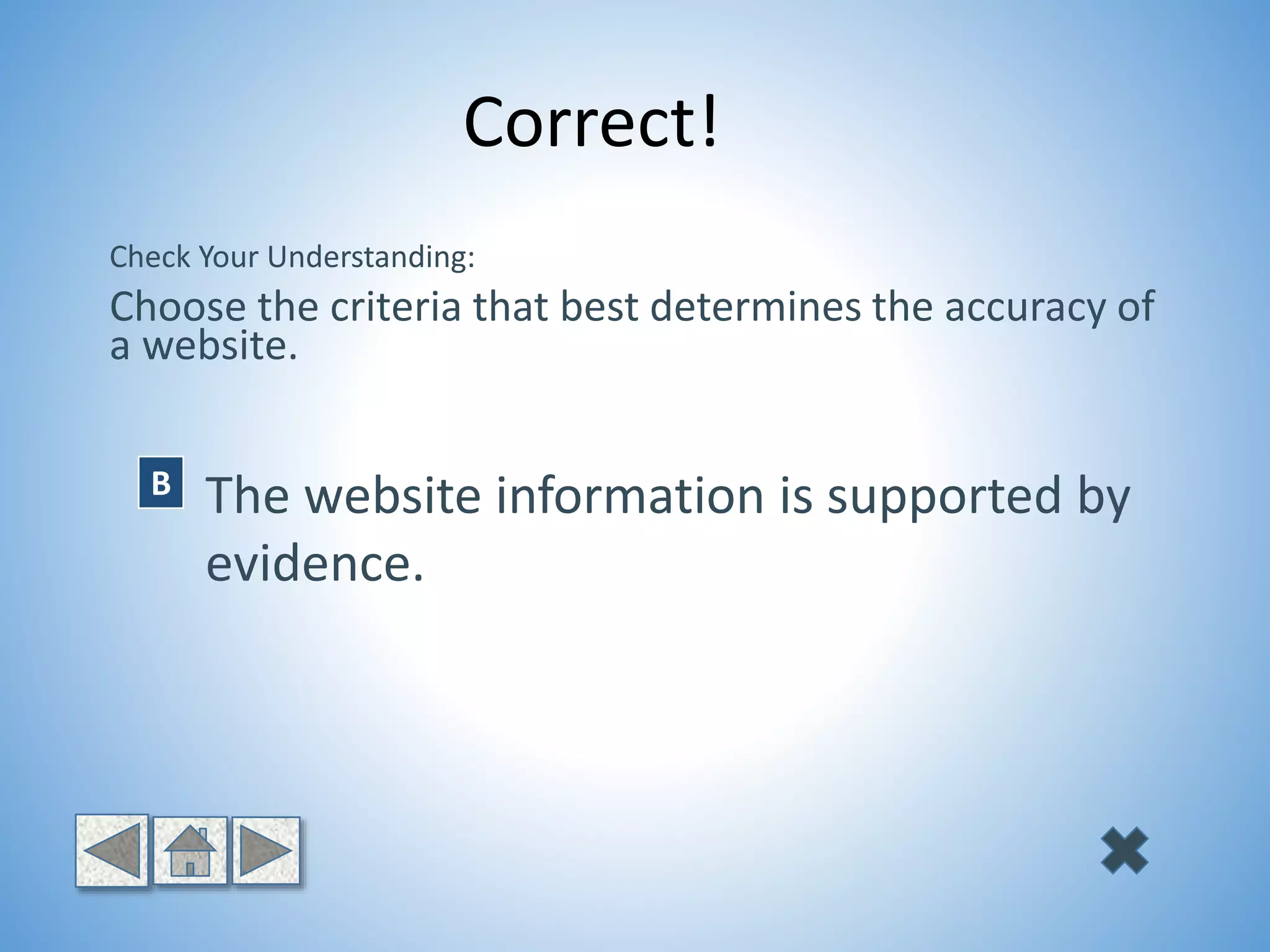
Choose the criteria that best determines the accuracy of
a website.
A
B
C The website topic aligns with the class assignment.
The website information is supported by evidence.
D The website is designed with high contrast colors for
accessibility.
Date of publication is within the last 5 years.
Scenarios for Evaluation
Let’s practice our new skills for determining authority and
accuracy before we wrap-up this learning module with a quiz.
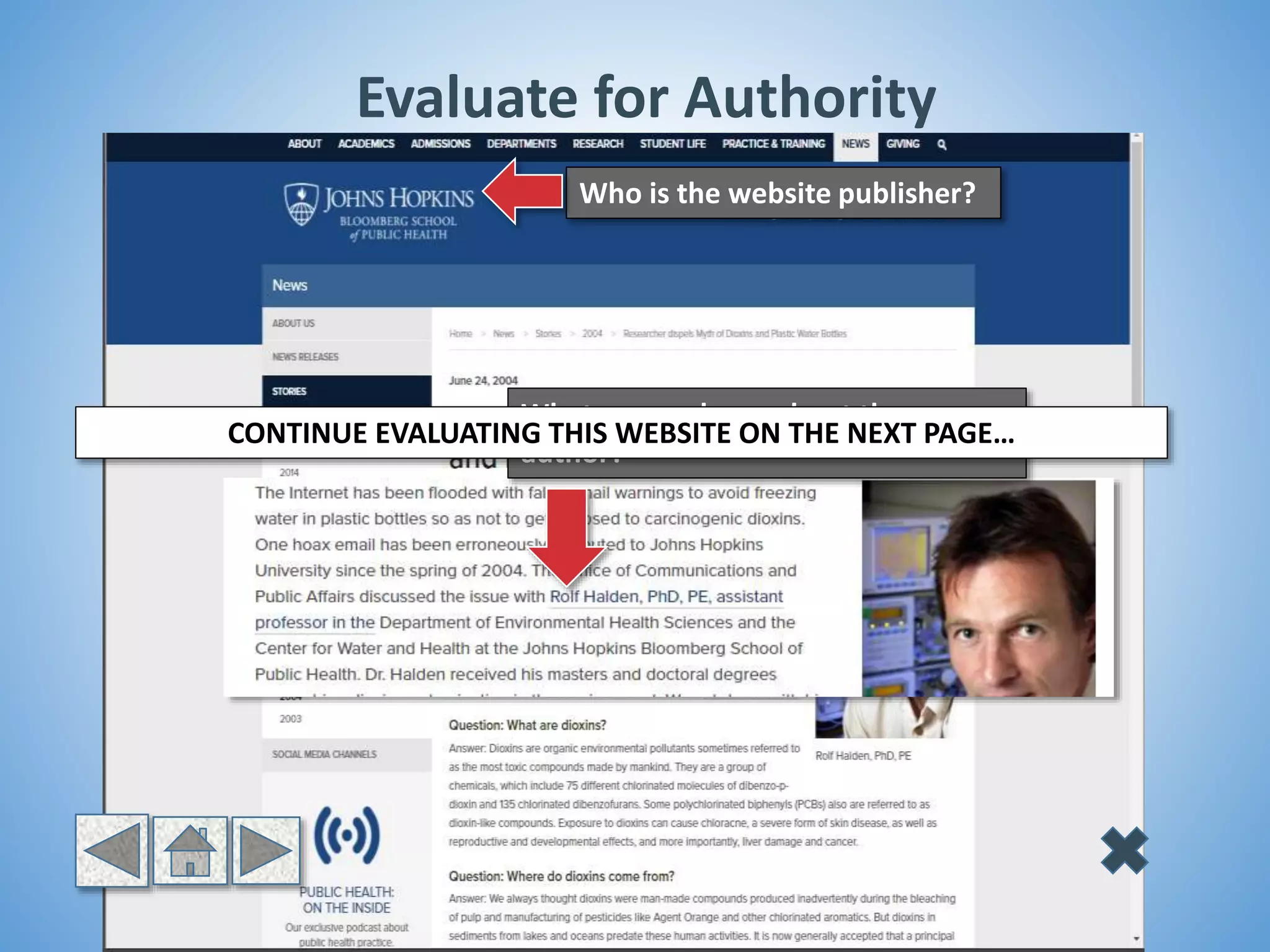
Who is the website publisher?
What can we learn about the
author?
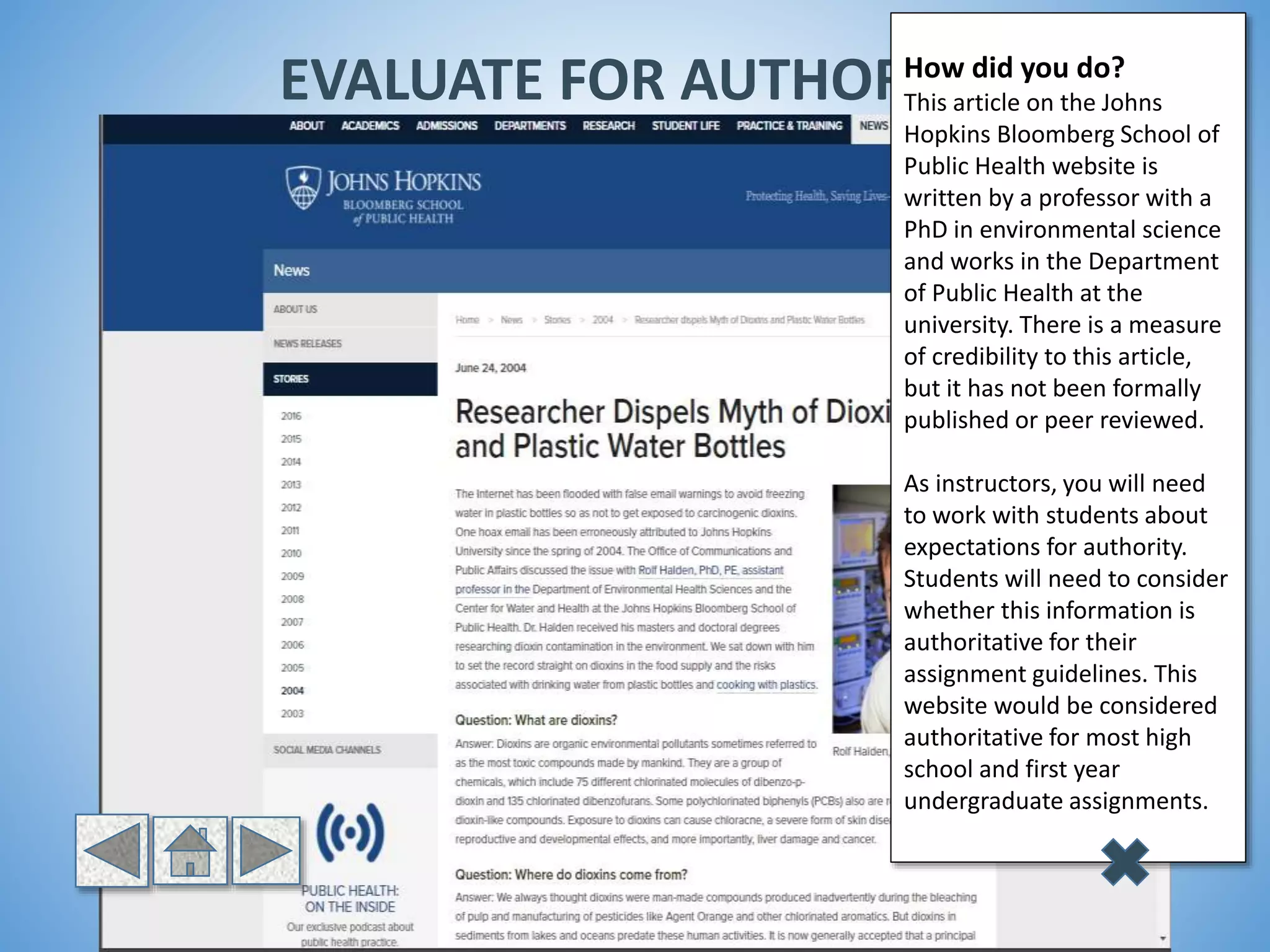
Evaluate for Authority
CONTINUE EVALUATING THIS WEBSITE ON THE NEXT PAGE…
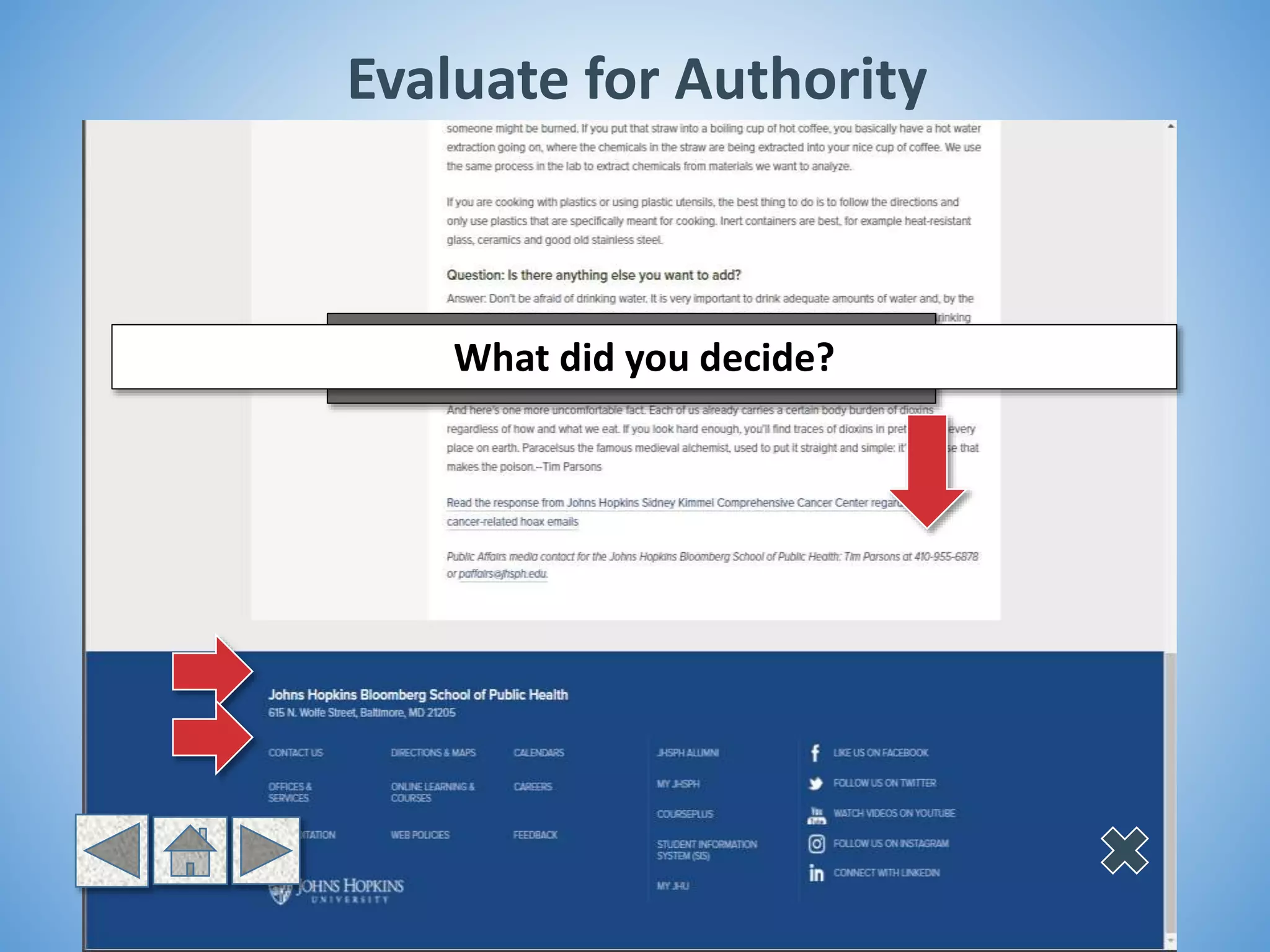
Scrolling down the page, can we locate
contact information?
What did you decide?
Evaluate for Authority
EVALUATE FOR AUTHORITYHow did you do?
This article on the Johns
Hopkins Bloomberg School of
Public Health website is
written by a professor with a
PhD in environmental science
and works in the Department
of Public Health at the
university. There is a measure
of credibility to this article,
but it has not been formally
published or peer reviewed.
As instructors, you will need
to work with students about
expectations for authority.
Students will need to consider
whether this information is
authoritative for their
assignment guidelines. This
website would be considered
authoritative for most high
school and first year
undergraduate assignments.
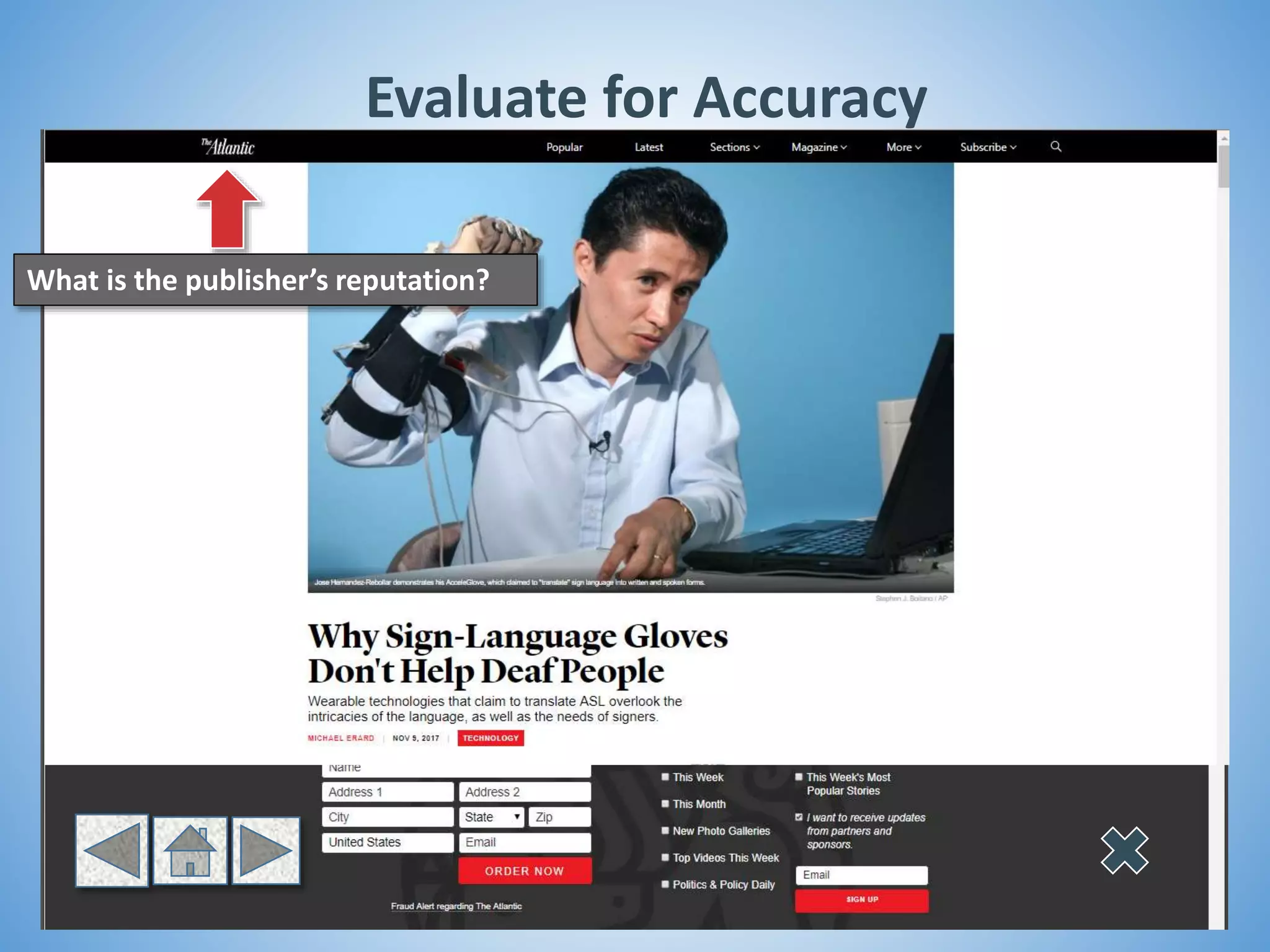
What is the publisher’s reputation?
Evaluate for Accuracy
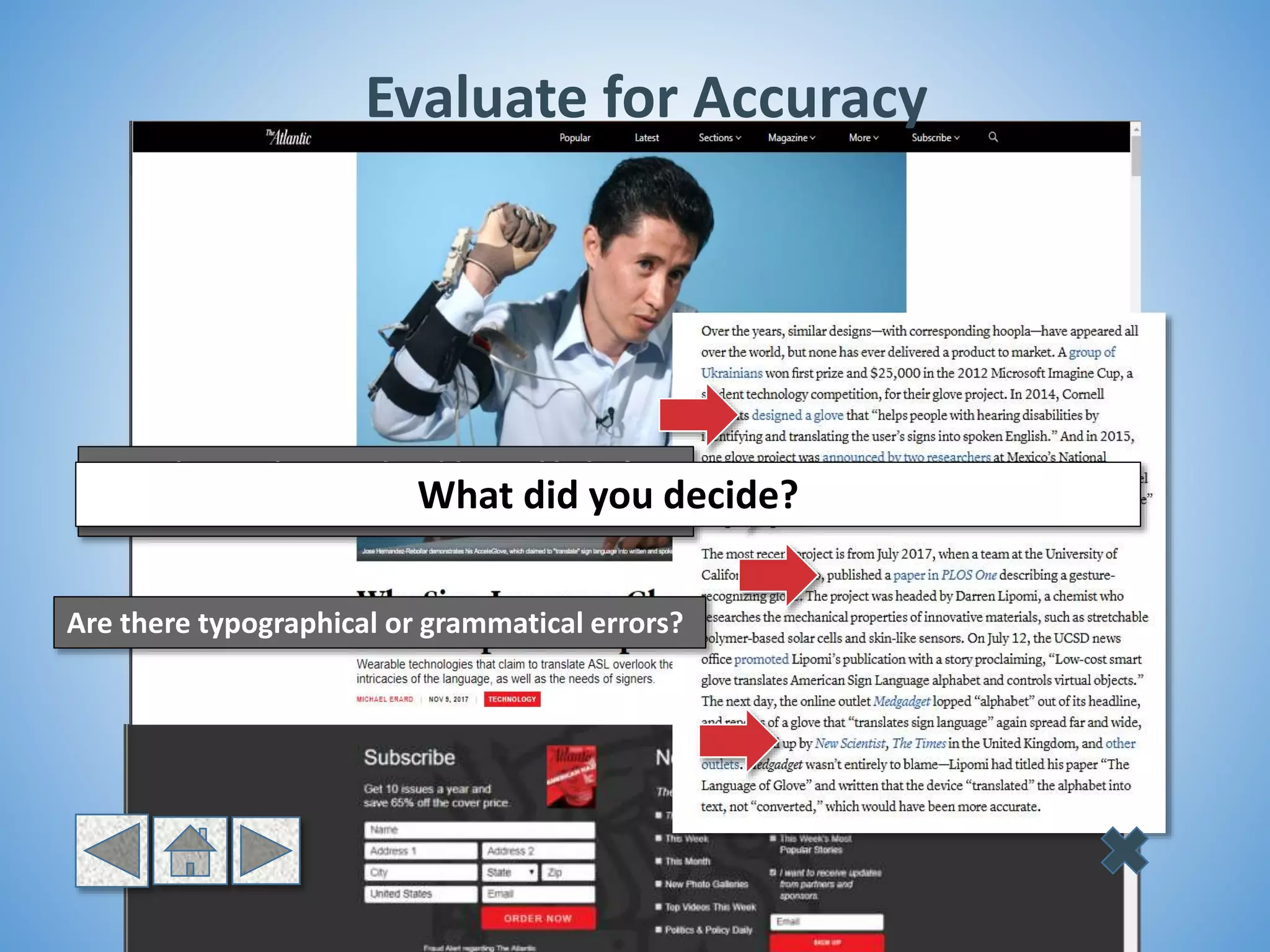
Does the article provide additional links for
more information? What did you decide?
Are there typographical or grammatical errors?
Evaluate for Accuracy
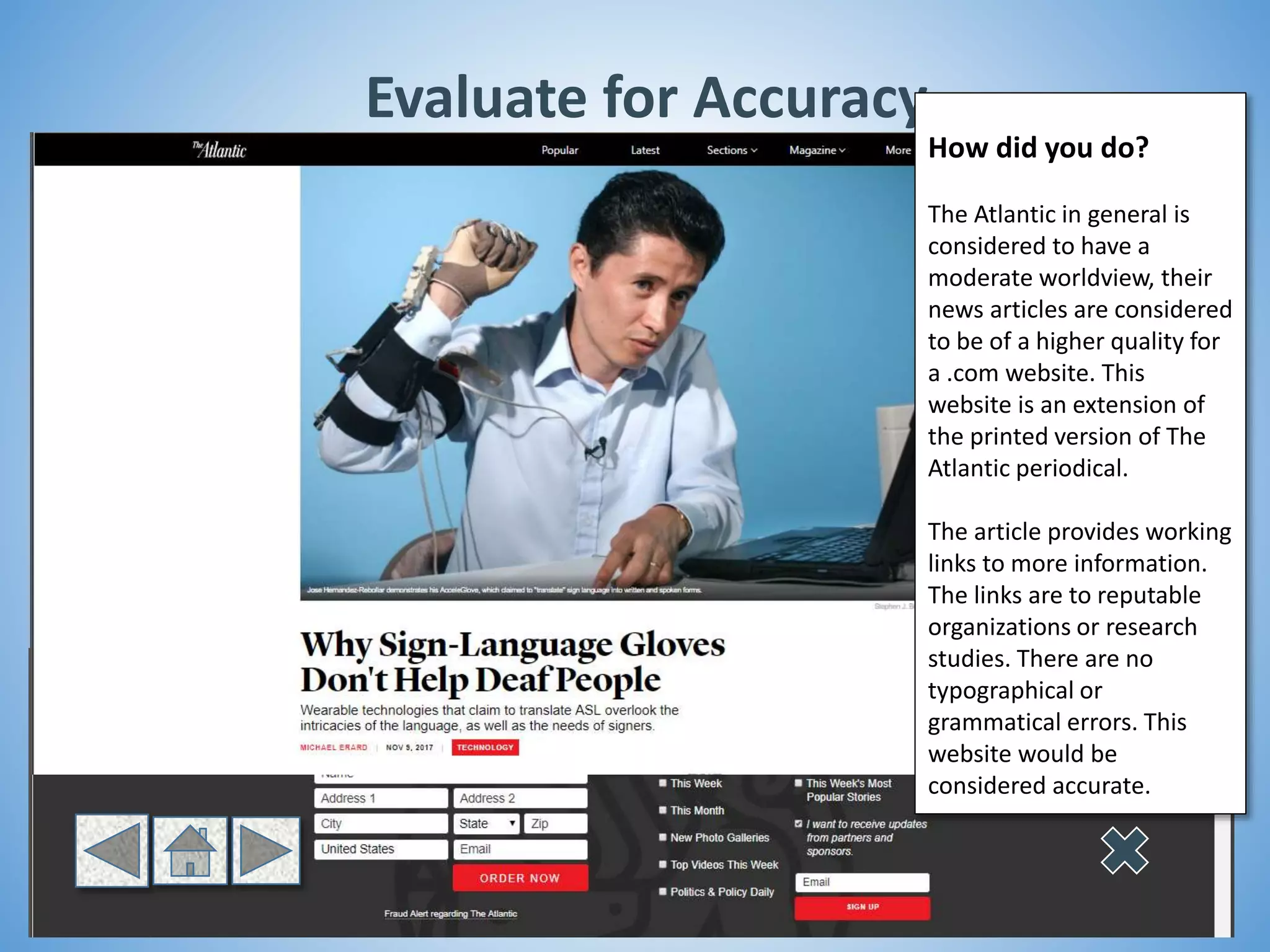
How did you do?
The Atlantic in general is
considered to have a
moderate worldview, their
news articles are considered
to be of a higher quality for
a .com website. This
website is an extension of
the printed version of The
Atlantic periodical.
The article provides working
links to more information.
The links are to reputable
organizations or research
studies. There are no
typographical or
grammatical errors. This
website would be
considered accurate.
5. Evaluate websites for accuracy and/or authority.
To critically evaluate websites
learners will use the criteria from
the CRAAP Test
1.Identify individual letters for the acronym
CRAAP.
2. Identify the meaning of a domain ending.
3. Identify the website with the most
authoritative information.
4. Identify the website with the most accurate
information.
5. Evaluate websites for accuracy and
authority.
Great work!
You completed the learning module
for Website Evaluation! Select the
link below to complete the post-
test.
Website Evaluation Post-test
(https://goo.gl/forms/UJMcBs1Md44ayJg33)
References
Butz, A. R. (1982). Context and perspective in the 'Holocaust' controversy.Retrieved November 11,
2017, from Institute for Historical Review website:http://www.ihr.org/jhr/v03/v03p371_Butz.html
California State University. (2010, September 17). CRAAP Test. RetrievedNovember 6, 2017, from
https://www.csuchico.edu/lins/handouts/eval_websites.pdf
Erard, M. (2017, November 9). Why sign-language gloves don't help deaf people. Retrieved
November 11, 2017, from The Atlantic website:
https://www.theatlantic.com/technology/archive/2017/11/ why-sign-language-glovesdont-help-
deaf-people/545441/
Parsons, T. (2004, June 24). Researcher dispels myth of dioxins and plastic water bottles. Retrieved
November 11, 2017, from Johns Hopkins website:
https://www.jhsph.edu/news/stories/2004/halden-dioxins-two.html
Seneca Libraries. (2013, July 18). Evaluating websites. Retrieved November 11, 2017, from YouTube
website: https://youtu.be/35PBCC5TKxs
Stormfront. (n.d.). Martin Luther King, Jr: A true historical examination. Retrieved November 11,
2017, from http://martinlutherking.org/ Zapato, L. (2015, May 17).
The Pacific Northwest Tree Octopus. Retrieved November 11, 2017, from
http://zapatopi.net/treeoctopus/
Check Your Understanding:
True or False: R stands for relevance of the website
information.
TrueA
Correct!
Check Your Understanding:
When evaluating a website with a domain ending of
.com, which answer best explains the intended purpose
of the site?
B commercial
Correct!
Check Your Understanding:
Choose the best option for an authoritative website
article about Dr. Martin Luther King, Jr.
C A website article by a Ph.D. in African
American Studies for the MLK, Jr.
Research and Education Institute at
Stanford.
Correct!
Check Your Understanding:
Choose the criteria that best determines the accuracy of
a website.
B The website information is supported by
evidence.
Correct!

Evaluating Websites

  • 1.
    WEBSITE EVALUATION FOR THECLASSROOM Start Created by Susan Moore
  • 2.
    Navigation You are ableto move through the course at your own pace. Feel free to go back and review information at any time. The icons below will help you navigate. BACK HOME NEXT END
  • 3.
    Content This learning moduleshould take approximately 20 minutes to complete. As an instructor of high school or first year college students, you already recognize the need for students to critically evaluate sources. This learning module will cover criteria and teaching techniques for website evaluation. As you move through the learning module, think about how you can apply this information to your classroom. BACK HOME NEXT END
  • 4.
    GOALS 1. Identify individualletters for the acronym CRAAP. 2. Identify the meaning of a domain ending. 3. Identify the website with the most authoritative information. 4. Identify the website with the most accurate information. 5. Evaluate websites for accuracy and authority.
  • 5.
    Introduction: Criteria ofWebsite Evaluation We will begin with a short video to explain the criteria this learning module uses for critical evaluation of websites. This would also be a good video to share with your students.
  • 6.
  • 7.
    Introduction: Criteria ofWebsite Evaluation To teach this method of website evaluation we will use a handout titled the CRAAP Test (students love the name and don’t forget it). The CRAAP Test was developed by librarians at California State University to help students understand important factors when evaluating a website. The acronym is memorable, but it’s important to understand that you do not have to use the criteria in any specific order and you do not have to use all five criteria. It all depends on the information need.
  • 8.
    What is CRAAP? TheCRAAP Test lists five criteria to consider when evaluating a website: I. Currency II. Relevance III. Authority IV. Accuracy V. Purpose
  • 9.
    I. Currency When wasthe information published, and how much does the date matter? When looking for information for technology or science the publication date is important, but the date is not as important when looking for information about historical events or literature criticism.
  • 10.
    II. Relevance How doesthe information on the website relate to your information needs? Is the information written at an appropriate level? How many other websites did you consider before determining the one that most closely met your needs? In other words, do you know this is the best source of material?
  • 11.
    III. Authority Does theauthor have first-hand experience? Knowing the author’s background is a vital step in determining if a website is authoritative.
  • 12.
    IV. Accuracy Where doesthe information originate? Is the information fact or opinion? Can you verify the information through citations within in the webpage, or is a reference list provided?
  • 13.
    V. Purpose Why wasthis particular website produced? Is the intent to sell a product? Is there an identifiable purpose for publishing the information? Does the language seem biased or free of emotion?
  • 14.
    1. Identify individualletters for the acronym CRAAP. C urrency R elevence A uthority A ccuracy urpose
  • 15.
    Check Your Understanding: Trueor False: R stands for relevance of the website information. A B True False
  • 16.
    Domain Endings andPurposes We often place a lot of value on website domain endings, but those endings don't actually carry as much weight as you might think. The domain endings .com and .org can be purchased by anyone, only .gov, .mil, and .edu are restricted for purchase. Let's take a look at some of the common domain endings and the types of websites you can find.
  • 17.
    Domain Endings andPurposes .com stands for commercial sites, but can really be anything. Often an instructor will ban the use of .com sites, however, that may exclude a good information source. Let’s look at some examples of .com sites you are probably familiar with and that your students may use in their research.
  • 18.
    Domain Endings andPurposes NBC.com – The National Broadcasting Company is a television network with information about news and current events; not always guaranteed to be accurate, but in general a credible .com website.
  • 20.
    Domain Endings andPurposes Glamour.com - may have occasional articles that are relevant for specific topics. It depends on the context and the assignment needs. If a student is preparing a speech on a popular culture topic, Glamour may be an acceptable source of information.
  • 22.
    Domain Endings andPurposes .org websites should be organizations, but remember, they can really be anything since the purchase of .org domain names is not restricted. The Modern Language Association, American Cancer Society, NRA and the American Medical Association are all examples of respected, well known websites and are considered to be "the" organization that drives the discipline.
  • 24.
    Domain Endings andPurposes Wikipedia.org - often students are allowed to use .org websites but not Wikipedia. This creates a little conflict in the information relayed to students. Is Wikipedia the only .org site that is unacceptable, or is it just the easiest one to identify?
  • 26.
    Domain Endings andPurposes .edu websites should contain credible materials, at least that is our expectation. The domain .edu is restricted for purchase, however, there are a few sites that have been grandfathered in (not legitimate schools), but the other general information to keep in mind is that schools often offer web space to students for student work. Many schools also offer a digital commons to share student and faculty work, that has not been peer-reviewed. The sites look professional, so it is important to understand what type of information you are viewing.
  • 27.
    This is astudent paper located in the Harvard digital commons. The paper looks very similar to any other article you might locate in a database, meaning students may have a difficult time determining it is a student's work.
  • 28.
    Domain Endings andPurposes Miscellaneous domain endings have a lot of variety, this should help us remember not to throw the baby out with the bathwater, so to speak. We will only look at a two good examples: 1. NATO: https://www.nato.int/ 2. World Health Organization: http://www.who.int/
  • 30.
    Domain Endings andPurposes .net - could be any type of website, but for our example of a credible site we will use the Institute of War and Peace Reporting, a charitable foundation that reports on the safety and events occurring in countries in upheaval around the world.
  • 32.
    2. Identify themeaning of a domain ending. We often place a lot of value on website domain endings, but those endings don't actually carry as much weight as you might think. The domain endings .com and .org can be purchased by anyone, only .gov, .mil, and .edu are restricted for purchase.
  • 33.
    Check Your Understanding: Whenevaluating a website with a domain ending of .com, which answer best explains the intended purpose of the site? A B C D commanded commons commercial complete
  • 34.
    Skills for DeterminingAuthority For the purposes of this learning module, we are going to focus on two criteria from the CRAAP Test based on the survey results. These two criteria were indicated on the preliminary survey as being the most important evaluation skills needed by your students. Future learning modules will address the remaining criteria. The first criteria we will examine is Authority. Let’s review what we read earlier about authority. To determine authority, we need to know about the author or in the case of no author attribution, the publisher.  Who wrote the website article? What is their knowledge on the subject? Are they experts, or is this an avocation?  Are credentials provided for the author or are there affiliates for the publisher listed?  What is the domain ending, and does that indicate anything about the website author/publishers?
  • 35.
    Let’s look ata website example. Keep in mind the questions concerning authority when looking over the site. Hint: this is not an authoritative website. Your job is to determine why it is not considered authoritative. Skills for Determining Authority
  • 36.
  • 37.
    Was this statement actuallypublished in Newsweek magazine?
  • 38.
    Let’s look atthis link Interesting…
  • 39.
  • 40.
    What did youdecide? The website title sounds like an appropriate source of information on Dr. Martin Luther King, Jr. It is a .org designation, which means it could be a non- profit organization dedicated to honoring Dr. King’s memory or philosophies. It's not obvious when you first visit the website, but if you look into the publisher of the site, you will find the group, Stormfront, is a white nationalist organization with a very biased opinion of Dr. King. This website is not authoritative.
  • 41.
    3. Identify thewebsite with the most authoritative information. To determine authority, we need to know about the author or in the case of no author attribution, the publisher.
  • 42.
    Check Your Understanding: Choosethe best option for an authoritative website article about Dr. Martin Luther King, Jr. A B C A website article by a Ph.D. in African American Studies for the MLK, Jr. Research and Education Institute at Stanford. A website article written by a M.Div. in Theology for the National Museum of African American History and Culture. A website article written by a professor with a Master’s Degree in Public History for the Memphis Historical Association.
  • 43.
    Skills for DeterminingAccuracy The second criteria we will examine is Accuracy. Let’s review what we read earlier about accuracy. We need to find out where the information originates.  Is the information fact or opinion?  Is the information verifiable? If citations are provided, try to locate those sources to verify the accuracy of the information published on the website.  Are there grammatical errors or typos?  Do all the links work?  Where do the links take you?  What is the domain ending, and does that indicate anything about the website author/publishers?
  • 44.
    Now we willlook at a website example. Keep in mind the questions concerning accuracy when looking at the site. Hint: this is not an accurate website. Your job is to determine why it is not considered accurate. Skills for Determining Accuracy
  • 45.
    Let’s look atthis section
  • 46.
  • 47.
    Let’s look atthis link
  • 48.
    The author, LyleZapato, hosts a second site listed as “Your source for Conspiracies & Other Diversions.”
  • 49.
    What did youdecide? The website title sounds a little odd. Is there really a Pacific Northwest Tree Octopus? If you scroll to the bottom of the page you will see a reference to the Pacific Northwest Octopus Tree. The website author has purposely reversed the name to suggest that an octopus can live in trees. If you select the links to learn more about the author you will find another equally confusing website tagged as “Your source for conspiracies & other diversions.” This website is not accurate.
  • 50.
    3. Identify thewebsite with the most accurate information. To determine accuracy, we need to verify the information reported on the website in some way.
  • 51.
    Check Your Understanding: Choosethe criteria that best determines the accuracy of a website. A B C The website topic aligns with the class assignment. The website information is supported by evidence. D The website is designed with high contrast colors for accessibility. Date of publication is within the last 5 years.
  • 52.
    Scenarios for Evaluation Let’spractice our new skills for determining authority and accuracy before we wrap-up this learning module with a quiz.
  • 53.
    Who is thewebsite publisher? What can we learn about the author? Evaluate for Authority CONTINUE EVALUATING THIS WEBSITE ON THE NEXT PAGE…
  • 54.
    Scrolling down thepage, can we locate contact information? What did you decide? Evaluate for Authority
  • 55.
    EVALUATE FOR AUTHORITYHowdid you do? This article on the Johns Hopkins Bloomberg School of Public Health website is written by a professor with a PhD in environmental science and works in the Department of Public Health at the university. There is a measure of credibility to this article, but it has not been formally published or peer reviewed. As instructors, you will need to work with students about expectations for authority. Students will need to consider whether this information is authoritative for their assignment guidelines. This website would be considered authoritative for most high school and first year undergraduate assignments.
  • 56.
    What is thepublisher’s reputation? Evaluate for Accuracy
  • 57.
    Does the articleprovide additional links for more information? What did you decide? Are there typographical or grammatical errors? Evaluate for Accuracy
  • 58.
    Evaluate for Accuracy Howdid you do? The Atlantic in general is considered to have a moderate worldview, their news articles are considered to be of a higher quality for a .com website. This website is an extension of the printed version of The Atlantic periodical. The article provides working links to more information. The links are to reputable organizations or research studies. There are no typographical or grammatical errors. This website would be considered accurate.
  • 59.
    5. Evaluate websitesfor accuracy and/or authority. To critically evaluate websites learners will use the criteria from the CRAAP Test
  • 60.
    1.Identify individual lettersfor the acronym CRAAP. 2. Identify the meaning of a domain ending. 3. Identify the website with the most authoritative information. 4. Identify the website with the most accurate information. 5. Evaluate websites for accuracy and authority.
  • 61.
    Great work! You completedthe learning module for Website Evaluation! Select the link below to complete the post- test. Website Evaluation Post-test (https://goo.gl/forms/UJMcBs1Md44ayJg33)
  • 62.
    References Butz, A. R.(1982). Context and perspective in the 'Holocaust' controversy.Retrieved November 11, 2017, from Institute for Historical Review website:http://www.ihr.org/jhr/v03/v03p371_Butz.html California State University. (2010, September 17). CRAAP Test. RetrievedNovember 6, 2017, from https://www.csuchico.edu/lins/handouts/eval_websites.pdf Erard, M. (2017, November 9). Why sign-language gloves don't help deaf people. Retrieved November 11, 2017, from The Atlantic website: https://www.theatlantic.com/technology/archive/2017/11/ why-sign-language-glovesdont-help- deaf-people/545441/ Parsons, T. (2004, June 24). Researcher dispels myth of dioxins and plastic water bottles. Retrieved November 11, 2017, from Johns Hopkins website: https://www.jhsph.edu/news/stories/2004/halden-dioxins-two.html Seneca Libraries. (2013, July 18). Evaluating websites. Retrieved November 11, 2017, from YouTube website: https://youtu.be/35PBCC5TKxs Stormfront. (n.d.). Martin Luther King, Jr: A true historical examination. Retrieved November 11, 2017, from http://martinlutherking.org/ Zapato, L. (2015, May 17). The Pacific Northwest Tree Octopus. Retrieved November 11, 2017, from http://zapatopi.net/treeoctopus/
  • 63.
    Check Your Understanding: Trueor False: R stands for relevance of the website information. TrueA Correct!
  • 64.
    Check Your Understanding: Whenevaluating a website with a domain ending of .com, which answer best explains the intended purpose of the site? B commercial Correct!
  • 65.
    Check Your Understanding: Choosethe best option for an authoritative website article about Dr. Martin Luther King, Jr. C A website article by a Ph.D. in African American Studies for the MLK, Jr. Research and Education Institute at Stanford. Correct!
  • 66.
    Check Your Understanding: Choosethe criteria that best determines the accuracy of a website. B The website information is supported by evidence. Correct!