In what ways does your media product use, develop or challenge
forms and conventions of real media products.
By Shawaeb Tayab
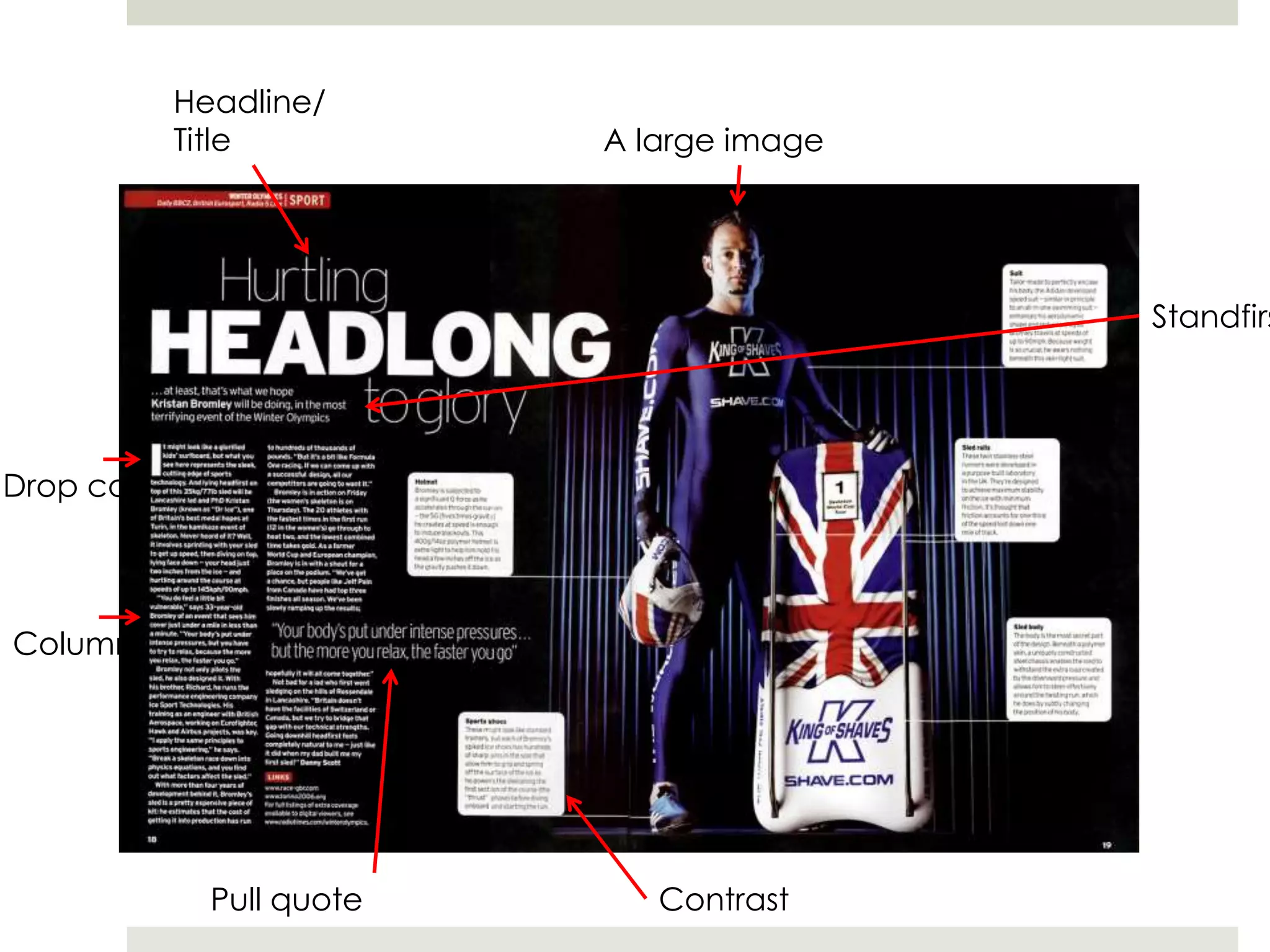
A large image
Pull quote
Standfirs
Drop cap
Headline/
Title
Columns
Contrast
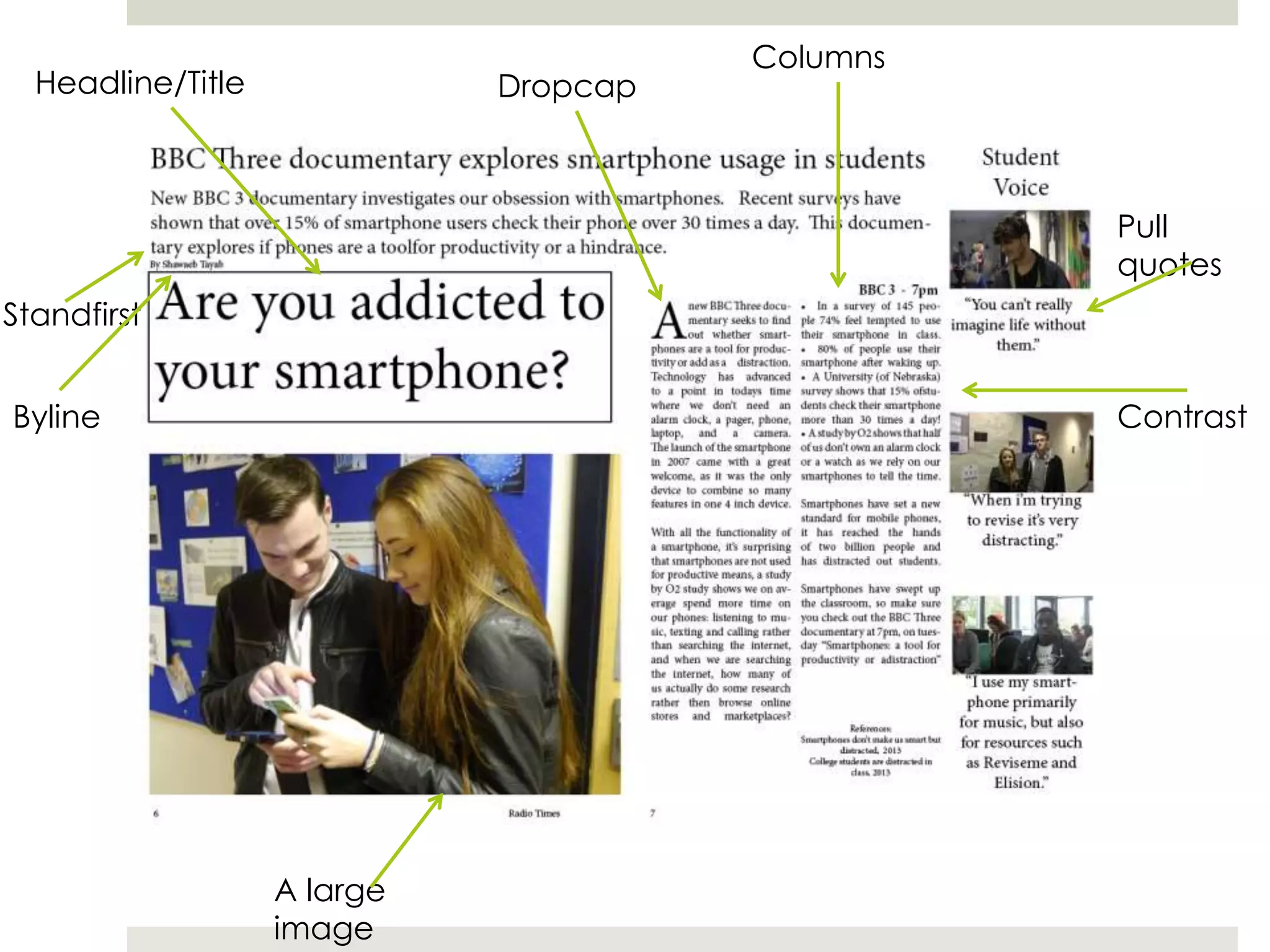
Headline/Title
Standfirst
Columns
A large
image
Pull
quotes
Dropcap
ContrastByline
Why these features were used and their effects
What it is and how it used, why its used and how have I used it.
 I had used:
Standfirst: To introduce the article, it comes before the main text and gives the reader an idea of the
article they’ll be reading. It summarizes the article in a paragraph.
By-lines: To credit myself as the author.
 Drop capital: A drop cap is a very common convention, it’s the introducing letter into the main text. It is
used in the majority of magazines.
 Pull quotes: These are found either around the double page spread or within the main body text. These
are usually quotes from within the article. “ I challenged by not using article quotes but rather
documentary quotes to give an idea of my documentary”
 Masthead: This is normally the head line of the page, and it is always positioned on the top left hand
corner. I had followed typical industry conventions with my use of this.
 the biggest font on the page, it’s the most dominant text on the page. It is very concise and separates
itself from the main body and stand first.
 Images: I noticed TV programme articles tend to have more than one image, and the images often
were stills from show, so I decided to add stills from the vox pops from my documentary.
 Columns: Articles always have columns, it’s a standard convention, and I chose to follow that, it makes
the article look more professional, and clear.
Radio trailer
 Here is my radio trailer:
Codes & conventions
 Radio adverts conventionally play for between 30-60 seconds. They
have a voiceover or narrator, and the narrator outlines what is
being advertised. Moving on to documentaries, the narrator for the
documentary is usually the narrator for the radio adverts, this is to
familiarise the consumer. The radio adverts purpose is to persuade
the consumer to watch the documentary, and typical conventions
of that is directly addressing the audience, using a triadic structure
(rule of three) and repetition. The language employed should be
targeted towards the demographic. Adverts typically contains
music, often catchy so it remains memorable.
 The radio adverts studied mentioned the time and date of broad
casting and the channel. They also contained audio clips from the
documentary.
 I had followed conventions and also challenged.
 I challenged conventions where I used short clips from
my documentary vox pops, but I blended them together
for an array of opinions in a short time.
 I also challenged conventions by keeping a calm tone
which is relative to my documentary.
 I had followed conventions by stating the time and date
of broadcasting, and what channel it will be shown on.
Documentary Codes & conventions
 After our task briefing, I understood I had to create a 5
minute introduction to a documentary. To create a
professional documentary, I need to understand the
codes and conventions of a professional documentary,
so I studied the documentary Supersize Me. After
completing my documentary I will compare it to my
example of Supersize Me to see how I used, developed
and challenged the conventions of a real media
product.
Theory
 Firstly I looked at the ‘theory of documentary modes’ (Bill
Nicholls, 2001). Nicholls theory states that there are
different modes of documentaries. Reflexive,
participatory, poetic, performative, expositional and
observational. My documentary was a mixture, It fit into
the categories of participatory and performative
because we had an on screen presenter. And it’s
expositional because of the voice over used throughout,
the voice over helped guide the audience through the
documentary.
Theory
 I also looked into narrative structure. Documentaries
typically adhere to a rhetoric structure to persuade their
audience. My documentary followed a linear narrative
structure as it maintained a clear beginning, middle and
finale. My beginning was a montage of’.
Filler footage/Background footage
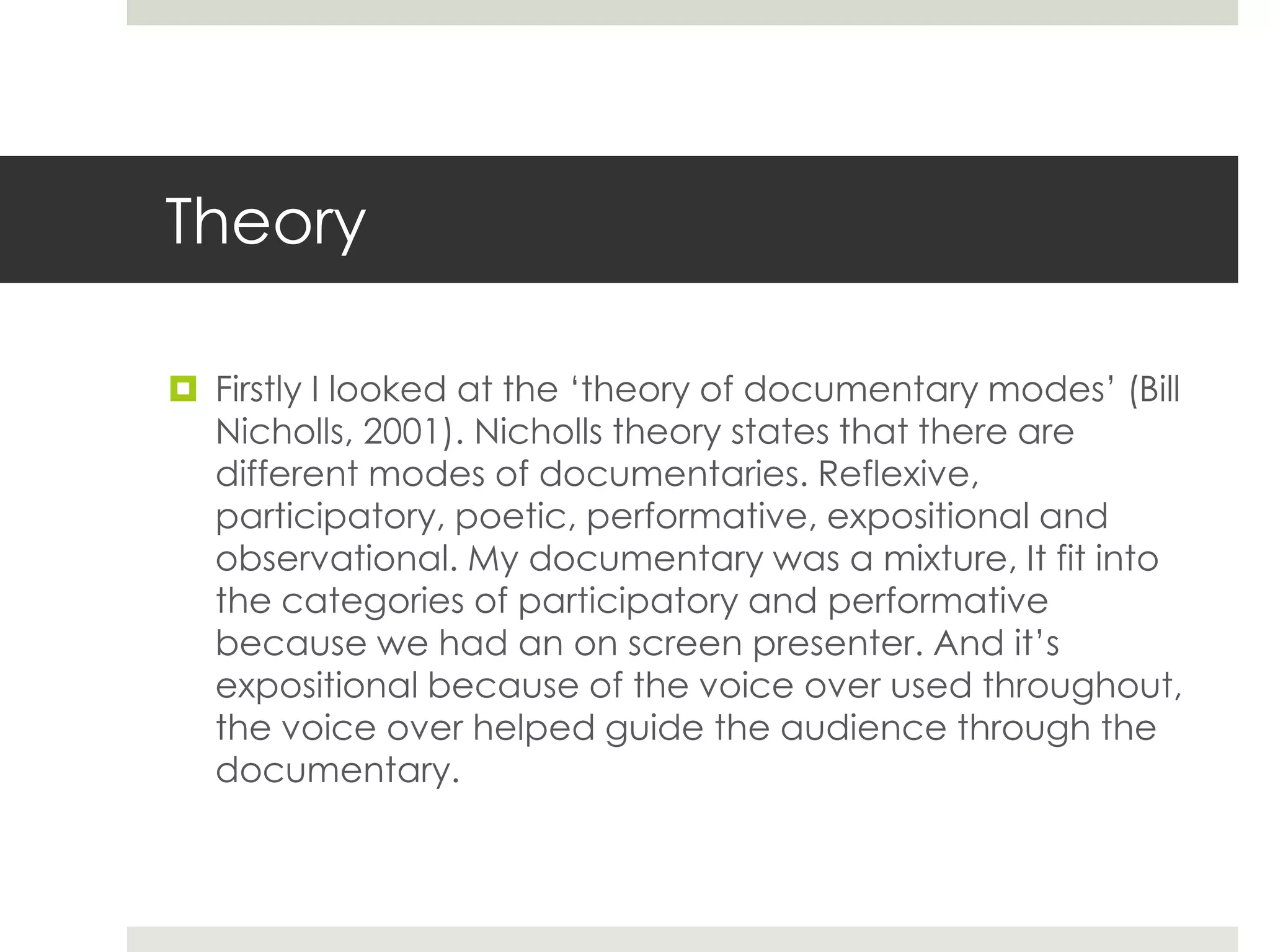
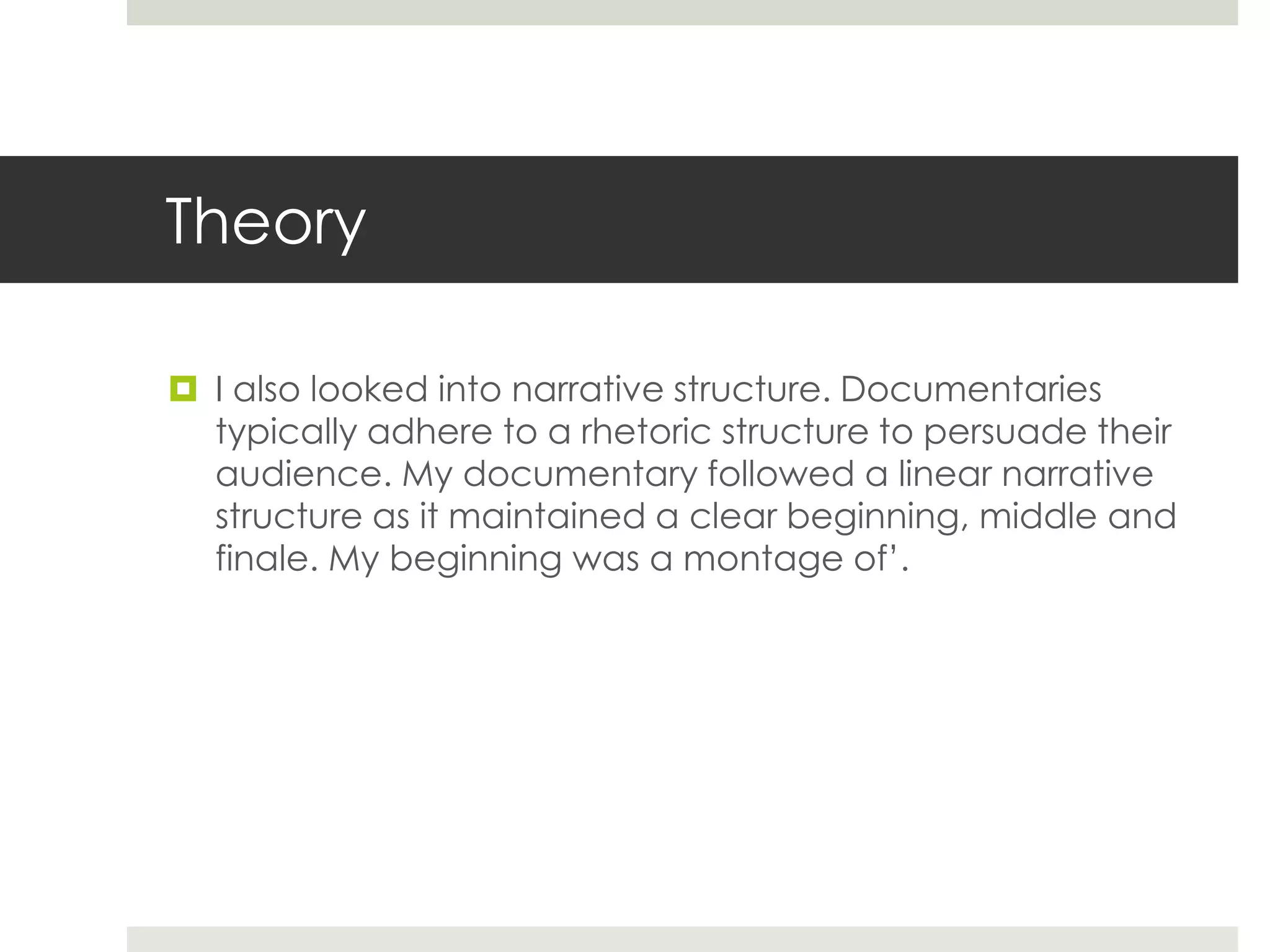
I discovered most documentaries take advantage of background footage, so
I did just that. Because my documentary was related to smartphones I opted
to record someone using their smartphone, so its relative to my documentary. I
followed typical industry conventions here.
Archival footage
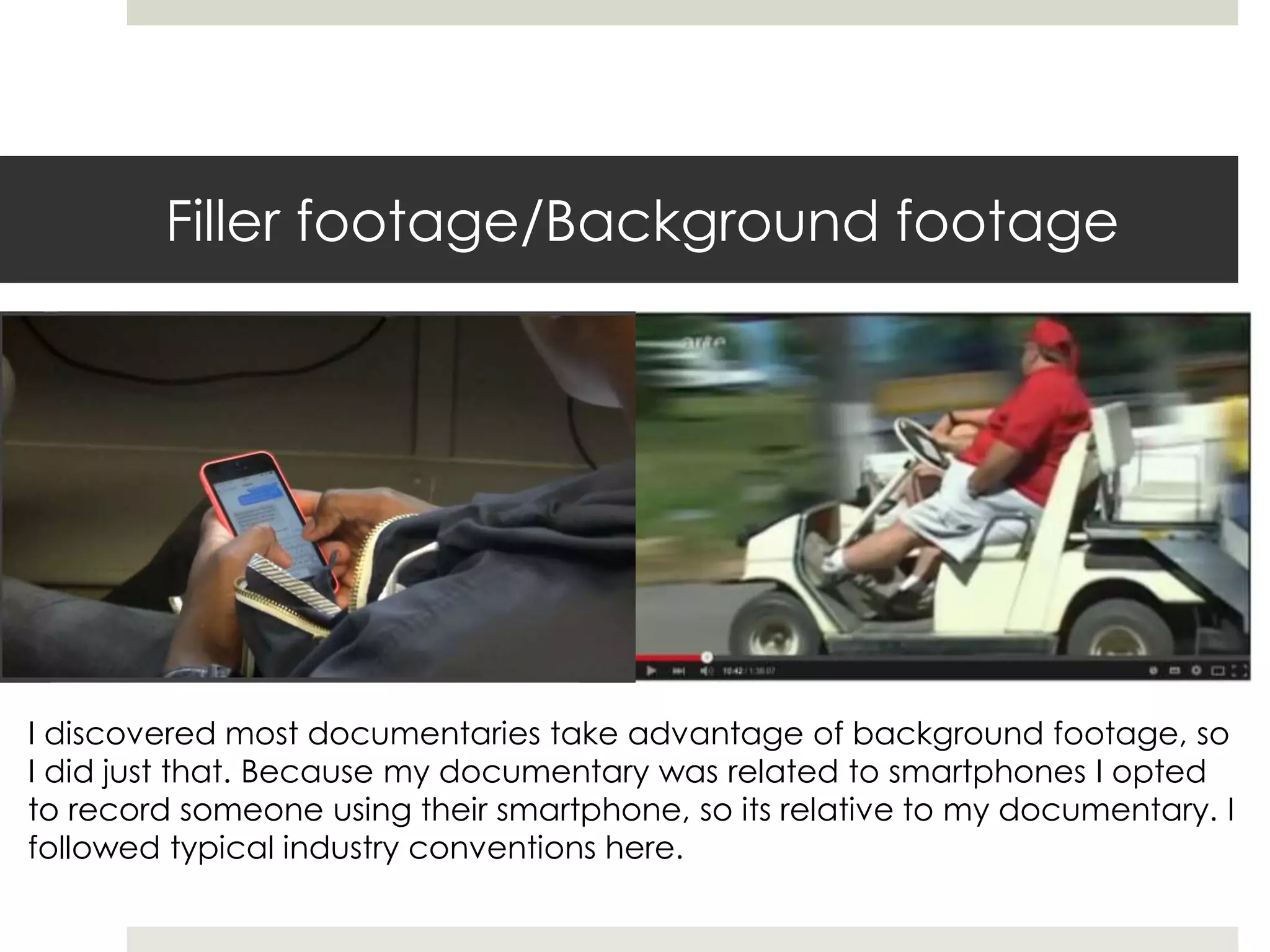
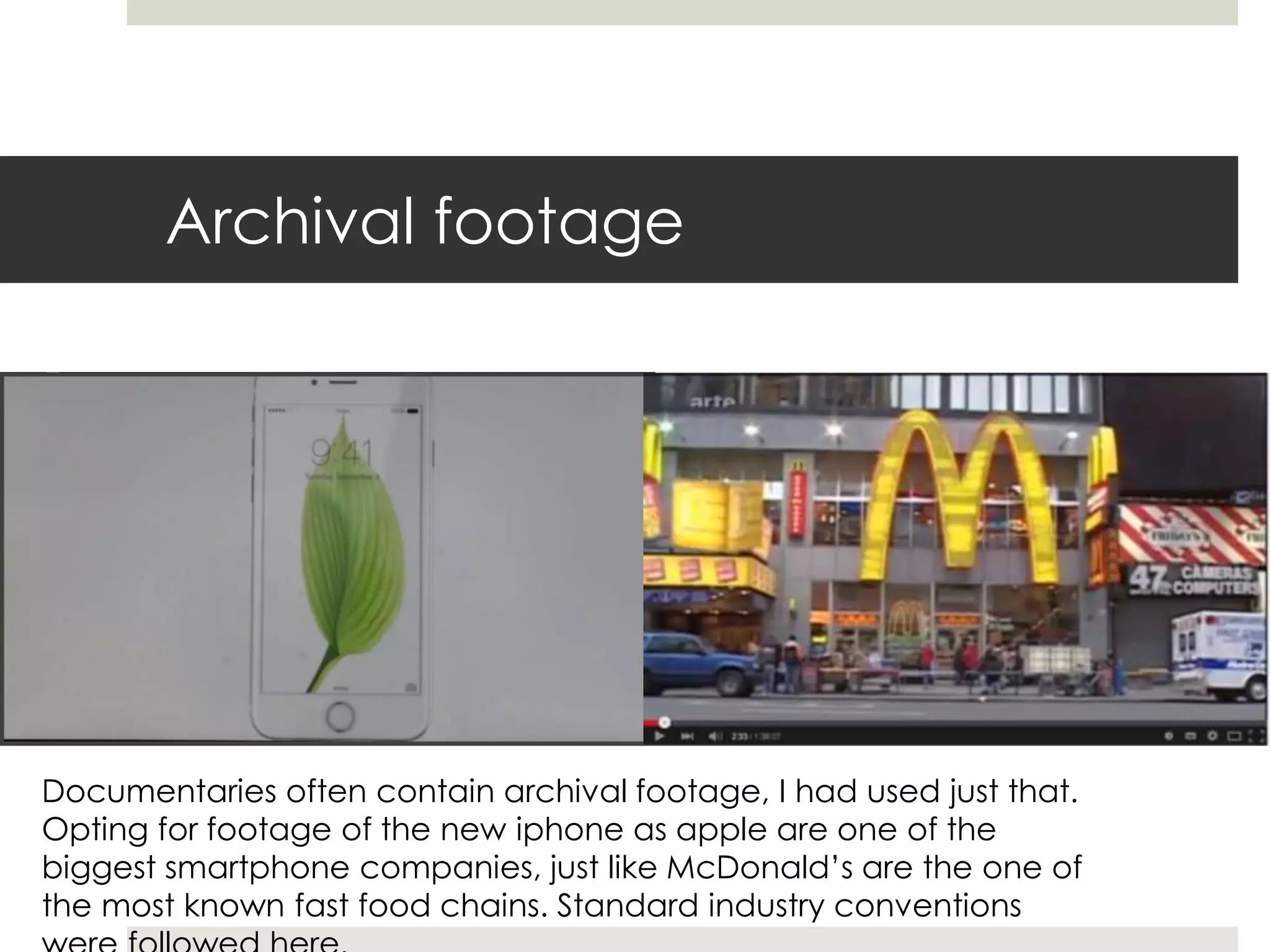
Documentaries often contain archival footage, I had used just that.
Opting for footage of the new iphone as apple are one of the
biggest smartphone companies, just like McDonald’s are the one of
the most known fast food chains. Standard industry conventions
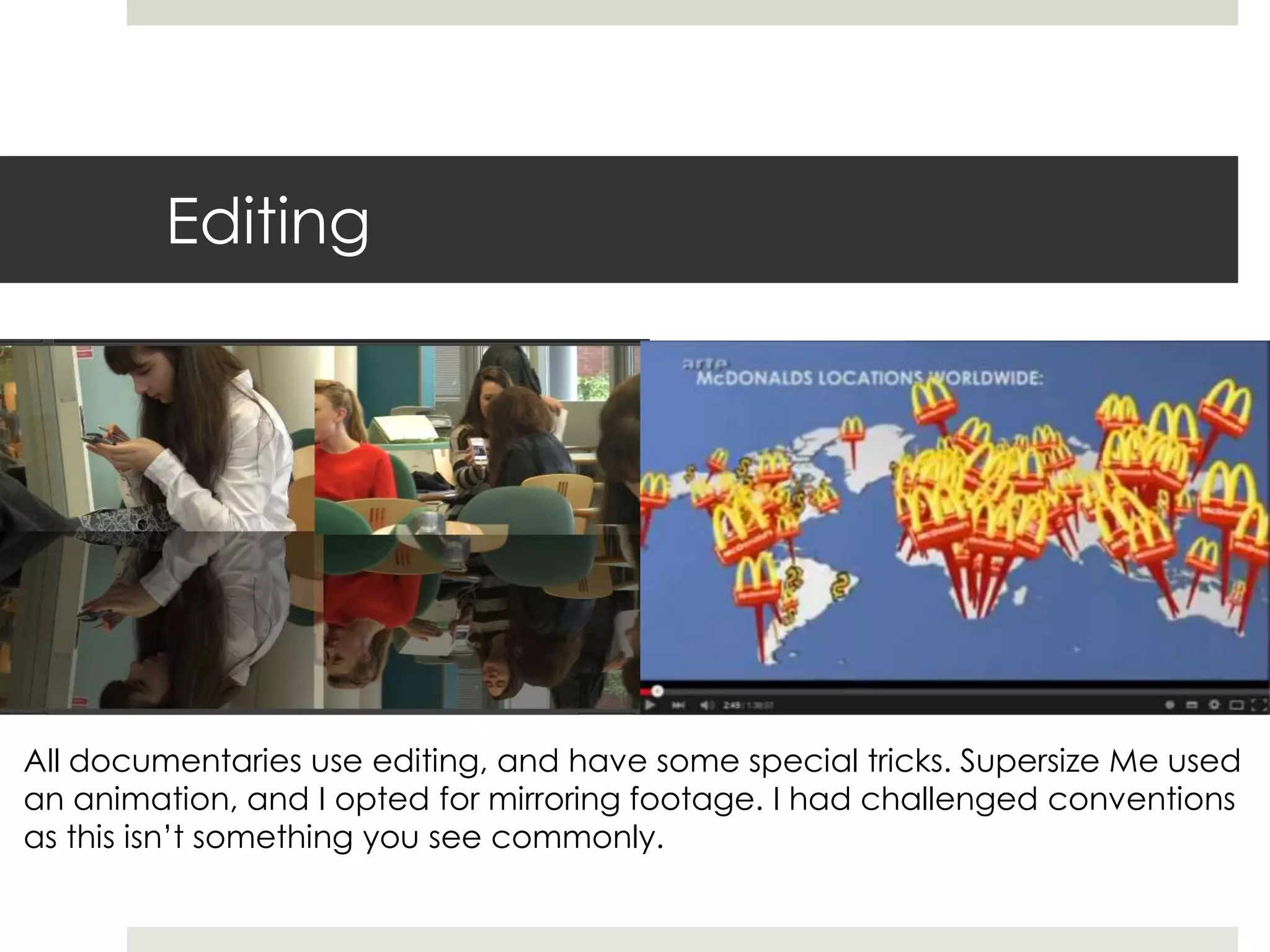
Editing
All documentaries use editing, and have some special tricks. Supersize Me used
an animation, and I opted for mirroring footage. I had challenged conventions
as this isn’t something you see commonly.
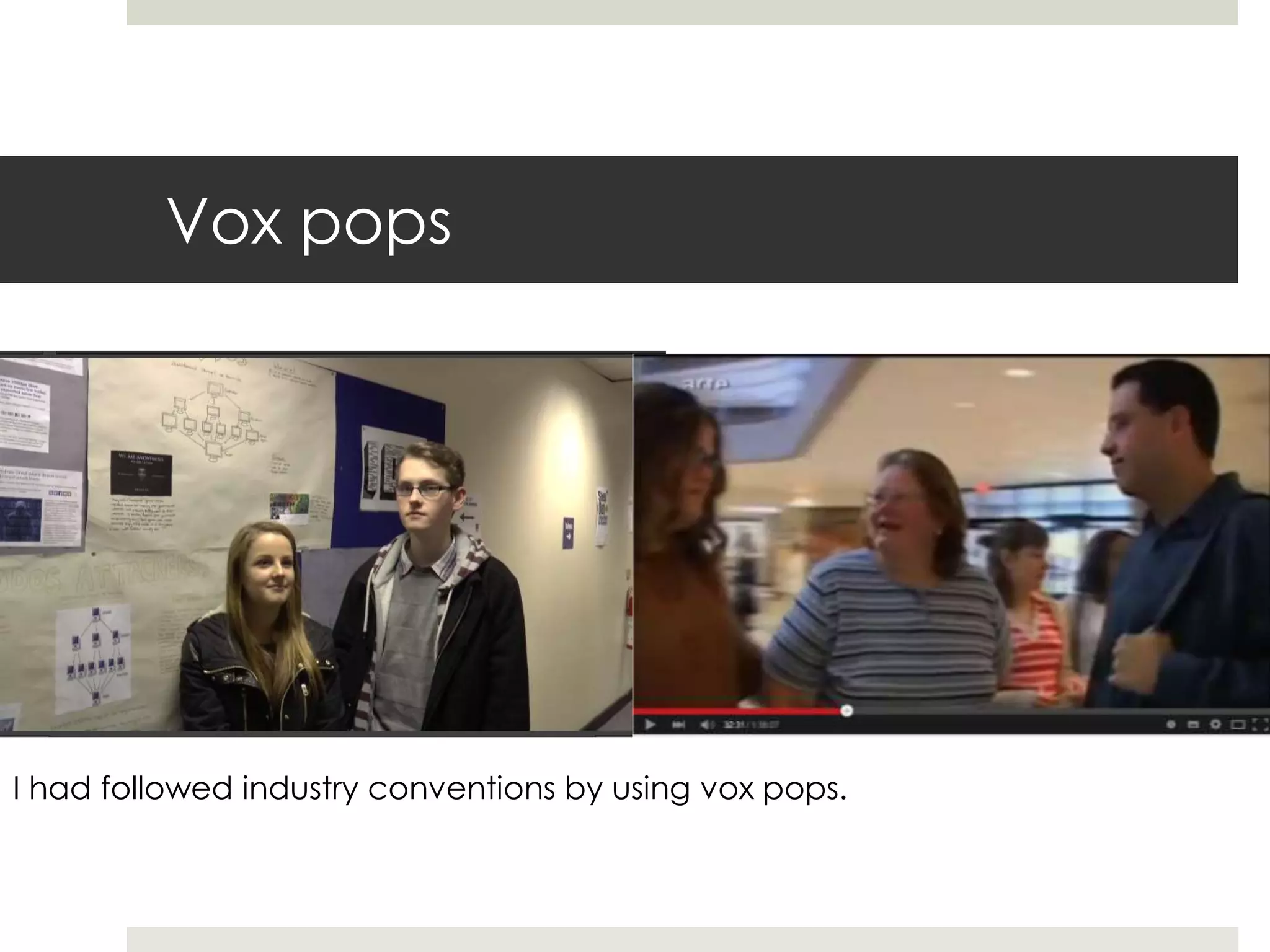
Vox pops
I had followed industry conventions by using vox pops.
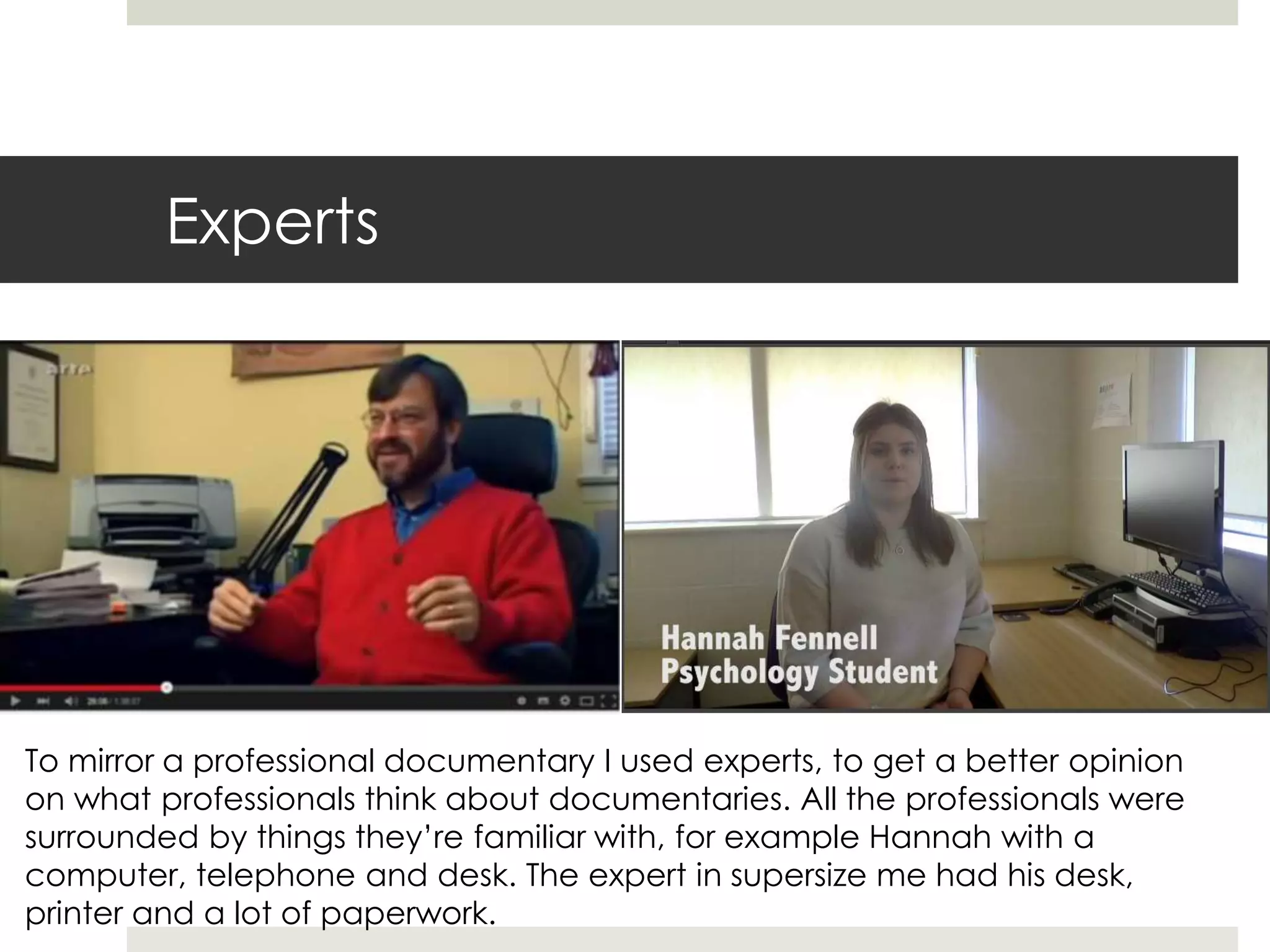
Experts
To mirror a professional documentary I used experts, to get a better opinion
on what professionals think about documentaries. All the professionals were
surrounded by things they’re familiar with, for example Hannah with a
computer, telephone and desk. The expert in supersize me had his desk,
printer and a lot of paperwork.
Conclusion
 Conclusion, throughout all three ancillary texts there were
various conventions used and challenged to make my
documentary seem professional. I had challenged
documentaries to not follow the status quo, for example
my choice of editing, and I had used conventions to
make it professional, for example on going narration.

Eval q 1 (2)

  • 1.
    In what waysdoes your media product use, develop or challenge forms and conventions of real media products. By Shawaeb Tayab
  • 2.
    A large image Pullquote Standfirs Drop cap Headline/ Title Columns Contrast
  • 3.
  • 4.
    Why these featureswere used and their effects What it is and how it used, why its used and how have I used it.  I had used: Standfirst: To introduce the article, it comes before the main text and gives the reader an idea of the article they’ll be reading. It summarizes the article in a paragraph. By-lines: To credit myself as the author.  Drop capital: A drop cap is a very common convention, it’s the introducing letter into the main text. It is used in the majority of magazines.  Pull quotes: These are found either around the double page spread or within the main body text. These are usually quotes from within the article. “ I challenged by not using article quotes but rather documentary quotes to give an idea of my documentary”  Masthead: This is normally the head line of the page, and it is always positioned on the top left hand corner. I had followed typical industry conventions with my use of this.  the biggest font on the page, it’s the most dominant text on the page. It is very concise and separates itself from the main body and stand first.  Images: I noticed TV programme articles tend to have more than one image, and the images often were stills from show, so I decided to add stills from the vox pops from my documentary.  Columns: Articles always have columns, it’s a standard convention, and I chose to follow that, it makes the article look more professional, and clear.
  • 5.
    Radio trailer  Hereis my radio trailer:
  • 6.
    Codes & conventions Radio adverts conventionally play for between 30-60 seconds. They have a voiceover or narrator, and the narrator outlines what is being advertised. Moving on to documentaries, the narrator for the documentary is usually the narrator for the radio adverts, this is to familiarise the consumer. The radio adverts purpose is to persuade the consumer to watch the documentary, and typical conventions of that is directly addressing the audience, using a triadic structure (rule of three) and repetition. The language employed should be targeted towards the demographic. Adverts typically contains music, often catchy so it remains memorable.  The radio adverts studied mentioned the time and date of broad casting and the channel. They also contained audio clips from the documentary.
  • 7.
     I hadfollowed conventions and also challenged.  I challenged conventions where I used short clips from my documentary vox pops, but I blended them together for an array of opinions in a short time.  I also challenged conventions by keeping a calm tone which is relative to my documentary.  I had followed conventions by stating the time and date of broadcasting, and what channel it will be shown on.
  • 8.
    Documentary Codes &conventions  After our task briefing, I understood I had to create a 5 minute introduction to a documentary. To create a professional documentary, I need to understand the codes and conventions of a professional documentary, so I studied the documentary Supersize Me. After completing my documentary I will compare it to my example of Supersize Me to see how I used, developed and challenged the conventions of a real media product.
  • 9.
    Theory  Firstly Ilooked at the ‘theory of documentary modes’ (Bill Nicholls, 2001). Nicholls theory states that there are different modes of documentaries. Reflexive, participatory, poetic, performative, expositional and observational. My documentary was a mixture, It fit into the categories of participatory and performative because we had an on screen presenter. And it’s expositional because of the voice over used throughout, the voice over helped guide the audience through the documentary.
  • 10.
    Theory  I alsolooked into narrative structure. Documentaries typically adhere to a rhetoric structure to persuade their audience. My documentary followed a linear narrative structure as it maintained a clear beginning, middle and finale. My beginning was a montage of’.
  • 11.
    Filler footage/Background footage Idiscovered most documentaries take advantage of background footage, so I did just that. Because my documentary was related to smartphones I opted to record someone using their smartphone, so its relative to my documentary. I followed typical industry conventions here.
  • 12.
    Archival footage Documentaries oftencontain archival footage, I had used just that. Opting for footage of the new iphone as apple are one of the biggest smartphone companies, just like McDonald’s are the one of the most known fast food chains. Standard industry conventions
  • 13.
    Editing All documentaries useediting, and have some special tricks. Supersize Me used an animation, and I opted for mirroring footage. I had challenged conventions as this isn’t something you see commonly.
  • 14.
    Vox pops I hadfollowed industry conventions by using vox pops.
  • 15.
    Experts To mirror aprofessional documentary I used experts, to get a better opinion on what professionals think about documentaries. All the professionals were surrounded by things they’re familiar with, for example Hannah with a computer, telephone and desk. The expert in supersize me had his desk, printer and a lot of paperwork.
  • 16.
    Conclusion  Conclusion, throughoutall three ancillary texts there were various conventions used and challenged to make my documentary seem professional. I had challenged documentaries to not follow the status quo, for example my choice of editing, and I had used conventions to make it professional, for example on going narration.