 One of the most important technologies we used in our research stages was
the internet. The internet is a powerful platform for search engines such as
Yahoo and Google Chrome of which enabled us to quickly narrow down
information we were looking for regarding pop promos. The internet was
pragmatic to us as it was a great medium for communication between
members of our production group as we could contact each other and
discuss the project when we weren't together.
 When researching information on the internet, we had to be careful as the
internet contains normative and subjective data that can be written by
anyone, meaning it is not always valid and/or reliable information. We
tended to stay clear of Wikipedia because we knew that Wikipedia is written
by the public.
› To present our research and planning stages we used Blogger instead of storing all of our work in
a folder. This meant that all of our work was stored in one, central location and could be
accessed by any internet portal. Also, my blog could be accessed by my media teacher which
enabled us to receive sufficient feedback on a regular basis. This therefore made my research
stages far more efficient as my organisation was to a good standard.
› One of the other media technologies we used on the internet was YouTube. YouTube was
particularly good when it came to researching music videos because it is simple to search a
video and it be immediately accessible. It allowed us to watch music videos from start to finish,
instantly. Furthermore, as each video on YouTube has its own unique URL, we could then use
specific pop promos as examples on our blogs by copying and pasting the URL onto them. This
helped us to have a better overlook of our coursework on blogger.
› Social network such as facebook was also a useful media technology that we used as a platform
for part of our audience research. Social networking improves communication between people
and helps to gather data about perceptions. We took advantage of facebook as a utility for
audience feedback as we felt we could develop an understanding of what our audiences
thought about music videos, digipaks and magazine advertisements. It was simple to receive
responses from our contacts in a short period of time. This therefore helped us to establish a better
understanding of our media products.
 During the construction phase of the pop promo we used a variety of
different equipment and media technologies that would enhance our
media product.
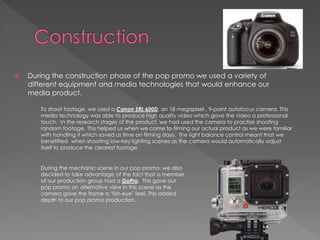
› To shoot footage, we used a Canon SRL 600D, an 18 megapixel , 9-point autofocus camera. This
media technology was able to produce high quality video which gave the video a professional
touch. In the research stages of the product, we had used the camera to practise shooting
random footage. This helped us when we came to filming our actual product as we were familiar
with handling it which saved us time on filming days. The light balance control meant that we
benefitted when shooting low-key lighting scenes as the camera would automatically adjust
itself to produce the clearest footage.
› During the mechanic scene in our pop promo, we also
decided to take advantage of the fact that a member
of our production group had a GoPro. This gave our
pop promo an alternative view in this scene as the
camera gave the frame a ‘fish-eye’ feel. This added
depth to our pop promo production.
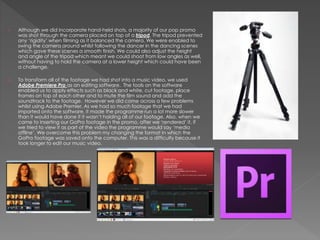
› Although we did incorporate hand-held shots, a majority of our pop promo
was shot through the camera placed on top of a tripod. The tripod prevented
any ‘rigidity’ when filming as it balanced the camera. We were enabled to
swing the camera around whilst following the dancer in the dancing scenes
which gave these scenes a smooth finish. We could also adjust the height
and angle of the tripod which meant we could shoot from low angles as well,
without having to hold the camera at a lower height which could have been
a challenge.
› To transform all of the footage we had shot into a music video, we used
Adobe Premiere Pro as an editing software. The tools on the software
enabled us to apply effects such as black and white, cut footage, place
frames on top of each other and to mute the film sound and add the
soundtrack to the footage. However we did come across a few problems
whilst using Adobe Premier. As we had so much footage that we had
imported onto the software, it made the programme run a lot more slower
than it would have done if it wasn’t holding all of our footage. Also, when we
came to inserting our GoPro footage in the promo, after we ‘rendered’ it, if
we tried to view it as part of the video the programme would say ‘media
offline’. We overcome this problem my changing the format in which the
GoPro footage was saved onto the computer. This was a difficulty because it
took longer to edit our music video.
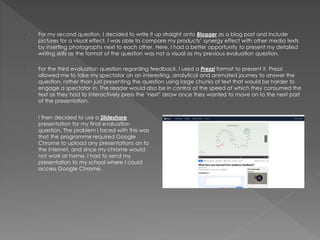
› To edit the pictures I took for both my magazine advertisement
and my digipak, I used Adobe Photoshop. I was able to magnify
where I was editing to correct really minor blemishes, which
gave my photographs a higher quality finish to them. On Adobe
Photoshop, I could also adjust the colour of my photographs to
black and white, and I could also adjust how contrasting the
colours in my photographs were. I felt confident using this
software because I had used it for my AS magazine coursework
images, therefore this stage of construction was less time
consuming than it would have been if I hadn’t used Adobe
Photoshop before.
› To construct both my magazine advertisement and my digipak, I used
Adobe InDesign because it allowed me to create a template for my
products. The software contains guidelines on its templates which I
found really useful as it was easier to align the content of my
products.
 For my evaluation stages, I decided to use different mediums to present
each question. This way, I could demonstrate my presentation skills and my
advanced insight into a variety of media technologies.
› For my first question, I decided I wanted to make
more of a visual presentation to my spectator. So I
immersed myself in the challenge of using a
different movie-making media technology other
than Adobe Premiere (which we had previously
become confident with in the construction phase
of our media product), that was Windows Movie
Maker. This media technology took a while to get
used to, but after a while, it was easy to
understand how to insert images, add captions,
change the length of slides and insert background
music. However, I did find many difficulties with this
media technology such as every time I came to
carry on with my editing, the content would never
fully load so I spent a long time buffering the
programme every time I opened it. It would have
been easier to do this evaluation question on
Adobe Premiere, but I accepted this challenge
and it was still able to upload onto YouTube in the
end.
› For my second question, I decided to write it up straight onto Blogger as a blog post and include
pictures for a visual effect. I was able to compare my products’ synergy effect with other media texts
by inserting photographs next to each other. Here, I had a better opportunity to present my detailed
writing skills as the format of the question was not a visual as my previous evaluation question.
› For the third evaluation question regarding feedback, I used a Prezzi format to present it. Prezzi
allowed me to take my spectator on an interesting, analytical and animated journey to answer the
question, rather than just presenting the question using large chunks of text that would be harder to
engage a spectator in. The reader would also be in control of the speed at which they consumed the
text as they had to interactively press the ‘next’ arrow once they wanted to move on to the next part
of the presentation.
› I then decided to use a Slideshare
presentation for my final evaluation
question. The problem I faced with this was
that the programme required Google
Chrome to upload any presentations on to
the internet, and since my chrome would
not work at home, I had to send my
presentation to my school where I could
access Google Chrome.

Evaluation Question 4

  • 2.
     One ofthe most important technologies we used in our research stages was the internet. The internet is a powerful platform for search engines such as Yahoo and Google Chrome of which enabled us to quickly narrow down information we were looking for regarding pop promos. The internet was pragmatic to us as it was a great medium for communication between members of our production group as we could contact each other and discuss the project when we weren't together.  When researching information on the internet, we had to be careful as the internet contains normative and subjective data that can be written by anyone, meaning it is not always valid and/or reliable information. We tended to stay clear of Wikipedia because we knew that Wikipedia is written by the public.
  • 3.
    › To presentour research and planning stages we used Blogger instead of storing all of our work in a folder. This meant that all of our work was stored in one, central location and could be accessed by any internet portal. Also, my blog could be accessed by my media teacher which enabled us to receive sufficient feedback on a regular basis. This therefore made my research stages far more efficient as my organisation was to a good standard. › One of the other media technologies we used on the internet was YouTube. YouTube was particularly good when it came to researching music videos because it is simple to search a video and it be immediately accessible. It allowed us to watch music videos from start to finish, instantly. Furthermore, as each video on YouTube has its own unique URL, we could then use specific pop promos as examples on our blogs by copying and pasting the URL onto them. This helped us to have a better overlook of our coursework on blogger. › Social network such as facebook was also a useful media technology that we used as a platform for part of our audience research. Social networking improves communication between people and helps to gather data about perceptions. We took advantage of facebook as a utility for audience feedback as we felt we could develop an understanding of what our audiences thought about music videos, digipaks and magazine advertisements. It was simple to receive responses from our contacts in a short period of time. This therefore helped us to establish a better understanding of our media products.
  • 4.
     During theconstruction phase of the pop promo we used a variety of different equipment and media technologies that would enhance our media product. › To shoot footage, we used a Canon SRL 600D, an 18 megapixel , 9-point autofocus camera. This media technology was able to produce high quality video which gave the video a professional touch. In the research stages of the product, we had used the camera to practise shooting random footage. This helped us when we came to filming our actual product as we were familiar with handling it which saved us time on filming days. The light balance control meant that we benefitted when shooting low-key lighting scenes as the camera would automatically adjust itself to produce the clearest footage. › During the mechanic scene in our pop promo, we also decided to take advantage of the fact that a member of our production group had a GoPro. This gave our pop promo an alternative view in this scene as the camera gave the frame a ‘fish-eye’ feel. This added depth to our pop promo production.
  • 5.
    › Although wedid incorporate hand-held shots, a majority of our pop promo was shot through the camera placed on top of a tripod. The tripod prevented any ‘rigidity’ when filming as it balanced the camera. We were enabled to swing the camera around whilst following the dancer in the dancing scenes which gave these scenes a smooth finish. We could also adjust the height and angle of the tripod which meant we could shoot from low angles as well, without having to hold the camera at a lower height which could have been a challenge. › To transform all of the footage we had shot into a music video, we used Adobe Premiere Pro as an editing software. The tools on the software enabled us to apply effects such as black and white, cut footage, place frames on top of each other and to mute the film sound and add the soundtrack to the footage. However we did come across a few problems whilst using Adobe Premier. As we had so much footage that we had imported onto the software, it made the programme run a lot more slower than it would have done if it wasn’t holding all of our footage. Also, when we came to inserting our GoPro footage in the promo, after we ‘rendered’ it, if we tried to view it as part of the video the programme would say ‘media offline’. We overcome this problem my changing the format in which the GoPro footage was saved onto the computer. This was a difficulty because it took longer to edit our music video.
  • 6.
    › To editthe pictures I took for both my magazine advertisement and my digipak, I used Adobe Photoshop. I was able to magnify where I was editing to correct really minor blemishes, which gave my photographs a higher quality finish to them. On Adobe Photoshop, I could also adjust the colour of my photographs to black and white, and I could also adjust how contrasting the colours in my photographs were. I felt confident using this software because I had used it for my AS magazine coursework images, therefore this stage of construction was less time consuming than it would have been if I hadn’t used Adobe Photoshop before. › To construct both my magazine advertisement and my digipak, I used Adobe InDesign because it allowed me to create a template for my products. The software contains guidelines on its templates which I found really useful as it was easier to align the content of my products.
  • 7.
     For myevaluation stages, I decided to use different mediums to present each question. This way, I could demonstrate my presentation skills and my advanced insight into a variety of media technologies. › For my first question, I decided I wanted to make more of a visual presentation to my spectator. So I immersed myself in the challenge of using a different movie-making media technology other than Adobe Premiere (which we had previously become confident with in the construction phase of our media product), that was Windows Movie Maker. This media technology took a while to get used to, but after a while, it was easy to understand how to insert images, add captions, change the length of slides and insert background music. However, I did find many difficulties with this media technology such as every time I came to carry on with my editing, the content would never fully load so I spent a long time buffering the programme every time I opened it. It would have been easier to do this evaluation question on Adobe Premiere, but I accepted this challenge and it was still able to upload onto YouTube in the end.
  • 8.
    › For mysecond question, I decided to write it up straight onto Blogger as a blog post and include pictures for a visual effect. I was able to compare my products’ synergy effect with other media texts by inserting photographs next to each other. Here, I had a better opportunity to present my detailed writing skills as the format of the question was not a visual as my previous evaluation question. › For the third evaluation question regarding feedback, I used a Prezzi format to present it. Prezzi allowed me to take my spectator on an interesting, analytical and animated journey to answer the question, rather than just presenting the question using large chunks of text that would be harder to engage a spectator in. The reader would also be in control of the speed at which they consumed the text as they had to interactively press the ‘next’ arrow once they wanted to move on to the next part of the presentation. › I then decided to use a Slideshare presentation for my final evaluation question. The problem I faced with this was that the programme required Google Chrome to upload any presentations on to the internet, and since my chrome would not work at home, I had to send my presentation to my school where I could access Google Chrome.