Ethics Moral philosophy ,  Branch of  philosophy  that addresses questions about  morality —that is, concepts such as  good and evil , right and wrong,  virtue  and  vice ,  justice , etc.
EUTHANASIA Tan It
EUTHANASIA    Definition  Greek:  eu-thanatos –  ‘good death’  or  ‘easy-death . The  act of ending a patient's life whether by act or omission in response to severe pain and suffering .  the deliberate bringing about of a  gentle and easy death, in the context of relieving incurable suffering or disability
EUTHANASIA Also Known As:  physician-assisted death,  physician-assisted suicide,  mercy killing
EUTHANASIA   Definitions Voluntary Euthanasia  refers to the action taken by the  physician and the patient, who both agree  (with informed consent) to end the patient's life  Involuntary Euthanasia  - taking a patient's life  without the informed consent of the patient -  e.g. a terminally ill, suffering patient's life who has lost all mental capacity to make his/her own decisions.
Passive EUTHANASIA   Hastening the death of a person by altering some form of support and  letting nature take its course  is known as passive euthanasia.  Examples  turning off respirators,  halting medications,  discontinuing food and water so as to allowing a person to dehydrate or starve to death, or  failure to resuscitate.
Nuremberg Trials 1948   Brandt, K 'Hitler's physician' in charge of the German euthanasia programme who presided over the deaths of millions of Jews, Slavs and 'defective' Germans  while on trial for carrying out euthanasia “ My  underlying motive was the desire to help individuals who could not help themselves...  such considerations should not be regarded as inhuman. Nor did I feel it in any way to be unethical or immoral.. I am convinced that if Hippocrates were alive today he would change the wording of his oath... in which a doctor is forbidden to administer poison to an invalid even on demand... I have  a perfectly clear conscience  about the part I played in the affair.”
As a result of the Nuremberg trials, two ethical declarations were adopted:- The  Declaration of Geneva  included the following: 'I will maintain the  utmost respect for human life from the time of conception…’ (Declaration of Geneva adopted by the General Assembly of World Medical Association, Geneva Switzerland, 1948). The  International Code of Medical Ethics  affirmed that a  'doctor must always bear in mind the importance of preserving human life from the time of conception until death '  (3rd World Medical Assembly, London October  1949 ).
Pro-Euthanasia Arguments Compassion : we need to address the suffering of the sick and dying Autonomy : people have the right to decide the manner and timing of their death – a right to “die with dignity”, and be allowed to make decisions concerning our lives which do not affect those around us – autonomy. Suicide is no longer unlawful in Britain since 1961. Animals which are very ill are often put to death to end their suffering , it is considered unethical not to do so - why can’t humans choose this option
Netherlands 1971 Dr Postma killed her mother , who was partially paralysed, deaf, and had pneumonia, with a lethal injection of 200mg morphine. In 1973 she was found guilty of murder but given a week's suspended sentence and a year of probation. The judge ruled that any doctor performing euthanasia may be exempt from prosecution if the patient has an incurable disease and is facing unbearable physical or mental suffering.  1984: euthanasia justified if applied according to objective medical insight. Over 2,300 cases of voluntary euthanasia a year (1992 data) and over 1000 cases of involuntary euthanasia.
Netherlands Dr Pieter Admiraal, once the president of the Dutch Society of Anaesthesiology, administered one of the largest units for terminally ill patients in Holland and sees himself as  his patients' friend, willing to assure them on an easy and painless death. He wants to see euthanasia provisions apply to the handicapped newborn, to the comatose, to the dementing - groups who could neither give consent nor be consulted.  There is  now a major transition in medical ethics and practice.   June 1994 Dutch Supreme Court convicted but declined to  punish a psychiatrist for assisting the suicide of a physically healthy patient with a 'depressive disorder in the narrowest sense'.
Netherlands Non-voluntary euthanasia is also being proposed: 1985 State Commission on Euthanasia recommended that it should not be an offence for a doctor to kill a patient who was unable to express his wishes, and who had irreversible lost consciousness, provided that treatment had been suspended as pointless 1991 Dutch Ministry of Justice Report: 1,030 patients were killed without their ‘explicit and persistent request’ – Involuntary euthanasia also now openly practised .
PHYSICIAN ASSISTED SUICIDE a physician supplies information and/or the means of committing suicide (e.g., a prescription for lethal dose of sleeping pills, or a supply of carbon monoxide gas) to a person, so that that individual can successfully terminate his or her own life.
PHYSICIAN ASSISTED SUICIDE Dr. Kevorkian (1990)  set up a machine that allowed a 54-year-old woman suffering from Alzheimer's disease to press a button that delivered a lethal poison into her veins.  Kevorkian  went on to assist in the suicides of dozens of individuals  suffering from terminal, debilitating, or chronic illnesses.  In 1992, Michigan passed an assisted-suicide bill (Mich. Comp. Laws § 752.1021) that was specifically designed to stop Kevorkian's activities, but technicalities and questions as to its constitutionality delayed its implementation, thus allowing Kevorkian to continue assisting suicides—often in direct opposition to court injunctions.
PHYSICIAN ASSISTED SUICIDE Proponents of physician-assisted suicide also claim that  diseases kill people in far more cruel ways than would any means of death that a physician  might provide for an irreversibly ill patient. As a result, they see the action of assisting in suicide as entirely compatible with the physician's duty to the patient.
Active EUTHANASIA September 17, 1998. Dr.  Jack Kevorkian  videotaped  himself administering a lethal medication  to Thomas Youk, a 52-year-old Michigan man with amyotrophic lateral sclerosis.  Authorities subsequently charged Kevorkian with first-degree premeditated murder, criminal assistance of a suicide There was no dispute that the dose was administered at the request of Mr. Youk, nor any dispute that Mr. Youk was terminally ill.  A jury found Kevorkian guilty of second-degree murder in 1999. He was sent to prison
Euthanasia –  The Non-Christian View World is in recession and debt. Medical costs are escalating.  Medical resources and money is limited.  Resources provided to look after old people must necessarily be subtracted from those available for  the other dependent group the children.  Why care expensively when you can kill cheaply ? Jacques Attali (former President of European Bank for Reconstruction and Development):  'As soon as he goes beyond 60-65 years of age man lives beyond his capacity to produce, and he costs society a lot of money...euthanasia will be one of the essential instruments of our future societies .'
Euthanasia –  The Non-Christian View Man is nothing but the product of matter, chance and time in a godless universe, a  highly specialized animal.  The value of an individual is determined by his degree of rationality, self-consciousness and physical characteristics.  Human life that does not have these qualities can be disposed of, and indeed it is an act of mercy and kindness to do so .
Euthanasia –  The Non-Christian View Peter Singer, Director of the Centre for Human Bioethics in Melbourne:  'We can no longer base our ethics on the idea that human beings are a special form of creation, made in the image of God ....Once the religious mumbo-jumbo surrounding the term "human" has been stripped away, we may continue to see normal members of our species as possessing greater qualities of rationality, self-consciousness, communication and so on than members of any other species, but  we will not regard as sacrosanct the life of every member of our species , no matter how limited its capacity for intelligent or even conscious life may be...'
Euthanasia  The Christian View Exodus 20:13: You shall not murder (NIV) Genesis 9:6: Whoever sheds the blood of man, by man shall his blood be shed; for in the image of God has God made man. Man, being made in the image of God (Gen 1:26), is not to be killed
Unauthorized Killing You shall not  kill,  vs You shall not commit  murder 10 Hebrew words translated 'kill' in the Authorized Version of the Bible - the word in the 6th commandment is  ratsach.  Its Greek equivalent is  phoneuo  and is most accurately translated 'murder‘ Difference:  Intent
Kill vs Murder Numbers 35:20-25. If anyone with  malice afterthought  shoves another or throws something at him intentionally so that he dies ……..that person shall be put to death; he is a murderer… But if  without hostility  someone suddenly shoves another or throws something at him unintentionally…and he dies, then since he was not his enemy and he did not intend to harm him, the assembly must judge….
Murder vs. Manslaughter Anyone killing another human being  unintentionally  was able to flee to a city of refuge where he would gain some protection from the 'avenger of blood'. Numbers 35:28.  This ' manslaughter ' provision applied in limited circumstances: 'For instance, a man may go into the forest with his neighbour to cut wood, and as he swings his axe to fell a tree, the head may fly off and it his neighbour and kill him.' Deut 19:5.
Murder vs. Manslaughter Killing resulting from  negligence was not excused  as unintentional (Ex 21:29).  Neither was killing  'in hostility ' even if not necessarily premeditated (Num 35:21).  Killing of the  poor  (Ex 23:7),  widows  and  orphans  (Ex 22:22-24),  aliens  (Ex 22:21), the  handicapped  (Lev 19:14),  slaves  and  servants   (Ex 21:2-6) and the  aged  (Lev 19:32) was  not exempted from punishment  (Ex 23:3-7).
Suicide Regarded as a sin by the Jews at the time of Christ . Martyrdom was however highly regarded by the early church  and Jerome approved of suicide for religious reasons Augustine concluded that suicide was always wrong  and a violation of the sixth commandment Many Christians feel that there is no recognition of a 'right to die' as  human life belongs to God (Ps 24:1) and is not the personal possession of any human being .  Only God has the authority to take human life. Man can only do so under God's delegated authority, even if the life is 'his own'.
Suicide However despair even to the point of contemplating suicide was something experienced by Paul, Job, David, Jeremiah, Elijah Jesus in John 10:17-18: ‘ I lay down my life only to take it up again. No one takes it from me, but I lay it down of my own accord. I have authority to lay it down and authority to take it up again .’  The  implication is that ordinary human beings don’t have this authority .
Killing at the extremes of life Abortion  – killing at the  beginning of life Euthanasia  – killing at the  end of life Key issue is: When does human life begin and end? - When does a foetus become a human? - When does a human cease to become a human? Related issue:  What makes a human different from an animal ? These questions become more and more difficult to answer with advances in reproductive technology and mechanical life support systems.
Killing at the extremes of life Christians value human life as sacred .  Are those in a  vegetative state  fully human?  Should millions of dollars in health-care funding be spent to keep them alive on life-support systems indefinitely because human life is sacred?
What makes man a human? Or is man only a more intelligent monkey? Genesis 1:26: Then God said, “Let us make man in our image, in our likeness, and let them rule …..” What is ‘God’s image’? Genesis 2:7. And the Lord God formed man from the dust of the ground and breathed into his nostrils the breath of life, and man became a living being. What is the ‘breath of life’?
What makes man a human? This likeness to God is a reference to the trinity of man. As God is triune (Father, Son, Holy Spirit), he created man a triune creature (spirit, soul, body). 1Thess. 5:23: ..and I pray God  your whole spirit and soul and body  be preserved blameless unto the coming of our Lord Jesus Christ.
What makes man a human? Man is created in the image of God in that his Creator gave his self-consciousness, God-consciousness, and a sense of morality.
What makes man a human?   When and how does man receive his soul? Creationist theory :  Each human soul is a special creation by God and enters the foetus at an early stage. Zech. 12:1. The Lord….who forms the spirit of man within him…. Objection: If each soul is created separately, why are all men sinners?
What makes man a human?   When and how does man receive his soul? Traducian theory .  Both body and soul are passed on through natural generations .  Ps 51:5. Behold, I was shapen in iniquity; and in sin did my mother conceive me.
Euthanasia Catholic Church Stance Catholic Church : opposes euthanasia and assisted suicide .  Pope John Paul II :  medical killings such as those caused by assisted suicide are "crimes which no human law can claim to legitimize ."  Basing its arguments on passages from the Bible,  Catholic theology has for many centuries opposed all forms of suicide . Catholicism argues that  innocent human life may not be destroyed for any reason whatsoever .
Euthanasia  Key question 1  When does a soul leave a man? Vegetative state? Brain death? When the heart and breathing stop? What if they are started again by mechanical means?
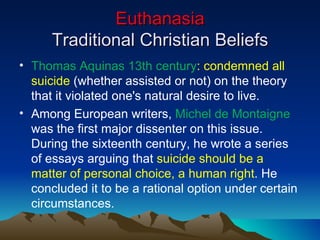
Euthanasia Traditional Christian Beliefs Thomas Aquinas 13th century : condemned all suicide  (whether assisted or not) on the theory that it violated one's natural desire to live.  Among European writers,  Michel de Montaigne  was the first major dissenter on this issue. During the sixteenth century, he wrote a series of essays arguing that  suicide should be a matter of personal choice, a human right . He concluded it to be a rational option under certain circumstances.
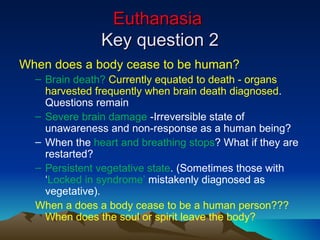
Euthanasia  Key question 2 When does a body cease to be human? Brain death?  Currently equated to death - organs harvested frequently when brain death diagnosed . Questions remain Severe brain damage  -Irreversible state of unawareness and non-response as a human being?  When the  heart and breathing stops ? What if they are restarted? Persistent vegetative state . (Sometimes those with ‘ Locked in syndrome’  mistakenly diagnosed as vegetative). When a does a body cease to be a human person??? When does the soul or spirit leave the body?
Euthanasia  –  The Christian View  Objections to euthanasia: Reasons that can lead a patient or persuade relatives to request euthanasia: depression and confusion  leading to suicidal tendencies. The  request often is withdrawn or forgotten later .  If the patient is dead he can’t change his mind later . feeling of worthlessness, or hopelessness financial  problems - a 'living will' may fail to anticipate the actual situation arising later - danger of  abuse by beneficiaries under the wills - danger that  elderly and vulnerable people would feel pressure to request it , and it would be difficult to set secure limits on its practice
Euthanasia  –  The Christian View 2. Alternatives to euthanasia: Hospice  movement - care for terminally ill We  don't have to kill the patient to kill the symptoms Efficacious use of drugs at home
Euthanasia  –  The Christian View 3.  Mistaken diagnosis or prognosis - errors are irreversible .  Admissions to St Joseph's Hospice for 1982-1983: 14 patients had either no cancer at all or who had cancer in such an early stage tat it was amenable to treatment. Some of these patients could not be discharged for social reasons and became long stay patient. (The only criterion for admission to St Joseph's is that the patient be in the terminal stage of cancer.
Euthanasia  –  The Christian View 4.  Slippery slope  argument - where voluntary euthanasia is tolerated, there is an inevitable progression to involuntary euthanasia (as in Holland). What makes someone's life worthless?  If there are valid reasons to kill a group of people whose quality of life is wanting, a class of people would be created who have lost their right not to have their lives taken from them . E.g. in Nazi Germany. 5.  Trust in the doctor's   intentions may be eroded   if patients suspect that doctors are prepared to see killing as a solution to certain medical or social problems
Euthanasia  –  The Christian View Standard medical practice is based on the premise that  whether or not the doctor may be able to cure, his aim will always be to relieve suffering  of body, mind and spirit, to care. The objective is to enhance life, not to terminate it.  Where, through the administration of pain-relieving drugs or other therapy the life is sometimes shortened, such death is not euthanasia .  The difference is the intent .
Euthanasia  –  The Christian View Triage  (e.g. in famine or natural disaster, mass trauma) to benefit those whose prognosis is most likely to be favourable, leaving others to die, is  not euthanasia .  There are treatments which can prolong life, but may be dehumanising, painful and extremely costly that other considerations outweigh the aim to prolong life (prolong death?)
The Methodist Book of Discipline 11. Suicide We believe that suicide is not the way a human life should end.  The Church, therefore, does not condone suicide.  Nevertheless, suicide is often the result of untreated depression, or untreated pain and suffering. The church has an obligation to see that  all persons have access to needed pastoral and medical care and therapy in those circumstances that lead to loss of self-worth, suicidal despair, and/or the desire to seek physician-assisted suicide.  We encourage the church to provide education to address the biblical, theological, social, and ethical issues related to death and dying, including suicide.
The Methodist Book of Discipline 11. Suicide A Christian perspective on suicide begins with an affirmation of faith that  nothing, including suicide, separates us from the love of God  (Romans 8:38-39). Therefore,  we deplore the condemnation of people who commit suicide , and we consider unjust the stigma that so often falls on surviving family and friends. We encourage pastors and faith communities to address these issues through preaching and teaching. We urge pastors and faith communities to provide pastoral care to those at risk, survivors, and their families who have lost loved ones to suicide, seeking always to remove the oppressive stigma around suicide.  The Church opposes assisted suicide and euthanasia .
Euthanasia  –  My Stand Unhelpful and extraordinary therapies should not be instituted or should be withdrawn when there is recognition that terminal illness has begun .  Deliberate attempts to end or shorten life, whether by commission or omission is not acceptable The medical decision in terminal illness is complex and variable from time to time and case to case. Withdrawing treatment in the case of brain death is not euthanasia  according to current medical knowledge Suffering, pain and depression can usually be managed and lessened by Christian compassion and care, and judicious use of pain-relieving drugs.
Euthanasia  –  My Stand Christians must promote compassionate care, better standards and practices in terminal care so that it is seen to be unnecessary to kill the dying or distressed, thus making euthanasia redundant. The elderly, sick and disabled should be treated and accorded a high self-esteem, sense of purpose and meaningful place in the community. 'I am come that they might have life, and that they might have it more abundantly.' The Christian church must establish Christian perspectives on human life and death. Romans 14:7 'For none of us lives to himself alone and none of us dies to himself alone'.

082111 euthanasia tan it

  • 1.
    Ethics Moral philosophy, Branch of  philosophy  that addresses questions about  morality —that is, concepts such as  good and evil , right and wrong,  virtue and  vice ,  justice , etc.
  • 2.
  • 3.
    EUTHANASIA Definition Greek: eu-thanatos – ‘good death’ or ‘easy-death . The act of ending a patient's life whether by act or omission in response to severe pain and suffering . the deliberate bringing about of a gentle and easy death, in the context of relieving incurable suffering or disability
  • 4.
    EUTHANASIA Also KnownAs: physician-assisted death, physician-assisted suicide, mercy killing
  • 5.
    EUTHANASIA Definitions Voluntary Euthanasia refers to the action taken by the physician and the patient, who both agree (with informed consent) to end the patient's life Involuntary Euthanasia - taking a patient's life without the informed consent of the patient - e.g. a terminally ill, suffering patient's life who has lost all mental capacity to make his/her own decisions.
  • 6.
    Passive EUTHANASIA Hastening the death of a person by altering some form of support and letting nature take its course is known as passive euthanasia. Examples turning off respirators, halting medications, discontinuing food and water so as to allowing a person to dehydrate or starve to death, or failure to resuscitate.
  • 7.
    Nuremberg Trials 1948 Brandt, K 'Hitler's physician' in charge of the German euthanasia programme who presided over the deaths of millions of Jews, Slavs and 'defective' Germans while on trial for carrying out euthanasia “ My underlying motive was the desire to help individuals who could not help themselves... such considerations should not be regarded as inhuman. Nor did I feel it in any way to be unethical or immoral.. I am convinced that if Hippocrates were alive today he would change the wording of his oath... in which a doctor is forbidden to administer poison to an invalid even on demand... I have a perfectly clear conscience about the part I played in the affair.”
  • 8.
    As a resultof the Nuremberg trials, two ethical declarations were adopted:- The Declaration of Geneva included the following: 'I will maintain the utmost respect for human life from the time of conception…’ (Declaration of Geneva adopted by the General Assembly of World Medical Association, Geneva Switzerland, 1948). The International Code of Medical Ethics affirmed that a 'doctor must always bear in mind the importance of preserving human life from the time of conception until death ' (3rd World Medical Assembly, London October 1949 ).
  • 9.
    Pro-Euthanasia Arguments Compassion: we need to address the suffering of the sick and dying Autonomy : people have the right to decide the manner and timing of their death – a right to “die with dignity”, and be allowed to make decisions concerning our lives which do not affect those around us – autonomy. Suicide is no longer unlawful in Britain since 1961. Animals which are very ill are often put to death to end their suffering , it is considered unethical not to do so - why can’t humans choose this option
  • 10.
    Netherlands 1971 DrPostma killed her mother , who was partially paralysed, deaf, and had pneumonia, with a lethal injection of 200mg morphine. In 1973 she was found guilty of murder but given a week's suspended sentence and a year of probation. The judge ruled that any doctor performing euthanasia may be exempt from prosecution if the patient has an incurable disease and is facing unbearable physical or mental suffering. 1984: euthanasia justified if applied according to objective medical insight. Over 2,300 cases of voluntary euthanasia a year (1992 data) and over 1000 cases of involuntary euthanasia.
  • 11.
    Netherlands Dr PieterAdmiraal, once the president of the Dutch Society of Anaesthesiology, administered one of the largest units for terminally ill patients in Holland and sees himself as his patients' friend, willing to assure them on an easy and painless death. He wants to see euthanasia provisions apply to the handicapped newborn, to the comatose, to the dementing - groups who could neither give consent nor be consulted. There is now a major transition in medical ethics and practice. June 1994 Dutch Supreme Court convicted but declined to punish a psychiatrist for assisting the suicide of a physically healthy patient with a 'depressive disorder in the narrowest sense'.
  • 12.
    Netherlands Non-voluntary euthanasiais also being proposed: 1985 State Commission on Euthanasia recommended that it should not be an offence for a doctor to kill a patient who was unable to express his wishes, and who had irreversible lost consciousness, provided that treatment had been suspended as pointless 1991 Dutch Ministry of Justice Report: 1,030 patients were killed without their ‘explicit and persistent request’ – Involuntary euthanasia also now openly practised .
  • 13.
    PHYSICIAN ASSISTED SUICIDEa physician supplies information and/or the means of committing suicide (e.g., a prescription for lethal dose of sleeping pills, or a supply of carbon monoxide gas) to a person, so that that individual can successfully terminate his or her own life.
  • 14.
    PHYSICIAN ASSISTED SUICIDEDr. Kevorkian (1990) set up a machine that allowed a 54-year-old woman suffering from Alzheimer's disease to press a button that delivered a lethal poison into her veins. Kevorkian went on to assist in the suicides of dozens of individuals suffering from terminal, debilitating, or chronic illnesses. In 1992, Michigan passed an assisted-suicide bill (Mich. Comp. Laws § 752.1021) that was specifically designed to stop Kevorkian's activities, but technicalities and questions as to its constitutionality delayed its implementation, thus allowing Kevorkian to continue assisting suicides—often in direct opposition to court injunctions.
  • 15.
    PHYSICIAN ASSISTED SUICIDEProponents of physician-assisted suicide also claim that diseases kill people in far more cruel ways than would any means of death that a physician might provide for an irreversibly ill patient. As a result, they see the action of assisting in suicide as entirely compatible with the physician's duty to the patient.
  • 16.
    Active EUTHANASIA September17, 1998. Dr. Jack Kevorkian videotaped himself administering a lethal medication to Thomas Youk, a 52-year-old Michigan man with amyotrophic lateral sclerosis. Authorities subsequently charged Kevorkian with first-degree premeditated murder, criminal assistance of a suicide There was no dispute that the dose was administered at the request of Mr. Youk, nor any dispute that Mr. Youk was terminally ill. A jury found Kevorkian guilty of second-degree murder in 1999. He was sent to prison
  • 17.
    Euthanasia – The Non-Christian View World is in recession and debt. Medical costs are escalating. Medical resources and money is limited. Resources provided to look after old people must necessarily be subtracted from those available for the other dependent group the children. Why care expensively when you can kill cheaply ? Jacques Attali (former President of European Bank for Reconstruction and Development): 'As soon as he goes beyond 60-65 years of age man lives beyond his capacity to produce, and he costs society a lot of money...euthanasia will be one of the essential instruments of our future societies .'
  • 18.
    Euthanasia – The Non-Christian View Man is nothing but the product of matter, chance and time in a godless universe, a highly specialized animal. The value of an individual is determined by his degree of rationality, self-consciousness and physical characteristics. Human life that does not have these qualities can be disposed of, and indeed it is an act of mercy and kindness to do so .
  • 19.
    Euthanasia – The Non-Christian View Peter Singer, Director of the Centre for Human Bioethics in Melbourne: 'We can no longer base our ethics on the idea that human beings are a special form of creation, made in the image of God ....Once the religious mumbo-jumbo surrounding the term "human" has been stripped away, we may continue to see normal members of our species as possessing greater qualities of rationality, self-consciousness, communication and so on than members of any other species, but we will not regard as sacrosanct the life of every member of our species , no matter how limited its capacity for intelligent or even conscious life may be...'
  • 20.
    Euthanasia TheChristian View Exodus 20:13: You shall not murder (NIV) Genesis 9:6: Whoever sheds the blood of man, by man shall his blood be shed; for in the image of God has God made man. Man, being made in the image of God (Gen 1:26), is not to be killed
  • 21.
    Unauthorized Killing Youshall not kill, vs You shall not commit murder 10 Hebrew words translated 'kill' in the Authorized Version of the Bible - the word in the 6th commandment is ratsach. Its Greek equivalent is phoneuo and is most accurately translated 'murder‘ Difference: Intent
  • 22.
    Kill vs MurderNumbers 35:20-25. If anyone with malice afterthought shoves another or throws something at him intentionally so that he dies ……..that person shall be put to death; he is a murderer… But if without hostility someone suddenly shoves another or throws something at him unintentionally…and he dies, then since he was not his enemy and he did not intend to harm him, the assembly must judge….
  • 23.
    Murder vs. ManslaughterAnyone killing another human being unintentionally was able to flee to a city of refuge where he would gain some protection from the 'avenger of blood'. Numbers 35:28. This ' manslaughter ' provision applied in limited circumstances: 'For instance, a man may go into the forest with his neighbour to cut wood, and as he swings his axe to fell a tree, the head may fly off and it his neighbour and kill him.' Deut 19:5.
  • 24.
    Murder vs. ManslaughterKilling resulting from negligence was not excused as unintentional (Ex 21:29). Neither was killing 'in hostility ' even if not necessarily premeditated (Num 35:21). Killing of the poor (Ex 23:7), widows and orphans (Ex 22:22-24), aliens (Ex 22:21), the handicapped (Lev 19:14), slaves and servants (Ex 21:2-6) and the aged (Lev 19:32) was not exempted from punishment (Ex 23:3-7).
  • 25.
    Suicide Regarded asa sin by the Jews at the time of Christ . Martyrdom was however highly regarded by the early church and Jerome approved of suicide for religious reasons Augustine concluded that suicide was always wrong and a violation of the sixth commandment Many Christians feel that there is no recognition of a 'right to die' as human life belongs to God (Ps 24:1) and is not the personal possession of any human being . Only God has the authority to take human life. Man can only do so under God's delegated authority, even if the life is 'his own'.
  • 26.
    Suicide However despaireven to the point of contemplating suicide was something experienced by Paul, Job, David, Jeremiah, Elijah Jesus in John 10:17-18: ‘ I lay down my life only to take it up again. No one takes it from me, but I lay it down of my own accord. I have authority to lay it down and authority to take it up again .’ The implication is that ordinary human beings don’t have this authority .
  • 27.
    Killing at theextremes of life Abortion – killing at the beginning of life Euthanasia – killing at the end of life Key issue is: When does human life begin and end? - When does a foetus become a human? - When does a human cease to become a human? Related issue: What makes a human different from an animal ? These questions become more and more difficult to answer with advances in reproductive technology and mechanical life support systems.
  • 28.
    Killing at theextremes of life Christians value human life as sacred . Are those in a vegetative state fully human? Should millions of dollars in health-care funding be spent to keep them alive on life-support systems indefinitely because human life is sacred?
  • 29.
    What makes mana human? Or is man only a more intelligent monkey? Genesis 1:26: Then God said, “Let us make man in our image, in our likeness, and let them rule …..” What is ‘God’s image’? Genesis 2:7. And the Lord God formed man from the dust of the ground and breathed into his nostrils the breath of life, and man became a living being. What is the ‘breath of life’?
  • 30.
    What makes mana human? This likeness to God is a reference to the trinity of man. As God is triune (Father, Son, Holy Spirit), he created man a triune creature (spirit, soul, body). 1Thess. 5:23: ..and I pray God your whole spirit and soul and body be preserved blameless unto the coming of our Lord Jesus Christ.
  • 31.
    What makes mana human? Man is created in the image of God in that his Creator gave his self-consciousness, God-consciousness, and a sense of morality.
  • 32.
    What makes mana human? When and how does man receive his soul? Creationist theory : Each human soul is a special creation by God and enters the foetus at an early stage. Zech. 12:1. The Lord….who forms the spirit of man within him…. Objection: If each soul is created separately, why are all men sinners?
  • 33.
    What makes mana human? When and how does man receive his soul? Traducian theory . Both body and soul are passed on through natural generations . Ps 51:5. Behold, I was shapen in iniquity; and in sin did my mother conceive me.
  • 34.
    Euthanasia Catholic ChurchStance Catholic Church : opposes euthanasia and assisted suicide . Pope John Paul II : medical killings such as those caused by assisted suicide are "crimes which no human law can claim to legitimize ." Basing its arguments on passages from the Bible, Catholic theology has for many centuries opposed all forms of suicide . Catholicism argues that innocent human life may not be destroyed for any reason whatsoever .
  • 35.
    Euthanasia Keyquestion 1 When does a soul leave a man? Vegetative state? Brain death? When the heart and breathing stop? What if they are started again by mechanical means?
  • 36.
    Euthanasia Traditional ChristianBeliefs Thomas Aquinas 13th century : condemned all suicide (whether assisted or not) on the theory that it violated one's natural desire to live. Among European writers, Michel de Montaigne was the first major dissenter on this issue. During the sixteenth century, he wrote a series of essays arguing that suicide should be a matter of personal choice, a human right . He concluded it to be a rational option under certain circumstances.
  • 37.
    Euthanasia Keyquestion 2 When does a body cease to be human? Brain death? Currently equated to death - organs harvested frequently when brain death diagnosed . Questions remain Severe brain damage -Irreversible state of unawareness and non-response as a human being? When the heart and breathing stops ? What if they are restarted? Persistent vegetative state . (Sometimes those with ‘ Locked in syndrome’ mistakenly diagnosed as vegetative). When a does a body cease to be a human person??? When does the soul or spirit leave the body?
  • 38.
    Euthanasia – The Christian View Objections to euthanasia: Reasons that can lead a patient or persuade relatives to request euthanasia: depression and confusion leading to suicidal tendencies. The request often is withdrawn or forgotten later . If the patient is dead he can’t change his mind later . feeling of worthlessness, or hopelessness financial problems - a 'living will' may fail to anticipate the actual situation arising later - danger of abuse by beneficiaries under the wills - danger that elderly and vulnerable people would feel pressure to request it , and it would be difficult to set secure limits on its practice
  • 39.
    Euthanasia – The Christian View 2. Alternatives to euthanasia: Hospice movement - care for terminally ill We don't have to kill the patient to kill the symptoms Efficacious use of drugs at home
  • 40.
    Euthanasia – The Christian View 3. Mistaken diagnosis or prognosis - errors are irreversible . Admissions to St Joseph's Hospice for 1982-1983: 14 patients had either no cancer at all or who had cancer in such an early stage tat it was amenable to treatment. Some of these patients could not be discharged for social reasons and became long stay patient. (The only criterion for admission to St Joseph's is that the patient be in the terminal stage of cancer.
  • 41.
    Euthanasia – The Christian View 4. Slippery slope argument - where voluntary euthanasia is tolerated, there is an inevitable progression to involuntary euthanasia (as in Holland). What makes someone's life worthless? If there are valid reasons to kill a group of people whose quality of life is wanting, a class of people would be created who have lost their right not to have their lives taken from them . E.g. in Nazi Germany. 5. Trust in the doctor's intentions may be eroded if patients suspect that doctors are prepared to see killing as a solution to certain medical or social problems
  • 42.
    Euthanasia – The Christian View Standard medical practice is based on the premise that whether or not the doctor may be able to cure, his aim will always be to relieve suffering of body, mind and spirit, to care. The objective is to enhance life, not to terminate it. Where, through the administration of pain-relieving drugs or other therapy the life is sometimes shortened, such death is not euthanasia . The difference is the intent .
  • 43.
    Euthanasia – The Christian View Triage (e.g. in famine or natural disaster, mass trauma) to benefit those whose prognosis is most likely to be favourable, leaving others to die, is not euthanasia . There are treatments which can prolong life, but may be dehumanising, painful and extremely costly that other considerations outweigh the aim to prolong life (prolong death?)
  • 44.
    The Methodist Bookof Discipline 11. Suicide We believe that suicide is not the way a human life should end. The Church, therefore, does not condone suicide. Nevertheless, suicide is often the result of untreated depression, or untreated pain and suffering. The church has an obligation to see that all persons have access to needed pastoral and medical care and therapy in those circumstances that lead to loss of self-worth, suicidal despair, and/or the desire to seek physician-assisted suicide. We encourage the church to provide education to address the biblical, theological, social, and ethical issues related to death and dying, including suicide.
  • 45.
    The Methodist Bookof Discipline 11. Suicide A Christian perspective on suicide begins with an affirmation of faith that nothing, including suicide, separates us from the love of God (Romans 8:38-39). Therefore, we deplore the condemnation of people who commit suicide , and we consider unjust the stigma that so often falls on surviving family and friends. We encourage pastors and faith communities to address these issues through preaching and teaching. We urge pastors and faith communities to provide pastoral care to those at risk, survivors, and their families who have lost loved ones to suicide, seeking always to remove the oppressive stigma around suicide. The Church opposes assisted suicide and euthanasia .
  • 46.
    Euthanasia – My Stand Unhelpful and extraordinary therapies should not be instituted or should be withdrawn when there is recognition that terminal illness has begun . Deliberate attempts to end or shorten life, whether by commission or omission is not acceptable The medical decision in terminal illness is complex and variable from time to time and case to case. Withdrawing treatment in the case of brain death is not euthanasia according to current medical knowledge Suffering, pain and depression can usually be managed and lessened by Christian compassion and care, and judicious use of pain-relieving drugs.
  • 47.
    Euthanasia – My Stand Christians must promote compassionate care, better standards and practices in terminal care so that it is seen to be unnecessary to kill the dying or distressed, thus making euthanasia redundant. The elderly, sick and disabled should be treated and accorded a high self-esteem, sense of purpose and meaningful place in the community. 'I am come that they might have life, and that they might have it more abundantly.' The Christian church must establish Christian perspectives on human life and death. Romans 14:7 'For none of us lives to himself alone and none of us dies to himself alone'.