
Euler and Euclid
Made By:
Lavanya Topa
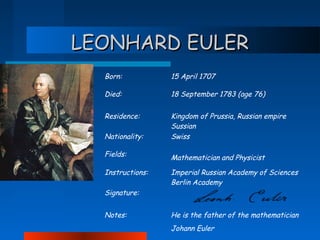
LEONHARD EULER
Born:

15 April 1707

Died:

18 September 1783 (age 76)

Residence:
Nationality:

Kingdom of Prussia, Russian empire
Sussian
Swiss

Fields:

Mathematician and Physicist

Instructions:

Imperial Russian Academy of Sciences
Berlin Academy

Signature:
Notes:

He is the father of the mathematician
Johann Euler
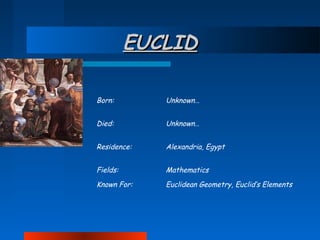
EUCLID
Born:

Unknown…

Died:

Unknown…

Residence:

Alexandria, Egypt

Fields:

Mathematics

Known For:

Euclidean Geometry, Euclid’s Elements
CONTENTS [EULER]
1.






2.








3.
4.

Life
1.1 Early Years
1.2 St. Petersburg
1.3 Berlin
1.4 Eyesight Deterioration
1.5 Return To Russia
Contributions To Mathematics And Physics
2.1 Mathematical Notation
2.2 Analysis
2.3 Number Theory
2.4 Graph Theory
2.5 Applied Mathematics
2.6 Physics And Astronomy
2.7 Logic
Personal Philosophy And Religious Beliefs
Commemorations
LIFE
1.1 Early Years
Euler was born on April 15, 1707, in Basel to Paul
Euler, a pastor of the Reformed Church. His
mother was Marguerite Brucker, a pastor's
daughter. He had two younger sisters named Anna
Maria and Maria Magdalena. Soon after the birth
of Leonhard, the Eulers moved from Basel to the
town of Riehen, where Euler spent most of his
childhood. Paul Euler was a friend of the bernoulli
family—Johann Bernoulli, who was then regarded as
Europe's foremost mathematician, would eventually
be the most important influence on young Leonhard.
1.2 St. Petersburg

Around this time Johann Bernoulli's two sons,
Daniel and Nicolas, were working at the
Imperial Russian Academy of Sciences in St
Petersburg. On July 10, 1726, Nicolas died of
appendicitis after spending a year in Russia,
and when Daniel assumed his brother's position
in the mathematics/physics division, he
recommended that the post in physiology that
he had vacated be filled by his friend Euler. In
November 1726 Euler eagerly accepted the
offer, but delayed making the trip to St
Petersburg while he unsuccessfully applied for
a physics professorship at the University of
Basel.
1.3 Berlin
Euler arrived in the Russian capital on 17 May
1727. He was promoted from his junior post in
the medical department of the academy to a
position in the mathematics department. He
lodged with Daniel Bernoulli with whom he often
worked in close collaboration. Euler mastered
Russian and settled into life in St Petersburg.
He also took on an additional job as a medic in
the Russian Navy.
The Academy at St. Petersburg, established by
Peter the Great, was intended to improve
education in Russia and to close the scientific
gap with Western Europe. As a result, it was
made especially attractive to foreign scholars
like Euler
1.4 Eyesight Deterioration
Euler's eyesight worsened throughout his mathematical
career. Three years after suffering a near-fatal fever in
1735 he became nearly blind in his right eye, but Euler
rather blamed his condition on the painstaking work on
cartography he performed for the St. Petersburg
Academy. Euler's sight in that eye worsened throughout
his stay in Germany, so much so that Frederick referred
to him as "Cyclops". Euler later suffered a cataract in his
good left eye, rendering him almost totally blind a few
weeks after its discovery in 1766. Even so, his condition
appeared to have little effect on his productivity, as he
compensated for it with his mental calculation skills and
photographic memory. For example, Euler could repeat
the Aeneid of Virgil from beginning to end without
hesitation,
1.5 Return To Russia

The situation in Russia had improved greatly since the
accession to the throne of Catherine the Great, and in
1766 Euler accepted an invitation to return to the St.
Petersburg Academy and spent the rest of his life in
Russia. His second stay in the country was marred by
tragedy. A fire in St. Petersburg in 1771 cost him his
home, and almost his life. In 1773, he lost his wife
Katharina after 40 years of marriage. Three years
after his wife's death Euler married her half sister,
Salome Abigail Gsell (1723–1794). This marriage
lasted until his death.
Contribution To Mathematics
And Physics
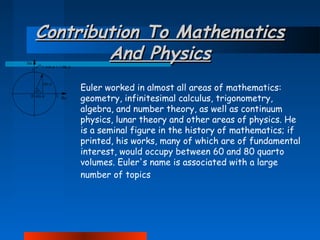
Euler worked in almost all areas of mathematics:
geometry, infinitesimal calculus, trigonometry,
algebra, and number theory, as well as continuum
physics, lunar theory and other areas of physics. He
is a seminal figure in the history of mathematics; if
printed, his works, many of which are of fundamental
interest, would occupy between 60 and 80 quarto
volumes. Euler's name is associated with a large
number of topics
2.1 Mathematical Notation

Euler introduced and popularized several notational
conventions through his numerous and widely circulated
textbooks. Most notably, he introduced the concept of a
function and was the first to write f(x) to denote the
function f applied to the argument x. He also introduced
the modern notation for the trigonometric functions, the
letter e for the base of the natural logarithm (now also
known as Euler's number), the Greek letter Σ for
summations and the letter I to denote the imaginary
unit. The use of the Greek letter π to denote the ratio
of a circle's circumference to its diameter was also
popularized by Euler, although it did not originate with
him.
2.2 Analysis
The development of infinitesimal calculus was at the forefront of
18th Century mathematical research, and the Bernoullis—family
friends of Euler — were responsible for much of the early progress
in the field. Thanks to their influence, studying calculus became the
major focus of Euler's work. While some of Euler's proofs are not
acceptable by modern standards of mathematical rigour (in
particular his reliance on the principle of the generality of algebra),
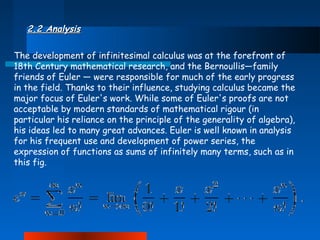
his ideas led to many great advances. Euler is well known in analysis
for his frequent use and development of power series, the
expression of functions as sums of infinitely many terms, such as in
this fig.
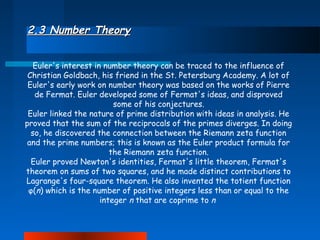
2.3 Number Theory
Euler's interest in number theory can be traced to the influence of
Christian Goldbach, his friend in the St. Petersburg Academy. A lot of
Euler's early work on number theory was based on the works of Pierre
de Fermat. Euler developed some of Fermat's ideas, and disproved
some of his conjectures.
Euler linked the nature of prime distribution with ideas in analysis. He
proved that the sum of the reciprocals of the primes diverges. In doing
so, he discovered the connection between the Riemann zeta function
and the prime numbers; this is known as the Euler product formula for
the Riemann zeta function.
Euler proved Newton's identities, Fermat's little theorem, Fermat's
theorem on sums of two squares, and he made distinct contributions to
Lagrange's four-square theorem. He also invented the totient function
φ(n) which is the number of positive integers less than or equal to the
integer n that are coprime to n
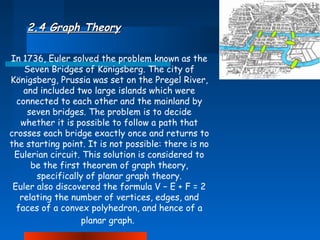
2.4 Graph Theory
In 1736, Euler solved the problem known as the
Seven Bridges of Königsberg. The city of
Königsberg, Prussia was set on the Pregel River,
and included two large islands which were
connected to each other and the mainland by
seven bridges. The problem is to decide
whether it is possible to follow a path that
crosses each bridge exactly once and returns to
the starting point. It is not possible: there is no
Eulerian circuit. This solution is considered to
be the first theorem of graph theory,
specifically of planar graph theory.
Euler also discovered the formula V − E + F = 2
relating the number of vertices, edges, and
faces of a convex polyhedron, and hence of a
planar graph.
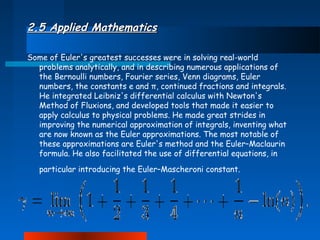
2.5 Applied Mathematics
Some of Euler's greatest successes were in solving real-world
problems analytically, and in describing numerous applications of
the Bernoulli numbers, Fourier series, Venn diagrams, Euler
numbers, the constants e and π, continued fractions and integrals.
He integrated Leibniz's differential calculus with Newton's
Method of Fluxions, and developed tools that made it easier to
apply calculus to physical problems. He made great strides in
improving the numerical approximation of integrals, inventing what
are now known as the Euler approximations. The most notable of
these approximations are Euler's method and the Euler–Maclaurin
formula. He also facilitated the use of differential equations, in
particular introducing the Euler–Mascheroni constant.
2.6 Physics And Astronomy
Euler helped develop the Euler–Bernoulli beam equation, which
became a cornerstone of engineering. Aside from
successfully applying his analytic tools to problems in
classical mechanics, Euler also applied these techniques to
celestial problems. His work in astronomy was recognized by
a number of Paris Academy Prizes over the course of his
career. His accomplishments include determining with great
accuracy the orbits of comets and other celestial bodies,
understanding the nature of comets, and calculating the
parallax of the sun. His calculations also contributed to the
development of accurate longitude tables.
In addition, Euler made important contributions in optics. He
disagreed with Newton's corpuscular theory of light in the
Opticks, which was then the prevailing theory.
2.7 Logic
He is also credited with using closed curves to illustrate
syllogistic reasoning (1768). These diagrams have become known
as Euler diagrams.
Personal Philosophy And
Religious Beliefs
Euler and his friend Daniel Bernoulli were opponents of
Leibniz's monadism and the philosophy of Christian Wolff.
Euler insisted that knowledge is founded in part on the basis
of precise quantitative laws, something that monadism and
Wolffian science were unable to provide. Euler's religious
leanings might also have had a bearing on his dislike of the
doctrine; he went so far as to label Wolff's ideas as
"heathen and atheistic".
Much of what is known of Euler's religious beliefs can be
deduced from his Letters to a German Princess and an
earlier work.
Commemorations
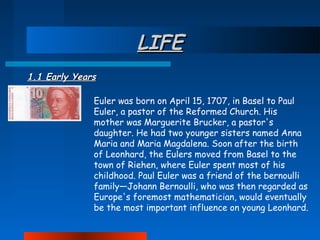
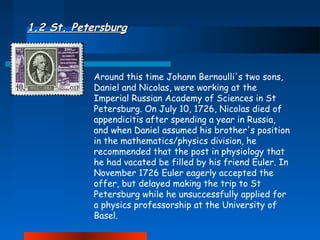
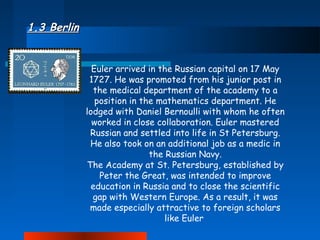
Euler was featured on the sixth series of the Swiss 10-franc
banknote and on numerous Swiss, German, and Russian
postage stamps. The asteroid 2002 Euler was named in his
honor. He is also commemorated by the Lutheran Church on
their Calendar of Saints on 24 May—he was a devout
Christian (and believer in biblical inerrancy) who wrote
apologetics and argued forcefully against the prominent
atheists of his time.
CONTENTS [EUCLID]
1.
2.
3.

Life
Elements
Other Work
LIFE
Little is known about Euclid's life, as there are only a
handful of references to him. The date and place of Euclid's
birth and the date and circumstances of his death are
unknown, and only roughly estimated in proximity to
contemporary figures mentioned in references. No likeness
or description of Euclid's physical appearance made during
his lifetime survived antiquity. Therefore, Euclid's depiction
in works of art is the product of the artist's imagination.
The few historical references to Euclid were written
centuries after he lived, by Proclus and Pappus of
Alexandria. Proclus introduces Euclid only briefly in his
fifth-century Commentary on the Elements, as the author of
Elements, that he was mentioned by Archimedes, and that
when King Ptolemy asked if there was a shorter path to
learning geometry than Euclid's Elements, "Euclid replied
there is no royal road to geometry."
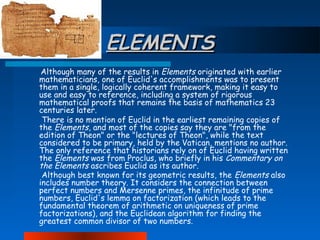
ELEMENTS
Although many of the results in Elements originated with earlier
mathematicians, one of Euclid's accomplishments was to present
them in a single, logically coherent framework, making it easy to
use and easy to reference, including a system of rigorous
mathematical proofs that remains the basis of mathematics 23
centuries later.
There is no mention of Euclid in the earliest remaining copies of
the Elements, and most of the copies say they are "from the
edition of Theon" or the "lectures of Theon", while the text
considered to be primary, held by the Vatican, mentions no author.
The only reference that historians rely on of Euclid having written
the Elements was from Proclus, who briefly in his Commentary on
the Elements ascribes Euclid as its author.
Although best known for its geometric results, the Elements also
includes number theory. It considers the connection between
perfect numbers and Mersenne primes, the infinitude of prime
numbers, Euclid's lemma on factorization (which leads to the
fundamental theorem of arithmetic on uniqueness of prime
factorizations), and the Euclidean algorithm for finding the
greatest common divisor of two numbers.
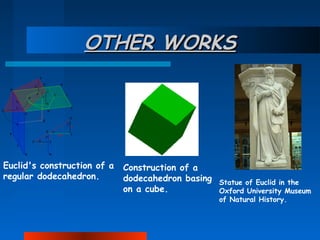
OTHER WORKS

Euclid's construction of a
regular dodecahedron. 

Construction of a
dodecahedron basing
on a cube.

Statue of Euclid in the
Oxford University Museum
of Natural History. 
THANK YOU

Euler and Euclid

  • 1.
    Euler and Euclid MadeBy: Lavanya Topa
  • 2.
    LEONHARD EULER Born: 15 April1707 Died: 18 September 1783 (age 76) Residence: Nationality: Kingdom of Prussia, Russian empire Sussian Swiss Fields: Mathematician and Physicist Instructions: Imperial Russian Academy of Sciences Berlin Academy Signature: Notes: He is the father of the mathematician Johann Euler
  • 3.
  • 4.
    CONTENTS [EULER] 1.      2.        3. 4. Life 1.1 EarlyYears 1.2 St. Petersburg 1.3 Berlin 1.4 Eyesight Deterioration 1.5 Return To Russia Contributions To Mathematics And Physics 2.1 Mathematical Notation 2.2 Analysis 2.3 Number Theory 2.4 Graph Theory 2.5 Applied Mathematics 2.6 Physics And Astronomy 2.7 Logic Personal Philosophy And Religious Beliefs Commemorations
  • 5.
    LIFE 1.1 Early Years Eulerwas born on April 15, 1707, in Basel to Paul Euler, a pastor of the Reformed Church. His mother was Marguerite Brucker, a pastor's daughter. He had two younger sisters named Anna Maria and Maria Magdalena. Soon after the birth of Leonhard, the Eulers moved from Basel to the town of Riehen, where Euler spent most of his childhood. Paul Euler was a friend of the bernoulli family—Johann Bernoulli, who was then regarded as Europe's foremost mathematician, would eventually be the most important influence on young Leonhard.
  • 6.
    1.2 St. Petersburg Aroundthis time Johann Bernoulli's two sons, Daniel and Nicolas, were working at the Imperial Russian Academy of Sciences in St Petersburg. On July 10, 1726, Nicolas died of appendicitis after spending a year in Russia, and when Daniel assumed his brother's position in the mathematics/physics division, he recommended that the post in physiology that he had vacated be filled by his friend Euler. In November 1726 Euler eagerly accepted the offer, but delayed making the trip to St Petersburg while he unsuccessfully applied for a physics professorship at the University of Basel.
  • 7.
    1.3 Berlin Euler arrivedin the Russian capital on 17 May 1727. He was promoted from his junior post in the medical department of the academy to a position in the mathematics department. He lodged with Daniel Bernoulli with whom he often worked in close collaboration. Euler mastered Russian and settled into life in St Petersburg. He also took on an additional job as a medic in the Russian Navy. The Academy at St. Petersburg, established by Peter the Great, was intended to improve education in Russia and to close the scientific gap with Western Europe. As a result, it was made especially attractive to foreign scholars like Euler
  • 8.
    1.4 Eyesight Deterioration Euler'seyesight worsened throughout his mathematical career. Three years after suffering a near-fatal fever in 1735 he became nearly blind in his right eye, but Euler rather blamed his condition on the painstaking work on cartography he performed for the St. Petersburg Academy. Euler's sight in that eye worsened throughout his stay in Germany, so much so that Frederick referred to him as "Cyclops". Euler later suffered a cataract in his good left eye, rendering him almost totally blind a few weeks after its discovery in 1766. Even so, his condition appeared to have little effect on his productivity, as he compensated for it with his mental calculation skills and photographic memory. For example, Euler could repeat the Aeneid of Virgil from beginning to end without hesitation,
  • 9.
    1.5 Return ToRussia The situation in Russia had improved greatly since the accession to the throne of Catherine the Great, and in 1766 Euler accepted an invitation to return to the St. Petersburg Academy and spent the rest of his life in Russia. His second stay in the country was marred by tragedy. A fire in St. Petersburg in 1771 cost him his home, and almost his life. In 1773, he lost his wife Katharina after 40 years of marriage. Three years after his wife's death Euler married her half sister, Salome Abigail Gsell (1723–1794). This marriage lasted until his death.
  • 10.
    Contribution To Mathematics AndPhysics Euler worked in almost all areas of mathematics: geometry, infinitesimal calculus, trigonometry, algebra, and number theory, as well as continuum physics, lunar theory and other areas of physics. He is a seminal figure in the history of mathematics; if printed, his works, many of which are of fundamental interest, would occupy between 60 and 80 quarto volumes. Euler's name is associated with a large number of topics
  • 11.
    2.1 Mathematical Notation Eulerintroduced and popularized several notational conventions through his numerous and widely circulated textbooks. Most notably, he introduced the concept of a function and was the first to write f(x) to denote the function f applied to the argument x. He also introduced the modern notation for the trigonometric functions, the letter e for the base of the natural logarithm (now also known as Euler's number), the Greek letter Σ for summations and the letter I to denote the imaginary unit. The use of the Greek letter π to denote the ratio of a circle's circumference to its diameter was also popularized by Euler, although it did not originate with him.
  • 12.
    2.2 Analysis The developmentof infinitesimal calculus was at the forefront of 18th Century mathematical research, and the Bernoullis—family friends of Euler — were responsible for much of the early progress in the field. Thanks to their influence, studying calculus became the major focus of Euler's work. While some of Euler's proofs are not acceptable by modern standards of mathematical rigour (in particular his reliance on the principle of the generality of algebra), his ideas led to many great advances. Euler is well known in analysis for his frequent use and development of power series, the expression of functions as sums of infinitely many terms, such as in this fig.
  • 13.
    2.3 Number Theory Euler'sinterest in number theory can be traced to the influence of Christian Goldbach, his friend in the St. Petersburg Academy. A lot of Euler's early work on number theory was based on the works of Pierre de Fermat. Euler developed some of Fermat's ideas, and disproved some of his conjectures. Euler linked the nature of prime distribution with ideas in analysis. He proved that the sum of the reciprocals of the primes diverges. In doing so, he discovered the connection between the Riemann zeta function and the prime numbers; this is known as the Euler product formula for the Riemann zeta function. Euler proved Newton's identities, Fermat's little theorem, Fermat's theorem on sums of two squares, and he made distinct contributions to Lagrange's four-square theorem. He also invented the totient function φ(n) which is the number of positive integers less than or equal to the integer n that are coprime to n
  • 14.
    2.4 Graph Theory In1736, Euler solved the problem known as the Seven Bridges of Königsberg. The city of Königsberg, Prussia was set on the Pregel River, and included two large islands which were connected to each other and the mainland by seven bridges. The problem is to decide whether it is possible to follow a path that crosses each bridge exactly once and returns to the starting point. It is not possible: there is no Eulerian circuit. This solution is considered to be the first theorem of graph theory, specifically of planar graph theory. Euler also discovered the formula V − E + F = 2 relating the number of vertices, edges, and faces of a convex polyhedron, and hence of a planar graph.
  • 15.
    2.5 Applied Mathematics Someof Euler's greatest successes were in solving real-world problems analytically, and in describing numerous applications of the Bernoulli numbers, Fourier series, Venn diagrams, Euler numbers, the constants e and π, continued fractions and integrals. He integrated Leibniz's differential calculus with Newton's Method of Fluxions, and developed tools that made it easier to apply calculus to physical problems. He made great strides in improving the numerical approximation of integrals, inventing what are now known as the Euler approximations. The most notable of these approximations are Euler's method and the Euler–Maclaurin formula. He also facilitated the use of differential equations, in particular introducing the Euler–Mascheroni constant.
  • 16.
    2.6 Physics AndAstronomy Euler helped develop the Euler–Bernoulli beam equation, which became a cornerstone of engineering. Aside from successfully applying his analytic tools to problems in classical mechanics, Euler also applied these techniques to celestial problems. His work in astronomy was recognized by a number of Paris Academy Prizes over the course of his career. His accomplishments include determining with great accuracy the orbits of comets and other celestial bodies, understanding the nature of comets, and calculating the parallax of the sun. His calculations also contributed to the development of accurate longitude tables. In addition, Euler made important contributions in optics. He disagreed with Newton's corpuscular theory of light in the Opticks, which was then the prevailing theory.
  • 17.
    2.7 Logic He isalso credited with using closed curves to illustrate syllogistic reasoning (1768). These diagrams have become known as Euler diagrams.
  • 18.
    Personal Philosophy And ReligiousBeliefs Euler and his friend Daniel Bernoulli were opponents of Leibniz's monadism and the philosophy of Christian Wolff. Euler insisted that knowledge is founded in part on the basis of precise quantitative laws, something that monadism and Wolffian science were unable to provide. Euler's religious leanings might also have had a bearing on his dislike of the doctrine; he went so far as to label Wolff's ideas as "heathen and atheistic". Much of what is known of Euler's religious beliefs can be deduced from his Letters to a German Princess and an earlier work.
  • 19.
    Commemorations Euler was featuredon the sixth series of the Swiss 10-franc banknote and on numerous Swiss, German, and Russian postage stamps. The asteroid 2002 Euler was named in his honor. He is also commemorated by the Lutheran Church on their Calendar of Saints on 24 May—he was a devout Christian (and believer in biblical inerrancy) who wrote apologetics and argued forcefully against the prominent atheists of his time.
  • 20.
  • 21.
    LIFE Little is knownabout Euclid's life, as there are only a handful of references to him. The date and place of Euclid's birth and the date and circumstances of his death are unknown, and only roughly estimated in proximity to contemporary figures mentioned in references. No likeness or description of Euclid's physical appearance made during his lifetime survived antiquity. Therefore, Euclid's depiction in works of art is the product of the artist's imagination. The few historical references to Euclid were written centuries after he lived, by Proclus and Pappus of Alexandria. Proclus introduces Euclid only briefly in his fifth-century Commentary on the Elements, as the author of Elements, that he was mentioned by Archimedes, and that when King Ptolemy asked if there was a shorter path to learning geometry than Euclid's Elements, "Euclid replied there is no royal road to geometry."
  • 22.
    ELEMENTS Although many ofthe results in Elements originated with earlier mathematicians, one of Euclid's accomplishments was to present them in a single, logically coherent framework, making it easy to use and easy to reference, including a system of rigorous mathematical proofs that remains the basis of mathematics 23 centuries later. There is no mention of Euclid in the earliest remaining copies of the Elements, and most of the copies say they are "from the edition of Theon" or the "lectures of Theon", while the text considered to be primary, held by the Vatican, mentions no author. The only reference that historians rely on of Euclid having written the Elements was from Proclus, who briefly in his Commentary on the Elements ascribes Euclid as its author. Although best known for its geometric results, the Elements also includes number theory. It considers the connection between perfect numbers and Mersenne primes, the infinitude of prime numbers, Euclid's lemma on factorization (which leads to the fundamental theorem of arithmetic on uniqueness of prime factorizations), and the Euclidean algorithm for finding the greatest common divisor of two numbers.
  • 23.
    OTHER WORKS Euclid's constructionof a regular dodecahedron.  Construction of a dodecahedron basing on a cube. Statue of Euclid in the Oxford University Museum of Natural History. 
  • 24.