Eesti Pank 
June 18, 2014 
Real unit labour costs in Eurozone countries: 
Drivers and clusters 
Javier Ordóñez 
Hector Sala 
José I. Silva
Introduction: 
Can nominal convergence last in the absence of real convergence? 
Our view is that the EU policy mix has been successful in terms of nominal 
convergence but has not been conducive to overall growth nor to real convergence 
across the euro area. 
The current economic crisis is the consequence of differences in competitiveness that 
generate real divergence and, therefore, growing account imbalances. 
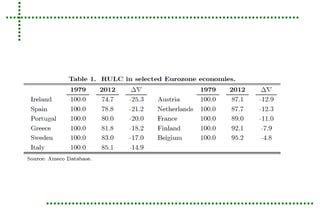
In this paper we take the real unit labour cost (RULC) as a relevant indicator of 
competitiveness and, as such, as a driver of real convergence. We examine to what 
extent our hypothesis of latent divergence forces holds by clustering the RULC 
according to its performance in a selection of 11 Eurozone economies.
Analytical decomposition: 
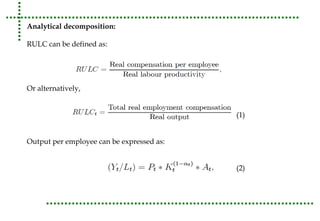
RULC can be defined as: 
Or alternatively, 
(1) 
Output per employee can be expressed as: 
(2)
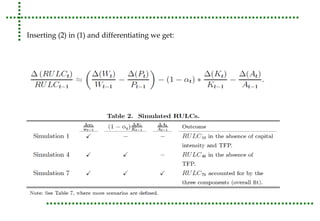
Inserting (2) in (1) and differentiating we get:
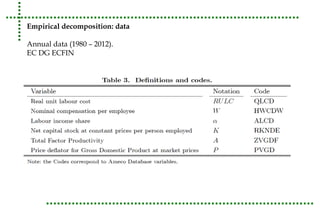
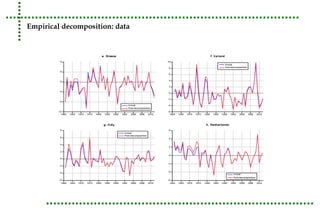
Empirical decomposition: data 
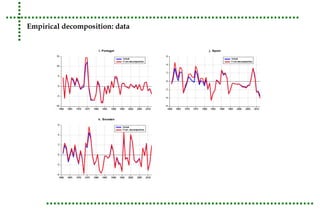
Annual data (1980 – 2012). 
EC DG ECFIN
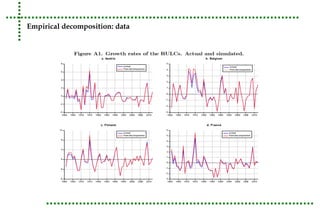
Empirical decomposition: data
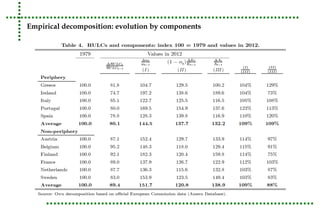
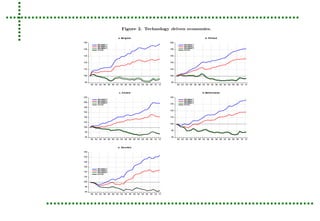
Empirical decomposition: evolution by components
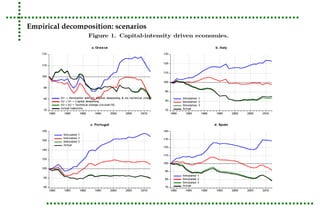
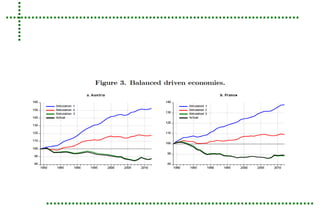
Empirical decomposition: scenarios
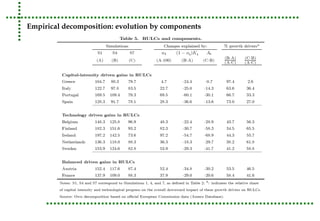
Empirical decomposition: evolution by components
Cluster analysis: methodology 
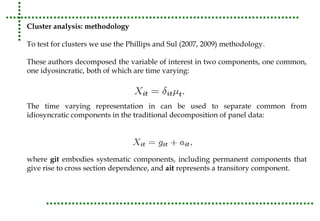
To test for clusters we use the Phillips and Sul (2007, 2009) methodology. 
These authors decomposed the variable of interest in two components, one common, 
one idyosincratic, both of which are time varying: 
The time varying representation in can be used to separate common from 
idiosyncratic components in the traditional decomposition of panel data: 
where git embodies systematic components, including permanent components that 
give rise to cross section dependence, and ait represents a transitory component.
Cluster analysis: methodology 
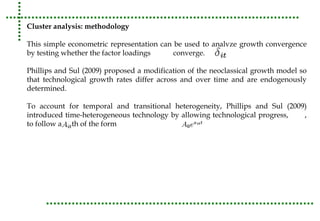
This simple econometric representation can be used to analyze growth convergence 
by testing whether the factor loadings converge. 
Phillips and Sul (2009) proposed a modification of the neoclassical growth model so 
that technological growth rates differ across and over time and are endogenously 
determined. 
To account for temporal and transitional heterogeneity, Phillips and Sul (2009) 
introduced time-heterogeneous technology by allowing technological progress, , 
to follow a path of the form
Cluster analysis: methodology 
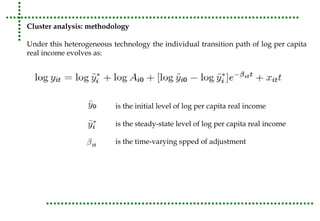
Under this heterogeneous technology the individual transition path of log per capita 
real income evolves as: 
is the initial level of log per capita real income 
is the steady-state level of log per capita real income 
is the time-varying spped of adjustment
Cluster analysis: methodology 
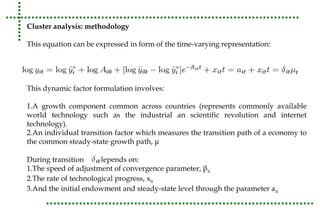
This equation can be expressed in form of the time-varying representation: 
This dynamic factor formulation involves: 
1.A growth component common across countries (represents commonly available 
world technology such as the industrial an scientific revolution and internet 
technology). 
2.An individual transition factor which measures the transition path of a economy to 
the common steady-state growth path, μ 
During transition depends on: 
1.The speed of adjustment of convergence parameter, βit 
2.The rate of technological progress, xit 
3.And the initial endowment and steady-state level through the parameter ait
Cluster analysis: methodology 
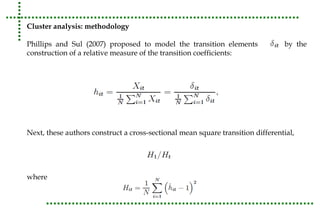
Phillips and Sul (2007) proposed to model the transition elements by the 
construction of a relative measure of the transition coefficients: 
Next, these authors construct a cross-sectional mean square transition differential, 
where
Cluster analysis: methodology 
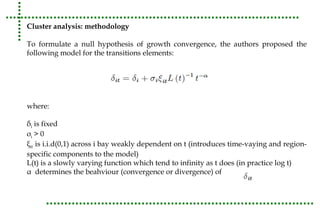
To formulate a null hypothesis of growth convergence, the authors proposed the 
following model for the transitions elements: 
where: 
δi is fixed 
σi > 0 
ξit is i.i.d(0,1) across i bay weakly dependent on t (introduces time-vaying and region-specific 
components to the model) 
L(t) is a slowly varying function which tend to infinity as t does (in practice log t) 
α determines the beahviour (convergence or divergence) of
Cluster analysis: methodology 
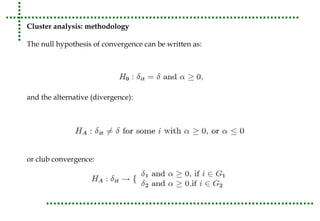
The null hypothesis of convergence can be written as: 
and the alternative (divergence): 
or club convergence:
Cluster analysis: methodology 
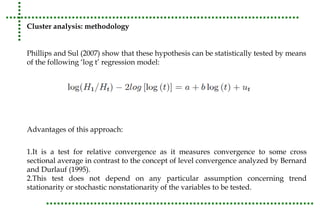
Phillips and Sul (2007) show that these hypothesis can be statistically tested by means 
of the following ‘log t’ regression model: 
Advantages of this approach: 
1.It is a test for relative convergence as it measures convergence to some cross 
sectional average in contrast to the concept of level convergence analyzed by Bernard 
and Durlauf (1995). 
2.This test does not depend on any particular assumption concerning trend 
stationarity or stochastic nonstationarity of the variables to be tested.
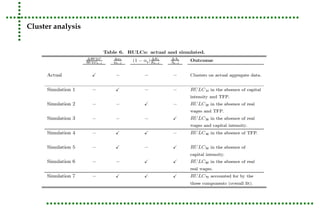
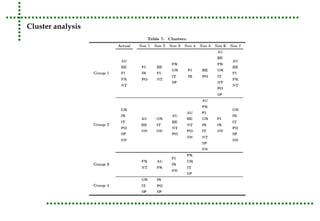
Cluster analysis
Cluster analysis
Concluding remarks 
Since the oberved divergencies can be ascribed mainly to different technological 
levels, rather than to a wrong wage behaviour in the Periphery, internal devaluation 
policies are not the solution to surpass the current situation in the Eurozone. These 
policies have forced rebalancing of the external deficits, but they do not help 
convergence. And the reason is the same we have heard many times when economies 
embark in external devaluations: these are not genuine competitive gains, it is 
technology what matters. 
Hence, looking retrospectively, the definition of the Maastricht criteria should have 
been probably more balanced towards the inclusion of some real convergence 
indicators to be fulfilled before joining the EMU. The extensive battery of indicators 
considered in the macroeconomic imbalance procedure (MIP) constitute a response 
to this void. We cannot abstain, however, to point out that this new set of indicative 
thresholds are formulated as a surveillance mechanism, and not as convergence 
targets. We wonder, in the current context, whether some real convergence indicators 
should also be targeted to safeguard, or at least strengthen, the process of European 
integration.

Javier Ordóñez. Real unit labour costs in Eurozone countries: Drivers and clusters

  • 1.
    Eesti Pank June18, 2014 Real unit labour costs in Eurozone countries: Drivers and clusters Javier Ordóñez Hector Sala José I. Silva
  • 2.
    Introduction: Can nominalconvergence last in the absence of real convergence? Our view is that the EU policy mix has been successful in terms of nominal convergence but has not been conducive to overall growth nor to real convergence across the euro area. The current economic crisis is the consequence of differences in competitiveness that generate real divergence and, therefore, growing account imbalances. In this paper we take the real unit labour cost (RULC) as a relevant indicator of competitiveness and, as such, as a driver of real convergence. We examine to what extent our hypothesis of latent divergence forces holds by clustering the RULC according to its performance in a selection of 11 Eurozone economies.
  • 4.
    Analytical decomposition: RULCcan be defined as: Or alternatively, (1) Output per employee can be expressed as: (2)
  • 5.
    Inserting (2) in(1) and differentiating we get:
  • 6.
    Empirical decomposition: data Annual data (1980 – 2012). EC DG ECFIN
  • 7.
  • 8.
  • 9.
  • 10.
  • 11.
  • 14.
  • 15.
    Cluster analysis: methodology To test for clusters we use the Phillips and Sul (2007, 2009) methodology. These authors decomposed the variable of interest in two components, one common, one idyosincratic, both of which are time varying: The time varying representation in can be used to separate common from idiosyncratic components in the traditional decomposition of panel data: where git embodies systematic components, including permanent components that give rise to cross section dependence, and ait represents a transitory component.
  • 16.
    Cluster analysis: methodology This simple econometric representation can be used to analyze growth convergence by testing whether the factor loadings converge. Phillips and Sul (2009) proposed a modification of the neoclassical growth model so that technological growth rates differ across and over time and are endogenously determined. To account for temporal and transitional heterogeneity, Phillips and Sul (2009) introduced time-heterogeneous technology by allowing technological progress, , to follow a path of the form
  • 17.
    Cluster analysis: methodology Under this heterogeneous technology the individual transition path of log per capita real income evolves as: is the initial level of log per capita real income is the steady-state level of log per capita real income is the time-varying spped of adjustment
  • 18.
    Cluster analysis: methodology This equation can be expressed in form of the time-varying representation: This dynamic factor formulation involves: 1.A growth component common across countries (represents commonly available world technology such as the industrial an scientific revolution and internet technology). 2.An individual transition factor which measures the transition path of a economy to the common steady-state growth path, μ During transition depends on: 1.The speed of adjustment of convergence parameter, βit 2.The rate of technological progress, xit 3.And the initial endowment and steady-state level through the parameter ait
  • 19.
    Cluster analysis: methodology Phillips and Sul (2007) proposed to model the transition elements by the construction of a relative measure of the transition coefficients: Next, these authors construct a cross-sectional mean square transition differential, where
  • 20.
    Cluster analysis: methodology To formulate a null hypothesis of growth convergence, the authors proposed the following model for the transitions elements: where: δi is fixed σi > 0 ξit is i.i.d(0,1) across i bay weakly dependent on t (introduces time-vaying and region-specific components to the model) L(t) is a slowly varying function which tend to infinity as t does (in practice log t) α determines the beahviour (convergence or divergence) of
  • 21.
    Cluster analysis: methodology The null hypothesis of convergence can be written as: and the alternative (divergence): or club convergence:
  • 22.
    Cluster analysis: methodology Phillips and Sul (2007) show that these hypothesis can be statistically tested by means of the following ‘log t’ regression model: Advantages of this approach: 1.It is a test for relative convergence as it measures convergence to some cross sectional average in contrast to the concept of level convergence analyzed by Bernard and Durlauf (1995). 2.This test does not depend on any particular assumption concerning trend stationarity or stochastic nonstationarity of the variables to be tested.
  • 23.
  • 24.
  • 25.
    Concluding remarks Sincethe oberved divergencies can be ascribed mainly to different technological levels, rather than to a wrong wage behaviour in the Periphery, internal devaluation policies are not the solution to surpass the current situation in the Eurozone. These policies have forced rebalancing of the external deficits, but they do not help convergence. And the reason is the same we have heard many times when economies embark in external devaluations: these are not genuine competitive gains, it is technology what matters. Hence, looking retrospectively, the definition of the Maastricht criteria should have been probably more balanced towards the inclusion of some real convergence indicators to be fulfilled before joining the EMU. The extensive battery of indicators considered in the macroeconomic imbalance procedure (MIP) constitute a response to this void. We cannot abstain, however, to point out that this new set of indicative thresholds are formulated as a surveillance mechanism, and not as convergence targets. We wonder, in the current context, whether some real convergence indicators should also be targeted to safeguard, or at least strengthen, the process of European integration.