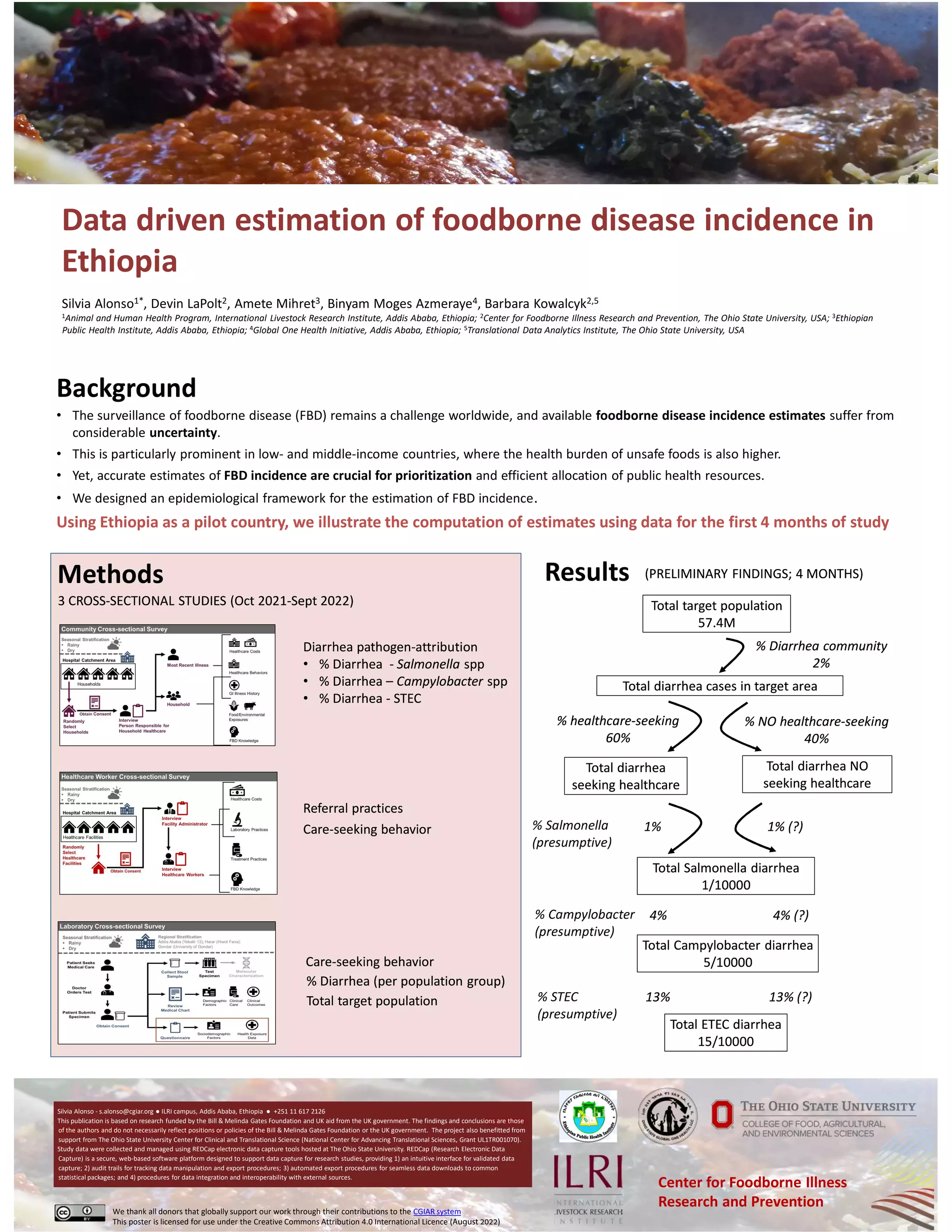
Data driven estimation of foodborne disease incidence in
Ethiopia
Silvia Alonso1*, Devin LaPolt2, Amete Mihret3, Binyam Moges Azmeraye4, Barbara Kowalcyk2,5
1Animal and Human Health Program, International Livestock Research Institute, Addis Ababa, Ethiopia; 2Center for Foodborne Illness Research and Prevention, The Ohio State University, USA; 3Ethiopian
Public Health Institute, Addis Ababa, Ethiopia; 4Global One Health Initiative, Addis Ababa, Ethiopia; 5Translational Data Analytics Institute, The Ohio State University, USA
Background
• The surveillance of foodborne disease (FBD) remains a challenge worldwide, and available foodborne disease incidence estimates suffer from
considerable uncertainty.
• This is particularly prominent in low- and middle-income countries, where the health burden of unsafe foods is also higher.
• Yet, accurate estimates of FBD incidence are crucial for prioritization and efficient allocation of public health resources.
• We designed an epidemiological framework for the estimation of FBD incidence.
Using Ethiopia as a pilot country, we illustrate the computation of estimates using data for the first 4 months of study
Silvia Alonso - s.alonso@cgiar.org ● ILRI campus, Addis Ababa, Ethiopia ● +251 11 617 2126
This publication is based on research funded by the Bill & Melinda Gates Foundation and UK aid from the UK government. The findings and conclusions are those
of the authors and do not necessarily reflect positions or policies of the Bill & Melinda Gates Foundation or the UK government. The project also benefitted from
support from The Ohio State University Center for Clinical and Translational Science (National Center for Advancing Translational Sciences, Grant UL1TR001070).
Study data were collected and managed using REDCap electronic data capture tools hosted at The Ohio State University. REDCap (Research Electronic Data
Capture) is a secure, web-based software platform designed to support data capture for research studies, providing 1) an intuitive interface for validated data
capture; 2) audit trails for tracking data manipulation and export procedures; 3) automated export procedures for seamless data downloads to common
statistical packages; and 4) procedures for data integration and interoperability with external sources.
Methods Results
3 CROSS-SECTIONAL STUDIES (Oct 2021-Sept 2022)
(PRELIMINARY FINDINGS; 4 MONTHS)
We thank all donors that globally support our work through their contributions to the CGIAR system
This poster is licensed for use under the Creative Commons Attribution 4.0 International Licence (August 2022)
Total target population
% Diarrhea (per population group)
Care-seeking behavior
Referral practices
Referral practices
Diarrhea pathogen-attribution
• % Diarrhea - Salmonella spp
• % Diarrhea – Campylobacter spp
• % Diarrhea - STEC
Diarrhea pathogen-attribution
• % Diarrhea - Salmonella spp
• % Diarrhea – Campylobacter spp
• % Diarrhea - STEC
Care-seeking behavior
Total target population
57.4M
Total target population
57.4M
% Diarrhea community
2%
% Diarrhea community
2%
% healthcare-seeking
60%
% healthcare-seeking
60%
% NO healthcare-seeking
40%
% NO healthcare-seeking
40%
Total diarrhea cases in target area
Total diarrhea NO
seeking healthcare
Total diarrhea NO
seeking healthcare
Total diarrhea
seeking healthcare
Total diarrhea
seeking healthcare
1% 1% (?)
1% 1% (?)
Total Salmonella diarrhea
1/10000
Total Salmonella diarrhea
1/10000
Total Campylobacter diarrhea
5/10000
Total Campylobacter diarrhea
5/10000
Total ETEC diarrhea
15/10000
Total ETEC diarrhea
15/10000
4% 4% (?)
4% 4% (?)
13% 13% (?)
13% 13% (?)
% Salmonella
(presumptive)
% Campylobacter
(presumptive)
% STEC
(presumptive)
Center for Foodborne Illness
Research and Prevention

Data driven estimation of foodborne disease incidence in Ethiopia

  • 1.
    Data driven estimationof foodborne disease incidence in Ethiopia Silvia Alonso1*, Devin LaPolt2, Amete Mihret3, Binyam Moges Azmeraye4, Barbara Kowalcyk2,5 1Animal and Human Health Program, International Livestock Research Institute, Addis Ababa, Ethiopia; 2Center for Foodborne Illness Research and Prevention, The Ohio State University, USA; 3Ethiopian Public Health Institute, Addis Ababa, Ethiopia; 4Global One Health Initiative, Addis Ababa, Ethiopia; 5Translational Data Analytics Institute, The Ohio State University, USA Background • The surveillance of foodborne disease (FBD) remains a challenge worldwide, and available foodborne disease incidence estimates suffer from considerable uncertainty. • This is particularly prominent in low- and middle-income countries, where the health burden of unsafe foods is also higher. • Yet, accurate estimates of FBD incidence are crucial for prioritization and efficient allocation of public health resources. • We designed an epidemiological framework for the estimation of FBD incidence. Using Ethiopia as a pilot country, we illustrate the computation of estimates using data for the first 4 months of study Silvia Alonso - s.alonso@cgiar.org ● ILRI campus, Addis Ababa, Ethiopia ● +251 11 617 2126 This publication is based on research funded by the Bill & Melinda Gates Foundation and UK aid from the UK government. The findings and conclusions are those of the authors and do not necessarily reflect positions or policies of the Bill & Melinda Gates Foundation or the UK government. The project also benefitted from support from The Ohio State University Center for Clinical and Translational Science (National Center for Advancing Translational Sciences, Grant UL1TR001070). Study data were collected and managed using REDCap electronic data capture tools hosted at The Ohio State University. REDCap (Research Electronic Data Capture) is a secure, web-based software platform designed to support data capture for research studies, providing 1) an intuitive interface for validated data capture; 2) audit trails for tracking data manipulation and export procedures; 3) automated export procedures for seamless data downloads to common statistical packages; and 4) procedures for data integration and interoperability with external sources. Methods Results 3 CROSS-SECTIONAL STUDIES (Oct 2021-Sept 2022) 3 CROSS-SECTIONAL STUDIES (Oct 2021-Sept 2022) (PRELIMINARY FINDINGS; 4 MONTHS) (PRELIMINARY FINDINGS; 4 MONTHS) We thank all donors that globally support our work through their contributions to the CGIAR system This poster is licensed for use under the Creative Commons Attribution 4.0 International Licence (August 2022) Total target population Total target population % Diarrhea (per population group) % Diarrhea (per population group) Care-seeking behavior Care-seeking behavior Referral practices Referral practices Diarrhea pathogen-attribution • % Diarrhea - Salmonella spp • % Diarrhea – Campylobacter spp • % Diarrhea - STEC Diarrhea pathogen-attribution • % Diarrhea - Salmonella spp • % Diarrhea – Campylobacter spp • % Diarrhea - STEC Care-seeking behavior Care-seeking behavior Total target population 57.4M Total target population 57.4M % Diarrhea community 2% % Diarrhea community 2% % healthcare-seeking 60% % healthcare-seeking 60% % NO healthcare-seeking 40% % NO healthcare-seeking 40% Total diarrhea cases in target area Total diarrhea cases in target area Total diarrhea NO seeking healthcare Total diarrhea NO seeking healthcare Total diarrhea seeking healthcare Total diarrhea seeking healthcare 1% 1% (?) 1% 1% (?) Total Salmonella diarrhea 1/10000 Total Salmonella diarrhea 1/10000 Total Campylobacter diarrhea 5/10000 Total Campylobacter diarrhea 5/10000 Total ETEC diarrhea 15/10000 Total ETEC diarrhea 15/10000 4% 4% (?) 4% 4% (?) 13% 13% (?) 13% 13% (?) % Salmonella (presumptive) % Campylobacter (presumptive) % STEC (presumptive) Center for Foodborne Illness Research and Prevention