PHARMACY PROFESSIONAL
ETHICS
1
OBJECTIVES
1. Understand the importance of ethics in the pharmacy profession
2. To describe the concepts and theories used in professional ethics
3. To relate and apply the ethical theories to the pharmacy profession.
4. To understand the framework in ethical decisional making in Pharmacy.
2
Definitions
• a code of ethics is a guide of principles designed to help professional
conduct business honestly and with integrity
• Also refered to as Ethical code , may encompass areas such as
business ethics, code of professional practice based on the Key
principals
• non- maleficence, Beneficence,effiency, respect of autonomy, justice,
and proportionality
BACKGROUND
• Over time, the role of pharmacists has changed significantly.
• Pharmacists are now playing a global crucial role in the adoption of global
standards and creating trends in pharmaceutical practices.
• “Patients are entitled to good standards of practice and care from their
healthcare providers.
• Essential elements of this(care &practice) are professional competence, good
relationships with patients and colleagues and observance of professional
ethical obligations.”
• The "triad of medical care" has been the basis for the ethical relationship
between the pharmacist, the physician, and the patient for centuries.
4
• Pharmacists have taken an awesome responsibility for learning about and
preparing medicines in-order to manage their health care.
• The practice of pharmacy and all health professions is an intensely personal,
peculiarly human activity that has been traditionally guided by basic human
values such as compassion, dignity, justice, and truth.
• When the full range of personal and societal values associated with pharmacy
practice is taken into consideration, even the seemingly benign activity take on
added meaning.
BACKGROUND
5
PHARMACY ETHICS
• Pharmacists are health professionals who assist individuals in making the best
use of medications.
• This Code, prepared and supported by pharmacists, is intended to state
publicly the principles that form the fundamental basis of the roles and
responsibilities of pharmacists.
• These principles, based on moral obligations and virtues, are established to
guide pharmacists in relationships with patients, health professionals, and
society.
6
Principals
• A pharmacist respects the covenantal relationship between the
patient and pharmacist.
• A pharmacist promotes the good of every patient in a caring,
compassionate, and confidential manner.
• A pharmacist respects the autonomy and dignity of each patient.
• A pharmacist acts with honesty and integrity in professional
relationships.
• A pharmacist maintains professional competence
• A pharmacist respects the values and abilities of colleagues and other
health professionals
Principals
• A pharmacist respects the values and abilities of colleagues and other
health professionals.
• A pharmacist serves individual, community, and societal needs
• A pharmacist seeks justice in the distribution of health resources
THE HISTORY OF PHARMACY ETHICS
• Code of Ethics 1848: respectability and accuracy
• 1852 : pharmacist’s behaviour, fair treatment of customers
• 1922: safety of the client.
Pharmacist’s changing role-
• “Non-Counselling” technique through the 1950’s .
• 1968: Drug effects can be discussed with patient – pharmaceutical care.
• 1973: Patient Bill of Rights
• 1994 Code of Ethics: Patient – centered (ASHP Code of Ethics, 1994)
9
Commitement
“A pharmacist promises to help individuals achieve optimum benefit from
their medications, to be committed to their welfare, and to maintain their
trust”
“…Pharmacists, as part of their professional responsibility, must offer to
provide counselling services to the patient and caregivers and be
prepared to provide pharmaceutical care to the patient until the end of
life.”
10
• To what extent, for example, does the perceived socioeconomic status of the
patient determine the extent and nature of the professional services
pharmacists provide?
• To what extent do the pressures for cost-containment influence the
pharmacist's drug-product selection process?
• What determines your decisions and actions in various health situations?
11
WHAT IS ETHICS? ETHICS DEFINITION
• Ethic is the systematic study of moral choices (what is right and wrong, good and
bad) with respect to conduct and character.
• It is also studying what makes something good or bad.
• it concerns the values that lie behind them (choices) and the language used to describe
them.
• Ethical decision making is the process whereby one recognises that a problem
needs to be overcome or a difficult choice made,
• It involves →identifying the possible courses of actions → chooses one → takes it
and then accepts responsibility.
12
• In Pharmacy for example; A pharmacists Covenants to take care of
patient’s medicines issue = promise = legal Contract to provide quality
pharmacetuical care.
Under the definition of professional code of conduct, an
unethical behavior can cost a lot to the company.
Pharmaceutical ethics - A set of norms and moral appeal of
pharmaceutical workers used in meeting their responsibilities to
society, the individual patient, one to one, the contact group of people
(medical personnel, control bodies, etc.).
13
WHY FOCUS ON PHARMACY ETHICS?
• Understanding ethics can help people decide what to do when they have choices.
• Many philosophers think that doing anything or making any choice is a part of
ethics.”
• Irrespective of formal or informal routines, the necessity of being ‘accountable’ for
one’s actions is always an important professional consideration.
• The increasing awareness of aspects of daily life with moral dimension and prevent
one from carrying out duties in a routine manner.
• Irrespective of where the pharmacist is practising from, they are accountable for
their roles and responsibilities. This includes an obligation to:
• Check that regulatory requirements are met
• That a prescriber’s intentions are unequivocal
• That there are no potential drug-drug interactions or other incompatibilities
• That patients receive clear and unambiguous advice and instructions with their
medication. 14
• The transition of pharmacy practice to embrace pharmaceutical care has
increased the likelihood of encountering ethical conflict.
• Many of these conflicts are issues that boarder on health and illness.
• Matters of life and death has become much more prominent because of
increasing possibilities of therapeutic intervention, legal challenges and media
coverage.
• Pharmacy has been characterised as incomplete profession because it
includes duties of both professional (requiring judgement and expertise) and
non-professional (repetitive, service routines).
• The characteristic values of a society or profession should focus on attitudes
relating to moral contexts and to draw a line on the moral boundaries.
• All pharmacists in the world are members of a professional body that requires
members to comply with a code of practice.
WHY FOCUS ON PHARMACY ETHICS?
15
• When faced with ethical dilemmas pharmacists are expected to use their
professional judgment to decide on the most appropriate course of action.
• This decision should be justified to their peers,
• To any person or organisation which may be affected by their actions,
• individual patients, the public, the MOH, the employers, and other health care
professionals.
• Pharmacists must disclose any factors which may affect their ability to provide
services be it religion or personal convictions.
• Examples:
16
Ethical Dilemmas
e.g., A ptient doesn’t want to take
his meds, out of stock drugs.
Irreconcilable Problems
e.g., Unauthorized but medically
need refill, over prescribing diet
pills / Antibiotics.
17
ETHICAL STANDARDS
• Are governed by a set of principles of right conduct.
• Are the ethical benchmarks for professionals regardless of job title, cultural differences,
or local laws
• PRINCIPLES: are fundamental truths or laws that we employ as a basis for
reasoning in deciding what action to take.
• Principles are designed to help professionals conduct business honestly and with
integrity.
• This brings about the establishment of ethical code/Norms of conduct. 18
19
One Day Seminar - “Responsibilities of Clinical Pharmacist’s”
PPA House – 7th
Jan 2012
Pharmacists are health professionals who assist individuals in making the best use of
medications
ETHICAL NORMS
• Ethical norms are rules of behaviour to be complied with or used to evaluate
or direct human conduct.
• In other words, they are firm guidelines on how we should live.
• The word norm, like the adjectival form normal, implies senses of both
conforming to a standard and such that it ought to be – which are quite
separate matters.
• Normative ethics is concerned with basic questions such as:
• what is right and wrong, good or bad?
• which actions should I perform and which should I avoid?
20
MORAL INTUITIONS
• Moral considerations are to a significant extent subjective.
• They relate to upbringing, cultural background, reflecting personal experiences
and feelings or religious teaching and faith.
• Often, though unable to explain exactly why, we may feel intuitively that
something is just plain right or wrong: an action ought to be allowed or
conversely should not be undertaken.
• Sometimes we have the sensation that conscience would not allow us to
behave in a certain way. We may not have given any special consideration as to
why, but we know that there is something seemingly within us that provokes a
sensation of unease or indeed more emphatically that something is just plain
right or alternatively it is wrong.
21
INVOKING THE CONSCIENCE SITUATION
A pharmacist working at a student health center pharmacy on a large campus
refuses to fill a prescription for four oral contraceptive tablets once he realizes
that the tablets are intended to be used for “morning-after therapy,”
explaining that his religious beliefs do not condone abortion.
The young woman counters, “You may have a right to your religious beliefs,”,
“but you don’t have a right to refuse to fill my prescription.”
Is the pharmacist acting ethical in this particular practice situation? Where do
we turn for reasonable standards to affirm an ethical stance—broad ethical
theories established over the years? Sets of humanistic virtues? Basic human
rights and duties? A code of ethics?
22
ETHICAL THEORIES
• A significant problem within ethics is the lack of universally recognised and
agreed ethical theory or ethical system.
• This indicates that no single system is capable of satisfying everyone and
may also indicate something of the nature of the philosophy of ethics.
• Three major theoretical concepts have received fairly wide contemporary
acceptance.
1. Deontological ethics
2. Consequentialist ethics
3. Virtue ethics.
23
1. CONSEQUENTIALIST ETHICS THEORY
• Concerned only with the outcomes or consequences of actions; favouring
action that will achieve the best possible consequence or result.
• It is not the nature of the action but its outcome that is most relevant in ethical
behaviour.
• What constitutes the most desirable consequence for human beings:
• Happiness
• Pleasure, absence of pain
• Well-being and flourishing.
 But should we consider that pain and happiness are the two extremes of a
spectrum?
24
Utilitarian approach
• It instructs us to weigh the different amounts of good and bad that will be
produced by our action.
• This follows our feeling that some good and some bad will be the result of
our action
• That the best action will be that which provides the most good or does the
least harm: produces the greatest balance of good over harm.
• The value of an act derives from the extent to which it increases general
utility or happiness
• Thus the life of an individual might be held to be less valuable, if as a
consequence more lives could be spared.
• If rules are followed they will produce the greatest happiness.
25
 Egoistic approach
• The ethics of self- interest: an individual often uses utilitarian calculation to produce
the greatest amount of good for self.
• Philosophers argue that self-interest is a prerequisite to self-respect and to respect
for others.
• The benefit of society is seen only as the fortunate by-product of following
individual self-interest - not its goal.
• The pursuit of self-interest is seen as leading to the benefit of society
• All actions have to benefit self more than society
The common good approach
• Our actions should contribute to ethical communal life.
• argues that the best society should be guided by the “general will” of the people
which would then produce what is best for the people as a whole.
• This approach to ethics underscores the networked society and emphasizes respect
and compassion for others - especially those who are more vulnerable. 26
3. DEONTOLOGICAL ETHICS: NON-CONSEQUENTIAL ETHICS
THEORY
The Rights Approach: Deontological ethics is a duty-based theory which
denotes that something is binding.
• This approach stipulates that the best ethical action is that which protects the
ethical rights of those who are affected by the action.
• It emphasizes the belief that all humans have a right to dignity.
• Considerable emphasis is given to the importance of respect for the special
status of human beings.
• doing what is right is not about the consequences of our actions - but about
having the proper intention in performing the action.
• An action is done precisely because it is our obligation to perform the action.
• Ethical obligations are the same for all rational creatures (they are universal),
• Always speak truthfully,” without running into a logical contradiction.
27
The Fairness or Justice Approach.
• All free men should be treated alike, just as all slaves should be treated alike. No one
is more superior.
• When combined with the universality of the rights approach, the justice approach can
be applied to all human persons.
• Fairness and equality is the principle for what is considered just.
The Divine Command Approach
• This approach sees what is right as the same as what God commands,
• Ethical standards are the creation of God’s will.
• Because God is seen as omnipotent and possessed of free will – He could change what
is now considered ethical,
• He is not bound by any standard of right or wrong short of logical contradiction.
• Based on Patriarch Abraham’s willingness to kill his son Isaac at God’s command,
Philosophers claim that truly right action must ultimately go beyond everyday morality
/ norm.” 28
2. VIRTUE ETHICS THEORY.
• An approach to ethical theory that has found favour in healthcare
• Refers to as being aretetic: which means that it relates to goodness, excellence or
virtue.
• The principle focus of this theory is on the moral uprightness or the goodness of the
individual or their character.
• Emphasizes the importance of acting virtuously (in an appropriate manner) in a
variety of situations.
• Expected that a virtuous person will have a disposition to behave morally; the nature
of any action taken is to some extent secondary.
29
VIRTUOUS CHARACTER TRAITS:
• The Being courageous, determined, trustworthy (faithfulness), loyal, generous
or helpful (tenderness), compassion and morally right
• Have been associated with and in some cases driven the moral motivations of health-
care practitioners for centuries.
• The premise that the virtuous person will make morally defensible decisions,
may be incorrect:
• E.g 1. a physician who purposefully avoids telling a patient he has a terminal
illness out of a sense of compassion may violate that patient’s right to self-
determination;
• E.g 2. a pharmacist who tolerates the potential dangers associated with a
drug-impaired colleague out of a sense of loyalty or faithfulness may neglect
his ethical duty to keep patients from harm. 30
TERMS USED IN MAKING ETHICAL JUDGEMENT
• This is applied ethics; deals with issues in private and public life that that are
matters for ethical judgments.
1. OBLIGATORY:
When we say something is ethically “obligatory”, it means that it is not only
right to do it, but that it is wrong not to do it.
 we have a ethical obligation to perform the action.
The easiest way to see if an action is ethically obligatory is to look at what it would
mean NOT to perform the action.
For example, we might say it is ethically obligatory for parents to care for their children, not only
because it is right for them to do it, but also because it is wrong for them not to do it. The children
would suffer and die if parents did not care for them. The parents are thus ethically “obligated” to
care for their children.
31
2. IMPERMISSIBLE:
The opposite of an ethically obligatory action: meaning that it is wrong to do it
and right not to do it.
For example, we would say that murder is ethically impermissible.
3. PERMISSIBLE:
Sometimes actions are referred to as ethically permissible, or ethically
“neutral,”: it is neither right nor wrong to do them or not to do them.
We might say that having plastic surgery is ethically permissible, because it is
not wrong to have the surgery (it is not impermissible), but neither is it ethically
necessary (obligatory) to have the surgery.
Some argue that suicide is permissible in certain circumstances. That is, a
person would not be wrong in committing suicide, nor would they be wrong in
not committing suicide. Others would say that suicide is ethically impermissible.
32
2. SUPEREROGATORY:
• These types of actions are seen as going “above and beyond the call of duty.”
• They are right to do, but it is not wrong not to do them.
For example, two people are walking down a hallway and see a third person drop their
book bag, spilling all of their books and papers onto the floor. If one person stops to
help the third person pick up their books and another person keeps on walking, we
somehow feel that the person who stopped to help has acted in a more ethically
appropriate way than the person who did not stop, but we cannot say that the person
who did not stop was unethical in not stopping.
In other words, the person who did not help was in no way obligated (it was not
ethically obligatory) to help. But we nevertheless want to ethically praise the person
who did stop, so we call his or her actions supererogatory.
33
FRAMEWORKS FOR ETHICAL DECISION-MAKING:
• Making good ethical decisions requires a trained sensitivity to ethical issues
• Also requires practiced method for exploring the ethical aspects of a decision
• Weighing the considerations that should impact our choice of a course of action.
• Having a method for ethical decision making is essential and when practiced regularly
it becomes so familiar that we work through it automatically without consulting the
specific steps.
• This is one reason why we feel we have a “moral intuition” about a certain situation
even when we have not consciously thought through the issue.
• Note that it is not always advisable to follow our immediate intuitions especially in
particularly complicated or unfamiliar situations.
• The method for ethical decision making should enable you to recognize these
situations and to act accordingly.
34
• The more novel and difficult the ethical choice we face in pharmacy practice,
the more we need to rely on discussion and dialogue with others about the
dilemma.
• Only by careful exploration of the problem, aided by the insights and different
perspectives of others, can we make good ethical choices in such situations.
• Three broad frameworks are suggested to guide ethical decision making based
upon the three ethical theories;
• The Consequentialist Framework;
• The Duty (Deontological) Framework.
• The Virtue Framework.
While each of the three frameworks is useful for making ethical decisions, none is
perfect
Knowing the advantages and disadvantages of the frameworks will be helpful in
deciding the most appropriate approach depending on the presenting situation.
FRAMEWORKS FOR ETHICAL DECISION-MAKING:
35
CONSEQUENTIAL FRAMEWORK
• Focus is on the future effects of the possible courses of action, considering the people who
will be directly or indirectly affected.
• We ask about what outcomes are desirable in a given situation, and consider ethical
conduct to be whatever action that will achieve the best consequences.
• The person using the consequences framework desires to produce the most good.
ADVANTAGES:
• Focusing on the results of an action is a reasonable/sensible approach.
• It helps in situations involving many people, some of whom may benefit from the action, while
others may not.
DISADVANTAGES
• It is not always possible to predict the consequences of an action, so some actions that are
expected to produce good consequences might actually end up harming people.
• People sometimesreact negatively to the use of compromise which is common in this approach;
and they recoil from the implication that the end justifies the means.
• It also does not include a pronouncement that certain things are always wrong, as even the most
atrocious actions may result in a good outcome for some people, 36
THE DUTY FRAMEWORK
• In this framework, the focus is on the duties and obligations that we have in a
given situation, and consider what ethical obligations we have and what things
we should never do.
• Ethical conduct is defined by doing one’s duties and doing the right thing: the
goal is performing the correct action.
ADVANTAGES
• It creates system of rules that has consistent expectations of all people.
• Iif an action is ethically correct or a duty is required it would apply to every
person in a given situation.
• It encourages treating everyone with equal dignity and respect.
• focuses on following moral rules or duty regardless of outcome, so it allows for
the possibility that one might have acted ethically, even if there is a bad result.
Therefore, this framework works best in situations where there is a sense of
37
NOTE:
• Focuses on following moral rules or duty regardless of outcome,
• It allows for the possibility that one might have acted ethically, even if there is a bad
result.
• Therefore, this framework works best in situations where there is a sense of obligation
or in situations which we need to consider why duty or obligation mandates or forbids
certain courses of action.
DISADVANTAGES
• It can appear cold and impersonal in that it might require actions which are known to
produce harms even though they are strictly in keeping with a particular moral rule.
• It does not provide a way to determine which duty to should follow there is a situation
in which two or more duties conflict.
• It can also be rigid in applying the notion of duty to everyone regardless of personal
situation. 38
THE VIRTUE FRAMEWORK
• This framework tries to identify the character traits (either positive or negative)
that might motivate us in a given situation.
• The concern is with what kind of person we should be and what our actions
indicate about our character.
• We define ethical behavior as whatever a virtuous person would do in the
situation, and we seek to develop similar virtues.
• This framework is useful in situations that ask what sort of person one should be
39
ADVANTAGES
• As a way of making sense of the world, it allows for a wide range of behaviors to be
called ethical.
• Consequently, it takes into account all parts of human experience and their role in
ethical deliberation - it believes that all of one’s experiences, emotions, and thoughts
can influence the development of one’s character.
DISADVANTAGES
• it also makes it more difficult to resolve disputes, as there can often be more
disagreement about virtuous traits than ethical actions.
• Because the framework looks at character, it is not particularly good at helping
someone to decide what actions to take in a given situation or determine the rules
that would guide one’s actions.
• Because it emphasizes the importance of role models and education to ethical
behavior, it can sometimes merely reinforce current cultural norms as the standard of
ethical behavior. 40
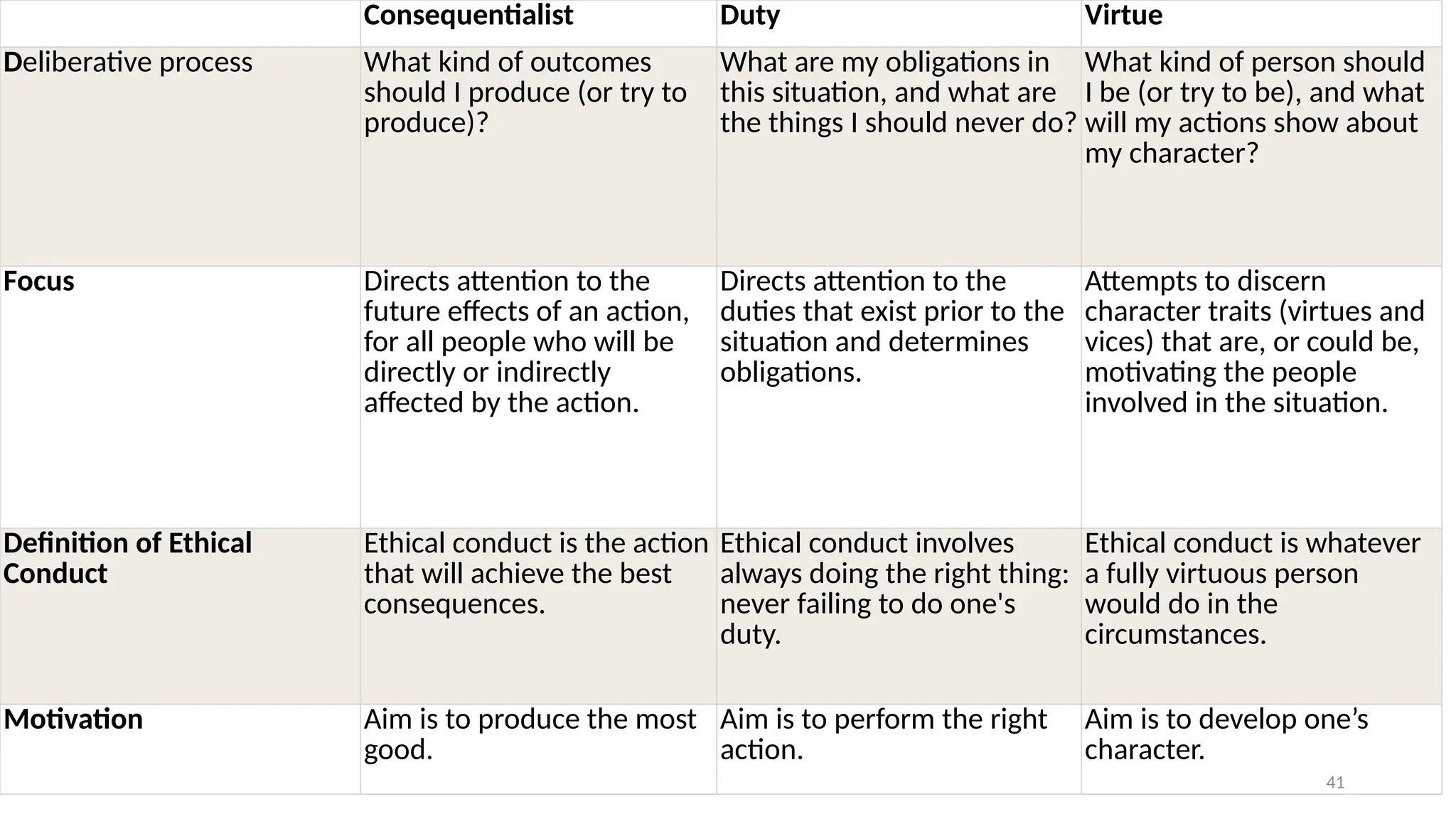
Consequentialist Duty Virtue
Deliberative process What kind of outcomes
should I produce (or try to
produce)?
What are my obligations in
this situation, and what are
the things I should never do?
What kind of person should
I be (or try to be), and what
will my actions show about
my character?
Focus Directs attention to the
future effects of an action,
for all people who will be
directly or indirectly
affected by the action.
Directs attention to the
duties that exist prior to the
situation and determines
obligations.
Attempts to discern
character traits (virtues and
vices) that are, or could be,
motivating the people
involved in the situation.
Definition of Ethical
Conduct
Ethical conduct is the action
that will achieve the best
consequences.
Ethical conduct involves
always doing the right thing:
never failing to do one's
duty.
Ethical conduct is whatever
a fully virtuous person
would do in the
circumstances.
Motivation Aim is to produce the most
good.
Aim is to perform the right
action.
Aim is to develop one’s
character.
41
APPLYING THE FRAMEWORKS TO CASES:
1. Recognizing an Ethical Issue
• to locate specifically ethical aspects of the issue at hand - Sometimes what appears to be
an ethical dispute is really a dispute about facts or concepts.
For example: some Utilitarians might argue that the death penalty is ethical because it
deters crime and thus produces the greatest amount of good with the least harm. Other
Utilitarians, however, might argue that the death penalty does not deter crime, and thus
produces more harm than good.
2. Consider the Parties Involved.
• Reflect upon are the various individuals and groups who may be affected by your decision.
Consider who might be harmed or who might benefit.
3. Gather all of the Relevant Information
• Before taking action make sure that you have gathered all of the pertinent information,
and that all potential sources of information have been consulted.
42
4. Formulate Actions and Consider Alternatives.
• Evaluate your decision-making options by asking the following questions:
I. Which action will produce the most good and do the least harm? (The
Utilitarian Approach)
II. Which action respects the rights of all who have a stake in the decision? (The
Rights Approach)
III. Which action treats people equally or proportionately? (The Justice
Approach)
IV. Which action serves the community as a whole, not just some members?
(The Common Good Approach)
V. Which action leads me to act as the sort of person I should be? (The Virtue
Approach)
APPLYING THE FRAMEWORKS TO CASES:
43
5. Make a Decision and Consider It
• After examining all of the potential actions consider which action best addresses
the situation?
• Ask yourself: How do I feel about my choice?
6. Act
• Take action based on the decision made; many ethical situations are uncomfortable
because you can never have all of the information.
7. Reflect on the Outcome
• What were the results of my decision?
• What were the intended and unintended consequences?
• Would I change anything now that I have seen the consequences?
APPLYING THE FRAMEWORKS TO CASES:
44
ETHICAL DECISION MAKING PROCESS IN PHARMACY
PRACTICE
• Mainly utilitarian approach.
• Weigh the different amounts of good and bad; risk-benefit ratio.
• The best action will provide more benefits and least harm
1. Gather relevant facts
2. Prioritise and ascribe values
3. Generate options
4. Choose an option.
This process entails asking and making assessments on ethical and legal issues
governing the profession.
• Consider the act; Medicines and allied substances act
• The civil law,
• MoH law?
• Profession code of conduct
• Professional knowledge regarding the issue
• Who to consult over an issue. 45
ETHICAL PRINCIPLES
• Fundamental truths that could be used by clinicians in evaluating ethical aspects
of professional–patient relationships.
• ethical judgements can be justified by reference to these principles
1. Beneficence
2. Non-maleficence (Do no harm)
3. Respect for autonomy
4. Justice.
46
BENEFICENCE
• Relates to acting in ways that benefit a patient, essentially doing good or
being actively kind.
• Requirements to provide the best possible healthcare for the community.
ETHICAL PRINCIPLES
47
THREE DUTIES OF CLINICAL CARE
• The rights of patients may be summed up by three corresponding
duties of care, which apply to all patients for whom pharmacist have
clinical responsibility.
48
Protect life and health.
• Clinicians should practice medicine to a high standard, taking
care not to cause unnecessary harm or suffering.
• Patients should only be given treatments which they need.
• Treatments should not be prescribed, for example, just
because patients request them.
• Common examples include the use of medicines for their
side effects like metronidazole, codeine, morphine and
diazepam.
49
Respect autonomy
•Competent humans have autonomy – the ability to reason, plan and make choices
about the future.
•Respect for these attributes goes hand in hand with respect for human dignity.
•Autonomous individuals are at liberty to perform whatever actions they wish, as
long as another autonomous individual’s actions are not infringed, even if the
actions appear to be foolish or unwise based upon conventional and generally
accepted wisdom.
•This duty to respect the autonomy of patients leads to two further rights –
informed consent and confidentiality.
•Competent patients should be able to choose to accept proposed treatments and
to control personal information which they divulge concerning such treatments.
•Denying patients such choice and control robs them of their human dignity. 50
Protect life and health and respect
autonomy with fairness and justice.
•In the conduct of public and professional life, it is generally thought
that people have the right to expect to be treated equally.
•Medicine is no exception and clinicians have a duty to practice
accordingly.
•The access to, and quality of, clinical care should be based only on the
dictatesof need rather than arbitrary prejudice or favouritism.
51
CODE OF ETHICS FOR PHARMACISTS
respects the covenantal relationship between the patient and
Pharmacist
• Considering the patient-pharmacist relationship as a covenant
means that a pharmacist has moral obligations in response to the
gift of trust received from society.
• In return for this gift, a pharmacist promises to help individuals
achieve optimum benefit from their medications, to be committed
to their welfare, and to maintain their trust.
52
Promotes the good of every patient in a
caring, compassionate, and confidential
manner.
• A pharmacist places concern for the well-being of the patient at the
center of professional practice.
• In doing so, a pharmacist considers needs stated by the patient as
well as those defined by health science.
• A pharmacist is dedicated to protecting the dignity of the patient.
With a caring attitude and a compassionate spirit, and focuses on
serving the patient in a private and confidential manner.
53
Pharmacists respects the autonomy and
dignity of each patient.
• A pharmacist promotes the right of self-determination and
recognizes individual self-worth by encouraging patients to
participate in decisions about their health.
• A pharmacist communicates with patients in terms that are
understandable.
• In all cases, a pharmacist respects personal and cultural differences
among patients.
54
Pharmacists acts with honesty and integrity
in professional relationships.
• A pharmacist has a duty to tell the truth and to act with conviction
of conscience.
• A pharmacist avoids discriminatory practices, behavior or work
conditions that impair professional judgment, and actions that
compromise dedication to the best interests of patients.
55
Pharmacist maintains professional
competence.
• A pharmacist has a duty to maintain knowledge and
abilities as new medications, devices, and technologies
become available and as health information advances.
56
Pharmacist respects the values and abilities
of colleagues and other health professionals
• When appropriate, a pharmacist asks for the consultation of
colleagues or other health professionals or refers the patient.
• A pharmacist acknowledges that colleagues and other health
professionals may differ in the beliefs and values they apply to the
care of the patient.
57
Pharmacists serves individual, community,
and societal needs.
• The primary obligation of a pharmacist is to individual patients.
• However, the obligations of a pharmacist may at times extend
beyond the individual to the community and society.
• In these situations, the pharmacist recognizes the
responsibilities that accompany these obligations and acts
accordingly.
58
Pharmacists seeks justice in the distribution
of health resources.
• When health resources are allocated, a Pharmacist is fair
and equitable, balancing the needs of patients and society.
59

Pharmacy Ethics and Principles lectures.pptx

  • 1.
  • 2.
    OBJECTIVES 1. Understand theimportance of ethics in the pharmacy profession 2. To describe the concepts and theories used in professional ethics 3. To relate and apply the ethical theories to the pharmacy profession. 4. To understand the framework in ethical decisional making in Pharmacy. 2
  • 3.
    Definitions • a codeof ethics is a guide of principles designed to help professional conduct business honestly and with integrity • Also refered to as Ethical code , may encompass areas such as business ethics, code of professional practice based on the Key principals • non- maleficence, Beneficence,effiency, respect of autonomy, justice, and proportionality
  • 4.
    BACKGROUND • Over time,the role of pharmacists has changed significantly. • Pharmacists are now playing a global crucial role in the adoption of global standards and creating trends in pharmaceutical practices. • “Patients are entitled to good standards of practice and care from their healthcare providers. • Essential elements of this(care &practice) are professional competence, good relationships with patients and colleagues and observance of professional ethical obligations.” • The "triad of medical care" has been the basis for the ethical relationship between the pharmacist, the physician, and the patient for centuries. 4
  • 5.
    • Pharmacists havetaken an awesome responsibility for learning about and preparing medicines in-order to manage their health care. • The practice of pharmacy and all health professions is an intensely personal, peculiarly human activity that has been traditionally guided by basic human values such as compassion, dignity, justice, and truth. • When the full range of personal and societal values associated with pharmacy practice is taken into consideration, even the seemingly benign activity take on added meaning. BACKGROUND 5
  • 6.
    PHARMACY ETHICS • Pharmacistsare health professionals who assist individuals in making the best use of medications. • This Code, prepared and supported by pharmacists, is intended to state publicly the principles that form the fundamental basis of the roles and responsibilities of pharmacists. • These principles, based on moral obligations and virtues, are established to guide pharmacists in relationships with patients, health professionals, and society. 6
  • 7.
    Principals • A pharmacistrespects the covenantal relationship between the patient and pharmacist. • A pharmacist promotes the good of every patient in a caring, compassionate, and confidential manner. • A pharmacist respects the autonomy and dignity of each patient. • A pharmacist acts with honesty and integrity in professional relationships. • A pharmacist maintains professional competence • A pharmacist respects the values and abilities of colleagues and other health professionals
  • 8.
    Principals • A pharmacistrespects the values and abilities of colleagues and other health professionals. • A pharmacist serves individual, community, and societal needs • A pharmacist seeks justice in the distribution of health resources
  • 9.
    THE HISTORY OFPHARMACY ETHICS • Code of Ethics 1848: respectability and accuracy • 1852 : pharmacist’s behaviour, fair treatment of customers • 1922: safety of the client. Pharmacist’s changing role- • “Non-Counselling” technique through the 1950’s . • 1968: Drug effects can be discussed with patient – pharmaceutical care. • 1973: Patient Bill of Rights • 1994 Code of Ethics: Patient – centered (ASHP Code of Ethics, 1994) 9
  • 10.
    Commitement “A pharmacist promisesto help individuals achieve optimum benefit from their medications, to be committed to their welfare, and to maintain their trust” “…Pharmacists, as part of their professional responsibility, must offer to provide counselling services to the patient and caregivers and be prepared to provide pharmaceutical care to the patient until the end of life.” 10
  • 11.
    • To whatextent, for example, does the perceived socioeconomic status of the patient determine the extent and nature of the professional services pharmacists provide? • To what extent do the pressures for cost-containment influence the pharmacist's drug-product selection process? • What determines your decisions and actions in various health situations? 11
  • 12.
    WHAT IS ETHICS?ETHICS DEFINITION • Ethic is the systematic study of moral choices (what is right and wrong, good and bad) with respect to conduct and character. • It is also studying what makes something good or bad. • it concerns the values that lie behind them (choices) and the language used to describe them. • Ethical decision making is the process whereby one recognises that a problem needs to be overcome or a difficult choice made, • It involves →identifying the possible courses of actions → chooses one → takes it and then accepts responsibility. 12
  • 13.
    • In Pharmacyfor example; A pharmacists Covenants to take care of patient’s medicines issue = promise = legal Contract to provide quality pharmacetuical care. Under the definition of professional code of conduct, an unethical behavior can cost a lot to the company. Pharmaceutical ethics - A set of norms and moral appeal of pharmaceutical workers used in meeting their responsibilities to society, the individual patient, one to one, the contact group of people (medical personnel, control bodies, etc.). 13
  • 14.
    WHY FOCUS ONPHARMACY ETHICS? • Understanding ethics can help people decide what to do when they have choices. • Many philosophers think that doing anything or making any choice is a part of ethics.” • Irrespective of formal or informal routines, the necessity of being ‘accountable’ for one’s actions is always an important professional consideration. • The increasing awareness of aspects of daily life with moral dimension and prevent one from carrying out duties in a routine manner. • Irrespective of where the pharmacist is practising from, they are accountable for their roles and responsibilities. This includes an obligation to: • Check that regulatory requirements are met • That a prescriber’s intentions are unequivocal • That there are no potential drug-drug interactions or other incompatibilities • That patients receive clear and unambiguous advice and instructions with their medication. 14
  • 15.
    • The transitionof pharmacy practice to embrace pharmaceutical care has increased the likelihood of encountering ethical conflict. • Many of these conflicts are issues that boarder on health and illness. • Matters of life and death has become much more prominent because of increasing possibilities of therapeutic intervention, legal challenges and media coverage. • Pharmacy has been characterised as incomplete profession because it includes duties of both professional (requiring judgement and expertise) and non-professional (repetitive, service routines). • The characteristic values of a society or profession should focus on attitudes relating to moral contexts and to draw a line on the moral boundaries. • All pharmacists in the world are members of a professional body that requires members to comply with a code of practice. WHY FOCUS ON PHARMACY ETHICS? 15
  • 16.
    • When facedwith ethical dilemmas pharmacists are expected to use their professional judgment to decide on the most appropriate course of action. • This decision should be justified to their peers, • To any person or organisation which may be affected by their actions, • individual patients, the public, the MOH, the employers, and other health care professionals. • Pharmacists must disclose any factors which may affect their ability to provide services be it religion or personal convictions. • Examples: 16
  • 17.
    Ethical Dilemmas e.g., Aptient doesn’t want to take his meds, out of stock drugs. Irreconcilable Problems e.g., Unauthorized but medically need refill, over prescribing diet pills / Antibiotics. 17
  • 18.
    ETHICAL STANDARDS • Aregoverned by a set of principles of right conduct. • Are the ethical benchmarks for professionals regardless of job title, cultural differences, or local laws • PRINCIPLES: are fundamental truths or laws that we employ as a basis for reasoning in deciding what action to take. • Principles are designed to help professionals conduct business honestly and with integrity. • This brings about the establishment of ethical code/Norms of conduct. 18
  • 19.
    19 One Day Seminar- “Responsibilities of Clinical Pharmacist’s” PPA House – 7th Jan 2012 Pharmacists are health professionals who assist individuals in making the best use of medications
  • 20.
    ETHICAL NORMS • Ethicalnorms are rules of behaviour to be complied with or used to evaluate or direct human conduct. • In other words, they are firm guidelines on how we should live. • The word norm, like the adjectival form normal, implies senses of both conforming to a standard and such that it ought to be – which are quite separate matters. • Normative ethics is concerned with basic questions such as: • what is right and wrong, good or bad? • which actions should I perform and which should I avoid? 20
  • 21.
    MORAL INTUITIONS • Moralconsiderations are to a significant extent subjective. • They relate to upbringing, cultural background, reflecting personal experiences and feelings or religious teaching and faith. • Often, though unable to explain exactly why, we may feel intuitively that something is just plain right or wrong: an action ought to be allowed or conversely should not be undertaken. • Sometimes we have the sensation that conscience would not allow us to behave in a certain way. We may not have given any special consideration as to why, but we know that there is something seemingly within us that provokes a sensation of unease or indeed more emphatically that something is just plain right or alternatively it is wrong. 21
  • 22.
    INVOKING THE CONSCIENCESITUATION A pharmacist working at a student health center pharmacy on a large campus refuses to fill a prescription for four oral contraceptive tablets once he realizes that the tablets are intended to be used for “morning-after therapy,” explaining that his religious beliefs do not condone abortion. The young woman counters, “You may have a right to your religious beliefs,”, “but you don’t have a right to refuse to fill my prescription.” Is the pharmacist acting ethical in this particular practice situation? Where do we turn for reasonable standards to affirm an ethical stance—broad ethical theories established over the years? Sets of humanistic virtues? Basic human rights and duties? A code of ethics? 22
  • 23.
    ETHICAL THEORIES • Asignificant problem within ethics is the lack of universally recognised and agreed ethical theory or ethical system. • This indicates that no single system is capable of satisfying everyone and may also indicate something of the nature of the philosophy of ethics. • Three major theoretical concepts have received fairly wide contemporary acceptance. 1. Deontological ethics 2. Consequentialist ethics 3. Virtue ethics. 23
  • 24.
    1. CONSEQUENTIALIST ETHICSTHEORY • Concerned only with the outcomes or consequences of actions; favouring action that will achieve the best possible consequence or result. • It is not the nature of the action but its outcome that is most relevant in ethical behaviour. • What constitutes the most desirable consequence for human beings: • Happiness • Pleasure, absence of pain • Well-being and flourishing.  But should we consider that pain and happiness are the two extremes of a spectrum? 24
  • 25.
    Utilitarian approach • Itinstructs us to weigh the different amounts of good and bad that will be produced by our action. • This follows our feeling that some good and some bad will be the result of our action • That the best action will be that which provides the most good or does the least harm: produces the greatest balance of good over harm. • The value of an act derives from the extent to which it increases general utility or happiness • Thus the life of an individual might be held to be less valuable, if as a consequence more lives could be spared. • If rules are followed they will produce the greatest happiness. 25
  • 26.
     Egoistic approach •The ethics of self- interest: an individual often uses utilitarian calculation to produce the greatest amount of good for self. • Philosophers argue that self-interest is a prerequisite to self-respect and to respect for others. • The benefit of society is seen only as the fortunate by-product of following individual self-interest - not its goal. • The pursuit of self-interest is seen as leading to the benefit of society • All actions have to benefit self more than society The common good approach • Our actions should contribute to ethical communal life. • argues that the best society should be guided by the “general will” of the people which would then produce what is best for the people as a whole. • This approach to ethics underscores the networked society and emphasizes respect and compassion for others - especially those who are more vulnerable. 26
  • 27.
    3. DEONTOLOGICAL ETHICS:NON-CONSEQUENTIAL ETHICS THEORY The Rights Approach: Deontological ethics is a duty-based theory which denotes that something is binding. • This approach stipulates that the best ethical action is that which protects the ethical rights of those who are affected by the action. • It emphasizes the belief that all humans have a right to dignity. • Considerable emphasis is given to the importance of respect for the special status of human beings. • doing what is right is not about the consequences of our actions - but about having the proper intention in performing the action. • An action is done precisely because it is our obligation to perform the action. • Ethical obligations are the same for all rational creatures (they are universal), • Always speak truthfully,” without running into a logical contradiction. 27
  • 28.
    The Fairness orJustice Approach. • All free men should be treated alike, just as all slaves should be treated alike. No one is more superior. • When combined with the universality of the rights approach, the justice approach can be applied to all human persons. • Fairness and equality is the principle for what is considered just. The Divine Command Approach • This approach sees what is right as the same as what God commands, • Ethical standards are the creation of God’s will. • Because God is seen as omnipotent and possessed of free will – He could change what is now considered ethical, • He is not bound by any standard of right or wrong short of logical contradiction. • Based on Patriarch Abraham’s willingness to kill his son Isaac at God’s command, Philosophers claim that truly right action must ultimately go beyond everyday morality / norm.” 28
  • 29.
    2. VIRTUE ETHICSTHEORY. • An approach to ethical theory that has found favour in healthcare • Refers to as being aretetic: which means that it relates to goodness, excellence or virtue. • The principle focus of this theory is on the moral uprightness or the goodness of the individual or their character. • Emphasizes the importance of acting virtuously (in an appropriate manner) in a variety of situations. • Expected that a virtuous person will have a disposition to behave morally; the nature of any action taken is to some extent secondary. 29
  • 30.
    VIRTUOUS CHARACTER TRAITS: •The Being courageous, determined, trustworthy (faithfulness), loyal, generous or helpful (tenderness), compassion and morally right • Have been associated with and in some cases driven the moral motivations of health- care practitioners for centuries. • The premise that the virtuous person will make morally defensible decisions, may be incorrect: • E.g 1. a physician who purposefully avoids telling a patient he has a terminal illness out of a sense of compassion may violate that patient’s right to self- determination; • E.g 2. a pharmacist who tolerates the potential dangers associated with a drug-impaired colleague out of a sense of loyalty or faithfulness may neglect his ethical duty to keep patients from harm. 30
  • 31.
    TERMS USED INMAKING ETHICAL JUDGEMENT • This is applied ethics; deals with issues in private and public life that that are matters for ethical judgments. 1. OBLIGATORY: When we say something is ethically “obligatory”, it means that it is not only right to do it, but that it is wrong not to do it.  we have a ethical obligation to perform the action. The easiest way to see if an action is ethically obligatory is to look at what it would mean NOT to perform the action. For example, we might say it is ethically obligatory for parents to care for their children, not only because it is right for them to do it, but also because it is wrong for them not to do it. The children would suffer and die if parents did not care for them. The parents are thus ethically “obligated” to care for their children. 31
  • 32.
    2. IMPERMISSIBLE: The oppositeof an ethically obligatory action: meaning that it is wrong to do it and right not to do it. For example, we would say that murder is ethically impermissible. 3. PERMISSIBLE: Sometimes actions are referred to as ethically permissible, or ethically “neutral,”: it is neither right nor wrong to do them or not to do them. We might say that having plastic surgery is ethically permissible, because it is not wrong to have the surgery (it is not impermissible), but neither is it ethically necessary (obligatory) to have the surgery. Some argue that suicide is permissible in certain circumstances. That is, a person would not be wrong in committing suicide, nor would they be wrong in not committing suicide. Others would say that suicide is ethically impermissible. 32
  • 33.
    2. SUPEREROGATORY: • Thesetypes of actions are seen as going “above and beyond the call of duty.” • They are right to do, but it is not wrong not to do them. For example, two people are walking down a hallway and see a third person drop their book bag, spilling all of their books and papers onto the floor. If one person stops to help the third person pick up their books and another person keeps on walking, we somehow feel that the person who stopped to help has acted in a more ethically appropriate way than the person who did not stop, but we cannot say that the person who did not stop was unethical in not stopping. In other words, the person who did not help was in no way obligated (it was not ethically obligatory) to help. But we nevertheless want to ethically praise the person who did stop, so we call his or her actions supererogatory. 33
  • 34.
    FRAMEWORKS FOR ETHICALDECISION-MAKING: • Making good ethical decisions requires a trained sensitivity to ethical issues • Also requires practiced method for exploring the ethical aspects of a decision • Weighing the considerations that should impact our choice of a course of action. • Having a method for ethical decision making is essential and when practiced regularly it becomes so familiar that we work through it automatically without consulting the specific steps. • This is one reason why we feel we have a “moral intuition” about a certain situation even when we have not consciously thought through the issue. • Note that it is not always advisable to follow our immediate intuitions especially in particularly complicated or unfamiliar situations. • The method for ethical decision making should enable you to recognize these situations and to act accordingly. 34
  • 35.
    • The morenovel and difficult the ethical choice we face in pharmacy practice, the more we need to rely on discussion and dialogue with others about the dilemma. • Only by careful exploration of the problem, aided by the insights and different perspectives of others, can we make good ethical choices in such situations. • Three broad frameworks are suggested to guide ethical decision making based upon the three ethical theories; • The Consequentialist Framework; • The Duty (Deontological) Framework. • The Virtue Framework. While each of the three frameworks is useful for making ethical decisions, none is perfect Knowing the advantages and disadvantages of the frameworks will be helpful in deciding the most appropriate approach depending on the presenting situation. FRAMEWORKS FOR ETHICAL DECISION-MAKING: 35
  • 36.
    CONSEQUENTIAL FRAMEWORK • Focusis on the future effects of the possible courses of action, considering the people who will be directly or indirectly affected. • We ask about what outcomes are desirable in a given situation, and consider ethical conduct to be whatever action that will achieve the best consequences. • The person using the consequences framework desires to produce the most good. ADVANTAGES: • Focusing on the results of an action is a reasonable/sensible approach. • It helps in situations involving many people, some of whom may benefit from the action, while others may not. DISADVANTAGES • It is not always possible to predict the consequences of an action, so some actions that are expected to produce good consequences might actually end up harming people. • People sometimesreact negatively to the use of compromise which is common in this approach; and they recoil from the implication that the end justifies the means. • It also does not include a pronouncement that certain things are always wrong, as even the most atrocious actions may result in a good outcome for some people, 36
  • 37.
    THE DUTY FRAMEWORK •In this framework, the focus is on the duties and obligations that we have in a given situation, and consider what ethical obligations we have and what things we should never do. • Ethical conduct is defined by doing one’s duties and doing the right thing: the goal is performing the correct action. ADVANTAGES • It creates system of rules that has consistent expectations of all people. • Iif an action is ethically correct or a duty is required it would apply to every person in a given situation. • It encourages treating everyone with equal dignity and respect. • focuses on following moral rules or duty regardless of outcome, so it allows for the possibility that one might have acted ethically, even if there is a bad result. Therefore, this framework works best in situations where there is a sense of 37
  • 38.
    NOTE: • Focuses onfollowing moral rules or duty regardless of outcome, • It allows for the possibility that one might have acted ethically, even if there is a bad result. • Therefore, this framework works best in situations where there is a sense of obligation or in situations which we need to consider why duty or obligation mandates or forbids certain courses of action. DISADVANTAGES • It can appear cold and impersonal in that it might require actions which are known to produce harms even though they are strictly in keeping with a particular moral rule. • It does not provide a way to determine which duty to should follow there is a situation in which two or more duties conflict. • It can also be rigid in applying the notion of duty to everyone regardless of personal situation. 38
  • 39.
    THE VIRTUE FRAMEWORK •This framework tries to identify the character traits (either positive or negative) that might motivate us in a given situation. • The concern is with what kind of person we should be and what our actions indicate about our character. • We define ethical behavior as whatever a virtuous person would do in the situation, and we seek to develop similar virtues. • This framework is useful in situations that ask what sort of person one should be 39
  • 40.
    ADVANTAGES • As away of making sense of the world, it allows for a wide range of behaviors to be called ethical. • Consequently, it takes into account all parts of human experience and their role in ethical deliberation - it believes that all of one’s experiences, emotions, and thoughts can influence the development of one’s character. DISADVANTAGES • it also makes it more difficult to resolve disputes, as there can often be more disagreement about virtuous traits than ethical actions. • Because the framework looks at character, it is not particularly good at helping someone to decide what actions to take in a given situation or determine the rules that would guide one’s actions. • Because it emphasizes the importance of role models and education to ethical behavior, it can sometimes merely reinforce current cultural norms as the standard of ethical behavior. 40
  • 41.
    Consequentialist Duty Virtue Deliberativeprocess What kind of outcomes should I produce (or try to produce)? What are my obligations in this situation, and what are the things I should never do? What kind of person should I be (or try to be), and what will my actions show about my character? Focus Directs attention to the future effects of an action, for all people who will be directly or indirectly affected by the action. Directs attention to the duties that exist prior to the situation and determines obligations. Attempts to discern character traits (virtues and vices) that are, or could be, motivating the people involved in the situation. Definition of Ethical Conduct Ethical conduct is the action that will achieve the best consequences. Ethical conduct involves always doing the right thing: never failing to do one's duty. Ethical conduct is whatever a fully virtuous person would do in the circumstances. Motivation Aim is to produce the most good. Aim is to perform the right action. Aim is to develop one’s character. 41
  • 42.
    APPLYING THE FRAMEWORKSTO CASES: 1. Recognizing an Ethical Issue • to locate specifically ethical aspects of the issue at hand - Sometimes what appears to be an ethical dispute is really a dispute about facts or concepts. For example: some Utilitarians might argue that the death penalty is ethical because it deters crime and thus produces the greatest amount of good with the least harm. Other Utilitarians, however, might argue that the death penalty does not deter crime, and thus produces more harm than good. 2. Consider the Parties Involved. • Reflect upon are the various individuals and groups who may be affected by your decision. Consider who might be harmed or who might benefit. 3. Gather all of the Relevant Information • Before taking action make sure that you have gathered all of the pertinent information, and that all potential sources of information have been consulted. 42
  • 43.
    4. Formulate Actionsand Consider Alternatives. • Evaluate your decision-making options by asking the following questions: I. Which action will produce the most good and do the least harm? (The Utilitarian Approach) II. Which action respects the rights of all who have a stake in the decision? (The Rights Approach) III. Which action treats people equally or proportionately? (The Justice Approach) IV. Which action serves the community as a whole, not just some members? (The Common Good Approach) V. Which action leads me to act as the sort of person I should be? (The Virtue Approach) APPLYING THE FRAMEWORKS TO CASES: 43
  • 44.
    5. Make aDecision and Consider It • After examining all of the potential actions consider which action best addresses the situation? • Ask yourself: How do I feel about my choice? 6. Act • Take action based on the decision made; many ethical situations are uncomfortable because you can never have all of the information. 7. Reflect on the Outcome • What were the results of my decision? • What were the intended and unintended consequences? • Would I change anything now that I have seen the consequences? APPLYING THE FRAMEWORKS TO CASES: 44
  • 45.
    ETHICAL DECISION MAKINGPROCESS IN PHARMACY PRACTICE • Mainly utilitarian approach. • Weigh the different amounts of good and bad; risk-benefit ratio. • The best action will provide more benefits and least harm 1. Gather relevant facts 2. Prioritise and ascribe values 3. Generate options 4. Choose an option. This process entails asking and making assessments on ethical and legal issues governing the profession. • Consider the act; Medicines and allied substances act • The civil law, • MoH law? • Profession code of conduct • Professional knowledge regarding the issue • Who to consult over an issue. 45
  • 46.
    ETHICAL PRINCIPLES • Fundamentaltruths that could be used by clinicians in evaluating ethical aspects of professional–patient relationships. • ethical judgements can be justified by reference to these principles 1. Beneficence 2. Non-maleficence (Do no harm) 3. Respect for autonomy 4. Justice. 46
  • 47.
    BENEFICENCE • Relates toacting in ways that benefit a patient, essentially doing good or being actively kind. • Requirements to provide the best possible healthcare for the community. ETHICAL PRINCIPLES 47
  • 48.
    THREE DUTIES OFCLINICAL CARE • The rights of patients may be summed up by three corresponding duties of care, which apply to all patients for whom pharmacist have clinical responsibility. 48
  • 49.
    Protect life andhealth. • Clinicians should practice medicine to a high standard, taking care not to cause unnecessary harm or suffering. • Patients should only be given treatments which they need. • Treatments should not be prescribed, for example, just because patients request them. • Common examples include the use of medicines for their side effects like metronidazole, codeine, morphine and diazepam. 49
  • 50.
    Respect autonomy •Competent humanshave autonomy – the ability to reason, plan and make choices about the future. •Respect for these attributes goes hand in hand with respect for human dignity. •Autonomous individuals are at liberty to perform whatever actions they wish, as long as another autonomous individual’s actions are not infringed, even if the actions appear to be foolish or unwise based upon conventional and generally accepted wisdom. •This duty to respect the autonomy of patients leads to two further rights – informed consent and confidentiality. •Competent patients should be able to choose to accept proposed treatments and to control personal information which they divulge concerning such treatments. •Denying patients such choice and control robs them of their human dignity. 50
  • 51.
    Protect life andhealth and respect autonomy with fairness and justice. •In the conduct of public and professional life, it is generally thought that people have the right to expect to be treated equally. •Medicine is no exception and clinicians have a duty to practice accordingly. •The access to, and quality of, clinical care should be based only on the dictatesof need rather than arbitrary prejudice or favouritism. 51
  • 52.
    CODE OF ETHICSFOR PHARMACISTS respects the covenantal relationship between the patient and Pharmacist • Considering the patient-pharmacist relationship as a covenant means that a pharmacist has moral obligations in response to the gift of trust received from society. • In return for this gift, a pharmacist promises to help individuals achieve optimum benefit from their medications, to be committed to their welfare, and to maintain their trust. 52
  • 53.
    Promotes the goodof every patient in a caring, compassionate, and confidential manner. • A pharmacist places concern for the well-being of the patient at the center of professional practice. • In doing so, a pharmacist considers needs stated by the patient as well as those defined by health science. • A pharmacist is dedicated to protecting the dignity of the patient. With a caring attitude and a compassionate spirit, and focuses on serving the patient in a private and confidential manner. 53
  • 54.
    Pharmacists respects theautonomy and dignity of each patient. • A pharmacist promotes the right of self-determination and recognizes individual self-worth by encouraging patients to participate in decisions about their health. • A pharmacist communicates with patients in terms that are understandable. • In all cases, a pharmacist respects personal and cultural differences among patients. 54
  • 55.
    Pharmacists acts withhonesty and integrity in professional relationships. • A pharmacist has a duty to tell the truth and to act with conviction of conscience. • A pharmacist avoids discriminatory practices, behavior or work conditions that impair professional judgment, and actions that compromise dedication to the best interests of patients. 55
  • 56.
    Pharmacist maintains professional competence. •A pharmacist has a duty to maintain knowledge and abilities as new medications, devices, and technologies become available and as health information advances. 56
  • 57.
    Pharmacist respects thevalues and abilities of colleagues and other health professionals • When appropriate, a pharmacist asks for the consultation of colleagues or other health professionals or refers the patient. • A pharmacist acknowledges that colleagues and other health professionals may differ in the beliefs and values they apply to the care of the patient. 57
  • 58.
    Pharmacists serves individual,community, and societal needs. • The primary obligation of a pharmacist is to individual patients. • However, the obligations of a pharmacist may at times extend beyond the individual to the community and society. • In these situations, the pharmacist recognizes the responsibilities that accompany these obligations and acts accordingly. 58
  • 59.
    Pharmacists seeks justicein the distribution of health resources. • When health resources are allocated, a Pharmacist is fair and equitable, balancing the needs of patients and society. 59

Editor's Notes

  • #4 In this session; an audience response system will be used to encourage participation in answering questions about ethics and the place of ethics in our profession. Examine your own ethical thinking as you participate with your colleagues.
  • #5 Rather than making a quick clinical judgment and recommending a product, pharmacists sensitive to their patients' individual needs may defer a "sale," recommend medical intervention, suggest a change in life style, or just offer comfort and reassurance.
  • #12 Ethics has been described as the systematic study of moral choices ; it concerns the values that lie behind them and the language used to describe them. Ethical decision making is the process whereby one recognises that a problem needs to be overcome or a difficult choice made, identifies the possible courses of actions, chooses one, takes it and then accepts responsibility.
  • #14 Most people don’t appear to give a great deal of thought to their own behaviour whether concerning domestic affairs or work-related activities unless there are special circumstances. If we do take time to reflect, many of our actions appear to be instinctive or virtually automatic: just plain routine or common sense. We seem to know how to behave and simply get on with it. For experienced practitioners, a great deal of their professional lives is devoted to dealing with relatively routine matters – transactions that are not markedly different from one client to another – and in these we tend to follow regular sequences or informal algorithms.
  • #20 The Code of Ethics sets out the principles that you must follow as a pharmacist or pharmacy technician. The principles of the Code are intended to guide and support the work you do and the decisions you make They also inform the general public of the standards of behaviour that can be expected from the pharmacy professions. The Code underpins all other standards and guidance
  • #21 So strong and commonplace are such feelings that it was believed that all human beings had within them an immediate, and intuitive grasp of the fundamental principles of morality (sometimes referred to as synderesis), which unlike conscience is both infallible and genera
  • #23 That no one has yet succeeded perhaps indicates that no single system is capable of satisfying everyone and may indeed indicate something of the nature of ethics or for that matter of philosophy – there is no ultimate solution! Each theory adopts a different focus, baseline or emphasis as being pivotal in addressing moral questions,
  • #27 duty-based approach says nothing about how easy or difficult it would be to carry out these maxims, only that it is our duty as rational creatures to do so
  • #41 However, it should be noted that each framework has its limits: by focusing our attention on one set of features, other important features may be obscured. Hence it is important to be familiar with all three frameworks and to understand how they relate to each other—where they may overlap, and where they may differ In many situations, all three frameworks will result in the same—or at least very similar—conclusions about what you should do, although they will typically give different reasons for reaching those conclusions.
  • #42 The argument here is over which facts argue for the morality of a particular action, not simply over the morality of particular principles. All Utilitarians would abide by the principle of producing the most good with the least harm.