Chapter 1 pharmacy and Ethics for pharmacy students.pptx
1.
April 10, 2025
1
PharmacyLaw & Ethics
HARAR HEALTH SCIENSE COLLEGE,
DEPARTMENT OF PHARMACY
For 4th
Year BSc. Pharmacy Student
By:- Anteneh z
2.
April 10, 2025
(PartI) Chapters view..
2
1. What is Ethics?
2. Ethical theories
3. Ethical principles and moral rules
4. Ethical issues in health care
5. Framework for ethical analysis
6. Professional ethics
7. Ethical codes
8. Standards of practice
9. Health professional-patient relationship
3.
April 10, 2025
3
1.WHAT IS ETHICS?
The term ethics derived from the Ancient Greek
word ethikos, which is derived from the word ethos
(habit, “custom”).
Ethics is the systematic study of what is right and
wrong with respect to conduct and character.
WHAT IS ETHICS?
4.
April 10, 2025
WHATIS ETHICS?
4
It refers to a method of inquiry that assists
people to understand the morality of human
behavior. (i.e. it is the study of morality).
Ethics refers to the practices or beliefs of a
certain group (i.e. nursing ethics, Physicians'
ethics and pharmacy ethics).
5.
April 10, 2025
WHATIS ETHICS?
5
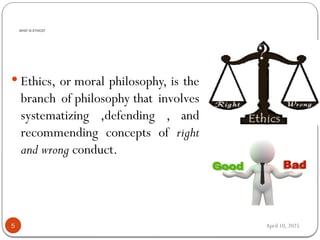
Ethics, or moral philosophy, is the
branch of philosophy that involves
systematizing ,defending , and
recommending concepts of right
and wrong conduct.
6.
April 10, 2025
Commonterms
6
Law : Law is the system of rules of conduct
established by the government of a society to maintain
stability and justice.
Morals: Morals are a person’s ideas about right and
wrong.
Values: Values are principles of worth and are
importance.
7.
April 10, 2025
Commonterms
7
Moral principles: the principles of right and
wrong that are accepted by an individual or a
social group.
Jurisprudence: It means study of fundamental
laws and in case of pharmaceutical Jurisprudence,
it is laws relating to pharmacy.
8.
April 10, 2025
Commonterms
8
Pharmaceutical jurisprudence: A branch of
pharmacy, which deals with various legislations
pertaining to drugs and pharmaceuticals and
profession of pharmacy.
Legislation:A group of laws that have the force of
authority by virtue of their promulgation by an
official organ of a state or other organization.
9.
April 10, 2025
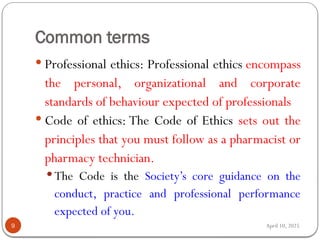
Commonterms
9
Professional ethics: Professional ethics encompass
the personal, organizational and corporate
standards of behaviour expected of professionals
Code of ethics: The Code of Ethics sets out the
principles that you must follow as a pharmacist or
pharmacy technician.
The Code is the Society’s core guidance on the
conduct, practice and professional performance
expected of you.
10.
April 10, 2025
LawVs Ethics
10
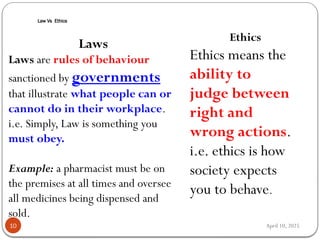
Laws
Laws are rules of behaviour
sanctioned by governments
that illustrate what people can or
cannot do in their workplace.
i.e. Simply, Law is something you
must obey.
Example: a pharmacist must be on
the premises at all times and oversee
all medicines being dispensed and
sold.
Ethics
Ethics means the
ability to
judge between
right and
wrong actions.
i.e. ethics is how
society expects
you to behave.
11.
April 10, 2025
Typesof Ethics
11
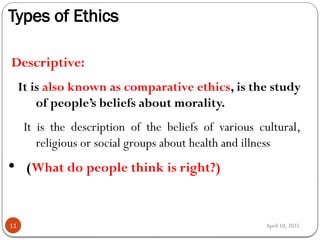
Descriptive:
It is also known as comparative ethics, is the study
of people’s beliefs about morality.
It is the description of the beliefs of various cultural,
religious or social groups about health and illness
(What do people think is right?)
12.
April 10, 2025
Typesof Ethics
12
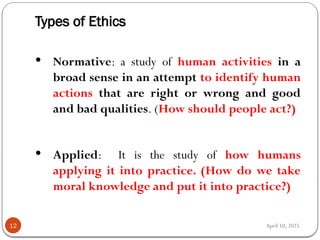
Normative: a study of human activities in a
broad sense in an attempt to identify human
actions that are right or wrong and good
and bad qualities. (How should people act?)
Applied: It is the study of how humans
applying it into practice. (How do we take
moral knowledge and put it into practice?)
13.
April 10, 2025
2.Ethical theories
13
Ethical theories may help us to view an ethical
problem.
Consequentialism : This theory can be simply
defined as 'the ends always justify the means'
Acts are considered right or wrong based on
how good or bad the outcomes of those acts are
(1).Consider a simple example:
A mother would like her daughter to focus on her
homework.
14.
April 10, 2025
Ethicaltheories
14
To ensure this, the mother tells her daughter that the television
show her daughter watches daily will not be aired
tonight. However, this is not the truth.
The daughter focuses on her homework instead of
watching television, and completes her schoolwork as a
result.
According to the theory of consequentialism, it was
right for the mother to be dishonest, since the outcome
was a good one.
15.
April 10, 2025
Ethicaltheories
15
Deontology: The theory of deontology is 'the ends
never justify the means.'
Acts are considered right or wrong intrinsically, regardless
of the outcomes.
Considering the example given above of the mother and
daughter, the mother would have committed a wrong
act according to the theory of deontology.
This is because the mother lied to her daughter, and lying
is considered unethical regardless of the outcome it
may lead to.
16.
April 10, 2025
3.Ethical principles and moral rules
16
Ethical Principles are basic ideas that are starting
points for understanding and working through a
problem.
Ethical principles presuppose that pharmacists
should respect the value and uniqueness of
persons and consider others to be worthy of high
regard.
These principles are tents that are important to
uphold in all situations.
17.
April 10, 2025
Ethicalprinciples and moral rules
17
The major principles of health professionals’
ethics are:
Autonomy
Beneficence
Nonmaleficence
Justice
18.
April 10, 2025
Ethicalprinciples and moral rules
18
Autonomy
Autonomy is the promotion of independent choice, self-determination and
freedom of action.
Autonomy means independence and ability to be self-directed in healthcare
Autonomy is the basis for the client's right to self-determination.
The term autonomy implies the following basic elements
1. The autonomous person is respected
2. The autonomous person must be able to determine personal goals
19.
April 10, 2025
Ethicalprinciples and moral rules
19
Autonomy
The autonomous person has the freedom to act upon the choices
Right after admission patients are asked about personal and
private matters
Informed consent
It is a process by which patients are informed of the possible outcomes,
alternatives and risks of treatments and are required to give their consent
freely.
It assures the legal protection of a patient’s right to personal
autonomy in regard to specific treatments and procedures.
20.
April 10, 2025
Ethicalprinciples and moral rules
20
Beneficence
Beneficence is doing or promoting good.
This principle is the basis for all health care
providers.
The principle of beneficence has three components:
Promote health
Prevent harm
Remove evil or harm
21.
April 10, 2025
Ethicalprinciples and moral rules
21
Nonmaleficience
Nonmaleficence is the converse of beneficence.
It means to avoid doing harm.
When working with clients, health care workers must not
cause injury or suffering to clients.
It is to avoid causing deliberate harm, risk of harm, and
harm that occurs during the performance of beneficial
acts.
22.
April 10, 2025
Ethicalprinciples and moral rules
22
Justice
Justice is fair, equitable and appropriate treatment
It is the basis for the obligation to treat all clients in an equal and
fair way.
Just decision is based on client need and fair distribution of
resources.
It would be unjust to make such decision based on how much he or she
likes each client
Any health professional should treat all the patients equally
irrespective of sex, culture, race, religion, language, social status
and political status
23.
April 10, 2025
Ethicalprinciples and moral rules
23
Paternalism
Restricting others autonomy to protect from perceived or
anticipated harm.
The intentional limitation of another’s autonomy justified by
the needs of another.
Thus, the prevention of any evil or harm is greater than any potential
evils caused by the interference of the individual’s autonomy or liberty.
Paternalism is appropriate when the patient is judged to be
incompetent or to have diminished decision-making capacity.
24.
April 10, 2025
Ethicalprinciples and moral rules
24
Non-compliance
Unwillingness of the patient to participate in health care
activities.
Lack of participation in a regimen that has been planned by the
health care professionals to be carried out by the client.
Noncompliance may result from two factors:
When plans seem unreasonable to the patient
Patients may be unable to comply with plans for a variety of
reasons including resources, lack of knowledge, psychological
and cultural factors that are not consistent with the proposed plan
of care
25.
April 10, 2025
Ethicalprinciples and moral rules
25
Veracity
Veracity means telling the truth, which is essential to the
integrity of the client-provider relationship
Health care providers obliged to be honest with
clients
The right to self-determination becomes
meaningless if the client does not receive
accurate, unbiased, and understandable
information
26.
April 10, 2025
Ethicalprinciples and moral rules
26
Fidelity
Fidelity means being faithful to one's commitments and
promises
Pharmacists commitment to clients include providing safe care and
maintaining competence in the practice
Pharmacists must use good judgment when making promises to
client
Fidelity means not only keeping commitment but also keeping
or maintaining our obligation
27.
April 10, 2025
Ethicalprinciples and moral rules
27
Confidentiality
Confidentiality comes from Latin fide: trust.
Confide as to “show trust by imparting secrets”; “tell in assurance of
secrecy ;
while confidential or in confidence is “a secret or private
matter not to be disclosed to others”
Confidentiality in the health care context is the requirement of
health professionals (HPs) to keep information obtained in the
course of their work
28.
April 10, 2025
4.Ethical issues in health care
28
Medical ethics is also known as biomedical ethics.
Ethical situations in health care can be divided into
two broad categories:
o“macro”
o“micro”
Macro situations involve issues that are not specific to a
given health care practitioner;
29.
April 10, 2025
29
These situations involve issues that must be
addressed by all health care practitioners
and society in general.
It includes issues such as abortion, assisted
suicide, genomics, rationing of and access to
health care, organ transplantation, and in
vitro fertilization.
30.
April 10, 2025
EthicalIssues….
30
Micro situations are those that may confront
individual practitioners in the course of their
daily practice.
In the case of pharmacists, they include the use
of placebos, patient confidentiality and
informed consent.
31.
April 10, 2025
Casescenario
31
What should a pharmacist do when a patient’s
prescription for heart medicine has been depleted, no
refills remain, and the prescriber is unavailable?
What if the medication is a controlled substance used
for pain control in a critically ill patient?
He will give the medication
even if it is illegal in both cases
32.
April 10, 2025
Rationing
32
Rationing is another term for resource allocation
As the cost of providing health care services continues
to grow, some have suggested and even attempted to
implement a system that would ration the availability of
health care
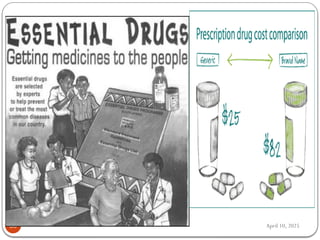
eg. List of essential drugs, Generic
prescription
April 10, 2025
34
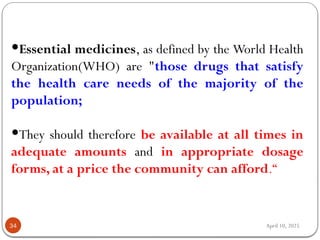
Essentialmedicines, as defined by the World Health
Organization(WHO) are "those drugs that satisfy
the health care needs of the majority of the
population;
They should therefore be available at all times in
adequate amounts and in appropriate dosage
forms, at a price the community can afford.“
35.
April 10, 2025
35
Genericname of a drug: The term "generic name" has
several meanings as regards drugs:
The chemical name of a drug.
A term referring to the chemical makeup of a drug rather than
to the advertised brand name under which the drug is sold.
A term referring to any drug marketed under its chemical name
without advertising.
36.
April 10, 2025
AssistedSuicide
36
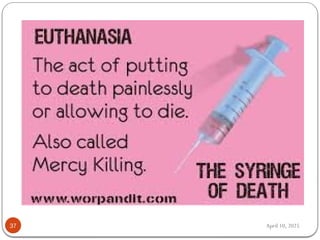
Although medical euthanasia (“mercy killing”) has long
been an ethical issue, it has only been in recent years that the
question of assisted suicide has been examined.
From an ethical perspective, the key issue remains whether
assisted suicide violates the Hippocratic responsibilities of
health care practitioners to “do no harm.”
Those who advocate its availability to patients suggest
that allowing a patient to continue to experience
persistent pain is to do harm
April 10, 2025
HumanDrug Experimentation
38
Two important ethical aspects including human
drug experimentation and the use of placebos
are the role of the institutional review board (IRB).
E.g. Syphilis Experiment
The IRB is the body responsible for overseeing
all clinical research conducted within a given
institution.
39.
April 10, 2025
Drugexperiment…
39
The IRB has two primary responsibilities:
1. To ensure the integrity and scientific rigor
of the proposed research study.
oIf the risks outweigh benefits, the IRB would
likely reject the proposal.
2. To evaluate and approve informed consent
forms used in conjunction with the
research
40.
April 10, 2025
Groupdiscussion
40
In which instances placebos are used?
What is the ethical dilemma related with placebo?
Which group is benefited from the drug experiment
(control (placebo) orTreatment (new drug) group)
How can we solve the ethical dilemma related
with drug experiment?
41.
April 10, 2025
Drugformulary
41
A drug formulary is a list of drugs that are
approved for use either within an institution
or for reimbursement by a third-party payer.
The restrictive nature of formularies has led to a
number of important ethical questions.
Does the use of generics violate the autonomy of
the patient or prescriber?
42.
April 10, 2025
Formulary…
42
Is the use of such substitution a violation of
informed consent?
Does the use of formularies violate the ethical
principles of beneficence and nonmaleficence?
However, one could argue that the use of formularies
and the resultant constraint on drug costs helps to
ensure affordable access to quality health care
for more people (distributive justice).
43.
April 10, 2025
5-Frameworkfor ethical analysis
43
Ethical dilemmas appear in every
area of pharmacy practice.
You cannot hide from them!
Rather than hide, we should have
an approach to dealing with
these dilemmas, one that is
easily applicable to different types
of pharmacy practice.
April 10, 2025
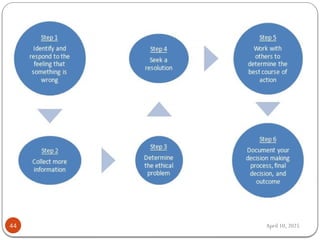
Step1
45
Respond to the SenseThat Something IsWrong
Many times, the little nagging voice that will not
leave you alone is enough indication that
something is wrong.
But just to ensure that ethical dilemmas are not
passing you by in oblivion,
you should ask yourself some questions to
make sure everything is ethically sound
when dealing with patients
46.
April 10, 2025
46
Forexample, consider asking yourself some of these
questions:
Is the patient's autonomy being breached?
Am I considering the patient's individual wishes and
values?
Am I maximizing benefit while minimizing harm for
the patient
If you find that some of the ethical principles
discussed earlier are being breached, then you
likely have an ethical dilemma on your hands.
47.
April 10, 2025
Step2
47
Collect Information
This is an essential step.
Do not make an assumption concerning what exactly the
ethical dilemma is without gathering all relevant
information!
Collect all the details surrounding the dilemma.
Who is involved?
When did this occur?
How have others responded to the dilemma?
Collect and organize all your facts.
48.
April 10, 2025
Step3
48
.Identify the Ethical Problem/Moral Diagnosis
At this point, you know something is wrong, and you have
all the facts surrounding the incident.
Now is the time to ask yourself, 'What exactly is the
dilemma?'
Identify what the source of the concern is.
What is at the heart of the issue?
Once you have defined exactly what the problem is, you
are on the right track to begin tackling the dilemma!
49.
April 10, 2025
Step4
49
Seek a Resolution
To resolve the dilemma, consider the following:
4 principles of medical ethics (autonomy, justice,
beneficence, non-maleficence
Laws (acts and regulations which govern the profession of
pharmacy)
Financial concerns
Commitments to friends and families
There may be more factors to consider, or you may not find all
applicable to your situation. Use your judgement, but try to
consider all important factors.
50.
April 10, 2025
Step5
50
Work with Others to Choose a Course of Action
Never make decisions regarding ethical dilemmas on your
own.
Similar to the collaborative approach of solving drug
therapy problems,
we should collaborate with other health care
providers when encountered with ethical dilemmas.
Involving others in your decision-making process helps you to
filter out any personal biases you may have but do not
recognize (we all have them, don't beat yourself up about it too
much).
51.
April 10, 2025
51
Ultimately, consulting with others protects you from
making any rash, uninformed, biased, or
paternalistic decisions.
Instead, your decisions will be thoughtful, well-
informed, and sensitive to all members involved in the
ethical dilemma.
52.
April 10, 2025
Step6
52
"DOCUMENTATION!"
Documentation is important!
Documenting all the steps you have taken to reach a
decision demonstrates a thorough and logical
thought process.
It also illustrates who you consulted with, and
what factors you considered to reach a final
decision.
53.
April 10, 2025
53
If possible, also document what the final outcome
was of the ethical dilemma.
Most importantly, documentation also serves as a
form of protection for you.
If after all that straining of your ethical reasoning
skills, the outcome of the ethical dilemma was an
unfortunate one, that documentation will come in
handy.
54.
April 10, 2025
Casestudy
54
Mr.Tesfaye Gabrie, 70 yrs old in ICU (PE) & fractured his femur
in fall at the nursing home & awaiting surgery the next morning
when he developed dyspnea, tachypnea, & tachycardia.
In ICU, another patient Mr.Yohannes Sileshi, 60 yrs old admitted
in next room with a history of liver cirrhosis from alcohol abuse.
He has ruptured esophageal varices.
Abraham dereje, Pharm.D., was the pharmacy supervisor for 6
ICU in the hospital. He & other 2 pharmacists worked frantically
to fill all the orders for IV drugs & parenteral solutions that came
from ICU units.
55.
April 10, 2025
Continues...
55
Dr. Dereje decided to conduct rounds and noticed that Mr. Sileshi
had died. He noticed the IV bag included heparin not the
octreotide in the trash. He came to know that the Ivs were
inappropriately labeled.
Dr. Dereje knew that its a critical case even though the mix-up
with the heparin may not have had anything to do with Mr. Sileshi’s
death, but he knew that such a patient should not receive Heparin.
Next step should be to stop the octreotide IV & notify the
pharmacy to send up the right drug for Mr. Gabrie. Also he has to
inform to Dr. Mulalem, intensivist. But he knew that he can’t
tolerate mistakes & also about the issue of Mr. Sileshi’s family.
56.
April 10, 2025
Commentary
56
This case is complex but reveals potential ethical concerns.
As the pharmacist involved in the case, Dr. Dereje will need
to decide what he needs to do and why. The six-step model
can help Dr. Dereje work toward a justifiable resolution.
57.
April 10, 2025
1.Respond to the Sense That something is wrong
57
In this case, Dr. Derege happened to notice the discarded IV
bag that led to his discovery of a drug error that may or may
not have contributed to Mr. Sileshi’s death.
Dr. Derege also experiences a sense of dread fear or anxiety
when he thinks about reporting the error to the intensivist in
charge of both patients
These negative emotions are indications that an ethical
problem is present.
58.
April 10, 2025
2.CollectInformation
58
To organize the numerous facts in the situation in which Dr.
Derege is involved, one can classify them into clinical and
situational information
clinical information
In Mr. Sileshi’s case
His illness was acute and life-threatening. If not treated immediately
with appropriate drug therapy and other life-saving measures, Mr.
Sileshi would certainly die from hemorrhage and shock
The administration of heparin to a patient who is already
hemorrhaging would increase the risk of bleeding, but it may not
have hastened Mr. Sileshi’s death.
59.
April 10, 2025
2.CollectInformation
59
Situational information includes data regarding the values and
perspectives of the principals involved; their authority; verbal and
nonverbal communication, including language barriers; cultural and
religious factors; setting and time constraints; and the relationships of
those immediately involved in the case.
urgency and time constraints
In other words, even if the clinical “facts” of a case remain constant,
changes in the situational or contextual factors, such as the values of a key
principal in the case, could change the ethical focus or intensify the
ethical conflict.
Of all the situational data mentioned, the most important is the
identification and understanding of the value judgments involved in a case
60.
April 10, 2025
60
In this case the principal involved are
the two patients,
any family involved,
Dr. Derege,
Dr. Mulalem,
the pharmacist(s) who prepared the drugs,
and members of the nursing staff responsible for hanging the IV
medications
We know specifically that Dr. Mulalem “. . . did not tolerate
mistakes
61.
April 10, 2025
61
Each member’s responsibilities are distinct yet overlap.
As part of the information-gathering step it is important to
sort out the various responsibilities, not for placing blame
but for identifying moral accountability
In this case Dr. Derege may not be the one who mislabeled
the IV bags, but..
as evening supervisor he has overarching responsibility for all
medications that leave the pharmacy.
Second, he is the one who discovered the error. Knowledge
of the error carries its own responsibility.
62.
April 10, 2025
Identifythe Ethical Problem/Moral
Diagnosis
62
The ethical principles most often involved in complex cases,
such as Dr. Derege’s situation, are:
(1) patient and health professional autonomy,
(2) beneficence and nonmaleficence, and
(3) justice.
• veracity, fidelity, and avoidance of killing are treated as
possible principles
63.
April 10, 2025
63
All we know for certain is that the error deprived him of
drug therapy that could have provided benefit.
The error may have caused harm to Mr. Gabriel as well. He
too was deprived, at least for a while, of a treatment that
could have helped him.
April 10, 2025
Introduction
65
Pharmacy is the field of expertise that ensures the
availability, accessibility, and the responsible use of
medicines.
The pharmacist is the professional who is particularly
competent within that field.
66.
April 10, 2025
Professionalethics - Definition
66
Professional ethics encompass the personal, organizational and
corporate standards of behaviour expected
of professionals.
Professionals, and those working in acknowledged professions, exercise
specialist knowledge and skill.
How the use of this knowledge should be governed when providing a service to
the public can be considered a moral issue and is termed professional ethics.
.
67.
April 10, 2025
Professionalethics - Definition
67
Professionals are capable of making judgements, applying their
skills and reaching informed decisions in situations that the general
public cannot, because they have not received the relevant training.
Profession;- A profession needs extensive training and specialized
knowledge.
Occupation:-An occupation does not need any extensive training.
A person with an occupation need not have
specialized knowledge of his trade
68.
April 10, 2025
68
•Guidelinesfor professional ethics are based on
principalism, which is the application of four distinct
moral principles.
•These principles function as a framework to express
general values of common morality.
• Respect for autonomy
• Non-maleficence
• Beneficence
• Justice
69.
April 10, 2025
69
Also, veracity (truthfulness) is important; healthcare
providers should be truthful to patients and families.
The four principles are applied to actions and
decision making, constituting the foundation for
professional ethics.
70.
Qualities / Componentsof Ethical behaviour
April 10, 2025
70
Confidentiality: Confidentiality means keeping the
patient related informations secret.
But there are times when the pharmacist or other
practitioners may unfold the information. E.g. If the
patient is willing, If unfolding the information is much better
or useful to the society than otherwise.
Adaptability: Is the ability to adjust one self to new or
changed circumstances/conditions .
71.
April 10, 2025
71
Cooperation: Is a co-working system;
The work of pharmacy is insignificant unless it is
augmented by other health practitioners.
There fore health practice must be team work.
Dependability: This is a condition in which one
develops to depend on others.
In health practice there are more things to learn from
people who have a lot of experience .
72.
April 10, 2025
72
Honest (Being loyal) : For the people to be
beneficiary and activities to be accomplished
successfully being an honest is the primary asset to
achieve .
Responsibility:- Is the condition or the fact that one can
shoulder obligations.
Accountability: - Is the condition or fact that one can be
called to answer for his wrong doings .
73.
April 10, 2025
73
Transparency:- This is a case in which things must run
by the book (based on rules, regulations etc.) rather than
by what is comfortable and beneficial to one self .
Maintaining good report : It is important to prepare
good report on the activities performed at each level
Prescription handling: Prescriptions should
be properly documented so that they can be used for
auditing, reporting on drug use, and to make
investigation on which drugs have been dispensed to a
patient.
74.
April 10, 2025
Continues…
74
Componentsof unethical behavior
1. Corruption – dishonest
2. Smuggling
3. Mistreating the patient
4. Behavioral
Theft
Drug dependence
75.
April 10, 2025
Codeof Ethics
75
A code of ethics for a health professional is a system of
principles intended to govern behaviour of those
entrusted with providing care to the sick.
. This code of ethics is based on the moral obligations
and designed to establish guidelines for professional
ethical behaviour.
EPA authored the Code of Ethics for Pharmacists
76.
April 10, 2025
Codeof Ethics
76
1. Ethical principles and obligations of the
pharmacist with respect to other stake
holders during his/her professional practice
2. Ethical principles and standards in
Pharmacy practices
3. Ethical principles and Obligations on Special
Ethical Issues
77.
April 10, 2025
Relationto his/her patients
77
I. Respects the covenantal relationship
II. Be morally obliged in a response to the gift of
trust received from the society
III. Not show partiality between his patrons.
IV. Not abuse his/her relationship with the patient
for personal gain.
V. Dedicate himself/herself to protecting the dignity
of the patient
78.
April 10, 2025
Relationto the public
78
At all times, act in a manner which promotes and
safeguards the interest of the public .
Offer services in premises .
Being an information provider and health
educator .
Accountable for any damage that may be
inflicted on the patron as a result of negligence
or breach of professional conduct .
79.
April 10, 2025
Relationto the Fellow professionals
79
I. Extend all support, respect &
cooperation
II. Expose any act of misconduct or
malpractice committed by a fellow
professional
80.
April 10, 2025
Relationto other Health professionals
80
Respect the skills and competence of other
health care providers and strive to develop a
team work spirit
Strive to maintain and develop the role of
pharmacist
Do Not recommend a particular medical
practitioner to the patient
81.
April 10, 2025
81
Strive to maintain the confidence and trust
placed in other health professionals by patients
Expose any acts of malpractice
Do Not enter into any secret arrangement or
negotiation
Do Not be an accomplice to any act of malpractice
82.
April 10, 2025
Asan Active professional member
82
Actively seek to update his / her knowledge
skills of pharmacy
Strive to join and participate in the activities
of professional associations & scientific
societies
83.
April 10, 2025
Asa Member of the Community
83
Keep his/her honour and demonstrate a high
standard of personal integrity in the
community
Be a law-abiding citizen
Participating in social development activities
84.
April 10, 2025
Dispensingof Medications in Pharmacy
84
Personally fill all prescriptions or ensure appropriate
filling or orders
Accept prescription only in writing except under an
emergency or compelling conditions
Ensure that medicines and health care products are
approved for sale
Not dispense Prescription only drugs without
prescriptions.
85.
April 10, 2025
85
Inform the prescriber for due correction or clarification
Not dispense both prescription &/or OTC drugs to
patients who are apparently not in their right mental
state
Promote that medicines would be dispensed as original
packs
Ethically free to make generic substitution of
prescription drugs
86.
April 10, 2025
86
Provide an effective and accurate patient
education and counselling
Know his/her patients with regard to cultures
Give ample verbal and written information
Ensure about the comfortable environment for
counselling
Ensure about the design and layout of the pharmacy
87.
April 10, 2025
Compoundingand Manufacturing pharmaceuticals
87
Make sure about authorized personnel involving
in the compounding
Ensure that the compounding personnel are free
from any ailments
Have written procedures for the compounding
drug products
Have working procedures, cleaning
procedures/SOP
88.
April 10, 2025
Handlingof Narcotic, Psychotropic and other
dangerous drugs
88
Keep separate and strict security storage
area
Dispense through special prescription paper
approved by Drug regulatory authority
Keep proper registration and submit records
to the control authorities
89.
April 10, 2025
89
Properly label, mark, store and dispense
poisons
Immediately report breakage, loss or theft
Keep expired and damaged products
separately
Refrain from abuse of controlled substances
90.
April 10, 2025
Qualityassurance
90
Ensure all standards are followed
Ensure about the batch processing records
Do Not make available for sale or distribute
substandard or adulterated products
91.
April 10, 2025
Promotionand advertisement
91
Don’t do self advertisement
Refrain from misinforming the pubic or other
HCP
Not to come under commercial pressure by drug
manufacturers
Not participate in any promotional methods or
campaign
92.
April 10, 2025
Pharmaceuticalcare practice
92
Have good understanding of the concept
Play a major role in promotion and
implementation of the concept
Strive to initiate and maintain good
relationships
93.
April 10, 2025
93
Realizing the importance of team work and
patient participation
Keep in mind that the patient is the main source
of information
Ensure the pharmaceutical care provided is
having optimum quality
Respect the rights of privacy, confidentiality and
dignity of the patient
94.
April 10, 2025
Rightto confidentiality
94
Only use or disclose personal health
information with the consent of the patient
Disclose to those who have a legitimate right
Ensure that consent is obtained in writing
Upon request of the patient, allow the
patients to inspect records
Comply with existing laws
95.
April 10, 2025
HCP– Patient relationship: Consumerism Vs Paternalism
97
Medical paternalism —the belief that the health care
professional knew best—was accepted as standard practice by
most health care professionals and their patients.
The medical rights of patients were not as widely
recognized as other rights (such as suffrage or due
process).
Consumerism- Today, patients have become true consumers of
medical care.
Patients wish—and have a right—to be informed and to be
asked for their consent.
96.
April 10, 2025
PATIENTS’RIGHTS
98
When patients seek the care of health care
providers,
what rights do they have?
What can they reasonably expect from health care
providers?
Patients can expect that clinicians will employ their
knowledge and experience in caring for them.
As autonomous individuals, patients can expect that
health care providers will respond to their wishes
about their treatment.
97.
April 10, 2025
HEALTHCARE PRACTITIONERS’ DUTY TO THEIR PATIENTS
100
Some might argue that health care providers have a
Hippocratic responsibility to their patients and that
this responsibility focuses solely on what is best for
the patient, irrespective of the consequences to
others.
The code of ethics also suggests that a pharmacist
serves individual, community and societal needs.
#1 Pharmacy is a noble and sacred profession. Because it is one of the profession which provides health care to the human beings. The pharmacist is health care practitioner who is a vital link between a physician and patient. He is charged with the responsibility of providing professional services to the community like production of a medicine (quality) and their sale and distribution to the consumers. The pharmacist of today is a drug-maker, drug-dispenser, drug-custodian, patient-counsellor, drug-researcher and drug-educator and above all a honest and patriotic citizen. In the current status, the role of pharmacist has shifted from the drug oriented to patient oriented. In order to ensure this professional role of pharmacist, there has to be an ethical framework within which a pharmacist is supposed to function. He/she should be familiar with the types of laws governing his/her profession and also the developments that have contributed to the current status of pharma education, pharmacy practice and pharmaceutical industry. Because in this tidy profession, wherever an error occurs which will affect directly or indirectly the life of a human being. For instance, We routinely handle substances where an error in dispensing can be fatal and an error in distribution, shipping or purchasing could result in dangerous drugs being available on the street through illegal, unregulated channels. Most of these laws, regulations, act and ethics have resulted from the problems that occured in the past, or have been put into place in an effort to avoid improper events. Hence It is important for a pharmacy personnel to understand pharmacy law and ethics. There are two main reasons for pharmacy personnel to study law and ethics: The first is to help you function at the highest professional level by providing competent, compassionate health care to patients, and the second is to help you avoid legal problems that can threaten your ability to earn a living.
#3 At its simplest, ethics is a system of moral principles. They affect how people make decisions and lead their lives.
Ethics is concerned with what is good for individuals and society and is also described as moral philosophy.
1st & 2nd point’s explanation: The word "ethics" in English can mean several things. As a branch of philosophy, ethics investigates the questions “What is the best way for people to live?” and “What actions are right or wrong in particular circumstances?”
3rd point’s explanation: In practice, ethics seeks to resolve questions of human morality, by defining concepts such as good and evil, right and wrong, virtue and vice, justice and crime. (Moral principles : the principles of right and wrong that are accepted by an individual or a social group)
#5 Ethics is concerned with morality, and hence is often called Moral philosophy. Ethics is a philosophical study of good, bad, right and wrong.
#10 Law is the system of rules of conduct established by the government of a society to maintain stability and justice. Law defines the legal rights and duties of the people and provides the means of enforcing these rights and duties. Governments enact laws to keep society running smoothly and to control behavior that could threaten public safety. Ethics is considered a standard of behavior and a concept of right and wrong beyond what the legal consideration is in any given situation. Moral values serve as a basis for ethical conduct. Moral values are formed through the influence of the family, culture, and society.
#11 Descriptive (comparative): It is the description of the beliefs of various cultural, religious or social groups about health and illness
Normative (prescriptive): a study of human activities in a broad sense in an attempt to identify human actions that are right or wrong and good and bad qualities. (How should people act?)
Applied : How do we take moral knowledge and put it into practice?
#31 He will give the medication even if it is illegal in both cases
#33 Essential medicines, as defined by the World Health Organization(WHO) are "those drugs that satisfy the health care needs of the majority of the population; they should therefore be available at all times in adequate amounts and in appropriate dosage forms, at a price the community can afford.“
Generic name, drug: The term "generic name" has several meanings as regards drugs:
The chemical name of a drug.
A term referring to the chemical makeup of a drug rather than to the advertised brand name under which the drug is sold.
A term referring to any drug marketed under its chemical name without advertising.
"Diazepam" is an example of the chemical (generic) name of a sedative. It is marketed by some companies under its generic name and by other companies under brand names such as Valium or Vazepam.
Generic drugs marketed without brand names are less expensive than brand-name drugs even though they are chemically identical to brand-name drugs and meet U.S. Food and Drug Administration (FDA) standards for safety, purity and effectiveness.
#35 "Diazepam" is an example of the chemical (generic) name of a sedative. It is marketed by some companies under its generic name and by other companies under brand names such as Valium or Vazepam.
Generic drugs marketed without brand names are less expensive than brand-name drugs even though they are chemically identical to brand-name drugs and meet U.S. Food and Drug Administration (FDA) standards for safety, purity and effectiveness.
#40 Placebos have 2 major roles in medicine: (1) in clinical drug research, and (2) as a means of decreasing the dose of or weaning a patient off a drug to which a patient has become dependent.
#44 A few important steps have been added to ensure that you consider every factor from beginning to end:
#45 Many times, the little nagging voice that will not leave you alone is enough indication that something is wrong. But just to ensure that ethical dilemmas are not passing you by in oblivion, you should ask yourself some questions to make sure everything is ethically sound when dealing with patients. For example, consider asking yourself some of these questions:
Is the patient's autonomy being breached? Am I considering the patient's individual wishes and values? (Principle of autonomy)
Am I maximizing benefit while minimizing harm for the patient (Principles of beneficence and non-maleficence)
If you find that some of the ethical principles discussed earlier are being breached, then you likely have an ethical dilemma on your hands.
#49 Easier said (or written) than done, right? This is the meat and flesh of it all, but do not become daunted by the task when you've come so far! When you factor in additional pieces to the puzzle, finding the best solution for everyone involved becomes easier to tease out.
#50 Never make decisions regarding ethical dilemmas on your own. Similar to the collaborative approach of solving drug therapy problems, we should collaborate with other health care providers when encountered with ethical dilemmas. This is encouraged in the OCP Code of Ethics:
Principle Seven:
Each member collaborates with other health care professionals to achieve the best possible outcomes for the patient, understanding the individual roles and contributions of other health care providers and consulting with or referring to them as appropriate.
Involving others in your decision-making process helps you to filter out any personal biases you may have but do not recognize (we all have them, don't beat yourself up about it too much). Ultimately, consulting with others protects you from making any rash, uninformed, biased, or paternalistic decisions. Instead, your decisions will be thoughtful, well-informed, and sensitive to all members involved in the ethical dilemma.
#52 Phew. Steps 1-5 were a lot of work. Don't you wish you could put that down on paper and store all that hard work? Well you should! And I am certain your professors have hammered this into your minds. Mine most definitely have. A constant stream of yells and shouts over the past 4 years, all harmoniously coming together like your fifth grade choir group: "DOCUMENTATION, DOCUMENTATION, DOCUMENTATION!"
I am quite happy to tell you that it is no different with ethical dilemmas. Documentation is important! Documenting all the steps you have taken to reach a decision demonstrates a thorough and logical thought process. It also illustrates who you consulted with, and what factors you considered to reach a final decision. If possible, also document what the final outcome was of the ethical dilemma.
Most importantly, documentation also serves as a form of protection for you. If after all that straining of your ethical reasoning skills, the outcome of the ethical dilemma was an unfortunate one, that documentation will come in handy.
A Documentation Tool for Ethical Dilemmas is available on this website. You can click on the link below to access it.
#58 Even if the treatment was effective in managing the bleeding, it would not resolve the underlying problem of cirrhosis
#61 These are only some of the facts affecting ethical decision-making in this case.
#64 Pharmacy is the field of expertise that ensures the availability, accessibility, and the responsible use of medicines. The pharmacist is the professional who is particularly competent within that field. In a number of aspects pharmacy practice in Ethiopia has been developing differently compared to other countries. Also Pharmacists in Ethiopia started to behave autonomously, can delegate tasks in a professional and responsible manner to competent assistants, are trained in pharmacotherapy and have easy access to prescribers, are accustomed to working as part of a team, and experience significant patient loyalty. However, the role and position in society of the pharmacist as a professional are not self-evident. The professional should be more aware than ever before of his actions in situations that require his expertise, but in which decisions are not made exclusively by him or in which he himself cannot give a unanimous opinion based solely on his own competences and expertise. Such dilemma’s and issues are a natural part of the existence of a professional. This demands a foundation for the profession.
#66 Professionals, and those working in acknowledged professions, exercise specialist knowledge and skill. How the use of this knowledge should be governed when providing a service to the public can be considered a moral issue and is termed professional ethics.
Professionals are capable of making judgements, applying their skills and reaching informed decisions in situations that the general public cannot, because they have not received the relevant training. One of the earliest examples of professional ethics is the Hippocratic oath to which medical doctors still adhere to this day.
#68 The words occupation and profession are interchangeable. Profession and occupation are almost the same, with only minor differences between them.
The difference between occupation and profession can be stated with a simple example: Designing a building would be called a profession, whereas, constructing a building is an occupation.
#69 Guidelines for professional ethics are based on principalism, which is the application of four distinct moral principles. These principles function as a framwork to express general values of common morality. The four principles are as follows:
#75 EPA authored the Code of Ethics for Pharmacists. This code of ethics is based on the moral obligations and designed to establish guidelines for professional ethical behaviour.
#80 An effective provision of healthcare service is based on multidisciplinary approach.
#82 Participation in different professional associations for the development of the community & the pharmacy profession
#83 Actively participate in the community services
#97 THE HEALTH PROFESSIONAL–PATIENT RELATIONSHIP: CONSUMERISM VERSUS PATERNALISM
Not long ago, when patients were instructed by their physician or pharmacist to have an operation, go for a laboratory test, or take a medication, they did so without question. Medical paternalism—the belief that the health care professional knew best—was accepted as standard practice by most health care professionals and their patients. The medical rights of patients were not as widely recognized as other rights (such as suffrage or due process).
Today, patients have become true consumers of medical care. Patients wish—and have a right—to be informed and to be asked for their consent. To do otherwise would be both unprofessional and unethical—not to mention the potential legal ramifications. Patients expect a certain level of service. As with sellers of other goods and services, health professionals who fail to meet the demands of health care consumers may lose customers or experience legal problems
#98 PATIENTS’ RIGHTS
When patients seek the care of health care providers, what rights do they have? What can they reasonably expect from health care providers? Patients can expect that clinicians will employ their knowledge and experience in caring for them. As autonomous individuals, patients can expect that health care providers will respond to their wishes about their treatment.
At first glance, the American health care system seems fundamentally based upon ensuring the rights of patients. Patients generally choose their own physician, pharmacy, and hospital. Patients are allowed to choose from multiple options for treatment when they exist (such as surgery versus drug therapy). Patients must give their approval, through the process of informed consent, prior to the initiation of care. All of the preceding presupposes that treatment is available and that the patient has the economic wherewithal to pay for that treatment. For patients who are uninsured or lack the ability to pay (like Leo), the right to choose the nature of their health care is meaningless. As Mappes and Zembaty argue, the United Nations (UN) Declaration of Human Rights may state “that all persons have a right to medical treatment” (1991, p. 36), but “A citizen of the United States . . . cannot walk into a hospital, demand and receive treatment simply on the basis of the claim that the UN Declaration proclaims his or her right to such care” (1991, p. 37). Patients also have a right to treatment that is both safe and effective within given parameters. The fundamental question that must be posed prior to considering any medical or surgical treatment for a patient is, “Is the treatment safe and effective?” Such a legal standard for drugs has been in effect since the early part of last century (Musto, 1987). Not only must a drug be shown to be effective—that is, able to produce the effect for which it was administered—but it must do so with a certain degree of safety.
#99 MORAL RIGHTS VERSUS LEGAL RIGHTS TO HEALTH CARE
It is important in any discussion of health care ethics to be clear about what is meant by the term rights. In contemporary U.S. society, one frequently refers to the legal rights of individuals. These are rights that are guaranteed fundamentally in the U.S. Constitution (such as the right of free speech and the right of assembly) or are provided by laws and regulations promulgated at the federal, state, or local level. We sometimes confuse what is really a legal duty (such as providing free elementary and secondary school education) with our moral obligation to do something (such as our responsibility to ensure that the next generation of Americans is provided with an adequate education).
Moral rights may be strengthened by laws, but their basis lies not in the law, but in ethical principles. Such rights might include the right to live without fear of harm and the right to food and adequate shelter. More recently, Americans have grappled with the question of health care as a moral right. Do Leo and his children, for example, have a moral right to adequate health care? As one might expect, moral rights and legal rights may be in conflict. There is disagreement over whether issues like abortion involve moral rights or legal rights. The question of the right to die has been played out in the media across the country. Dr. Jack Kevorkian and his so-called suicide machine have forced this society to deal with a moral question in legal terms.
#100 HEALTH CARE PRACTITIONERS’ DUTY TO THEIR PATIENTS
What is the responsibility of health care practitioners? As Mappes and Zembaty point out, “The [Hippocratic] oath requires physicians to act so as to ‘benefit’ the sick and ‘keep them from harm’” (1991, p. 45). Some might argue that health care providers have a Hippocratic responsibility to their patients and that this responsibility focuses solely on what is best for the patient, irrespective of the consequences to others.
This view is supported by the Code of Ethics of the APhA, which states, “A pharmacist promotes the good of every patient in a caring, compassionate, and confidential manner” (APhA, 1995, p. 2131). The code suggests that pharmacists have a moral obligation to do whatever they deem necessary in the interest of their patients. But the code goes on to state, “A pharmacist serves individual, community and societal needs.” Therefore, how far does a pharmacist’s or another health care professional’s duty to his or her patients go? Is it the health care professional’s moral obligation to care for patients without exception?




![PERI-PROSTHETIC FRACTURE NAIL-PLATE CONSTRUCT [NPC].pptx](https://cdn.slidesharecdn.com/ss_thumbnails/drarunkumardrmohamedashrafperiprostheticfrasturenail-plateconstructnpc-260209164459-7e9d15a1-thumbnail.jpg?width=640&height=640&fit=bounds)

![ONFH[AVN HIP] -TRIPLE REGIME -A NOVAL SURGICAL CONCEPT .pptx](https://cdn.slidesharecdn.com/ss_thumbnails/onfhavnhip2026koaconcalicutdrgokuldevdrmashraf-260210064517-213ec005-thumbnail.jpg?width=640&height=640&fit=bounds)


