|| Jai Sri Gurudev||
Sri Adichunchanagiri Shikshana Trust (R)
SJB INSTITUTE OF TECHNOLOGY
(Autonomous Institution Affiliated to Visvesvaraya Technological University, Belagavi by NAAC with ‘A+’ grade Certified by ISO 9001-2015, 2(f) and 12(B) recognized by UGC, New
Delhi.)
No. 67, BGS Health & Education City, Dr. Vishnuvardhan Road Kengeri, Bengaluru – 560 060
Subject:
RESEARCH METHODOLOGY & INTELLECTUAL PROPERTY
RIGHTS (21RMI56)
By
Dr. Pavitra Bai S
For
V Sem
Department of Information Science & Engineering
Aca. Year: ODD SEM /2023-24
Module 3
Introduction to Intellectual Property
Role of IP in the Economic and Cultural Development of the
Society
IP Governance
IP as a Global Indicator of Innovation
Origin of IP History of IP in India
Major Amendments in IP Laws and Acts in India.
Dr.Pavitra Bai S, Dept. of ISE, SJBIT
INTRODUCTION TO INTELLECTUAL
PROPERTY
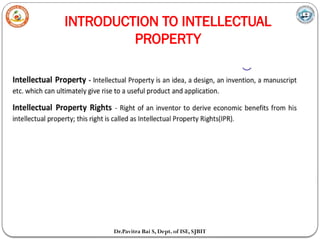
 Intellectual Property (IP) is a special category of property created by
human intellect (mind) in the fields of arts, literature, science, trade, etc.
 IP is a novel creation of the mind, it is intangible (i.e. invisible and
indivisible) in nature and differs from the tangible property, such as land,
house, gold and car with which we are quite familiar.
 Intellectual Property Rights (IPR) are the privileges accorded to the
creator/inventor (of IP) in conformance(standards) with the laws.
 These rights are given to the creator/inventor in exchange for revealing
the process of creation/invention in the public domain.
 The inventor is given with the special rights to use, sell, distribute,
offering for sale and restricting others from using the invention without
his prior permission.
Dr.Pavitra Bai S, Dept. of ISE, SJBIT
INTRODUCTION TO INTELLECTUAL
PROPERTY
Dr.Pavitra Bai S, Dept. of ISE, SJBIT
Copyrights and Related Rights
and
Industrial Property Rights
Dr.Pavitra Bai S, Dept. of ISE, SJBIT
 Broadly, IP comprises of two branches
1. Copyrights and Related Rights
2. Industrial Property Rights.
 Copyrights and Related Rights‘ refer to the creative expressions in
the fields of literature and art, such as books, publications,
architecture, music, wood/stone carvings, pictures, portrays,
sculptures, films and computer-based software's/databases.
 The Industrial Property Rights‘ refer to the Patents,Trademarks,
Trade Services, Industrial Designs and Geographical Indications.
1.1. Role of IP in the Economic and Cultural Development
of the Society
Dr.Pavitra Bai S, Dept. of ISE, SJBIT
 Creativity being the keystone of progress, no civilized society can afford to
ignore the basic requirement of encouraging the same.
 The economic and social development of a society is largely dependent on
creativity.
 The protection provided by the IPR to the creators/innovators is in fact an act of
incentivization for encouraging them to create more and motivates others to
create new and novel things.
 IPR is practiced rigidly, it may have a negative impact on the progress of society.
 For example, compliance with the Trade-Related Aspects of Intellectual
Property Rights (TRIPS) Agreement has affected the farming community as they
are unable to store seeds for the next crop.
 Multinational companies regulate the price of seeds, which is generally beyond
the reach of a majority of the farmers.
1.2. IP Governance
Dr.Pavitra Bai S, Dept. of ISE, SJBIT
 IP is an integral component of human society, each and every nation has
dedicated agencies for laying out the guidelines, implementation and
enforcement of IP related matters.
 In India, many organizations/agencies deal with various aspects of IP.The
governance of all categories of IP, except the PlantVariety and Farmers‘
Rights Act, is carried out by the Department for Promotion of Industry
& Internal Trade (DPIIT) under the support of Ministry of Commerce
and Industry, GoI (Government of India).
 There are a few other dedicated organizations/departments established
by the government to promote patent-ecosystem (patent awareness,
patent filing and patent commercialization) in India e.g. Technology
Information Forecasting and Assessment Council (TIFAC), National
Research Development Corporation (NRDC) and Cell for IPR
Promotion and Management (CIPAM), etc.
World Intellectual Property Organization
(WIPO)
Dr.Pavitra Bai S, Dept. of ISE, SJBIT
 Creates a hassle-free exchange of IP related activities amongst all
the nations, it is imperative to have minimum standards of rules and
regulations pertaining to all aspects of IP including rights,
empowerment, exceptions, etc.
 The United Nations (UN) has established an organization called the
World Intellectual Property Organization (WIPO).
 This agency is at the forefront of imparting knowledge about IP and
governs international filing and registration of IP through various
Conventions and Treaties like Paris Conventions, Patent
Cooperation Treaty (PCT), Rome Convention, Berne Convention,
etc.
1.3. IP as a Global Indicator of Innovation
Dr.Pavitra Bai S, Dept. of ISE, SJBIT
 IP, especially patents, is considered as one of the important cogs (Cost
of Goods Sold) in assessing the innovation index of a nation.
 The global ranking organizations always have IP or a subset of IP as one
of the parameters for understanding and grading the Science,
Technology and Innovation (STI) ecosystem of a nation.
 For example, the Scimago 2020 report ranked India at 4th position in
the parameter of a number of Research Publications, and 50th position
in the parameter of Intellectual Property Rights.
 Scimago - Publically available online portal which ranks journals and
countries based on the data taken from Scopus
1.4. Origin of IP
Dr.Pavitra Bai S, Dept. of ISE, SJBIT
 Though there is no official record of the origin of IP, it is believed
that a rudimentary(Basic) form of IP was being practiced around
500 Before the Common Era (BCE) in Sybaris, a state of Greece.
 The natives of Sybaris were granted a year‘s protection for using
their intellect to create any new improvement in luxury.
―
1.5. History of IP in India
Dr.Pavitra Bai S, Dept. of ISE, SJBIT
1.5.1. Patents
 The history of the Indian patent system dates back to the pre
independence era of British rule.
 The first patent related legislation in India was Act VI of 1856,
adapted from the British Patent Law of 1852.
 The objective of this legislation was to encourage the inventions of
new and useful manufactures.
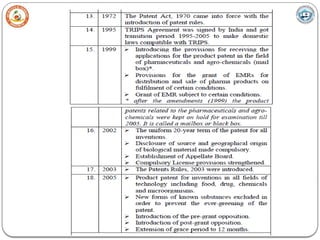
Patent Rules, 2003
Dr.Pavitra Bai S, Dept. of ISE, SJBIT
 The major amendments were:
1. The protection term of 20 years for all inventions from the date of
filing.
2. Scope of non-patentable inventions includingTraditional Knowledge
expanded.
3. Disclosure of source and geographical origin of biological material
made compulsory.
4. Provisions concerning convention countries simplified.
5. Establishment of Appellate Board.
6. Compulsory license provisions strengthened.
7. Simplification of procedures.
8. Harmonization with Patent CooperationTreaty (PCT) provisions.
Patents (Amendments) Act 2005
Dr.Pavitra Bai S, Dept. of ISE, SJBIT
1. Product patent for inventions in all fields of technology.
2. New forms of known substances excluded to prevent evergreening
of the patent.
3. Rationalization of the opposition procedure.
4. Introduction of pre-grant opposition by representation.
5. Introduction of post-grant opposition.
6. Compulsory license for export purposes.
7. Compulsory license for manufacture.
8. Extension of grace period from 6 months to 12 months for filing a
patent, if published in government exhibition.
1.5.2. Copyrights and Related Rights
Dr.Pavitra Bai S, Dept. of ISE, SJBIT
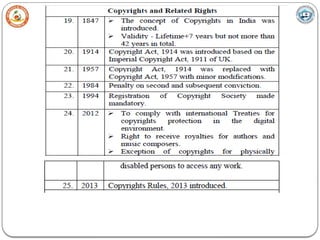
 The concept of copyrights started way back in the 15th century.
 The actual need for copyrights law was felt only after the invention
of printers and copiers.
 Before the invention of printers, writing could be created only once.
 It was highly laborious, and the risk of errors was involved in the
manual process of copying by a scribe.
 During the 15th and 16th centuries, printing was invented and
widely established in Europe.
 Copies of Bibles were the first to be printed. The government had
allowed the printing of the documents without any restrictions, but
this led to the spreading of a lot of governmental information.
Subsequently, the government started issuing licenses for printing.
1.5.3. Trademarks
Dr.Pavitra Bai S, Dept. of ISE, SJBIT
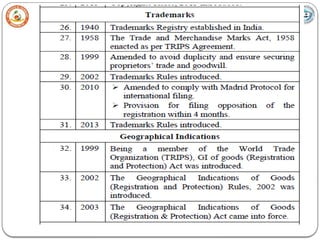
 The first statutory law related toTrademarks (TM) in India was the
TrademarksAct, 1940, which was carved out from theTrademarksAct,
1938 of the UK.
 It was followed by the incorporation of provisions ofTM stated in the
Indian Penal Code, Criminal Procedure Code and the Sea CustomsAct.
Later on,Trademarks Act, 1940 was rechristened asTrade and
Merchandise Marks Act, 1958.
 Nearly four decades later, thisAct was repealed by theTradeMarks Act,
1999.
 The need for this occurred to comply with the provisions of theTRIPS.
It is the current governing law related to registeredTM.
 TRIPS —Trade-RelatedAspects of Intellectual Property Rights.
1.5.4. Geographical Indications
Dr.Pavitra Bai S, Dept. of ISE, SJBIT
 India, as a member ofWTO, enacted the Geographical Indications
of Goods (Registration and Protection) Act, 1999.
 It came into force with effect from 15th September 2003.
 Geographical Indicators have been defined under Article 22 (1) of
theWTO Agreement onTRIPS.
 WorldTrade Organization (WTO)
 A geographical indication (GI) is a distinctive sign used to identify a
product whose quality, reputation or other such characteristics
relate to its geographical origin.
1.5.5. Trade Secrets
Dr.Pavitra Bai S, Dept. of ISE, SJBIT
 Although India has no specific Trade Secrets Laws, Indian
courts have upheld Trade Secrets protection under various
statutes, including contract law, Copyright law, the principles
of equity and the common law action of breach of confidence.
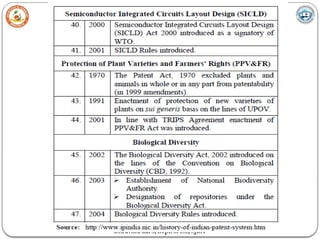
1.5.6. Semiconductor Integrated Circuits and Layout Designs
Dr.Pavitra Bai S, Dept. of ISE, SJBIT
 In the 21st century, InformationTechnology (IT) has revolutionized
the economic and societal growth of the world economy.
 The rapid and tremendous scientific advancements in the field of IT
resulted in the creation of a new class of IP called the Layout-Design
of the Semiconductor Integrated Circuits.
 Various organizations, including WTO and TRIPS Agreement laid
down rules and regulations regarding the protection of
Semiconductor Integrated Circuits and Layout Designs (SICLD)
India being a member of the WTO also passed an Act called the
SICLD Act, 2000.
 This Act is TRIPS compliant and fulfils the conditions of the TRIPS
agreement (Articles. 35 to 38) concerning the protection of SICLD.
1.5.7. Plant Varieties
Dr.Pavitra Bai S, Dept. of ISE, SJBIT
 Till 1970s, not much emphasis was laid on patentable matter
originating from animals and plants.
 microbes and microbial products/processes were patentable.
 To include all kinds of biological materials under the ambit of
patent laws, a decision to enact a new sui generis law under the
International Convention for the Protection of New Varieties of
Plants (UPOV, 1978) and UPOV, 1991 was taken.
 These decisions were taken to address environmental and public
interest concerns.
1.5.8. Traditional Knowledge
Dr.Pavitra Bai S, Dept. of ISE, SJBIT
 It is the ancient and originating knowledge held by any community or a
group of people.
 In olden times it was not recorded anywhere and was available only in
oral form. So, Traditional Knowledge (TK) was verbally passed on to
future generations.
 TK is not limited to a particular field. It covers a wide area, such as the
use of plants or their extracts for medical treatments, a traditional form of
dance, particular techniques used for hunting, craft knowledge/skills and
so on.
 Previously, there was no mechanism available to protectTK, but now, it
has been recognized as IPR underTRIPS Agreement.
 The Government of India has created a digital library termed as
Traditional Knowledge Digital Library (TKDL) as a repository of
2,50,000 formulations of various systems of Indian medicine.
1.5.9. Industrial Designs
Dr.Pavitra Bai S, Dept. of ISE, SJBIT
 A design is a creation of the human mind, which is appealing to the
eyes and attracts the attention of the viewers.
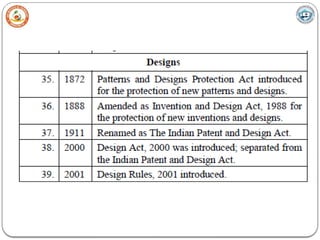
 The need to protect Industrial Designs (ID) was recognized in the
18th century and the Indian legislation enacted the Patterns and
Designs Act in 1872 for the first time.
 The Act was enacted to protect the rights over the creation of the
designs and novel patterns by the inventors.
 The Act was replaced by the British Patents and Designs Act in 1907,
which later became the basis for the Indian Patents and Designs Act,
1911.
 In the year 2000, a dedicated Act for the ID was passed, which came
into force in 2001.
1.5.10. Biodiversity Conservation
Dr.Pavitra Bai S, Dept. of ISE, SJBIT
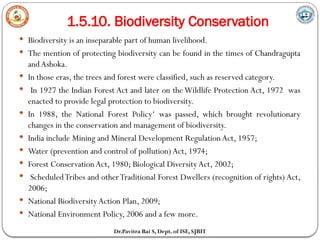
 Biodiversity is an inseparable part of human livelihood.
 The mention of protecting biodiversity can be found in the times of Chandragupta
andAshoka.
 In those eras, the trees and forest were classified, such as reserved category.
 In 1927 the Indian Forest Act and later on theWildlife Protection Act, 1972 was
enacted to provide legal protection to biodiversity.
 In 1988, the National Forest Policy‘ was passed, which brought revolutionary
changes in the conservation and management of biodiversity.
 India include Mining and Mineral Development RegulationAct, 1957;
 Water (prevention and control of pollution)Act, 1974;
 Forest ConservationAct, 1980; Biological Diversity Act, 2002;
 ScheduledTribes and otherTraditional Forest Dwellers (recognition of rights) Act,
2006;
 National BiodiversityAction Plan, 2009;
 National Environment Policy, 2006 and a few more.
1.6. Major Amendments in IP Laws and Acts in India
Dr.Pavitra Bai S, Dept. of ISE, SJBIT
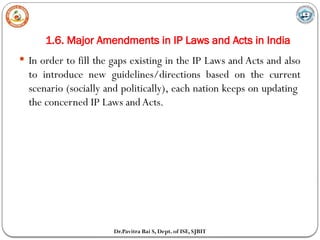
 In order to fill the gaps existing in the IP Laws and Acts and also
to introduce new guidelines/directions based on the current
scenario (socially and politically), each nation keeps on updating
the concerned IP Laws and Acts.
Dr.Pavitra Bai S, Dept. of ISE, SJBIT
References/Bibliography
 Intellectual PropertyA Primer for Academia by Prof. Rupinder
Tewari Ms. Mamta Bhardwa

introduction-data-to-structure-Module-3.pptx

  • 1.
    || Jai SriGurudev|| Sri Adichunchanagiri Shikshana Trust (R) SJB INSTITUTE OF TECHNOLOGY (Autonomous Institution Affiliated to Visvesvaraya Technological University, Belagavi by NAAC with ‘A+’ grade Certified by ISO 9001-2015, 2(f) and 12(B) recognized by UGC, New Delhi.) No. 67, BGS Health & Education City, Dr. Vishnuvardhan Road Kengeri, Bengaluru – 560 060 Subject: RESEARCH METHODOLOGY & INTELLECTUAL PROPERTY RIGHTS (21RMI56) By Dr. Pavitra Bai S For V Sem Department of Information Science & Engineering Aca. Year: ODD SEM /2023-24
  • 2.
    Module 3 Introduction toIntellectual Property Role of IP in the Economic and Cultural Development of the Society IP Governance IP as a Global Indicator of Innovation Origin of IP History of IP in India Major Amendments in IP Laws and Acts in India. Dr.Pavitra Bai S, Dept. of ISE, SJBIT
  • 3.
    INTRODUCTION TO INTELLECTUAL PROPERTY Intellectual Property (IP) is a special category of property created by human intellect (mind) in the fields of arts, literature, science, trade, etc.  IP is a novel creation of the mind, it is intangible (i.e. invisible and indivisible) in nature and differs from the tangible property, such as land, house, gold and car with which we are quite familiar.  Intellectual Property Rights (IPR) are the privileges accorded to the creator/inventor (of IP) in conformance(standards) with the laws.  These rights are given to the creator/inventor in exchange for revealing the process of creation/invention in the public domain.  The inventor is given with the special rights to use, sell, distribute, offering for sale and restricting others from using the invention without his prior permission. Dr.Pavitra Bai S, Dept. of ISE, SJBIT
  • 4.
  • 5.
    Copyrights and RelatedRights and Industrial Property Rights Dr.Pavitra Bai S, Dept. of ISE, SJBIT  Broadly, IP comprises of two branches 1. Copyrights and Related Rights 2. Industrial Property Rights.  Copyrights and Related Rights‘ refer to the creative expressions in the fields of literature and art, such as books, publications, architecture, music, wood/stone carvings, pictures, portrays, sculptures, films and computer-based software's/databases.  The Industrial Property Rights‘ refer to the Patents,Trademarks, Trade Services, Industrial Designs and Geographical Indications.
  • 6.
    1.1. Role ofIP in the Economic and Cultural Development of the Society Dr.Pavitra Bai S, Dept. of ISE, SJBIT  Creativity being the keystone of progress, no civilized society can afford to ignore the basic requirement of encouraging the same.  The economic and social development of a society is largely dependent on creativity.  The protection provided by the IPR to the creators/innovators is in fact an act of incentivization for encouraging them to create more and motivates others to create new and novel things.  IPR is practiced rigidly, it may have a negative impact on the progress of society.  For example, compliance with the Trade-Related Aspects of Intellectual Property Rights (TRIPS) Agreement has affected the farming community as they are unable to store seeds for the next crop.  Multinational companies regulate the price of seeds, which is generally beyond the reach of a majority of the farmers.
  • 7.
    1.2. IP Governance Dr.PavitraBai S, Dept. of ISE, SJBIT  IP is an integral component of human society, each and every nation has dedicated agencies for laying out the guidelines, implementation and enforcement of IP related matters.  In India, many organizations/agencies deal with various aspects of IP.The governance of all categories of IP, except the PlantVariety and Farmers‘ Rights Act, is carried out by the Department for Promotion of Industry & Internal Trade (DPIIT) under the support of Ministry of Commerce and Industry, GoI (Government of India).  There are a few other dedicated organizations/departments established by the government to promote patent-ecosystem (patent awareness, patent filing and patent commercialization) in India e.g. Technology Information Forecasting and Assessment Council (TIFAC), National Research Development Corporation (NRDC) and Cell for IPR Promotion and Management (CIPAM), etc.
  • 8.
    World Intellectual PropertyOrganization (WIPO) Dr.Pavitra Bai S, Dept. of ISE, SJBIT  Creates a hassle-free exchange of IP related activities amongst all the nations, it is imperative to have minimum standards of rules and regulations pertaining to all aspects of IP including rights, empowerment, exceptions, etc.  The United Nations (UN) has established an organization called the World Intellectual Property Organization (WIPO).  This agency is at the forefront of imparting knowledge about IP and governs international filing and registration of IP through various Conventions and Treaties like Paris Conventions, Patent Cooperation Treaty (PCT), Rome Convention, Berne Convention, etc.
  • 9.
    1.3. IP asa Global Indicator of Innovation Dr.Pavitra Bai S, Dept. of ISE, SJBIT  IP, especially patents, is considered as one of the important cogs (Cost of Goods Sold) in assessing the innovation index of a nation.  The global ranking organizations always have IP or a subset of IP as one of the parameters for understanding and grading the Science, Technology and Innovation (STI) ecosystem of a nation.  For example, the Scimago 2020 report ranked India at 4th position in the parameter of a number of Research Publications, and 50th position in the parameter of Intellectual Property Rights.  Scimago - Publically available online portal which ranks journals and countries based on the data taken from Scopus
  • 10.
    1.4. Origin ofIP Dr.Pavitra Bai S, Dept. of ISE, SJBIT  Though there is no official record of the origin of IP, it is believed that a rudimentary(Basic) form of IP was being practiced around 500 Before the Common Era (BCE) in Sybaris, a state of Greece.  The natives of Sybaris were granted a year‘s protection for using their intellect to create any new improvement in luxury. ―
  • 11.
    1.5. History ofIP in India Dr.Pavitra Bai S, Dept. of ISE, SJBIT 1.5.1. Patents  The history of the Indian patent system dates back to the pre independence era of British rule.  The first patent related legislation in India was Act VI of 1856, adapted from the British Patent Law of 1852.  The objective of this legislation was to encourage the inventions of new and useful manufactures.
  • 12.
    Patent Rules, 2003 Dr.PavitraBai S, Dept. of ISE, SJBIT  The major amendments were: 1. The protection term of 20 years for all inventions from the date of filing. 2. Scope of non-patentable inventions includingTraditional Knowledge expanded. 3. Disclosure of source and geographical origin of biological material made compulsory. 4. Provisions concerning convention countries simplified. 5. Establishment of Appellate Board. 6. Compulsory license provisions strengthened. 7. Simplification of procedures. 8. Harmonization with Patent CooperationTreaty (PCT) provisions.
  • 13.
    Patents (Amendments) Act2005 Dr.Pavitra Bai S, Dept. of ISE, SJBIT 1. Product patent for inventions in all fields of technology. 2. New forms of known substances excluded to prevent evergreening of the patent. 3. Rationalization of the opposition procedure. 4. Introduction of pre-grant opposition by representation. 5. Introduction of post-grant opposition. 6. Compulsory license for export purposes. 7. Compulsory license for manufacture. 8. Extension of grace period from 6 months to 12 months for filing a patent, if published in government exhibition.
  • 14.
    1.5.2. Copyrights andRelated Rights Dr.Pavitra Bai S, Dept. of ISE, SJBIT  The concept of copyrights started way back in the 15th century.  The actual need for copyrights law was felt only after the invention of printers and copiers.  Before the invention of printers, writing could be created only once.  It was highly laborious, and the risk of errors was involved in the manual process of copying by a scribe.  During the 15th and 16th centuries, printing was invented and widely established in Europe.  Copies of Bibles were the first to be printed. The government had allowed the printing of the documents without any restrictions, but this led to the spreading of a lot of governmental information. Subsequently, the government started issuing licenses for printing.
  • 15.
    1.5.3. Trademarks Dr.Pavitra BaiS, Dept. of ISE, SJBIT  The first statutory law related toTrademarks (TM) in India was the TrademarksAct, 1940, which was carved out from theTrademarksAct, 1938 of the UK.  It was followed by the incorporation of provisions ofTM stated in the Indian Penal Code, Criminal Procedure Code and the Sea CustomsAct. Later on,Trademarks Act, 1940 was rechristened asTrade and Merchandise Marks Act, 1958.  Nearly four decades later, thisAct was repealed by theTradeMarks Act, 1999.  The need for this occurred to comply with the provisions of theTRIPS. It is the current governing law related to registeredTM.  TRIPS —Trade-RelatedAspects of Intellectual Property Rights.
  • 16.
    1.5.4. Geographical Indications Dr.PavitraBai S, Dept. of ISE, SJBIT  India, as a member ofWTO, enacted the Geographical Indications of Goods (Registration and Protection) Act, 1999.  It came into force with effect from 15th September 2003.  Geographical Indicators have been defined under Article 22 (1) of theWTO Agreement onTRIPS.  WorldTrade Organization (WTO)  A geographical indication (GI) is a distinctive sign used to identify a product whose quality, reputation or other such characteristics relate to its geographical origin.
  • 17.
    1.5.5. Trade Secrets Dr.PavitraBai S, Dept. of ISE, SJBIT  Although India has no specific Trade Secrets Laws, Indian courts have upheld Trade Secrets protection under various statutes, including contract law, Copyright law, the principles of equity and the common law action of breach of confidence.
  • 18.
    1.5.6. Semiconductor IntegratedCircuits and Layout Designs Dr.Pavitra Bai S, Dept. of ISE, SJBIT  In the 21st century, InformationTechnology (IT) has revolutionized the economic and societal growth of the world economy.  The rapid and tremendous scientific advancements in the field of IT resulted in the creation of a new class of IP called the Layout-Design of the Semiconductor Integrated Circuits.  Various organizations, including WTO and TRIPS Agreement laid down rules and regulations regarding the protection of Semiconductor Integrated Circuits and Layout Designs (SICLD) India being a member of the WTO also passed an Act called the SICLD Act, 2000.  This Act is TRIPS compliant and fulfils the conditions of the TRIPS agreement (Articles. 35 to 38) concerning the protection of SICLD.
  • 19.
    1.5.7. Plant Varieties Dr.PavitraBai S, Dept. of ISE, SJBIT  Till 1970s, not much emphasis was laid on patentable matter originating from animals and plants.  microbes and microbial products/processes were patentable.  To include all kinds of biological materials under the ambit of patent laws, a decision to enact a new sui generis law under the International Convention for the Protection of New Varieties of Plants (UPOV, 1978) and UPOV, 1991 was taken.  These decisions were taken to address environmental and public interest concerns.
  • 20.
    1.5.8. Traditional Knowledge Dr.PavitraBai S, Dept. of ISE, SJBIT  It is the ancient and originating knowledge held by any community or a group of people.  In olden times it was not recorded anywhere and was available only in oral form. So, Traditional Knowledge (TK) was verbally passed on to future generations.  TK is not limited to a particular field. It covers a wide area, such as the use of plants or their extracts for medical treatments, a traditional form of dance, particular techniques used for hunting, craft knowledge/skills and so on.  Previously, there was no mechanism available to protectTK, but now, it has been recognized as IPR underTRIPS Agreement.  The Government of India has created a digital library termed as Traditional Knowledge Digital Library (TKDL) as a repository of 2,50,000 formulations of various systems of Indian medicine.
  • 21.
    1.5.9. Industrial Designs Dr.PavitraBai S, Dept. of ISE, SJBIT  A design is a creation of the human mind, which is appealing to the eyes and attracts the attention of the viewers.  The need to protect Industrial Designs (ID) was recognized in the 18th century and the Indian legislation enacted the Patterns and Designs Act in 1872 for the first time.  The Act was enacted to protect the rights over the creation of the designs and novel patterns by the inventors.  The Act was replaced by the British Patents and Designs Act in 1907, which later became the basis for the Indian Patents and Designs Act, 1911.  In the year 2000, a dedicated Act for the ID was passed, which came into force in 2001.
  • 22.
    1.5.10. Biodiversity Conservation Dr.PavitraBai S, Dept. of ISE, SJBIT  Biodiversity is an inseparable part of human livelihood.  The mention of protecting biodiversity can be found in the times of Chandragupta andAshoka.  In those eras, the trees and forest were classified, such as reserved category.  In 1927 the Indian Forest Act and later on theWildlife Protection Act, 1972 was enacted to provide legal protection to biodiversity.  In 1988, the National Forest Policy‘ was passed, which brought revolutionary changes in the conservation and management of biodiversity.  India include Mining and Mineral Development RegulationAct, 1957;  Water (prevention and control of pollution)Act, 1974;  Forest ConservationAct, 1980; Biological Diversity Act, 2002;  ScheduledTribes and otherTraditional Forest Dwellers (recognition of rights) Act, 2006;  National BiodiversityAction Plan, 2009;  National Environment Policy, 2006 and a few more.
  • 23.
    1.6. Major Amendmentsin IP Laws and Acts in India Dr.Pavitra Bai S, Dept. of ISE, SJBIT  In order to fill the gaps existing in the IP Laws and Acts and also to introduce new guidelines/directions based on the current scenario (socially and politically), each nation keeps on updating the concerned IP Laws and Acts.
  • 24.
    Dr.Pavitra Bai S,Dept. of ISE, SJBIT
  • 26.
    Dr.Pavitra Bai S,Dept. of ISE, SJBIT
  • 30.
    Dr.Pavitra Bai S,Dept. of ISE, SJBIT
  • 31.
    References/Bibliography  Intellectual PropertyAPrimer for Academia by Prof. Rupinder Tewari Ms. Mamta Bhardwa