Ethics and Human Interface
RAJ KRISHNA
Definition
Systematic study of human
actions
From point view of their
rightfulness or wrongfulness
As means for attainment of
the ultimate happiness
RAJ KRISHNA
Fodder Points
• That part of human conduct- human personal
responsibility
• Set of standards of society-helps in guiding
behavior, choices & actions
• Integral to public administration- how to
question & reflect to act responsibly
• Deals with human actions & not actions of
human. HA -voluntary, done consciously,
deliberately, in view of an end. AOH- may not be
willfully, voluntarily,c,d but done by human.
Example- sleeping, walking etc. Intentions make
a difference
RAJ KRISHNA
What Ethics is Not?
Morality- individual commitment, may be rejected by others
Can be morally alone but not ethically
Religion-Not all are religious but ethics applies to everyone.
Religion advocate ethics but sometimes don’t follow
Following Law- if violate law then guilty but if think of doing bad
to anyone then guilty, laws have ethic standard but sometimes it
deviates, difficult in designing, slow to address new problem
Culturally accepted norms- Caste system, Slavery-US, “No to
when in Rome ,do as the Romans do”
RAJ KRISHNA
Why be Moral?
To perfect oneself as a moral being-Human by
nature tend to be good, about one’s interior
self, rational nature tells about logic & moral
reasoning, objective aspect- common principles
Society- rules for proper functioning of society,
satisfactory life in group living, life easier, better
for humankind, but here question of individual
freedom
Like Nutrition- most of us don’t do any course
but we know what is good to eat and what is
not. We do make mistakes . Nutrition is about
physical health, Morality about moral health
RAJ KRISHNA
Branches of Ethics
Descriptive- Empirical investigation of people’s moral beliefs , studies
history & evolution of ethics, customs , taboos, family, marriage way of life
of community, condemned action, value free approach
Normative- Involves arriving at moral standards that regulate right &
wrong conduct, search for ideal test of proper behavior, prescriptive
ethics , suggests punishments , offers moral principles to solve moral
issues, Golden Rule-We should do to others what we would want others
to do to us
MetaEthics- Study of origin & meaning of ethical concepts. 2
issues- Metaphysical: morality exists independently of humans
? Psychological: mental basis of moral conduct, study of
ethical terms and theories
Applied- Analysis of specific, controversial moral issues- group
of people for & against issue and moral issue not social
controversy. Example- Euthanasia, Abortion, Animal rights,
Affirmative Action, using knowledge of moral principles to
dilemmas
RAJ KRISHNA
Determinants
Ethical Behavior
Individual personality traits:
Education, upbringing,
experience , value system ,
religion
Culture & Country of indiv
Organization/industry
Ethics in Governance
• Social , Economic ,
political , cultural ,
legal-judicial ,
historical context of
country;
• evolves over a long
period of time
RAJ KRISHNA
Values
 Individual
principles/qualities guide
judgment & behavior of a
person or a group
 Anchor in a ship- strong
values/characters sticks to
principles during crisis
 Source- 1.Within oneself-
inbuilt mechanism which
distinguishes right & wrong 2.
Acquired from environment-
continuous teaching &
behavior of others- aged or
higher statues , as perceived
by an individual
 Based on importance, values are
classified-1. Intrinsic- end in itself;
truth,beauty,goodness,temperance,co
urage etc, good in themselves,
absolute values , universal values, can
exist alone. 2.Extrinsic:means to some
other value , instrumental worth only,
spectacles like , wealth , fame ,
physical fitness
 Both are used relatively, not always
mutually exclusive. IV>EV
 Human mind locus of values , special
sort of reaction to environment
 Human mind 3 psychical functions-
Thinking-Intellectual
values(Truth),Feeling-aesthetic
values(Beauty),& Willing-Moral
values(goodness)
RAJ KRISHNA
Fodder Points
Morality & Ethics : M define personal character,
E stress a social system.
Ethics , Values & Morals:-E is standards , rely
on logical & rational criteria; V are ideas that we
value or prize , we aspire for it like equality ,
justice; M is behavioral code of conduct to which
individual ascribes.
Value System: organization of beliefs
concerning preferable mode of conduct
RAJ KRISHNA
Ethics in Public Administration
RAJ KRISHNA
Legality &
Rationality:
follow rules
and laws
while
framing
policies &
decisions
Responsibility &
Accountability:
accept
responsibility for
his decision/action
, willing to be held
accountable to
higher authorities
& to people.
Work
Commitment:
committed to
duties, perform
work with
involvement,
intelligence &
dexterity
Excellence:
high
standard of
quality in
decision ,
actions ,
convenience,
TQM
Ethics in Public Administration
Fusion:
rationally fuse
individual,
organizational &
social goals for
greater good. In
case of conflict
goals ethics
should govern
choices made
Responsiveness &
Resilience:
respond to
demands &
challenges from
external & internal
environment ,
adapt to
transformation ,
yet ethical , any
deviation in ethics
show resilience &
bounce back to
accepted ethics
Utilitarianis
m: ensure
decision/poli
cies lead to
greater good
of the
greatest
number
Compassion:
without violating
laws/rules ,
demonstrate
compassion for
poor , disabled,
weak while
making decision
, not to grant
benefits to
stronger section
for being strong
RAJ KRISHNA
Ethics in Public Administration
National
Interest :
Impact of
decision on
nation’s
strength &
prestige ,
always at back
of mind
concern and
respect for
nation this
raise level of
service
Justice :
decision/pol
icies respect
to equality ,
equity
,fairness ,
impartiality ,
objective ,
no special
favor to
anyone
Transparent :
implement
decision/policies
in transparent
manner, person
affected by
decision or
evaluator
understand
reason behind
decision &
sources of
information on
which decisions
made
Integrity :
action based
on honesty &
not to use
power ,
prestige &
discretion to
serve personal
interests &
illegitimate
interests of
other
individuals or
groups
RAJ KRISHNA
Public Relations
RAJ KRISHNA
Public Relations
Vital function affecting management decisions &
influencing public opinion in every public &
private organization , indispensable
Reason: freedom of expression , RTI , advance in
telecommunication & transport, opening up of
closed societies , increasing education, pressure
groups , globalization , for staying in
power(Govt.), growth in biz. Etc
Long term responsibility, basic policy ethical ,
means truthful, conscience, relationship building
RAJ KRISHNA
Public Relations- Unethical
Acts
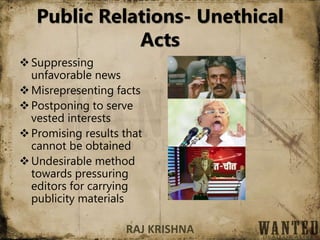
Suppressing
unfavorable news
Misrepresenting facts
Postponing to serve
vested interests
Promising results that
cannot be obtained
Undesirable method
towards pressuring
editors for carrying
publicity materials
RAJ KRISHNA
Values in Public relations-7 Principles of
public life by Nolan Committee, UK
Selflessness: decision in public interest, not to
gain financial or other benefits for themselves ,
family or friends
Integrity: not under financial or other
obligation to outside individual or organization.
Might influence performance of official duties
Accountability : accountable to public & higher
authorities, open for appropriate scrutiny
RAJ KRISHNA
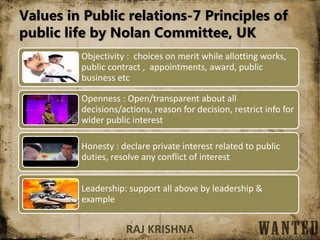
Values in Public relations-7 Principles of
public life by Nolan Committee, UK
Objectivity : choices on merit while allotting works,
public contract , appointments, award, public
business etc
Openness : Open/transparent about all
decisions/actions, reason for decision, restrict info for
wider public interest
Honesty : declare private interest related to public
duties, resolve any conflict of interest
Leadership: support all above by leadership &
example
RAJ KRISHNA
Human Values
According to or against which we act
Unavoidable & essential element of all important
decisions in human arena
Links personal perceptions & judgments;
motives & actions
They are human, not divinely ordained rules
Life embedded ideas & percepts
Formulated/expressed in many ways
RAJ KRISHNA
Basic Human Values
Truth: independent of desires , opinions, inherent in
human psyche , no one likes to be called liar , lie leads to
complexity
Love-Caring : wider sense , unselfish
care/concern/respect for others & environment ,
universal sense, real love , altruism
Peace : universally accepted +ve value , harmony ,
absence of disturbances , war , violence , all +ve acts-
peace in society , peace of mind individual ,w/o
truth,love,justice it is lost
Responsibility : Acting rightly , non violently , respecting
others etc
Justice : idea ,fairness , equality before law , non
violence, human rights , rule of law , democracy,
RAJ KRISHNA
Leader/Administrator/Reformer
Leader: envisioning mission , developing strategy ,
Inspiring people , changing culture , appointed or emerge
from within a group , get other people to want to do
,Initiate new structures/procedures to achieve goals ,
formulate policies , visionary, does the right thing
Administrator : working with or through others to
accomplish goals , carrying out process ; planning,
organizing , leading & controlling, are appointed
,legitimate power , can reward/punish, get other people
to do , utilize existing structures , does the thing right
Reformer: wants to improve prevailing conditions-social ,
political , religious , against social evils ,make impact on
people , poor practices in govt. like corruption , archaic
religious practice
RAJ KRISHNA
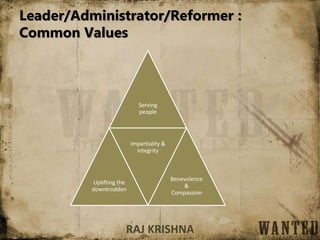
Leader/Administrator/Reformer :
Common Values
Serving
people
Uplifting the
downtrodden
Impartiality &
integrity
Benevolence
&
Compassion
RAJ KRISHNA
Human Values
Leaders : Love for
justice , selflessness
, respect for
humanity , dignity
for all , loving &
caring behavior ,
peace loving ,
benevolence ,
compassion
Administrator: Integrity
, non discrimination
,discipline , citizenly
duty , social equality
,lawfulness, ethical
accountability , loyalty,
courage , solidarity &
respect
Reformers :
Respect for
humanity , dignity
for all , humanism ,
reason & inquiry for
seeking the truth ,
kindness &
compassion ,
contentment ,
social equality
RAJ KRISHNA
Inculcating Values
Family:1st & major
agency ,great
influence , family
having sustaining
wholesome
relationship gives
great achievers ,
intellectual growth ,
good values ,
attitude formation
Society : civic
consciousness ,
education
system , mass
media , helps in
character
building ,
patriotism,
discipline, public
services
Educational
Institutes :
transmission of
values , human
personality, pursuit of
knowledge ,
preservation of
culture ,
development of
character ,
promotion of social
justice , scientific
temper , democracy ,
secularism , good life
etc
RAJ KRISHNA

Ethics

  • 1.
    Ethics and HumanInterface RAJ KRISHNA
  • 2.
    Definition Systematic study ofhuman actions From point view of their rightfulness or wrongfulness As means for attainment of the ultimate happiness RAJ KRISHNA
  • 3.
    Fodder Points • Thatpart of human conduct- human personal responsibility • Set of standards of society-helps in guiding behavior, choices & actions • Integral to public administration- how to question & reflect to act responsibly • Deals with human actions & not actions of human. HA -voluntary, done consciously, deliberately, in view of an end. AOH- may not be willfully, voluntarily,c,d but done by human. Example- sleeping, walking etc. Intentions make a difference RAJ KRISHNA
  • 4.
    What Ethics isNot? Morality- individual commitment, may be rejected by others Can be morally alone but not ethically Religion-Not all are religious but ethics applies to everyone. Religion advocate ethics but sometimes don’t follow Following Law- if violate law then guilty but if think of doing bad to anyone then guilty, laws have ethic standard but sometimes it deviates, difficult in designing, slow to address new problem Culturally accepted norms- Caste system, Slavery-US, “No to when in Rome ,do as the Romans do” RAJ KRISHNA
  • 5.
    Why be Moral? Toperfect oneself as a moral being-Human by nature tend to be good, about one’s interior self, rational nature tells about logic & moral reasoning, objective aspect- common principles Society- rules for proper functioning of society, satisfactory life in group living, life easier, better for humankind, but here question of individual freedom Like Nutrition- most of us don’t do any course but we know what is good to eat and what is not. We do make mistakes . Nutrition is about physical health, Morality about moral health RAJ KRISHNA
  • 6.
    Branches of Ethics Descriptive-Empirical investigation of people’s moral beliefs , studies history & evolution of ethics, customs , taboos, family, marriage way of life of community, condemned action, value free approach Normative- Involves arriving at moral standards that regulate right & wrong conduct, search for ideal test of proper behavior, prescriptive ethics , suggests punishments , offers moral principles to solve moral issues, Golden Rule-We should do to others what we would want others to do to us MetaEthics- Study of origin & meaning of ethical concepts. 2 issues- Metaphysical: morality exists independently of humans ? Psychological: mental basis of moral conduct, study of ethical terms and theories Applied- Analysis of specific, controversial moral issues- group of people for & against issue and moral issue not social controversy. Example- Euthanasia, Abortion, Animal rights, Affirmative Action, using knowledge of moral principles to dilemmas RAJ KRISHNA
  • 7.
    Determinants Ethical Behavior Individual personalitytraits: Education, upbringing, experience , value system , religion Culture & Country of indiv Organization/industry Ethics in Governance • Social , Economic , political , cultural , legal-judicial , historical context of country; • evolves over a long period of time RAJ KRISHNA
  • 8.
    Values  Individual principles/qualities guide judgment& behavior of a person or a group  Anchor in a ship- strong values/characters sticks to principles during crisis  Source- 1.Within oneself- inbuilt mechanism which distinguishes right & wrong 2. Acquired from environment- continuous teaching & behavior of others- aged or higher statues , as perceived by an individual  Based on importance, values are classified-1. Intrinsic- end in itself; truth,beauty,goodness,temperance,co urage etc, good in themselves, absolute values , universal values, can exist alone. 2.Extrinsic:means to some other value , instrumental worth only, spectacles like , wealth , fame , physical fitness  Both are used relatively, not always mutually exclusive. IV>EV  Human mind locus of values , special sort of reaction to environment  Human mind 3 psychical functions- Thinking-Intellectual values(Truth),Feeling-aesthetic values(Beauty),& Willing-Moral values(goodness) RAJ KRISHNA
  • 9.
    Fodder Points Morality &Ethics : M define personal character, E stress a social system. Ethics , Values & Morals:-E is standards , rely on logical & rational criteria; V are ideas that we value or prize , we aspire for it like equality , justice; M is behavioral code of conduct to which individual ascribes. Value System: organization of beliefs concerning preferable mode of conduct RAJ KRISHNA
  • 10.
    Ethics in PublicAdministration RAJ KRISHNA Legality & Rationality: follow rules and laws while framing policies & decisions Responsibility & Accountability: accept responsibility for his decision/action , willing to be held accountable to higher authorities & to people. Work Commitment: committed to duties, perform work with involvement, intelligence & dexterity Excellence: high standard of quality in decision , actions , convenience, TQM
  • 11.
    Ethics in PublicAdministration Fusion: rationally fuse individual, organizational & social goals for greater good. In case of conflict goals ethics should govern choices made Responsiveness & Resilience: respond to demands & challenges from external & internal environment , adapt to transformation , yet ethical , any deviation in ethics show resilience & bounce back to accepted ethics Utilitarianis m: ensure decision/poli cies lead to greater good of the greatest number Compassion: without violating laws/rules , demonstrate compassion for poor , disabled, weak while making decision , not to grant benefits to stronger section for being strong RAJ KRISHNA
  • 12.
    Ethics in PublicAdministration National Interest : Impact of decision on nation’s strength & prestige , always at back of mind concern and respect for nation this raise level of service Justice : decision/pol icies respect to equality , equity ,fairness , impartiality , objective , no special favor to anyone Transparent : implement decision/policies in transparent manner, person affected by decision or evaluator understand reason behind decision & sources of information on which decisions made Integrity : action based on honesty & not to use power , prestige & discretion to serve personal interests & illegitimate interests of other individuals or groups RAJ KRISHNA
  • 13.
  • 14.
    Public Relations Vital functionaffecting management decisions & influencing public opinion in every public & private organization , indispensable Reason: freedom of expression , RTI , advance in telecommunication & transport, opening up of closed societies , increasing education, pressure groups , globalization , for staying in power(Govt.), growth in biz. Etc Long term responsibility, basic policy ethical , means truthful, conscience, relationship building RAJ KRISHNA
  • 15.
    Public Relations- Unethical Acts Suppressing unfavorablenews Misrepresenting facts Postponing to serve vested interests Promising results that cannot be obtained Undesirable method towards pressuring editors for carrying publicity materials RAJ KRISHNA
  • 16.
    Values in Publicrelations-7 Principles of public life by Nolan Committee, UK Selflessness: decision in public interest, not to gain financial or other benefits for themselves , family or friends Integrity: not under financial or other obligation to outside individual or organization. Might influence performance of official duties Accountability : accountable to public & higher authorities, open for appropriate scrutiny RAJ KRISHNA
  • 17.
    Values in Publicrelations-7 Principles of public life by Nolan Committee, UK Objectivity : choices on merit while allotting works, public contract , appointments, award, public business etc Openness : Open/transparent about all decisions/actions, reason for decision, restrict info for wider public interest Honesty : declare private interest related to public duties, resolve any conflict of interest Leadership: support all above by leadership & example RAJ KRISHNA
  • 18.
    Human Values According toor against which we act Unavoidable & essential element of all important decisions in human arena Links personal perceptions & judgments; motives & actions They are human, not divinely ordained rules Life embedded ideas & percepts Formulated/expressed in many ways RAJ KRISHNA
  • 19.
    Basic Human Values Truth:independent of desires , opinions, inherent in human psyche , no one likes to be called liar , lie leads to complexity Love-Caring : wider sense , unselfish care/concern/respect for others & environment , universal sense, real love , altruism Peace : universally accepted +ve value , harmony , absence of disturbances , war , violence , all +ve acts- peace in society , peace of mind individual ,w/o truth,love,justice it is lost Responsibility : Acting rightly , non violently , respecting others etc Justice : idea ,fairness , equality before law , non violence, human rights , rule of law , democracy, RAJ KRISHNA
  • 20.
    Leader/Administrator/Reformer Leader: envisioning mission, developing strategy , Inspiring people , changing culture , appointed or emerge from within a group , get other people to want to do ,Initiate new structures/procedures to achieve goals , formulate policies , visionary, does the right thing Administrator : working with or through others to accomplish goals , carrying out process ; planning, organizing , leading & controlling, are appointed ,legitimate power , can reward/punish, get other people to do , utilize existing structures , does the thing right Reformer: wants to improve prevailing conditions-social , political , religious , against social evils ,make impact on people , poor practices in govt. like corruption , archaic religious practice RAJ KRISHNA
  • 21.
    Leader/Administrator/Reformer : Common Values Serving people Upliftingthe downtrodden Impartiality & integrity Benevolence & Compassion RAJ KRISHNA
  • 22.
    Human Values Leaders :Love for justice , selflessness , respect for humanity , dignity for all , loving & caring behavior , peace loving , benevolence , compassion Administrator: Integrity , non discrimination ,discipline , citizenly duty , social equality ,lawfulness, ethical accountability , loyalty, courage , solidarity & respect Reformers : Respect for humanity , dignity for all , humanism , reason & inquiry for seeking the truth , kindness & compassion , contentment , social equality RAJ KRISHNA
  • 23.
    Inculcating Values Family:1st &major agency ,great influence , family having sustaining wholesome relationship gives great achievers , intellectual growth , good values , attitude formation Society : civic consciousness , education system , mass media , helps in character building , patriotism, discipline, public services Educational Institutes : transmission of values , human personality, pursuit of knowledge , preservation of culture , development of character , promotion of social justice , scientific temper , democracy , secularism , good life etc RAJ KRISHNA