INTRODUCTION TO BUSINESS
(MGMT 101)
Chapter 5: Social and Ethical
Responsibility
i. Social value and business ethics
ii. Social Responsibility and Sustainable
Development
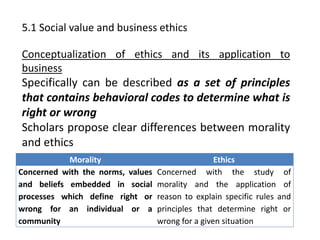
5.1 Social value and business ethics
Conceptualization of ethics and its application to
business
Specifically can be described as a set of principles
that contains behavioral codes to determine what is
right or wrong
Scholars propose clear differences between morality
and ethics
Morality Ethics
Concerned with the norms, values
and beliefs embedded in social
processes which define right or
wrong for an individual or a
community
Concerned with the study of
morality and the application of
reason to explain specific rules and
principles that determine right or
wrong for a given situation
Ethics is also acquired from religious teaching
1. ISLAM
Fundamental principles in Islam which are
iman and taqwa, require every Muslim to
display uprightness, honesty and integrity,
irrespective of the state he/she is in, be it as
an individual, a business person or a figure
or authority and power
2. THE GOLDEN RULE, CHRISTIANITY AND
EMMANUEL KANT’S
If he/she is going to be adversely affected or
harmed by an action taken and the action is
still done onto others, then he/she is being
unjust, therefore, unethical
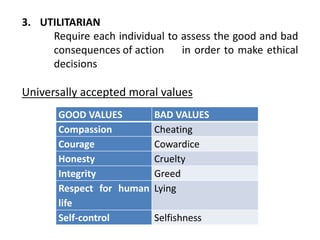
3. UTILITARIAN
Require each individual to assess the good and bad
consequences of action in order to make ethical
decisions
Universally accepted moral values
GOOD VALUES BAD VALUES
Compassion Cheating
Courage Cowardice
Honesty Cruelty
Integrity Greed
Respect for human
life
Lying
Self-control Selfishness
Factors of unethical behaviors in the global business
world
 Business enterprises have to fulfill many
interests
 Society is undergoing dramatic change
Ethical Dilemmas in the Conduct of Business
Four themes of ethical dilemmas faced by those
involved in business:
Personality traits
Conflict of interest
Responsibility to stakeholders
Level of openness
Managing Ethical Dilemmas
1. Is it legal?
Am I violating any laws (inclusive of religious principles) or
company policy?
2. Is it balanced?
Am I acting fairly in my decisions? Am I taking into
consideration the needs of others apart from my own
personal needs?
3. How will the action make me feel about myself?
Will I be happy after taking such actions?
Check questions before acting to ensure that their actions and
decisions are ethical:
Importance of Managing Business Ethically
Business organizations should be managed ethically for
the following reasons:
Keeping existing customers: reputable organizations
will maintain customer loyalty and business
sustainability
Attracting new customers: good business corporate
image will attract new customers and increase
profitability
Avoiding lawsuits: reputable organizations will not
hesitate to comply with laws and regulations to
maintain their good image and dignity
Reducing employee turnover: reputable organizations
will be able to maintain employee loyalty, thus reducing
employee turnover. This will subsequently increase
organizational effectiveness
Pleasing customers, employees and society: good
organizations will strive to fulfill the needs of main
stakeholders. i.e customers, employees and the
community they serve
5.2 Social Responsibility and Sustainable Development
Social responsibility is a broader concept of ethics that
concerns the impact of an organization’s activities on
society
Obligation of a business to maximize its positive impact
and minimize its negative impact on society
Sustainability- as the long-term maintenance of systems
according to environmental, economic and social
considerations
Is a pattern of resources use that aims to meet human
needs while preserving the environment, so that these
needs can be met not only in the present but also for
future generations
Corporate social responsibility- specifically emphasize
the importance of corporations to be socially responsible,
apart from maximizing profits
Advantage: businesses can win trust and respect
from employees, customers and society, and increase
profits in the long-term
Disadvantage: the risk of losing customers and
encouraging the public and government to take legal
action to restrict their activities
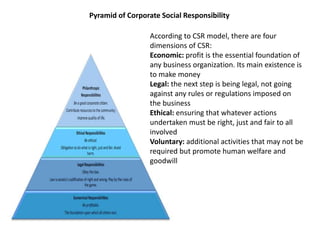
Pyramid of Corporate Social Responsibility
According to CSR model, there are four
dimensions of CSR:
Economic: profit is the essential foundation of
any business organization. Its main existence is
to make money
Legal: the next step is being legal, not going
against any rules or regulations imposed on
the business
Ethical: ensuring that whatever actions
undertaken must be right, just and fair to all
involved
Voluntary: additional activities that may not be
required but promote human welfare and
goodwill

Chapter 5: Social and Ethical Responsibility

  • 1.
    INTRODUCTION TO BUSINESS (MGMT101) Chapter 5: Social and Ethical Responsibility i. Social value and business ethics ii. Social Responsibility and Sustainable Development
  • 2.
    5.1 Social valueand business ethics Conceptualization of ethics and its application to business Specifically can be described as a set of principles that contains behavioral codes to determine what is right or wrong Scholars propose clear differences between morality and ethics Morality Ethics Concerned with the norms, values and beliefs embedded in social processes which define right or wrong for an individual or a community Concerned with the study of morality and the application of reason to explain specific rules and principles that determine right or wrong for a given situation
  • 3.
    Ethics is alsoacquired from religious teaching 1. ISLAM Fundamental principles in Islam which are iman and taqwa, require every Muslim to display uprightness, honesty and integrity, irrespective of the state he/she is in, be it as an individual, a business person or a figure or authority and power 2. THE GOLDEN RULE, CHRISTIANITY AND EMMANUEL KANT’S If he/she is going to be adversely affected or harmed by an action taken and the action is still done onto others, then he/she is being unjust, therefore, unethical
  • 4.
    3. UTILITARIAN Require eachindividual to assess the good and bad consequences of action in order to make ethical decisions Universally accepted moral values GOOD VALUES BAD VALUES Compassion Cheating Courage Cowardice Honesty Cruelty Integrity Greed Respect for human life Lying Self-control Selfishness
  • 5.
    Factors of unethicalbehaviors in the global business world  Business enterprises have to fulfill many interests  Society is undergoing dramatic change Ethical Dilemmas in the Conduct of Business Four themes of ethical dilemmas faced by those involved in business: Personality traits Conflict of interest Responsibility to stakeholders Level of openness
  • 6.
    Managing Ethical Dilemmas 1.Is it legal? Am I violating any laws (inclusive of religious principles) or company policy? 2. Is it balanced? Am I acting fairly in my decisions? Am I taking into consideration the needs of others apart from my own personal needs? 3. How will the action make me feel about myself? Will I be happy after taking such actions? Check questions before acting to ensure that their actions and decisions are ethical:
  • 7.
    Importance of ManagingBusiness Ethically Business organizations should be managed ethically for the following reasons: Keeping existing customers: reputable organizations will maintain customer loyalty and business sustainability Attracting new customers: good business corporate image will attract new customers and increase profitability Avoiding lawsuits: reputable organizations will not hesitate to comply with laws and regulations to maintain their good image and dignity
  • 8.
    Reducing employee turnover:reputable organizations will be able to maintain employee loyalty, thus reducing employee turnover. This will subsequently increase organizational effectiveness Pleasing customers, employees and society: good organizations will strive to fulfill the needs of main stakeholders. i.e customers, employees and the community they serve
  • 9.
    5.2 Social Responsibilityand Sustainable Development Social responsibility is a broader concept of ethics that concerns the impact of an organization’s activities on society Obligation of a business to maximize its positive impact and minimize its negative impact on society Sustainability- as the long-term maintenance of systems according to environmental, economic and social considerations Is a pattern of resources use that aims to meet human needs while preserving the environment, so that these needs can be met not only in the present but also for future generations
  • 10.
    Corporate social responsibility-specifically emphasize the importance of corporations to be socially responsible, apart from maximizing profits Advantage: businesses can win trust and respect from employees, customers and society, and increase profits in the long-term Disadvantage: the risk of losing customers and encouraging the public and government to take legal action to restrict their activities
  • 11.
    Pyramid of CorporateSocial Responsibility According to CSR model, there are four dimensions of CSR: Economic: profit is the essential foundation of any business organization. Its main existence is to make money Legal: the next step is being legal, not going against any rules or regulations imposed on the business Ethical: ensuring that whatever actions undertaken must be right, just and fair to all involved Voluntary: additional activities that may not be required but promote human welfare and goodwill