Scalable DeSecure
ECCPoW Blockchains
Heung-No Lee, GIST, South Korea
Home page: http:/ / infonet.gist.ac.kr
Facebook/ Publication ID: Heung-No Lee
E-mail: heungno@gist.ac.kr
Abstract
GIST Blockchain-Economy Center (BEC, Director Heung-No Lee) aims to
introduce the Decentralized Secure(DeSecure) blockchains it has been
developing since 2018. They aim to resolve the re-centralization problem of
today’s mining market. One of the key ideas is to have the proof-of-work (PoW)
puzzle time-varying from block-to-block, using the error-correction-codes (ECC).
Two new blockchains based on Bitcoin and Ethereum are to be developed
using new consensus algorithm based on this new ECC-PoW. Time-varying
puzzles make it very difficult to develop an ASIC mining chips. As the result,
with the size of network growing, the difficulty level needs not be growing as
well. As such, energy spent for mining can be controlled. The proposed ECC-
PoW mechanism is to be explained in details. In addition, our plan to hardfork
Bitcoin and Ethereum, by replacing the SHA based PoW with the proposed
ECC-PoW, and by developing two new DeSecure blockchains, i.e. BTC-ECC
and ETH-ECC, is discussed. The two DeSecure blockchains will be openly
shared under an open source license at Github. We address how DeSecure
blockchains can be used to resolving the issue of scalability. Our schedule to
release the cores (C++ and Go) and technical meet-ups will be addressed.
Heung-No Lee graduated from University of California, Los Angeles (UCLA), U.S.A.
with Ph.D., M.S., and B.S. degrees all in Electrical Engineering, 1999, 1994 and
1993 respectively. He has written more than 270 journal and conference
publications. In the past, he worked at HRL Laboratory, Malibu, California, U.S.A., as
Research Staff Member and as Assistant Professor at the University of Pittsburgh,
Pittsburgh, Pennsylvania, U.S.A. He is currently a full tenured professor at Gwangju
Institute of Science and Technology (GIST), Republic of Korea.
His research lies in the areas of Information Theory, Signal Processing Theory and
their application to Communications and Networking systems, Biomedical systems,
and Signal Processing systems.
Awards he has received recently include Top 50 R&D Achievements of
Fundamental Research in 2013 (National Research Foundation), Top 100 National
R&D Research Award in 2012 (the Ministry of Science, ICT and Future Planning) and
This Month Scientist/ Engineer Award (National Research Foundation) in January
2014.
He was the Director of Electrical Engineering and Computer Science within GIST
College in 2014. Administrative positions he has held at GIST include the Dean of
Research and the Director of GIST Research Institute.
Short Bio of Dr. Heung-No Lee
Talk today
 DeSecure Blockchains
 Error Correction Codes based PoW
 Fast transaction enabled by novel DSanalysis
 Release Plan
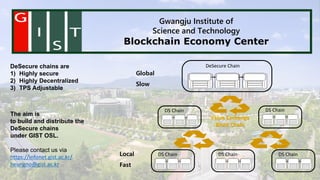
Gwangju Institute of
Science and Technology
Blockchain Economy Center
Value Exchange
Block Chain
DeSecure Chain
Global
Slow
Local
Fast
DS Chain DS Chain
DS Chain DS Chain DS Chain
DeSecure chains are
1) Highly secure
2) Highly Decentralized
3) TPS Adjustable
The aim is
to build and distribute the
DeSecure chains
under GIST OSL.
Please contact us via
https://infonet.gist.ac.kr/
heungno@gist.ac.kr
Bitcoin’s Ideals
 Since birth in 2009, Bitcoin has never stopped breathing and alive currency system.
 It is a global digital currency which works beyond national boundaries.
 It was the time when trust on the banks and governments were severely degraded.
 Ideals around bitcoin are
Decentralization
Reforming Wall street
Unbundling big corporations
Reduction of inequality
7
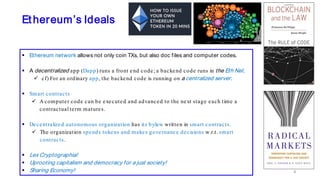
Ethereum’s Ideals
 Ethereum network allows not only coin TXs, but also doc files and computer codes.
 A decentralized app (Dapp) runs a front end code; a backend code runs in the Eth Net.
 cf) For an ordinary app, the backend code is running on a centralized server.
 Smart contracts
 A computer code can be executed and advanced to the next stage each time a
contractual term matures.
 Decentralized autonomous organization has its bylaw written in smart contracts.
 The organization spends tokens and makes governance decisions w.r.t. smart
contracts.
 Lex Cryptographia!
 Uprooting capitalism and democracy for a just society!
 Sharing Economy! 8
Novel DeSecure Blockchains
• BTC and ETH are great BUT they are
• Re-Centralized
• Scalability Issue
• We aim to approach these two issues with DeSecure blockchains
• Anti-ASIC ECC PoW
• Ecosystem of DeSecure blockchains
• DeSecure blockchains uses novel Error-Correction Code PoW.
• We aim to provide two DeSecure blockchains, ETH-ECC and BTC-ECC.
Complaints today
• PoW based blockchains are the most secure;
But they are
• Too slow, not supporting fast transactions
• Spending too much energy in mining
• Re-centralized
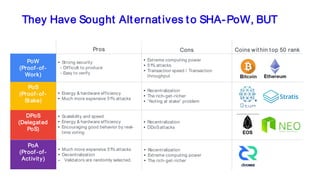
They Have Sought Alternatives to SHA-PoW, BUT
PoW
(Proof-of-
Work)
PoS
(Proof-of-
Stake)
DPoS
(Delegated
PoS)
• Strong security
- Difficult to produce
- Easy to verify
Pros Cons Coins within top 50 rank
• Extreme computing power
• 51% attacks
• Transaction speed / Transaction
throughput
• Energy & hardware efficiency
• Much more expensive 51% attacks
• Recentralization
• The rich-get-richer
• “Noting at stake” problem
• Scalability and speed
• Energy & hardware efficiency
• Encouraging good behavior by real-
time voting
• Recentralization
• DDoSattacks
PoA
(Proof-of-
Activity)
• Much more expensive 51% attacks
• Decentralization
- Validators are randomly selected.
• Recentralization
• Extreme computing power
• The rich-get-richer
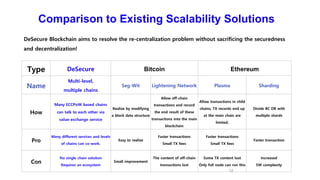
Comparison to Existing Scalability Solutions
12
DeSecure Blockchain aims to resolve the re-centralization problem without sacrificing the securedness
and decentralization!
Type DeSecure Bitcoin Ethereum
Name
Multi-level,
multiple chains
Seg-Wit Lightening Network Plasma Sharding
How
Many ECCPoW based chains
can talk to each other via
value-exchange service
Realize by modifying
a block data structure
Allow off-chain
transactions and record
the end result of these
transactions into the main
blockchain
Allow transactions in child
chains, TX records end up
at the main chain are
limited.
Divide BC DB with
multiple shards
Pro
Many different services and levels
of chains can co-work.
Easy to realize
Faster transactions
Small TX fees
Faster transactions
Small TX fees
Faster transaction
Con
No single chain solution
Requires an ecosystem
Small improvement
The content of off-chain
transactions lost
Some TX content lost
Only full node can run this
Increased
SW complexity
We aim to Replacing SHA-PoW with ECC-PoW!
Three key parts
1. Web server interface networking of peers
 Node registration, get-address, give-address
 Full node or light node
 Communication among the wallets and the miners
2. Wallet for TX generations
 Make private and public keys, address, store UTXOs, make TX, put signature, announce it to
the neighbor, check to see if the TX is supported by the blockchain.
3. Consensus Mechanism
 Data: Genesis block + regular blocks, one block every 10 min, block-size 1Mbyte
 Protocol: consensus, block header, difficulty level adjustment, …
 Mining: Get the longest chain, validate it and all transactions within it, get transactions from
mempool and form a block, run SHA repeatedly until you hit a good hash, put the proof into
the block header, and attach the proofed block to the longest chain, and make announcement
ASAP.
Program Suite
 C++, Python, Go, Java, Flask, http
 Download and run, then you have a blockchain server.
13
Consensus Engine
Blockchain Core Program
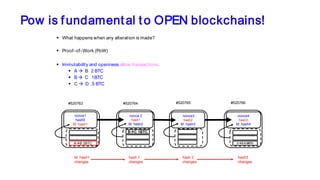
#520763
AB 2BTC
nonce1
hash0
M. hash1
#520764
nonce 2
hash1
M. hash2
#520765
nonce3
hash2
M. hash3
#520766
nonce4
hash3
M. hash4
BC 1BTC
CD 0.5BTC
M. hash1
changes
hash 1
changes
hash 2
changes
hash3
changes
Pow is fundamental to OPEN blockchains!
 What happens when any alteration is made?
 Proof-of-Work (PoW)
 Immutability and openness allow transactions.
 A  B 2 BTC
 B  C 1BTC
 C  D .5 BTC
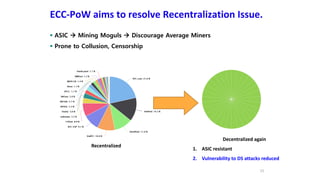
ECC-PoW aims to resolve Recentralization Issue.
15
 ASIC  Mining Moguls  Discourage Average Miners
 Prone to Collusion, Censorship
Recentralized
Decentralized again
1. ASIC resistant
2. Vulnerability to DS attacks reduced
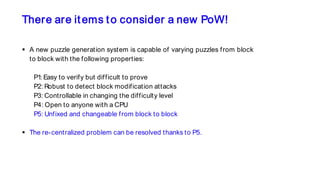
There are items to consider a new PoW!
 A new puzzle generation system is capable of varying puzzles from block
to block with the following properties:
P1: Easy to verify but difficult to prove
P2: Robust to detect block modification attacks
P3: Controllable in changing the difficulty level
P4: Open to anyone with a CPU
P5: Unfixed and changeable from block to block
 The re-centralized problem can be resolved thanks to P5.
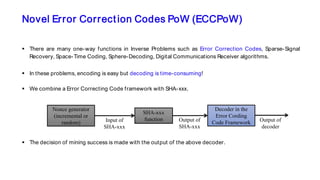
Novel Error Correction Codes PoW (ECCPoW)
 There are many one-way functions in Inverse Problems such as Error Correction Codes, Sparse-Signal
Recovery, Space-Time Coding, Sphere-Decoding, Digital Communications Receiver algorithms.
 In these problems, encoding is easy but decoding is time-consuming!
 We combine a Error Correcting Code framework with SHA-xxx.
 The decision of mining success is made with the output of the above decoder.
Nonce generator
(incremental or
random)
SHA-xxx
functionInput of
SHA-xxx
Output of
SHA-xxx
Decoder in the
Error Cording
Code Framework Output of
decoder
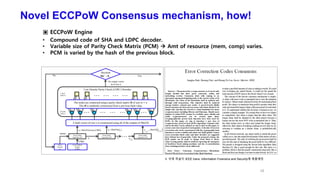
Novel ECCPoW Consensus mechanism, how!
18
▣ ECCPoW Engine
• Compound code of SHA and LDPC decoder.
• Variable size of Parity Check Matrix (PCM)  Amt of resource (mem, comp) varies.
• PCM is varied by the hash of the previous block.
Nonce
Generat
or
Variable
nodes n
Check
nodes m
Low Density Parity Check (LDPC) Decoder
  
 
Secure Hash
Algorithm 256

  

  
 
   
The nodes are connected using a parity check matrix H of size m × n.
This H is randomly constructed from a previous hash value.
Current Block
Header
(CBH)
A hash vector of size n is constructed using all of the outputs of Sha256
Secure Hash
Algorithm 256
Secure Hash
Algorithm 256
( )1:=Sha256 nonce,CBHs ( )2:=Sha256 1s s ( )256
256
1: Sha256 n
n 
  
+ =  
 
s s
nonce
CBH
Decision
No YesT
m=Hn 0
An output vector
n of size n
1s 2s
256
n 
 
s
※ 국제 학술지 IEEE trans. Information Forensics and Security에 제출예정
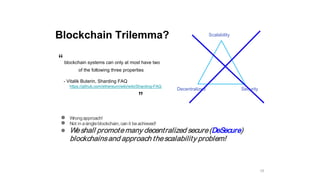
● Wrongapproach!
● Not in asingleblockchain,can it beachieved!
● Weshall promotemany decentralized secure(DeSecure)
blockchainsand approach thescalability problem!
19
Blockchain Trilemma?
“blockchain systems can only at most have two
of the following three properties
- Vitalik Buterin, Sharding FAQ
https://github.com/ethereum/wiki/wiki/Sharding-FAQ
”
Scalability
Decentralized Security
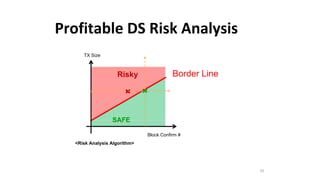
Profitable DS Risk Analysis
20
Block Confirm #
TX Size
<Risk Analysis Algorithm>
Risky
SAFE
Border Line
21
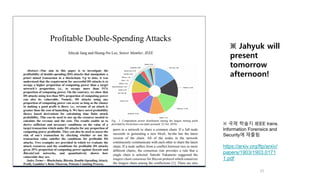
※ 국제 학술지 IEEE trans.
Information Forensics and
Security에 제출됨
https://arxiv.org/ftp/arxiv/
papers/1903/1903.0171
1.pdf
※ Jahyuk will
present
tomorrow
afternoon!
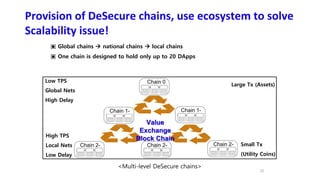
Provision of DeSecure chains, use ecosystem to solve
Scalability issue!
22
▣ Global chains  national chains  local chains
▣ One chain is designed to hold only up to 20 DApps
Chain 0
Chain 2-
3
Value
Exchange
Block Chain
Chain 2-
2
Chain 2-
1
Chain 1-
1
Chain 1-
2
Low TPS
Global Nets
High Delay
High TPS
Local Nets
Low Delay
Large Tx (Assets)
Small Tx
(Utility Coins)
<Multi-level DeSecure chains>
Block code
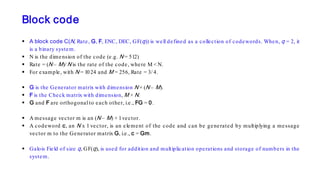
 A block code C(N, Rate, G, F, ENC, DEC, GF(q)) is well defined as a collection of codewords. When, q = 2, it
is a binary system.
 N is the dimension of the code (e.g. N = 512)
 Rate = (N – M)/ N is the rate of the code, where M < N.
 For example, with N = 1024 and M = 256, Rate = 3/ 4.
 G is the Generator matrix with dimension N × (N – M).
 F is the Check matrix with dimension, M × N.
 G and F are orthogonal to each other, i.e., FG = 0.
 A message vector m is an (N – M) × 1vector.
 A codeword c, an N x 1 vector, is an element of the code and can be generated by multiplying a message
vector m to the Generator matrix G, i.e., c = Gm.
 Galois Field of size q, GF(q), is used for addition and multiplication operations and storage of numbers in the
system.
Block code, encoder and decoder
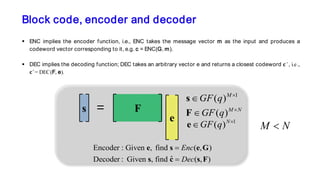
 ENC implies the encoder function, i.e., ENC takes the message vector m as the input and produces a
codeword vector corresponding to it, e.g. c = ENC(G, m).
 DEC implies the decoding function; DEC takes an arbitrary vector e and returns a closest codeword 𝐜𝐜 ̂ , i.e.,
𝐜𝐜 ̂ = DEC(F, e).
1
( )M
GF q ×
∈s
( )M N
GF q ×
∈F
1
( )N
GF q ×
∈e
Encoder : Given , find ( , )
ˆDecoder : Given , find ( , )
Enc
Dec
=
=
e s e G
s c s F
s F
e
=
M N<
Decoder
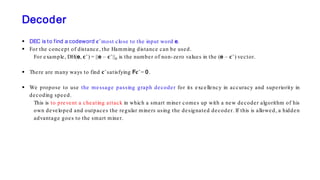
 DEC is to find a codeword 𝐜𝐜 ̂ most close to the input word e.
 For the concept of distance, the Hamming distance can be used.
For example, DH(e, 𝐜𝐜 ̂ ) = ||e – 𝐜𝐜 ̂ ||0 is the number of non-zero values in the (e – 𝐜𝐜 ̂ ) vector.
 There are many ways to find 𝐜𝐜 ̂ satisfying F𝐜𝐜 ̂ = 0.
 We propose to use the message passing graph decoder for its excellency in accuracy and superiority in
decoding speed.
This is to prevent a cheating attack in which a smart miner comes up with a new decoder algorithm of his
own developed and outpaces the regular miners using the designated decoder. If this is allowed, a hidden
advantage goes to the smart miner.
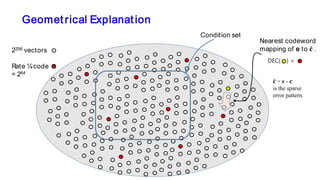
Geometrical Explanation
DEC( ) =
2256 vectors
Rate ¼code
= 264
Condition set
Nearest codeword
mapping of e to ̂𝐜𝐜 .
̂𝐜𝐜 = e - 𝐜𝐜
is the sparse
error pattern.
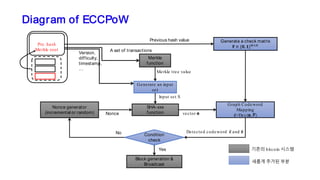
Diagram of ECCPoW
Nonce generator
(incremental or random)
Merkle
function
A set of transactions
SHA-xxx
functionNonce
Version,
difficulty,
timestamp,
…
Condition
check
No
Yes
Block generation &
Broadcast
Previous hash value Generate a check matrix
𝐅𝐅 ∈ {𝟎𝟎, 𝟏𝟏} 𝑀𝑀×𝑁𝑁
Generate an input
set
Input set S
vector e
Graph Codeword
Mapping
̂𝐜𝐜=Dec(e, F)
Detected codeword ̂𝐜𝐜 and �𝐞𝐞
기존의 bitcoin 시스템
새롭게 추가된 부분
Merkle tree value
Pre. hash
Merkle root
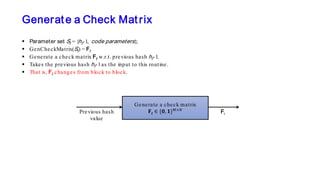
Generate a Check Matrix
 Parameter set St = {ht-1, code parameters};
 GenCheckMatrix(St) = Ft
 Generate a check matrix Ft w.r.t. previous hash ht-1.
 Takes the previous hash ht-1as the input to this routine.
 That is, Ft changes from block to block.
Previous hash
value
Generate a check matrix
𝐅𝐅𝒕𝒕 ∈ {𝟎𝟎, 𝟏𝟏} 𝑀𝑀×𝑁𝑁
Ft
Pseudo Code of the Decoder
 Input:
 Hard decision of a priori LLR:
 Iteration: repeat until converse
 Update variable-to-check node messages for t = 1, 2, …, N and :
 Update check-to-variable node messages for l = 1, 2, …, M and :
 Output
 Hard decision of a posteriori LLR:
[ ]t
aL t= e
2( )
l t t l
t Q l t
L L′→ →
′∈
= ⊕∑
( )1( )
( ) 1t l t l t
al Q t l
L L L j′→ →
′∈
 = ⊕ −
 ∑
1( )l Q t∀ ∈
2( )t Q l∀ ∈
1( )
ˆ[ ]t l t l t
a l Q t
L L L j t′→ →
′∈
 = ⊕
 ∑ c
Implemented code in C
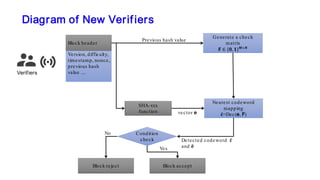
Verifiers
SHA-xxx
function
Condition
check
No
Yes
Block accept
Generate a check
matrix
𝐅𝐅 ∈ {𝟎𝟎, 𝟏𝟏} 𝑴𝑴×𝑵𝑵
vector e
Nearest codeword
mapping
̂𝐜𝐜=Dec(e, F)
Detected codeword ̂𝐜𝐜
and �𝐞𝐞
Block reject
Block header
Version, difficulty,
timestamp, nonce,
previous hash
value ....
Previous hash value
Diagram of New Verifiers
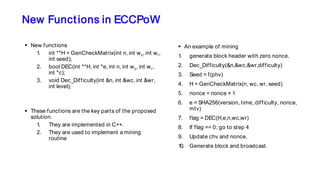
New Functions in ECCPoW
 New functions
1. int **H = GenCheckMatrix(int n, int wc, int wr,
int seed);
2. bool DEC(int **H, int *e, int n, int wc, int wr,
int *c);
3. void Dec_Difficulty(int &n, int &wc, int &wr,
int level);
 These functions are the key parts of the proposed
solution.
1. They are implemented in C++.
2. They are used to implement a mining
routine
 An example of mining
1. generate block header with zero nonce.
2. Dec_Difficulty(&n,&wc,&wr,difficulty)
3. Seed = f(phv)
4. H = GenCheckMatrix(n, wc, wr, seed)
5. nonce = nonce + 1
6. e = SHA256(version, time, difficulty, nonce,
mtv)
7. flag = DEC(H,e,n,wc,wr)
8. If flag == 0; go to step 4
9. Update chv and nonce.
10. Generate block and broadcast.
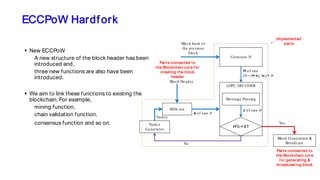
ECCPoW Hardfork
 New ECCPoW
A new structure of the block header has been
introduced and,
three new functions are also have been
introduced.
 We aim to link these functions to existing the
blockchain. For example,
mining function,
chain validation function,
consensus function and so on.
SHA-xxx
LDPC DECODER
Generate H
H of size
(n – n×wc/ wr) × n
Block hash of
the previous
block
HTc = 0?
Message Passing
c of size n
Nonce
Generator
Nonce
Bloch Header
No
Yes
Block Generation &
Broadcast
e of size n
Implemented
parts
Parts connected to
the Blockchain.core for
creating the block
header
Parts connected to
the Blockchain.core
for generating &
broadcasting block
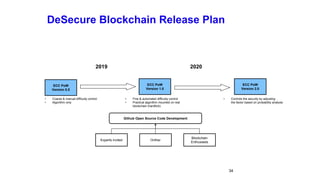
DeSecure Blockchain Release Plan
34
ECC PoW
Version 0.5
• Coarse & manual difficulty control
• Algorithm only
• Fine & automated difficulty control
• Practical algorithm mounted on real
blockchain (hardfork)
Github Open Source Code Development
ECC PoW
Version 1.0
2019
ECC PoW
Version 2.0
• Controls the security by adjusting
the factor based on probability analysis
2020
Experts invited Onther
Blockchain
Enthusiasts
Impact of ECCPoW 1:
It is easier to start a new blockchain network.
 A large blockchain network is stable and not easy to disrupt.
 Today there are mining equipment renting sites.
 A new borne blockchain network needs to grow, but newbies are much more vulnerable to 51% attacks.
 DeSecure blockchain networks with ECCPoW do not suffer from such problems since there are no mining
equipment available for ECCPoW.
Impact of ECCPoW 2:
One can make multiple blockchain networks
 It is easy to make a new blockchain with ECCPoW.
 Suppose hardforking a Bitcoin, and an Ethereum, with ECCPoW.
 Let us call them BTC-ECC and ETH-ECC protocols.
 Make the first blockchain network by running ETH-ECC over a network (Pusan coin)
 Make the second blockchain network by running BTC-ECC over other network (Gwangju coin)
 Make the third blockchain network by running ETH-ECC over another network (Seoul coin)
 Make the fourth blockchain network by running BTH-ECC over yet another network (Korea coin)
 Each cryptocurrency is independent with its own genesis block and random starting seed, and can be
adjusted sufficiently strong for its regional requirement in the sense of scalability, security and
decentralization.
 These blockchains are inter-connected at the local, regional, and national, transnational level.
Impact of ECCPoW 3:
Resolving the Scalability Trilemma
 Trilemma by V. Buterin is well known: Only up to two out of the three virtues such as Scalibility,
Decentralization and Security can be achieved simultaneously.
 With ECC, each blockchain is already very strong in decentralization.
 Each EEC blockchain is flexible enough to fit into various settings of transaction speeds and security levels.
 Campus ECC blockchain networks can be set to work very fast allowing up to 100s of thousands of TXs per
second since the delay of the underlying communications network is very small.
 Regional ECC blockchain networks can be set to work fast, i.e. allowing up to 10s of thousands of TXs per sec.
 National ECC blockchain networks can be set sufficiently fast for covering inter-regional transactions.
 Transnational ECC blockchain networks shall be set to work slow due to large delays.
 All these DeSecure chains started up with its own seed and decentralized levels are mutually independent
and each one can be set to work at the required level of security and speed to serve its purpose.
 These DeSecure chains can be inter-connected via distributed value-exchange networks.
 The connected ECC blockchains can be named the ECC Blockchain International.
 ECC Blockchain International as a whole can serve to resolve the Scalability Trilemma.
Impact of ECCPoW 4:
It is safe to use a time-proven blockchain protocol.
 Bitcoin protocol has withstood the tough test of time.
 Thus, the networking part and the wallet part are robust enough.
 PoW is problem. Yes.
 But it is not the problem of PoW.
 It is the fixedness of the PoW puzzle.
 ECCPoW puzzles can be made to vary over time.
 The problematic consensus part with a fixed PoW can be replaced with the new ECC PoW consensus.
Impact of ECCPoW 5:
The complexity of ECCPoW puzzles can be set to grow very
large; thus the cost for hardware acceleration is boundless.
 ECCPoW is a computer algorithm!
 Thus it is not impossible to find a hardware acceleration solution for it.
 ECCPoW puzzle can be represented as a randomly connected bipartite graph.
 In order to parallelize the algorithm, more memory and computation resource need to be allocated.
 The size of ECCPoW puzzle can grow very large.
 As the size of the puzzle grows, the more needed is the memory and computation resource.
 With ECCPoW puzzles, therefore, one can easily deter the emergence of hardware acceleration solution.
 Deterrence to hardware acceleration offers a blockchain network with small power consumption
requirement.
Development Schedule
● Open research platform
○ Source codes github uploaded
○ Open development
● 2019 plan
○ ECCPoW 0.5 Version
○ Ethereum and Bitcoin Hardforks with ECCPoW 0.5v
○ Develop them into Ethereum ECCPoW 1.0v and Bitcoin ECCPow 1.0v
● 2020 plan
○ Network growth at least by 10,000 nodes worldwide
○ Co-working with Bitcoin and Ethereum communities
Plan to Offer DeSecure
Chains and Meet-Ups
● May 28th, Tuesday, 2019
● Place: Startup Alliance
● 주소: Teheran-Ro 423, 7th floor of
Hyundai Tower, 701Ho, Gangnam-Gu,
Seoul (선릉역 10번 출구와 삼성역 7번
출구 사이)
● 시간: 15:00 ~ 17:00
● Anyone can attend, notify us at 정현준
junghj85@gmail.com appreciated.
Concluding Remarks
 PoW is fundamental for blockchains’ immutability.
• You put PoW to a block, you get the benefit of data immutability.
• Recentralization issue is problem due to fixeness of PoW puzzles, not due to PoW itself.
 Trilemma by V. Buterin is well known. We seek to get two Security and Decentralization.
• Flexible puzzles enabled by ECCPoW can resolve the recentralization problem;
• PoW has shown to be the most secure.
 Scalability is left to the ecosystem of DeSecure blockchains.
• Multiple layers of ECCPoW blockchains can operate simultaneously resolving the issues of scalability and thus breaking the
trilemma.
 ECCPoW blockchains can play a crucial role in ushering in the ideals of blockchains and
advance our society to the next level!
 Thank you!
 Q&A
We are actively looking for programmers to join us.
Send me an e-mail!
Heung-No Lee, GIST, South Korea
Home page: http:/ / infonet.gist.ac.kr
Facebook/ Publication ID: Heung-No Lee
E-mail: heungno@gist.ac.kr

Ethcon seoul 2019 presentation final

  • 1.
    Scalable DeSecure ECCPoW Blockchains Heung-NoLee, GIST, South Korea Home page: http:/ / infonet.gist.ac.kr Facebook/ Publication ID: Heung-No Lee E-mail: heungno@gist.ac.kr
  • 3.
    Abstract GIST Blockchain-Economy Center(BEC, Director Heung-No Lee) aims to introduce the Decentralized Secure(DeSecure) blockchains it has been developing since 2018. They aim to resolve the re-centralization problem of today’s mining market. One of the key ideas is to have the proof-of-work (PoW) puzzle time-varying from block-to-block, using the error-correction-codes (ECC). Two new blockchains based on Bitcoin and Ethereum are to be developed using new consensus algorithm based on this new ECC-PoW. Time-varying puzzles make it very difficult to develop an ASIC mining chips. As the result, with the size of network growing, the difficulty level needs not be growing as well. As such, energy spent for mining can be controlled. The proposed ECC- PoW mechanism is to be explained in details. In addition, our plan to hardfork Bitcoin and Ethereum, by replacing the SHA based PoW with the proposed ECC-PoW, and by developing two new DeSecure blockchains, i.e. BTC-ECC and ETH-ECC, is discussed. The two DeSecure blockchains will be openly shared under an open source license at Github. We address how DeSecure blockchains can be used to resolving the issue of scalability. Our schedule to release the cores (C++ and Go) and technical meet-ups will be addressed.
  • 4.
    Heung-No Lee graduatedfrom University of California, Los Angeles (UCLA), U.S.A. with Ph.D., M.S., and B.S. degrees all in Electrical Engineering, 1999, 1994 and 1993 respectively. He has written more than 270 journal and conference publications. In the past, he worked at HRL Laboratory, Malibu, California, U.S.A., as Research Staff Member and as Assistant Professor at the University of Pittsburgh, Pittsburgh, Pennsylvania, U.S.A. He is currently a full tenured professor at Gwangju Institute of Science and Technology (GIST), Republic of Korea. His research lies in the areas of Information Theory, Signal Processing Theory and their application to Communications and Networking systems, Biomedical systems, and Signal Processing systems. Awards he has received recently include Top 50 R&D Achievements of Fundamental Research in 2013 (National Research Foundation), Top 100 National R&D Research Award in 2012 (the Ministry of Science, ICT and Future Planning) and This Month Scientist/ Engineer Award (National Research Foundation) in January 2014. He was the Director of Electrical Engineering and Computer Science within GIST College in 2014. Administrative positions he has held at GIST include the Dean of Research and the Director of GIST Research Institute. Short Bio of Dr. Heung-No Lee
  • 5.
    Talk today  DeSecureBlockchains  Error Correction Codes based PoW  Fast transaction enabled by novel DSanalysis  Release Plan
  • 6.
    Gwangju Institute of Scienceand Technology Blockchain Economy Center Value Exchange Block Chain DeSecure Chain Global Slow Local Fast DS Chain DS Chain DS Chain DS Chain DS Chain DeSecure chains are 1) Highly secure 2) Highly Decentralized 3) TPS Adjustable The aim is to build and distribute the DeSecure chains under GIST OSL. Please contact us via https://infonet.gist.ac.kr/ heungno@gist.ac.kr
  • 7.
    Bitcoin’s Ideals  Sincebirth in 2009, Bitcoin has never stopped breathing and alive currency system.  It is a global digital currency which works beyond national boundaries.  It was the time when trust on the banks and governments were severely degraded.  Ideals around bitcoin are Decentralization Reforming Wall street Unbundling big corporations Reduction of inequality 7
  • 8.
    Ethereum’s Ideals  Ethereumnetwork allows not only coin TXs, but also doc files and computer codes.  A decentralized app (Dapp) runs a front end code; a backend code runs in the Eth Net.  cf) For an ordinary app, the backend code is running on a centralized server.  Smart contracts  A computer code can be executed and advanced to the next stage each time a contractual term matures.  Decentralized autonomous organization has its bylaw written in smart contracts.  The organization spends tokens and makes governance decisions w.r.t. smart contracts.  Lex Cryptographia!  Uprooting capitalism and democracy for a just society!  Sharing Economy! 8
  • 9.
    Novel DeSecure Blockchains •BTC and ETH are great BUT they are • Re-Centralized • Scalability Issue • We aim to approach these two issues with DeSecure blockchains • Anti-ASIC ECC PoW • Ecosystem of DeSecure blockchains • DeSecure blockchains uses novel Error-Correction Code PoW. • We aim to provide two DeSecure blockchains, ETH-ECC and BTC-ECC.
  • 10.
    Complaints today • PoWbased blockchains are the most secure; But they are • Too slow, not supporting fast transactions • Spending too much energy in mining • Re-centralized
  • 11.
    They Have SoughtAlternatives to SHA-PoW, BUT PoW (Proof-of- Work) PoS (Proof-of- Stake) DPoS (Delegated PoS) • Strong security - Difficult to produce - Easy to verify Pros Cons Coins within top 50 rank • Extreme computing power • 51% attacks • Transaction speed / Transaction throughput • Energy & hardware efficiency • Much more expensive 51% attacks • Recentralization • The rich-get-richer • “Noting at stake” problem • Scalability and speed • Energy & hardware efficiency • Encouraging good behavior by real- time voting • Recentralization • DDoSattacks PoA (Proof-of- Activity) • Much more expensive 51% attacks • Decentralization - Validators are randomly selected. • Recentralization • Extreme computing power • The rich-get-richer
  • 12.
    Comparison to ExistingScalability Solutions 12 DeSecure Blockchain aims to resolve the re-centralization problem without sacrificing the securedness and decentralization! Type DeSecure Bitcoin Ethereum Name Multi-level, multiple chains Seg-Wit Lightening Network Plasma Sharding How Many ECCPoW based chains can talk to each other via value-exchange service Realize by modifying a block data structure Allow off-chain transactions and record the end result of these transactions into the main blockchain Allow transactions in child chains, TX records end up at the main chain are limited. Divide BC DB with multiple shards Pro Many different services and levels of chains can co-work. Easy to realize Faster transactions Small TX fees Faster transactions Small TX fees Faster transaction Con No single chain solution Requires an ecosystem Small improvement The content of off-chain transactions lost Some TX content lost Only full node can run this Increased SW complexity
  • 13.
    We aim toReplacing SHA-PoW with ECC-PoW! Three key parts 1. Web server interface networking of peers  Node registration, get-address, give-address  Full node or light node  Communication among the wallets and the miners 2. Wallet for TX generations  Make private and public keys, address, store UTXOs, make TX, put signature, announce it to the neighbor, check to see if the TX is supported by the blockchain. 3. Consensus Mechanism  Data: Genesis block + regular blocks, one block every 10 min, block-size 1Mbyte  Protocol: consensus, block header, difficulty level adjustment, …  Mining: Get the longest chain, validate it and all transactions within it, get transactions from mempool and form a block, run SHA repeatedly until you hit a good hash, put the proof into the block header, and attach the proofed block to the longest chain, and make announcement ASAP. Program Suite  C++, Python, Go, Java, Flask, http  Download and run, then you have a blockchain server. 13 Consensus Engine Blockchain Core Program
  • 14.
    #520763 AB 2BTC nonce1 hash0 M. hash1 #520764 nonce2 hash1 M. hash2 #520765 nonce3 hash2 M. hash3 #520766 nonce4 hash3 M. hash4 BC 1BTC CD 0.5BTC M. hash1 changes hash 1 changes hash 2 changes hash3 changes Pow is fundamental to OPEN blockchains!  What happens when any alteration is made?  Proof-of-Work (PoW)  Immutability and openness allow transactions.  A  B 2 BTC  B  C 1BTC  C  D .5 BTC
  • 15.
    ECC-PoW aims toresolve Recentralization Issue. 15  ASIC  Mining Moguls  Discourage Average Miners  Prone to Collusion, Censorship Recentralized Decentralized again 1. ASIC resistant 2. Vulnerability to DS attacks reduced
  • 16.
    There are itemsto consider a new PoW!  A new puzzle generation system is capable of varying puzzles from block to block with the following properties: P1: Easy to verify but difficult to prove P2: Robust to detect block modification attacks P3: Controllable in changing the difficulty level P4: Open to anyone with a CPU P5: Unfixed and changeable from block to block  The re-centralized problem can be resolved thanks to P5.
  • 17.
    Novel Error CorrectionCodes PoW (ECCPoW)  There are many one-way functions in Inverse Problems such as Error Correction Codes, Sparse-Signal Recovery, Space-Time Coding, Sphere-Decoding, Digital Communications Receiver algorithms.  In these problems, encoding is easy but decoding is time-consuming!  We combine a Error Correcting Code framework with SHA-xxx.  The decision of mining success is made with the output of the above decoder. Nonce generator (incremental or random) SHA-xxx functionInput of SHA-xxx Output of SHA-xxx Decoder in the Error Cording Code Framework Output of decoder
  • 18.
    Novel ECCPoW Consensusmechanism, how! 18 ▣ ECCPoW Engine • Compound code of SHA and LDPC decoder. • Variable size of Parity Check Matrix (PCM)  Amt of resource (mem, comp) varies. • PCM is varied by the hash of the previous block. Nonce Generat or Variable nodes n Check nodes m Low Density Parity Check (LDPC) Decoder      Secure Hash Algorithm 256               The nodes are connected using a parity check matrix H of size m × n. This H is randomly constructed from a previous hash value. Current Block Header (CBH) A hash vector of size n is constructed using all of the outputs of Sha256 Secure Hash Algorithm 256 Secure Hash Algorithm 256 ( )1:=Sha256 nonce,CBHs ( )2:=Sha256 1s s ( )256 256 1: Sha256 n n     + =     s s nonce CBH Decision No YesT m=Hn 0 An output vector n of size n 1s 2s 256 n    s ※ 국제 학술지 IEEE trans. Information Forensics and Security에 제출예정
  • 19.
    ● Wrongapproach! ● Notin asingleblockchain,can it beachieved! ● Weshall promotemany decentralized secure(DeSecure) blockchainsand approach thescalability problem! 19 Blockchain Trilemma? “blockchain systems can only at most have two of the following three properties - Vitalik Buterin, Sharding FAQ https://github.com/ethereum/wiki/wiki/Sharding-FAQ ” Scalability Decentralized Security
  • 20.
    Profitable DS RiskAnalysis 20 Block Confirm # TX Size <Risk Analysis Algorithm> Risky SAFE Border Line
  • 21.
    21 ※ 국제 학술지IEEE trans. Information Forensics and Security에 제출됨 https://arxiv.org/ftp/arxiv/ papers/1903/1903.0171 1.pdf ※ Jahyuk will present tomorrow afternoon!
  • 22.
    Provision of DeSecurechains, use ecosystem to solve Scalability issue! 22 ▣ Global chains  national chains  local chains ▣ One chain is designed to hold only up to 20 DApps Chain 0 Chain 2- 3 Value Exchange Block Chain Chain 2- 2 Chain 2- 1 Chain 1- 1 Chain 1- 2 Low TPS Global Nets High Delay High TPS Local Nets Low Delay Large Tx (Assets) Small Tx (Utility Coins) <Multi-level DeSecure chains>
  • 23.
    Block code  Ablock code C(N, Rate, G, F, ENC, DEC, GF(q)) is well defined as a collection of codewords. When, q = 2, it is a binary system.  N is the dimension of the code (e.g. N = 512)  Rate = (N – M)/ N is the rate of the code, where M < N.  For example, with N = 1024 and M = 256, Rate = 3/ 4.  G is the Generator matrix with dimension N × (N – M).  F is the Check matrix with dimension, M × N.  G and F are orthogonal to each other, i.e., FG = 0.  A message vector m is an (N – M) × 1vector.  A codeword c, an N x 1 vector, is an element of the code and can be generated by multiplying a message vector m to the Generator matrix G, i.e., c = Gm.  Galois Field of size q, GF(q), is used for addition and multiplication operations and storage of numbers in the system.
  • 24.
    Block code, encoderand decoder  ENC implies the encoder function, i.e., ENC takes the message vector m as the input and produces a codeword vector corresponding to it, e.g. c = ENC(G, m).  DEC implies the decoding function; DEC takes an arbitrary vector e and returns a closest codeword 𝐜𝐜 ̂ , i.e., 𝐜𝐜 ̂ = DEC(F, e). 1 ( )M GF q × ∈s ( )M N GF q × ∈F 1 ( )N GF q × ∈e Encoder : Given , find ( , ) ˆDecoder : Given , find ( , ) Enc Dec = = e s e G s c s F s F e = M N<
  • 25.
    Decoder  DEC isto find a codeword 𝐜𝐜 ̂ most close to the input word e.  For the concept of distance, the Hamming distance can be used. For example, DH(e, 𝐜𝐜 ̂ ) = ||e – 𝐜𝐜 ̂ ||0 is the number of non-zero values in the (e – 𝐜𝐜 ̂ ) vector.  There are many ways to find 𝐜𝐜 ̂ satisfying F𝐜𝐜 ̂ = 0.  We propose to use the message passing graph decoder for its excellency in accuracy and superiority in decoding speed. This is to prevent a cheating attack in which a smart miner comes up with a new decoder algorithm of his own developed and outpaces the regular miners using the designated decoder. If this is allowed, a hidden advantage goes to the smart miner.
  • 26.
    Geometrical Explanation DEC( )= 2256 vectors Rate ¼code = 264 Condition set Nearest codeword mapping of e to ̂𝐜𝐜 . ̂𝐜𝐜 = e - 𝐜𝐜 is the sparse error pattern.
  • 27.
    Diagram of ECCPoW Noncegenerator (incremental or random) Merkle function A set of transactions SHA-xxx functionNonce Version, difficulty, timestamp, … Condition check No Yes Block generation & Broadcast Previous hash value Generate a check matrix 𝐅𝐅 ∈ {𝟎𝟎, 𝟏𝟏} 𝑀𝑀×𝑁𝑁 Generate an input set Input set S vector e Graph Codeword Mapping ̂𝐜𝐜=Dec(e, F) Detected codeword ̂𝐜𝐜 and �𝐞𝐞 기존의 bitcoin 시스템 새롭게 추가된 부분 Merkle tree value Pre. hash Merkle root
  • 28.
    Generate a CheckMatrix  Parameter set St = {ht-1, code parameters};  GenCheckMatrix(St) = Ft  Generate a check matrix Ft w.r.t. previous hash ht-1.  Takes the previous hash ht-1as the input to this routine.  That is, Ft changes from block to block. Previous hash value Generate a check matrix 𝐅𝐅𝒕𝒕 ∈ {𝟎𝟎, 𝟏𝟏} 𝑀𝑀×𝑁𝑁 Ft
  • 29.
    Pseudo Code ofthe Decoder  Input:  Hard decision of a priori LLR:  Iteration: repeat until converse  Update variable-to-check node messages for t = 1, 2, …, N and :  Update check-to-variable node messages for l = 1, 2, …, M and :  Output  Hard decision of a posteriori LLR: [ ]t aL t= e 2( ) l t t l t Q l t L L′→ → ′∈ = ⊕∑ ( )1( ) ( ) 1t l t l t al Q t l L L L j′→ → ′∈  = ⊕ −  ∑ 1( )l Q t∀ ∈ 2( )t Q l∀ ∈ 1( ) ˆ[ ]t l t l t a l Q t L L L j t′→ → ′∈  = ⊕  ∑ c
  • 30.
  • 31.
    Verifiers SHA-xxx function Condition check No Yes Block accept Generate acheck matrix 𝐅𝐅 ∈ {𝟎𝟎, 𝟏𝟏} 𝑴𝑴×𝑵𝑵 vector e Nearest codeword mapping ̂𝐜𝐜=Dec(e, F) Detected codeword ̂𝐜𝐜 and �𝐞𝐞 Block reject Block header Version, difficulty, timestamp, nonce, previous hash value .... Previous hash value Diagram of New Verifiers
  • 32.
    New Functions inECCPoW  New functions 1. int **H = GenCheckMatrix(int n, int wc, int wr, int seed); 2. bool DEC(int **H, int *e, int n, int wc, int wr, int *c); 3. void Dec_Difficulty(int &n, int &wc, int &wr, int level);  These functions are the key parts of the proposed solution. 1. They are implemented in C++. 2. They are used to implement a mining routine  An example of mining 1. generate block header with zero nonce. 2. Dec_Difficulty(&n,&wc,&wr,difficulty) 3. Seed = f(phv) 4. H = GenCheckMatrix(n, wc, wr, seed) 5. nonce = nonce + 1 6. e = SHA256(version, time, difficulty, nonce, mtv) 7. flag = DEC(H,e,n,wc,wr) 8. If flag == 0; go to step 4 9. Update chv and nonce. 10. Generate block and broadcast.
  • 33.
    ECCPoW Hardfork  NewECCPoW A new structure of the block header has been introduced and, three new functions are also have been introduced.  We aim to link these functions to existing the blockchain. For example, mining function, chain validation function, consensus function and so on. SHA-xxx LDPC DECODER Generate H H of size (n – n×wc/ wr) × n Block hash of the previous block HTc = 0? Message Passing c of size n Nonce Generator Nonce Bloch Header No Yes Block Generation & Broadcast e of size n Implemented parts Parts connected to the Blockchain.core for creating the block header Parts connected to the Blockchain.core for generating & broadcasting block
  • 34.
    DeSecure Blockchain ReleasePlan 34 ECC PoW Version 0.5 • Coarse & manual difficulty control • Algorithm only • Fine & automated difficulty control • Practical algorithm mounted on real blockchain (hardfork) Github Open Source Code Development ECC PoW Version 1.0 2019 ECC PoW Version 2.0 • Controls the security by adjusting the factor based on probability analysis 2020 Experts invited Onther Blockchain Enthusiasts
  • 35.
    Impact of ECCPoW1: It is easier to start a new blockchain network.  A large blockchain network is stable and not easy to disrupt.  Today there are mining equipment renting sites.  A new borne blockchain network needs to grow, but newbies are much more vulnerable to 51% attacks.  DeSecure blockchain networks with ECCPoW do not suffer from such problems since there are no mining equipment available for ECCPoW.
  • 36.
    Impact of ECCPoW2: One can make multiple blockchain networks  It is easy to make a new blockchain with ECCPoW.  Suppose hardforking a Bitcoin, and an Ethereum, with ECCPoW.  Let us call them BTC-ECC and ETH-ECC protocols.  Make the first blockchain network by running ETH-ECC over a network (Pusan coin)  Make the second blockchain network by running BTC-ECC over other network (Gwangju coin)  Make the third blockchain network by running ETH-ECC over another network (Seoul coin)  Make the fourth blockchain network by running BTH-ECC over yet another network (Korea coin)  Each cryptocurrency is independent with its own genesis block and random starting seed, and can be adjusted sufficiently strong for its regional requirement in the sense of scalability, security and decentralization.  These blockchains are inter-connected at the local, regional, and national, transnational level.
  • 37.
    Impact of ECCPoW3: Resolving the Scalability Trilemma  Trilemma by V. Buterin is well known: Only up to two out of the three virtues such as Scalibility, Decentralization and Security can be achieved simultaneously.  With ECC, each blockchain is already very strong in decentralization.  Each EEC blockchain is flexible enough to fit into various settings of transaction speeds and security levels.  Campus ECC blockchain networks can be set to work very fast allowing up to 100s of thousands of TXs per second since the delay of the underlying communications network is very small.  Regional ECC blockchain networks can be set to work fast, i.e. allowing up to 10s of thousands of TXs per sec.  National ECC blockchain networks can be set sufficiently fast for covering inter-regional transactions.  Transnational ECC blockchain networks shall be set to work slow due to large delays.  All these DeSecure chains started up with its own seed and decentralized levels are mutually independent and each one can be set to work at the required level of security and speed to serve its purpose.  These DeSecure chains can be inter-connected via distributed value-exchange networks.  The connected ECC blockchains can be named the ECC Blockchain International.  ECC Blockchain International as a whole can serve to resolve the Scalability Trilemma.
  • 38.
    Impact of ECCPoW4: It is safe to use a time-proven blockchain protocol.  Bitcoin protocol has withstood the tough test of time.  Thus, the networking part and the wallet part are robust enough.  PoW is problem. Yes.  But it is not the problem of PoW.  It is the fixedness of the PoW puzzle.  ECCPoW puzzles can be made to vary over time.  The problematic consensus part with a fixed PoW can be replaced with the new ECC PoW consensus.
  • 39.
    Impact of ECCPoW5: The complexity of ECCPoW puzzles can be set to grow very large; thus the cost for hardware acceleration is boundless.  ECCPoW is a computer algorithm!  Thus it is not impossible to find a hardware acceleration solution for it.  ECCPoW puzzle can be represented as a randomly connected bipartite graph.  In order to parallelize the algorithm, more memory and computation resource need to be allocated.  The size of ECCPoW puzzle can grow very large.  As the size of the puzzle grows, the more needed is the memory and computation resource.  With ECCPoW puzzles, therefore, one can easily deter the emergence of hardware acceleration solution.  Deterrence to hardware acceleration offers a blockchain network with small power consumption requirement.
  • 40.
    Development Schedule ● Openresearch platform ○ Source codes github uploaded ○ Open development ● 2019 plan ○ ECCPoW 0.5 Version ○ Ethereum and Bitcoin Hardforks with ECCPoW 0.5v ○ Develop them into Ethereum ECCPoW 1.0v and Bitcoin ECCPow 1.0v ● 2020 plan ○ Network growth at least by 10,000 nodes worldwide ○ Co-working with Bitcoin and Ethereum communities
  • 41.
    Plan to OfferDeSecure Chains and Meet-Ups ● May 28th, Tuesday, 2019 ● Place: Startup Alliance ● 주소: Teheran-Ro 423, 7th floor of Hyundai Tower, 701Ho, Gangnam-Gu, Seoul (선릉역 10번 출구와 삼성역 7번 출구 사이) ● 시간: 15:00 ~ 17:00 ● Anyone can attend, notify us at 정현준 junghj85@gmail.com appreciated.
  • 42.
    Concluding Remarks  PoWis fundamental for blockchains’ immutability. • You put PoW to a block, you get the benefit of data immutability. • Recentralization issue is problem due to fixeness of PoW puzzles, not due to PoW itself.  Trilemma by V. Buterin is well known. We seek to get two Security and Decentralization. • Flexible puzzles enabled by ECCPoW can resolve the recentralization problem; • PoW has shown to be the most secure.  Scalability is left to the ecosystem of DeSecure blockchains. • Multiple layers of ECCPoW blockchains can operate simultaneously resolving the issues of scalability and thus breaking the trilemma.  ECCPoW blockchains can play a crucial role in ushering in the ideals of blockchains and advance our society to the next level!
  • 43.
     Thank you! Q&A We are actively looking for programmers to join us. Send me an e-mail! Heung-No Lee, GIST, South Korea Home page: http:/ / infonet.gist.ac.kr Facebook/ Publication ID: Heung-No Lee E-mail: heungno@gist.ac.kr